


Introduction
Although considerable progress has been made to promote gender equality and empower women in various economic activities, the debate about the effects of gender diversity on firm productivity is still highly contested. One stream of the debate relies on the explanations of the knowledge-based and decision-making perspectives to suggest that a more diverse workforce enhances firm productivity because of the effects of multiple perspectives on firm decision-making (Darmadi, Reference Darmadi2013; Mannix & Neale, Reference Mannix and Neale2005; Nguyen, Locke, & Reddy, Reference Nguyen, Locke and Reddy2015; Noland, Moran, & Kotschwar, Reference Noland, Moran and Kotschwar2016; Post & Byron, Reference Post and Byron2015; Solakoglu & Demir, Reference Solakoglu and Demir2016; Terjesen, Couto, & Francisco, Reference Terjesen, Couto and Francisco2016). Another stream of the debate focused on the social identity theory (SIT) as well as the similarity/attraction and homosociality perspectives to suggest a negative association through the inter-group conflict explanations offered by Dezso, Ross, and Uribe (Reference Dezso, Ross and Uribe2016); Coffman (Reference Coffman2014); Chapple and Humphrey (Reference Chapple and Humphrey2014); Richard, Murthi, and Ismail (Reference Richard, Murthi and Ismail2007).
Other studies have attempted to explore various competing explanations including possible nonlinear effects (Ali, Kulik, & Metz, Reference Ali, Kulik and Metz2011; Bae & Skaggs, Reference Bae and Skaggs2019; Richard, Kochan, & McMillan-Capehart, Reference Richard, Kochan and McMillan-Capehart2002) and even the role of context (Hoobler, Masterson, Nkomo, & Michel, Reference Hoobler, Masterson, Nkomo and Michel2016; Joshi & Roh, Reference Joshi and Roh2009; Post & Byron, Reference Post and Byron2015; Richard, Murthi, & Ismail, Reference Richard, Murthi and Ismail2007). Particularly for the studies exploring the context, the moderating effects of environment, industry and supportive culture have been investigated. Few studies have used cross-country data to show the results of spatial contexts (Dezsö & Ross, Reference Dezsö and Ross2012; Marinova, Plantenga, & Remery, Reference Marinova, Plantenga and Remery2016; Terjesen, Couto, & Francisco, Reference Terjesen, Couto and Francisco2016; Zhang, Reference Zhang2020).
In this paper, we seek to provide evidence for Sub-Saharan Africa (SSA) by exploring structural differences in subsectors within the manufacturing sector. The main motivation for the paper is twofold. First, the paper is motivated by the changing dynamics in manufacturing activities. Recent evidence suggests that the transformation of manufacturing can be linked to factors such as talent, skillset and innovation (Giffi, Huelsman, Drew-Rodriguez, & McClelland, Reference Giffi, Huelsman, Drew-Rodriguez and McClelland2017). This dynamic implies that there is an opportunity for a more gender-diverse workforce to be employed by manufacturing firms, and there is a vast pool of talents in women that can be a critical resource for manufacturing transformation (Giffi et al., Reference Giffi, Huelsman, Drew-Rodriguez and McClelland2017). There has been a steady progress of women in terms of educational qualification, career and professional and managerial positions, and there is interest in how this relates to manufacturing productivity in Africa (Giffi et al., Reference Giffi, Huelsman, Drew-Rodriguez and McClelland2017). Second, the paper is motivated by the evolution of gender diversity in Africa, following the implementation of various affirmative action bills after decades of systematic exclusion at the workplace. Historically, women in Africa were heavily underrepresented at the workplace, even though they constitute a greater proportion of the population. UNIDO (2016) notes that women constitute less than 40% of the manufacturing workforce in Africa. This trend appears to be changing, as the continent continues to record increasing shares in women's labour force participation (Moodley et al., Reference Moodley, Kuyoro, Holt, Leke, Madgavkar, Krishnan and Akintayo2019). Unpaid family work, which used to be dominated by women, continues to witness a decline in the share of women's involvement (Moodley et al., Reference Moodley, Kuyoro, Holt, Leke, Madgavkar, Krishnan and Akintayo2019). Recent data also show that Africa has the highest share of female representation on company boards (Moodley et al., Reference Moodley, Kuyoro, Holt, Leke, Madgavkar, Krishnan and Akintayo2019). It is important to indicate, however, that the observed progress is not evenly distributed, as some countries still have a substantial proportion of women out of the labour force (Moodley et al., Reference Moodley, Kuyoro, Holt, Leke, Madgavkar, Krishnan and Akintayo2019).
The overall trends, nonetheless, reflect positively for Africa given the view that accelerating the progress that has been made towards increasing gender diversity could boost African economies by the equivalent of 10% of collective GDP by 2025 (Moodley et al., Reference Moodley, Kuyoro, Holt, Leke, Madgavkar, Krishnan and Akintayo2019). A variety of programmes have thus been implemented to enhance women's empowerment on the continent including the various initiatives that have sought to increase the share of women in Science, Technology, Engineering and Mathematics (Moodley et al., Reference Moodley, Kuyoro, Holt, Leke, Madgavkar, Krishnan and Akintayo2019). Despite all these developments, not much evidence exists to show the extent to which the progress being made is enhancing various economic indicators including firm productivity or what may constitute the best approach to empowering women. A revisit of predictions on the link between gender diversity and productivity is critical in reinforcing the various actions supporting women's empowerment.
This paper, therefore, revisits the issue of the link between gender diversity and firm productivity, with a focus on African manufacturing firms. We argue that with the growing importance of factors such as skillset, talents and innovation within manufacturing, women who used to be underrepresented will play a significant role in enhancing manufacturing productivity. One of the questions that we seek to answer is to find out in which of the manufacturing subsectors are these relationships more pronounced.
In carrying out our estimations, we explored possible heterogeneity in the relation by relying on firms that fall under what has come to be known as the Industry without Smokestacks (IWOSS) concept that has been popularized by Newfarmer, Page, and Tarp (Reference Newfarmer, Page and Tarp2018). IWOSS are viewed as an alternative source of structural transformation in Africa, following the continent's several years of manufacturing deindustrialization. According to Newfarmer, Page, and Tarp (Reference Newfarmer, Page and Tarp2018), IWOSS have some characteristics that make them useful for structural transformation in Africa and this includes high tradability, high productivity (relative to other economy-wide productivity levels), capacity to incorporate technological change and the evidence of scale/agglomeration economies. Some of the manufacturing subsectors described as IWOSS include agro-processing and horticulture, telecommunication and ICT-based products and business/trade services. Although existing data do not seem to capture its full range of activities, the evidence seems to suggest that these sectors are becoming important for transformation (Coulibaly & Page, Reference Coulibaly and Page2021).
Our study makes use of data from the World Bank Enterprise and Innovation Follow-up Surveys for six SSA economies for our estimations: Ghana, the Democratic Republic of Congo, Tanzania, Uganda, Zambia and Kenya. These are the only African countries with data in the World Bank Enterprise Surveys that was found to be useful in exploring the link between gender diversity and firm productivity. While the main Enterprise Survey contains general information about firms, the Innovation Follow-up surveys contain questions on innovations that are similar to the Organisation for Economic Co-operation and Development (OECD) technological innovation measures.
Following our analysis, we find evidence of a nonlinear relationship between gender diversity and productivity. Specifically, we find that an increase in the proportion of female-owned firms, as well as the proportion of full-time female employees, is initially associated with increases in firm productivity, but subsequently, some displacement effects are realized. In further exploring whether the heterogeneity in manufacturing according to the IWOSS concept matter for the diversity–productivity link, we find that its interaction with the proportion of full-time female employees is negative. This finding suggests that firms in non-IWOSS sectors seem to account for the positive association between gender diversity and firm productivity. These firms in non-IWOSS sectors are those engaged in traditional manufacturing activities.
Our main contribution to the literature stems from the finding that an exploration of heterogeneity in manufacturing activities reveals a more nuanced relationship between gender diversity and productivity. The implication for public policy is that a one-size-fits-all approach cannot continue to underscore gender-related interventions. Policies must be sector-specific and seek to provide a more relevant role for women in manufacturing.
The rest of the paper is structured as follows: the second section provides a conceptual background of the paper, while the third and fourth sections provide the method used for the estimation as well as discuss the main results, respectively. The last section provides some concluding remarks.
Conceptual background and hypothesis development
Conceptually, there are three main views about the nature of the relationship between gender diversity and firm productivity: namely, positive, negative and curvilinear. The first predicts a positive association between the two variables. The main explanation in support of this prediction is based on the ‘knowledge-based research’ and ‘decision-making theory’ which postulates that knowledge (or how to relate knowledge to the decision-making processes of a firm) is the primary problem facing firms (Mannix & Neale, Reference Mannix and Neale2005; Watson, Kumar, & Michaelsen, Reference Watson, Kumar and Michaelsen1993). In responding to how this problem can be addressed, proponents of the theory postulated that diversity in knowledge actors introduces multiple perspectives and discourages the situation where only one particular knowledge dominates firm decision-making. Several channels for knowledge dissemination have been explored by this literature, and this includes socialization, interpersonal communications and collaboration in the form of pooling of group resources, which leads to success in decision-making (Nguyen, Locke, & Reddy, Reference Nguyen, Locke and Reddy2015; Noland, Moran, & Kotschwar, Reference Noland, Moran and Kotschwar2016; Post & Byron, Reference Post and Byron2015; Terjesen, Couto, & Francisco, Reference Terjesen, Couto and Francisco2016).
A corresponding explanation for the positive association between gender diversity and firm productivity is found in the resource-based view of a firm. In this view, it is suggested that intangible and socially complex resources, such as employee competence and experience, are the critical resources needed to sustain a firm's competitive advantage, relative to tangible resources such as the scale of operation (Barney, Reference Barney2001). McMahan, Bell, and Virick (Reference McMahan, Bell and Virick1998) have argued that intangible and socially complex resources, derived from gender diversity, in the form of market insight, creativity and innovation, and improved problem-solving, are critical in boosting firm productivity.
Another explanation for the positive relationship can be found in the upper-echelons theory about top management teams (TMT) (Finkelstein & Hambrick, Reference Finkelstein and Hambrick1996). This perspective applies mostly to females as managers/owners. The argument here is that a more diverse TMT can enhance the breadth of perspectives, cognitive resources and the overall problem-solving capacity of the team (Bantel & Jackson, Reference Bantel and Jackson1989; Hambrick, Cho, & Chen, Reference Hambrick, Cho and Chen1996; Smith, Smith, Olian, Sims, O'Brannon, & Scully, Reference Smith, Smith, Olian, Sims, O'Brannon and Scully1994).
Empirically, numerous studies have confirmed this positive link. For instance, Terjesen, Couto, and Francisco (Reference Terjesen, Couto and Francisco2016) in an assessment involving 3,876 public firms across 47 countries find that the presence of female directors is associated with high firm performance. Using a global sample of 21,980 firms across 91 countries, Noland, Moran, and Kotschwar (Reference Noland, Moran and Kotschwar2016) also find that the presence of women in corporate leadership positions improves firm performance. They attributed this finding to skill diversity and suggested that policies that facilitated women rising through the corporate ranks are important. Similar findings were reported by Post and Byron (Reference Post and Byron2015), Nguyen, Locke, and Reddy (Reference Nguyen, Locke and Reddy2015) and Darmadi (Reference Darmadi2013) specifically for women in management roles (boardroom). Zhang (Reference Zhang2020) used a longitudinal sample of 1,069 public firms in 35 countries to show that the more gender diversity is normatively accepted, the more it benefits a firm's market valuation and revenue. Other studies have found that firms with gender-diverse workforces innovate better and thus achieve higher output and better returns (Ali, Kulik, & Metz, Reference Ali, Kulik and Metz2011; Herring, Reference Herring2009; Richard, Barnett, Dwyer, & Chadwick, Reference Richard, Barnett, Dwyer and Chadwick2004; Yang & Konrad, Reference Yang and Konrad2011).
A second view of the gender diversity–productivity link is the direct opposite to the view discussed above. In this perspective, gender diversity hurts firm productivity by lowering group commitment, organizational cohesion and increasing inter-group conflict. The explanation for this latter prediction is based on a combination of the social categorization theory (Tajfel, Reference Tajfel1981), SIT (Turner, Hogg, Oakes, Reicher, & Wetherell, Reference Turner, Hogg, Oakes, Reicher and Wetherell1987) and the similarity-attraction paradigm (Byrne, Reference Byrne1971; Ibarra, Reference Ibarra1992). The main thrust of the argument in this literature is that, in gender-diverse groups, individuals are more likely to make favourable associations with in-group members, rather than with out-group members. The resulting polarization can lead to conflict and stereotyping and hinder group solidarity and cooperation, thus reducing workplace efficiency and productivity (Chapple & Humphrey, Reference Chapple and Humphrey2014; Coffman, Reference Coffman2014; Dezso, Ross, & Uribe, Reference Dezso, Ross and Uribe2016; DiTomaso, Post, & Parks-Yancy, Reference DiTomaso, Post and Parks-Yancy2007; Holgersson, Reference Holgersson2013; Van Knippenberg & Schippers, Reference Van Knippenberg and Schippers2007; Wellalage & Locke, Reference Wellalage and Locke2012; Williams & O'Reilly, Reference Williams and O'Reilly1998). In relating gender diversity to the upper-echelons theory about TMT, Ancona and Caldwell (Reference Ancona and Caldwell1992) and Murray (Reference Murray1989) suggest that a more diverse TMT can be costly to coordinate and control relative to a more homogenous team and that these added costs may impede performance.
Consistent with these views, Richard, Murthi, and Ismail (Reference Richard, Murthi and Ismail2007) and Ely and Thomas (Reference Ely and Thomas2001) have shown that as gender diversity increases, the tendency is towards social comparison and categorization, with a rise in in-group/out-group formation as well as cognitive bias. Studies such as Matsa and Miller (Reference Matsa and Miller2013); Ahern and Dittmar (Reference Ahern and Dittmar2012); and Richard et al. (Reference Richard, Barnett, Dwyer and Chadwick2004) also find evidence to suggest that gender diversity hampers productivity and reduces efficiency.
Beyond the assumption of linearity, other studies have emphasized that the gender diversity–productivity link is curvilinear, i.e., the existence of both the knowledge-based and resource-based theories as well as the social identity theories at various levels of gender diversity (Richard, Kochan, & McMillan-Capehart, Reference Richard, Kochan and McMillan-Capehart2002, Reference Richard, Murthi and Ismail2007; Van Knippenberg, De Dreu, & Homan, Reference Van Knippenberg, De Dreu and Homan2004). In other words, different ranges of gender diversity are associated with different dynamics that can be explained by one or the other theory. This becomes the third and final view. Van Knippenberg, De Dreu, and Homan (Reference Van Knippenberg, De Dreu and Homan2004), more explicitly, discussed this view within the categorization-elaboration model (CEM), where the role of information processing systems is explored in the diversity–performance link. The CEM incorporates the view that information/decision-making and social categorization processes interact such that intergroup biases flowing from social categorization disrupt the elaboration (in-depth processing) of task-relevant information and perspectives, thus producing the offsetting relationships. Ali, Kulik, and Metz (Reference Ali, Kulik and Metz2011) also explored this relation and suggested that at low to moderate levels of gender diversity, the group dynamics predicted by the knowledge-based and resource-based view of the firm are stronger than those predicted by self-categorization and social identity theories. At moderate to high levels of gender diversity, the group dynamics predicted by self-categorization and social identity theories are stronger than those predicted by the resource-based view of the firm. Further support for the curvilinear hypothesis can be found in Bae and Skaggs (Reference Bae and Skaggs2019); Schneid, Isidor, Li, and Kabst (Reference Schneid, Isidor, Li and Kabst2015); Ali, Kulik, and Metz (Reference Ali, Kulik and Metz2011); Richard, Murthi, and Ismail (Reference Richard, Murthi and Ismail2007); Palmer (Reference Palmer2006); Richard et al. (Reference Richard, Barnett, Dwyer and Chadwick2004); Earley and Mosakowski (Reference Earley and Mosakowski2000); Knouse and Dansby (Reference Knouse and Dansby1999); Alexander, Nuchols, Bloom, and Lee (Reference Alexander, Nuchols, Bloom and Lee1995); and Blau (Reference Blau1977).
Also linked to the nonlinear hypothesis are studies that seek to predict the thresholds of gender diversity that is consistent with their argument. Although no consistent thresholds are established in these studies, Knouse and Dansby (Reference Knouse and Dansby1999) found that diversity levels of about 11–30% were optimal in the diversity and perceived group effectiveness relationship.
Other studies have also employed the contingency approach to explore the contextual nature of the gender diversity–productivity link (Neale, Northcraft, & Jehn, Reference Neale, Northcraft and Jehn1999; Richard & Johnson, Reference Richard and Johnson1999). Their findings do not deviate fundamentally from those discussed above. Additionally, they focus on various moderators in explaining the gender diversity–productivity link. The moderators explored include industry type (Ali, Kulik, & Metz, Reference Ali, Kulik and Metz2011; Joshi & Roh, Reference Joshi and Roh2009; Richard, Murthi, & Ismail, Reference Richard, Murthi and Ismail2007), alliance networks (Bae & Skaggs, Reference Bae and Skaggs2019), regulatory framework (Bae & Skaggs, Reference Bae and Skaggs2019; Zhang, Reference Zhang2020) and organizational culture (Dwyer, Richard, & Chadwick, Reference Dwyer, Richard and Chadwick2003; Richard, Reference Richard2000).
Relating the different predictions on the gender diversity–productivity link to the context of SSA, we hypothesize that gender diversity may be positively associated with firm productivity. This hypothesis is based on the trajectory of the economic empowerment of women on the continent and the responsiveness of manufacturing, more generally. Although there are considerable variations in progress, Africa performs better ahead of other regions of the world in terms of women's labour-force participation at work (Moodley et al., Reference Moodley, Kuyoro, Holt, Leke, Madgavkar, Krishnan and Akintayo2019). The continent has the highest share of female representation on company boards of any region (25% vs. the global average of 17%), while women's participation in unpaid family work continues to fall. At the same time, manufacturing as a proportion of GDP appears to be following an upward trend, after several decades of continuous decline. We, therefore, argue that the progress made with a more diverse gender in the world of work should account for some of the variations in the upward trend.
Methodology
Data and sample construction
This study focuses on a sample of manufacturing firms across six SSA countries. The attention on manufacturing firms is because of their importance for employment and economic growth. Also, manufacturing firms tend to exhibit significant heterogeneities in productivity, which makes it unique in exploring a subject like the impact of gender diversity on firm productivity. We use data from the 2013 World Bank Enterprise and Innovation Follow-up Surveys which had an analytical sample of 1,082 firms.
Measurement of firm productivity
Firm productivity, in this study, is measured by the traditional (single factor) measure of labour productivity. Two variants of labour productivity are used: (1) one based on total sales revenue (2) and the other based on firm value-added. We calculate the ratio of total sales revenue by total full-time employees and take its logarithmic transformation as has been done in studies such as Bae and Skaggs (Reference Bae and Skaggs2019); Richard et al. (Reference Richard, Barnett, Dwyer and Chadwick2004); Dwyer, Richard, and Chadwick (Reference Dwyer, Richard and Chadwick2003); and Richard (Reference Richard2000). The measure based on firm value-added is obtained by following an approach like that of sales revenue where we divide the differences between total sales revenue and the cost of intermediate inputs with the total number of full-time employees and take its logarithmic transformation. Liu, Wang, and Wei (Reference Liu, Wang and Wei2009) and Wu and Cheng (Reference Wu and Cheng2016) have used this approach. This variant of the productivity measure is less sensitive to the processes of substitution between materials/services and labour or the degree of vertical integration.
Measurement of independent variables
Gender diversity
We employ four measures of gender diversity which are consistent with the extant literature: (1) a dummy for female ownership, (2) a dummy for a female being in the top management, (3) the proportion of the firm owned by a female and (4) the proportion of female full-time employees. Tsou and Yang (Reference Tsou and Yang2019) measured gender diversity using the share of female employees; Marinova, Plantenga, and Remery (Reference Marinova, Plantenga and Remery2016) used the percentage of women on the management board as well as a dummy for the presence of at least one female on the board; Pfeifer and Wagner (Reference Pfeifer and Wagner2014) measured gender diversity using the share of female employees (i.e., the total number of females covered by social security over the total number of employees covered by social security). While Zhang (Reference Zhang2020) and Bae and Skaggs (Reference Bae and Skaggs2019) use the popular Blau's index, they find it to be highly correlated with the measures we employ in this study.
Moderator variable
We relied on the IWOSS concept to define heterogeneity in manufacturing activities. Based on the classifications in the World Bank Enterprise Surveys questionnaire, we categorize the following subsectors as IWOSS based on the definitions of Newfarmer, Page, and Tarp (Reference Newfarmer, Page and Tarp2018): (i) food, (ii) textiles, (iii) garments, (iv) leather, (v) wood, (vi) paper, (vii) publishing, printing and recorded media, (viii) furniture and (ix) recycling. Correspondingly, the non-IWOSS sectors are as follows: (i) chemicals, (ii) transport machines, (iii) plastics and rubber, (iv) basic metals, (v) nonmetallic products, (vi) fabricated metal products, (vii) machinery and equipment and (viii) electronics.
Control variables
We include control variables that may have a direct impact on firm productivity and are also consistent with the literature on gender diversity. These control variables include the proportion of the workforce with at least secondary education, age, innovation, firm size, training, exporting and foreign ownership. The proportion of the workforce with secondary education is used to capture the effects of human capital on firm productivity. Typically, firms with a more highly educated workforce are expected to be more productive than those with a small, educated workforce (Tsou & Yang, Reference Tsou and Yang2019). Firm age is included because newer firms have less formalized structures and may be able to promote creativity and innovation more easily, which can be beneficial to organizational performance (Bae & Skaggs, Reference Bae and Skaggs2019). Alternatively, older firms can explore their economies of scale and scope to be more productive. The link between innovation and productivity has been widely explored in the literature (Crépon, Duguet, & Mairessec, Reference Crépon, Duguet and Mairessec1998; Sauer & Vrolijk, Reference Sauer and Vrolijk2019). The basic conclusion from this literature is that firms that tend to be more innovative also have a higher propensity to be productive. Firm size is included as a control because large firms have a greater capacity for profits due to economies of scale (Bae & Skaggs, Reference Bae and Skaggs2019).
The inclusion of training is related to the effects of human capital on firm productivity. It captures on-the-job training that is offered to employees and is thus different from general education. Exporting is included to account for the role of the exports market in enhancing the productivity of local firms (Tsou & Yang, Reference Tsou and Yang2019). Given the standards and high-quality demands for engagement in the export market, it is expected that an unproductive firm that cannot meet these expectations is not likely to export. Further arguments can be made about the entry costs for participation in the exports market, which may also hinder entry for unproductive firms. Finally, foreign ownership is assumed to come with high-quality human capital and technology, both of which are positive correlates with firm productivity (Tsou & Yang, Reference Tsou and Yang2019).
Estimation strategy
The link between gender diversity and firm productivity has been explored using various specifications. The most common technique has assumed linearity between gender diversity and productivity. Others have relied on nonlinear models as a competing prediction (Ali, Kulik, & Metz, Reference Ali, Kulik and Metz2011; Bae & Skaggs, Reference Bae and Skaggs2019; Richard, Kochan, & McMillan-Capehart, Reference Richard, Kochan and McMillan-Capehart2002). Both approaches are employed in this paper. A key innovation in our estimation is the introduction of an interaction between gender diversity and the IWOSS variable. This IWOSS variable is the main indicator variable that we introduce to account for heterogeneity between firms in the manufacturing sector.
Descriptive statistics
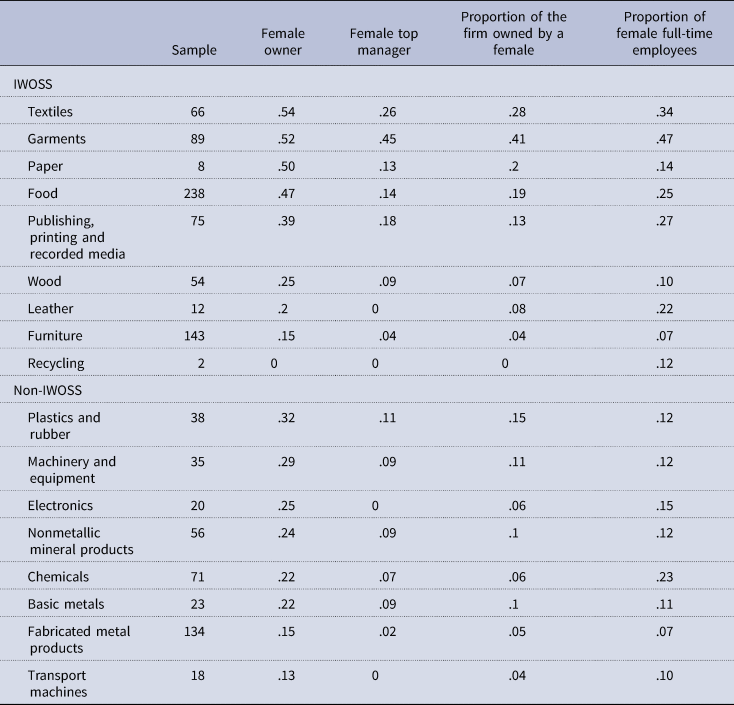
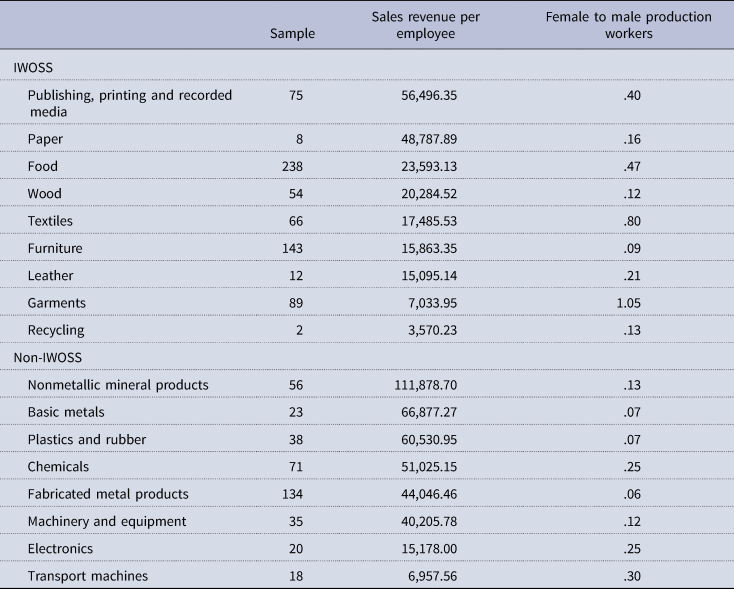
Tables 1–3 present some descriptive statistics of the variables used for the estimations. In Table 1, where we provide statistics on the sectoral distribution of the gender diversity variables used in the study, we find that the firms with the highest female ownership can be found in textiles (54%), garments (52%), paper (50%) and food (47%). These are typically firms in the IWOSS sector. Conversely, firms with the lowest proportion of female ownership include transport machines (13%), furniture (15%) and fabricated metal products (15%) (typically non-IWOSS). These distributions are not vastly different when we consider female top managers, the proportion of the firms owned by a female and the share of full-time female employees as indicators of gender diversity. In Table 2, where we present the sectoral distribution of labour productivity, we find that the highest shares are in nonmetallic mineral products, basic metals, plastics and rubber, publishing, printing and recorded media, and chemicals. We again find that the industries with the highest shares of female-to-male production workers are textiles, food, publishing, printing and recorded media, chemicals, and electronics.
Sectoral distribution of gender diversity variables
Sectoral distribution of labour productivity and the ratio of female to male production workers
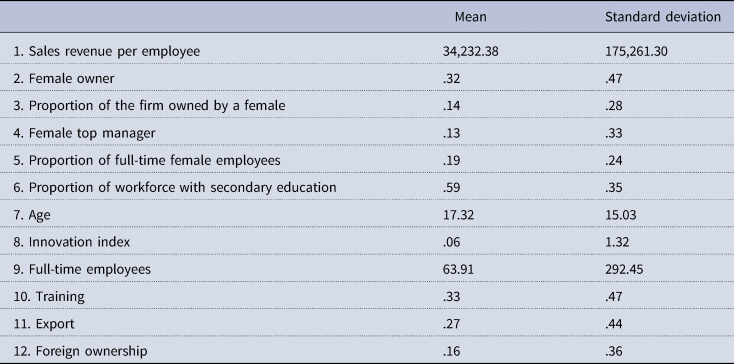
Descriptive statistics of variables
In combining Tables 1 and 2, we find that in firms with the highest share, the gender diversity variables such as textiles and garments have low labour productivity values. These firms also have the lowest ratios of female to male production workers. A basic deduction from these results is that gender diversity may be negatively correlated with labour productivity since the most productive sectors also appear to have the lowest proportion of female workers. Further analysis will still be required to determine the true nature of the relationship, and this is done in subsequent sections of the paper.
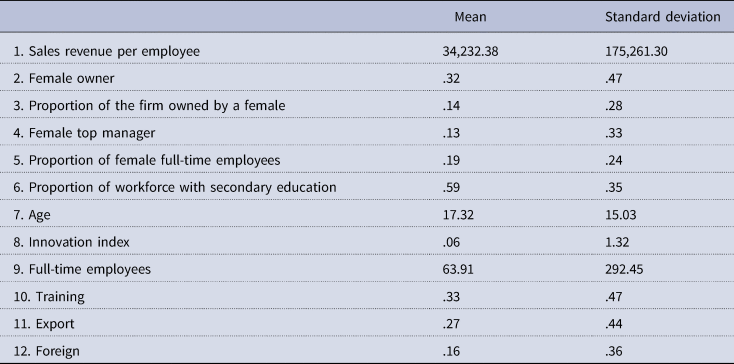
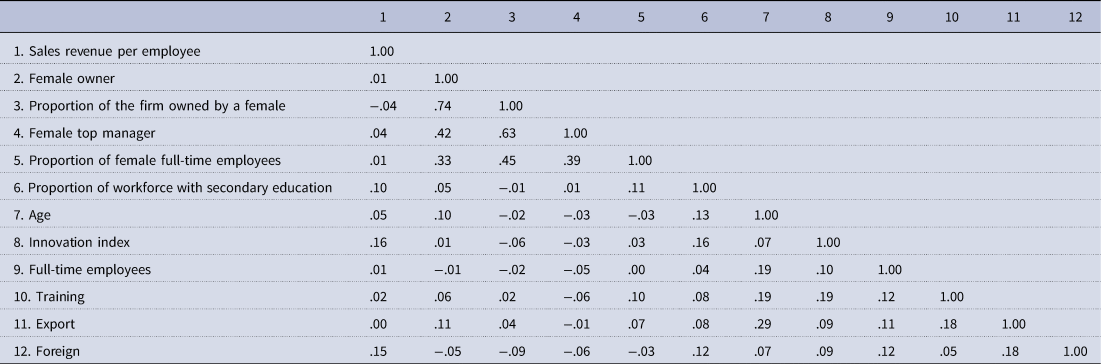
We present, in Table 3, the descriptive statistics of all the variables in the analysis. We observe that about 32% of the firms have a female owner, and 13% have their top manager being a female. The average proportion of a firm owned by a female is 14%, and the average proportion of female full-time employees is 19%. We also observe for the control variables that about 59% of the workforce have at least secondary education, the average age of a firm is 17 and the average firm size is 64. While about 33% of the firms have undertaken some specific training, 27% are exporting firms and 16% are foreign-owned. In terms of the correlation coefficients, we find a positive association between labour productivity and all measures of gender diversity except for the proportion of the firm owned by a female. For the control variables, all are positively correlated with labour productivity with the highest being innovation. We do not find the explanatory variables to be strongly correlated in a way to be concerned about multicollinearity. We relied on the Tolerance Statistics to confirm it.
Empirical results
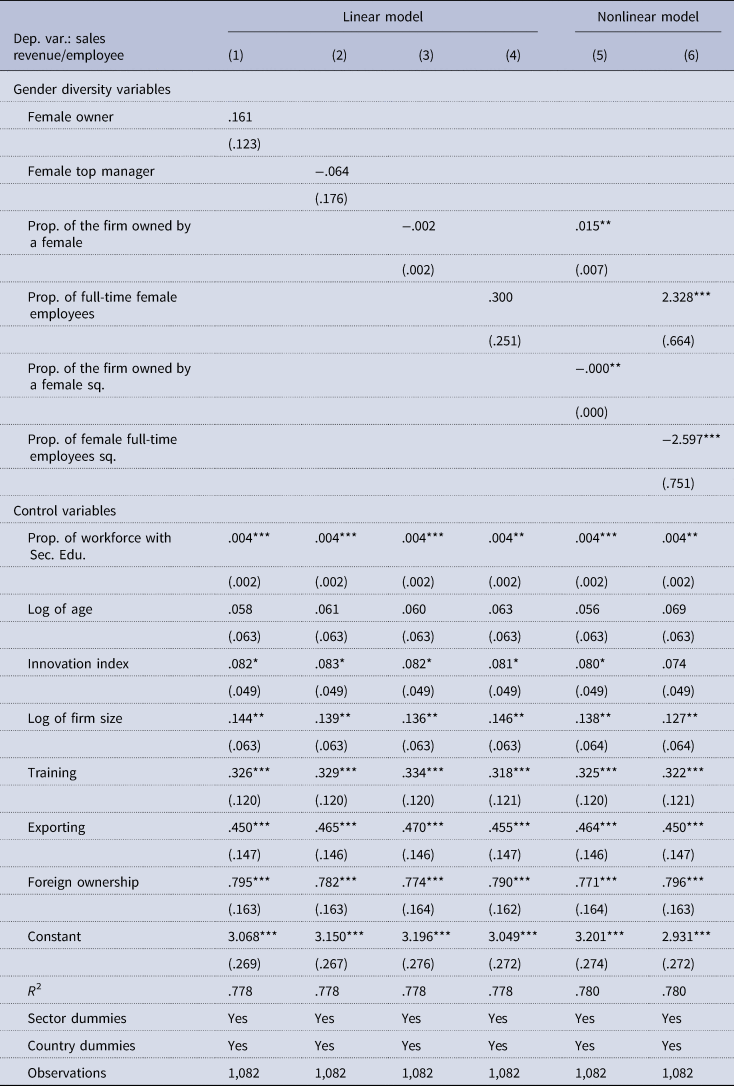
Table 4 reports the basic results of our estimations. In the linear specification (columns 1–4), which is estimated by ordinary least squares, we do not find any evidence of the gender diversity variables having statistically significant effects on labour productivity. That notwithstanding, we find most of the control variables (proportion of the workforce with secondary education, innovation, firm size, training, exporting and foreign ownership) to be positively associated with labour productivity. Firm age was insignificant. In the nonlinear model (columns 5 and 6), where we include only the measures of gender diversity that are continuous (i.e., the proportion of the firm owned by a female and proportion of female full-time employees), we find evidence that suggests an inverted-U relationship between diversity and productivity. In this specification, gender diversity has an initial positive effect on labour productivity measured as sales revenue per employee ([b= .015, p < .05] in Equation 5 and [b = 2.324, p < .05] in Equation 6), but the square term is negatively correlated with sales per employee ([b = −.0001, p < .05] in Equation 5 and [b = −2.597, p < .05] in Equation 6). The results show that initial or lower levels of gender diversity (the proportion of the firm owned by a female or female full-time employee) are associated with productivity improvements. However, beyond a certain level of gender diversity, productivity declines. In other words, the results suggest that for some range of gender diversity, productivity is enhanced; however, beyond a certain threshold, gender diversity harms productivity. It will be recalled from the discussion on the descriptive statistics earlier, that an initial negative association was found.
Base model (linear and nonlinear model)
Robust standard errors in parentheses.
***p < .01, **p < .05, *p < .1.
As a robustness check, we assess whether the findings are consistent across the different measures of the dependent variable by using value-added per employee instead of sales per employee, as a measure of productivity. The results, which are presented in Table 5, are consistent with those observed in Table 4 in that the proportion of the firm owned by a female and the proportion of full-time female employees are positively associated with value-added per employee (b = .017, p < .05; b = 2.087, p < .05 respectively), and the square terms of these variables produce negative results (b = −.0001, p < .05; b = −2.463, p < .05 respectively). Similar to the results in Table 4, the rest of the control variables in Table 5 maintained their signs as before, indicating that the observed findings are robust.
Robustness check (linear and nonlinear model)
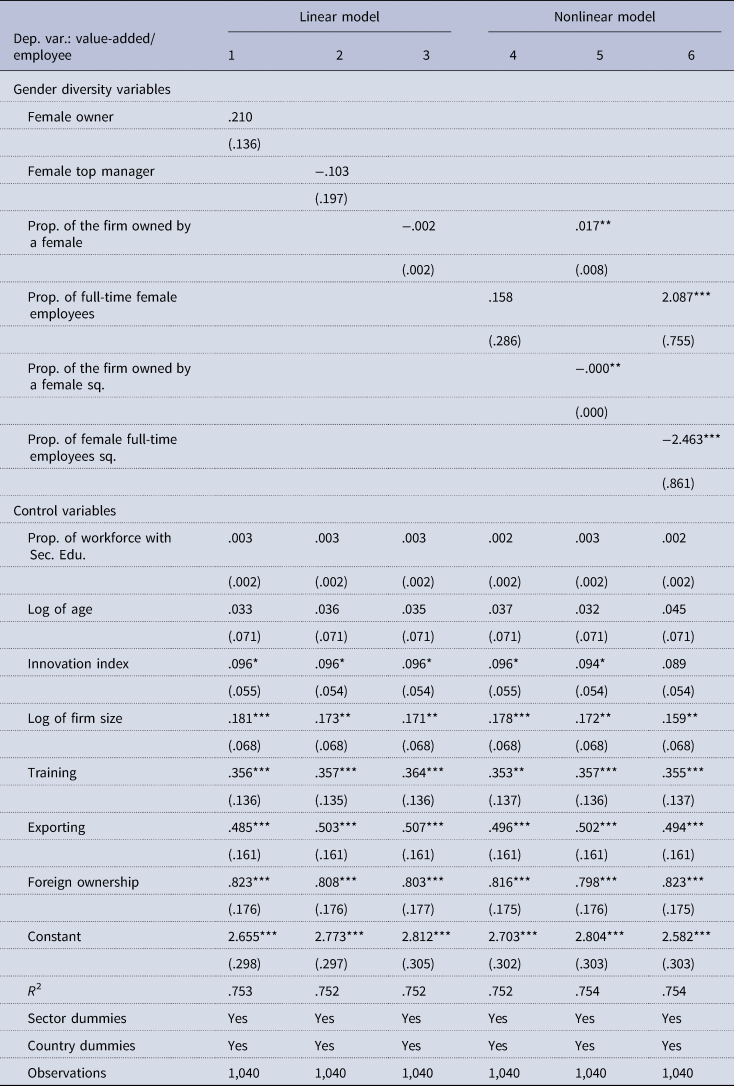
Robust standard errors in parentheses.
***p < .01, **p < .05, *p < .1.
In Table 6, we extend the base model in Table 4, by interacting the gender diversity variables with the IWOSS dummy. The interaction term allows us to explore heterogeneity in the gender diversity and firm productivity link by comparing IWOSS and non-IWOSS firms. The results show that only the interaction between the proportion of full-time female workers and the IWOSS dummy was significant (b = −1.452, p < .05). The negative and significant interaction term suggests that the positive association between the proportion of full-time female workers and labour productivity is relevant only for non-IWOSS firms. Interestingly, the IWOSS dummy on its own is consistently negative in all the specifications, suggesting IWOSS firms may be less productive. Like Table 5, we check for consistency in the results by relying on the value-added per employee as our dependent variable (see Table 7). The results remain unchanged as the interaction term remains negative (b = −1.714, p< .05).
Base model: introducing an interaction term
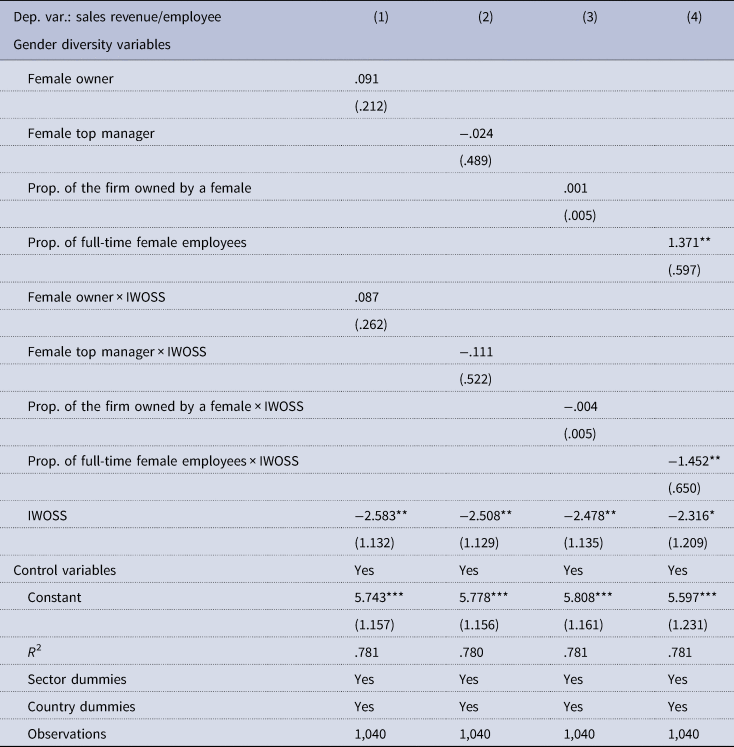
Robust standard errors in parentheses.
***p < .01, **p < .05, *p < .1.
Robustness check: introducing an interaction term
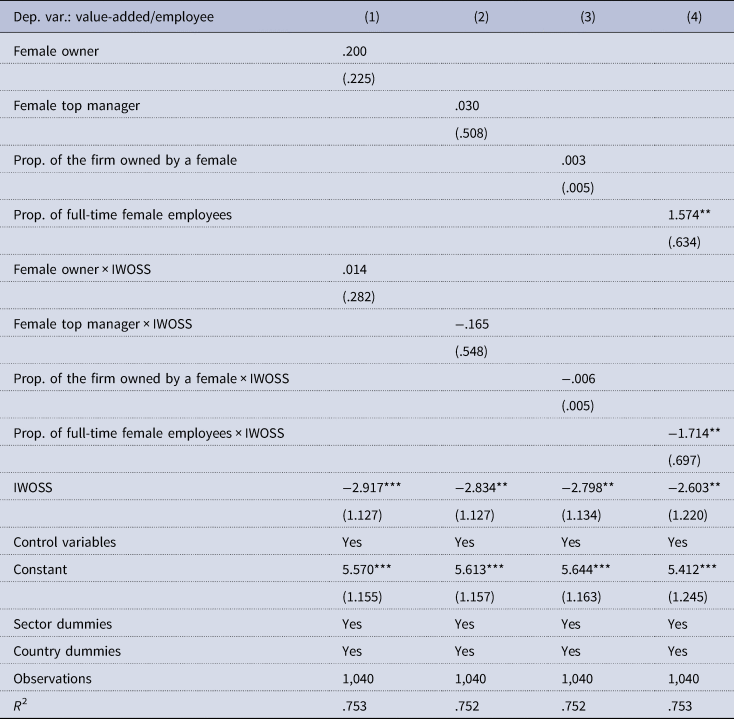
Robust standard errors in parentheses.
***p < .01, **p < .05, *p < .1.
Discussion
In this paper, we have analysed the effects of gender diversity on firm productivity using data on manufacturing firms from six SSA countries. We have also explored the potential moderating role of structural differences in manufacturing activities by identifying and controlling for IWOSS firms given their growing popularity as an alternative and emerging source of structural transformation in Africa (Newfarmer, Page, & Tarp, Reference Newfarmer, Page and Tarp2018) following the continent's several years of deindustrialization.
The main conclusion from our study is that the IWOSS firms do no better in explaining the positive association between gender diversity and firm productivity. This finding indicates that an increasing proportion of full-time females employed in IWOSS sectors do not contribute to increasing firm productivity. Rather, we find the evidence to be applicable to non-IWOSS firms (i.e., traditional manufacturers that rely on resources that Africans are most engaged). These results are consistent with the studies that have found a positive association between gender-diverse workforces and firm productivity (Ali, Kulik, & Metz, Reference Ali, Kulik and Metz2011; Herring, Reference Herring2009; Richard et al., Reference Richard, Barnett, Dwyer and Chadwick2004; Yang & Konrad, Reference Yang and Konrad2011). That notwithstanding, our results are unique to the extent that in addition to controlling for common firm characteristics, we show that the relationship is peculiar to firms classified as non-IWOSS. A gender-diverse human capital provides access to a broader talent pool as well as varied perspectives and knowledge that feed into creativity, problem-solving and innovation in a firm. A gender-diverse human capital may also facilitate access to a wider variety of customers. Our results on the effect of diversity on sales per worker and value-added per worker suggest that this may be the case for the non-IWOSS firms in the study.
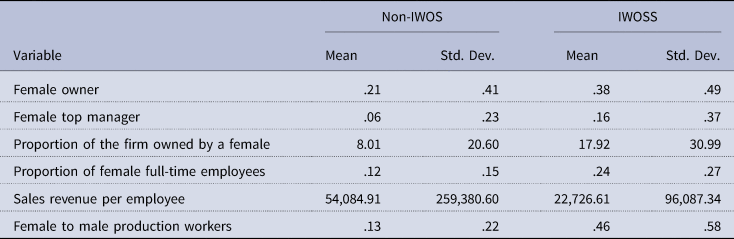
The observed findings may be the result of several efforts to reverse the African continent's deindustrialization by continuously enhancing the capital intensity of traditional African manufacturers manufacturing which is focused on the processing of primary resources and related activities. Not surprisingly, we find from our descriptive statistics that non-IWOSS firms, including firms that produce nonmetallic mineral products, basic metals as well as plastics and rubber, tend to have the highest average productivity values relative to the typical IWOSS sectors. It is to be noted that firms that are becoming more capital intensive tend to be more productive when compared to firms that are usually labour intensive (McMillan & Zeufack, Reference McMillan and Zeufack2022) and a gender-diverse human capital base provides access to talent, knowledge and perspectives required for increased productivity.
We again note from our results that males tend to dominate non-IWOSS firms which is possibly an outcome of a social construct about the gendered nature of manufacturing activities. Flecker, Meil, and Pollert (Reference Flecker, Meil and Pollert1998) showed how women steered away from male-dominated jobs (such as manufacturing) since they (and other minority groups) are the easy targets for redundancies or retrenchment when firms are restructuring or downsizing. We argue, based on our results, that with the evolving nature of the world of work, where firms are increasingly utilizing more innovative manufacturing processes and the increasing openness towards the engagement, the empowerment of women should provide ample motivation for women to get more involved at all levels in non-IWOSS firms. Public policy should be seen as explicitly supporting and encouraging this change given the evidence provided in our study of diversity enhancing productivity in African manufacturing firms.
Again, the knowledge-based research and decision-making theories have relevance in explaining our results. These theories posit that the primary problem confronting firms relates to knowledge and how it can enhance decision-making. They further emphasize that diversity in decision-making is critical in addressing the knowledge problems of firms. We, therefore, contend, based on our empirical findings, that gender diversity can be critical in addressing the challenges faced by African firms in efficiently exploiting their natural resources or sectors related to it. Given that most non-IWOSS sectors (or firms) tend to be characterized by the reliance on natural resources, it is therefore not surprising that such firms better explain the positive association between gender diversity and firm productivity.
Furthermore, the resource-based view of the firm, as emphasized by Barney (Reference Barney2001) and McMahan, Bell, and Virick (Reference McMahan, Bell and Virick1998), can be useful in explaining the finding in as much as it posits that the intangible and socially complex characteristics of a more gender-diverse workforce are critical for enhancing firm productivity.
Research and theoretical contribution
This paper has explored the implication of gender diversity for productivity, considering the heterogeneous effects based on the classification of firms as IWOSSFootnote 1. Our initial results showed that there is a nonlinear relationship between gender diversity and productivity. This means that while access to a larger pool of talent, knowledge, perspectives and a potentially wider variety of customers through an increased proportion of females employed may firstly be associated with increased productivity in the form of sales per employee and value-added per employee, continued expansion of gender diversity may be associated with productivity declines in manufacturing firms. This nonlinear relationship provides support for an integration of the knowledge-based, resource-based and social identity theories at various levels of gender diversity (Ali, Kulik, & Metz, Reference Ali, Kulik and Metz2011; Bae & Skaggs, Reference Bae and Skaggs2019; Schneid et al., Reference Schneid, Isidor, Li and Kabst2015). In the specific case of our study, the group dynamics predicted by the knowledge-based and resource-based view of the firm at low to moderate levels of gender diversity are stronger than those based on self-categorization and social identity theories. However, at moderate to high levels of gender diversity, the group dynamics predicted by the social identity theories are stronger and, therefore, adversely affect productivity.
Subsequently, where we introduce IWOSS firms as a moderator for gender diversity, we find a negative association between gender diversity and firm productivity for IWOSS firms. In other words, gender diversity is found to be productivity-enhancing in non-IWOSS or traditional manufacturing firms. This result for non-IWOSS firms is also consistent with the knowledge-based and resource-based theories (Mannix & Neale, Reference Mannix and Neale2005; Watson, Kumar, & Michaelsen, Reference Watson, Kumar and Michaelsen1993). For a sector of manufacturing that has otherwise been on a path of decline, gender diversity offers a broad scope of employee competence and experience, market insight, creativity, innovation and problems solving critical to enhancing firm competitiveness (Barney, Reference Barney2001; McMahan, Bell, & Virick, Reference McMahan, Bell and Virick1998). We, therefore, argue that gender diversity may be critical in addressing the trend of decline in African manufacturing.
In sum, we observe a complexity of relations that require an integration of various theories in seeking to explain the impact of gender diversity on productivity, especially when we consider a unique form of heterogeneity among firms. Nonetheless, the overall results provide support for the affirmative action efforts being undertaken to enhance gender diversity on the African continent and more so at the workplace (Moodley et al., Reference Moodley, Kuyoro, Holt, Leke, Madgavkar, Krishnan and Akintayo2019; UNIDO, 2016). Our findings suggest that these efforts can yield favourable results, especially when they are properly targeted within the manufacturing sector. Our results also suggest that the advantages of manufacturing can be used as leverage towards enhancing affirmative action on the African continent (Moodley et al., Reference Moodley, Kuyoro, Holt, Leke, Madgavkar, Krishnan and Akintayo2019; UNIDO, 2016).
Practical implications
The study has brought to the fore the importance of diversification in recruitment by drawing from a broader talent base, particularly for traditional manufacturing in SSA. Increased gender diversity among employees of the firms will allow the firms to not only potentially access a wider variety of knowledge and perspectives for problem-solving and innovation but also reach out to a wider variety of customers (see Moodley et al., Reference Moodley, Kuyoro, Holt, Leke, Madgavkar, Krishnan and Akintayo2019; UNIDO, 2016). The result of increased gender diversity may be evidenced in the increased productivity not only in terms of sales revenue per employee but also in terms of value-added per employee as the evidence adduced in this study has shown.
The nonlinearity observed in the relationship between gender diversity and productivity within African firms suggests that managers need to be aware of the potential reversal in productivity with further expansions in gender diversity. Thus, for some ranges of gender diversity, various intergroup biases that arise from social categorization may produce the observed offsetting relationship (Richard, Kochan, & McMillan-Capehart, Reference Richard, Kochan and McMillan-Capehart2002; Reference Richard, Murthi and Ismail2007; Van Knippenberg, De Dreu, & Homan, Reference Van Knippenberg, De Dreu and Homan2004). Finding the optimal proportion of females for increased productivity must engage the attention of managers beyond seeking to satisfy a regulatory requirement or affirmative action.
The trends observed with the introduction of IWOSS firms as a moderator in the effect of gender diversity on productivity in the results once again underscore the need to take into consideration peculiar heterogeneities among firms in the design of policy in Africa. While some firms may pursue gender diversity in response to regulatory requirements or affirmative action policy, there is the need to be minded that such laws or programmes while best-intentioned, do not necessarily have the same effect on the productivity of firms (Van Knippenberg, De Dreu, & Homan, Reference Van Knippenberg, De Dreu and Homan2004). As has been shown in this study, implementation of such policies may yield positive results on productivity in non-IWOSS firms and negative results in IWOSS firms.
Again, the differential impact based on the IWOSS classification suggests that identifying relevant heterogeneities can lead to the realization of a more nuanced relationship between gender diversity and firm productivity. The implication of this for public policy is that a one-size-fits-all approach cannot continue to underscore affirmative action interventions, particularly for those intended to enhance firm productivity. Some differential actions can be useful in realizing the positive association between diversity and productivity.
Limitations and future research
Overall, the findings of this study may be considered preliminary given that they are based on cross-sectional data from a limited number of countries in SSA – Ghana, the Democratic Republic of Congo, Tanzania, Uganda, Zambia and Kenya. Also, the nonavailability of micro-panel data that can be explored for causal inferences remains a challenge. In addition, our study relies on the use of a single-factor measure of productivity as opposed to a multi-factor productivity measure that tends to be the preferred measure in the extant literature. Future studies may take advantage of a relevant micro-panel to explore the dynamic association between gender diversity and labour productivity. Also, extensions may include an attempt to isolate heterogeneity in the distribution of women that are relevant for manufacturing using age, skillset, the proportion of production and nonproduction workforce. Also, the moderating role of other variables such as innovation, education and various organizational variables can be explored.
Appendix
Definition of variables
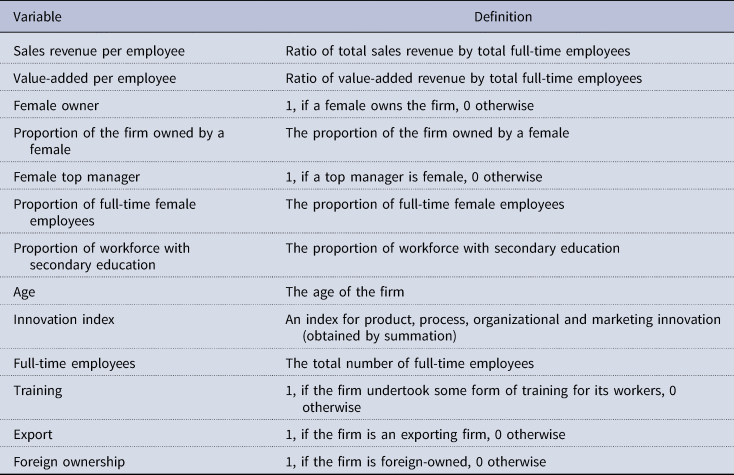
Summary statistics
Descriptive statistics and correlations
Distribution of gender diversity and productivity variables across IWOSS


 Open access

