

The question of how to improve mental health and reduce and prevent suicidal behaviours is a problem worthy of attention for the whole of society. Studies have shown that meaning in life plays an important role in the prevention of suicide and in ameliorating mental illness (King, Hicks, Krull, & Del Gaiso, Reference King, Hicks, Krull and Del Gaiso2006; Kleiman, Adams, Kashdan, & Riskind, Reference Kleiman, Adams, Kashdan and Riskind2013; Peng, Wang, & Guo, Reference Peng, Wang and Guo2011; Steger, Frazier, & Zacchanini, Reference Steger, Frazier and Zacchanini2008). Since some characteristics of meaning in life have been found to have greater differences across cultures (Steger, Kawabata, Shimai, & Otake, Reference Steger, Kawabata, Shimai and Otake2008), it is necessary to further enrich and strengthen the theoretical and practical significance of cross-cultural research on the meaning in life. This study focuses on the development of Chinese adolescents’ mental health from the perspective of meaning in life, and may provide the basis for new, effective ways to improve the mental health of students.
Although studies on the meaning of life are not new, until recently, researchers had not provided a unified definition of the concept of life meaning and its dimensions as a function of different cultural backgrounds. In the early stages of research, Western researchers were inclined to use words like purpose or significance to define meaning in life, and thus they formed their measurement tools from a unidimensional angle, as in the Purpose in Life Test (Crumbaugh & Maholick, Reference Crumbaugh and Maholick1968); but, due to a lack of life purpose suitable to all (for instance, in collectivist cultures, people put self-improvement as their life purpose, while in individualistic cultures, life purposes tend to be the pursuit of success and self-enhancement; see Heine, Lehman, Markus, & Kitayama, Reference Heine, Lehman, Markus and Kitayama1999), the cross-cultural applicability of the research was insufficient. That is to say, people in some cultures pay more attention to the experience of meaning in life (outcomes), but attach less importance to the search for meaning in life (processes; Steger, Frazier, Oishi, & Kaler, Reference Steger, Frazier, Oishi and Kaler2006). Therefore, based on the logotherapy theory by Frankl (Reference Frankl1963, Reference Frankl1965), Steger et al. (Reference Steger, Frazier, Oishi and Kaler2006) put forward that there are two dimensions of meaning in life: cognitive and motivational dimensions. They named the cognitive dimension as ‘the presence of meaning’, which refers to people's understanding of meaning in life, and their sense of purpose or mission across the life span, as well as the degree to which people experience their lives as being significant. They called the motivational dimension ‘the search for meaning’, referring to the idea that people try to pursue or increase their understanding of meaning and goals in life, and actively seek meaning in life.
The 10- to 25-year-old age group is in a special period of transition when physical and psychological changes take place. This may be a critical stage for researchers to understand and investigate the relationship between the meaning in life and mental health; therefore, we chose students at this age stage for study. Based on the relative theory of adolescence put forward by Yang and Yao (Reference Yang and Yao2002) and the personality development theory proposed by Erikson (Reference Erikson1968), the study first divided adolescent students into three age groups: early adolescence, middle adolescence, and late adolescence, with each stage nominated a period of about 2–4 years. However, we then divided our sample into four age groups: early adolescence (10–13 years), middle adolescence (14–17 years), late adolescence (18–21 years), and early adulthood (22–25 years), and made comparative analyses about the applicability of the Meaning in Life Questionnaire (MLQ) to the characteristics of meaning in life, and their relationships with mental health in each of these four age groups.
Assessment and Age Suitability of the Meaning in Life Questionnaire in China
International studies have shown that in the United States, Turkey and Brazil, and in African populations, the MLQ (Steger et al., Reference Steger, Frazier, Oishi and Kaler2006) has measurement invariance across age groups (most of the subjects were divided into early, middle and late stage adulthood) and across cultures; configural invariance, metric invariance and scalar invariance were found, and the corresponding results supported the idea that the two-dimensional structure of the MLQ has the same psychological structure in different age stages (Boyraz, Lightsey, & Can, Reference Boyraz, Lightsey and Can2013; Damásio & Koller, Reference Damásio and Koller2015; Steger, Oishi, & Kashdan, Reference Steger, Oishi and Kashdan2009; Temane, Khumalo, & Wissing, Reference Temane, Khumalo and Wissing2014). However, in China, although the scores of meaning in life are significantly different for teenagers than for other age groups (Qin & Wang, Reference Qin and Wang2012; Qin, Wang, & Zhang, Reference Qin, Wang and Zhang2013), previous findings were not based on measurement invariance. The MLQ as a new, imported measurement tool for Chinese populations was tested for measurement invariance in the present research.
Liu and Gan (Reference Liu and Gan2010) surveyed the applicability of the MLQ developed by Steger et al. (Reference Steger, Frazier, Oishi and Kaler2006) among Chinese college students, and Wang (Reference Wang2013) explored the applicability of the scale in middle school students; all these studies indicated that the scale had good reliability and validity. But these findings were limited by factors such as small size and single samples; the MLQ revised by Liu and Gan (Reference Liu and Gan2010) had item 10 deleted from the original scale, whereas Wang's (Reference Wang2013) revision of the Meaning in Life Questionnaire — Chinese version (MLQ-C) did not achieve construct validity in its Chinese college students’ group. Thus, it would require larger samples from each age group in Chinese students, aged from 10 to 25, to more thoroughly examine the validity, reliability, and applicability of the MLQ-C, as revised by Wang (Reference Wang2013).
The above studies have shown that the MLQ has cross-cultural utility, but have not fully taken into consideration possible differences in construct validity across the age groups for young adults. Based on Steger et al.’s (Reference Steger, Frazier, Oishi and Kaler2006) theory of dimensions of the meaning in life (and that studies that have verified the applicability of the scale for Chinese students), we predicted that the MLQ is applicable in Chinese adolescents aged from 10 to 25, and will have good internal consistency and construct validity (Hypothesis 1).
Level Characteristics and Age Development Trend of the Meaning in Life
With regard to the age development trends for meaning in life, Steger et al. (Reference Steger, Oishi and Kashdan2009) found that in the age range from 18 to 65, people in emerging adulthood were reported to have higher levels of the search for meaning, but higher levels of the presence of meaning were found in the later stages of life. Chinese scholars found that the level of search for meaning among middle school students (aged 12, 13 to 17, 18) increased, whereas the presence of meaning decreased over the same age range (Qin & Wang, Reference Qin and Wang2012; Qin, Wang, & Zhang, Reference Qin, Wang and Zhang2013).
According to Erikson's (Reference Erikson1968) personality development theory, the age range of 12 to 18 years is not only used for integrating self-identity and self-development, but also is a peak period for frequent psychological problems; young people are often in a mental state of depression, contradiction, and entanglement as they adjust to or even deny values that were established for them in childhood. Therefore, the level of the presence of meaning at this stage reached the lowest level and then increased.
From a cultural perspective, China is a country deeply influenced by Confucian collectivism (see J.H. Liu, Yeh, Wu, Liu, & Yang, Reference Liu, Yeh, Wu, Liu and Yang2015). Although the Chinese have also been influenced by Confucianism, Buddhism and Taoism (three major philosophies in China), Confucianism traditionally holds the dominant position historically (S.L. Li, Reference Li2011; Wang et al., Reference Wang, Tu, Yang, Guo, Yuan and Liu2016). In addition, according to clause 3 of the Education Law of the People's Republic of China, the state enforces separation of education and religious activity, and there is no religious activity allowed in schools. However, Confucian culture (i.e., thought or tradition) is generally not considered to be a religion (J.H. Liu et al., Reference Liu, Yeh, Wu, Liu and Yang2015; Zhou, Reference Zhou1996). Therefore, Confucian culture (or thought) is promoted in school through Sinology education, which provides opportunities for Chinese teenagers to read the Confucian classics (Wang, Su, & Cao, Reference Wang, Su and Cao2014). Consequently, they may adopt the Confucian culture. Confucian collectivism follows the example of men of virtue, and regards the cultivation of the ideal sage personality as an educational training goal (J.H. Liu, Reference Liu2014). This makes many younger adolescents long for a good future and to have more experiences in the meaning of life while entering into early adulthood; however, as they begin to face their problems in a realistic manner (a profound aphorism widely accepted by Chinese adolescents is that ‘The dream is plump but the reality is skinny’), their search for meaning in life becomes only to make a living, so the level of their search for meaning may gradually decline (see J.H. Liu et al., Reference Liu, Yeh, Wu, Liu and Yang2015; Wang, Fu, Zhang, & Kou, Reference Wang, Fu, Zhang and Kou2015).
Additionally, the principle of zhongyong (中庸), or ‘being moderate’, in Confucian culture affects almost every aspect of social life of adults. Some studies have pointed out that a disadvantage of it is that it supports a conservative orientation that does not remind people about the importance of enterprise and competition, or breaking down barriers and promoting reform, because people are encouraged to pursue moderate goals and appropriate means (Tian, Reference Tian2000). A life goal that is characterised by zhongyong is to be oriented towards maintaining innermost harmony and interpersonal tranquility (Z.F.A. Yang, Reference Yang2009); thus, adolescents’ sense of searching for ambitious life goals might weaken and the level of the search for meaning might decline if Chinese people adopt a zhongyong orientation as they mature.
Although we were unable to predict the levels of the search for meaning for the four age groups, in accordance with a previous analysis, the study predicted that the level of the presence of meaning in the middle adolescence would be the lowest, while the level of their search for meaning would show a rising trend among the four age groups (Hypothesis 2).
Apart from the aspect of age, the developmental trends for meaning in life among students of different genders and those from urban and rural areas may be different. First, the social status of Chinese men and women in politics, economy, culture, and education has undergone major changes in recent decades, which has led to the traditional gender roles having increasingly blurred boundaries; however, due to the enormous influence of 5,000 years of traditional culture, psychological differences between the genders still exists (Guan, Wang, & Lei, Reference Guan, Wang and Lei2011; L. Tian, Wang, & Chen, Reference Tian, Wang and Chen2005). Consequently, female students may still struggle more to achieve their values and independence. However, concurrently it appears that females have a demonstrated advantage in school education, which has become more obvious during the last 10 years (C.L. Li, Reference Li2016). Therefore, the trends of meaning in life for a Chinese student are probably affected by gender, and females will probably show a greater awareness of meaning in life, compared to males.
A survey centred on Chinese middle school students showed that girls’ total scores on meaning in life, the presence of meaning, and search for meaning were significantly higher than those of boys, and that youth from urban and rural areas and gender had significant interaction effects on meaning in life. For girls, the total score of their meaning in life and score of factors of their presence of meaning from urban areas were higher than those from rural areas, while for boys there was no significant difference (Qin & Wang, Reference Qin and Wang2012). Although previous studies have noted the differences between genders and between people from urban and rural areas on meaning in life, they were unable to take into account the interaction effects at different ages. We therefore endeavoured to provide more specific evidence with regard to possible interactions so as to assist in improving the mental health of Chinese adolescents in the future.
Correlation and Age Differences of Presence of Meaning and Search for Meaning
Previous research has pointed out cultural differences between the presence of meaning and search for meaning in life among different populations. For instance, some researchers found that in an individualist culture (e.g., the United States), the presence of meaning and search for meaning were negatively correlated, while in a collectivist culture (e.g., Japan), they were positively related (Steger, Kawabata et al., Reference Steger, Kawabata, Shimai and Otake2008). At the same time, one study in China indicated that the presence of meaning and search for meaning were positively related (Wang, Reference Wang2013), while another study found them to be not related (S.-S. Liu & Gan, Reference Liu and Gan2010). The different relationships between the presence of meaning and search for meaning shown in studies may result from the different ages of participants (e.g., Wang [Reference Wang2013] surveyed 1,899 middle school students, while S.-S. Liu and Gan [Reference Liu and Gan2010] surveyed 307 college students); or they may be due to the inconsistent use of scales in the two studies (e.g., Wang used 10 items in the MLQ-C, thus maintaining the integrity of the original questionnaire, whereas S.-S. Liu and Gan used the MLQ but deleted Question 10 in the original scale). In accordance with previous research, we predicted that students in a collectivist culture such as in China would demonstrate a positive relationship between the presence of meaning and search for meaning; however, the degree to which they are connected with each other may be affected by age group (i.e., with maturation, the relationship between the presence of meaning and search for meaning may gradually weaken over the course of adolescence to young adulthood; Hypothesis 3). This is because as they mature, students are expected to achieve more difficult goals in life, and the search for and presence of meaning diverge as reality constraints set in in late adolescence and early adulthood.
To test this hypothesis, this study will use the MLQ-C and focus on a large group of Chinese participants with more representative sampling, and will span wider ages and grades to verify the consistency of their relationship in different groups.
Correlation and Age Differences Between Meaning in Life and Mental Health
In Western countries, research has generally found that those who have a higher level of the presence of meaning have a stronger sense of wellbeing and more positive affect, while those who have higher levels of the search for meaning tend to have more sadness, anger, depression, and other types of negative affect (Steger et al., Reference Steger, Oishi and Kashdan2009). However, in Asian populations, this has not been replicated: the presence of meaning and mental health has shown a positive correlation, and the search for meaning and mental health (e.g., the purpose of life and subjective wellbeing) showed a positive correlation as well (Steger, Kawabata et al., Reference Steger, Kawabata, Shimai and Otake2008; Wang, Reference Wang2013). According to the dual factor model of mental health (DFM), mental health consists of positive and negative aspects, and only through a full investigation of these two aspects can we come to a comprehensive overview of an individual's mental health state (Suldo & Shaffer, Reference Suldo and Shaffer2008; Wang, Zhang, & Wang, Reference Wang, Zhang and Wang2011). Therefore, we chose depression, negative affect, positive affect, and life satisfaction as four indicators of mental health; among them, depression and negative affect were negative indicators, and positive affect and life satisfaction were positive mental health indicators. We predicted that the presence of meaning is positively correlated with life satisfaction and positive affect, but negatively correlated with depression and negative affect during the stages of adolescence and early adulthood (Hypothesis 4).
With regard to the relationship between the search for meaning and mental health, Frankl's (Reference Frankl1963, Reference Frankl1965) logotherapy theory advocated that people should search for meaning through the experience of hardship; this idea has something in common with an idea in Confucian theory: (天行健, 君子以自强不息) ‘As heaven maintains vigor through movements, a gentleman should constantly strive for self-perfection’ (this sentence by Confucius from Xiang Chuan (象传) gives an explanation of the meaning of different hexagrams in the Book of Changes). However, Christians treat pain as something that people experience as an obstacle (Mao, Reference Mao2010). Therefore, Western people may be less positive and more negative in searching for meaning. In contrast, Confucianism advocates: (生于忧患, 死于安乐) ‘Be born and live in pain, die in happiness’ (Mencius-Gaozi II, Chinese Confucian classics), enhancing happiness through adversity. Also, Confucianists believe that people who can manage pain and difficulty are capable of greater achievements. Thus, Confucianism promotes people smiling while they experience difficulty, and advocates learning from ‘bumps’, developing abilities, and preparing for the future (Jing, Reference Jing2006). Therefore, we might expect Chinese people to be more positive in searching for meaning and less negative about this search. Chinese people are not only searching for meaning (in difficulty), but they are also searching for it when there are no difficulties, as Chinese people always uphold the idea that: (路漫漫其修远兮, 吾将上下而求索) ‘The way ahead is long, I see no ending, yet high and low I'll search with my will unbending’, the 97th line in the Li Sao (离骚). This Chinese poem, dating from the Warring States Period, was authored by a famous Chinese patriotic poet, Qu Yuan (340–278 BC), of the Kingdom of Chu (widely known in China), who did not end his search for meaning in life just because it was a hard path to follow. Therefore, there might be an inner spirit of enjoyment for Chinese people to search for meaning; it does not necessarily mean that he or she is experiencing a psychological crisis due to lacking of meaning.
Confucianism holds to the philosophy of (三不朽) ‘three indestructibles’ for setting one's life goals: (立德) ‘To set one's virtue’, (立功) ‘To set one's meritorious deeds’, and (立言) ‘To expound one's ideas in words and writing’. These life goals are important for highly educated Chinese people who aspire to have a high reputation and social status. It is a mainstream value in China (Chen, Reference Chen2012). Thus, we may find that the search for meaning is recognised as a positive psychological quality for Chinese people who have a background of Confucian culture. Therefore, we make the prediction that during the phase of adolescence, the search for meaning is positively related with life satisfaction and positive affect, while negatively related with depression and negative affect (Hypothesis 5).
Processes
Purposes
The purposes of this study were: (1) to explore the applicability of the MLQ in Chinese adolescence, including reliability and factorial invariance among the four age groups, gender groups, and rural–urban groups; (2) to assess the levels of meaning in life among different age groups; (3) to test the interaction between gender, location (i.e., urban vs. rural), and age on the MLQ of adolescents; (4) to test the relationship between the two dimensions of the MLQ and mental health.
Method
Participants
Students were from schools that were cluster sampled mainly from two provinces and one city (Sichuan Province, Hubei Province, and Chongqing City). Then, we deleted the missing values and invalid data, and were left with 5,510 students. The resulting response rate was 97.8%, of whom 2,355 (42.7%) were boys and 3,155 were girls (57.3%); the number of students from urban areas and rural areas was 2,873 (52.1%) and 2,637 (47.9%). Participants were divided into four age phases: 10–13 years old (n = 1,258), 14–17 years old (n = 1,987), 18–21 years of age (n = 1,950) and 22–25 years of age (n = 315). The overall mean age was 16.77 years (SD = 3.268).
Procedure
The study was approved by the school academic ethics committee before the survey was conducted, and each participant volunteered to sign an informed consent form. The questionnaires were paper-based and took 20 minutes to complete, including the demographic variables (e.g., gender, location, age).
Measures
Meaning in life
The MLQ (Steger et al., Reference Steger, Frazier, Oishi and Kaler2006) is divided into two dimensions: the presence of and the search for meaning in life. The MLQ-C was used to measure Chinese students’ current level of life meaning, as revised by Wang (Reference Wang2013). The MLQ-C retains the integrity of the MLQ with one-on-one correspondence, which means the questionnaire includes 10 items and two factors, MLQ-C presence (MLQ-C-P; 5 items) and MLQ-C search (MLQ-C-S; 5 items). Students answered items on a 7-point Likert scale ranging from absolutely untrue to absolutely true, with higher scores corresponding to greater meaning in life (see Appendix for items). In the present study, the Cronbach's alphas of the MLQ-C, MLQ-C-P, and MLQ-C-S were 0.829, 0.84, and 0.832, respectively.
Depression
The Center for Epidemiologic Studies Depression Scale (CES-D) was developed by the National Institutes of Health (NIH) with 20 items. Previous research shows that the CES-D shows good reliability and structural validity when administered to Chinese students (Chen, Yang, & Li, Reference Chen, Yang and Li2009). Items were rated on a 4-point scale, ranging from 0 (rarely or none of the time, less than 1 day) to 4 (most or all of the time, 5–7 days), and the higher score indicated a severe depressive symptom. For the current study, the Cronbach's alpha of this scale was 0.844.
Life satisfaction
The Satisfaction With Life Scale (SWLS; Diener, Emmons, Larsen, & Griffin, Reference Diener, Emmons, Larsen and Griffin1985) was administered to measure global satisfaction with life. It contains five items, and students answered these on a 7-point Likert scale ranging from strongly disagree to strongly agree; the higher score indicated more satisfaction with life. The SWLS is widely used in China, and it shows good reliability and structural validity. In the present study, the estimated Cronbach's alpha of this scale was 0.749.
Positive and negative affect
In the present study, we used the Chinese revised edition of the Positive and Negative Affect Schedule (PANAS; Qiu, Zheng, & Wang, Reference Qiu, Zheng and Wang2008; Watson, Clark, & Tellegen, Reference Watson, Clark and Tellegen1988), which consisted of nine descriptive words. Items were rated on a 5-point scale from 1 (very slightly or not at all) to 5 (extremely) Cronbach's alphas of the positive and negative affect (PA and NA) subscales in the present sample were 0.91 and 0.88, respectively.
Analytical Strategy
Exploratory factor analysis and reliability analysis
This part assessed the factor structure of the two-dimensional MLQ across the four age groups and calculated the amount of variance accounting for MLQ latent factors. We examined the internal consistency and reliability of the two factors on the MLQ with five items from each subscale.
Multigroup confirmatory factor analyses (MGCFA)
MGCFA were performed to evaluate the measurement invariance of both subscales of the MLQ across age, gender, and location groups. Four models were tested. Model 1, configural invariance, checked whether the model fits the different groups, and whether the model structure is the same for groups. This model is a prerequisite for the more restrictive models to follow. Model 2, metric invariance, analysed whether the items’ factor loadings were equal across groups, thus suggesting the same meaning between the latent construct and other theoretical constructs across groups. Model 3, scalar invariance, tested whether the initial level of the latent factors was equal among the different groups so that they may be meaningfully compared. Model 4, structural invariance, assessed the extent to which the variances of the latent variables were equal across groups. Because of similar steps and patterns in the model-fitting process, we listed model fit indexes for the age groups in detail, rather than the gender and location groups, which have simple values (see Results section).
We conducted post-hoc analyses with a pairwise t test and a one-way ANOVA for between-group comparisons, testing whether the relationship between age groups and MLQ subscales is moderated by gender and location. Finally, we tested the relationships between the two dimensions of the MLQ and mental health with bivariate correlations.
Results
Factor Structure and Invariance of the MLQ for Four Adolescent Age Groups
Internal consistency (i.e., reliability) was used to test the scale's reliability, and we performed principal axis factor analysis with oblique rotation (direct oblimin, delta set to 0) to calculate the correlation coefficient and the amount of variance that accounted for two factors of the MLQ across four adolescent age groups (see Table 1). It was found that the Kaiser-Meyer-Olkin (KMO) measure of sampling adequacy was >0.85, which meets the conditions of factor analysis, and that internal consistency was very good for the two MLQ subscales (Cronbach's α > 0.78). The amount of variance accounted for each factor was over 60%. Across Chinese students in the four age groups, there were three trends: (1) the amount of variance accounted for the MLQ increased with the growth in age of the students; (2) the amount of variance accounted for the MLQ-S was more than for the MLQ-P, which is the opposite of the result from Western subjects (Steger et al., Reference Steger, Oishi and Kashdan2009); (3) the two factors (MLQ-P and MLQ-S) were significantly positively correlated, and the correlation coefficient decreased with the increase of age. Simple and confirmatory factor analyses were conducted to confirm factor structure; the maximum likelihood extraction method was used in the CFA, and results found that the Comparative Fit Index (CFI) = 0.926, Tucker-Lewis Index (TLI) = 0.912, Normed Fit Index (NFI) = 0.930, Root Mean Square Error of Approximation (RMSEA) = 0.092 [90% CI 0.091, 0.099; not exceeding 0.10], Standardised Root Mean Squared Residual (SRMR) = 0.073, which indicated that a two-factor structure of MLQ was acceptable.
Internal Consistency and Variance Accounted for With the MLQ at Four Age Groups

Note: *p < .05; **p < .01; MLQ-P = Meaning in Life Questionnaire Presence of meaning subscale. MLQ-S = Meaning in Life Questionnaire Search for meaning subscale.
Measurement Factors Invariance of the MLQ for Four Adolescent Age Groups
In order to obtain a meaningful comparison between different groups, it is necessary that the scales have equivalence for different groups, that is, measurement invariance (Zhao, Reference Zhao2007). Therefore, in the present study, we were required to demonstrate that the factor structure of the MLQ had scalar invariance across the four age groups. We used the program Amos 17.0 to perform a MGCFA (a test of the measurement invariance and structural invariance for MLQ using the sample of 5,510 individuals), which contained four models (see Table 2). First, we evaluated the baseline model (Model 1) for the different age groups and achieved adequate fit indexes, which indicated that the scale configuration was acceptable for the four age groups CFI ≥ 0.905, TLI ≥ 0.892, RMSEA ≤ 0.051, RMSEA [90% CI] ≤ 0.053, SRMR ≤ 0.100. Note that when N > 1,000, the standard for SRMR and RMSEA is deemed too harsh, so it falls to the TLI and CFI (Guo, Li, Chen, Wang, & Meng, Reference Guo, Li, Chen, Wang and Meng2008) to provide better indicators of fit. Because measurement equivalence is assessed by comparing the difference between the baseline model and the nested model, model comparisons (i.e., goodness of fit indices) are an exact estimation method for determining measurement equivalence. As χ2 is easily affected by sample size, this study will mainly reference the Change in Comparative Fit Index (△CFI) as an indication of change in model fit. If the ΔCFI ≤ 0.01, then we will consider that there is measurement invariance between the models (Cheung & Rensvold, Reference Cheung and Rensvold2002). Subsequently, we tested invariance across successively constrained models. There was not a significant reduction in the fit of Model 2 compared to Model 1, Model 3 compared to Model 2, or Model 4 compared to Model 3 (CFI did not decrease by more than 0.01), which means we established full metric invariance of the MLQ across age groups in this sample. Once configural, metric, and scalar invariances were achieved, we could be confident about conducting group comparisons.
Fit Indices From Confirmatory Factor Analysis of the MLQ for Four Age Groups

Note: Model 1, only item residual loadings fixed; Model 2, factor loading fixed at four age groups; Model 3, same as 2 but regression intercepts fixed; Model 4, same model as 3 but with structural coefficient and covariance fixed at four age groups; TLI = Tucker-Lewis index; RMSEA = Root Mean Square Error of Approximation; SRMR = Standardised Root Mean Squared Residual; CFI = Comparative Fit Index; △CFI = Change in Comparative Fit Index.
Descriptive Statistics for the Impact of Demographic Variables on the MLQ Subscales and Wellbeing Variables
As shown in Table 3, for 10- to 25-year-old Chinese students, the average scores of presence of meaning (M pro = 23.7) and search for meaning (M sea = 24.7) were higher than the median of 20, and there was a significant difference between scores according to gender (we examined the measurement invariance of the MLQ for gender and found goodness of model-fit indexes, TLI ≥ 0.905, CFI ≥ 0.913, △CFI ≤ 0.001, RMSEA ≤ 0.068, SRMR ≤ 0.081; in the urban and rural, the model fit index met the requirements as well, TLI ≥ 0.905, CFI ≥ 0.926, △CFI ≤ 0.001, RMSEA ≤ 0.068, SRMR ≤ 0.077. The scores from female students were significantly higher than male students (t pre = 4.194, p < .001, M male ± SD = 23.33 ± 6.10, M female ± SD = 24.0 ± 5.62; t sea = 3.589, p < .001, M male ± SD = 24.41 ± 6.28, M female ± SD = 24.99 ± 5.68). Significant differences were found in the family location on negative affect and life satisfaction, with students from cities having significantly higher life satisfaction than those from rural locations (t = 11.279, p < .001, M urban ± SD = 20.75 ± 5.72, Mrural ± SD = 19.02 ± 5.67).
Descriptive Statistics for Demographic Variables
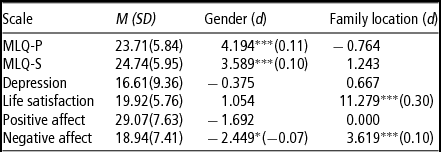
Note:*p < .05, **p < .01, ***p < .001. Cohen's d = effect size.
Mean Levels and Comparisons of Mean Levels of the MLQ Subscale for the Four Age Groups
We performed post-hoc analyses with a pairwise t test and found the estimated value of the effect size and differences between the age groups (see Table 4); scores on the presence of meaning and search for meaning reached a moderate level in the four age groups (M ≥ 22.65). Moreover, there were significant differences in between-group comparisons: specifically, the presence of meaning for middle adolescence (14–17 years) was significantly lower than in early adolescence (10–13 years), late adolescence (18–21 years), and early adulthood (22–25 years). Also, the presence of meaning in early adolescence (10–13 years) was significantly lower than late adolescence (18–21 years) and early adulthood (22–25 years). Finally, search for meaning in early adolescence (10–13 years) was significantly lower than in middle adolescence (14–17 years), late adolescence (18–21 years) and early adulthood (22–25 years), and search for meaning in middle adolescence (14–17 years) was significantly lower than late adolescence (18–21 years).
Mean Levels, and Comparisons of Mean Levels, of the MLQ Subscales at Four Age Groups
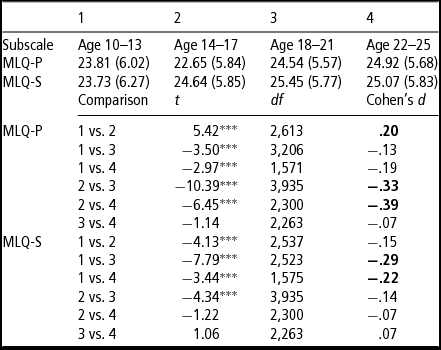
Note: ***p < .0083
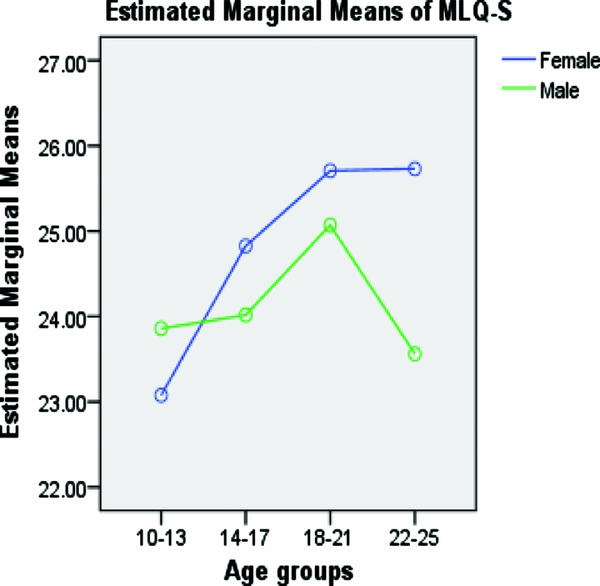
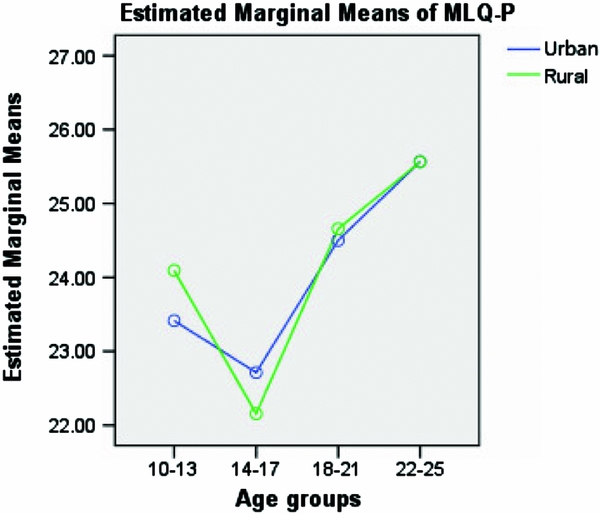
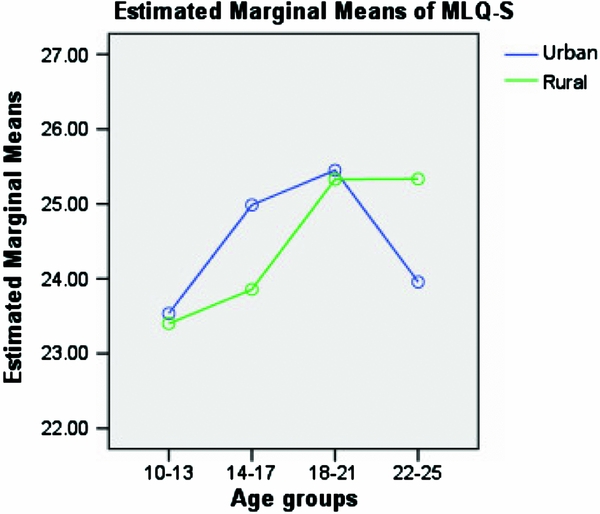
We performed a one-way ANOVA and found a significant main effect of gender, F (3, 5502) = 4.17, p < .05, η2 p = 0.001, and a significant interaction effect of gender and age groups on MLQ-S, F (3, 5502) = 3.07, p < .05, η2 p = 0.002. A significant main effect was not found for family location on MLQ-P and MLQ-S, F (3, 5502) = 0.37, p > .05; F (3, 5502) = 0.64, p > .05), while the interaction effects of family location and age group were significant for the MLQ-P and MLQ-S (MLQ-P, F (3, 5502) = 5.31, p < .01, η2 p = 0.003; MLQ-S, F (3,5502) = 6.23, p < .001, η2 p = 0.003).
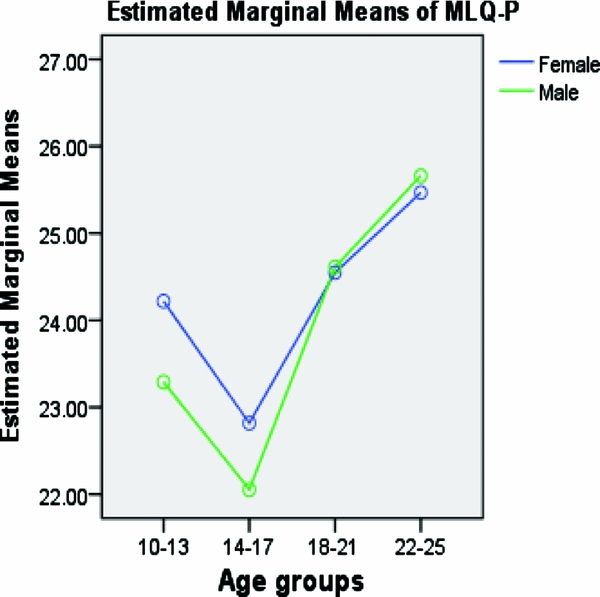
In the next simple effect analysis, we found that in middle and late adolescence and early adulthood, the MLQ-S of female students was significantly higher than that of male students (p < .05; see Figure 1 and Figure 2); the MLQ-P and the MLQ-S for city students in middle adolescence were significantly higher than that of the rural students (p < .001, p < .001), and there were no significant differences in other age groups (see Figure 3 and Figure 4).
Mean levels of presence of meaning in four age groups, by gender.
Mean levels of search for meaning in four age groups, by gender.
Mean levels of presence of meaning in four age groups, by family location.
Mean levels of search for meaning in four age groups, by family location.
Correlations Between MLQ Subscales and Wellbeing Variables for the Four Age Groups
We performed bivariate correlations and found, as shown in Table 5, that in the four age groups of Chinese students that the MLQ-P was significantly positively correlated with life satisfaction and positive affect (.24 ≤ r ≤ .41), and negatively correlated with depression and negative affect (−.51 ≤ r ≤ −.19); the MLQ-S had a zero or significantly positive correlation with life satisfaction (.00 ≤ r ≤ .14) and positive affect (.09 ≤ r ≤ .17), and it was negatively correlated with depression (−.26 ≤ r ≤ −.03) and negative affect (−.11 ≤ r ≤ −.08).
Correlations Between MLQ Subscales and Wellbeing Variables by Four Age Groups
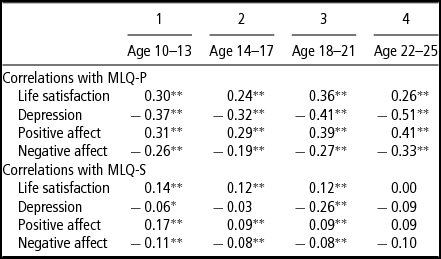
Note: *p < .05, **p < .01, ***p < .001.
The results showed an obvious feature, that the search for meaning and wellbeing variables have a significant correlation with early (10–13 years) and late (18–21 years) adolescence (p < .05), but not among emerging adults (22–25 years; p > .05). Having made a further analysis of the relationship between the search for meaning and various indicators of mental health among students in early adulthood (22–25 years), we found that there was zero relation between the search for meaning and indicators of mental health among female students at this age phase, and that there was a negative correlation between search for meaning and negative effects and depression among male students in the same age group (p < .05). It perhaps means that the search for meaning plays a part in protecting the mental health of males in early adulthood, while it has no effect on females.
Discussion
Hypothesis 1 received good support in that the two-dimensional MLQ had the same structure and invariance across age groups. It means that this scale is suitable for use among students from Chinese culture. Further, the results showed that for Chinese students, the presence of meaning in middle adolescence was the lowest among the four age groups, but increased after that age; search for meaning in late adolescence was the highest, but decreased after this stage. This result is consistent with Hypothesis 2, which suggests that Chinese students’ presence and search for meaning is influenced by self-identity development under Confucian influences. These show different levels of meaning in life across the different age groups. In addition, we have also found an interesting trend: the amount of variance accounted for by the search for meaning was more than the presence of meaning on various indicators of life satisfaction and mental health, which is the opposite trend compared to Western subjects (Steger et al., Reference Steger, Oishi and Kashdan2009). The results suggest that search for meaning may be an important personality trait for Chinese students who have grown up under the Confucian philosophy of san bu xiu (三不朽) or the ‘three indestructibles’ (see Liu et al., Reference Liu, Yeh, Wu, Liu and Yang2015; Wang et al., Reference Wang, Tu, Yang, Guo, Yuan and Liu2016).
During the entire stage of adolescence, we found specific differences of gender in the meaning of life. The level of search for meaning among girls was significantly higher than that of boys during middle and late adolescence and early adulthood; the reason for this may be that in traditional Confucian culture, the thought of (男主外, 女主内) ‘The man goes out to work while the woman looks after the house’ left the responsibility for family affairs on women. With the rapid development of society, females may enhance their female consciousness and become more independent, so that they bear the dual roles of career and family (Zhai, Reference Zhai2006). The rise of female consciousness leads to the result that the level of the search for meaning among females is far higher than that of males, from high school to early adulthood. However, another study pointed out that the traditional male-oriented awareness of college students was declining but still existed (D.Z. Liu et al., Reference Liu, Huang, Jia, Gong, Huang and Xia2011); namely, the Confucian patriarchal idea that men are superior to women is still entrenched. For a collectivist country that employs social orientation to evaluate individual success (Yang & Lu, Reference Yang and Lu2005), an adult male who pursues more would be praised as self-motivated while a female might be blamed for not looking after her family well. Research based on Chinese indigenous psychology indicated that men were more likely to emphasise the innovation of Yang (阳) values, while women emphasise the social harmony of Yin (阴) values (Yu, Fu, Liu, & Qu, Reference Yu, Fu, Liu and Qu2007). These ideas may partly account for the reason why the search for meaning among men in early adulthood had a negative relation with negative effects and depression, while search for meaning among women in early adulthood had no relation with negative effects and depression.
The levels of the search and presence of meaning for students from urban areas were higher than those of students from rural areas in adolescence. On the one hand, it is perhaps the superior living and learning conditions that enable students in urban areas to have more meaning in life and a stronger motivation to search for meaning; this is in accordance with the result that life satisfaction and happiness of students from urban areas are higher than those of students from rural areas (Hu, Reference Hu2013). On the other hand, the study indicated that educated parents tend to be much more demanding with their children, which enhances the competitive consciousness of their children, since the number of highly educated parents from urban areas is far more than that from rural areas (Yang et al., Reference Yang, Xu, Wang, Shen, Fu and Jiang2009). Mid-adolescence is basically the junior middle school stage; thus, students in cities and towns had higher levels of the presence of meaning and search for meaning when faced with competitive large examinations for the first time in life. This result informs us that further promotion of the economic development and popularisation of adult education in rural areas may enhance the education standard of young parents, which may help students from rural areas to possess a better sense of meaning in life from an early age.
This study found that in Chinese students between 10 to 25 years old, the presence of meaning and search for meaning was positively correlated (.20 ≤ r ≤ .36), which was consistent with the result of the study by Steger, Kawabata et al. (Reference Steger, Kawabata, Shimai and Otake2008) that the correlation coefficient between the presence of meaning and search for meaning of a Japanese group (average age 19.1 years old, SD 2.3) was 0.24. The reason for the close results was perhaps that China and Japan, as collectivist cultures, are influenced by Confucianism, which advocates (天行健, 君子以自强不息) ‘As heaven maintains vigor through movements, a gentle man should constantly strive for self-perfection’ to encourage adolescents to establish a long-term life ideal with positive attitudes towards life, even if their current living situations are not favourable (Yang, Reference Yang2008). So, for Chinese and Japanese people, efforts to seek out the meaning of life are positive and related to having a meaningful life. This may not be the same for Westerners, for whom personal success is the goal and to have a higher self-regard; this suggests that self-acceptance of current difficult circumstances may be harder to manage for Westerners than Asians (Heine, Lehman, Markus, & Kitayama, Reference Heine, Lehman, Markus and Kitayama1999; Steger, Kashdan, Sullivan, & Lorentz, Reference Steger, Kashdan, Sullivan and Lorentz2008). In addition, pressure in some way is an alien and negative power in Western psychology documents, but a factor that enables growth in the view of China's Confucian culture (Jing, Reference Jing2006). Studies have confirmed that Confucianism can guide people to hold a positive life philosophy and stimulate their affirmation and pursuit of life (Peng & Wang, Reference Peng and Wang2011; Liu, Reference Liu2014). As a result, the search for meaning might not be a negative quality in Chinese culture.
In accord with Hypothesis 3, we found that the positive correlation coefficient between the presence of meaning and search for meaning in Chinese students aged from 10 to 25 years decreased from 0.36 to 0.20 with age. Similarly, Steger et al. (Reference Steger, Oishi and Kashdan2009) calculated the correlation of the two factors among Westerners and found that the negative correlation coefficient between the two factors increased gradually from −0.22 (ages 18–24), -0.36 (25–44), -0.34 (45–64), to -0.44 (over 65). This may establish that people (with the growth of the age) experience less happiness in the process of searching for meaning in both Chinese and Western cultures; the difference is that Chinese students enjoy less happiness (but still get a small quantity of happiness) as they search for meaning, whereas the search brings mainly negative effects for Western people.
Finally, the results of this study showed that the presence of meaning was positively correlated with life satisfaction and positive affect and negatively correlated with depression and negative affect, which was consistent with previous research results (Steger et al., Reference Steger, Oishi and Kashdan2009; Kiang & Fuligni, Reference Kiang and Fuligni2010); it also confirms Hypothesis 4. The difference in our study was that, in accord with Hypothesis 5, the search for meaning was positively correlated with life satisfaction and positive affect, and negatively correlated with depression and negative affect, which was in line with the cross-cultural results on meaning in life drawn by Steger, Kawabata et al. (Reference Steger, Kawabata, Shimai and Otake2008). It showed that the search for meaning in Chinese students was a positive psychological quality; the higher the level of the search for meaning, the more one would feel happy. Surprisingly, things were different in early adulthood; this was probably because in Chinese society it is believed that a man should be independent by the age of 30 and have some achievements in his career and family (Shi, Reference Shi1999). Deeply influenced by traditional concepts, adolescents in early adulthood clearly hoped to establish their family and start their career steadily after graduation, and stabilise their search for meaning. In other words, the search for meaning in early adulthood is likely to be a less positive activity.
Limitations and Future Research
First, the study was a cross-sectional study design and not a longitudinal one, which leads to limitations in interpretation. After tracking a sample of 82 adolescents for a year, Steger and Kashdan (Reference Steger and Kashdan2007) found that the search for meaning was not correlated with the presence of meaning a year later, and that the presence of meaning was negatively related with the search for meaning a year later (r = .22). Zhang and Xu (Reference Zhang and Xu2012) found that the presence of meaning and search for meaning were positively related in Chinese high school students when measured simultaneously, but longitudinal investigation over an interval of 5 months revealed that after controlling interference variables, there was no relationship between the post-test presence of meaning and the pre-test search for meaning (and it was the same with the relationship between the post-test search for meaning and the pre-test presence of meaning).
Second, it is advisable to take samples of postgraduates for future research studies, and compare the characteristics of meaning in life between postgraduates and undergraduates to diversify development trends of meaning in life for Chinese students. Third, this study showed that the search for meaning had many positive functions for adolescents. However, the result that the search for meaning does not affect health in early adulthood is worthy of further discussion, since early adulthood could be a turning point for the search for meaning shifting from positive functions to negative functions. Fourth, the study did not directly make an actual intervention to heighten the level of meaning in life among Chinese adolescents, and thus future research should pay more attention to the practical application of meaning in life to promote mental health.
Acknowledgments
We sincerely appreciate Professor James Liu and three anonymous reviewers for their comments. This work was supported by the Science Foundation for Young Scholars of Jiangxi Province (20151BAB215033); the postdoctoral Science Foundation of Jiangxi Province (2014KY52, 2014RC11); the Graduate Student Innovation Project of Jiangxi Normal University (YJS2015069); the MOE (Ministry of Education in China) Project of Humanities and Social Sciences (16YJCZH105); and the National Social Science foundation of China (14CTY020).
Declaration of Interest
All authors declare no conflicts of interest.
Appendix
The Meaning in Life Questionnaire-Chinese version (MLQ-C)
请仔细阅读每个题目, 选择下面描述的内容与自己实际情况相符合的程度。如果完全不符合, 请选1; 很不符合, 请选2; 稍不符合, 请选3; 不确定, 请选4; 稍符合, 请选5; 很符合, 请选6; 完全符合, 请选7。在相应的选项数字上打“√”。
Please read each question carefully, and also please respond to the following statements as truthfully and accurately as you can. Please answer according to the scale below:

1.我正在寻觅我人生的一个目的或使命。
I am seeking a purpose or mission for my life.
2.我的生活没有明确的目的。
My life has no clear purpose.
3.我正在寻找自己生活的意义。
I am searching for meaning in my life.
4.我明白自己生活的意义。
I understand my life's meaning.
5.我正在寻觅让我感觉自己生活饶有意义的东西。
I am looking for something that makes my life feel meaningful.
6.我总在尝试寻找自己生活的目的。
I am always looking to find my life's purpose.
7.我的生活有一个清晰的方向。
My life has a clear sense of purpose.
8.我知道什么东西能使自己的生活有意义。
I have a good sense of what makes my life meaningful.
9.我已经发现一个让自己满意的生活目的。
I have discovered a satisfying life purpose.
10.我一直在寻找某样能使我的生活感觉起来是重要的东西。
I am always searching for something that makes my life feel significant.
MLQ-C syntax to create Presence and Search subscales:
Presence 2-reverse-coded, 4, 7, 8, and 9
Search 1, 3, 5, 6, and 10



