Book contents
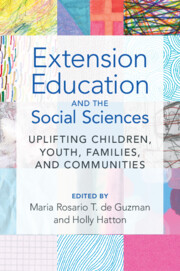
- Extension Education and the Social Sciences
- Extension Education and the Social Sciences
- Copyright page
- Contents
- Contributors
- Part I Overview of Extension and the Social Sciences
- Chapter 1 Introduction
- Chapter 2 Engaged Scholarship
- Chapter 3 Extension’s Role in Promoting Resilience among Rural Families with Low Incomes
- Chapter 4 Extension Programming to Enhance Urban Well-Being
- Part II Addressing Key Issues in the Well-Being of Children, Youth, and Families
- Part III Looking Ahead: Emerging Issues and Trends
- Index
- References
Chapter 1 - Introduction
The Role of Extension Education in Supporting Children, Youth, Families, and Communities
from Part I - Overview of Extension and the Social Sciences
Published online by Cambridge University Press: 28 March 2024

Book contents
- Extension Education and the Social Sciences
- Extension Education and the Social Sciences
- Copyright page
- Contents
- Contributors
- Part I Overview of Extension and the Social Sciences
- Chapter 1 Introduction
- Chapter 2 Engaged Scholarship
- Chapter 3 Extension’s Role in Promoting Resilience among Rural Families with Low Incomes
- Chapter 4 Extension Programming to Enhance Urban Well-Being
- Part II Addressing Key Issues in the Well-Being of Children, Youth, and Families
- Part III Looking Ahead: Emerging Issues and Trends
- Index
- References
Summary
As the largest publicly funded, nonformal education system in the United States, Cooperative Extension (a.k.a. “Extension”) has played a critical role in how technologies and innovations generated through state agricultural experiment stations (AES) and land-grant universities (LGUs) in the United States have been translated and shared directly to its constituents for over a century. Extension has served as a unique and robust system to collaborate, generate, and disseminate research, as well as to engage in mission-oriented work to support communities in optimizing their current and future circumstances and through collaborative partnerships shaping the ways in which we cultivate and preserve food, how we educate and care for our children, manage our finances, work with communities, and support populations disproportionality affected by structural inequities. The current volume brings together leading scholars to discuss Extension’s contributions to the well-being of children, youth, families, and communities; and to critically reflect on Extension’s future directions in light of significant shifts in the context in which it now operates.
Keywords
Information
- Type
- Chapter
- Information
- Extension Education and the Social SciencesUplifting Children, Youth, Families, and Communities, pp. 3 - 14Publisher: Cambridge University PressPrint publication year: 2024
References
APLU. (n.d.). Cooperative Extension Section (CES). Retrieved on July 18, 2023 from www.aplu.org/members/commissions/food-environment-and-renewable-resources/board-on-agriculture-assembly/cooperative-extension-section/Google Scholar
Arnold, S., & Place, N. (2010). What influences agents to pursue a career in Extension? The Journal of Extension, 48(1), Article 9. https://tigerprints.clemson.edu/joe/vol48/iss1/9Google Scholar
Brodeur, C. W., Higgins, C., Galindo-Gonzalez, S., Craig, D. D., & Haile, T. (2011). Designing a competency-based new county extension personnel training program: A novel approach. The Journal of Extension, 49(3), Article 2. https://tigerprints.clemson.edu/joe/vol49/iss3/2Google Scholar
Bronstein, L. R. (2003). A model for interdisciplinary collaboration. Social Work, 48(3), 297–306. https://doi.org/10.1093/sw/48.3.297Google Scholar
Coppess, J., Paulson, N., Schnitkey, G., & Zulauf, C. (2018). Cooperative Extension challenges: Funding and remaining relevant. AgFax. 2018 August. Retrieved on November 22, 2023 from www.agfax.com/2018/08/24/cooperative-extension-challenges-funding-and-remaining-relevant/Google Scholar
DeBord, K. (2007). How integrated extension programming helps market Cooperative Extension: The North Carolina recommendation. The Journal of Extension, 45(5), Article 2.Google Scholar
Derry, S. J., & Schunn, C. D (2005). Interdisciplinarity: A beautiful but dangerous beast. In Derry, S. J., Schunn, C. D., & Gernsbacher, M. A. (Eds.), Interdisciplinary collaboration: An emerging cognitive science (pp. xii–xx). Taylor and Francis.Google Scholar
Gould, F. I., Steele, D., & Woodrum, W. J. (2014). Cooperative Extension: A century of innovation. The Journal of Extension, 52(1), Article 3. https://tigerprints.clemson.edu/joe/vol52/iss1/3Google Scholar
Moody, Z., & Darbellay, F. (2019). Studying childhood, children, and their rights: The challenge of interdisciplinarity. Childhood, 26(1), 8–21. https://doi.org/10.1177/0907568218798016Google Scholar
Narine, L., & Meier, C. (2020). Responding in a time of crisis: Assessing extension efforts during COVID-19. Advancements in Agricultural Development, 1(2), 12–23. https://doi.org/10.37433/aad.v1i2.35Google Scholar
Reed, L. (2022). Nebraska U continues to assist with 2019 flooding recovery. Nebraska Today. 2022 March. Retrieved on November 23, 2023 from https://news.unl.edu/newsrooms/today/article/nebraska-u-continues-to-assist-with-2019-flooding-recovery/Google Scholar
USDA-NIFA. (2021). USDA-NIFA, CDC and Cooperative Extension team up for vaccine education in rural America. Retrieved from www.nifa.usda.gov/about-nifa/press-releases/usda-nifa-cdc-cooperative-extension-team-vaccine-education-rural-americaGoogle Scholar
USDA-NIFA. (n.d.). Cooperative Extension System. Retrieved July 18, 2023 from www.nifa.usda.gov/about-nifa/how-we-work/extension/cooperative-extension-systemGoogle Scholar
Wang, S. L. (2014). Cooperative Extension System: Trends and economic impacts on U.S. agriculture. Choices: The Magazine of Food, Farm, and Resource Issues. Agricultural and Applied Economics Association, 29(1), 1–8.Google Scholar
Accessibility standard: Unknown
Why this information is here
This section outlines the accessibility features of this content - including support for screen readers, full keyboard navigation and high-contrast display options. This may not be relevant for you.Accessibility Information
Accessibility compliance for the HTML of this chapter is currently unknown
and may be updated in the future.
- 1
- Cited by