





Introduction
Migration continues to be consequential for citizens and states around the world as it raises questions that have economic, political, and public policy implications. Perhaps chief among them are debates about who should be prioritized for admission into the country, and on what grounds. This has animated several decades of empirical research into the forms and drivers of immigration attitudes in receiving countries, particularly in higher-income settings. These studies consistently show that people prefer immigrants with higher skill levels – mainly understood as those possessing more formal education. This preference (a ‘skills premium’) appears to be driven largely by sociotropic economic and fiscal considerations rather than respondents’ own occupational profiles or economic standing (Hainmueller and Hopkins Reference Hainmueller and Hopkins2015; Heath and Richards Reference Heath and Richards2019; Helbling and Kriesi Reference Helbling and Kriesi2014; Igarashi, Miwa and Ono Reference Igarashi, Miwa and Ono2022; Valentino et al. Reference Valentino, Soroka, Iyengar, Aalberg, Duch, Fraile, Hahn, Hansen, Harell, Helbling and Jackman2019). Moreover, the skills premium persists whether skill is described using either abstract terms such as ‘high’ and ‘low’ or specific occupational labels (Ford and Mellon Reference Ford and Mellon2020; Naumann and Stoetzer Reference Naumann and Stoetzer2018; Naumann, Stoetzer and Pietrantuono Reference Naumann, Stoetzer and Pietrantuono2018a).
Policies in most receiving countries tend to mirror these favorable public attitudes toward high-skilled immigration. Governments typically prioritize the admission of high-skilled labor immigrants (Czaika and Parsons Reference Czaika and Parsons2017) and grant them more rights compared with their lower-skilled counterparts, such as fuller access to labor markets and pathways toward permanent residency (Ruhs Reference Ruhs2013a). These distinctions are often justified by the belief that high-skilled immigration boosts national economic performance by raising productivity, fostering innovation, and contributing to long-run growth (Boubtane, Dumont and Rault Reference Boubtane, Dumont and Rault2016; Kerr et al., Reference Kerr, Kerr, Ozden and Parsons2016).
Despite the centrality of skill in theories explaining immigration attitudes, we argue that individuals do not evaluate immigrant labor solely based on skill level or cultural attributes unrelated to their labor market profile such as nationality, ethnicity, or religion (Ford and Mellon Reference Ford and Mellon2020). Rather, we propose that individuals use two evaluative logics based on two distinct sets of sociotropic judgments: one centered on perceptions of economic and fiscal contribution of the jobs that immigrants perform (proxied by skill level) and the other based on perceptions of the moral worth and social value of those jobs. In other words, alongside a skills premium, individuals also apply a social value or essentiality premium when judging the desirability of immigrant workers. By doing so, they can reward immigrants viewed as contributing to collective welfare and a successful functioning of society, even if they are low-skilled.
Although these evaluative logics may overlap in practice and covary in individual judgments, we argue that they remain analytically distinct and should be examined separately to clarify their respective roles in shaping attitudes toward immigrant labor. We develop this argument in two steps. First, we draw on scholarship about the subjective valuation of work and the cultural foundations of occupational hierarchies (Budig, Hodges and England Reference Budig, Hodges and England2019; Jiang Reference Jiang2025; Lamont Reference Lamont2012; Valentino Reference Valentino2020) to provide a theoretical basis for our claim that skill is only one component of immigrants’ labor market profiles that the public considers when forming admission preferences. With few exceptions (eg Gerver Reference Gerver2022), immigration public opinion research has largely overlooked how people also assign moral worth and social value to occupations and to the workers who perform them, and how these evaluations relate to immigration attitudes.
Second, we empirically develop our argument by way of two survey-based studies. Study 1 uses data from a preregistered conjoint survey experiment (N = 4,951) fielded in the UK during its COVID-19 lockdown in January 2021 (The Institute for Government 2021). The COVID-19 pandemic brought visibility not only of health sector workers but also of low-skilled workers providing essential services in sectors such as utilities, waste disposal, food delivery, and food manufacturing and processing. Many of the so-called ‘essential’ or ‘key’ workers during the pandemic were in low-paid and low-skilled jobs, yet their contributions to society’s well-being during a public health and economic emergency became highly visible and widely recognized (Blau, Koebe and Meyerhofer Reference Blau, Koebe and Meyerhofer2021; The Lancet 2020), likely amplifying their moral valuation and perceived social contributions. In addition, a substantial share of essential workers in both high- and low-skilled jobs were immigrants (Fassani and Mazza Reference Fassani and Mazza2020; Fernández-Reino, Sumption and Vargas-Silva Reference Fernández-Reino, Sumption and Vargas-Silva2020; Office for National Statistics 2020). This exceptional context provided an opportunity to examine whether the public assigned a premium to immigrants in essential jobs independently of their skill level. Thus, Study 1 examines whether individuals viewed labor immigrants more favorably when described as working in occupations deemed essential during the pandemic.
In line with our expectations, we find that, net of skill, respondents were more likely to prefer admitting immigrants working in essential rather than nonessential jobs by 22 percentage points, and more likely to view them as having a positive impact on the British economy compared with nonessential workers by 10 percentage points. These results hold even after accounting for differences in essential jobs’ saliencies during the pandemic (by excluding health- and personal care-sector jobs) and after 6 months as the immediate crisis lessened. Additional exploratory analyses reveal that occupational essentiality matters more for respondents’ preferences for admission than for their perceptions of immigrants’ economic impact. This suggests that the premium to immigrant essential workers is likely driven by perceptions of societal usefulness and public benefit rather than by purely economic or fiscal assessments.
Then, Study 2 further probes immigrant workers’ essentiality as a distinct dimension of work valuation compared with other aspects of occupations that may also confer material and symbolic value, such as social value, prestige, and exposure to labor shortages. Empirically, we draw on data from an online survey (N = 1,944) fielded in the UK during February–March 2025. Respondents evaluated a range of occupations, including those examined in Study 1, in terms of their perceived essentiality in a pandemic context, social value, economic value, skill level, prestige, and exposure to labor shortages. Public perceptions of essentiality during a health crisis are closely related to perceptions of social value and distinct from skill levels. Meanwhile, skill level is strongly associated with prestige perceptions. Linking Study 2 to Study 1 shows that admission preferences for immigrant workers align, reflecting the combined influence of economic-fiscal and moral-social evaluations rather than a single dominant logic.
In sum, theories of immigration attitudes that focus primarily on economic self-interest and sociotropic fiscal concerns provide an incomplete account of how individuals evaluate immigrants’ occupational profiles. Alongside economic considerations explaining the skill premium, immigration attitudes also reflect judgments about which forms of work – and, by extension, which workers – are viewed as socially valuable and worthy (Lamont Reference Lamont2012; Valentino and Vaisey Reference Valentino and Vaisey2022). Our point is not to downplay the importance of fiscal and economic reasoning, but rather to argue that a moral-social evaluative logic grounded in judgments about essentiality and contribution to the common good also inform public attitudes toward labor immigrants. These distinct yet overlapping evaluative logics regarding what is materially rewarded by the economy and what is symbolically valued by society help explain why public support for immigrant workers varies across occupations in ways that skill-based accounts alone cannot capture.
The relationship between immigrants’ occupational profile and attitudes toward immigrant labor
Major explanations of public opinion on immigration have been historically divided between theories focusing on cultural versus economic drivers. On the cultural side, research on perceived cultural threats shows how nativism, ethnocentrism, and group stereotyping explain levels of opposition toward immigrant minorities of different national origins (Bansak, Hainmueller and Hopkins Reference Bansak, Hainmueller and Hangartner2016; Creighton and Jamal Reference Creighton and Jamal2015; Flores and Azar Reference Flores and Azar2023; Ford Reference Ford2011; Ford and Mellon Reference Ford and Mellon2020; Hainmueller and Hiscox 2010). On the economic side, economic explanations are split between theories focusing on sociotropic economic considerations on the fiscal impact of immigration (Citrin, Green, Muste et al. Reference Citrin, Green, Muste and Wong1997) and models that foreground individuals’ material self-interest – including concerns about increased labor market competition (Malhotra, Margalit and Hyunjung Mo Reference Malhotra, Margalit and Hyunjung Mo2013; Mayda Reference Mayda2006; Pardos-Prado and Xena Reference Pardos-Prado and Xena2019) and individual fiscal burden (Facchini and Mayda Reference Facchini and Mayda2008; Gerber, Huber, Biggers et al. Reference Gerber, Huber, Biggers and Hendry2017). In both sociotropic and self-interest models, immigrants’ skill level is a central determinant of public preferences.
Most empirical evidence has shown that the premium placed on high-skilled immigrants mainly reflects sociotropic perceptions about their positive contribution to tax revenues, economic growth, and innovation (Helbling and Kriesi Reference Helbling and Kriesi2014; Igarashi, Miwa and Ono Reference Igarashi, Miwa and Ono2022). That said, Newman and Malhotra (Reference Newman and Malhotra2019) show that ‘skill’ is not always race-neutral and can function as a proxy for cultural and racial desirability. Their study demonstrates that skill matters more for admission preferences of US respondents when evaluating stigmatized and highly prevalent minority groups than for nonstigmatized immigrants.
The public preference for high-skilled migration is likely reinforced by governments’ favorable policies and political discourse around high-skilled migration (Chaloff and Lemaître Reference Chaloff and Lemaître2009). The UK is no exception to this trend: sets of immigration policies proposed under the last Conservative government (2019–2024) explicitly aimed to bring ‘the best and brightest talent from around the world (Home Office and UK Visas and Immigration 2020b), framing selective migration as essential for economic growth (Home Office and UK Visas and Immigration 2020a). More recently in 2025, the Labour government raised salary thresholds and limited long-term work visas to graduate-level jobs, further increasing the selectivity of inflows based on skill level Prime Minister’s Office 2025.
Beyond skill: what other characteristics of immigrants’ occupational profiles matter for public attitudes?
While acknowledging the importance of skill in shaping attitudes toward labor immigration, we argue that occupations and the workers in them convey more than their skill levels or potential fiscal contributions. Rather, they are also evaluated in terms of their social contribution and moral worth. Research on attitudes toward immigrant labor has largely overlooked a rich body of scholarship on the cultural processes through which societies assign both material value (eg pay) and symbolic value (eg prestige, social value, moral worth) to different kinds of work (Jiang Reference Jiang2025; Ridgeway Reference Ridgeway2014; Valentino Reference Valentino2020, Reference Valentino2021; Zhou Reference Zhou2005). To fully explain attitudes toward immigrant labor, it is therefore necessary to consider public perceptions of the societal usefulness and moral worth of occupations (symbolic value) alongside their fiscal and economic value (material value). Public judgments about immigrant labor are grounded in multiple, and not always overlapping, work valuation criteria that do not always align. Indeed, variation in attitudes toward workers in occupations at similar skill or education levels suggests that criteria beyond skill are at play. For instance, high-skilled immigrants employed as financial analysts are frequently viewed less favorably than low-skilled immigrants in construction, care, or agriculture, despite the former’s higher earnings and presumed fiscal contributions (Kantar Public 2023). Such variation points to the relevance of symbolic and moral valuations of work in shaping immigration preferences.
From a public opinion perspective, there is no reason to assume that the material valuation of work (ie perceptions of fiscal contributions) should matter more than the symbolic valuation (ie social value perceptions). Policies and public debates about immigration are often framed around immigrants’ expected contributions to society broadly understood (Hainmueller and Hopkins Reference Hainmueller and Hopkins2014), not solely in terms of their fiscal impact. As a result, public judgments may incorporate moral assessments of whether the work immigrants perform is socially valuable, indispensable, or worthy of recognition (inherently or in specific contexts), irrespective of skill or remuneration. For example, during the COVID-19 pandemic, immigrants employed in frontline occupations and in sectors designated as essential by governments (Farquharson, Rasul and Sibieta Reference Farquharson, Rasul and Sibieta2020; Fernández-Reino and McNeil Reference Fernández-Reino and McNeil2020; OECD 2020) received widespread public and media recognition regardless of their skill level (De Camargo and Whiley Reference De Camargo and Whiley2020). Indeed, the proportion of essential workers in logistics, manufacturing, and retail who reported feeling appreciated by the public increased by 17 percentage points during the pandemic (YouGov 2020).
Two evaluative logics of work that matter for attitudes toward immigrant labor
Building on the previous discussion, we advance two evaluative logics that jointly shape how immigrants’ occupational profiles are evaluated and, ultimately, how desirable different types of immigrants appear to public opinion in destination countries: (1) economic-fiscal value and (2) moral-social value. Despite the centrality of prestige in the literature examining the cultural valuation of work (Jiang Reference Jiang2025; Ridgeway Reference Ridgeway2014; Valentino Reference Valentino2020, Reference Valentino2021; Zhan Reference Zhan2015; Zhou Reference Zhou2005), we do not consider perceptions of immigrants’ occupational prestige as a distinct evaluative logic. This is because prestige judgments correlate strongly with perceptions of an occupation’s pay, skill, and cognitive demands (captured by the economic-fiscal logic), while less so with its degree of authority or power, and only marginally with its social contribution (Bukodi, Dex and Goldthorpe Reference Bukodi, Dex and Goldthorpe2010; Treiman and Rossi Reference Treiman and Rossi2013).
The first logic corresponds to the dominant explanation for the ‘skills premium’, ie sociotropic economic reasoning. Individuals infer fiscal and productivity contributions from immigrants’ skill levels, education, and pay (Hainmueller and Hopkins Reference Hainmueller and Hopkins2014; Valentino et al. Reference Valentino, Soroka, Iyengar, Aalberg, Duch, Fraile, Hahn, Hansen, Harell, Helbling and Jackman2019). The logic is straightforward: high-skilled workers are perceived as net contributors to public finances, whereas low-skilled workers are seen as a net burden and more likely to be welfare-dependent. This literature implicitly assumes that immigrants’ occupational profile matters to the public only insofar as they proxy their skill level, one of the main determinants of immigrants’ fiscal contribution (OECD 2013). If this logic were exhaustive, then skill level should wholly determine admission preferences and subjective assessments of immigrants’ economic impact. Yet, deviations from this pattern suggest that other evaluative logics are at work.
A second logic, largely absent from empirical immigration attitudes research, centers on the moral or social valuation of work. This concerns beliefs about whether an occupation contributes to the common good, helps society function, or provides services that are collectively necessary or morally deserving (Lamont Reference Lamont2012; Valentino and Vaisey Reference Valentino and Vaisey2022). Crucially, social value often cuts across skill levels: high-skilled workers such as doctors and teachers are perceived as having high social value, but low-skilled care workers, cleaners, and truck drivers can also be judged as socially indispensable (Newlands and Lutz Reference Newlands and Lutz2024).
Contextual factors can play an important role in making one or the other evaluative logic more salient. For example, the COVID-19 pandemic likely amplified the moral-evaluative logic by making the societal importance of many low-wage and low-prestige occupations highly visible (Anderson, Poeschel and Ruhs Reference Anderson, Poeschel and Ruhs2021). Essentiality, as designated during the crisis, could therefore be understood as a context-specific manifestation of moral-social value, as it did not revolve around skill level, prestige, or fiscal contributions.
In sum, understanding how immigrants’ occupations relate to public attitudes requires moving beyond a sole focus on sociotropic fiscal judgments. We thus conceptualize immigration attitudes as a function of how the public evaluates the work immigrants perform in terms of perceived economic and fiscal contributions on the one hand, and moral worth and social contribution on the other hand. This represents a relevant theoretical contribution to the literature on immigration attitudes, in which subjective perceptions of immigrants’ sociotropic social contributions have largely been ignored. While other factors such as immigrants’ country of origin, religion, or ethnicity also matter for public opinion, our focus here is on immigrants’ occupational profiles.
Although these two logics may overlap empirically, they are conceptually distinct and have different empirical implications. If the economic logic dominated, people would consistently favor high-skilled over low-skilled immigrants, independent of occupation. If the moral-social logic dominated, immigrants in socially valuable occupations would be preferred regardless of skill and pay.
In what follows, we empirically test how and to what extent these evaluative logics explain variation in support for immigrant labor across occupations. In Study 1, we focus on essentiality during the COVID-19 pandemic as one context-specific manifestation of the broader moral-social value logic because it provides a clear, externally defined categorization of societal usefulness. Then, in Study 2, we assess whether essentiality is perceived by the public as a distinct evaluative dimension relative to dimensions that capture the fiscal-economic evaluative logic (skill level, economic value, and labor shortage perceptions) and the moral-social logic (social value perceptions). Study 2 provides an occupation-level mapping of how respondents perceive a broad set of jobs across different occupational attributes, allowing us to test whether what we call an ‘essentiality premium’ observed in Study 1 reflects a unique moral-social valuation of work rather than other correlated attributes.
Study 1: The COVID-19 pandemic and the role of occupational essentiality in attitudes toward immigrant labor
During the COVID-19 pandemic, media attention and public awareness of the so-called ‘essential’ or ‘key’ workers became commonplace, especially during periods of lockdown (BBC 2020; Blau, Koebe and Meyerhofer Reference Blau, Koebe and Meyerhofer2021; Enninful Reference Enninful2020; ITV 2020; The Lancet 2020). Across many high-income countries including the US and the UK, the extent to which jobs were considered essential or key depended on how directly they related to providing services seen as critical for the continued functioning of society and the economy. Formally defining these functions was a task for governments and associated agencies; in the UK, this fell to the Cabinet Office and Department for Education (Cabinet Office and Department for Education 2020). Government definition of who was in an essential job was important because it determined who was allowed to continue working in-person or not. The Office for National Statistics (ONS) provided a detailed list of essential occupations based on government guidance, using the UK 2010 Standard Occupational Classification scheme at the four-digit level and the 2007 Standard Industrial Classification of Economic Activities scheme at the one-digit level.
Crucially, the way ‘essential’ work was defined, implemented, and portrayed in popular media during COVID-19 cut across traditional occupational skill categories. This brought into focus many jobs that were lower-paid, precarious, or typically undervalued (Fassani and Mazza Reference Fassani and Mazza2020; Fernández-Reino and McNeil Reference Fernández-Reino and McNeil2020; Guerrero, Avgar, Phillips et al. Reference Guerrero, Avgar, Phillips and Sterling2020; Isaac and Elrick Reference Isaac and Elrick2021; Office for National Statistics 2020; The Lancet 2020). On the one hand, some of the most visible essential occupations during the pandemic already possessed high social value, particularly those in the health and social care sectors (see Newlands and Lutz Reference Newlands and Lutz2024). Indeed, research preceding the pandemic had already shown that immigrants working as nurses or doctors elicited exceptionally strong public support – likely because of perceptions of being both high-skilled and making a substantial contribution to the welfare of society (Hainmueller and Hopkins Reference Hainmueller and Hopkins2015). On the other hand, a wide range of essential occupations highlighted during COVID-19 are typically low paid, cannot be performed remotely, and are often disproportionately staffed by immigrant workers (Allen, Pacas and Martens Reference Allen, Pacas and Martens2022). Although some of these jobs may have been valued prior to the pandemic, COVID-19 dramatically increased the visibility of their societal contributions, elevating the perceived importance of both essential sectors and the immigrant workers performing these roles.
In the UK, essential workers represented a third of the workforce in employment, although this share was higher in some sectors such as healthcare (80.9%), social care (65.1%), and education (58%) (Farquharson, Rasul and Sibieta Reference Farquharson, Rasul and Sibieta2020; Office for National Statistics 2020). Immigrants were slightly overrepresented in healthcare (18.2% of the workforce), which was the sector with highest share of essential workers (80.9%). However, the sector most associated with immigrant labor – hospitality, where immigrants made up 25.3% of the workforce in 2019 – was not classified as essential. Crucially, the skill distribution of the essential workforce was similar for both immigrant and native workers; an estimated 44.7% of essential UK-born workers were in low- or medium–low-skilled occupations, compared with 45.8% among immigrants.Footnote 1
Following from the above and based on our conceptualization of the occupational determinants of immigration attitudes, we expect that immigrants working in essential jobs will be considered more desirable compared with immigrants working in nonessential jobs, both in terms of preference for admission and perceptions of their impact on the economy.Footnote 2
H1. (preregistered). Respondents will be more likely to admit immigrants working in essential occupations (ie those which were considered critical during the pandemic context as defined by the UK government) compared with those working in nonessential occupations.
H2. (preregistered). Respondents will view the economic impact of immigrants working in essential occupations more positively compared with those working in nonessential occupations.
Additionally, we expect that the economic/fiscal evaluative logic – sociotropic economic considerations about immigrants’ fiscal contribution – which is central to the skills premium, is less relevant to the essentiality premium, given the large share of low-skilled essential workers. Instead, we anticipate that perceptions of essential workers’ direct contributions to societal well-being and public health (moral-social evaluative logic) are more important to explain the essentiality premium. Consequently, we empirically test two exploratory (ie not preregistered) hypotheses. First, the size of the premium given to essential workers should be smaller when respondents are asked about immigrants’ benefits to the economy compared to when they are asked about their admission preferences.
H3. (exploratory). The premium given to high- and low-skilled essential workers will be smaller when respondents are asked about immigrants’ impact on the economy than when they are asked about their admission preferences.
Second, this difference should not be salient when measuring the skills premium: people may prefer admitting certain immigrant profiles for a variety of reasons, of which working in an essential occupation is only one, along with cultural and economic factors. By contrast, asking respondents to evaluate immigrants’ economic contributions focuses attention on a single factor.
H4. (exploratory). The premium given to all high-skilled profiles will be the same when respondents are asked about immigrants’ impact on the economy than when they are asked about their admission preferences.
Placing H3 and H4 alongside each other, it follows that:
H5. (exploratory). The difference in ratings between the economic impact outcome and the admission outcome should be larger for the essentiality premium than for the skills premium.
Research design and outcome variables
We conducted a randomized choice-based conjoint experiment with YouGov UK in January 2021, during the third UK lockdown, to a sample of 4,951 UK adults.Footnote 3 The sample was broadly representative of the UK population in terms of age, gender, education, political characteristics, and region. We also conducted two subsequent waves in April and June–July 2021 with the same respondents, which we use as a robustness check. Unlike experiments where respondents are assigned to treatments that vary in terms of only one or a few characteristics of interest (Mutz Reference Mutz2011), conjoint designs allow the estimation of potentially many different treatment components simultaneously (Bansak, Hainmueller and Hopkins et al., Reference Bansak, Hainmueller, Hopkins, Yamamoto, Druckman and Green2021; Hainmueller, Hopkins and Yamamoto Reference Hainmueller, Hopkins and Yamamoto2014).
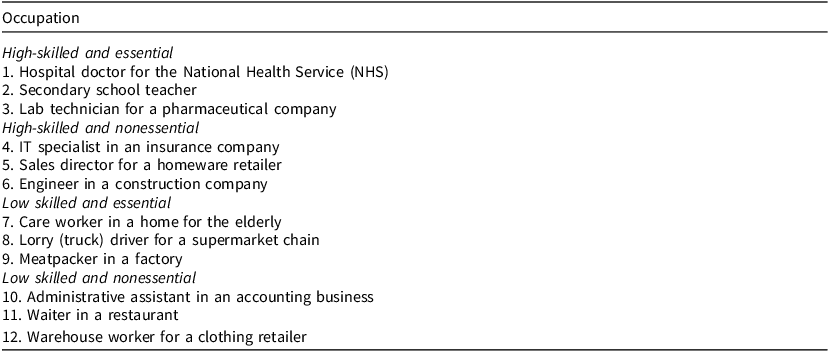
We presented respondents with two pairs of hypothetical immigrant profiles that had an occupation and national origin randomly selected from the set list of 12 occupations seen in Table 1.Footnote 4 Our choices of occupations covered jobs that varied in skill level, based on the ONS’ skill-level classification of occupations developed in 2010 (low and medium–low-skilled vs high- and medium–high-skilled) and the extent to which they were considered essential by the ONS based on the UK government guidelines. We selected nationalities based on countries’ historical ties to the UK and their representation in the immigrant population to enhance realism and external validity.
Occupations used in the experiment, by levels of skill and essentiality

Using 2019 UK Labour Force Survey data, we considered occupations with more than 40% of essential workers as ‘essential’ and those with less than 20% as ‘nonessential’. Selecting the 40% threshold allowed us to include occupations beyond the healthcare, social care, and education sectors. An occupation’s essentiality could vary depending on the industry, as there were sectors where almost all workers were considered essential (eg healthcare), whereas other sectors had almost no essential workers (eg hospitality or recreational services). We also avoided occupations with very low shares of immigrant workers. Table A4 in the online Appendix shows the percentage of essential workers in the selected occupations, with and without considering the industrial sector of the occupation.
Crucially to our study, our design did not disclose the statuses of each occupation as either essential or nonessential, or high-skilled versus low-skilled to avoid priming. This diverges from some previous studies – including those using conjoint designs – that measure preferences for high- and low-skilled immigrants without specifying their occupation (Ford and Mellon Reference Ford and Mellon2020; Hainmueller and Hiscox Reference Hainmueller and Hiscox2010; Naumann, Stoetzer and Pietrantuono Reference Naumann, Stoetzer and Pietrantuono2018b). When no concrete occupations are provided to respondents, they may draw on prototypical occupational profiles they associate with each skill or essential group (Flores and Azar Reference Flores and Azar2023). These mental representations are shaped by context- and country-specific factors, including media, and inevitably influence broader judgments about high- and low-skilled labor migration (Blinder Reference Blinder2015).
We report two outcome variables: priority for admission into the UK (admission outcome) and perception of economic impact on the UK (economic impact outcome). Each outcome was measured using two alternative operationalizations: a binary choice, in which respondents were forced to select one of the two immigrant profiles, and a 7-point rating scale, in which respondents rated each immigrant profile individually, where 1 indicated ‘absolutely should not admit’ or ‘very negative impact’, and 7 indicated ‘absolutely should admit’ or ‘very positive impact’.Footnote 5 With the exception of H5, we use the binary choice questions as the dependent variables to test H1 through H4. As a robustness check, the online Appendix reports the main models estimated with the 1–7 scale as the outcome variables.
Estimation strategy
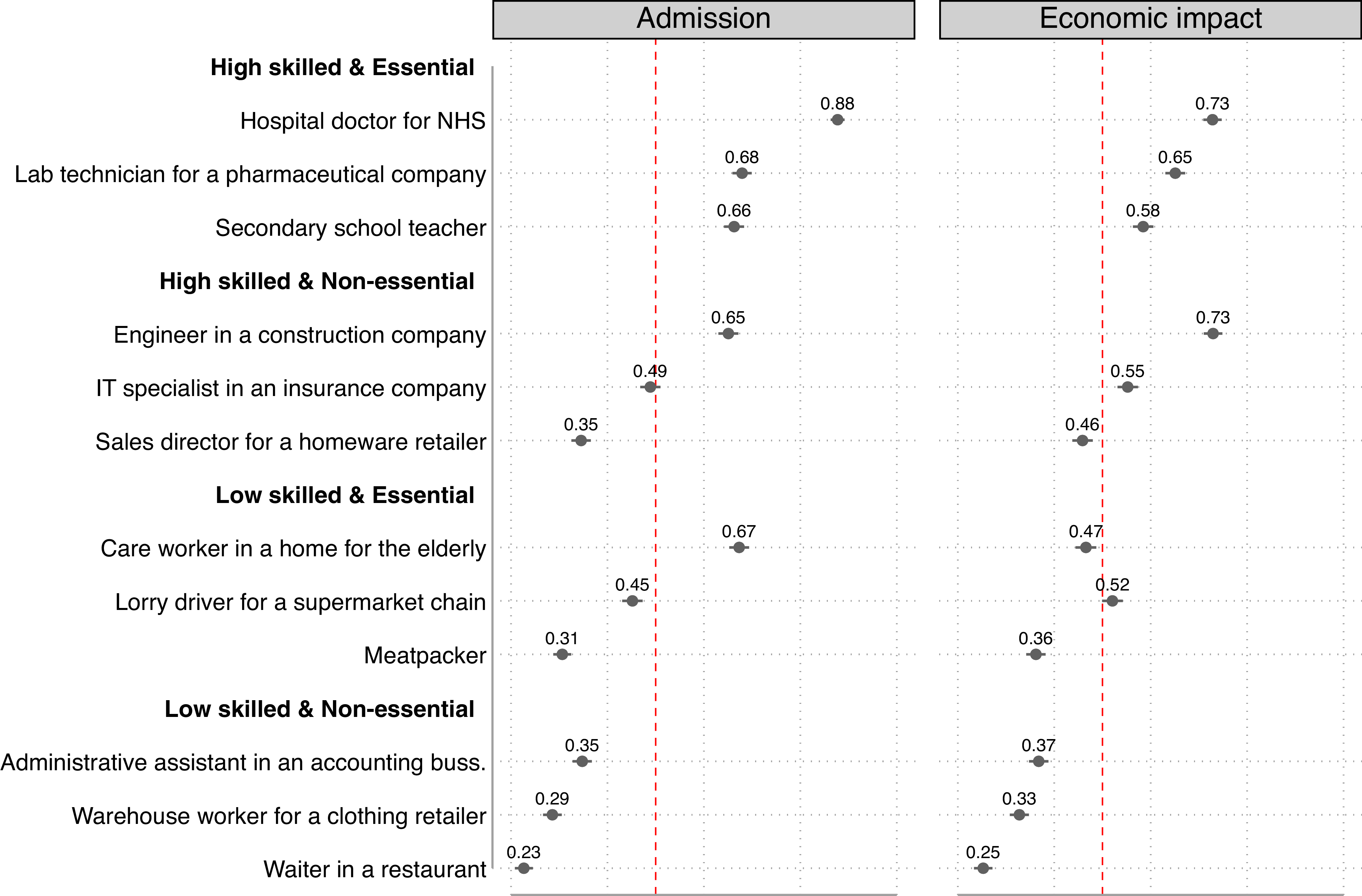
We estimated both the average marginal component effects (AMCEs) and marginal means (MMs) to measure preferences for admissions and perceptions of impact on the economy for different types of immigrants that vary in terms of the treatment variables. AMCEs and MMs are estimated with linear probability models with robust standard error. MMs are more easily interpretable in some cases because they do not require reference to a baseline category (Leeper, Hobolt and Tilley Reference Leeper, Hobolt and Tilley2020; Ratkovic Reference Ratkovic, Druckman and Donald2021). In our design, MMs for the forced choice outcomes indicate the likelihood of a profile being chosen if it contains that attribute, all other attributes being equal.Footnote 6 We report a series of linear probability estimations where the dependent variables of interest are binary (forced choice) variables (Figure 1).
Marginal means for admission and economic-impact preferences, by occupation (binary choice).
Note: Dotted red line refers to the 0.50 mark, which signifies the point at which respondents are more likely to either admit an immigrant possessing a given occupation, or to view that immigrant as having a positive economic impact. The table with the results can be found in the online Appendix, Table A10.

Results
Is there an essentiality premium?
Focusing on high-skilled occupations, we find that immigrants in essential occupations (hospital doctor for the National Health Service [NHS], lab technician in a pharmaceutical company, and secondary school teacher) are generally preferred over immigrants in nonessential occupations. Among immigrants’ profiles in low-skilled occupations, we observe the same pattern except for meatpackers – an essential job that is only preferred for admission over nonessential waiters, also a low-skilled occupation.
The MMs for each occupational profile do not vary substantially when respondents are asked about their admission preferences compared with their perceptions of economic impact. There are, however, some differences worth noting. First, essential occupations in the health, social care, and education sectors (doctor, care worker, schoolteacher) are more often chosen by respondents when they are asked about their admission preferences than when they are asked about the economic impact. By contrast, nonessential occupations such as an engineer in a construction company, an information technology (IT) specialist in an insurance company, a sales director for a homeware retailer, or a warehouse worker for a clothing retailer are more often selected when asked about perceptions of economic impact than regarding admission preferences.
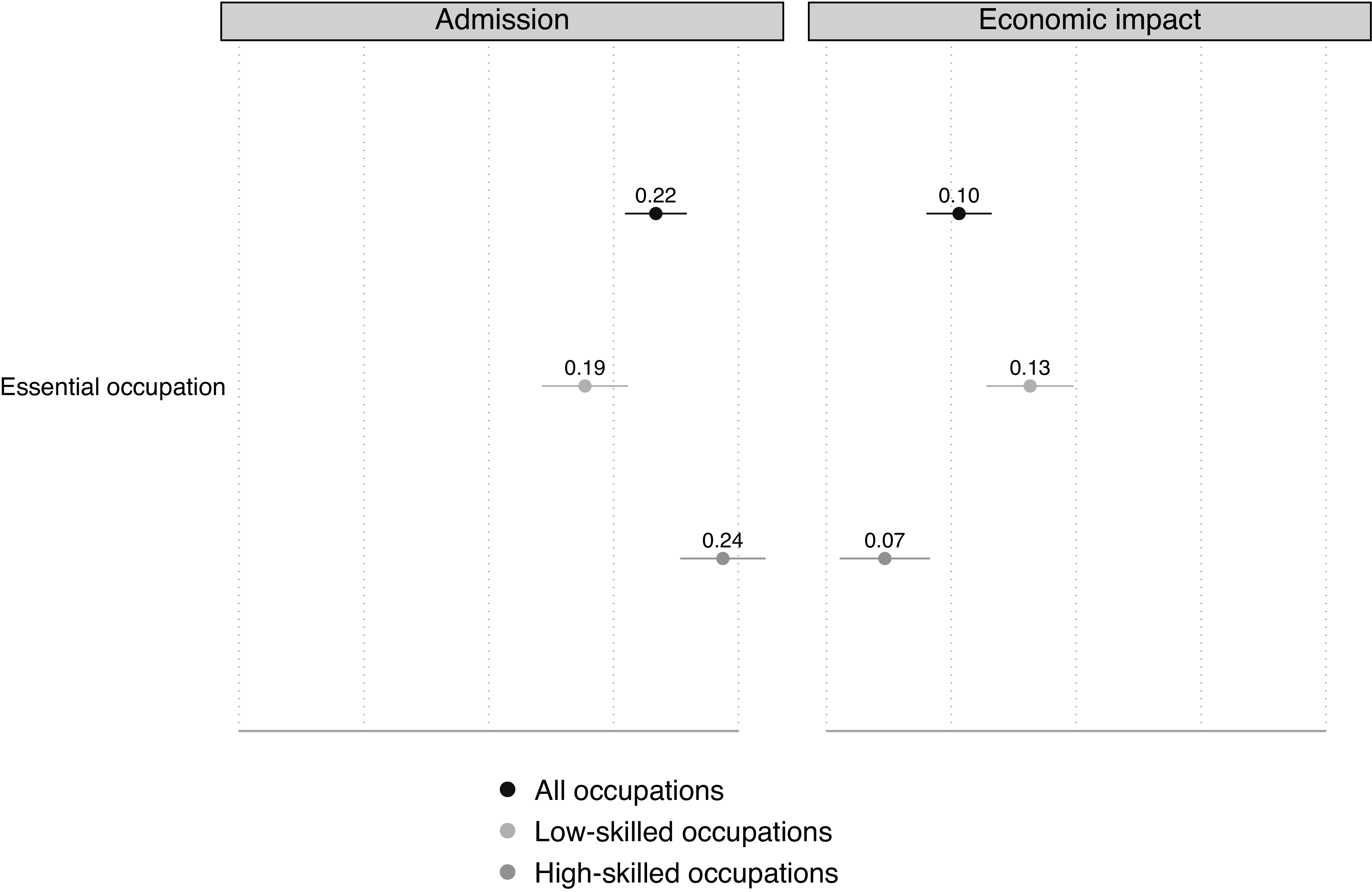
Grouping occupations together by their essential or nonessential statuses (Figure 2), we find clear evidence that respondents are more likely both to admit immigrants working in essential jobs over those in nonessential jobs (by 22 percentage points) and to view them as having a more positive economic impact (by 10 percentage points). Respondents still prefer immigrants working in essential over nonessential occupations, regardless of whether the jobs are low-skilled or high-skilled. Regarding the economic impact outcome, the essentiality premium (10 percentage points) is smaller compared with the admission outcome, but still significant for both high- and low-skilled profiles. Thus, H1 and H2 are supported. The essentiality premium, although reduced, remains significant even when doctors, teachers, and care workers are excluded from the model (see Figure A4 in the online Appendix).
Average marginal component effects (AMCEs) of occupational essentiality on admission and economic-impact preferences, for all, low-skilled, and high-skilled occupations (binary choice).
Note: Baseline level is nonessential. The table with the results can be found in the online Appendix, Table A11.

Does essentiality matter more for admission preferences or economic perceptions?
Although our results show that respondents’ attitudes are sensitive to occupational essentiality, H3 examines in an exploratory manner whether this dimension of immigrants’ profiles matters more for admission preferences than for economic perceptions. To test this, we created a new outcome variable representing the difference between respondents’ ratings of admission preferences and their perceptions of economic impact, both measured on a 1–7 scale. This new outcome variable ranges from −6 (indicating a much higher preference for admission relative to perceived economic impact) to +6 (indicating a much stronger perceived economic impact relative to admission preference).
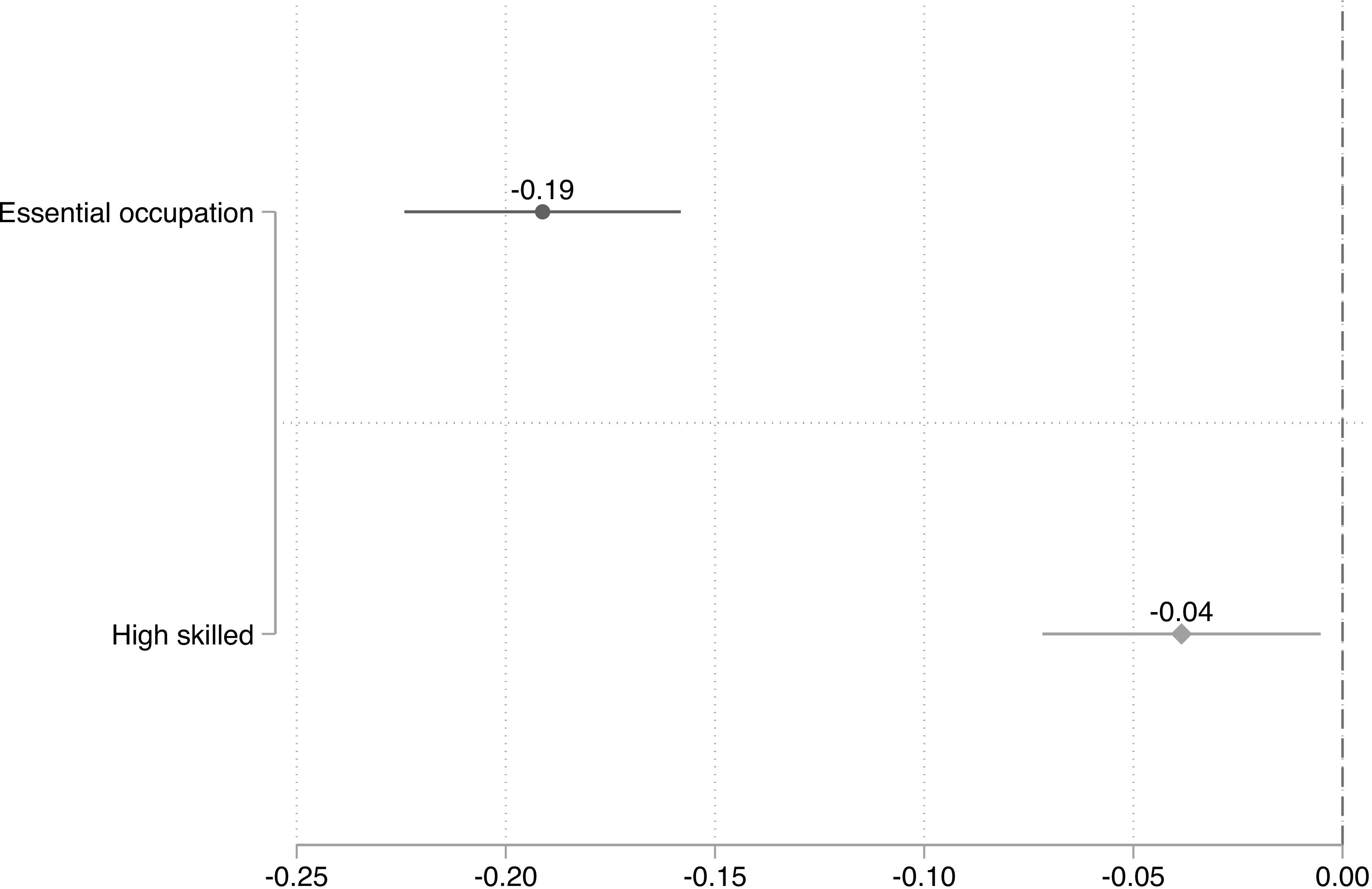
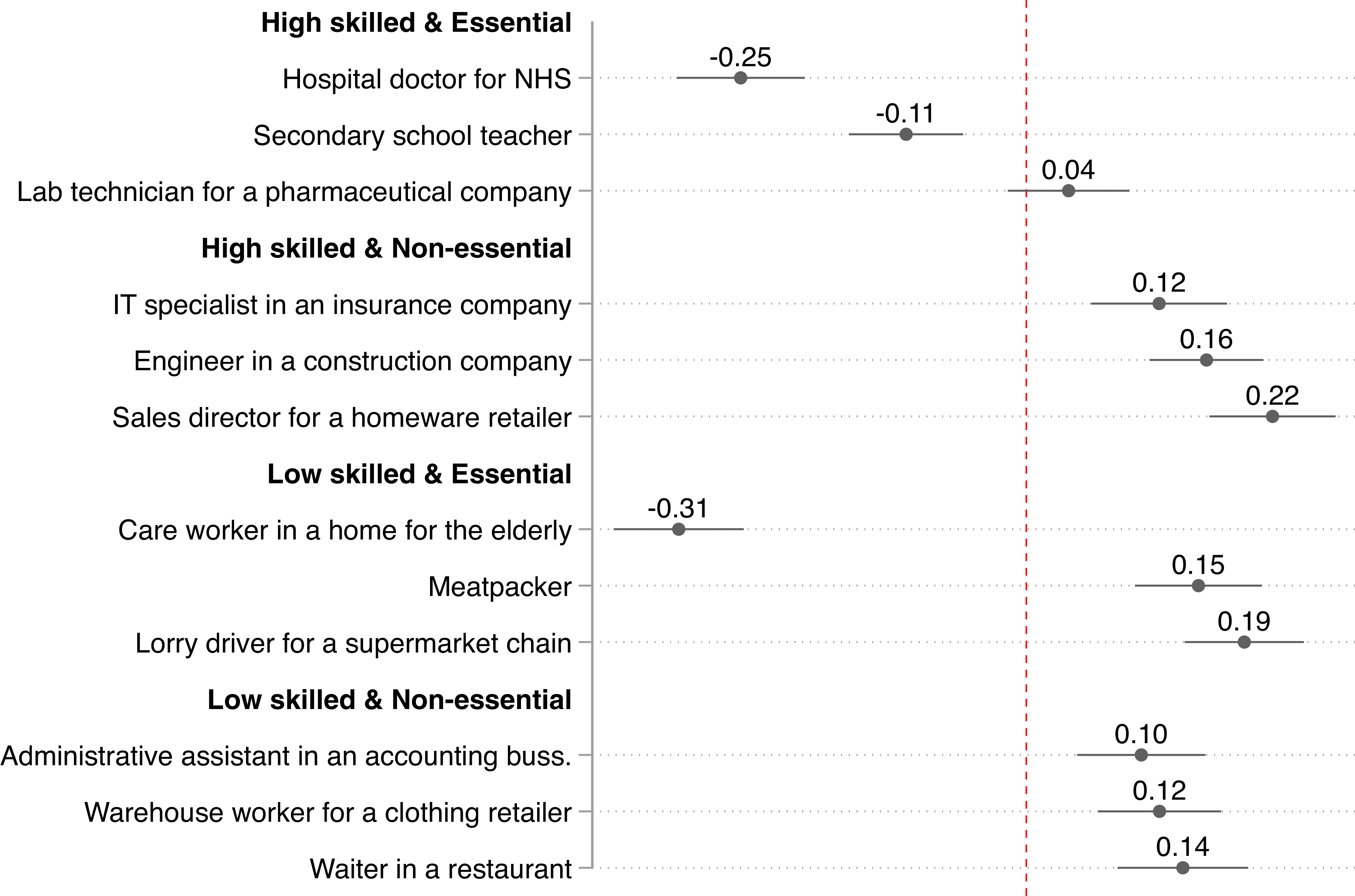
Figure 3 shows that the premium to labor immigrants in essential jobs is larger when respondents are asked about their admission preferences than when asked about the economic impact, by about 0.19 points, lending support for H3. Meanwhile, the skills premium afforded to immigrants in high-skilled jobs is also significantly higher when considering their admission compared with their economic impact, by about 0.04 points, which does not lend support for H4. However, the difference between admission and economic-impact ratings is substantially larger for the essentiality premium than for the skills premium, and the confidence intervals do not overlap; in other words, immigrants’ occupational essentiality matters more than their skill levels for admissibility, which lends support for H5.
Differences between admission preferences and economic-impact perceptions, by occupational essentiality and skill level (AMCEs).
Note: Negative values indicate that, for the same profile, the preference for admission is higher than the economic impact. The outcome variable is constructed by subtracting the admission rating outcome from the economic-impact rating outcome. Baseline levels are nonessential and low-skilled. The table with the results can be found in the online Appendix, Table A12.

Yet, pooling occupations in the high or low essentiality categories hides important heterogeneity that has implications for our theorization of essentiality. Figure 4 shows the differences in MMs between the admission and economic perceptions rating outcomes for all occupations, with negative values still indicating greater ratings for admission preferences over perceptions of economic impact. Doctors, personal care workers, and teachers attract strikingly different evaluations compared with the other occupations; respondents prefer admitting immigrants in these jobs more than they view them as economically beneficial to the UK. By contrast, other essential jobs such as meatpackers and supermarket truck drivers are perceived to be more economically important even if they are not necessarily prioritized for admission. This pattern suggests that, although essentiality is still salient for structuring labor market preferences, it is not globally relevant across all occupations. Rather, other features, such as occupations’ perceived social value, are likely to be relevant regardless of skill level and pay.
Differences between admission preferences and economic-impact perceptions, by occupation (marginal means).
Note: Negative values indicate that, for the same profile, the preference for admission is higher than the economic impact. The outcome variable is constructed by subtracting the admission rating outcome from the economic-impact rating outcome. The table with the results can be found in the online Appendix, Table A13.

Finally, our main results hold across several robustness checks, which we include in the online Appendix. These checks indicate that our findings are not driven by the inclusion of health-related occupations, are not sensitive to changing pandemic conditions, and do not reflect respondents’ changing economic circumstances due to the pandemic. Additional robustness checks and analyses are discussed in the online Appendix.
Study 2: Is essentiality a distinctive feature of occupations or a context-specific manifestation of the moral-social evaluative logic?
Our experimental results from Study 1 show a clear public preference for labor immigrants working in occupations deemed essential during the COVID-19 pandemic. Yet, there remain two reasonable objections to this overall finding, which also present potential threats to our broader theoretical argument about the relevance of two distinct evaluative logics (economic-fiscal and moral-social) driving public opinion toward immigrants in different occupational profiles.
First, because respondents were not informed which occupations and sectors were classified as essential by the UK Government, it is possible that their responses were based on other occupational characteristics that happen to correlate with essentiality in a public health crisis. Second, it is possible that respondents partially based their responses in Study 1 on the economic sectors in which those occupations were situated. For example, some industries may be viewed as more important than others from a moral-social evaluative logic; a warehouse worker for a supermarket chain might be viewed more positively than one working for a clothing retailer. Likewise, an occupation in the public sector might be valued more highly than its equivalent in the private sector because it is perceived as contributing to a collective benefit or good.
To address these alternative explanations as well as probe our theoretical argument connecting attitudes toward immigrant workers and the public valuation of different occupations, we conducted an online survey in February–March 2025 via Prolific.Footnote 7 It comprised 1,944 respondents in the UK drawn to be nationally representative along lines of age, sex, and ethnicity. Sample characteristics appear in the online Appendix (Table A7). Respondents were randomly assigned to one of two sets of 34 occupations (68 in total), among which we included the same 12 occupations from Study 1. Where possible, we varied the type of employer or industry (eg supermarket chain vs clothing retailer) and the ownership of the company (public vs private), while keeping the occupation itself constant. We added occupations varying in levels of skill and share of essential workers, and with low and high scores on the O*NET work activity ‘assisting and caring for others’.Footnote 8 We selected 34 pairs of occupations where variation within each pair was introduced either through the sector of employment or by having closely related roles within the same occupational group. The list of occupations appears in the online Appendix.
Although the full set included 68 occupations, each respondent rated only 34 of the set. This minimized carryover effects and consistency pressure; no respondent rated the same occupation in different sectors or more than one occupation from the same occupational group. Furthermore, to avoid cognitive overload, respondents rated occupations on only one of six dimensions, which was randomly assigned to them: essentiality during a pandemic such as COVID-19, social value (described in the survey as being ‘valuable for the functioning of society’), economic value (‘valuable for the economy’), skill level, prestige, and exposure to labor shortages (‘whether there are enough workers to fill all vacancies’). Respondents rated occupations on a 7-point scale, where 1 indicated the lowest and 7 the highest value for each dimension. The wording of the questionnaire, the list of occupations, and summary statistics for each occupation are provided in the online Appendix.
In what follows, we first focus on the analysis involving the 12 occupations from Study 1, along with corresponding jobs within the same occupational group but situated in different sectors. The full analysis covering all 68 occupations is available in the online Appendix.
Estimation strategy
We calculated the mean rating and standard deviation for each occupation on each of the six dimensions. Since respondents rated occupations on only one of the six dimensions, we cannot directly compare ratings for the same occupation across different dimensions for the same respondent. In other words, we have summary statistics per occupation (means and standard deviations), not individual-level data that would allow us to compute the actual correlation between dimensions for each individual. This means that we can only look at how dimensions relate to one another at the occupational level.
To link Study 1 and Study 2, we report Kendall rank correlations between the admission MMs from Study 1 and the essentiality ratings from Study 2. We do so across the whole set of 12 occupations used in Study 1, since three observations within each of the four occupational classes across categories of skill and essentialness are not enough to support statistical testing. Nevertheless, Kendall correlations tend to be more efficient on smaller samples and resistant to outliers (Croux and Dehon Reference Croux and Dehon2010). Overall, we stress that Study 1 cannot isolate a pure causal effect of essentiality or skill level because occupational profiles also carry information about social value, economic value, and potential labor shortages. Rather, we use Study 2 to assess whether perceptions of essentiality are primarily grounded in a social-moral evaluative logic and therefore empirically more closely associated with perceptions of social value than with attributes tied to the economic-fiscal logic, such as skill level, economic value, occupational prestige, or exposure to labor shortages.
To examine how sector (public vs private) and industry shape the economic-fiscal versus moral-social valuation of occupations and the workers who perform them, we analyze respondents’ evaluations of pairs of occupations within the same occupational group but situated in different sectors or industries.
Finally, to examine whether respondents’ perceptions of occupational shortages are informed by an economic-fiscal evaluative logic, as would be expected, or instead reflect a moral-social evaluative logic, we compare respondents’ perceived occupational shortages with an objective indicator of skills shortage, ie skills shortage vacancy density (SSVD). SSVD is calculated by the UK Department for Education (Department for Education 2024) dividing the total number of employer-reported skills shortage vacancies by the total number of vacancies in each two- or four-digit occupational codes across the UK. The most recent SSVD data, based on the Employer Skills Survey 2024, only include an occupational breakdown at the two-digit level, whereas the SSVD data based on the Employer Skills Survey 2022/2023 provide a breakdown at the four-digit level.
Results
Are essentiality perceptions distinct from perceptions of social value, skill level, economic value, prestige, and labor shortages?
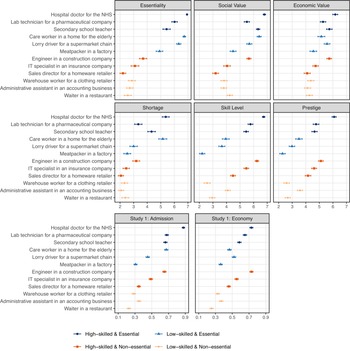
Figure 5 shows the plot of the mean ratings and standard deviations for the subset of 12 occupations used in Study 1 along each occupational attribute (essentiality in a public health emergency, social value, skill, prestige, economic value, and exposure to shortages). For reference, the bottom panels plot the MMs and standard errors by occupation for admission preferences and economic impact from Figure 1 (Study 1).
Mean ratings and standard deviations of Study 1 occupations, by dimension.
Note: For reference, the bottom panels reproduce marginal means and standard errors by occupation for admission preferences and economic impact (binary choice outcomes) from Study 1, where 0.5 indicates a 50% chance of choosing that occupation.

While not representing a true manipulation check given the different sample and time frame, the results do lend reassurance that even several years after the proximate effects of the pandemic, respondents’ perceptions of which occupations are more essential in a pandemic context still align closely with those set by the UK government during the crisis. Notably, the six highest-rated occupations in terms of essentiality match those selected as ‘essential’ in Study 1. Likewise, respondents rated the six occupations designated as ‘nonessential’ in Study 1 substantially lower in terms of essentiality during a pandemic, suggesting that respondents’ pandemic-essentiality judgments are anchored in perceived contributions to collective welfare and societal functioning. By contrast, the occupational dimensions more related to the economic-fiscal evaluative logic (skill, economic value, prestige, and labor shortages) do not track essentiality as closely, eg high-skilled engineers and IT specialists are seen as economically valuable and relatively high-prestige, yet score comparatively low on essentiality in a public health emergency.
Visual inspection of Figure 5 reveals overlap between public perceptions of occupational essentiality and social value, and to a lesser extent economic value and perceived labor shortages. By contrast, there is little overlap with perceived skill levels and prestige, which instead correlate strongly with each other. The overlap between social value and essentiality is particularly strong for hospital doctors (high-skilled) and care workers (low-skilled), followed by meatpackers (low-skilled), lab technicians (high-skilled), and lorry drivers (low-skilled). Except for schoolteachers (high-skilled), the essentiality ratings are higher than the corresponding social value ratings, despite the close overlap.
The visual patterns shown in Figure 5 are corroborated by formal correlation analyses across occupational attributes reported in the online Appendix, where we include both Pearson correlation coefficients and Kendall’s tau-b rank coefficients for the 12 occupations included in Study 1, and for all the occupations in the Study 2 sample (68) (Figures A14 and A15). Regardless of whether we consider Pearson or Kendall’s tau-b coefficients, essentiality perceptions appear most strongly correlated with social value, followed by labor shortage perceptions and economic value. This pattern is consistent with a moral-social halo effect: occupations viewed as socially valuable and essential are also more likely to be perceived as economically valuable and as experiencing labor shortages. Importantly, the strength of the associations between shortage perceptions, essentiality, and social value suggests that perceived shortages are not simply reflections of objective labor market conditions but are also shaped by broader moral-social evaluations of occupations.
How do preferences for admission of immigrant workers in Study 1 align with valuation of occupations in Study 2?
The bottom panels of Figure 5, which reproduce Study 1 outcomes, help connect work valuation patterns across different dimensions to immigration preferences. Admission preferences are not only highest for occupations that combine high skill with high essentiality (hospital doctors, lab technicians, and teachers) but are also relatively high for engineers in a construction company (high-skilled and nonessential in Study 1) and care workers (low-skilled and essential in Study 1), consistent with social value ratings of those occupations. This suggests that respondents in Study 1 were not only rewarding ‘high skill’, but were also applying a valuation tied to perceived societal contribution. By contrast, other low-skilled occupations that were also seen as essential during the pandemic, notably meatpackers, received weaker support in Study 1. This is plausibly because respondents view these occupations’ skill level and social value as moderate to low even while recognizing their pandemic essentiality. This pattern is consistent with the idea that respondents weigh essentiality partly through a moral-social evaluative logic, but that expressed admission preferences also reflect the joint influence of multiple occupational cues that follow different evaluative logics, ie skill and perceived economic contribution on the one hand, and essentiality and social value on the other hand.
Figure 6 shows rank plots that link the ranking of immigrants’ occupational profiles in Study 1 (based on admission MMs for each occupation, taken from the left-hand panel of Figure 1) to their rankings on essentiality, social value, skill, prestige, economic value, and exposure to labor shortages in Study 2 (taken from the top six panels of Figure 5). Kendall’s Tau b (τ) is also reported for each rank plot. Overall, we find a positive rank correspondence across all dimensions; immigrant workers ranked more favorably for admission in Study 1 are in occupations that were also ranked higher in terms of skills, economic value, prestige, social value, essentiality, and exposure to labor shortages in Study 2. For skill, prestige, economic value, and exposure to labor shortages, the rank plots display a relatively monotonic relationship, which produce high Kendall’s τ coefficients that indicate a strong correspondence between how occupations are rated based on an economic-fiscal evaluative logic and how desirable immigrants in those occupations are perceived.
Rank correlations between Study 2 occupational dimensions and Study 1 admission marginal means, by occupational group.

Figure 6. Long description
The image contains six scatter plots, each comparing the rank of admission from Study 1 on the x-axis with the rank of different occupational dimensions from Study 2 on the y-axis. Each plot is labeled with a specific dimension: Essentiality, Skill, Social Value, Economic Value, Shortage, and Prestige. The plots categorize occupations into four groups using different symbols and colors: High-Skilled, Essential (blue circles), High-Skilled, Non-Essential (orange squares), Low-Skilled, Essential (blue triangles), and Low-Skilled, Non-Essential (orange diamonds). Each plot shows the correlation between the ranks of admission and the respective occupational dimension, with Kendall’s tau (τ) and p-values indicated at the top of each plot. The plots reveal how different occupations are ranked across various dimensions, highlighting patterns and correlations between admission ranks and occupational values.
Rankings based on social value show slightly greater dispersion around the diagonal, despite a similar overall rank correlation with admission preferences. This reflects how, for several occupations, high perceived social value does not fully translate into stronger admission preferences, such as truck drivers in a supermarket chain and engineers in a construction company. Likewise, meatpackers and truck drivers rank highly in terms of essentiality but fall in the mid-to-lower range of admission preferences. By contrast, care workers in homes for the elderly ranked very high on essentiality, social value, and exposure to shortages, but low on skill and prestige, and were among the most preferred profiles in terms of admission.
These patterns suggest that, while the moral-social evaluative logic proxied by essentiality and social value is related to admission preferences, it does not perfectly map onto them. This is consistent with our argument that the moral-social evaluative logic operates alongside, rather than replaces, the economic-fiscal logic in shaping public attitudes toward immigrant labor. In other words, different yet overlapping evaluative logics are at play when people perceive immigrants working in different jobs.
The relevance of industry and sector for the valuation of work
The occupations used in Study 1 were situated within specific sectors or industries to follow how the UK government classified the same occupation as essential or nonessential depending on its sector. On grounds of space, we restrict ourselves to describing the key differences that we plot in the online Appendix in Figure A17, which displays the original 12 occupations of Study 1 and a similar occupation located in a different industry or sector (public or private), yielding 24 occupations in total.
First, public-sector or public-service roles embedded in industries that were historically state-owned but privatized in the 1980s, such as utilities and public transport, are consistently rated as more essential and as having higher social value than their private-sector counterparts. This public-sector premium is evident for doctors, teachers, engineers, administrative assistants, and kitchen assistants or waiters. Within matched occupation pairs, the public-sector premium is smaller for social value than for essentiality. Second, respondents appear highly sensitive to whether industries were publicly framed as essential during the COVID-19 pandemic, particularly those related to food distribution and public health. Warehouse workers and lorry drivers in supermarkets receive substantially higher essentiality ratings than those in clothing or online retail, while lab technicians and sales directors in the pharmaceutical industry are rated more highly than their counterparts in water utilities or homeware retail. Industry matters less for evaluations of economic value and labor shortages, although a public-sector premium remains visible for several occupations. And finally, industry and sector (public vs private) show little systematic relationship with perceptions of skill level and prestige, which are very similar across matched occupation pairs.
Taken together, these patterns indicate that industry (ie food distribution and public health relative to other industries) and sector (public vs private) matter more for a moral-social evaluative logic than for an economic-fiscal one. Essentiality and social value ratings are shaped both by occupational characteristics and by the sectoral contexts in which occupations are embedded. By contrast, economic value – and especially skill level and prestige – are far less responsive to sectoral differences.
Perceptions of labor shortages: are they based on an economic-fiscal logic?
Finally, we examine the extent to which respondents’ perceptions of occupational labor shortages reflect an economic-fiscal logic grounded in objective labor market indicators, as opposed to a moral-social evaluative logic. For conciseness, we summarize the main findings here: full correlation matrices and graphical results are reported in the online Appendix.
As discussed earlier, our formal correlation analyses reported in the online Appendix (Figures A14 and A15) show that perceived labor shortages are most strongly associated with respondents’ perceptions of occupations’ social value, essentiality, and economic value. Comparing respondents’ perceptions of occupational shortages with commonly used indicators of actual labor market shortages reveals a substantial degree of divergence. Specifically, we use the SSVD measured at the two- and four-digit occupational levels, and the Demand Index, both developed by the UK Department for Education. Although respondents correctly identify shortages among care workers, childcare assistants, and, to a lesser extent, engineers, they also tend to assign the largest shortages to occupations they perceive as particularly essential or socially valuable. Beyond care occupations, these include doctors, teachers, and laboratory technicians (Figures A17 and A18). This pattern suggests that respondents may be more attentive to shortages in occupations they view as socially valuable, or that public and media discourse disproportionately emphasizes shortages in such occupations, thereby shaping perceptions.
To further examine these relationships, we conducted an exploratory Ordinary Least Squares regression analysis at the occupational level, with perceived shortages across 68 occupations as the outcome variable and objective shortage indicators, along with perceptions of social value and essentiality, as covariates (Table A14). Consistent with the correlational evidence discussed earlier, occupations perceived as having higher social value are systematically and significantly more likely to be viewed as experiencing labor shortages. Perceived essentiality is also positively associated with shortage perceptions, although the relationship is weaker. By contrast, objective indicators of labor market tightness have limited association with perceived shortages.
Taken together, these findings support our broader theoretical claim that even perceptions that might be expected to reflect objective labor market conditions, such as beliefs about occupational shortages, are more strongly shaped by moral-social evaluations than by economic indicators of labor market tightness.
Discussion
How do people evaluate immigrants in different occupations, and what are the implications for understanding attitudes toward labor immigration policies and immigrants? Drawing on the immigration attitudes literature and theories of work valuation, we argued that public attitudes toward immigrant workers are shaped by two analytically distinct evaluative logics: an economic-fiscal logic centered on perceptions of skill, productivity, and economic contribution and a moral-social logic grounded in judgments about social value, essentiality, and contribution to the common good. While prior research has largely treated immigrants’ occupational profiles as proxies for skill, we showed that occupations convey additional moral and social meanings that are consequential for immigration attitudes.
Study 1 demonstrated that these moral-social evaluations matter in practice. Using a preregistered conjoint experiment fielded during the COVID-19 pandemic, we showed that immigrants working in occupations designated as essential were substantially more likely to be preferred for admission than those in nonessential jobs across skill levels. This essentiality premium was large, robust, and evident for both high- and low-skilled occupations. Importantly, the premium was stronger for admission preferences than for perceptions of immigrants’ economic impact, suggesting that respondents were not simply inferring fiscal contributions from essentiality. Instead, essentiality appeared to activate a moral-social evaluative logic tied to perceptions of societal usefulness and collective welfare. These findings challenge accounts that explain occupational variation in immigration attitudes mainly through sociotropic economic reasoning.
Study 2 further clarifies how these two evaluative logics operate and intersect. Using occupation-level ratings across multiple dimensions, we showed that essentiality is perceived to be closely aligned with social value and yet distinct from skill and prestige which cluster together and reflect an economic-fiscal evaluative logic. Occupations ranked more favorably for admission in Study 1 tended to score highly across both sets of dimensions in Study 2, indicating that public preferences reflect the combined influence of economic-fiscal and moral-social evaluations rather than a single dominant logic. Although moral-social attributes help explain why some low-skilled occupations receive relatively strong support, economic-fiscal considerations remain central in structuring the overall hierarchy of occupational desirability. Together, these findings show that public attitudes toward immigrant labor are shaped by the interaction of multiple, overlapping evaluative criteria, with essentiality and social value complementing rather than displacing skill-based and economic assessments.
Study 2 also showed that perceived labor shortages are only weakly aligned with objective measures of skills shortages, particularly at disaggregated occupational levels. Instead, shortage perceptions are strongly associated with perceived social value, suggesting that respondents infer shortages partly through a moral-social lens – perceiving socially valuable workers as more likely to be in shortage. Additionally, occupations embedded in public service provision or in sectors that were highly salient during the pandemic were rated as more essential and socially valuable than otherwise similar private-sector roles. By contrast, employment sector played a much smaller role in shaping perceptions of skill, prestige, or economic value.
As with all data collection efforts, our study has limitations, and our findings may be somewhat context- and time-dependent. That said, the robustness checks for Study 1 provide reassurance that our main treatment effects are not driven by the inclusion of health-related occupations, and that they persist over time. Moreover, the between-study correlations (Figure 6) indicate that highly admissible occupations were still perceived as essential several years later. This holds despite the over-representation of university-educated respondents in the Study 2 sample (Table A7). Nevertheless, replication and extension to other countries would be valuable for assessing the scope conditions of our findings. Importantly, our framework of multiple evaluative logics accommodates such variation by allowing for the possibility that different considerations become more salient across contexts.
We also note that our outcomes in Study 1 may have been affected by person–positivity bias (Iyengar et al. Reference Iyengar, Jackman, Messing, Valentino, Aalberg, Duch, Hahn, Soroka, Harell and Kobayashi2013) due to our use of individual profiles, as opposed to group-based evaluations used in Study 2. Although this bias may have led to more favorable evaluations in Study 1, it does not undermine the core finding that essential occupations are consistently evaluated more positively, whether their constituent workers are described individually or as part of a group.
At their broadest level, the evidence and analysis we have presented here enrich rather than replace existing theories about how occupational profiles shape immigration attitudes. Much of the existing literature is anchored in theories of labor market competition or sociotropic economic concerns and focuses on explaining the ‘skills premium’. The underlying assumption of this literature, although rarely stated explicitly, is that occupations matter for public attitudes only insofar as they proxy skill and education. We challenge this assumption by demonstrating that the public evaluates immigrants not only through an economic logic of skill and productivity but also through a moral-social logic of societal usefulness and contribution. These evaluations are sensitive to the sector and industry in which an occupation is located, with public sector versions of similar occupations being perceived as being more essential.
These findings have implications for labor immigration policymaking, particularly the question of which kinds of workers can be prioritized without eliciting public opposition. They also contribute to emerging normative debates about who ought to gain access to rights, including citizenship, and on what grounds (Anderson, Poeschel and Ruhs Reference Anderson, Poeschel and Ruhs2021; Gerver Reference Gerver2022; Ruhs Reference Ruhs2013b). A clear challenge for policymakers is that people are as sensitive to sector and societal relevance as to occupation. Yet, most immigration systems, including that of the UK, use occupation-based classifications and salary thresholds rather than sector-specific evaluations.
Despite strong public support for immigrants in essential occupations, particularly with respect to admission preferences, we acknowledge that essentiality alone does not overcome broader barriers to social and political inclusion. For example, evidence from the US suggests that the public often disapproves of political participation and activism among immigrants, even among groups whose work was deemed ‘essential’ during the pandemic (Guardino, Pugh and Edmond Reference Guardino, Pugh and Edmond2026; Langevin Reference Langevin2022). Instead, societies may extend conditional acceptance through what Pugh (Reference Pugh2021) describes as the ‘invisibility bargain’, whereby immigrants are expected to contribute economically while remaining socially and politically unobtrusive. If correct, this suggests that invoking immigrant workers’ essentiality or social value may reinforce rather than reduce their marginalization.
Nevertheless, it remains crucial to understand how, and to what extent, immigrant-receiving societies are willing to support different labor immigration arrangements – especially as future crises are likely to require sustained public trust and cooperation. Beyond skills and economic considerations, the moral and social meanings attached to work play a central role in shaping public support and should be integrated into future research and policy design. Understanding how economic-fiscal and moral-social evaluative logics interact, and under what conditions one becomes more salient than the other, is essential for explaining immigration attitudes.
Supplementary material
The supplementary material for this article can be found at https://doi.org/10.1017/S1475676526101492.
Data availability statement
The data and replication code that support the findings of this article are openly available in the EJPR website.
Acknowledgments
All authors contributed equally to this work and their names are listed alphabetically. The authors would like to thank anonymous reviewers, as well as participants at the ‘Comparative Perspectives on Migration Attitudes and Behaviours: Causes, Consequences, Interventions’ British Academy workshop (2024) and the Public Opinion Research Southampton group (2025), particularly Jason Reifler, for their helpful feedback on earlier versions.
Funding statement
This research was supported by the UK Research and Innovation (UKRI) under its ‘Ideas to Address COVID-19’ scheme (grant number ES/V011057/1). Mariña Fernández-Reino acknowledges additional support through grant RYC2022-036893-I funded by MICIU/AEI /10.13039/501100011033 and ESF+, and grant 20241AT023 funded by the Spanish National Research Council. William Allen acknowledges additional support from the British Academy (grant number PF21\210066).
Competing interests
The authors declare no conflict of interest.
Ethical standards
Study 1 received ethical approval from the SAME Departmental Research Ethics Committee (SAME DREC) of the University of Oxford and Study 2 received ethical approval from the Ethics Committee of the Spanish National Research Council.


 Open access

