





1 Introduction
1.1 Contents of the article
Let ${\mathbf {T}}$
be a neutral Tannakian category (in the sense of [Reference Deligne and Milne6]) over a field of characteristic zero. Let M be an object of
${\mathbf {T}}$
be a neutral Tannakian category (in the sense of [Reference Deligne and Milne6]) over a field of characteristic zero. Let M be an object of ${\mathbf {T}}$
with an increasing filtration
${\mathbf {T}}$
with an increasing filtration $(F_r M)_{r\in {\mathbb Z}}$
with
$(F_r M)_{r\in {\mathbb Z}}$
with
 $$ \begin{align} 0=F_0M \subsetneq F_1M \subsetneq F_2M\subsetneq \cdots \subsetneq F_kM=M \hspace{.4in} (k\geq 1). \end{align} $$
By Tannakian formalism, there is a canonical object ${\mathfrak {u}}(M)$
of
${\mathfrak {u}}(M)$
of ${\mathbf {T}}$
with the property that for every fiber functor
${\mathbf {T}}$
with the property that for every fiber functor $\omega $
, the image of
$\omega $
, the image of ${\mathfrak {u}}(M)$
under
${\mathfrak {u}}(M)$
under $\omega $
is the Lie algebra of the kernel of the natural surjection from the fundamental group (in the Tannakian sense) of M to the fundamental group of
$\omega $
is the Lie algebra of the kernel of the natural surjection from the fundamental group (in the Tannakian sense) of M to the fundamental group of
 $$\begin{align*}\mathrm{Gr}^FM = \bigoplus_r \mathrm{Gr}^F_rM = \bigoplus_r \, F_rM/F_{r-1}M.\end{align*}$$
This kernel is easily seen to be a unipotent group, and thus the study of the fundamental group of M reduces, to a large extent, to the study of ${\mathfrak {u}}(M)$
and the fundamental group of
${\mathfrak {u}}(M)$
and the fundamental group of $\mathrm {Gr}^FM$
. The goal of this article is to give some new results about
$\mathrm {Gr}^FM$
. The goal of this article is to give some new results about ${\mathfrak {u}}(M)$
, building on and generalizing some of the results of the earlier works [Reference Eskandari and Murty9, Reference Eskandari and Murty10] of the author with Murty and [Reference Eskandari7, Reference Eskandari8] of the author.
${\mathfrak {u}}(M)$
, building on and generalizing some of the results of the earlier works [Reference Eskandari and Murty9, Reference Eskandari and Murty10] of the author with Murty and [Reference Eskandari7, Reference Eskandari8] of the author.
A natural framework in which our results are applicable is the framework of mixed motives and their various (in particular, Hodge, $\ell $
-adic, and de Rham-BettiFootnote
1
) realizations. The filtration
$\ell $
-adic, and de Rham-BettiFootnote
1
) realizations. The filtration $(F_\bullet M)$
in this case will typically be taken to be given, up to a relabeling of the indices, by the weight filtration on the motive or its realization. In this context, one may be tempted to make the following two assumptions from the outset:
$(F_\bullet M)$
in this case will typically be taken to be given, up to a relabeling of the indices, by the weight filtration on the motive or its realization. In this context, one may be tempted to make the following two assumptions from the outset:
-
(i) $\mathrm {Gr}^FM$
is a semisimple object.
$\mathrm {Gr}^FM$
is a semisimple object. -
(ii)
${\mathbf {T}}$
is equipped with a functorial weight filtration
$W_\bullet $
similar to the weight filtration on the category of rational mixed Hodge structures or a reasonable category of mixed motives.


Our results about ${\mathfrak {u}}(M)$
will be new even under these assumptions. However, importantly, much of the article (almost all of it with the exception of Section 5) is carried out in the generality of an arbitrary finitely filtered object in an arbitrary Tannakian category in characteristic zero. Working in this generality is useful even for motivic applications. Indeed, for example, the semisimplicity of the
${\mathfrak {u}}(M)$
will be new even under these assumptions. However, importantly, much of the article (almost all of it with the exception of Section 5) is carried out in the generality of an arbitrary finitely filtered object in an arbitrary Tannakian category in characteristic zero. Working in this generality is useful even for motivic applications. Indeed, for example, the semisimplicity of the $\ell $
-adic and de Rham-Betti realizations of pure motives (over suitable fields) is only known in limited cases. Moreover, no interesting functorial weight filtration is known for the category of de Rham–Betti realizations.
$\ell $
-adic and de Rham-Betti realizations of pure motives (over suitable fields) is only known in limited cases. Moreover, no interesting functorial weight filtration is known for the category of de Rham–Betti realizations.
We now proceed to give a summary of the contents of the article. Working with a finite filtration $(F_\bullet M)$
as in equation (1.1) on an object M of a Tannakian category
$(F_\bullet M)$
as in equation (1.1) on an object M of a Tannakian category ${\mathbf {T}}$
over a field of characteristic zero, the filtration
${\mathbf {T}}$
over a field of characteristic zero, the filtration $F_\bullet $
induces a filtration on the internal Hom
$F_\bullet $
induces a filtration on the internal Hom ${\underline {\mathrm {End}}}(M):={\underline {\mathrm{Hom}}}(M,M)$
. The object
${\underline {\mathrm {End}}}(M):={\underline {\mathrm{Hom}}}(M,M)$
. The object ${\mathfrak {u}}(M)$
is a canonical subobject of
${\mathfrak {u}}(M)$
is a canonical subobject of ${\underline {\mathrm {End}}}(M)$
, so it is equipped with a filtration defined by
${\underline {\mathrm {End}}}(M)$
, so it is equipped with a filtration defined by
 $$\begin{align*}F_n {\mathfrak{u}}(M) := {\mathfrak{u}}(M)\cap F_n{\underline{\mathrm{End}}}(M) \end{align*}$$
for every integer n. One trivially has $F_{-1}{\mathfrak {u}}(M)={\mathfrak {u}}(M)$
. Our primary goal in this article is to describe the graded component
$F_{-1}{\mathfrak {u}}(M)={\mathfrak {u}}(M)$
. Our primary goal in this article is to describe the graded component $\mathrm {Gr}^F_{-1}{\mathfrak {u}}(M)$
(this is what “depth 1” in the title of the article means). It is easy to see that there is a canonical embedding
$\mathrm {Gr}^F_{-1}{\mathfrak {u}}(M)$
(this is what “depth 1” in the title of the article means). It is easy to see that there is a canonical embedding
 $$ \begin{align} \mathrm{Gr}^F_{-1}{\mathfrak{u}}(M) \hookrightarrow \bigoplus_r {\underline{\mathrm{Hom}}}(\mathrm{Gr}^F_{r+1} M,\mathrm{Gr}^F_{r} M) \end{align} $$
(see Sections 3.4 and 3.5). The first main result of the article is the following characterization of $\mathrm {Gr}^F_{-1}{\mathfrak {u}}(M)$
.
$\mathrm {Gr}^F_{-1}{\mathfrak {u}}(M)$
.
Theorem 1.1.1 For brevity, set
 $$\begin{align*}V_{r,r+1} \ := \ {\underline{\mathrm{Hom}}}(\mathrm{Gr}^F_{r+1}M,\mathrm{Gr}^F_{r}M) \hspace{.2in} (1\leq r\leq k-1) \end{align*}$$
and
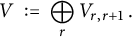 $$\begin{align*}V \ := \ \bigoplus_r V_{r,r+1} \,. \end{align*}$$
Let $\mathcal {E}_r$
be the element of
$\mathcal {E}_r$
be the element of  corresponding to the extension $F_{r+1}M/F_{r-1}M$
of
$F_{r+1}M/F_{r-1}M$
of $\mathrm {Gr}^F_{r+1}M$
by
$\mathrm {Gr}^F_{r+1}M$
by $\mathrm {Gr}^F_{r}M$
. Set
$\mathrm {Gr}^F_{r}M$
. Set $\mathcal {E}:=(\mathcal {E}_r)$
, considered as an element of
$\mathcal {E}:=(\mathcal {E}_r)$
, considered as an element of  . Then $\mathrm {Gr}^F_{-1}{\mathfrak {u}}(M)$
is the smallest subobject of V with the property that the pushforward of
$\mathrm {Gr}^F_{-1}{\mathfrak {u}}(M)$
is the smallest subobject of V with the property that the pushforward of $\mathcal {E}$
along the quotient map
$\mathcal {E}$
along the quotient map $V\rightarrow V/\mathrm {Gr}^F_{-1}{\mathfrak {u}}(M)$
is an extension in the Tannakian subcategory
$V\rightarrow V/\mathrm {Gr}^F_{-1}{\mathfrak {u}}(M)$
is an extension in the Tannakian subcategory $\langle \mathrm {Gr}^FM\rangle ^{\otimes }$
of
$\langle \mathrm {Gr}^FM\rangle ^{\otimes }$
of ${\mathbf {T}}$
generated by
${\mathbf {T}}$
generated by $\mathrm {Gr}^FM$
.
$\mathrm {Gr}^FM$
.
The result has the following immediate corollary.
Corollary 1.1.2 Let V and $\mathcal {E}$
be as in Theorem 1.1.1.
$\mathcal {E}$
be as in Theorem 1.1.1.
-
(a) The subobject
$\mathrm {Gr}^F_{-1}{\mathfrak {u}}(M)$
of V only depends on the extensions
$F_{r+1}M/F_{r-1}M$
of
$\mathrm {Gr}^F_{r+1}M$
by
$\mathrm {Gr}^F_{r}M$
(for
$r=1,\ldots , k-1$
). -
(b) If
$\mathrm {Gr}^FM$
is semisimple, then
$\mathrm {Gr}^F_{-1}{\mathfrak {u}}(M)$
is the smallest subobject of V with the property that the pushforward of
$\mathcal {E}$
along the quotient map
$V\rightarrow V/\mathrm {Gr}^F_{-1}{\mathfrak {u}}(M)$
splits.








The case $k=2$
of Theorem 1.1.1 (for which
$k=2$
of Theorem 1.1.1 (for which ${\mathfrak {u}}(M)=\mathrm {Gr}^F_{-1}{\mathfrak {u}}(M)$
) was proved by Bertrand [Reference Bertrand3, Theorem 1.1] and Hardouin [Reference Hardouin12, Théorème 2.1] when
${\mathfrak {u}}(M)=\mathrm {Gr}^F_{-1}{\mathfrak {u}}(M)$
) was proved by Bertrand [Reference Bertrand3, Theorem 1.1] and Hardouin [Reference Hardouin12, Théorème 2.1] when $\mathrm {Gr}^FM$
is semisimple and
$\mathrm {Gr}^FM$
is semisimple and  , and by the author and Murty in [Reference Eskandari and Murty9, Theorem 3.3.1] in general. The case $k=3$
of Theorem 1.1.1 was proved in [Reference Eskandari8, Theorem 3.7.1] assuming
$k=3$
of Theorem 1.1.1 was proved in [Reference Eskandari8, Theorem 3.7.1] assuming $\mathrm {Gr}^FM$
is semisimple. The argument for Theorem 1.1.1 refines the cohomological method of the proofs of the last two aforementioned results from [Reference Eskandari8, Reference Eskandari and Murty9]. A sketch of this argument is included in Section 1.2 below.
$\mathrm {Gr}^FM$
is semisimple. The argument for Theorem 1.1.1 refines the cohomological method of the proofs of the last two aforementioned results from [Reference Eskandari8, Reference Eskandari and Murty9]. A sketch of this argument is included in Section 1.2 below.
The article includes some applications of Theorem 1.1.1. In Proposition 4.4.1, we give a necessary and sufficient criterion for when ${\mathfrak {u}}(M)$
is maximal (in the sense that it is equal to its trivial upper bound
${\mathfrak {u}}(M)$
is maximal (in the sense that it is equal to its trivial upper bound $F_{-1}{\underline {\mathrm {End}}}(M)$
). This criterion, obtained in the fullest possible generality of finite filtrations in Tannakian categories in characteristic 0, implies in particular that whether or not
$F_{-1}{\underline {\mathrm {End}}}(M)$
). This criterion, obtained in the fullest possible generality of finite filtrations in Tannakian categories in characteristic 0, implies in particular that whether or not ${\mathfrak {u}}(M)$
is maximal depends only on the extensions
${\mathfrak {u}}(M)$
is maximal depends only on the extensions $F_{r+1}M/F_{r-1}M$
of
$F_{r+1}M/F_{r-1}M$
of $\mathrm {Gr}^F_{r+1}M$
by
$\mathrm {Gr}^F_{r+1}M$
by $\mathrm {Gr}^F_{r}M$
. The result generalizes several earlier maximality criteria by various authors in special cases (in particular, Theorem 2.1 of [Reference Bertrand3], Corollary 4.5 and 4.6 of [Reference Bertolin and Philippon2], Theorem 5.3.2 of [Reference Eskandari7], and Corollary 3.8.1 of [Reference Eskandari8]).
$\mathrm {Gr}^F_{r}M$
. The result generalizes several earlier maximality criteria by various authors in special cases (in particular, Theorem 2.1 of [Reference Bertrand3], Corollary 4.5 and 4.6 of [Reference Bertolin and Philippon2], Theorem 5.3.2 of [Reference Eskandari7], and Corollary 3.8.1 of [Reference Eskandari8]).
In the last section of the article, we assume that the category ${\mathbf {T}}$
has a functorial weight filtration
${\mathbf {T}}$
has a functorial weight filtration $W_\bullet $
. Given an object M of
$W_\bullet $
. Given an object M of ${\mathbf {T}}$
, let
${\mathbf {T}}$
, let ${\mathfrak {u}}(M)$
be the object associated with the Lie algebra of the kernel of the restriction map from the fundamental group of M to the fundamental group of
${\mathfrak {u}}(M)$
be the object associated with the Lie algebra of the kernel of the restriction map from the fundamental group of M to the fundamental group of $\mathrm {Gr}^WM$
. Thus, if the nonzero graded components of
$\mathrm {Gr}^WM$
. Thus, if the nonzero graded components of $\mathrm {Gr}^WM$
are in weights
$\mathrm {Gr}^WM$
are in weights $p_1<\cdots <p_k$
, then
$p_1<\cdots <p_k$
, then ${\mathfrak {u}}(M)$
coincides with its namesake from before for the filtration
${\mathfrak {u}}(M)$
coincides with its namesake from before for the filtration $F_\bullet M$
given by
$F_\bullet M$
given by $F_rM:=W_{p_r}M$
. Fix a graded object A with k graded components. In [Reference Eskandari7, Sections 3 and 4], we developed a theory of “generalized extensions” of A which was used to study the set of isomorphism classes of objects M of
$F_rM:=W_{p_r}M$
. Fix a graded object A with k graded components. In [Reference Eskandari7, Sections 3 and 4], we developed a theory of “generalized extensions” of A which was used to study the set of isomorphism classes of objects M of ${\mathbf {T}}$
with associated graded
${\mathbf {T}}$
with associated graded $\mathrm {Gr}^WM$
isomorphic to A. The case
$\mathrm {Gr}^WM$
isomorphic to A. The case $k=3$
of this is exactly the theory of blended extensions (extensions panachées [Reference Grothendieck11]). This machinery was used in [Reference Eskandari7, Section 5] to study the set of isomorphism classes of objects M of
$k=3$
of this is exactly the theory of blended extensions (extensions panachées [Reference Grothendieck11]). This machinery was used in [Reference Eskandari7, Section 5] to study the set of isomorphism classes of objects M of ${\mathbf {T}}$
with
${\mathbf {T}}$
with $\mathrm {Gr}^W(M)$
isomorphic to A and a maximal
$\mathrm {Gr}^W(M)$
isomorphic to A and a maximal ${\mathfrak {u}}(M)$
(i.e., with
${\mathfrak {u}}(M)$
(i.e., with ${\mathfrak {u}}(M)=W_{-1}{\underline {\mathrm {End}}}(M)$
). There, we were only able to give a description of this set in the case where A is semisimple and “graded-independent”; the latter hypothesis, which can be quite limiting, means that the components in a certain decomposition of
${\mathfrak {u}}(M)=W_{-1}{\underline {\mathrm {End}}}(M)$
). There, we were only able to give a description of this set in the case where A is semisimple and “graded-independent”; the latter hypothesis, which can be quite limiting, means that the components in a certain decomposition of $W_{-1}{\underline {\mathrm {End}}}(A)$
have no nonzero isomorphic subobjects (see Definition 5.3.1 of [Reference Eskandari7]). The reason for not being able to go beyond these hypotheses was a lack of a suitable maximality criterion for
$W_{-1}{\underline {\mathrm {End}}}(A)$
have no nonzero isomorphic subobjects (see Definition 5.3.1 of [Reference Eskandari7]). The reason for not being able to go beyond these hypotheses was a lack of a suitable maximality criterion for ${\mathfrak {u}}(M)$
in general. With Proposition 4.4.1 in hand, in Section 5 of this article, we handle the general case with no condition on A. The result in recorded as Theorem 5.1.1.
${\mathfrak {u}}(M)$
in general. With Proposition 4.4.1 in hand, in Section 5 of this article, we handle the general case with no condition on A. The result in recorded as Theorem 5.1.1.
1.2 Sketch of the proof of Theorem 1.1.1
Let $\omega $
be a fiber functor for
$\omega $
be a fiber functor for ${\mathbf {T}}$
and
${\mathbf {T}}$
and $\mathcal {G}(M)$
(resp.
$\mathcal {G}(M)$
(resp. $\mathcal {G}(\mathrm {Gr}^FM)$
and
$\mathcal {G}(\mathrm {Gr}^FM)$
and $\mathcal {U}(M)$
) the fundamental group of M with respect to
$\mathcal {U}(M)$
) the fundamental group of M with respect to $\omega $
(resp. the fundamental group of
$\omega $
(resp. the fundamental group of $\mathrm {Gr}^FM$
with respect to
$\mathrm {Gr}^FM$
with respect to $\omega $
and the kernel of the restriction map
$\omega $
and the kernel of the restriction map $\mathcal {G}(M)\twoheadrightarrow \mathcal {G}(\mathrm {Gr}^FM)$
). For every object X of
$\mathcal {G}(M)\twoheadrightarrow \mathcal {G}(\mathrm {Gr}^FM)$
). For every object X of $\langle \mathrm {Gr}^FM \rangle ^{\otimes }$
, we have a commutative diagram
$\langle \mathrm {Gr}^FM \rangle ^{\otimes }$
, we have a commutative diagram

The top row is the beginning part of the inflation-restriction exact sequence for group cohomology of algebraic groups (the action of $\mathcal {U}(M)$
on
$\mathcal {U}(M)$
on $\omega X$
is trivial because X is in
$\omega X$
is trivial because X is in $\langle \mathrm {Gr}^FM \rangle ^{\otimes }$
). The first two vertical identifications are given by
$\langle \mathrm {Gr}^FM \rangle ^{\otimes }$
). The first two vertical identifications are given by $\omega $
, combined with the fact that the Yoneda
$\omega $
, combined with the fact that the Yoneda $\mathrm {Ext}^1$
groups for the category of finite-dimensional representations of an algebraic group agree with the
$\mathrm {Ext}^1$
groups for the category of finite-dimensional representations of an algebraic group agree with the $\mathrm {Ext}^1$
groups defined using resolutions (i.e., with group cohomology). The identification
$\mathrm {Ext}^1$
groups defined using resolutions (i.e., with group cohomology). The identification $(\ast )$
is obtained starting from the top by noting that since the action of
$(\ast )$
is obtained starting from the top by noting that since the action of $\mathcal {U}(M)$
on
$\mathcal {U}(M)$
on $\omega X$
is trivial,
$\omega X$
is trivial, $H^1(\mathcal {U}(M),\omega X)$
is simply the Hom group
$H^1(\mathcal {U}(M),\omega X)$
is simply the Hom group $\mathrm{Hom}(\mathcal{U}(M),\omega X)$
in the category of algebraic groups, then passing on to the Lie algebras (since
$\mathrm{Hom}(\mathcal{U}(M),\omega X)$
in the category of algebraic groups, then passing on to the Lie algebras (since $\mathcal {U}(M)$
is unipotent and
$\mathcal {U}(M)$
is unipotent and $\omega X$
is a vector group), and finally again using
$\omega X$
is a vector group), and finally again using $\omega $
(the superscript
$\omega $
(the superscript $ab$
stands for abelianization). The map
$ab$
stands for abelianization). The map $\Psi _X$
is defined by the commutativity of the diagram. Everything is functorial in X and in fact, even though not needed for the present argument, one can show that the map
$\Psi _X$
is defined by the commutativity of the diagram. Everything is functorial in X and in fact, even though not needed for the present argument, one can show that the map $\Psi _X$
is independent of the choice of
$\Psi _X$
is independent of the choice of $\omega $
. We compute the image of the extension
$\omega $
. We compute the image of the extension $\mathcal {E}$
under
$\mathcal {E}$
under $\Psi _V$
, where
$\Psi _V$
, where $\mathcal {E}$
and V are as in the statement of Theorem 1.1.1. We see that this image is the map induced by the natural map
$\mathcal {E}$
and V are as in the statement of Theorem 1.1.1. We see that this image is the map induced by the natural map
 $$\begin{align*}{\mathfrak{u}}(M) \twoheadrightarrow \mathrm{Gr}^F_{-1}{\mathfrak{u}}(M) \subset V \end{align*}$$
(see Proposition 4.2.1). Theorem 1.1.1 is then easily deduced using functoriality of the maps $\Psi _X$
in X and the fact that the kernel of
$\Psi _X$
in X and the fact that the kernel of $\Psi _X$
is the subgroup of extensions in
$\Psi _X$
is the subgroup of extensions in $\langle \mathrm {Gr}^FM\rangle ^{\otimes }$
.
$\langle \mathrm {Gr}^FM\rangle ^{\otimes }$
.
1.3 Outline of the article
Section 2 is devoted to studying the map $\Psi _X$
of equation (1.3) (in particular, its explicit description and its independence of the fiber functor). For potential future use, the section is written in a slight more generality with no extra work. In Section 3, we introduce the setup of our problem of interest and make some initial observations. In Section 4, we prove Theorem 1.1.1 (Sections 4.1–4.3). We also give some variants of this result (Sections 4.5 and 4.6) and give some criteria for maximality of
$\Psi _X$
of equation (1.3) (in particular, its explicit description and its independence of the fiber functor). For potential future use, the section is written in a slight more generality with no extra work. In Section 3, we introduce the setup of our problem of interest and make some initial observations. In Section 4, we prove Theorem 1.1.1 (Sections 4.1–4.3). We also give some variants of this result (Sections 4.5 and 4.6) and give some criteria for maximality of ${\mathfrak {u}}(M)$
and
${\mathfrak {u}}(M)$
and $\mathrm {Gr}^F_{-1}{\mathfrak {u}}(M)$
(Sections 4.4 and 4.6). Finally, in Section 5, we prove our result about the structure of the set of isomorphism classes of objects M of a filtered Tannakian category with a given associated graded and maximal
$\mathrm {Gr}^F_{-1}{\mathfrak {u}}(M)$
(Sections 4.4 and 4.6). Finally, in Section 5, we prove our result about the structure of the set of isomorphism classes of objects M of a filtered Tannakian category with a given associated graded and maximal ${\mathfrak {u}}(M)$
.
${\mathfrak {u}}(M)$
.
2
$\mathrm {Ext}^1$
groups in Tannakian categories

The goal of this section is to make some remarks about $\mathrm {Ext}^1$
groups in neutral Tannakian categories. In the process, we also recall some needed background and introduce some notation.
$\mathrm {Ext}^1$
groups in neutral Tannakian categories. In the process, we also recall some needed background and introduce some notation.
Throughout the article, by a Tannakian category, we always mean a neutral Tannakian category. The fundamentals of Tannakian formalism to the extent of [Reference Deligne and Milne6] will be taken for granted. For any Lie algebra object ${\mathfrak {g}}$
in any Tannakian category, we denote the abelianization
${\mathfrak {g}}$
in any Tannakian category, we denote the abelianization ${\mathfrak {g}}/[{\mathfrak {g}},{\mathfrak {g}}]$
by
${\mathfrak {g}}/[{\mathfrak {g}},{\mathfrak {g}}]$
by ${\mathfrak {g}}^{\mathrm {ab}}$
. Internal Homs are denoted by
${\mathfrak {g}}^{\mathrm {ab}}$
. Internal Homs are denoted by ${\underline {\mathrm{Hom}}}$
. The symbol
${\underline {\mathrm{Hom}}}$
. The symbol  refers to the unity object with respect to tensor product. By a Tannakian subcategory of a Tannakian category, we always mean a Tannakian subcategory that is closed under taking subobjects (and hence subquotients). For any object X of a Tannakian category, the Tannakian subcategory generated by X is denoted by $\langle X\rangle ^{\otimes }$
; by definition, this is the smallest full Tannakian subcategory containing X.
$\langle X\rangle ^{\otimes }$
; by definition, this is the smallest full Tannakian subcategory containing X.
Given a field ${\mathbb K}$
, the category of algebraic groups over
${\mathbb K}$
, the category of algebraic groups over ${\mathbb K}$
is denoted by
${\mathbb K}$
is denoted by $\mathbf {AlgGr}({\mathbb K})$
. For an object
$\mathbf {AlgGr}({\mathbb K})$
. For an object $\mathcal {G}$
of
$\mathcal {G}$
of $\mathbf {AlgGr}({\mathbb K})$
, the category of finite-dimensional representations of
$\mathbf {AlgGr}({\mathbb K})$
, the category of finite-dimensional representations of $\mathcal {G}$
over
$\mathcal {G}$
over ${\mathbb K}$
is denoted by
${\mathbb K}$
is denoted by $\mathbf {Rep}(\mathcal {G})$
.
$\mathbf {Rep}(\mathcal {G})$
.
The notation $\mathrm {Ext}^i$
always refers to the Ext groups (or vector spaces, if applicable) in the sense of Yoneda. We include the intended category for Ext and Hom groups as subscripts (e.g.,
$\mathrm {Ext}^i$
always refers to the Ext groups (or vector spaces, if applicable) in the sense of Yoneda. We include the intended category for Ext and Hom groups as subscripts (e.g., $\mathrm {Ext}^1_{\mathbf {T}}$
for a category
$\mathrm {Ext}^1_{\mathbf {T}}$
for a category ${\mathbf {T}}$
). Given an algebraic group
${\mathbf {T}}$
). Given an algebraic group $\mathcal {G}$
over a field
$\mathcal {G}$
over a field ${\mathbb K}$
, for brevity, the Hom and Ext groups in
${\mathbb K}$
, for brevity, the Hom and Ext groups in $\mathbf {Rep}(\mathcal {G})$
are simply denoted by
$\mathbf {Rep}(\mathcal {G})$
are simply denoted by $\mathrm {Hom}_{\mathcal {G}}$
and
$\mathrm {Hom}_{\mathcal {G}}$
and $\mathrm {Ext}^i_{\mathcal {G}}$
. As usual,
$\mathrm {Ext}^i_{\mathcal {G}}$
. As usual, $\mathrm {Hom}_{\mathbb K}$
means Hom in the category of vector spaces over
$\mathrm {Hom}_{\mathbb K}$
means Hom in the category of vector spaces over ${\mathbb K}$
.
${\mathbb K}$
.
Throughout the article from this point on, we fix a field ${\mathbb F}$
of characteristic zero. We will simply write
${\mathbb F}$
of characteristic zero. We will simply write $\mathbf {AlgGr}$
instead of
$\mathbf {AlgGr}$
instead of $\mathbf {AlgGr}({\mathbb F})$
.
$\mathbf {AlgGr}({\mathbb F})$
.
2.1
Let $\mathcal {G}$
be an algebraic group over
$\mathcal {G}$
be an algebraic group over ${\mathbb F}$
and
${\mathbb F}$
and $\mathcal {H}$
a normal subgroup of
$\mathcal {H}$
a normal subgroup of $\mathcal {G}$
. We consider
$\mathcal {G}$
. We consider $\mathbf {Rep}(\mathcal {G}/\mathcal {H})$
as a full subcategory of
$\mathbf {Rep}(\mathcal {G}/\mathcal {H})$
as a full subcategory of $\mathbf {Rep}(\mathcal {G})$
. Let
$\mathbf {Rep}(\mathcal {G})$
. Let ${\mathfrak {g}}$
and
${\mathfrak {g}}$
and ${\mathfrak {h}}$
be, respectively, the Lie algebras of
${\mathfrak {h}}$
be, respectively, the Lie algebras of $\mathcal {G}$
and
$\mathcal {G}$
and $\mathcal {H}$
, both considered as representations of
$\mathcal {H}$
, both considered as representations of $\mathcal {G}$
via the adjoint action. The abelianization
$\mathcal {G}$
via the adjoint action. The abelianization ${\mathfrak {h}}^{\mathrm {ab}}$
belongs to the subcategory
${\mathfrak {h}}^{\mathrm {ab}}$
belongs to the subcategory $\mathbf {Rep}(\mathcal {G}/\mathcal {H})$
, as
$\mathbf {Rep}(\mathcal {G}/\mathcal {H})$
, as $\mathcal {H}$
acts on it trivially.
$\mathcal {H}$
acts on it trivially.
Let X be an object of $\mathbf {Rep}(\mathcal {G}/\mathcal {H})$
. Then there exists a functorial (in X) map
$\mathbf {Rep}(\mathcal {G}/\mathcal {H})$
. Then there exists a functorial (in X) map

defined as follows:
Step one: The canonical isomorphism between (Yoneda)  and the group cohomology $H^1(\mathcal {G}, X)$
(for algebraic groups) composed with the restriction map for the subgroup
$H^1(\mathcal {G}, X)$
(for algebraic groups) composed with the restriction map for the subgroup $\mathcal {H}\mathrel {\unlhd } \mathcal {G}$
from group cohomology gives a map
$\mathcal {H}\mathrel {\unlhd } \mathcal {G}$
from group cohomology gives a map

where X is considered as an additive algebraic group, and the action of $\mathcal {G}$
on
$\mathcal {G}$
on $\mathrm {Hom}_{\mathbf {AlgGr}}(\mathcal {H}, X)$
is via its natural action on X and its conjugation action on
$\mathrm {Hom}_{\mathbf {AlgGr}}(\mathcal {H}, X)$
is via its natural action on X and its conjugation action on $\mathcal {H}$
. In the article, we will need to work with this map explicitly, so here we shall give its description more concretely (we may take this concrete description as the definition). Given
$\mathcal {H}$
. In the article, we will need to work with this map explicitly, so here we shall give its description more concretely (we may take this concrete description as the definition). Given 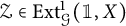 represented by an extension

choose a linear section s of  to identify $Z\cong X\oplus {\mathbb F}$
as vector spaces. Express the action of
$Z\cong X\oplus {\mathbb F}$
as vector spaces. Express the action of $\mathcal {H}$
on Z in terms of this decomposition. Since
$\mathcal {H}$
on Z in terms of this decomposition. Since $\mathcal {H}$
acts trivially on X, every element h of
$\mathcal {H}$
acts trivially on X, every element h of $\mathcal {H}$
will act on Z through an element of
$\mathcal {H}$
will act on Z through an element of $\mathrm {GL}(X\oplus {\mathbb F})$
of the form
$\mathrm {GL}(X\oplus {\mathbb F})$
of the form
 $$\begin{align*}\begin{pmatrix} 1 & h_{12}\\ 0& 1\end{pmatrix}. \end{align*}$$
Sending $h\mapsto h_{12}$
, we obtain a morphism of algebraic groups
$h\mapsto h_{12}$
, we obtain a morphism of algebraic groups

This map is easily seen to be independent of both the choice of the section s and the choice of the representative of $\mathcal {Z}$
. Thus, so far, we have defined a map from
$\mathcal {Z}$
. Thus, so far, we have defined a map from  to
to $\mathrm {Hom}_{\mathbf {AlgGr}}(\mathcal {H}, X)$
.
$\mathrm {Hom}_{\mathbf {AlgGr}}(\mathcal {H}, X)$
.
Identifying Z as $X\oplus {\mathbb F}$
via a choice of a section and writing elements of
$X\oplus {\mathbb F}$
via a choice of a section and writing elements of $\mathrm {GL}(Z)$
as
$\mathrm {GL}(Z)$
as $2\times 2$
matrices again, given
$2\times 2$
matrices again, given $g\in \mathcal {G}$
and
$g\in \mathcal {G}$
and $h\in \mathcal {H}$
, the action of the element
$h\in \mathcal {H}$
, the action of the element $ghg^{-1}$
of
$ghg^{-1}$
of $\mathcal {G}$
on Z is through the element
$\mathcal {G}$
on Z is through the element
 $$\begin{align*}\begin{pmatrix} g_{11} & g_{12}\\ 0& 1\end{pmatrix} \begin{pmatrix} 1 & h_{12}\\ 0& 1\end{pmatrix} \begin{pmatrix} g_{11}^{-1} & -g_{11}^{-1}g_{12} \\ 0& 1\end{pmatrix} = \begin{pmatrix} 1 & g_{11}h_{12}\\ 0& 1\end{pmatrix}, \end{align*}$$
where $g_{11}=g_X$
is the action of g on X. It follows that
$g_{11}=g_X$
is the action of g on X. It follows that  , so that
  is
is $\mathcal {G}$
-equivariant. We have thus indeed defined a map
$\mathcal {G}$
-equivariant. We have thus indeed defined a map

Its functoriality in X can be checked by a direct computation from the construction.
Step two: The map (2.1) is obtained by composing (2.2) with
 $$\begin{align*}\mathrm{Hom}_{\mathbf{AlgGr}}(\mathcal{H}, X)^{\mathcal{G}} \xrightarrow{\mathrm{Lie}} \mathrm{Hom}_{\mathbf{Lie}}({\mathfrak{h}}, X)^{\mathcal{G}} \stackrel{(\ast)}{\cong} \mathrm{Hom}_{{\mathbb F}}({\mathfrak{h}}^{\mathrm{ab}}, X)^{\mathcal{G}} = \mathrm{Hom}_{\mathcal{G}}({\mathfrak{h}}^{\mathrm{ab}}, X), \end{align*}$$
where the first map passes on to the Lie algebras ( $\mathbf {Lie}$
= the category of Lie algebras over
$\mathbf {Lie}$
= the category of Lie algebras over ${\mathbb F}$
) and
${\mathbb F}$
) and $(\ast )$
is because the Lie algebra X is abelian.Footnote
2
$(\ast )$
is because the Lie algebra X is abelian.Footnote
2
2.2
From this point on in the article, we fix a Tannakian category ${\mathbf {T}}$
over
${\mathbf {T}}$
over ${\mathbb F}$
. By a fiber functor, we shall mean a fiber functor over
${\mathbb F}$
. By a fiber functor, we shall mean a fiber functor over ${\mathbb F}$
. Let
${\mathbb F}$
. Let $\omega $
be a fiber functor for
$\omega $
be a fiber functor for ${\mathbf {T}}$
. For any object X of
${\mathbf {T}}$
. For any object X of ${\mathbf {T}}$
, we denote the Tannakian group of X with respect to
${\mathbf {T}}$
, we denote the Tannakian group of X with respect to $\omega $
(i.e., the group
$\omega $
(i.e., the group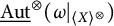 $\underline {\mathrm {Aut}}^{\otimes }(\omega |_{\langle X\rangle ^{\otimes }})$
of tensor automorphisms of the restriction of
$\underline {\mathrm {Aut}}^{\otimes }(\omega |_{\langle X\rangle ^{\otimes }})$
of tensor automorphisms of the restriction of $\omega $
to
$\omega $
to $\langle X\rangle ^{\otimes }$
, see [Reference Deligne and Milne6]) by
$\langle X\rangle ^{\otimes }$
, see [Reference Deligne and Milne6]) by $\mathcal {G}(X,\omega )$
. By the main theorem of Tannakian formalism [Reference Deligne and Milne6, Theorem 2.11], the functor
$\mathcal {G}(X,\omega )$
. By the main theorem of Tannakian formalism [Reference Deligne and Milne6, Theorem 2.11], the functor $\omega $
gives an equivalence of tensor categories
$\omega $
gives an equivalence of tensor categories
 $$\begin{align*}\langle X\rangle^{\otimes} \rightarrow \mathbf{Rep}(\mathcal{G}(X,\omega)). \end{align*}$$
We identify $\mathcal {G}(X,\omega )$
as a subgroup of
$\mathcal {G}(X,\omega )$
as a subgroup of $\mathrm {GL}(\omega X)$
via its action on X. Via the equivalence above, the internal Hom
$\mathrm {GL}(\omega X)$
via its action on X. Via the equivalence above, the internal Hom ${\underline {\mathrm {End}}}(X)={\underline {\mathrm{Hom}}}(X,X)$
then becomes
${\underline {\mathrm {End}}}(X)={\underline {\mathrm{Hom}}}(X,X)$
then becomes $\mathrm {End}_{\mathbb F}(\omega X)$
equipped with the restriction of the adjoint action of
$\mathrm {End}_{\mathbb F}(\omega X)$
equipped with the restriction of the adjoint action of $\mathrm {GL}(\omega X)$
to the subgroup
$\mathrm {GL}(\omega X)$
to the subgroup $\mathcal {G}(X,\omega )$
.
$\mathcal {G}(X,\omega )$
.
From here until the end of Section 2, we fix an object M of ${\mathbf {T}}$
and an object N of
${\mathbf {T}}$
and an object N of $\langle M\rangle ^{\otimes }$
. There is a surjective restriction map
$\langle M\rangle ^{\otimes }$
. There is a surjective restriction map
 $$\begin{align*}\mathcal{G}(M,\omega) \rightarrow \mathcal{G}(N,\omega), \end{align*}$$
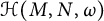
the kernel of which we shall denote by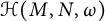 $\mathcal {H}(M,N,\omega )$
. An object X of
$\mathcal {H}(M,N,\omega )$
. An object X of $\langle M\rangle ^{\otimes }$
belongs to the subcategory
$\langle M\rangle ^{\otimes }$
belongs to the subcategory $\langle N\rangle ^{\otimes }$
if and only if the action of
$\langle N\rangle ^{\otimes }$
if and only if the action of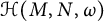 $\mathcal {H}(M,N,\omega )$
on
$\mathcal {H}(M,N,\omega )$
on $\omega X$
is trivial.
$\omega X$
is trivial.
We shall denote the Lie algebra of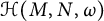 $\mathcal {H}(M,N,\omega )$
by
$\mathcal {H}(M,N,\omega )$
by ${\mathfrak {h}}(M,N,\omega )$
. It is a Lie subalgebra of
${\mathfrak {h}}(M,N,\omega )$
. It is a Lie subalgebra of $\mathrm {End}_{\mathbb F}(\omega X)$
. The adjoint action of
$\mathrm {End}_{\mathbb F}(\omega X)$
. The adjoint action of $\mathcal {G}(M,\omega )$
restricts to an action on
$\mathcal {G}(M,\omega )$
restricts to an action on ${\mathfrak {h}}(M,N,\omega )$
, which via the main theorem of Tannakian formalism gives rise to a Lie subobject
${\mathfrak {h}}(M,N,\omega )$
, which via the main theorem of Tannakian formalism gives rise to a Lie subobject
 $$\begin{align*}{\mathfrak{h}}(M,N) \subset {\underline{\mathrm{End}}}(M) \end{align*}$$
whose image under $\omega $
is the Lie subalgebra
$\omega $
is the Lie subalgebra ${\mathfrak {h}}(M,N,\omega )$
of
${\mathfrak {h}}(M,N,\omega )$
of $\mathrm {End}_{\mathbb F}(\omega X)$
. Moreover, the subobject
$\mathrm {End}_{\mathbb F}(\omega X)$
. Moreover, the subobject ${\mathfrak {h}}(M,N)$
of
${\mathfrak {h}}(M,N)$
of ${\underline {\mathrm {End}}}(M)$
is independent of the choice of the fiber functor
${\underline {\mathrm {End}}}(M)$
is independent of the choice of the fiber functor $\omega $
. See, for instance, [Reference Eskandari and Murty10, Section 2].
$\omega $
. See, for instance, [Reference Eskandari and Murty10, Section 2].
2.3
Let X be an object of the subcategory $\langle N\rangle ^{\otimes }$
of
$\langle N\rangle ^{\otimes }$
of $\langle M\rangle ^{\otimes }$
. Choose a fiber functor
$\langle M\rangle ^{\otimes }$
. Choose a fiber functor $\omega $
for
$\omega $
for ${\mathbf {T}}$
. In view of the equivalence of categories
${\mathbf {T}}$
. In view of the equivalence of categories $\langle M\rangle ^{\otimes } \xrightarrow { \, \omega \, } \mathbf {Rep}(\mathcal {G}(M,\omega ))$
, the map (2.1) for
$\langle M\rangle ^{\otimes } \xrightarrow { \, \omega \, } \mathbf {Rep}(\mathcal {G}(M,\omega ))$
, the map (2.1) for $\mathcal {G}=\mathcal {G}(M,\omega )$
and
$\mathcal {G}=\mathcal {G}(M,\omega )$
and $\mathcal {H}=\mathcal {H}(M,N,\omega )$
gives us a map
$\mathcal {H}=\mathcal {H}(M,N,\omega )$
gives us a map

that is functorial in the object X of $\langle N\rangle ^{\otimes }$
. Note that the object
$\langle N\rangle ^{\otimes }$
. Note that the object ${\mathfrak {h}}(M,N)^{\mathrm {ab}}$
belongs to
${\mathfrak {h}}(M,N)^{\mathrm {ab}}$
belongs to $\langle N\rangle ^{\otimes }$
because
$\langle N\rangle ^{\otimes }$
because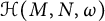 $\mathcal {H}(M,N,\omega )$
acts on
$\mathcal {H}(M,N,\omega )$
acts on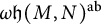 $\omega {\mathfrak {h}}(M,N)^{\mathrm {ab}}$
trivially.
$\omega {\mathfrak {h}}(M,N)^{\mathrm {ab}}$
trivially.
Proposition 2.3.1 The map $\Psi ^{M,N}_X$
is independent of the choice of fiber functor
$\Psi ^{M,N}_X$
is independent of the choice of fiber functor $\omega $
.
$\omega $
.
Proof This is a consequence of the fact, due to Deligne [Reference Deligne5, Sections 1.12 and 1.13], that any two fiber functors are isomorphic over an algebraic closure $\overline {{\mathbb F}}$
of
$\overline {{\mathbb F}}$
of ${\mathbb F}$
. The proof was given in details in [Reference Eskandari8] (see Lemma 3.2.1 therein) when
${\mathbb F}$
. The proof was given in details in [Reference Eskandari8] (see Lemma 3.2.1 therein) when ${\mathfrak {h}}(M,N)$
is the Lie algebra of the unipotent radical of the fundamental group of M. The argument goes through essentially identically to establish the more general statement given here. Given two fiber functors
${\mathfrak {h}}(M,N)$
is the Lie algebra of the unipotent radical of the fundamental group of M. The argument goes through essentially identically to establish the more general statement given here. Given two fiber functors $\omega $
and
$\omega $
and $\omega '$
, let
$\omega '$
, let $\alpha $
be an isomorphism of
$\alpha $
be an isomorphism of $\otimes $
-functors
$\otimes $
-functors $\overline {\omega }\rightarrow \overline {\omega '}$
, where throughout, we use the bar symbol to refer to the extension of scalars from
$\overline {\omega }\rightarrow \overline {\omega '}$
, where throughout, we use the bar symbol to refer to the extension of scalars from ${\mathbb F}$
to
${\mathbb F}$
to $\overline {{\mathbb F}}$
. For brevity, let us tentatively write
$\overline {{\mathbb F}}$
. For brevity, let us tentatively write ${\mathfrak {h}}$
for
${\mathfrak {h}}$
for ${\mathfrak {h}}(M,N)$
, and
${\mathfrak {h}}(M,N)$
, and $\mathcal {G}$
,
$\mathcal {G}$
, $\mathcal {H}$
(resp.
$\mathcal {H}$
(resp. $\mathcal {G}'$
,
$\mathcal {G}'$
, $\mathcal {H}'$
) for
$\mathcal {H}'$
) for $\mathcal {G}(M,\omega )$
,
$\mathcal {G}(M,\omega )$
, $\mathcal {H}(M,N,\omega )$
(resp. the counterparts for
$\mathcal {H}(M,N,\omega )$
(resp. the counterparts for $\omega '$
). Then
$\omega '$
). Then $\alpha $
gives an isomorphism
$\alpha $
gives an isomorphism $\overline {\mathcal {G}}\rightarrow \overline {\mathcal {G}'}$
restricting to an isomorphism
$\overline {\mathcal {G}}\rightarrow \overline {\mathcal {G}'}$
restricting to an isomorphism $\overline {\mathcal {H}}\rightarrow \overline {\mathcal {H}'}$
. Then there is a commutative diagram
$\overline {\mathcal {H}}\rightarrow \overline {\mathcal {H}'}$
. Then there is a commutative diagram
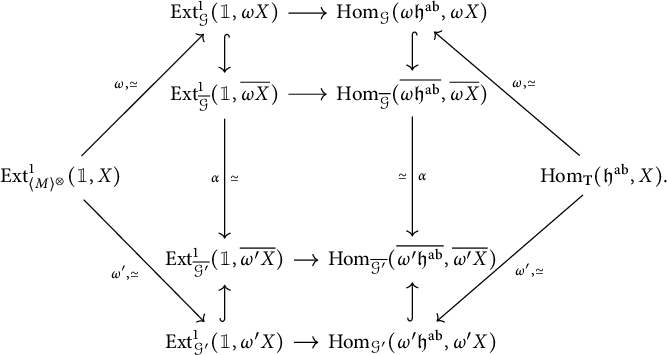
Here, the horizontal maps are all of the form of equation (2.1) of Section 2.1. The vertical maps in the top and bottom squares are by extension of scalars; that the ones on the left (from $\mathrm {Ext}^1_{\mathcal {G}}$
to
$\mathrm {Ext}^1_{\mathcal {G}}$
to $\mathrm {Ext}^1_{\overline {\mathcal {G}}}$
and the counterpart for
$\mathrm {Ext}^1_{\overline {\mathcal {G}}}$
and the counterpart for $\mathcal {G}'$
) are injective will not matter for the proof, but it is by the fact that invariants behave well with respect to extension of scalars [Reference Milne13, Proposition 4.31]. The isomorphisms marked by
$\mathcal {G}'$
) are injective will not matter for the proof, but it is by the fact that invariants behave well with respect to extension of scalars [Reference Milne13, Proposition 4.31]. The isomorphisms marked by $\omega $
and
$\omega $
and $\omega '$
are given by Tannakian formalism. The isomorphism
$\omega '$
are given by Tannakian formalism. The isomorphism $\alpha $
on the right is given by the isomorphism of functors
$\alpha $
on the right is given by the isomorphism of functors $\alpha $
. The isomorphism marked by
$\alpha $
. The isomorphism marked by $\alpha $
on the left is obtained at the level of extensions by replacing the
$\alpha $
on the left is obtained at the level of extensions by replacing the $\overline {\mathcal {G}}$
-representation
$\overline {\mathcal {G}}$
-representation $\overline {\omega X}$
by the
$\overline {\omega X}$
by the $\overline {\mathcal {G}'}$
-representation
$\overline {\mathcal {G}'}$
-representation $\overline {\omega ' X}$
via
$\overline {\omega ' X}$
via $\alpha $
, keeping the middle vector space unchanged, and transferring the
$\alpha $
, keeping the middle vector space unchanged, and transferring the $\overline {\mathcal {G}}$
-action on it to a
$\overline {\mathcal {G}}$
-action on it to a $\overline {\mathcal {G}'}$
-action via
$\overline {\mathcal {G}'}$
-action via $\alpha $
. That the triangles on the left and right commute is because
$\alpha $
. That the triangles on the left and right commute is because $\alpha $
is an isomorphism of functors. That the top and bottom squares commute is easily seen from the definition of the map (2.1). That the middle square is commutative is seen via again the definition of the horizontal maps, on noting that the map
$\alpha $
is an isomorphism of functors. That the top and bottom squares commute is easily seen from the definition of the map (2.1). That the middle square is commutative is seen via again the definition of the horizontal maps, on noting that the map $\overline {\omega {\mathfrak {h}}}\rightarrow \overline {\omega ' {\mathfrak {h}}}$
given by the morphism of functors
$\overline {\omega {\mathfrak {h}}}\rightarrow \overline {\omega ' {\mathfrak {h}}}$
given by the morphism of functors $\alpha $
coincides with the map obtained by first considering the isomorphism
$\alpha $
coincides with the map obtained by first considering the isomorphism $\overline {\mathcal {H}}\rightarrow \overline {\mathcal {H}'}$
given by
$\overline {\mathcal {H}}\rightarrow \overline {\mathcal {H}'}$
given by $\alpha $
, and then passing to the Lie algebras.
$\alpha $
, and then passing to the Lie algebras.
The independence of $\Psi ^{M,N}_X$
from the choice of
$\Psi ^{M,N}_X$
from the choice of $\omega $
now follows from the commutativity of the diagram and injectivity of the top and bottom vertical arrows on the right.
$\omega $
now follows from the commutativity of the diagram and injectivity of the top and bottom vertical arrows on the right.
2.4
For convenience and referencing purposes, let us summarize the discussion so far. Fix an object M of ${\mathbf {T}}$
( = a Tannakian category over
${\mathbf {T}}$
( = a Tannakian category over ${\mathbb F}$
) and an object N of
${\mathbb F}$
) and an object N of $\langle M\rangle ^{\otimes }$
. Then for every object X of
$\langle M\rangle ^{\otimes }$
. Then for every object X of $\langle N\rangle ^{\otimes }$
, we have constructed a map
$\langle N\rangle ^{\otimes }$
, we have constructed a map

which is functorial with respect to morphisms $X\rightarrow X'$
between two objects
$X\rightarrow X'$
between two objects $X,X'$
of
$X,X'$
of $\langle N\rangle ^{\otimes }$
. Given an extension class
$\langle N\rangle ^{\otimes }$
. Given an extension class $\mathcal {Z}$
of
$\mathcal {Z}$
of  by X in $\langle M\rangle ^{\otimes }$
, the image of
$\langle M\rangle ^{\otimes }$
, the image of $\mathcal {Z}$
under
$\mathcal {Z}$
under $\Psi ^{M,N}_X$
is computed as follows: Choose a representative extension for
$\Psi ^{M,N}_X$
is computed as follows: Choose a representative extension for $\mathcal {Z}$
with its middle denoted by Z. Choose a fiber functor
$\mathcal {Z}$
with its middle denoted by Z. Choose a fiber functor $\omega $
and a linear section of the surjection
$\omega $
and a linear section of the surjection  to obtain a decomposition $\omega Z\cong \omega X\oplus {\mathbb F}$
as vector spaces. The action of
$\omega Z\cong \omega X\oplus {\mathbb F}$
as vector spaces. The action of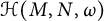 $\mathcal {H}(M,N,\omega )$
on
$\mathcal {H}(M,N,\omega )$
on $\omega Z$
expressed in terms of this decomposition gives rise to a
$\omega Z$
expressed in terms of this decomposition gives rise to a $\mathcal {G}(M,\omega )$
-equivariant morphism of algebraic groups
$\mathcal {G}(M,\omega )$
-equivariant morphism of algebraic groups $\mathcal {H}(M,N,\omega )\rightarrow \omega X$
. Passing to the Lie algebras and the abelianization, we obtain a morphism of
$\mathcal {H}(M,N,\omega )\rightarrow \omega X$
. Passing to the Lie algebras and the abelianization, we obtain a morphism of $\mathcal {G}(M,\omega )$
-representations
$\mathcal {G}(M,\omega )$
-representations $\omega {\mathfrak {h}}(M,N)^{\mathrm {ab}} = {\mathfrak {h}}(M,N,\omega )^{\mathrm {ab}}\rightarrow \omega X$
. This map is
$\omega {\mathfrak {h}}(M,N)^{\mathrm {ab}} = {\mathfrak {h}}(M,N,\omega )^{\mathrm {ab}}\rightarrow \omega X$
. This map is $\omega $
of
$\omega $
of $\Psi ^{M,N}_X(\mathcal {Z})$
. This recipe for defining
$\Psi ^{M,N}_X(\mathcal {Z})$
. This recipe for defining $\Psi ^{M,N}_X(\mathcal {Z})$
is indeed well-defined and in particular, is independent of the choice of a fiber functor
$\Psi ^{M,N}_X(\mathcal {Z})$
is indeed well-defined and in particular, is independent of the choice of a fiber functor $\omega $
.
$\omega $
.
2.5
Under mild conditions (which will be satisfied for the purposes of this article), the kernel of the map $\Psi ^{M,N}_X$
can be intrinsically described, as follows.
$\Psi ^{M,N}_X$
can be intrinsically described, as follows.
Lemma 2.5.1 As in Sections 2.3 and 2.4, let N be an object of $\langle M\rangle ^{\otimes }$
and X an object of
$\langle M\rangle ^{\otimes }$
and X an object of $\langle N\rangle ^{\otimes }$
. Suppose that the subgroup
$\langle N\rangle ^{\otimes }$
. Suppose that the subgroup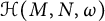 $\mathcal {H}(M,N,\omega )$
of
$\mathcal {H}(M,N,\omega )$
of $\mathcal {G}(M,\omega )$
is connected for a choice of fiber functor
$\mathcal {G}(M,\omega )$
is connected for a choice of fiber functor $\omega $
. Then the kernel of
$\omega $
. Then the kernel of $\Psi ^{M,N}_X$
is equal to the subgroup
$\Psi ^{M,N}_X$
is equal to the subgroup 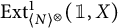 of
of 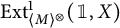 .
.
Proof We calculate $\Psi ^{M,N}_X$
using the fiber functor
$\Psi ^{M,N}_X$
using the fiber functor $\omega $
. By construction (see Sections 2.1 and 2.4),
$\omega $
. By construction (see Sections 2.1 and 2.4), $\Psi ^{M,N}_X$
is the composition
$\Psi ^{M,N}_X$
is the composition

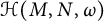
where we have abbreviated $\mathcal {G}(M,\omega )$
,
$\mathcal {G}(M,\omega )$
, $\mathcal {H}(M,N,\omega )$
, and
$\mathcal {H}(M,N,\omega )$
, and ${\mathfrak {h}}(M,N),$
respectively, as
${\mathfrak {h}}(M,N),$
respectively, as $\mathcal {G}$
,
$\mathcal {G}$
, $\mathcal {H}$
, and
$\mathcal {H}$
, and ${\mathfrak {h}}$
. By the hypothesis of connectedness of
${\mathfrak {h}}$
. By the hypothesis of connectedness of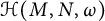 $\mathcal {H}(M,N,\omega )$
, the map denoted by
$\mathcal {H}(M,N,\omega )$
, the map denoted by $\mathrm {Lie}$
(which passes to the Lie algebras) is injective. Thus, an extension
$\mathrm {Lie}$
(which passes to the Lie algebras) is injective. Thus, an extension  is in the kernel of $\Psi ^{M,N}_X$
if and only if
$\Psi ^{M,N}_X$
if and only if $\omega \mathcal {Z}$
is in the kernel of the map
$\omega \mathcal {Z}$
is in the kernel of the map $(\ast )$
of the diagram. The result now follows from the first three terms of the inflation-restriction exact sequence for cohomology of algebraic groups together with the interpretation of
$(\ast )$
of the diagram. The result now follows from the first three terms of the inflation-restriction exact sequence for cohomology of algebraic groups together with the interpretation of $H^1(\mathcal {G}(M,\omega )/\mathcal {H}(M,N,\omega ), \omega X)$
as
$H^1(\mathcal {G}(M,\omega )/\mathcal {H}(M,N,\omega ), \omega X)$
as 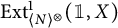 . In the interest of completeness and since we already have an explicit definition of $(\ast )$
at hand, we give a more explicit version of the argument: Denoting the middle object of a representative of
$(\ast )$
at hand, we give a more explicit version of the argument: Denoting the middle object of a representative of $\mathcal {Z}$
by Z, upon recalling the construction of the map (2.2) from Section 2.1, we see that
$\mathcal {Z}$
by Z, upon recalling the construction of the map (2.2) from Section 2.1, we see that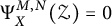 $\Psi ^{M,N}_X(\mathcal {Z})=0$
if and only if
$\Psi ^{M,N}_X(\mathcal {Z})=0$
if and only if $\omega \mathcal {Z}$
admits an
$\omega \mathcal {Z}$
admits an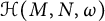 $\mathcal {H}(M,N,\omega )$
-equivariant section, which in turn (since
$\mathcal {H}(M,N,\omega )$
-equivariant section, which in turn (since $X\in \langle N\rangle ^{\otimes }$
) is equivalent to the action of
$X\in \langle N\rangle ^{\otimes }$
) is equivalent to the action of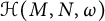 $\mathcal {H}(M,N,\omega )$
on
$\mathcal {H}(M,N,\omega )$
on $\omega Z$
being trivial. The latter is equivalent to Z being in
$\omega Z$
being trivial. The latter is equivalent to Z being in $\langle N\rangle ^{\otimes }$
, or in other words,
$\langle N\rangle ^{\otimes }$
, or in other words, $\mathcal {Z}$
being in
$\mathcal {Z}$
being in 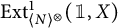 .
.
2.6
We now consider an important special case. Suppose that $\langle N\rangle ^{\otimes }$
is the full subcategory of all the semisimple objects of
$\langle N\rangle ^{\otimes }$
is the full subcategory of all the semisimple objects of $\langle M\rangle ^{\otimes }$
, or that equivalently,
$\langle M\rangle ^{\otimes }$
, or that equivalently,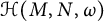 $\mathcal {H}(M,N,\omega )$
for one or all choices of
$\mathcal {H}(M,N,\omega )$
for one or all choices of $\omega $
is the unipotent radical of
$\omega $
is the unipotent radical of $\mathcal {G}(M,\omega )$
. Then for every semisimple object X of
$\mathcal {G}(M,\omega )$
. Then for every semisimple object X of $\langle M\rangle ^{\otimes }$
, the map
$\langle M\rangle ^{\otimes }$
, the map $\Psi ^{M,N}_X$
of equation (2.3) is an isomorphism. Indeed, the injectivity of
$\Psi ^{M,N}_X$
of equation (2.3) is an isomorphism. Indeed, the injectivity of $\Psi ^{M,N}_X$
follows from Lemma 2.5.1, as
$\Psi ^{M,N}_X$
follows from Lemma 2.5.1, as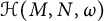 $\mathcal {H}(M,N,\omega )$
is connected and
$\mathcal {H}(M,N,\omega )$
is connected and $\langle N\rangle ^{\otimes }$
is semisimple. As for surjectivity, since
$\langle N\rangle ^{\otimes }$
is semisimple. As for surjectivity, since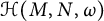 $\mathcal {H}(M,N,\omega )$
is unipotent, the map
$\mathcal {H}(M,N,\omega )$
is unipotent, the map $\mathrm {Lie}$
of the diagram of the proof of Lemma 2.5.1 is an isomorphism, so the surjectivity amounts to the surjectivity of the map marked as
$\mathrm {Lie}$
of the diagram of the proof of Lemma 2.5.1 is an isomorphism, so the surjectivity amounts to the surjectivity of the map marked as $(\ast )$
in the same diagram. The surjectivity of this map can be seen via the inflation-restriction sequence of group cohomology (since
$(\ast )$
in the same diagram. The surjectivity of this map can be seen via the inflation-restriction sequence of group cohomology (since $\mathcal {G}(M,\omega )/\mathcal {H}(M,N,\omega )\cong \mathcal {G}(N,\omega )$
is reductive and hence
$\mathcal {G}(M,\omega )/\mathcal {H}(M,N,\omega )\cong \mathcal {G}(N,\omega )$
is reductive and hence $H^2(\mathcal {G}(N,\omega ),-)$
vanishes). One can also easily check surjectivity of
$H^2(\mathcal {G}(N,\omega ),-)$
vanishes). One can also easily check surjectivity of $(\ast )$
in this case just from our explicit definition from Section 2.1. See [Reference Eskandari8, Section 3.1] for details.
$(\ast )$
in this case just from our explicit definition from Section 2.1. See [Reference Eskandari8, Section 3.1] for details.
3 The setup and initial considerations
Recall that ${\mathbf {T}}$
is a (neutral) Tannakian category over a field
${\mathbf {T}}$
is a (neutral) Tannakian category over a field ${\mathbb F}$
of characteristic 0.
${\mathbb F}$
of characteristic 0.
3.1
From here until the end of Section 4, we fix the following data:
-
– an object M of
${\mathbf {T}}$
, equipped with a finite increasing filtration
$(F_r M)_{r\in {\mathbb Z}}$
with
$$\begin{align*}0=F_0M \subsetneq F_1M \subsetneq F_2M\subsetneq \cdots \subsetneq F_kM=M \hspace{.4in}(k\geq 1). \end{align*}$$



As usual, we denote
 $$\begin{align*}\mathrm{Gr}^FM = \bigoplus\limits_r \mathrm{Gr}^F_r M = \bigoplus\limits_r \frac{F_rM}{F_{r-1}M}. \end{align*}$$
We will adopt the notation of Section 2.2 for Tannakian fundamental groups, their subgroups, Lie algebras, etc. Throughout, we shall set
 $$\begin{align*}{\mathfrak{u}}(M) := {\mathfrak{h}}(M,\mathrm{Gr}^FM) \end{align*}$$
and for every fiber functor $\omega $
,
$\omega $
,
 $$\begin{align*}\mathcal{U}(M,\omega) := \mathcal{H}(M,\mathrm{Gr}^FM,\omega) \end{align*}$$
(see Section 2.2). The fundamental group $\mathcal {G}(M,\omega )$
of M respects the filtration
$\mathcal {G}(M,\omega )$
of M respects the filtration $F_\bullet \omega M:=\omega F_\bullet M$
, and
$F_\bullet \omega M:=\omega F_\bullet M$
, and $\mathcal {U}(M,\omega )$
is the subgroup of
$\mathcal {U}(M,\omega )$
is the subgroup of $\mathcal {G}(M,\omega )$
consisting of the elements that act trivially on
$\mathcal {G}(M,\omega )$
consisting of the elements that act trivially on $\mathrm {Gr}^F\omega M$
. In particular,
$\mathrm {Gr}^F\omega M$
. In particular, $\mathcal {U}(M,\omega )$
is unipotent. If
$\mathcal {U}(M,\omega )$
is unipotent. If $\mathrm {Gr}^FM$
is semisimple, then
$\mathrm {Gr}^FM$
is semisimple, then $\mathcal {U}(M,\omega )$
will be the unipotent radical of
$\mathcal {U}(M,\omega )$
will be the unipotent radical of $\mathcal {G}(G,\omega )$
. In what follows, unless otherwise indicated, we will not assume that
$\mathcal {G}(G,\omega )$
. In what follows, unless otherwise indicated, we will not assume that $\mathrm {Gr}^FM$
is semisimple.
$\mathrm {Gr}^FM$
is semisimple.
3.2
The filtration $F_\bullet $
on M induces a finite increasing filtration on the internal Hom
$F_\bullet $
on M induces a finite increasing filtration on the internal Hom ${\underline {\mathrm {End}}}(M)$
. For any fiber functor
${\underline {\mathrm {End}}}(M)$
. For any fiber functor $\omega $
and any integer n, the image of
$\omega $
and any integer n, the image of $F_n{\underline {\mathrm {End}}}(M)$
under
$F_n{\underline {\mathrm {End}}}(M)$
under $\omega $
is the subspace of
$\omega $
is the subspace of $\omega {\underline {\mathrm {End}}}(M) = \mathrm {End}_{\mathbb F}(\omega M)$
consisting of all the linear maps
$\omega {\underline {\mathrm {End}}}(M) = \mathrm {End}_{\mathbb F}(\omega M)$
consisting of all the linear maps $f: \omega M\rightarrow \omega M$
such that
$f: \omega M\rightarrow \omega M$
such that $f(F_r \omega M) \subset F_{r+n}\omega M$
for all r. That the subobject
$f(F_r \omega M) \subset F_{r+n}\omega M$
for all r. That the subobject $F_n{\underline {\mathrm {End}}}(M)$
defined this way is independent of the choice of
$F_n{\underline {\mathrm {End}}}(M)$
defined this way is independent of the choice of $\omega $
can be seen using the fact, due to Deligne [Reference Deligne5], that every two fiber functors are isomorphic after base change to an algebraic closure of
$\omega $
can be seen using the fact, due to Deligne [Reference Deligne5], that every two fiber functors are isomorphic after base change to an algebraic closure of ${\mathbb F}$
. From the description of
${\mathbb F}$
. From the description of $F_\bullet {\underline {\mathrm {End}}}(M),$
it is easily seen that
$F_\bullet {\underline {\mathrm {End}}}(M),$
it is easily seen that
 $$\begin{align*}[F_n{\underline{\mathrm{End}}}(M), F_m{\underline{\mathrm{End}}}(M)] = F_{n+m}{\underline{\mathrm{End}}}(M). \end{align*}$$
In particular, $F_{-1}{\underline {\mathrm {End}}}(M)$
is a Lie subobject of
$F_{-1}{\underline {\mathrm {End}}}(M)$
is a Lie subobject of ${\underline {\mathrm {End}}}(M)$
with derived algebra
${\underline {\mathrm {End}}}(M)$
with derived algebra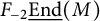 $F_{-2}{\underline {\mathrm {End}}}(M)$
.
$F_{-2}{\underline {\mathrm {End}}}(M)$
.
3.3
Let $\omega $
be a fiber functor. By a splitting of
$\omega $
be a fiber functor. By a splitting of $\omega M,$
we shall mean the data of a (linear) section
$\omega M,$
we shall mean the data of a (linear) section $s_r$
of the quotient map
$s_r$
of the quotient map $F_r\omega M \rightarrow \mathrm {Gr}^F_r\omega M$
for each integer r. Given a choice of a splitting
$F_r\omega M \rightarrow \mathrm {Gr}^F_r\omega M$
for each integer r. Given a choice of a splitting $(s_r)$
of
$(s_r)$
of $\omega M$
, for each
$\omega M$
, for each $r,$
we use the section
$r,$
we use the section $s_r$
to obtain an isomorphism
$s_r$
to obtain an isomorphism $F_r \omega M \cong F_{r-1}\omega M \oplus \mathrm {Gr}^F_r\omega M$
as vector spaces. Putting these isomorphisms together, we obtain isomorphisms
$F_r \omega M \cong F_{r-1}\omega M \oplus \mathrm {Gr}^F_r\omega M$
as vector spaces. Putting these isomorphisms together, we obtain isomorphisms
 $$\begin{align*}\omega M = F_k \omega M \cong F_{k-1} \omega M\oplus \mathrm{Gr}^F_k\omega M \cong F_{k-2} \omega M\oplus \mathrm{Gr}^F_{k-1}\omega M\oplus \mathrm{Gr}^F_k\omega M \cong \cdots \end{align*}$$
and thus an isomorphism
 $$ \begin{align} \omega M \cong \bigoplus\limits_{r=1}^k \mathrm{Gr}^F_r\omega M \end{align} $$
of vector spaces. This isomorphism induces isomorphisms
 $$ \begin{align} \frac{F_n\omega M}{F_m\omega M} \cong \bigoplus\limits_{r=m+1}^n \mathrm{Gr}^F_r\omega M. \end{align} $$
for all $m<n$
, all compatible with the natural inclusion and projection maps.
$m<n$
, all compatible with the natural inclusion and projection maps.
Once a splitting of $\omega M$
is chosen, we make identifications given by (3.1) and (3.2). We will then write elements of
$\omega M$
is chosen, we make identifications given by (3.1) and (3.2). We will then write elements of $\mathrm {End}_{\mathbb F}(\omega M)$
and
$\mathrm {End}_{\mathbb F}(\omega M)$
and $\mathrm {GL}(\omega M)$
as
$\mathrm {GL}(\omega M)$
as $k\times k$
matrices. Similarly, elements of
$k\times k$
matrices. Similarly, elements of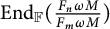 $\mathrm {End}_{\mathbb F}(\frac {F_n\omega M}{F_m\omega M})$
and more generally,
$\mathrm {End}_{\mathbb F}(\frac {F_n\omega M}{F_m\omega M})$
and more generally, $\mathrm {Hom}_{\mathbb F}(\frac {F_n\omega M}{F_m\omega M}, \frac {F_{n'}\omega M}{F_{m'}\omega M})$
will become matrices. The entry
$\mathrm {Hom}_{\mathbb F}(\frac {F_n\omega M}{F_m\omega M}, \frac {F_{n'}\omega M}{F_{m'}\omega M})$
will become matrices. The entry $f_{ij}$
of an element
$f_{ij}$
of an element $f=(f_{ij})\in \mathrm {End}_{\mathbb F} (\omega M)$
is the component of f in
$f=(f_{ij})\in \mathrm {End}_{\mathbb F} (\omega M)$
is the component of f in $\mathrm {Hom}_{\mathbb F}(\mathrm {Gr}^F_j\omega M, \mathrm {Gr}^F_i\omega M)$
via the decomposition
$\mathrm {Hom}_{\mathbb F}(\mathrm {Gr}^F_j\omega M, \mathrm {Gr}^F_i\omega M)$
via the decomposition
 $$ \begin{align} \mathrm{End}_{\mathbb F} \omega M \cong \mathrm{End}_{\mathbb F} (\mathrm{Gr}^F\omega M) = \bigoplus\limits_{1\leq i,j\leq k} \mathrm{Hom}_{\mathbb F}(\mathrm{Gr}^F_j\omega M, \mathrm{Gr}^F_i\omega M). \end{align} $$
The group $\mathcal {G}(M,\omega )$
is contained in the subgroup of
$\mathcal {G}(M,\omega )$
is contained in the subgroup of $\mathrm {GL}(\omega M)$
consisting of upper triangular invertible matrices. If
$\mathrm {GL}(\omega M)$
consisting of upper triangular invertible matrices. If $\sigma =(\sigma _{ij})$
is an element of
$\sigma =(\sigma _{ij})$
is an element of $\mathcal {G}(M,\omega )$
, the automorphism
$\mathcal {G}(M,\omega )$
, the automorphism $\sigma _{\frac {F_nM}{F_mM}}$
(i.e., the action of
$\sigma _{\frac {F_nM}{F_mM}}$
(i.e., the action of $\sigma $
on
$\sigma $
on $\frac {F_nM}{F_mM}$
) of
$\frac {F_nM}{F_mM}$
) of $F_n\omega M/F_m\omega M$
is simply given by truncating the matrix
$F_n\omega M/F_m\omega M$
is simply given by truncating the matrix $(\sigma _{ij})$
to the part with
$(\sigma _{ij})$
to the part with $m< i,j\leq n$
.
$m< i,j\leq n$
.
The unipotent group $\mathcal {U}(M,\omega )$
is the intersection of
$\mathcal {U}(M,\omega )$
is the intersection of $\mathcal {G}(M,\omega )$
and the subgroup of
$\mathcal {G}(M,\omega )$
and the subgroup of $\mathrm {GL}(\omega M)$
consisting of upper triangular elements with the identity maps on the diagonal. The Lie algebra
$\mathrm {GL}(\omega M)$
consisting of upper triangular elements with the identity maps on the diagonal. The Lie algebra $\omega F_{-1}{\underline {\mathrm {End}}}(M)$
consists of strictly upper triangular elements of
$\omega F_{-1}{\underline {\mathrm {End}}}(M)$
consists of strictly upper triangular elements of $\mathrm {End}_{\mathbb F}(\omega M)$
. The subalgebra
$\mathrm {End}_{\mathbb F}(\omega M)$
. The subalgebra $\omega F_{-2}{\underline {\mathrm {End}}}(M)$
consists of those matrices
$\omega F_{-2}{\underline {\mathrm {End}}}(M)$
consists of those matrices $(f_{ij})$
for which
$(f_{ij})$
for which $f_{ij}=0$
if
$f_{ij}=0$
if $j-i\leq 1$
, that is, it consists of strictly upper triangular matrices with zeros on the superdiagonal.
$j-i\leq 1$
, that is, it consists of strictly upper triangular matrices with zeros on the superdiagonal.
3.4
The goal of this paragraph is to define a canonical surjective morphism
 $$\begin{align*}\pi: F_{-1}{\underline{\mathrm{End}}}(M) \rightarrow \bigoplus\limits_{r} {\underline{\mathrm{Hom}}}(\mathrm{Gr}^F_{r+1}M, \mathrm{Gr}^F_{r}M) \end{align*}$$
with
 $$\begin{align*}\ker(\pi) = F_{-2}{\underline{\mathrm{End}}}(M). \end{align*}$$
This map will play an important role in the article. Let $\omega $
be a fiber functor for
$\omega $
be a fiber functor for ${\mathbf {T}}$
. We will first explicitly define the linear map
${\mathbf {T}}$
. We will first explicitly define the linear map $\omega \pi $
, and then verify that
$\omega \pi $
, and then verify that $\omega \pi $
indeed comes from a morphism
$\omega \pi $
indeed comes from a morphism $\pi $
that is independent of the choice of
$\pi $
that is independent of the choice of $\omega $
.
$\omega $
.
Choose a splitting of $\omega M$
in the sense of Section 3.3. Use the isomorphism (3.3) given by this splitting to write the elements of
$\omega M$
in the sense of Section 3.3. Use the isomorphism (3.3) given by this splitting to write the elements of $\mathrm {End}_{\mathbb F}(\omega M)$
as
$\mathrm {End}_{\mathbb F}(\omega M)$
as $k\times k$
matrices. Let
$k\times k$
matrices. Let $\omega \pi $
be the linear map
$\omega \pi $
be the linear map
 $$ \begin{align*} \omega F_{-1}{\underline{\mathrm{End}}}(M) & = \bigoplus\limits_{\stackrel{i,j}{j-i\geq 1}} \mathrm{Hom}_{\mathbb F}(\mathrm{Gr}^F_{j}\omega M, \mathrm{Gr}^F_{i}\omega M) \xrightarrow{ \ \omega\pi \ } \\ & \bigoplus\limits_{r} \ \mathrm{Hom}_{\mathbb F}(\mathrm{Gr}^F_{r+1}\omega M, \mathrm{Gr}^F_{r}\omega M) = \bigoplus\limits_{r} \ \omega {\underline{\mathrm{Hom}}}(\mathrm{Gr}^F_{r+1}M, \mathrm{Gr}^F_{r}M) \end{align*} $$
that sends
 $$\begin{align*}f=(f_{i,j}) \mapsto (f_{r,r+1}) \end{align*}$$
(the indices compatible with those used in the decompositions). That is, $\omega \pi $
is the projection onto the superdiagonal entries. The notation
$\omega \pi $
is the projection onto the superdiagonal entries. The notation $\omega \pi $
for this map will be justified momentarily in the next lemma. Clearly,
$\omega \pi $
for this map will be justified momentarily in the next lemma. Clearly, $\omega \pi $
is surjective and
$\omega \pi $
is surjective and
 $$\begin{align*}\ker(\omega\pi) = \bigoplus\limits_{\stackrel{i,j}{j-i\geq 2}} \mathrm{Hom}_{\mathbb F}(\mathrm{Gr}^F_{j}\omega M, \mathrm{Gr}^F_{i}\omega M) = \omega F_{-2}{\underline{\mathrm{End}}}(M). \end{align*}$$
Lemma 3.4.1 The map
 $$\begin{align*}\omega \pi: \omega F_{-1}{\underline{\mathrm{End}}}(M) \rightarrow \bigoplus\limits_{r} \ \omega {\underline{\mathrm{Hom}}}(\mathrm{Gr}^F_{r+1}M, \mathrm{Gr}^F_{r}M) \end{align*}$$
is independent of the choice of splitting of $\omega M$
and is the image under
$\omega M$
and is the image under $\omega $
of a morphism
$\omega $
of a morphism
 $$\begin{align*}F_{-1}{\underline{\mathrm{End}}}(M) \rightarrow \bigoplus\limits_{r} {\underline{\mathrm{Hom}}}(\mathrm{Gr}^F_{r+1}M, \mathrm{Gr}^F_{r}M) \end{align*}$$
denoted by $\pi $
. Moreover, the morphism
$\pi $
. Moreover, the morphism $\pi $
is independent of the choice of fiber functor
$\pi $
is independent of the choice of fiber functor $\omega $
.
$\omega $
.
Proof We will give an intrinsic description of $\pi $
. All the claims made in the construction below can be checked easily (upon taking a fiber functor
$\pi $
. All the claims made in the construction below can be checked easily (upon taking a fiber functor $\omega $
and a splitting of
$\omega $
and a splitting of $\omega M$
, if needed).
$\omega M$
, if needed).
For each r, there is a canonical surjective map
 $$ \begin{align} {\underline{\mathrm{Hom}}}(\frac{M}{F_rM}, F_rM) \rightarrow {\underline{\mathrm{Hom}}}(\mathrm{Gr}^F_{r+1}M, \mathrm{Gr}^F_{r}M) \end{align} $$
given by functoriality properties of ${\underline {\mathrm{Hom}}}$
(say, first apply
${\underline {\mathrm{Hom}}}$
(say, first apply ${\underline {\mathrm{Hom}}}(-,F_rM)$
to
${\underline {\mathrm{Hom}}}(-,F_rM)$
to $\mathrm {Gr}^F_{r+1}M\hookrightarrow M/F_rM$
, then
$\mathrm {Gr}^F_{r+1}M\hookrightarrow M/F_rM$
, then ${\underline {\mathrm{Hom}}}(\mathrm {Gr}^F_{r+1}M,-)$
to
${\underline {\mathrm{Hom}}}(\mathrm {Gr}^F_{r+1}M,-)$
to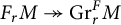 $F_rM\twoheadrightarrow \mathrm {Gr}^F_{r}M$
). The kernel of (3.4) is the subobject of
$F_rM\twoheadrightarrow \mathrm {Gr}^F_{r}M$
). The kernel of (3.4) is the subobject of ${\underline {\mathrm{Hom}}}(\frac {M}{F_rM}, F_rM)$
, denoted by
${\underline {\mathrm{Hom}}}(\frac {M}{F_rM}, F_rM)$
, denoted by $F_{-2}{\underline {\mathrm{Hom}}}(\frac {M}{F_rM}, F_rM)$
, that after applying a fiber functor
$F_{-2}{\underline {\mathrm{Hom}}}(\frac {M}{F_rM}, F_rM)$
, that after applying a fiber functor $\omega $
consists of all linear maps
$\omega $
consists of all linear maps $\omega M/F_r\omega M \xrightarrow {f} F_r\omega M$
satisfying
$\omega M/F_r\omega M \xrightarrow {f} F_r\omega M$
satisfying $f(\mathrm {Gr}^F_{r+1}\omega M)\subset F_{r-1}\omega M$
. Taking the direct sum of the maps (3.4) over
$f(\mathrm {Gr}^F_{r+1}\omega M)\subset F_{r-1}\omega M$
. Taking the direct sum of the maps (3.4) over $r,$
we obtain a surjective map
$r,$
we obtain a surjective map
 $$ \begin{align} \bigoplus\limits_r {\underline{\mathrm{Hom}}}(\frac{M}{F_rM}, F_rM) \rightarrow \bigoplus\limits_r {\underline{\mathrm{Hom}}}(\mathrm{Gr}^F_{r+1}M, \mathrm{Gr}^F_{r}M). \end{align} $$
On the other hand, for each $r,$
there is an obvious canonical inclusion
$r,$
there is an obvious canonical inclusion
 $$\begin{align*}{\underline{\mathrm{Hom}}}(\frac{M}{F_rM}, F_rM) \hookrightarrow F_{-1}{\underline{\mathrm{End}}}(M), \end{align*}$$
again given by functoriality of ${\underline {\mathrm{Hom}}}$
. The summation map
${\underline {\mathrm{Hom}}}$
. The summation map
 $$\begin{align*}\sum: \ \bigoplus\limits_r {\underline{\mathrm{Hom}}}(\frac{M}{F_rM}, F_rM) \rightarrow F_{-1}{\underline{\mathrm{End}}}(M) \end{align*}$$
is surjective. Moreover, the map (3.5) vanishes on the kernel of the summation map above. The map $\pi $
is then the map fitting in the following commutative diagram:
$\pi $
is then the map fitting in the following commutative diagram:
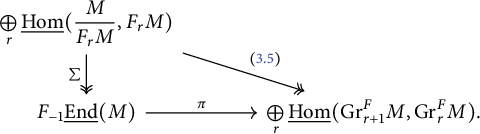
The image of $\pi $
under any fiber functor
$\pi $
under any fiber functor $\omega $
is the map denoted by
$\omega $
is the map denoted by $\omega \pi $
earlier.
$\omega \pi $
earlier.
Let
 $$\begin{align*}\pi_{r,r+1} : F_{-1}{\underline{\mathrm{End}}}(M) \rightarrow {\underline{\mathrm{Hom}}}(\mathrm{Gr}^F_{r+1}M, \mathrm{Gr}^F_{r}M) \end{align*}$$
be the composition of $\pi $
with the projection to
$\pi $
with the projection to ${\underline {\mathrm{Hom}}}(\mathrm {Gr}^F_{r+1}M, \mathrm {Gr}^F_{r}M)$
, so that
${\underline {\mathrm{Hom}}}(\mathrm {Gr}^F_{r+1}M, \mathrm {Gr}^F_{r}M)$
, so that $\pi =(\pi _{r,r+1})$
. After choosing a fiber functor
$\pi =(\pi _{r,r+1})$
. After choosing a fiber functor $\omega $
and a splitting of
$\omega $
and a splitting of $\omega M$
, the map
$\omega M$
, the map $\omega \pi _{r,r+1}$
sends an element
$\omega \pi _{r,r+1}$
sends an element $f=(f_{ij})\in \omega F_{-1}{\underline {\mathrm {End}}}(M)$
to the superdiagonal entry
$f=(f_{ij})\in \omega F_{-1}{\underline {\mathrm {End}}}(M)$
to the superdiagonal entry $f_{r,r+1}$
.
$f_{r,r+1}$
.
3.5
The elements of $\mathcal {U}(M,\omega )$
stabilize the filtration
$\mathcal {U}(M,\omega )$
stabilize the filtration $F_\bullet \omega M$
and induce identity on
$F_\bullet \omega M$
and induce identity on $\mathrm {Gr}^F\omega M$
. Thus,
$\mathrm {Gr}^F\omega M$
. Thus,
 $$\begin{align*}{\mathfrak{u}}(M) \subset F_{-1}{\underline{\mathrm{End}}}(M). \end{align*}$$
Define a filtration $F_\bullet {\mathfrak {u}}(M)$
on
$F_\bullet {\mathfrak {u}}(M)$
on ${\mathfrak {u}}(M)$
by setting
${\mathfrak {u}}(M)$
by setting
 $$\begin{align*}F_n{\mathfrak{u}}(M) := {\mathfrak{u}}(M)\cap F_n{\underline{\mathrm{End}}}(M). \end{align*}$$
Then $\mathrm {Gr}^F {\mathfrak {u}}(M)$
is concentrated in negative degrees. Our focus in this article is on the graded component
$\mathrm {Gr}^F {\mathfrak {u}}(M)$
is concentrated in negative degrees. Our focus in this article is on the graded component $\mathrm {Gr}^F_{-1}{\mathfrak {u}}(M)$
. In view of Section 3.4, we have a commutative diagram
$\mathrm {Gr}^F_{-1}{\mathfrak {u}}(M)$
. In view of Section 3.4, we have a commutative diagram

with exact rows. We identify $\mathrm {Gr}^F_{-1} {\mathfrak {u}}(M)$
as a subobject of
$\mathrm {Gr}^F_{-1} {\mathfrak {u}}(M)$
as a subobject of $\bigoplus \limits _r {\underline {\mathrm{Hom}}}(\mathrm {Gr}^F_{r+1}M, \mathrm {Gr}^F_{r}M)$
via the vertical map on the right (this is the embedding in equation (1.2) of Section 1). Our goal is to determine
$\bigoplus \limits _r {\underline {\mathrm{Hom}}}(\mathrm {Gr}^F_{r+1}M, \mathrm {Gr}^F_{r}M)$
via the vertical map on the right (this is the embedding in equation (1.2) of Section 1). Our goal is to determine
 $$\begin{align*}\mathrm{Gr}^F_{-1} {\mathfrak{u}}(M) = \pi({\mathfrak{u}}(M)) \subset \bigoplus\limits_r {\underline{\mathrm{Hom}}}(\mathrm{Gr}^F_{r+1}M, \mathrm{Gr}^F_{r}M). \end{align*}$$
4 Determination of
$\mathrm {Gr}^F_{-1}{\mathfrak {u}}(M)$

We will prove Theorem 1.1.1 in this section. In addition, we will also give some variants and consequences of the result. Throughout the section, we shall work in the setting of Section 3.1, adopting the notation as introduced in the rest of Section 3 and in Section 2.
4.1 The maps
$\Psi _X$

Out tool to study $\mathrm {Gr}^F_{-1}{\mathfrak {u}}(M)$
will be the maps of the form
$\mathrm {Gr}^F_{-1}{\mathfrak {u}}(M)$
will be the maps of the form $\Psi ^{M,N}_X$
constructed in Section 2, taking
$\Psi ^{M,N}_X$
constructed in Section 2, taking $N=\mathrm {Gr}^FM$
. By Sections 2.1–2.4, for every object X of
$N=\mathrm {Gr}^FM$
. By Sections 2.1–2.4, for every object X of $\langle \mathrm {Gr}^FM\rangle ^{\otimes }$
, we have a canonical map
$\langle \mathrm {Gr}^FM\rangle ^{\otimes }$
, we have a canonical map

which is functorial in X. This map can be computed by choosing any fiber functor $\omega $
, following the procedure outlined in Section 2.4 (with
$\omega $
, following the procedure outlined in Section 2.4 (with $\mathcal {H}(M,N,\omega )= \mathcal {U}(M,\omega )$
). Since
$\mathcal {H}(M,N,\omega )= \mathcal {U}(M,\omega )$
). Since $\mathcal {U}(M,\omega )$
is unipotent, by Lemma 2.5.1, we have
$\mathcal {U}(M,\omega )$
is unipotent, by Lemma 2.5.1, we have

If $\mathrm {Gr}^FM$
is semisimple, then the map
$\mathrm {Gr}^FM$
is semisimple, then the map $\Psi _X$
is injective for every object X of
$\Psi _X$
is injective for every object X of $\langle \mathrm {Gr}^F M\rangle ^{\otimes }$
(in fact, it is an isomorphism because we are then in the situation of Section 2.6).
$\langle \mathrm {Gr}^F M\rangle ^{\otimes }$
(in fact, it is an isomorphism because we are then in the situation of Section 2.6).
The quotient map ${\mathfrak {u}}(M)\rightarrow {\mathfrak {u}}(M)^{\mathrm {ab}}$
induces an injection
${\mathfrak {u}}(M)\rightarrow {\mathfrak {u}}(M)^{\mathrm {ab}}$
induces an injection
 $$\begin{align*}\mathrm{Hom}_{\mathbf{T}}({\mathfrak{u}}(M)^{\mathrm{ab}}, X) \hookrightarrow \mathrm{Hom}_{\mathbf{T}}({\mathfrak{u}}(M), X). \end{align*}$$
For every object X of $\langle \mathrm {Gr}^FM\rangle ^{\otimes }$
, we use this injection to consider
$\langle \mathrm {Gr}^FM\rangle ^{\otimes }$
, we use this injection to consider $\Psi _X$
as a map
$\Psi _X$
as a map

(functorial in X and with the same kernel as (4.1)). The image of an extension class $\mathcal {Z}$
of
$\mathcal {Z}$
of  by X in $\langle M\rangle ^{\otimes }$
under (4.2) is computed using the same procedure as in Section 2.4, except we skip the last step of passing to the abelianization: Denoting the middle object of a representative of
$\langle M\rangle ^{\otimes }$
under (4.2) is computed using the same procedure as in Section 2.4, except we skip the last step of passing to the abelianization: Denoting the middle object of a representative of $\mathcal {Z}$
by Z, the logarithm of the morphism
$\mathcal {Z}$
by Z, the logarithm of the morphism $\mathcal {U}(M,\omega )\rightarrow \omega X$
that describes the action of
$\mathcal {U}(M,\omega )\rightarrow \omega X$
that describes the action of $\mathcal {U}(M,\omega )$
on
$\mathcal {U}(M,\omega )$
on $\omega Z$
is equal to the image under
$\omega Z$
is equal to the image under $\omega $
of the morphism
$\omega $
of the morphism ${\mathfrak {u}}(M)\rightarrow X$
corresponding to
${\mathfrak {u}}(M)\rightarrow X$
corresponding to $\mathcal {Z}$
under (4.2).
$\mathcal {Z}$
under (4.2).
4.2 The key computation
In this section, we establish the key technical component of the proof of Theorem 1.1.1. Following Section 1, we shall set
 $$\begin{align*}V_{r,r+1}:= {\underline{\mathrm{Hom}}}(\mathrm{Gr}^F_{r+1}M, \mathrm{Gr}^F_{r}M) \hspace{.3in}\text{and} \hspace{.2in} V:=\bigoplus\limits_r V_{r,r+1}. \end{align*}$$
Recall the definitions of the extensions $\mathcal {E}_r$
and
$\mathcal {E}_r$
and $\mathcal {E}$
from Section 1: The filtration
$\mathcal {E}$
from Section 1: The filtration $F_\bullet M$
gives rise to an extension
$F_\bullet M$
gives rise to an extension

for each r. The element

is the extension class corresponding to (4.3) under the canonical isomorphism

The extension class

is the element corresponding to the tuple  under the canonical isomorphism

Recall from Section 3.4 that we have a map
 $$\begin{align*}\pi: F_{-1}{\underline{\mathrm{End}}}(M) \rightarrow V,\end{align*}$$
whose component in $V_{r,r+1}$
was denoted by
$V_{r,r+1}$
was denoted by $\pi _{r,r+1}$
. Denote the map obtained by restricting the domain of
$\pi _{r,r+1}$
. Denote the map obtained by restricting the domain of $\pi $
(resp.
$\pi $
(resp. $\pi _{r,r+1}$
) to
$\pi _{r,r+1}$
) to ${\mathfrak {u}}(M)$
also by
${\mathfrak {u}}(M)$
also by $\pi $
(resp.
$\pi $
(resp. $\pi _{r,r+1}$
). Recall that after applying a fiber functor
$\pi _{r,r+1}$
). Recall that after applying a fiber functor $\omega $
and choosing a splitting of
$\omega $
and choosing a splitting of $\omega M$
, the map
$\omega M$
, the map $\pi _{r,r+1}$
simply sends
$\pi _{r,r+1}$
simply sends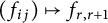 $(f_{ij})\mapsto f_{r,r+1}$
.
$(f_{ij})\mapsto f_{r,r+1}$
.
Finally, recall that for every object X of $\langle \mathrm {Gr}^FM\rangle ^{\otimes }$
, we have a map
$\langle \mathrm {Gr}^FM\rangle ^{\otimes }$
, we have a map $\Psi _X$
as in (4.2) of Section 4.1.
$\Psi _X$
as in (4.2) of Section 4.1.
Proposition 4.2.1
-
(a)
$\Psi _{V_{r,r+1}}(\mathcal {E}_r) = \pi _{r,r+1}$
for every r. -
(b)
$\Psi _V(\mathcal {E}) = \pi .$


Proof
-
(a) Fix r. Let
$\omega $
be a fiber functor. Recalling the explicit description of the canonical isomorphism for any objects N and L of a Tannakian category (see, e.g., [Reference Eskandari and Murty9, Section 3.2]),
$\mathcal {E}_r$
is given by the extension (4.4)

 for any objects N and L of a Tannakian category (see, e.g., [

where $E_{r,r+1}$
is the object
$E_{r,r+1}$
is the object ${\underline {\mathrm{Hom}}}(\mathrm {Gr}^F_{r+1}M, F_{r+1}M/F_{r-1}M)^\dagger $
in the notation of [Reference Eskandari and Murty9]: This is the subobject of
${\underline {\mathrm{Hom}}}(\mathrm {Gr}^F_{r+1}M, F_{r+1}M/F_{r-1}M)^\dagger $
in the notation of [Reference Eskandari and Murty9]: This is the subobject of ${\underline {\mathrm{Hom}}}(\mathrm {Gr}^F_{r+1}M, F_{r+1}M/F_{r-1}M)$
whose image under
${\underline {\mathrm{Hom}}}(\mathrm {Gr}^F_{r+1}M, F_{r+1}M/F_{r-1}M)$
whose image under $\omega $
consists of all linear maps
$\omega $
consists of all linear maps $g: \mathrm {Gr}^F_{r+1}\omega M\rightarrow F_{r+1}\omega M/F_{r-1}\omega M$
such that the composition
$g: \mathrm {Gr}^F_{r+1}\omega M\rightarrow F_{r+1}\omega M/F_{r-1}\omega M$
such that the composition
 $$\begin{align*}\mathrm{Gr}^F_{r+1}\omega M \xrightarrow{ \ g \ } \displaystyle{\frac{F_{r+1}\omega M}{F_{r-1}\omega M}} \ \twoheadrightarrow \ \mathrm{Gr}^F_{r+1}\omega M\end{align*}$$
(the latter being the canonical surjection) is a scalar multiple $\lambda (g)\cdot \mathrm {Id}$
of the identity map. The injection
$\lambda (g)\cdot \mathrm {Id}$
of the identity map. The injection $V_{r,r+1} \hookrightarrow E_{r,r+1}$
is given by functoriality of
$V_{r,r+1} \hookrightarrow E_{r,r+1}$
is given by functoriality of ${\underline {\mathrm{Hom}}}$
, and the surjection
${\underline {\mathrm{Hom}}}$
, and the surjection  after applying $\omega $
is simply the map
$\omega $
is simply the map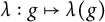 $\lambda : g\mapsto \lambda (g)$
. See [Reference Eskandari and Murty9, Section 3.2] for more details.
$\lambda : g\mapsto \lambda (g)$
. See [Reference Eskandari and Murty9, Section 3.2] for more details.
Choose a splitting of $\omega M$
in the sense of Section 3.3 to identify the vector space
$\omega M$
in the sense of Section 3.3 to identify the vector space $\omega M$
with
$\omega M$
with $\mathrm {Gr}^F\omega M$
. Let
$\mathrm {Gr}^F\omega M$
. Let $s_{r+1}$
be the section of the quotient map
$s_{r+1}$
be the section of the quotient map $F_{r+1}\omega M \rightarrow \mathrm {Gr}^F_{r+1}\omega M$
used to form the splitting. Then
$F_{r+1}\omega M \rightarrow \mathrm {Gr}^F_{r+1}\omega M$
used to form the splitting. Then $s_{r+1}$
gives a section
$s_{r+1}$
gives a section $\overline {s_{r+1}} = s_{r+1} \pmod {F_{r-1}\omega M}$
of the map
$\overline {s_{r+1}} = s_{r+1} \pmod {F_{r-1}\omega M}$
of the map $F_{r+1}\omega M/F_{r-1}\omega M \rightarrow \mathrm {Gr}^F_{r+1}\omega M$
, which in turn gives rise to a section of the map
$F_{r+1}\omega M/F_{r-1}\omega M \rightarrow \mathrm {Gr}^F_{r+1}\omega M$
, which in turn gives rise to a section of the map $\lambda $
. We will use this section (which is given by
$\lambda $
. We will use this section (which is given by $1\mapsto \overline {s_{r+1}}$
) to compute
$1\mapsto \overline {s_{r+1}}$
) to compute $\Psi _{V_{r,r+1}}(\mathcal {E}_r)$
following the steps outlined at the end of Section 4.1.
$\Psi _{V_{r,r+1}}(\mathcal {E}_r)$
following the steps outlined at the end of Section 4.1.
Identify
 $$ \begin{align} \omega E_{r,r+1} \cong \mathrm{Hom}_{\mathbb F}(\mathrm{Gr}^F_{r+1}\omega M, \mathrm{Gr}^F_{r}\omega M) \oplus {\mathbb F} \end{align} $$
via the section of $\lambda $
above. The map
$\lambda $
above. The map $\overline {s_{r+1}}$
gives an isomorphism
$\overline {s_{r+1}}$
gives an isomorphism $F_{r+1}\omega M/F_{r-1}\omega M \cong \mathrm {Gr}^F_{r}\omega M \oplus \mathrm {Gr}^F_{r+1}\omega M$
, which agrees with the one in equation (3.2) of Section 3.3 for
$F_{r+1}\omega M/F_{r-1}\omega M \cong \mathrm {Gr}^F_{r}\omega M \oplus \mathrm {Gr}^F_{r+1}\omega M$
, which agrees with the one in equation (3.2) of Section 3.3 for $n=r+1$
and
$n=r+1$
and $m=r-1$
and our choice of splitting of
$m=r-1$
and our choice of splitting of $\omega M$
. This gives an isomorphism
$\omega M$
. This gives an isomorphism
 $$\begin{align*}\begin{aligned} \mathrm{Hom}_{\mathbb F}(\mathrm{Gr}^F_{r+1}\omega M, \displaystyle{\frac{F_{r+1}\omega M}{F_{r-1}\omega M}}) & \cong \mathrm{Hom}_{\mathbb F}(\mathrm{Gr}^F_{r+1}\omega M, \mathrm{Gr}^F_{r}\omega M)\\ & \oplus \mathrm{Hom}_{\mathbb F}(\mathrm{Gr}^F_{r+1}\omega M, \mathrm{Gr}^F_{r+1}\omega M), \end{aligned} \end{align*}$$
compatible with (4.5) via the natural inclusion maps (embedding ${\mathbb F}$
as the scalar endomorphisms of
${\mathbb F}$
as the scalar endomorphisms of $\mathrm {Gr}^F_{r+1}\omega M$
).
$\mathrm {Gr}^F_{r+1}\omega M$
).
Use our splitting to write endomorphisms of $\omega M$
as
$\omega M$
as $k\times k$
matrices. Let
$k\times k$
matrices. Let $f=(f_{ij})\in \omega {\mathfrak {u}}(M)$
(a strictly upper triangular matrix). Set
$f=(f_{ij})\in \omega {\mathfrak {u}}(M)$
(a strictly upper triangular matrix). Set $\sigma :=\exp (f)\in \mathcal {U}(M,\omega )$
. Then f and
$\sigma :=\exp (f)\in \mathcal {U}(M,\omega )$
. Then f and $\sigma $
have the same superdiagonal entries because
$\sigma $
have the same superdiagonal entries because $f^n\in \omega F_{-2}{\underline {\mathrm {End}}}(M)$
for
$f^n\in \omega F_{-2}{\underline {\mathrm {End}}}(M)$
for $n\geq 2$
. The action of
$n\geq 2$
. The action of $\sigma $
on
$\sigma $
on $\omega {\underline {\mathrm{Hom}}}(\mathrm {Gr}^F_{r+1}M, F_{r+1}M/ F_{r-1}M)$
is by sending
$\omega {\underline {\mathrm{Hom}}}(\mathrm {Gr}^F_{r+1}M, F_{r+1}M/ F_{r-1}M)$
is by sending $g:\mathrm {Gr}^F_{r+1}\omega M \rightarrow F_{r+1}\omega M/ F_{r-1}\omega M$
to
$g:\mathrm {Gr}^F_{r+1}\omega M \rightarrow F_{r+1}\omega M/ F_{r-1}\omega M$
to $\sigma _{F_{r+1}M/ F_{r-1}M}\circ g\circ {\sigma _{\mathrm {Gr}^F_{r+1}M}}^{-1}=\sigma _{F_{r+1}M/ F_{r-1}M}\circ g,$
where as before,
$\sigma _{F_{r+1}M/ F_{r-1}M}\circ g\circ {\sigma _{\mathrm {Gr}^F_{r+1}M}}^{-1}=\sigma _{F_{r+1}M/ F_{r-1}M}\circ g,$
where as before, $\sigma _X$
means the action of
$\sigma _X$
means the action of $\sigma $
on
$\sigma $
on $\omega X$
for an object X of
$\omega X$
for an object X of $\langle M\rangle ^{\otimes }$
(note that
$\langle M\rangle ^{\otimes }$
(note that $\sigma _{\mathrm {Gr}^F_{r+1}M}=1$
because
$\sigma _{\mathrm {Gr}^F_{r+1}M}=1$
because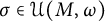 $\sigma \in \mathcal {U}(M,\omega )$
). Writing endomorphisms of
$\sigma \in \mathcal {U}(M,\omega )$
). Writing endomorphisms of $F_{r+1}\omega M/F_{r-1}\omega M$
as
$F_{r+1}\omega M/F_{r-1}\omega M$
as $2\times 2$
matrices via our isomorphism
$2\times 2$
matrices via our isomorphism $F_{r+1}\omega M/F_{r-1}\omega M \cong \mathrm {Gr}^F_{r}\omega M \oplus \mathrm {Gr}^F_{r+1}\omega M$
, the matrix
$F_{r+1}\omega M/F_{r-1}\omega M \cong \mathrm {Gr}^F_{r}\omega M \oplus \mathrm {Gr}^F_{r+1}\omega M$
, the matrix $\sigma _{F_{r+1}M/ F_{r-1}M}$
is obtained from
$\sigma _{F_{r+1}M/ F_{r-1}M}$
is obtained from $\sigma =(\sigma _{ij})$
by truncation to the part
$\sigma =(\sigma _{ij})$
by truncation to the part $r\leq i,j\leq r+1$
, so that
$r\leq i,j\leq r+1$
, so that
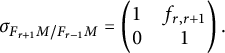 $$\begin{align*}\sigma_{F_{r+1}M/ F_{r-1}M}=\begin{pmatrix} 1 & f_{r,r+1}\\ 0 & 1\end{pmatrix}.\end{align*}$$
Given any $g=(g_{r,r+1}, \lambda )\in \omega E_{r,r+1}$
, we have
$g=(g_{r,r+1}, \lambda )\in \omega E_{r,r+1}$
, we have
 $$\begin{align*}\sigma\cdot g = \sigma_{F_{r+1}M/ F_{r-1}M}\circ g = \begin{pmatrix} 1 & f_{r,r+1}\\ 0 & 1\end{pmatrix}\begin{pmatrix} g_{r,r+1} \\ \lambda\end{pmatrix} \end{align*}$$
(the computation done in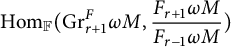 $\mathrm {Hom}_{\mathbb F}(\mathrm {Gr}^F_{r+1}\omega M, \displaystyle {\frac {F_{r+1}\omega M}{F_{r-1}\omega M}})$
). Thus, the morphism
$\mathrm {Hom}_{\mathbb F}(\mathrm {Gr}^F_{r+1}\omega M, \displaystyle {\frac {F_{r+1}\omega M}{F_{r-1}\omega M}})$
). Thus, the morphism $\mathcal {U}(M,\omega )\rightarrow \mathrm {Hom}_{\mathbb F}(\mathrm {Gr}^F_{r+1}\omega M,\mathrm {Gr}^F_{r}\omega M)$
of algebraic groups that corresponds to the action of
$\mathcal {U}(M,\omega )\rightarrow \mathrm {Hom}_{\mathbb F}(\mathrm {Gr}^F_{r+1}\omega M,\mathrm {Gr}^F_{r}\omega M)$
of algebraic groups that corresponds to the action of $\mathcal {U}(M,\omega )$
on
$\mathcal {U}(M,\omega )$
on $E_{r,r+1}$
is simply given by
$E_{r,r+1}$
is simply given by $\sigma \mapsto f_{r,r+1}$
. Taking logarithms, the image under
$\sigma \mapsto f_{r,r+1}$
. Taking logarithms, the image under $\omega $
of the morphism
$\omega $
of the morphism $\Psi _{V_{r,r+1}}(\mathcal {E}_r)$
is the map
$\Psi _{V_{r,r+1}}(\mathcal {E}_r)$
is the map
 $$\begin{align*}\omega {\mathfrak{u}}(M)\rightarrow \mathrm{Hom}_{\mathbb F}(\mathrm{Gr}^F_{r+1}\omega M,\mathrm{Gr}^F_{r}\omega M) \hspace{.5in} f\mapsto f_{r,r+1}. \end{align*}$$
Upon recalling the description of $\pi _{r,r+1}$
from Section 3.4, this gives the result.
$\pi _{r,r+1}$
from Section 3.4, this gives the result.
-
(b) By the functoriality of the map
$\Psi _X$
in
$X,$
we have a commutative diagram where the vertical identifications are via the canonical isomorphisms. Part (b) follows from part (a) since
$\mathcal {E}$
(resp.
$\pi $
) corresponds to the tuple
$(\mathcal {E}_{r,r+1})$
(resp.
$(\pi _{r,r+1})$
) under the vertical identifications.


4.3 Proof of Theorem 1.1.1
We now deduce Theorem 1.1.1. Recall from (3.6) in Section 3.5 that $\mathrm {Gr}^F_{-1}{\mathfrak {u}}(M)=\pi ({\mathfrak {u}}(M))$
. Let W be a subobject of V. We need to show that one has
$\mathrm {Gr}^F_{-1}{\mathfrak {u}}(M)=\pi ({\mathfrak {u}}(M))$
. Let W be a subobject of V. We need to show that one has $\pi ({\mathfrak {u}}(M))\subset W$
if and only if the pushforward of
$\pi ({\mathfrak {u}}(M))\subset W$
if and only if the pushforward of $\mathcal {E}$
along the quotient map
$\mathcal {E}$
along the quotient map $V\rightarrow V/W$
lives in the subcategory
$V\rightarrow V/W$
lives in the subcategory $\langle \mathrm {Gr}^FM\rangle ^{\otimes }$
. Tentatively, denote the quotient map
$\langle \mathrm {Gr}^FM\rangle ^{\otimes }$
. Tentatively, denote the quotient map $V\rightarrow V/W$
by
$V\rightarrow V/W$
by $\varphi $
. We have a commutative diagram
$\varphi $
. We have a commutative diagram

where $\varphi _\ast $
denotes pushforward of extensions along
$\varphi _\ast $
denotes pushforward of extensions along $\varphi $
. The kernel of the map
$\varphi $
. The kernel of the map $\Psi _{V/W}$
is the subgroup
$\Psi _{V/W}$
is the subgroup  (see Section 4.1). Thus, $\varphi _\ast (\mathcal {E})$
is in the subcategory
$\varphi _\ast (\mathcal {E})$
is in the subcategory $\langle \mathrm {Gr}^FM\rangle ^{\otimes }$
if and only if
$\langle \mathrm {Gr}^FM\rangle ^{\otimes }$
if and only if $\Psi _{V/W}(\varphi _\ast (\mathcal {E}))=0$
if and only if
$\Psi _{V/W}(\varphi _\ast (\mathcal {E}))=0$
if and only if $\varphi \circ (\Psi _V(\mathcal {E})) = 0$
. Thanks to Proposition 4.2.1, the latter is equivalent to
$\varphi \circ (\Psi _V(\mathcal {E})) = 0$
. Thanks to Proposition 4.2.1, the latter is equivalent to $\pi ({\mathfrak {u}}(M))\subset W$
.
$\pi ({\mathfrak {u}}(M))\subset W$
.
Remark 4.3.1 Suppose $\mathrm {Gr}^FM$
is semisimple. Then Theorem 1.1.1 asserts that
$\mathrm {Gr}^FM$
is semisimple. Then Theorem 1.1.1 asserts that $\mathrm {Gr}^F_{-1}{\mathfrak {u}}(M)$
is the smallest subobject of V such that the pushforward of
$\mathrm {Gr}^F_{-1}{\mathfrak {u}}(M)$
is the smallest subobject of V such that the pushforward of $\mathcal {E}$
along the quotient map
$\mathcal {E}$
along the quotient map $V\rightarrow V/\mathrm {Gr}^F_{-1}{\mathfrak {u}}(M)$
splits. Since
$V\rightarrow V/\mathrm {Gr}^F_{-1}{\mathfrak {u}}(M)$
splits. Since $\mathrm {Gr}^FM$
is semisimple, this can be equivalently formulated as follows:
$\mathrm {Gr}^FM$
is semisimple, this can be equivalently formulated as follows: $\mathrm {Gr}^F_{-1}{\mathfrak {u}}(M)$
is the intersection of the kernels of all endomorphisms of V that annihilate
$\mathrm {Gr}^F_{-1}{\mathfrak {u}}(M)$
is the intersection of the kernels of all endomorphisms of V that annihilate $\mathcal {E}$
:
$\mathcal {E}$
:
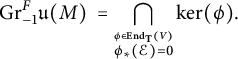 $$\begin{align*}\mathrm{Gr}^F_{-1}{\mathfrak{u}}(M) \ = \bigcap\limits_{\stackrel{\phi\in \mathrm{End}_{\mathbf{T}}(V)}{\phi_\ast(\mathcal{E})=0}} \ker(\phi). \end{align*}$$
4.4 A maximality criterion
In this section, we use Theorem 1.1.1 to give a criterion for when ${\mathfrak {u}}(M)$
is equal to
${\mathfrak {u}}(M)$
is equal to $F_{-1}{\underline {\mathrm {End}}}(M)$
. Before we state the result, let us recall a definition due to Bertrand [Reference Bertrand3]: An extension
$F_{-1}{\underline {\mathrm {End}}}(M)$
. Before we state the result, let us recall a definition due to Bertrand [Reference Bertrand3]: An extension $\mathcal {Z}$
of an object Y by an object X in
$\mathcal {Z}$
of an object Y by an object X in ${\mathbf {T}}$
is called totally nonsplit (or totally unsplit) if, considering
${\mathbf {T}}$
is called totally nonsplit (or totally unsplit) if, considering $\mathcal {Z}$
as an extension of
$\mathcal {Z}$
as an extension of  by
by ${\underline {\mathrm{Hom}}}(Y,X)$
, for every proper subobject W of
${\underline {\mathrm{Hom}}}(Y,X)$
, for every proper subobject W of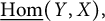 ${\underline {\mathrm{Hom}}}(Y,X),$
the pushforward of
${\underline {\mathrm{Hom}}}(Y,X),$
the pushforward of $\mathcal {Z}$
along the quotient map
$\mathcal {Z}$
along the quotient map ${\underline {\mathrm{Hom}}}(Y,X)\rightarrow {\underline {\mathrm{Hom}}}(Y,X)/W$
is nonsplit. If
${\underline {\mathrm{Hom}}}(Y,X)\rightarrow {\underline {\mathrm{Hom}}}(Y,X)/W$
is nonsplit. If ${\underline {\mathrm{Hom}}}(Y,X)$
is semisimple, then
${\underline {\mathrm{Hom}}}(Y,X)$
is semisimple, then $\mathcal {Z}$
is totally nonsplit if and only if the annihilator of
$\mathcal {Z}$
is totally nonsplit if and only if the annihilator of $\mathcal {Z}$
in
$\mathcal {Z}$
in $\mathrm {End}_{\mathbf {T}}({\underline {\mathrm{Hom}}}(Y,X))$
(for the
$\mathrm {End}_{\mathbf {T}}({\underline {\mathrm{Hom}}}(Y,X))$
(for the $\mathrm {End}_{\mathbf {T}}({\underline {\mathrm{Hom}}}(Y,X))$
-module
$\mathrm {End}_{\mathbf {T}}({\underline {\mathrm{Hom}}}(Y,X))$
-module  ) is trivial.
Theorem 1.1.1 has the following consequence.
Proposition 4.4.1 (a) The following statements are equivalent:
-
(i)
${\mathfrak {u}}(M)=F_{-1}{\underline {\mathrm {End}}}(M).$
-
(ii)
$\mathrm {Gr}^F_{-1}{\mathfrak {u}}(M)=V.$
-
(iii) If
$W\subset V$
has the property that the pushforward of
$\mathcal {E}$
along the quotient map
$V\rightarrow V/W$
is in the subcategory
$\langle \mathrm {Gr}^FM\rangle ^{\otimes }$
, then
$W=V$
.




In particular, whether or not ${\mathfrak {u}}(M)=F_{-1}{\underline {\mathrm {End}}}(M)$
depends only on the extensions
${\mathfrak {u}}(M)=F_{-1}{\underline {\mathrm {End}}}(M)$
depends only on the extensions $\displaystyle {\frac {F_{r+1}M}{F_{r-1}M}}$
of
$\displaystyle {\frac {F_{r+1}M}{F_{r-1}M}}$
of $\mathrm {Gr}^F_{r+1}M$
by
$\mathrm {Gr}^F_{r+1}M$
by $\mathrm {Gr}^F_{r-1}M$
.
$\mathrm {Gr}^F_{r-1}M$
.
(b) If ${\mathfrak {u}}(M)=F_{-1}{\underline {\mathrm {End}}}(M)$
, then the extension
${\mathfrak {u}}(M)=F_{-1}{\underline {\mathrm {End}}}(M)$
, then the extension $\mathcal {E}$
of
$\mathcal {E}$
of  by V (and a fortiori, each $\mathcal {E}_r$
of
$\mathcal {E}_r$
of  by
by $V_{r,r+1}$
) is totally nonsplit.
$V_{r,r+1}$
) is totally nonsplit.
(c) If $\mathrm {Gr}^FM$
is semisimple, then the statements (i)–(iii) of part (a) are also equivalent to the following statement:
$\mathrm {Gr}^FM$
is semisimple, then the statements (i)–(iii) of part (a) are also equivalent to the following statement:
-
(iv) The extension
$\mathcal {E}$
of by V is totally nonsplit.

 by V is totally nonsplit.
Proof (a) The equivalence (ii) $\Leftrightarrow $
(iii) is by Theorem 1.1.1. The implication (i)
$\Leftrightarrow $
(iii) is by Theorem 1.1.1. The implication (i) $\Rightarrow $
(ii) is by diagram (3.6) in Section 3.5. In view of the same diagram and the fact that the derived algebra of
$\Rightarrow $
(ii) is by diagram (3.6) in Section 3.5. In view of the same diagram and the fact that the derived algebra of $F_{-1}{\underline {\mathrm {End}}}(M)$
is
$F_{-1}{\underline {\mathrm {End}}}(M)$
is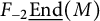 $F_{-2}{\underline {\mathrm {End}}}(M)$
, the implication (ii)
$F_{-2}{\underline {\mathrm {End}}}(M)$
, the implication (ii) $\Rightarrow $
(i) follows immediately from the following standard fact (see, for instance, [Reference Bertrand4, Lemma 7]): if
$\Rightarrow $
(i) follows immediately from the following standard fact (see, for instance, [Reference Bertrand4, Lemma 7]): if ${\mathfrak {g}}$
is a nilpotent Lie algebra and
${\mathfrak {g}}$
is a nilpotent Lie algebra and ${\mathfrak {u}}$
is a Lie subalgebra of
${\mathfrak {u}}$
is a Lie subalgebra of ${\mathfrak {g}}$
such that
${\mathfrak {g}}$
such that ${\mathfrak {u}}/({\mathfrak {u}}\cap [{\mathfrak {g}},{\mathfrak {g}}]) = {\mathfrak {g}}/[{\mathfrak {g}},{\mathfrak {g}}]$
, then
${\mathfrak {u}}/({\mathfrak {u}}\cap [{\mathfrak {g}},{\mathfrak {g}}]) = {\mathfrak {g}}/[{\mathfrak {g}},{\mathfrak {g}}]$
, then ${\mathfrak {u}}={\mathfrak {g}}$
.
${\mathfrak {u}}={\mathfrak {g}}$
.
(b) This follows from the equivalent statement (iii): if the pushforward of $\mathcal {E}$
along
$\mathcal {E}$
along $V\rightarrow V/W$
is split, then that pushforward is in
$V\rightarrow V/W$
is split, then that pushforward is in $\langle \mathrm {Gr}^FM\rangle ^{\otimes }$
.
$\langle \mathrm {Gr}^FM\rangle ^{\otimes }$
.
(c) When $\mathrm {Gr}^FM$
is semisimple, an extension of
$\mathrm {Gr}^FM$
is semisimple, an extension of  by a quotient of V is in $\langle \mathrm {Gr}^FM\rangle ^{\otimes }$
if and only if it splits. Thus, in this case, (iii) of part (a) and statement (iv) are equivalent.
$\langle \mathrm {Gr}^FM\rangle ^{\otimes }$
if and only if it splits. Thus, in this case, (iii) of part (a) and statement (iv) are equivalent.
The equivalence of statements (i) and (iii) in part (a) of Proposition 4.4.1 will play an important role in Section 5. The following definition (motivated by statement (iii) of Proposition 4.4.1(a)) will be convenient.
Definition 4.4.2 Let $\mathbf {S}$
be a full Tannakian subcategory of
$\mathbf {S}$
be a full Tannakian subcategory of ${\mathbf {T}}$
. Let X be a nonzero object of
${\mathbf {T}}$
. Let X be a nonzero object of ${\mathbf {S}}$
. We say that an element
${\mathbf {S}}$
. We say that an element  is totally disjoint from $\mathbf {S}$
if for every proper subobject W of X, the pushforward of
$\mathbf {S}$
if for every proper subobject W of X, the pushforward of $\mathcal {Z}$
along the quotient map
$\mathcal {Z}$
along the quotient map $X\rightarrow X/W$
does not belong to
$X\rightarrow X/W$
does not belong to $\mathbf {S}$
. (Thus, if
$\mathbf {S}$
. (Thus, if $\mathbf {S}$
is semisimple, then
$\mathbf {S}$
is semisimple, then $\mathcal {Z}$
is totally disjoint from
$\mathcal {Z}$
is totally disjoint from $\mathbf {S}$
if and only if it is totally nonsplit.)
$\mathbf {S}$
if and only if it is totally nonsplit.)
By Proposition 4.4.1(a), we have ${\mathfrak {u}}(M)=F_{-1}{\underline {\mathrm {End}}}(M)$
if and only if the extension
${\mathfrak {u}}(M)=F_{-1}{\underline {\mathrm {End}}}(M)$
if and only if the extension $\mathcal {E}$
of
$\mathcal {E}$
of  by V is totally disjoint from the subcategory $\langle \mathrm {Gr}^FM\rangle ^{\otimes }$
.
$\langle \mathrm {Gr}^FM\rangle ^{\otimes }$
.
4.5 Variants – I
In the remainder of Section 4, we will discuss two variants of Theorem 1.1.1 and some consequences. This content will not be needed in Section 5. A reader who wishes to skip to Section 5 may do so.
One has the following variant (or generalization) of Theorem 1.1.1 about the projections of $\pi ({\mathfrak {u}}(M))$
to the direct summands of V.
$\pi ({\mathfrak {u}}(M))$
to the direct summands of V.
Proposition 4.5.1 Let I be a nonempty subset of $\{1,\ldots ,k-1\}$
. Set
$\{1,\ldots ,k-1\}$
. Set $V_I:=\bigoplus _{r\in I} V_{r,r+1}$
and
$V_I:=\bigoplus _{r\in I} V_{r,r+1}$
and $\pi _I:=(\pi _{r,r+1})_{r\in I}$
, considered as a map from
$\pi _I:=(\pi _{r,r+1})_{r\in I}$
, considered as a map from ${\mathfrak {u}}(M)$
to
${\mathfrak {u}}(M)$
to $V_I$
. Let
$V_I$
. Let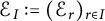 $\mathcal {E}_I:=(\mathcal {E}_r)_{r\in I}$
, considered as an extension of
$\mathcal {E}_I:=(\mathcal {E}_r)_{r\in I}$
, considered as an extension of  by
by $V_I$
. Then
$V_I$
. Then $\pi _I({\mathfrak {u}}(M))$
is the smallest subobject of
$\pi _I({\mathfrak {u}}(M))$
is the smallest subobject of $V_I$
with the property that the pushforward of the extension
$V_I$
with the property that the pushforward of the extension $\mathcal {E}_I$
along the quotient map
$\mathcal {E}_I$
along the quotient map $V_I\rightarrow V_I/\pi _I({\mathfrak {u}}(M))$
is an extension in the subcategory
$V_I\rightarrow V_I/\pi _I({\mathfrak {u}}(M))$
is an extension in the subcategory $\langle \mathrm {Gr}^FM\rangle ^{\otimes }$
. In particular, if
$\langle \mathrm {Gr}^FM\rangle ^{\otimes }$
. In particular, if $\mathrm {Gr}^FM$
is semisimple, then
$\mathrm {Gr}^FM$
is semisimple, then $\pi _I({\mathfrak {u}}(M))$
is the smallest subobject of
$\pi _I({\mathfrak {u}}(M))$
is the smallest subobject of $V_I$
such that the pushforward of
$V_I$
such that the pushforward of $\mathcal {E}_I$
to an extension of
$\mathcal {E}_I$
to an extension of  by
by $V_I/\pi _I({\mathfrak {u}}(M))$
splits.
$V_I/\pi _I({\mathfrak {u}}(M))$
splits.
Proof By Proposition 4.2.1(a) and functoriality of the maps $\Psi _X$
in
$\Psi _X$
in $X,$
we obtain
$X,$
we obtain $\Psi _{V_I}(\mathcal {E}_I) = \pi _I$
. The proof of Proposition 4.5.1 is now identical to the argument for Theorem 1.1.1 given in Section 4.3, with V,
$\Psi _{V_I}(\mathcal {E}_I) = \pi _I$
. The proof of Proposition 4.5.1 is now identical to the argument for Theorem 1.1.1 given in Section 4.3, with V, $\mathcal {E,}$
and
$\mathcal {E,}$
and $\pi $
throughout being replaced by
$\pi $
throughout being replaced by $V_I$
,
$V_I$
, $\mathcal {E}_I,$
and
$\mathcal {E}_I,$
and $\pi _I$
, respectively.
$\pi _I$
, respectively.
Consider a subquotient $F_nM/F_mM$
of M with
$F_nM/F_mM$
of M with $0\leq m<n\leq k$
. The filtration
$0\leq m<n\leq k$
. The filtration $F_\bullet $
induces a filtration on
$F_\bullet $
induces a filtration on $F_nM/F_mM$
. We can apply the constructions and results of the article to this filtered object. We obtain an object
$F_nM/F_mM$
. We can apply the constructions and results of the article to this filtered object. We obtain an object ${\mathfrak {u}}(F_nM/F_mM)\subset F_{-1}{\underline {\mathrm {End}}}(F_nM/F_mM)$
whose image under any fiber functor is the Lie algebra of the subgroup of the Tannakian fundamental group of
${\mathfrak {u}}(F_nM/F_mM)\subset F_{-1}{\underline {\mathrm {End}}}(F_nM/F_mM)$
whose image under any fiber functor is the Lie algebra of the subgroup of the Tannakian fundamental group of $F_nM/F_mM$
that acts trivially on
$F_nM/F_mM$
that acts trivially on $\mathrm {Gr}^F(F_nM/F_mM)\cong \bigoplus _{m<r\leq n}\mathrm {Gr}^F_r(M)$
. We also have a natural map
$\mathrm {Gr}^F(F_nM/F_mM)\cong \bigoplus _{m<r\leq n}\mathrm {Gr}^F_r(M)$
. We also have a natural map
 $$ \begin{align} {\mathfrak{u}}(M) \rightarrow {\mathfrak{u}}(F_nM/F_mM) \end{align} $$
induced by the restriction map from the Tannakian group of M to the Tannakian group of $F_nM/F_mM$
. This map fits in a commutative diagram
$F_nM/F_mM$
. This map fits in a commutative diagram
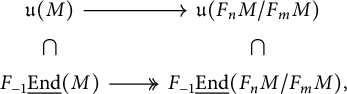
where the bottom arrow is the map that after applying a fiber functor $\omega $
, sends a linear map
$\omega $
, sends a linear map $f\in \mathrm {End}_{\mathbb F}(\omega M)$
in
$f\in \mathrm {End}_{\mathbb F}(\omega M)$
in $F_{-1}\omega {\underline {\mathrm {End}}}(M)$
to the induced map in
$F_{-1}\omega {\underline {\mathrm {End}}}(M)$
to the induced map in $\mathrm {End}_{\mathbb F}(\omega F_nM/\omega F_mM)$
(this makes sense because f is in
$\mathrm {End}_{\mathbb F}(\omega F_nM/\omega F_mM)$
(this makes sense because f is in $F_{-1}\omega {\underline {\mathrm {End}}}(M)$
). One may ask if the top arrow is always surjective. As an application of Proposition 4.5.1, we can see that this is not true in general, as we now explain.
$F_{-1}\omega {\underline {\mathrm {End}}}(M)$
). One may ask if the top arrow is always surjective. As an application of Proposition 4.5.1, we can see that this is not true in general, as we now explain.
For brevity, let $(m,n)$
denote the set of integers
$(m,n)$
denote the set of integers $\{r: m< r< n\}$
. Consider the map
$\{r: m< r< n\}$
. Consider the map $\pi $
for
$\pi $
for $F_nM/F_mM$
(see Section 3.4). Including
$F_nM/F_mM$
(see Section 3.4). Including $F_nM/F_mM$
as a superscript in the notation to avoid confusion, this is a map
$F_nM/F_mM$
as a superscript in the notation to avoid confusion, this is a map
 $$\begin{align*}\pi^{F_nM/F_mM} : F_{-1}{\underline{\mathrm{End}}}(F_nM/F_mM) \rightarrow V_{(m,n)} = \bigoplus\limits_{m<r<n} V_{r,r+1} \end{align*}$$
(the notation $V_{(m,n)}$
is as in Proposition 4.5.1). There is a commutative diagram
$V_{(m,n)}$
is as in Proposition 4.5.1). There is a commutative diagram

where $\pi ^M$
means our
$\pi ^M$
means our $\pi $
from before (for M) and
$\pi $
from before (for M) and $\pi ^M_{(m,n)}={(\pi _{r,r+1})}_{m<r<n}$
(again, following the notation of Proposition 4.5.1). By Proposition 4.5.1,
$\pi ^M_{(m,n)}={(\pi _{r,r+1})}_{m<r<n}$
(again, following the notation of Proposition 4.5.1). By Proposition 4.5.1,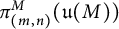 $\pi ^M_{(m,n)}({\mathfrak {u}}(M))$
is the smallest subobject of
$\pi ^M_{(m,n)}({\mathfrak {u}}(M))$
is the smallest subobject of $V_{(m,n)}$
such that the pushforward of
$V_{(m,n)}$
such that the pushforward of $\mathcal {E}_{(m,n)}$
along the quotient
$\mathcal {E}_{(m,n)}$
along the quotient $V_{(m,n)}\rightarrow V_{(m,n)}/\pi ^M_{(m,n)}({\mathfrak {u}}(M))$
belongs to
$V_{(m,n)}\rightarrow V_{(m,n)}/\pi ^M_{(m,n)}({\mathfrak {u}}(M))$
belongs to $\langle \mathrm {Gr}^FM\rangle ^{\otimes }$
. On the other hand, applying the same result (or Theorem 1.1.1) to
$\langle \mathrm {Gr}^FM\rangle ^{\otimes }$
. On the other hand, applying the same result (or Theorem 1.1.1) to $F_{n}M/F_{m}M,$
we see that
$F_{n}M/F_{m}M,$
we see that $\pi ^{F_{n}M/F_{m}M}({\mathfrak {u}}(F_{n}M/F_{m}M))$
is the smallest subobject of
$\pi ^{F_{n}M/F_{m}M}({\mathfrak {u}}(F_{n}M/F_{m}M))$
is the smallest subobject of $V_{(m,n)}$
such that the pushforward of
$V_{(m,n)}$
such that the pushforward of $\mathcal {E}_{(m,n)}$
along the quotient
$\mathcal {E}_{(m,n)}$
along the quotient $V_{(m,n)}\rightarrow V_{(m,n)}/\pi ^{F_{n}M/F_{m}M}({\mathfrak {u}}(F_{n}M/F_{m}M))$
belongs to
$V_{(m,n)}\rightarrow V_{(m,n)}/\pi ^{F_{n}M/F_{m}M}({\mathfrak {u}}(F_{n}M/F_{m}M))$
belongs to $\langle \mathrm {Gr}^F(F_nM/F_mM)\rangle ^{\otimes }$
. Already in the case
$\langle \mathrm {Gr}^F(F_nM/F_mM)\rangle ^{\otimes }$
. Already in the case $n-m=2$
with
$n-m=2$
with $n=r+1$
and
$n=r+1$
and $m=r-1$
(where
$m=r-1$
(where $F_nM/F_mM$
has only two graded components
$F_nM/F_mM$
has only two graded components $\mathrm {Gr}^F_{r+1}M$
and
$\mathrm {Gr}^F_{r+1}M$
and $\mathrm {Gr}^F_r M$
), one can now easily use these characterizations to construct an example where the restriction map
$\mathrm {Gr}^F_r M$
), one can now easily use these characterizations to construct an example where the restriction map ${\mathfrak {u}}(M)\rightarrow {\mathfrak {u}}(F_{r+1}M/F_{r-1}M)$
is not surjective.
${\mathfrak {u}}(M)\rightarrow {\mathfrak {u}}(F_{r+1}M/F_{r-1}M)$
is not surjective.
On the other hand, one has the following corollary.
Corollary 4.5.2 Suppose that $\mathrm {Gr}^FM$
is semisimple.
$\mathrm {Gr}^FM$
is semisimple.
-
(a) Let
$0\leq m<n\leq k$
. Then with notation as above, we have
$$\begin{align*}\pi^M_{(m,n)}({\mathfrak{u}}(M)) = \pi^{F_{n}M/F_{m}M}({\mathfrak{u}}(F_{n}M/F_{m}M)). \end{align*}$$
-
(b) For every r, the restriction map
$$\begin{align*}{\mathfrak{u}}(M)\rightarrow {\mathfrak{u}}(F_{r+1}M/F_{r-1}M)\end{align*}$$
is surjective.
-
(c) Let
$0\leq m<n\leq k$
. If (4.9)
$$ \begin{align} F_{-2}{\mathfrak{u}}(F_{n}M/F_{m}M) = [{\mathfrak{u}}(F_{n}M/F_{m}M),{\mathfrak{u}}(F_{n}M/F_{m}M)], \end{align} $$
then the restriction map
$$\begin{align*}{\mathfrak{u}}(M)\rightarrow {\mathfrak{u}}(F_{n}M/F_{m}M)\end{align*}$$
is surjective.






Proof
-
(a) Since
$\mathrm {Gr}^FM$
is semisimple, the conditions “belongs to
$\langle \mathrm {Gr}^F M\rangle ^{\otimes }$
” and “belongs to
$\langle \mathrm {Gr}^F(F_nM/F_m M)\rangle ^{\otimes }$
” for pushforwards of the extension
$\mathcal {E}_{(m,n)}$
are both equivalent to splitting. Thus, part (a) follows from Proposition 4.5.1. -
(b) Setting
$n=r+1$
and
$m=r-1$
, diagram (4.8) becomes where
$\pi ^{\frac {F_{r+1}M}{F_{r-1}M}}$
is simply the natural inclusion of
${\mathfrak {u}}(F_{r+1}M/F_{r-1}M)$
in
$F_{-1}{\underline {\mathrm {End}}}(\displaystyle {\frac {F_{r+1}M}{F_{r-1}M}})\cong V_{r,r+1}$
. Thus, the assertion follows from (a) and injectivity of
$\pi ^{F_{r+1}M/F_{r-1}M}$
. -
(c) The assumption (4.9) implies that
$\pi ^{F_{n}M/F_{m}M}({\mathfrak {u}}(F_{n}M/F_{m}M))$
is the abelianization of the nilpotent Lie algebra
${\mathfrak {u}}(F_{n}M/F_{m}M)$
. By part (a), the composition
$$\begin{align*}{\mathfrak{u}}(M) \rightarrow {\mathfrak{u}}(F_{n}M/F_{m}M) \rightarrow {\mathfrak{u}}(F_{n}M/F_{m}M)^{\mathrm{ab}} \end{align*}$$
is surjective. The claim follows from [Reference Bertrand4, Lemma 7].





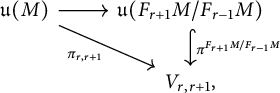


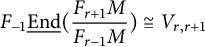




Remark 4.5.3 Corollary 4.5.2(b) is a special case of part (c) (as $F_{-2}{\underline {\mathrm {End}}}(F_{r+1}M/F_{r-1}M)$
is zero). I do not know whether or not for general
$F_{-2}{\underline {\mathrm {End}}}(F_{r+1}M/F_{r-1}M)$
is zero). I do not know whether or not for general $n,m$
, the semisimplicity of
$n,m$
, the semisimplicity of $\mathrm {Gr}^FM$
by itself (without condition (4.9)) is enough to guarantee the surjectivity of the restriction map
$\mathrm {Gr}^FM$
by itself (without condition (4.9)) is enough to guarantee the surjectivity of the restriction map ${\mathfrak {u}}(M)\rightarrow {\mathfrak {u}}(F_{n}M/F_{m}M)$
.
${\mathfrak {u}}(M)\rightarrow {\mathfrak {u}}(F_{n}M/F_{m}M)$
.
Remark 4.5.4 Suppose that after a relabeling of indices, the filtration $F_\bullet M$
is given by a functorial weight filtration
$F_\bullet M$
is given by a functorial weight filtration $W_\bullet $
(see Section 5 for what this exactly means). Then the restriction maps
$W_\bullet $
(see Section 5 for what this exactly means). Then the restriction maps ${\mathfrak {u}}(M)\rightarrow {\mathfrak {u}}(F_nM/F_mM)$
are all surjective, even if
${\mathfrak {u}}(M)\rightarrow {\mathfrak {u}}(F_nM/F_mM)$
are all surjective, even if $\mathrm {Gr}^FM$
is not semisimple. To see this, let
$\mathrm {Gr}^FM$
is not semisimple. To see this, let $\omega _0$
be a fiber functor for
$\omega _0$
be a fiber functor for ${\mathbf {T}}$
and let
${\mathbf {T}}$
and let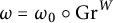 $\omega =\omega _0\circ \mathrm {Gr}^W$
, where
$\omega =\omega _0\circ \mathrm {Gr}^W$
, where $\mathrm {Gr}^W$
is the associated graded functor
$\mathrm {Gr}^W$
is the associated graded functor ${\mathbf {T}}\rightarrow {\mathbf {T}}$
. Then for every object N of
${\mathbf {T}}\rightarrow {\mathbf {T}}$
. Then for every object N of ${\mathbf {T,}}$
the surjection
${\mathbf {T,}}$
the surjection $\mathcal {G}(N,\omega )\twoheadrightarrow \mathcal {G}(\mathrm {Gr}^W N,\omega )$
admits a canonical section given by
$\mathcal {G}(N,\omega )\twoheadrightarrow \mathcal {G}(\mathrm {Gr}^W N,\omega )$
admits a canonical section given by $\mathrm {Gr}^W: \langle N\rangle ^{\otimes }\rightarrow \langle \mathrm {Gr}^W N\rangle ^{\otimes }$
. The surjectivity of
$\mathrm {Gr}^W: \langle N\rangle ^{\otimes }\rightarrow \langle \mathrm {Gr}^W N\rangle ^{\otimes }$
. The surjectivity of ${\mathfrak {u}}(M)\rightarrow {\mathfrak {u}}(F_nM/F_mM)$
can be seen easily from this.
${\mathfrak {u}}(M)\rightarrow {\mathfrak {u}}(F_nM/F_mM)$
can be seen easily from this.
4.6 Variants – II
Suppose $\mathrm {Gr}^FM$
is semisimple. In this case, we will give an equivalent formulation of Theorem 1.1.1 that will be useful to give a refinement of Proposition 4.4.1. Thanks to semisimplicity of
$\mathrm {Gr}^FM$
is semisimple. In this case, we will give an equivalent formulation of Theorem 1.1.1 that will be useful to give a refinement of Proposition 4.4.1. Thanks to semisimplicity of $\mathrm {Gr}^FM$
, the object
$\mathrm {Gr}^FM$
, the object ${\mathfrak {u}}(F_{r+1}M/F_{r-1}M)$
is the smallest subobject of
${\mathfrak {u}}(F_{r+1}M/F_{r-1}M)$
is the smallest subobject of $V_{r,r+1}$
such that the pushforward of
$V_{r,r+1}$
such that the pushforward of $\mathcal {E}_r$
along the quotient map
$\mathcal {E}_r$
along the quotient map $V_{r,r+1}\rightarrow V_{r,r+1}/{\mathfrak {u}}(F_{r+1}M/F_{r-1}M)$
splits (this is by the case
$V_{r,r+1}\rightarrow V_{r,r+1}/{\mathfrak {u}}(F_{r+1}M/F_{r-1}M)$
splits (this is by the case $k=2$
of Theorem 1.1.1, which was also proved earlier in [Reference Eskandari and Murty9, Theorem 3.3.1]). Equivalently,
$k=2$
of Theorem 1.1.1, which was also proved earlier in [Reference Eskandari and Murty9, Theorem 3.3.1]). Equivalently, ${\mathfrak {u}}(F_{r+1}M/F_{r-1}M)$
is the smallest subobject of
${\mathfrak {u}}(F_{r+1}M/F_{r-1}M)$
is the smallest subobject of $V_{r,r+1}$
such that
$V_{r,r+1}$
such that $\mathcal {E}_r$
is in the image of the map
$\mathcal {E}_r$
is in the image of the map

given by pushforward along the inclusion ${\mathfrak {u}}(F_{r+1}M/F_{r-1}M)\hookrightarrow V_{r,r+1}$
. Since
${\mathfrak {u}}(F_{r+1}M/F_{r-1}M)\hookrightarrow V_{r,r+1}$
. Since $V_{r,r+1}$
is semisimple, the map (4.10) is injective. With abuse of notation, we use the same notation for
$V_{r,r+1}$
is semisimple, the map (4.10) is injective. With abuse of notation, we use the same notation for $\mathcal {E}_r$
and the element of
$\mathcal {E}_r$
and the element of  that pushes forward to it.
Under the assumption of semisimplicity of $\mathrm {Gr}^FM$
, Theorem 1.1.1 can be equivalently formulated as follows.
$\mathrm {Gr}^FM$
, Theorem 1.1.1 can be equivalently formulated as follows.
Proposition 4.6.1 Suppose $\mathrm {Gr}^FM$
is semisimple. Set
$\mathrm {Gr}^FM$
is semisimple. Set
 $$\begin{align*}\hat{V}:=\bigoplus\limits_r \, {\mathfrak{u}}(F_{r+1}M/F_{r-1}M) \subset V. \end{align*}$$
For each r, consider $\mathcal {E}_r$
as an extension of
$\mathcal {E}_r$
as an extension of  by
by ${\mathfrak {u}}(F_{r+1}M/F_{r-1}M)$
, and consider
${\mathfrak {u}}(F_{r+1}M/F_{r-1}M)$
, and consider $\mathcal {E}=(\mathcal {E}_r)$
as an extension of
$\mathcal {E}=(\mathcal {E}_r)$
as an extension of  by
by $\hat {V}$
. Then
$\hat {V}$
. Then $\mathrm {Gr}^F_{-1}{\mathfrak {u}}(M)$
is the smallest subobject of
$\mathrm {Gr}^F_{-1}{\mathfrak {u}}(M)$
is the smallest subobject of $\hat {V}$
such that the pushforward of the extension
$\hat {V}$
such that the pushforward of the extension $\mathcal {E}$
along the quotient map
$\mathcal {E}$
along the quotient map $\hat {V}\rightarrow \hat {V}/\mathrm {Gr}^F_{-1}{\mathfrak {u}}(M)$
splits.
$\hat {V}\rightarrow \hat {V}/\mathrm {Gr}^F_{-1}{\mathfrak {u}}(M)$
splits.
As an immediate consequence of Proposition 4.6.1, one gets the following result, which refines Proposition 4.4.1 in the case when $\mathrm {Gr}^FM$
is semisimple and
$\mathrm {Gr}^FM$
is semisimple and $\hat {V}\neq V$
.
$\hat {V}\neq V$
.
Corollary 4.6.2 Suppose $\mathrm {Gr}^FM$
is semisimple. Then the following statements are equivalent:
$\mathrm {Gr}^FM$
is semisimple. Then the following statements are equivalent:
-
(i)
$\mathrm {Gr}^F_{-1}{\mathfrak {u}}(M)=\hat {V.}$
-
(ii) The extension
$\mathcal {E}$
, considered as an extension of by
$\hat {V}$
, is totally nonsplit (see Section 4.4 to recall what this means).


 by
by 
Note that for semisimple $\mathrm {Gr}^FM$
, one has
$\mathrm {Gr}^FM$
, one has $\hat {V}=V$
if and only if for every r, the extension
$\hat {V}=V$
if and only if for every r, the extension $\mathcal {E}_r\in \mathrm {Ext}^1_{\mathbf {T}}(\mathrm {Gr}^F_{r+1}M, \mathrm {Gr}^F_{r}M)$
is totally nonsplit.
$\mathcal {E}_r\in \mathrm {Ext}^1_{\mathbf {T}}(\mathrm {Gr}^F_{r+1}M, \mathrm {Gr}^F_{r}M)$
is totally nonsplit.
5 Classification of objects with maximal
${\mathfrak {u}}$
in the case of a weight filtration

5.1 Statement of the result
In the remainder of the article, we assume that our Tannakian category ${\mathbf {T}}$
is equipped with a functorial filtration
${\mathbf {T}}$
is equipped with a functorial filtration $W_\bullet $
(called the weight filtration) with similar properties to the weight filtration on rational mixed Hodge structures: indexed by
$W_\bullet $
(called the weight filtration) with similar properties to the weight filtration on rational mixed Hodge structures: indexed by ${\mathbb Z}$
, increasing and finite on every object, functorial, exact, and compatible with the tensor structure. More explicitly, this means that every object M of
${\mathbb Z}$
, increasing and finite on every object, functorial, exact, and compatible with the tensor structure. More explicitly, this means that every object M of ${\mathbf {T}}$
is equipped with a filtration
${\mathbf {T}}$
is equipped with a filtration $(W_n M)_{n\in {\mathbb Z}}$
with
$(W_n M)_{n\in {\mathbb Z}}$
with $W_{n-1}M\subset W_nM$
for all
$W_{n-1}M\subset W_nM$
for all $n\in {\mathbb Z}$
,
$n\in {\mathbb Z}$
, $W_n M = 0$
for
$W_n M = 0$
for $n\ll 0$
, and
$n\ll 0$
, and $W_n M = M$
for
$W_n M = M$
for $n\gg 0$
, such that the following conditions (i)–(iii) hold: (i) For every objects M and N and morphism
$n\gg 0$
, such that the following conditions (i)–(iii) hold: (i) For every objects M and N and morphism $f:M\rightarrow N$
in
$f:M\rightarrow N$
in ${\mathbf {T}}$
, we have
${\mathbf {T}}$
, we have $f(W_n M)\subset W_n N$
for every n; (ii) the functors
$f(W_n M)\subset W_n N$
for every n; (ii) the functors $W_n: {\mathbf {T}}\rightarrow {\mathbf {T}}$
(defined by
$W_n: {\mathbf {T}}\rightarrow {\mathbf {T}}$
(defined by $M\mapsto W_n M$
on objects and acting on a morphism
$M\mapsto W_n M$
on objects and acting on a morphism $f: M\rightarrow N$
by restricting it to
$f: M\rightarrow N$
by restricting it to $f: W_nM\rightarrow W_nN$
) are exact for every n; and (iii) for every objects M and N and every integer n,
$f: W_nM\rightarrow W_nN$
) are exact for every n; and (iii) for every objects M and N and every integer n,
 $$\begin{align*}W_n(M\otimes N) = \sum\limits_{p+q=n}W_pM\otimes W_qN. \end{align*}$$
We call an object M of ${\mathbf {T}}$
pure if there exists an integer n such that
${\mathbf {T}}$
pure if there exists an integer n such that $W_{n-1}M=0$
and
$W_{n-1}M=0$
and $W_nM=M$
. A weight of an object M is an integer n such that
$W_nM=M$
. A weight of an object M is an integer n such that $W_{n-1}M\neq W_nM$
. A nonzero pure object is an object with exactly one weight.
$W_{n-1}M\neq W_nM$
. A nonzero pure object is an object with exactly one weight.
For every nonzero object M of ${\mathbf {T}}$
, we apply the constructions and results of the article by taking the increasing filtration
${\mathbf {T}}$
, we apply the constructions and results of the article by taking the increasing filtration $(F_r M)_{r\in {\mathbb Z}}$
to be given by the weight filtration: more precisely, if the weights of M are
$(F_r M)_{r\in {\mathbb Z}}$
to be given by the weight filtration: more precisely, if the weights of M are $p_1<\cdots <p_k$
, set
$p_1<\cdots <p_k$
, set $F_rM:=W_{p_r}M$
for
$F_rM:=W_{p_r}M$
for $1\leq r\leq k$
and
$1\leq r\leq k$
and $F_0M=0$
. We thus obtain an object
$F_0M=0$
. We thus obtain an object
 $$\begin{align*}{\mathfrak{u}}(M)\subset F_{-1}{\underline{\mathrm{End}}}(M)=W_{-1}{\underline{\mathrm{End}}}(M).\end{align*}$$
As an application of Theorem 1.1.1, we will prove the following result about the structure of the set of isomorphism classes of objects M of ${\mathbf {T}}$
with a given associated graded and maximal
${\mathbf {T}}$
with a given associated graded and maximal ${\mathfrak {u}}(M)$
.
${\mathfrak {u}}(M)$
.
Theorem 5.1.1 Fix objects $A_1,\ldots , A_k$
of
$A_1,\ldots , A_k$
of ${\mathbf {T}}$
, where
${\mathbf {T}}$
, where $A_r$
is nonzero and pure of weight
$A_r$
is nonzero and pure of weight $p_r$
, and
$p_r$
, and $p_1<\cdots < p_k$
. Set
$p_1<\cdots < p_k$
. Set $A := \bigoplus _r A_r$
. Let
$A := \bigoplus _r A_r$
. Let $S^\ast (A)$
be the set of equivalence classes of objects M of
$S^\ast (A)$
be the set of equivalence classes of objects M of ${\mathbf {T}}$
such that
${\mathbf {T}}$
such that $\mathrm {Gr}^WM$
is isomorphic to A and
$\mathrm {Gr}^WM$
is isomorphic to A and ${\mathfrak {u}}(M)=W_{-1}{\underline {\mathrm {End}}}(M)$
, where two such objects M and
${\mathfrak {u}}(M)=W_{-1}{\underline {\mathrm {End}}}(M)$
, where two such objects M and $M'$
are considered equivalent if they are isomorphic in
$M'$
are considered equivalent if they are isomorphic in ${\mathbf {T}}$
(note that we do not keep any trace of a choice of isomorphism between
${\mathbf {T}}$
(note that we do not keep any trace of a choice of isomorphism between $\mathrm {Gr}^WM$
and A). Then there exist sets
$\mathrm {Gr}^WM$
and A). Then there exist sets $S^\ast _\ell (A)$
(
$S^\ast _\ell (A)$
( $1\leq \ell \leq k-1$
) and maps
$1\leq \ell \leq k-1$
) and maps
 $$ \begin{align} S^\ast(A)\cong S^\ast_{k-1}(A) \rightarrow S^\ast_{k-2}(A) \rightarrow\cdots \rightarrow S^\ast_1(A) \end{align} $$
such that the following statements hold:
-
(i) For
$2\leq \ell \leq k-1$
, every nonempty fiber of the map
$S_\ell ^\ast (A)\rightarrow S_{\ell -1}^\ast (A)$
is a torsor over
$$\begin{align*}\bigoplus\limits_{r} \mathrm{Ext}^1_{\mathbf{T}}(A_{r+\ell},A_r) \end{align*}$$
(where r runs from
$1$
to
$k-\ell $
). -
(ii) Let
$2\leq \ell \leq k-1$
. Then the map
$S_\ell ^\ast (A)\rightarrow S_{\ell -1}^\ast (A)$
is surjective if
$$\begin{align*}\bigoplus\limits_{r} \mathrm{Ext}^2_{\mathbf{T}}(A_{r+\ell},A_r) \end{align*}$$
vanishes.
-
(iii) (Description of
$S^\ast _1(A)$
) Let
$$\begin{align*}\bigm(\bigoplus_r \mathrm{Ext}^1_{\mathbf{T}}(A_{r+1},A_r)\bigm)^\ast \end{align*}$$
be the subset of
$\bigoplus _r \mathrm {Ext}^1_{\mathbf {T}}(A_{r+1},A_r)$
consisting of every extension tuple
$\mathcal {E}=(\mathcal {E}_r)$
such that considering
$\mathcal {E}$
as an element of in the natural way,
$\mathcal {E}$
is totally disjoint from the subcategory
$\langle A\rangle ^{\otimes }$
(see Definition 4.4.2). Then there is a canonical bijection
$$\begin{align*}S^\ast_1(A) \ \cong \ \bigm(\bigoplus_r \mathrm{Ext}^1_{\mathbf{T}}(A_{r+1},A_r)\bigm)^\ast \bigm/ \mathrm{Aut}(A),\end{align*}$$
where the action of
$\mathrm {Aut}(A)=\prod _r \mathrm {Aut}(A_r)$
on extensions is by pushforwards and pullbacks (i.e.,
$\sigma =(\sigma _r)\in \prod _r \mathrm {Aut}(A_r)$
sends
$(\mathcal {E}_r)$
to
$((\sigma _{r+1}^{-1})^\ast (\sigma _{r})_\ast \mathcal {E}_r)$
).






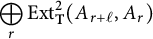

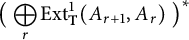



 in the natural way,






This result was proved in [Reference Eskandari7, Section 5, Theorem 5.4.3] in the special case when A is “graded-independent” (in the sense of Definition 5.3.1 of [Reference Eskandari7]) and semisimple. Our goal in the rest of the article is to establish Theorem 5.1.1. This will be done in Section 5.3 after we review some relevant constructions of [Reference Eskandari7] in Section 5.2 below. In what follows until the end of the article, A (and k, the $A_r$
and
$A_r$
and $p_r$
) are fixed and as described in the statement of Theorem 5.1.1.
$p_r$
) are fixed and as described in the statement of Theorem 5.1.1.
5.2 Recollections on generalized extensions
Following [Reference Eskandari7], we denote by $S'(A)$
the set of equivalence classes of pairs
$S'(A)$
the set of equivalence classes of pairs $(M,\phi )$
consisting of an object M of
$(M,\phi )$
consisting of an object M of ${\mathbf {T}}$
and an isomorphism
${\mathbf {T}}$
and an isomorphism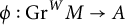 $\phi : \mathrm {Gr}^WM\rightarrow A$
, where two such pairs
$\phi : \mathrm {Gr}^WM\rightarrow A$
, where two such pairs $(M,\phi )$
and
$(M,\phi )$
and $(M',\phi ')$
are considered equivalent if there exists a morphism (automatically, an isomorphism)
$(M',\phi ')$
are considered equivalent if there exists a morphism (automatically, an isomorphism)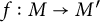 $f: M\rightarrow M'$
such that
$f: M\rightarrow M'$
such that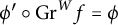 $\phi '\circ \mathrm {Gr}^Wf=\phi $
. Denote by
$\phi '\circ \mathrm {Gr}^Wf=\phi $
. Denote by $S(A)$
the set of isomorphism classes of objects M of
$S(A)$
the set of isomorphism classes of objects M of ${\mathbf {T}}$
such that
${\mathbf {T}}$
such that $\mathrm {Gr}^WM$
is isomorphic to A. Note that no trace of a choice of an isomorphism
$\mathrm {Gr}^WM$
is isomorphic to A. Note that no trace of a choice of an isomorphism $\mathrm {Gr}^WM\rightarrow A$
is kept in
$\mathrm {Gr}^WM\rightarrow A$
is kept in $S(A)$
(in contrast to the set
$S(A)$
(in contrast to the set $S'(A)$
). There is a natural action of
$S'(A)$
). There is a natural action of $\mathrm {Aut}(A)$
on
$\mathrm {Aut}(A)$
on $S'(A)$
(given by twisting
$S'(A)$
(given by twisting $\phi $
in a pair
$\phi $
in a pair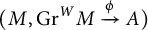 $(M,\mathrm {Gr}^WM\xrightarrow {\phi } A)$
), and the set
$(M,\mathrm {Gr}^WM\xrightarrow {\phi } A)$
), and the set $S(A)$
can be identified with the quotient of
$S(A)$
can be identified with the quotient of $S'(A)$
by
$S'(A)$
by $\mathrm {Aut}(A)$
. The set
$\mathrm {Aut}(A)$
. The set $S^\ast (A)$
of Theorem 5.1.1 is contained in
$S^\ast (A)$
of Theorem 5.1.1 is contained in $S(A)$
.
$S(A)$
.
We introduced a new approach to study $S'(A)$
and
$S'(A)$
and $S(A)$
in [Reference Eskandari7, Section 3]. This approach, which in loc. cit. we called induction on the level, appears to have better naturalness properties than the obvious approach of induction on the number of weights k (see [Reference Eskandari7, Remark 3.3.2]). The inductive approach on the level is a natural generalization of the formalism of blended extensions (extensions panachées [Reference Grothendieck11]). Here, we will briefly sketch this approach to the extent needed to prove Theorem 5.1.1. We refer the reader to Sections 3 and 4 of [Reference Eskandari7] for more details and the proofs of everything we will say below in this section.
$S(A)$
in [Reference Eskandari7, Section 3]. This approach, which in loc. cit. we called induction on the level, appears to have better naturalness properties than the obvious approach of induction on the number of weights k (see [Reference Eskandari7, Remark 3.3.2]). The inductive approach on the level is a natural generalization of the formalism of blended extensions (extensions panachées [Reference Grothendieck11]). Here, we will briefly sketch this approach to the extent needed to prove Theorem 5.1.1. We refer the reader to Sections 3 and 4 of [Reference Eskandari7] for more details and the proofs of everything we will say below in this section.
We constructed sets $S^{\prime }_\ell (A)$
for
$S^{\prime }_\ell (A)$
for $1\leq \ell \leq k-1$
and maps
$1\leq \ell \leq k-1$
and maps
 $$ \begin{align} S'(A)\cong S^{\prime}_{k-1}(A) \rightarrow S^{\prime}_{k-2}(A) \rightarrow\cdots \rightarrow S^{\prime}_1(A)\cong \bigoplus\limits_{r}\mathrm{Ext}^1_{\mathbf{T}}(A_{r+1},A_r) \end{align} $$
such that for every $\ell $
, every nonempty fiber of
$\ell $
, every nonempty fiber of $S^{\prime }_\ell (A)\rightarrow S^{\prime }_{\ell -1}(A)$
is canonically a torsor over
$S^{\prime }_\ell (A)\rightarrow S^{\prime }_{\ell -1}(A)$
is canonically a torsor over
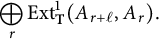 $$\begin{align*}\bigoplus\limits_{r} \mathrm{Ext}^1_{\mathbf{T}}(A_{r+\ell},A_r). \end{align*}$$
Moreover, the map $S^{\prime }_\ell (A)\rightarrow S^{\prime }_{\ell -1}(A)$
is surjective if
$S^{\prime }_\ell (A)\rightarrow S^{\prime }_{\ell -1}(A)$
is surjective if
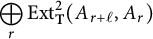 $$\begin{align*}\bigoplus\limits_{r} \mathrm{Ext}^2_{\mathbf{T}}(A_{r+\ell},A_r) \end{align*}$$
vanishes. We also constructed quotients $S_\ell (A)$
of
$S_\ell (A)$
of $S^{\prime }_\ell (A)$
for
$S^{\prime }_\ell (A)$
for $1\leq \ell \leq k-1$
such that (5.2) descends to a sequence of maps
$1\leq \ell \leq k-1$
such that (5.2) descends to a sequence of maps
 $$ \begin{align} S(A)\cong S_{k-1}(A) \rightarrow S_{k-2}(A) \rightarrow\cdots \rightarrow S_1(A)\cong \ \bigm(\bigoplus\limits_{r} \mathrm{Ext}^1_{\mathbf{T}}(A_{r+1},A_r)\bigm)\bigm/\mathrm{Aut}(A), \end{align} $$
where the action of the automorphism group $\mathrm {Aut}(A)=\prod _r \mathrm {Aut}(A_r)$
on a tuple of extension classes is by pushforwards and pullbacks, as described at the end of Theorem 5.1.1(iii). (See Theorem 3.3.1(a–d) of [Reference Eskandari7] for all of this.)
$\mathrm {Aut}(A)=\prod _r \mathrm {Aut}(A_r)$
on a tuple of extension classes is by pushforwards and pullbacks, as described at the end of Theorem 5.1.1(iii). (See Theorem 3.3.1(a–d) of [Reference Eskandari7] for all of this.)
We will sketch the constructions of (5.2) and (5.3) as they will be relevant. We shall use the word “depth” for what was called “level” in [Reference Eskandari7], since the former might be a better choice of wording. Given an object M and an isomorphism $\phi : \mathrm {Gr}^WM\rightarrow A$
, setting
$\phi : \mathrm {Gr}^WM\rightarrow A$
, setting $M_{m,n}:=W_{p_n}M/W_{p_m}M$
for
$M_{m,n}:=W_{p_n}M/W_{p_m}M$
for $0\leq m<n\leq k$
with
$0\leq m<n\leq k$
with $p_0:=p_1-1$
(so that
$p_0:=p_1-1$
(so that $W_{p_0}M=0$
), the natural inclusions and projections between the
$W_{p_0}M=0$
), the natural inclusions and projections between the $M_{m,n}$
give rise to a diagram
$M_{m,n}$
give rise to a diagram

where we have used the isomorphism $\phi $
to replace
$\phi $
to replace $M_{r-1,r}$
by
$M_{r-1,r}$
by $A_r$
for every r. A generalized extension of depth
$A_r$
for every r. A generalized extension of depth $k-1$
(or full depth) of A is an abstract version of the data of the diagram above (see Definition 3.4.1 of [Reference Eskandari7]). More generally, for
$k-1$
(or full depth) of A is an abstract version of the data of the diagram above (see Definition 3.4.1 of [Reference Eskandari7]). More generally, for $1\leq \ell \leq k-1$
, a generalized extension of depth
$1\leq \ell \leq k-1$
, a generalized extension of depth $\ell $
of A is an abstract version of a truncated version of the diagram above, consisting of the first
$\ell $
of A is an abstract version of a truncated version of the diagram above, consisting of the first $\ell $
diagonals above the diagonal formed by the
$\ell $
diagonals above the diagonal formed by the $A_r$
. (By the i-th diagonal here, we mean the objects
$A_r$
. (By the i-th diagonal here, we mean the objects $M_{m,n}$
with
$M_{m,n}$
with $n-m=i+1$
.) The precise definition is recalled below. Note that in this definition and in what follows after, for convenience, in the context of indices, we will often use the phrase “the eligible range” to mean the range in which the indices in question make sense.
$n-m=i+1$
.) The precise definition is recalled below. Note that in this definition and in what follows after, for convenience, in the context of indices, we will often use the phrase “the eligible range” to mean the range in which the indices in question make sense.
Definition 5.2.1 (Definition 3.4.2 of [Reference Eskandari7])
Let $1\leq \ell \leq k-1$
. A generalized extension of depth
$1\leq \ell \leq k-1$
. A generalized extension of depth $\ell $
of A consists of the data of an object
$\ell $
of A consists of the data of an object $M_{m,n}$
of
$M_{m,n}$
of ${\mathbf {T}}$
for each pair
${\mathbf {T}}$
for each pair $(m,n)$
of integers with
$(m,n)$
of integers with $0\leq m<n\leq k$
and
$0\leq m<n\leq k$
and $n-m\leq \ell +1$
, with
$n-m\leq \ell +1$
, with $M_{r-1,r}=A_r$
for all
$M_{r-1,r}=A_r$
for all $1\leq r\leq k$
, together with the data of a surjective morphism
$1\leq r\leq k$
, together with the data of a surjective morphism $M_{m,n}\rightarrow M_{m+1,n}$
and an injective morphism
$M_{m,n}\rightarrow M_{m+1,n}$
and an injective morphism $M_{m,n-1}\rightarrow M_{m,n}$
for every m and n in the eligible ranges, such that the following two axioms hold:
$M_{m,n-1}\rightarrow M_{m,n}$
for every m and n in the eligible ranges, such that the following two axioms hold:
-
(i) Every diagram of the form
(with the maps as in the given data) commutes.
-
(ii) Every diagram of the form
(5.5)is an exact sequence. Here, the morphism
$M_{m,n}\rightarrow A_n$
is the composition
$$\begin{align*}M_{m,n} \twoheadrightarrow M_{m+1,n} \twoheadrightarrow M_{m+2,n} \twoheadrightarrow \cdots \twoheadrightarrow M_{n-1,n}=A_n. \end{align*}$$
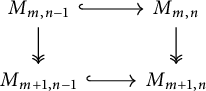



We visualize a generalized extension of depth $\ell =k-1$
(resp.
$\ell =k-1$
(resp. $\ell <k-1$
) by a diagram of the form (5.4) (resp. a truncated version of the diagram that includes the
$\ell <k-1$
) by a diagram of the form (5.4) (resp. a truncated version of the diagram that includes the $\ell $
diagonals above the
$\ell $
diagonals above the $A_r$
). For example, the diagram below shows a generalized extension of depth
$A_r$
). For example, the diagram below shows a generalized extension of depth $\ell =2$
in the case
$\ell =2$
in the case $k=4$
:
$k=4$
:
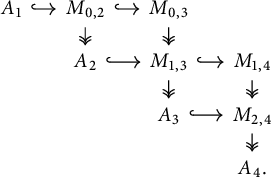
Given two generalized extensions $(M_{\bullet ,\bullet })$
and
$(M_{\bullet ,\bullet })$
and $(N_{\bullet ,\bullet })$
of the same depth, a morphism between them is defined as a collection of morphisms
$(N_{\bullet ,\bullet })$
of the same depth, a morphism between them is defined as a collection of morphisms $M_{m,n}\rightarrow N_{m,n}$
in
$M_{m,n}\rightarrow N_{m,n}$
in ${\mathbf {T}}$
that commute with the structure arrows of
${\mathbf {T}}$
that commute with the structure arrows of $(M_{\bullet ,\bullet })$
and
$(M_{\bullet ,\bullet })$
and $(N_{\bullet ,\bullet })$
. For each
$(N_{\bullet ,\bullet })$
. For each $1\leq \ell \leq k-1$
, the set
$1\leq \ell \leq k-1$
, the set $S_\ell (A)$
of (5.3) (resp.
$S_\ell (A)$
of (5.3) (resp. $S^{\prime }_\ell (A)$
of (5.2)) is defined as the collection of all generalized extensions of depth
$S^{\prime }_\ell (A)$
of (5.2)) is defined as the collection of all generalized extensions of depth $\ell $
of A modulo the equivalence relation given by declaring two generalized extensions to be equivalent if there exists an isomorphism between them (resp. an isomorphism between them that is identity on the
$\ell $
of A modulo the equivalence relation given by declaring two generalized extensions to be equivalent if there exists an isomorphism between them (resp. an isomorphism between them that is identity on the $A_r$
). In particular, there is a natural surjection
$A_r$
). In particular, there is a natural surjection $S^{\prime }_\ell (A)\rightarrow S_\ell (A)$
for each
$S^{\prime }_\ell (A)\rightarrow S_\ell (A)$
for each $\ell $
. The identification
$\ell $
. The identification $S^{\prime }_1(A) \cong \bigoplus _r \mathrm {Ext}^1_{\mathbf {T}}(A_{r+1},A_r)$
sends the equivalence class of a generalized extension
$S^{\prime }_1(A) \cong \bigoplus _r \mathrm {Ext}^1_{\mathbf {T}}(A_{r+1},A_r)$
sends the equivalence class of a generalized extension $(M_{m,n})_{n-m\leq 2}$
of depth 1 (i.e., with just one diagonal above the
$(M_{m,n})_{n-m\leq 2}$
of depth 1 (i.e., with just one diagonal above the $A_r$
) to the element
$A_r$
) to the element $(\mathcal {E}_r)$
of
$(\mathcal {E}_r)$
of $\bigoplus _r \mathrm {Ext}^1_{\mathbf {T}}(A_{r+1},A_r)$
, where
$\bigoplus _r \mathrm {Ext}^1_{\mathbf {T}}(A_{r+1},A_r)$
, where $\mathcal {E}_r$
is given by
$\mathcal {E}_r$
is given by

(the maps being structure arrows of our generalized extension; note that this is indeed an extension by axiom (ii) of Definition 5.2.1). The canonical bijection $S'(A)\cong S_{k-1}'(A)$
is given by sending the equivalence class of a pair
$S'(A)\cong S_{k-1}'(A)$
is given by sending the equivalence class of a pair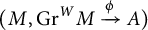 $(M,\mathrm {Gr}^WM\xrightarrow {\phi } A)$
to the class of the generalized extension (5.4) of full depth with
$(M,\mathrm {Gr}^WM\xrightarrow {\phi } A)$
to the class of the generalized extension (5.4) of full depth with $M_{m,n}:=W_{p_n}M/W_{p_m}M$
and
$M_{m,n}:=W_{p_n}M/W_{p_m}M$
and $\mathrm {Gr}^W_{p_r}M$
having been replaced by
$\mathrm {Gr}^W_{p_r}M$
having been replaced by $A_r$
via
$A_r$
via $\phi $
. This descends to a canonical bijection
$\phi $
. This descends to a canonical bijection $S(A)\cong S_{k-1}(A)$
. The maps
$S(A)\cong S_{k-1}(A)$
. The maps $S^{\prime }_\ell (A)\rightarrow S^{\prime }_{\ell -1}(A)$
and
$S^{\prime }_\ell (A)\rightarrow S^{\prime }_{\ell -1}(A)$
and $S_\ell (A)\rightarrow S_{\ell -1}(A)$
are given by truncation, that is, by erasing the top diagonal ( = the
$S_\ell (A)\rightarrow S_{\ell -1}(A)$
are given by truncation, that is, by erasing the top diagonal ( = the $\ell $
-th diagonal above the
$\ell $
-th diagonal above the $A_r$
) of a generalized extension of depth
$A_r$
) of a generalized extension of depth $\ell $
. With abuse of notation, we denote the truncation maps
$\ell $
. With abuse of notation, we denote the truncation maps $S^{\prime }_\ell (A)\rightarrow S^{\prime }_{\ell -1}(A)$
and
$S^{\prime }_\ell (A)\rightarrow S^{\prime }_{\ell -1}(A)$
and $S_\ell (A)\rightarrow S_{\ell -1}(A)$
both by
$S_\ell (A)\rightarrow S_{\ell -1}(A)$
both by $\Theta _\ell $
.
$\Theta _\ell $
.
Notably, the group actions that describe how the fibers of the truncation map $S_\ell (A)\rightarrow S_{\ell -1}(A)$
descend from those of
$S_\ell (A)\rightarrow S_{\ell -1}(A)$
descend from those of $S^{\prime }_\ell (A)\rightarrow S^{\prime }_{\ell -1}(A)$
were described in [Reference Eskandari7] (see Section 3.10 therein). In particular, by Proposition 4.2.3 of [Reference Eskandari7] (also see Remark 4.2.5 therein), given
$S^{\prime }_\ell (A)\rightarrow S^{\prime }_{\ell -1}(A)$
were described in [Reference Eskandari7] (see Section 3.10 therein). In particular, by Proposition 4.2.3 of [Reference Eskandari7] (also see Remark 4.2.5 therein), given $\epsilon \in S_{\ell -1}(A)$
and any
$\epsilon \in S_{\ell -1}(A)$
and any $\epsilon '\in S^{\prime }_{\ell -1}(A)$
above
$\epsilon '\in S^{\prime }_{\ell -1}(A)$
above $\epsilon $
, if
$\epsilon $
, if $\epsilon $
(equivalently,
$\epsilon $
(equivalently, $\epsilon '$
) is the class of a generalized extension
$\epsilon '$
) is the class of a generalized extension $(M_{\bullet ,\bullet })$
of depth
$(M_{\bullet ,\bullet })$
of depth $\ell -1$
such that all the extensions (5.5) are totally nonsplit, then the fiber of
$\ell -1$
such that all the extensions (5.5) are totally nonsplit, then the fiber of $S^{\prime }_\ell (A)\rightarrow S^{\prime }_{\ell -1}(A)$
above
$S^{\prime }_\ell (A)\rightarrow S^{\prime }_{\ell -1}(A)$
above $\epsilon '$
descends bijectively to the fiber of
$\epsilon '$
descends bijectively to the fiber of $S_\ell (A)\rightarrow S_{\ell -1}(A)$
above
$S_\ell (A)\rightarrow S_{\ell -1}(A)$
above $\epsilon $
:
$\epsilon $
:

This last fact will be important for us in Section 5.3.
As mentioned earlier, the reader can consult [Reference Eskandari7, Sections 3 and 4] for the details and the proofs of all of what was discussed above. Note that the diagrams of generalized extensions above are the reflected versions of those in [Reference Eskandari7] (reflected over the diagonal of the $A_r$
), with the role of horizontal and vertical arrows switched. The pictures as shown here are more consistent with our matrix notation for elements of Tannakian groups of objects with increasing filtrations (where the matrices are upper triangular).
$A_r$
), with the role of horizontal and vertical arrows switched. The pictures as shown here are more consistent with our matrix notation for elements of Tannakian groups of objects with increasing filtrations (where the matrices are upper triangular).
5.3 Proof of Theorem 5.1.1
We can now prove Theorem 5.1.1. The notation ( $A_r$
,
$A_r$
, $p_r$
, A,
$p_r$
, A, $S^\ast (A)$
and
$S^\ast (A)$
and $(\bigoplus _r \mathrm {Ext}^1_{\mathbf {T}}(A_{r+1},A_r))^\ast $
) is as introduced in the statement of the theorem. We shall set
$(\bigoplus _r \mathrm {Ext}^1_{\mathbf {T}}(A_{r+1},A_r))^\ast $
) is as introduced in the statement of the theorem. We shall set
 $$\begin{align*}V:=\bigoplus_{r} {\underline{\mathrm{Hom}}}(A_{r+1},A_r). \end{align*}$$
This notation is consistent with the notation of Section 4 in the following way: If M is an object of ${\mathbf {T}}$
with
${\mathbf {T}}$
with $\mathrm {Gr}^WM$
isomorphic to A, a choice of an isomorphism
$\mathrm {Gr}^WM$
isomorphic to A, a choice of an isomorphism $\mathrm {Gr}^WM\rightarrow A$
allows us to identify V defined here with its namesake in Section 4 and Theorem 1.1.1 for the filtration
$\mathrm {Gr}^WM\rightarrow A$
allows us to identify V defined here with its namesake in Section 4 and Theorem 1.1.1 for the filtration $(F_r M)$
on M given by
$(F_r M)$
on M given by $F_rM=W_{p_r}M$
.
$F_rM=W_{p_r}M$
.
We start the proof by a lemma.
Lemma 5.3.1
-
(a) Let
$\phi : A'\rightarrow A$
be an isomorphism in
${\mathbf {T}}$
, where
$A'=\bigoplus _{1\leq r\leq k} A^{\prime }_r$
and for every r, the component
$A^{\prime }_r$
is nonzero pure of weight
$p_r$
. Set
$V':= \bigoplus _r{\underline {\mathrm{Hom}}}(A^{\prime }_{r+1},A^{\prime }_r)$
. Define
$$\begin{align*}\bigm(\bigoplus_r \mathrm{Ext}^1_{\mathbf{T}}(A^{\prime}_{r+1},A^{\prime}_r)\bigm)^\ast\end{align*}$$
in the same way as we defined
$(\bigoplus _r \mathrm {Ext}^1_{\mathbf {T}}(A_{r+1},A_r))^\ast $
in statement (iii) of Theorem 5.1.1, that is,
$(\bigoplus _r \mathrm {Ext}^1_{\mathbf {T}}(A^{\prime }_{r+1},A^{\prime }_r))^\ast $
is the subset of
$\bigoplus _r \mathrm {Ext}^1_{\mathbf {T}}(A^{\prime }_{r+1},A^{\prime }_r)$
consisting of every tuple
$\mathcal {E}'=(\mathcal {E}^{\prime }_r)$
with the property that, considered as an extension of by
$V'$
in the natural way,
$\mathcal {E}'$
is totally disjoint from
$\langle A\rangle ^{\otimes }$
(in the sense of Definition 4.4.2). Let (5.8)
$$ \begin{align} \bigoplus_r \mathrm{Ext}^1_{\mathbf{T}}(A^{\prime}_{r+1},A^{\prime}_r) \rightarrow \bigoplus_r \mathrm{Ext}^1_{\mathbf{T}}(A_{r+1},A_r) \end{align} $$
be the isomorphism given by pushforwards and pullbacks of extensions along
$\phi $
(more explicitly, if
$\phi =(\phi _r)$
with
$\phi _r:A^{\prime }_r\xrightarrow {\simeq } A_r$
and
$\mathcal {E}'=(\mathcal {E}^{\prime }_r)\in \bigoplus _r \mathrm {Ext}^1_{\mathbf {T}}(A^{\prime }_{r+1},A^{\prime }_r)$
, then (5.8) sends
$\mathcal {E}'$
to
$((\phi _{r+1}^{-1})^\ast (\phi _r)_\ast (\mathcal {E}^{\prime }_r))$
). Then the map (5.8) sends
$(\bigoplus _r \mathrm {Ext}^1_{\mathbf {T}}(A^{\prime }_{r+1},A^{\prime }_r))^\ast $
bijectively to
$(\bigoplus _r \mathrm {Ext}^1_{\mathbf {T}}(A_{r+1},A_r))^\ast $
. -
(b) The subset
$(\bigoplus _r \mathrm {Ext}^1_{\mathbf {T}}(A_{r+1},A_r))^\ast $
of
$\bigoplus _r \mathrm {Ext}^1_{\mathbf {T}}(A_{r+1},A_r)$
is closed under the action of
$\mathrm {Aut}(A)$
on the latter space by pushforwards and pullbacks.











 by
by 


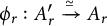








Proof Part (b) is immediate from (a) so we only need to prove the latter. Thanks to the functoriality properties of ${\underline {\mathrm{Hom}}}$
, the isomorphism
${\underline {\mathrm{Hom}}}$
, the isomorphism $\phi =(\phi _r): A'\rightarrow A$
induces an isomorphism
$\phi =(\phi _r): A'\rightarrow A$
induces an isomorphism $V'\rightarrow V$
, which we denote also by
$V'\rightarrow V$
, which we denote also by $\phi $
; given a fiber functor
$\phi $
; given a fiber functor $\omega $
, the isomorphism
$\omega $
, the isomorphism $\omega \phi : \omega V'\rightarrow \omega V$
sends
$\omega \phi : \omega V'\rightarrow \omega V$
sends $f\in \mathrm {Hom}_{\mathbb F}(\omega A^{\prime }_{r+1},\omega A^{\prime }_r)$
to
$f\in \mathrm {Hom}_{\mathbb F}(\omega A^{\prime }_{r+1},\omega A^{\prime }_r)$
to $(\omega \phi _r)\circ f\circ (\omega \phi _{r+1})^{-1}$
. We have a commutative diagram
$(\omega \phi _r)\circ f\circ (\omega \phi _{r+1})^{-1}$
. We have a commutative diagram
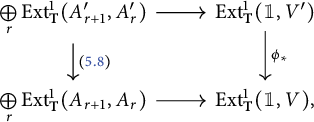
where the horizontal arrows are the canonical isomorphisms and $\phi _\ast $
is pushforward along
$\phi _\ast $
is pushforward along $\phi : V'\rightarrow V$
. Thus, to establish the lemma, it suffices to verify that
$\phi : V'\rightarrow V$
. Thus, to establish the lemma, it suffices to verify that  is totally disjoint from $\langle A\rangle ^{\otimes }$
if and only if
$\langle A\rangle ^{\otimes }$
if and only if  is such. To verify this, let $\mathcal {E}'$
be represented by an extension
$\mathcal {E}'$
be represented by an extension

Given $W\subset V$
, consider the following two extension classes: (i) the pushforward of
$W\subset V$
, consider the following two extension classes: (i) the pushforward of $\mathcal {E}'$
along the quotient
$\mathcal {E}'$
along the quotient $V'\rightarrow V'/\phi ^{-1}(W)$
and (ii) the pushforward of
$V'\rightarrow V'/\phi ^{-1}(W)$
and (ii) the pushforward of $\phi _\ast (\mathcal {E}')$
along the quotient
$\phi _\ast (\mathcal {E}')$
along the quotient $V\rightarrow V/W$
. These two extension classes are, respectively, given by the first and second rows of the commutative diagram
$V\rightarrow V/W$
. These two extension classes are, respectively, given by the first and second rows of the commutative diagram

In particular, the two extension classes have isomorphic middle objects and hence are in $\langle A\rangle ^{\otimes }$
at the same time. Thus,
$\langle A\rangle ^{\otimes }$
at the same time. Thus, $\mathcal {E}'$
is totally disjoint from
$\mathcal {E}'$
is totally disjoint from $\langle A\rangle ^{\otimes }$
if and only if
$\langle A\rangle ^{\otimes }$
if and only if $\phi _\ast (\mathcal {E}')$
is such.
$\phi _\ast (\mathcal {E}')$
is such.
With Lemma 5.3.1 in hand, we proceed to give the definition of the sets $S^\ast _\ell (A)$
of Theorem 5.1.1. We shall use the notation introduced in Section 5.2 for generalized extensions. For
$S^\ast _\ell (A)$
of Theorem 5.1.1. We shall use the notation introduced in Section 5.2 for generalized extensions. For $1\leq \ell \leq k-1$
, the set
$1\leq \ell \leq k-1$
, the set $S^\ast _\ell (A)$
is the pre-image of
$S^\ast _\ell (A)$
is the pre-image of
 $$ \begin{align} \bigm(\bigoplus_r \mathrm{Ext}^1_{\mathbf{T}}(A_{r+1},A_r)\bigm)^\ast \bigm/ \mathrm{Aut}(A) \ \ \subset \ \ \bigm(\bigoplus_r \mathrm{Ext}^1_{\mathbf{T}}(A_{r+1},A_r)\bigm) \bigm/ \mathrm{Aut}(A) \end{align} $$
(which makes sense by Lemma 5.3.1(b)) under the composition
 $$\begin{align*}S_\ell(A)\rightarrow \cdots \rightarrow S_1(A) \stackrel{(\dagger)}{\cong} \bigm(\bigoplus_r \mathrm{Ext}^1_{\mathbf{T}}(A_{r+1},A_r)\bigm) \bigm/ \mathrm{Aut}(A) \end{align*}$$
in (5.3). The requirement given in statement (iii) of Theorem 5.1.1 is satisfied thanks to the bijection $(\dagger )$
. The map
$(\dagger )$
. The map $S^\ast _\ell (A)\rightarrow S^\ast _{\ell -1}(A)$
in the statement of the theorem is just the restriction of the truncation map
$S^\ast _\ell (A)\rightarrow S^\ast _{\ell -1}(A)$
in the statement of the theorem is just the restriction of the truncation map $S_\ell (A)\rightarrow S_{\ell -1}(A)$
in (5.3).
$S_\ell (A)\rightarrow S_{\ell -1}(A)$
in (5.3).
Our next task is to argue that the bijection $S(A)\xrightarrow {\simeq } S_{k-1}(A)$
in (5.3) restricts to a bijection between
$S(A)\xrightarrow {\simeq } S_{k-1}(A)$
in (5.3) restricts to a bijection between $S^\ast (A)$
and
$S^\ast (A)$
and $S^\ast _{k-1}(A)$
. By construction, the composition
$S^\ast _{k-1}(A)$
. By construction, the composition
 $$\begin{align*}S(A)\rightarrow S_{k-1}(A)\rightarrow \cdots \rightarrow S_1(A) \cong \bigm(\bigoplus\limits_{r} \mathrm{Ext}^1_{\mathbf{T}}(A_{r+1},A_r)\bigm)\bigm/\mathrm{Aut}(A)\end{align*}$$
is the map that sends the isomorphism class of an object M to the $\mathrm {Aut}(A)$
-orbit of the tuple of extension classes
$\mathrm {Aut}(A)$
-orbit of the tuple of extension classes
 $$\begin{align*}(W_{p_{r+1}}M/W_{p_{r-1}} M) \in \bigoplus_r \mathrm{Ext}^1_{\mathbf{T}}(\mathrm{Gr}^W_{p_{r+1}}M, \mathrm{Gr}^W_{p_{r}}M), \end{align*}$$
with each $\mathrm {Gr}^W_{p_r}M$
being replaced by
$\mathrm {Gr}^W_{p_r}M$
being replaced by $A_r$
via a choice of isomorphism
$A_r$
via a choice of isomorphism $\phi : \mathrm {Gr}^WM\rightarrow A$
. By Proposition 4.4.1(a) and Lemma 5.3.1(a), this sends
$\phi : \mathrm {Gr}^WM\rightarrow A$
. By Proposition 4.4.1(a) and Lemma 5.3.1(a), this sends $S^\ast (A)$
into (5.9). Thus, the bijection
$S^\ast (A)$
into (5.9). Thus, the bijection $S(A)\rightarrow S_{k-1}(A)$
restricts to an injection
$S(A)\rightarrow S_{k-1}(A)$
restricts to an injection $S^\ast (A)\rightarrow S^\ast _{k-1}(A)$
. On the other hand, given
$S^\ast (A)\rightarrow S^\ast _{k-1}(A)$
. On the other hand, given $\epsilon \in S^\ast _{k-1}(A)$
, let M be an object of
$\epsilon \in S^\ast _{k-1}(A)$
, let M be an object of ${\mathbf {T}}$
with
${\mathbf {T}}$
with $\mathrm {Gr}^WM\simeq A$
such that the class of M in
$\mathrm {Gr}^WM\simeq A$
such that the class of M in $S(A)$
is sent to
$S(A)$
is sent to $\epsilon $
by the bijection
$\epsilon $
by the bijection $S(A)\rightarrow S_{k-1}(A)$
. Since the truncation of
$S(A)\rightarrow S_{k-1}(A)$
. Since the truncation of $\epsilon $
to depth 1 lives in (5.9), the element
$\epsilon $
to depth 1 lives in (5.9), the element $(W_{p_{r+1}}M/W_{p_{r-1}} M)$
of
$(W_{p_{r+1}}M/W_{p_{r-1}} M)$
of

is totally disjoint from $\langle A\rangle ^{\otimes }$
(first, we see this for the tuple
$\langle A\rangle ^{\otimes }$
(first, we see this for the tuple $(W_{p_{r+1}}M/W_{p_{r-1}} M)$
considered as an element of
$(W_{p_{r+1}}M/W_{p_{r-1}} M)$
considered as an element of  via a choice of isomorphism $\phi : \mathrm {Gr}^WM\rightarrow A$
, and then by Lemma 5.3.1(a) for
$\phi : \mathrm {Gr}^WM\rightarrow A$
, and then by Lemma 5.3.1(a) for $(W_{p_{r+1}}M/W_{p_{r-1}} M)$
as an element of (5.10)). It now follows from Proposition 4.4.1(a) that
$(W_{p_{r+1}}M/W_{p_{r-1}} M)$
as an element of (5.10)). It now follows from Proposition 4.4.1(a) that ${\mathfrak {u}}(M)=W_{-1}{\underline {\mathrm {End}}}(M)$
, so that the class of M is indeed in
${\mathfrak {u}}(M)=W_{-1}{\underline {\mathrm {End}}}(M)$
, so that the class of M is indeed in $S^\ast (A)$
. We have proved that the bijection
$S^\ast (A)$
. We have proved that the bijection $S(A)\cong S_{k-1}(A)$
restricts to a bijection
$S(A)\cong S_{k-1}(A)$
restricts to a bijection $S^\ast (A)\cong S^\ast _{k-1}(A)$
.
$S^\ast (A)\cong S^\ast _{k-1}(A)$
.
It remains to verify requirements (i) and (ii) of the statement of the theorem. Let $\epsilon \in S^\ast _{\ell -1}(A)$
. By construction, the fiber of
$\epsilon \in S^\ast _{\ell -1}(A)$
. By construction, the fiber of $S^\ast _\ell (A)\rightarrow S^\ast _{\ell -1}(A)$
above
$S^\ast _\ell (A)\rightarrow S^\ast _{\ell -1}(A)$
above $\epsilon $
is the same as the fiber of
$\epsilon $
is the same as the fiber of $S_\ell (A)\rightarrow S_{\ell -1}(A)$
above
$S_\ell (A)\rightarrow S_{\ell -1}(A)$
above $\epsilon $
. We will see that if
$\epsilon $
. We will see that if $(M_{\bullet ,\bullet })$
is a generalized extension of depth
$(M_{\bullet ,\bullet })$
is a generalized extension of depth $\ell -1$
representing
$\ell -1$
representing $\epsilon $
, then all the extensions (5.5) are totally nonsplit. Taking this for granted for the moment, choosing
$\epsilon $
, then all the extensions (5.5) are totally nonsplit. Taking this for granted for the moment, choosing $\epsilon '\in S^{\prime }_{\ell -1}(A)$
above
$\epsilon '\in S^{\prime }_{\ell -1}(A)$
above $\epsilon $
, by Proposition 4.2.3 of [Reference Eskandari7] (also see Remark 4.2.5 therein), the fiber of
$\epsilon $
, by Proposition 4.2.3 of [Reference Eskandari7] (also see Remark 4.2.5 therein), the fiber of $S_\ell (A)\rightarrow S_{\ell -1}(A)$
above
$S_\ell (A)\rightarrow S_{\ell -1}(A)$
above $\epsilon $
is in a canonical bijection with the fiber of
$\epsilon $
is in a canonical bijection with the fiber of $S^{\prime }_\ell (A)\rightarrow S^{\prime }_{\ell -1}(A)$
above
$S^{\prime }_\ell (A)\rightarrow S^{\prime }_{\ell -1}(A)$
above $\epsilon '$
(see diagram (5.7)). Statements (i) and (ii) of Theorem 5.1.1 thus follow from the structure of the fibers of the truncation map
$\epsilon '$
(see diagram (5.7)). Statements (i) and (ii) of Theorem 5.1.1 thus follow from the structure of the fibers of the truncation map $S^{\prime }_\ell (A)\rightarrow S^{\prime }_{\ell -1}(A)$
given in [Reference Eskandari7, Theorem 3.3.1(b,c)] and recalled earlier in Section 5.2.
$S^{\prime }_\ell (A)\rightarrow S^{\prime }_{\ell -1}(A)$
given in [Reference Eskandari7, Theorem 3.3.1(b,c)] and recalled earlier in Section 5.2.
To complete the proof, let $(M_{\bullet ,\bullet })$
be a generalized extension of A of depth
$(M_{\bullet ,\bullet })$
be a generalized extension of A of depth $\ell -1$
representing
$\ell -1$
representing $\epsilon \in S^\ast _{\ell -1}(A)$
. Fixing
$\epsilon \in S^\ast _{\ell -1}(A)$
. Fixing $m,n$
in the eligible range, we need to show that the extension (5.5) is totally nonsplit. The data of the generalized extension
$m,n$
in the eligible range, we need to show that the extension (5.5) is totally nonsplit. The data of the generalized extension $(M_{\bullet ,\bullet })$
allow us to identify
$(M_{\bullet ,\bullet })$
allow us to identify $\mathrm {Gr}^WM_{m,n}\cong \bigoplus _{m+1\leq r\leq n}A_r$
(see [Reference Eskandari7, Lemma 3.5.1(b)]). Let
$\mathrm {Gr}^WM_{m,n}\cong \bigoplus _{m+1\leq r\leq n}A_r$
(see [Reference Eskandari7, Lemma 3.5.1(b)]). Let
 $$\begin{align*}(\mathcal{E}_r)_{1\leq r\leq k-1}\in \bigoplus_r \mathrm{Ext}^1_{\mathbf{T}}(A_{r+1},A_r)\end{align*}$$
be the truncation of $(M_{\bullet ,\bullet })$
to depth one (i.e.,
$(M_{\bullet ,\bullet })$
to depth one (i.e., $\mathcal {E}_r$
is given by (5.6)). By definition of
$\mathcal {E}_r$
is given by (5.6)). By definition of $S^\ast _{\ell -1}(A)$
, this truncation belongs to
$S^\ast _{\ell -1}(A)$
, this truncation belongs to $\bigm (\bigoplus _r \mathrm {Ext}^1_{\mathbf {T}}(A_{r+1},A_r)\bigm )^\ast $
. That is, considered as an element of
$\bigm (\bigoplus _r \mathrm {Ext}^1_{\mathbf {T}}(A_{r+1},A_r)\bigm )^\ast $
. That is, considered as an element of  , the extension $(\mathcal {E}_r)_{1\leq r\leq k-1}$
is totally disjoint from
$(\mathcal {E}_r)_{1\leq r\leq k-1}$
is totally disjoint from $\langle A\rangle ^{\otimes }$
. On recalling the definition of total disjointness (Definition 4.4.2), we see easily that this forces the extension
$\langle A\rangle ^{\otimes }$
. On recalling the definition of total disjointness (Definition 4.4.2), we see easily that this forces the extension

to be totally disjoint from $\langle A\rangle ^{\otimes }$
. A fortiori, the latter extension is totally disjoint from
$\langle A\rangle ^{\otimes }$
. A fortiori, the latter extension is totally disjoint from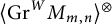 $\langle \mathrm {Gr}^WM_{m,n}\rangle ^{\otimes }$
. By [Reference Eskandari7, Lemma 3.7.3(b)] (applied to the generalized extension of
$\langle \mathrm {Gr}^WM_{m,n}\rangle ^{\otimes }$
. By [Reference Eskandari7, Lemma 3.7.3(b)] (applied to the generalized extension of $\bigoplus _{m+1\leq r\leq n}A_r$
of full depth obtained by cropping
$\bigoplus _{m+1\leq r\leq n}A_r$
of full depth obtained by cropping $(M_{\bullet ,\bullet })$
to the part to the left and below
$(M_{\bullet ,\bullet })$
to the part to the left and below $M_{m,n}$
, see diagram (5.4)), the extension
$M_{m,n}$
, see diagram (5.4)), the extension $(\mathcal {E}_r)_{m< r<n}$
above coincides with the extension
$(\mathcal {E}_r)_{m< r<n}$
above coincides with the extension

where we have used the identification $\mathrm {Gr}^WM_{m,n}\cong \bigoplus _{m+1\leq r\leq n}A_r$
given by the data of our generalized extension to identify
$\mathrm {Gr}^WM_{m,n}\cong \bigoplus _{m+1\leq r\leq n}A_r$
given by the data of our generalized extension to identify $\mathrm {Gr}^W_{p_{r}}M_{m,n}$
with
$\mathrm {Gr}^W_{p_{r}}M_{m,n}$
with $A_r$
. In view of Lemma 5.3.1(a), it follows that the element
$A_r$
. In view of Lemma 5.3.1(a), it follows that the element

is totally disjoint from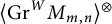 $\langle \mathrm {Gr}^WM_{m,n}\rangle ^{\otimes }$
. Thus, criterion (iii) of Proposition 4.4.1(a) holds for
$\langle \mathrm {Gr}^WM_{m,n}\rangle ^{\otimes }$
. Thus, criterion (iii) of Proposition 4.4.1(a) holds for $M_{m,n}$
, so that
$M_{m,n}$
, so that ${\mathfrak {u}}(M_{m,n})=W_{-1}{\underline {\mathrm {End}}}(M_{m,n})$
. By Lemma 5.2.1 of [Reference Eskandari7] (see also Remark 5.2.4 therein), this implies that every extension coming from the weight filtration of
${\mathfrak {u}}(M_{m,n})=W_{-1}{\underline {\mathrm {End}}}(M_{m,n})$
. By Lemma 5.2.1 of [Reference Eskandari7] (see also Remark 5.2.4 therein), this implies that every extension coming from the weight filtration of $M_{m,n}$
, and in particular the one in (5.4), is totally nonsplit.
$M_{m,n}$
, and in particular the one in (5.4), is totally nonsplit.





 Open access

