

Introduction
In 1975, Claude Lévi-Strauss introduced his concept of the ‘house’ for a cross-culturally specifiable form of social organization (sociétés à maison) different from societies based on ‘lineages’, meaning groups comprised by unilineal descent (patrilineal or matrilineal). Enthusiasm for Lévi-Strauss’s house proved extensive both in social anthropology and soon in archaeology, enabling reconceptualization of cognatic social systems (e.g. in Southeast Asia) and of social organization in archaeological sites of the ‘middle range’ (e.g. Beck Reference Beck2007; Carsten & Hugh-Jones Reference Carsten, Hugh-Jones, Carsten and Hugh-Jones1995; González-Ruibal Reference González-Ruibal2006; González-Ruibal & Ruiz-Gálvez Reference González-Ruibal and Ruiz-Gálvez2016; Joyce & Gillespie Reference Joyce and Gillespie2000; Kay Reference Kay2020; Plog & Heitman Reference Plog and Heitman2010; Wiersma Reference Wiersma2020). By comparison, the lineage model derived from ‘tribal’ societies that were less complex than ‘chiefdoms’ seemed inadequate to explain such systems. Unilineal lineages, like those of the Nuer (Evans-Pritchard Reference Evans-Pritchard1940) and the Tallensi (Fortes Reference Fortes1945), had been interpreted by the structural-functionalists as virtually independent societal sub-units coalescing at scale but otherwise classical examples of acephalous, mechanically solidary societies. In the US Southwest, Chaco Canyon, both architecturally and settlement-wise, clearly represented a more complex formation than living Pueblo societies which, thanks to Fred Eggan, were exemplars of Radcliffe-Brown’s lineage model (notoriously resistant to diachronic change). Lévi-Strauss’s house society offered a heuristic alternative for Chacoan ‘great houses’ (Heitman Reference Heitman and Beck2007; 2015). Beyond this, the ‘house’ has been used extensively in archaeological analyses (e.g. Borić Reference Borić and Jones2008; Ensor Reference Ensor2013a; González-Ruibal Reference González-Ruibal2006; Thomas Reference Thomas, Renfrew, Boyd and Morley2015; Waterson Reference Waterson, Hofmann and Smyth2013), yet its many varied applications suggest a certain conceptual amorphousness. What exactly has been gained for explanation? I contend here that its analytical value should be re-evaluated via reconnection with the study of kinship systems, in particular those of Crow–Omaha type.
Under the influence of Radcliffe-Brown (Reference Radcliffe-Brown1952) and others like Eggan (Reference Eggan1950) and Fortes (Reference Fortes1953), at mid-century corporate unilineal descent groups as jural units with joint estates in material and immaterial property had become the dominant model for cross-cultural comparison. Lévi-Strauss’s critique of descent-group reductionism began at the same time (1949), when he sought to shift the focus from how social action groups were constituted and recruited their members towards how systematic interrelationships among groups were structured and reproduced, especially via marriage alliances. In his ‘elementary systems’, the organization and reproduction of a social system occurred via repeating, prescriptive marriage exchange among its constituent segments. ‘Elementary’ contrasted with ‘complex’ systems, in which marriage was only proscriptive, merely prohibiting a small range of relatives, and in which systemic organization was based on class and the state.
Lévi-Strauss irrevocably moved the analytical needle toward exchange and process, in contrast to structurally fixed descent entities. Like other aspects of the functionalist paradigm, descent and its groups were trapped in synchronic bubbles with no way of escape: no analytical means to observe or identify processual change. But descent theory continued to prevail in much ethnographic research, and remained argued for in archaeological modelling, whereas alliance was often given short shrift (e.g. Longacre Reference Longacre1970). While some structuralist approaches did gain archaeological purchase, they ‘never formed a major coherent alternative in archaeology’ (Hodder & Hutson Reference Hodder and Hutson2003, 45). Yet, after Lévi-Strauss switched away from alliance mechanisms to ‘house societies’, the ‘house’ model has come to prove enduringly popular in archaeology. A ‘house’, in his sense, is a hybrid form between kin-based and class-based social formations. In ‘house societies’ the operative social units might or might not recruit by descent and/or alliance, but can in practice cohere around a house (like a European noble house) either as a symbolic (‘fetishistic’ à la Marx) or physical/architectural focus of group interests (e.g. Gillespie Reference Gillespie2000):
[A house is] a corporate body holding an estate made up of both material and immaterial wealth, which perpetuates itself through the transmission of its name, its good and its titles down a real or imaginary line, considered legitimate as long as this continuity can express itself in the language of kinship or of affinity and, most often, of both. (Lévi-Strauss Reference Lévi-Strauss and Modelski1982, 174)
Lévi-Strauss’s house emerged to anthropological consciousness just when ‘old kinship’ was undergoing a demise. So, it remained largely unnoticed that, while usefully expanding beyond descent versus alliance debates, the house as conceived shares significant features with Lévi-Strauss’s (Reference Lévi-Strauss1966; Reference Lévi-Strauss1969) earlier conclusions about Crow–Omaha semi-complex alliance. Similarities between Crow–Omaha systems and house societies are not least of interest because, on the Pacific Northwest Coast of North America, where Lévi-Strauss first identified ‘house societies’ (among the Kwakwa̲ka̲’wakw, formerly Kwakiutl), these occur in close proximity to Crow systems (Haida, Tlingit—with similar ‘big-house’ architecture to Kwakwa̲ka̲’wakw) in a contiguous geographic series of ethnolinguistic groups along coastal and island British Columbia and southeastern Alaska. I will return to this below.
While ‘houses’ remain a target of archaeological analysis, the emergence of archaeogenetics, relying on biological degrees of relatedness, as defined genetically to recover intra- and inter-household relationships from osteological evidence, seems to have rebirthed an older iteration of descent theory in application to Neolithic Europe (e.g. Blöcher et al. Reference Blöcher, Brami, Feinauer and Burger2023; Sjögren et al. Reference Sjögren, Olalde and Carver2020). A recent paper, for example, asserts patrilineal descent ‘represents the most frequent system [cross-culturally], with family membership solely deriving from the father’s lineage. When associated with patrilocality (or female exogamy), women relocate to their husbands’ native region’ (Orlando Reference Orlando2023, emphasis added). While there are alternate emphases, including on matrilocal patterns in Britain and Anatolia (e.g. Cassidy et al. Reference Cassidy, Russell and Smith2025; Ensor Reference Ensor2021; Yüncü et al. Reference Yüncü, Doğu and Kaptan2025), statements like that just quoted recall earlier kinship theory depicting men as agents and women objects of social exchange. That earlier position—correlated to Man the Hunter/Herder models of adaptation—was roundly displaced by more grounded examinations of social and economic processes (see e.g. Dahlberg Reference Dahlberg1983; James Reference James1975; Rosaldo & Lamphere Reference Rosaldo and Lamphere1974; Strathern Reference Strathern1984). Lest this be forgotten, it certainly merits revisiting by current analysts emphasizing patriliny/patrilocality in the archaeological past, as does the issue of complementary filiation (see below). And whatever its other faults, descent theory itself (from the 1930s to the 1960s) was never governed by genetic or sociobiological essentialism, indeed foregrounding the differences between social and biological descent—say, between a pater and a genitor, a mater and a genetrix, or recognizing ghost marriage, female fathers, and so on (Fox Reference Fox1967, 34). In modern evolutionary anthropology’s re-embrace of Murdock’s (e.g. Reference Murdock1949) cross-cultural comparativism, awareness of social versus biological ‘descent’ has often been effaced, and in emphasizing genetic versus socially constructed ties, some Europeanist bioarchaeology may risk reproducing an earlier patricentric reductionism.
In short, both houses and lineages (meaning unilineal descent groups) remain in play as social-anthropological analogues in current archaeology. If kinship analysis is to have heuristic value for social reconstruction, however, there needs to be a robust sense of materially identifiable social units, and how these may evolve or change from one form into another (cf. Boríc Reference Borić and Jones2008; Ensor Reference Ensor2013a; Thomas Reference Thomas, Renfrew, Boyd and Morley2015). And if houses are to provide genuinely testable hypotheses for archaeological reconstruction of social systems, there should be a clear definition of what they are and what they are not, and how they produce distinct configurations from social systems in which unilineal descent is construed as the governing principle. Similarly, if descent models are to be dusted off from critiques of the 1970s–80s, there needs to be a more serious inquiry into their capacity for explanation, both its reach and its limitations.
As described below, both Crow–Omaha systems and houses are transitional between elementary and complex alliance structures, between societies based on kinship versus those based on class, and between egalitarian and stratified political economies—all these oppositions further considered as socio-evolutionary progressions. In kin-based societies, social, economic and political actions are governed by positions and relationships within systems of familial relations, while in class-based societies socio-economic hierarchies provide the organizing principles. If both Crow–Omaha systems and houses represent ‘middle-range’ social-structural phenomena, the question arises whether they are genuine analytical alternatives in different social (including archaeological) settings, or simply variations on a similar social-structural spectrum in comparable social spaces, and thus better considered as perspectival than genuinely structural distinctions. This paper addresses that question, concluding with a look at the inspiration for Lévi-Strauss’s house model among societies of the Northwest Coast. In a word, my purpose is to place kinship back in the house. But to reach this end, we must first consider what kinship systems are.
What is a kinship system?
To anthropologists of a certain antiquity, this question may seem needless, but the decline in kinship teaching in graduate programmes has produced a lacuna in the transmission of knowledge evident to all who broach such terms as ‘Iroquois’ or ‘avuncolocal’ in the unblinking presence of younger scholars. So, at some risk of stating the obvious, kinship systems comprise four intersecting axes (Fig. 1).
The four axes of a kinship system.

In practice, the history of study has frequently presumed one or another, or various partial combinations, of these axes as fundamental and sidelined the others. Moreover, this tendency even co-occurs with some national anthropological traditions: e.g. terminology in the United States; descent in Britain; and alliance in France. Some have sedulously argued that the four axes are mutually independent and can only be treated as such if there are to be analytical advances (e.g. Barry Reference Barry2008). But thoroughgoing ethnographic comparison shows their persistent patterns of mutual influence and determination, and while treating each separately may enable discrete conclusions, I contend that more comprehensive explanation requires conjoint treatment of the four axes as much as possible. Of the four, the most definitive feature is typically the terminology or ‘nomenclature’, a structure of terms in a particular language comprising a series of equations, distinctions and reciprocal interplays. Standard ethnography-derived labels for the terminologies (which continue to prevail, notwithstanding efforts to replace them with more neutral descriptors) have themselves come to stand for whole kinship systems (an ‘Iroquois system’, for example). While terminologies are, of course, not available archaeologically, this does not mean reconstructive efforts should simply ignore them, and explanation can benefit by including putative terminologies as hypotheses (see e.g. Whiteley Reference Whiteley, Heitman and Plog2015; and cf. Ensor’s Reference Ensor2013a,b; 2021 proposed material correlates for kinship-system typologies).
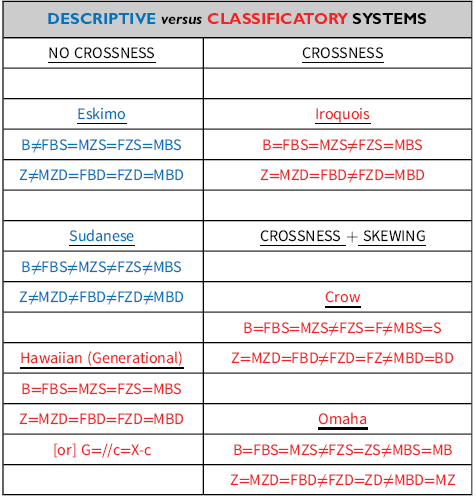
Of the six main types of nomenclature, four are ‘classificatory’ in Lewis Henry Morgan’s (Reference Morgan1871) sense, and sociocentric: Iroquois, Crow, Omaha and Hawaiian, which all classify extended kin under the same terms as those in a close family circle. The other two, Eskimo and Sudanese, are contrastively ‘descriptive’ and egocentric, where the links to another relative need specifying from the perspective of a particular individual (‘ego’, or the ‘propositus’) as a node in a network. The classificatory four often coincide with established descent groups, in which the correct term to use for another relative is known not through a descriptive network of genealogical ties, but simply because of his/her ‘clan’ or ‘lineage’ and generation in relation to one’s own, and those of one’s parents et al. (hence the sociocentric aspect). So, Hopi society operates via a Crow terminology, matrilineal descent and matrilocal residence (generally speaking). Everyone belongs to a particular matriclan (e.g. Parrot)—which owns houses, ritual hereditament and some agricultural fields—and beyond that to a more inclusive set of clans (e.g. Parrot, Katsina, Raven, Rabbit and Tobacco in so-called clan-set—a.k.a. phratry—#I in standard Hopi ethnography). If I am Parrot clan, all clans in the set are also my ‘matrilineal’ relatives, for whom I use the same terms as for immediate kin on my mother’s side (despite the absence of known genealogical links among clans in a set). Similarly, my father’s clan (by definition, not my own) is linked to others in a set for whom I use patrilateral (father’s side) kin terms, which are ‘classified’ in the same group as my father, father’s sister, etc. Standardly, kinship positions, or ‘kin-types’, in a matrix are specified by abbreviations. Notations vary, but a common variant uses single letters: P parent; M mother; F father; G sibling; Z sister; B brother; C child; D daughter; S son; E spouse; H husband; W wife. These combine into strings: FBW for father’s brother’s wife, MZS for mother’s sister’s son, and so on. Relationships among kin-types within kin-terminologies exhibit mathematical features, with intricate algebraic properties and generative logics (e.g. Gould Reference Gould2000; Lounsbury Reference Lounsbury and Goodenough1964; Read Reference Read2001). For present purposes, the basic algebraic value of the notational abbreviations serves minimally to distinguish the six major terminology types formally by the equations and distinctions they make among siblings and cousins, as shown in Table 1 (in the table, an = sign means an equation, in contrast to ≠, meaning a distinction; in the kinship diagrams of Figures 2 and 3 below, = means marriage).
Kinship terminologies defined by equations and distinctions of kin-terms used for siblings (‘brother’ [B], ‘sister’ [Z]) and cousins by the speaker (Ego-male or Ego-female).

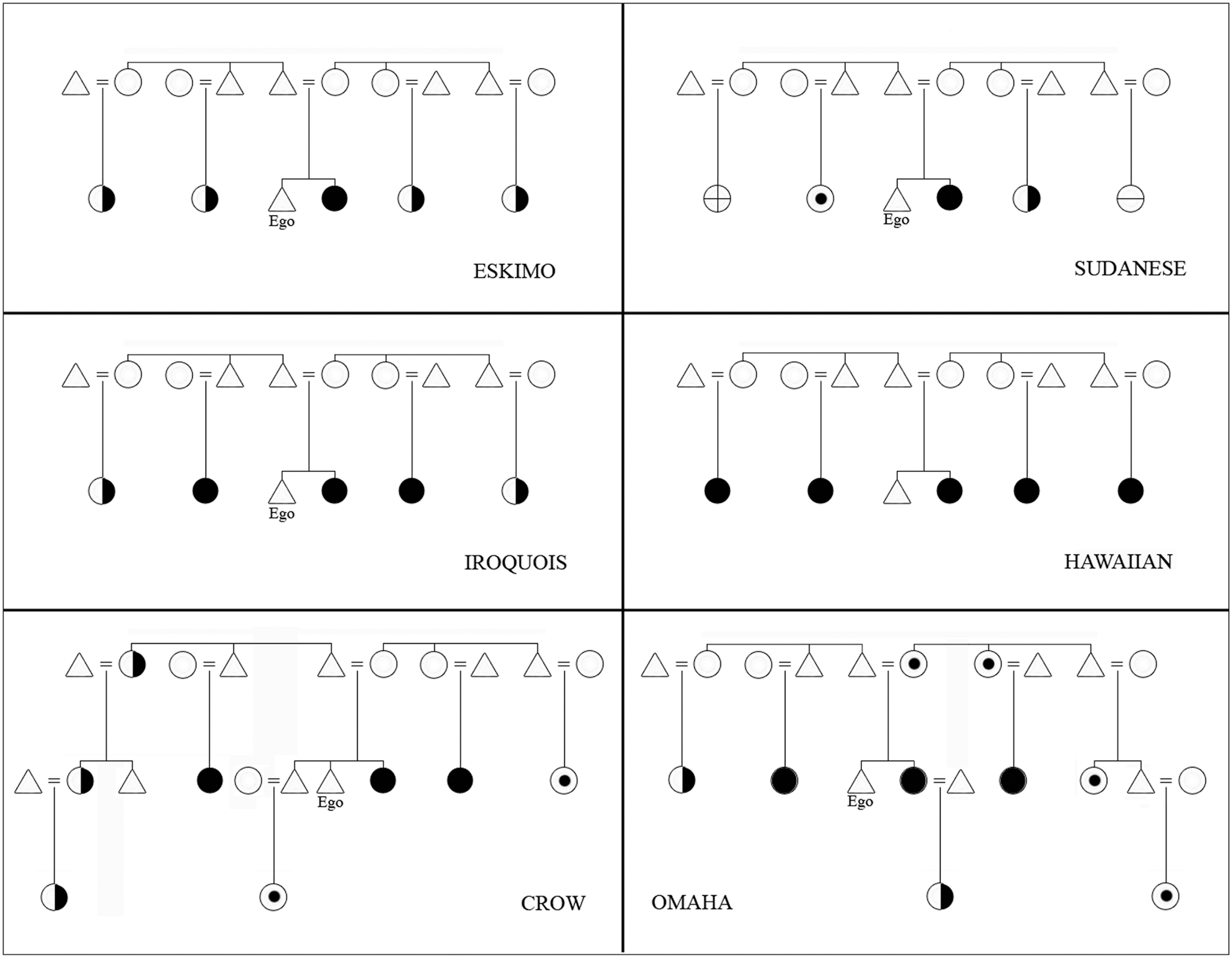
The six main types of kinship systems defined by equations and distinctions of kinterms for female siblings and cousins used by male Ego: circles with the same infill (within a single system) represent terminological equations; circles with different infill (within a single system) represent terminological distinctions (e.g. in an ‘Eskimo’ system—typical in modern European societies—Ego uses a different term for his sister than for his cousins, but has a common term for all ‘cousins’ without distinguishing father’s side from mother’s side or whether his link to them is via same-sex or cross-sex relatives of the ascending generation). (After Driver & Massey Reference Driver and Massey1957, diagram 12.)
Core skewing equations in Crow versus Omaha systems over three generations: Crow [FZ=FZD=FM]: the same kinterm is used for father’s sister, father’s sister’s daughter, and father’s mother; Omaha [MB=MBS=MF]: the same kinterm is used for mother’s brother, mother’s brother’s son, and mother’s father.

Of the four classificatory systems, three—Iroquois (and its Dravidian variant), Crow and Omaha—are further defined by the presence of ‘crossness’: those related via an opposite-sex tie are distinguished from those related via a same-sex tie. The governing equations appear in G+1 (the generation above Ego): M=MZ≠FZ (a mother’s sister is called by the same term as mother, while a father’s sister gets a distinctive term) and F=FB≠MB. These G+1 equations and distinctions entail concomitant patterns in an Iroquois system for Ego’s generation (G0): Z=MZD=FBD≠FZD=MBD and B=MZS=FBS≠FZS=MBS (see Table 1); or, siblings are classified with parallel cousins and both are distinguished from cross-cousins. As an Iroquois subtype,Footnote 1 Dravidian explicitly equates cross-cousin with spouse/sibling-in-law. And here the collocation of terminology with marriage rules comes clearly into view: crossness is ‘a property derived from an alliance structure … it always carries a matrimonial implication’ (Viveiros de Castro Reference Viveiros de Castro, Godelier, Trautmann and Tjon Sie Fat1998, 354).
Such equations and distinctions may be expressed by classic kinship diagrams, as shown in Figure 2 (noting that their symbols—triangle for a male, circle for a female, = for a marriage tie—adhere to the standard format in socio-cultural anthropology since the 1930s: see Wilson Reference Wilson2018—differing from conventions used by archaeogeneticists to represent biological relationships; here, the emphasis is on social descent and genealogical interrelationships, which may or may not correlate with biological descent and ties). To Iroquois crossness, Crow and Omaha add lineal, intergenerational equations, with additional implications for alliance (see below).
As regards the marriage axis of kinship structures, ‘elementary’ alliance, per Lévi-Strauss, predicates intergroup exchange of spouses in direct, symmetrical reciprocity (A⇔B) or indirect reciprocal circulation (A→B→C→D→A). Direct exchange often co-occurs with named exogamous descent groups: notably, moieties (Ravens versus Eagles, Earth versus Sky, Red versus White, etc.) some internally differentiated into constituent unilineal clans and lineages, in some cases also with distinctive (often ‘totemic’) names. Members of one moiety ‘give’ their siblings to the other moiety in exchange for spouses. In Lévi-Strauss’s original formulation, this was ‘sister-exchange’,” but if the gender bias is removed (sibling-exchange) the structural effect remains the same. Some systems, however, prohibit direct exchange and, extending beyond binary divisions, prescribe cycles of marriages among four exchanging groups: women of group A marry men of group B, B women marry C men, C women marry D men, and D women marry A men, completing the circle. This indirect pattern produces a more intricate, though still elementary, system of alliances termed ‘asymmetric matrilateral cross-cousin marriage’ (e.g. Leach Reference Leach1951). Both direct and indirect exchange are framed through dualistic kinship terminologies that assign kinship positions to all members of society, i.e. producing a total kinship matrix that serves as the primary language for the arrangement of social relations. The terminologies commonly termed Iroquois (and Dravidian) specify cousins as ‘kin’ if based on ‘parallel’ (same-sex) connections, but ‘affines’— in-laws or marriageable categories—if connected via ‘cross’ (opposite-sex) ties. A father’s brother’s child or a mother’s sister’s child are ontologically the same as siblings in this schema and off-limits to marriage: indeed, the kin-terms for parallel cousins in a particular language are the same as those for siblings—a ‘brother’ also means a male parallel cousin, for example. But cross-cousins, a father’s sister’s child or a mother’s brother’s child, are not only acceptable but expected, indeed ‘prescribed’ as marriage partners. More than close family ties, Iroquois and Dravidian kin-terms are extended to more distant relatives: i.e. they are ‘classificatory’ in Morgan’s sense, so that one has many ‘siblings’ and many (marriageable) ‘cross-cousins’, not just the first-cousin variety, for whom there may be a de facto practice of avoidance (in Haudenosaunee society, for example, where Morgan first became aware of these systems) in preference for the more wide-ranging socio-political alliances that exchanging with more distant relatives entails.
Crow–Omaha
Descent and alliance theories persisted through the late 1960s at least, although both came increasingly under assault. Lévi-Strauss’s concentration was shifting away from social structure, particularly toward myth. His intention had been to complete a similar comparison of ‘complex systems’ to his 1949 magnum opus on elementary. But he began to realize he would first have to address an intermediate form, ‘semi-complex’, correlative with Crow–Omaha kinship systems (e.g. Lévi-Strauss Reference Lévi-Strauss1966). Crow and Omaha retain some aspects of Iroquois dualism but create different restrictions on direct exchange to the alternative offered by asymmetric prescriptive marriage. Crow–Omaha semi-complex rules disperse alliances away from a closed binary structure, implying an (evolutionary) egress from elementary constraints (e.g. Whiteley & McConvell Reference Whiteley and McConvell2021). Crow and Omaha skew some kin-terms inter-generationally: down the father’s matriline for Crow, the mother’s patriline for Omaha (Fig. 3). A father’s sister (FZ) is called by the same term as a father’s sister’s daughter (FZD), and a father’s sister’s daughter’s daughter (FZDD, not shown on Figure 3) in a Crow system (e.g. for Hopi, ikya, generally translated ‘my aunt’—thus including ‘aunts’ two or three generations younger than Ego); often this extends upwards to include the father’s mother (FM). In an Omaha system the mother’s brother (MB) is called by the same term as the mother’s brother’s son (MBS) and mother’s brother’s son’s son (MBSS, not shown on Figure 3); again, often with an upward extension to include mother’s father (MF). The ‘basic sex’ (Hammel Reference Hammel1965) of a Crow structure is female (i.e. a matriline), while that of an Omaha structure is male (a patriline).
Dravidian, or a similar ‘tetradic’ variant (e.g. Allen Reference Allen, Trautmann and Whiteley2012), has been persuasively argued as a structural proxy for the earliest form of human kinship systems, from which others developed or historically evolved (of course, Dravidian itself was retained in some societies, including kingdoms in South Asia, so the terminology per se does not limit a social system’s scale or evolution: see Trautmann Reference Trautmann1982). From this perspective, while keeping the Iroquois/Dravidian equation of siblings with parallel cousins in G0, Crow–Omaha terminologies added intergenerational equations, in effect replacing Footnote 2 the prior cross-cousin terms with ‘uncle’, ‘aunt’, ‘nephew’ and ‘niece’ terms, i.e. shifting referents both downward and upward: for Omaha, MBC=MG and FZC=ZC; for Crow, FZC=FG and MBC=C. The transition from Iroquois crossness to Crow–Omaha trends as evolutionarily unidirectional and (perhaps) irreversible (Trautmann & Whiteley Reference Trautmann, Whiteley, Trautmann and Whiteley2012a). But aspects of Iroquois and Crow–Omaha may co-occur: while Crow in terminology, Northwest Coast Haida and Tlingit operate with exogamous moieties reflecting an apparently substrate Iroquois pattern; and geographically they adjoin the Tsimshian-Gitxsan-Nisga’a, who have similar matrilineal, exogamous clans but Iroquois terminology and no Crow skewing (Whiteley & McConvell Reference Whiteley and McConvell2021). Additionally, Kronenfeld (e.g. 2012) has argued, Crow–Omaha skewing is sometimes an ‘overlay’, co-occurring with other terminological forms (like Iroquois, or Cheyenne—a mixed Iroquois-Hawaiian form) in the same society, allowing optative choices of terms in discourse contingent upon social interest. Kronenfeld (e.g. Reference Kronenfeld2009) argues that for West African Fanti, alternative terms are invoked to prioritize competing inheritance privileges.
Kronenfeld’s overlay model does not emphasize the effect on marriage alliances per se, but the addition of Crow–Omaha equations clearly obviates the ‘matrimonial implication’ of Iroquois crossness. As McKinley (Reference McKinley1971b) demonstrated, this obviation of prescriptive (elementary) alliance disperses alliances beyond binary exchange, in the fashion shown for Orayvi Hopi intermarriages among nine exchanging clan-sets (Fig. 4), so marriages over several generations exhibit the ‘aleatory’ pattern seen as characteristic of semi-complex alliance by Lévi-Strauss (Reference Lévi-Strauss1966; Reference Lévi-Strauss1969). Moreover, cross-culturally, the addition of Crow–Omaha equations has been shown to strengthen unilineal descent structures—matrilineal for Crow, patrilineal for Omaha (Dyen & Aberle Reference Dyen and Aberle1974; McConvell Reference McConvell, Trautmann and Whiteley2012; White Reference White1939). In Native North America, Crow and Omaha cases typically co-occur with named totemic unilineal descent groups that corporately own property. Moreover, Crow-matrilineal and Omaha-patrilineal systems correlate very strongly also with post-marital residence rules (patrilocal for Omaha, and especially matrilocal for Crow: McKinley Reference McKinley1971a; Dyen & Aberle Reference Dyen and Aberle1974).
Hopi semi-complex alliance configured by intermarriages over time among nine matrilineal clan-sets at the Hopi town of Orayvi.

With Crow–Omaha systems, notably via the Hopi Crow case as described by Eggan (Reference Eggan1950), Lévi-Strauss (Reference Lévi-Strauss1966) recognized the alliance pattern was neither prescriptive (elementary) nor proscriptive (complex), but a mixture that came to be termed ‘semi-complex’ (Héritier Reference Héritier1981; Trautmann & Whiteley Reference Trautmann, Whiteley, Trautmann and Whiteley2012a). Alliances tie differentiated kin-groups to each other, but restrictions change with each particular marriage. Among the nine clan-sets of Hopi Orayvi prior to the town’s split in 1906, the networks were labyrinthine (Fig. 4).
Formal proscriptions on one’s own clan-set, father’s clan-set and mother’s father’s clan-set eliminate one-third (structurally speaking) of possible marriage partners. But in this largely endogamous system, a choice among six other sets is in effect ‘prescribed’ as the only available source of spouses. And with each actual marriage, the configuration of prohibitions for the next generation changes, creating the ‘aleatory’ pattern. Perplexed by the sheer number of possible Hopi marriage exchanges (mathematically calculated at ∼300 million) in a society of only a few thousand people, Lévi-Strauss chose to abandon his project on kinship and marriage structures per se. But at this moment when the study of kinship was entering a more general crisis (e.g. Needham Reference Needham and Needham1971; Reference Needham1974), Lévi-Strauss (Reference Lévi-Strauss1975) now steered his interest in alliance toward ‘house societies’, identifying a form that (like Crow–Omaha systems in this regard) was intermediate between kin-based and class-based social formations.
Anthropology’s crisis in kinship studies reached its apogee with Schneider’s Critique (Reference Schneider1984) seeming to mark a final death-blow.Footnote 3 Yet ‘houses’ evaded that fate. In effect, having deflected attention away from their kinship aspects, houses offered an enduring alternative to superseded descent versus alliance debates, escaping the reification of social systems as nested descent groups, and de-emphasizing the structural logic of intergroup alliance. However, as suggested above, if examined outside the cut-and-thrust of discourse pronouncing old kinship’s (premature) death, structural continuities between ‘house societies’ and Crow–Omaha systems—specifiable by particular combinations of terminology, descent, residence and marriage rules—are strikingly apparent.
From the perspective of demography and adaptation, Omaha-patrilineal systems show evidence of outward (‘downstream’) expansion, while Crow-matrilineal systems correlate more with internal concentration and differentiation (Whiteley & McConvell Reference Whiteley and McConvell2021). But discernible spread patterns of skewed kinterms/meanings from one neighbouring ethnolinguistic group to another cut across language boundaries in both Crow and Omaha instances (e.g. for Crow, Iroquoian Cherokee in the Southeast borrowed term-skewing from Muskogean Creek; Haida, a language isolate on the Northwest Coast, borrowed skewing from Athapaskan Tlingit; and Uto-Aztecan Hopi in the Southwest borrowed skewing from Keresan). In this light, the kinship structure is shown as in part an agentive social technology for managing relations, both intra- and inter-societally, notably via intermarriage (i.e. in the examples just cited, among the respective term-skewing neighbours: see Whiteley & McConvell Reference Whiteley and McConvell2021).
Additionally, in the North American Southeast, Northeast, Prairie-Plains and Puebloan Southwest (all with adaptive dependence on intensive horticulture), the ethnographic cases clearly descend from more complex late-prehistoric social formations: Mississippian for the first three, Ancestral Puebloan for the last. Chaco Canyon, the epicentre of Prehispanic archaeological complexity in the Southwest, has been profitably interpreted as a house society (Heitman Reference Heitman and Beck2007; 2015). But comparing the settlement architecture of Pueblo Bonito with Hopi Orayvi, I have also argued (Whiteley Reference Whiteley, Heitman and Plog2015) for the presence of Crow-matrilineal patterns,Footnote 4 while binary arrangements suggestive of moieties are evident in some neighbouring sites (e.g. Wijiji). Conversely, my reanalysis of Orayvi social structure (Whiteley Reference Whiteley2008) showed that Hopi social units are often better explained as ‘houses’—i.e. involving affinal and fictive-patrilateral recruitment and inheritance of privileges beyond matrilineal descent—than treated as corporate matri-units alone. As in other instances globally (Gillespie Reference Gillespie2000), the difference between the house and the lineage (especially of Crow–Omaha type) may be more a matter of diachronic versus synchronic perspectives, and a typological oscillation rather than an absolute cleavage.
Northwest Coast houses and Crow systems
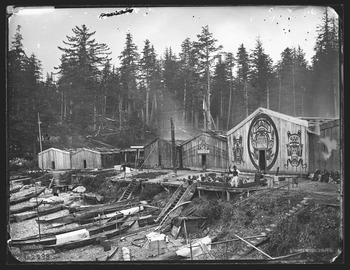
The other Native North American Crow–Omaha systems—in California and on the Northwest Coast—also co-occur with adaptive intensification, sedentism, and higher population densities (but without agriculture or pastoralism). Especially on the Northwest Coast, the Crow-matrilineal cases (Haida, Tlingit) are associated with marked social ranking (nobles, commoners, and slaves), with privileges, titles, and crests descending in particular families, often associated with specific nineteenth-century villages comprising large communal houses, some abandoned under colonial pressures including the demographic devastation of introduced diseases.Footnote 5 Except for the Crow terminology and matriliny/matrilocality, however, the other social and architectural features noted are identical with those Lévi-Strauss (Reference Lévi-Strauss and Modelski1982) used to designate the ‘house’ in Kwakwa̲ka̲’wakw society, from Franz Boas’s ethnography (Figs 5 & 6).Footnote 6 Boas, as Lévi-Strauss (Reference Lévi-Strauss and Modelski1982, 164–6) retailed, shifted position over time. At first, he described Kwakwa̲ka̲’wakw social units as patrilineages that he inferred had evolved from a prior stage of matriliny (then considered a universal trajectory since Bachofen Reference Bachofen1861). But Boas later reversed that inference, i.e. suggesting Kwakwa̲ka̲’wakw society had evolved from an earlier patriliny toward matriliny. Finally, abandoning etic concepts (and their evolutionary implications) altogether, Boas treated the Kwakwa̲ka̲’wakw nuymaym as a unique form deploying dual or ambilineal descent, affinity and non-kinship ties to reproduce itself through time:
In previous writings I have used the terms ‘gens’ [i.e., under then prevailing nomenclature, a patrilineal descent group] and ‘clan’ [then meaning a matrilineal descent group] according to the varying impression of prevalence of maternal and paternal descent, both of which are important. After much hesitation I have decided to use the native term numaym … because the characteristics of the unit are so peculiar that the terms ‘gens’ or ‘clan’ or even ‘sib’ [a descent group of unspecified composition—matrilineal, patrilineal, or bilateral] would be misleading. (Boas Reference Boas1940, 359–60)
Kwakwa̲ka̲’wakw village of Newitti (Hope Island), British Columbia, 1881. AMNH Special Collections, Photographic Negative #42298. (Photograph: Edward Dossetter.)

Haida village of Yan (Haida Gwaii), British Columbia, 1881. AMNH Special Collections, Photographic Negative #44310. (Photograph: Edward Dossetter.)

Yet Boas was very much aware of the socio-cultural continuities from the Tlingit in southeast Alaska south to the Coast Salish Lushootseed in Washington State, and argued for a gradient of transitions:
The variety of forms of social organization found among the tribes of the coast of Alaska and British Columbia has given rise to extended discussion which relates to fundamental questions regarding the theory of the growth of social institutions. In the extreme north we find a purely matrilineal clan organization, while in the extreme south we find village communities with a loose family organization with bilateral descent in which, however, preference is given to paternal descent. In the central regions a mixed type is found in which descent in the female line is obtained by the transfer of privileges from a man to his son-in-law. (Boas Reference Boas1924, 323–4)
Extensive interchange—especially via the potlatch—was (and remains—even after a colonial law banning it for seven decades, 1885–1951) common among Native Northwest Coast societies. Exchange embraced material goods (Chilkat robes, carved boxes, mountain-goat wool, etc.), prestige foods (eulachon grease, etc.), intermarriages, and encompassed internecine wars through the adoption of enslaved captives, while specific myths and ancestral figures (like Komogwa, the undersea lord of wealth) were widely shared (e.g. Drucker Reference Drucker1955; Lévi-Strauss Reference Lévi-Strauss and Modelski1982). Thus social and ideational chains of interconnection united peoples of different language families into a common ‘culture’. In fact, this was exactly what defined the Northwest Coast as a culture-area, as Boas recognized early on in a manuscript catalogue he was commissioned to produce for the American Museum of Natural History:
The Northwestcoast of Northamerica [sic] is inhabited by numerous tribes of different lineage, all of whom participate in a common culture and a common mode of life (Boas n.d. [1887]).Footnote 7
The Kwakwa̲ka̲’wakw belonged to ‘the central regions’ (from the penultimate passage quoted) representing the ‘mixed type’ of social organization. The combinatory structure of Kwakwa̲ka̲’wakw social units and inheritance of privileges, together with Boas’s cumulative frustration with how to classify them, directly inspired Lévi-Strauss’s (Reference Lévi-Strauss and Modelski1982, 169–70) house concept, especially via comparison with European feudal houses. But Lévi-Strauss’s definition of houses (see above) surely applies equally to Tlingit, Haida, or Tsimshian—in which matriclans are subdivided into named, localized houses with titles and privileges—just as well as it applies to the Kwakwa̲ka̲’wakw. Moreover, Boas (Reference Boas1940, 360) acknowledged that there had been extensive changes in Kwakwa̲ka̲’wakw society owing to nineteenth-century population losses before he began to work there, and he questioned whether this may have had an impact on the pattern of ambilateral descent and claiming of privileges.
In this regard, there seem palpable similarities with the historic Southwestern Pueblos, among whom much shared culture cuts across linguistic boundaries, and where a gradient of social organization tracks from Crow-matrilineal in the west among the Hopi and Zuni to ambilineal among the Keresans and bilateral among the Tewa (Eggan Reference Eggan1950; Ford Reference Ford and Whiteley2018). Variant earlier attributions of matrilineal versus patrilineal versus bilateral in the history of Tewa ethnology even echo Boas’s Kwakwa̲ka̲’wakw oscillations, and there were comparable processes of population decline and consolidation among the Tewa also (together with long-term superimposition of patriarchal structures by the colonial Spanish state, although nineteenth-century Kwakwa̲ka̲’wakw colonial history is not directly comparable in that regard). As noted, I have argued that Hopi social groups and marriages over time showed matriliny in practice actively intersected by patrilateral ties (including some that are patrilineal), and that inherited privileges are not infrequently held by affines (Whiteley Reference Whiteley2008). Fortes’s (Reference Fortes1969) ‘complementary filiation’ de-emphasized the structural importance of such intersections in a unilineal system, but it is precisely these conjunctures in which the practicalities of history operate within and against—thus often transforming—received ideal-typical (strictly lineal) structures. Prima facie, it seems very likely that Tlingit and Haida Crow-matrilineal systems must have operated with similar interruptions and contraventions of purely matrilineal principles (this exceeds my present scope, but merits further investigation).
Houses and lineages
So when is a house a ‘house’, and when is it not much different from a kinship group—especially of Crow–Omaha semi-complex type? Conversely, when is a descent group (like a Hopi ngyam, ‘clan’) better treated as a house (wungwki, ‘clanhouse’), considering the roles played by affinity, locality and optation in the transmission of its privileges (Whiteley Reference Whiteley2008)? Here Kronenfeld’s argument for Crow–Omaha skewing as optative overlay on an underlying kin-terminology, with alternate strategic deployments, is resonant.Footnote 8 If positions, hereditament and titles can switch back and forth among descent and affinal lines, or if descent modalities in fact comprise a suite of alternatives rather than a fixed unitary form, one must ask how different this is, except as a matter of emphasis, from the patterns Boas identified for the Kwakwa̲ka̲’wakw numaym. With the preference in sociocultural anthropology and archaeology for Lévi-Strauss’s houses emerging at the same moment as discontent with lineages reached its height, the shift to an ostensively non-kinship-based concept may be more a matter of epistemological convenience than genuine analytical advance.
In this regard, it is useful to turn to another analyst of Kwakwa̲ka̲’wakw social organization, Irving Goldman (sometimes reckoned as Boas’s ‘last student’). Just before Lévi-Strauss launched his inquiry into the house in the mid-1970s (see e.g. Gillespie Reference Gillespie2000), Goldman (Reference Goldman1975) had meticulously reanalysed many of the same Boas sources Lévi-Strauss depended on. While Goldman’s conclusions on Kwakwa̲ka̲’wakw religion were contested by specialists, his observations on social structure retain significant value. Goldman maintained that lineages were just as important for the Kwakwa̲ka̲’wakw as farther north, but that the definition of lineages as only unilineal and exogamous had prevented Boas from realizing this. Goldman proposed a more inclusive definition for Kwakwa̲ka̲’wakw ‘status lineages’, which operated with ‘in effect a mixed or dual descent’. Lineages remained, he argued, central to Kwakwa̲ka̲’wakw social organization:
The absence of exogamy or of sex line unilinearity is for Kwakiutl, as for Polynesian societies, only of secondary interest. With the Gwasela tribal historyFootnote 9 as direct evidence, and with the repeated declarations of the Hunt textsFootnote 10 on the necessity for unbroken continuity with founding ancestors as corroboration, there is no difficulty in recognizing, even from fragmentary traditions, that lineage is the central principle. Boas did not see lineages at all, but neither did he take note of the Gwasela history. Moreover, he was captive of the sociological orthodoxy that lineages had to be exogamous and either matrilineal or patrilineal. (Goldman Reference Goldman1975,30–31)
That Goldman could reach this conclusion from the same sources used by Lévi-Strauss again suggests seeing a ‘house’ rather than a ‘lineage’ may be a matter of perspective.
With their constitutive amorphousness, houses may have eased the burden of engaging with the four dimensions of how kinship systems operate at a time when the kinship paradigm was undergoing antinomian critique, but the consequence, in my view, has meant a loss of explanatory rigour. Houses and lineages are in practice and diachronically not sufficiently different as to constitute separable analytical units as such, with which to clarify the explanation of middle-range societies, either ethnographically or archaeologically. Conditions for the emergence of houses and Crow–Omaha systems in Native North America appear to reflect an intermediate status in longer-term evolutionary transitions. These include population pressure and social and/or geographic circumscription (per Carneiro’s Reference Carneiro1970 theory of the origin of the state). But in many ways, houses and (Crow–Omaha) lineages appear to represent different perspectives or emphases on similar socio-cultural phenomena, considered diachronically versus synchronically.
Conclusion
In short, strategic combinations of kinship and affinal ties, property, ranks, titles and privileges of the kind seen in Native Northwest Coast societies all suggest the emergence of more complex forms of social organization than synchronically predicated lineage theory developed in the ethnography of ‘tribal societies’ could elucidate. The intermediate status of Crow–Omaha systems and houses between kin and class societies remains a useful conceptual scheme through which to explain some fundamental evolutionary and historical developments in both the present and the past. And applications of house models in archaeology have not neglected the practical problematics of discerning when a formation represents a ‘house’ versus something else (e.g. Borić Reference Borić and Jones2008; Ensor Reference Ensor2013a; 2021; González-Ruibal Reference González-Ruibal2006; Joyce & Gillespie Reference Joyce and Gillespie2000). But in genuinely explanatory diachronic approaches to social systems, the present analysis has argued that kinship belongs in the house as much as the house belongs in kinship: the distinction is without too much difference. For archaeological explanation to profit from ethnological analogies, attending to the four interconnected axes of kinship systems seems important, notably as these interrelate with ‘houses’—both as material, architectural forms and as social aggregations—insofar as these can be discerned in the material and biological record of human settlements. But ‘houses’ and ‘kinship groups’—notably, Crow–Omaha—belong together analytically, as shown for the Northwest Coast, and do not—pace Lévi-Strauss—demonstrably represent ontologically distinct forms of social organization.





 Open access

