





1 Introduction
In this paper, the term semigroup refers to an additive subsemigroup of $\mathbb {N} = \{0,1,2,\ldots \}$
. A numerical semigroup is a subsemigroup of
$\mathbb {N} = \{0,1,2,\ldots \}$
. A numerical semigroup is a subsemigroup of $\mathbb {N}$
with finite complement [Reference Assi, D’Anna and García-Sánchez1, Reference Rosales and García-Sánchez8]. The notation
$\mathbb {N}$
with finite complement [Reference Assi, D’Anna and García-Sánchez1, Reference Rosales and García-Sánchez8]. The notation $\langle \cdot \rangle $
denotes the semigroup generated by the indicated set. For example,
$\langle \cdot \rangle $
denotes the semigroup generated by the indicated set. For example, $\langle 4,7 \rangle = \{0, 4, 7, 8, 11, 12, 14, 15, 16, 18, 19, 20,\ldots \}$
. The Frobenius number
$\langle 4,7 \rangle = \{0, 4, 7, 8, 11, 12, 14, 15, 16, 18, 19, 20,\ldots \}$
. The Frobenius number $F(S)$
of a numerical semigroup is the largest natural number not in S. For example,
$F(S)$
of a numerical semigroup is the largest natural number not in S. For example, $F(\langle 4,7 \rangle ) = 17$
. Each numerical semigroup has a unique minimal system of generators
$F(\langle 4,7 \rangle ) = 17$
. Each numerical semigroup has a unique minimal system of generators $n_1 < n_2 < \cdots < n_k$
such that
$n_1 < n_2 < \cdots < n_k$
such that $\gcd (n_1,n_2,\ldots ,n_k) = 1$
and
$\gcd (n_1,n_2,\ldots ,n_k) = 1$
and $S = \langle n_1,n_2,\ldots ,n_k \rangle $
[Reference Rosales and García-Sánchez8, Theorem 2.7]. The smallest generator
$S = \langle n_1,n_2,\ldots ,n_k \rangle $
[Reference Rosales and García-Sánchez8, Theorem 2.7]. The smallest generator $n_1$
is the multiplicity
$n_1$
is the multiplicity $m(S)$
of S. The genus
$m(S)$
of S. The genus $g(S)$
of S is the cardinality of
$g(S)$
of S is the cardinality of $\mathbb {N} \setminus S$
.
$\mathbb {N} \setminus S$
.
Let $\mathsf {M}_d(\cdot )$
denote the set of
$\mathsf {M}_d(\cdot )$
denote the set of $d \times d$
matrices with entries in the indicated set. Let
$d \times d$
matrices with entries in the indicated set. Let $\mathbb {Z}$
and
$\mathbb {Z}$
and $\mathbb {Q}$
denote the set of integers and rational numbers, respectively. The exponent semigroup of
$\mathbb {Q}$
denote the set of integers and rational numbers, respectively. The exponent semigroup of $A \in \mathsf {M}_d(\mathbb {Q})$
is
$A \in \mathsf {M}_d(\mathbb {Q})$
is
 $$ \begin{align*} \mathcal{S}(A) = \{ n \in \mathbb{N} : A^n \in \mathsf{M}_d(\mathbb{Z})\}. \end{align*} $$
As its name suggests, the exponent semigroup of a rational matrix is a semigroup (not necessarily numerical) since it contains $0$
and is closed under addition. Each additive subsemigroup of
$0$
and is closed under addition. Each additive subsemigroup of $\mathbb {N}$
is of the form
$\mathbb {N}$
is of the form $\mathcal {S}(A)$
for some
$\mathcal {S}(A)$
for some $A \in \mathsf {M}_d(\mathbb {Q})$
with
$A \in \mathsf {M}_d(\mathbb {Q})$
with $d \leq m(S)$
[Reference Chhabra, Garcia and O’Neill6, Theorem 1.1]. In fact, the representing matrix A can be taken to be a weighted permutation matrix (the
$d \leq m(S)$
[Reference Chhabra, Garcia and O’Neill6, Theorem 1.1]. In fact, the representing matrix A can be taken to be a weighted permutation matrix (the $1$
s being replaced with suitable nonzero constants) for a cycle of length d. This result improved the previous best-known bound
$1$
s being replaced with suitable nonzero constants) for a cycle of length d. This result improved the previous best-known bound $d \leq F(S) + 1$
from [Reference Chhabra, Garcia, Zhang and Zhang7, Theorem 6.2]; in that case, the representing matrix can be taken to be a weighted nilpotent Jordan block of size
$d \leq F(S) + 1$
from [Reference Chhabra, Garcia, Zhang and Zhang7, Theorem 6.2]; in that case, the representing matrix can be taken to be a weighted nilpotent Jordan block of size $F(S) + 1$
.
$F(S) + 1$
.
The matricial dimension $\operatorname {dim_{\mathrm {mat}}} S$
of a semigroup S is the smallest dimension d such that
$\operatorname {dim_{\mathrm {mat}}} S$
of a semigroup S is the smallest dimension d such that $S = \mathcal {S}(A)$
for some
$S = \mathcal {S}(A)$
for some $A \in \mathsf {M}_d(\mathbb {Q})$
. Following [Reference Chhabra and Garcia5], S is dimension-d realisable if
$A \in \mathsf {M}_d(\mathbb {Q})$
. Following [Reference Chhabra and Garcia5], S is dimension-d realisable if ${S= \mathcal {S}(A)}$
for some
${S= \mathcal {S}(A)}$
for some $A \in \mathsf {M}_d(\mathbb {Q})$
; this is equivalent to
$A \in \mathsf {M}_d(\mathbb {Q})$
; this is equivalent to $\operatorname {dim_{\mathrm {mat}}} S \leq d$
since
$\operatorname {dim_{\mathrm {mat}}} S \leq d$
since ${\mathcal {S}(A \oplus 0) = \mathcal {S}(A)}$
, in which
${\mathcal {S}(A \oplus 0) = \mathcal {S}(A)}$
, in which $0$
denotes a square zero matrix. One has the upper bound
$0$
denotes a square zero matrix. One has the upper bound ${\operatorname {dim_{\mathrm {mat}}} S \leq m(S)}$
[Reference Chhabra, Garcia and O’Neill6, Theorem 1.1], which is often attained. However,
${\operatorname {dim_{\mathrm {mat}}} S \leq m(S)}$
[Reference Chhabra, Garcia and O’Neill6, Theorem 1.1], which is often attained. However, $\operatorname {dim_{\mathrm {mat}}} S$
is sometimes significantly smaller than
$\operatorname {dim_{\mathrm {mat}}} S$
is sometimes significantly smaller than $m(S)$
. An open, and apparently difficult, problem is the determination of the matricial dimension of an arbitrary semigroup. This paper takes several steps toward this goal.
$m(S)$
. An open, and apparently difficult, problem is the determination of the matricial dimension of an arbitrary semigroup. This paper takes several steps toward this goal.
This article is organised as follows. Section 2 introduces a module-theoretic approach (Proposition 2.1) for finding representing matrices for semigroups. This places several previous ad hoc computations on a systematic footing while simultaneously permitting the computation of the matricial dimension for certain semigroups whose matricial dimension was previously unknown. For example, we obtain a short module-theoretic proof (Theorem 2.2) of a generalisation of the main result of [Reference Chhabra, Garcia and O’Neill6]. This provides dramatic improvements over previous matricial-dimension bounds for certain reducible semigroups (Theorem 2.5). We collect several more ideas in Section 3, in which we determine the matricial dimension of all semigroups of multiplicity at most $3$
. In Section 4, we introduce a novel integer linear-programming approach, the ‘companion-matrix method’, for obtaining representing matrices. Taken together, our new results are sufficient to compute the matricial dimensions of all numerical semigroups with
$3$
. In Section 4, we introduce a novel integer linear-programming approach, the ‘companion-matrix method’, for obtaining representing matrices. Taken together, our new results are sufficient to compute the matricial dimensions of all numerical semigroups with $F(S) \leq 10$
or
$F(S) \leq 10$
or $g(S) \leq 6$
(Section 5). We conclude in Section 6 with several open questions spurred by our investigations.
$g(S) \leq 6$
(Section 5). We conclude in Section 6 with several open questions spurred by our investigations.
2 Module-theoretic approach
Our first theorem provides an abstract framework that relates exponent semigroups to $\mathbb {Z}$
-modules in
$\mathbb {Z}$
-modules in $\mathbb {Q}$
-vector spaces. This recovers several previous results (Theorem 2.8(a) and (b)), generalises a fundamental construction (Theorem 2.2) that leads to vast improvements in certain cases (Theorem 2.5) and produces new results such as Theorem 2.8(c).
$\mathbb {Q}$
-vector spaces. This recovers several previous results (Theorem 2.8(a) and (b)), generalises a fundamental construction (Theorem 2.2) that leads to vast improvements in certain cases (Theorem 2.5) and produces new results such as Theorem 2.8(c).
Proposition 2.1. Let $\mathcal {V}$
be a d-dimensional
$\mathcal {V}$
be a d-dimensional $\mathbb {Q}$
-vector space containing
$\mathbb {Q}$
-vector space containing $\mathcal {M} \subseteq \mathcal {V}$
, a
$\mathcal {M} \subseteq \mathcal {V}$
, a $\mathbb {Z}$
-module of rank d. Let
$\mathbb {Z}$
-module of rank d. Let $L \in \operatorname {End}(\mathcal {V})$
and let
$L \in \operatorname {End}(\mathcal {V})$
and let $\beta $
denote an integral basis for
$\beta $
denote an integral basis for $\mathcal {M}$
. Then
$\mathcal {M}$
. Then $A = {}_{\beta }[L]_{\beta } \in \mathsf {M}_d(\mathbb {Q})$
satisfies
$A = {}_{\beta }[L]_{\beta } \in \mathsf {M}_d(\mathbb {Q})$
satisfies $\mathcal {S}(A) = \{n\in \mathbb {N}: L^n \mathcal {M} \subseteq \mathcal {M} \}$
.
$\mathcal {S}(A) = \{n\in \mathbb {N}: L^n \mathcal {M} \subseteq \mathcal {M} \}$
.
Proof. Observe that
 $$ \begin{align*} L^n \mathcal{M} \subseteq \mathcal{M} \iff {}_{\beta}[L^n]_{\beta} \in \mathsf{M}_d(\mathbb{Z}) \iff {}_{\beta}[L]_{\beta}^n \in \mathsf{M}_d(\mathbb{Z}) \iff A^n \in \mathsf{M}_d(\mathbb{Z}).\\[-37pt] \end{align*} $$
The following is a generalisation of [Reference Chhabra, Garcia and O’Neill6, Theorem 1.1]. The module-theoretic proof below is completely different and avoids the use of the Kunz inequalities altogether.
Theorem 2.2. Let S be a numerical semigroup. If $d \in S \setminus \{0\}$
, then there is an
$d \in S \setminus \{0\}$
, then there is an ${A \in \mathsf {M}_d(\mathbb {Q})}$
such that
${A \in \mathsf {M}_d(\mathbb {Q})}$
such that $\mathcal {S}(A) = S$
. In particular,
$\mathcal {S}(A) = S$
. In particular, $\operatorname {dim_{\mathrm {mat}}} S \leq m(S) = \min S \setminus \{0\}$
.
$\operatorname {dim_{\mathrm {mat}}} S \leq m(S) = \min S \setminus \{0\}$
.
Proof. Let p be a prime and $\alpha =p^{1/d}$
. For
$\alpha =p^{1/d}$
. For $0 \leq i \leq d-1$
, let
$0 \leq i \leq d-1$
, let $s_i$
be the smallest element of S such that
$s_i$
be the smallest element of S such that $s_i\equiv i\,\,(\operatorname {mod} d)$
; in particular,
$s_i\equiv i\,\,(\operatorname {mod} d)$
; in particular, $s_0 = 0$
. Then
$s_0 = 0$
. Then $\beta =\alpha ^{s_0},\alpha ^{s_1},\ldots ,\alpha ^{s_{d-1}}$
is an integral basis for the
$\beta =\alpha ^{s_0},\alpha ^{s_1},\ldots ,\alpha ^{s_{d-1}}$
is an integral basis for the $\mathbb {Z}$
-submodule
$\mathbb {Z}$
-submodule $\mathcal {M} = \operatorname {span}_{\mathbb {Z}} \{\alpha ^s:s\in S\}$
in
$\mathcal {M} = \operatorname {span}_{\mathbb {Z}} \{\alpha ^s:s\in S\}$
in $\mathcal {V} = \operatorname {span}_{\mathbb {Q}}\{\alpha ^s:s\in S\}$
. Let
$\mathcal {V} = \operatorname {span}_{\mathbb {Q}}\{\alpha ^s:s\in S\}$
. Let $L \in \operatorname {End}_{\mathbb {Z}}(\mathcal {M})$
be multiplication by
$L \in \operatorname {End}_{\mathbb {Z}}(\mathcal {M})$
be multiplication by $\alpha $
. We claim that
$\alpha $
. We claim that $S = \{n \in \mathbb {N}: L^n \mathcal {M} \subseteq \mathcal {M}\}$
.
$S = \{n \in \mathbb {N}: L^n \mathcal {M} \subseteq \mathcal {M}\}$
.
-
(a) If $n \in S$
, then
$\alpha ^n \mathcal {M} = \operatorname {span}_{\mathbb {Z}}\{ \alpha ^{n+s} :s\in S\} \subseteq \mathcal {M}$
since
$n+s\in S$
.
$n \in S$
, then
$\alpha ^n \mathcal {M} = \operatorname {span}_{\mathbb {Z}}\{ \alpha ^{n+s} :s\in S\} \subseteq \mathcal {M}$
since
$n+s\in S$
. -
(b) If
$n \notin S$
, then
$n<s_i$
, in which
$n \equiv i\,\,(\operatorname {mod} d)$
. Therefore,
$\alpha ^n \mathcal {M} \subseteq \mathcal {M}$
implies that
$\alpha ^{s_i}> \alpha ^n = \alpha ^n 1 = c \alpha ^{s_i} > 0$
for some
$c\in \mathbb {Z}$
, which is impossible.







We see that $s_i + 1 \equiv i +1 \equiv s_{i+1} \,\,(\operatorname {mod} d)$
; hence,
$s_i + 1 \equiv i +1 \equiv s_{i+1} \,\,(\operatorname {mod} d)$
; hence, $\alpha \alpha ^{s_i} = \alpha ^{s_i + 1} = p^{\ell _i}\alpha ^{s_{i+1}}$
for some
$\alpha \alpha ^{s_i} = \alpha ^{s_i + 1} = p^{\ell _i}\alpha ^{s_{i+1}}$
for some ${\ell _i \in \mathbb {Z}}$
. Proposition 2.1 ensures that
${\ell _i \in \mathbb {Z}}$
. Proposition 2.1 ensures that $A = {}_{\beta }[L]_{\beta }\in \mathsf {M}_d(\mathbb {Q})$
satisfies
$A = {}_{\beta }[L]_{\beta }\in \mathsf {M}_d(\mathbb {Q})$
satisfies $\mathcal {S}(A) = S$
.
$\mathcal {S}(A) = S$
.
Example 2.3. Let $S=\langle 6,9,20 \rangle $
, the so-called McNugget semigroup [Reference Chapman, Garcia, O’Neill, Harris, Insko and Wootton2–Reference Chapman and O’Neill4], and let
$S=\langle 6,9,20 \rangle $
, the so-called McNugget semigroup [Reference Chapman, Garcia, O’Neill, Harris, Insko and Wootton2–Reference Chapman and O’Neill4], and let $d=6$
. Let
$d=6$
. Let $p=2$
be a prime and
$p=2$
be a prime and $\alpha =2^{1/d}$
. For
$\alpha =2^{1/d}$
. For $0\leq i\leq 5$
, let
$0\leq i\leq 5$
, let $s_i$
be the smallest element of S such that
$s_i$
be the smallest element of S such that $s_i\equiv i\,\,(\operatorname {mod} d)$
:
$s_i\equiv i\,\,(\operatorname {mod} d)$
: $s_0,s_1,s_2,s_3,s_4,s_5=0,49,20,9,40,29$
, respectively. Then
$s_0,s_1,s_2,s_3,s_4,s_5=0,49,20,9,40,29$
, respectively. Then
 $$ \begin{align*} \beta= \alpha^{s_0},\alpha^{s_1},\ldots,\alpha^{s_{5}} = \alpha^0, \alpha^{49}, \alpha^{20}, \alpha^9, \alpha^{40}, \alpha^{29} \end{align*} $$
is an integral basis for the $\mathbb {Z}$
-module
$\mathbb {Z}$
-module $\mathcal {M} = \operatorname {span}_{\mathbb {Z}} \{\alpha ^s:s\in S\}$
. Since
$\mathcal {M} = \operatorname {span}_{\mathbb {Z}} \{\alpha ^s:s\in S\}$
. Since
 $$ \begin{align*} \alpha\alpha^{s_0} &=\alpha\alpha^0=\alpha^1=\alpha^{-48}\alpha^{49} = 2^{-8} \alpha^{49} = \tfrac{1}{256} \alpha^{s_1},\\ \alpha\alpha^{s_1} &=\alpha\alpha^{49}=\alpha^{50}=\alpha^{30}\alpha^{20} = 2^5 \alpha^{20} = 32 \alpha^{s_2}, \\ \alpha\alpha^{s_2} &=\alpha\alpha^{20}=\alpha^{21}=\alpha^{12}\alpha^{9} = 2^2 \alpha^9 = 4 \alpha^{s_3}, \\ \alpha\alpha^{s_3} &=\alpha\alpha^{9}=\alpha^{10}=\alpha^{-30}\alpha^{40} = 2^{-5} \alpha^{40} = \tfrac{1}{32}\alpha^{s_4}, \\ \alpha\alpha^{s_4} &=\alpha\alpha^{40}=\alpha^{41}=\alpha^{12}\alpha^{29} = 2^{2} \alpha^{29} = 4 \alpha^{s_5}, \\ \alpha\alpha^{s_5} &=\alpha\alpha^{29}=\alpha^{30}=\alpha^{30}\alpha^{0} = 2^{5} \alpha^0 = 32\alpha^{s_0}, \end{align*} $$
Theorem 2.2 ensures that $\mathcal {S}(A) = \langle 6,9,20 \rangle $
for
$\mathcal {S}(A) = \langle 6,9,20 \rangle $
for
 $$ \begin{align*} A = {}_{\beta}[L]_{\beta} = \begin{bmatrix} {\color{lightgray}0}&{\color{lightgray}0}&{\color{lightgray}0}&{\color{lightgray}0}&{\color{lightgray}0}&32\\ \frac{1}{256}&{\color{lightgray}0}&{\color{lightgray}0}&{\color{lightgray}0}&{\color{lightgray}0}&{\color{lightgray}0}\\ {\color{lightgray}0}&32&{\color{lightgray}0}&{\color{lightgray}0}&{\color{lightgray}0}&{\color{lightgray}0}\\ {\color{lightgray}0}&{\color{lightgray}0}&4&{\color{lightgray}0}&{\color{lightgray}0}&{\color{lightgray}0}\\ {\color{lightgray}0}&{\color{lightgray}0}&{\color{lightgray}0}&\frac{1}{32}&{\color{lightgray}0}&{\color{lightgray}0}\\ {\color{lightgray}0}&{\color{lightgray}0}&{\color{lightgray}0}&{\color{lightgray}0}&4&{\color{lightgray}0} \end{bmatrix}\in \mathsf{M}_6(\mathbb{Q}). \end{align*} $$
This is the transpose of the weighted permutation matrix obtained in [Reference Chhabra, Garcia and O’Neill6, Example 3.1].
Remark 2.4. One can adapt the construction of [Reference Chhabra, Garcia and O’Neill6, Theorem 1.1] to prove Theorem 2.2 as follows: replace the Apéry set $\operatorname {Ap}(S, m(S))$
with
$\operatorname {Ap}(S, m(S))$
with $\operatorname {Ap}(S,d)$
and use [Reference Rosales and García-Sánchez8, Lemma 1.4] to obtain the Kunz inequalities [Reference Chhabra, Garcia and O’Neill6, (2.1)] directly. However, the module-theoretic approach is superior since it is more general and does not require the Kunz inequalities.
$\operatorname {Ap}(S,d)$
and use [Reference Rosales and García-Sánchez8, Lemma 1.4] to obtain the Kunz inequalities [Reference Chhabra, Garcia and O’Neill6, (2.1)] directly. However, the module-theoretic approach is superior since it is more general and does not require the Kunz inequalities.
An upper bound on the matricial dimension can sometimes be obtained by representing a numerical semigroup as an intersection of other numerical semigroups. Recall that the best-known general upper bound on the matricial dimension is $\operatorname {dim_{\mathrm {mat}}} S \leq m(S)$
[Reference Chhabra, Garcia and O’Neill6, Theorem 1.1]. Our next theorem often improves upon this.
$\operatorname {dim_{\mathrm {mat}}} S \leq m(S)$
[Reference Chhabra, Garcia and O’Neill6, Theorem 1.1]. Our next theorem often improves upon this.
Theorem 2.5. Let $S_1,S_2,\ldots ,S_k$
be numerical semigroups and let
$S_1,S_2,\ldots ,S_k$
be numerical semigroups and let $S = \bigcap _{i=1}^k S_i$
. Suppose that
$S = \bigcap _{i=1}^k S_i$
. Suppose that $d_i \in S_i \setminus \{0\}$
for
$d_i \in S_i \setminus \{0\}$
for $i=1,2,\ldots ,k$
. Then there exists an
$i=1,2,\ldots ,k$
. Then there exists an $A\in \mathsf {M}_{d_1+d_2+\cdots + d_k}(\mathbb {Q})$
such that
$A\in \mathsf {M}_{d_1+d_2+\cdots + d_k}(\mathbb {Q})$
such that $\mathcal {S}(A) = S$
. In particular,
$\mathcal {S}(A) = S$
. In particular, $\operatorname {dim_{\mathrm {mat}}} S \leq d_1 + d_2 + \cdots + d_k$
.
$\operatorname {dim_{\mathrm {mat}}} S \leq d_1 + d_2 + \cdots + d_k$
.
Proof. First, recall that the finite intersection of numerical semigroups is a numerical semigroup [Reference Rosales and García-Sánchez8, Exercise 2.2]. For $i=1,2,\ldots ,k$
, Theorem 2.2 provides an
$i=1,2,\ldots ,k$
, Theorem 2.2 provides an $A_i \in \mathsf {M}_{d_i}(\mathbb {Q})$
such that
$A_i \in \mathsf {M}_{d_i}(\mathbb {Q})$
such that $\mathcal {S}(A_i) = S_i$
. Thus,
$\mathcal {S}(A_i) = S_i$
. Thus, $S=\mathcal {S}(A)$
for
$S=\mathcal {S}(A)$
for $A = A_1 \oplus A_2 \oplus \cdots \oplus A_k \in \mathsf {M}_{d_1+d_2+\cdots + d_k}(\mathbb {Q})$
.
$A = A_1 \oplus A_2 \oplus \cdots \oplus A_k \in \mathsf {M}_{d_1+d_2+\cdots + d_k}(\mathbb {Q})$
.
If $d_1+d_2+\cdots +d_k<m(S)$
, then Theorem 2.5 improves upon [Reference Chhabra, Garcia and O’Neill6, Theorem 1.1], which established
$d_1+d_2+\cdots +d_k<m(S)$
, then Theorem 2.5 improves upon [Reference Chhabra, Garcia and O’Neill6, Theorem 1.1], which established $\operatorname {dim_{\mathrm {mat}}} S \leq m(S)$
. This can actually occur, as the next example demonstrates.
$\operatorname {dim_{\mathrm {mat}}} S \leq m(S)$
. This can actually occur, as the next example demonstrates.
Example 2.6. Consider $S = \langle 30,31,36,40,45,46,51,55,65 \rangle $
. Before this paper, the best we could say was
$S = \langle 30,31,36,40,45,46,51,55,65 \rangle $
. Before this paper, the best we could say was $\operatorname {dim_{\mathrm {mat}}} S \leq m(S) = 30$
[Reference Chhabra, Garcia and O’Neill6, Theorem 1.1]; this handily beats the previous bound
$\operatorname {dim_{\mathrm {mat}}} S \leq m(S) = 30$
[Reference Chhabra, Garcia and O’Neill6, Theorem 1.1]; this handily beats the previous bound $\operatorname {dim_{\mathrm {mat}}} S \leq 120 = F(S) + 1$
from [Reference Chhabra, Garcia, Zhang and Zhang7, Theorem 6.2]. Since
$\operatorname {dim_{\mathrm {mat}}} S \leq 120 = F(S) + 1$
from [Reference Chhabra, Garcia, Zhang and Zhang7, Theorem 6.2]. Since
 $$ \begin{align*} S= \langle 2,31 \rangle \cap \langle 3,31 \rangle\cap \langle 5,31 \rangle, \end{align*} $$
Theorem 2.5 ensures that $\operatorname {dim_{\mathrm {mat}}} S \leq 2+3+5 = 10$
, which is a three-fold improvement.
$\operatorname {dim_{\mathrm {mat}}} S \leq 2+3+5 = 10$
, which is a three-fold improvement.
Example 2.7. Let $p,q,r$
be distinct primes such that
$p,q,r$
be distinct primes such that $r> pq$
and consider
$r> pq$
and consider ${S {\kern-1pt}={\kern-1pt} \langle p,r \rangle {\kern-1pt}\cap{\kern-1pt} \langle q,r \rangle }$
. Then
${S {\kern-1pt}={\kern-1pt} \langle p,r \rangle {\kern-1pt}\cap{\kern-1pt} \langle q,r \rangle }$
. Then $\operatorname {dim_{\mathrm {mat}}} S {\kern-1pt}\leq{\kern-1pt} \operatorname {dim_{\mathrm {mat}}} \langle p,r \rangle {\kern-1pt}+{\kern-1pt} \operatorname {dim_{\mathrm {mat}}} \langle q,r \rangle = p+q$
by Theorem 2.5. In relative terms, this estimate can be arbitrarily better than the upper bound
$\operatorname {dim_{\mathrm {mat}}} S {\kern-1pt}\leq{\kern-1pt} \operatorname {dim_{\mathrm {mat}}} \langle p,r \rangle {\kern-1pt}+{\kern-1pt} \operatorname {dim_{\mathrm {mat}}} \langle q,r \rangle = p+q$
by Theorem 2.5. In relative terms, this estimate can be arbitrarily better than the upper bound $\operatorname {dim_{\mathrm {mat}}} S \leq m(S)= pq$
provided by Theorem 2.2 since
$\operatorname {dim_{\mathrm {mat}}} S \leq m(S)= pq$
provided by Theorem 2.2 since $(p+q)/pq = 1/p + 1/q$
tends to
$(p+q)/pq = 1/p + 1/q$
tends to $0$
as
$0$
as $p,q \to \infty $
.
$p,q \to \infty $
.
Parts (a) and (b) of the next theorem are contained in [Reference Chhabra, Garcia, Zhang and Zhang7, Proposition 2.2] (although the matrices involved are different). In contrast with the ad hoc method of [Reference Chhabra, Garcia, Zhang and Zhang7], the module-theoretic approach, based upon Proposition 2.1, is systematic. Part (c) is novel and it is the most important result in our computation of matricial dimensions for semigroups of low complexity; see Theorem 3.4 and Section 5.
Theorem 2.8. The following semigroups have matricial dimension $2$
.
$2$
.
-
(a) Cyclic semigroups:
$\langle a \rangle $
with
$a \geq 2$
. -
(b) Ordinary semigroups:
$S_b = \{b,b+1,b+2,\ldots \}$
with
$b \geq 2$
. -
(c) The union of a cyclic and ordinary semigroup:
$\langle a \rangle \cup S_b$
with
$a,b\geq 2$
.


Proof. We sketch the constructions in (a) and (b) while presenting (c) in full detail. This is no loss, since (c) is more complex and involves aspects of both previous cases. It is more convenient here to work with matrices instead of transformations. In the terminology of Proposition 2.1, $\mathcal {V} = \mathbb {Q}^2$
,
$\mathcal {V} = \mathbb {Q}^2$
, $\beta = \{\mathbf {b}_1, \mathbf {b}_2\}$
, in which
$\beta = \{\mathbf {b}_1, \mathbf {b}_2\}$
, in which $B = [\mathbf {b}_1~\mathbf {b}_2] \in \mathsf {M}_2(\mathbb {Q})$
, and
$B = [\mathbf {b}_1~\mathbf {b}_2] \in \mathsf {M}_2(\mathbb {Q})$
, and $\mathcal {M} = B\mathbb {Z}^2$
.
$\mathcal {M} = B\mathbb {Z}^2$
.
-
(a) Fix
$a \geq 2$
, let
$p \equiv 1 \,\,(\operatorname {mod} a)$
be a prime and let
$\operatorname {ord}_p z = a$
. Let
$B = \big [ \begin {smallmatrix} 1 & 1/p \\ {\color {lightgray}0} & 1/p \end {smallmatrix} \big ]$
and
$L = \big [ \begin {smallmatrix} z & {\color {lightgray}0} \\ {\color {lightgray}0} & 1 \end {smallmatrix} \big ]$
. Then
$A = B^{-1}LB = \big [ \begin {smallmatrix} z & (z-1)/p \\ {\color {lightgray}0} & 1 \end {smallmatrix} \big ]$
, so
$A^n = \big [ \begin {smallmatrix} z^n & (z^n-1)/p \\ {\color {lightgray}0} & 1 \end {smallmatrix} \big ]$
and
$\mathcal {S}(A) = \langle a \rangle $
. -
(b) Fix
$m\geq 1$
, let p be a prime, let
$B = \big [ \begin {smallmatrix} 1 & 1/p^b \\ {\color {lightgray}0} & 1/p^b \end {smallmatrix} \big ]$
and let
$L = \big [ \begin {smallmatrix} p^2 & {\color {lightgray}0} \\ {\color {lightgray}0} & p \end {smallmatrix} \big ]$
. Then
$A = B^{-1}LB= \big [ \begin {smallmatrix} p^2 & (p-1)p^{1-m} \\ {\color {lightgray}0} & p \end {smallmatrix} \big ]$
, so
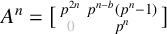
$A^n = \big [ \begin {smallmatrix} p^{2n} & p^{n-b}(p^n-1) \\ {\color {lightgray}0} & p^n \end {smallmatrix} \big ]$
and
$\mathcal {S}(A) = S_b$
. -
(c) Fix
$a,b \geq 2$
, let
$p \equiv 1 \,\,(\operatorname {mod} a)$
be prime and let
$\operatorname {ord}_{p^b} z = a$
. Let
$B = [ \mathbf {b}_1~\mathbf {b}_2] = \big [ \begin {smallmatrix} 1 & 1/p^b \\ {\color {lightgray}0} & 1/p^b \end {smallmatrix} \big ]$
and
$L = \big [ \begin {smallmatrix} zp & {\color {lightgray}0} \\ {\color {lightgray}0} & p \end {smallmatrix} \big ]$
. Then
$A = B^{-1}LB = \big [ \begin {smallmatrix} pz & p^{1-b}(z-1) \\ {\color {lightgray}0} & p \end {smallmatrix} \big ]$
, so We claim that
$$ \begin{align*} A^n= \begin{bmatrix} p^n z^n & p^{n-b}(z^n-1) \\ {\color{lightgray}0} & p^n \end{bmatrix}. \end{align*} $$
$\mathcal {S}(A) = \langle a \rangle \cup S_b$
. Since
$\mathbf {b}_1 \in \mathbb {Z}^2$
, we only need to determine when This occurs whenever there exists an
$$ \begin{align*} L^n \mathbf{b}_2 = \begin{bmatrix} p^{n-b}z^n \\ p^{n-b} \end{bmatrix} \in \mathcal{M} = \operatorname{span}_{\mathbb{Z}}\{ \mathbf{b}_1 , \mathbf{b}_2\} = B\mathbb{Z}^2. \end{align*} $$
$\mathbf {x}=[\begin {smallmatrix} x_1 \\ x_2 \end {smallmatrix}] \in \mathbb {Z}^2$
such that
$L^n \mathbf {b}_2 = x_1 \mathbf {b}_1 + x_2 \mathbf {b}_2$
. Solve the corresponding system
$p^{n-b} z^n = x_1 + p^{-b} x_2$
and
$p^{n-b} = 0 x_1 + p^{-b} x_2$
, and get
$x_2 = p^n$
, so that
$x_1 = p^{n-b}(z^n - 1)$
, which is an integer if and only if
$n \geq b$
or
$z^n \equiv 1 \,\,(\operatorname {mod} p^b)$
. The second condition is equivalent to
$a \mid n$
.





















Prior to this paper, even relatively simple numerical semigroups such as $\langle 4,6,7,9 \rangle $
and
$\langle 4,6,7,9 \rangle $
and $\langle 5,7,8,9,11 \rangle $
were beyond our ability to handle. The next two examples use Theorem 2.8(c) to compute the matricial dimension of these previously intractable semigroups.
$\langle 5,7,8,9,11 \rangle $
were beyond our ability to handle. The next two examples use Theorem 2.8(c) to compute the matricial dimension of these previously intractable semigroups.
Example 2.9. The matricial dimension of $S= \langle 4 \rangle \cup S_6 = \langle 4,6,7,9 \rangle $
is
$S= \langle 4 \rangle \cup S_6 = \langle 4,6,7,9 \rangle $
is $2$
. Let
$2$
. Let $a=4$
and
$a=4$
and $b=6$
in the proof of Theorem 2.8(c). Select
$b=6$
in the proof of Theorem 2.8(c). Select $p=5 \equiv 1 \,\,(\operatorname {mod} 4)$
and observe that
$p=5 \equiv 1 \,\,(\operatorname {mod} 4)$
and observe that $\operatorname {ord}_{5^6} z = 4$
, in which
$\operatorname {ord}_{5^6} z = 4$
, in which $z = 14557$
. Then
$z = 14557$
. Then $\mathcal {S}(A)=S$
for
$\mathcal {S}(A)=S$
for $A = \big [ \begin {smallmatrix} pz & p^{1-b}(z-1) \\ {\color {lightgray}0} & p \end {smallmatrix} \big ]=\big [ \begin {smallmatrix} 72785 & \frac {14556}{3125} \\ {\color {lightgray}0} & 5 \end {smallmatrix} \big ]$
.
$A = \big [ \begin {smallmatrix} pz & p^{1-b}(z-1) \\ {\color {lightgray}0} & p \end {smallmatrix} \big ]=\big [ \begin {smallmatrix} 72785 & \frac {14556}{3125} \\ {\color {lightgray}0} & 5 \end {smallmatrix} \big ]$
.
Example 2.10. The matricial dimension of $S = \langle 5 \rangle \cup S_7 = \langle 5,7,8,9,11 \rangle $
is
$S = \langle 5 \rangle \cup S_7 = \langle 5,7,8,9,11 \rangle $
is $2$
. Let
$2$
. Let ${a=5}$
and
${a=5}$
and $b=7$
in the proof of Theorem 2.8(c). Select
$b=7$
in the proof of Theorem 2.8(c). Select $p=11 \equiv 1 \,\,(\operatorname {mod} 5)$
and observe that
$p=11 \equiv 1 \,\,(\operatorname {mod} 5)$
and observe that $\operatorname {ord}_{11^7} 10{,}250{,}663 = 5$
. Then
$\operatorname {ord}_{11^7} 10{,}250{,}663 = 5$
. Then $\mathcal {S}(A) = S$
for
$\mathcal {S}(A) = S$
for $A=\big [ \begin {smallmatrix} 112{,}757{,}293 & \frac {10{,}250{,}662}{1{,}771{,}561} \\ {\color {lightgray}0} & 11 \end {smallmatrix} \big ]$
.
$A=\big [ \begin {smallmatrix} 112{,}757{,}293 & \frac {10{,}250{,}662}{1{,}771{,}561} \\ {\color {lightgray}0} & 11 \end {smallmatrix} \big ]$
.
3 Numerical semigroups of low multiplicity
In this section, we compute the matricial dimension of numerical semigroups of multiplicity at most $3$
. If
$3$
. If $m(S) = 1$
, then
$m(S) = 1$
, then $S = \mathbb {N}$
and hence
$S = \mathbb {N}$
and hence $\operatorname {dim_{\mathrm {mat}}} S = 1$
[Reference Chhabra, Garcia, Zhang and Zhang7, Proposition 2.1]. If
$\operatorname {dim_{\mathrm {mat}}} S = 1$
[Reference Chhabra, Garcia, Zhang and Zhang7, Proposition 2.1]. If $m(S) = 2$
, then
$m(S) = 2$
, then $S = \langle 2 \rangle $
or
$S = \langle 2 \rangle $
or $S = \langle 2,k \rangle $
with
$S = \langle 2,k \rangle $
with $k\geq 3$
odd; in both cases, the semigroups have matricial dimension
$k\geq 3$
odd; in both cases, the semigroups have matricial dimension $2$
(Theorem 2.8).
$2$
(Theorem 2.8).
For $m(S) = 3$
, we require new ideas. A nonzero element of a numerical semigroup S is small if it is less than the Frobenius number,
$m(S) = 3$
, we require new ideas. A nonzero element of a numerical semigroup S is small if it is less than the Frobenius number, $F(S)$
. The set of nonzero small elements is
$F(S)$
. The set of nonzero small elements is
 $$ \begin{align*} \mathfrak{s}(S) = \{ n \in S \setminus \{0\} : n < F(S)\}. \end{align*} $$
Lemma 3.1 [Reference Chhabra and Garcia5, Theorem 7.2]
If S is dimension- $2$
realisable, then
$2$
realisable, then $\mathfrak {s}(S) = \varnothing $
or
$\mathfrak {s}(S) = \varnothing $
or $\gcd \mathfrak {s}(S) \geq 2$
.
$\gcd \mathfrak {s}(S) \geq 2$
.
Arsh Chhabra (personal communication) noted the following useful extension, which will be useful at a certain point in Section 5, although it is tangential to our present aim.
Theorem 3.2. Let S be dimension-d realisable and $g = \gcd \mathfrak {s}(S) \geq 2$
. Then
$g = \gcd \mathfrak {s}(S) \geq 2$
. Then ${S/g = \{ n \in \mathbb {N} : gn \in S\}}$
is dimension-d realisable.
${S/g = \{ n \in \mathbb {N} : gn \in S\}}$
is dimension-d realisable.
Proof. If $S = \mathcal {S}(A)$
for some
$S = \mathcal {S}(A)$
for some $A \in \mathsf {M}_d(\mathbb {Q})$
, let
$A \in \mathsf {M}_d(\mathbb {Q})$
, let $B = A^g$
and observe that we have
$B = A^g$
and observe that we have $\mathcal {S}(B) = \{ n \in \mathbb {N} : B^n \in \mathsf {M}_d(\mathbb {Z})\} = \{n \in \mathbb {N} : A^{gn} \in \mathsf {M}_d(\mathbb {Z})\} = \{ n \in \mathbb {N} : gn \in S\} = S/g$
.
$\mathcal {S}(B) = \{ n \in \mathbb {N} : B^n \in \mathsf {M}_d(\mathbb {Z})\} = \{n \in \mathbb {N} : A^{gn} \in \mathsf {M}_d(\mathbb {Z})\} = \{ n \in \mathbb {N} : gn \in S\} = S/g$
.
We next need the following rephrasing of [Reference Chhabra, Garcia, Zhang and Zhang7, Theorem 5.1] in terms of matricial dimension. It is the primary method for establishing lower bounds on the matricial dimension.
Lemma 3.3. If S is a numerical semigroup such that $n,n+1,n+2,\ldots ,n+r-1 \in S$
and
$n,n+1,n+2,\ldots ,n+r-1 \in S$
and $n+r \notin S$
, then
$n+r \notin S$
, then $\operatorname {dim_{\mathrm {mat}}} S> r$
.
$\operatorname {dim_{\mathrm {mat}}} S> r$
.
Here is the main theorem of this section.
Theorem 3.4. Let S be a numerical semigroup with $m(S) = 3$
and
$m(S) = 3$
and $\operatorname {Ap}(S)=\{0,a_1,a_2\}$
, in which
$\operatorname {Ap}(S)=\{0,a_1,a_2\}$
, in which $a_i \equiv i \,\,(\operatorname {mod} 3)$
for
$a_i \equiv i \,\,(\operatorname {mod} 3)$
for $i=1,2$
.
$i=1,2$
.
-
(a) If
$|a_1-a_2|\leq 2$
, then
$\operatorname {dim_{\mathrm {mat}}} S=2$
. -
(b) If
$|a_1-a_2|> 2$
, then
$\operatorname {dim_{\mathrm {mat}}} S=3$
.


Proof. Since $m(S) = 3$
, Theorem 2.2 ensures that
$m(S) = 3$
, Theorem 2.2 ensures that $\operatorname {dim_{\mathrm {mat}}} S \leq 3$
.
$\operatorname {dim_{\mathrm {mat}}} S \leq 3$
.
-
(a) If
$|a_1 - a_2| \leq 2$
, then
$S = \langle 3 \rangle \cup \mathcal {S}_{\min \{a_1,a_2\}}$
, so
$\operatorname {dim_{\mathrm {mat}}} S = 2$
by Theorem 2.8. -
(b) If
$|a_1 - a_2|> 2$
, then
$\{3,\min \{a_1,a_2\}\}\subseteq \mathfrak {s}(S)$
and
$\gcd \mathfrak {s}(S)=1$
. Lemma 3.1 ensures that S is not dimension-
$2$
realisable, so
$\operatorname {dim_{\mathrm {mat}}} S=3$
.





4 The companion-matrix method
This paper culminates in the computation of the matricial dimensions of all numerical semigroups S with $F(S) \leq 10$
or
$F(S) \leq 10$
or $g(S) \leq 6$
. This would be impossible without the introduction of novel methods, since many of these semigroups were beyond the means of [Reference Chhabra and Garcia5–Reference Chhabra, Garcia, Zhang and Zhang7]. We explain here a powerful new method for finding representing matrices of size smaller than
$g(S) \leq 6$
. This would be impossible without the introduction of novel methods, since many of these semigroups were beyond the means of [Reference Chhabra and Garcia5–Reference Chhabra, Garcia, Zhang and Zhang7]. We explain here a powerful new method for finding representing matrices of size smaller than $m(S)$
. Since there is a bit of intuition and a lot of linear programming involved, it is difficult to state our approach as a formal theorem. Consequently, we describe the technique as we have employed it so that others can apply the method.
$m(S)$
. Since there is a bit of intuition and a lot of linear programming involved, it is difficult to state our approach as a formal theorem. Consequently, we describe the technique as we have employed it so that others can apply the method.
The method illustrated in the following examples is called the companion-matrix method (CMM). It relies on the fact that the characteristic polynomial $p_A(x)$
of any
$p_A(x)$
of any $A \in \mathsf {M}_d(\mathbb {Q})$
with
$A \in \mathsf {M}_d(\mathbb {Q})$
with $\mathcal {S}(A) \neq \{0\}$
has integer coefficients [Reference Chhabra, Garcia, Zhang and Zhang7, Theorem 3.3(a)]. Given a semigroup S, one can often make an educated guess about the form of the characteristic polynomial of a generating matrix for S and from there attack the problem with integer linear programming.
$\mathcal {S}(A) \neq \{0\}$
has integer coefficients [Reference Chhabra, Garcia, Zhang and Zhang7, Theorem 3.3(a)]. Given a semigroup S, one can often make an educated guess about the form of the characteristic polynomial of a generating matrix for S and from there attack the problem with integer linear programming.
Example 4.1. Consider $S = \langle 4,5,7 \rangle $
, which has
$S = \langle 4,5,7 \rangle $
, which has $F(S) = 6$
. Since
$F(S) = 6$
. Since $4,5 \in S$
and
$4,5 \in S$
and $6 \notin S$
, Lemma 3.3 ensures that
$6 \notin S$
, Lemma 3.3 ensures that $\operatorname {dim_{\mathrm {mat}}} S \geq 3$
. Since
$\operatorname {dim_{\mathrm {mat}}} S \geq 3$
. Since $m(S) = 4$
, Theorem 2.2 implies that
$m(S) = 4$
, Theorem 2.2 implies that $\operatorname {dim_{\mathrm {mat}}} S \leq 4$
. Therefore,
$\operatorname {dim_{\mathrm {mat}}} S \leq 4$
. Therefore, $\operatorname {dim_{\mathrm {mat}}} S \in \{3,4\}$
. We claim that
$\operatorname {dim_{\mathrm {mat}}} S \in \{3,4\}$
. We claim that $\operatorname {dim_{\mathrm {mat}}} S = 3$
, and we prove this by constructing an
$\operatorname {dim_{\mathrm {mat}}} S = 3$
, and we prove this by constructing an $A \in \mathsf {M}_3(\mathbb {Q})$
such that
$A \in \mathsf {M}_3(\mathbb {Q})$
such that $\mathcal {S}(A) = S$
.
$\mathcal {S}(A) = S$
.
If $a\in \mathbb {Z}$
and
$a\in \mathbb {Z}$
and $p_A(x)$
divides
$p_A(x)$
divides $x^4 - a^4 = (x-a) (x+a) (x^2+a^2)$
in
$x^4 - a^4 = (x-a) (x+a) (x^2+a^2)$
in $\mathbb {Z}[x]$
, the Cayley– Hamilton theorem ensures that
$\mathbb {Z}[x]$
, the Cayley– Hamilton theorem ensures that $A^{4n} = a^{4n}I \in \mathsf {M}_3(\mathbb {Z})$
; that is,
$A^{4n} = a^{4n}I \in \mathsf {M}_3(\mathbb {Z})$
; that is, $\langle 4 \rangle \subseteq \mathcal {S}(A)$
. We search for representing matrices among rational matrices whose characteristic polynomial divides
$\langle 4 \rangle \subseteq \mathcal {S}(A)$
. We search for representing matrices among rational matrices whose characteristic polynomial divides $x^4-a^4$
. At a later stage, we require
$x^4-a^4$
. At a later stage, we require $a \neq \pm 1$
. For the sake of simplicity, we choose
$a \neq \pm 1$
. For the sake of simplicity, we choose $a=2$
.
$a=2$
.
The characteristic polynomial of the desired matrix $A \in \mathsf {M}_3(\mathbb {Q})$
(if it exists) might be a cubic divisor of
$A \in \mathsf {M}_3(\mathbb {Q})$
(if it exists) might be a cubic divisor of $x^4 - 2^4 = (x-2)(x+2)(x^2+4)$
. We choose
$x^4 - 2^4 = (x-2)(x+2)(x^2+4)$
. We choose $f(x) = (x-2)(x^2+4) = x^3-2 x^2+4 x-8$
and let
$f(x) = (x-2)(x^2+4) = x^3-2 x^2+4 x-8$
and let
 $$ \begin{align*} C_f = \begin{bmatrix} {\color{lightgray}0} & {\color{lightgray}0} & 8 \\ 1 & {\color{lightgray}0} & -4\\ {\color{lightgray}0} & 1 & 2 \end{bmatrix} \end{align*} $$
denote the corresponding companion matrix, so $f(C_f) = 0$
. If
$f(C_f) = 0$
. If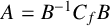 $A = B^{-1} C_f B$
, then
$A = B^{-1} C_f B$
, then $p_A(x) = f(x)$
, so
$p_A(x) = f(x)$
, so $\langle 4 \rangle \subseteq \mathcal {S}(A)$
. We seek a
$\langle 4 \rangle \subseteq \mathcal {S}(A)$
. We seek a $B \in \mathsf {M}_3(\mathbb {Q})$
such that
$B \in \mathsf {M}_3(\mathbb {Q})$
such that $S = \langle 4,5,7 \rangle = \mathcal {S}(A)$
.
$S = \langle 4,5,7 \rangle = \mathcal {S}(A)$
.
Let $B = \operatorname {diag}(2^{x_1},2^{x_2},2^{x_3})$
, in which
$B = \operatorname {diag}(2^{x_1},2^{x_2},2^{x_3})$
, in which $x_1,x_2,x_3 \in \mathbb {Z}$
are to be determined. Then
$x_1,x_2,x_3 \in \mathbb {Z}$
are to be determined. Then
 $$ \begin{align*} A = B^{-1}C_p B = \begin{bmatrix} {\color{lightgray}0} & {\color{lightgray}0} & 2^{-x_1+x_3+3} \\ 2^{x_1-x_2} & {\color{lightgray}0} & -2^{-x_2+x_3+2} \\ {\color{lightgray}0} & 2^{x_2-x_3} & 2 \\ \end{bmatrix}. \end{align*} $$
For $\ell \in \mathbb {N}$
, observe that
$\ell \in \mathbb {N}$
, observe that $A^{4\ell } = 16^{\ell } I$
,
$A^{4\ell } = 16^{\ell } I$
,
 $$ \begin{align*} \begin{split} A^{4\ell+1} &= \left[ \begin{array}{ccc} {\color{lightgray}0} & {\color{lightgray}0} & 2^{4 \ell-x_1+x_3+3} \\ 2^{4 \ell+x_1-x_2} & {\color{lightgray}0} & -2^{4 \ell-x_2+x_3+2} \\ {\color{lightgray}0} & 2^{4 \ell+x_2-x_3} & 2^{4 \ell+1} \\ \end{array} \right], \\ A^{4\ell+2} &= \left[ \begin{array}{ccc} {\color{lightgray}0} & 2^{4 \ell-x_1+x_2+3} & 2^{4 \ell-x_1+x_3+4} \\ {\color{lightgray}0} & -4^{2 \ell+1} & {\color{lightgray}0} \\ 2^{4 \ell+x_1-x_3} & 2^{4 \ell+x_2-x_3+1} & {\color{lightgray}0} \\ \end{array} \right], \\ A^{4\ell+3} &= \left[ \begin{array}{ccc} 2^{4 \ell+3} & 2^{4 \ell-x_1+x_2+4} & {\color{lightgray}0} \\ -2^{4 \ell+x_1-x_2+2} & {\color{lightgray}0} & 2^{4 \ell-x_2+x_3+4} \\ 2^{4 \ell+x_1-x_3+1} & {\color{lightgray}0} & {\color{lightgray}0} \\ \end{array} \right]. \end{split} \end{align*} $$
Since each exponent is a linear expression in the integer variables $x_1,x_2,x_3$
, our search for a suitable B can be reduced to an integer linear-programming problem.
$x_1,x_2,x_3$
, our search for a suitable B can be reduced to an integer linear-programming problem.
We seek $x_1,x_2,x_3 \in \mathbb {Z}$
such that
$x_1,x_2,x_3 \in \mathbb {Z}$
such that $A^4,A^5,A^7 \in \mathsf {M}_3(\mathbb {Z})$
and such that
$A^4,A^5,A^7 \in \mathsf {M}_3(\mathbb {Z})$
and such that $A,A^2,A^3,A^6 \notin \mathsf {M}_3(\mathbb {Z})$
. Since
$A,A^2,A^3,A^6 \notin \mathsf {M}_3(\mathbb {Z})$
. Since $F(S) = 6$
and
$F(S) = 6$
and $S = \langle 4,5,7 \rangle $
, it would follow that
$S = \langle 4,5,7 \rangle $
, it would follow that $\mathcal {S}(A) = S$
. Because
$\mathcal {S}(A) = S$
. Because $A^4 = 16 I \in \mathsf {M}_3(\mathbb {Z})$
, we can ignore this constraint. The condition
$A^4 = 16 I \in \mathsf {M}_3(\mathbb {Z})$
, we can ignore this constraint. The condition $A^5 \in \mathsf {M}_3(\mathbb {Z})$
requires that each of the following linear inequalities must be satisfied:
$A^5 \in \mathsf {M}_3(\mathbb {Z})$
requires that each of the following linear inequalities must be satisfied:
 $$ \begin{align} \begin{aligned} 4+x_1 - x_2 \geq 0,\\ 4 + x_2 - x_3 \geq 0,\\ 6 - x_2 + x_3 \geq 0,\\ 7-x_1 + x_3 \geq 0. \end{aligned} \end{align} $$
We pick up another system of linear inequalities for the condition $A^7 \in \mathsf {M}_3(\mathbb {Z})$
:
$A^7 \in \mathsf {M}_3(\mathbb {Z})$
:
 $$ \begin{align} \begin{aligned} 5 + x_1 - x_3 \geq 0,\\ 6 + x_1 - x_2 \geq 0,\\ 8 - x_1 + x_2 \geq 0,\\ 8 - x_2 + x_3 \geq 0. \end{aligned} \end{align} $$
Since we want $A \notin \mathsf {M}_3(\mathbb {Z})$
, at least one of the following inequalities must hold:
$A \notin \mathsf {M}_3(\mathbb {Z})$
, at least one of the following inequalities must hold:
 $$ \begin{align*} x_1 -x_2 \leq - 1,\quad x_2 - x_3 \leq - 1,\quad -x_1+x_2+3 \leq - 1\quad \text{and} \quad -x_2 + x_3 + 2 \leq - 1. \end{align*} $$
We select $x_1 - x_2 \leq - 1$
and append it to (4.1) and (4.2). Similarly, the condition
$x_1 - x_2 \leq - 1$
and append it to (4.1) and (4.2). Similarly, the condition $A^3 \notin \mathsf {M}_3(\mathbb {Z})$
yields (among other possibilities) the inequality
$A^3 \notin \mathsf {M}_3(\mathbb {Z})$
yields (among other possibilities) the inequality $2+x_1 - x_2 \leq -1$
. From
$2+x_1 - x_2 \leq -1$
. From $A^6 \notin \mathsf {M}_3(\mathbb {Z})$
we obtain
$A^6 \notin \mathsf {M}_3(\mathbb {Z})$
we obtain $4 + x_1 - x_3 \leq -1$
. So in total we append to (4.1) and (4.2) the inequalities
$4 + x_1 - x_3 \leq -1$
. So in total we append to (4.1) and (4.2) the inequalities
 $$ \begin{align} \begin{aligned} x_1 - x_2 \leq - 1, \\ 2+x_1 - x_2 \leq -1,\\ 4 + x_1 - x_3 \leq -1. \end{aligned} \end{align} $$
Of the many solutions to (4.1), (4.2) and (4.3) in $\mathbb {Z}^3$
we choose
$\mathbb {Z}^3$
we choose $(x_1,x_2,x_3) = (0,3,5)$
, so
$(x_1,x_2,x_3) = (0,3,5)$
, so $B = \operatorname {diag}(1,8,32)$
and
$B = \operatorname {diag}(1,8,32)$
and
 $$ \begin{align*} A = \begin{bmatrix} {\color{lightgray}0} & {\color{lightgray}0} & 256 \\ \frac{1}{8} & {\color{lightgray}0} & -16 \\ {\color{lightgray}0} & \frac{1}{4} & 2 \\ \end{bmatrix}, \end{align*} $$
which satisfies $\mathcal {S}(A) = S = \langle 4,5,7 \rangle $
, as desired.
$\mathcal {S}(A) = S = \langle 4,5,7 \rangle $
, as desired.
While there is no guarantee that the companion-matrix method works, it often does in practice. Mathematica or any other comparable software can solve these small-scale integer-linear-programming problems instantly or, at worst, declare that no solutions exists. In the latter case, one can try again with a different potential characteristic polynomial.
Example 4.2. Consider $S = \langle 5,6,13,14 \rangle $
, which has
$S = \langle 5,6,13,14 \rangle $
, which has $\operatorname {dim_{\mathrm {mat}}} S \geq 3$
by Lemma 3.3. Since
$\operatorname {dim_{\mathrm {mat}}} S \geq 3$
by Lemma 3.3. Since $m(S)=5$
and the only nonlinear factor of
$m(S)=5$
and the only nonlinear factor of $x^5-a^5$
over
$x^5-a^5$
over $\mathbb {Z}[x]$
is a single degree-
$\mathbb {Z}[x]$
is a single degree- $4$
factor, the CMM cannot easily produce a
$4$
factor, the CMM cannot easily produce a $3 \times 3$
representing matrix for S. One way to use the CMM for semigroups with
$3 \times 3$
representing matrix for S. One way to use the CMM for semigroups with $m(S)=5$
is to use the characteristic polynomial of a representing matrix for a compatible model semigroup. To illustrate this, we show that
$m(S)=5$
is to use the characteristic polynomial of a representing matrix for a compatible model semigroup. To illustrate this, we show that $\mathcal {S}(A)=S$
for
$\mathcal {S}(A)=S$
for
 $$ \begin{align} A = \begin{bmatrix} {\color{lightgray}0} & {\color{lightgray}0} & \frac{1}{262144} \\[2pt] 4096 & {\color{lightgray}0} & -\frac{1}{128}\\[2pt] {\color{lightgray}0} & 4096 & 8 \end{bmatrix} \end{align} $$
and thus $\operatorname {dim_{\mathrm {mat}}} S = 3$
. We want S and the model semigroup to share some elements so that the CMM has the best chance of producing S; this is analogous to how we chose the characteristic polynomial in Example 4.1 so that
$\operatorname {dim_{\mathrm {mat}}} S = 3$
. We want S and the model semigroup to share some elements so that the CMM has the best chance of producing S; this is analogous to how we chose the characteristic polynomial in Example 4.1 so that $\langle 4 \rangle \subseteq \mathcal {S}(A)$
by construction. Take
$\langle 4 \rangle \subseteq \mathcal {S}(A)$
by construction. Take $S' = \langle 6,7,11,15,16 \rangle $
, which shares
$S' = \langle 6,7,11,15,16 \rangle $
, which shares $6,11,12,13,14,15,16,\ldots $
with S. Lemma 3.3 ensures that
$6,11,12,13,14,15,16,\ldots $
with S. Lemma 3.3 ensures that $\operatorname {dim_{\mathrm {mat}}} S' \geq 3$
and one can show, as we do below, that a representing matrix for
$\operatorname {dim_{\mathrm {mat}}} S' \geq 3$
and one can show, as we do below, that a representing matrix for $S'$
is
$S'$
is
 $$ \begin{align*} A'= \begin{bmatrix} {\color{lightgray}0} & {\color{lightgray}0} & \frac{1}{512} \\[2pt] 16777216 & {\color{lightgray}0} & -16384 \\[2pt] {\color{lightgray}0} & \frac{1}{512} & 8 \\ \end{bmatrix}, \end{align*} $$
so $\operatorname {dim_{\mathrm {mat}}} S' = 3$
. Since
$\operatorname {dim_{\mathrm {mat}}} S' = 3$
. Since $m(S') = 6$
and
$m(S') = 6$
and
 $$ \begin{align*} x^6 - a^6 = (x-a) (x+a) (x^2-a x +a^2) (x^2+a x+a^2) \end{align*} $$
has four degree- $3$
factors, it is much easier to find a
$3$
factors, it is much easier to find a $3 \times 3$
representing matrix for
$3 \times 3$
representing matrix for $S'$
than for S. The characteristic polynomial of
$S'$
than for S. The characteristic polynomial of $A'$
is
$A'$
is $p_{A'}(x) = x^3 - 8x^2 + 32x - 64$
. We take this as our educated guess for a possible characteristic polynomial for the desired A. Using
$p_{A'}(x) = x^3 - 8x^2 + 32x - 64$
. We take this as our educated guess for a possible characteristic polynomial for the desired A. Using
 $$ \begin{align*} C_{p_{A'}(x)} = \begin{bmatrix} {\color{lightgray}0} & {\color{lightgray}0} & 64 \\ 1 & {\color{lightgray}0} & -32\\ {\color{lightgray}0} & 1 & 8 \end{bmatrix} \quad \text{and} \quad B = \operatorname{diag}(2^{12},2^{0},2^{-12}), \end{align*} $$
in which B was obtained through integer linear programming, we obtain the matrix $A = B^{-1}C_{p_{A'}}B$
given in (4.4).
$A = B^{-1}C_{p_{A'}}B$
given in (4.4).
Example 4.3. As Example 4.2 suggests, semigroups with $m(S) = 5$
can be difficult to find
$m(S) = 5$
can be difficult to find $3 \times 3$
generating matrices for (if they exist at all). For example,
$3 \times 3$
generating matrices for (if they exist at all). For example, $S=\langle 5,6,8 \rangle $
proved the most stubborn of all, and it required new techniques altogether. First observe that Lemma 3.3 ensures that
$S=\langle 5,6,8 \rangle $
proved the most stubborn of all, and it required new techniques altogether. First observe that Lemma 3.3 ensures that $\operatorname {dim_{\mathrm {mat}}} S \geq 3$
, so we are in the same difficult position as we were in Example 4.2. Despite many attempts, the method of that example appeared inadequate. However, we could take an educated guess as to the form of
$\operatorname {dim_{\mathrm {mat}}} S \geq 3$
, so we are in the same difficult position as we were in Example 4.2. Despite many attempts, the method of that example appeared inadequate. However, we could take an educated guess as to the form of $p_A(x)$
for an
$p_A(x)$
for an $A \in \mathsf {M}_3(\mathbb {Q})$
such that
$A \in \mathsf {M}_3(\mathbb {Q})$
such that $\mathcal {S}(A) = S$
. Suppose that
$\mathcal {S}(A) = S$
. Suppose that $\mathcal {S}(A) = \langle 5,6,8 \rangle $
, in which
$\mathcal {S}(A) = \langle 5,6,8 \rangle $
, in which $A \in \mathsf {M}_3(\mathbb {Q})$
and
$A \in \mathsf {M}_3(\mathbb {Q})$
and $p_A(x) = x^3 + px^2 +qx + r$
with
$p_A(x) = x^3 + px^2 +qx + r$
with $p,q,r \in \mathbb {Z}$
. The Cayley–Hamilton theorem ensures that
$p,q,r \in \mathbb {Z}$
. The Cayley–Hamilton theorem ensures that $A^3 + pA^2 + qA + rI = 0$
. From this we can make a variety of observations.
$A^3 + pA^2 + qA + rI = 0$
. From this we can make a variety of observations.
-
(a) First note that
$r\neq 0$
(so A is invertible). Suppose toward a contradiction that
$r=0$
. Then
$A^7 + pA^6 + qA^5 = A^4(A^3 + pA^2 + qA + rI) = 0$
, so
$A^7 \in \mathsf {M}_3(\mathbb {Z})$
since
${5,6 \in S}$
. Since this contradicts the fact that
$7 \notin S$
, we conclude that
$r \neq 0$
. -
(b) Next observe that
$q \neq 0$
. Suppose toward a contradiction that
$q = 0$
. Then
${A^9 + pA^8 + r A^6 = A^6 (A^3 + pA^2 + qA + rI) = 0}$
, so
$A^9 \in \mathsf {M}_3(\mathbb {Z})$
since
$6,8 \in S$
. Since this contradicts the fact that
$9 \notin S$
, we conclude that
$q \neq 0$
. -
(c) We claim that
$\gcd (q,r) \geq 2$
. Since
$A^{11} + pA^{10} + qA^9 + r A^8 = A^8 p_A(A) =0$
and
$8,10,11\in S$
, we conclude that
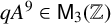
$qA^9\in \mathsf {M}_3(\mathbb {Z})$
. In a similar manner, examine
${A^{12} + pA^{11} + qA^{10} + r A^9 = 0}$
and deduce that
$rA^9 \in \mathsf {M}_3(\mathbb {Z})$
. Therefore,
$\gcd (q,r) A^9 \in \mathsf {M}_3(\mathbb {Z})$
. Since
$9 \notin S$
, we conclude that
$\gcd (q,r) \geq 2$
.













Similar arguments suggest that $\gcd (p,q,r)\geq 2$
. Preliminary computations indicated that
$\gcd (p,q,r)\geq 2$
. Preliminary computations indicated that $2$
did not provide enough granularity. Ultimately, we took
$2$
did not provide enough granularity. Ultimately, we took $\gcd (p,q,r) = 8$
and used the CMM as follows. We generated random polynomials
$\gcd (p,q,r) = 8$
and used the CMM as follows. We generated random polynomials $f(x)=x^3+px^2+qx+r$
with
$f(x)=x^3+px^2+qx+r$
with $\gcd (p,q,r)=8$
and random lower-triangular matrices B whose nonzero entries were nonnegative powers of two. Since inversion of such B is fast, we could test matrices of the form
$\gcd (p,q,r)=8$
and random lower-triangular matrices B whose nonzero entries were nonnegative powers of two. Since inversion of such B is fast, we could test matrices of the form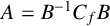 $A = B^{-1} C_f B$
by the billions: compute
$A = B^{-1} C_f B$
by the billions: compute $A^n = B^{-1} C_f^n B$
for
$A^n = B^{-1} C_f^n B$
for $n=1,2,3,\ldots ,14$
, checking step-by-step whether
$n=1,2,3,\ldots ,14$
, checking step-by-step whether $A^n \in \mathsf {M}_3(\mathbb {Z})$
for
$A^n \in \mathsf {M}_3(\mathbb {Z})$
for $n\in S = \{5,6,8,10,11,12,13,14,\ldots \}$
(since
$n\in S = \{5,6,8,10,11,12,13,14,\ldots \}$
(since $5 \in S$
, Lemma 3.3 ensures that we need check no power higher than
$5 \in S$
, Lemma 3.3 ensures that we need check no power higher than $14$
). At the first disagreement, reject A and start again. On a high-performance computing cluster, this method quickly produced the generating matrix
$14$
). At the first disagreement, reject A and start again. On a high-performance computing cluster, this method quickly produced the generating matrix
 $$ \begin{align*} A = B^{-1} C_f B = \begin{bmatrix} -12 & -196608 & -768 \\[2pt] \frac{2363}{4096} & 9448 & \frac{1181}{32} \\[2pt] -\frac{273}{4} & -1379072 & -5388 \\ \end{bmatrix}, \end{align*} $$
in which $f(x) = x^3 - 4048 x^2 + 2840 x + 48$
and
$f(x) = x^3 - 4048 x^2 + 2840 x + 48$
and
 $$ \begin{align*} B = \begin{bmatrix} 2^2 & {\color{lightgray}0} & {\color{lightgray}0} \\ 2^{10} & 2^{14} & {\color{lightgray}0} \\ 1 & 2^{14} & 2^6 \\ \end{bmatrix}. \end{align*} $$
5 Matricial dimension by Frobenius number and genus
We now demonstrate the collective power of our techniques by determining the matricial dimension of every numerical semigroup S with Frobenius number $F(S) \leq 10$
or genus
$F(S) \leq 10$
or genus $g(S) \leq 6$
. Semigroups with Frobenius number at most
$g(S) \leq 6$
. Semigroups with Frobenius number at most $4$
can be attacked with methods from [Reference Chhabra, Garcia, Zhang and Zhang7]. As the Frobenius number increases, methods from this paper are required. Theorems 2.2, 2.8 and 3.4, and the CMM described in Section 4, become the primary workhorses. Ultimately, high-performance computing becomes valuable for addressing the final few difficult semigroups.
$4$
can be attacked with methods from [Reference Chhabra, Garcia, Zhang and Zhang7]. As the Frobenius number increases, methods from this paper are required. Theorems 2.2, 2.8 and 3.4, and the CMM described in Section 4, become the primary workhorses. Ultimately, high-performance computing becomes valuable for addressing the final few difficult semigroups.
5.1 Matricial dimension by Frobenius number ${F(S)=1}$
-
•
$S=\langle 2,3 \rangle $
:
$\operatorname {dim_{\mathrm {mat}}} S=2$
by Theorem 2.8(c) with
$a=2$
and
$b=3$
.


 ${F(S)=2}$
-
•
$S = \langle 3,4,5 \rangle $
:
$\operatorname {dim_{\mathrm {mat}}} S = 2$
by Theorem 3.4.

 ${F(S)=3}$
-
•
$S=\langle 2,5 \rangle $
:
$\operatorname {dim_{\mathrm {mat}}} S=2$
by Theorem 2.8(c) with
$a=2$
and
$b=5$
. -
•
$S=\langle 4,5,6,7 \rangle $
:
$\operatorname {dim_{\mathrm {mat}}} S=2$
by Theorem 2.8(b) since
$S = S_4$
.




 ${F(S)=4}$
-
•
$S=\langle 3,5,7 \rangle $
:
$\operatorname {dim_{\mathrm {mat}}} S =2$
by Theorem 3.4 (see also [Reference Chhabra, Garcia, Zhang and Zhang7, Remark 5.8]). -
•
$S=\langle 5,6,7,8,9 \rangle $
:
$\operatorname {dim_{\mathrm {mat}}} S =2$
by Theorem 2.8(b) since
$S = S_5$
.



 ${F(S)=5}$
-
•
$S=\langle 2,7 \rangle $
:
$\operatorname {dim_{\mathrm {mat}}} S=2$
by Theorem 2.8(c) with
$a=2$
and
$b=7$
. -
•
$S=\langle 3,4 \rangle $
:
$\operatorname {dim_{\mathrm {mat}}} S =3$
by Theorem 3.4 (see also [Reference Chhabra, Garcia, Zhang and Zhang7, Example 5.2]). -
•
$S=\langle 3,7,8 \rangle $
:
$\operatorname {dim_{\mathrm {mat}}} S =2$
by Theorem 3.4. -
•
$S=\langle 4,6,7,9 \rangle $
:
$\operatorname {dim_{\mathrm {mat}}} S =2$
by Theorem 2.8(c) with
$a=4$
and
$b=6$
. -
•
$S=\langle 6,7,8,9,10,11 \rangle $
:
$\operatorname {dim_{\mathrm {mat}}} S =2$
by Theorem 2.8(b) since
$S = S_6$
.


 ${F(S)=6}$
-
•
$S=\langle 4,5,7 \rangle $
:
$\operatorname {dim_{\mathrm {mat}}} S =3$
. See Example 4.1. -
•
$S=\langle 4,7,9,10 \rangle $
:
$\operatorname {dim_{\mathrm {mat}}} S =2$
by Theorem 2.8(c) with
$a=4$
and
$b=7$
. -
•
$S=\langle 5,7,8,9,11 \rangle $
:
$\operatorname {dim_{\mathrm {mat}}} S =2$
by Theorem 2.8(c) with
$a=5$
and
$b=7$
. -
•
$S=\langle 7,8,9,10,11,12,13 \rangle $
:
$\operatorname {dim_{\mathrm {mat}}} S =2$
by Theorem 2.8(b) since
$S = S_7$
.









 ${F(S)=7}$
-
•
$S=\langle 2,9 \rangle $
:
$\operatorname {dim_{\mathrm {mat}}} S=2$
. Use Theorem 2.8(c) with
$a=2$
and
$b=9$
. -
•
$S=\langle 3,5 \rangle $
:
$\operatorname {dim_{\mathrm {mat}}} S =3$
by Theorem 3.4. -
•
$S=\langle 3,8,10 \rangle $
:
$\operatorname {dim_{\mathrm {mat}}} S =2$
by Theorem 3.4. -
•
$S=\langle 4,5,6 \rangle $
:
$\operatorname {dim_{\mathrm {mat}}} S =4$
. Since
$4,5,6 \in S$
and
$7 \notin S$
, Lemma 3.3 ensures that
$\operatorname {dim_{\mathrm {mat}}} S \geq 4$
. Theorem 2.2 with
$d=4$
shows that
$\operatorname {dim_{\mathrm {mat}}} S= 4$
. -
•
$S=\langle 4,5,11 \rangle $
:
$\operatorname {dim_{\mathrm {mat}}} S =3$
. Since
$4,5 \in S$
and
$6 \notin S$
, Lemma 3.3 ensures that
$\operatorname {dim_{\mathrm {mat}}} S \geq 3$
. The CMM ensures that
$\operatorname {dim_{\mathrm {mat}}} S = 3$
since
$S = \mathcal {S}\left (\left [\begin {smallmatrix}{\color {lightgray}0} & {\color {lightgray}0} & \frac 18 \\512 & {\color {lightgray}0} & -32 \\ {\color {lightgray}0} & \frac 18 & 2 \\\end {smallmatrix}\right ]\right )$
. -
•
$S=\langle 4,6,9,11 \rangle $
:
$\operatorname {dim_{\mathrm {mat}}} S =2$
. The CMM provides
$S = \mathcal {S}\Big (\Big [\begin {smallmatrix}0&32\\ \frac {1}{16} & 8\end {smallmatrix}\Big ]\Big )$
. -
•
$S=\langle 4,9,10,11 \rangle $
:
$\operatorname {dim_{\mathrm {mat}}} S =2$
. Use Theorem 2.8(c) with
$a=4$
and
$b=9$
. -
•
$S=\langle 5,6,8,9 \rangle $
:
$\operatorname {dim_{\mathrm {mat}}} S =3$
. Since
$5,6 \in S$
and
$7 \notin S$
, Lemma 3.3 ensures that
$\operatorname {dim_{\mathrm {mat}}} S \geq 3$
. The CMM ensures that
$\operatorname {dim_{\mathrm {mat}}} S = 3$
since
$S = \mathcal {S}\bigg (\bigg [\begin {smallmatrix} {\color {lightgray}0} & {\color {lightgray}0} & 16 \\ 64 & {\color {lightgray}0} & -1024 \\ {\color {lightgray}0} & \frac {1}{128} & 4 \end {smallmatrix}\bigg ]\bigg )$
. -
•
$S=\langle 5,8,9,11,12 \rangle $
:
$\operatorname {dim_{\mathrm {mat}}} S =2$
. Use Theorem 2.8(c) with
$a=5$
and
$b=8$
. -
•
$S=\langle 6,8,9,10,11,13 \rangle $
:
$\operatorname {dim_{\mathrm {mat}}} S =2$
. Use Theorem 2.8(c) with
$a=7$
and
$b=8$
. -
•
$S=\langle 8,9,10,11,12,13,14,15 \rangle $
:
$\operatorname {dim_{\mathrm {mat}}} S =2$
by Theorem 2.8(b) since
$S = S_8$
.























 ${F(S)=8}$
-
•
$S=\langle 3,7,11 \rangle $
:
$\operatorname {dim_{\mathrm {mat}}} S =3$
by Theorem 3.4. -
•
$S=\langle 3,10,11 \rangle $
:
$\operatorname {dim_{\mathrm {mat}}} S =2$
by Theorem 3.4. -
•
$S=\langle 5,6,7,9 \rangle $
:
$\operatorname {dim_{\mathrm {mat}}} S = 4$
. Since
$5,6,7 \in S$
and
$8 \notin S$
, Lemma 3.3 ensures that
$\operatorname {dim_{\mathrm {mat}}} S \geq 4$
. The CMM ensures that
$\operatorname {dim_{\mathrm {mat}}} S = 4$
since
$S = \mathcal {S}\left (\left [\begin {smallmatrix}{\color {lightgray}0} & {\color {lightgray}0} & -32 & \frac {1}{16} \\ 1 & {\color {lightgray}0} & -16 & {\color {lightgray}0} \\ {\color {lightgray}0} & \frac 14 & -2 & {\color {lightgray}0} \\ {\color {lightgray}0} & {\color {lightgray}0} & -1024 & {\color {lightgray}0} \\ \end {smallmatrix}\right ]\right )$
. -
•
$S=\langle 5,6,9,13 \rangle $
:
$\operatorname {dim_{\mathrm {mat}}} S = 3$
. Since
$5,6\in S$
and
$7 \notin S$
, Lemma 3.3 ensures that
$\operatorname {dim_{\mathrm {mat}}} S \geq 3$
. The CMM ensures that
$\operatorname {dim_{\mathrm {mat}}} S = 3$
since
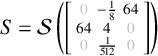
$S = \mathcal {S}\left (\left [ \begin {smallmatrix} {\color {lightgray}0} & -\frac 18 & 64 \\ 64 & 4 & {\color {lightgray}0} \\ {\color {lightgray}0} & \frac {1}{512} & {\color {lightgray}0} \\ \end {smallmatrix} \right ]\right )$
. -
•
$S=\langle 5,7,9,11,13 \rangle $
:
$\operatorname {dim_{\mathrm {mat}}} S =3$
. Since
$\mathfrak {s}(S) = \{5,7\}$
and
$\gcd (5,7)= 1$
, Lemma 3.1 ensures that
$\operatorname {dim_{\mathrm {mat}}} S \geq 3$
. The CMM ensures that
$\operatorname {dim_{\mathrm {mat}}} S = 3$
since
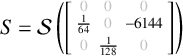
$S = \mathcal {S}\left (\left [\begin {smallmatrix} {\color {lightgray}0} & {\color {lightgray}0} & {\color {lightgray}0} \\ \frac {1}{64} & {\color {lightgray}0} & -6144 \\ {\color {lightgray}0} & \frac {1}{128} & {\color {lightgray}0} \\ \end {smallmatrix}\right ]\right )$
. -
•
$S=\langle 5,9,11,12,13\rangle $
:
$\operatorname {dim_{\mathrm {mat}}} S =2$
. Use Theorem 2.8(c) with
$a=5$
and
$b=9$
. -
•
$S=\langle 6,7,9,10,11\rangle $
:
$\operatorname {dim_{\mathrm {mat}}} S =3$
. Since
$6,7 \in S$
and
$8 \notin S$
, Lemma 3.3 ensures that
$\operatorname {dim_{\mathrm {mat}}} S \geq 3$
. The CMM ensures that
$\operatorname {dim_{\mathrm {mat}}} S = 3$
since
$S = \mathcal {S}\left (\left [\begin {smallmatrix} {\color {lightgray}0} & {\color {lightgray}0} & \frac 18 \\ 1024 & {\color {lightgray}0} & -128 \\ {\color {lightgray}0} & \frac {1}{16} & 4 \\ \end {smallmatrix}\right ]\right )$
. -
•
$S=\langle 6,9,10,11,13,14 \rangle $
:
$\operatorname {dim_{\mathrm {mat}}} S =2$
. Use Theorem 2.8(c) with
$a=6$
and
$b=9$
. -
•
$S=\langle 7,9,10,11,12,13,15 \rangle $
:
$\operatorname {dim_{\mathrm {mat}}} S =2$
. Use Theorem 2.8(c) with
$a=7$
and
$b=9$
. -
•
$S=\langle 9,10,11,12,13,14,15,16,17 \rangle $
:
$\operatorname {dim_{\mathrm {mat}}} S =2$
by Theorem 2.8(b) since
$S = S_9$
.

















 ${F(S)=9}$
-
•
$S=\langle 2,11 \rangle $
:
$\operatorname {dim_{\mathrm {mat}}} S =2$
. Use Theorem 2.8(c) with
$a=2$
and
$b=11$
. -
•
$S=\langle 4,6,7 \rangle $
:
$\operatorname {dim_{\mathrm {mat}}} S =4$
. Since
$6,7,8 \in S$
and
$9 \notin S$
, Lemma 3.3 ensures that
$\operatorname {dim_{\mathrm {mat}}} S \geq 4$
. Theorem 2.2 with
$d=4$
shows that
$\operatorname {dim_{\mathrm {mat}}} S= 4$
. -
•
$S=\langle 4,6,11,13 \rangle $
:
$\operatorname {dim_{\mathrm {mat}}} S =2$
. The CMM provides
$S = \mathcal {S}\left (\left [\begin {smallmatrix} {\color {lightgray}0}&64\\ \frac {1}{32}&16 \end {smallmatrix}\right ]\right )$
. -
•
$S=\langle 4,7,10,13 \rangle $
:
$\operatorname {dim_{\mathrm {mat}}} S = 3$
. Since
$7,8 \in S$
and
$9 \notin S$
, Lemma 3.3 ensures that
$\operatorname {dim_{\mathrm {mat}}} S \geq 3$
. The CMM ensures that
$\operatorname {dim_{\mathrm {mat}}} S = 3$
since
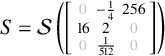
$S = \mathcal {S}\left (\left [ \begin {smallmatrix} {\color {lightgray}0} & -\frac 14 & 256 \\ 16 & 2 & {\color {lightgray}0} \\ {\color {lightgray}0} & \frac {1}{512} & {\color {lightgray}0} \\ \end {smallmatrix} \right ]\right )$
. -
•
$S=\langle 4,10,11,13 \rangle $
:
$\operatorname {dim_{\mathrm {mat}}} S =2$
. Use Theorem 2.8(c) with
$a=4$
and
$b=10$
. -
•
$S=\langle 5,6,7 \rangle $
:
$\operatorname {dim_{\mathrm {mat}}} S = 4$
. Since
$5,6,7\in S$
but
$8\notin S$
, Lemma 3.3 ensures that
$\operatorname {dim_{\mathrm {mat}}} S \geq 4$
. The CMM ensures that
$\operatorname {dim_{\mathrm {mat}}} S=4$
since
$S = \mathcal {S}\left (\left [ \begin {smallmatrix} {\color {lightgray}0} & {\color {lightgray}0} & -64 & \frac {1}{16} \\ 2 & {\color {lightgray}0} & -64 & 0 \\ {\color {lightgray}0} & \frac {1}{16} & -2 & 0 \\ {\color {lightgray}0} & {\color {lightgray}0} & -2048 & 0 \\ \end {smallmatrix} \right ]\right )$
. -
•
$S=\langle 5,6,7,8 \rangle $
:
$\operatorname {dim_{\mathrm {mat}}} S =5$
. Since
$5,6,7,8 \in S$
and
$9 \notin S$
, Lemma 3.3 ensures that
$\operatorname {dim_{\mathrm {mat}}} S \geq 5$
. Theorem 2.2 with
$d=5$
shows that
$\operatorname {dim_{\mathrm {mat}}} S= 5$
. -
•
$S=\langle 5,6,8\rangle $
:
$\operatorname {dim_{\mathrm {mat}}} S=3$
. Since
$5,6\in S$
but
$7\notin S$
, Lemma 3.3 ensures
${\operatorname {dim_{\mathrm {mat}}} S\geq 3}$
. Since
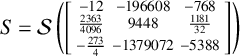
$S=\mathcal {S}\left (\left [ \begin {smallmatrix} -12 & -196608 & -768 \\ \frac {2363}{4096} & 9448 & \frac {1181}{32} \\ -\frac {273}{4} & -1379072 & -5388 \\ \end {smallmatrix}\right ]\right )$
, we have
$\operatorname {dim_{\mathrm {mat}}} S=3.$
-
•
$S=\langle 5,6,13,14\rangle $
:
$\operatorname {dim_{\mathrm {mat}}} S=3$
. Since
$5,6\in S$
but
$7\notin S$
, Lemma 3.3 ensures
$\operatorname {dim_{\mathrm {mat}}} S\geq 3$
. The CMM ensures that
$\operatorname {dim_{\mathrm {mat}}} S=3$
since
$S=\mathcal {S}\left (\left [\begin {smallmatrix} {\color {lightgray}0} & {\color {lightgray}0} & 256 \\ \frac {1}{4096} & {\color {lightgray}0} & -\frac {1}{32} \\ {\color {lightgray}0} & 256 & 4 \\ \end {smallmatrix}\right ]\right )$
. -
•
$S=\langle 5,7,8,11\rangle $
:
$\operatorname {dim_{\mathrm {mat}}} S=3$
. Since
$7,8\in S$
but
$9\notin S$
, Lemma 3.3 ensures
$\operatorname {dim_{\mathrm {mat}}} S\geq 3$
. Since
$S=\mathcal {S}\left (\left [ \begin {smallmatrix} -\frac {317}{4} & \frac {1}{32} & -628 \\ -1286 & -\frac 14 & -10336 \\ \frac {837}{32} & \frac {3}{256} & \frac {419}{2} \\ \end {smallmatrix} \right ]\right )$
, we have
$\operatorname {dim_{\mathrm {mat}}} S=3$
. -
•
$S=\langle 5,7,11,13 \rangle $
:
$\dim S = 3$
. Since
$\mathfrak {s}(S)=\{5,7\}$
and
$\gcd (5,7)=1$
, Lemma 3.1 ensures that
$\operatorname {dim_{\mathrm {mat}}} S\geq 3$
. The CMM ensures that
$\operatorname {dim_{\mathrm {mat}}} S=3$
since
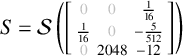
$S = \mathcal {S}\left (\left [ \begin {smallmatrix} {\color {lightgray}0} & {\color {lightgray}0} & \frac {1}{16} \\ \frac {1}{16} & {\color {lightgray}0} & -\frac {5}{512} \\ {\color {lightgray}0} & 2048 & -12 \\ \end {smallmatrix} \right ]\right )$
. -
•
$S=\langle 5,8,11,12,14\rangle $
:
$\operatorname {dim_{\mathrm {mat}}} S=3.$
Since
$\mathfrak {s}(S)=\{5,8\}$
and
$\gcd (5,8)=1$
, Lemma 3.1 ensures that
$\operatorname {dim_{\mathrm {mat}}} S\geq 3$
. The CMM ensures that
$\operatorname {dim_{\mathrm {mat}}} S=3$
since
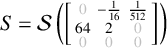
$S=\mathcal {S}\left (\left [ \begin {smallmatrix} {\color {lightgray}0} & -\frac {1}{16} & \frac {1}{512} \\ 64 & 2 & {\color {lightgray}0} \\ {\color {lightgray}0} & {\color {lightgray}0} & {\color {lightgray}0} \\ \end {smallmatrix} \right ]\right )$
. -
•
$S=\langle 5,11,12,13,14\rangle $
:
$\operatorname {dim_{\mathrm {mat}}} S =2$
Use Theorem 2.8(c) with
$a=5$
and
$b=11$
. -
•
$S=\langle 6,7,8,10,11\rangle $
:
$\operatorname {dim_{\mathrm {mat}}} S =4$
. Since
$6,7,8\in S$
but
$9\notin S$
, Lemma 3.3 ensures
$\operatorname {dim_{\mathrm {mat}}} S\geq 4$
. The CMM ensures that
$\operatorname {dim_{\mathrm {mat}}} S=4$
since
$S=\mathcal {S}\left (\left [ \begin {smallmatrix} {\color {lightgray}0} & {\color {lightgray}0} & {\color {lightgray}0} & 2048 \\ \frac 14 & {\color {lightgray}0} & {\color {lightgray}0} & 256 \\ {\color {lightgray}0} & 2 & {\color {lightgray}0} & {\color {lightgray}0} \\ {\color {lightgray}0} & {\color {lightgray}0} & \frac {1}{64} & -2 \\ \end {smallmatrix} \right ]\right )$
. -
•
$S=\langle 6,7,10,11,15\rangle $
:
$\operatorname {dim_{\mathrm {mat}}} S =3$
. Since
$6,7\in S$
but
$8\notin S$
, Lemma 3.3 ensures
$\operatorname {dim_{\mathrm {mat}}} S\geq 3.$
The CMM ensures that
$\operatorname {dim_{\mathrm {mat}}} S=3$
since
$S =\mathcal {S}\left (\left [ \begin {smallmatrix} {\color {lightgray}0} & {\color {lightgray}0} & 8388608 \\ \frac {1}{256} & {\color {lightgray}0} & -16384 \\ {\color {lightgray}0} & \frac {1}{512} & 8 \\ \end {smallmatrix} \right ]\right )$
. -
•
$S=\langle 6,8,10,11,13,15\rangle $
:
$\operatorname {dim_{\mathrm {mat}}} S =2$
. The CMM ensures that
$\operatorname {dim_{\mathrm {mat}}} S=2$
since
$S =\mathcal {S}\left (\left [ \begin {smallmatrix} {\color {lightgray}0} & -69632 \\ \frac {1}{1024} & -64 \\ \end {smallmatrix} \right ]\right )$
. -
•
$S=\langle 6,10,11,13,14,15\rangle $
:
$\operatorname {dim_{\mathrm {mat}}} S =2$
. Use Theorem 2.8(c) with
$a=6$
and
$b=10$
. -
•
$S=\langle 7,8,10,11,12,13\rangle $
:
$\operatorname {dim_{\mathrm {mat}}} S =3$
. Since
$7,8\in S$
but
$9\notin S$
, Lemma 3.3 ensures that
$\operatorname {dim_{\mathrm {mat}}} S \geq 3$
. The CMM ensures that
$\operatorname {dim_{\mathrm {mat}}} S=3$
since
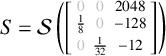
$S =\mathcal {S}\left (\left [ \begin {smallmatrix} {\color {lightgray}0} & {\color {lightgray}0} & 2048 \\ \frac 18 & {\color {lightgray}0} & -128 \\ {\color {lightgray}0} & \frac {1}{32} & -12 \\ \end {smallmatrix} \right ]\right )$
. -
•
$S=\langle 7,10,11,12,13,15,16\rangle $
:
$\operatorname {dim_{\mathrm {mat}}} S =2$
. Use Theorem 2.8(c) with
$a=7$
and
$b=10$
. -
•
$S=\langle 8,10,11,12,13,14,15,17\rangle $
:
$\operatorname {dim_{\mathrm {mat}}} S =2$
. Use Theorem 2.8(c) with
$a=8$
and
$b=10$
. -
•
$S=\langle 10,11,12,13,14,15,16,17,18,19\rangle $
:
$\operatorname {dim_{\mathrm {mat}}} S =2$
by Theorem 2.8(b) since
$S = S_{10}$
.

















































 ${F(S)=10}$
-
•
$S=\langle 3,8,13\rangle $
:
$\operatorname {dim_{\mathrm {mat}}} S =3$
. Since
$8,9 \in S$
and
$10 \notin S$
, Lemma 3.3 ensures that
$\operatorname {dim_{\mathrm {mat}}} S \geq 3$
. Theorem 2.2 with
$d=3$
shows that
$\operatorname {dim_{\mathrm {mat}}} S= 3$
. -
•
$S=\langle 3,11,13\rangle $
:
$\operatorname {dim_{\mathrm {mat}}} S =2$
. Use Theorem 2.8(c) with
$a=3$
and
$b=11$
. -
•
$S=\langle 4,7,9\rangle $
:
$\operatorname {dim_{\mathrm {mat}}} S =4$
. Since
$7,8,9 \in S$
and
$10 \notin S$
, Lemma 3.3 ensures that
$\operatorname {dim_{\mathrm {mat}}} S \geq 4$
. Theorem 2.2 with
$d=4$
shows that
$\operatorname {dim_{\mathrm {mat}}} S= 4$
. -
•
$S=\langle 4,7,13\rangle $
:
$\operatorname {dim_{\mathrm {mat}}} S =3$
. Since
$7,8\in S$
but
$9\notin S$
, Lemma 3.3 ensures
${\operatorname {dim_{\mathrm {mat}}} S\geq 3}$
. The CMM ensures that
$\operatorname {dim_{\mathrm {mat}}} S=3$
since
$S=\mathcal {S}\left (\left [ \begin {smallmatrix} {\color {lightgray}0} & -\frac {1}{64} & 32 \\ 256 & 2 & {\color {lightgray}0} \\ {\color {lightgray}0} & \frac {1}{1024} & {\color {lightgray}0} \\ \end {smallmatrix} \right ]\right )$
. -
•
$S=\langle 4,9,11,14\rangle $
:
$\operatorname {dim_{\mathrm {mat}}} S =3$
. Since
$8,9\in S$
but
$10\notin S$
, Lemma 3.3 ensures
$\operatorname {dim_{\mathrm {mat}}} S\geq 3$
. The CMM ensures that
$\operatorname {dim_{\mathrm {mat}}} S=3$
since
$S=\mathcal {S}\left (\left [ \begin {smallmatrix} {\color {lightgray}0} & -16 & \frac {1}{128} \\ \frac 14 & 2 & {\color {lightgray}0} \\ {\color {lightgray}0} & 4096 & {\color {lightgray}0} \\ \end {smallmatrix} \right ]\right )$
. -
•
$S=\langle 4,11,13, 14\rangle $
:
$\operatorname {dim_{\mathrm {mat}}} S =2$
. Use Theorem 2.8(c) with
$a=4$
and
$b=11$
. -
•
$S=\langle 6,7,8,9,11\rangle $
:
$\operatorname {dim_{\mathrm {mat}}} S =5$
. Since
$6,7,8,9\in S$
but
$10\notin S$
, Lemma 3.3 ensures
$\operatorname {dim_{\mathrm {mat}}} S \geq 5$
. The CMM ensures that
$\operatorname {dim_{\mathrm {mat}}} S=5$
since
$S=\mathcal {S}\left (\left [ \begin {smallmatrix} {\color {lightgray}0} & {\color {lightgray}0} & {\color {lightgray}0} & -32 & 4096 \\ \frac 12 & {\color {lightgray}0} & {\color {lightgray}0} & 8 & 0 \\ {\color {lightgray}0} & \frac {1}{16} & {\color {lightgray}0} & -\frac 14 & 0 \\ {\color {lightgray}0} & {\color {lightgray}0} & 16 & 2 & 0 \\ {\color {lightgray}0} & {\color {lightgray}0} & {\color {lightgray}0} & \frac {1}{64} & 0 \\ \end {smallmatrix} \right ]\right )$
. -
•
$S=\langle 6,7,8,11\rangle $
:
$\operatorname {dim_{\mathrm {mat}}} S =4$
. Since
$6,7,8\in S$
but
$9\notin S$
, Lemma 3.3 ensures
$\operatorname {dim_{\mathrm {mat}}} S\geq 4$
. The CMM ensures that
$\operatorname {dim_{\mathrm {mat}}} S=4$
since
$S=\mathcal {S}\left (\left [ \begin {smallmatrix} {\color {lightgray}0} & {\color {lightgray}0} & 64 & \frac {1}{32} \\ 1 & {\color {lightgray}0} & {\color {lightgray}0} & {\color {lightgray}0} \\ {\color {lightgray}0} & \tfrac 18 & -2 & {\color {lightgray}0} \\ {\color {lightgray}0} & {\color {lightgray}0} & 4096 & {\color {lightgray}0} \\ \end {smallmatrix} \right ]\right )$
. -
•
$S=\langle 6,7,9,11\rangle $
:
$\operatorname {dim_{\mathrm {mat}}} S=3$
. Since
$6,7\in S$
but
$8\notin S$
, Lemma 3.3 ensures
$\operatorname {dim_{\mathrm {mat}}} S\geq 3$
. Then
$\operatorname {dim_{\mathrm {mat}}} S=3$
since
$S=\mathcal {S}\left (\left [ \begin {smallmatrix} \frac {337}{16}& \frac {337}{4}& 1348 \\ -\frac {529}{32} & -\frac {561}{8} & -1122 \\ -\frac {3247}{1024} & -\frac {6767}{256} & -\frac {7279}{16} \\ \end {smallmatrix} \right ]\right )$
. -
•
$S=\langle 6,7,11,15,16\rangle $
:
$\operatorname {dim_{\mathrm {mat}}} S=3.$
Since
$6,7\in S$
but
$8\notin S$
, Lemma 3.3 ensures
$\operatorname {dim_{\mathrm {mat}}} S\geq 3$
. The CMM ensures that
$\operatorname {dim_{\mathrm {mat}}} S=3$
since
$S=\mathcal {S}\left (\left [ \begin {smallmatrix} {\color {lightgray}0} & {\color {lightgray}0} & 16777216 \\ \frac {1}{64} & {\color {lightgray}0} & -131072 \\ {\color {lightgray}0} & \frac {1}{4096} & 8 \\ \end {smallmatrix} \right ]\right )$
. -
•
$S=\langle 6,8,9,11,13\rangle $
:
$\operatorname {dim_{\mathrm {mat}}} S =3$
. Since
$8,9\in S$
but
$10\notin S$
, Lemma 3.3 ensures
$\operatorname {dim_{\mathrm {mat}}} S \geq 3$
. The CMM ensures that
$\operatorname {dim_{\mathrm {mat}}} S=3$
since
$S =\mathcal {S}\left (\left [ \begin {smallmatrix} {\color {lightgray}0} & {\color {lightgray}0} & -56 \\ \frac {1}{16} & {\color {lightgray}0} & 1 \\ {\color {lightgray}0} & 4 & 16 \\ \end {smallmatrix} \right ]\right )$
. -
•
$S=\langle 6,8,11,13,15\rangle $
: Observe that
$\mathfrak {s}(S)=\{6,8\}$
and
$\gcd \mathfrak {s}(S) = 2$
. Since
$\operatorname {dim_{\mathrm {mat}}} S/2 = \operatorname {dim_{\mathrm {mat}}} \langle 3,4 \rangle = 3$
by [Reference Chhabra, Garcia, Zhang and Zhang7, Example 5.2]. Theorem 3.2 ensures that
$\operatorname {dim_{\mathrm {mat}}} S \geq 3$
. The CMM ensures that
$\operatorname {dim_{\mathrm {mat}}} S=3$
since
$S=\mathcal {S}\left (\left [ \begin {smallmatrix} {\color {lightgray}0} & {\color {lightgray}0} & 128 \\ \frac {1}{1024} & {\color {lightgray}0} & -\frac 18 \\ {\color {lightgray}0} & 64 & 4 \\ \end {smallmatrix} \right ]\right )$
. -
•
$S=\langle 6,9,11,13,14,16\rangle $
:
$\operatorname {dim_{\mathrm {mat}}} S=2$
. The CMM provides
$S=\mathcal {S}\left (\left [ \begin {smallmatrix} {\color {lightgray}0}&\frac {7}{1024}\\ 4096& -6\\ \end {smallmatrix}\right ]\right )$
. -
•
$S=\langle 6,11,13,14,15,16\rangle $
:
$\operatorname {dim_{\mathrm {mat}}} S =2$
. Use Theorem 2.8(c) with
$a=6$
and
$b=11$
. -
•
$S=\langle 7,8,9,11,12,13\rangle $
:
$\operatorname {dim_{\mathrm {mat}}} S=4$
. Since
$7,8,9\in S$
but
$10\notin S$
, Lemma 3.3 ensures
$\operatorname {dim_{\mathrm {mat}}} S\geq 4$
. The CMM ensures that
$\operatorname {dim_{\mathrm {mat}}} S=4$
since
$S=\mathcal {S}\left (\left [ \begin {smallmatrix} {\color {lightgray}0} & {\color {lightgray}0} & {\color {lightgray}0} & \frac 14 \\ 4 & {\color {lightgray}0} & {\color {lightgray}0} & {\color {lightgray}0} \\ {\color {lightgray}0} & 4 & 4 & {\color {lightgray}0} \\ {\color {lightgray}0} & {\color {lightgray}0} & \frac 12 & 2 \\ \end {smallmatrix} \right ]\right )$
. -
•
$S=\langle 7,8,11,12,13,17\rangle $
:
$\operatorname {dim_{\mathrm {mat}}} S=3$
. Since
$7,8\in S$
but
$8\notin S$
, Lemma 3.3 ensures
$\operatorname {dim_{\mathrm {mat}}} S\geq 3$
. The CMM ensures that
$\operatorname {dim_{\mathrm {mat}}} S=3$
since
$S = \mathcal {S}\left (\left [ \begin {smallmatrix} {\color {lightgray}0} & {\color {lightgray}0} & -4096 \\ \frac {1}{32} & {\color {lightgray}0} & -128 \\ {\color {lightgray}0} & \frac {1}{16} & -10 \\ \end {smallmatrix} \right ]\right )$
. -
•
$S=\langle 7,9,11,12,13,15,17\rangle $
:
$\operatorname {dim_{\mathrm {mat}}} S =3$
. Since
$\mathfrak {s}(S)=\{7,9\}$
and
$\gcd (7,9)=1$
, Lemma 3.1 ensures
$\operatorname {dim_{\mathrm {mat}}} S\geq 3$
. The CMM ensures that
$\operatorname {dim_{\mathrm {mat}}} S=3$
since
$S = \mathcal {S}\left (\left [ \begin {smallmatrix} {\color {lightgray}0} & {\color {lightgray}0} & -\frac 34 \\ 256 & {\color {lightgray}0} & -208 \\ {\color {lightgray}0} & \frac 18 & 32 \\ \end {smallmatrix} \right ]\right )$
. -
•
$S=\langle 7,11,12,13,15,16,17\rangle $
:
$\operatorname {dim_{\mathrm {mat}}} S =2$
. Use Theorem 2.8(c) with
$a=7$
and
$b=11$
. -
•
$S=\langle 8,9,11,12,13,14,15\rangle $
:
$\operatorname {dim_{\mathrm {mat}}} S =3$
. Since
$8,9\in S$
but
$10\notin S$
, Lemma 3.3 ensures
$\operatorname {dim_{\mathrm {mat}}} S\geq 3$
. The CMM ensures that
$\operatorname {dim_{\mathrm {mat}}} S=3$
since
$S = \mathcal {S}\left (\left [ \begin {smallmatrix} {\color {lightgray}0} & {\color {lightgray}0} & 20 \\ \frac {1}{16} & {\color {lightgray}0} & \frac 32 \\ {\color {lightgray}0} & 8 & 18 \\ \end {smallmatrix} \right ]\right )$
. -
•
$S=\langle 8,11,12,13,14,15,17,18\rangle $
:
$\operatorname {dim_{\mathrm {mat}}} S =2$
. Use Theorem 2.8(c) with
$a=8$
and
$b=11$
. -
•
$S=\langle 9,11,12,13,14,15,16,17,19\rangle $
:
$\operatorname {dim_{\mathrm {mat}}} S =2$
. Use Theorem 2.8(c) with
$a=9$
and
$b=11$
. -
•
$S=\langle 11,12,13,14,15,16,17,18,19,20,21\rangle $
:
$\operatorname {dim_{\mathrm {mat}}} S =2$
by Theorem 2.8(b) since
$S = S_{11}$
.



























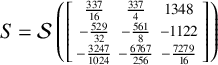




















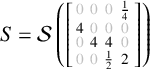




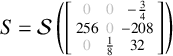














5.2 Matricial dimension by genus
Most of the semigroups with genus at most $6$
are already included in the list above. The exceptions are the following semigroups.
$6$
are already included in the list above. The exceptions are the following semigroups.
-
•
$S=\langle 2,13 \rangle $
:
$\operatorname {dim_{\mathrm {mat}}} S=2$
. Use Theorem 2.8(c) with
$a=2$
and
$b=13$
. -
•
$S=\langle 3,7 \rangle $
:
$\operatorname {dim_{\mathrm {mat}}} S=3$
by Theorem 3.4. -
•
$S=\langle 4,5 \rangle $
:
$\operatorname {dim_{\mathrm {mat}}} S=4$
. Since
$8,9,10\in S$
but
$11\notin S$
, Lemma 3.3 ensures
${\operatorname {dim_{\mathrm {mat}}} S\geq 4}$
. Theorem 2.2 with
$d=4$
shows that
$\operatorname {dim_{\mathrm {mat}}} S= 4$
. -
•
$S=\langle 4,6,9 \rangle $
:
$\operatorname {dim_{\mathrm {mat}}} S=4$
. Since
$8,9,10\in S$
but
$11\notin S$
, Lemma 3.3 ensures
$\operatorname {dim_{\mathrm {mat}}} S\geq 4$
. Theorem 2.2 with
$d=4$
shows that
$\operatorname {dim_{\mathrm {mat}}} S= 4$
. -
•
$S=\langle 5,7,8,9 \rangle $
:
$\operatorname {dim_{\mathrm {mat}}} S=5$
. Since
$7,8,9,10\in S$
but
$11\notin S$
, Lemma 3.3 ensures
$\operatorname {dim_{\mathrm {mat}}} S\geq 5$
. Theorem 2.2 with
$d=5$
shows that
$\operatorname {dim_{\mathrm {mat}}} S= 5$
. -
•
$S=\langle 6,7,8,9,10 \rangle $
:
$\operatorname {dim_{\mathrm {mat}}} S=6$
. Since
$6,7,8,9,10\in S$
but
$11\notin S$
, Lemma 3.3 ensures
$\operatorname {dim_{\mathrm {mat}}} S\geq 6$
. Theorem 2.2 with
$d=6$
shows that
$\operatorname {dim_{\mathrm {mat}}} S= 6$
.












6 Open questions
A natural extension of this work is to extend the tabulation of matricial dimensions beyond $F(S) \leq 10$
and
$F(S) \leq 10$
and $g(S) \leq 6$
. How far can this be extended before new techniques are required? A first step in this direction is the following question.
$g(S) \leq 6$
. How far can this be extended before new techniques are required? A first step in this direction is the following question.
Problem 6.1. Compute the matricial dimensions of all semigroups with $F(S) = 11$
.
$F(S) = 11$
.
In a similar manner, one wishes to compute the matricial dimensions of numerical semigroups with $m(S) = 4$
and beyond. Beyond
$m(S) = 4$
and beyond. Beyond $m(S) = 3$
, it becomes prudent to work with Apéry sets instead of generators, as we did in the proof of Theorem 3.4.
$m(S) = 3$
, it becomes prudent to work with Apéry sets instead of generators, as we did in the proof of Theorem 3.4.
Problem 6.2. Compute the matricial dimensions of all semigroups with $m(S) = 4$
.
$m(S) = 4$
.
The semigroup $S=\langle 5,7,16,18 \rangle $
, which has Frobenius number
$S=\langle 5,7,16,18 \rangle $
, which has Frobenius number $13$
, appeared in [Reference Chhabra and Garcia5] as a counterexample to the lonely element conjecture. It is known that
$13$
, appeared in [Reference Chhabra and Garcia5] as a counterexample to the lonely element conjecture. It is known that $3 \leq \operatorname {dim_{\mathrm {mat}}} S \leq 5$
.
$3 \leq \operatorname {dim_{\mathrm {mat}}} S \leq 5$
.
Problem 6.3. What is the matricial dimension of $\langle 5,7,16,18 \rangle $
?
$\langle 5,7,16,18 \rangle $
?
Acknowledgements
We thank Bjorn Poonen for several helpful suggestions. In particular, his evaluation $\operatorname {dim_{\mathrm {mat}}}\langle 5,7,8,9,11 \rangle = 2$
, provided us with many new ideas. We thank Christopher O’Neill for his help with Sage and GAP in the early stages of this project, and for several helpful comments on more recent drafts. Special thanks go to Andrew Wilson of the Pomona College High Performance Computing (HPC) team.
$\operatorname {dim_{\mathrm {mat}}}\langle 5,7,8,9,11 \rangle = 2$
, provided us with many new ideas. We thank Christopher O’Neill for his help with Sage and GAP in the early stages of this project, and for several helpful comments on more recent drafts. Special thanks go to Andrew Wilson of the Pomona College High Performance Computing (HPC) team.

 Open access

