




Introduction
With only 5 years remaining to meet the Kunming–Montreal Global Biodiversity Framework (GBF) mandate to halt and reverse biodiversity loss, it is necessary to shift from rhetorical inclusion towards operational epistemic justice (Hutchinson et al. Reference Hutchinson, Zito and McGowan2026). Yet, despite growing awareness of the divide between the Global North and Global South (Trisos et al. Reference Trisos, Auerbach and Katti2021, de Angeli Dutra et al. Reference de Angeli Dutra, Erikson, Genes, Dirzo and Venturini2025), systemic power asymmetries continue to dictate ‘conditional visibility’ (Maliao Reference Maliao2025, Maliao & Tóthmérész Reference Maliao and Tóthmérész2026), an epistemic trap whereby the visibility of Global South scholarship depends on its alignment with Global North priorities. While ‘parachute science’ describes extractive conduct by researchers external to the local context (Miller et al. Reference Miller, White and Christie2023), ‘conditional visibility’ identifies the structural filter that marginalizes local scholarship. Crucially, this marginalization sidelines Indigenous and local knowledge (ILK), which represents a dynamic body of adaptive practices reflecting the link between local communities and their environments (IPBES Reference McElwee, Harrison and van Huysen2024). When these situated knowledges are filtered out, global policy such as the GBF leads to risks being severed from grounded ecological realities (Dawson et al. Reference Dawson, Coolsaet, Bhardwaj, Brown, Lliso and Loos2024). Using the Philippines as a model system, we reveal geography, funding and gender as three primary drivers of this marginalization (Maliao & Tóthmérész Reference Maliao and Tóthmérész2026). This inequality is sustained by the Matthew Effect, where resource advantages translate into disproportionate visibility (Merton Reference Merton1968), and it is further compounded by the Matilda Effect, where gender-based under-recognition layers an additional filter on scholarly visibility (Rossiter Reference Rossiter1993). We demonstrate that conditional visibility functions as the operational intersection of these two effects, creating a compounded epistemic hierarchy that obscures the very expertise required for effective planetary stewardship.
Drivers and consequences of conditional visibility
We position Philippine aquatic ILK scholarship as a representative model system for the Global South, quantifying the structural drivers of conditional visibility as a primary mechanism of marginalization. This analysis draws from a scientometric corpus of 132 articles identified via international and regional databases through 2025 (Maliao Reference Maliao2025, Maliao & Tóthmérész Reference Maliao and Tóthmérész2026). We evaluate this dataset using citations per year (CPY), a metric whereby citation velocity defines scholarly visibility, thereby reinforcing established institutional hierarchies (Garfield Reference Garfield1955, Bornmann & Daniel Reference Bornmann and Daniel2008). Through an intersectional lens (Crenshaw Reference Crenshaw1989), our analysis reveals geography, funding and gender as the primary drivers of this conditional visibility. First, geography determines global reach, in that a Global North affiliation functions as a visibility multiplier, yielding a CPY of 2.06, which is more than double that of local scholars. Second, funding governs access, as prohibitive article processing charges (APCs) create financial constraints for under-resourced researchers. Third, gender acts as a global filter that reinforces the Matilda Effect (Rossiter Reference Rossiter1993). While gender-based marginalization is a pervasive global phenomenon (Rajkó et al. Reference Rajkó, Herendy, Goyanes and Demeter2025), its impact is significantly intensified in the Global South, where the Matilda Effect intersects with the systemic feminization of poverty and responsibility (Chant Reference Chant2007, Maliao & Polohan Reference Maliao and Polohan2008). Thus, conditional visibility does more than stifle individual careers because it creates a systemic disconnect that undermines on-the-ground conservation (Dawson et al. Reference Dawson, Coolsaet, Bhardwaj, Brown, Lliso and Loos2024).
While financial capacity drives visibility, it fails to equalize scholarly recognition across demographic lines. Although funded local male scholars achieve parity with international peers at 1.8 CPY, funded female scholars reach only half this visibility, reflecting a persistent citation disparity despite equivalent financial support (Maliao & Tóthmérész Reference Maliao and Tóthmérész2026). While probably interacting with unmeasured factors such as career stage and thematic aversion, gender remains a distinct intersectional axis that transcends professional capital. This reinforces a global Matilda Effect, whereby recognition bias operates through upstream epistemic gatekeeping and downstream citation behaviour (Rossiter Reference Rossiter1993, Rajkó et al. Reference Rajkó, Herendy, Goyanes and Demeter2025). Within this system, conditional visibility imposes a thematic filter that sidelines place-based scholarship and associated ILK, thereby relegating localized expertise to lower-visibility outlets.
The conditional visibility we documented functions as a core outcome of what Ogden et al. (Reference Ogden, Heynen, Oslender, West, Kassam and Robbins2013) defined as ‘global assemblages’, which are transnational constellations of institutions that centralize epistemic authority in the Global North while dictating socioecological governance in the Global South. A primary manifestation of this system is the marketized capture of open science that maintains a neocolonial structure of academic authority, reinforcing a cycle in which the Global North dictates the boundaries of scientific knowledge (Aspesi & Brand Reference Aspesi and Brand2020, Meagher Reference Meagher2021). Similarly to the commodity chains described by West (Reference West2012), these systems often romanticize local lives as ecological myths while obscuring the sociopolitical interests that drive them. In conservation, this fosters a sanitized form of inclusion, whereby ILK is reduced to a cultural curiosity while its governing logic is filtered out by epistemic gatekeepers (Nakamura et al. Reference Nakamura, Soares, Pillar, Diniz-Filho and Duarte2023). By dismissing place-based research as lacking global significance (de Angeli Dutra et al. Reference de Angeli Dutra, Erikson, Genes, Dirzo and Venturini2025), these structures sideline the very expertise needed for effective stewardship (Dawson et al. Reference Dawson, Coolsaet, Bhardwaj, Brown, Lliso and Loos2024). This decoupling drives misaligned strategies such as the proliferation of ‘paper parks’ (Relaño & Pauly Reference Relaño and Pauly2023), reducing them to management artefacts severed from the community-led governance detailed in local scholarship. Thus, conditional visibility filters out the contextual nuances of ILK, rendering global conservation strategies locally maladaptive.
Operationally, the conditional visibility we documented represents the intersection of the Matthew Effect (Merton Reference Merton1968) and the Matilda Effect (Rossiter Reference Rossiter1993). Although grounded in the Philippines, this analysis reflects a systemic reality across the Global South whereby shared power asymmetries and economic constraints drive parallel patterns of marginalization (see Nakamura et al. Reference Nakamura, Soares, Pillar, Diniz-Filho and Duarte2023, Dáttilo & Rivera-Núñez Reference Dáttilo and Rivera-Núñez2025, de Angeli Dutra et al. Reference de Angeli Dutra, Erikson, Genes, Dirzo and Venturini2025). This hierarchy results in the systemic compartmentalization and peripheralization of local epistemology, reinforcing the observation that a predominant focus on universalized biological metrics often leads researchers to know more about the fish than the fishers themselves (Johannes et al. Reference Johannes, Freeman and Hamilton2000). By filtering out these situated ways of knowing, the system loses the capacity to detect the subtle ecological shifts that broad-scale assessments inevitably miss. This disconnect is evident in the Nabaoy River watershed, where local fishers utilize traditional knowledge of frog and dragonfly population dynamics to monitor river health while employing fishing taboos as de facto institutions that provide the social capital for resilient governance (Maliao et al. Reference Maliao, Cahilig, Cahilig and Jaspe2025). In practice, sidelining situated systems severs conservation from local complexity, actively undermining the resilience of the very ecosystems global mandates aim to protect.
Political economy of conditional visibility
Confronting the drivers of conditional visibility requires braiding together diverse knowledge systems – an imperative impaired by neocolonial centre–periphery hierarchies (Miller et al. Reference Miller, White and Christie2023, Dawson et al. Reference Dawson, Coolsaet, Bhardwaj, Brown, Lliso and Loos2024). This legacy perpetuates academic dependency through a hierarchical division of intellectual labour, whereby Global North partners dominate research agendas, control budgets and lead theory generation while Global South researchers are often relegated to data collection and logistical support (Rakotonarivo & Andriamihaja Reference Rakotonarivo and Andriamihaja2023, de Angeli Dutra et al. Reference de Angeli Dutra, Erikson, Genes, Dirzo and Venturini2025). These asymmetries suggest that the citation disparities we documented do not simply reflect the interaction of scientific merit and institutional resource access; rather, they are systemically driven by the subordination of local scholars during research design and agenda-setting.
This labour divide manifests as parachute or remote-control science (Dáttilo & Rivera-Núñez Reference Dáttilo and Rivera-Núñez2025), whereby data are extracted with minimal engagement from local counterparts. Although criticized as extractive, this dynamic is often framed as an operational expediency. Global North partners lead authorship to navigate publishing norms while local counterparts provide logistical mediation. Crucially, the metric-driven architecture of scholarly visibility (Garfield Reference Garfield1955) weaponized a culture often referred to as ‘publish or perish’, creating a system whereby career promotion criteria and rigid funding deliverables compel scholars to prioritize expediency over the slower work of equitable partnership. Although this transactional velocity inflates visibility, it fosters a competency trap that breeds dependency and erodes local epistemic agency. Yet, attributing these centre–periphery dynamics solely to individual researcher conduct ignores the overarching influence of a marketized system that values documentation over meaningful co-production.
Open science promised universal accessibility, yet its flagship open access (OA) model traded subscription paywalls for exclusionary APCs. This transition has shifted the financial burden to authors as publishers have pivoted towards monetized research ecosystems. Growing corporate ownership of research portals and hosting services now risks locking in institutional dependencies and stifling diverse knowledge systems (Aspesi & Brand Reference Aspesi and Brand2020). Such corporate capture privatizes publicly funded research, transforming the global knowledge commons into a tool for private profit that reinforces Southern epistemic enclosure (Meagher Reference Meagher2021).
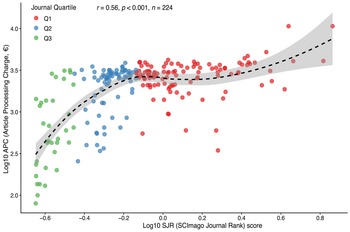
Although publishers offer waivers for low-income nations, these mechanisms address individual barriers without dismantling structural marginalization. APCs remain a formidable barrier for unfunded Global North researchers and those in middle-income regions ineligible for full waivers. A typical €3000 APC represents triple the monthly salary of a mid-career faculty member at a Philippine state university. As APCs scale with journal prestige (Fig. 1), this financial wall prevents a diverse global author base from accessing high-prestige scholarly venues. This creates a market in which scholarly visibility correlates directly with financial capacity, institutionalizing conditional visibility for the underfunded Global South and unfunded Global North alike. Consequently, rigorous place-based scholarship deprived of capital stagnates beneath a structural visibility ceiling. To substantiate this link between prestige and the APC, our analysis in Fig. 1 focuses on author-paid Gold and Hybrid models. Diamond OA is excluded from the analyses because it bypasses the APC–prestige correlation that defines the current marketized system.
Financial barriers scale with journal prestige. The relationship between SCImago Journal Rank (SJR) and standard article processing charges (APCs) for journals in the Environmental Science and Ecology categories (n = 224) is shown. The dashed line represents a locally weighted scatterplot smoothing (LOESS) curve fitted using the ggplot2 package in R version 4.5.2 (R Core Team 2025), visualizing the non-linear trend; the shaded region indicates the 95% confidence interval. APC values reflect the undiscounted list price for primary research articles under Gold (fully open access) or Hybrid (subscription journals with open access options) models. To ensure comparability and bibliometric robustness, the analysis was restricted to journals in the first three quartiles (Q1 to Q3). Journals with variable costs, such as per-page fees, subscription-only models and Diamond open access models, were excluded. There is a significant positive correlation between prestige and APC (Pearson’s r = 0.56, p < 0.001).

Conclusion: challenging the architecture of conditional visibility
The cost of epistemic marginalization is not a missing citation, but a missing solution. Bending the curve of biodiversity loss demands a decisive shift from rhetorical inclusion towards operational epistemic justice. This requires moving beyond the symbolic recognition of power asymmetries to the implementation of substantive reforms that embed equity directly into the discipline’s budgets, metrics and incentive systems. We propose three specific interventions targeting these financial, administrative and evaluative pillars (Box 1). Yet, external reform must be matched by a parallel commitment to internal empowerment in order to assert epistemic parity (Shanker Reference Shanker2025). Fostering a local research culture grounded in collective action and equitable incentives drives the disruptive innovation that is essential for effective stewardship (Munafò Reference Munafò2019, Rasmussen et al. Reference Rasmussen, Banks, Demeter, Holladay-Sandidge, McBride, Hall-Hertel and Tonidandel2023, Pedersen Reference Pedersen2025). Ultimately, operationalizing epistemic justice bridges the chasm between diplomatic ambition and grounded planetary reality.
Structural pathways to address the drivers of conditional visibility.
-
• Funding: from subcontracting to fiscal autonomy and capacity-building. The prevailing metric-driven system often relegates local partners to logistical roles by designing frameworks that prioritize rapid data extraction over collaborative knowledge creation. To rectify this, funding bodies should move beyond line-item reimbursements towards direct institutional overhead allocation, empowering Southern institutions to manage grants independently. We propose integrating graduate degree completion and professional skills transfer as primary grant deliverables. This transforms research projects into talent incubators driven by a triangular mentorship model whereby international partners facilitate resources, senior local scholars serve as primary mentors and junior researchers drive the inquiry. By dedicating specific budget lines for independent satellite projects, this model allows local early-career collaborators to lead inquiries alongside the main study. Transitioning to this model of fiscal autonomy ensures local teams move from being data providers to equal intellectual partners capable of sustaining their own regional research agendas.
-
• Publishing: bridging the gap with a scholar startup tier. While many publishers commendably offer full waivers for low-income nations, a critical gap remains for emerging scholars in middle-income regions and unfunded researchers globally. To bridge this gap, funding bodies and publishers should complement existing GDP-based models with a scholar startup tier. This mechanism extends a significant waiver or reduction to first authors from middle-income regions or those without active institutional grant support for a defined number of initial internationally indexed publications. Verifiable via open, persistent identifiers (e.g., ORCID), this quantity-based eligibility improves upon arbitrary time-based limits that disadvantage those with career breaks or non-linear trajectories. To foster mutually beneficial partnerships, this tier can be paired with review-for-waiver incentives whereby peer-review contributions from these scholars earn credits towards future publication fees. Treating these initial waivers as market and skill-building investments rather than as charity halts the attrition of emerging scholars, develops their editorial expertise and cultivates a diverse, long-term author base.
-
• Evaluation: aligning incentives with innovation. To redress centre–periphery dynamics, institutions should reform the internal incentives that fuel academic dependency. We propose elevating national and regional citation indices as primary quality filters, authenticated through automated validation via open metadata infrastructure (e.g., Crossref) and field-normalized benchmarks to ensure scientific integrity. Rather than relying on citations as the sole measure of success, institutions should broaden their evaluative lens to include societal impact contributions. These are evidenced by digital signals such as Altmetric policy mentions and dataset usage tracking (e.g., via DataCite), providing verifiable proof of applied scholarship and stewardship outcomes. To ensure institutional feasibility, these should be introduced as supplementary metrics that reward local relevance alongside traditional outputs, facilitating a gradual transition towards inclusive recognition. Furthermore, replacing divisive fractional counting with collaborative credit ensures that the teamwork required for disruptive innovation is documented and rewarded.
Availability of data and materials
The datasets generated and analysed during the current study are available from the corresponding author upon reasonable request.
Acknowledgements
RJM gratefully acknowledges the Stipendium Hungaricum Scholarship Programme for supporting his doctoral studies at the University of Debrecen (Hungary), as well as institutional support through granting study leave from Aklan State University (Philippines).
CRediT authorship contribution statement
RJM: Conceptualization, Methodology, Data extraction and curation, Formal analysis, Visualization, Writing – original and final drafts. BT: Conceptualization, Methodology, Formal analysis, Writing – review & editing.
Authors’ positionality statement
RJM, rooted in the Philippines and trained in Europe, leverages a dual perspective to bridge the lived realities of Global South conservation with the academic systems of the Global North. BT contributes the analytical rigour of a senior quantitative ecologist. Together, we fuse these distinct vantage points to ground our perspective in both local practice and global system, providing a roadmap to breach the structural barriers to epistemic justice.
Financial support
This research was supported by the KKP 144068 grant (Forefront Research Excellence Program).
Competing interests
The authors have no relevant financial or non-financial interests to disclose.
Ethical standards
Not applicable.

 Open access

