


Introduction
Political science scholars often evaluate the relevance of their discipline from an academic perspective, supplemented by the contributions scholars make to the production of knowledge in society. They rarely evaluate the impact their work has on their students and which opportunities their graduates gain from studying political science. At the same time, we sometimes lack the empirical evidence showing that these innovative approaches result in improved learning outcomes. In other words, how do we know whether what we do in our programs, or in our classes, facilitates student learning?
For this contribution,Footnote 1 we look at the impact a political science degree has on the careers and individual learning outcomes of Austrian graduates. We want to show how graduates benefit from a political science education and what they consider the strengths and weaknesses of a political science programme. We seek to analyse whether training in political science contributes to the professional and political agency of graduates. To explore the societal relevance (Senn and Eder Reference Senn and Eder2018), we combine both a quantitative and a qualitative method. First, we look at the career paths of Austrian graduates, using data from the Graduate Monitoring to establish the careers graduates chose after completing the degree. Second, we present the results of a pilot study conducted among recent graduates of the University of Innsbruck to illustrate the societal relevance of graduating in political science.
Increasing knowledge about students’ likely career paths and learning outcomes will help to improve or adjust curricula and contribute to a better understanding of the theories, methods and professional instruments that political science graduates will apply in their future careers. Additionally, a stronger focus on the societal dimension will help to improve our evaluation tools. As our study shows, from a student perspective, both academic and non-academic skills are important for their future careers. Furthermore, the major strength of a political science degree lies in its dual functionality as both a professional and a civic education; students highly appreciate the civic dimension of a political science programme.
Relevance of teaching and learning in higher education
According to the differentiation between the academic and societal relevance of political science, we look at the concept through the lens of teaching and learning in higher education. In the academic literature, the relevance of teaching and learning is mainly discussed within two strands: The first focuses on scientists as teachers and discusses the status of teaching within academia (Anderson Reference Anderson1958; Goldsmith and Goldsmith Reference Goldsmith and Goldsmith2010; Ishiyama et al. Reference Ishiyama, Miles and Balarezo2010; Trepanier Reference Trepanier2017). We propose this focus as a matter of academic relevance. The other strand of research highlights the learning outcomes of students, which political science researchers define mainly as matters of employability and, to a lesser degree, as civic education (Abrandt Dahlgren et al. Reference Abrandt Dahlgren2006; Collins et al. Reference Collins, Gibbs Knotts and Schiff2012; Dominguez et al. Reference Dominguez, Smith and Williams2017; Lowenthal Reference Lowenthal2012; Lightfoot Reference Lightfoot, Ishiyama, Miller and Simon2015; Niemann and Heister Reference Niemann and Heister2010; Nussbaum Reference Nussbaum2010; Nyström et al. Reference Nyström, Abrandt Dahlgren and Dahlgren2008; Stuckey et al. Reference Stuckey2013). Here, societal relevance comes first.
The academic and societal relevance of teaching and learning in higher education closely relate to each other in questions of professional agency. Research on societal relevance mainly focuses on the professional education of students, putting the emphasis on learning outcomes, such as development of skills and knowledge, and the preparation of political science graduates for the academic job market. At the same time, however, we know little about career preparation as part of political science curricula (Collins et al. Reference Collins, Gibbs Knotts and Schiff2012). From the perspective of professional education, a political science degree should prepare its students for jobs within and beyond academia, because only a small percentage choose an academic career upon completing their degree (Lowenthal Reference Lowenthal2012), and academic and non-academic jobs might not require the same skills. “A degree in Political Science could be seen as a general degree where the graduates do not have an obvious path to go into” (Nyström et al. Reference Nyström, Abrandt Dahlgren and Dahlgren2008: 227). Graduates of political science work within diverse fields of non-academic jobs, which complicates questions of career preparation and challenges the professional relevance of a political science degree. In other words, teaching also requires sensibility for this situation. Curricula need to address heterogeneous learning outcomes, suitable for both academic and non-academic careers.
Collins et al. (Reference Collins, Gibbs Knotts and Schiff2012) have surveyed departments across the United States to examine how they prepare students for their future careers. They find that “political science departments are not doing enough to address their students’ career preparation” (Collins et al. Reference Collins, Gibbs Knotts and Schiff2012: 87). They especially pinpoint the lack of evaluation tools to determine the effectiveness of different career preparation strategies. In Austria, previous studies on political science programmes include descriptive analyses of the student population on enrolment and mobility as well as a graduate survey report about job market entry requirements (König Reference König, Krauz-Mozer, Kulakowska, Borowiec and Scigaj2016; Heinrich et al. Reference Heinrich, Liebhart and Springnagel2008). Apart from that, data on career paths of political science graduates is rare and has not yet been used for extensive analyses.
Our study not only focuses on professional relevance, but also on civic relevance (Senn and Eder Reference Senn and Eder2018). Beyond the discourse on employability, studies show that a political science degree raises the political awareness of students and strengthens the ability for political participation (Dominguez et al. Reference Dominguez, Smith and Williams2017; Nussbaum Reference Nussbaum2010). In other words, a political science degree is, to some extent, a form of adult civic education and contributes to the political agency of its students as a learning outcome. Therefore, we add civic relevance to our research design. A degree might evoke curiosity and an interest in politics and form identities as active citizens (Stuckey et al. Reference Stuckey2013). As a result, civic relevance could be as important as professional relevance for individuals.
Research design, data and results
Central to this paper are the career paths of Austrian political science graduates and their individual learning outcomes. We are interested in the diverse field of potential careers. While Collins et al. (Reference Collins, Gibbs Knotts and Schiff2012) show that a degree in political science does not provide students with marketable skills, we demonstrate in this paper how well-prepared political science graduates in Austria are for their individual careers. To address these sub-questions and explore the relevance of acquired skills we distinguish between substantive and generic skills (Abrandt Dahlgren et al. Reference Abrandt Dahlgren2006). Substantive skills include all discipline-specific core subjects, such as knowledge about political institutions and processes, theories and methods. Generic skills include researching, critical thinking or practical skills required through internships.
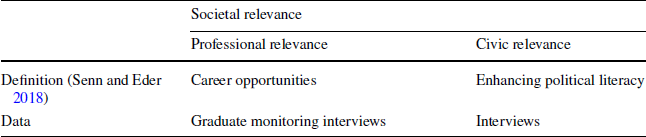
To illustrate the dimensions of the relevance of teaching and learning in Austria, we draw on two sets of data as shown in Table 1. Firstly, we looked at data from the Graduate Monitoring conducted by the Institute of Advanced Studies to assess the professional relevance of political science programmes. Secondly, we conducted semi-structured interviews with graduates from the University of Innsbruck to look into the individual and societal relevance of studying political science.
Research design

The relevance of political science education is usually measured through graduate surveys, collecting data on, methods, and skills acquired during the degree programme. Another relevance indicator is the integration of graduates into the labour market—how employable are political science graduates, and which career paths do they choose? To measure employability, the Institute for Advanced Studies (IHS, Vienna) relies on surveys and on a tracking system anonymously registering the social security numbers of graduates and thereby their career paths, dropout rates or employability of different social groups.
At the University of Innsbruck, the IHS conducted their Graduate Monitoring between 2011 and 2013 (Walch et al. 2014). For the political science diploma programme, cohorts of graduates between 2007/2008 and 2012/2013 were examined. In total, they recorded 317 graduates through the 6-year examination period. They collected data on each student’s labour status before and after graduation, the workload while studying, the business sectors they worked in and the development of their income.
As an exemplary cohort we show data from the 2009/2010 graduates. Due to the transition to the Bologna system, an exceptionally high number of students graduated in this year and we have data from 105 graduates. Also in our qualitative study, the highest number of respondents graduated in 2010 (11 respondents).
We illustrate career perspectives of political science graduates by examining two indicators from the Graduate Monitoring: The occupational status of students and the impact that their graduation has on their annual income or salary.
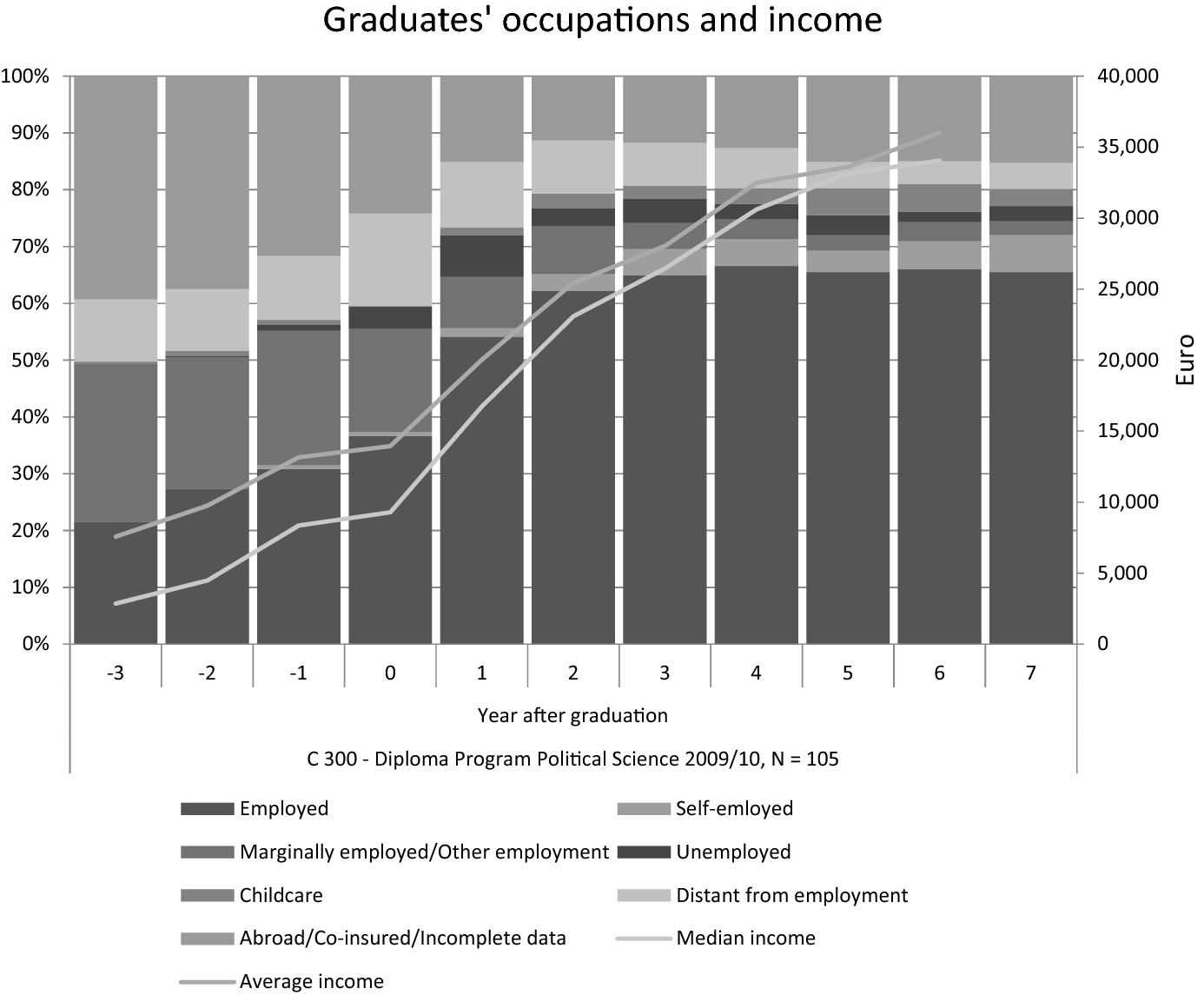
First, we focus on political science graduates’ employment status. Figure 1 shows the different employment statuses of students before and after graduation. The dark grey sectors show the percentage of students and graduates whose occupational status is “employed”, increasing during the observation period. Nearly 30% already find employment before their graduation, whereas after graduation, this number rises to 65% within 3 years and remains at that level until 7 years after graduation. Comparably, the self-employment rate is very low, just about 5%. The amount of people in the middle sector—more than 20% before and around 5% after graduation—are harder to define. Most of them do not work on a regular basis, which means they either have contracts for specific work (Werkvertrag) or that they are marginally employed.
Labour market status and income of graduates (Walch et al. 2014)

The figure shows that after graduation, shares of these forms of occupation decline, which indicates that graduates manage to get regular jobs. After graduation, family planning becomes an issue, but only for 1–2% of graduates. The unemployment rate is rather high in the first year after graduation, but later declines to a low rate of 2–4%. The actual number of graduates without an occupation may be higher, but for a number of graduates, no data is available (light grey sectors: “Abroad/co-insured/incomplete data”). The most frequent reasons are that graduates have no occupation and are co-insured with their parents (or a partner), or they moved to another country and therefore are not recorded in the Austrian system. Graduates of the political science diploma programme, as we can see in Fig. 1, are highly integrated into the labour market even before their graduation. The occupational status changes after leaving university and is becoming more stable.
Second, we look at the impact that the graduate’s degree has on their annual income or salary. The progress of wages and incomes of graduates can be used as an indicator of employability and demand for labour. After graduation in the years 2009 and 2010, the average annual gross income increases from EUR 13,945 to EUR 28,000 in the year 2013. There is a difference between the average income and the median income, which shows that there are some graduates with a high income, but many of them have a slow progression. Compared to graduates of other disciplines such as law graduates or business and management, the average gross income of political scientists is 7000 to 12,000 EUR lower.
Comparison to other cohorts
To get a better overview, we compared the results of the 2009/2010 cohort to other graduate cohorts of the diploma program. As the data show, after graduation the occupational status “employed” reaches around 60% in every cohort. There are some differences in the self-employment rate, which is higher in the 2007/2008 cohort, while in the 2008/2009 cohort, the marginally employed or “special contracts” (Werkvertrag) are higher than in other graduation years. One assumption is that the tense labour market situation after the financial crisis of 2008 made it more difficult to find a regular job. In the end, job market integration had taken longer for the 2008/2009 graduates than others.
Looking at the business sectors 1 year after graduation, more graduates of the cohorts were employed in public administration, in information/communication or other similar services. Overall, the business sectors in which graduates are employed or work do not differ too much. Comparing the progress of income and wages, the graduates from 2007/2008 and 2008/2009 have a smaller increase in average annual income from 17,000 EUR to 20,000 EUR. The 2010/11 cohort earned 25.000 EUR in average, but only 1 year after they had graduated.
The progress of integration into the labour market of political science graduates compared with diploma graduates 2009/10 across all programmes at the University of Innsbruck is very similar. After 3 years, about 65% had found employment and the rates of self-employment and unemployment were the same. However, the income and wages after graduation increased faster and higher. In 2012, the average income was about 31.000 EUR.
Graduates from other universities
The University of Vienna carried out similar studies for their graduates. In cooperation with UNIPORT and Statistics Austria, they examined the entry into professional life of 1091 political science graduates from 2003 to 2014.Footnote 2 In contrast to the Innsbruck model, the University of Vienna decided to analyse the former students not in cohorts but as a whole. The results are similar to the ones at the University of Innsbruck. After 3 years, the occupational status “employed” seems to be higher in Vienna (over 80%). As in Innsbruck, the most important business sector is public administration, where 17% find employment 1 year after graduation, followed by the sector of representation of interests and associations (11%) and education (10%). Three years after graduation, graduates from the University of Vienna have a monthly income that is 2500 EUR higher than that of graduates from Innsbruck. Notably, career perspectives for political science graduates are more favourable in Vienna, as the capital provides opportunities in ministries, NGOs or other public bodies.
Graduate Tracking in Higher Education (HE) and Vocational Education Training (VET) is an established practice in many European countries, although the systems vary in methodology and data sources. There are well known tracking programmes as the Destinations of Leavers from HE (DLHE) in the UK, the Graduate Tracking in Switzerland or the KOAB graduate study in Germany, which are implemented on a national level and are a regular practice and mostly a legal obligation. To enhance understanding in terms of quality and outcomes of the higher education sector, the European commission established an expert group to achieve better comparability between the countries and the different tracking systems, such as the Eurograduate pilot survey.Footnote 3
As previously mentioned, the analysis of social security data has its limitations. Hence, it is not possible to draw conclusions from the data concerning differences between academic or non-academic employment, political or non-political jobs or societal relevance and political agency in general. For these dimensions, we conducted a case study using email interviews, which is discussed in the following section.
Case study: graduates from University of Innsbruck
To test the professional and civic dimensions of relevance among recent graduates, we conducted interviews with 29 graduates from the Department of Political Science at the University of Innsbruck. We selected them based on two criteria: Firstly, they had all followed the same curriculum (Studienplan für das Diplomstudium der Studienrichtung Politikwissenschaft 2001), meaning they were therefore exposed to the same teaching and learning content, but had also faced the same decisions and challenges during their studies. Secondly, their graduation dates back 5 years or more, so we can assume they have since gained some experience in the labour market. Although curricula have since been integrated into the Bologna system, political science graduates still enter the job market with similar skills and competences.
We are aware of a certain selection bias in choosing the respondents. However, this is due to the pilot study nature of this paper: the aim is to illustrate potential career paths of graduates to be further examined in future research. We deliberately chose respondents whose graduation dates back 5 years or more so that we can also show long-term developments. A third of our respondents graduated in 2010 and therefore belong to the cohort we also examined using the Graduate Monitoring data. We are aware that the dataset used is small, but as a pilot study, the paper can propose ideas for further in-depth research. Further research may include graduates of MA programmes, who to this date constitute too small a number to be properly analysed.
We selected our participants by reviewing lists of graduates and selected a number of participants that we knew personallyFootnote 4 in order to increase the number of respondents. Due to time constraints, we conducted semi-structured interviews by e-mail (response rate: 52%), and although we are aware of reliability issues of using this method, given our well-informed and homogenous respondents (Meho Reference Meho2006), we are confident that the data produced is of adequate quality and the findings trustworthy (Curasi Reference Curasi2001). We conducted 29 interviews with 20 male and 9 female graduates who completed their degree programme between 2004 and 2012. Half the respondents completed only a political science degree, while 14 completed at least one additional programme. These included economics, psychology, master programmes specialising in subfields of political science, and a PhD degree in political science (five respondents).
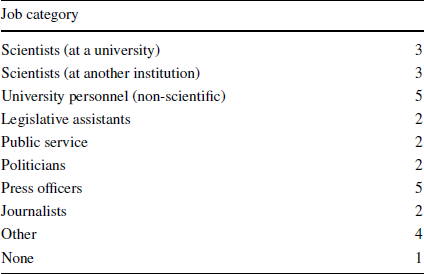
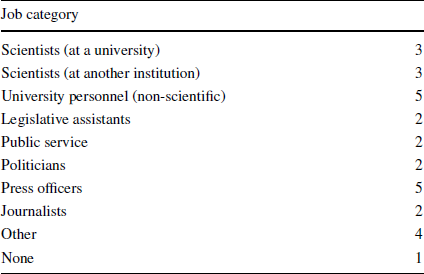
The participants’ exact work functions are summarized in Table 2. Six of the graduates are employed in the academic sector, while 23 work outside of academia. Only two of the respondents have actually become politicians, but more of them work in the greater field of politics. We have five respondents who work as press officers or legislative assistants in a political context (i.e. for a political party or an institutional body), one respondent who is with the European Civil Service and two respondents who lead projects in an NGO. In summary, 16 of the 29 respondents work in the field of political science or politics in an extended sense.
Respondents’ job statuses
Professional dimension
Nine respondents perceive themselves as political scientists in their everyday work. The respondents seemed to interpret this definition rather narrowly (other than on the civic dimension) and emphasized the science and research nature of their work. Those who work in or on the edge of the political process do not perceive themselves as political scientists.
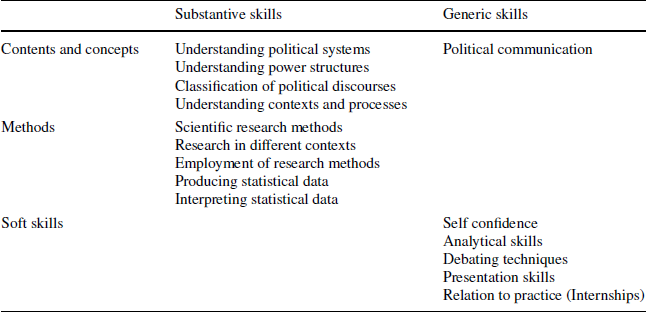
We asked the respondents to name the relevance of specific skills acquired during the graduate programme, including the work-related relevance of content and concepts, of methods, and of soft skills (Table 3).
Work-related skills acquired through the graduate programme
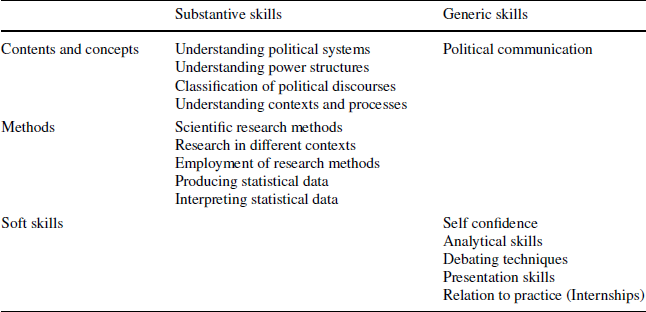
Graduates assign a high level of relevance to the content of the programme and the concepts acquired. Some state that they employ specific skills from specific subjects because they are working in this very area:
The things I have learned about the internal processes in European and international politics are of great relevance for my everyday work.
EU officer, male
Others summarize that what they have taken away from the programme is a general understanding of contexts, decision making systems and power relations with respect to their work area.
Knowledge about processes in practical politics as well as the basics of our political system helps me to make informed decisions.
City councillor, female
Regarding the methods training in the graduate programme, graduates provide mixed responses. Half the respondents state that the methods training they received was not extensive enough and for some of them, it is not relevant to their everyday work at all. Not a single respondent states that he or she can actively employ the research methods acquired during the political science programme; however, a number of respondents report a “second-level competence” in research methods, meaning that they are able to interpret and understand results presented to them.
Researching specific content and assessing its quality is very relevant to me; other than that, no methods skills were conveyed.
Public servant (financial sector), male
Soft skills, finally, seem to be have been much more relevant than their place in the curriculum might have suggested. Almost all of the respondents name presentation techniques, discussion and argumentative skills or teamwork as soft skills relevant to their work.
Preparing presentations (alone or in groups) is a large part of my work - therefore I find the skills acquired during the programme very helpful and can use them everyday.
Communications manager, female
Internships (which were compulsory in the degree programme) receive extra attention by 10 of the respondents. They state that it was important for them to gain their first working experience in a field relevant to their studies as well as having built relations that helped them in finding a job.
In my view, internships are one of the most important parts of the programme. The mandatory internship helps many people make their first steps into working life, and many return to where they completed their internship. Personally, I would even extend the importance of internships in the programme.
Head of communications division, male
No difference exists between graduates working in academia and those working outside academia concerning the skills they could take away from the programme.
Civic dimension
Twenty-one respondents perceive themselves as political scientists in their daily life, outside of their work. Many of them state that discussing and analysing politics is part of their everyday life, and they do perceive the role of “political scientist” as something they have gained from their degree.
I perceive myself as a political scientist because I chose the programme out of general interest and not for job training reasons.
Scientist, female
Politics has become more than a job for me.
Press officer, male
Those who do not perceive themselves as political scientists state that their personal lives have little or no connection to politics or political science and they have no reasons to use “political scientist” as a self-description. All of them work in fields not related to the political science discipline and, in addition, state that “political scientist” would not be an accurate job description for them.
The political science degree was also useful for many of the respondents’ everyday life skills. Many of them state that they can still draw on the general knowledge and analytical skills acquired during their studies, although some light-heartedly question the relevance of these learned facts.
I have gained a lot of knowledge that I can brag about during an evening with friends.
Legislative assistant, male
Despite some criticism, 24 of the respondents (82%) would choose the programme again. Most of the respondents state that they continue to be interested in the subject, and would enjoy the opportunity to acquire further knowledge. Many who did not do so previously, however, would choose a second programme to go with the political science degree. Those who would not choose the programme again list the low chances of employability and the new curriculum as reasons.
Studying political science has like no other activity given me the opportunity to independently work on content and ideas that would have interested me anyway. However, I am not sure whether this is still possible today under the Bologna regime.
Press officer, male
Finally, we sought to measure political agency by asking respondents whether the political science degree has made them a more politically interested or active person. Responses were mixed: 17 respondents agreed and stated that the programme has helped them question their beliefs and become less dogmatic. Of those disagreeing, many say that they were already politically-minded, even before their degree. Only one respondent stated that he perceives himself as a political outsider and has no desire to become a more politically active person.
Conclusion
By analysing the findings from the Graduate Monitoring and from our exploratory study conducted at the University of Innsbruck, we conclude that political science graduates do well on the societal dimension.
On the civic dimension concerning their individual benefits, students seem to be satisfied with their choice of degree programme. A great number of graduates state that they would choose the programme again and all of them have taken away at least some general knowledge and an understanding of political processes from the programme. On a personal level, graduates perceive themselves as political scientists at a much higher rate than they do in their professional life. The programme contributes greatly to their understanding of political systems and processes. The fact that two-thirds of the graduates work in fields close to politics (or political science) shows that the programme also contributes to the political agency of its students.
On the professional dimension of relevance, graduates seem to be less satisfied. Firstly, income expectations are low. Many political science graduates start working in areas that do not pay well (PR and media, NGOs, etc.) and often only work in part time jobs, indeed the unemployment rate within the first 2 years after graduation is high. Secondly, expectations about their future work seem to differ greatly from what students experience during the programme. Many respondents state that they had to acquire additional skills after completing the programme before they felt ready for the work they wanted to do. They especially felt there was a lack of emphasis on methodological training and would have profited from more profound specializations in core areas.
Preparing students for careers in academia as well as providing training for careers in the public and private sector while still contributing to the political agency of the students will remain one of the main challenges of political science teachers. Designing modern curricula for these heterogeneous learning outcomes will however facilitate bridging the gap between academia and practise to a mutual benefit. The conceptual differentiation between the (academic and non-academic) professional dimension and the civic dimension of political science curricula will help to develop stronger evaluation tools. The major strength of a political science degree lies in its dual functionality as professional and civic education, indeed, as we discovered through our research, students greatly appreciate the civic dimension of a political science programme.

 Open access

