


Introduction
The experience of control over one’s environment has long been regarded as a central component of psychological well-being and adaptive functioning (Key et al., 2009). From early work on perceived control and health (Rodin, Reference Rodin1986) to contemporary motivational theories, control is viewed as a primary factor in shaping individuals’ engagement, learning, and performance (Bandura, Reference Bandura1997; Skinner, Reference Skinner1996). In educational contexts, a sense of control contributes not only to academic success but also to persistence, resilience, and goal-directed behavior (Robbins et al., Reference Robbins, Lauver, Le, Davis, Langley and Carlstrom2004). However, the psychological mechanisms that underpin control motivation are not homogeneous. Researchers have proposed distinctions between different types of control-related motivations, notably between the desire for control and the need for control (MacKenzie Myles et al., Reference MacKenzie Myles, Maria Merlo and Obele2021) concepts that, while related, operate through different psychological pathways and may result in divergent behavioral outcomes.
The desire for control refers to a relatively stable, dispositional tendency to seek personal agency and influence over one’s environment (Burger, Reference Burger1992, Reference Burger2013; Burger & Cooper, Reference Burger and Cooper1979). Individuals high in desire for control prefer autonomy, initiate decisions, and seek opportunities to act as causal agents. By contrast, the need for control is a more fundamental, universal psychological drive to experience the world as ordered and predictable, even if that sense of order is derived from external sources or symbolic systems (Kay et al., Reference Kay, Whitson, Gaucher and Galinsky2009). Whereas desire for control entails an active motivation to exert influence, need for control may be satisfied through indirect mechanisms that restore perceived structure, such as religious beliefs, rituals, or shared cultural frameworks. This distinction is echoed in the differentiation between controllability and predictability (Ligneul, Reference Ligneul2021; Seligman, Reference Seligman1975): the former linked to the effectiveness of one’s actions, and the latter to the ability to anticipate outcomes, regardless of personal agency.
Despite their theoretical significance, these two constructs are often conflated or insufficiently differentiated in empirical research. Most studies focus on desire for control and its association with academic performance, leadership, or task persistence (Burger, Reference Burger1985, Reference Burger1992), leaving the role of need for control and its compensatory expressions relatively understudied. Moreover, existing work seldom explores how individuals with low desire for control navigate learning environments. Although such individuals may lack the motivation to act as the source of control, they still possess a basic need for predictability and thus may turn to symbolic systems that offer a sense of order without requiring direct agency (De Miguel, Martín, & Márquez Reference De Miguel, Martín and Márquez2012).
One such system is superstition. Traditionally viewed as irrational, superstitions comprise culturally shaped beliefs and practices that ascribe causal power to symbolic actions or objects (Damisch et al., Reference Damisch, Stoberock and Mussweiler2010; Schumaker, Reference Schumaker1990). While lacking objective efficacy, these beliefs can nonetheless provide subjective experiences of control and certainty, particularly in contexts marked by uncertainty or stress. From a psychological perspective, superstition may serve as an adaptive function by fulfilling the need for control in individuals who do not actively seek to control outcomes themselves (Kay et al., Reference Kay, Whitson, Gaucher and Galinsky2009; Whitson & Galinsky, Reference Whitson and Galinsky2008). Although correlational studies suggest that individuals who attribute control to external causes or are not motivated to be the source of control themselves are more likely to endorse superstitious beliefs (De Miguel, Martín, & Márquez Reference De Miguel, Martín and Márquez2012; Keinan, Reference Keinan2002), few experimental studies have explored whether superstition actually enhances performance under specific motivational conditions, particularly among learners with low desire for control.
This gap is particularly relevant in educational psychology, where interventions are often designed to foster student engagement and autonomy. Understanding whether symbolic or indirect strategies can compensate for a lack of agency-oriented motivation could have significant implications for supporting disengaged learners. For example, if superstition provides a psychologically meaningful sense of structure for students who have a low desire for control, it may enhance their learning outcomes even when more conventional motivational pathways fail. Conversely, for students high in desire for control, such external attributions might interfere with their preferred agentic strategies, potentially undermining their performance.
To address these gaps, the present research sought to (1) empirically distinguish between desire for control and need for control in relation to learning, and (2) evaluate whether superstition operates as a compensatory mechanism for learners with low desire for control. Two empirical studies were conducted with high school students in Spain. Study 1 employed a cross-sectional design to test the hypothesis that students with high desire for control would perform better on a reinforcement-based computerized learning task than those with low desire for control. Study 2 introduced an experimental manipulation of superstition through a fabricated documentary about the supposed power of “crystal skulls.” This manipulation allowed us to assess whether a symbolic belief in an external source of control could improve learning outcomes for students low in desire for control—consistent with a compensatory control framework (Kay et al., Reference Kay, Whitson, Gaucher and Galinsky2009)—while having no effect or even a negative effect on those high in desire for control.
By exploring the interplay between motivational orientation and symbolic belief, this research makes three key contributions. First, it empirically supports the theoretical distinction between desire and need for control in a learning context. Second, it demonstrates that superstition—typically viewed as maladaptive—may serve a functional, compensatory role in specific motivational profiles. Third, it offers novel insight into how indirect control strategies might be used to support learners who are not motivated by agency but still require structure and predictability. These findings open new avenues for motivational interventions in educational settings and extend the applicability of compensatory control theory to performance-related domains.
The remainder of the manuscript is structured as follows. The next section presents the conceptual framework in greater detail, defining and differentiating the constructs of desire for control, need for control, and superstition, while reviewing relevant literature. This is followed by the methodology, results, and discussion for Study 1, which examines the relationship between desire for control and learning performance. The manuscript then details the design, implementation, and findings of Study 2, which experimentally tests the moderating role of superstition. The final section discusses the theoretical and practical implications of the findings, limitations of the current research, and potential directions for future studies.
Conceptual Framework
Desire for Control and Need for Control
A distinction especially relevant is that which exists between the desire for control and the need for control, two concepts that, although related, refer to motivations of a different nature. The desire for control refers to individual differences in the motivation to actively influence the events of everyday life (Burger, Reference Burger1987; Burger & Cooper, Reference Burger and Cooper1979; MacKenzie Myles et al., Reference MacKenzie Myles, Maria Merlo and Obele2021). It is conceived as a relatively stable personality trait that reflects the extent to which a person wants to be the agent of the outcomes that affect them. People who score high in desire for control tend to prefer situations where they can make decisions themselves, while those with low desire for control tolerate or even prefer to cede initiative to others.
In contrast, the need for control refers to a more basic motivation, linked to the psychological need to reduce uncertainty and maintain a sense of stability (Kay et al., Reference Kay, Whitson, Gaucher and Galinsky2009). This need is universal and does not depend on the explicit willingness to act on the environment but rather relates to the expectation of being able to anticipate what will happen. Thus, while desire for control manifests when individuals are motivated to be the source of control, the need for control can be satisfied through any stimulus, event or context that allows them to make predictions about future events.
The basis for this distinction comes from previous studies whose results led us to suggest that individuals scoring low in desire for control still need to satisfy their need for control (De Miguel, Martín, & Márquez Reference De Miguel, Martín and Márquez2012). Since they are not motivated to exert control directly —i.e., to be the source of control— these individuals tend to compensate for this lack of motivation through alternative mechanisms, such as adherence to beliefs or routines that allow them to anticipate the course of events. In these cases, predictability plays a functional role: it satisfies the need for control without requiring a sense of controllability. This distinction is particularly useful in understanding phenomena such as superstition, which may serve as a compensatory strategy for those seeking to reduce uncertainty but who are not inclined to exert direct control over their environment.
This compensatory phenomenon is described by Kay et al. (Reference Kay, Whitson, Gaucher and Galinsky2009) in their compensatory control theory. According to this theoretical view when personal control is threatened, people can preserve the sense of order by perceiving patterns in the noise as the superstition. In the base of the compensatory phenomenon is the need for control as a human necessity. In addition, when personal control is insufficient, individuals compensate by seeking structure and meaning in external systems —institutional, cultural, or symbolic.
Additionally, this distinction between desire and need for control can be clarified using the terms controllability and predictability, as proposed by Seligman (Reference Seligman1975) and taken up by Ligneul (Reference Ligneul2021). Controllability refers to the individual’s perception of control over the effectiveness of their actions—where behavior is decisive and the occurrence of events is contingent upon those actions. Conversely, predictability refers to the perceived ability to forecast associations among stimuli—where actions are irrelevant and events occur regardless of the individual’s behavior. To be more precise, desire for control is associated with controllability, reflecting the motivation to make events in one’s life contingent on one’s actions. On the other hand, need for control is associated with predictability, reflecting the drive to reduce uncertainty about future events. In summary, both are motivations to control, but only in the desire for control is there a motivation to be the source of that control.
Desire for Control and Learning
Having control is definitively associated with a greater number of adaptive behaviors, thereby facilitating success (Burger, Reference Burger1985). However, if anything improves the ability to adapt, it is learning (Mustaca, Reference Mustaca, Ardila, López López, Pérez, Quiñones and Reyes1998; Santacreu et al., Reference Santacreu, Hernández, Adarraga and Márquez2002; Skinner, Reference Skinner1950). Therefore, it seems relevant to explore the relationship between the desire for control and learning; more specifically, how individual differences in such desire may affect learning.
Learning has been at the core of discussions in psychology since its inception e.g., Ebbinghaus (Reference Ebbinghaus, Ruger and Bussenius1913) and Thorndike (Reference Thorndike1911). As De Houwer et al. (Reference De Houwer, Barnes-Holmes and Moors2013) state, there is no consensus about the definition of learning, and this should not be surprising given the great difficulty in defining broad concepts satisfactorily. According to Lachman (Reference Lachman1997), learning refers to a change in behavior that is due to experience. Nonetheless, this definition has been criticized for being unsatisfactory, as it does not account for the fact that changes in behavior are neither necessary nor sufficient for learning to occur.
An extensive and sufficient definition of learning should consider both implicit and explicit learning. Thus, the concept of learning should encompass the functional (behavioral changes) and the mechanisms (cognitive processes) involved in the learning process. Nonetheless, these complementary conceptions of learning share a main idea: learning allows adaptation to the environment.
The relationship between the desire for control and learning has been studied for Burger (Reference Burger1985) showed that a high desire for control is positively related to higher levels of achievement and a better response to changes in experimental tasks. Based on this, we propose the following hypothesis:
Hypothesis 1: Participants with a high desire for control will exhibit significantly higher learning ability than those with a low desire for control.
Need for Control and Superstition as a Response to Low Desire for Control
From Malinowski’s anthropological perspective (Malinowski, Reference Malinowski1944), culture exists to satisfy the psychological, biological, and social needs of the individual (De Miguel, Reference De Miguel2024). Among these needs, the need for control occupies a particularly prominent place: individuals seek ways to reduce uncertainty and increase their sense of predictability and agency in everyday life. In this context, superstition emerges as a culturally shaped mechanism that offers a sense of control over events that lie beyond one’s influence.
Superstitious beliefs and behaviors—often expressed through rituals, symbolic objects, or magical thinking—serve this adaptive function by providing individuals with the illusion of control. These beliefs, culturally transmitted and legitimized by social norms, become integrated into the symbolic universe that sustains the social order (Berger & Luckmann, Reference Berger and Luckmann1966). Thus, superstition not only fulfils individual psychological needs but also functions as a socially shared coping strategy, reducing uncertainty and reinforcing a coherent perception of the world.
Aligned with this cultural and psychological view, it is relevant to investigate superstition as a strategy to satisfy the need for control—especially among individuals who lack the motivation to be the source of control themselves, that is, those with low desire for control. This hypothesis stems from the distinction between desire and need for control: while desire reflects the active motivation to influence the environment, need refers to a more basic demand, linked to the capacity to anticipate future events. When the desire for control is low, the need persists and can be satisfied through beliefs or routines that increase predictability, without requiring the individual to assume an active role as a causal agent. In such cases, superstition may function as a compensatory strategy: it reduces uncertainty and provides an illusion of control in contexts where individuals are not motivated to exercise it directly.
However, if there is no actual causal relationship between superstitious beliefs and the outcomes they promise, what psychological processes explain their positive effects? Broadly speaking, superstition is rooted in the fundamental desire to maintain a sense of control over one’s life (Alcock, Reference Alcock1981; Day et al., Reference Day, Maltby and Macaskill1999; Liu & Liao, Reference Liu and Liao2022; Schumaker, Reference Schumaker1990). More specifically, at least five types of explanations have been identified that help clarify this relationship between superstition and control: metacognitive, attributional, motivational, learning-based (whether by conditioning or observation), and sociocultural. The beneficial impact of superstitious beliefs on behavior thus depends on a complex interaction between individual differences, environmental characteristics, and culturally shared mechanisms.
From a metacognitive perspective, superstition can be understood as a strategy for managing uncertainty and reinforcing self-confidence. The concept of the illusion of control suggests that in situations characterized by chance or low contingency, individuals tend to overestimate their influence over outcomes (Klusowski et al., Reference Klusowski, Small and Simmons2021; Langer, Reference Langer1975). This perception of control, though illusory, can enhance perceived self-efficacy and, consequently, improve performance (Damisch et al., Reference Damisch, Stoberock and Mussweiler2010; De Miguel & Martín, Reference De Miguel and Martín2014).
From an attributional standpoint, locus of control plays a central role. Individuals with an external locus—those who attribute outcomes to external forces—are more likely to adopt superstitious beliefs as a way of symbolically explaining or influencing those outcomes (Groth-Marnat & Pegden, Reference Groth-Marnat and Pegden1998). By contrast, an internal locus of control is associated with a lower tendency to engage in ritualistic or superstitious behavior.
The motivational explanation relates to individual differences in desire for control. Previous research indicates that individuals with a high desire for control are less inclined to use superstition in non-threatening contexts but may resort to it when uncertainty and outcome importance are high (Burger, Reference Burger1991; Keinan, Reference Keinan2002). In contrast, those with low desire for control tend to adopt superstitions more readily, as they do not aspire to exert direct control. Although there is a positive correlation between low desire for control and an external locus of control, it is important to note that desire for control refers to a motivational trait (i.e., the willingness to exert control), whereas locus of control is an attributional style (i.e., the perceived source of outcomes). Thus, individuals with low desire for control may not necessarily believe outcomes are externally caused but may rely on external strategies—such as superstitions—to satisfy their need for control without seeking to be the source of it.
From a learning perspective, it has been shown that superstitions can be acquired through accidental conditioning: when a behavior systematically precedes reinforcement, even in the absence of actual contingency, it may be internalized as superstitious conduct (Schunk, Reference Schunk1996; Skinner, Reference Skinner1948). This type of learning is reinforced by repetition and its subjective effectiveness.
Finally, the sociocultural dimension explains how superstitions become embedded in collective norms and values, functioning as shared frameworks for meaning making. As Berger and Luckmann (Reference Berger and Luckmann1966) argue, such beliefs are socially transmitted and legitimized as symbolic structures that organize experience. In this way, superstition satisfies the individual’s need for control while simultaneously strengthening the connection to social order. In times of threat or loss of control—as observed during the COVID-19 pandemic—people tend to rely more heavily on external systems that offer structure and certainty, including religious, political, or superstitious beliefs (Hoffmann et al., Reference Hoffmann, Plotkina, Roger and D’Hondt2022; Kay et al., Reference Kay, Gaucher, Napier, Callan and Laurin2008).
Taken together, these five perspectives converge in suggesting that superstition, despite its lack of causal basis, fulfils adaptive psychological functions. As Kay et al. (Reference Kay, Whitson, Gaucher and Galinsky2009) pointed out, superstition allows people satisfy the need for control searching order in the noise. This is especially pertinent for individuals with low desire for control, for whom superstition provides a means of satisfying the need for control through alternative mechanisms that do not require direct agency.
This theoretical framework leads us to formulate the following hypothesis:
Hypothesis 2: We expect to find that superstition increases the learning ability of people with a low desire for control, but not for people with a high desire for control.
Study 1
Method
Sample and Design
The researchers requested the collaboration of educational institutions in the Community of Madrid. Meetings were held with school administrators to invite them to participate in Studies 1 and 2. Through this process, a sample of 48 high school students in their fourth year participated voluntarily (age range = 15 to 17 years, average age = 15.77, SD = 0.66; females = 60.4% and males = 39.6%). All parents or legal guardians signed an informed consent form.
As an inclusion criterion, participants were required to complete all items of the Desire for Control Scale. Cases with missing responses on this scale were excluded from the analyses. In Study 1, no missing values were detected, and therefore no participants were excluded on this basis.
A cross-sectional design was used, with desire for control (high desire for control versus low desire for control) as the independent variable and a learning index as the dependent variable.
Instruments
Desire for Control. The desire for control was measured using the Spanish adaptation of the Desire for Control Scale originally developed by Burger and Cooper (Reference Burger and Cooper1979), as adapted by De Miguel, Martín, Sánchez-Iglesias, et al., (Reference De Miguel, Martín, Sánchez-Iglesias and Ruiz2012). This version has demonstrated adequate psychometric properties for research use (Cronbach’s α = .735; test–retest reliability = .713). The scale consists of 15 items, each rated on a 5-point Likert scale ranging from 1 “Completely disagree“ to 5 “Completely agree,” with total scores ranging from 15 to 75.
Sample items from both the original English version and the Spanish adaptation include:
-
• “I enjoy having control over my own destiny” / “Disfruto teniendo control sobre mi propio destino”;
-
• “When it comes to orders, I would rather give them than receive them” / “Prefiero dar órdenes en lugar de recibirlas.”
Participants were divided into two groups based on their scores on the desire for control scale. The cut-off point for group assignment was the sample median, which in this study was 52.5.
Learning. This was measured through a Learning Index provided by a PAVLOV system task (Santacreu & García-Leal, Reference Santacreu and García-leal2000). This computerized learning task is based on positive reinforcement and has been validated by various experiments (Hernández, et al., 2004; Hernández et al., Reference Hernández, Lozano and Santacreu2011; Lozano et al., Reference Lozano, Hernández, Rubio and Santacreu2011). The task aims to induce the learning of a specific response under a positive reinforcement paradigm (Figure 1).
Pavlov system interface. reproduced with permission from the copyright owners.

The experimental interface consisted of a virtual keyboard displaying nine flags. Participants were instructed to identify and click on the flag that matched a predetermined target (the “key”) in order to generate a correct response. A correct response required the participant to click on the correct flag twice using the mouse, following a fixed-ratio 2 (FR-2) schedule.
At the start of the task, both the target flag and its position were randomly assigned. Throughout the task, the target flag remained constant, but its position on the keyboard was randomized on each trial to prevent reliance on spatial cues.
For each trial, the proportion of correct responses was calculated as the ratio of correct clicks (i.e., clicks on the correct flag) to the total number of clicks made during that trial.
The task was programmed to terminate when one of two conditions was met: (a) the participant achieved a proportion of correct responses equal to or greater than .50 in any trial after the 20th trial, or (b) the participant completed 30 trials without reaching that criterion. Accordingly, the total number of trials per participant ranged from 20 to 30.
A trial was defined as the interval between two correct responses or a maximum duration of 120 seconds without a correct response, whichever occurred first. Upon obtaining a correct response, the message “CORRECT ANSWER!” appeared on the screen. If no correct response was made within 120 seconds, the message “Press the buttons to get a correct answer” was displayed for 2 seconds.
To quantify learning, we computed a learning index for each participant by averaging the proportion of correct responses across their final three trials.
Procedure
The study was conducted following a double-blind procedure to prevent any unwanted effects of the tester on the participants’ behavior. Consequently, the experiment was carried out by two assistants who were unaware of the research purpose and hypotheses.
The study was conducted in a computer room, with each participant assigned their own fully-equipped computer (monitor, keyboard, mouse, and headphones). Participants completed the learning task on their computers and once finished, answered the Desire for Control Scale.
Results
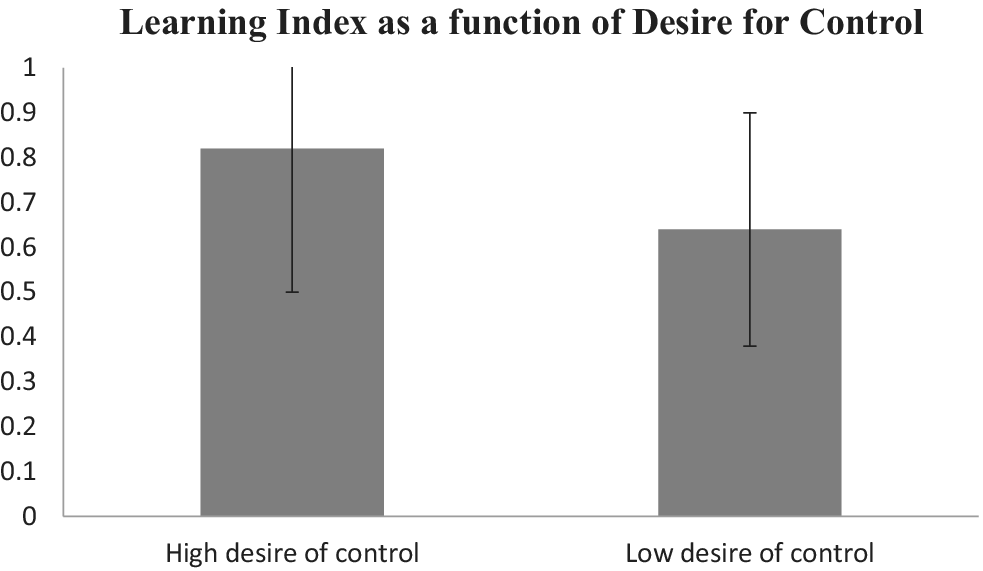
A Student’s t-test (for independent samples) revealed statistically significant differences in the learning index between the two desire for control groups, t(44.235) = −2.145, p = .037 (see Figure 2). Participants with a high desire for control showed a higher learning index (M = 0.82, SD = 0.26) than those with a lower desire for control (M = 0.64, SD = 0.32). We calculate Cohen’s d and it was 0.62, a moderate effect size. In addition, we calculated the power analysis, and it indicated that, given an effect size of d = 0.62, and an alpha level of .05 (two-tailed), the achieved power was 0.73. This indicates that the study had a 73% probability of detecting an effect of the observed magnitude if such an effect truly exists in the population. Although slightly below the conventional threshold of 0.80 (Cohen, Reference Cohen1988), this level of power still suggests a reasonably acceptable sensitivity to detect moderate-to-large effects.
Learning index average score and 95% confidence interval by desire of control group.

As an additional analysis, we treated the desire for control as a continuous variable without applying a median cut-off, and we found a positive relationship with the learning index (r = .30, p < .01). This approach mitigates the potential impact of restricted variance.
The results indicate that individuals with a high desire for control obtain a significantly higher learning index than those with a low desire for control. These findings are consistent with previous research and support H1. Thus far, the desire for control has been shown to be related to academic performance, performance expectations, effort expended, and result attributions. Our results contribute to the existing evidence regarding the relationship between the desire for control and performance on a learning task.
Having confirmed the relationship between desire for control and learning performance, it becomes pertinent to explore whether compensatory strategies, such as superstition, can influence the performance of individuals with low desire for control. This rationale constitutes the central objective of Study 2.
Study 2
Method
Sample and Design
Eighty-nine high school students initially participated voluntarily in the study. Of these, eight participants were excluded due to missing responses on the Desire for Control Scale. The final sample therefore consisted of 81 students aged between 14 and 18 years (M = 15.05, SD = 0.89), of whom 45% were male and 54.5% were female. Participants were recruited from two schools in the Community of Madrid, and all parents or legal guardians provided informed consent.
A two-way between-subject factorial design was employed, with desire for control (high versus low) and superstition (presence versus absence) as independent variables, and the learning index as the dependent variable. Additionally, the attended school was used as a covariate.
Instruments and Control Manipulation
Variables. Desire for Control and Learning Index were treated and measured identically to Study 1. The median value of 55 was used to separate participants into high and low desire for control groups.
Superstition. The manipulation was based on a belief and superstitious behavior related to the power associated with crystal skulls (see Figure 3). A mockumentary was produced to induce belief in the magical power of crystal skulls. This 10-minute documentary was divided into five sections: introduction, Mitchell-Hedgess story, skull origin and mysteries, scientific discoveries, and current research. The final section explicitly mentioned the positive effects of crystal skulls on people, such as improving health, quality of life, or job prospects. The belief was grounded in the presence of a crystal skull housed in the ethnographic museum at the Universidad Autónoma de Madrid, purportedly associated with successful outcomes.
False crystal skull.

Control Manipulation. Manipulating situations to induce superstitious behavior poses challenges, as acknowledging superstition can lead to rejection of superstitious behavior itself. However, this rejection typically occurs when individuals perceive personal influence, rather than when assessing influence in others (Martín et al., Reference Martín, Mayor, Hidalgo, Hidalgo, Borrego, González, Cuevas, Palop, De Miguel, Román, Carbonero and Valdivieso2011). To validate the influence and credibility potential of superstitious behavior, a study was conducted using a fabricated documentary. The manipulation check strategy used was similar to the procedure used by Damisch et al. (Reference Damisch, Stoberock and Mussweiler2010), and Calin-Jageman & Caldwell (Reference Calin-Jageman and Caldwell2014) that used a verbal report to identify the effect of the manipulation. In this study, twenty participants (10 males, 10 females; aged 15 to 19 years) took part, with 18 accepting the documentary as genuine and 2 expressing hesitation about its content, though none definitively labelled it as fake. Therefore, a fabricated documentary was deemed sufficiently influential to induce superstitious beliefs.
Procedure
The experiment followed a double-blind procedure to minimize potential biases from testers that could affect participant behavior. Consequently, two assistants conducted the experiment without knowledge of the research objectives or hypotheses.
Participants completed the experiment in a dedicated computer room, each using a fully equipped computer (monitor, keyboard, mouse, and headphones). Under the “absence of superstition” condition, participants watched a neutral documentary before completing the task and subsequently filling out the desire for control scale. In contrast, under the “presence of superstition” condition, participants viewed a fabricated documentary on crystal skulls before undertaking the task. A crystal skull, purportedly one featured in the documentary and part of the collections at the ethnographic museum of the Universidad Autónoma de Madrid, was then introduced into the room. After completing the task, participants responded to a questionnaire that included two parts: first, the desire for control scale, and second, the manipulation check question as we explained before in the control manipulation section.
To test the hypothesis 2, we used an ANCOVA test. This statistical technique enable compare the means of a variable in two or more groups controlling the effect of other covariables. In this paper we compare the mean of the two groups of desire for control (high vs low) and the superstition (presence vs absence) on the learning index.
Results
The ANCOVA did not reveal any effect related to belonging to one school or the other, F(1, 76) = 0.349, p > .05, η2 = .005. Nor did it reveal any effects linked to desire of control, F(1, 6) = 0.94, p > .05, η2 = .12, or related to the presence or absence of superstition, F(1, 76) = 0.009, p > .05, η2 < .001.
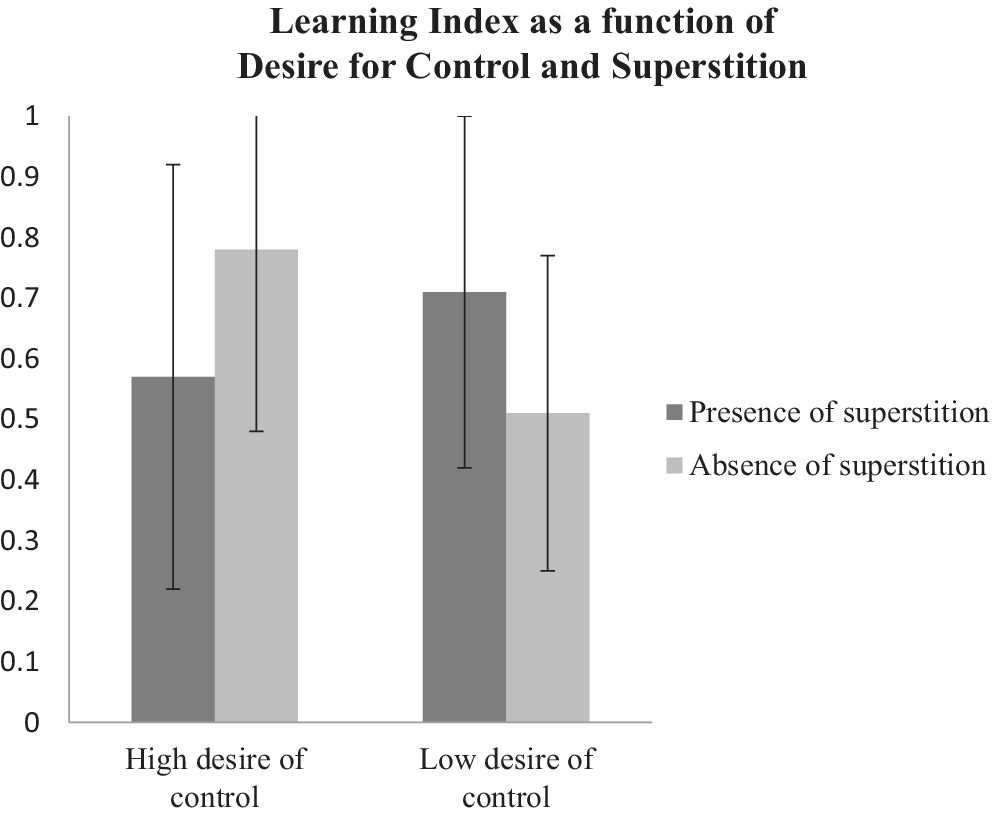
However, the ANCOVA did reveal a statistically significant interaction effect between desire of control and superstition, F(1, 76) = 8.449, p = .005, η2 = .10 (see Figure 4). This interaction indicates that the effect on the learning index differs depending on whether superstition is present or absent. Specifically, the difference between these effects, d = −0.193, SE = 0.02, was found to be statistically significant, t = −1.957, p = .005.
Learning index average score for participants, based on desire of control and the presence or absence of superstition.

Figure 4. Long description
The vertical y-axis represents the learning index score ranging from 0 to 1 in increments of 0.1. The horizontal x-axis is divided into two categories: High desire of control and Low desire of control. A legend to the right indicates that dark gray bars represent Presence of superstition and light gray bars represent Absence of superstition. All bars include vertical error bars.
In the High desire of control category, the Absence of superstition bar is higher at approximately 0.78 compared to the Presence of superstition bar at approximately 0.57.
In the Low desire of control category, the trend reverses. The Presence of superstition bar is higher at approximately 0.71 while the Absence of superstition bar is lower at approximately 0.51.
Differences were found among participants assigned to the absence of superstition condition; those with a higher desire of control (M = 0.78, SD = 0.78) achieved a higher learning index than those with a lower desire of control (M = 0.51, SD = 0.63), with a Cohen’s d = 0.38 and a statistical power of 38%. p < .05. These results mirror those obtained in study 1. In contrast, among participants allocated to the presence of superstition condition, no significant differences in the learning index were observed between those with a higher desire of control (M = 0.57, SD = 0.60) and those with a lower desire of control (M = 0.71, SD = 0.70), d = 0.21, p = .211 and power analysis = 0.131. As anticipated, the presence of superstition as a control strategy diminishes these differences.
Finally, analyzing both groups separately reveals that individuals in the high desire of control group showed lower performance in the learning task in the presence of superstition (t38 = 1.96, p = .057, r = .30). Average learning values in the absence of superstition condition were M = 0.78, SD = 0.30, and in the presence of superstition M = 0.57, SD = 0.35; d = 0.64 and a power analysis of 76%,. Conversely, the group with low desire of control significantly improved their performance in the learning task (t 39 = −2.18, p = .035, r = .33). Average learning values in the absence of superstition condition were M = 0.51, SD = 0.26, and in the presence of superstition M = 0.70, SD = 0.29; d = 0.69 and power analysis of 80%. The effect size identified was moderated and the power analysis indicate that the study had adequate sensitivity to detect a moderate-to-large effect. According to these findings H2 was confirmed.
General Discussion
The present research aimed to analyze the roles of desire for control and superstition in learning performance through two complementary studies. Taken together, our findings provide empirical support for the theoretical distinction between desire for control and need for control and offer new insights into the compensatory role that superstitious beliefs can play, particularly for individuals with low desire for control.
Regarding the first hypothesis, Study 1 confirmed that individuals with high desire for control achieved significantly higher learning scores than those with low desire for control. This finding aligns with previous research showing that individuals with elevated desire for control tend to adopt strategies that promote task engagement, persistence, and efficacy (Burger, Reference Burger1985, Reference Burger1991, Reference Burger1992). Importantly, this improved performance should not be interpreted as reflecting superior inherent ability or intelligence but rather as the result of specific behavioral strategies aimed at exerting agency and optimizing performance (Burger, Reference Burger1992).
Study 2 extended these findings by experimentally manipulating superstition through the introduction of a culturally framed symbolic belief —the power of crystal skulls— to examine its effect on learning. As hypothesized, superstition exerted a compensatory effect: participants with low desire for control significantly improved their performance when exposed to the superstition condition, whereas those with high desire for control showed decreased performance, albeit non-significantly. This interaction reinforces the notion that superstition can function as an externalized mechanism to restore order and predictability, satisfying the need for control in those who do not actively seek to be its source (Kay et al., Reference Kay, Whitson, Gaucher and Galinsky2009). Conversely, for individuals with high desire for control, reliance on such external attributions may conflict with their preferred strategies of agency, attenuating performance.
These results can be interpreted through the lens of compensatory control theory (Kay et al., Reference Kay, Whitson, Gaucher and Galinsky2009). Our findings suggest that superstition can serve this function for individuals with low desire for control, providing them with a psychologically meaningful sense of order without requiring direct agency. In contrast, for those with high desire for control, whose motivation is rooted in exerting personal influence, these strategies may prove incongruent and less effective.
Although the main effects of desire for control and superstition on performance in Study 2 did not reach statistical significance, this does not imply irrelevance. As Pardo et al. (Reference Pardo, Ángel Ruiz and San Martín2007) note, when a statistically significant interaction is present, interpreting main effects in isolation is inappropriate, as their meaning is conditioned by the interaction. In our study, the interaction between desire for control and superstition provides substantial information: it demonstrates that the effectiveness of symbolic systems such as superstition is not universal but contingent on motivational profiles. This reinforces the importance of considering individual differences when designing interventions that incorporate external sources of perceived control.
Limitations and Future Research
Several limitations should be acknowledged. The sample size, while adequate for detecting moderate-to-large effects, limits the generalizability of the findings. Future research should replicate these results with larger and more diverse samples, including adult learners and cross-cultural contexts. Moreover, our experimental manipulation of superstition was limited to a single strategy; future studies should explore other forms of symbolic or cultural beliefs to determine whether these effects generalize. Finally, while our findings are framed within compensatory control theory, we did not directly measure perceived threat to control or perceived order, which could shed further light on the mechanisms underlying these effects.
Practical Implications
Our findings have broader implications for the design of learning and development environments. They suggest that interventions aimed at enhancing performance should consider individuals’ motivational orientation towards control. For those with low desire for control, incorporating culturally meaningful or symbolic elements into the environment may provide compensatory structure that fosters engagement and improves outcomes. Conversely, for individuals with high desire for control, fostering autonomy and providing opportunities to exercise personal agency may prove more effective.
That said, we must be cautious and prudent with the indiscriminate use of superstition, as following Matute (Reference Matute1994), Matute et al., Reference Matute, Yarritu and Vadillo2011), such practices may reduce personal autonomy and foster dependence on external causes in decision-making. Therefore, while their integration as a compensatory strategy may be functional for certain profiles —such as those with low desire for control—, their use should be carefully contextualized to avoid undesirable effects on individuals’ agency and critical capacity.
In this line, the true potential of these symbolic elements lies not in their isolated use but in their integration within a consolidated and socially constructed cultural framework, capable of meeting broader and sustained human needs rather than merely serving as isolated compensatory interventions. As De Miguel (Reference De Miguel2024) states, “human beings build culture as a system of shared meanings and behavioral guidelines that reduce uncertainty and provide control over their lives, a sine qua non condition for satisfying their needs as individuals and as a group.” Consequently, interventions grounded in solid cultural systems that guarantee and sustain a desired state of well-being will likely be more beneficial than those focused solely on isolated symbolic elements such as superstition.
Conclusion
In sum, this research provides novel evidence that superstition, often dismissed as irrational, can serve a functional, compensatory role in satisfying the need for control, particularly among those with low desire for control. By integrating motivational constructs with compensatory control theory and a sociocultural perspective on behavior, this study expands our understanding of how individuals manage uncertainty in learning and development contexts and opens new avenues for interventions tailored to distinct motivational profiles.
Supplementary material
The supplementary material for this article can be found at http://doi.org/10.1017/SJP.2026.10033.
Data availability statement
The data, analytical procedures, code, and materials supporting the findings of this study are available from the corresponding author upon reasonable request. Researchers interested in accessing these resources for the purpose of reproducing the results or replicating the study are kindly invited to contact the corresponding author via email. Access will be granted in a timely and appropriate manner, in accordance with ethical considerations and any applicable data protection requirements. jesus.demiguel@uam.es
Competing interests
The authors declare none.




 Open access

