

21 Not exactly black letter law: emergent choices and textual symbolic design in Athenian legal−political oratory
21.1 Introduction
This chapter examines the extent to which the notion of linguistic choice provides an explanation of some of the design of an oratorical text in ancient Greek, and what it might say for the notion of ‘choosing what to say’. Oratory in ancient Greece was regarded as a highly crafted and highly purposed form of talk, in a culture that already valued literature, drama, history, science and art, and where argumentation and persuasion were the foundation on which public life was built. Does linguistic choice mediate this variety of talk? It is argued that choice, as conceptualised in Systemic Functional Linguistics (SFL), does have a role in explaining these linguistic patterns. But one must carefully consider the theoretical question of what ‘choice’ means in SFL. I argue that the concept of choice will ultimately turn out to be not an explanatory endpoint, but a gateway to understanding the operation of the probability-based complex adaptive systems of language and text. The emergent character of linguistic motifs in the speech analysed in this chapter supports the notion of these conditioned linguistic probabilities in action.
The political orator Demosthenes’ speech On The Crown (Greek title peri tou stephanou; Latinised to De Corona; cited in this chapter as Demosthenes 18, using the text of the speech as found in Dilts, 2002) is one of the most widely admired pieces of Greek oratory from the fourth century bce. On The Crown embodies a subtle and intricate negotiation by Demosthenes through a complex legal and political landscape. To this end, Demosthenes constructs a text whose semantic design is appropriate to the context in which he delivers the speech – both the context of situation and context of culture of speechmaking and political discourse in classical period Athens.
Here, it is argued that textual design is symbolic design that is adaptive to the semiotic and social context of fourth-century bce Athens, and that this is the result of (i) the accumulation of selections within a given linguistic system, and (ii) the relations that hold between sets of selections in relatively discrete linguistic systems, resulting in emergent linguistic co-patterning. If thought of this way, then the design of a text with respect to its social and semiotic context is only indirectly the result of selections in linguistic systems, and even then linguistic choice is as conceived of in the systemic functional framework, which does not necessarily correspond to the notion of individual psychological intention.
To demonstrate this, this discussion focuses on the accumulation of choices in two lexicogrammatical systems in ancient Greek – the system of THEME, and the systems of TAXIS and LOGICO-SEMANTIC RELATIONS as applied to the analysis of an important section of Demosthenes’ speech.
21.2 Law and politics: the context of the speech
21.2.1 The context of situation: personal, legal and political attack in Athens in response to Philip II of Macedonia (Yunis, Reference Yunis2001:1–17)
The Macedonian King Philip II (the father of Alexander the Great) became the dominant military and political player in the Greek world during the fourth century bce. As part of this process, Philip gained control of the Greek mainland, including Athens, through the battle of Chaironeia in 338 bce. This occurred after a number of military, diplomatic and political events between Athens and Macedonia, and within Athens itself.
Diplomatic events before Chaironeia brought two prominent men in Athens into political conflict with each other – Demosthenes and the politician Aeschines. They were bitter political rivals, espousing opposing strategies (war and negotiation, respectively) for dealing with Philip. Over the course of several years, claim and counter-claim were traded between the two, each accusing the other of colluding with Philip and of selling out Athens’ interests.
In 336 bce, a certain Ctesiphon proposed that the Athenian assembly award a golden crown (Greek stephanos) to Demosthenes to recognise his public work, and for his support of the best interests of the assembly and Athens. Aeschines sensed an opportunity to restore his own standing and to demolish that of Demosthenes. He lodged a graphê paranomon, a charge that the award (ratified by Athens’ boulê [council]) contravened statute law (Johnstone, Reference Johnstone1999:37–40; Yunis, Reference Yunis1988:368–369). In spite of its technical legal meaning, such a charge in practice gave political rivals opportunity to attack each other in the courts (Yunis, Reference Yunis2001:8–9; Todd, Reference Todd1993:154–163). Although Ctesiphon was technically the defendant, Demosthenes stepped in to answer the graphê paranomon charge himself.
The context of situation for this speech, therefore, is quite complex. It is simultaneously a defence of oneself in court, a narrative and justification of one's public life, and an opportunity to attack and discredit enemies. As a result, Demosthenes does not ultimately aim to persuade the jury that he is technically not guilty (Yunis, Reference Yunis1988:375); instead, the speech is focused on why he deserves the award, and why his political conduct has always been in Athens’ interests. Demosthenes therefore answers a legal charge with a political argument. Part of this defence of his conduct (Demosthenes 18:42–49) is to emphasise that he discerned Philip's real intentions against Athens when others, wilfully or unwittingly, did not. It is with this particular section of the speech that the following discussion is concerned.
21.2.2 The context of culture: oratory as the literature of political thought
Persuasive oratory became established in the Greek world in two ways: through the operation of public life, and through literature. The notions of argument, rhetoric and persuasion, and an awareness that these arose by conscious and deliberate use of the ancient Greek language, were well established before the fifth century bce, not least through activities of legal and political disputation.
Two factors in the legal system made the appreciation and use of effective argumentation particularly valued. First, the court was expected to be the domain of those who were relative novices at legal process, although with professional help behind the scenes (Todd, Reference Todd1993:77–97). Moreover, in Greek legal systems, compared with the present day, there was fluidity in choosing legal procedure, and in the status of written and verbal evidence (Thür, Reference Thür, Gagarin and Cohen2005; Todd, Reference Todd, Cartledge, Todd and Millett1990:23–30, Reference Todd1993:96–97; Johnstone, Reference Johnstone1999:83–92). As a result, legal cases were assessed by the quality of their arguments taken by themselves, and less by their citing of factual evidence. Consequently, a wide range of effective oratorical skills was a highly prized asset. Therefore, a consciousness of text design and the available linguistic resources became essential to legal and political argumentation.
These strands of cultural literary practice come together in Demosthenes’ speeches as we have them. Thus an audience or reader can expect On The Crown to fulfil literary expectations, to act as a model for effective public speaking and persuasion, and to be an embodiment of political thinking, action and reflection. These are strong contextual parameters which allow for the emergence and persistence of particular linguistic patterning.
21.3 Thematic analysis
The first assumption made in this discussion is that any text has a particular ‘method of development’. This term, originally coined by the Prague School, later adopted into SFL and further developed (Mathesius, Reference Mathesius1937; Daneš, Reference Daneš and Daneš1974; Fries, Reference Fries, Hasan and Fries1995; Hasan & Fries, Reference Fries, Hasan and Fries1995), refers to the fact that a text develops information from a given starting point, and that each clause also has a point of departure which underlies the overall flow of information in a text. Importantly for this discussion, in the ‘unmarked’ case the point of departure of a clause, and of a text, usually consists of information already known to, or assumed by, the speaker and audience. However, if this information is actually new to the text (the marked case), then such information is symbolised in the text as if it were assumed or previously given information. Speakers can often exploit this phenomenon for their own ends, and from time to time ‘slip in’ information which is actually new, but has the effect of the audience assuming it is part of their shared contextual knowledge.
21.3.1 The THEME system
When we turn our attention to the individual clauses of a text, the departure point (or ‘focus’, or ‘starting point’) of each clause – what the clause is about – is under the control of the grammatical resources of a language, and is referred to as the Theme of a clause (Halliday & Matthiessen, Reference Halliday and Webster2004:64–67). A clause constituent is selected in the lexicogrammatical system to take on this Theme role. Modern linguistic studies that ultimately draw upon the Prague School imply a concept of Theme by assuming that word order is motivated by the context of the speaker and text. This has been implicit in many studies of word order in classical language linguistics (Weil, Reference Weil and Super1887; Denniston, Reference Denniston1954:41–59; Dik, Reference Dik, Engberg-Pedersen and Jakobsen1994, Reference Dik1995; Horrocks, Reference Horrocks1997:59–60; see also Hasan & Fries, Reference Fries, Hasan and Fries1995).
21.3.2 The practical determination of the Theme of the ancient Greek clause
In SFL studies of English, the prominent element of a clause falls on the experiential element that occurs first in the clause, labelled the Theme (following Halliday & Matthiessen, Reference Halliday and Webster2004; Graber, Reference Graber2001:135–141). For practical purposes, the other ‘non-first’ elements of the clause are collectively called the Rheme. An example from On The Crown is shown in Table 21.1.
Table 21.1. Theme and Rheme

[Note that the clause numbering consists of three numbers separated by periods following the standard reference to the speech (Demosthenes 18): the first refers to the section number, following the section number notation convention in Dilts (Reference Dilts2002); the second, to the clause complex (or ‘sentence’) number in the section as determined by the linguistic analysis; the third, to the clause number in the clause complex concerned. The clause boundaries are marked with a double vertical line ∥.]
The Theme of the ancient Greek clause is likely to be assigned to initial position for a number of reasons. First, as in English, the topical element of the clause is not morphologically marked, which makes it more likely that Theme is expressed through clause position. Second, the elements of the clause that relate the clause to other clauses in the text and the text and context as a whole – particles and conjunctions – are obvious candidates as clause elements that ‘start off’ the clause. These typically gravitate to the initial parts of the clause, which makes it likely that any word group that most closely associates with these elements is likely to be the most ‘thematic’ group of the clause. It is for these reasons that it is provisionally assumed that initial position has the role of Theme assigned to it. However, the most convincing test is if one is able to relate these most initial groups to the co-text and context in which the clauses are located, since Theme, in SFL theory, typically is a ‘microcosm’ of the concerns and development of the text as a whole (Hasan & Fries, Reference Fries, Hasan and Fries1995:xxvii; Fries, Reference Fries, Hasan and Fries1995:323–325; Halliday & Matthiessen, Reference Halliday and Webster2004:100–105).
We can test this idea out on Demosthenes’ text by identifying the initial clausal constituent of each clause of a representative stretch of text from On The Crown:
Demosthenes 18.173
ephanên toinun houtos en ekeinêi têi hêmerâi egô ∥ kai parelthôn ∥ eipon eis humas, ∥ ha mou duoin heinek’ akousate ∥ proskhontes ton noun, ∥∣ henos men, ∥ hin’ eidêth’ ∥ hoti monos tôn [[legontôn ∥ kai politeuomenôn]] egô tên tês eunoias taxin en tois deinois ouk elipon, ∥ alla kai legôn ∥ kai graphôn ∥ exêtasdomên [[ta deonth’]] huper humôn en autois tois phoberois, ∥∣ heterou de, hoti << mikron analôsantes khronon >> pollôi pros ta loipa tês pasês politeias esesth’ empeiroteroi. ∥∣
Translation
‘This person – me – did present myself on that day, ∥ and I got up ∥ and said to you ∥ things which you should listen to, for two reasons ∥ and pay attention to – ∥∣ firstly, so that you may know ∥ that I alone, of those [[who made speeches ∥ and were politicians]], did not abandon my post of patriotism during difficult times, ∥ but also, by making speeches ∥ and writing arguments, ∥ I proved myself on your behalf for [[what was required]] in these fearful times – ∥∣ and secondly, << expending a small amount of time, >> that you would be more greatly experienced in all your political life in the future. ∥∣’
The highlighted initial clause constituents of the ranking (non-embedded) clauses in this section of the speech show that Demosthenes uses initial clause constituent position to fulfil three functions in the text of the section. The first of these is to bring to prominence the actions of himself (ephanên [‘I appeared’], parelthôn [‘I came up’], eipon [‘I said’], legôn [‘speaking’], graphôn [‘writing’], exêtasdomên [‘I proved myself’]) and the putative actions of his audience (proskhontes [‘paying attention’], eidêth’ [‘you know’]) through putting verbs (both finite and non-finite) in initial position of their respective clauses. The rich morphological inflectional system of Greek for nouns, verbs and adjectives provides the potential for clauses to be ‘verb initial’. In the case of finite verbs the suffixal inflection denotes the ‘person’ (first, second, third), which allows the Subject of the clause to be retrieved from the rest of the clause or inferred from the context of situation. The second function of Theme in this section is to organise text segments into a defined argument structure (ha [‘those things’], henos [‘one thing’], heterou [‘the other thing’]), where Demosthenes refers first to what he has said to his audience, and then enumerates the particular points he wants to make. Third, Theme is used to make semantic contrasts between different words in separate clauses (micron [‘small’] pollôi [‘by much’]) – the well-known stylistic technique of antithesis found in many ancient Greek texts. In this way, Demosthenes uses the grammatical resource of Theme to highlight the actions of himself and his audience, to manage the argument structure of his text, and to create particular stylistic effects. These consistencies of selection of a functional element comprising information from co-text and context, mapped onto the single initial clause constituent, reflect the functions of Theme. Given the above analysis, it is likely that Theme typically takes a clause-initial position. A detailed quantitative analysis of a large volume of text to prove this is beyond the scope of this chapter. Additionally, the lack of an available spoken form of Greek makes evidence from tone groups not possible.
The clause constituents highlighted in this section each represent some element of the state of affairs construed by each clause, and so can be labelled Topical Theme. The analysis of Topical Themes will be the focus of analysis and interpretation here. It should be noted that various other elements, identified in SFL, may be associated with this clause-initial position, and have a function in either semantically relating one clause to another (such as particles and conjunctions) or expressing speaker evaluations of the clause content (such as modal adjuncts). Analysis of these elements (Textual and Interpersonal Theme) will be left aside from further discussion, as will a full justification for the boundaries and extent of Theme in a clause.
An ancient Greek speaker, theoretically, can select any experiential element in a clause as Topical Theme, because of the free word order that is found in Greek, although to call this ‘free word order’ would be to overstate the case (Luraghi, Reference Luraghi2005:73–75). Nevertheless, there is no absolute requirement that the grammatical subject of the clause precedes other clause elements. Therefore, an individual speaker has some freedom to assign Topical Theme to a non-Subject element of the clause. But at the same time, one might expect such choices to be constrained by, and be appropriate to, the co-text and context. The choice of Topical Theme is therefore under the influence of the requirements of the discourse and the context – a point borne out by the analysis in this discussion.
21.3.3 Interpreting Topical Theme as a resource for constructing rhetoric
Topical Theme allows the author of a text to highlight particular aspects of the situation about which they are talking, and develop their representation from this point of departure. We thus expect that how the author wants the audience to see a particular situation – and in particular in what terms or what frame of reference – is reflected in that author's selections of Topical Theme (Fries, Reference Fries, Hasan and Fries1995:325).
We expect that a Theme analysis of the clauses of the text would provide a significant insight into important aspects of rhetoric – including the more modern notions of examining the ‘design’ and structure of text varieties associated with a wide variety of social purposes (Toolan, Reference Toolan2001:206–241). In this case, the analysis of Theme reflects the particular perspective that Demosthenes has on Athens’ geopolitical situation, and that the points Demosthenes makes develop out of this perspective.
21.3.4 Topical Theme reflecting the perspective adopted in the speech
The Topical Themes in this passage focus the clauses on the ‘main players’ in the Greek and Macedonian worlds that are involved in the confrontation between the Greek states and Philip. This can be illustrated in the examples in Table 21.2. The Topical Themes in each of the clauses have been underlined in the glosses and translations.
Table 21.2. Selections of Topical Theme
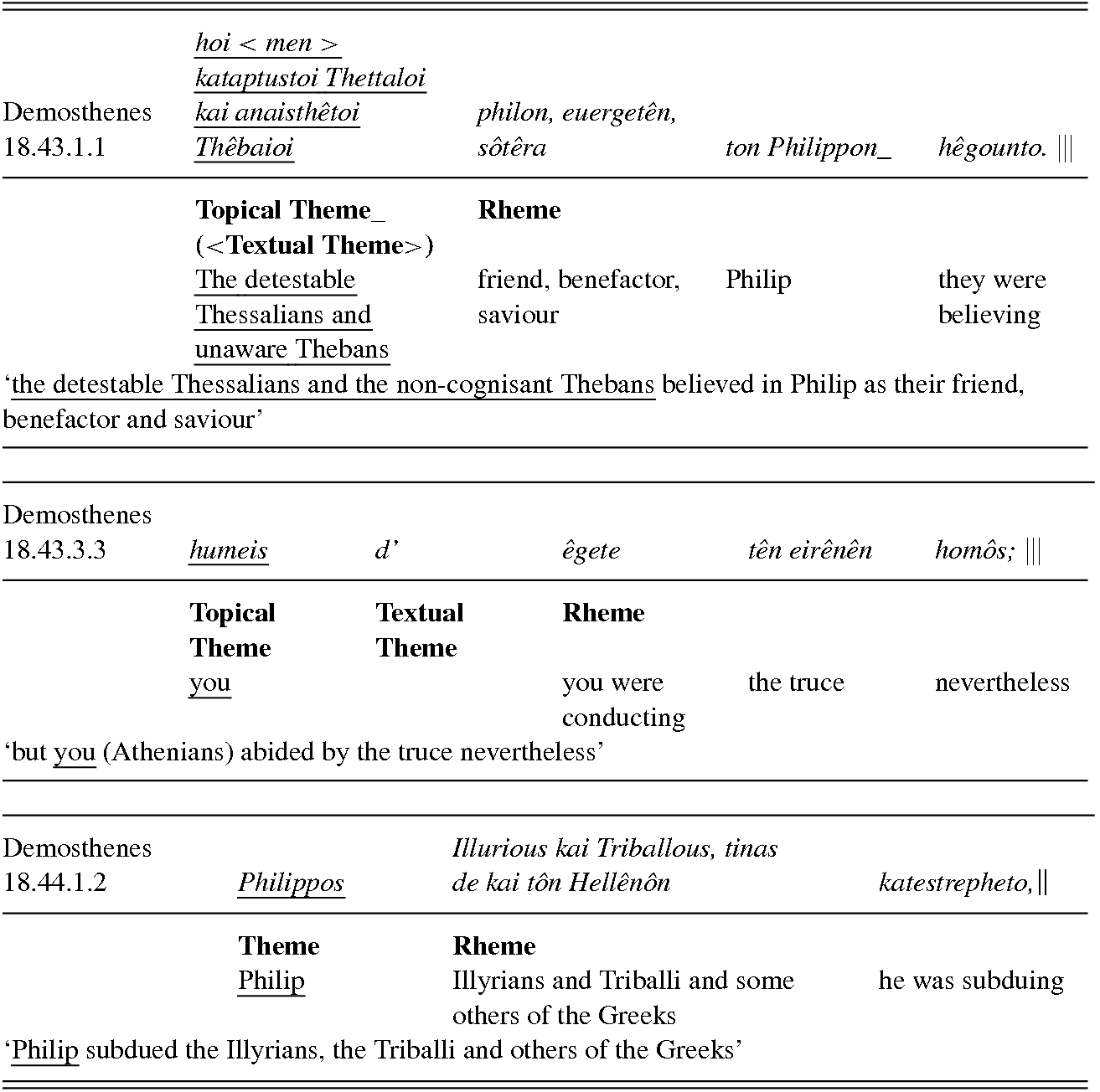
[Note that in addition to the explanation of the examples cited in previous sections, in the following analysis of individual clauses, there is a gloss provided of each constituent of the clause, followed by the author's idiomatic translation of the clause which aims to reflect the structure of the Greek grammar as much as possible.]
In this way, the selection of Topical Theme in these clauses is intended to gear the audience towards seeing the conflict as being between a number of sides. This includes ‘you’ – the jury hearing the speech, and more generally the Athenian people and government by extension. In each of these clauses, the Topical Theme containing each ‘major player’ in the action serves as the ‘anchor point’ from which the events are described and unfolded.
It may be argued that the reason why these players in the courtroom and the political scene are selected as Topical Theme is essentially a product of the high likelihood that the Subject will occur in initial position in the clause. However, the presence of Subject in the Topical Theme is motivated not only by the usual, ‘unmarked’ operation of the grammatical system, but also, importantly, by the discourse requirements. In this case, the discourse motivation is the need to anchor the happenings represented in each clause with respect to people, and groups of people, deemed important for the particular argument that Demosthenes puts forward.
21.3.5 Aligning the political and the legal through selections in the THEME system
Part of the reason for Demosthenes highlighting the action as being mediated between sides is that the legal process is also between ‘sides’ – Demosthenes on one side, Aeschines on the other, each the ‘leader’ of their respective political fellow travellers, addressing a third party, the jury (andres Athênaioi). And indeed, each of them turns up as Topical Theme (see Table 21.3).
Table 21.3. Major players in discourse selected as Theme
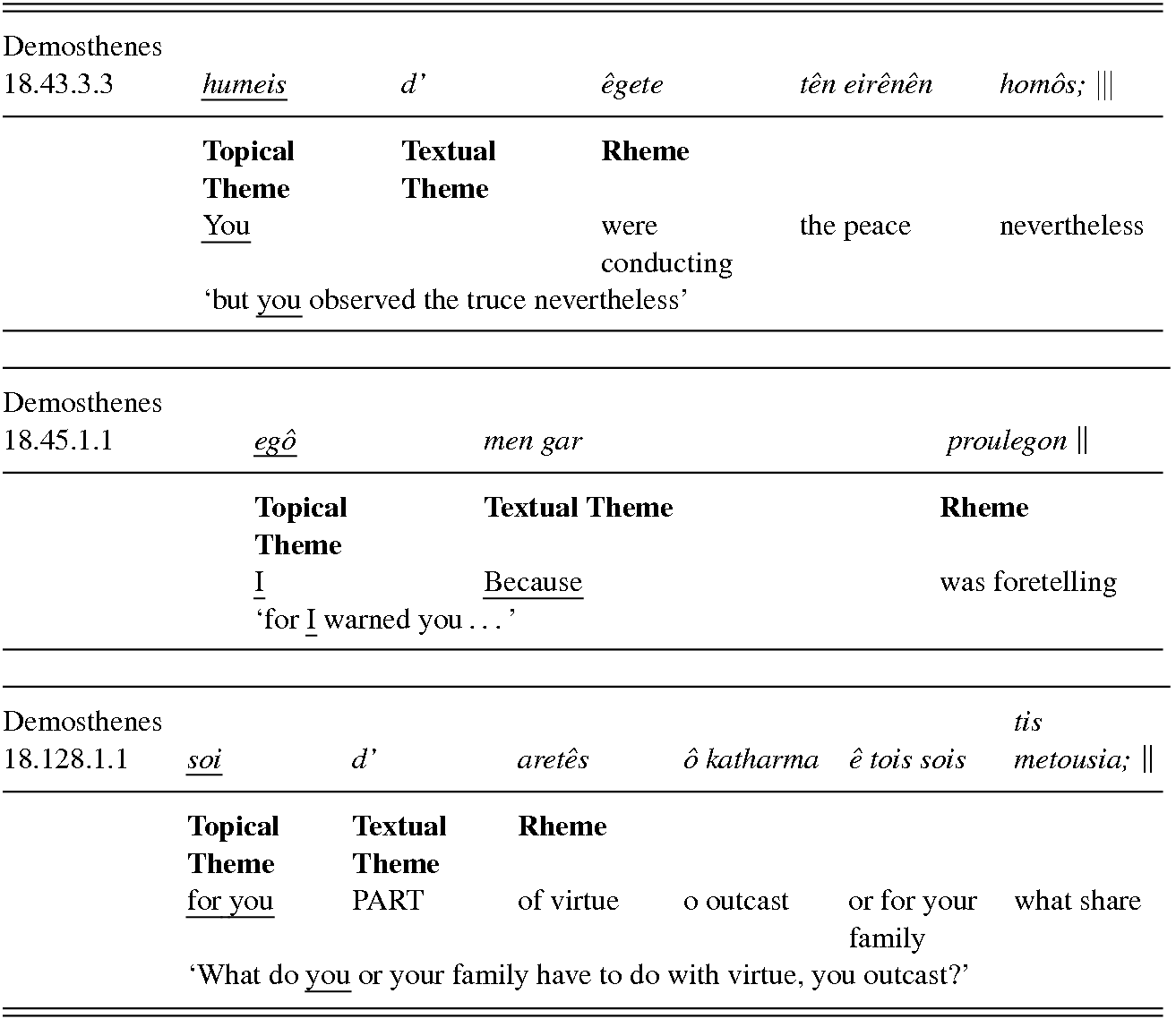
In this way, by allowing the participants in the legal process to be the topic of their respective clauses, just as the main political participants in Greece are in their clauses, Demosthenes portrays the legal events as intimately connected with the political ones with which the court case is concerned. Thus the selections of Theme have an important role in construing the experienced world (the political situation) in terms of a particular cultural activity (arguing one's case in court). The court case is being presented not just as another case, but one that has ramifications for the Athenian polity as a whole.
The other important point to note is that these selections of Theme are an important strategy in persuading the audience that the political situation in Greece, and the events that brought it about, have direct relevance to the legal case being played out, and to Demosthenes’ own conduct. This is particularly important with respect to the graphê paranomon. Demosthenes wants his political conduct to be non-legalistically judged by the people of Athens. By selecting both the legal combatants in the courtroom and the political players of the Greek mainland as Themes, Demosthenes makes the political manoeuvrings outside the courtroom seem to be relevant to the legal argument, and thus makes the defence of his personal conduct in court directly relevant to wider issues that affect the whole of Athens. This in turn subserves a larger overall strategy to portray himself as being fundamentally connected and important to Athens’ welfare. This patterning of Themes in the speech thus are an important means by which the functions of speeches defending against a graphê paranomon are mediated, and are a means of developing Demosthenes’ own aims and strategies. In this way, one might say that this particular use of the system of THEME in Greek underpins an important aspect of the genre of the graphê paranomon which Demosthenes exploits.
By these means, Demosthenes creates a situation where political arguments are seen to be on the same footing as legal ones. Demosthenes allows his political arguments to ‘piggyback’ on a legal framework, in order to demonstrate that his political conduct is also properly reviewed and approved by the Athenian polity. The patterns of Topical Theme noted above, by closely linking the political world to the legal context of the court, play an important role in allowing Demosthenes to exploit the opportunities provided by a graphê paranomon case to further his own standing, and effectively to answer a legal argument with a political one. This linguistic co-patterning may potentially be the result of choice, but later it will be argued that this is the result of the probabilistic nature of linguistic phenomena.
21.4 The interpretation of clause complexing
21.4.1 Taxis: relationships of co-ordination and subordination between clauses
In SFL, two dimensions of clause complexing are identified. The first of these is the system of TAXIS (Halliday & Matthiessen, Reference Halliday and Webster2004:373–376). In this system, clauses may be seen as able to stand independently (paratactic), and these tactic relationships are denoted in an analysis by numbers (1, 2, 3…). Alternatively, one clause is ‘dependent’ on another clause (hypotactic). These hypotactic relationships are usually denoted by letters (a, b) where the subordinated clause (b) depends on another clause (a).
In English, and indeed as in Greek, there is no theoretical limit as to the number of clauses that can be paratactically or hypotactically arranged in a single complex sentence; indeed, as we shall see in Demosthenes (and this holds true of many other Greek authors), the number and complexity of these complexes of clauses can be quite considerable (see Table 21.4).
Table 21.4. Example of complex sentence involving both paratactic and hypotactic complexing of clauses

Key for clause complex annotation
1,2,3… Paratactic labels
A,b Hypotactic labels
<< >> Boundaries of one clause interrupting another
[[]] Boundaries of one clause embedded inside another
∥ Boundary between clauses at the same ‘level'
∥∣ Boundary between clause complexes
[Note that in the annotation of clause complexes, clauses are numbered as in previous examples and tables, followed by their taxis labels (following Halliday & Matthiessen, Reference Halliday and Webster2004:388–395), followed by the whole clause and its gloss. The whole clause complex is then presented, with an idiomatic translation of the whole complex.]
21.4.2 Logico-semantic relations: encoded meaning relationships between clauses
Operating concurrently with the system of TAXIS is the system of LOGICO-SEMANTIC RELATIONS (Halliday & Matthiessen, Reference Halliday and Webster2004:373, 395–482). These relationships are usually marked ‘structurally’ in the grammar of individual clauses in the complex, such as through the use of particles and conjunctions, and the use of non-finite verbal forms (such as participles and infinitives) in hypotactic clauses that stand in relation to the finite verbs of ‘main’ clauses. These logico-semantic relations in the grammar of Greek are of a number of well-defined types that have been well documented in traditional grammars, such as time, cause, concession, the grammar of indirect speech, thought and perception, relative clauses, and other clauses that are linked through ‘additive’ or ‘subtractive’ conjunctions such as ‘and’, ‘or’ and ‘but’.
Armed with these concepts, the reader of a Greek text will be able to observe that there is considerable variation in the kind of complexity of taxis and logico-semantic relations as a text progresses. At the same time, however, there may emerge certain kinds of complexing that appear regularly in a given text and are motivated by elements of the context of the speech. These patterns are often seen as a product of what is known as the style appropriate to a particular written or spoken genre (Denniston, Reference Denniston1954:66–70). However, more recently there has been work that relates clause complex types to particular features and purposes of the discourse in which they are found (Bolkestein, Reference Bolkestein and Coleman1991).
21.4.3 Clause complexing patterns as symbolic of clarity and truth
In this section of the speech, certain kinds of clause complexing appear to be associated with the way in which Demosthenes attempts to portray himself as the person who sees the ‘truth’ of a situation, as opposed to other political players who do not. This is in part reflected in the different kinds of clause complexing associated with reporting his own actions, and the clause complexes that report the actions of others. With respect to the actions of others, the clause complexing in terms of taxis and logico-semantic relations is considerably intricate (see Table 21.5).
Table 21.5. Tactically and logico-semantically intricate clause complexing

The first thing to note is that the clause complex has a highly subordinated structure which builds as the clause complex proceeds. Some of these subordinated levels in turn consist of paratactic elements. In terms of logico-semantic relations, there are a number of different types of relation, such as cause, time, elaboration and idea projection. Many of these relationships are not explicitly expressed through conjunctions, but are instead expressed through the relations between finite clauses (using finite forms of verbs, marked for person and number) and non-finite clauses that use participial or infinitival verbal forms. As a result, it is somewhat more difficult for the reader or hearer to determine at first glance a number of the logico-semantic relations between the clauses, and their meaning relationships. Of those relationships that are marked by a conjunction or particle, there is some loss of explicitness, because of the use of particles to mark some relations (which tend to have rather less explicit connecting force than full conjunctions) and the use of kai which, like English and (Halliday & Matthiessen, Reference Halliday and Webster2004:405, 411), can specify a number of kinds of logico-semantic relation such as a temporal sequence, or the addition of new information.
The overall effect is that of a clause complex whose structure and meaning is rather involved, placing a considerable burden on the audience to determine a precise picture of how the actions of these political figures are being portrayed. In order to interpret this patterning properly, we have to ask ourselves first whether this represents a ‘failure’ on Demosthenes’ part to express himself clearly to his audience. Judging from what we know of the context of this speech – Demosthenes’ known effectiveness as an orator, his ensuing political success, the likely ‘processing’ of the text into a published and disseminated form – we may come to the conclusion that these contextual factors decrease the probability of an unintentional lack of clarity. The local co-text also reduces this likelihood further, as it shows evidence that there is attention to detail in the ordering of constituents of each of the clauses, where there is a clearly constructed parallelism between the governing and the governed social classes, and, at the morphological level, there is a repeating ‘genitive absolute’ construction at the end of many of the subordinate clauses, broken towards the end of the clause complex by two infinitives associated with indirect thought (Yunis, Reference Yunis2001:21). For these reasons, we may conclude that Demosthenes worded this passage deliberately, and thus that any lack of clarity is, in fact, deliberate.
Through the intricate clause complexing of this example, Demosthenes might therefore be assumed to be attempting to portray the actions of others as being complicated, disorganised, misleading or devious and, ultimately, wrong and misguided. This, the audience might presume, is the result of unenlightened thinking, and the lack of political and strategic wisdom and intelligence that engendered it. This becomes even more apparent when we compare this clause complex to others where Demosthenes’ own actions are being talked about. Demosthenes talks about his actions in very ‘plain’ clause complexes, which are not that complex in terms of taxis or logico-semantic relations. A case in point is the two clause complexes (see Table 21.6) which precede the reporting of other states’ actions as discussed above:
Table 21.6. Demosthenes’ reporting of self through ‘simpler’ clause complexing

This kind of complexing stands in sharp contrast to the next clause complex that describes the actions of others and the consequences that they suffer. The whole complex is shorter, comprises at most two levels of taxis, and the logico-semantic relations between clauses are quite unambiguous. In short, when Demosthenes represents himself to his audience, he portrays himself as ‘simple’ and ‘direct’, in contrast to other political figures in Athens and abroad, who are not. Indeed, this is part of an explicitly avowed strategy for the whole of his speech:
Demosthenes 18.58
∥∣ houtôsi men, ô andres Athenaioi, dikaiôs kai haplôs tên apologian egnôka poieisthai, ∥ badioumai d’ ep’ auth’ [[ha pepraktai moi]]. ∥∣
∥∣ ‘In this way, men of Athens, I have decided to conduct my defence in a proper and simple way, ∥ and I will proceed to those things [[which have been done by me]].’ ∥∣
Demosthenes is professing to be direct about what he has done, both explicitly, and implicitly through the grammar that he uses; the explicit and the implicit reinforce each other. In turn, this is meant to imply that Demosthenes is presumed to be the bearer of the ‘truth’ and enlightened political thinking in a complex and difficult world.
It is reasonable to assume that his audience would associate the lucidity and relative simplicity of the complexing with notions of ‘plain speaking’ and ‘speaking the truth’. Through at least the century beforehand, educated Athenian audiences were well acquainted with the idea that speakers could be deinoi – ‘clever’, in both negative and positive senses (defined in Liddell et al., Reference Liddell, Scott, Jones, McKenzie and Barber1968:374; Wardy Reference Wardy and Rorty1996:56–58) – and were well aware of the power of highly crafted speech to mislead, and of others’ exhortations (famously, Socrates and Plato) to reject such ‘sophistry’ in the search for the ‘unmediated truth’. There was a widely shared consciousness that complicated and ambitious schemes in political and social life can often lead to disaster – a lesson painfully learnt by Athens in its humiliating defeat by Sparta two generations before. Adopting the ‘plain’ style, as Demosthenes does here, is symbolic of reaching towards the truth, and he actively uses such symbolism – in this case mediated through deliberate choices in the clause complexing – to engender the trust of the audience in both what he is saying and his previous words and actions. In this way, the grammatical resources of the Greek language (in particular, the system of clause complexing) are exploited by Demosthenes in the service of the oratorical and persuasive functions of his speech – to encourage the audience to trust him, and to portray himself as having political intelligence superior to anyone else, either within Athens (particularly including his opponent Aeschines) or abroad. This feeds into êthos, a notion long recognised (and explicitly formulated by Aristotle) as an important requirement of persuasive talk in ancient Greek: a representation of the moral character of the speaker to the audience that is intended to encourage the audience to believe in the speaker's authority and trustworthiness (Carey, Reference Carey and Worthington1994:34–38).
An important issue to address at this point is that this phenomenon is not simply an issue of oratorical ‘style’ in this case, without any motivation beyond trying to give the speech a certain ‘texture’. The particular kinds of clause complexing have so far been examined largely as an issue of Demosthenes’ style of speaking and/or writing. That is, the clause complexing is seen as mediating text rhythm and patterning, which in turn have a role as ‘expected’ or ‘effective’ features of the genre of oratory, or as part of the individuality of a particular speaker. Indeed, clause complexing patterns have been noted as part of Demosthenes’ oratorical style, such as the use of repeating genitive absolute constructions in long complexes, and a general tendency to use a great variety of clause complexing taxis and logico-semantic relations, such variation being a valued feature of extended talk and writing (Yunis, Reference Yunis2001:17–26). The present chapter does not in any way contradict the stylistic role of such clause complexing, as both part of the style of the genre and the style of the individual speaker. What is being argued here is that clause complexing patterns go beyond this: they are also directly tied to the specific strategies in this particular speech, and to persuading others of Demosthenes’ ‘superiority’. One might say that the clause complexing not only has a role in the genre, but also the register. Additionally, the context is driving a wide range of different selections in the systems of TAXIS and LOGICO-SEMANTIC RELATIONS, where the probabilities of selection of each option tend towards equality with each other, thus leading to intricacy.
21.5 Choice and textual design
The above discussion has attempted to show that there are consistencies in selection in two lexicogrammatical systems which have some relation to factors in the context of situation in which Demosthenes crafts and delivers his speech. Specifically, there are consistencies in the selection of Theme that reflect the prominence of the major interactants in court, the prominence of major elements in the political environment, and the role of the graphê paranomon in classical Athenian legal and political culture. Their common ‘thematicity’ is used by Demosthenes to make a legal courtroom argument relevant to a political argument, and vice versa. Second, there are consistencies in selections of taxis in the clause complexing that are related to casting one party in a negative light and another in a positive light.
To Halliday, choice is one of the organising principles of language – a language is an “organisation as a huge network of interrelated choices”; it is also intimately involved with the notion of meaning – “meaning is choice: selecting among options that arise in the environment of other options” (Halliday, Reference Halliday and Webster2003c:8). Ultimately, though, Halliday's language is open-ended about who or what is doing the selecting of options in a linguistic system, and certainly does not commit to the notion of psychological intention. On one reading, choice operates over linguistic phenomena related to each other, and these relations are theorised and modelled in terms of a system network.
However, in the case of Demosthenes’ speech, we are not only talking about individual selections in linguistic systems, but also consistencies of selection and distributions of probability of selection across options, and their relationship to the semiotic and social context in which the production, transmission and reception of the speech is situated. Can we extend the notion of choice to denote a tendency to select one option over another over one or more linguistic systems, where consistencies of selection result in complex products of symbolism that resonate with important aspects of the context of a text? This is an abiding concern not only for Greek literature, but also in modern-day speechmaking (Thompson, this volume) and also complex acts of semiosis in many kinds of text and their relation to individual intention (see Butt, Moore & Tuckwell, this volume).
This in turn raises a number of questions. In a given context of situation, do we make choices about which aspects of that context have a bearing on choices we make at the linguistic strata, and thereby only make certain parameters of context meaningful? Or is there an alternative to the notion of choice that we can use?
The term ‘choice’ as used by Halliday and other SFL practitioners shares a certain element in common with other SFL terminology. The term has been introduced from another domain, and often from lay usage. English speakers use the term ‘choice’ frequently in all kinds of text, and the vast majority of those occurrences are not to do with linguistic theorisation. As a result, the term ‘choice’ is used in SFL with what one might call ‘baggage’ from its non-linguistic and lay usage, which complicates efforts to explicitly theorise how choice relates to meaning and linguistic systems. Like many other terms in SFL, ‘choice’ is a linguistic term whose functions and meanings in the theory are yet to be fully explicated.
An important alternative model to the notion of choice with the potential for better explanatory power – and one which Halliday has cited from his work in automated language systems (Halliday, Reference Halliday and Webster2003c:23–26) – is to think of choice as probabilities of systemic selection. In the case of Demosthenes’ speech, we may say that the situation and context that Demosthenes was expected to engage in influenced the probabilities of selection in the semantic, lexicogrammatical and phonological systems of ancient Greek, with selection of particular options and the interstratal phenomenon of semogenesis resulting in the persistence of patterns of selection that cumulatively build configurations of meaning in text. These feed forward into context, and subsequently condition selection probabilities of linguistic options. In this way, complex symbolic structures assemble and persist through Demosthenes’ text.
Modelling systemic choice in terms of settings of system probabilities is not simply an alternative to using the term ‘choice’; as in quantum mechanics, probability and indeterminacy are part of the nature of language. This means that langue (in Saussure's terms) operates as a complex adaptive system with associated notions of metastability, non-linear behaviour and threshold effects, feed-forward and feedback mechanisms, and the emergence, persistence and decay of particular kinds of linguistic and social practice in text (Beckner et al., Reference Beckner, Blythe, Bybee, Christiansen, Croft, Ellis, Holland, Ke, Larsen-Freeman and Schoenemann2009).
So in the case of Demosthenes’ speech, the semantic configurations represent ‘metastable’ states of a text formed through self-organisation (Beckner et al., Reference Beckner, Blythe, Bybee, Christiansen, Croft, Ellis, Holland, Ke, Larsen-Freeman and Schoenemann2009:2–3). This self-organisation arises from the cumulative effect of consistent and interdependent selections, producing a configuration that is relatively stable, conditioned by certain aspects of the social and semiotic context. Understanding language and text in these terms is required to understand text−context relations and language variation, issues of interest to ancient language linguistics and literature more generally.
So, to what extent is Demosthenes choosing (in non-SFL terms) the language of his speech, if we are to consider his language in terms of being the product of complex adaptive systems, where no recourse is made to the notion of psychological intention? I suggest that the most psychologically conscious act of meaning that Demosthenes performs is his determination of what particular aspects of the semiotic and social context are to condition selection probabilities, which cumulatively feed forward into the linguistic systems to produce a textual design adaptive to the contextual settings and condition subsequent linguistic behaviour.
The large volumes of linguistic data and the computational tools required to bear out a complex systems view of language have been developed and are still being developed, with the emergence and growth of ‘probabilistic linguistics’ to model various kinds of linguistic phenomena (Bod et al., Reference Bod, Hay and Jannedy2003). With regards to lexicogrammar, work is being done on the probabilities of co-selection of grammatical features in a clause and the computational prediction of grammatical structures given a particular semantic configuration based on the learning of observed probabilities of co-occurrence of linguistic features (see Manning, Reference Manning, Bod, Hay and Jannedy2003). Further work in this area requires intensive collaboration between linguistics and those involved in statistical modelling and the information sciences. In the meantime, the notion of linguistic choice – carefully characterised and used – will continue to serve a valuable role in understanding relational linguistic systems and meaning. However, it will ultimately be a conceptual entry point to more articulated and precise ways to characterise and model linguistic behaviour.
21.6 Conclusion
A number of conclusions can be drawn from the present inquiry into the language of Demosthenes and what it might say about the nature of linguistic choice.
This chapter in no way purports to be a complete exploration of those features of the grammar of the text that create meanings in the rhetoric of Demosthenes. Only two kinds of grammatical feature have been under examination here. Other issues can be areas of further study in Demosthenes and other orators in order to build a profile of what linguistic resources – grammar, lexis and semantics – are used in particular oratorical registers and genres. It is proposed here that these aspects of language characterised in SFL terms may also be subject to probability-based complex system modelling.
Through the selections of Theme from clause to clause, there is an alignment between the two potentially conflicting functions of a speech defending against a graphê paranomon. This is achieved by making major players in the political and strategic landscape, and major players in the court case (Aeschines and, effectively, Demosthenes) the prominent information element of many of the clauses. In this way, the personal enmity between the court combatants is made to be a microcosm of the military, diplomatic and strategic struggle between Macedonia and the Greek mainland states, and directly responding to the requirements of adversaries in the courtroom and legal situation.
The clause complexing patterns in the section under consideration play an important role in enabling Demosthenes to portray himself as being pre-eminent in political foresight and action, and therefore pre-eminent in êthos. This symbolism is achieved by reading the clause complexing against the surrounding cultural assumptions about styles of speaking, and in particular what kinds of speaking lead to what kinds of thinking and action. In short, the contextual situation results in the creation of metastable co-patterning in the ideational and textual grammar.
Thus there are two relatively complex pieces of meaning-making emergent in the text of Demosthenes’ speech which are deeply connected to the context of situation. The selection of options in linguistic systems is the mechanism by which these phenomena develop and are sustained. It is suggested that multiple factors in the situation of context and culture – the particular nature of the graphê paranomon, the value attached to complex meaning-making in literary contexts, and the entrenched notion of acts of speaking having political and social consequences – provide the environment in which complex symbolism develops to sustain the portrayal of the public and political self in relation to others, particularly in relation to the notion of one's êthos. To fully explore the emergence of complex text phenomena it may be necessary to move beyond the notion of choice, and to model language instances and systems in terms of probability and complex adaptive systems, in order to provide explanatory power for both the operation of individual linguistic systems and the conditioning of these systems to enable logogenetic, ontogenetic and phylogenetic change.1
1 I would like to thank Associate Professor David Butt, Macquarie University, Australia, for his kind assistance, advice and encouragement in the course of preparation of this chapter.


