




Introduction
Since February 2022, Tbilisi has become one of the key nodes in the geography of post-2022 Russian migration and mobility – and a rare case where the arrival of large numbers of migrants has been met not only with irritation or economic grievance, but with an explicit contestation, and anti-imperial language of refusal. On city walls, in bars, and across social media, everyday Russian visibility is repeatedly translated into the vocabulary of “occupation”: Russian speech in cafés, Russian-only signage, Russian-oriented “third places,” and clustered leisure in central districts have been perceived and narrated as signs of a “third occupation” rather than as ordinary features of displacement. This article starts from that translation process. It asks how and why mundane practices of settling-in become so contested in Tbilisi, and what this reveals about the afterlives of empire in urban encounters – where colonial hierarchies of language, culture, and authority continue to organise what kinds of presence feel acceptable, threatening, or intolerable, even when the newcomers present themselves as anti-war and anti-regime.
This study asks why resistance to Russian emigration has developed so strongly in Georgia among all other destinations that Russian migrants pursued, why it has been narrated with reference to neo-imperial wordings by pro-European youth, and why it is frequently directed even at self-declared “good Russians” who oppose the war. Rather than focusing on migrants’ self-perceptions or political activities as a lot of recent literature on the Russian migration did (Kamalov et al. Reference Emil, Ivetta Sergeeva and Zavadskaya2022) we examine how young, urban, pro-European Georgians interpret Russian presence in Tbilisi and how these interpretations are shaped by long-standing historical memories and hierarchies. In doing so, we contribute to debates: on 1) post-2022 migration that have largely focused on sociology of Russian migration (Kamalov Reference Kamalov, Sergeeva, Zavadskaya and Kostenko2023; Darieva Reference Darieva, Golova and Skibo2023, 2025; Zavadskaya 2025 and others) paying much less attention to the host societies that receive Russian migrants (Mühlfried Reference Mühlfried2023, Reference Mühlfried2025; Bronnikova et al. Reference Bronnikova, Gavrilova and Margvelashvili2025; Le Pavic and Korableva Reference Le Pavic and Korableva2025) or to the everyday urban frictions that follow; and on 2) Russian neo-imperialism, the field dominated by research on state strategies (Laruelle Reference Laruelle2019; White Reference White2011), diasporic lobbying and geopolitical alignments (for example, Kolstø and Edemsky Reference Kolstø and Edemsky1995; Kolstø Reference Kolstø2001), not as much looking at the individual narratives and experience of coloniality. We argue that in Tbilisi (2022–2024) it is precisely in these encounters – in cafés, parks, social media groups and neighbourhoods – that broader post-imperial relations between pro-European Georgians and emigrated Russians are made visible and contested.
Analytically, the article adopts a decolonial/postcolonial perspective, treating it as an interpretive framework. Drawing on the concept of coloniality (Mignolo Reference Mignolo2013), we distinguish between colonialism (as a historical structure of domination) and coloniality as the enduring hierarchies of language, culture and epistemic authority that persist after formal empire has ended (Tlostanova Reference Tlostanova2012; Mignolo Reference Mignolo2013). Approaching the post-Soviet migration through the framework of coloniality allows us to conceptualise why particular social and spatial practices – such as speaking Russian by default, clustering in specific central districts, building services “for Russians”, or explaining local realities to Georgians – are so readily read as markers of renewed domination, even when migrants themselves explicitly oppose the Russian state. The analysis draws on qualitative research conducted through an interdisciplinary approach.
The article proceeds in four steps. First, we provide a quick introduction to the impact of Russian emigration to Tbilisi and the reaction from the pro-European youth, moving to overview of the historical and political preconditions that inform Georgian perceptions of Russian migration, tracing how Tsarist, Soviet and post-2008 histories of occupation have been woven into a powerful decolonial national historical narrative. Second, we analyse how Russian migrants’ linguistic practices and cultural initiatives are interpreted as reproducing linguistic coloniality and epistemic hierarchies. Third, we examine lifestyle patterns, spatial clustering and consumption practices – what respondents call “Russian bubbles” – and show how these are read as forms of everyday occupation and symbolic dominance. Fourth, we explore the geopolitical anxieties and security fears that frame Russian presence as a direct threat, including the possibility of a “second front” justified through the protection of Russian citizens. In doing so, we argue in conclusion that Tbilisi offers a critical vantage point for understanding how coloniality shapes the reception of the current wave of Russian migrantsFootnote 1 from the former imperial centre – and how carefully designed language and integration measures might help to mitigate tensions in other former Soviet contexts.
Context. Russian exodus to Tbilisi and its impact
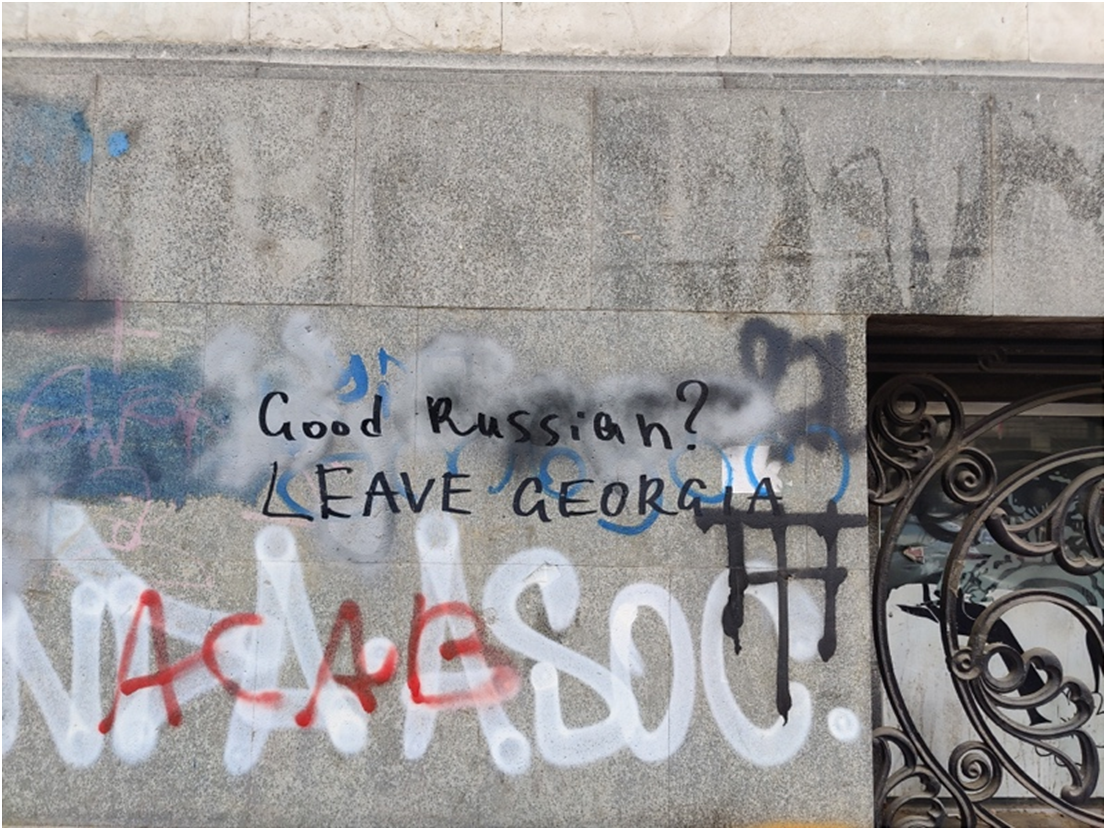
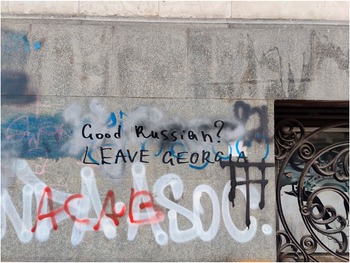
Since the start of the full-scale Russian invasion of Ukraine on 24 February 2022, several waves of migration from Russia have moved primarily to “near abroad” countries. Georgia has been one of the most visible destinations: two major waves followed in quick succession, the first in the spring of 2022 and the second in September after the announcement of military mobilisation. In Tbilisi, this sudden and highly visible arrival of Russian migrants has unfolded in a city where memories of Tsarist annexation, Soviet rule and the 2008 war already frame Russia as a recurrent imperial aggressor. Against this background, the new Russian presence has been met with unusually sharp public resistance. Urban campaigns deploying slogans such as “Good Russian? Leave Georgia” (Figure 1) and graffiti equating everyday Russian presence with a “third occupation” have circulated widely, attracting international media attention and differentiating Georgia from other host societies where similar migration flows have not produced such intense contestation.
Graffiti on the streets of Tbilisi, 2023 © authors.
At the same time, the material impact of Russian migration on the Georgian economy, social life and urban space has been significant and uneven. Transparency International reports that more than 26,000 companies were registered by Russian citizens between March 2022 and mid-2024 – almost four times the total number registered by Russians between 1995 and 2021 – with the overwhelming majority structured as sole proprietorships, suggesting long-term settlement plans. As early as in 2022 the Georgian economy began to be severely affected by Russian migrantsFootnote 2, who created increased demand for the real estate marketFootnote 3 especially in Tbilisi, against the backdrop of the existing economic dependence on Russia. The increased demand (both for rental and purchase) in the central Tbilisi provoked by the migrants from Russia squeezed out the residents, especially students. A number of students has been reporting in online groups the sudden dismissal of their contracts with the renters, during the increased waves of migration since Spring/Summer 2022. Many newcomers rely on incomes earned abroad, creating visible “Russian bubbles” of consumption and services operating partly in the grey zone and largely in RussianFootnote 4. New bars, cafés and bookstores target Russian-speaking publics and often operate primarily in Russian despite Georgian language legislation. Simultaneously, the Georgian government’s refusal to join sanctions against Russia, the re-opening of direct flights, and the controversial “foreign agents” (“Russian”) law have intensified domestic polarisation and reinforced public fears of renewed Russian influence. Although it has been argued that Russian emigration provides a much-needed stimulus to the Georgian economy, more and more sceptics are questioning the benefits of such an ostensible economic boostFootnote 5.
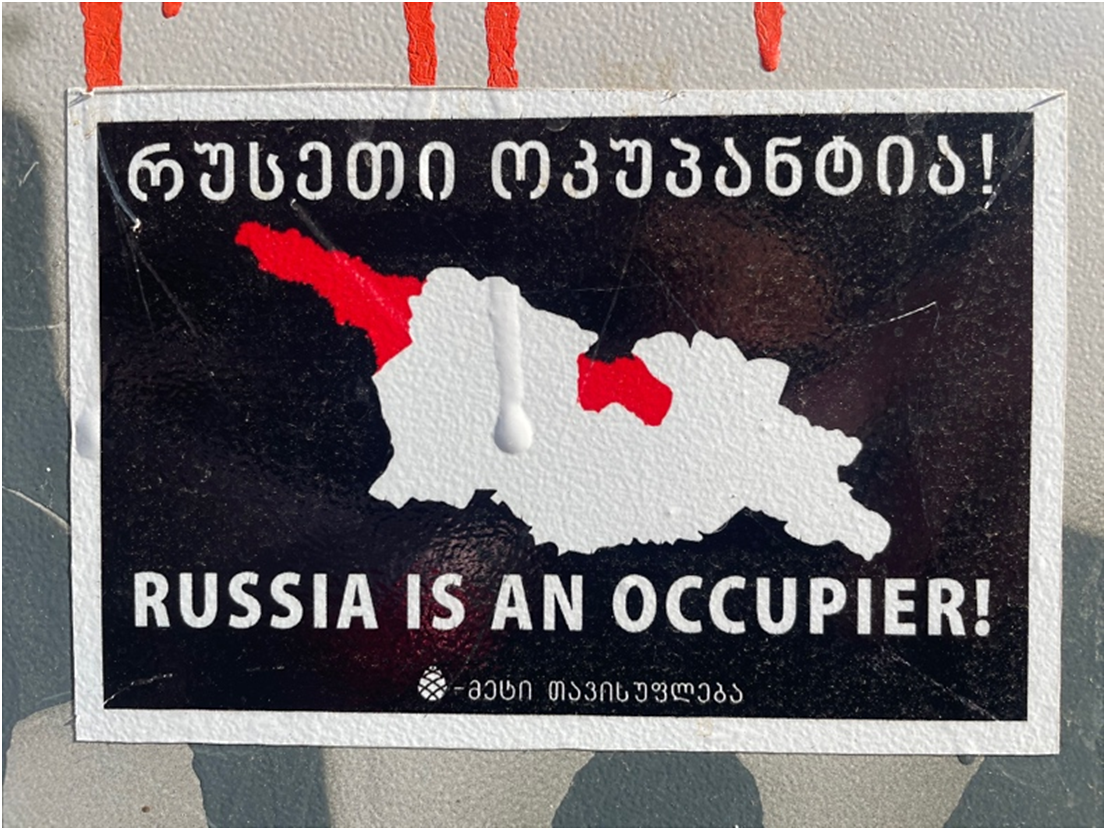
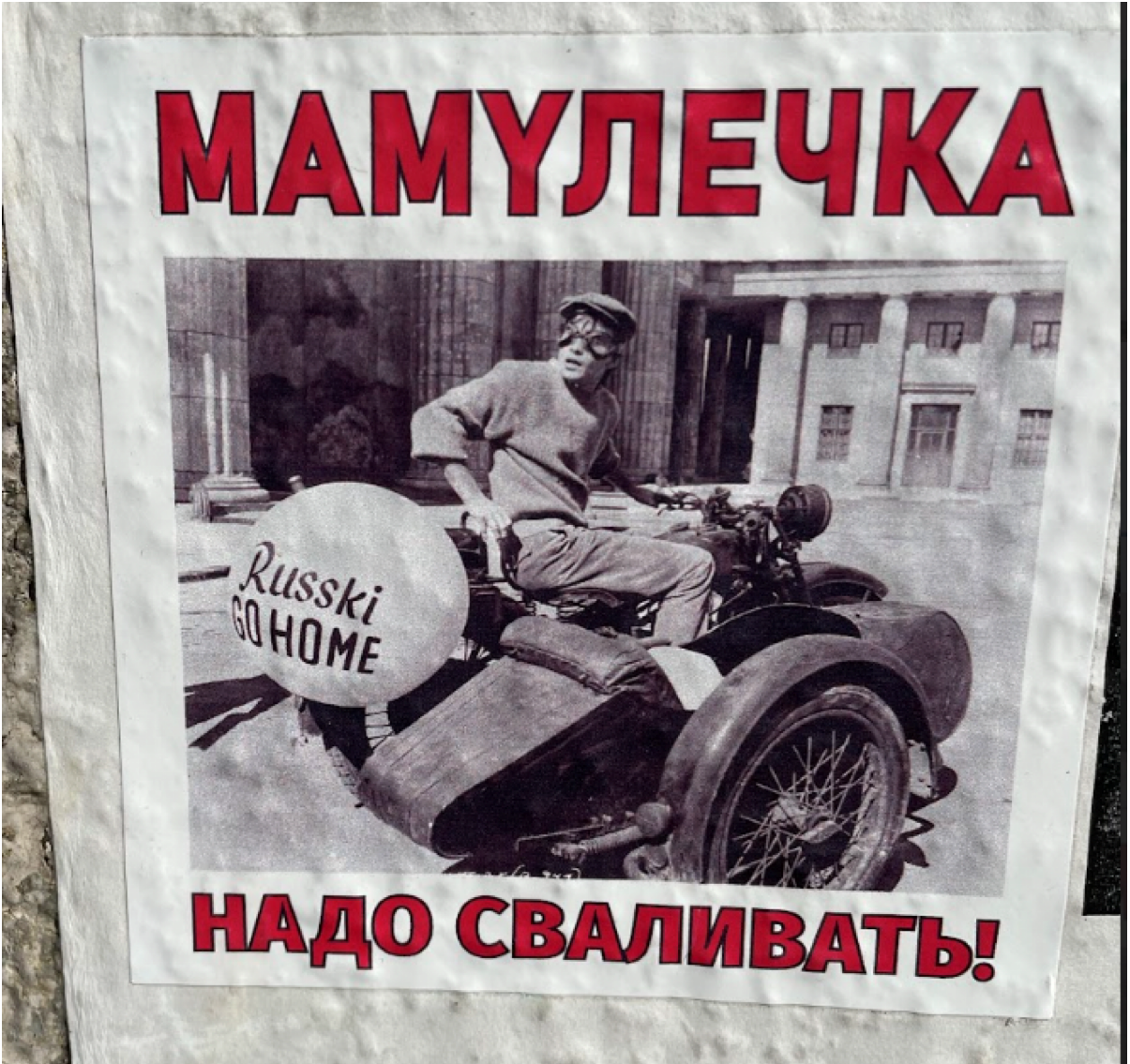
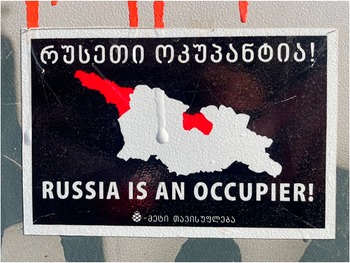
The majority of Russians in Georgia did not depend on income earned in Georgia in the first year of their emigration. The digital nomads and IT workers have continued to earn Russian or Western salaries despite their relocation, which created a significant wage gap between them and Georgian workersFootnote 6. As a result of these two factors, ‘Russian bubbles’ of consumption for the navigation of daily life in the Russian community have emerged, which have occurred in the economic grey zone. Russian social media groups have been flooded with both supply and demand for uncertified Russian babysitters, repair workers, drivers, teachers, and beauty masters who bypass the official economy and do not pay taxes. Apart from the development of the unregistered services “for Russians”, the Russians started to open so-called “third places” aimed at Russian migrants. The new emerging bars, bookstores, and coffee shops, which are targeted on Russians and run by them have been largely operating primarily in Russian language.Footnote 7 One of the Georgian journalists, Basti Mgaloblishvili, tried to address this issue through his article on PublikaFootnote 8 platform by checking whether he can get services in Georgian language in the “Russian” bars. Among the reactions to this are the numerous graffiti displaying slogans like “Russians go home” and “good or bad Russians, you are not welcomed” (Figure 2), the implementation of “visas” for Russians to enter the Dedaena Park barFootnote 9, “rules of behaviour” for Russians printed in front of the EZO bar, societal appealsFootnote 10, political discussionsFootnote 11 about visas for Russians.
Graffiti on the streets of Tbilisi, 2023 © authors.
In 2023 and 2024, political tensions in Georgia continued to escalate as the government pushed forward the so-called “Russian law” against the backdrop of sustained street protests. During this period, the growing physical presence of Russian migrants in Tbilisi became closely entangled with public opposition to the government’s perceived pro-Russian orientation. The situation shifted markedly after the October 2024 elections, when public unrest increasingly focused on rising political repression and a pronounced turn away from the European course. In this new context, narratives surrounding the presence of Russian migrants became less prominent, while a significant number of Russian citizens left Georgia, fearing repression and the country’s growing alignment with Putin’s government. These political developments shape the temporal scope of this article, which draws on empirical material collected between spring 2022 and autumn 2024.
Research questions, methods, and analytical framework
The main research question that this article asks is why in Georgia the resistance towards Russian migrants developed, why to that extent, and why equally towards the “Good Russians” who explicitly were in the political opposition to the Putin’s government. To tackle this overarching research question the study focuses on two main sub-questions:
-
1) What are the historical and political preconditions that inform the current tensions and resistance, and why they are so distinct in Georgia of all other destinations of Russian emigration?
-
2) How are Russian migrants’ everyday presence and practices perceived and interpreted as forms of “neo-imperialism” and a “third occupation” by young, pro-Western Georgians, regardless of migrants’ political stance?
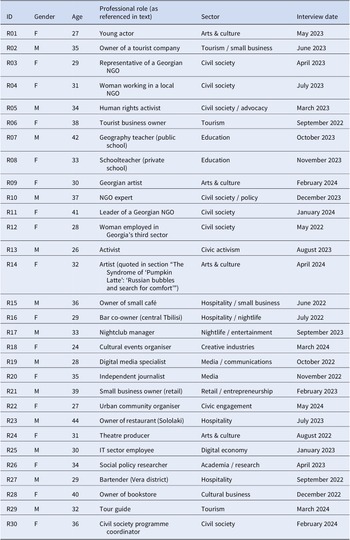
This article uses qualitative methods, informed by an interdisciplinary approach: by combining ethnographical, including digital, and sociological methods. It is based on the extensive periods of the participatory observations in Tbilisi conducted by authors in 2022, 2023 and early 2024; following the online groups for Russian migrants on social media (“Verhniy Lars”, “Georgia expats”, “Zhiteli Tbilisi”, “Russkie v Tbilisi”, “Mi iz Saburtallo”), and discussions there, and on 30 semi structured interviews with Georgian residents (see Annex for the anonymised table of participants). The people we have been interviewing represent a very specific social group: young, urban, pro-European Georgians, primarily based in Tbilisi and working in sectors such as civil society, the arts, digital media, and the service economy. This cohort was selected as they are active agents in shaping public discourse among young residents of Tbilisi, and have been central in the production of the “anti-Russian” urban forms of resistance, and narratives. Furthermore, they are often the most exposed to daily interactions with Russian migrants in professional and social spaces. Their perspectives, while not universally representative, are particularly valuable for studying the emerging neo-imperial narratives in everyday life and how they are informed by historical memory, identity politics, and urban geographies. This demographic also aligns with the broader literature on “post-colonial publics” – those segments of society most engaged in constructing alternative narratives to colonial power (Gunko Reference Gunko2023; Tlostanova Reference Tlostanova2012). In this sense, these voices are critical to grasp what is perceived as the Russian “negative-” or “neo-imperial” influence on the everyday life in Tbilisi, and what aspects of the individual and collective behaviour have been perceived as “occupation”.
The interviews that we have been conducting offline have been semi-structured; we have been focusing on: (1) general attitude towards presence of the Russian migrants; (2) how that has affected their everyday life, life in the city and in their neighbourhood; (3) what are the expectations from the Russian migrants. When and if narratives of “imperialism” or “occupation” towards the Russian migrants, or references to the historical contexts, would start to occur we would go deeper in that direction, asking what exactly they mean about that.
For both of the researchers involved in this article the questions of positionality, ethics, and self-reflectivity have been of high importance. Sofia Gavrilova, originally Russian geographer scholar, working in the German Academia have published an extensive self-reflective essay on that question (Gavrilova Reference Gavrilova2024). She talks in detail about her experience of “othering” Russian emigration, and to which extent their own political position influences the choice of the topic for this article. Tamara Margvelashvili, as a Georgian co-author of the article, acknowledges that their personal background and experience connected with the Russian aggression affects their perception of the Russian migrants. However, both researchers truly believe that they have done a lot to gain the balance in both the research design, selection of the interviewers and interpreting the narratives.
This article adopts a decolonial/postcolonial perspective as a theoretical lens for interpreting how post-Soviet publics make sense of social and spatial changes associated with contemporary Russian emigration. This lens is not used to posit a direct causal explanation for specific outcomes; rather, it provides a conceptual frame for understanding how historical hierarchies and public memories continue to inform present-day interpretations. Approaching the post-Soviet space through the lens of coloniality enables us to conceptualise why particular individual or collective social strategies, practices, or social formations may become interpreted as markers of renewed domination, even when no state-directed imperial project is present, or when individuals are in the opposition.
Central to this approach is the distinction between colonialism, as a historical structure of domination, and coloniality, which refers to the persistence of linguistic, cultural, and epistemic hierarchies long after the end of formal imperial rule (for more on that please refer to Mignolo Reference Mignolo2013). Coloniality foregrounds how certain forms of knowledge, cultural authority, and communicative practices have retained their privileged status in the region and continue to shape perceptions of legitimacy, centrality, and hierarchy.
The framework emphasises how historically sedimented hierarchies structure the interpretive environment within which contemporary mobility, presence, and socio-cultural visibility are evaluated. In this sense, the focus is not on migrants’ intentions or behaviours themselves, but on the historically produced conditions that make certain interpretations – such as “neo-imperialism” – more thinkable, resonant, or politically salient than others.
Crucially, this mechanism is not universal across the former Soviet region. Its strength varies according to the political and mnemonic environments. In contexts where decolonisation and desovietization projects, de-Russification policies, and projects on reshaping the collective memories played a central role in national identity formation after the collapse of the Soviet Union, the interpretive field is more strongly oriented toward reading the migration waves through anti-imperial and post-colonial narratives. Conversely, in settings characterised by entrenched multilingualism, weaker decolonial discourses, or a more pragmatic relationship to the Soviet past, such interpretations are less likely to crystallise. These scope conditions clarify where the theoretical lens is most analytically productive and where its explanatory power is likely to be more limited.
By positioning coloniality as an interpretive framework, this article builds a conceptual foundation for understanding how post-imperial hierarchies shape the reception of contemporary migrations without presupposing a single political logic or empirical outcome. This framing enables the subsequent analysis to examine how specific interpretations emerge, gain traction, or become contested across different post-Soviet contexts.
Historical and Political Preconditions
The contemporary tensions surrounding Russian emigration to Georgia must be understood within the long and entangled history of Russian–Georgian imperial, Soviet, and post-Soviet relations. For over two centuries, mutual perceptions of “Russianness” and “Georgianness” have been shaped by asymmetrical encounters and competing representational regimes (Scott Reference Scott2017). Russian imaginaries framed Georgia as an exotic, underdeveloped Oriental periphery awaiting civilization under Russian tutelage (Layton Reference Susan2009, Reference Layton2021). Yet Georgian intellectuals inverted this colonial gaze: from the nineteenth-century national revival onward, they portrayed Russia as despotic, backward, and Asiatic, positioning Georgia as inherently closer to Europe (Jones Reference Jones2014; Suny Reference Suny1994; Smith Reference Smith1998). This produced a paradoxical situation in which both sides viewed themselves as more “European” than the other. Such contradictory yet mutually reinforcing narratives laid the groundwork for a deeply contested relationship over identity, cultural hierarchy, and political belonging.
The Soviet period entrenched these dynamics further. Official narratives promoted the myth of “Sunny Georgia” – a picturesque, loyal borderland, the ultimate tourist destination, celebrated for hospitality and wine, yet stripped of political or intellectual agency (Maisuradze Reference Maisuradze2015). Simultaneously, Russia was cast as the benevolent “big brother,” reinforcing a paternalistic hierarchy (Batiashvili Reference Batiashvili2022). By the late Soviet era, however, Georgian nationalists increasingly reinterpreted the Soviet project as a continuation of Russian imperial domination. The early 1990s therefore saw a powerful push for de-Sovietization as decolonization, aligning Georgia with Baltic and Ukrainian trajectories rather than with Russia or Belarus (Blacker and Etkind Reference Blacker, Etkind and Fedor2013; Plokhy Reference Plokhy2008; Onken Reference Onken2007). Georgia became one of the few post-Soviet states to construct an explicit historical narrative linking Tsarist annexation, Soviet governance, and contemporary Russian policies as parts of one overarching imperial continuum (Broers Reference Broers2005).
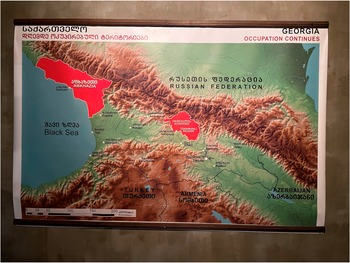
A decisive moment in consolidating this narrative was the 2008 Russo–Georgian war, which transformed latent historical grievances into an immediate experience of renewed violence and territorial loss. The occupation of Abkhazia and South Ossetia/Tskhinvali region and the subsequent discourse of the “creeping occupation” (Toal and Merabishvili Reference Toal and Merabishvili2019) deepened the perception that Russian power was not only historical but ongoing, encroaching, and territorially expansive (Toal Reference Toal2017; Kuzio Reference Kuzio2002). The war is often narrated as the continuation of imperial domination rather than as a discrete geopolitical conflict. Memory institutions – including the Georgian National Museum (Figure 3), and local museums along the occupation line – visually and narratively integrate images from the 2008 war into exhibitions on Soviet occupation, fusing Imperial, Soviet, and post-Soviet aggression into a single storyline of subjugation and resistance. In public consciousness, the 2008 war functions as a linking hinge that brings older imperial and Soviet oppression into the present, making historical memory feel immediate, unbroken, and politically actionable.
The map of occupied Abkazhia and South Ossetia/Tskhinvali in the National Museum, floor dedicated to the Soviet Occupation © authors.
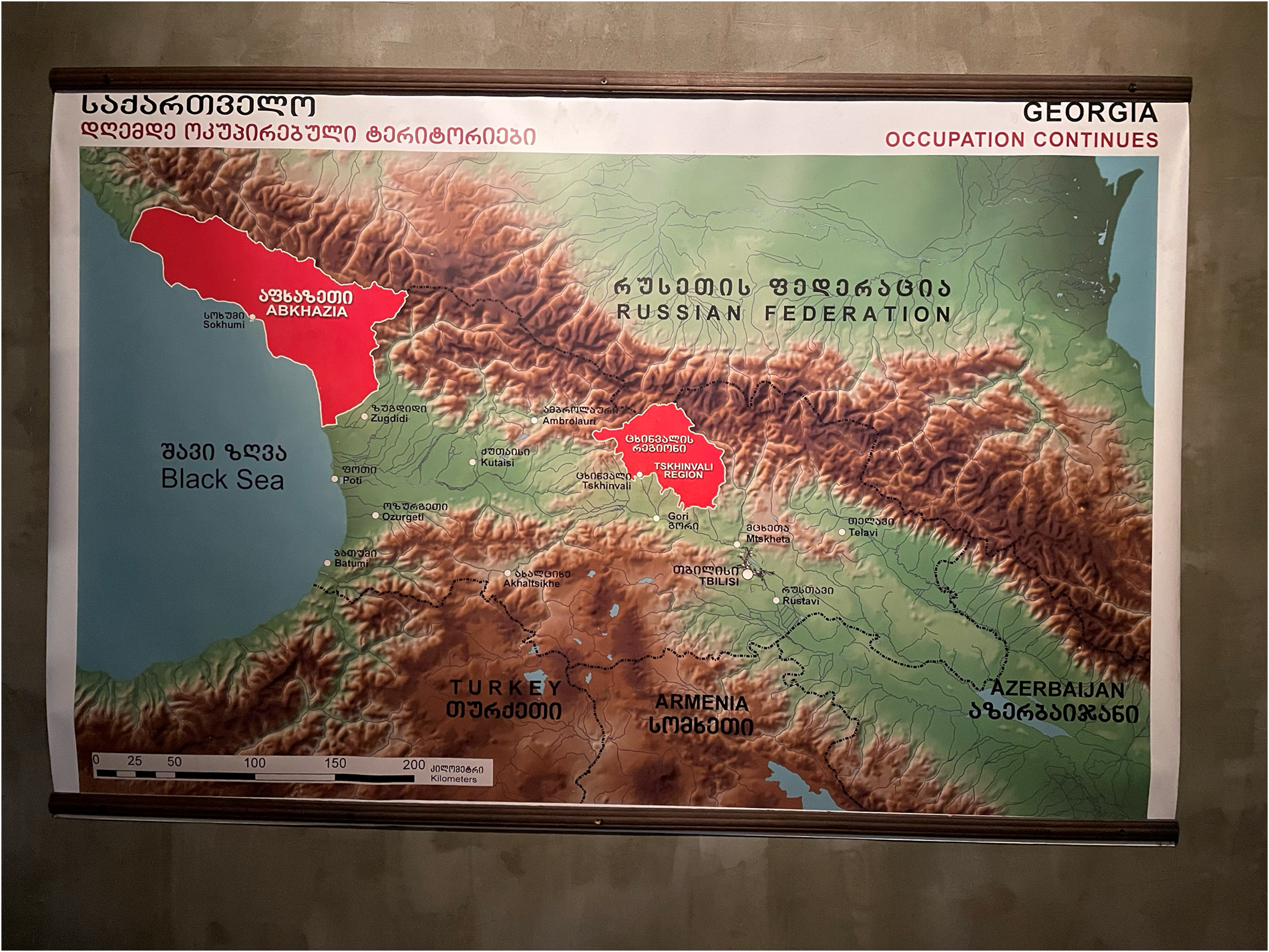
Figure 3. Long description
A topographic wall map titled GEORGIA OCCUPATION CONTINUES in the top right corner. The map uses green for lowlands and brown for mountainous terrain. Two regions are highlighted in solid red.
* In the Northwest, the coastal region of Abkhazia is red, with the city of Sokhumi labeled.
* In the North-Central area, the Tskhinvali Region is red, with the city of Tskhinvali labeled.
* To the West is the Black Sea.
* To the North is the Russian Federation.
* To the South are Turkey and Armenia.
* To the Southeast is Azerbaijan.
Major Georgian cities are marked with white dots and bilingual labels, including Zugdidi, Kutaisi, Poti, Batumi, Gori, and the capital, Tbilisi, in the South-Central region. A scale bar at the bottom left indicates distances up to 200 kilometers. The top left of the map contains Georgian script in black and red text.
These memory practices, alongside the distinct post-Soviet historical narrative produced a powerful post-Soviet anti-colonial identity. State policies, street renaming, the demolition of Soviet monuments, and cultural projects dedicated to “occupation” reinforce the narrative of a nation continually resisting Russian domination (Makarychev and Yatsyk Reference Andrey and Yatsyk2016; Spetschinsky and Bolgova Reference Spetschinsky and Bolgova2014).
Importantly, this narrative is not limited to the past: it structures EU-integration discourses, civic activism, and political mobilization. In this interpretive landscape, Russian actions – whether military, political, or symbolic – are sharply attuned to the logic of ongoing imperial pressure.
This historically saturated environment also shapes how contemporary Russian migrants are perceived. Russian migrants – regardless of their political stance – become interpreted not as individuals but as embodied reminders of a centuries-long continuum of domination. In this context, everyday encounters with Russian language, visibility, or spatial clustering resonate with layered histories of occupation and trauma. The clash of Russian and Georgian historical narratives – each deeply internalised and institutionally reproduced – creates the preconditions for intensified urban contestation, anti-Russian graffiti, and civic demands for boundaries, rules, and vigilance. The 2008 war, as both a violent rupture and a contemporary touchstone, ensures that imperial memory is not abstract but lived, forming an essential backdrop against which the arrival of Russian migrants is interpreted in Tbilisi today.
Together, these historical layers crystallise into a lived coloniality that structures how young Georgians perceive hierarchy, legitimacy, and threat in the present. This coloniality does not operate abstractly but informs how language, space, and social behaviour are read and evaluated in daily life. The empirical findings that follow trace how this interpretive field becomes articulated through personal narratives, urban practices, and emerging forms of resistance toward Russian migrants in Tbilisi.
Unwelcome guests: Russian Migrants and the “Recolonisation” of Tbilisi
Against the backdrop described in the previous section, the arrival of large numbers of Russian migrants after 2022 became immediately entangled with memory of recent hierarchies of language, visibility, and cultural authority and triggered anxieties of their reappearance. Rather than being read simply as newcomers fleeing an authoritarian regime, Russian migrants were interpreted through the coloniality already embedded in Georgian historical memory. The empirical material, presented in the sections that follow, traces how these perceptions take shape in everyday life, focusing on three key domains: (1) the interpretation of linguistic and cultural practices as neo-imperial behaviour; (2) tensions surrounding lifestyle, consumption, and spatial presence in central Tbilisi; and (3) the emergence of geopolitical anxieties and fears of renewed occupation. Through these narratives, we demonstrate how Russian presence becomes socially meaningful not through the intentions of migrants themselves, and might be not reflected and seen as such, but through the interpretive field produced by Georgia’s post-imperial condition.
Linguistic coloniality and cultural hierarchies in everyday life
One of the first points that comes up in the interviews is the issue of language. In a context marked by a long history of domination of Russian language, it becomes one of the clearest everyday signs of coloniality: it is through the use of Russian language that almost all of respondents first recognise and interpret Russian presence as (neo)imperial.
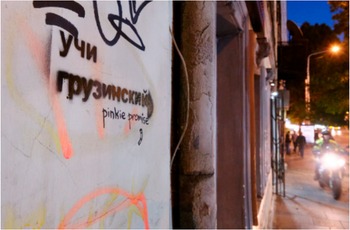
The predominance of the Russian language in the city settings, which has a long tradition of forcing out Georgian in education and culture in Imperial and Soviet times, usually relates to public spaces and signboards outside restaurants, galleries, and bars. This is particularly visible in the central areas of Tbilisi (Sololaki, Vera, and Vake), where a lot of Russians moved to (Gurchiani Reference Gurchiani2025). The narratives our respondents use to explain what feels wrong or uncomfortable are centred on the idea that Russians do not fully acknowledge or understand that “this is not Russia,” and that “Georgians do not want to speak Russian.” (Figure 4). Here, linguistic coloniality is experienced not in abstract terms, but as the felt displacement of Georgian from spaces where it is expected to be central.
The graffiti in Russian on one of the central streets of Tbilisi saying “Learn Georgian” © authors.
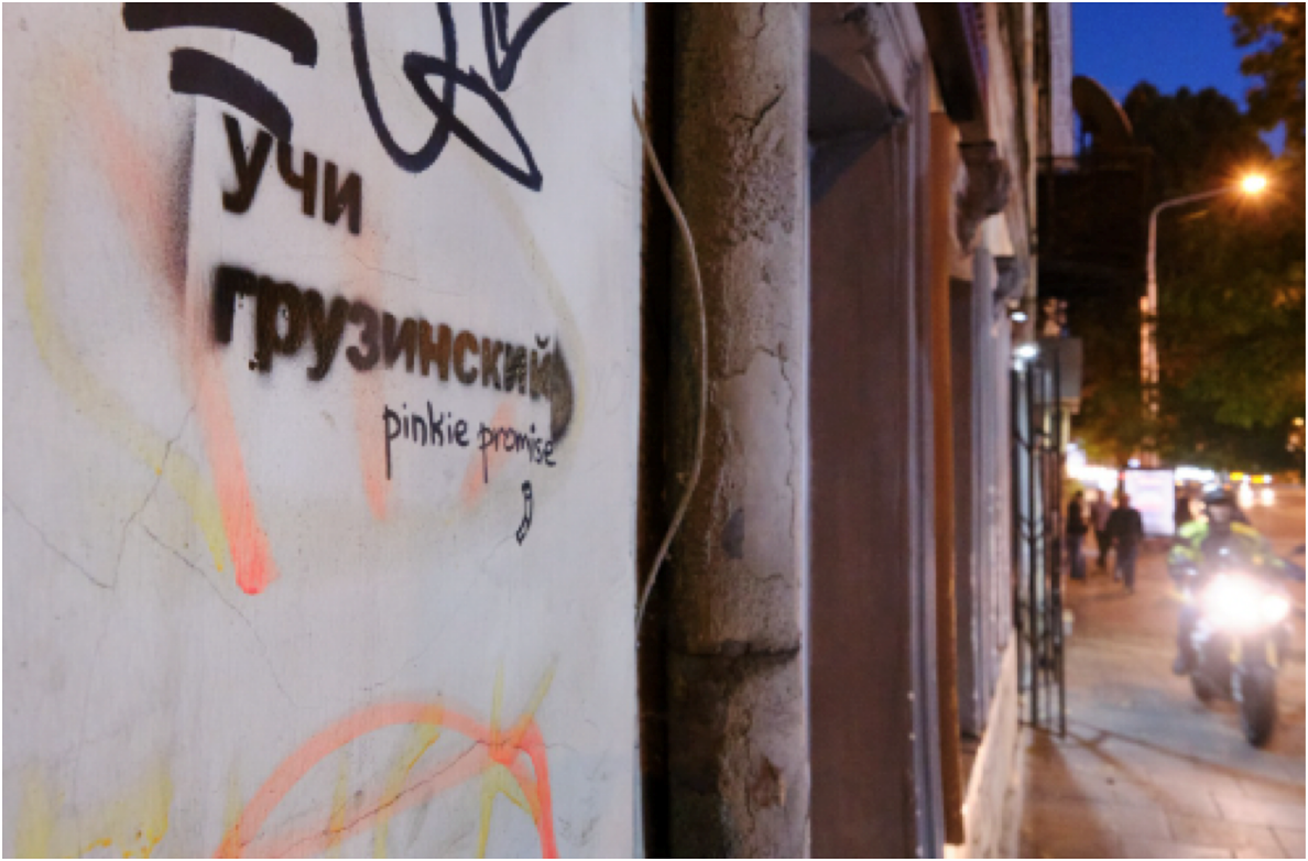
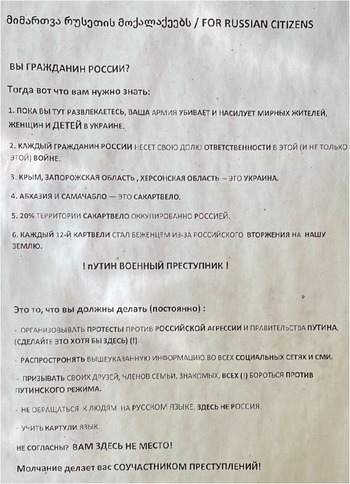
The dominance of the language spoken on the street among Russians themselves is closely connected with everyday practices and lifestyle described in the following sections, as well as with security anxieties. When it comes to the use of language in day-to-day communication between Georgians and Russians, all respondents share a similar position: defaulting to Russian is considered unacceptable. A young actor (R1) recalls: “I worked in a coffee shop, and that was the first time when a customer started talking Russian with me and did not switch to English when I said I don’t speak Russian. He was angry and left.” Almost all of respondends describe such behaviour as “imperial” and interpret it as a form of conscious arrogance; however, they make a distinction with regard to the older generation of Russians and kids, whose use of Russian is sometimes seen as less intentional and more habit-based. This narrative is doubled by numerous graffiti in the city and by being one of the main “rules of behaviour” for Russians displayed in some bars and restaurants in central Tbilisi (for example, the note in EZO café saying: “Don’t speak Russian, it’s NOT Russia” (Figure 5). In these micro-encounters, we can see how coloniality is embodied in everyday expectations about who has the right to set the linguistic terms of interaction.
The “rules of behaviour” in Russian in the Ezo bar.
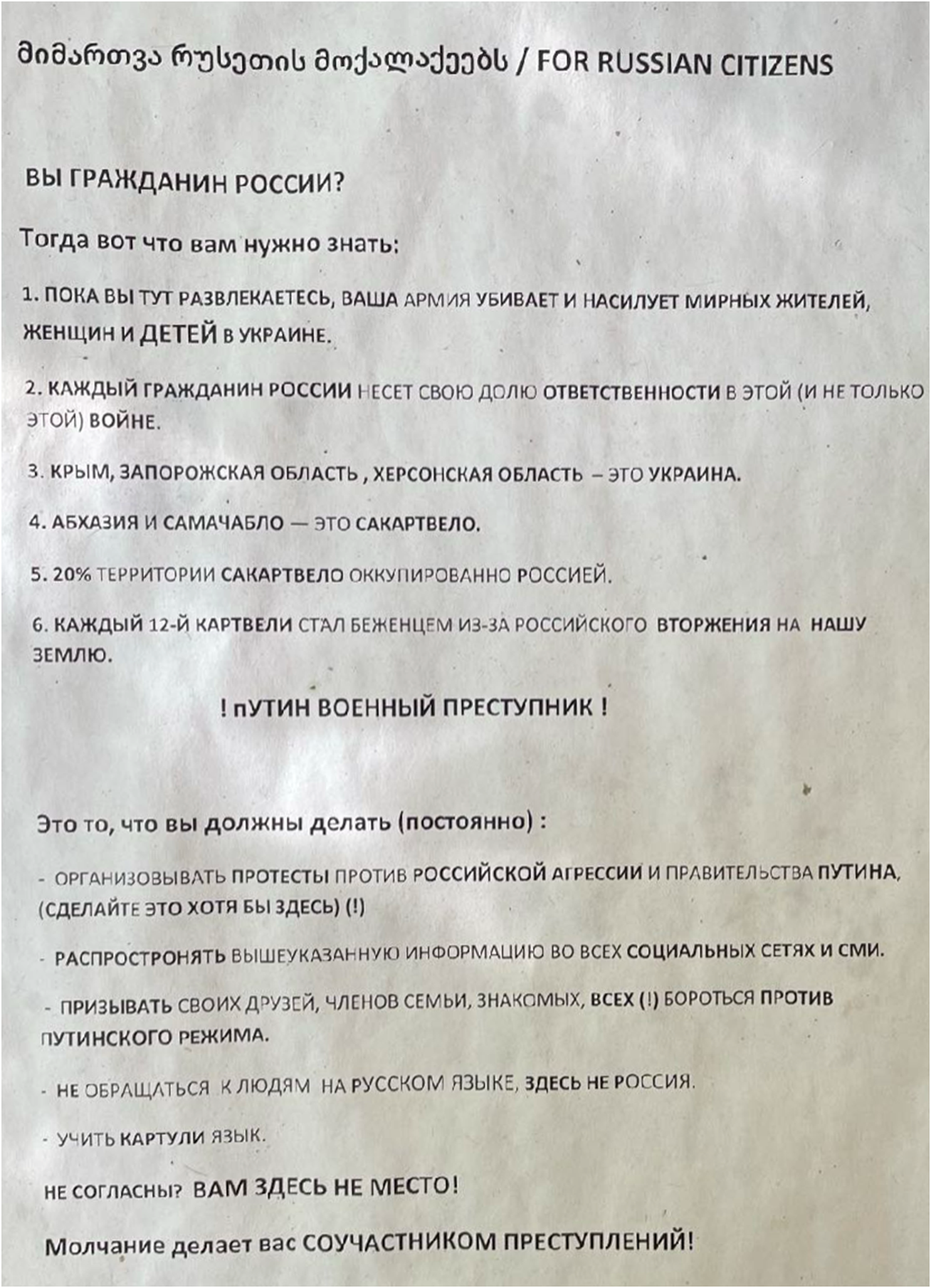
Figure 5. Long description
The document begins with a header in Georgian followed by a forward slash and the English text FOR RUSSIAN CITIZENS. Below this, the text asks in Russian if the reader is a Russian citizen and states there are things they need to know.
A numbered list follows.
1. States that while the reader is having fun, their army is killing and raping civilians, women, and children in Ukraine.
2. Asserts every Russian citizen bears responsibility for this war.
3. Declares Crimea, Zaporizhzhia, and Kherson regions are Ukraine.
4. Declares Abkhazia and Samachablo are Sakartvelo, which is Georgia.
5. States 20 percent of Georgian territory is occupied by Russia.
6. States every 12th Georgian became a refugee due to the Russian invasion.
A centered line between exclamation marks reads Putin is a war criminal.
The next section titled This is what you must do constantly includes bullet points.
- Organize protests against Russian aggression and Putin's government.
- Spread this information on social media and mass media.
- Call on friends and family to fight against the regime.
- Do not address people in the Russian language because this is not Russia.
- Learn the Georgian language.
The notice concludes by stating that if the reader does not agree, they have no place here, and that silence makes them an accomplice to crimes.
Several respondents also pointed out that the exclusive use of Russian in services organised by Russians blurs the boundaries of Georgian lawFootnote 12. The Georgian Law on the State Language states that “the service user has the right to request and receive information in the state language”Footnote 13, and not knowing Georgian cannot be a reason for refusing to provide services (R2, R26, R30, R16). However, despite that, a lot of small cafes and bookstores, as well as centres for additional education for kids which appeared immediately, have been operating in Russian language. One respondent, the owner of a tourist company in Tbilisi, (R6) notes: “Georgians are not always good at following the law. When they see that Russians can break it, they think, well, now we can do it too.” The issue of using Russian and its dominance is therefore seen not only as a cultural problem but also as a legal and political one, closely connected with questions of security and governance (see the section below on anxiety). The spread of Russian is named as one of the three most impactful changes brought by migration (alongside the changing voting landscape and economic impact) by the leader of a Georgian NGO. The other interviewee connects the language dominance with possible broader cultural dominance: “The problem is that the Russian language is not only starting to be used in day-to-day business operations; it is the marker of the so-called Russian world. Where Russian people are, where Russian businesses are, where Russian language is – those are the ingredients of the Russian world. Language is one of the markers of an independent country; if we speak Russian, we become an extension of the Russian world.” (R 08). In this sense, language is perceived as an (neo) imperial practice and as a key symbol of the “Russian world,” regardless of what political strands its user holds to.
While respondents criticise Russian communities for using Russian and Russian-language signs in public spaces, they also confront Georgian businesses that have not refrained from using Russian and, instead, contribute to the adaptation and normalisation of Russian by providing services in Russian and using it in menus, advertisements and online platforms. Several interviewees agree that there is no shared understanding or collective effort to oppose the spread of Russian; resistance appears mostly at the level of individual initiatives, such as graffiti or informal rules in particular venues as described above.
Another cluster of narratives around language concerns expectations of integration on the part of Russian migrants. Most interviewees agree on the importance of Russians integrating into the local community economically and socially and give examples of the negative effects of isolating ethnic minorities within Georgia, while still recognising differences between contexts. Learning Georgian is widely seen as the most important aspect of integration – a sign of respect and sensitivity to the local context – but not something that can be made formally obligatory. Here, the demand is less about fluency and more about symbolic gestures that acknowledge Georgian cultural and linguistic centrality and counteract inherited hierarchies of coloniality.
The question of language is also closely connected to education and cultural expansion and thus evokes Imperial and Soviet educational policies in Georgia, where Georgian society was framed as needing enlightenment in alignment with broader Soviet modernisation project (Tlostanova Reference Tlostanova2012). During the interviews, several respondents talked about the persistent perception of Russian culture as “advanced” and the circulation of stereotypes that associate knowledge of Russian with erudition and higher status in contemporary Georgian settings. “We all remember the times – and it is still the case in Azerbaijan and partly in Armenia – when knowing Russian in a family was a sign of erudition. It is similar to Russians speaking French in their families. The risk of such tendencies coming back is not so far. Having a Russian nanny for kids was seen as a sign of intelligentsia,” explains a woman working in a local NGO. This reveals how cultural and linguistic hierarchies built under empire continue to shape aspirations and self-understandings, even among those who are critical of Russian politics.
The cultural expansion of Russians in Tbilisi is often described by interviewees as an (neo)imperial tool and as a way of performing a more “civilised” lifestyle, and therefore connected to arrogance. One respondent (R17) relates this not only to Georgia but to the South Caucasus more broadly: “I was in Yerevan recently and wanted to buy a book for my mother. It was by the Russian author Vladimir Sorokin. I did not know this bookstore was owned by Russians, but I understood soon, because when I asked about this book, the owner replied to me saying: ‘No, these people don’t read such serious stuff,’ implying Armenians. Maybe this is not something that needs much attention, but this is their attitude, that they are predominant and want to make us all more civilised,” a representative of a Georgian NGO states. Russian activism is, in some cases, also characterised as imperial, not sensitive to the needs of the local society and “parachuted” from Russia (Bronnikova et al., Reference Bronnikova, Gavrilova and Margvelashvili2025). A Russian queer initiative, for instance, organised an event claiming to host the first event of this kind in Georgia, completely ignoring the existing work of local organisations. A Georgian artist (R09) comments: “What stood out to me the most is that I never witnessed any sign of appreciation towards the local community that offered them a safe place. Any activities or events organised by Russians (clean-ups, recycling, stand-up events, concerts) carry this idea of ‘educating’ or improving the local society to modern standards, rather than giving back to the community and contributing.” Such examples illustrate how the “civilising mission” at the heart of coloniality reappears in contemporary activist and cultural practices.
Another issue connected with language raised by respondents is the gradual dominance of Russian in online spaces. Social networks and platforms such as YouTube and Instagram have started to propose content and commercials in Russian. “Even I, who never listens to Russian videos, receive suggestions on YouTube, see Russian commercials on Instagram, etc. I don’t recall this happening before,” says a woman employed in Georgia’s third sector (R12). The digital sphere, too, becomes a site where Russian language visibility is experienced as intrusive and as evidence of growing Russian influence.
To sum up, the use and spread of the Russian language is one of the most prominent issues raised in interviews and is mirrored in graffiti in central Tbilisi and in multiple “rules of behaviour” for Russians. The increasing presence of Russian language in the cityscape generates security concerns and is perceived as imperial arrogance and a sign of presumed superiority over Georgians. Connected to the language issue is what Gunko calls “a gaze of a giver” (Gunko Reference Gunko2023): the overtaking of cultural and social agendas and the imposition of educational and enlightening programmes. This is a very familiar Imperial and later Soviet pattern of “enlightening backward nations,” which was part of established policies of modernisation and Sovietisation of the republics. In a city that still partly relies on Russian tourism and post-Soviet service economies, the renewed visibility of Russian language reactivates these colonial hierarchies in particularly painful ways, turning everyday encounters into affective reminders of dependence, subordination, and unresolved historical trauma. In our material, linguistic practices and cultural projects by Russian migrants are read through exactly this coloniality-inflected lens, turning everyday language use into a key marker of neo-imperial presence.
Everyday encounters. Between Occupation and Tourism
Sociologists of Russian migration show that many Russians who arrived in Tbilisi did not have a clear understanding during their first years whether they would stay in Georgia, nor were they economically and socially integrated (Kamalov et al. Reference Emil, Ivetta Sergeeva and Zavadskaya2022). That uncertainty created a very specific lifestyle, which was interpreted by many Georgian respondents as privileged and visibly distinct, often becoming an early site where coloniality was perceived to manifest in everyday lifeFootnote 14. This lifestyle was not read through intentions or political positions, but through its outward, embodied visibility in urban space. In what follows here we asked our respondents to reflect on what exactly in the encounters perceived so negatively and why.
One of the first things our respondents noticed about newcomers is how they stood out through their signature style of clothing, piercings, and tattoos. Public display of expensive brands and electronic devices became, for many respondents, markers through which Russians were recognised and interpreted. “For me the typical prototype of a Russian in Georgia is a little dog chihuahua and a yoga mat in the park. The wealthy attributes like Bluetooth earphones, everything very styled. If you notice that someone is a bit more casually dressed and is a punk or a hipster, even such styles include attributes of good quality. Everything about their style tells you it is expensive,” underlines one of our respondents (R15). At the same time, respondents say that the Russian presence and youth culture affected the way young people in Tbilisi spend time, especially with regards to behaviour in public spaces, for example, the culture of picnicking. As one interviewee (R17) noted: “I noticed that the Russian community was not just picnicking and laying around like Georgians. Everything was very organized and stylish… the food properly packed in picnic baskets, a little chihuahua sitting quietly next to the blanket, a child in a small chair.” Respondents described this style of picnicking as very different from local practices and read it as an imprint of an outsider lifestyle that, in their eyes, subtly reorganised public culture.
In the Georgian context, these visible markers of comfort and distinction – stylised leisure, expensive attributes, and the concentration of everyday life within familiar social circles – were not read simply as signs of class or taste. Rather, they became legible as forms of spatial and social presence that echoed earlier experiences of imperial dominance, where privilege, visibility, and centrality in the city had historically been associated with occupation. The formation of Russian “bubbles” in public space thus operated as an interpretive bridge between lifestyle and geopolitics: everyday practices of gathering, consuming, and inhabiting central neighbourhoods were folded into a broader historical vocabulary in which occupation is understood not only as military control, but as the gradual normalisation of an external presence that reshapes urban life.
Apart from the language issue described previously – which constitutes an important part of how Russian presence is spatially perceived – respondents repeatedly described a sense of Russians “taking over” places, whether through businesses, cultural projects, or group behaviour in public. Russian dominance in parks, cafés, and bars was often noted and read as reflective of their privileged mobility and economic independence: “Are they working at all, or only sitting around with their phones? Do they live here? Are they tourists?” asked R14. This visibility was frequently described as a form of “occupation,” a term that does not claim actual political intent but reflects how respondents make sense of spatial concentration and behavioural distinction. The central districts – Vake, Sololaki, Mtatsminda, and Vera – were most often described as “occupied,” a perception mirrored in the graffiti across these neighbourhoods.
It is through this lens that the discourse of occupation in relation to Russian everyday life and presence in the city emerges across a variety of interview contexts. “What can I say? We experience the third occupation. First, during the Russian Empire, then with the Soviet Union, and now with the Russian Federation,” a geography teacher from a public school told us at the outset of the interview (R07). Here, Russian practices in public space are not judged in isolation but are filtered through long-standing historical narratives that link visible privilege and spatial dominance to imperial power, amplifying even mundane behaviours into perceived signs of renewed occupation. As a result, the label of “occupiers” is applied regardless of migrants’ political positions. Graffiti in the city stating that even “good Russians” should leave Tbilisi reflects this logic: respondents explained such messages as attempts to curb the growth and normalisation of Russian presence before it consolidates into a more enduring form.
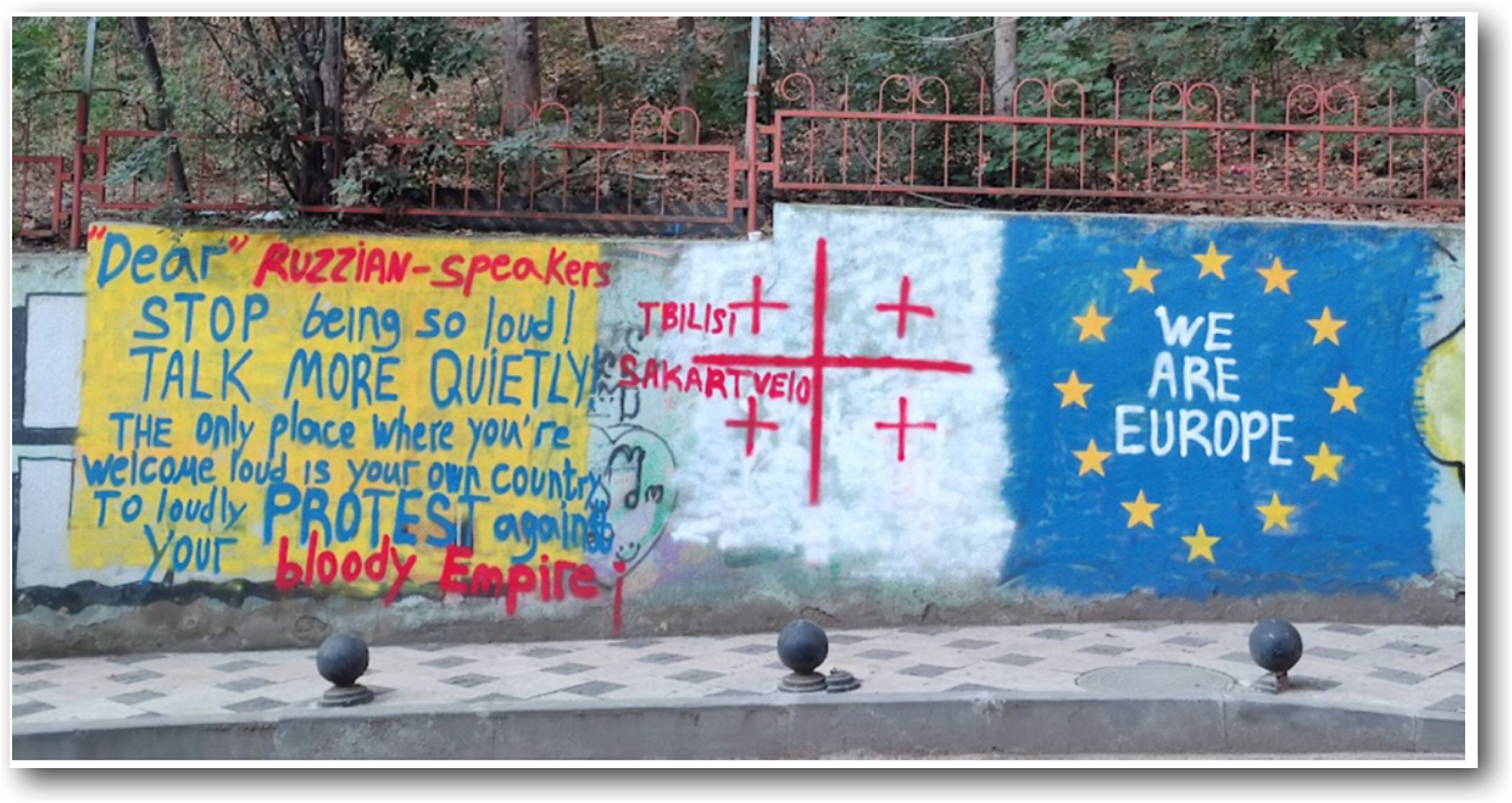
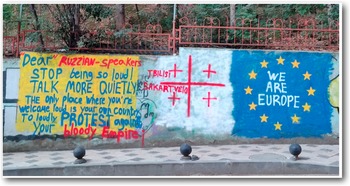
Beyond physical occupation, respondents pointed to loudness and visibility as salient cues. Many emphasised that Russians “make themselves visible and dominant” in city spaces. “I can easily recognize if it is Russian going on the street… They are loud, they use all the street so nobody can go along with them,” says the owner of a tourist company (see the graffity on the Figure 6). Here, behavioural differences become charged with meaning through the coloniality lens, where noise, assertiveness, or confidence are interpreted as signs of entitlement or cultural centrality. “It seems like they talk with exclamation points!” one human rights activist said (R13). “They love to instruct you towards order… They love to give remarks.” A tourist business owner added: “Russians always know better about everything. About Georgian culture, history. They correct the guide all the time.”
The graffiti on the Vilnius square.
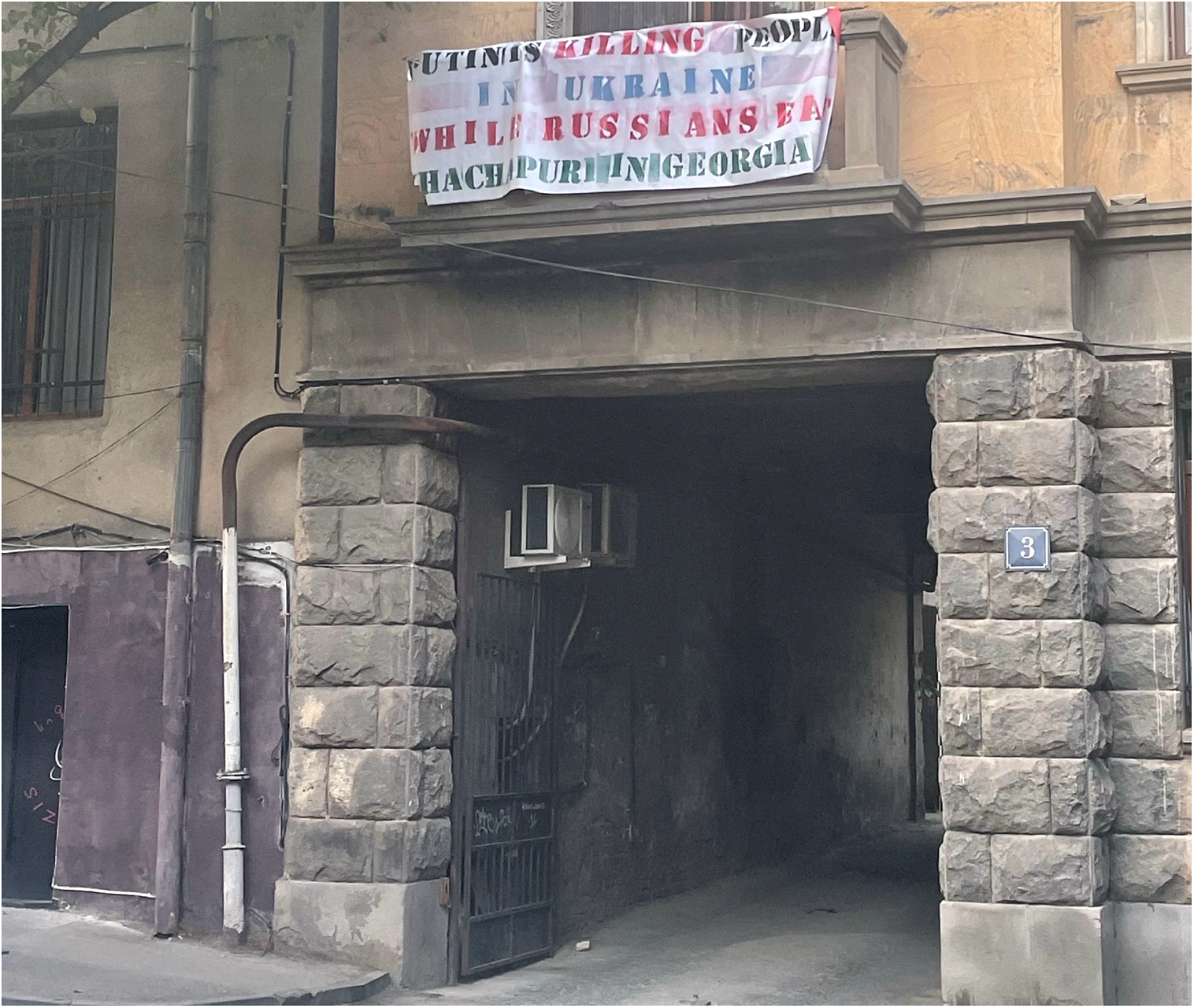
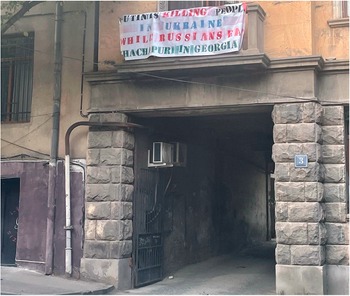
Respondents frequently criticised loud parties hosted by Russians in bars and restaurants, especially during the weeks when news of Bucha or Mariupol was circulating, as the famous anti-Russian slogan put it: “Putin is killing people in Ukraine, while Russians eat khachapuri in Georgia” (Figure 7). The juxtaposition of leisure and war – when viewed through historical trauma – triggers interpretations of indifference and symbolic domination. These concerns intertwined with anger about the lack of political protest from Russian émigrés. “We would sit in a café talking about Bucha or Mariupol, and then hear someone at the next table say they are apolitical,” explains our respondent (R05). TikTok parodies of a “Typical Russian in Georgia” replicated the same pattern: “Hello, I am Natasha… No, I am not going to talk about occupation, I said many times, I am apolitical.” The declaration of being “apolitical,” in wartime, became one of the clearest signals respondents associated with neo-imperial attitudes, not because apoliticism is inherently imperial, but because it resonated with long-standing anxieties about entitlement, avoidance of responsibility, and historical amnesia. This apolitical stance was interpreted not merely as political disengagement but as another sign of imperial arrogance, a refusal to acknowledge the violence that had displaced them. Even in 2024, when some Russian groups joined the protests against the “Russian law,” many Georgians still felt that anti-war did not necessarily mean anti-imperial. The lack of sensitivity to Georgian history – especially 2008 and the status of Abkhazia and South Ossetia – was repeatedly cited as evidence of embodied imperial attitudes, even among politically liberal Russians.
The famous slogan saying “Putin killing people in Ukraine while Russians eat Khachapuri in Georgia”.
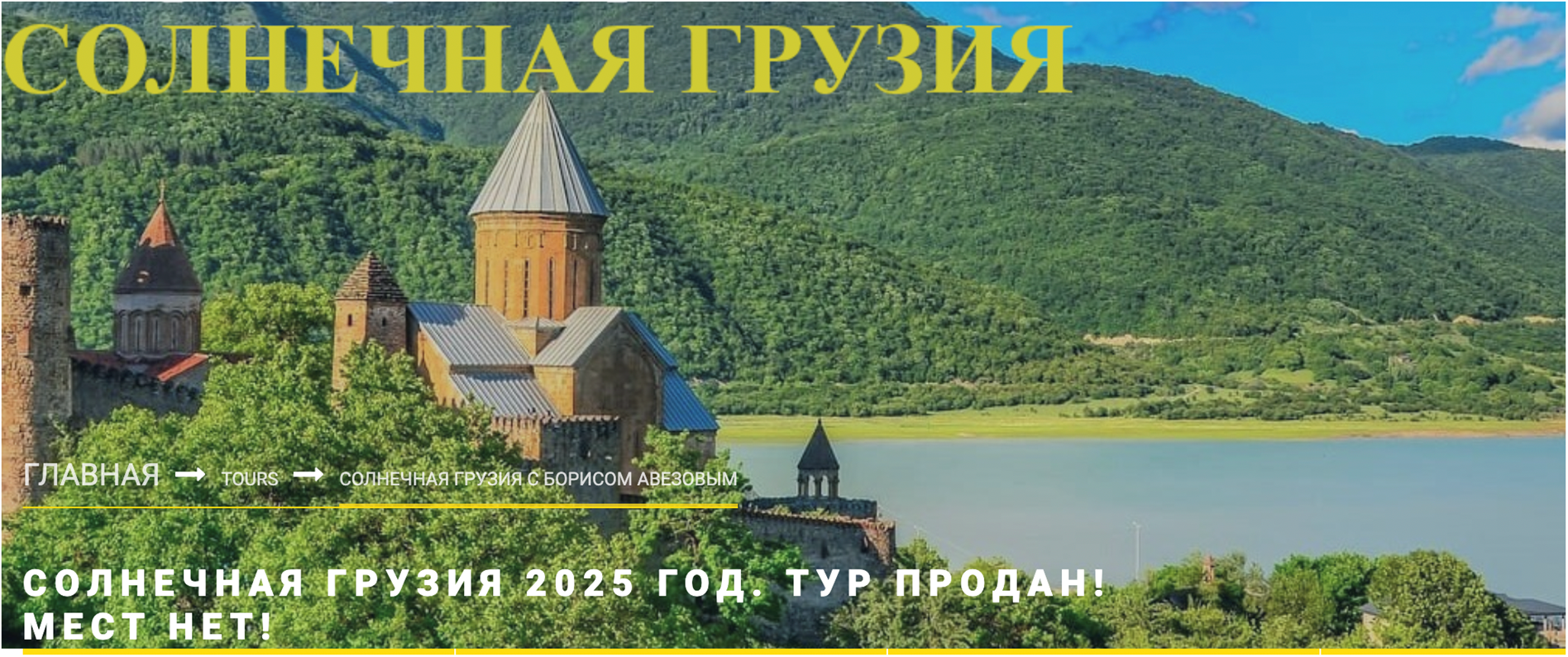
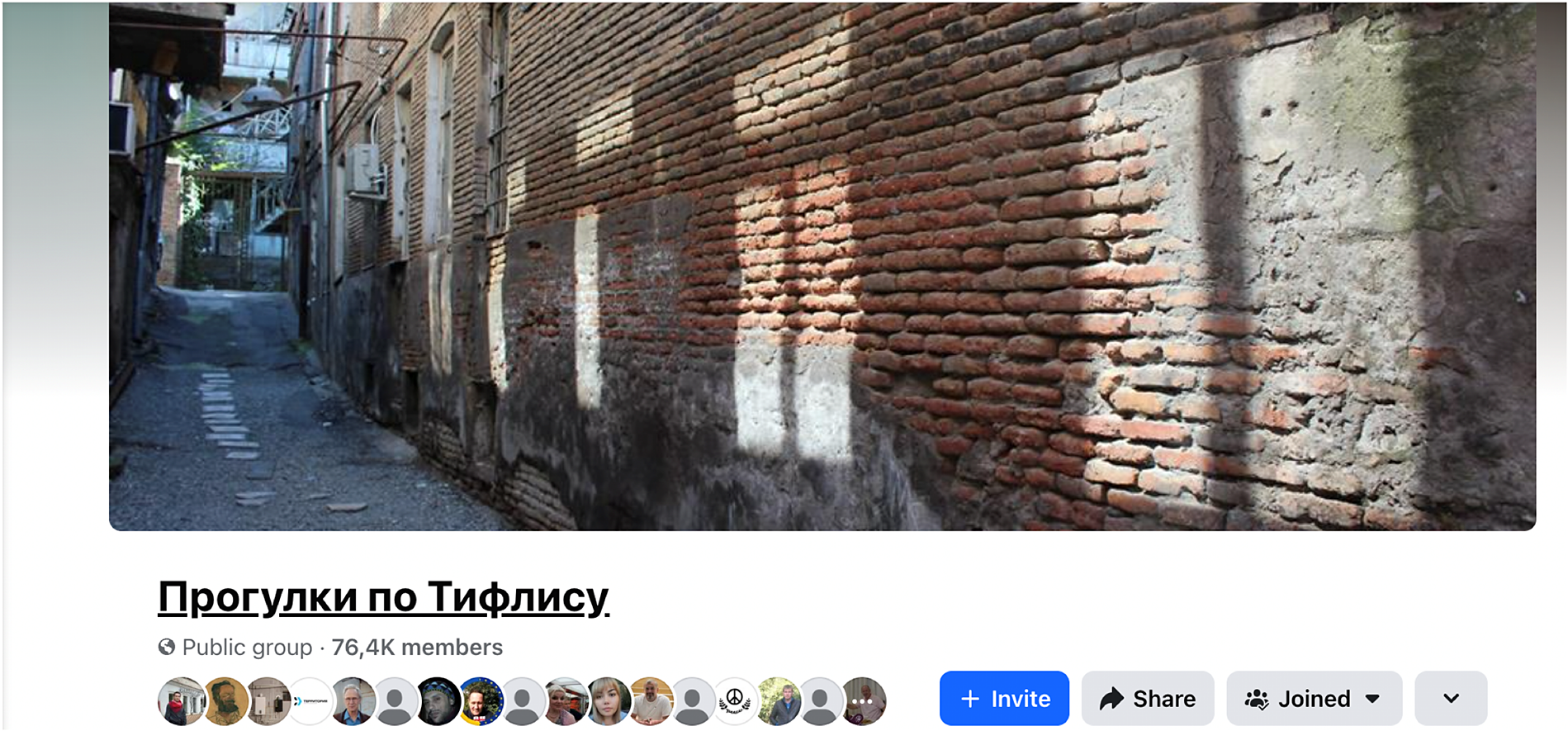
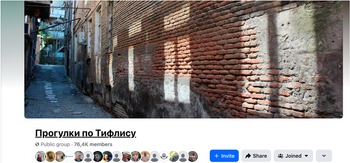
Separate narratives surrounded the increasing demand on the tourism in Russian and for Russians, provided both by established Georgian entities and by newly emerged Russian initiatives. Georgia was produced as a tourist destination in Imperial and Soviet imaginaries (Maisuradze Reference Maisuradze2015; Meladze Reference Meladze2015), generating particular expectations of Georgian hospitality and pleasure, and that pattern is perceived to be reoccurring within new social fabric. As one respondent noted: “We have different programs for Russian and European tourists. Russians want ‘true Georgian experience,’ but what is it? Wine and khachapuri.” This khachapuri tourism – a search for “authentic Georgia” rooted in long-standing representational hierarchies – was read by Georgians as an extension of earlier imperial ways of consuming the country, rather than a neutral tourist practice (see advertisement on Figure 8). The reproduction of such experiences by recent migrants, who now offer tours for Russians themselves, further entrenched this dynamic (Figure 9). Their excursions and educational projects contributed to the expansion of a Russian-targeted tourism market, reinforcing asymmetric roles where Georgians appear again as service-providers to Russian consumers.
The Russian tourist company advertising tour to “Sunny Georgia”.
The Facebook group “Walks in Tiflis”, run by Russian migrant community.
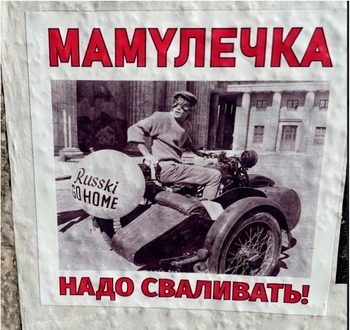
A sarcastic poster in Tbilisi picturing Russians exodus, saying “Mummy, its time to get out of here!”.
Respondents also reflected on earlier experiences from childhood and adulthood that shaped their interpretive frameworks. Many recalled a post-Soviet family attitude that positioned Russians as culturally superior – a vertical respect learned from Soviet hierarchies – which now complicated their feelings towards the newcomers. Having Russian nannies, Russian-language childcare, or the prestige associated with speaking Russian were remembered as remnants of this hierarchy. “I remember growing up with an understanding that if some families speak Russian, despite no Russian origins, they are very emancipated and advanced… I still notice this attitude,” says activist (R13).
The Syndrome of “Pumpkin Latte”: “Russian bubbles and search for comfort”
A recurring theme, quite connected to the previous section on economical disintegration, and ambivalent lifestyle, in our interviews was how newcomers’ attempts to recreate familiar lifestyles became visible signs of separation – what respondents repeatedly called “Russian bubbles”. The term captures a clustering of practices that, while mundane in themselves, were widely interpreted through the decolonial lens as signs of status, entitlement, and an assumed cultural centrality. The now-famous “pumpkin latte” meme is emblematic of this: it began with a viral Facebook post from a Russian woman asking in Israel where to find a Starbucks latte with pumpkin flavour she was so nostalgic about. Although trivial, it was read far beyond its immediate context as a symbol of searching for metropolitan comforts abroad and expressing dissatisfaction with local infrastructure – a pattern respondents in Georgia saw as highly recognisable.
In Georgian social media, the closest analogue was an open post by a Dozhd TV journalist, which likewise went viral. Intending to share practical advice for well-off migrants, she described her everyday routine in central Tbilisi – Sololaki, Mtatsminda, Vera – listing cafés, hairdressers, restaurants, and bookstores that felt “as in Moscow.” She framed Tbilisi as “the only home available to me… Georgia could very well have been a new homeland”. Her descriptions of services “for Russians,” complaints about English-language theatre, and praise for Russian-speaking doctors “like in Moscow EMC clinics but three times cheaper” were repeatedly cited by Georgian respondents as crystallising the sense that Russians were living in Georgia while continuing to inhabit a different socio-spatial world.
Our observations indicate that migrants’ efforts to preserve familiar lifestyles stretch across income groups and occupational niches – from digital nomads to cultural workers. The search for “the manicure as in Moscow”, for “doctors… as in Moscow hospital”, or for what was described in one Telegram channel as “normal living conditions”, reflects a constant comparison with metropolitan Russian standards that are often economically inaccessible to Georgians living on Georgian salaries. This pattern recurred in online reviews of newly opened Russian cafés. Russian customers frequently evaluated Georgian services as nedostatki (imperfections) and celebrated having “finally found good coffee.” These comments were widely interpreted not as consumer reviews but as subtle enactments of a hierarchy of taste, reinforcing the sense that Russian newcomers judged Georgian services from a position of cultural superiority.
Georgian respondents repeatedly emphasised that such practices felt particularly striking – and politically insensitive – because they unfolded during a time of war. Social media comments frequently double the famous slogan that we described above: “How is it possible to party when Putin kills Ukrainians?” or “Why are you looking for a haircut, not protesting?”
Across the interviews, respondents consistently described a recognisable constellation of everyday cues through which Russian “bubbles” became legible as signs of status and spatial dominance in a city shaped by coloniality. These included the default use of Russian in certain shops and services without switching languages as described above, the clustering of Russian migrants in particular cafés, parks, and central districts such as Sololaki, Vera, and Vake, and the proliferation of services operating primarily “for Russians,” from cafés and bars to clinics and informal care networks. Respondents also pointed to situations in which newcomers organised events or initiatives that implicitly positioned them as explaining or improving local realities, a dynamic read as a micro-enactment of a civilising mission. Finally, repeated claims to be “apolitical” during wartime were interpreted as a form of indifference toward Georgian history and ongoing security concerns, resonating with older patterns of colonial aloofness. Taken together, these practices were not treated as objective indicators of behaviour but as interpretive cues, activated within a historical field marked by imperial asymmetry. Georgian respondents repeatedly stressed that even politically liberal Russians – critical of their government and aware of imperialism – often reproduced embodied habits that felt intrusive in this context. As one Georgian artist put it, “Their comfort and their order of things in my space becomes a priority… They know what imperialism and colonialism are, and yet imperialism is so embodied in their behaviour that they cannot get rid of it” (R14). Another NGO expert summarised the dynamic succinctly: “They all treat us as the service providers. And we are trying to be good ones… But they see us as always smiling Georgians, friends, drinking chacha. And that has a long history” (R10). Here, economic privilege intersects with historical stereotypes, activating colonial memories that shape how Russians’ everyday actions are read.
To sum up, the attempts of Russian migrants in Tbilisi to reproduce familiar lifestyles, including metropolitan consumption, service expectations, and leisure practices, were widely interpreted as forms of appropriation and symbolic dominance, rather than neutral settling-in strategies as they could be read in other settings or with other migrant communities. These interpretations connected directly to longer family stories, Soviet-era hierarchies, and post-Soviet resentments. As such, Russian “bubbles” were not simply clusters of newcomers but became sites where coloniality was perceived to re-emerge, giving everyday behaviours a political charge that exceeded their immediate intent.
Geopolitical Anxiety and Everyday Fear: Russian Presence as a Security Threat
The perception of Russian presence as “third occupation” builds up what Batiashvili (Reference Batiashvili2022) calls “anxiety of a small country”: the range of topics connected with the issues of personal and collective security. Almost all of our respondents underlined that the city has begun to feel less secure, and at least half explicitly linked this shift to what they described as a form of “third occupation.”Footnote 15 When pushed to elaborate, respondents diverged slightly on what “the third” signifies: for some, it follows the Tsarist and Soviet occupations; for others, it refers to the post-2008 occupation of Tskhinvali and Abkhazia. Across these interpretations, however, the term signals a persistent sense that Russian presence – regardless of form – activates a deeply layered historical anxiety. In this framing, everyday encounters in Tbilisi are not isolated events but signs that echo long-standing structures of dominance and subordination.
This sense of vulnerability is not abstract. All of our interviewees stated that since the increase of Russian arrivals, they have begun to feel unsafe in ways they did not before. The narratives surrounding these fears are diverse, but the dominant one relates to the possibility that the Kremlin could open a “second front” under the pretext of protecting Russian citizens living in Georgia. A schoolteacher at a private school articulated a sentiment shared by many: “He [Vladimir Putin] is always using this argument to invade other countries. That he is protecting the Russians… Look at these Russians on the street, do you think he will try to ‘protect’ them as well and invade Tbilisi?” (R08). Similar concerns circulate widely online, often in discussions about the young Russian men who fled mobilisation: “If Putin invades Georgia tomorrow, where would you run? Would you fight for Georgia? Where would you run next?”
These anxieties amplify political tensions in Georgia in 2022-2024. The country’s strong societal aspiration toward a “Western route” gained global attention during the anti-government protests against the 2023 and 2024 versions of the “foreign agents” law, widely referred to as the “Russian law.” Street protests, anti-Russian slogans, and solidarity with Ukraine are simultaneously expressions of pro-European belonging and responses to a government increasingly perceived as leaning toward Moscow. In this climate, Russian presence is easily grafted onto pre-existing fears of geopolitical backsliding, unresolved trauma from the 1990s, and the still-unfolding consequences of the 2008 war. Many respondents explicitly connected the current migration wave to memories of internal displacement, creeping occupation along administrative boundary lines, and the consolidation of an anti-colonial national narrative since the early 2000s.
The most direct threat imagined by respondents is a renewed Russian invasion. One artist put it bluntly: “If Putin wins [in Ukraine], he will invade Georgia. If Ukraine wins, Putin will take Georgia as a silver medal.” (R09). In this reading, the concentration of Russian migrants in central Tbilisi was not merely seen a demographic shift but a potential justification for intervention.
Indirect security concerns were also repeatedly mentioned: fears that Russian citizens could skew the electoral landscape, strengthen Russian-owned businesses, or accelerate the spread of the Russian language in public life. For many, these developments signal not only economic or cultural change but the erosion of symbolic boundaries that underpin Georgian sovereignty. The sense of insecurity is frequently tied to the perceived inaction of the Georgian government. As another interviewer from a Georgian NGO stated, “The moment when they [‘Georgian Dream’] could have taken over the control is gone… We don’t know how many Russians have come. We can’t trust them, and think they will protect us.” (R30). Some respondents also cited an increase in drug use, minor crime, and violations of the Georgian language law as part of a generalised feeling that public order and cultural norms are slipping. Whether or not these issues are directly linked to Russian migrants, they become folded into a broader narrative that associates Russian presence with a weakening of state capacity and heightened vulnerability.
The cumulative effect of these fears resonates strongly with what Batiashvili (Reference Batiashvili2022) (describes as the “anxiety of a small country,” a longstanding affective condition in Georgian political culture characterised by mistrust, anticipation of betrayal, and a sense of existential fragility. The arrival of Russian migrants – many of whom form relatively closed “bubbles,” maintain Russian-language informational spaces, and remain opaque to Georgian publics – intensifies what Batiashvili calls “treason anxiety”: a readiness to interpret ambiguity as potential danger. In this context, clustering, linguistic visibility, and perceived political apathy are not neutral behaviours but triggers that activate a historically sedimented interpretive field.
In other words, security fears in Tbilisi are not solely a response to geopolitical developments but are mediated through coloniality: the enduring hierarchies of power, language, and epistemic authority that continue to structure how Russian presence is recognised and evaluated. Behaviours that might elsewhere be understood as benign – forming tight-knit migrant networks, searching for familiar services, avoiding politics – are here read through the lens of an unresolved imperial relationship. These readings do not claim that Russian migrants seek domination; instead, they reveal how deeply embedded historical experiences shape what kinds of presence feel threatening, what kinds of visibility feel intrusive, and what kinds of silence feel complicit.
Conclusion
The empirical sections show a coherent interpretive pattern emerges: young, urban Georgians read the arrival and everyday practices of Russian migrants through a historically sedimented lens shaped by coloniality, the memory of occupation, and unresolved geopolitical trauma. While individual Russians may not intend to reproduce hierarchies or superiority, specific behaviours, spatial patterns, and modes of interaction repeatedly become legible, in respondents’ accounts, as signs of a renewed imperial presence. Linguistic visibility sits at the centre of this interpretive field: Russian is experienced not only as a practical medium but as a reminder of earlier cultural domination, and its renewed prominence in central districts is described as particularly painful in a city whose service and tourism economies have long been entangled with Russian-speaking publics. Spatial clustering, the proliferation of Russian-oriented “third places,” and the growth of services “for Russians” intensify this reading by making Russian presence materially dense and socially self-sufficient. In parallel, respondents repeatedly return to everyday scenes and encounters – newcomers correcting locals, “explaining” Georgia to Georgians, or declaring themselves “apolitical” in wartime – which are interpreted not simply as individual manners or survival strategies, but as the reappearance of older epistemic hierarchies and moral distance that have historically structured centre–periphery relations in the region. In this sense, the persistent suspicion towards even “good Russians” is not reducible to disagreement about political positions: in the Georgian case, anti-war identification does not automatically neutralise the coloniality-sensitive cues through which presence, language, and authority are read in public space.
Foregrounding coloniality as an interpretive framework helps clarify the mechanism at stake: what produces friction is less a single action than the way mundane practices acquire disproportionate political meaning in a memory-saturated environment. The same behaviours that might elsewhere be understood as ordinary settlement – seeking familiar services, clustering with co-nationals, relying on Russian-language networks, avoiding politics – are here recontextualised through a narrative field where Russian language, spatial dominance, and cultural authority have historically been tied to domination and territorial vulnerability. This is why everyday encounters in cafés, parks, neighbourhoods, and online spaces repeatedly become sites where geopolitics is “felt” and where historical asymmetry is reactivated as an immediate urban experience.
Recognising the depth and structure of these anxieties also points toward possible policy responses. Tbilisi’s experience reveals the urgent need for context-sensitive approaches to integration or to neutral co-existence – particularly around language, visibility, and civic participation – that take seriously the asymmetrical histories shaping these interactions. Many tensions described by our respondents arise from perceptions of linguistic hierarchy, closed “Russian bubbles,” and limited engagement with Georgia’s historical and political realities. Measures that expand access to Georgian-language learning encourage its daily use in public-facing businesses, and provide support for multilingual signage and communication could help shift everyday encounters from unequal to reciprocal. Because political silence was interpreted as deeply unsettling, structured opportunities for newcomers to learn about Georgia’s recent history – particularly the 2008 war, the ongoing occupation of Abkhazia and South Ossetia, and the country’s broader security landscape – could help align expectations and foster solidarities that resonate locally. At the same time, addressing concerns about economic privilege and the opaque nature of certain migrant-driven markets requires greater clarity around informal labour practices, transparent business registration procedures, and mechanisms that protect local workers from structural disadvantage in sectors reshaped by remote-income earners.
At the same time, the Georgian case should not be universalised across the post-Soviet region. The intensity of neo-imperial readings depends on political and mnemonic environments: where de-Russification and de-Sovietisation have been central to national identity, Russian visibility is more likely to trigger anti-imperial interpretations; elsewhere, tensions may crystallise around different fault lines – housing, labour markets, security institutions, local ethnic politics, or other language regimes, or troubled history of labour migration and Othering (as in Dushanbe, for example). Even when the migrants come from the same former imperial centre, the interpretive field differs, and integration measures therefore need to be calibrated to local histories of hierarchy and vulnerability rather than imported as generic “best practice.” What Tbilisi nonetheless makes clear is that integration is not only technical but historically saturated: policies that ignore how coloniality structures everyday perception can inadvertently reproduce the very cues that make even anti-war migrants readable as a threat, whereas policies that take those sensitivities seriously can create conditions for coexistence that are less anxious, less punitive, and more sustainable for both host society and newcomers.
Acknowledgments
We are truly thankful to all our interviewees and colleagues in Tbilisi.
Disclosure
None.
Annex
Semi-structured interviews with young, urban, pro-European Georgian residents of Tbilisi conducted between spring 2022 and autumn 2024. Identifying details have been anonymised. Respondents are referred to in the text by sector or professional role
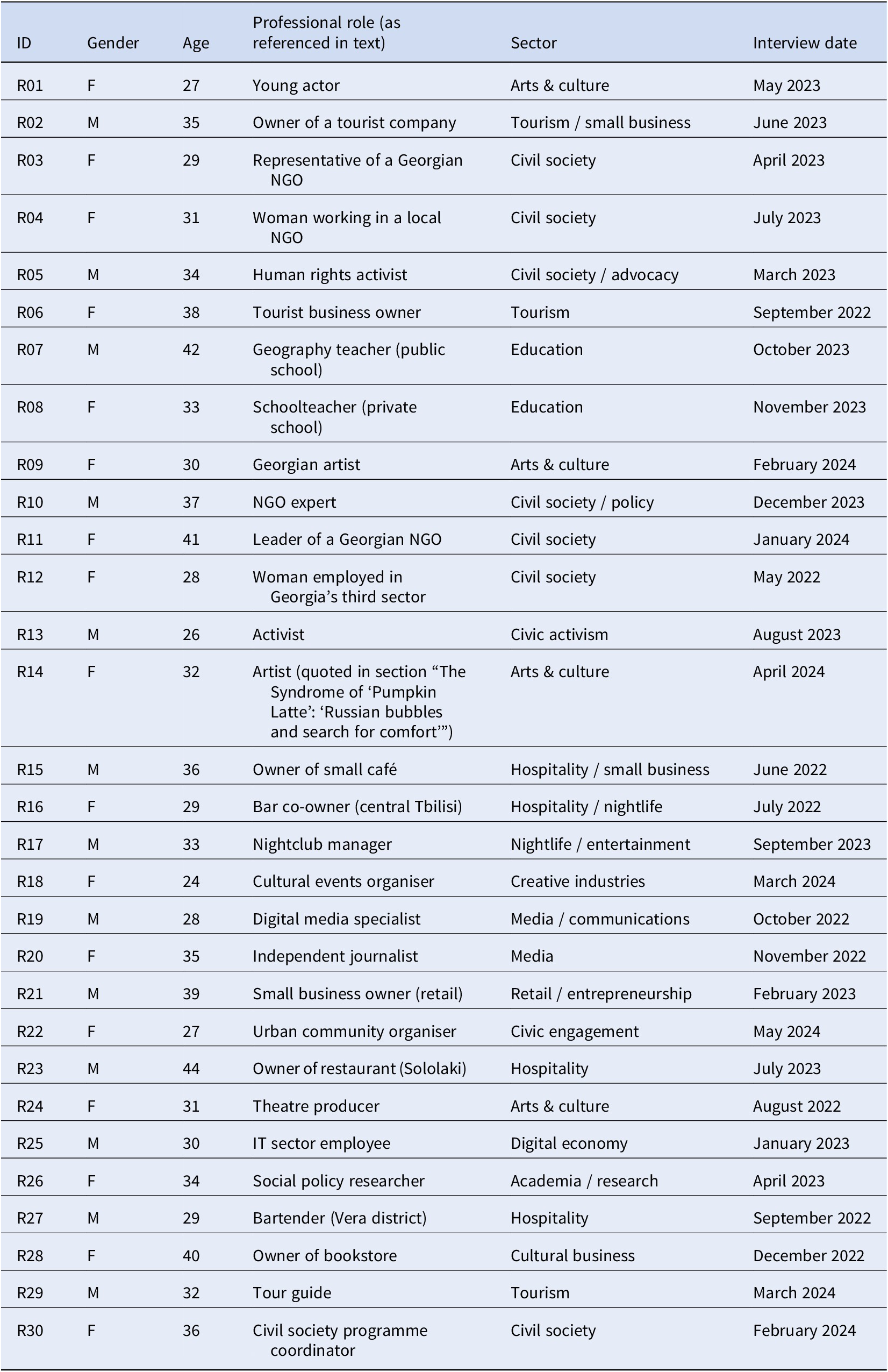
Table A1 Long description
The table contains six columns: I D, Gender, Age, Professional role, Sector, and Interview date.
* R 0 1: Female, 27, Young actor, Arts and culture, May 2023.
* R 0 2: Male, 35, Owner of a tourist company, Tourism / small business, June 2023.
* R 0 3: Female, 29, Representative of a Georgian N G O, Civil society, April 2023.
* R 0 4: Female, 31, Woman working in a local N G O, Civil society, July 2023.
* R 0 5: Male, 34, Human rights activist, Civil society / advocacy, March 2023.
* R 0 6: Female, 38, Tourist business owner, Tourism, September 2022.
* R 0 7: Male, 42, Geography teacher (public school), Education, October 2023.
* R 0 8: Female, 33, Schoolteacher (private school), Education, November 2023.
* R 0 9: Female, 30, Georgian artist, Arts and culture, February 2024.
* R 1 0: Male, 37, N G O expert, Civil society / policy, December 2023.
* R 1 1: Female, 41, Leader of a Georgian N G O, Civil society, January 2024.
* R 1 2: Female, 28, Woman employed in Georgia’s third sector, Civil society, May 2022.
* R 1 3: Male, 26, Activist, Civic activism, August 2023.
* R 1 4: Female, 32, Artist, Arts and culture, April 2024.
* R 1 5: Male, 36, Owner of small café, Hospitality / small business, June 2022.
* R 1 6: Female, 29, Bar co-owner (central Tbilisi), Hospitality / nightlife, July 2022.
* R 1 7: Male, 33, Nightclub manager, Nightlife / entertainment, September 2023.
* R 1 8: Female, 24, Cultural events organiser, Creative industries, March 2024.
* R 1 9: Male, 28, Digital media specialist, Media / communications, October 2022.
* R 2 0: Female, 35, Independent journalist, Media, November 2022.
* R 2 1: Male, 39, Small business owner (retail), Retail / entrepreneurship, February 2023.
* R 2 2: Female, 27, Urban community organiser, Civic engagement, May 2024.
* R 2 3: Male, 44, Owner of restaurant (Sololaki), Hospitality, July 2023.
* R 2 4: Female, 31, Theatre producer, Arts and culture, August 2022.
* R 2 5: Male, 30, I T sector employee, Digital economy, January 2023.
* R 2 6: Female, 34, Social policy researcher, Academia / research, April 2023.
* R 2 7: Male, 29, Bartender (Vera district), Hospitality, September 2022.
* R 2 8: Female, 40, Owner of bookstore, Cultural business, December 2022.
* R 2 9: Male, 32, Tour guide, Tourism, March 2024.
* R 3 0: Female, 36, Civil society programme coordinator, Civil society, February 2024.


 Open access

