


Introduction
Faculty mentorship is critical to the continued growth of clinical and translational research because it benefits early career investigators in the health sciences [Reference Meagher1–Reference Cho, Ramanan and Feldman8], and because it attracts future generations of investigators to these fields [Reference Pfund9]. Good mentorship has broad effects across the entire research enterprise. It supports the growth of academic research organizations [Reference Maisel6, Reference Fornari7, Reference Sambunjak10–12] by improving their investigators’ job satisfaction and retention [Reference Pololi13, Reference Kupfer14] and supports investigators’ responsible conduct of research and research productivity [Reference Cho, Ramanan and Feldman8, Reference Young15].
Senior faculty with a demonstrated track record of mentorship are highly sought as mentors but are often limited in their time and capacity to serve as a direct mentor due to their substantial scientific and administrative commitments. In fact, the lack of time and dedicated effort for mentoring are commonly referenced as the primary barriers to mentorship [Reference Steiner3, Reference Fornari7]. The lack of specific mentor training or continuing professional development focusing on mentoring skills also contributes to a lack of mentor development that would enable them to take on new mentees [Reference Fornari7, Reference Cho, Ramanan and Feldman8, 12, Reference Harawa16]. Moreover, senior faculty, like faculty at all levels, often perceive that excellent mentorship is not highly valued, supported, or rewarded within their departments and research universities [Reference Steiner3, Reference Maisel6, Reference Fornari7, Reference Sambunjak10–12, Reference Young15, Reference Shea17]. These barriers are preventing senior faculty from devoting more of their energy towards mentoring the next generation of research investigators.
Recent research has examined the association between institutional incentives for mentoring and faculty perceptions regarding the benefits of mentoring in order to examine their impact on the time faculty spend mentoring [Reference Maisel6, Reference Pololi13]. Examples of incentives include the inclusion of mentoring in a teaching portfolio [Reference Byington18], local and national awards, and papers coauthored with mentees [Reference Steiner3, Reference Maisel6]; public recognition and salary effort [Reference Maisel6, Reference Young15, Reference Harawa16, Reference Byington18]; and access to additional institutional resources [Reference Maisel6], and an incentive structure would be systematic policies and processes in place to fairly and equally award incentives at the department, school or college, or university level. Maisel and colleagues found that incentives such as including mentoring activities in performance evaluation and mentor awards were positively associated with a mentor’s perceptions of the benefits of mentoring as well as their mentoring activity [Reference Maisel6]. But as they note, while there is a need for more research into how such incentives change perceptions, “few researchers have examined institutional policies that may promote mentoring—despite the widespread belief that institutional mentoring practice and culture play a significant role in the development and retention of early-career researchers” [Reference Maisel6]. As they argue, more needs to be known about how the mentoring policies and incentives of higher education organizations change over time, and to what effect.
This paper describes the implementation and perceived impact of a mentoring award program developed by the Michigan Institute for Clinical & Health Research (MICHR) at the University of Michigan (U-M). The following sections of this paper describe the award program that was designed to promote effective mentoring for clinical and translational researchers throughout the university. In addition, we detail how the award was implemented and the impact was evaluated over a period of years, showing how 1 university-wide mentoring recognition program can affect other mentoring incentives within an organization.
Creating the MICHR Distinguished Clinical and Translational Research Mentor Award
In 2010, the faculty members of MICHR’s Education and Mentoring Group (EMG) at U-M formally created the Mentor Council to address a noticeable lack of dedicated faculty who were mentoring emerging translational scientists. The council consisted of 8 full professors representing the Medical School; the College of Literature, Science, and the Arts; the School of Dentistry; the College of Pharmacy; and the School of Nursing, as well as 1 EMG staff member, with the gender breakdown of this interdisciplinary group representing a 50/50 mix. This Mentor Council was convened, in part, in response to a report by the U-M Provost’s Advisory Committee on Mentoring and Community Building, which had identified in 2004 2 major obstacles to effective mentoring at U-M: (1) lack of time to mentor and (2) lack of incentives or rewards for effective mentoring. The U-M Provost’s Advisory Committee further noted that “good mentoring arises from a culture that recognizes and supports the importance of mentoring” [19]. In the ensuing years of constrained financial resources for academic research and the increased scrutiny of higher education, the committee’s assertion that cultural factors play a causal role in the cultivation of faculty mentorship had only gained resonance.
The council was charged with raising the value of mentoring in promotion and tenure at U-M by developing a process for awarding the competitive MICHR Distinguished Clinical and Translational Research Mentor Award (MICHR Mentor Award) which would heighten and draw attention to the importance of mentoring in clinical and translational research. As part of this process, the council reviewed relevant research and gathered feedback from key stakeholders with the help of a dedicated staff trained in adult educational learning theory, who synthesized stakeholders’ input. Because clinical and translational researchers can be found in many schools and colleges across U-M, the council also met with leaders from schools and colleges across U-M (including the School of Public Health, the Medical School, and the Rackham Graduate School) to ensure coordination with their mentoring initiatives.
The process developed by the council enabled MICHR to systematically identify faculty demonstrating excellent mentorship to their colleagues, postdoctoral trainees, and students. Competencies that empirical research have found to be associated with effective mentoring [Reference Abedin4] were used to create a scoring rubric for the MICHR Mentor Award nominations (Table 1). This evidence-based approach was necessitated by the lack of other well-established, validated methods for accurately identifying successful mentors in the field [Reference Pfund2–Reference Fleming5, Reference Geraci and Thigpen11, 12, Reference Kupfer14, Reference Harawa16, Reference Shea17].
Competencies and nomination review criteria
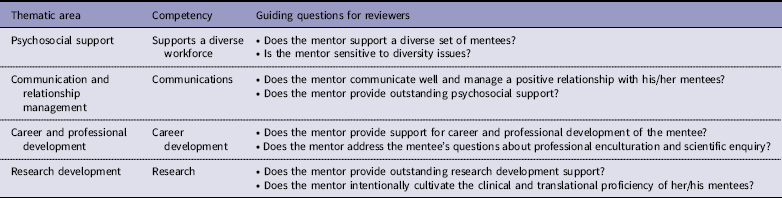
Modified from Albedin et al. [21]
The MICHR Mentor Award nomination and review process mirrors a standard graduate program admissions process, and from the initial call for nominations to the awards ceremony, takes about 7 months. Nomination packets are required to include the nominee’s curriculum vitae, a list of previous mentees and letters of support from current or previous mentees. As of 2014, a letter of support from a chair, dean, or senior colleague was also required. Nominators are also asked to specifically describe evidence of the 4 competencies, which serve as the foundation for the scoring rubric (Table 1), in the letters of support. Starting in 2013, the rubric was made available to guide nominators’ work on the nomination packets.
After the nominations are reviewed for eligibility, an NIH-style review process is used to score the nomination packets. To begin this process, reviewers are asked to declare any conflicts of interest, in keeping with standard NIH guidelines [20], which is followed by 2 rounds of peer-reviews. In the first round, reviewers typically have 4–5 nominations to review, with each packet receiving at least 2 separate peer-reviews. All review assignments are done ensuring gender and disciplinary equity in the review process, and a reviewer from the nominee’s school or college is assigned to review each nomination packet. To further support the equity of the review process, care is taken to ensure that the same 2 reviewers are not assigned to more than 1 nomination packet.
Reviewers score every nominee in each competency area and provide each an overall score and rank using the rubric in Table 1. Originally the NIH 1-9 scale was used, but it was found that reviewers rarely used anything lower than a 3, so in 2015 the scale was reduced to a 1 (strong) — 5 (weak). After all the nominees are scored and ranked, overall mean scores and ranks are calculated to identify the nominations that will be discussed at a study section, which is the second peer-review process. Any nomination that has a high average score or rank (those typically scoring between 1 and 1.5) are moved to study section, as are nominations garnering polarized scores or ranks from the reviewers (e.g., a 1 and a 4). The nomination packets are then reviewed in study sections that typically consist of 5 faculty representing at least 3 different U-M schools or colleges. This approach to the review process helps to mitigate, but not to fully correct for, the fact that male faculty and faculty with appointments in the Medical School are typically overrepresented among the nominees (see Fig. 1).
Distribution of medical school to nonmedical school within the nomination pool and awardees. U-M, University of Michigan.
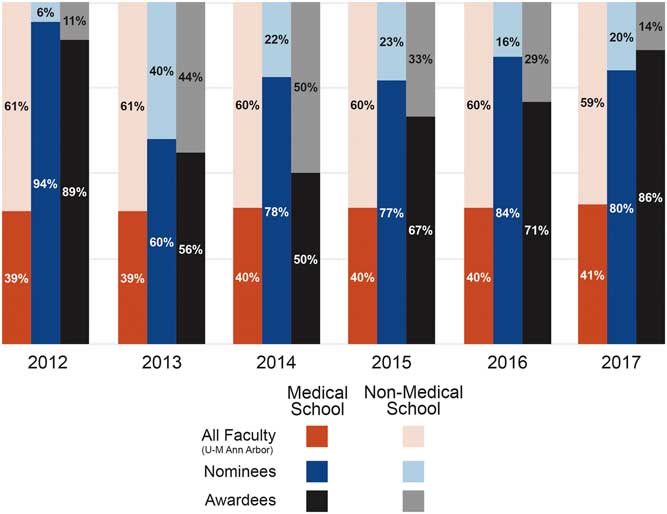
During the study section, faculty discuss the merits of each nomination based on the first round reviewers’ scores, ranks, and comments as well as additional factors that are deemed important for the goals of the award, including having women and nonMedical School mentors represented among the awardees. Going into the study section, there is an anticipated number of awardees that will be chosen, and approximately a third of the nominations submitted each year go on to receive the award (see Table 2).
Nominations received and awardee characteristics
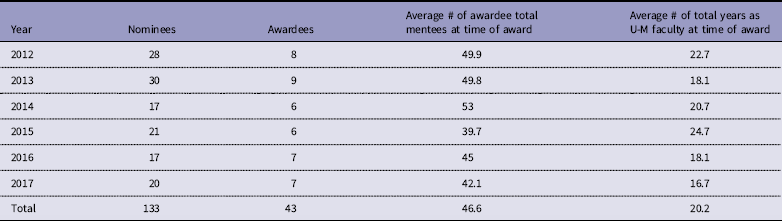
U-M, University of Michigan.
The criteria of the MICHR Mentor Award have also been refined over time in response to changes in university policies and Mentor Council feedback. First, eligibility was initially limited to faculty with ranks of associate professor or above, but this criterion was changed in 2014 to include faculty with documentation of 10 years of mentoring for untenured faculty, as U-M had recently changed their tenure clock from an 8-year to a 10-year timeline. A letter of support from a chair, dean, or senior colleague was also added as a nomination packet requirement in 2014 because some nominators included such a letter, and reviewers found the unevenness between the nomination packets unfair for those packets that did not include such a letter. Finally, in 2014 the Mentor Council recommended that the importance of mentoring for diversity be raised, and included a competency about diversity within the nomination criteria; the competency was directly informed by the NIH definition for diversity [Reference Abedin21]. Save this change in criteria, the reviewer rubric has remained consistent since it was developed.
MICHR Mentor Award Communications and Ceremony
Given the broad range of clinical and translational research found in many schools and colleges across U-M, nominations are sought from faculty working throughout the university. Emails are sent to all U-M graduate program coordinators, the campus-wide postdoctoral associations, and all MICHR former trainees and their mentors. A short video showcasing a few of the awardees and their mentees was created in 2014 to help encourage nominations; the video has been used in various publicity since [22]. In addition, MICHR’s Executive Director sends personalized messages to all U-M deans and associate deans to solicit nominations. Once the nominations have been received, MICHR’s EMG also sends notification to the nominees’ deans in an effort to increase awareness of this award. Once the awardees have been chosen and the decisions have been released, the Executive Director of MICHR also sends notes to all nominators, thanking them for valuing the mentorship of the nominee. Some nominations were made without the nominee’s knowledge; however, if the nominator(s) has indicated that we could do so, then letters are also sent to nominees who are not selected letting them know they had been nominated and thanking them for their service.
The MICHR Mentor Award ceremony has served not only as a way to recognize the awardees but also to celebrate and raise the value of mentoring across the university by inviting senior leadership (such as deans, the Provost, the Vice President for Research, and the Executive Director of Translational Research) who represent units from across the university to attend and speak at the ceremony. In addition to presentation of the awards, the award ceremony has also always been paired with another activity (such as a symposium or a talk on mentorship) to help encourage attendance at the event. Lastly, a press release is shared announcing the awardees and publicizing the upcoming awards ceremony. Afterward, MICHR’s Executive Director sends personal messages to the awardees’ deans that includes a press release about the award ceremony and awardees, along with photos of the event. These may be used then by the various awardees’ departments.
Evaluation of the MICHR Mentor Award
To evaluate the impact of the MICHR Mentor Award, EMG developed a survey instrument designed to assess how past awardees perceived the award impacted their work. This evaluation was reviewed by the U-M IRB (HUM# HUM00130626) and exempted from IRB oversight. Questions and potential responses were developed using 3 sources of information including, a review of relevant literature, particularly publications about mentoring competencies [Reference Abedin4, Reference Fleming5], prior surveys of awardees, and awardees’ anecdotes regarding the impact the award had on their career. The survey instrument was then iteratively refined in collaboration with MICHR EMG faculty and staff, as well as a prior recipient of the mentor award. The survey question formats and scales were designed to be in alignment with well-established questionnaire guidelines [23, Reference Boynton and Greenhalgh24].
The survey contained open-ended and closed questions about the impact of the award on the awardee’s scientific career, any professional and personal recognition they have received in regard to this award, and how their subsequent mentoring practices may have changed. The questions regarding mentoring practices were aligned with the mentoring competencies used to score the nomination packets, and posed with dichotomous Yes/No response options. The survey also contained questions about specific outcomes that may or may not have resulted from the award, and whether each occurred within 6 months, 1 year, and more than 1 year of receiving the award. Respondents were also presented with several opportunities to provide open-ended comments, including regarding the impact of the award and perceived barriers to mentoring. All the survey questions and response options are shown in the Appendix.
Due to the small number of awards distributed, quantitative analyses of the survey data are limited to parametric statistics. In contrast, the qualitative data obtained through the survey were rich enough to be analyzed more intensively. Grounded theory [Reference Schaeffer and Dykema25] was used to iteratively code the many themes contained within each comment. The codes that were used represented emic concepts derived directly from the interviewees’ responses and etic concepts derived from the intended competency-based outcomes of the award.
These codes were produced through an iterative process of comparison in which existing codes were compared to new codes as they were developed. During this process, 2 people reviewed the qualitative comments from the survey and coded the impacts and barriers they referenced. One comment could be associated with different codes but not with multiples of the same code. The coding was then reviewed with a third person who facilitated resolution of the discrepancies between the reviewers’ codes. The codes were subsequently condensed to a set of 12 that fell into either an impact category (N=9) or a barrier category (N=3) (see Table 3 for examples of coded comments). The original 2 reviewers recoded the qualitative data using this condensed set of codes. Final analyses were conducted using these condensed codes.
Examples of respondents’ open-ended comments containing selected coding category
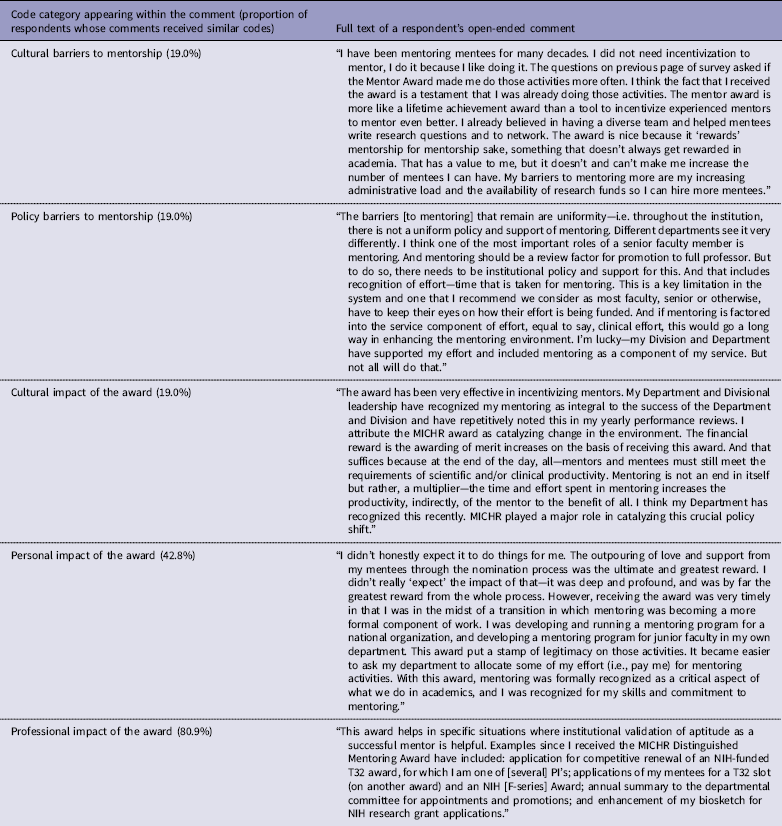
MICHR, Michigan Institute for Clinical & Health Research.
This iterative methodology ensured close contact with phenomena being studied and prevented premature commitment to ways of interpreting the survey data [Reference Corbin and Strauss26].
Results
The survey was sent in May 2017 to the 34 mentor awardees (out of 36) who had current appointments at U-M using Qualtrics. The invitations and 2 reminders were sent over email and were personalized to increase the response rate [Reference Wasserman, Clair and Wilson27]. Twenty-one awardees (62%) completed the survey. This response rate is modest considering the recognition provided to the respondents, raising the concern that those who were likely to respond were also those who were most likely to be active and committed mentors. Many respondents were, in fact, active contributors to the scholarship of mentoring, with 14.3% having publications on topics related to mentoring or education within a year of their award and 47.6% having a speaking engagement on mentoring roughly 1 year after receiving the award. However, the survey response rate is better than that of many similar evaluation surveys conducted by MICHR, such as 1 conducted to evaluate a training program for clinical research investigators [Reference Heerwegh28]. Typical causes of nonresponse for these surveys primarily regard the lack of time and attention faculty can afford to pay to the many survey invitations they receive. The possibility of self-selection among the respondents is further discussed as a limitation later on.
Overall, the survey results suggest that the MICHR Mentor Award had a modest but positive impact on the awardees’ professional recognition and scientific work. All respondents reported that their receipt of the MICHR Mentor Award had some effect on their professional lives, but the timing of the effect varied (see Table 4). For example, while most awardees added the MICHR Mentor Award to their curricula vitae within 6 months, a majority referenced it in grant proposals or biosketches between 6 months to a year after receiving the award. And 14.3% reported that the award had contributed to their recognition for promotion during the same time period. This variation suggests that some of the award’s attributed effects occurred within a year while others took longer to appear. These results did not differ systematically between full professors and associate professors, but the small number of associate professors responding to the survey (N=4) prevents conclusions from being made about the differences in the outcomes for these groups.
Impact of the MICHR Mentor Award on mentors’ professional careers

MICHR, Michigan Institute for Clinical & Health Research.
* 1=within 6 mo, 2=6 mo to 1 yr, 3=more than 1 yr.
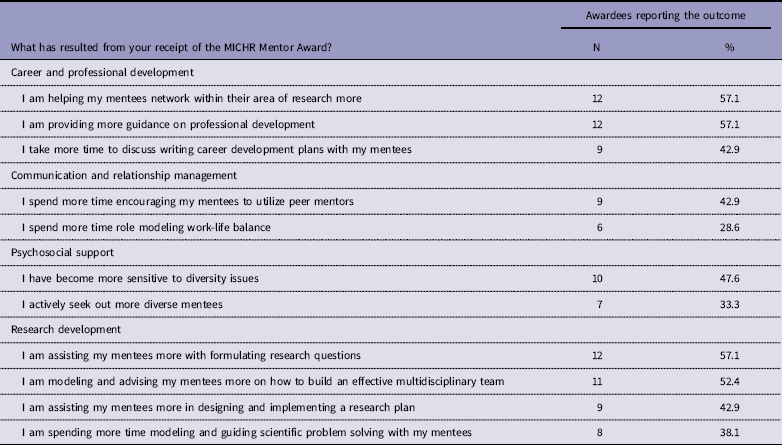
The survey results also suggest that the MICHR Mentor Award had a modest impact on the awardees’ mentoring practices. For example, many reported that receiving the award encouraged them to mentor more people (47.6%, N=10) or to participate as an attendee in mentorship training programs (28.6%, N=6). A few individuals (14.3%) also indicated that the MICHR Mentor Award motivated them to meet with their current mentees more frequently. The awardees also reported that the MICHR Mentor Award affected their mentoring practices related to psychosocial support, communication and relationship management, career and professional development, and research development (Table 5).
Impact of the MICHR Mentor Award on mentors’ mentoring practices.
MICHR, Michigan Institute for Clinical & Health Research.
The awardees’ responses to questions associated within the same competency domain were not strongly correlated with each other. However, the awardees’ responses to all of the questions relating to the research development they provide through their mentorship were moderately correlated, with correlation coefficients ranging from 0.52 to 0.75 (p<0.01). The responses to the 2 questions regarding mentoring for psychosocial support were also moderately correlated with each other (0.54, p<0.05). In contrast, only 2 out of 3 questions regarding the mentoring for career and professional development were correlated (ranging from 0.56 to 0.81, p<0.01) and there was no significant correlation found between the results of the 2 questions associated with the communication and relationship management domain. These results suggest that while the award bolstered the awardees’ mentorship activity overall, it may have a more coherent impact on awardees’ efforts to cultivate the research agendas of their mentees compared to other domains of mentorship.
The survey also included 5 open-ended questions that prompted respondents to describe how the MICHR Mentor Award impacted their work and mentorship. The respondents left a total of 36 distinct comments with an average of over 59 words per comment for a total of 2,110 words. These comments provided sufficient detail to analyze common themes regarding the impact of the award. While the impact of the award was described in modest terms, the awardees reported that the award did affect their work in specific and positive ways.
Of the respondents who left open-ended comments on the survey, 95% (N=20) detailed the impact the award had on their careers. Most of the individuals described how it affected their professional work (81%, N=17), although some described its impacts on their personal lives (43%, N=9) or on the culture of their workplace (19%, N=4). Roughly 24% (N=5) of the respondents who answered open-ended questions described barriers to mentoring they found in professional culture or institutional policies. Table 3 shows representative examples of comments associated with each of these categories.
Many respondents leaving comments made an explicit connection between their receipt of the award and subsequent changes to factors that would incentivize their mentoring. For example, several (29%) noted that referencing the award in training grant proposals, including for the NIH’s K, T, and F-series award mechanisms, might better enable them and their mentees to obtain further funding to support their mentorship. Two of the respondents (10%) even attributed their department’s decision to provide them with dedicated effort for mentoring with receipt of the MICHR Mentor Award. Some also claimed that the MICHR Mentor Award would affect social dynamics within their departments, with 1 individual noting that,
The [award] helps emphasize the importance of mentoring and with the recognition I am looked to as a leader in departmental decisions related to teaching, mentorship and research training. Also other junior faculty seek my advice as it relates to mentoring.
This particular comment is fairly representative of many other comments provided by the awardees. Specifically, this comment was given 3 codes also applied to sizable proportions of all comments, as shown in brackets following each of these codes:
1. Recognition by department chairs or deans (13.9%)
2. Recognition of mentoring by others (36.1%)
3. New mentees are attracted to the mentor (5.5%).
Moreover, all 21 awardees who responded to the survey indicated through a closed-response question that they received some form of subsequent acknowledgment of their achievement. All reported receiving some form of acknowledgment or recognition in-person, and many reported receiving acknowledgments either in print or correspondence (76.2%), or via social media (42.8%).
More generally, respondents’ commented on how the development of the MICHR Mentor Award affected the way faculty mentoring was incentivized by U-M as a whole. The frequency of the impact codes, comment examples shown in Table 3, and pull-quotes all suggest that some awardees believed that the creation of the award had the potential to positively affect institutional factors incentivizing faculty mentorship throughout U-M. For example, 1 awardee noted of the award that,
It called attention to a long neglected skill set. The University system (not just Michigan, all Universities) do not recognize mentoring as a key skill that is required for senior faculty. My experience is that mentoring is at best tolerated but certainly not rewarded. I decided to mentor young clinical investigators because of such a huge void in the field, the lack of interest or attention by leadership at any major University, and my own experience of poor mentorship when I was a junior faculty member. There is no financial incentive to mentor faculty (or for that matter anyone). And until MICHR there was no recognition of any kind. This award has required the Medical School and University to grapple with the fact that without mentoring, many promising academics will fail due to the lack of guidance, very difficult scientific environment, and many other pressures to raise funds via service tasks.
Discussion
The MICHR Mentor Award was developed to address the lack of incentives or rewards for effective mentoring at U-M. This competitive award was intended to raise awareness of the value of mentoring in general and in faculty recognition specifically. This study demonstrates how the development of an award honoring excellence in faculty mentoring had a modest effect on the cultural factors incentivizing mentoring at U-M, most particularly among the awardees’ academic departments. The evidence suggests that the award not only impacted the work of the awardees but, as Maisel and colleagues suggest may be the case, it also affected their perceptions of the cultural factors affecting mentoring throughout the university.
While the relationship between cultural incentives for mentoring and the perceptions of the benefits of mentoring have been studied, this study builds upon the work of Maisel and colleagues by showing how faculty member’s perceptions of cultural incentives for mentoring are changed by the creation of new opportunities for the recognition of excellent mentoring. Specifically, the awardees perceived that the implementation of a new mentoring award changed some departmental and institutional incentives for mentoring in ways that affected their work and the university over all. The fact that some awardees attributed their department’s decision to allocate dedicated effort for their mentoring to their receipt of the MICHR Mentor Award provides a concrete, substantive example of how the award may have in fact affected the cultural factors incentivizing faculty mentoring within the awardees’ departments.
Current research suggests that faculty members’ perceptions of the cultural factors incentivizing mentoring can directly affect their mentoring practices [Reference Maisel6]. This study makes a unique contribution to the literature on faculty mentorship by showing how the recognition of excellent mentors can change their perceptions of cultural factors incentivizing mentorship within 1 university. This does not suggest that the perception of faculty at different universities would be similarly affected by the development of an identical mentoring award. In fact, given the size and decentralized organization of U-M, it is unlikely that development of the MICHR Mentor Award affected faculty perceptions similarly even across all of the awardees’ academic departments, let alone across the entire university. However, the findings of this study do raise the possibility that changes to institutional incentives for mentoring can change some faculty members’ perceptions of the mentoring culture at their institutions. This hypothesis enables models of the individual and ecological factors affecting faculty mentorship in higher education institutions to be better integrated [Reference Maisel6, Reference Sambunjak10] (Fig. 2). The effectiveness of awarding faculty protected time to incentivize their mentoring may be mitigated by organizational and societal factors [Reference Sambunjak10], the interactions of which remain largely unknown and in need of further research.
Model of factors affecting faculty mentorship.
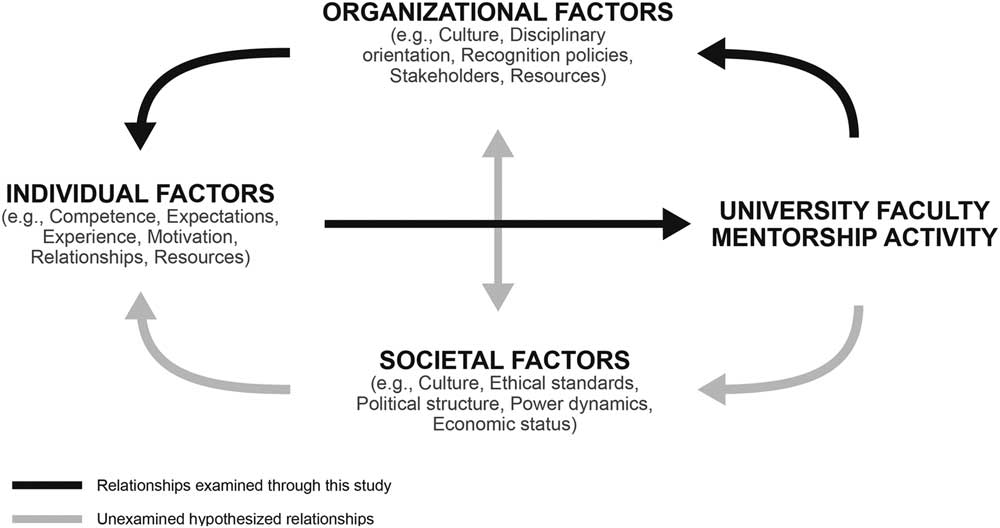
Future research can build upon this study in a few ways. Further research is needed into the competencies that are most crucial to the effective mentorship of new clinical and translational researchers. Evaluations of similar mentoring awards and recognition programs could utilize validated competency-based assessments [Reference Fleming5] and semistructured interviews to more rigorously explore the effects of such institutional incentives on a host of mentoring outcomes. A sample drawn from university faculty who have not received recognition for their mentoring could also be studied to provide a point of comparison for any estimate of the impact of such mentoring awards or programs. Finally, future research should also explore the interaction of mentoring recognition programs with other institutional mentoring initiatives, such as mentor training academies, as well as the untested societal factors shown in Fig. 2. Such research promises to provide a better understanding of the ways interacting incentives for mentorship within and outside of the academy can mitigate barriers and challenges to faculty mentoring.
The practical implications of this study regard the development and evaluation of similar mentoring awards. Given their broad mission and status, university research institutes and centers funded by the National Center for Advancing Translational Sciences’ (NCATS) Clinical and Translational Science Award (CTSA) are particularly well positioned to implement and evaluate the effects of university-wide mentoring awards. If implemented, supporting communications to deans and department chairs should not only encourage them to nominate their faculty but also to consider subsequent recognition of the awardees through promotions and dedicated time for mentoring. It is further recommended that evaluations of similar mentoring awards should gather evidence of their impact no sooner than 1 year after the award is received.
These findings and recommendations should be interpreted in the context of the limitations of this study. Since the only faculty to participate in the evaluation had already demonstrated accomplishments in mentorship, the results could be biased in ways that artificially inflate the attested impact of the award. Most notably, the modest survey response rate for this study could reflect a self-selection effect that serves to amplify the observable impact of the award. Similarly, survey respondents may have overreported the impacts of the award simply because they were shown questions that included prompts for what the likely and desirable effects of the award were. A future direction of this study might be to investigate the MICHR Mentor Award’s impact on other faculty, as this could corroborate a change in a culture of mentorship throughout the university. Similarly, this study did not account for the ways in which the impact of the award may have been affected by any societal factors affecting the field of higher education more broadly. For example, this study did not account for broad economic factors which may affect the way university faculty mentor each other over time. Finally, this study is only at 1 institution. If other institutions were to adopt a university-wide mentor award, their evaluation could further demonstrate the impacts of such an award.
Conclusion
The MICHR Mentor Award was created with the aim to elevate the value of mentoring across the U-M campus and our evaluation suggests the award had a modest but positive impact. The award was found to have validated mentors’ past efforts, motivated mentors’ subsequent mentorship, elevated a mentoring culture across the university, and in a couple of cases, changed departmental incentives in ways that further promote faculty mentorship.
Creating a culture of mentorship requires focusing on the factors that affect faculty’s mentorship activity including key incentives for mentoring activity such as protected time, physical resources, targeted funding, and curricula [Reference Steiner3]. The results of this study show how a university-wide mentoring recognition program can impact how mentoring is incentivized throughout the organization and add positively to a culture of mentoring. Better understanding how a culture of faculty mentorship can be cultivated will enable research universities to develop and implement more effective mentoring programs and initiatives.
Supplementary materials
To view supplementary material for this article, please visit https://doi.org/10.1017/cts.2018.329
Acknowledgments
The authors thank Meg Fairchild for her contributions to this work. This project was supported by grant number # UL1TR002240 (George Mashour, PI) from the National Center for Advancing Translational Sciences (NCATS).


 Open access

