

INTRODUCTION
By the start of the Formative period, obsidian was one of Mesoamerica's most important commodities. It preserves exceedingly well in archaeological contexts and, through geochemical analysis, can be sourced to a specific quarry site with known elemental components. These traits make obsidian an ideal subject for archaeologists interested in ancient economies, as it provides a tangible benchmark for assessing the range and structure of exchange networks. Considerable attention has been paid to prismatic blade technology, in terms of its production, exchange, and emergence as a near-ubiquitous element of the Mesoamerican toolkit (Clark Reference Clark, Johnson and Morrow1987; De León et al. Reference De León, Hirth and Carballo2009; Healan Reference Healan2009; Hirth et al. Reference Hirth, Cyphers, Cobean, De León and Glascock2013). Lithic industries during the Early and Middle Formative, however, were still typically dominated by the expedient production of flake tools through direct percussion or bipolar nodule smashing (Boksenbaum Reference Boksenbaum1978; Boksenbaum et al. Reference Boksenbaum, Tolstoy, Harbottle, Kimberlin and Neivens1987; Clark Reference Clark, Johnson and Morrow1987:206).
This paper explores the nature of obsidian exchange within the Formative-period Basin of Mexico, considering both expedient flake tools and prismatic pressure blades. It asks two fundamental questions: (1) In what form was obsidian transported from procurement sites to consumption sites? (2) Did particular sites play specialized roles in these exchange networks, as dedicated procurers, processors, gatekeepers, or some other form of middlemen?
Obsidian used in percussion flake production could plausibly have been transported in several forms: as raw, unprocessed nodules; as preformed cores; or as finished tools. We expect that each of these scenarios would result in a different distribution of stone tool types and production debris within consumption sites that would be perceptible in the archaeological record (Hirth Reference Hirth2008).
To address the second question, we need to examine several roughly contemporaneous sites and compare their assemblages. Fortunately, such a collection exists, having been recovered during excavations of Early and Middle Formative sites in the Basin led by Tolstoy (Reference Tolstoy1975; Tolstoy and Paradis Reference Tolstoy and Paradis1970; Tolstoy et al. Reference Tolstoy, Fish, Boksenbaum, Vaughn and Smith1977). The sites are not strictly contemporaneous, but all date to the Early and Middle Formative, between about 1550 and 500 cal b.c.
Of the nine sites included in this analysis, we examine the possibility that two of the sites may have served important intermediary functions in the distribution of obsidian throughout the Basin of Mexico. Early research at Altica suggested that the site may have been a locus for obsidian processing, where obsidian nodules could be reduced to facilitate transport into the Basin of Mexico (Charlton Reference Charlton and Hirth1984:31–35; Healan Reference Healan2019), especially if obsidian is found not to have been traded in it its raw form. Coapexco, situated in the Amecameca pass that connected the Basin of Mexico with Morelos to the south, may have served in a different capacity as a sort of middleman, more akin to a “gateway community,” where resources might have been pooled and then distributed outward (Grove Reference Grove and Benson1981; Hirth Reference Hirth1978). The position of the site in a natural transport bottleneck would have facilitated that type of exchange behavior. Both sites operated as nodes in a dendritic procurement network, through which obsidian in different forms moved on both regional and interregional scales.
METHODS
A total of 4,262 obsidian artifacts from nine Formative-period sites in the Basin of Mexico were classified by technological type. Of these, 1,704 artifacts were analyzed by portable X-ray fluorescence (pXRF) in order to determine their likely geochemical source. The sites include Altica, two distinct occupations at El Arbolillo (East and West), Coapexco, Loma de Atoto, Santa Catarina, Tlapacoya, El Terremote, and Tlatilco. The eastern and western components of El Arbolillo are regarded as separate sites because they date to different periods of occupation (Boksenbaum Reference Boksenbaum1978; Tolstoy et al. Reference Tolstoy, Fish, Boksenbaum, Vaughn and Smith1977).
These obsidian assemblages were initially analyzed by Boksenbaum (Reference Boksenbaum1978; Boksenbaum et al. Reference Boksenbaum, Tolstoy, Harbottle, Kimberlin and Neivens1987). This study expands upon his research by greatly increasing the sample of geochemically sourced specimens and addressing new questions regarding stone tool technology. Assemblages from each of the sites were collected from unmixed strata, dated both through consideration of ceramic seriation and through 25 radiocarbon dates (Boksenbaum et al. Reference Boksenbaum, Tolstoy, Harbottle, Kimberlin and Neivens1987; Tolstoy et al. Reference Tolstoy, Fish, Boksenbaum, Vaughn and Smith1977). The Altica assemblage analyzed by Boksenbaum and used here for discussion purposes consists of materials collected during surface survey. The site was dated to the Early and Middle Formative on the basis of its ceramic assemblage (Boksenbaum et al. Reference Boksenbaum, Tolstoy, Harbottle, Kimberlin and Neivens1987:Table 4; Tolstoy et al. Reference Tolstoy, Fish, Boksenbaum, Vaughn and Smith1977). Radiocarbon dates from the recent Altica Project excavations have confirmed the site's antiquity, dating it to between 1250 and 850 cal b.c. (Stoner and Nichols Reference Stoner and Nichols2019).
The obsidian artifacts from the nine Formative sites analyzed by Boksenbaum (Reference Boksenbaum1978) were reexamined following an explicitly technological approach (see Healan [Reference Healan2019] for discussion of the approach). The manufacture of flaked stone artifacts involves the reduction of raw material using percussion and/or pressure techniques. The focus of the reclassification involved identifying the lithic production sequence or chaîne opératoire by which artifacts were made (Clark and Bryant Reference Clark and Bryant1997; Collins Reference Collins and Swanson1975; Flenniken Reference Flenniken1981) and placing them within their respective production industry based on the combination of production techniques employed (Sheets Reference Sheets1972, Reference Sheets1975). Four distinct production industries could be identified in the obsidian remains. These are referred to here as the expedient or percussion core/flake, bipolar, bifacial/unifacial, and prismatic core-blade industries. All artifacts were classified by both technological and formal attributes that included platform type, platform angle, amount of cortex, size, whole or complete, usewear observed, segment of artifact when fragmented, and other attributes that helped identify aspects of the production process.
The expedient or percussion core/flake industry refers to the removal of flakes using direct or indirect percussion from unprepared nodules or prepared cores. These percussion flakes can be highly varied in form and cross section and, as earlier investigators have noted, dominated Early and Middle Formative obsidian assemblages in the Basin of Mexico and elsewhere (Boksenbaum et al. Reference Boksenbaum, Tolstoy, Harbottle, Kimberlin and Neivens1987; Coe and Diehl Reference Coe and Diehl1980; Clark Reference Clark, Johnson and Morrow1987, Reference Clark1988; Cyphers and Hirth Reference Cyphers and Hirth2016). These flakes were used as handheld cutting tools and required little skill to produce. We believe both men and women produced them on an expedient basis when and where they were needed.
Bipolar flake production was referred to as nodule smashing by Boksenbaum (Reference Boksenbaum1978:37). As the name implies, bipolar percussion involves the application of force to a core or chunk that has been placed on an anvil, causing the core to be split or shattered (Crabtree Reference Crabtree1972:42). Bipolar flakes can be highly irregular in form or may have flat ventral sides when removed in a controlled fashion (Crabtree Reference Crabtree1972:40–41; Flenniken Reference Flenniken1981). They are often used to obtain a usable edge from irregular or otherwise discarded material.
The production of bifaces and unifacial tools combines percussion and pressure techniques and can reflect a high level of skill in their manufacture if the crafter is a specialized artisan (Crabtree Reference Crabtree1968; Sheets Reference Sheets1972). Both are shaped by percussion techniques. A uniface is modified by percussion and pressure on either its dorsal or ventral side while a biface is worked on two surfaces that meet to form a single edge (Andrefsky Reference Andrefsky1998). Most of the unifacial and bifacial artifacts in this collection are not precise, symmetrical tools. Instead, most are scrapers, the edges of which were roughly shaped and do not reflect a high level of skill. See Healan (Reference Healan2019) for a discussion of the variation in bifaces recovered at Altica.
The prismatic core-blade industry was used to create the prismatic pressure blades that were a diagnostic feature of specialized Mesoamerican blade production up through the sixteenth century a.d. Obsidian polyhedral cores were shaped by percussion and further reduced using pressure to produce thin, parallel-sided prismatic blades. Ethnohistoric and experimental research indicates that prismatic core-blade production was a specialized industry involving both stationary and itinerant craftspersons. During the Early to Middle Formative transition, which this study covers, obsidian prismatic blade production grows in frequency and eventually replaces expedient flaking as the cutting tool of choice.
A sample of the obsidian from the nine Formative sites was analyzed geochemically to determine their geological source. Though some specimens could be sourced visually, like the clear, bottle-green obsidian from Pachuca, Hidalgo, visual sourcing can be unreliable. Variation within sources may lead to differing appearances, or different sources may produce similarly colored obsidian (Boksenbaum Reference Boksenbaum1978; Braswell et al. Reference Braswell, Clark, Aoyama, McKillop and Glascock2000). As a result, obsidian samples from all sites except Altica were geochemically analyzed using pXRF. Compared to other methods of geochemical sourcing, such as instrumental neutron activation analysis (INAA) and laser ablation inductively coupled plasma mass spectrometry (LA-ICP-MS), pXRF is a cost-effective and non-destructive technique that can be conducted in a variety of laboratory or field settings (Ebert et al. Reference Ebert, Dennison, Hirth, McClure and Kennett2015; Glascock Reference Glascock and Steven Shackley2011). Technological analysis of the Altica samples was also conducted at Penn State, but the geochemical source analysis of 69 of these fragments had previously been performed at the Research Reactor Laboratory at the University of Missouri (Glascock Reference Glascock2013; Stoner et al. Reference Stoner, Nichols, Alex and Crider2015).
A total of 1,371 obsidian fragments from the remaining eight Formative sites were sourced in the Penn State Archaeological Ceramics Laboratory using a Bruker Tracer III-V+ SD handheld XRF spectrometer. The samples were measured for 200 seconds at 40 kV and 12.0 μA. The resultant values for 10 elements (Mn, Fe, Zn, Ga, Th, Rb, Sr, Y, Zr, and Nb) were calibrated with Bruker's factory standards and compared to trace elemental data from known Mesoamerican obsidian sources and unpublished source data from the Missouri University Research Reactor (Cobean Reference Cobean2002; Cobean et al. Reference Cobean, Vogt, Glascock and Stocker1991; Glascock and Ferguson Reference Glascock and Ferguson2012; Glascock et al. Reference Glascock, Braswell, Cobean and Steven Shackley1998). To ensure accuracy, samples with valid counts lower than 1,000 were excluded from sourcing analysis. The selection of specimens for geochemical sourcing was random, but very small specimens (<0.5 cm across or <2 mm thick) were excluded from consideration because previous experimental studies have show variation in reading specimens from the same source when they are this size (Eric Dyrdahl, personal communication 2017). Source assignments were made in the program Gauss using the MURRAP statistical routine developed at the University of Missouri Research Reactor (MURR).
The Spread of Prismatic Blade Technology
Prismatic blade technology appears in Mesoamerica during the Early Formative and increases in frequency during the Middle Formative, becoming a ubiquitous element of the Mesoamerican toolkit into the Colonial period. During the Early Formative and Middle periods, prismatic pressure blades formed a relatively small component of stone tool use. Expedient percussion flakes that did not require specialized production provided most of the cutting edge found at sites both in the Basin of Mexico and elsewhere (Boksenbaum et al. Reference Boksenbaum, Tolstoy, Harbottle, Kimberlin and Neivens1987; Clark Reference Clark, Johnson and Morrow1987; Coe and Diehl Reference Coe and Diehl1980; Parry Reference Parry1987).
The initial dispersal of pressure blade technology is not fully understood, but has been described in general terms as a three-stage process. In the first stage, percussion flakes and other non-blade technologies were dominant with the obsidian used to make expedient percussion flakes transported in the form of simple percussion cores (Clark Reference Clark, Johnson and Morrow1987:260–265; Tolstoy Reference Tolstoy1978). The second phase is represented by the appearance of prismatic blades that traveled in their finished state. Only in the third stage did pressure blades increase in frequency, with the obsidian used to produce them moving in the form of shaped polyhedral cores that were used in local blade production (Clark Reference Clark, Johnson and Morrow1987; De León et al. Reference De León, Hirth and Carballo2009).
A variant on this developmental sequence specifically for the Basin of Mexico was proposed by Boksenbaum et al. (Reference Boksenbaum, Tolstoy, Harbottle, Kimberlin and Neivens1987), who associate stage three and the pan-Mesoamerican use of prismatic blades with the rise of the San Lorenzo Olmec (Boksenbaum et al. Reference Boksenbaum, Tolstoy, Harbottle, Kimberlin and Neivens1987:70–72). Boksenbaum and colleagues (Reference Boksenbaum, Tolstoy, Harbottle, Kimberlin and Neivens1987:73) argued for two more stages to the spread of pressure blade technology: a fourth, in which trade networks shifted toward a greater degree of regionalization and an increased dependence on Otumba obsidian, and a fifth involving the long-range trade of finished obsidian blades. While we no longer credit the Olmecs with all major cultural changes in the highlands, the sequence for the development and spread of obsidian blade technology remains unclear.
THE SITES AND THEIR OBSIDIAN ASSEMBLAGES
The Basin of Mexico is an expansive lake basin in the central highlands of Mexico. It includes present-day Mexico City and has seen tens of thousands of years of human occupation, from Late Pleistocene hunters to the region's earliest villages to the massive Aztec capital of Tenochtitlan (Evans Reference Evans2004). During the Formative, pioneer farmers were beginning to settle the area, as a nomadic hunter-gatherer lifestyle gave way to an economy that depended on successful food production (Nichols Reference Nichols2015; Niederberger Reference Niederberger1976, Reference Niederberger1979).
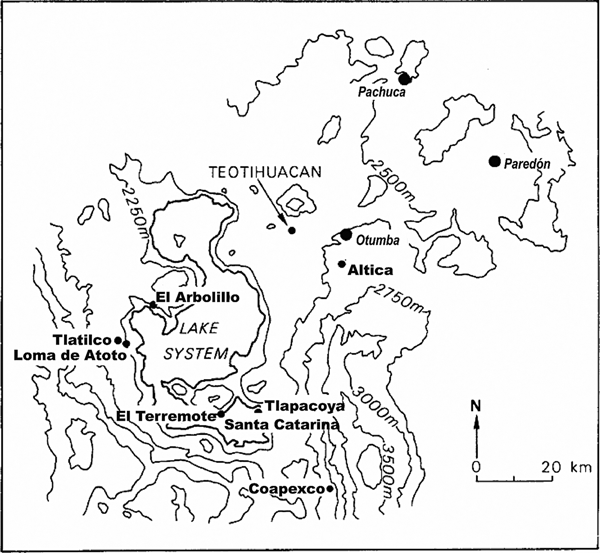
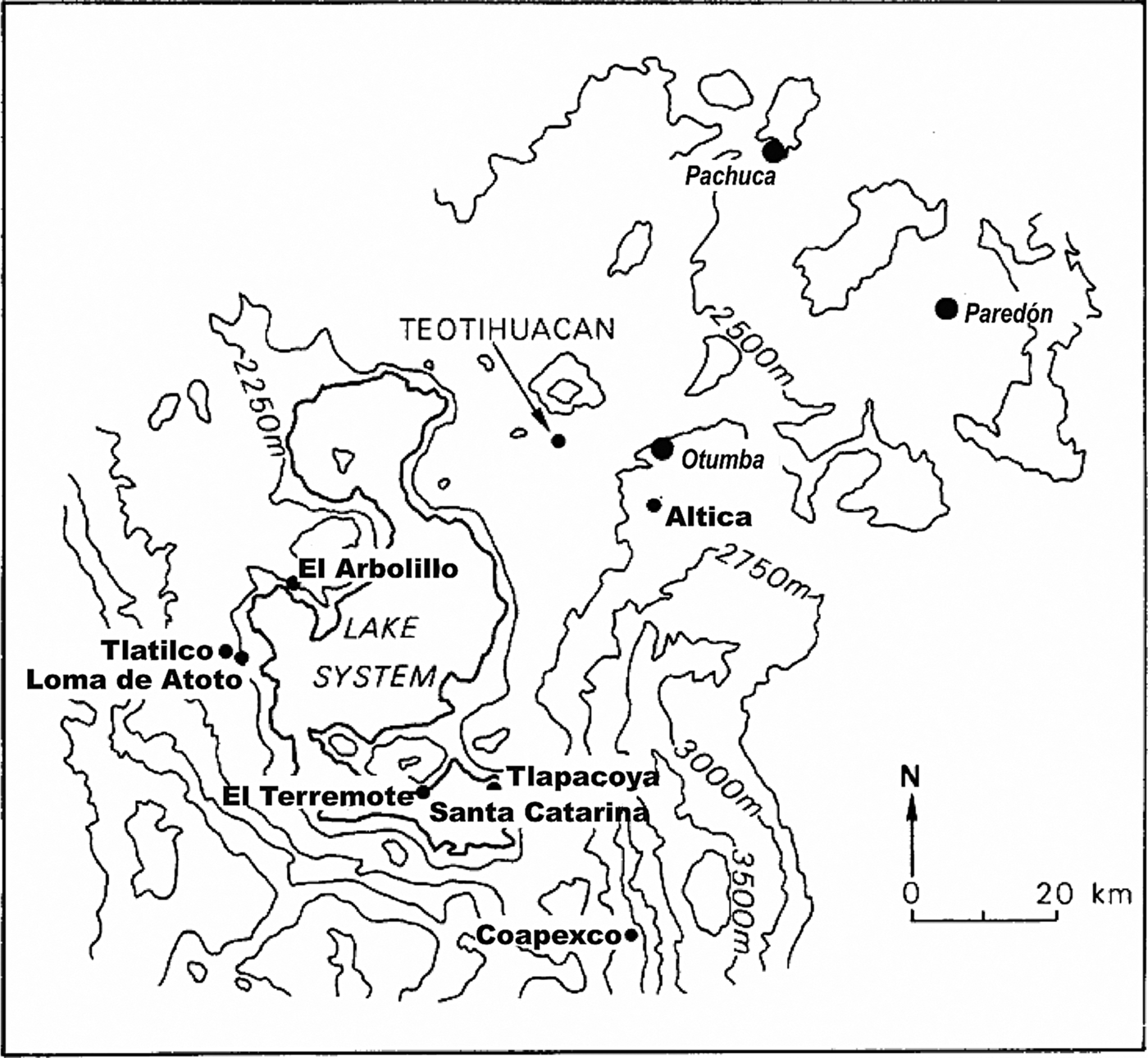
The nine sites included in this study represent some of the earliest permanent settlements in the Basin of Mexico (Sanders et al. Reference Sanders, Parsons and Santley1979; Tolstoy et al. Reference Tolstoy, Fish, Boksenbaum, Vaughn and Smith1977). Most of these are situated on or near the lakeshores of the southern Basin, where a warmer, wetter climate and desirable wild resources enabled a relatively smooth transition into sedentary agricultural life (Parsons Reference Parsons2005, Reference Parsons, Staller and Carrasco2010; Serra Puche Reference Serra Puche1988). Figures 1 and 2 show the locations and occupation dates, respectively, for each of the sites.
Sites discussed in the text, with nearby obsidian sources in italics. Adapted from Boksenbaum (Reference Boksenbaum1978) by Johnson.
Recalibration of all radiocarbon dates based on IntCal 13 (Reimer et al. Reference Reimer, Bard, Bayliss, Warren Beck, Blackwell, Ramsey, Buck, Cheng, Lawrence Edwards, Friedrich, Grootes, Guilderson, Haflidason, Hajdas, Hatté, Heaton, Hoffmann, Hogg, Hughen, Felix Kaiser, Kromer, Manning, Niu, Reimer, Richards, Marian Scott, Southon, Staff, Turney and van der Plicht2013). Dates for Tlatilco taken from Pool (Reference Pool2007). Dates for Altica taken from Stoner and Nichols (Reference Stoner and Nichols2019). Subphases based on Tolstoy et al. (Reference Tolstoy1978).
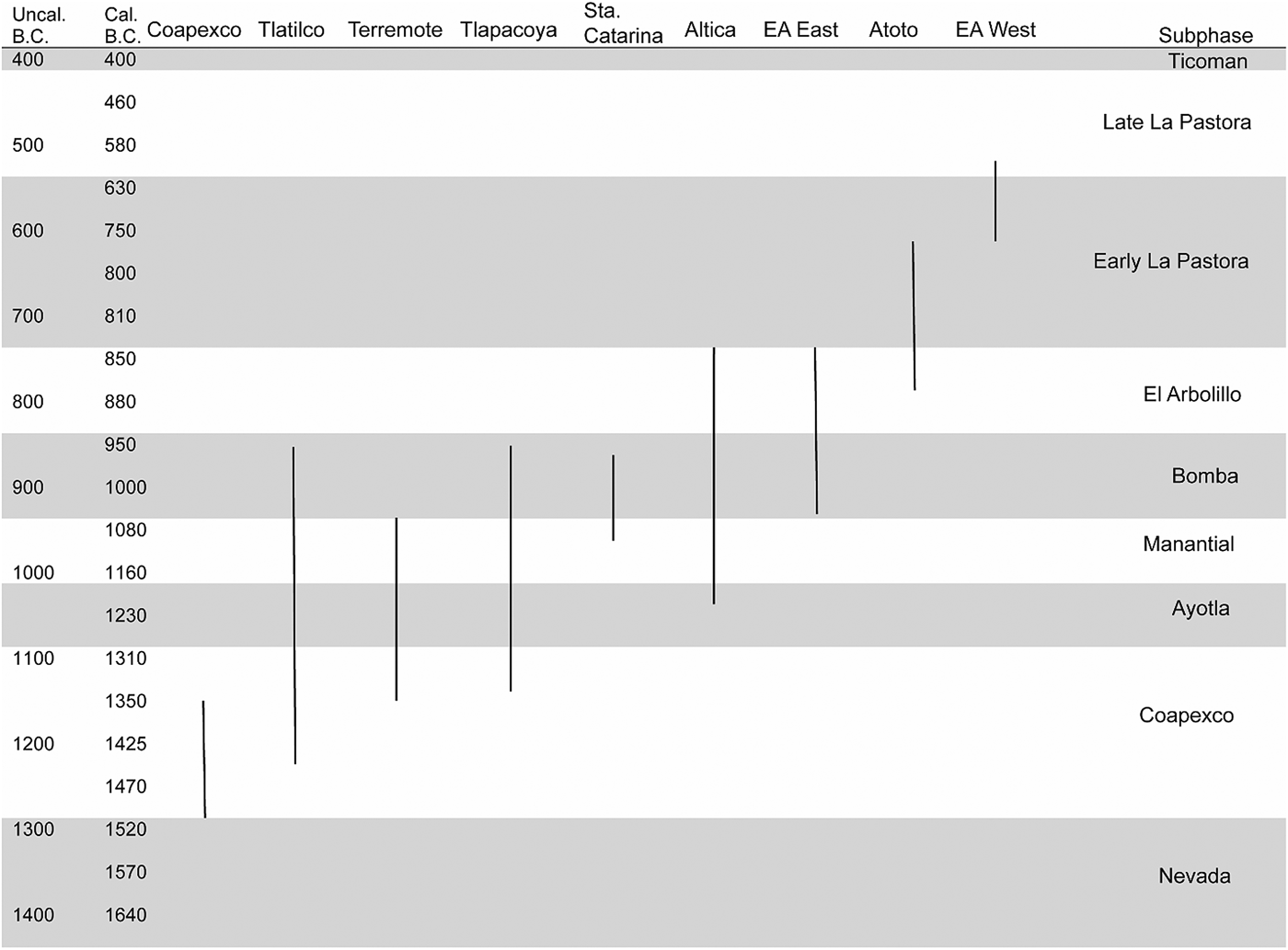
All assemblages from the nine sites in this study include each of the four lithic industries mentioned previously, although they vary considerably in proportion. Bifaces and unifaces, as they are discussed here, are included in the category “shaped artifacts,” though it is important to note that, in these assemblages, the production of bifaces and unifaces does not represent a well-developed and sophisticated industry. Rather, such tools were usually scrapers, roughly shaped from percussion flake blanks. The sample does not include any complete or finely finished bifaces or unifaces. Prismatic pressure blades were separated into initial (first- and second-) series irregular blades and final (third-) series blades.
Coapexco
Coapexco represents one of the earliest sedentary farming communities in the Basin of Mexico, and its assemblage is the oldest considered here (Parsons et al. Reference Parsons, Brumfiel, Parsons and Wilson1982; Tolstoy and Fish Reference Tolstoy and Fish1975). The population numbered between 450–500 residents at this time, but site occupation was relatively brief (Parsons et al. Reference Parsons, Brumfiel, Parsons and Wilson1982). Coapexco was situated in a 10-ha area of piedmont of the volcano Iztaccihuatl, overlooking the Amecameca pass that exits the Basin of Mexico to the southeast. Its position along an easily traversable travel route may have offered sufficient advantages to make up for the more limited access to valuable lacustrine resources. Coapexco benefited from considerably higher rainfall than elsewhere in the Basin, which likely mitigated agricultural risk (Tolstoy Reference Tolstoy1984:177).
The lithic sample was drawn from a stratigraphically controlled excavation in a domestic refuse pit associated with four Coapexco subphase households (Boksenbaum et al. Reference Boksenbaum, Tolstoy, Harbottle, Kimberlin and Neivens1987:71). It includes 403 obsidian fragments, of which 204 were selected for geochemical sourcing based on size. Coapexco's sample is notable in its high proportion of blades relative to the overall obsidian assemblage, although Boksenbaum (Boksenbaum et al. Reference Boksenbaum, Tolstoy, Harbottle, Kimberlin and Neivens1987:72) notes that the overall ratio of lithic to ceramic artifacts recovered at the site is very low relative to the other sites discussed here. Nearly all of these are third-series blades, and there is no indication that obsidian cores used to manufacture pressure blades were shaped at this site.
Tlatilco
The Early Formative site of Tlatilco is also located on a lakeside plain adjacent to the Cerro de Guadalupe (Boksenbaum Reference Boksenbaum1978:116). Tlatilco is especially noteworthy for the hundreds of burials discovered there, which contained a variety of grave goods used to establish the presence of social stratification at the site (Joyce Reference Joyce, Joyce and Grove1999; Tolstoy Reference Tolstoy, Sharer and Grove1989). Tlatilco lends its name to a set of cultural characteristics appearing together at Formative sites throughout central Mexico, notably including Chalcatzingo, Morelos. This “Tlatilco culture” is characterized by red-on-brown ceramics and stirrup-spouted vessels, exhibiting evident ties to West Mexican stylistic motifs (Grove Reference Grove2007:216–219). Chipped stone artifacts are rare among these burials, present in only 23 percent of the burials but, interestingly, four of the burials contain some evidence of craft specialization including obsidian blades, flake concentrations and, in one case, a core (Boksenbaum Reference Boksenbaum1978:117).
The Tlatilco sample included in this study, consisting of 88 obsidian fragments that were assigned by Tolstoy to the Coapexco, Ayotla, Manatial, and Bomba subphases (Figure 2). Of these, 42 artifacts were sourced using pXRF. In terms of technology, Tlatilco's assemblage strongly favors a percussion flake-core toolkit, although all of the aforementioned lithic industries are represented.
El Terremote
El Terremote was located on the shore of Lake Chalco, barely above the water's surface at 2,240 m (Tolstoy Reference Tolstoy1984:132). Its occupation was relatively brief, having been established in the Ayotla subphase and abandoned at the end of the Manantial. The cause for its abandonment may be associated with a minor rise in lake level which occurred at that time and encouraged lake-adjacent settlements farther upslope (Tolstoy Reference Tolstoy1975:343–344).
This lithic assemblage was recovered from a domestic refuse deposit, on and around two house mounds. The midden extends across the site's entire occupation, containing both Ayotla and Manantial phase materials (Boksenbaum et al. Reference Boksenbaum, Tolstoy, Harbottle, Kimberlin and Neivens1987:71). As is the case with Tlatilco, El Terremote's lithic assemblage is dominated by the expedient percussion flake industry, with percussion artifacts occurring about twice as often as pressure artifacts. Eighty-seven of the sample's 192 fragments were sourced.
Tlapacoya
Research has identified Tlapacoya as one of the earliest sites of long-term occupation in the Basin of Mexico, with evidence for year-round exploitation of lacustrine resources emerging as early as 2000 b.c. (Niederberger Reference Niederberger1976, Reference Niederberger1979). Materials from the Tlapacoya lithic assemblage have been dated to the Ayotla, Manantial, and Bomba subphases (Boksenbaum Reference Boksenbaum1978:126). Tolstoy (Reference Tolstoy1984:89) gives an area of about 12 ha for the site, which is situated directly on the pre-Hispanic shores of Lake Chalco.
Although the Tlapacoya assemblage is also dominated by percussion artifacts, it is one of only two sites that shows a high proportion of fragments resulting from bipolar percussion, the other being El Arbolillo's eastern occupation. Like most of the assemblages considered here, Tlapacoya's lithics were recovered in a stratigraphically controlled excavation of a domestic midden. Of the 776 obsidian fragments in the assemblage, 356 were sampled for geochemical sourcing.
Santa Catarina
The site of Santa Catarina is also located on the Chalco lakeshore slightly to the east of El Terremote. The total area is 6.25 ha of rough, rocky terrain at the foot of the Sierra de Santa Catarina (Tolstoy Reference Tolstoy1984:110–115). Santa Catarina's occupation dates to the Manantial and Bomba subphases (Figure 2), after the level of Lake Chalco had completed its rise and again begun to recede (Boksenbaum et al. Reference Boksenbaum, Tolstoy, Harbottle, Kimberlin and Neivens1987:66; Tolstoy Reference Tolstoy1975:344).
Although the site's occupation was relatively brief, Santa Catarina's assemblage is the largest included in this study, with 976 total fragments considered. The assemblage favors percussion artifacts, with prismatic artifacts occurring at about half the rate. A subsample of 152 artifacts was selected for geochemical sourcing.
Altica
Altica, like Coapexco, is located away from the lakeshore environment. Its position in the rugged piedmont of the Teotihuacan Valley removes it from prime agricultural land, as well as lacustrine resources. Altica is, however, substantially closer to significant sources of obsidian, especially the Otumba source. In the Early and Middle Formative, Otumba obsidian makes up the vast majority (74.7 percent) of the region's stone tool assemblage (Blomster and Glascock Reference Blomster and Glascock2011; Boksenbaum Reference Boksenbaum1978; Boksenbaum et al. Reference Boksenbaum, Tolstoy, Harbottle, Kimberlin and Neivens1987; Pires-Ferreira Reference Pires-Ferreira1975, Reference Pires-Ferreira and Flannery1976). Altica dates to about 1250–850 cal b.c. (1050–750 b.c., uncalibrated), which places is it in the middle of the sample in terms of age (Figure 2). While not exceptionally early within the Basin of Mexico, it is the oldest known farming site in the Teotihuacan Valley and the only known Formative site within one day's travel of Otumba (Nichols Reference Nichols2015; Stoner et al. Reference Stoner, Nichols, Alex and Crider2015; Tolstoy et al. Reference Tolstoy, Fish, Boksenbaum, Vaughn and Smith1977).
Altica's assemblage is the only one included in this study that was collected in a surface survey, rather than a domestic refuse context (Boksenbaum et al. Reference Boksenbaum, Tolstoy, Harbottle, Kimberlin and Neivens1987:71). The lack of stratigraphic control may imply a lack of chronological control for the artifacts as well. Tolstoy (Reference Tolstoy, Sharer and Grove1989) and Boksenbaum (Boksenbaum et al. Reference Boksenbaum, Tolstoy, Harbottle, Kimberlin and Neivens1987), however, assert that the ceramics found in association place the lithic assemblage considered in this study firmly in the Formative, with no significant intrusion of later materials. Surface survey during the Altica Project encountered a small Aztec occupation adjacent to the Formative site but suggested that the Formative and Aztec occupations of the site do not overlap (Stoner et al. Reference Stoner, Nichols, Alex and Crider2015:20).
This study considers 582 obsidian fragments from the Altica surface collection, of which 289 were geochemically sourced at the University of Missouri Research Reactor (MURR) (Glascock Reference Glascock2013).
El Arbolillo (East and West)
The site of El Arbolillo is located on a stretch of Lake Texcoco's former lakeshore, separated from the main body of the lake by the Sierra de Guadalupe (Boksenbaum Reference Boksenbaum1978:113–116; Vaillant Reference Vaillant1935:147). It was originally excavated by Vaillant (Reference Vaillant1930, Reference Vaillant1935) before Tolstoy's (Reference Tolstoy1984) later reexamination. Excavations revealed two distinct occupations at El Arbolillo: the western excavation dating to the La Pastora subphase and an eastern area corresponding to the Bomba and El Arbolillo subphases (Boksenbaum Reference Boksenbaum1978:125–126). The easternmost occupation is particularly noteworthy for the depth and density of its cultural remains, with sherd densities as high as 15,000 sherds/m3 and depths exceeding seven meters before reaching sterile soil (Tolstoy Reference Tolstoy1984:55). The two occupations together occupy about eight hectares. Both assemblages were collected in controlled excavations of domestic refuse (Boksenbaum et al. Reference Boksenbaum, Tolstoy, Harbottle, Kimberlin and Neivens1987:71).
The earlier of the El Arbolillo assemblages, from the eastern occupation, consists of 584 obsidian fragments, of which 271 were selected for sourcing. The assemblage is relatively balanced between percussion and pressure artifacts and includes a relatively high proportion of roughly shaped bifaces and other such tools.
The El Arbolillo West assemblage favors artifacts from the prismatic blade sequence and contains one of only two core segments considered in this study. Still, there is very little evidence for prismatic blade production, with no core-shaping artifacts and only one initial-series blade among the 339 fragments in the assemblage. Of these, 146 fragments were selected for sourcing.
Loma de Atoto
Loma de Atoto is located within the western margin of present-day Mexico City, on a small hill on the Río de los Remedios floodplain. The site occupies an elliptical area of about 20 ha and is separated from Tlatilco by the river. Both of these sites are relatively far from the pre-Hispanic lakeshore, at a distance of about 6 km (Tolstoy Reference Tolstoy1984:67–70). Tolstoy (Reference Tolstoy1975) and Boksenbaum (Reference Boksenbaum1978:125) date the site's assemblage to the El Arbolillo and Early La Pastora subphases. The fragments were recovered in a controlled excavation of domestic refuse and several feature pits (Boksenbaum et al. Reference Boksenbaum, Tolstoy, Harbottle, Kimberlin and Neivens1987:71).
Like most of the assemblages included in this study, most of Atoto's 298 lithic fragments are percussion-based. A subsample of 113 fragments was chosen for geochemical sourcing. Atoto's assemblage includes one of two core segments examined in the study, but the only other artifacts associated with the prismatic blade sequence are final series blades, suggesting that blade production did not happen on site.
OBSIDIAN NETWORKS, TRANSPORTATION CORRIDORS, AND GATEWAY COMMUNITIES
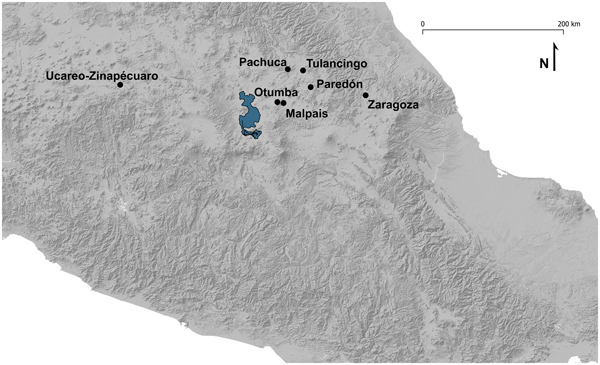
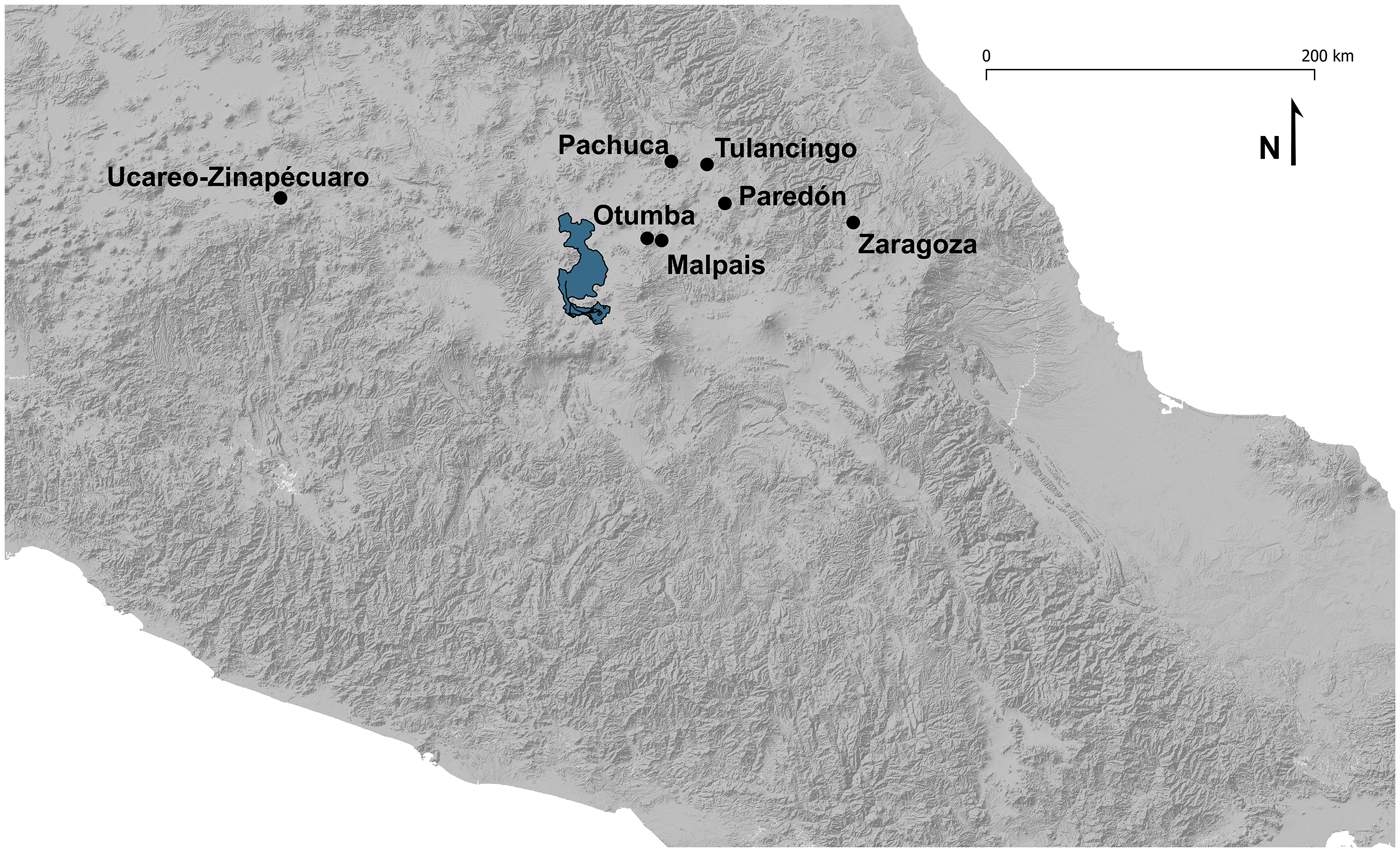
Obsidian use and distribution start at the geological source. Raw material is mined or collected from outcrops, where preliminary processing may take place (Figure 3). Obsidian is then either used, or it enters the distribution network where it is transported to other sites where it is consumed in both domestic and craft related activities. Individuals who procured obsidian directly from the source had short lines of procurement and their use areas reflect direct access to source deposits in different ways (Hirth Reference Hirth2008). Consumers located in communities without direct access, however, relied on exchange networks of different types to move obsidian over space. While the structure of procurement and exchange networks in Mesoamerica changed over time, we assume that most regional and interregional exchange was carried out through a combination of formal and informal household-to-household interactions involving both gift giving and reciprocal exchanges (Dalton Reference Dalton, Earle and Ericson1977; Heider Reference Heider1969; Yan Reference Yan and Carrier2005) during the Early and Middle Formative (Pires-Ferriera and Flannery Reference Pires-Ferreira and Flannery1976). How Formative exchange networks were structured is a research question that needs concerted problem-oriented examination and cannot be answered with the information currently at our disposal.
Mesoamerican obsidian sources mentioned in the text. Map by Johnson.
Every community in central Mexico was using obsidian as a major material for cutting implements by the Early and Middle Formative periods. A notable outlier in terms of the dominance of obsidian is Amomoloc, an early Middle Formative site in the state of Tlaxcala. Amomoloc's lithic assemblage is comprised of imported obsidians as well as local non-obsidian materials, which make up 40 percent of its assemblage. The relatively high proportion of non-obsidian lithics at Amomoloc, and the high diversity of obsidian sources represented in its assemblage, suggest a decentralized, opportunistic means of raw material acquisition (Carballo et al. Reference Carballo, Carballo and Neff2007).
While the form of lithic cutting implements varied from site to site, virtually every community was connected to the obsidian procurement network to some degree or another. These networks were unstructured in the sense that material moved through them was based on the initiative of the individuals within them. The location of the communities consuming obsidian determined the physical shape of these networks, which influenced both the ease of transport and quantity of material being exchanged. From a network perspective, communities were the nodes in a transportation matrix with the links between nodes determined by the frequency and type of exchange involved in moving obsidian through it. Communities with multiple lines of network connectivity benefited from more lines of access to the obsidian moving through it. Differences in community size could place stresses on procurement when consumers in large communities depended on a few providers in small communities to meet their needs. This stress was amplified when exchange networks were highly dendritic in structure as a result of natural topography or when there were few communities along which trade goods might move.
The role and importance of sites within a network varied with their location and the activities carried out within them. Sites located close to obsidian sources certainly played an important role in obtaining, processing, and initiating the movement of obsidian into the exchange network. We refer to these as “processor” sites or communities when individuals in them engage in mining and preparing obsidian for exchange. Depending on demand, this need not be a full-time activity. It could be work carried out as a part-time activity alongside, or in addition to, agriculture as part of their overall subsistence strategy. Several things are certain, however. First, the involvement of processor sites in the acquisition of obsidian will be a function of demand throughout the entire network. Second, when processing involves modifying natural stone in a way that makes it more suitable for transport, then these sites will have lithic debitage that reflect those activities and are different from normal consumer sites. Finally, processing can involve the creation of value-added items in the form of finished tools that can also be interjected into the exchange network. Unlike raw material acquisition, this can occur at different locations within the exchange network. The creation of prismatic pressure blades from polyhedral cores moving through the network would be one example of the type of value-added finished tools that processing sites can create.
As mentioned above, how materials moved through exchange networks can be directly affected by the natural topography when it constrains movement and forces it through a natural communication corridor and the sites or communities located within it (Gotliko and Feinman Reference Golitko and Feinman2015). The funneling effect that natural topography creates can assist in the formation of what have been called gateway communities, which are important nodes within interregional transportation networks. The movement of goods in such a system is expected to follow a dendritic pattern. As a gateway community develops and its ability to exert control over trade increases, it may be able to pool resources and redistribute them, both to its immediate hinterlands and to trading partners farther afield.
The site of Chalcatzingo has been argued to have functioned as a type of gateway community, facilitating east-west communication between Morelos and the Valley of Puebla during the Early and Middle Formative periods (Hirth Reference Hirth1978). Chalcatzingo exhibited the west Mexican associated characteristics of the Tlatilco culture by 1150 b.c. but is perhaps best known for the “Olmecoid” architecture exhibited there in later periods (Grove Reference Grove, Sharer, Grove and Haas1989, Reference Grove, Luján, Carrasco and Cué2006; Grove et al. Reference Grove, Hirth, Bugé and Cyphers1976; Plunket and Uruñuela Reference Plunket and Uruñuela2012). In terms of obsidian, Chalcatzingo appears to have played a notable role in the early dispersal of obsidian blade-core technology, which may be related to its functions as an intermediary of obsidian transport. The earliest obsidian blade-core workshop in the region has been identified at the site (Burton Reference Burton and Grove1987; Espinosa Severino Reference Espinosa Severino2016; Hirth Reference Hirth2008), and its position within the trade networks make it a probable introducer for this technology into the region. Archaeologically, we would expect communities with a situational advantage within exchange networks to exhibit signs of resource pooling and participation in consistent, long-range trade. In the case of obsidian exchange, this may present itself as a diverse assemblage not dominated by any single lithic source. Debitage from tool production may be present, but initial nodule processing and decortication are unlikely to have occurred, owing to the costs of transport.
Altica and Formative-Period Obsidian Exchange
Altica is the oldest known agricultural site in the Teotihuacan Valley, emerging in the Early Formative in what was then a sparsely populated landscape. It is located on a flattish segment of the rugged Sierra de Patlachique piedmont. Unpredictable rains and frosts, as well as highly erosive soils (Nichols Reference Nichols1987, Reference Nichols2015, Reference Nichols2016) made Altica a less than an ideal location for early farmers. Nevertheless, research has shown that households can balance unpredictable agricultural yields by engaging in craft production and other forms of economic activities to meet their domestic needs (Hirth Reference Hirth and Hirth2009; Netting Reference Netting1981). In the case of Altica, ready access to obsidian may have provided farmers with an opportunity to diversify economically and, in doing so, protect themselves from the uncertainties of early agricultural life.
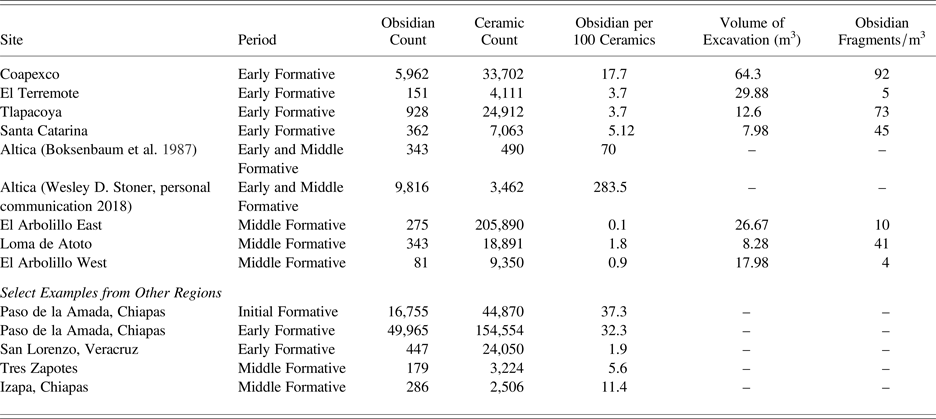
The Altica site is located less than 10 kilometers from the Otumba obsidian source, and density of obsidian artifacts at the site is conspicuously high (Table 1). Several researchers have postulated that the site must have been involved in some form of obsidian processing, in the form of core preparation or even blade production (Charlton Reference Charlton and Hirth1984; Sanders Reference Sanders1965; Santley Reference Santley and Hirth1984; Stoner et al. Reference Stoner, Nichols, Alex and Crider2015; Tolstoy et al. Reference Tolstoy, Fish, Boksenbaum, Vaughn and Smith1977). The high density of surface lithics led Tolstoy and colleagues (Reference Tolstoy, Fish, Boksenbaum, Vaughn and Smith1977:102) to characterize the site as the earliest obsidian workshop in the Basin of Mexico at a time when no other factory workshops in the Basin had as yet been found. Stoner and colleagues (Reference Stoner, Nichols, Alex and Crider2015) have observed that the quantity of obsidian found at Altica is far in excess of what one would expect from a normal farming village. One possibility suggested by Charlton (Reference Charlton and Hirth1984) is that Altica played a key role in preparing and processing obsidian nodules for movement into down-the-line exchange. According to Charlton, initial processing involving the removal of cortex would have helped to lighten the load and increase the amount of usable obsidian that could move to consumers through the forms of informal exchange operating during the Formative period. If this occurred at Altica, one would expect to recover a relatively high incidence of flakes removing cortex within the site. Other investigators have suggested that Altica may have been geared toward the preparation of polyhedral cores used in pressure blade production (Santley Reference Santley and Hirth1984; Tolstoy et al. Reference Tolstoy, Fish, Boksenbaum, Vaughn and Smith1977), although technological analysis suggests that this was not likely the case (Tables 2 and 3; Healan Reference Healan2019). Though primarily a farming village, the quantity of obsidian recovered from early surface collections at the site suggested that Altica's residents actively participated in some form of obsidian processing within Early Formative exchange networks.
Basin of Mexico data modified from Boksenbaum et al. (Reference Boksenbaum, Tolstoy, Harbottle, Kimberlin and Neivens1987:Table 4). Their analyses did not include Tlatilco. There is no density of obsidian/m3 excavated for Altica, as this assemblage originated from surface collection. Data from other sites were sourced from Stark et al. (Reference Stark, Boxt, Gasco, González Lauck, Hedgepeth Balkin, Joyce, King, Knight, Kruger, Levine, Lesure, Mendelsohn, Navarro-Castillo, Neff, Ohnersorgen, Pool, Mark Raab, Rosenswig, Venter, Voorhies, Williams and Workinger2016) and include analyses from Lesure (Reference Lesure1999, Reference Lesure and Lesure2011), Lesure and Blake (Reference Lesure and Blake2002), Pool et al. (Reference Pool, Knight and Glascock2014), Rosenswig et al. (Reference Rosenswig, Mendelsohn, Antonelli, Lieske and Núñez-Cortés2014), and Wendt (Reference Wendt2003).
Lithic assemblages by artifact category.
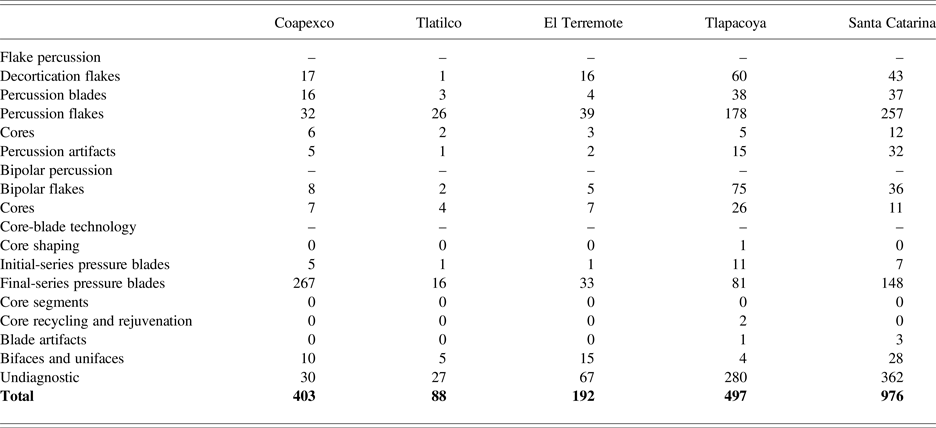
Lithic assemblages by artifact category.

Healan's careful technological analysis of the obsidian remains recovered at Altica is reported in this volume. Important in this analysis is the low level of cortex removal flakes in the collection that would be expected if obsidian nodules were being processed into percussion cores for expedient flake reduction. Whether obsidian nodules underwent some form of initial processing as a preliminary step before entering the exchange network is unclear because we lack good information on the form in which obsidian moved. Nevertheless, even if the obsidian nodules were processed into percussion cores as a regular aspect of obsidian exchange, we would have no evidence of this if it took place in secondary sites at or near the obsidian source. Finally, rectifying observed-to-expected cortex frequencies is difficult without some knowledge of the size of the nodules that Formative-period miners could obtain since the relative frequency of decortication flakes in an assemblage is inversely proportional to the size of the nodules from which they are removed. The larger the nodules obtained, the lower the relative frequency of decortication flakes in the assemblage.
Two interesting aspects of the Altica assemblage suggest that residents of the site were active participants as suppliers in regional obsidian exchange networks during the Early and Middle Formative periods. The first of these is the high level of obsidian working observed and recorded at the site. While abnormally high obsidian concentrations cannot by themselves be used to argue for some level of craft specialization, they do reflect a different level of lithic related production and work. At Altica, that work took the form of expedient percussion flaking. Table 1 provides a comparison of obsidian density at Altica to seven other consumer sites in the study sample expressed as the quantity of obsidian recovered compared to a ratio of 100 pottery sherds, as well as several Formative examples from other regions. It is clear from this simple calculation that the abundance of obsidian registered from surface observations is no anomaly. In the recent Altica Project surface survey, obsidian is actually more abundant than pottery sherds. Moreover, the obsidian density of 283.5 pieces of obsidian per 100 potsherds is more than 16 times the next highest frequency of obsidian density recorded at Coapexco (17.7 pieces per 100 potsherds). A range of somewhere between one to five pieces of obsidian per 100 potsherds may be the norm for typical consumer sites that did not engage in some auxiliary production activities. No other contemporaneous site in the Basin of Mexico, aside from Altica and Coapexco, has such a high proportion of obsidian. Even when compared with other regions, Altica is anomalous in its obsidian concentration, although the site of Paso de la Amada in Chiapas surpasses Coapexco's obsidian density. Whatever was going on at Altica, its residents were consuming an abnormally large amount of obsidian compared to other contemporaneous agricultural communities (see Stark et al. [2016] for comparisons of obsidian consumption rations in Formative sites elsewhere in Mesoamerica).
A second interesting aspect of the Altica assemblage is the high percentage of small flakes in the obsidian assemblage. Healan calculates that fully 98.6 percent of the artifacts are less than 3.2 centimeters in size; of these, fully 57.8 percent are small debris 1.6 centimeters or less in size. Most of these remains are expedient flakes since they constitute 79 percent of the entire Altica artifact assemblage (Healan Reference Healan2019:Tables 2 and 3). This is something of a conundrum since experimental studies conducted by Bamforth (Reference Bamforth1991) suggest that flakes under 2.5 cm in size cannot be used effectively in an economy were cutting activities relied on handheld tools. Similar experiments by Hirth and colleagues (Hirth and Andrews Reference Hirth, Andrews and Hirth2006:215; Hirth and Castanzo Reference Hirth, Castanzo and Hirth2006) suggest that the minimum usable length for hafted prismatic blades is not much smaller at 2.0 cm.
Given these parameters, it is likely that somewhere between 70–75 percent of all the flaked obsidian artifacts recovered in the Altica assemblage are too small for handheld use. For comparison, when looking at the other site assemblages in aggregate, fragments larger than three centimeters comprise almost 16 percent of the sample, about the same as the proportion of fragments smaller than two centimeters. Sixty-eight percent of the sample is between 2 and 3 centimeters. The surface collections from Altica were excluded on the grounds that they were likely biased in favor of larger, more visible fragments. Based on the quantity of obsidian recovered it is clear that “something” is being processed at Altica that required the production of a large number of small flakes. The flake debris left behind may well be the broken flakes consumed by that activity.
Whatever the specific range of activities carried out at Altica, the site does not compare well to any other site in the Basin of Mexico in terms of the quantity of obsidian recovered. Based its proximity to the geological source and the quantity of lithic reduction carried out at Altica, we believe that residents of the site were involved in procuring and initiating the trade of raw material in the Basin of Mexico obsidian network. Whether they were trading raw nodules or partially prepared percussion cores is unclear. If the latter, it is likely that preparation would have taken place at a secondary production site as Healan (Reference Healan2019) suggests.
COAPEXCO AND ITS ROLE IN FORMATIVE-PERIOD OBSIDIAN EXCHANGE
The site of Coapexco stands out as an exception site in several regards. First, it is the earliest site in the sample and provides insight into the earliest phases of obsidian exchange and technological development. Second, its geographic location in a natural bottleneck in the exchange network—the Amecameca pass—could have afforded it some degree of control over the obsidian and other materials flowing between Morelos and the Basin of Mexico. Third, it is a locale where specialized lithic production or processing took place. The majority of the obsidian artifacts recovered in this assemblage (62.8 percent) are prismatic pressure blades, a percentage which far exceeds that found in any other known site in the Basin of Mexico during the Early and Middle Formative periods (Tables 2 and 3). In contrast to Altica, however, Coapexco's overall assemblage is very low in its proportion of flaked stone artifacts as compared to ceramics.
Boksenbaum (Reference Boksenbaum1978; Boksenbaum et al. Reference Boksenbaum, Tolstoy, Harbottle, Kimberlin and Neivens1987) identifies Coapexco as a possible middleman site in long-range trade, on the basis of its relatively high proportion of prismatic blades and diversity of exploited obsidian sources, and as a potential catalyst in the spread of prismatic blade technology into the Basin of Mexico. If Otumba and Paredón obsidian were moving into the Basin from the east, through the Teotihuacan Valley, then Coapexco may have served an important role in improving access to obsidians from the west, like Ucareo, or from the east, like Zaragoza (Boksenbaum et al. Reference Boksenbaum, Tolstoy, Harbottle, Kimberlin and Neivens1987:72).
Coapexco's position in the Amecameca pass may have made it a concentrated point of trade of non-obsidian artifacts as well. For example, ceramics and other artifacts in the Gulf Coast style were recovered from the site, though these were locally produced (Biskowski Reference Biskowski2015:395; Boksenbaum et al. Reference Boksenbaum, Tolstoy, Harbottle, Kimberlin and Neivens1987). Ground stone artifacts found at the site suggest that some specialized production of ground stone tools like manos and metates also took place there, despite the fact that the durability of such tools would have kept demand quite low (Biskowski Reference Biskowski2015; Hayden Reference Hayden and Hayden1987). A certain degree of differentiation in burial practices, in conjunction with the presence of long-range trade and craft specialization, suggest that Coapexco society was stratified. Biskowski (Reference Biskowski2015:396) suggests that the unexpected specialization in stone grinding tools may even have been the result of some form of elite sponsorship.
If there was an established trade route between the Basin of Mexico and Morelos that split and extended to the Gulf Coast and Michoacan, then both Coapexco and Chalcatzingo would have been on or near it. As such, both sites would have been able to exert some influence over the movement of goods both into and out of the Basin.
OBSIDIAN EXCHANGE WITHIN THE NETWORK
Analysis of lithic assemblages within the Basin of Mexico reveals that obsidian was used to fashion the majority of cutting tools in obsidian used in archaeological sites during the Early and Middle Formative periods. But the important questions are: what geological sources provided the obsidian used to manufacture cutting tools and what does this tell us about the structure and organization of the obsidian networks? Energetic efficiency models would predict that local obsidian sources would provide the raw material used in producing the obsidian tools in sites situated closest to them. Deviation from that model would reveal potentially interesting aspects of the structure of obsidian networks and the selective pressures that influenced the obsidian moving through them.
Movement of obsidian within the Basin of Mexico exchange networks was examined through an analysis of 1700 obsidian artifacts from the nine sites in the study sample using pXRF geochemical techniques. Table 4 summarizes the results of these analyses. The top section examines the sources used in percussion flaking activities (expedient flake, bipolar, and bifacial/unifacial production), while the bottom section presents the obsidian used in core-blade pressure blade production. The analyses revealed both predictable and surprising results.
Source identifications for core-blade and non-blade artifacts.
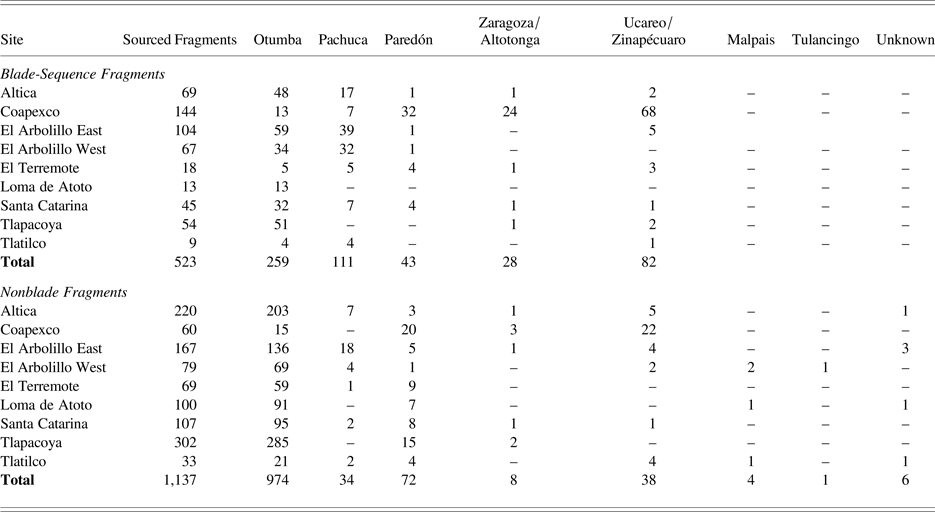
As would be expected, Otumba obsidian dominated Altica's lithic assemblage, to the point that all 69 of the sourced fragments originated at Otumba. Though no other site exhibits such a strong Otumba dominance, all but Coapexco exhibited a majority of Otumba obsidian used for both pressure and percussion technologies. Otumba obsidian comprises 13.7 percent of Coapexco's total obsidian assemblage. By way of comparison, Loma de Atoto and Tlapacoya both have extremely high proportions of Otumba obsidian at 92 and 94.4 percent, respectively, with Santa Catarina close behind at 83.6 percent. Even Tlatilco, which has the second lowest proportion of Otumba obsidian, has a majority of Otumba (59.5 percent). Otumba's importance as a primary source is evident among both Early and Middle Formative sites, and its overall role as the dominant obsidian source in central Mexico is supported.
While Otumba's dominance is not surprising, the diversity of non-Otumba obsidians is. Each of the percussion assemblages includes obsidians from two to six additional sources. Clearly, obsidian from each of these other sources was also moving through these Formative-period procurement and exchange networks, at a lower volume than that from Otumba. Some of the sources represented are located a great distance away from the Basin of Mexico. The Ucareo-Zinapécuaro sources are located in highland Michoacan, some 115 km to the west of the lake system, while the Zaragoza-Oyemeles sources are located 125 km away in the opposite direction.
As early as 1800 b.c., similarly expansive obsidian procurement networks were provisioning the emergent Gulf Coast Olmec. Assemblages at San Lorenzo include nodules and blades from central Mexican sources, as well as sources as far away as Michoacan and Guatemala (Hirth et al. Reference Hirth, Cyphers, Cobean, De León and Glascock2013).
Though most sites exhibit a surprising level of source diversity, none has as diverse of an obsidian assemblage as Coapexco. Five sources are represented in the assemblage, of which four comprise at least 10 percent of the assemblage. This conforms to expectations established by Boksenbaum's (Boksenbaum et al. Reference Boksenbaum, Tolstoy, Harbottle, Kimberlin and Neivens1987) more limited sourcing sample. A plurality of Coapexco's obsidian, 44.1 percent, originated in the Michoacan sources of the Ucareo-Zinapécuaro source area. Including the contribution of Zaragoza obsidian, over half of Coapexco's assemblage originated in the more distant sources. Paredón and Otumba are also represented, but the usually dominant Otumba makes up only 13.7 percent of the assemblage, equivalent to the proportion of Zaragoza obsidian. That Coapexco exhibits a relatively high level of source diversity suggests that it was able to maintain certain long-range trade connections that were not necessarily shared by all Formative sites in the Basin of Mexico. Coapexco was strongly connected to West Mexico, but also to Puebla and Veracruz to the east and the rest of the Basin to the north. This supports the idea that the site served as a sort of gateway through which these trade pathways could move.
Interestingly, Early Formative assemblages from Chalcatzingo are thought to contain only Otumba and Paredón obsidian (Grove Reference Grove and Grove1987:381–382), while we have determined that contemporaneous Coapexco had a greater diversity, emphasizing Michoacan obsidians. A reexamination of these early Chalcatzingo assemblages is necessary for assessing the nature of any trade relationship that may have existed between the two sites. Potentially, Coapexco could have served as a middleman, both in transporting nonlocal obsidians into the Basin of Mexico and in moving Otumba and Paredón obsidian into Morelos.
The Basin of Mexico's obsidian procurement and exchange networks were far-reaching, but it does not seem that different obsidians were sought out for different uses. Rather, the use of obsidian from different sources was undifferentiated in terms of technology: even stone from exotic sources was being employed in the same basic expedient flake industries as the more accessible Otumba stone. Once a nodule entered circulation, it was evidently regarded as interchangeable with obsidian from other sources.
This interchangeability of material also holds true when considering the production of prismatic pressure blades. Otumba still dominates in most sites except for Coapexco and Tlatilco where, despite the suitability of Otumba obsidian for pressure blade production, distant sources continue to be exploited for this purpose. For all sites with a sample of at least 15 blades, between three and five sources are represented. These include distant sources such as Ucareo-Zinapécuaro, which is represented in six of the nine assemblages, and Zaragoza, which appears in five of the nine sites. Significantly, the source diversity does not differ much between the percussion and pressure assemblages, and no sources seem to be particularly associated with blade production. This, again, suggests that obsidians from various sources were not differentiated when they entered into the exchange network. For sites with smaller samples of blades, the proportions of obsidian from different sources may not accurately reflect the overall composition of the assemblage.
Another major point of interest is the presence of prismatic blades and blade production debris in some of the assemblages. During the Early and Middle Formative, blade technology was gradually becoming more ubiquitous in central Mexico, but exactly how the technology diffused and spread remains unknown.
Coapexco is exceptional in the proportion of prismatic blades within the assemblage. The overall proportion of blades for all sites is only 23.5 percent, while 67.5 percent of Coapexco's assemblage is made up of blades and other blade-core artifacts. Among these blade-core artifacts, fewer than 10 percent originated in Otumba. This supports the hypothesis that Coapexco facilitated the movement of foreign obsidians into the Basin of Mexico, particularly from the west. Other early sites, like Tlatilco, Tlapacoya, and El Terremote, also contain some of these western obsidians, although in smaller proportion than Otumba. Small sample sizes prevent definitive interpretation, but these results are consistent with Coapexco having been involved in the production of blades for downstream trade. The lack of core-shaping debris indicates that the cores themselves were not produced at Coapexco.
The site with the next highest proportion of blade-core artifacts is El Arbolillo West with 38.1 percent. This relatively high proportion could be indicative of some sort of resource pooling, but determining the specifics of that function requires a greater understanding of the nature of the blade trade. Specifically, do these findings imply a trade in whole blades or the work of itinerant crafters or local producers?
To address this question, we turn to the previously cited work by De León et al. (Reference De León, Hirth and Carballo2009) and consider the types of blade-core artifacts found in these assemblages (see Table 5). Their original assessment of the models included Boksenbaum's technological data from three of the sites included in this sample: Tlapacoya, Atoto, and El Arbolillo. Boksenbaum's (Reference Boksenbaum1978) original technological analysis described the assemblages as having almost no secondary production debris and a relatively small proportion of medial blade segments (De León et al. Reference De León, Hirth and Carballo2009). On the basis of these analyses, De León et al. (Reference De León, Hirth and Carballo2009:112–113) determined that blade trade in the Early and early Middle Formative Basin of Mexico best fit the whole-blade trade model. Our reanalysis of Boksenbaum's entire, contemporaneous Formative collection does not support that assessment, however. While few of the site assemblages contain primary production debris (i.e., cores and core fragments), all of them include a small amount of secondary production debris in the form of core-shaping flakes, blade production errors, crested flakes, or initial-series blades (Table 6). Furthermore, we found that the medial-to-distal ratios were typically higher than those presented in De León et al.’s (Reference De León, Hirth and Carballo2009) analysis, as high as 9:1 in the case of El Arbolillo East. Another significant factor affecting our interpretation is the absence of whole blades from the collection.
Expectations for three proposed blade-trade models, adapted from De León et al. (Reference De León, Hirth and Carballo2009).

Summary of late-series blade totals and ratios.

For sites like Coapexco, Tlapacoya, Atoto, and El Arbolillo, both medial-to-distal and proximal-to-distal ratios are higher than would be expected for whole-blade trade or local manufacture, but proximal-to-distal ratios are also lower than might be expected for processed-blade trade. These ratios, in conjunction with the presence of secondary production debris, may indicate a system of blade transport that includes both processed-blade trade and some form of local production. Alternatively, this might reflect a greater segmentation of medial blade sections than anticipated, along with a stronger-than-expected bias against the preservation of fragile distal ends.
Other sites, namely Altica, Santa Catarina, and El Terremote, have ratios more in keeping with expectations for whole-blade trade or local production. Of these three, Altica and Santa Catarina exhibit relatively higher proportions of secondary production debris, while such material is largely absent at El Terremote. This may indicate that the former two relied primarily on local production, possibly by itinerant crafters, as primary production debris is absent. El Terremote, on the other hand, may have relied more on the import of whole blades.
If Altica functioned as a processor of obsidian, this role apparently did not specifically involve blade production. When technological and sourcing data are compared for the site, blade-sequence artifacts are the most geochemically diverse category in the assemblage. The presence of any amount of non-Otumba obsidian at Altica is noteworthy. Otumba is by far the nearest obsidian source, though Paredón and Pachuca are also reasonably close. The presence of foreign obsidians like Ucareo-Zinapécuaro and Zaragoza, however, shows that the residents of Altica were engaged in trade networks that extended far beyond their immediate vicinity. While blades originated from diverse sources, all of the artifacts classified as decortication flakes or blades, meaning that 20 percent or more of their dorsal surface is cortex, were sourced to Otumba (Table 7).
Sourcing results for the Altica assemblage by technological category.

In terms of the chronology presented previously, it is noteworthy that the two sites at which obsidian blades dominate the assemblages are the earliest, Coapexco, and the latest, El Arbolillo West. Coapexco's apparent dependence on obsidian blades is not consistent with the notion that the spread of blade technology developed gradually and progressively between the Early and Middle Formative periods. With that exception in mind, the later sites in the sample do tend toward a higher proportion of blades and other associated artifacts.
Bipolar percussion is present in all assemblages at a consistent but low frequency with the exception of Tlapacoya, where bipolar flakes and cores compose a full 13 percent of the assemblage. The persistence of bipolar percussion across the Formative suggests that, like expedient percussion flaking, bipolar percussion functioned as a separate, non-specialist industry alongside other forms of tool production.
Nodule Preparation
Before the widespread production of obsidian blades, other forms of obsidian processing and preparation dominated lithic assemblages in archaeological sites. The preparation of nodules and subsequent production of flake cores was not as uniform an industry as the production of polyhedral cores for prismatic blade production. We can investigate some simple proxies of initial nodule preparation for expedient flake production, however, namely the presence of cortex in the lithic debitage.
Initial processing, whether producing a flake core or preparing a blade-core, necessitates the removal of the rocky cortex from the exterior of the raw nodules. Distinguishing between those two technologies solely on the basis of decortication flakes would be prohibitively challenging, but it can reasonably be assumed that a high proportion of decortication flakes in the absence of blade production debris would indicate that a site was either (1) solely involved in the process of decortication or (2) was involved in the initial processing and possibly some other use of the flakes produced. In this regard, Altica is the stand-out site. Its proportion of artifacts containing any amount of cortex is 13.1 percent, nearly twice the overall proportion of 7.6 percent for all sites (Table 8). This high proportion is significant in light of Altica's high overall obsidian density (Stoner et al. Reference Stoner, Nichols, Alex and Crider2015; Tolstoy et al. Reference Tolstoy, Fish, Boksenbaum, Vaughn and Smith1977).
Evidence of decortication.

Tlapacoya, El Terremote, and Coapexco also contain high densities of artifacts with any amount of cortex: 9.7, 8.9, and 8.2 percent, respectively. It bears mention that these percentages are still considerably lower than that of Altica. When only artifacts with cortex on at least 20 percent of the dorsal surface are considered, however, Altica no longer stands out so strongly. Altica still has the highest proportion, but barely, with 8.8 percent, as compared to El Terremote's 8.3 percent and a mean of 5.3 percent. As such, the relatively high proportion of cortex might not be the result of large-scale decortication, which would produce flakes for which the entire surface area is rocky cortex. It may instead indicate a greater-than-normal reliance on cortical flakes as tools, possibly because of the relatively higher accessibility of raw Otumba nodules.
If Coapexco was a middleman in the processing of obsidian for trade, it does not appear that that processing involved much in the way of quarrying or nodule reduction. Given its reliance on obsidian from the faraway Michoacan sources, this could be the result of obsidian having been processed to reduce unnecessary weight for transport. Coapexco may have been a site at which blades were removed from pre-prepared cores before being traded as a finished product. Some nodule processing may have taken place at Altica, but such activity likely operated on a small scale. Potentially, the initial removal of cortex took place at the Otumba obsidian source itself, or at some secondary site. In such a case, Altica's role in obsidian distribution networks is less clear.
CONCLUSIONS
The present analysis does not confirm that individuals at Altica were involved in nodule preparation or finished tool manufacture. Evidence for tool production is scarce and is nearly absent for blade production. Still, Altica has an exceptionally high obsidian density, and its assemblage contains a high proportion of cortical fragments. For many of these, though, cortex covered only a small portion of the fragment's overall surface area. The relatively high amount of cortex suggests that some nodule reduction took place at the site, but the bulk of Altica's lithic assemblage consists of simple percussion flakes not necessarily consistent with the shaping of tool blanks or cores. These fragments are more likely associated with a simple tool industry reliant on expedient flaking from percussion cores. On the basis of these data, Altica does not seem to have been a significant exporter of tools or tool pre-forms. If Altica was involved in nodule-shaping, it was not involved in the on-site decortication of raw nodules, which may already have been reduced closer to the Otumba source.
This surface collection also varies from the excavated collections from the recent Altica Project (Healan Reference Healan2019). The excavated collection actually exhibits a relatively low proportion of cortex. Healan's analyses (Dan Healan, personal communication 2017; Healan Reference Healan2019) are also inconsistent with Altica having functioned as a major nodule processing site, though the presence of whole nodule caches reveals a possible role as a transshipment site.
The other potential middleman in the sample, Coapexco, stands out primarily on the basis of its increased source diversity and its evident trade relationships both east and west of the Basin of Mexico. While the other sites relied primarily on Otumba obsidian, Coapexco utilized a variety of obsidians including sources from Michoacan (the Ucareo-Zinapécuaro source area), the northern Basin (Otumba and Paredón), and to the east (the Zaragoza-Oyemeles source area), all in significant proportion. This diversity supports the idea that obsidian and other valuable trade goods were pooled in Coapexco upon their entrance to, or exit from the Basin of Mexico prior to their subsequent redistribution. Given the especially high proportion of blades, Coapexco was likely involved in the movement of processed blades into the Basin of Mexico.
Of the sites included in the sample, Coapexco is the strongest candidate for a middleman, particularly as an intermediary in the movement of foreign obsidians into the Basin of Mexico and, possibly, as a distributor of blade-core technology. The other candidate, Altica may have served as a processor of nodules for expedient flake reduction since it had a higher-than-average proportion of cortical flakes and the benefit of superior access to the Otumba obsidian source. Evidence for this function is somewhat weak, but improved network analyses for the entire region may clarify its role more fully.
Nevertheless, the roles that Altica and Coapexco played within the Early Formative exchange networks are not as simple as their assigned categories of “processor” and “gateway community.” Sites like Coapexco could have served different but overlapping functions, pooling resources and producing blades. Additionally, these roles were certainly embedded in far-reaching trade networks that connected the region to the Gulf Coast, Michoacan, Guerrero, Oaxaca, and Puebla. Such networks may also have included other significant middlemen, like Chalcatzingo, that worked in concert or competition with Basin of Mexico sites. This study plays only a small part in identifying these networks and exchange behaviors. Further investigation into Formative obsidian assemblages from adjacent regions and comparisons between them is required, ideally with a greater degree of intrasite chronological control.
While imperfect, these analyses are essential for a greater understanding of Mesoamerican economic behaviors prior to the emergence of state-level societies. As the Basin of Mexico is subsumed by the continued urban expansion of Mexico City, studies like this, which rely on previously investigated collections will become an increasingly vital element of archaeological research in the region. Some of the sites included in this sample have already been covered by urban sprawl and others, like Altica, are now threatened by this expansion.
RESUMEN
Investigaciones previas han identificado a algunos sitios del periodo formativo en la Cuenca de México como intermediarios importantes en el intercambio y obtención de obsidiana, entre ellos los sitios de Altica y Coapexco. Específicamente, ha sido sugerido que Altica funcionaba como un procesador de nódulos de obsidiana en bruto. Coapexco, que estaba situado en un embotellamiento topográfico natural, funcionaba como alguna puerta en cual recursos como obsidiana podrían ser acumulados o procesados antes de ser intercambiados de nuevo. Esta investigación tiene como objetivo investigar estas funciones mediante el análisis tecnológico y geoquímico de fragmentos de obsidiana de nueve sitios formativos en la Cuenca de México. Hemos no hemos encontrado evidencia que Altica estuviera involucrado en la reducción de nódulos ni la producción de herramientas líticas. Sin embargo, Altica tiene una densidad de obsidiana mucha más alta que cualquier otro sitio en la cuenca. Esto significa que los habitantes de Altica tenían una industria lítica que no dependía en la producción de herramientas, sino en lascas no modificadas y núcleos expedientes. En el caso de Coapexco, el ensamblaje lítico contiene una gran variedad de fuentes geoquímicas de obsidiana y una alta proporción de navajas prismáticas, una tecnología aún emergente en aquel periodo. Estas observaciones son consistentes con una potencial función como intermediario. Se requiere más investigación para comprender completamente el intercambio de obsidiana durante el periodo formativo, pero este estudio constituye un paso importante en la investigación de redes de intercambio y obtención de recursos naturales antes del desarrollo del estado en la región.
ACKNOWLEDGMENTS
This research was supported by the Pennsylvania State University Department of Anthropology's Hill Graduate Fellowship and the Altica Project. Permission for the Altica Project was given by the Consejo de Arqueología, Instituto Nacional de Antropología y Historia (INAH), Centro del INAH Estado de México. Artifacts from the Altica excavations and survey are curated at the Arizona State University (ASU)-Teotihuacan Research Laboratory in San Juan Teotihuacán, Mexico. Funding was provided by the National Geographic Society, the National Science Foundation (NSF) No. 1424132-Nichols (Dartmouth), Stoner NSF No. 1424184 (Arkansas), the Claire Garber Goodman Fund-Dartmouth, Rockefeller Center for the Social Sciences Urban Studies Grant-Dartmouth, Dickey Center for International Understanding-Dartmouth, Neukom Center for Computational Sciences-Dartmouth, and the William J. Bryant 1925 Professor of Anthropology-Dartmouth. Artifacts from the Altica excavations and survey are curated at the ASU-Teotihuacan Research Laboratory in San Juan Teotihuacán, Mexico. The authors wish to thank Drs. Claire Ebert, Eric Dyrdahl, and Sarah McClure for essential training in the use of pXRF, and Michael Glascock for providing trace elemental data for Mesoamerican obsidian sources. We are also grateful to the American Museum of Natural History for permitting us access to Tolstoy's obsidian collections and to Drs. Deborah Nichols and Wesley Stoner for inviting us to participate in this project.