

Introduction: Scoping the field
The extent, nature, and sources of life satisfaction have been extensively studied, yet disproportionately less attention has been paid to migrants’ appraisals of their own life circumstances. The migration literature is more centrally concerned with the question of integration. While integration and life satisfaction are likely to be positively correlated, the question of how satisfied migrants are with their new life in the destination and whether their decision to move was worth is likely to occupy a more central place in the minds of the migrants themselves.
Moreover, much of the relevant literature remains destination-based; it focuses on a specific migrant/ethnic group (Neto, Reference Neto1995, Reference Neto2001; Vohra and Adair, Reference Vohra and Adair2000; Silveira and Allebeck, Reference Silveira and Allebeck2001; Lowenstein and Katz, Reference Lowenstein and Katz2005; Edwards and Lopez, Reference Edwards and Lopez2006; Wright, Reference Wright2011) or draws comparisons within multiple migrant/ethnic groups (Amit, Reference Amit2010; Gökdemir and Dumludağ, Reference Gökdemir and Dumludağ2012) or between one or more migrant/ethnic group(s) and the “natives” (Sam, Reference Sam1998; Baltatescu, Reference Baltatescu2007; Verkuyten, Reference Verkuyten2008; Safi, Reference Safi2010; Bartram, Reference Bartram2011; Fokkema and Naderi, Reference Fokkema and Naderi2013; Nesterko et al., Reference Nesterko, Braehler, Grande and Glaesmer2013; Obucina, Reference Obucina2013; Olgiati et al., Reference Olgiati, Calvo and Berkman2013; Vroome and Hooghe, Reference Vroome and Hooghe2014; Kusnirovich and Sherman, Reference Kusnirovich and Sherman2018). Only a minority spans two or more countries (Baltatescu, Reference Baltatescu2007; Safi, Reference Safi2010; Olgiati et al., Reference Olgiati, Calvo and Berkman2013; Kogan et al., Reference Kogan, Shen and Siegert2018).
There is little research that explicitly links migrant origin(s) to destination(s), despite its importance in terms of obtaining a better sense of whether migrants are more satisfied with their lives following migration. Some studies investigate the likely impact of average life satisfaction levels in the destination and origin countries on migrant life satisfaction (Berggren et al., Reference Berggren, Bergh, Bjørnskov and Tanaka2020; Voicu and Vasile, Reference Voicu and Vasile2014). Others conduct longitudinal and experimental studies to examine migrants’ pre- and post-migration status (Mähönen et al., Reference Mähönen, Leinonen and Jasinskaja-Lahti2013; Lönnqvist et al., Reference Lönnqvist, Leikas, Mahonen and Jasinskaja-Lahti2015), or to compare applicants who won an emigration lottery with their unsuccessful counterparts (Stillman et al., Reference Stillman, Gibson, McKenzie and Rohorua2015). The longitudinal and experimental designs are the gold standard for eliminating the bias likely to arise from migrant selectivity. The social world, however, rarely provides migration scholars with such a design opportunity. Under these circumstances, researchers turn to cross-sectional, multi-site comparisons of migrants and stayers as the best possible option.
One such study examines the life quality of migrants from Turkey to Sweden, as compared with stayers in the origin country (Bayram et al., Reference Bayram, Thorburn, Demirhan and Bilgel2007); however, since the stayer information comes from other sources, the comparisons suffer from the absence of a control group. This also applies to Helliwell et al.’s work (Reference Helliwell, Shiplett and Bonikowska2020). Another two compare the stayers in the origin and migrants (a) from Eastern to Western Europe, including those with origins in Turkey (Bartram, Reference Bartram2013) and (b) from economically more to less advanced parts of the world (Bartram, Reference Bartram2015). Bartram’s works are, however, framed in terms of happiness, which is deemed more ephemeral; hence, provide a less robust measure of subjective well-being than life satisfaction (Kogan et al., Reference Kogan, Shen and Siegert2018). The group comparisons rarely extend to the returnees. Of the two existing studies, one investigates German emigrants, re-migrants, and non-migrants in Germany from both life satisfaction and happiness perspectives (Erlinghagen, Reference Erlinghagen2011), whereas the other targets elderly migrants (55+) from Turkey to Europe (Baykara-Krumme and Platt, Reference Baykara-Krumme and Platt2018). However, none of the group comparisons between migrants and stayers have a generational focus.
Generational research on migrant life satisfaction is indeed a rarity (Neto, Reference Neto1995; Lowenstein and Katz, Reference Lowenstein and Katz2005; Safi, Reference Safi2010; Gökdemir and Dumludağ, Reference Gökdemir and Dumludağ2012; Vroome and Hooghe, Reference Vroome and Hooghe2014; Berggren et al., Reference Berggren, Bergh, Bjørnskov and Tanaka2020). Except for Neto’s (Reference Neto1995) study of the second-generation Portuguese, the existing works cover two to three generations but hardly establish the family link between them. All but the work of Lowenstein and Katz (Reference Lowenstein and Katz2005) draw on migration cohorts as opposed to family generations. This potentially produces different results as well as disallowing a focus on direct transfers from (grand)parents.
Overall, little remains known about the extent to which the life satisfactions of migrants change across generations and dissimilate from their origins. The present article contributes to the less-developed parts of the literature by comparing three family generations of “settler” migrants from Turkey spanning multiple European destinations with their “returnee” and “stayer” counterparts who moved (back) to or have not left their origin country for more than a year. It not only incorporates a unique (inter)generational dimension into multi-site comparisons of migrants and stayers but also advances the field theoretically and empirically by developing and applying a novel approach to life satisfaction that attaches central importance to understanding the role of migrant resources and economic actions and their outcomes for poverty and wealth. Based on data from the pioneering 2000 Families Survey (Güveli et al., Reference Güveli, Ganzeboom, Baykara-Krumme, Bayrakdar, Eroğlu, Hamutçi, Nauck, Platt and Sözeri2016), the study specifically investigates the following questions:
-
1. Are settlers significantly more or less satisfied with their overall lives than returnees and stayers?
-
2. What difference do asset and poverty status, and intergenerational family endowments (or transfers) make to overall life satisfaction? Does their role play out differently for the three groups?
-
3. Do significant generational differences exist within and across the three groups? How can we make sense of any observed differences?
The remainder of this article is organised as follows. It first outlines the key features of the theoretical approach developed and applied in this study. It then reviews the past findings that led towards hypotheses. This is followed by a presentation of the research design, methods, and findings. This article concludes with a discussion of research findings, limitations, and their implications for future research.
A resource-based approach to life satisfaction
The term life satisfaction is used here to refer to an evaluative appraisal of life as a whole (Veenhoven, Reference Veenhoven, Saris, Veenhoven, Scherpenzeel and Bunting1996) and examined from a new resource-based perspective, versions of which have long been used within the poverty and livelihoods literatures (e.g., Swift, Reference Swift1989; Moser, Reference Moser1998; Eroğlu, Reference Eroğlu2011, Reference Eroğlu2013) but only recently been applied to understanding migrants’ economic behaviours, adaptations, and subjective wellbeing (Alba and Nee, Reference Alba and Nee2003; Ryan et al., Reference Ryan, Dooley and Benson2008). Some of its most recent applications to the international migration context were developed by the Eroğlu (Reference Eroğlu2018, Reference Eroğlu2020, Reference Eroğlu2021, Reference Eroğlu2022) to explore migrants’ economic actions (e.g., self-employment, investment, and intra-household income allocation) and their outcomes for poverty, wealth, and gender in/equality and form the basis of the model proposed here.
Before introducing the main components of this model, wider theoretical perspectives on life satisfaction applied specifically to the international migration context need to be acknowledged. Of particular relevance is the one developed by Veenhoven (Reference Veenhoven, Kenneth, Land, Michalos and Sirgy2012) according to whom the interactions between people’s life chances and events determine their life experiences and assessments. He views the “liveability” of the environment and the “life-ability” of the individuals as integral to life chances, and uses them interchangeably with the respective notions of “societal” and “personal” resources. The former set of resources is linked to economic, social, cultural political, and moral environments, whereas the latter refers to an individual’s social position and abilities. Baykara-Krumme and Platt’s (Reference Baykara-Krumme and Platt2018) extend the coverage of “personal resources” to include “family outcomes” (e.g., children’s educational gains) as a key investment for migrants living in highly individualised European societies, yet find no evidence to confirm their importance.
Although Veenhoven’s (Reference Veenhoven, Kenneth, Land, Michalos and Sirgy2012) framework remains useful in analysing longitudinally the key events that shape people’s life satisfaction throughout the life course, it risks treating migration as an event rather than a process that shapes individuals’ and their families’ entire lives from the point of their move to a new context. This approach also equates the indiscriminate term “life chances” with resources, making it difficult to disentangle resources from factors that enhance or constrain their capacity to deliver benefits. Fundamentally, it fails to demonstrate the dynamic interplays between people’s resources and economic actions and their outcomes for poverty, wealth, and life satisfaction. These facts warrant particular attention within the context of international migration given the widely known fact that much of the global migration flows are economically motivated.
Figure 1 presents the proposed model that overcomes the aforementioned theoretical limitations. The model rests upon the idea that people’s positive appraisal of their lives depends upon how favourably they compare their current living standards against what they consider to be the standards of a “good life” (Veenhoven, Reference Veenhoven, Saris, Veenhoven, Scherpenzeel and Bunting1996). Living standards are understood here to include the work sphere. The absence of socially accepted living standards is often seen as an indication of multi-dimensional poverty (Townsend, Reference Townsend1979), but due to data limitations, this study is only able to empirically investigate the monetary aspects of poverty based on a national income threshold (i.e., 60% of the equivalised median household income), along with asset status. Although asset and wealth status both reflect ownership of tangible (non-financial) and intangible (financial) assets, they are not synonymous given the latter’s focus on the difference between the net worth of these assets, excluding any outstanding debts.
A resource based approach to life satisfaction.
Source: Adapted from Eroğlu (Reference Eroğlu2021).
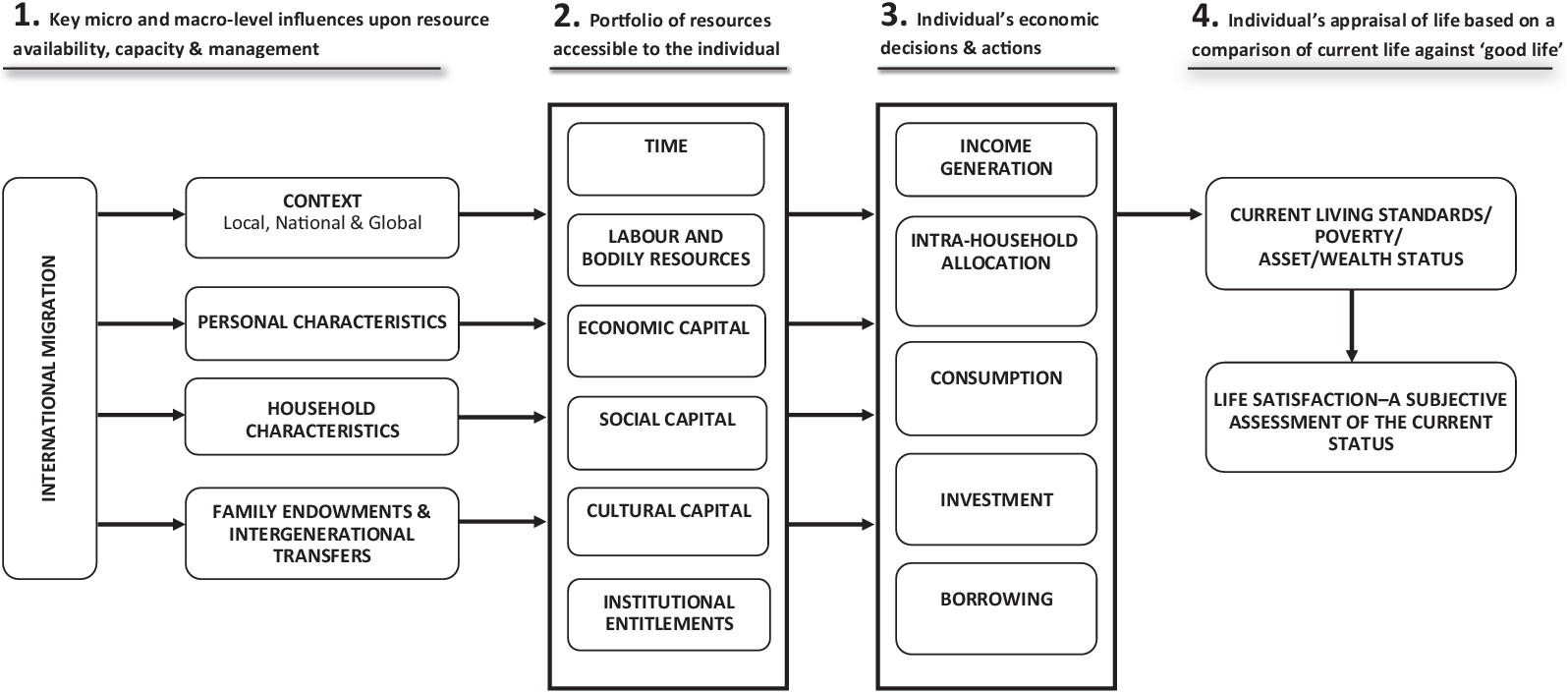
Advancing Titmuss’s (Reference Titmuss1958) idea of linking the standards or “levels of living” with “command of resources,” the model directs attention to the benefit delivery capacity of the resources accessible to the individuals and their households and identifies six main resource types: time, labour and bodily resources, economic, cultural, and social capital stocks and institutional entitlements. Time is self-explanatory, but the distinction between labour and bodily resources is worth mentioning since the latter can be used without exertion of labour power, as evident in the illicit sale of one’s organ/s to obtain a visa or passport. As for capital resources, its economic form is defined in a similar way as Bourdieu (Reference Bourdieu1986) to refer to financial and non-financial assets immediately and directly convertible into money. While these assets can be re/invested throughout one’s lifetime, at a given point in time, they make up the stocks that represent one’s asset status. Again, following Bourdieu, its cultural form is understood as the skills, knowledge, and qualifications individuals obtain formally through schooling and informally through their personal experiences of life. Its social form is, however, defined in a more restricted sense than Bourdieu, to include relatively durable relations established inside and outside markets but to exclude the benefits these relations generate. Institutional entitlements are used to denote rights granted by governmental or non-governmental organisations to enable one’s access to various monetary and non-monetary benefits (e.g., cash, assets, goods, and services).
A wide range of micro- and macro-level factors are considered to shape the composition and benefit delivery capacity of one’s resource portfolio and their economic actions within the behavioural domains of income generation, intra-household income and resource allocation, consumption (commodified and non-commodified), investment, and borrowing; thereby producing outcomes, for example, in terms of poverty, wealth, or living standards, the individual is likely to deem critical to their appraisal of a “good life.”
These factors are subsumed under four main categories. The first concerns personal features such as age, gender, ethnicity, migration history, and nationality. For example, the economic, social, and cultural capital resources utilised for investment are likely to increase by age and the time spent in the destination country, leading to a potential improvement in one’s asset portfolio and their satisfaction with life. The second relates to household characteristics, such as size and composition, likely to affect the availability of labour resources that can be mobilised for income generation and hence the amount of money that can be generated and invested. This would, in turn, determine one’s poverty and wealth status and hence their self-evaluation of life. The third category refers to intergenerational family endowments and transfers that can come in the form of beliefs, values, resources and behaviours. The financial skills, contacts, and tangible and intangible assets comprise some of the endowments whose transmission may enhance one’s poverty and asset status and thereby make them more satisfied with their life circumstances. A fourth encompasses a wide range of contextual influences operating at the local, national and global levels (e.g., the labour and asset market conditions, government economic and social policies, public attitudes to migrants and the wider economic climate). For example, by virtue of its role in determining one’s entitlements to work and welfare, migration policy can shape one’s poverty, wealth status, and living standards and hence their appraisal of life.
From this perspective, international migration is viewed as a major life process that reshapes individuals’ resource portfolios and economic actions and hence their poverty/asset/wealth status, living standards, and life satisfaction levels by altering the local and national contexts within which they operate, some of their personal and household characteristics (e.g., national and ethnic identity and household composition) as well as the nature and extent of intergenerational family transfers.
Overall, the proposed model depicts the causal paths considered key to understanding migrants’ and their descendants’ appraisal of their overall lives. It bridges a theoretical gap in the literature by providing a coherent, comprehensive, and clear-cut framework that jointly captures the individual, familial, intergenerational, and contextual influences on life satisfaction and their interactions with people’s migration decisions, resources, and economic actions.
Research background and hypotheses
This section briefly reviews the past findings that led towards the research hypotheses that are statistically tested here. For a systematic overview of research evidence regarding the key drivers of migrant life satisfaction, see, for example, Hendriks (Reference Hendriks2015).
Prevailing findings indicate a general propensity for migrants, especially those coming from economically poorer countries, to display lower life satisfaction levels than “natives” (e.g., Baltatescu, Reference Baltatescu2007; Verkuteyn, 2008; Safi, Reference Safi2010; Bartram, Reference Bartram2011; Vroome and Hooghe, Reference Vroome and Hooghe2014), while remaining more satisfied than the stayers in the origin (e.g., Bayram et al., Reference Bayram, Thorburn, Demirhan and Bilgel2007; Erlinghagen, Reference Erlinghagen2011; Bartram, Reference Bartram2013).Footnote 1 The same tendency is confirmed by Baykara-Krumme and Platt’s (Reference Baykara-Krumme and Platt2018) study of elder migrants from Turkey to Europe that uses the same dataset as my latest research (Eroğlu, Reference Eroğlu2022, Reference Eroğlu2023), which assesses their life circumstances more objectively to show that across all destinations and family generations studied, the “settler” migrants currently living in Europe are monetarily poorer than their returnee and stayer counterparts.
This is a perplexing picture, considering the evidence that migrants attach greater importance to their economic status in evaluating their overall lives (Bartram, Reference Bartram2011). While the evidence remains mixed, income is shown to matter to migrant life satisfaction and, or happiness up to a point, or in a more relative sense (e.g., Safi, Reference Safi2010; Bartram, Reference Bartram2011; Erlinghagen, Reference Erlinghagen2011; Gökdemir and Dumludağ, Reference Gökdemir and Dumludağ2012; Olgiati et al., Reference Olgiati, Calvo and Berkman2013). Unlike income, the role of migrant poverty and wealth is, however, rarely examined. The few existing works document reduced life satisfaction, and/or happiness among migrants who are relatively deprived (Obucina, Reference Obucina2013), positioned at the lower end of the wealth distribution (Erlinghagen, Reference Erlinghagen2011), or perceive their living standards to be low (Lowenstein and Katz, Reference Lowenstein and Katz2005).
Yet, the relationship between migrants’ “objective” material conditions and life satisfactions remains far from straightforward (e.g., Stillman et al., Reference Stillman, Gibson, McKenzie and Rohorua2015). The literature clearly shows that the factors influencing their appraisals of life and comparisons they make with the lives of others extend beyond their economic circumstances. Some scholars attribute the “downward comparisons” migrants tend to draw with the stayers to positive self-selection, that is, a propensity for “happier” people to migrate (e.g., Bartram, Reference Bartram2015). The evidence, however, suggests that migrants can be negatively or positively self-selected as far as their subjective wellbeing is concerned (e.g., Graham and Markowitz, Reference Graham and Markowitz2011). Indeed, for migrants from Turkey, the tendency to migrate is shown to be significantly associated with lower wellbeing (Krieger, Reference Krieger2004). However, the observed variation in the life satisfactions of migrants and stayers cannot solely be attributed to self-selection.
Scholars also speak about the “liveability” of the destination context as a possible explanation (e.g., Baykara-Krumme and Platt, Reference Baykara-Krumme and Platt2018). Despite its centrality, however, the question regarding which features of these contexts make them more liveable for migrants remains little explored. The destination-based studies shed some light upon this question by empirically demonstrating that the provision of high-quality public goods, such as education, health, and social services (e.g., Silveira and Allebeck, Reference Silveira and Allebeck2001; Baltatescu, Reference Baltatescu2007; Kogan et al., Reference Kogan, Shen and Siegert2018) and well-functioning democracy and government institutions (Baltatescu, Reference Baltatescu2007) help enhance migrant life satisfaction. The degree to which the destinations cultivate welcoming reception climates towards migrants and ensure equality within their populations is also shown to make a positive difference (Kogan et al., Reference Kogan, Shen and Siegert2018). On the flip side, perceived structural discrimination, exclusion/marginalisation, and unemployment are generally found to have a negative effect (Neto, Reference Neto1995, Reference Neto2001; Safi, Reference Safi2010; Vohra and Adair, Reference Vohra and Adair2000; Verkuyten, Reference Verkuyten2008), although some detect no significant effect of perceived discrimination (e.g., Sam, Reference Sam1998) or notable variation in the life satisfactions of the employed and unemployed migrants (e.g., Kogan et al., Reference Kogan, Shen and Siegert2018). Overall, while some of the reported contextual influences enhance migrant life satisfaction, others reduce it. It is probable that relatively favourable aspects of the destination context become highlighted in the “downward comparisons” migrants make with stayers, while their “upward comparisons” with “natives” are driven more by contextual factors that place them at a relative disadvantage.
The above-presented findings about the contextual influences reinforce the possibility for migration to have an independent effect on life satisfaction, for example, by virtue of its role in changing the contexts in which people operate. There is, indeed, some longitudinal and experimental evidence to show that the effect can be positive (Mähönen et al., Reference Mähönen, Leinonen and Jasinskaja-Lahti2013; Lönnqvist et al., Reference Lönnqvist, Leikas, Mahonen and Jasinskaja-Lahti2015) or negative (Stillman et al., Reference Stillman, Gibson, McKenzie and Rohorua2015) in nature. The literature, however, tells us very little about the impact of migration on younger generations’ overall satisfactions with life. The sparse evidence obtained from the destination-based studies of multiple migration cohorts (including those who originated from Turkey) indicates no significant improvement across generations (Safi, Reference Safi2010; Gökdemir and Dumludağ, Reference Gökdemir and Dumludağ2012; Vroome and Hooghe, Reference Vroome and Hooghe2014). The generational gap between migrants and “natives” is shown to remain particularly wide in the case of Asian, African, and Turkish people, which is attributed to their persistent exposure to unemployment, low status employment, and discrimination/exclusion (Safi, Reference Safi2010). Further support for this explanation comes from research reporting diminished returns on educational achievements of migrants from Turkey and their descendants (e.g., Bayrakdar and Güveli, Reference Bayrakdar and Güveli2021; Eroğlu, Reference Eroğlu2022, Reference Eroğlu2023). Thus, destination contexts appear to have made little progress in terms of addressing the structural problems that disadvantage migrants and their children when compared with “natives.”
Based on the above empirical and theoretical considerations, the following hypotheses are derived for statistical testing. Since the guest-worker movement from Turkey to Europe that have occurred between the 1960s and early 1970s was economically motivated, migrants’ economic situation is likely to remain key to their overall life satisfaction. Hence, monetarily poor migrants and those with less economic capital (or fewer assets) are expected to be significantly less satisfied with their lives (Hypotheses 1 and 2). However, even for those with low economic capital, the relatively favourable features of the destination contexts may still weigh heavily in the comparisons they make with their counterparts based in the origin country. Having said this, their (sole) reference for comparison might not be the people who remained in or returned to their origins but (also) the lives they had led in Turkey prior to migration. Anecdotally known to come mostly from poorer backgrounds, especially the first generation who moved from the selected regions may look upon their lives in Europe more favourably. Thus, across all destinations, the settlers are expected to display greater satisfaction levels than the stayers and the returnees (Hypothesis 3).
It is, however, unlikely that migrants and their descendants will be seeing their living and working conditions in Europe through tinted glasses with limited awareness of the contextual influences that disadvantage them against the “natives.” Given their above-documented exposure to discrimination, exclusion, unemployment, or employment that yields diminished returns on education within destination contexts and its continued influence in restricting the subsequent generations’ choices and actions (e.g., Safi, Reference Safi2010), it is unlikely that the settlers’ life satisfactions will improve significantly across generations (Hypothesis 4). Moreover, considering their propensity to own fewer assets in the current country of residence than the stayers and the returnees (Eroğlu, Reference Eroğlu2021), parental assets of the settlers are unlikely to make a significant improvement (Hypothesis 5).
Overall, there is growing research interest in understanding the life satisfactions of migrants and their descendants; however, much of the existing works remain based on comparisons of the “natives” with one or more migration cohorts. Thus, they provide no insight into the extent to which their appraisals of life differ from those of their peers who remained in the origin country. The migrant-stayer comparisons performed to date may shed some light upon this question, but they lack a generational focus, and like the rest of the field, overlook the role of poverty, asset/wealth accumulation, and intergenerational family endowments. With its multi-site and nested design, the present study makes a unique contribution to the life satisfaction and migration literatures by bridging this research gap.
Research design and method
The research base for this study is the 2000 Families SurveyFootnote 2 performed between 2010 and 2012 to investigate migration histories of one of the largest minority populations in Europe. The Survey (thereof) located male ancestors who moved from five-high migrant sending regions in Turkey (i.e., Acıpayam, Akçaabat, Emirdağ, Kulu, and Şarkışla) between the guest-worker years of 1961 and 1974 and their comparators who stayed behind, and charted their family members in Turkey and Europe up to the fourth generation. It resulted in the creation of the largest quantitative database on labour migration to Europe with coverage of (a) settler migrants who have been residing in Europe for a year or more, (b) returnee migrants who went (back) to Turkey after having spent at least a year there, and (c) stayers who have not left Turkey for more than a year.
The Survey developed and applied an innovative technique of screening high migrant-sending regions from rural and semi-urban parts of Turkey to identify “migrant” and “non-migrant” families and to obtain their contact details (Ganzeboom et al. Reference Ganzeboom, Sözeri, Güveli and Bayrakdar2016; Güveli et al., Reference Güveli, Ganzeboom, Baykara-Krumme, Bayrakdar, Eroğlu, Hamutçi, Nauck, Platt and Sözeri2016; Güveli et al., Reference Güveli, Ganzeboom, Platt, Bernard, Baykara, Eroğlu, Bayrakdar, Sozeri and Spierings2015 for detailed regional information). The selection criteria for migrant families was to have a male ancestor who: (a) might be alive or no longer alive, (b) was or would have been between the ages of 65 and 90, (c) grew up in the region, (d) moved to Europe between 1960 and 1974, and (e) stayed there for at least 5 years. The same criteria were applied to non-migrant families with one difference: their male ancestor must have stayed in Turkey instead of moving to Europe. These families were anchored on their male ancestors since the great majority of the guest-workers who moved from Turkey to Europe in the 1960s and 1970s were men (Akgündüz, Reference Akgündüz2008). A respective sampling quota of 80%–20% was also imposed for migrant and non-migrant families in each region.
In screening the families, a clustered probability sample was drawn for each region. The Turkish Statistical Institute’s (TÜİK) address register was used to obtain 100 primary sampling units with a random starting point. The size of each unit was proportional to the estimated population size of the randomly chosen locality. From the primary sampling point onwards, the sample was selected through random walk. This involved going to the random starting point and knocking on every door if the locality inhabited less than 1000 households and on every other door if the number of inhabitants was 1000 or above. Four migrant families were sampled for every non-migrant. The random walk ended when 60 households were screened or when eight families were recruited.
The screenings were carried out in two stages: a pilot study was performed in Şarkışla in the summer of 2010. The remaining four regions were screened in the summer of 2011, during which approximately 21,000 addresses were visited to achieve the target sample of 400 families per region. The strike rate (i.e., the proportion of eligible families) was around one in every 12 households, yielding 1992 participating families in total.
The members of these families were traced across Turkey and Europe up to the fourth generation. Face-to-face and phone interviews were performed respectively with those present in the field and those who were absent. Multiple instruments were designed for data collection, including family tree, proxy and personal interviews. The present study is based on personal interviews conducted with male ancestors and their randomly selected descendants aged 18 or above. The sample frame for each family included the living male ancestor, his two children, two adult children of these two children (i.e., male ancestors’ grandchildren), and their adult children if any (i.e., male ancestors’ great grandchildren). For randomisation, the adults with initials closest to A and Z were selected. By the end of the main-stage fieldwork, it was observed that while the non-response rate, due to reasons other than non-contact (e.g., refusal), was similarly low across eligible family members living in Europe and Turkey (i.e., 6–8%), the non-contact rate was about 18% higher for the former. This imbalance was redressed through additional three-month tracing in 2012, resulting in 551 more interviews and a 20% increase in the response rate for migrants in Europe. This increased the overall response to 61%, corresponding to 5980 interviews with adults nested within 1770 families.Footnote 3 It should be noted here that while 80% of these respondents had a migrant family background, they did not necessarily share the same migration status as their male ancestor. Of the entire sample, 39% were stayers in Turkey and the rest consisted of settler (45%) and returnee (16%) migrants.
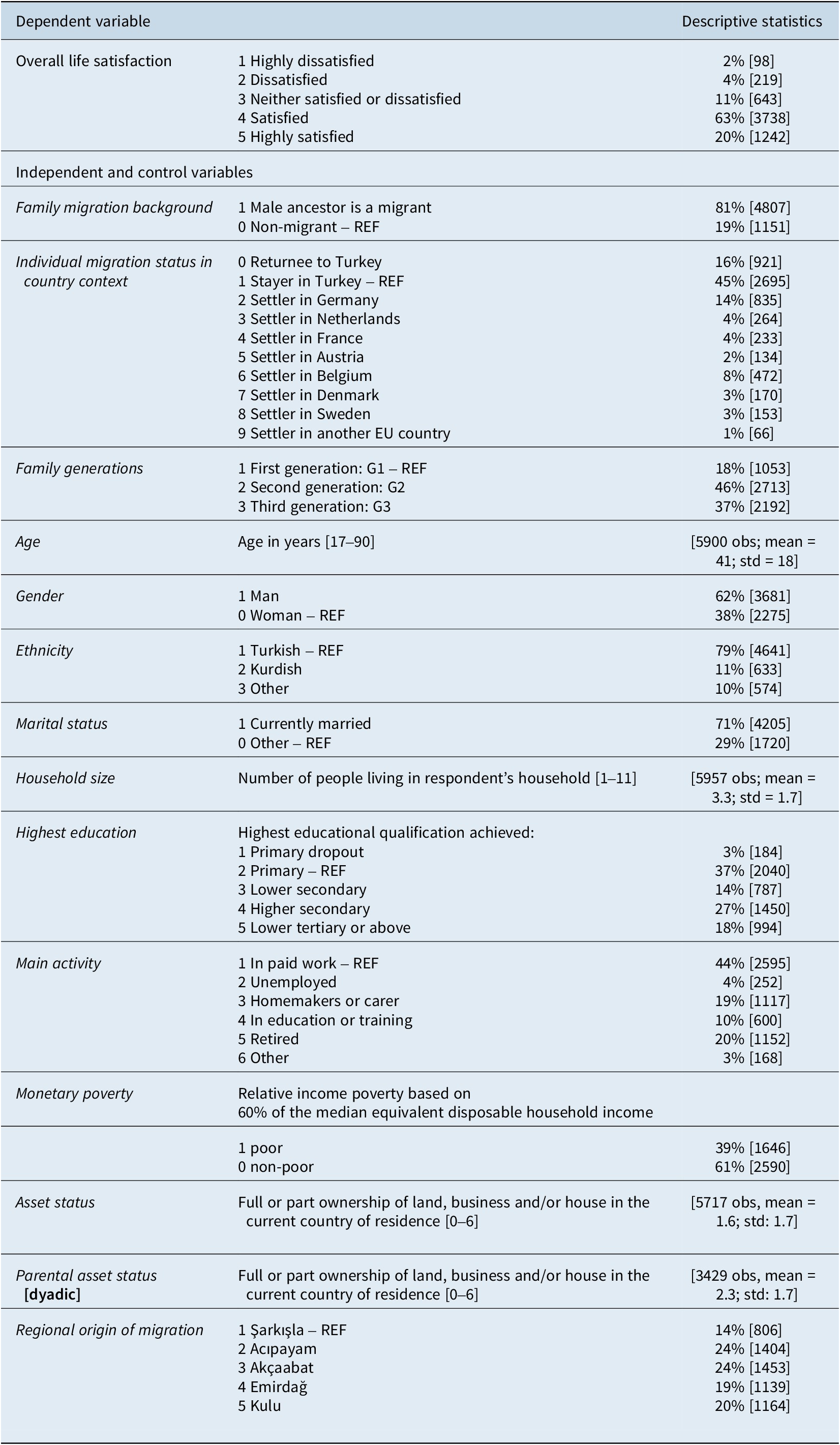
The personal interview data are used to estimate ordinal probit regression functions of life satisfaction aggregately and separately for the three groups because of the ordinal nature of the dependent variable. The ideal would have been to estimate multi-level models to better detect the macro- and micro-influences, but this was not possible due to the number of countries being below the minimum requirement of 15. Table 1 presents the dependent and independent variables included in the probit estimations.
Dependent and independent variables
Source: 2000 Families Survey, personal data.
To begin with the dependent variable, the measure of overall life satisfaction was obtained from the following question with response categories located on a Likert scale of 1–5: “All being considered, how satisfied are you with your life?” The response categories were recoded to ensure higher scores indicate increased satisfaction.
The independent variables were chosen to represent the core components of the theoretical framework presented in Figure 1. Personal characteristics of the respondents were captured by age, gender, ethnicity, marital status, and family generation variables. Given the substantial age differences observed within each generation (mean age and std. for G1 = 72, 6; G2 = 43, 9; G3 = 25, 6), age and family generation had to be incorporated within the same model to detect any generational effects. Personal characteristics also cover respondents’ migration history and status, reflected here by the variables of family migration background (i.e., whether the respondent’s family has a migrant or non-migrant male ancestor) and individual migration status (i.e., stayer, settler, or returnee). The regional origin of migration was chosen for being anchored to the migration decision itself and used to control for possible regional influences upon life satisfaction. Variables such as age at migration and proportion of life time spent in Europe were considered for inclusion yet omitted from the statistical models not only because they remain inapplicable to the stayers’ predicament but also because they absorbed the observed effects of age and family generations. The effects of migration motives could not be explored directly either because of their irrelevance to the stayers’ case.
As for health status, it was removed from the final model to circumvent a potential problem of endogeneity despite the auxiliary aggregate analysis indicating a strong, positive association (probit = 0.472, p < 0.001, se = 0.026).
Household characteristics were indicated by household size. It would have been ideal to estimate the household dependency ratio for a better representation of the labour resources mobilised for income generation (hence investment). However, due to a lack of data on the number of working and non-working members, household size was employed as a proxy alongside the main activity variable that was introduced fundamentally to account for the role of economic actions in life satisfaction.
The potential effects of family endowments and intergenerational transfers were explored in terms of economic capital flows by linking parental information about non-financial assets to their own children (see below for details regarding the construction of the economic capital variable). It was not possible to measure asset/wealth transfers directly due to the unavailability of information about the amount of assets parents passed on to their children and/or inter vivo payments they made towards their education, business ventures, or asset purchases. Thus, transfers had to be inferred from parental assets, which is considered acceptable given that: (a) some of these assets will likely have some cash-generating capacity (e.g., rent) that can be deployed to enhance children’s asset portfolios and (b) within the Turkish culture, parents are expected to provide financial support for their children.
As for context, an individual migration status variable was differentiated along the respondent’s current country of residence to control for possible national-level influences operating within migrant origin and destinations and to indirectly account for country-specific institutional entitlements. In addition, the generosity of welfare provision in destination contexts is assessed using a welfare effort index borrowed from Corrigan (Reference Corrigan2014: 231). This is a reconstruction of Scruggs and Allan’s (Reference Scruggs and Allan2006) benefit generosity index where higher scores indicate greater welfare provision, and the scorings were based on data obtained from multiple sources, including OECD and International Social Security Association between 2004 and 2009. The scores for the countries studied here are as follows: Austria (6.34), Belgium (10.74), Denmark (9.95), France (6.05), Germany (7.73), Netherlands (10.87), Sweden (10.03), and other EU countries (Greece [5.23], Italy [3.86], Norway [11.79], Switzerland [9.70], and United Kingdom [5.14]). More local effects, however, remained unexplored because of the absence of data on urban versus rural division.
Turning to the elements of the resource portfolio, time, labour resources and institutional entitlements were, to a degree, captured by the variables of age, family generation, household size and individual migration status. Formal aspects of cultural capital were indicated by the highest educational qualification, and economic capital stocks were indicated by non-financial asset accumulations in the current country of residence. Their economic capital stocks were estimated, based on six questions concerning business, land, and house ownership in Turkey and the destination country with response categories of 1 “yes, full ownership,” 2 “yes, shared ownership,” and 3 “no ownership.” First, these items were recoded to ensure that higher scores indicate greater accumulation (range 0–2), and then added up to create a six-point scale. Due to data unavailability, the role of financial asset accumulations (e.g., savings) remained unexplored. As for social capital, the Survey contained relevant questions, for example, about acquaintanceship but since these were excluded from the pilot, their inclusion in the statistical models would have substantially increased missing cases, causing significant loss of statistical power. Hence, it had to be omitted.
The variables presented, thus far, represent Columns 1 and 2 of the resource-based model summarised in Figure 1. To explore the significance of respondents’ economic decisions and actions for life satisfaction visualised in Column 3 of the figure, the current main activity variable is introduced. Investment behaviour is captured through the aforementioned measure of non-financial assets. The role of consumption and intra-household income allocation, however, went unexplored due to data limitations.
Regarding the independent variables chosen to represent Column 4 of the model, it should be noted that a fuller assessment of one’s living standards would require measuring multi-dimensional poverty by integrating its monetary and non-monetary aspects. However, due to data constraints, it was only possible to explore the impact of monetary poverty and asset status. The monetary poverty measure was derived from the following question: “Thinking of all the people living in your household and all sources of income including earnings, pensions, benefits and investments, what is the total annual income that is at the disposal of your household?” Although the percentage of respondents who jointly answered the household income and currency questions was considerably high at 74%, auxiliary probit analyses were performed to check whether the distribution of missing income data was random or not. The likelihood of generating missing information proved to be significantly greater for the settlers that the stayers (probit coefficient = 0.40, p < 0.000) and lower for those from migrant families than their non-migrant counterparts (probit coefficient = -0.15, p < 0.01). However, further analyses conducted separately for the settlers revealed no significant variation across different ages, sexes, generations, or groups with different educational or family migration backgrounds, suggesting that missing cases are most likely to be distributed randomly for this group of migrants, as well (see Eroğlu, Reference Eroğlu2022 for full results).
The monetary poverty measure was generated in six stages. First, all household incomes were checked to see whether the reported currency matches that of the respondents’ current country of residence. Eurostat (2018) annual average exchange rates were used to convert the non-matching cases into the country currency, considering the year of interview. Second, the household incomes were equivalised, based on the OECD’s square root scale to ensure comparability across households with different sizes. Third, since the interviews were conducted between 2010 and 2012, the equivalised household incomes had to be adjusted for inflation, using the country’s CPI figures for the years 2010 and 2011 (IMF, 2018). Fourth, they were checked for outliers on a-per-country basis and the outliers were removed, using Hoaglin and Iglewicz’s (Reference Hoaglin and Iglewicz1987) formula. Consequently, 71% of the sample was retained. Fifth, the monetary poverty thresholds were calculated for each country, using 60% of the median equivalent disposable household income as the cut off. In identifying the cut offs, the 2012 median disposable household income figures, estimated using the same equivalisation scale as the one adopted here, are taken as the basis.
Monetary poverty measure was complemented with an indicator of asset status, which unavoidably corresponds to the economic capital variable described earlier. This was due to the Survey’s cross-sectional nature, which disallows an exploration of economic capital deployment at Time A as an input for investment affecting one’s asset/wealth status at Time B.
To conclude with the statistical techniques employed, eight ordinal probit regression functions were estimated. Two of these (Models 1 and 2) used pooled data obtained from the entire sample, while the rest drew on data split across the three groups. Model 1 was designed to examine: (a) the degree of variation in life satisfactions of the stayers, returnees, and settlers (RQ.1); (b) the relative significance of monetary poverty and asset status (part of RQ.2); and (c) the aggregate generational trends in life satisfaction (part of RQ.3). Model 2 was developed to investigate the role of intergenerational family transfers or endowments (part of RQ.2). For this purpose, dyads were established between parents and their own children by linking members of the second and third generations to their fathers/mothers to determine parental asset status. Model 2 only covers the second and third generations, as no information is available on male ancestor’s parental assets. Of the separate models, Model 3 (a–c) was estimated to explore likely group differences in: (a) the role played by monetary poverty and asset status (part of RQ.2) and (b) generational trends (part of RQ.3). Model 4 (a–c) used dyads to investigate possible group differences in the role played by intergenerational family transfers or endowments (part of RQ.2). Finally, all models were checked for potential multi-collinearity and cluster corrected to account for within-family associations.
Results
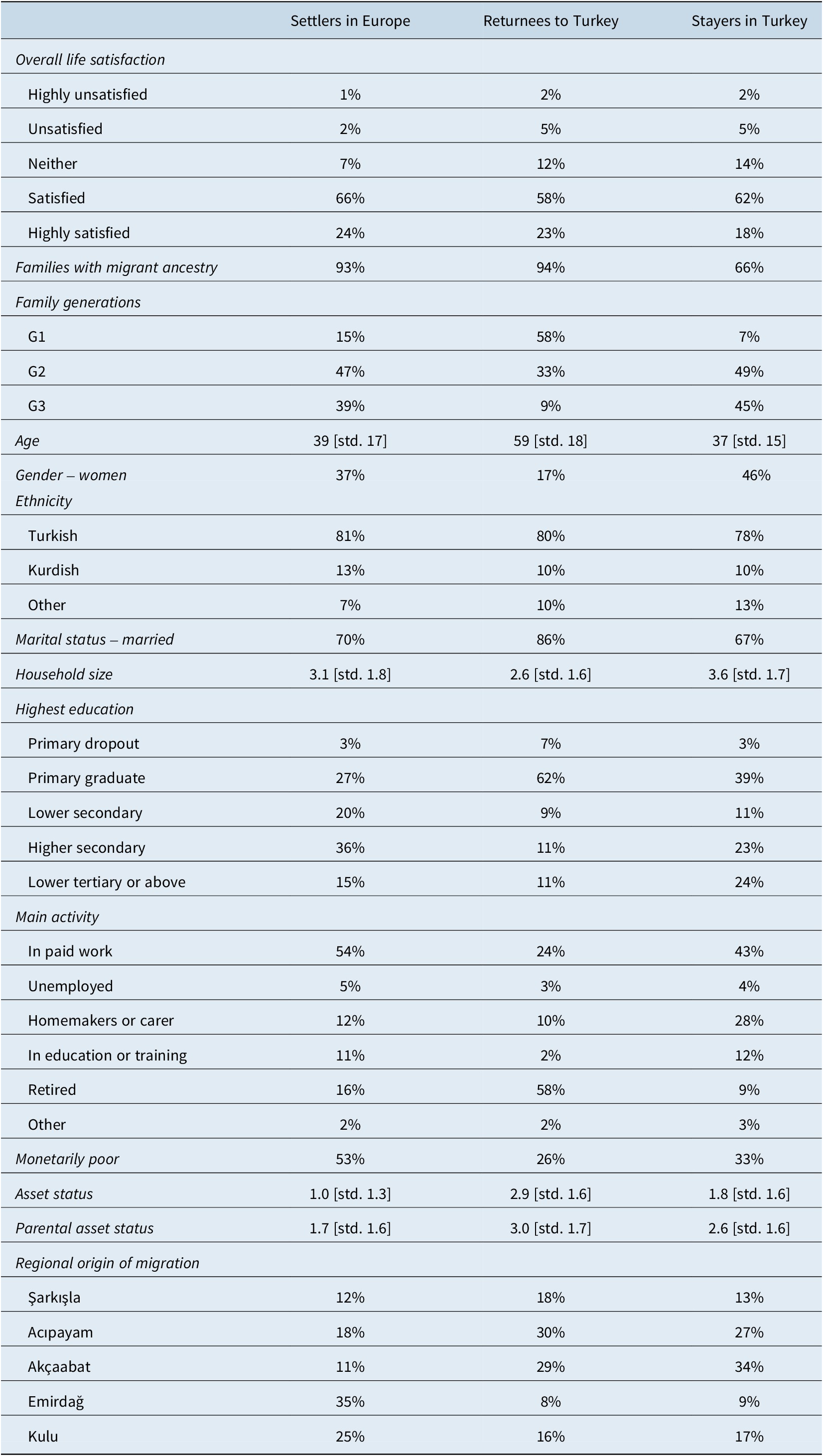
This section summarises the results obtained from the descriptive and multi-variable regression analyses. The cross tabulations presented in Table 2 demonstrate a propensity for the settlers in Europe to be more satisfied with their lives than their returnee and stayer counterparts living in Turkey despite experiencing greater monetary poverty, and possessing, on average, fewer non-financial assets in their current country of residence. Let us examine how significant this tendency is, and whether it persists across generations.
Mean scores and conditional distributions for settlers, returnees, and stayers
Source: 2000 Families Survey, personal data.
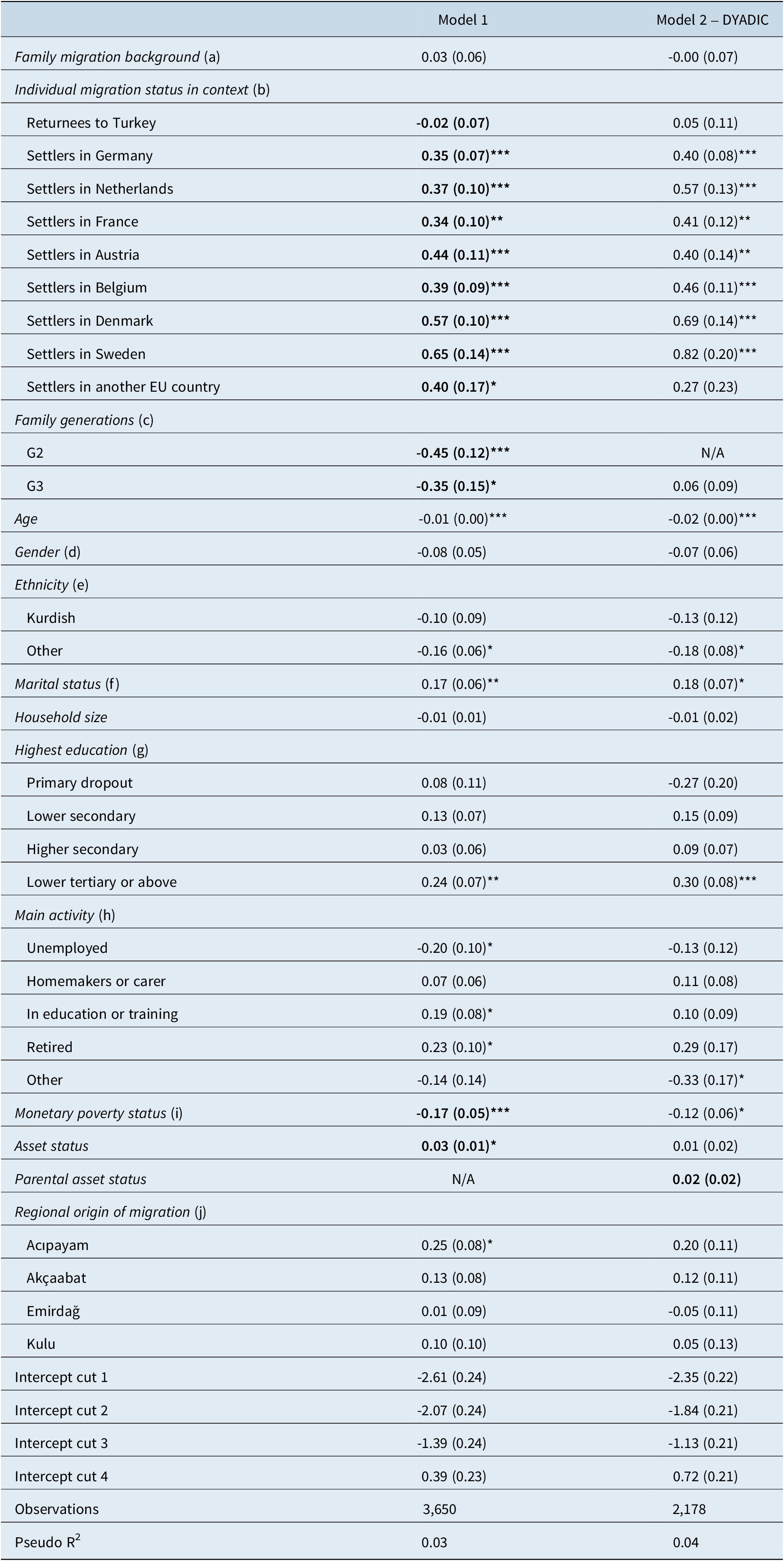
Tables 3 and 4 present the aggregate and separate ordinal probit regression results, respectively. According to Model 1, having migrant ancestry makes no significant difference to life satisfaction, whereas individual migration status does. The settlers across all destinations appear more satisfied with their lives than their returnees and stayer counterparts whose satisfaction levels tend not to vary from each other. This confirms Hypothesis 3. Strikingly, however, the results from the auxiliary analysis performed separately for the settlers indicate no significant association between welfare effort and life satisfaction (probit coefficient = 0.03, se = 0.02, p = 0.149), indicating that being governed by more generous welfare states do not necessarily make them see their lives in a more positive light.
Aggregate ordinal probit regression models of overall life satisfaction
Note: Standard errors in parentheses. *p < 0.05, **p < 0.01, ***p < 0.001.
(a) Baseline: families with non-migrant ancestors; (b) baseline: stayers in Turkey
(c) baseline: G1 – first generation; (d) baseline: women; (e) baseline: Turkish; (f) baseline: unmarried;
(g) baseline: primary graduate; (h) baseline: in paid work; (i) baseline: non-poor; (j) baseline: Şarkışla.
Source: 2000 Families Survey, personal data.
Separate ordinal probit regression models for settlers, returnees, and stayers
Notes: Standard errors in parentheses. *p < 0.05, **p < 0.01, ***p < 0.001.
(a) Baseline: families with non-migrant ancestors; (b) baseline: G1 – first generation; (c) baseline: women;
(d) baseline: Turkish; (e) baseline: unmarried; (f) baseline: primary graduate; (g) baseline: in paid work;
(h) baseline: non-poor; (j) baseline: Şarkışla.
Source: 2000 Families Survey, personal data.
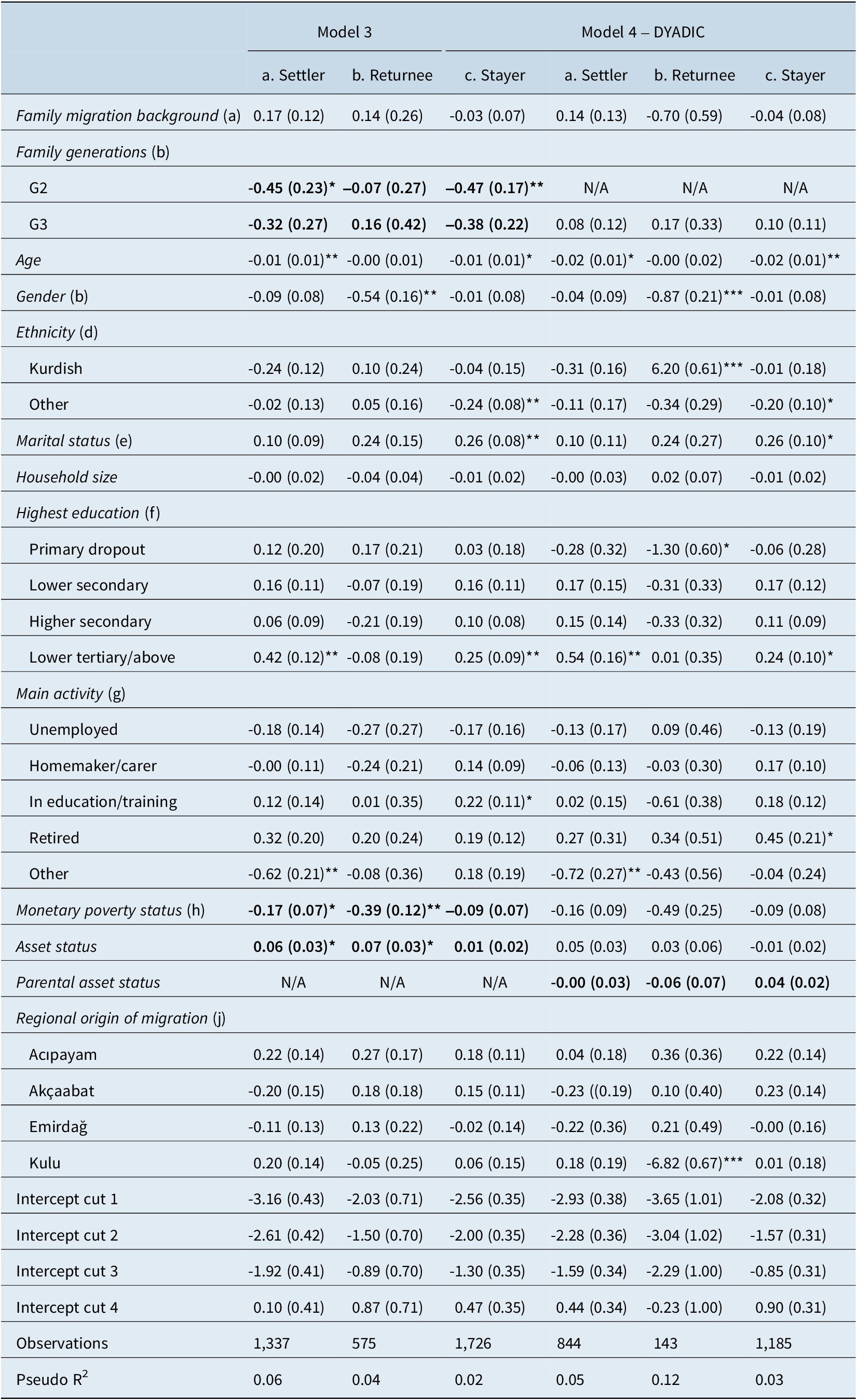
Model 1 documents an aggregate, generational effect that is independent of age. Life satisfaction appears to decline not only with age but also across family generations, meaning that younger (second and third) generations are less satisfied with their lives than the first-generation. Model 3 demonstrates this to be the case with the settlers and stayers from the second generation, while the auxiliary analyses detect no variation between the second and third generations for any of the groups. These findings lend some support to Hypothesis 4 that predicts no improvement for the settlers from subsequent generations. Model 1 documents reduced life satisfaction for older people, or vice versa. According to Model 3, this tendency applies to the settlers and stayers but not to the returnees, which may be to do with many of the returnees being members of the first-generation at retirement age. Model 1 shows that gender bears no significant relationship with life satisfaction – except for returnee men for whom Model 3 records reduced satisfaction levels. Although Model 1 documents considerably lower satisfaction levels for ethnic minorities other than Kurdish and Turkish, Model 3 demonstrates this to be true only for the stayers. The same applies to marital status. Model 1 may indicate greater life satisfaction among married people, but Model 3 verifies this tendency for the stayers only. It might be that more of the migrants are in less happier marriages; however, it is also likely that marriage as an institution is diminishing in importance for the migrants. The latter could well be a migration rather than self-selection effect, considering the sampling of respondents from some of the most conservative parts of Turkey. Regarding household size, none of the models register a significant association.
Turning to education, Model 1 records increased life satisfaction for those with a university degree or higher. Model 3 confirms the applicability of this tendency to all groups except returnees, who are mostly primary school graduates. Thus, it remains likely that university education is impacting on life satisfaction across borders and in ways that cannot solely be explained in terms of its potential contributions to one’s economic performance. Regarding main activities, Model 1 indicates greater life satisfaction among the retirees, students, and trainees, and the reverse for the unemployed. Model 3 verifies this only in the case of the stayers in education/training, while recording significantly reduced satisfaction levels for the settlers engaging in “other” activities. So, while unemployment appears to adversely influence people’s appraisal of life independently of their context and migration status, the absence of significant variation between the unemployed settlers and stayers and their counterparts in paid work implies that neither within the Turkish nor European labour markets the pay and working conditions are favourable enough to make the workers feel more satisfied with their lives than those searching for work. The lack of significant differences between retirees and those in paid work should also not detract one from the poverty-inducing conditions of retirement affecting the settlers, in particular. As a matter of fact, 79% of the retired settlers currently experience monetary poverty, whereas the respective percentages remain at 23% and 28% for their returnee and stayer counterparts.
Model 1 indicates a significant, inverse association between monetary poverty and life satisfaction; however, as shown in Model 3, the poverty status of settlers and returnees matters more centrally to their appraisals of their overall lives. These findings hence support Hypothesis 1. As for asset status, Model 1 suggests a positive relationship, which, according to Model 3, remains true for the settlers and the returnees but not for the stayers. These results, which confirm Hypothesis 2, are not surprising given the propensity for (a) the returnees to own more non-financial assets and enjoy homeownership in the current country of residence than the other two, and (b) the settlers to possess assets with a greater capacity to generate an income (Eroğlu, Reference Eroğlu2021; Eroğlu et al., Reference Eroğlu, Bayrakdar and Güveli2024). The returnees’ assets might be worth less than those of the settlers’ but still seem to hold significant use and/or exchange value at least within the confines of Turkey, enabling them to live comfortably without having to resort to the labour market or state welfare.
Finally, in line with Hypothesis 5, the results obtained from dyadic analyses (Models 2 and 4) reveal that parental assets make no significant difference to the life satisfactions of the second and third generations from any of the groups.
Discussion and conclusion
From a resource-based perspective, this article has sought to examine the extent to which migrants’ life satisfaction varies across generations and dissimilate from origins through unparalleled comparisons across three family generations of migrants who reside in Europe and who returned to Turkey with their counterparts who remained in the origin country.
As predicted, the results show that migrants’ poverty and asset status remain key to their appraisals of life. However, there is more to the story, given the convergence between the life satisfactions of the stayers and the returnees and their divergence from those of the settlers. Coupled with the observed similarities between the stayers with varying asset and poverty status, the evidence tells us something about the significance of the context; hence, the migration process.
The process may have enhanced the settlers’ pre-migration satisfaction levels in ways that cannot be empirically demonstrated here. However, any such improvement cannot be attributed to their exposure to new situations that help them avoid monetary poverty, accumulate more assets, or fully enjoy the generosity of the welfare states. Indeed, most settlers at retirement age do not seem to have a decent enough state pension to lift them out of monetary poverty. The same can perhaps be said about unemployment benefits. There might, however, be other undetected features of the destination contexts that make them more “liveable” in migrants’ eyes of the migrants. Previous research demonstrates such features to include the quality of welfare services and the reliability of democratic and government institutions (e.g., Baltatescu, Reference Baltatescu2007; Kogan et al., Reference Kogan, Shen and Siegert2018). However, an alternative or additional explanation for the settlers’ downward comparisons with those based in the origin country may be to do with their reference point for comparison being their lives prior to migration.
The “liveability” argument is, however, reinforced by the observed lack of association between the poor and non-poor stayers. It can be inferred from this finding that the adverse contextual influences upon life satisfaction extend beyond those widely known to induce monetary poverty (e.g., limited welfare benefits and unfavourable labour market conditions) to include non-monetary factors that, for instance, disrupt the everyday, institutional and political life in the origin. This may partly explain the lack of significant differences in the life satisfactions of the stayers and the returnees. Like the stayers, the returnees also seem less satisfied with the context they live in. However, their decisions about re/migration appear to have contributed positively to their life satisfaction by improving their poverty and asset status.
The aggregate results, however, indicate a significant decline in the life satisfactions of younger generations. This downward trend is particularly visible in the case of the settlers and the stayers from the second generation. Coupled with the observed lack of variation across the (a) three generations of returnees and (b) members of the second and third generations from the other two groups, the evidence begins to suggest that living and working conditions have deteriorated or at best not sufficiently improved for younger generations regardless of their migration status or country of residence. Parental assets do not seem to have cushioned them well against the challenges facing their generation. Nonetheless, both younger stayers and settlers appear more satisfied with their lives than their elder counterparts. The sources of young people’s optimism require further exploration but may be partly attributed to having better health and more years ahead of them.
Overall, the findings provide substantial support for the hypotheses set out earlier as well as complementing the evidence obtained from destination-based studies regarding the persistence of a wide generational gap between migrants and “natives” (e.g., Safi, Reference Safi2010). However, like all research, the study is fraught with certain limitations. First, given its specific interest in the guest-worker movement, the Survey only partially captures the post-1974 migrants; hence, conclusions drawn here cannot be extrapolated to the entire population of Europe with origins in Turkey. Yet, they may have applicability beyond the Turkish case to other labour migrants who moved during guest-worker years, for example, from the Balkans and their families. Second, due to data unavailability, it was not possible to devise a life satisfaction scale combining multiple items. However, although the use of a scale is considered to enhance reliability, it is also shown to make little difference to the results (e.g., Diener et al., Reference Diener, Emmons, Larsen and Griffin1985). Third, this study controlled for the regional origin of migration to reduce potential self-selection bias, but there might be unobserved characteristics that remain uncontrolled. To fully eliminate the risk of bias, longitudinal or experimental data would be required. Fourth, potentially important effects, for example, of health and social capital went unexplored because of data constraints. Unfortunately, health status had to be excluded as a suitable instrumental variable cannot be found to eliminate potential endogeneity. Likewise, due to sampling from origins and data limitations, this study left unanswered questions as to whether those who maintain links with origins or lead a truly transnational life are more satisfied with their lives than those who do not. Considering their potential access to the “best of both worlds,” the answer may well be affirmative but remains to be empirically established.
To conclude with its implications for policy, the study demonstrated how contextual features of the destination countries can improve the life satisfaction of migrants and their descendants, as well as documenting the reverse effects of living in monetary poverty with limited assets. The fact remains that across all generations and destinations, the settlers are not only monetarily more impoverished but also are less likely to own non-financial assets or become homeowners than their returnee and stayer counterparts (Eroğlu, Reference Eroğlu2021, Reference Eroğlu2022; Eroğlu et al., Reference Eroğlu, Bayrakdar and Güveli2024). Cumulatively, the evidence provides substantial support for the possibility that migrants and their descendants may still be faced with structural barriers in access to well-paid jobs, lucrative pension schemes, and/or housing markets. Concerted policy effort needs to be directed at removing such barriers to improve their lives objectively as well as subjectively.
Ethics
Approval for this project was obtained from the Ethics Committee of the Department of Sociology based at the University of Essex.
Disclosure statement
The author declares no potential conflicts of interest with respect to the research, authorship, and/or publication of this article.
Funding
This work was supported by the NORFACE, New Opportunities for Research Funding Agency Co-operation in Europe, under the grant number 235548.


 Open access

