


Families are more actively involved in the long-term care of their severely mentally ill relatives since the implementation of the NHS and Community Care Act 1990. Caregivers' experiences encompass distress, stigma, worry, shame and guilt, and positive aspects such as caregiver reward (Reference Szmukler, Burgess and HermanSzmukler et al, 1996). Studies have consistently shown that approximately one-third of caring relatives have elevated levels of anxiety or depression connected with the caring role (Reference Goldberg and HillierGoldberg & Hillier, 1979; Reference Maccarthy, Lesage and BrewinMacCarthy et al, 1989). For people experiencing psychosis, caregivers are mainly elderly mothers (Reference Scazufca and KuipersScazufca & Kuipers, 1997). This study is one of the first to investigate ‘burden’ among caregivers of people with first-episode psychosis. The aims of this study were: (a) to describe the association between caregiving dimensions and caregiver distress; (b) to examine the relationship between participants' symptomatology (negative and positive symptoms) and caregiving, and (c) to provide data to enhance family intervention strategies to improve caregivers' well-being.
METHOD
Subjects
Fifty participants were recruited from the Bethlem & Maudsley NHS Trust, the West Kent Health Authority, the Merton, Sutton and Wandsworth Health Authority and the Redbridge and Waltham Forest Health Authority as part of a longitudinal study of first-episode psychosis. Participants were between 18 and 45 years of age and fulfilled criteria for schizophrenia and associated disorders according to DSM-IV (American Psychiatric Association, 1994). All participants were experiencing their first episode of psychosis of less than 24 months' duration and with no more than 12 weeks' exposure to neuroleptics. We excluded those with organic mental disorders as well as those with a primary diagnosis of alcohol or drug misuse. For each participant recruited into the study, a main caregiver was identified by that person as the caregiver who was most available (contact) and most supportive either emotionally or financially. To be eligible, caregivers were required to be in ‘reasonable contact’ with the participant and over 16 years of age. Reasonable contact was defined as face-to-face contact at least twice per week. The study was approved by the Maudsley and Bethlem Royal Hospital ethical committee. All participants and caregivers gave written informed consent after the study had been fully explained to them.
Involvement Evaluation Questionnaire (IEQ) (Reference Schene and van WijngaardenSchene & van Wijngaarden, 1992)
This is a 77-item self-report questionnaire that provides socio-demographic information about the caregiver, details about their physical and psychological well-being and information about the impact of the participants' problems with finances. The main aspects are worrying, urging, tension and amount of supervision. Tension involves a strained interpersonal atmosphere between the caregiver and their relative: quarrels, annoyances and occasional threats. Worrying covers painful interpersonal cognition, such as concern about the participant's safety, general health and the kind of help he or she is receiving. Supervision involves caregiver tasks such as maintaining the participant's medication, checking the amount of sleep and monitoring dangerous behaviour. Urging relates to activation and motivation of the participant to take care of himself or herself, to eat enough and to undertake activities.
Experience of Caregiving Inventory (ECI) (Reference Szmukler, Burgess and HermanSzmukler et al, 1996)
This is a 66-item self-report questionnaire which measures caregivers' appraisal of the caregiving experience. Items are scored on a 5-point Likert scale. The main measures are negative and positive aspects of caregiving. Negative aspects (caregiver distress) are negative symptoms, stigma, effects on family, the need to provide backup, dependency, problems with services, difficult behaviours and loss. The positive aspects (caregiver rewards) are positive personal experiences and good aspects of the relationship.
Assessments
Participants were assessed using the Structured Clinical Interview for DSM-IV (SCID) (Reference Michael, Gibbon and SpitzerMichael et al, 1996) to generate DSM-IV diagnoses. Information was collected on their socio-demographic characteristics, current symptomatology, age of onset and duration of illness. Symptomatology was assessed with the Positive and Negative Syndrome Scale (PANSS) (Reference Kay, Fishbone and OlperKay et al, 1987). Data on social class and occupational status were collected using the UK Standard Occupational Classification (Office of Population Censuses and Surveys, 1990).
Caregivers were interviewed by L.T. for approximately 2 hours in their homes. The following assessments were used.
Ways of Coping (WOC) (Reference Maccarthy, Lesage and BrewinMacCarthy et al, 1989)
This is a self-report check-list, which provides information about coping style. Respondents are asked to rate how frequently they have used each coping behaviour during the preceding 4 weeks. Items are scored on a 5-point Likert scale. This instrument measures four coping styles, including practical, emotional, detachment and spiritual.
General Health Questionnaire (GHQ-12) (Reference Goldberg and HillierGoldberg & Hillier, 1979)
This is a self-report screening instrument for psychological morbidity. Respondents are asked to rate on a 4-point Likert scale the frequency with which they have experienced 12 indicators of psychological morbidity.
This study reports the results of the cross-sectional baseline data of this sample of participants and their caregivers.
Statistical analysis
Statistical analysis was carried out using SPSS version 7.5 for Windows and STATA version 5 for Windows. Independent t-tests were used to compare quantitative variables. Correlations between the participant and the caregiver data were computed using Pearson's r. The level of statistical significance was set at 0.01.
RESULTS
Socio-demographic characteristics of caregivers and participants
Eighty per cent of participants had a caregiver and gave consent for us to interview them; this was the sample used in our study (n=40/50). The mean age of the 40 participants was 25 years (s.d.=5.57; range 18-39). The mean duration of the illness was 44.43 weeks (s.d.=60.41).
For caregivers (n=40), 57.5% were female; their mean age was 49.04 years (s.d.=14.96; range 16-68); 70% were parents; 17.5% were siblings; 5% were partners; 7.5% had another relationship (grandparent, aunt/uncle) with the participant. Of the caregivers 12.5% were professionals (doctors/lawyers); 22.5% were from the intermediate social class (manager/teacher); 40% were from the skilled manual class (shop assistant/bus driver/carpenter); 10% were from the semi-skilled manual class (agricultural/bus conductor); 15% were from the unskilled manual class (labourer/cleaner). Sixty per cent of caregivers were living with the participant in the same household. Fifty per cent were married, 27.5% were single, 15% had a long-term partnership, 2.5% were divorced and 5% were widowed. A university education had been experienced by 12.5% of caregivers, 12.5% had completed ‘A’ levels, 27.5% had completed CSE/GCE ‘O’ levels while 47.5% had no qualifications. Caregiver response rate was 89% (40/45) of possible and available caregivers.
The participant response rate was 80%. Of the 20% of participants (n=10) who did not respond, five did not want their caregivers to be contacted, one did not have an identified caregiver, three did not have caregivers in the UK, and one was lost to follow-up.
Contact
Despite our definition of reasonable contact as being twice a week, we found that a few caregivers spent less than this time with the participants. When these very low-contact caregivers (n=2) were omitted from the analyses, no substantial differences were found in the following results so the full analyses are presented (n=40). However, the majority of caregivers - 58% (n=24) - had more than 32 hours direct contact with the participant each week (including telephone calls), 10% (n=4) had 17-32 hours contact each week, 4% (n=1) had 9-16 hours each week, 8% (n=3) had 5-8 hours each week, 12.5% (n=6) had 1-4 hours each week and 7.5% (n=2) had less than 1 hour of contact each week.
Caregiving and distress
Ways of coping (WOC)
Negative symptoms and difficult behaviours in the participants were positively correlated with the caregivers' emotional and practical coping styles (negative symptoms: r=0.47, P=0.002 and r=0.36, P=0.02, respectively; difficult behaviours: r=0.56, P<0.001 and r=0.41, P=0.009, respectively). Difficult behaviours in participants were moodiness, unpredictably, irritability, lack of consideration, behaving in a restless way, suspiciousness, embarrassing appearances and strange behaviour. There was no correlation between participants' negative symptoms or behavioural problems with caregivers' ‘spiritual’ coping style (Pearson r=0.09; P=0.54).
GHQ-12 scores
Twelve per cent of caregivers exhibited psychiatric morbidity (psychiatric caseness) as defined by the GHQ-12 among our caregiver population. Caregivers from the professional social class had significantly higher GHQ total scores compared with skilled manual caregivers (mean=23.83 v. 20.81; P=0.04) while divorced caregivers had high GHQ total scores compared with married caregivers (mean 30 v. 21.4; P=0.01).
Involvement Evaluation Questionnaire (IEQ) scale
We examined the relationship between IEQ outcomes (supervision, worrying, tension) and participants' scores on negative symptoms, difficult behaviours, effects of the illness on the family, loss and the need to back the participant (difficulty in looking after money, supporting the participant, effects on caregivers' finances, backing-up the participant when they run out of money). Caregivers experienced a high degree of worrying when their relatives displayed difficult behaviours (r=0.55; P<0.001). Caregivers were worried about the participant's lost opportunities, their attempts to harm themselves, the risk of committing suicide and whether caregivers themselves had done something to make the participant ill. These factors were significantly correlated with the caregivers' worry (r=0.47; P=0.002). Negative symptoms in the participants were also correlated with worrying by caregivers (r=0.32; P=0.04). Caregivers increased supervision when their ill relatives displayed difficult behaviours (r= 0.52; P=0.001) and they were worried about the effects of the participant's illness on the family, including how his or her illness affected special family events, the illness causing a family breakup, effects of the illness on children in the family, family members leaving because of the illness and how the participant got on with other family members (r=0.39; P=0.01). ‘Tension’ was positively correlated with loss of opportunities (r=0.34; P=0.01). There was no correlation between the caregivers' tension status and the participants' difficult behaviours or negative symptoms. There was a positive significant correlation between ‘need to back-up’ and supervision (r=0.35; P=0.02) (see Table 1).
Correlation between Involvement Evaluation Questionnaire outcomes and the person's characteristics
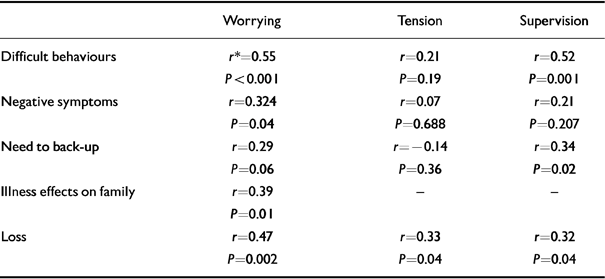
| Worrying | Tension | Supervision | |
|---|---|---|---|
| Difficult behaviours | r *=0.55 | r=0.21 | r=0.52 |
| P<0.001 | P=0.19 | P=0.001 | |
| Negative symptoms | r=0.324 | r=0.07 | r=0.21 |
| P=0.04 | P=0.688 | P=0.207 | |
| Need to back-up | r=0.29 | r=-0.14 | r=0.34 |
| P=0.06 | P=0.36 | P=0.02 | |
| Illness effects on family | r=0.39 | - | - |
| P=0.01 | |||
| Loss | r=0.47 | r=0.33 | r=0.32 |
| P=0.002 | P=0.04 | P=0.04 |
We also investigated the relationship between IEQ outcomes and coping strategies and found that ‘supervision’ status correlated with emotional coping strategy (r=0.55; P<0.001). Caregivers who were living with participants had more frequent visits to their general practitioner (GP) compared with caregivers who were not living with them: the difference was statistically significant (mean scores: 1.87 v. 1.58; P=0.03). When asked whether the relationship between the participant and their caregiver had changed since the onset of the illness, 40% of caregivers reported that there had not been any change in the quality of the relationship, 45% reported moderate changes and 15% stated that there had been a marked change in their relationship.
Experience of Caregiving Inventory (ECI) scores
Women caregivers had higher scores for ‘effects of illness on family’ — effects of the illness on children, how the illness affects special family events, the illness causing family breakup, the level of understanding of the illness in family members (mean: 10.52 v. 9.58; P=0.03). We investigated the association between the ‘stigma’ of having a mentally ill participant in the family and family relationship. Data on stigma (using the ECI scale) were collected by computing the following items: covering up the illness, feeling unable to tell anyone about the illness, feeling unable to have visitors at home, the stigma of having a mentally ill relative and how to explain his or her illness to others. We found that parental caregivers had higher mean scores on stigma than sibling caregivers (mean: 7.78 v. 3.42; P=0.01). No other significant relationships were found. Caregivers mainly used the ‘spiritual’ coping strategy to cope with stigma (r=0.37; P=0.01).
We next looked at the effect of ECI subscores (dependency, loss, effects on family) on caregivers' coping strategies. ‘Dependency’ was computed with the following items: the participant's dependence on the caregiver; helping the participant to fill the day; whether a participant is always at the back of the caregiver's mind; feelings of being unable to leave the participant at home alone; feelings of being unable to do things. There was a highly significant positive correlation between dependency and emotional coping strategy (r=0.44; P=0.004). We found a significant positive correlation between ‘effects of illness on family’ and emotional coping (r=0.43; P=0.005). Caregivers also tended to use practical coping strategies to cope with the effects of illness on the family (r=0.35; P=0.02). We found a highly significant positive correlation between negative aspects of caregiving total scores (caregiver distress) and emotional coping (r=0.47; P=0.002). There was a further positive correlation between practical coping and the negative aspects of caregiving total scores (r=0.35; P=0.02): both sorts of coping were related to distress.
DISCUSSION
Coping at first episode of psychosis
The caregivers interviewed in this study were confronting the emotional upheaval and practical challenges visited on the family of a person with a first episode of psychosis. The coping styles recorded in this article represent a cross-section of family coping with first-episode psychosis. It is not known in what way or to what extent caregivers' coping styles change with time over the course of psychotic illness (Reference Birchwood and CochraneBirchwood & Cochrane, 1990). Most caregivers in our study used both ‘practical’ and ‘emotional’ coping strategies rather than ‘spiritual’ (faith) strategies. This contrasts with the finding of spiritual coping as being the predominant strategy for caregivers in the Mediterranean countries (Reference Magliano, Vetro and MajMagliano et al, 1998). Caregivers in our study used the spiritual strategy to cope only with the stigma of having a mentally ill relative. On this basis it might be helpful to advise caregivers to think about adopting a range of coping strategies as an initial coping effort.
Caregiver distress
Twelve per cent of caregivers exhibited psychiatric morbidity in our study. This is comparable to the percentage in the general population. Caregivers in the professional social class had higher total GHQ scores than those in the skilled manual class. There was no significant difference between caregivers in the professional class compared with those in the skilled manual class with respect to hours of contact or participants' living status. Fifty-eight per cent of caregivers had more than 32 hours of direct contact per week with the participant in our sample. In a recent study conducted among people with long-term schizophrenia, Schene et al (Reference Schene, van Wijngaarden and Koeter1998) found that carers had very much less direct contact with the person later in the course of illness. It is not clear whether higher levels of contact will contribute to feelings of burden and levels of expressed emotion (both found to be related) by the time carers are more experienced (Reference Scazufca and KuipersScazufca & Kuipers, 1997). Although not measured in this study, some evidence exists that even at the first episode, burden and expressed emotion are already established for some caregivers (Reference Kuipers, Raune, Birchwood and FowlerKuipers & Raune, 2000). Caregivers experienced a high degree of worrying when the participants displayed difficult behaviour and negative symptoms. Those who were living with the participants had more frequent GP visits. Schene et al (Reference Schene, van Wijngaarden and Koeter1998) reported similar findings among caregivers of those experiencing long-term schizophrenia in that caregivers who were more distressed consulted their GP more frequently.
Methodological issues
Our study has limitations. First, even though our caregiver sample was collected from a first-episode psychosis study from a defined catchment area, we were unable to include all those experiencing a first-episode of psychosis within the catchment area because they did not all meet our inclusion criteria. In addition, some of the caregivers from our sample could not be interviewed. Second, this study was cross-sectional and focused on the ‘primary’ caregiver of people with a first episode of psychosis. A third limitation relates to the definition of caregiver contact. This is known to be difficult to quantify accurately (e.g. Reference Tucker, Barker and GregoireTucker et al, 1998). We found that two caregivers spent less than 1 hour each week with the participant. Although this did not change our results, it remains problematic that in fact some caregivers spent very little time with the participant and would not have been included in other studies, despite the fact that they may still have found the role burdensome.
The nature of the burden of the caregiver is likely to change over time as the participant progresses from his or her first episode of psychosis. A future study aims both to follow up and include multiple caregivers of people with first-episode psychosis and will thus overcome these potential problems. In addition, the first study (which includes participants and their caregivers from both inner and outer areas of London) should allow us to examine the relationship between the socio-demographic profile of the catchment area and the caregiver burden over time. All of these issues suggest that the sample may not be totally representative and results may not be generalisable.
Future interventions
Interventions might be planned on the basis of the existing coping strategies, the interpersonal skills of each caregiver and culturally sensitive family interventions. Our findings suggest that increasing the range of coping strategies among caregivers as well as focusing on improving participants' negative symptoms and associated behavioural problems might help to reduce caregivers' distress. Many caregivers believed that negative symptoms were under the participant's control. This is consistent with previous literature (e.g. Reference Kuipers, Leff and LamKuipers et al, 1992). There is also evidence that caregiver coping will be strongly influenced by their appraisal of the participant's symptoms (rather than by the symptoms per se) (Reference Barrowclough and ParleBarrowclough & Parle, 1997; Reference Scazufca and KuipersScazufca & Kuipers, 1996). These findings suggest that early intervention for caregivers could be based on the same kind of issues found helpful in the family intervention studies, with particular reference to identifying and modifying burdensome symptoms and their appraisal by caregivers. It is also clear that caregivers are often confused by symptoms and distressed by the levels of supervision required of them. Presumably this can lead to reduced levels of contact over time. At first episode, caregivers have clear needs of their own for information, support and help with coping with an unfamiliar range of problems. Services should be aware of these needs, as suggested by the National Service Framework (Department of Health, 1999). At first-episode psychosis, both the individuals experiencing this and caregivers are having to deal with new and distressing difficulties. Interventions which include all concerned family members seem likely to begin to ease these problems.
Clinical Implications and Limitations
CLINICAL IMPLICATIONS
-
▪ At first episode, negative symptoms and behavioural problems cause more caregiver distress (burden).
-
▪ Women caregivers scored higher than men on distress.
-
▪ Even at first episode, caregivers are experiencing distress and are attempting to cope using a range of styles; interventions which routinely include caregivers might be more helpful.
LIMITATIONS
-
▪ The study reports cross-sectional data.
-
▪ Not all patients within the defined catchment area agreed to participate in the study.
-
▪ Not all caregivers could be interviewed and some had little contact with participants.
ACKNOWLEDGEMENTS
We thank Sophia Rabe-Hesketh for statistical advice and helpful comments. We are indebted to Professor T. Burns and Dr K. Harvey. We are also grateful to all the participants and caregivers for giving us their time and to the consultants at the various hospital and community mental health centres who helped us to identify the participants.




eLetters
No eLetters have been published for this article.