


Introduction
As “periodic revolts of the working-class against the autocracy of capital” (Marx Reference Marx1974: 435–36), strikes have long been regarded as labor’s “only true weapon” (Gould Reference Gould1993: 202). With the growth of industrial capital during the last quarter of the nineteenth century, strikes expanded dramatically and, with them, a host of forceful countertactics devised by employers (e.g., Griffin et al. Reference Griffin, Wallace and Rubin1986; Isaac Reference Isaac2002; Smith Reference Smith2003), including the use of replacement workers (or “scabs” as the labor movement would have it) to break strikes and undermine union formation (Kimeldorf Reference Kimeldorf2013). While much has been said about the importance of strike solidarity and its antithesis—strikebreaking—in labor history, there has been little systematic analysis of the relative impact of solidarity and strikebreaking replacements on strike outcomes.Footnote 1 Even more notable, scholars often assume that strike solidarity carries the day, or alternatively that the presence of strikebreakers will automatically spell defeat. Both assumptions should be empirically assessed across multiple dimensions of solidarity. Historical case studies do suggest that strikebreakers have potent negative influence on outcomes, and this is the case for early strikes (e.g., the Homestead Carnegie Steel strike of 1892 or the Gould rail strike of 1885–86; see Brecher Reference Brecher1997: 40–42, 69–114) as well as more recent clashes (e.g., the PATCO strike in 1981; the Arizona cooper miner’s strike of 1983 [Rosenblum Reference Rosenblum1995]; the Detroit Newspaper strike of 1995 [Rhomberg Reference Rhomberg2012a]). Yet we have no systematic general evidence indicating how strikebreakers influence the likelihood of strike success or failure, and how other conditions may moderate strikebreaker influence. Quite simply we do not know the relative efficacy that dimensions of solidarity (and its breakdown) may have on strike outcomes.
Our purpose is to theorize and empirically assess key dimensions of workers’ strike solidarity and its antithesis—what the labor movement would call “scabbing” or acting as replacement workers during strikes when the US labor movement was in its formative phase. If the strike is labor’s “only true weapon,” to what extent does strike solidarity by workers, or alternatively scabbing, influence strike outcomes—that is, success or failure in obtaining worker demands? We place solidarity and its antithesis in a framework that emphasizes the two-sidedness of cooperation in the commodity form of social organization, and in so doing highlight the intersection of political economy, the sociology of class formation, and social movement scholarship.
To address these questions, we employ rich strike event data collected by the US Commissioner of Labor for the years 1881–86 inclusive, a tumultuous period of capital-labor relations. We estimate strike outcome models (success/failure) that directly assess the influence of (a) forms of solidarity, (b) solidarity breakdown using strikebreaking replacement workers (scabs), (c) net of important controls, including (d) adjustment for industry clustering. It is extremely rare in social movement or labor studies to have such rich characteristic and outcome data for the same class of events (i.e., tactical collective action form—strikes in this case). Our results demonstrate the powerful impact that strike solidarity has for increasing the likelihood of strike success during the first Gilded Age while also showing its limits, and the devastating negative impact that the use of replacement workers by employers (the epitome of solidarity breakdown) can have in the opposite direction as capital successfully pits one part of the working class against another.
Our findings have important implications. An enduring line of inquiry since the founding of the social sciences, the study of solidarity is integral to questions of social order and change (e.g., Hechter Reference Hechter1987). While virtually all scholarship on collective action and social movements presupposes the importance of solidarity, we have little direct systematic assessment of its dimensions, efficacy, limits, or breakdown. In a concrete theoretical manner, our findings go to the heart of risky worker collective action and its influence on the success of collective struggle. Results also demonstrate how important intraclass struggle is if interclass actions (like strikes) are to have a chance at success. A powerful culture of individualism, economic need, and potential cleavages around race, ethnicity, nativity, gender, skill, and more offered employers the opportunity to pit one faction of the working class against another through a variety of countertactics (e.g., Davis Reference Davis1986; Griffin et al. Reference Griffin, Wallace and Rubin1986). Historically, our findings indicate how lethal the legality of replacement workers was when the industrial working class and labor movement were emerging on a national scale, one that has a powerful legacy continuing to plague and undermine workers’ power in contemporary American workplaces.
Workplace Heterogeneity and Status Stratification
“Status-consciousness…masks class consciousness; in fact it prevents it from emerging at all.”
—Georg Lukacs, History and Class Consciousness (1971: 58)As early as the mid-nineteenth century, Marx and Engels (Reference Marx and Engels1967 [1848]: 90) observed in the European theater that the organization of proletarians into a class was frequently being upset, as they put it, “by competition between the workers themselves.” For its part, the US working class has always been a highly heterogeneous labor force, stratified with a mixture of status differences in most workplaces. Differences in race, ethnicity, nativity, gender, religion, occupation, skill, and income carry the capacity to become divisions that fragment workers’ political potential. Frequently scholars have attributed the relatively conservative trajectory of the American labor movement to precisely such status distinctions among workers, including workers’ ability to mobilize for collective action such as strikes (e.g., Davis Reference Davis1986; Dixon Reference Dixon2004; Dixon and Roscigno Reference Dixon and Roscigno2003; Form Reference Form1985; Sombart Reference Sombart1976).
For example, as a white settler colonial society, race was crucial to understanding the stifled political potential of the working class. Slave history, its Jim Crow aftermath, and ongoing exploitation of Black labor has and continues to create a deep divide. It was such a major division coming out of the nineteenth century that W. E. B. Du Bois (Reference Du Bois1903) saw it—“the color line”—as the fundamental problem of the next century. Numerous social scientists and historians have documented the detrimental consequences of racism and ethnic divisions on the fortunes of the working class (e.g., Davis Reference Davis1986; Foner Reference Foner1981; Form Reference Form1985; Zeitlin and Weyher Reference Zeitlin and Frank Weyher2001). As Asher and Stephenson (Reference Asher, Stephenson, Asher and Stephenson1990: 5) put it: “It is commonplace to view the labor force of the United States as being unusually fragmented by ethnic and racial divisions. This heterogeneity was clearly encountered more often in American workplaces than anywhere else in the industrial world.”
Immigration provided large streams of cheap readily available labor for capitalist enterprise, while multiple sources of origin helped produce cultural diversity that could be used to divide workers in ethnoreligious, linguistic, and other ways. If this was not enough, there were also skill and political-ideological divisions among workers. In short, worker alliances were frequently divided by multiple overlapping categories of difference in a context of surplus labor, market anarchy, economic despair, and hardship coupled with despotic control in the workplace that sometimes extended out into the community (Burawoy Reference Burawoy1985; Edwards Reference Edwards1979).
Most post-Marx class-formation scholarship has been less than sanguine on the issue of class divisions. The literature is replete with studies highlighting the detrimental influence of status differences among workers (e.g., Aronowitz Reference Aronowitz1973; Hofstader Reference Hofstader1955; Katznelson Reference Katznelson, Katznelson and Zolberg1986; Olson Reference Olson1973; Rosenblum Reference Rosenblum1973). The major takeaway from this literature is that status difference can become an active cleavage that impedes collective action (e.g., Lukacs Reference Lukacs1971). Thus, intraclass struggle to achieve solidarity is integral to interclass struggle: the intraclass struggle over social status cleavages and the meaning of class must be overcome before interclass struggle can be effectively pursued (e.g., Przeworski Reference Przeworski1985; Zeitlin and Weyher Reference Zeitlin and Frank Weyher2001).
However, before such status differences can undermine worker solidarity they have to be translated from latent to active divisions. There is evidence that worker differentiation impact did damage to solidarity during this period but this was not always the case. For example, we know that some labor unions, such as the Knights of Labor, mobilized assemblies that were race and gender inclusive (e.g., Voss Reference Voss1993). Sometimes workforce composition makes a difference. For example, analyzing strikes in northeastern states in the late nineteenth century, Jacobs and Isaac (Reference Jacobs and Isaac2019) find that the impact of gender on strike success tipped in contradictory directions depending on the level of workplace gender composition. In ranges approximating relatively equal gender composition, women had a positive impact on strike settlements—that is, increasing the likelihood of success; elsewhere along the compositional range (both lower and higher proportions) women had a detrimental effect on strike success.Footnote 2 We know, too, that while these differences were often used to undermine solidarity among strikers and attempts to unionize, that was not always the case; sometimes the struggle within the working class produced powerful forms of worker oppositional culture and solidarity.
Intraclass Struggle for Solidarity and Class Formation
“Each for himself is the bosses plea. Union for all will make you free.”
—Parade banner of Detroit Cooper’s Union, 1880Footnote 3Scholars and activists have long debated and struggled with the role of solidarity in contentious collective action (e.g., Gamson Reference Gamson1975; Lipsitz Reference Lipsitz2004; Olson Reference Olson1973; Voss Reference Voss1993). When does solidarity take place and under what conditions? How can it be achieved? How resilient is it? How can it be measured? What difference does it make for the achievement of movement goals? Indeed, the role of solidarity is integral to the entire enterprise of contentious collective action—the development of collective identity (Fireman and Gamson Reference Fireman, Gamson, Zald and McCarthy1979), group commitment, activist skill and mobilization (Santos Reference Santos2020).
Drawing on Durkheimian tradition (Durkheim Reference Durkheim1987 [1897]; Hechter Reference Hechter1987), Santos (Reference Santos2020: 126) defines solidarity as actors’ willingness to contribute private resources—such as time, energy, money—to collective ends. But because movements are often faced with limited access to material resources (contra political parties and pressure groups), they work to substitute symbolic resources for their deficit in the material realm. As Della Porta and Diani (Reference Della Porta and Diani1999: 141) put it: “For the most part building incentives to solidarity, social movement organizations give particular importance to internal relations, transforming the very costs of collective action into benefits through the intrinsic rewards of participation itself.” This internal group solidarity is the product and process of mutual association. Through mutuality—on the job, in the neighborhood—workers are sometimes successful at creating a “culture of solidarity” that valorizes general worker welfare and ties individual self-interest to the collective (e.g., Fantasia Reference Fantasia1988).Footnote 4
Theorists who presuppose individualist-rational calculus models of human behavior, so central to capitalist political economy,Footnote 5 find it rational for workers to disregard picket lines and norms of worker solidarity during a strike. For example, Mancur Olson Reference Olson1973: 71) writes:
If some workers of a particular firm go out on strike, the supply function for labor tends to shift to the left; so for those who continue working, or for those outside strikebreakers, wages will if anything be higher than they were before.Footnote 6 By contrast, for the duration of the conflict the strikers get nothing. Thus all the economic incentives affecting individuals are on the side of those workers who do not respect picket lines.
Olson’s theory of collective action contains a keen skepticism regarding the efficacy of “internalized” means for collective action through “persuasion,” or what we would call a culture of solidarity central to working-class formation. In his theory the free-rider problem can be typically overcome through selective incentives (usually market-oriented quid pro quo exchanges) or coercion. Yet, due to the overwhelming force of individual self-interests recourse to persuasion-based solidarity is unlikely to achieve a favorable outcome absent other factors. Olson (Reference Olson1973: 70–71) explains that workers sometimes perform collective action under these conditions through their use of coercion and violence. This captures one side of the dialectic in contentious collective action under capitalism, a potent and important reality. However, the processes of making a working-class culture and the process of class formation are beyond the grasp of such theories. We need to know if, when, and how the culture of solidarity wins out over capitalist individual rationality. Thus, it is important to examine the impact of solidarity and its limitations in the face of individual self-interest.
Various social differences could and often did lead to divisions and fragmentation of workers that might weaken or undermine the process of class formation and play into the hands of capitalist rationality. By class formation, we mean the simultaneous dual process whereby: (a) class segregation and boundary construction increases the economic, social, and cultural distance between class; while (b) class consciousness, solidarity, and intensification of social relations are enhanced within class.Footnote 7 Thus, classes are understood as variably organized and disorganized formations that result from continuous struggles (Przeworski Reference Przeworski1985: 70) embodying varying degrees of interclass polarization and intraclass solidarity. Strikes embody all these processes.
A key feature of labor during this period of extraordinary industrial capital development was the massive emergence of cooperation, one that is fundamentally two-sided (Isaac and Christiansen Reference Isaac, Christiansen, Wardell, Meiksens and Steiger1999). On one side, what appears as the productive power of capital is due to labor cooperation on an increasing scale—greater volumes of labor power concentrated within and actively linked with the means of production. On the other side, this same cooperative labor power for capital carries the increased capacity for cooperation or mutuality of labor’s power for labor that manifests as “resistance to domination of capital, and with it, the necessity for capital to overcome this resistance by counter-pressure” (Marx Reference Marx1974: 331).
Where does this resistance come from? What are its active elements? The answer, in a word, is culture, the development of a “working-class subculture of opposition” (Oestreicher Reference Oestreicher1989: 60–67) or workers’ “culture of solidarity” (Fantasia Reference Fantasia1988) necessary for class formative solidarity at the point of production, the workplace where workers’ grievances against capital become concentrated in contentious form.
For workers to have a chance at successfully persuading their employers to capitulate as a result of their withdrawal of collective labor power, they need to make the effort as fully collective as possible by building awareness, understanding, trust, commitment, all shaped into a working-class culture prepared for opposition. In the face of multiple competing alliances, cleavages, dominant ideological opposition, workers develop rudiments of an oppositional subculture as one side of the class formative process, intraclass solidarity manifested in a culture of mutuality and material organization. This culture of solidarity grew out of the conditions of labor as it was being shaped by industrial capital. The materialization of this class mutuality in the Gilded Age consisted of unions, Knights of Labor assemblies, clubs, cooperatives, labor newspapers, singing societies, fraternal organizations, political organizations, and workers’ militia (Oestreicher Reference Oestreicher1989: 60–67).
The cultural glue that contributes to an intraclass community of solidarity appears as a “code,” a “doctrine of mutualism,” or workers’ moral economy: “informal practices and commonly understood moral precepts which were communicated to and accepted by a broad segment of [Detroit’s] working population; setting stints and limiting output, honoring picket lines and boycotts, helping needy compatriots” (ibid.: 62–65). The 1892 strike at Carnegie’s Homestead Steel Works offers an impressive example of solidarity, perhaps one “unsurpassed in American history” (Serrin Reference Serrin1992: 73). Thousands of strikers and townspeople were organized on a “military basis,” with a whistle warning system; men and women were stationed on roads, railroads, plant gates, and the Monongahela River; and scouts in Pittsburgh were on alert for an expected influx of Pinkerton strikebreakers (ibid.: 73–75). Focusing on more recent strikes, Fantasia (Reference Fantasia1988) elaborates a similar worker’s culture emerging around the strike as a trying and emotionally difficult process where the rudiments of a “community of solidarity” (intraclass dynamics) emerges in opposition to the company (interclass dynamics). Both community support and some outside support “created a sense of mutuality and sociability,” an “intense sense of community nourished by the strike” (p. 193).
Class-based norms were central to this oppositional culture of strike solidarity, and perhaps no norm was more important than the emergence of the meaning of “scab,” a commonly used pejorative term for one who does not participate with coworkers in a strike, crosses a picket line, or hires on as a replacement worker during a strike. This linguistic moral code was part of community ostracism of persons who put individual interests above collective interests, a class-defined deviant behavior. Emerging with force in the wake of the 1877 national strike, the norm’s purpose was to persuade against individualistic practices that would undermine solidarity around the strike. Theories that are premised on individualistic behavioral models (e.g., Olson Reference Olson1973) have trouble accounting for high-risk solidarity in struggles over collective goods like strikes over wages, better working conditions, union recognition, and so forth. Our conceptualization of class formation and intraclass dynamics centers on cultural practices leading to a multidimensional approach to worker solidarity as part of the class-formation process (e.g., Katznelson Reference Katznelson, Katznelson and Zolberg1986), all forms of which are expected to increase the likelihood of strike success. We conceive of these empirical dimensions of solidarity as more-or-less stemming from bottom-up sources (e.g., direct action mobilization of workers in single firms or across multiple firms) and from top-down sources (e.g., organization, resources) (e.g., Roscigno and Hodson Reference Roscigno and Hodson2004). First, worker solidarity in strike participation at the point of production is required. High levels of participation would be necessary, if not sufficient, for success leading to our first hypothesis:
H1A: The greater the degree of worker strike participation solidarity at the point of production, the greater the likelihood of strike success.Footnote 8
Sometimes strike actions spread beyond a single workplace in a given industry signaling broader grievances, solidarity, and willingness to mobilize. This might be due to general strike actions in an industry and/or sympathy strike actions; both add potency to the strike because “they create widespread solidarity to magnify the power of any single group of workers” (Brenner et al. 2009: xxxviii–xxxix). The idea behind multifirm action as an indicator of solidarity in the same industry-locality is that it carries the weight of cross-firm or organizational breadth of striker action. Therefore, we hypothesize that:
H1B: The presence of extended strike solidarity across multiple workplaces will increase the likelihood of strike success.
There are other crucial intraclass solidarity processes of the organizational and resource variety that are likely to lead to greater strike success. Union organization matters for class formation and worker solidarity in collective action like strikes (e.g., Kimeldorf Reference Kimeldorf2013; Montgomery Reference Montgomery1979; Southworth and Stepan-Norris Reference Southworth and Stepan-Norris2003). The presence of worker self-organization can have a powerful impact on the production of collective militancy like strikes especially when operating jointly in conflictual manager-worker space (Roscigno and Hodson Reference Roscigno and Hodson2004), very much the dominant conditions in the Gilded Age. In general, organizational solidarity in the form of a union-led strike would increase worker power, resources, and discipline, so we hypothesize:
H1C: The presence of organizational solidarity, in the form of union backing, will increase the likelihood of strike success.
The flow of resources to support strikers from various sources (including their union, other unions, community members) signify intraclass solidarity potentially important for success. Financial assistance signals economic resource solidarity with strikers that could come from the union in union-led strikes. However, union and financial support, while related, are not identical. Some nonunion strikes also received financial assistance (11 percent in our data). During this historical period the Knights of Labor were known for extending solidarity in the form of financial assistance when strikers had no union or strike funds (Montgomery Reference Montgomery1980: 90), and there is also evidence that strikers sometimes received financial assistance from local communities (Henry Reference Henry1991). Therefore, we hypothesize:
H1D: The flow of financial support solidarity with a strike will increase the likelihood of strike success.
Group Size, Proximity, and Limits to Strike Solidarity
“I can pay one half of the working class to kill the other half.”
—A famous quote widely attributed to Gilded Age robber baron and railroad tycoon, Jay GouldFootnote 9“The right to permanently replace [strikers], [is the] right to use nuclear weaponry in the arsenal of industrial warfare.”
—Former National Labor Relations Board chair, William Gould (Reference Gould1993: 202)During the last quarter of the nineteenth century, strike frequency escalated rapidly. Figure 1 shows this enormous surge in workplace disruptions between 1870 and 1900 and highlights our analytic time frame (1881–86) embedded in this period of initial strike acceleration. Prior to the 1877 national uprising, strikes were quite infrequent and relatively small scale.Footnote 10 As work stoppages became more frequent, they also became larger, more aggressive, and more disruptive for employers and political authorities, and more lethal for strikers. Between 1877 and 1900 almost 400 were killed in strikes (surely an undercount), mostly workers, accounting for more than a third of all strike deaths in the United States to present (Lipold and Isaac Reference Lipold and Isaac2009: 198).

Not only did strikes become more frequent and disruptive, they also were displaying a shocking level of worker power, an affront to bourgeois ideology. Over our analytic period (1881–86), strikes won either some (partial success or compromise) or all worker demands (total success) in 53 percent of the contests. This shockingly high success rate was due in no small measure to both worker militancy and mutuality in the fight for workers’ control of production during the period (Montgomery Reference Montgomery1979), which most certainly got the attention of employers and of agents of the state (e.g., US Commissioner of Labor 1888: 5–33). We note, however, that the success rate did not stay at this high level indefinitely; it shows a declining trend over the next decade and would face more difficult odds as employers began to organize and counter with “scientific management” and other tactics (Griffin et al. Reference Griffin, Wallace and Rubin1986; Montgomery Reference Montgomery1979, Reference Montgomery1987).
In the context of bourgeois understandings, this strike surge and especially their success was anathema—contrary to the natural order of the market. By the 1880s, the definition of property was augmented to include not only material things like factories but also intangible terms like market value and profitable potential (Voss Reference Voss1993: 118–19). Workers’ collective actions were understood as illegitimate interference with these property and market processes. Consequently, in dominant bourgeois ideology, “strikes expressed a conflict not between employers and workers but of ‘labor against labor,’ that is, striking workers against strikebreakers” (Beckert Reference Beckert2001: 282; emphasis added). The extreme position took the view that strikes and boycotts should be felonies while the use of fatal force for interfering with strike replacements (or scabs) should be treated merely as “justifiable homicide” (Thompson Reference Thompson1900; cited in Pearson Reference Pearson2015). Authorities constructed institutional barriers to counter growing labor militancy, including conspiracy and injunction law, municipal police forces, public and private militias, employer associations, and a growing industry of specialized strikebreaking and unionbusting companies (e.g., Griffin et al. Reference Griffin, Wallace and Rubin1986; Isaac Reference Isaac2002; McCammon Reference McCammon1993; Norwood Reference Norwood2002; Skowronek Reference Skowronek1982; Smith Reference Smith2003; Tomlins Reference Tomlins1985).
Strike solidarity at the point of production is, no doubt, extremely important but also equally challenging to accomplish. Localized solidarity has limits; even with 100 percent solidarity among strikers at the point of production, strikers could still find their efforts defeated.Footnote 11 One of the most potent countertactics used by employers was the recruitment of replacement workers to dampen production disruption costs of a strike. An existing supply of surplus labor could be drawn upon for replacement workers and molded in cooperation with capital rather than cooperation with labor. This was a highly visible tactic and one that added an extra level of contentiousness to any walkout.
Strikes carry a variety of costs for both sides of the conflict. When workers strike they seek leverage over their employer by halting production, and thereby adds a new operating cost—disruption costs—to the employer’s accounting ledger. The employer’s calculus would involve these disruption costs as well as estimated concessionary costs associated with conceding to strikers’ demands. If the costs associated with replacement workers is less than the sum of disruption and concessionary costs, then we might expect an employer to bring in replacements to break the strike. US labor law certainly did not (does not) preclude such employer tactics (e.g., Feldacker and Hayes Reference Feldacker and Hayes2014; Tomlins Reference Tomlins1985; White Reference White2008), and in fact was (is) very conducive to it.
From the striker’s side, things change dramatically when an employer opts for replacement workers. The strike dynamic changes fundamentally because it immediately raises the stakes of the conflict by posing a direct challenge to future employment; a routine strike changes to a “strike under siege” and the picket line shifts from a symbol of collective intraclass solidarity and line of demarcation between-class polarization to a crucible of hot conflict (Fantasia Reference Fantasia1988: 189). Given the stakes and increased intensity of struggle, typically accompanied by armed force (police, militia, hired mercenary thugs), the resort to scabs often lead to violence (e.g., Norwood Reference Norwood2002; Olson Reference Olson1973: 70; Smith Reference Smith2003).
With a shift in the size, quality, and frequency of strikes over the Gilded Age (Montgomery Reference Montgomery1979: 18), employers often used replacement workers to break strikes. Panel A of table 1 shows the percentage of strikes for which replacements were used over our period. Mild fluctuations appear during the period, but generally about 40 percent of all strikes faced strikebreaking replacements. Panel B shows the percentage of strikes scabbed for several locations—including New York and Chicago, the two largest cities and leading strike sites during these years. Note that the peripheral mining regions had a substantially lower scab rate than the nation as a whole, possibly a consequence of higher costs for mining companies seeking to import replacements to isolated mining sites (see Kimeldorf Reference Kimeldorf2013). In general, between 1870 and 1900 employers hired more than a half million strikebreaking replacements, or approximately 10.8 percent of the 4.7 million workers who went on strike during this period (see also: Rosenbloom Reference Rosenbloom1998: 184).
Prevalence of strikebreaking replacement worker use by employers

Note: Raw strikebreaker data are from the US Commissioner of Labor (1888).
Scholars have long regarded replacement workers as one of the most potent weapons available for employers in strike conflicts. For example, historian Philip Foner (Reference Foner1981: 17) maintains that “the failure of a great number of strikes in cotton textiles, mining, iron and steel, cigar, railroad, and other industries must be attributed in no small measure to the ability of employers to make use of unskilled labor obtained from labor exchanges and steamship companies as strikebreakers.” Howard Kimeldorf (Reference Kimeldorf2013) argues that the origins of the organized labor movement are located in industries where it was most difficult (and therefore costlier) for employers to resort to replacements to break strikes, giving such workplaces a special advantage from which embryonic unions could gain footholds with a chance to grow.
Employers who sought to use replacements in the face of a strike had two choices; one option would be to recruit from the local community. In this case, it is conceivable that working-class solidarity might extend from the strike site out through the community preventing the recruitment of replacement workers. This was most likely to occur with union presence at the struck workplace, especially unions with social unionism culture (Montgomery Reference Montgomery1979; Southworth and Stepan-Norris Reference Southworth and Stepan-Norris2003).Footnote 12 Precepts of workers’ moral economy most certainly included strong prohibitions against scab labor (and the very term scab) and crossing picket lines, and these moral codes were communicated and accepted by many working-class communities.Footnote 13 The creation, diffusion, and enforcement of these codes was a key part of intra-working-class struggle. During a strike-induced crisis, fusion between workplace and community could grow more intense. Fantasia (Reference Fantasia1988: 206–9) reports that for strikers to sustain themselves during a strike, solidarity with family and community was crucial. Montgomery (Reference Montgomery1987: 371) also underscores the importance of strike support from neighborhood solidarities: “high visibility strikes could enjoy overwhelming community support.… The vast working-class neighborhoods of [this period] could make life unbearable for scabs, mount large funeral processions for slain strikers, and involve entire families in marketplace as well as workplace struggles.” Dense concentrations of workers in class-segregated neighborhoods often conveyed workplace struggles into community mobilizations (Montgomery Reference Montgomery1987: 332; also Southworth and Stepan-Norris Reference Southworth and Stepan-Norris2003). For example, during the 1895 Brooklyn trolley strike, picket crowds (mostly nonstriking sympathizers) as large as 6,000 supported the strike; community support for the strikers came in the form of food, entertainment, financial support, and symbolic window placards while also doing battle with police and militia (Henry Reference Henry1991).
Yet there is an underlying difficulty or contradiction in expanding group scale factor (i.e., from workplace to surrounding community). On the one hand, labor’s disruptive capacity grows with scale. But, on the other hand, that same scale factor—say, creating solidarity that extends from the workplace strike site through the community—becomes increasingly difficult to achieve as population scale or latent group size increases (a point recognized in a somewhat different fashion by Olson [Reference Olson1973]). Stitching together relations of solidarity is easier to accomplish in a smaller group and if all individuals have equivalent interest in the goal of the collective effort (i.e., strike outcome). Moreover, there is also the issue of proximity. As distance from the struck firm increases, the likelihood of strong community ties to build solidarity decreases.
Extensive community solidarity with strikers happened but it was not a given. For instance, we know from the US Commissioner’s Third Annual Report (1888) that during 1881 and 1886, almost 30 percent of strikes drew scabs from the local community suggesting that workplace-community strike solidarity certainly has its limits. When these limits are breached in the local community, neighborhood solidarity with strikers is weakened, strikers’ associational power is reduced, and employers gain a major resource in the strike battle.
Local labor markets are but one source, perhaps the cheapest, for a replacement labor supply, if strikers’ moral code could be breached. But if the local community does not provide a source of replacement workers, employers are left with the prospect of importing replacements from farther away. Imported replacements generally came at a premium. Employers would be faced with locating willing and able (sufficiently skilled) unemployed workers, transport and perhaps house them, or find commercial agents who would provide such services.Footnote 14 But even with these additional expenses, employers’ calculus may still find this a cheaper approach than accepting ongoing disruption costs and/or concessionary costs associated with worker demands, especially those challenging workplace control.
From labor’s perspective, the ideal situation would find the moral code of solidarity with strikers widespread across the entire social formation, the social factory (Cleaver Reference Cleaver1979) including many localities and neighborhoods (Isaac and Christiansen Reference Isaac, Christiansen, Wardell, Meiksens and Steiger1999).Footnote 15 So here we would look for market support in boycotts against the targeted employer, sympathy strikes, and certainly adherence to the prohibition against hiring on as scabs to be transported to a strike site. For example, this moral code operated outside the local community during a foundry strike in Newark where factory owners recruited 50 replacements from New York City. When the replacements arrived and learned they were there to break a strike, they refused to scab and demanded a day’s pay for their travel (Chicago Tribune, July 1, 1881, p. 3). Of course, this presupposes not only generalized adherence to such norms of workers’ moral economy but also the material conditions of existence that could increase the likelihood of adherence to that norm: no substantial labor surplus, or discrimination-induced segmented labor markets that would generate severe economic distress as an overriding motive to scab a strike. As distance from the strike site and latent group size both increase, solidarity with strikers becomes more difficult to achieve. For example, more than 40 percent of scab labor between 1881 and 1900 was imported from sources beyond the community of the strike site (Rosenbloom Reference Rosenbloom1998: 184), and these imported workers were often (not always) unemployed immigrants or African Americans (Whatley Reference Whatley1993).Footnote 16 These conditions lead to our second general hypothesis:
H2: When strike solidarity is breached through employer recruitment of replacement workers (from local community or beyond), the likelihood of strike success is reduced.
Workplace strike solidarity was extremely difficult to produce and fragile to maintain under conditions prevailing in late-nineteenth-century America. But it was, nonetheless, necessary for strike success. It was not, however, sufficient. Workplace strike solidarity can be undermined if: (a) a legal environment permits permanent replacements or scabs, as strikebreakers, and (b) a culture of individualism promotes and economic necessity pushes workers to cooperate with capital rather than with other workers, thus impeding the intraclass component of solidarity in the class-formation process. With the copresence of these conditions, very much a part of the nineteenth-century political-economic context, there is reason to believe that workplace class formation can be undermined by either community or social factory breaches in workers’ moral code. This leads to our third general hypothesis:
H3: The power of employers to hire strikebreaking replacement workers is generally sufficiently strong to negate the positive impact of worker strike solidarity in all its forms.
Urban Political Regimes and Differential Strike Policing
“Year after year platoons of [New York City] police cracked skulls, broke up meetings, and smashed picket lines while press and politicians acquiesced or applauded wildly.” (Burrows and Wallace Reference Burrows and Wallace1999: 1110)
To this point we have focused on solidarity and strikebreaking in a general sense during the last quarter of the nineteenth century. The estimates we provide in the following text for hypotheses 1–4 are general estimates across many cities. But local institutional political context constructed by city governments varied during this period in approaches to policing strikes. Thus, characteristics specific to the local state (municipality) might influence the relationship between strikebreaking and strike success. Indeed, some have argued that municipal political regime policing policy toward strikes and other forms of working-class action is a good gauge of labor’s collective strength in relation to the local state (e.g., Richardson Reference Richardson1974; Schneirov Reference Schneirov2019).
Although we can expect capital to be generally antagonistic toward any type of labor militancy, differential policing regimes could generate a political context that buffered or exacerbated the negative effect of strikebreakers. For example, if political authorities favored workers or were neutral, police might play a more neutral role relative to strikers. If, however, authorities and mainstream press treated strikers as un-American radicals or a fundamental economic threat (Isaac Reference Isaac2002, Reference Isaac2008), then police might be likely to act as agents of capital in their repressive strikebreaking capacities (Richardson Reference Richardson1974: 159). Here repressive policing would target strikers and protect strikebreakers, while more labor-friendly political authorities might do the opposite. The brutal/soft or repressive/tolerant polarities (from labor’s perspective) are generally consistent with some typologies of protest policing styles in Western democracies (e.g., Della Porta and Reiter Reference Della Porta, Reiter, Della Porta and Reiter1998; Earl Reference Earl2011: 268–71). When it comes to strikes, solidarity, and strikebreaking, the role of the police and policing culture could be important by moderating or interacting with how scabs impact the strike and settlement processes. Testing political regime interactions in our models would require detailed information about differential policing policies in a large number of cities (n = 670 distinct municipalities to be exact), an impossible data collection task even assuming that such data were available.
We are, however, able to shed light on this question by examining models specifically for New York and Chicago, the two largest and most strike-active cities at this moment in US history. Historic evidence on the policing of strikes in New York City generally paints a picture of a direct and forcefully repressive approach to strikers and worker self-organization (Beckert Reference Beckert2001; Burrows and Wallace Reference Burrows and Wallace1999; Schneirov Reference Schneirov2019). New York police not only attacked strikers and protected strikebreakers but also the police served as scab labor sometimes.
The regime that replaced the Boss Tweed group in New York was known as the “Swallowtails,” Democratic Party business leaders who dominated city government (Beckert Reference Beckert2001: 130–32; Hammock Reference Hammock1982: 110; Schneirov Reference Schneirov1998, Reference Schneirov2019). “Every mayor elected between 1872 and 1886 was a prominent merchant or manufacturer, and Swallowtails had major representation among aldermen and lesser city offices” (Schneirov Reference Schneirov2019: 260). The Swallowtail regime began to organize along clear class lines during 1872 in political, economic, and cultural spheres, leaving the working class largely closed out of political parties and electoral activities. The regime permitted the police to brutally repress strikes (ibid.: 261–62), and frequently monitored, infiltrated, raided, and otherwise disrupted workers’ meetings and organizations (ibid.: 269).
Things were different in Chicago during our analytic period. Coming into office in the 1878 wake of the bloody street fighting of the national general strike the previous year, Mayor Carter Harrison worked to curb labor-capital violence in the city. A staunch supporter of the ethnic working class of Chicago, especially the Irish, Harrison’s approach was to build a more inclusive coalition to mollify the interests of business as well as organized labor and socialists (Miller Reference Miller1996: 435–48). Cooling to this approach over time, business leaders distanced themselves from city politics under Harrison’s regime. Unlike New York mayors, whose political “Committee of Seventy” supervised police, Harrison had direct personal control over all police matters; he appointed top personnel, controlled promotions, and insisted on personnel with labor sympathies who would resist using police violence to deal with strikers (Schneirov Reference Schneirov2019: 266).
Exemplary cases from the two regimes are instructive. The event in New York City that initiated the strong move to business class formation in 1872 was a strike at Steinway Piano. Here police clubbed strikers and escorted scabs across picket lines. A series of subsequent strikes at Steinway (and many other firms) during the 1880s were handled in a similar violent manner (Beckert Reference Beckert2001). In Chicago, by contrast, a series of 1882 strikes occurred in the Bridgeport district of the city.Footnote 17 Strikes by brickmakers, blast furnacemen, and iron ore shovelers all led to success for workers largely because police commanders, under Mayor Harrison’s direction, did not attack strikers but instead allowed strikers and sympathetic neighborhood crowds to convince scabs—one way or another—of the errors of their ways (Schneirov Reference Schneirov1998: 110–13; Reference Schneirov2019: 105).
These are interesting cases of differential strike policing. But did the two regimes apply this differential policing in a consistently strong manner? If the Chicago approach to policing strikes was sufficiently robust,Footnote 18 we would expect the impact of strikebreakers on strike success to be weaker in Chicago than in New York. These different policing practices lead to our fourth hypothesis:
H4: Given differential policing regimes, the negative impact of strikebreakers on strike success will be greater in New York than in Chicago.
Data
The data for our analysis are coded from the US Bureau of Labor’s Third Annual Report of the U.S. Commissioner of Labor (1888). Motivated by the growing prevalence of strikes and lockouts emerging during the late 1870s and 1880s, the bureau collected detailed information on every strike in the United States occurring between January 1, 1881 and December 31, 1886. The bureau began by generating a massive list of strikes culled from newspapers, magazines, trade journals, and other commercial publications that mentioned strikes or lockouts located anywhere in the country. Field agents were then sent to these sites to gather detailed information about each strike (or lockout) by interviewing employers and employees. While in the field, agents gathered information on additional strikes, thus expanding their initial pool. The final compendium documents 38 fields of data for nearly 5,000 strikes that targeted more than 23,000 firms.Footnote 19
By contemporary standards of strike data collection, the bureau’s compendium represents an “extraordinary effort,” according to two leading labor economists (Card and Olson Reference Card and Olson1995: 35). Consequently, these data have been employed by economic historians, labor economists, and sociologists to examine a variety of questions (e.g., Biggs Reference Biggs2005; Currie and Ferrie Reference Currie and Ferrie2000; Friedman Reference Friedman1988; Geraghty and Wiseman Reference Geraghty and Wiseman2008; Isaac et al. Reference Isaac, Coley, Mai and Jacobs2022; Jacobs and Isaac Reference Jacobs and Isaac2019; Rosenbloom 1988; Rossel Reference Rossel2002). Drawing from the northeast and Midwest states, we employ all cases from this source with complete data resulting in a sample of 4,528 strikes spanning 6 years, 21 industries, and 17 states.
Measures
Our hypotheses highlight the role of solidarity and its breakdown implicitly at various levels of scale in population size and proximity to the strike (i.e., point of production, local community, and beyond the local community) in shaping the outcome of a strike. We control for a variety of strike event characteristics as well as year, industry, and state context.
Dependent Variable
For each strike, the bureau file records the outcome or settlement with three categories: success (all striker goals or demands obtained); partial success or compromise (some goals obtained); and failure (no goals obtained). Our dependent variable is strike success, a binary measure that combines total or partial success (= 1) in contrast to failure (= 0).Footnote 20 These settlements are moments in a process of ongoing local class contention. During our time frame, on average approximately 53 percent of all strikes achieved some level of success (some or all demands achieved) for workers. This nontrivial success rate and the sheer frequency of strikes at this historical juncture were key motivations for government concern and this massive government data collection (see US Commission of Labor 1888).
Solidarity
Because we conceptualize strike solidarity as multidimensional, we employ several distinct measures. Strike participation solidarity at the point of production is gauged with several different measures: a continuous measure—the proportion of the workforce participating in the strike. We also show the impact of solidarity at several points in the distribution: a binary variable for 100 percent worker strike participation (= 1), where the idea is that anything less implies some level of scabbing within the workplace leading to potential for weakening workers’ structural power (e.g., Schwartz Reference Schwartz1976) of the strike; and binary variables for below the median (<98 percent participation) and very low participation (<50 percent). We tap extended workplace solidarity with a binary variable for strikes that extended beyond one firm in an industry/locality (= 1). Our data uses the strike as the unit of analysis and number of firms (same industry) hit by the strike can vary. This measure allows a gauge on the breadth or generalization of worker mobilization. We measure organizational solidarity support with a binary variable for union-supported strikes (= 1) in contrast to spontaneous, unorganized, or wildcat strikes (= 0). We expect union-supported strikes to bring a greater degree of solidarity because of their organizational power, culture of opposition, and ability to exert sanctions and incentives against nonparticipations. In short, unions bring an organizational basis for solidarity to the conflict. Financial assistance signals some degree of economic support for strikers that would likely come from the union. However, union and financial support, while related, are not identical. Some nonunion strikes also received financial assistance (11 percent in our data); during this time period the Knights of Labor were known for providing assistance to strikers with no union or meager strike funds (Montgomery Reference Montgomery1980: 90).Footnote 21 We measure financial support solidarity with a binary variable (1 = support).
Replacement Worker (Scab) Measures
We examine several strikebreaker measures: whether any replacement workers (scabs) were used against strikers (= 1).Footnote 22 In some models, we also examine the impact of substantial within-firm strike scabbing measured as less than the median (98 percent) strike participation (= 1),Footnote 23 and strike participation at less than half the workforce.
Strike Characteristic Controls
It is important to control for other characteristics of collective action events that might be driving the outcome. Based on past research on strike outcomes, labor history, and sociological theory of contentious collective action, we have clear expectations regarding the directional influence of our control variables. In addition to our focus on the importance of various dimensions of solidarity discussed in the preceding text (including union led, financial assistance, and multifirm in breadth), we control for two other variables that are likely to increase success. One is the level of worker skill. The higher the skill level, the more difficult for employers to replace during a strike (Kimeldorf Reference Kimeldorf2013). Our proxy for skill is the average daily worker wage rate (ln $). Another factor likely to increase success is the disruption cost strikers impose on the target employer. We gauge disruption cost by including the estimated financial loss (logged) incurred by the employer relative to losses sustained by strikers.
Other characteristics increase the likelihood of failure. Typically, the longer a strike lasts, the greater the likelihood of strike failure (Card and Olson Reference Card and Olson1995; Jacobs and Isaac Reference Jacobs and Isaac2019; Ragin et al. Reference Ragin, Coverman and Hayward1982; Rhomberg Reference Rhomberg2012a), and we measure strike duration as the logarithm of the number of days workers were out on strike. Workers strike for a variety of different reasons, and some demands are more threatening to employers than others. Workplace control demands (or those for union recognition), struggles over organizational work rules, and sympathy strikes, for example, are likely more threatening because they directly challenge capital’s prerogative to organize and control the production process. Therefore, we expect such strikes to be more forcefully resisted by employers and more likely to fail. In our historical period, many strikes were about such issues (Montgomery Reference Montgomery1979, Reference Montgomery1980).Footnote 24 As Montgomery (Reference Montgomery1979: 24) notes: “The fiercest battles and bitterest losses pivoted around union rules and recognition and around sympathetic action itself.” Over the Gilded Age, strikes increasingly revolved around what we, following Montgomery (Reference Montgomery1979), call “control strikes” and the failure rate grew in tandem (Edwards Reference Edwards1981: 119). Our measure of control strikes is a binary variable that combines union recognition, organizational work rules, sympathy, or multiple causes that include at least some of these control issues (= 1) in contrast to exclusively economic or wage strikes (= 0). Workplace heterogeneity is another challenge to worker struggles with employers because it can potentially undermine solidarity and offers opportunity for employers to pit one group of workers against another. Unfortunately, the BLS did not collect information on workplace race or ethnic composition, but it did collect the number of male and female workers in the struck firm. Based on past research, we expect the higher the proportion female in the firm, the less likely a strike will be successful (e.g., Card and Olson Reference Card and Olson1995; Jacobs and Isaac Reference Jacobs and Isaac2019). Because proportion female is insignificant in all models, we dropped it from the estimates presented in the text that follows. We also control for time (year dummies) and industry.Footnote 25 Descriptive statistics for all variables are presented in table 2.
Variable definitions, hypothesized influence, and descriptive statistics
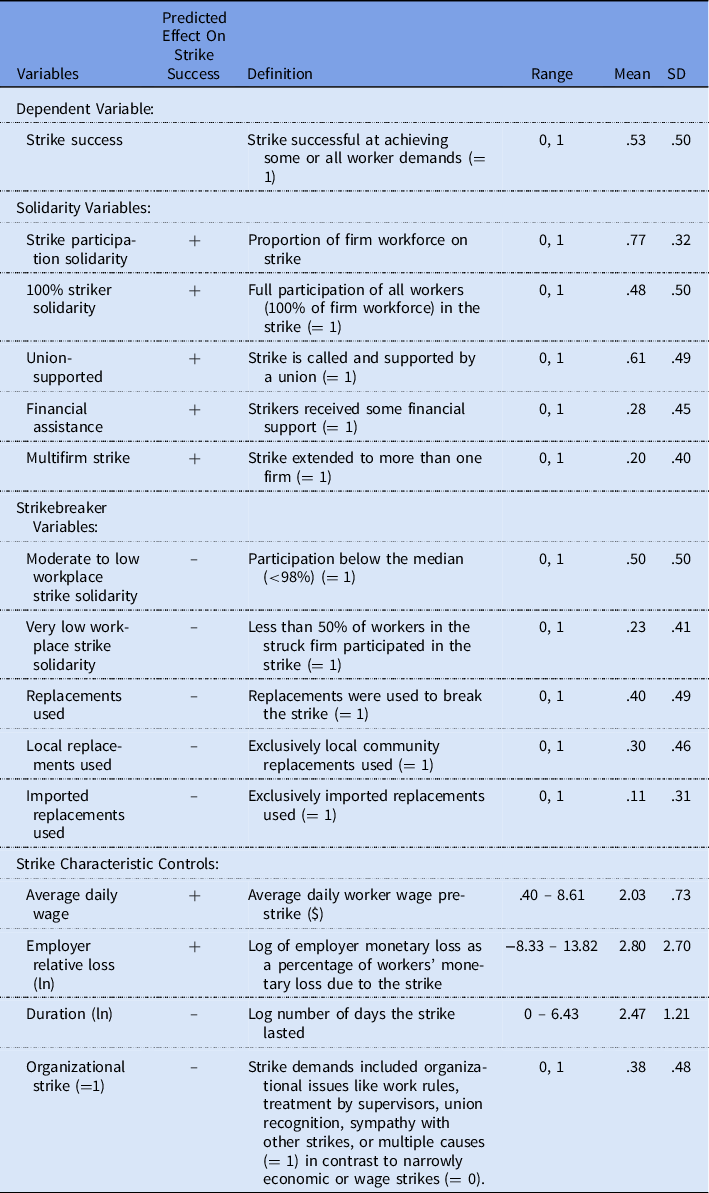
Notes: N = 4,560; all strike event data are from the US Commissioner of Labor (1888).
Model Specification and Estimation Strategy
The basic structure of the models estimated in the following text take strike success (= 1) as a function of (a) solidarity, (b) solidarity breakdown in the form of strikebreaking replacements (scabs), (c) other strike event characteristics, (d) year of strike event, and (e) industry using cluster-adjusted standard errors.
Our models require attention to two estimation issues. First, because logistic regression estimates are not strictly appropriate for comparison of coefficients across models or for interpreting interaction terms, we report both logistic regression coefficients and average marginal effect (AME) coefficients generated from linear probability models. AMEs are appropriate for such contrasts and provide unbiased and consistent estimates of the average effect of predictors on the probability of a binary outcome (Mize Reference Mize2019; Mood Reference Mood2010). We are led to the same substantive conclusions regardless of estimator, although the linear probability models have a more intuitive interpretation.Footnote 26 Second, because strikes often tend to cluster within particular industries, we cannot simply assume observations are independent. Significant clustering would bias standard errors and significance tests. Therefore, all models are estimated with industry cluster-adjusted standard errors.Footnote 27
Analysis and Findings
We address the evidence bearing on our hypotheses beginning with the expectation that the greater worker strike solidarity at the point of production (i.e., the struck firm), the greater the probability of strike success (H1A). Table 3 presents evidence indicating support for this expectation. Models 1 through 5 introduce our solidarity measures one at a time: workplace strike participation solidarity, organizational solidarity (union), financial support solidarity, and cross-firm solidarity. All solidarity indicators are significant and positively signed as expected, and all control variables behave as expected, thus supporting our solidarity hypotheses (H1A-H1D). The influence of organizational solidarity (union) is the most important of the direct solidarity measures increasing the average probability of success by about 14 percent (see model 6). Thus, the central assumption of labor studies and most social movement scholarship that solidarity is central to the potential success of collective contention is supported in these early labor movement strike actions.
Models of strike success with dimensions of solidarity
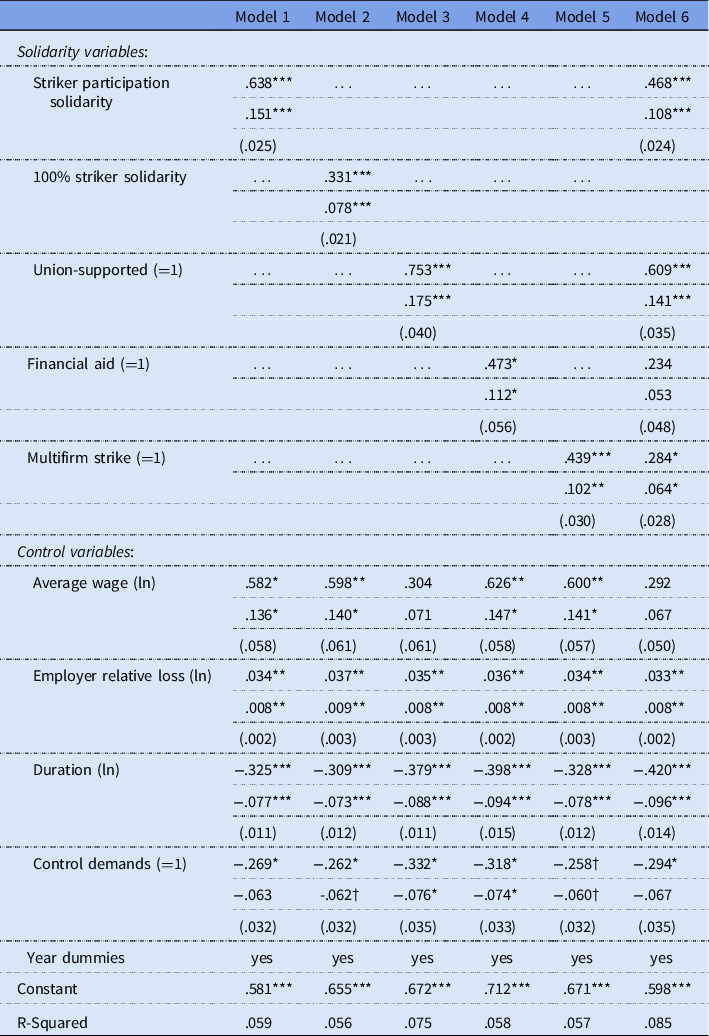
Notes: N = 4,528; first coefficient is the logit and the second is the average marginal effect estimated using linear probability model (LPM); both estimators use industry cluster-adjusted standard errors (LPM standard errors in parentheses); constant and R-squared are from the LPM.
*** p < .001; ** p < .01; * p < .05; † p < .10 (two-tailed tests).
Table 4 reports evidence of several forms of strikebreaking.Footnote 28 At the workplace level, nonparticipation in a strike would be understood by striking coworkers as a form of scabbing or at least a breach in solidarity. Model 1 indicates that strike participation below the median (i.e., < 98 percent) reduces the probability of success by about 8 percent, and model 2 shows that very low strike participation (<50 percent) also reduces the chances of success at a higher rate (by about 11 percent) as expected. Model 3 presents estimates for hired replacement workers. The impact of replacement strikebreakers is strongly negative and significant (reducing the probability of success by about 33 percent), and it generally does not matter for success whether replacements are recruited locally or imported.Footnote 29 It is worth noting, too, that the deployment of scabs has the largest impact of all variables in our models (see coefficients in models 3 and 4). Hypothesis 2 is supported indicating that irrespective of origin of strikebreaking labor power—local or imported from outside the communityFootnote 30 —scabs have a devastating impact on the material fortunes of strikers, reducing the probability of strike success by almost a third.
Models of strike success with dimensions of strikebreaking

Notes: N = 4,528; first coefficient is the logit and the second is the average marginal effect estimated using linear probability model (LPM); both estimators use industry cluster-adjusted standard errors (LPM standard errors in parentheses); constant and R-squared are from the LPM.
*** p < .001; ** p < .01; * p < .05 (two-tailed tests).
We also anticipated (H3) that solidarity breaches due to replacement workers would have stronger impact on strike success than any dimension of worker solidarity. Table 5 reports evidence bearing on this hypothesis. Here we find that when hired replacement strikebreakers are deployed, all dimensions of solidarity are weakened, although all are still statistically significant (compare model 5 coefficients to those in models 1–4). Strikebreaker presence is far more potent in influencing strike outcome than any single dimension of striker solidarity. In fact, the replacement worker effect is roughly equivalent to the sum of all solidarity measures on the probability of strike success.Footnote 31 These effects are shown graphically in figure 2.
Models of strike success comparing solidarity and strikebreaker impact

Notes: N = 4,527; first coefficient is the logit and the second is the average marginal effect estimated using linear probability model (LPM); both estimators use industry cluster-adjusted standard errors (LPM standard errors in parentheses); constant and R-squared are from the LPM.
*** p < .001; ** p < .01; * p < .05 (two-tailed tests).
Impact of worker solidarities and scabs on the probability of strike success.
Note: Estimates are linear probability model estimates from model 5 in table 5.

Our final hypothesis (H4) contrasts the impact of strikebreaking replacements on strike success for New York and Chicago. Because of a more repressive strike policing regime in New York during our analytic period, we expect that the use of scabs would be even more efficacious for employers there than in Chicago. Table 6 shows the results of interaction models for scabs alternating two different measures for strike participation solidarity: proportion of employees participating in the strike (model 1) and 100 percent striker participation (model 2). We note that the main (general) effect of scabs is still highly significant in reducing strike success in this two-city sample for both models. The interaction terms signal that scabs in New York do indeed have a negative impact on success (reducing the probability of success by about 35 percent) that is significantly greater than the parallel measure for Chicago (reducing the probability of success by about 21 percent). Therefore, while strikes were about equally likely to be scabbed in New York (39 percent) over our period as in Chicago (40 percent), when they were scabbed in Chicago the impact was less likely to lead to strike failure. Replacement scabs significantly reduced the chances of success, but the differential impact of scabs on outcomes was also significantly less in Chicago than New York, likely due to Chicago Mayor Harrison’s less repressive approach to policing strikes.
Strike success models with strike policing regime interactions: New York and Chicago

Notes: N = 1.460; first coefficient is the logit and the second is the average marginal effect estimated using linear probability model (LPM); both estimators use industry cluster-adjusted standard errors (LPM standard errors in parentheses); constant and R-squared are from the LPM.
*** p < .001; ** p < .01; * p < .05 (two-tailed tests).
Summary, Discussion, and Implications
Scholars and activists alike agree that solidarity is crucial to movement success. In fact, it is no exaggeration to say that high-risk social movement activism requires a significant degree of solidarity if movements are to have a chance to succeed in their struggles with powerful adversaries. Labor’s early collective contention with capitalists provides an excellent arena for an assessment of solidarity’s dimensions, impact, and limits in high-risk collective contention. Here we find strong support for four general hypotheses that speak to the question of solidarity’s impact, sources of breakdown as a result of capitalist countering with strikebreaking replacements from the local community and beyond, and the moderating impact of the local state regime in differential policing of strikes. Hypotheses and findings are summarized in table 7.
Hypotheses and summary of findings

We find that while strike solidarity at the point of production (at the firm level) is necessary, it is not sufficient for success. Strikebreaking replacement workers can significantly dilute workplace solidarity and reduce disruption costs that strikers impose on employers. The source—local or imported—of replacements does not matter for impact on strike outcomes; we find that both measures produce approximately the same success-dampening influence, although employers likely find imports more expensive, as well as more likely to spawn violence (e.g., see Rosenblum Reference Rosenblum1995). Scabs have a dramatic negative impact in reducing strike success, one that has the potential to basically negate the positive influence of shop floor solidarity. It is also likely that sites where replacements could most readily be deployed as strikebreakers are also the least likely to successfully build unions (Kimeldorf Reference Kimeldorf2013). Furthermore, our data also indicate that workers not only lost their jobs to permanent replacement strikebreakers, wage rates were affected as well. Scabbed strikes depress wages for workers (both original and replacements) on average in our data by about 19 percent, an enormous wage loss for many workers already operating at the margins of subsistence.
In addition, we find evidence, drawing on New York and Chicago experience, that local political regimes mattered in these collective contentions between capital and labor. In particular, the impact of replacements could be moderated if local political power controlled police repression, as in the case of Chicago; however, the impact of replacement strikebreakers could be maximized if the policing regime used unrestrained repressive approaches to strikes, as in New York; disproportionately strong support for employers by government authorities makes a difference (see also Dixon Reference Dixon2010). In short, the local state played a role in moderating the intensity of local class struggle as well as its material outcomes.
The key to undermining solidarity of collective contention at the point of attack is an old one; divide the class of potential contenders—here wage workers in strike action—to win the battle. Some employers were in a better position than others to make this labor substitution; conditions that limited this exchange freedom for employers made them more vulnerable to workers’ strikes (see Kimeldorf Reference Kimeldorf2013; Martin et al. Reference Martin, Dixon and Nau2017). The fact that such orchestrated contests of commodified labor centered quite literally on terms of physical survival for the working class made these events often ruthless and bloody contests for a substantial stretch of US history (Lipold and Isaac Reference Lipold and Isaac2009).
Intraclass struggle for solidarity is necessary for the execution of interclass struggle (as in the case of strike outcomes), but workplace solidarity requires extension into the local community and beyond the site of the strike. Our evidence suggests that the probability of strike success can be greatly increased if solidarity with striking workers is strongly entrenched in the local community and beyond to the social factory—or wider society. To that point, some scholars have recently argued that the contemporary US labor movement needs the solidary support of the wider community and allies in a way that it never did before (e.g., Clawson Reference Clawson2003; Rhomberg Reference Rhomberg2012a; Rose Reference Rose2000). We agree with the assessment of labor’s current need for broad allies, but we disagree that this is somehow a new feature of labor struggles. Our evidence suggests that it was also a significant condition of struggle for success during the first Gilded Age, at the dawn of the modern industrial labor movement.
How does the breach in solidarity associated with strikebreaking compare to other social movements? The role played by strikebreaking replacement workers, both in availability and efficacy, may be unique as a form of repression in social movement experience, at least in nonauthoritarian regimes. By repression, we mean, following Tilly (Reference Tilly1978: 100), “any action by another group which raises the contender’s cost of collective action.” Social movements routinely encounter repression in many different forms and there are certainly other movements that have faced fierce and violent repression from both state authorities and nonstate countermovement forces; the African American Freedom struggle is riddled with historical instances (e.g., Bloom Reference Bloom2020). But workers’ strikes operate in a unique structural space where their actions can be weakened if not totally undermined by a thoroughly legal labor substitution act. To be clear: insurgent workers are embedded in two layers of unequal power relations; first, they contend with employers in the wage relation, and second, that very wage relation (tilted toward cooperation with capital) is enforced by state legal apparatus and criminal law (White Reference White2008). Moreover, in the process of executing this labor substitution act as a countertactic against the strike, capital also creates division within the working class.
What does this long-ago evidence say about contemporary worker strikes and likelihood of success? Unfortunately, at root this evidence is still highly relevant for contemporary workers. While some employer strike-countering tactics have largely disappeared since the first Gilded Age—for example, the use of overt violence and bloodshed on a mass scale (e.g., Lipold and Isaac Reference Lipold and Isaac2009)—the use of permanent replacement workers to break strikes and to intimidate would-be strikers has not only remained legal but has been reinvigorated as part of US capital’s repertoire of contention over the last several decades (e.g., LeRoy Reference LeRoy1995; Logan Reference Logan2008; Rosenfeld Reference Rosenfeld2014; White Reference White2008). After a period (c. 1940s–1980s) of some capitalist restraint on the use of permanent replacements for strikebreaking under the New Deal Liberal/Labor coalition, a shift in the balance of power delivered through Republican administrations and conservative courts, capital has returned to strikebreaking as it did before World War II (Rhomberg Reference Rhomberg2012b). This is one of the reasons that the strike, as a form of collective contention, has declined dramatically, become less potent, and decoupled from wage increases (Rosenfeld Reference Rosenfeld2014), leaving the organized labor movement in a highly precarious condition. One of the more general consequences of the deep weakening of labor’s “only true weapon” is the rise of supereconomic inequality (Western and Rosenfeld Reference Western and Rosenfeld2011) not seen since the decades of the first long Gilded Age. This prevailing massive inequality is, therefore, due in no small part to the permissive legal environment for the use of permanent replacement workers. Workers at the lower range of the income distribution not only live on less, but also they are continually threatened by a social structure and political culture that works to undermine worker solidarity by pitting the working class against itself.
Acknowledgments
For comments, we thank participants in the American Sociological Association session on “Leverage and Disruption,” especially Michael Schwartz. The first author gratefully acknowledges research support from the Gertrude Conaway Vanderbilt Endowment, College of Arts & Science, Vanderbilt University. Direct all correspondence to larry.isaac@vanderbilt.edu. ORCID: Larry Isaac: 0000-0003-2961-7509.


 Open access

