


In this chapter, I illustrate the importance of ongoing engagement with conceptual analysis when conducting research. I focus on clientelism, a phenomenon in which politicians provide material benefits to citizens in direct exchange for political support. One of the thorniest issues in clientelism is conceptualization, with scholarly disagreement about questions such as what it is exactly, what different forms exist, and how it differs from other phenomena. At the outset, it should be emphasized that excellent studies by numerous others have advanced the conceptualization of clientelism;Footnote 1 such research is not examined here. Instead, I explore how my own published work on clientelism involves several conceptual typologies, which each consider different aspects of the concept. As discussed later, these typologies clarify four key points that address challenges that faced the clientelism literature: (1) campaign handouts can be used for both persuasion and mobilization; (2) campaign handouts can also shape the composition of the electorate; (3) a key distinction exists between electoral and relational clientelism; and (4) some scholarly usage of the term “vote buying” involves conceptual stretching.
Clientelism for Mobilization
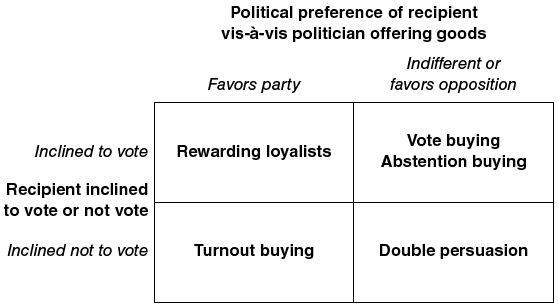
A first key challenge that faced the clientelism literature was its predominant focus on vote buying, which led studies to overlook the use of rewards for mobilization. Distinguishing whether rewards are used to influence vote choices or induce electoral participation is crucial not only for conceptual clarity but also to avoid analytic mistakes. Numerous prominent quantitative and formal studies of clientelism focus exclusively on vote buying,Footnote 2 unlike more recent research that investigates various distinct strategies. In Nichter (Reference Nichter2008), I emphasize that vote buying should not be confused with other forms of electoral clientelism, and examine how rewards can be distributed to mobilize rather than persuade citizens. To refine the concept, the article develops a conceptual typology of clientelist strategies during elections shown in Figure 8.1. As discussed in David Collier, Jody LaPorte, and Jason Seawright’s 2012 article, “Putting Typologies to Work: Concept Formation, Measurement, and Analytic Rigor,”Footnote 3 this typology has two dimensions: The row variable is whether the reward recipient is inclined to vote, and the column variable is whether the recipient favors the party offering the reward.
Strategies of clientelism during elections.

Figure 8.1 Long description
A two-by-two grid has an x-axis labeled “Political preference of recipient vis-à-vis politician offering goods”: the left column is “Favors party,” and the right column is “Indifferent or favors opposition.” The y-axis indicates the recipient’s inclination to vote: the top is “Inclined to vote,” and the bottom is “Inclined not to vote.” Within the four quadrants are labeled: top left “Rewarding loyalists,” top right “Vote buying/Abstention buying,” bottom left “Turnout buying,” and bottom right “Double persuasion.”
The clientelist strategies in each cell of Figure 8.1 target different types of individuals and induce distinct actions. The understudied strategy of turnout buying rewards unmobilized supporters for showing up at the polls. By contrast, vote buying rewards opposing (or indifferent) voters for switching their vote choices. Another clientelist strategy, abstention buying, rewards opposing (or indifferent) individuals for not voting.Footnote 4 Double persuasion distributes clientelist benefits to influence vote choices and induce electoral participation. Finally, rewarding loyalists delivers clientelist benefits to supporters who would turn out anyway. In addition to providing this typology, I conduct formal and quantitative analyses of turnout buying in Nichter (Reference Nichter2008). The article argues that Argentine survey data are more consistent with turnout buying than vote buying, though it explains that both strategies coexist.
The conceptual innovation in Figure 8.1, which increases analytic differentiation of clientelism, revealed an important avenue for further research. By refining the concept of clientelism and elaborating underlying dimensions, the typology laid the foundation for research on how the phenomenon might entail portfolios of distinct strategies. How and why might clientelist parties combine the strategies in Figure 8.1? To explore this question, I collaborated with Jordan Gans-Morse and Sebastian Mazzuca to operationalize the typology’s two dimensions – as political preferences and voting costs – and develop a formal model to analyze how parties adapt their portfolios of vote buying, turnout buying, abstention buying, and double persuasion to contextual factors (Gans-Morse, Mazzuca, and Nichter Reference Gans‐Morse, Mazzuca and Nichter2014). In addition to deriving formal predictions, we provide a graphical depiction of how many citizens are expected to be targeted with each clientelist strategy, as well as the effects of institutional factors. These axes correspond to the two dimensions of the typology discussed above. Among other findings, the article shows why introducing compulsory voting is expected to increase vote buying, and why enhanced ballot secrecy is expected to increase turnout buying and abstention buying. The typology, in other words, does quite a bit of work: It not only helps us disambiguate important concepts in the “semantic field” (Sartori Reference Sartori and Sartori1984), but it also helps to generate and structure causal predictions.
Clientelism for Shaping the Electorate
A second important challenge facing the clientelism literature was its nearly universal focus on how rewards shape the actions of the existing electorate. This depiction of the phenomenon was incomplete because it failed to capture how clientelism can also be used to shape the electorate. Indeed, my observations during empirical research suggested that the typology in Figure 8.1 required further conceptual analysis. As I conducted eighteen months of fieldwork and two surveys on clientelism in Brazil, I recognized another subtype of clientelism during elections that received scant attention in the academic literature – voter buying. Under this strategy, a politician distributes rewards to voters in other districts in exchange for transferring their electoral registration – and their vote – to the politician’s district. My collaborative work uncovered compelling qualitative evidence of this strategy, as well as survey evidence that voter buying was a common form of electoral clientelism in Northeast Brazil.Footnote 5 Voter buying does not correspond to any of the cells in Figure 8.1 because – as is common in the clientelism literature – the typology assumes that clientelist parties deliver rewards to the existing electorate (i.e., voters in a politician’s own district).
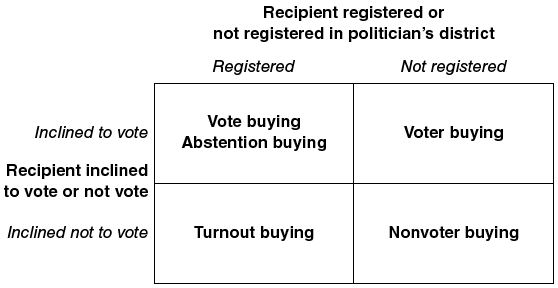
F. Daniel Hidalgo and I conducted further conceptual analysis to unpack this overlooked subtype (Hidalgo and Nichter Reference Hidalgo and Nichter2014). We contend that campaign handouts influence not only the electorate’s actions but also its composition. In order to clarify this point, we develop the conceptual typology in Figure 8.2, which introduces an important new dimension. Observe that the overarching concept (clientelist strategies during elections) and the row variable (whether the recipient is inclined to vote) are identical to Figure 8.1. However, the column variable is different: whether the recipient is registered in the politician’s district. The most common strategies discussed earlier continue to be shown in this revised typology.Footnote 6 More important, the new column variable exposes important variation in the overarching concept, thereby untangling voter buying from other forms of clientelism during elections.Footnote 7 Building on this conceptual analysis, we employ a regression discontinuity design and find that voter buying has significant effects on mayoral reelection as well as on voter registration in some Brazilian municipalities.
Strategies of clientelism during elections (with voter buying).
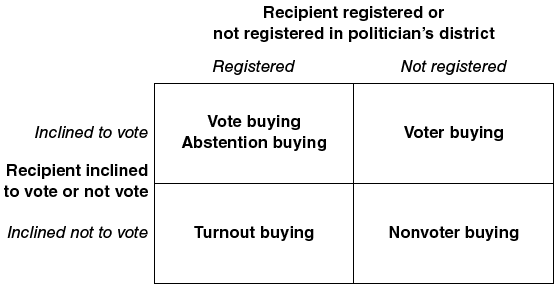
Figure 8.2 Long description
The two-by two grid x-axis categorizes voters’ registration status: “Registered” on the left and “Not registered” on the right. The y-axis distinguishes between “Inclined to vote” at the top and “Inclined not to vote” at the bottom. Within the four quadrants are labeled” top-left: “Vote buying” and “Abstention buying,” top-right: “Voter buying,” bottom-left: “Turnout buying” and bottom-right: “Nonvoter buying”
Electoral versus Relational Clientelism
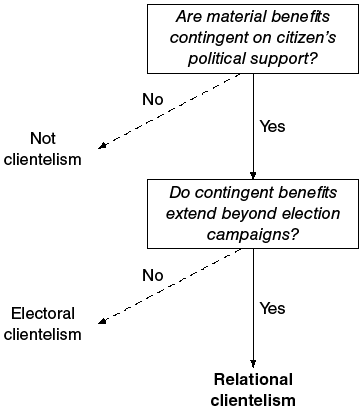
A third key challenge facing the literature was that it largely focused on clientelism during electoral campaigns. Unlike traditional work on the topic, many formal and quantitative studies ignore how clientelism often involves ongoing relationships between politicians and citizens. As with voter buying, my fieldwork made it clear that many contingent exchanges extend beyond elections, thereby suggesting yet another aspect of clientelism requiring further conceptual refinement. My 2018 book develops the conceptual typology in Figure 8.3 to sharpen the distinction between electoral clientelism and what I termed “relational clientelism” (Nichter Reference Nichter2018). The upper box describes the key defining attribute of the overarching concept of clientelism: Material benefits are provided contingent on a citizen’s political support. That is, recipients promise that they will provide (or have provided) political support in exchange for goods or services. If such contingency is not present, then the provision of benefits involves not clientelism but instead another modality of distribution (such as programmatic politics or constituency service) that one might view as politics as usual. The lower box presents a second defining attribute, which differentiates between electoral and relational clientelism. This attribute pertains to the timing of benefits – more specifically, whether contingent benefits extend beyond election campaigns. Whereas benefits are provided exclusively during campaigns with electoral clientelism, they extend beyond campaigns with relational clientelism.
Strategies of clientelism (electoral versus relational clientelism).
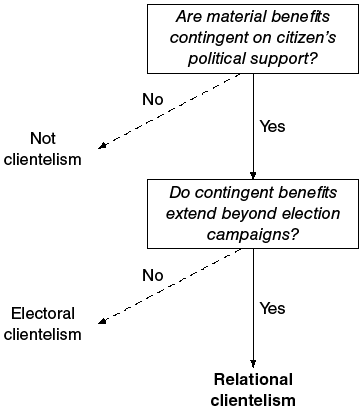
Figure 8.3 Long description
A flowchart begins with the question, “ Are material benefits contingent on citizen’s political support?”. If “No,” the outcome is “Not clientelism.” If “Yes,” it poses the question, “ Do contingent benefits extend beyond election campaigns?”. A “No” leads to “Electoral clientelism,” while a “Yes” leads to “Relational clientelism”.
The conceptual typology in Figure 8.3 proved to be foundational for quantitative and qualitative research in my 2018 book. One key reason is that by disaggregating clientelism according to the timing of benefits, the typology draws attention to the fact that the subtypes entail distinct credibility problems. With both forms of clientelism, politicians assess if a voter’s promises to provide political support are trustworthy. But unlike electoral clientelism, relational clientelism involves a dual credibility problem. Because relational clientelism involves promises of benefits beyond campaigns (i.e., after voting), citizens also assess the trustworthiness of politicians’ promises. By contrast, electoral clientelism provides all benefits during campaigns before voting, so citizens do not face the threat of opportunistic defection. Building on this conceptual insight – which emerged in the development of the typology in Figure 8.3 – I explore how and why citizens often help to alleviate this dual credibility problem, and thus play a crucial yet underappreciated role in sustaining relational clientelism. Many citizens across the world face inadequate social safety nets and are vulnerable to adverse shocks, and are thereby motivated to fortify long-term clientelist relationships as a risk-coping mechanism. Evidence suggests that citizens often use two key mechanisms to help sustain relational clientelism: they declare support to signal their own credibility, and they request benefits to screen politician credibility.
The typology in Figure 8.3 also suggests a fruitful direction for improving measurement and explanatory efforts in the field of clientelism. As with my prior work discussed earlier, the contemporary literature focuses predominantly on strategies of electoral clientelism, such as vote buying, turnout buying, abstention buying and voter buying. Yet it is possible that much of what researchers interpret to be electoral clientelism is actually relational clientelism. Researchers often measure electoral clientelism by asking survey respondents whether they received a handout during a given campaign period. But observe that in Figure 8.3 the second attribute about the timing of benefits does not imply that relational clientelism suspends benefits during electoral campaigns. As such, simply identifying the provision of a campaign handout is insufficient to determine whether the exchange constitutes electoral or relational clientelism. Instead, researchers must determine whether the provision of contingent benefits to the citizen also extends beyond campaigns. This issue is important not only for measurement but also for evaluating explanatory claims: If studies overlook the distinction between electoral and relational clientelism, serious analytical mistakes can arise. The broader point is that refining the concept of clientelism can offer both measurement and explanatory contributions.
“Vote Buying” and Conceptual Stretching
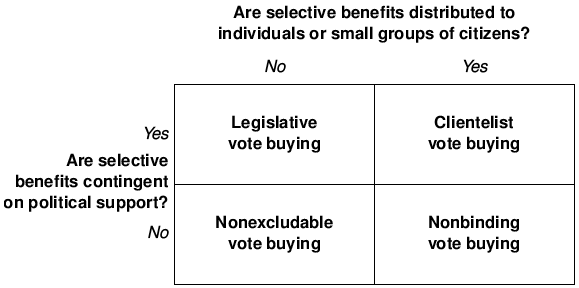
A fourth key challenge is that many studies use the term “vote buying” when referring to a broad range of phenomena, many of which do not involve clientelism at all. This practice contributes to substantial conceptual ambiguity with regard to scholarly usage of the term “vote buying.” My 2014 article (Nichter Reference Nichter2014) presents the typology in Figure 8.4 and, as discussed later, argues that some scholarly usage involves conceptual stretching (Sartori Reference Sartori1970). The conceptual typology has two dimensions referring to how researchers use the term “vote buying”: The row variable is whether selective benefits are contingent on political support, and the column variable is whether selective benefits are delivered to individual or small groups of citizens.
Common usage of “vote buying” in academic studies.
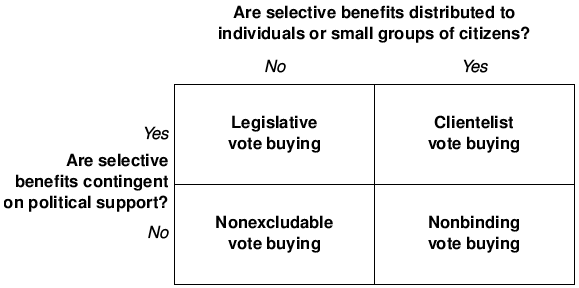
Figure 8.4 Long description
The x-axis of the 2x2 grid graph has the question “Are selective benefits distributed to individuals or small groups of citizens?”, having “No” on the left and “Yes” on the right. The y-axis presents the question “ “Are selective benefits contingent on political support?” with “Yes” at the top and “No” at the bottom”. The boxes in the graph contain “Legislative vote buying” on the top left, “Clientelist vote buying” on the top right, “Non-excludable vote buying” on the bottom left, and “Non-binding vote buying” on the bottom right.
As shown in the cells, academic usage of “vote buying” can be categorized into four subtypes: clientelist, legislative, nonexcludable, and nonbinding. Clientelist vote buying refers to the phenomenon described earlier (see discussion of Figure 8.1). A second common subtype is legislative vote buying, which similarly involves contingent benefits but provides benefits to legislators instead of citizens. Many studies investigate how vote buyers such as interest groups or politicians provide selective benefits to legislators who agree to vote for a specific bill. Such studies typically deem the exchanges to be quid pro quo: Legislators agree to support a bill in exchange for including specific benefits before voting. A third common subtype is nonexcludable vote buying, which provides local public goods to political districts in an effort to generate political support. Unlike the first two subtypes, these studies typically do not describe citizens or elites as providing political support in contingent exchange for benefits. Local public goods are nonexcludable within districts; all residents can access them even if they refuse political support. Thus, vote buying with local public goods does not involve contingency. A fourth subtype is nonbinding vote buying, which delivers benefits to individual or small groups of citizens without conditioning receipt on promises of political support. Such studies typically depict politicians as providing benefits – with or without partisan bias – in order to foster goodwill that can heighten future electoral support. While both clientelist and nonbinding vote buying target individual or small groups of citizens, only the former subtype involves quid pro quo exchanges of benefits for political support.
Building on this typology, I contend in Nichter (Reference Nichter2014) that some scholarly usage of the term “vote buying” is inappropriate. Because contingent exchange is a fundamental component of any “root definition” of vote buying, the bottom two subtypes in Figure 8.4 – nonexcludable and nonbinding vote buying – involve conceptual stretching.Footnote 8 As discussed earlier, nonexcludable vote buying lacks contingency because residents in recipient districts cannot be prevented from accessing local public goods, and nonbinding vote buying lacks contingency because it does not require recipients to promise political support in exchange for benefits. Ideally, researchers should not use the term “vote buying” when referring to either of these phenomena. Alternatively, they should be explicitly identified as “diminished subtypes” (Collier Reference Collier and Smith1995; Collier and Levitsky Reference Collier and Levitsky1997), in which the adjectives “nonexcludable” and “nonbinding” convey that an attribute of the root concept (i.e., contingency) is missing.
Discussion
Stepping back, this discussion of clientelism demonstrates that continued engagement with conceptual analysis can yield important insights and analytic leverage. Taken together, the typologies presented herein refine the overarching concept of clientelism by revealing underlying dimensions, explicating subtypes, and reducing conceptual ambiguity. Among other insights, they heighten analytical differentiation by revealing how distinct strategies of electoral clientelism can be used to persuade, mobilize, and even shape the electorate. Also of fundamental importance, the typologies distinguish between electoral clientelism (in which benefits are limited to campaigns) and relational clientelism (in which benefits extend beyond campaigns). Moreover, refined conceptualization identifies how researchers can avoid potential conceptual stretching when using the term “vote buying.” These typologies not only improve conceptual clarity but also prove to be foundational for further formal and empirical research on the topic.

 Open access