


INTRODUCTION
The number of zoonotic Bartonella spp. identified in the last 15 years has increased considerably, since the first HIV-infected patient with unusual vascular proliferative lesions of bacillary angiomatosis (BA) was described in 1983 [Reference Stoler1]. Of the 21 species of Bartonella currently described, 10 are acknowledged as human pathogen species. B. bacilliformis, B. quintana, and B. henselae are the most frequently described species [Reference Anderson and Neuman2–Reference Comer, Paddock and Childs4], while B. elizabethae, B. vinsonii, B. washoensis, B. grahamii, B. clarridgeiae, B. koehlerae and B. alsatica were recently identified as being responsible for some cases of human infection [Reference Johnson5–Reference Raoult10]. Cat scratch disease (CSD), BA, hepatic peliosis and some cases of bacteraemia, endocarditis, osteomyelitis, uveitis and neurological disorders are directly caused by some species of the genus Bartonella [Reference Chomel11–Reference Raoult13]. To determine the real incidence of Bartonella infection, it is necessary to study the seroprevalence in the general population as well as the principal reservoirs and vectors involved in infection transmission. In the present study, we serologically tested 218 samples across Catalonia for evidence of Bartonella spp. antibodies and analysed possible corresponding risk factors for infection.
MATERIAL AND METHODS
Geographical area
The study was undertaken in Vallès Occidental, Catalonia, a predominantly urban area near the coast in the northeast of Spain. A total of 11 municipalities (356 266 inhabitants) participated in the study.
Samples
Serum samples from 218 patients who had attended Sabadell Hospital were collected for the survey. The collection of samples took place during a 5-month period, from September to January. The samples include adults undergoing minor surgery and children cared for non-infectious diseases in the Paediatrics Emergency Service.
Taking into account a previous analysis of the actual population of Vallès Occidental regarding sex, age and residential area, subjects were selected in order to obtain a representative sample. Thus, the study population was stratified by sex, by age (0–14 years, 15–29 years, 30–44 years, 45–64 years, ⩾65 years) and by residential area: rural (<5000 inhabitants), semi-rural (5000–50 000), and urban (>50 000).
Informed consent was obtained from all adult participants and from parents or legal guardians of minors. Each patient completed a questionnaire in which the following variables were registered: age, gender, place of residence, contact with pets, stray dogs, and occupation. Those inhabitants unable to answer the epidemiological survey were excluded.
The sample of heparinized blood was sedimented and the supernatant was collected and stored at −80°C. A serological survey was carried out according to the ethical guidelines of the ethics committee of Sabadell Hospital.
Serological technique
Human serum samples were evaluated by indirect immunofluorescence assay (IFA). We used commercial slides (Bartonella IFA IgG; Focus Technologies Inc., Herndon, VA, USA) to determine antibodies to Bartonella spp. The kit for detecting IgG antibodies utilizing Vero cells infected with either B. henselae or B. quintana was used according to the manufacturer's instructions. The serum samples were initially diluted 1/64. Any serum samples found to be positive at the initial dilution were further titrated. Positive and negative controls were included in each test. We considered specimens showing no fluorescence at IgG titres of 1/64 as negative and specimens with bright fluorescence at a dilution of ⩾1/64 as positive. The intensity of each specific fluorescence test was subjectively evaluated and independently graded by two of the authors [Reference Zbinden14].
Statistical analysis
Statistical analysis was performed using SPSS software version 14.0 (SPSS Inc., Chicago, IL, USA) Seroprevalence was determined globally and by residential area. A univariate analysis was performed to determine possible risk factors. Univariate group comparisons were performed using χ2 and Fisher's exact test. Group differences were determined by odds ratio and 95% confidence intervals. Quantitative variables were compared by Mann–Whitney U test. A P value of <0·05 was considered significant.
RESULTS
Of the 218 subjects, 119 were male and 99 female. The mean age was 34·36 years (0–91 years). Subjects were reported from 11 towns, and 145 (66·51%), 59 (27·2%), and 14 (6·5%) subjects lived in urban, semi-rural, and rural areas, respectively; 35 (16%) reported contact with pets, and four (1·9%) with stray dogs. In the group of 161 adults (⩾18 years), there were 11 (6·8%) students, 27 (16·8%) retired, 37 (23%) housewives, 53 (32·9%) workers, and 26 (16·1%) unemployed. For seven people the occupation was unknown.
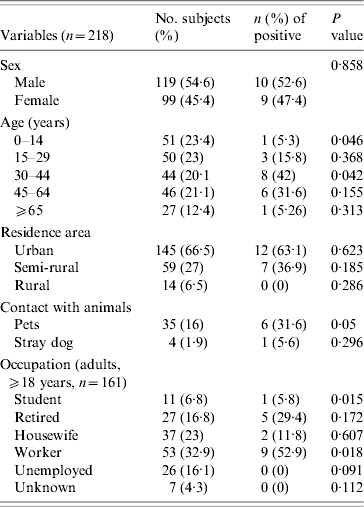
Considering titres of ⩾1:64 as positive, the seroprevalence of B. henselae in humans was 8·7%, considering samples with antibodies against B. henselae only or with B. henselae titres twofold higher to B. quintana titres. No sample had antibodies against B. quintana only. The relationship between the B. henselae antibody prevalence and the surveyed items is shown in Table.
Table Demographic information from subjects tested for antibodies to B. henselae
Nineteen samples had antibodies against B. henselae. Ten of them had an IgG titre of 1:64, four a titre of 1:128, four a titre of 1:256 and one a titre of 1:512.
No difference in seroposivity was observed between males and females. The B. henselae seroprevalence was 8·3% in urban areas, 11·9% in semi-rural areas and 0% in rural areas. The mean age (±s.d.) of seropositive subjects was 42·83±17·04 years, whereas the mean age of seronegative subjects was 33·59±23·56 years (P=0·053). Seropositivity was significantly more prevalent in subjects aged 30–44 years (P=0·042). On the other hand, subjects aged 0–14 years showed a lower seropositive rate (P=0·046). Of seropositive patients, six (31·6%) had contact with pets (P=0·05) and one (5·6%) with stray dogs (non-significant). Concerning occupation, students presented lower seroprevalence (5·8%, P=0·015) and workers had a higher seropositive rate (52·9%, P=0·018).
DISCUSSION
B. henselae, now regarded as the primary, and perhaps sole, causative agent of CSD, is also a cause of BA and hepatic peliosis, and has been associated with endocarditis, fever, and bacteraemia in adults and children [Reference Piemont and Bermon15, Reference Chomel16]. Isolation of Bartonella is typically time-consuming, often requiring 2–6 weeks or longer incubation for primary isolation. The resulting isolation must then be identified by PCR. In general, isolation or detection of B. henselae from blood is not successful for CDS patients who have no evidence of systemic disease. Conversely, isolation of Bartonella spp. from blood of immunocompromised patients, or patients with evidence of systematic disease is usually possible. PCR offers a rapid and specific means to detect the organism directly from clinical samples and is more sensitive than isolation [Reference Fournier, Mainardi and Raoult17]. In humans, serological testing is the reference test for diagnosis of CDS and other infections by Bartonella [Reference Sander18]. An IgG anti-B. henselae antibody titre of ⩾1:64 is considered as positive for infection.
Nineteen people (8·71%) had antibodies against B. henselae. This seroprevalence is slightly lower than those reported by other investigators: 30% by Sander et al. [Reference Sander18] in Germany, 19·8% by Alexiou-Daniel et al. [Reference Alexiou-Daniel19] in Greece, and 24·7% by Garcia-Garcia et al. [Reference Garcia-Garcia20] in Sevilla, Spain. However, similar or lower seroprevalence have been found in healthy populations from Sweden (3·2%) or La Rioja, Spain (5·88%) [Reference McGill21, Reference Blanco22]. We are able to assume that this seropositivity may indicate a past infection with Bartonella spp. However, we could not exclude unspecified serological cross-reactivity with other heterologous antigens. It is well known that Bartonella can cross-react with other genera, such as Coxiella burnetti or Chlamydia [Reference La Scola and Raoult23, Reference Maurin, Etienne and Raoult24]. Therefore, we compared these data with those obtained in a previous study (M. Vila et al., unpublished data). All 218 individuals included in this study were examinated by an IFA test for Chlamydia [Chlamydophila pneumoniae IFA IgG (Vircell, S.L., Santa Fé, Granada, Spain), cut-off 1/64]. Eight (3·66%) serum samples had antibodies against B. henselae exclusively; three serum samples reacted against C. pneumoniae and Bartonella at the same titre levels; six sera showed higher titres against B. henselae (1/128 vs. 1/32, 1/512 vs. 1/32 and 1/256 vs. 1/32); and in two other samples titres against Chlamydia were higher (1/256 vs. 1/64 and 1/128 vs. 1/64). These last two sera should not be considered positive for B. henselae. These results indicate B. henselae may be present in Catalonia and its seroprevalence might range from 6·42% to 7·9%.
The only statistically significant association observed was that between B. henselae seropositivity and age. B. henselae seropositivity was significantly more prevalent in subjects aged 30–44 years. This observation agrees with a study carried out in Greece, which also showed higher B. henselae seropositive rates in children aged <14 years (non-significant). Moreover, those children had greater titres [Reference Alexiou-Daniel19]. Taking into account that the cat is the main Bartonella reservoir, most seropositive subjects had contact with pets. Highest titres in children could be due to greater contact with pets. Seropositives rates differ from one study to another due to the different epidemiological and climatic environments. Therefore, we carried out a seroprevalence study of B. henselae in cats from the same region and over the same period of time [Reference Pons25]. Seroprevalence of B. henselae in cats was 26% and there were 7% of cats with bacteraemia. If cats aged <1 year were considered, incidence of bacteraemia rises to 12·1%.
As shown in Sander et al. [Reference Sander18], most titres were not high. Thus, it seems that subjects did not have recent infection. In our study 1·37% of the healthy population examined had IgG antibodies to B. henselae at a titre 1:128, and 0·91% had IgG antibodies at a titre of 1:256 and 0·45% had IgG antibodies at a titre of 1:512.
Because bartonelloses are a newly recognized class of infection in Spain, it is important to identify certain potential risk factors. It is reasonable to assume that as reliable, validated, and safe methods for serological diagnosis of Bartonella infections become a routine procedure in many clinical laboratories, the spectrum of Bartonella-associated diseases will continue to expand. The present study therefore provides an epidemiological and serological framework for future Bartonella studies.
ACKNOWLEDGEMENTS
This work was supported by a FIS-0/0598 grant from ‘Fondo de Investigaciones Sanitarias’ (Health Research Fund), Madrid, Spain, and supported in part by Ministerio de Sanidad y Consumo, Instituto de Salud Carlos III – FEDER, Spanish Network for the Research in Infectious Diseases (REIPI RD06/0008). We thank Jordi Real and Eva Penelo for their advice on biostatistics.
DECLARATION OF INTEREST
None.



