




Recent studies of China’s law-making process demonstrate that the National People’s Congress (NPC) serves as a critical site for elite bargaining and contestation over policy.Footnote 1 While these works offer important insights, they primarily focus on intra-legislature activities and, at best, only touch on the preceding executive phase indirectly. Lawmaking in China is a “multi-stage, multi-arena” process.Footnote 2 A government bill is typically drafted and approved by the executive before being presented to the legislature for deliberation and passage.Footnote 3 One cannot develop a fuller picture of the dynamics of lawmaking and legislative–executive relations without examining this early, crucial phase. This article aims to fill that gap by analysing and comparing bill changes across executive and legislative phases.
This article utilizes a unique dataset to trace bill evolution from the executive room to the legislative floor. Using a combination of statistical and content analyses of 45 executive-sponsored bills enacted between 2008 and 2023, it reveals an intriguing pattern of reversion, where changes adopted during the executive phase are later overturned in the legislature. This finding provides strong evidence that China’s national legislature functions as an important arena for policy negotiations. Additionally, the article maps the variety of disputes that often remain obscure due to the regime’s opaque decision making. This article finds that reversions occur most frequently in health, safety and environment bills, typically concerning topics such as scope of application, regulatory frameworks and legal liability. Qualitative case studies illustrate the specific monitoring and negotiation mechanisms underpinning reversions.
Bridging the Gap: Linking Executive and Legislative Phases of Lawmaking
Authoritarian legislative studies have increasingly moved from broader outcomes, such as regime durability and economic performance, to micro-level processes.Footnote 4 Recent scholarship characterizes authoritarian legislatures as dynamic policy-making arenas, documenting bill and proposal submissions, deliberations and amendments, and gridlock.Footnote 5 Despite advances in the study of intra-legislature activities, a critical antecedent remains underexplored: the pre-legislative executive phase and, crucially, its linkage to the subsequent legislative phase.Footnote 6 Lawmaking in China typically unfolds in a basic two-stage sequence, whereby bills are developed and approved in the pre-legislative executive phase before being presented to the legislature for deliberation and passage.Footnote 7 Understanding this preceding phase is essential for tracing the bill’s evolution and establishing the baseline against which the processes and outcomes of the legislative phase can be meaningfully assessed.Footnote 8
This article bridges that gap by adopting a corpus-based method and using an original collection of bill texts to analyse and compare policy changes across the two phases. Recent years have seen the increasing application of text-as-data methods to study legislative processes. Scholars have employed innovative similarity metrics to trace the evolution of policy ideas, track legal modifications and examine parliamentary amendments to bills.Footnote 9 This article draws on this literature to assess the textual changes made by the executive and the legislature to 45 executive-initiated bills in China from 2008 to 2023. Further, it combines fine-grained content analysis and case studies to explore bill change patterns, classify topical themes and probe underlying mechanisms, ultimately advancing our empirical understanding of executive-legislative dynamics in lawmaking.
Background: China’s Two-phase Law-making Process
In China, executive-initiated bills first undergo drafting, revision and approval within the State Council (pre-legislative, executive phase). Only then do they advance to the legislative phase for deliberation and passage by the NPC and/or its Standing Committee.Footnote 10
The executive phase comprises three core stages: drafting, inter-agency review and leadership approval.Footnote 11 Following initial drafting by the designated ministries, bills enter an intensive bureaucratic review stage dominated by the relevant State Council bodies (line ministries and agencies).Footnote 12 This stage involves a lengthy process of opinion solicitation, interdepartmental negotiation and consensus building. Following multiple rounds of revision and further review by the Ministry of Justice, the phase concludes with formal approval at the State Council Executive Meeting.Footnote 13 Since 2008, in response to both the NPC’s transparency initiative and its internal procedural requirements, the State Council has increasingly released bill drafts for public comment.Footnote 14 This public consultation, if conducted, typically follows the completion of internal reviews.Footnote 15 However, while post-consultation revisions are considered to reflect societal input, several factors suggest a more complex dynamic. First, the quality of internal reviews may vary across bills, sometimes failing to adequately solicit or incorporate diverse bureaucratic perspectives.Footnote 16 Stakeholders who feel ignored or cut out of internal discussions may use public consultations as a platform to (re)assert their position and influence bill content.Footnote 17 Second, internal review and public consultation may overlap or run in parallel, making it difficult to distinguish the input of regime actors from that of societal stakeholders.Footnote 18
The legislative NPC phase begins with bill introduction by the leading drafting unit, followed by group deliberations, public consultations and revisions, culminating in voting and passage. A bill typically undergoes three deliberations by the NPC Standing Committee (NPCSC), with participation from the relevant State Council departments and NPC special committees. Since 2008, almost all pending bills have been made available online for public comment following their initial deliberation.Footnote 19 In addition, the NPC working committee collects feedback from all relevant parties through field investigations, seminars and forums.Footnote 20 The bill evolves through these stages, incorporating deliberation opinions and broadly solicited feedback. Once revisions are finalized, a voting draft is submitted for floor voting and passage, bringing the legislative phase to its conclusion.Footnote 21 Characterized by its public and consultative nature, the changes made to the bill during this phase are shaped by the NPCSC alongside a wide range of government and societal stakeholders.
Data, Methods and Results
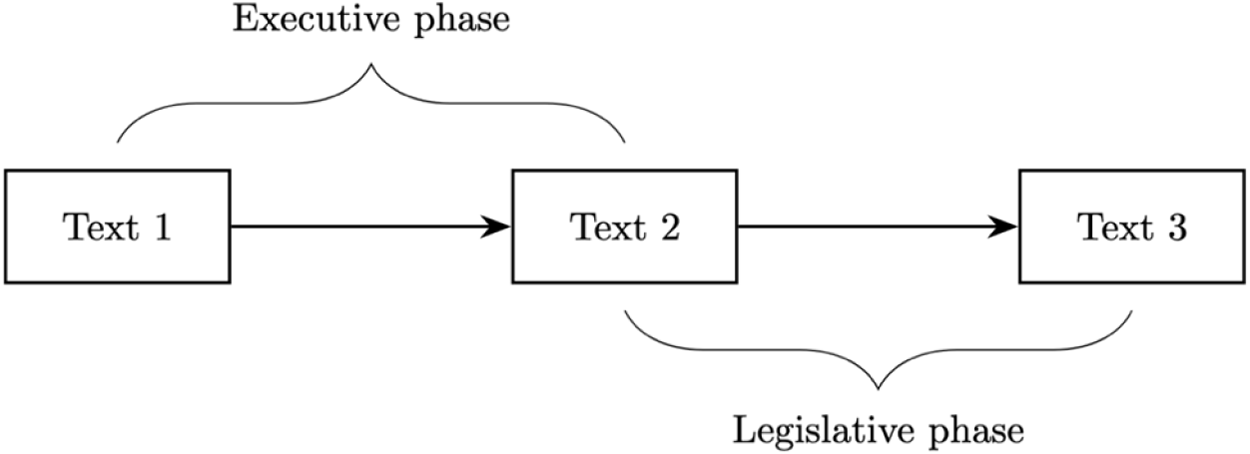
Because public consultations are conducted in both phases, three versions of a bill are available: the draft released by the State Council (executive-phase draft, Text 1), the draft released by the NPCSC following its first deliberation (legislative-phase draft, Text 2), and the final adopted version (final law, Text 3). Figure 1 offers a simple illustration. During the 11th, 12th and 13th terms (2008–2023), 92 independent executive bills were enacted.Footnote 22 Of these, 81 had their legislative-phase drafts published (88 per cent), while 45 had their executive-phase drafts released (49 per cent). This discrepancy is attributable to differences in legal requirements. In 2008, the NPCSC Chairpersons’ Council implemented a requirement for bill drafts to be published after the NPCSC’s initial deliberation,Footnote 23 whereas the executive phase operates under a much weaker mandate,Footnote 24 resulting in fewer State Council drafts being published. Nevertheless, I used this partial transparency to construct a dataset of all bills where both Text 1 and Text 2 are available, ultimately including 45 bill cases for analysis.
Bill Text Evolution Across the Two-phase Process

Figure 1 Long description
The flowchart consists of three boxes connected by arrows. The first box labeled 'Text 1' is part of the 'Executive phase'. An arrow points from 'Text 1' to the second box labeled 'Text 2'. Another arrow connects 'Text 2' to the third box labeled 'Text 3', which is part of the 'Legislative phase'.
The limited availability of executive-phase drafts, owing to the State Council’s selective disclosure, introduces potential selection bias. To address this, I conducted a balance check (Table 1), comparing key variables between bills with and without public consultation in the executive phase.Footnote 25 The results reveal notable differences: bills that underwent executive-phase public consultation (sample) had fewer co-sponsored, foreign/security, low-priority and 11th-term bills than those that did not. It should be noted that the findings are based on this specific sample and may not be generalizable to bills with these characteristics.
Bills With Versus Without Public Consultation in the Executive Phase

Table 1 Long description
The table compares characteristics of bills that did versus did not have public consultation during the executive phase (45 vs 47 bills), reporting counts/percentages or means with standard deviations and p-values for group differences. Consultation is associated with a higher share of Class I bills (mean 0.76 vs 0.40; p=0.001) and a lower co-sponsor measure (0.04 vs 0.26; p=0.005). Legislation type does not differ significantly (p=0.318): with consultation, 48.9% are laws, 26.7% revisions, and 24.4% amendments; without consultation, 36.2% laws, 25.5% revisions, and 38.3% amendments. Logged law word length is similar between groups (8.71 vs 8.58; p=0.426). Legislative term differs strongly (p<0.001): with consultation, 4.4% are 11th term, 46.7% 12th, 48.9% 13th; without consultation, 57.4% are 11th, 14.9% 12th, 27.7% 13th. Policy domain differences are not statistically significant overall (p=0.068), though foreign affairs/security is more common without consultation (34.0% vs 8.9%). P-values indicate statistical significance of differences but do not establish causation.
Notes: Co-sponsor indicates a bill jointly proposed by the executive and another state organ; Class I indicates a bill that ranks as a priority in the NPCSC’s legislative plan from its first inclusion. Values are mean (SD) or n (per cent). The p-test values indicate the statistical significance of differences between the two groups.
To assess bill textual changes across phases, I employed a similarity algorithm to compare sequential bill versions.Footnote 26 Each bill is divided into articles, and cosine similarity scores are calculated to match articles between consecutive versions. This process generates a dataset that systematically tracks article-level changes throughout the two-phase process. (See the online Appendix for detailed methods.)
A manual inspection of a random sample from this dataset revealed a previously undocumented pattern: reversion. It occurs when changes adopted and approved in the executive phase are later overridden in the legislature. This discovery carries significant implications, as reversion has the potential to systematically 1) map key points of policy division throughout the legislative process,Footnote 27 and 2) substantiate the NPC’s role as an important arena for policy negotiations. To enable systematic empirical analysis, I operationalized reversion as occurring when a substantive change made to an article from Text 1 to Text 2 (executive phase) is later undone from Text 2 to Text 3 (legislative phase), returning the affected content to its original status.Footnote 28 Applying this operational definition to the full sample, I identified and validated 158 confirmed instances of reversion. (See the online Appendix for validation details.)
Out of the 45 bill cases analysed, 40 exhibited instances of reversion. Table 2 highlights the ten bills with highest number of reversions. These bills predominantly concern high-salience domains, such as health, safety and environmental regulation, where debates persist throughout the legislative processes. Prior qualitative research corroborates these findings, revealing the contested nature of these policy spaces, primarily due to fragmented governance structures and greater public attention.Footnote 29 In contrast, tax-related legislation showed minimal to no reversion. This suggests that potential disputes over tax affairs are typically resolved before a bill reaches the legislature, either because of a prevailing policy consensus or because the executive branch serves as the decisive arena for settling such disputes.
Top Ten Bills with Most Reversions

Table 2 Long description
The table lists ten laws and the number of recorded reversions for each. Food Safety Law (2015 Revision) ranks first with 22 reversions, far ahead of the second-ranked Water Pollution Prevention and Control Law (2017 Amendment) with 10. Three laws tie for third at 9 reversions: Work Safety Law (2014 Amendment), Atmospheric Pollution Prevention and Control Law (2015 Revision), and Vaccine Administration Law (2019). Four laws each have 6 reversions: Mental Health Law (2012), Medicinal Product Administration Law (2019 Revision), Agricultural Product Quality and Safety Law (2022 Revision), and Traditional Chinese Medicine Law (2017). Anti-domestic Violence Law (2015) has the fewest among the top ten with 5. Overall, counts drop sharply after the top entry, with most laws clustered between 5 and 9 reversions. The figures reflect a count of reversions and do not indicate the reasons for reversions or the relative importance of each law.
Source: Author’s count.
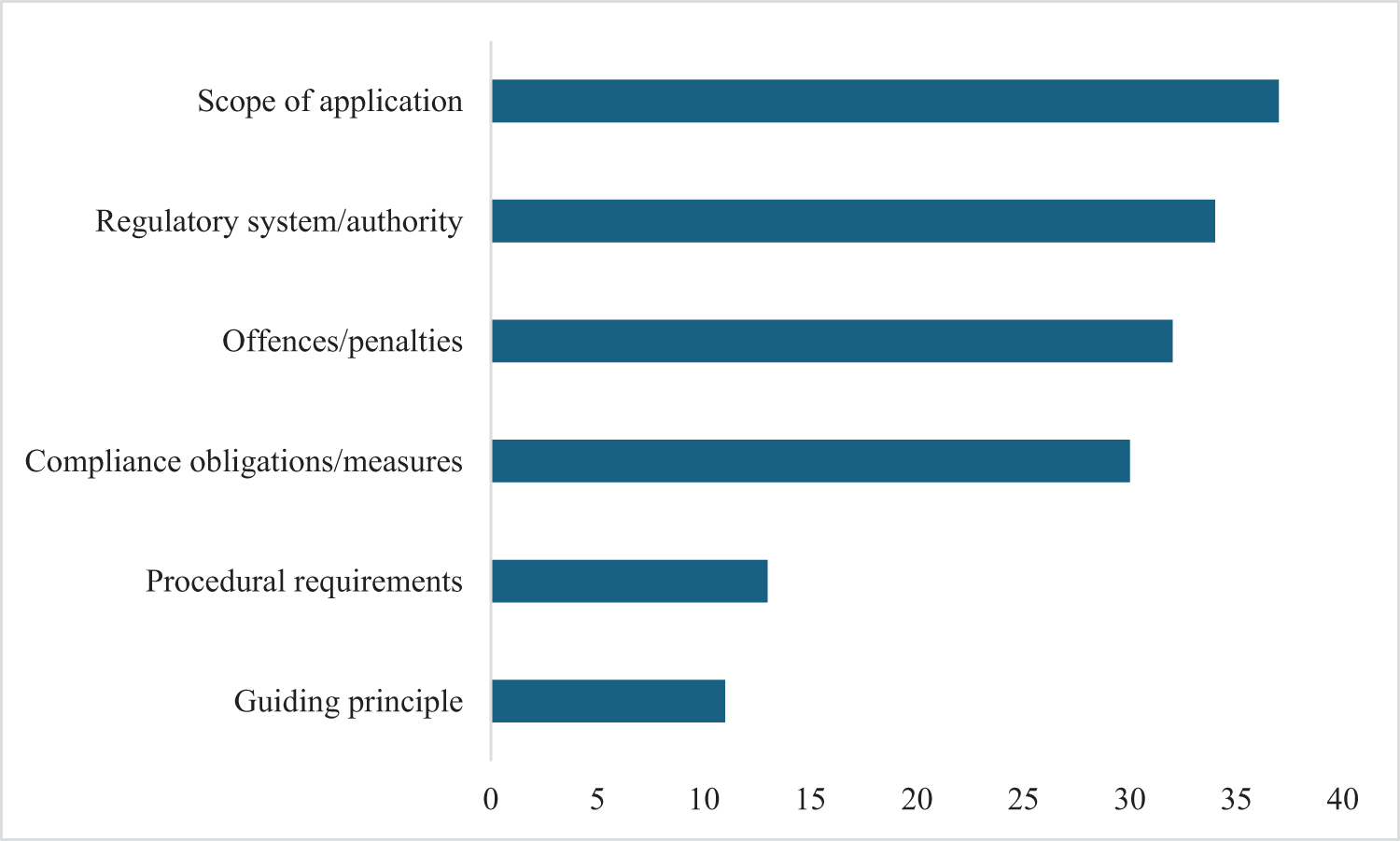
To explore the content of these bills, I adopted a grounded theory approach,Footnote 30 conducting an inductive content analysis to manually classify the reversion cases into six themes: (1) regulatory system/authority, referring to the framework of institutions, agencies and mechanisms that administer, manage and enforce regulations; (2) scope of application, referring to the subjects and range of matters governed by a law or specific provision; (3) compliance obligations/measures, referring to the legal obligations regulated entities must fulfil or the (proactive) actions authorities must take to enforce them; (4) offences/penalties, referring to prohibited actions and the sanctions or liabilities prescribed for committing them; (5) procedural requirements, referring to the mandated steps, procedures or methods that must be followed to achieve a legal or regulatory outcome; and (6) guiding principles, referring to principle-based, declarative statements that establish a framework for action or prioritize implementation efforts. Figure 2 illustrates the distribution of reversion themes. The top three are scope of application, regulatory system/authority and offences/penalties. This indicates that these topics are the subject of intractable disputes, spanning from executive discussions to legislative deliberations. The online Appendix provides representative examples of each theme.
Distribution of Themes

Figure 2 Long description
The horizontal axis shows numeric ticks from 0 to 40. Bar endpoints align at: Scope of application 39; Regulatory system slash authority 34; Offences slash penalties 32; Compliance obligations slash measures 30; Procedural requirements 13; Guiding principle 11.
The Logic Behind Reversions
Recent research advances our understanding of the NPC’s amending role by quantifying the extent of bill changes in the legislative phase. However, it offers limited insights into the substantive importance of particular amendments.Footnote 31 Proponents of the rubber-stamp view may argue that these adjustments are merely minor, technical refinements anticipated by the executive. This study challenges that premise by systematically documenting two patterns: 1) the legislature’s reversion of executive-approved changes, and 2) these reversions consistently touch upon policy substance. The findings invite a more fundamental question: what explains the occurrence of legislative reversions in China’s single-party, executive-dominant regime?
The existing literature suggests two primary mechanisms.Footnote 32 First, stakeholders who were unaware of adverse changes adopted during executive approval may leverage the legislature as a platform for additional oversight. While the executive-level public consultation enables input from all affected parties, the subsequent opinion adoption, revision and approval processes are relatively private. This privacy prevents excluded stakeholders from detecting potentially negative amendments to the draft legislation.Footnote 33 However, the mandatory publication of the bill draft upon legislative entry reduces information asymmetry, allowing these actors to “monitor and challenge” proposals they dislike.Footnote 34 Second, stakeholders who were forced to compromise during the executive decision making may leverage the legislature as a venue for further negotiations. While some actors participate in earlier consultations, they may lack sufficient bargaining power to block undesirable changes.Footnote 35 Since the details of a bill’s content are not finalized at the point of executive approval, these stakeholders can use the legislative floor to re-open debate. Particularly, the public and consultative nature of the legislative phase empowers previously disadvantaged stakeholders. By forming a policy coalition with allied legislators, marshalling evidence from like-minded experts and mobilizing sympathetic public opinion, they are able to contest and ultimately overturn prior unfavourable changes.Footnote 36
Who drives reversals? Given the broad range of actors who may exert influence during the legislative phase, it is difficult to provide a definitive answer regarding their precise identity.Footnote 37 Yet these actors, whether they are legislative members, bureaucratic factions, societal groups or hybrid coalitions, consistently exhibit a common characteristic: they were disadvantaged in the executive decision making. This disadvantage stems from being excluded from the negotiation and revision processes or lacking sufficient veto power, which limits their ability to monitor and/or block unfavourable changes earlier in the process. The subsequent legislative phase, with its institutionalized transparency and consultative procedures, offers these actors formal channels through which to scrutinize, challenge and ultimately overturn the executive-approved revisions with which they disagree.
Here, I use two bill cases to demonstrate these mechanisms.Footnote 38 The 2007 Anti-Monopoly Law (AML) illustrates how the legislative phase can facilitate negotiation. China’s WTO accession necessitated the creation of an anti-trust framework, culminating in the AML. A hotly debated issue during the law-making process concerned the AML’s jurisdiction over regulated industries.Footnote 39 The 2004 draft prepared by the Ministry of Commerce (MOFCOM) called for universal application and unified jurisdiction, aligning with WTO commitments and the ministry’s institutional agenda.Footnote 40 However, this approach faced strong opposition from sectoral regulators and state-owned enterprises (SOEs). These powerful stakeholders successfully lobbied the State Council leadership to carve regulated industries out of AML jurisdiction, maintaining sector-specific oversight instead.Footnote 41 This concession dissatisfied the MOFCOM and competition law experts involved in the drafting process, but they were unable to block this negative proposal during executive approval in 2006.Footnote 42 The subsequent legislative phase enabled them to revisit the debate and strengthen their position. Through coordinated NPCSC deliberations, expanded academic engagement and targeted media campaigns, the pro-competition coalition ultimately succeeded in removing the hostile provision,Footnote 43 affirming the AML’s authority.Footnote 44
The 2014 revision of China’s Environmental Protection Law (EPL) exemplifies how the legislative phase enables more effective monitoring.Footnote 45 In 2011, amending the 1989 EPL was added to the NPC’s legislative agenda in response to mounting public pressure over pollution crises. The Ministry of Environmental Protection (MEP) proposed an ambitious draft to the NPC’s Environment Protection and Resources Conservation Committee (EPRCC), featuring strengthened regulatory measures.Footnote 46 The EPRCC, however, systematically marginalized the MEP’s input, producing a conservative draft that favoured powerful stakeholders, such as the National Development and Reform Commission (NDRC) and local governments.Footnote 47 These substantive deviations were not entirely visible to the MEP until the EPRCC draft was published following its legislative introduction.Footnote 48 After discovering its proposals had been significantly diluted, the MEP adopted a “go public” strategy, openly releasing a detailed critique of the EPRCC draft.Footnote 49 By mobilizing support from its bureaucratic networks, as well as expert and civil society allies, the MEP ultimately compelled significant revisions to the EPRCC draft during legislative passage.Footnote 50
This study constructed an original, fine-grained dataset capable of tracing bill changes throughout China’s two-phase law-making process. By identifying and analysing instances of reversion across phases, it 1) captures a variety of policy disputes often obscured in a single-party authoritarian regime, 2) reveals a key mechanism in China’s inter-branch policymaking interaction, and 3) demonstrates the NPC’s functional role as an effective arena for policy change. It is important to note, however, that these findings derive exclusively from laws with publicly available drafts during both phases. This sample underrepresents 11th-term, co-sponsored, low-priority and foreign/security affairs bills. Readers should consider these scope conditions when interpreting the results.
Supplementary material
The Appendix for this paper is available online at https://doi.org/10.1017/S0305741026102239.
Acknowledgements
I thank the editor and the anonymous reviewers for their constructive comments. I am grateful to Qixuan Huang, Jung Eun Kim, Zhenhuan Lei, Liqun Liu, Lin Nie, Victor Shih, Chen Xiang, Yu Zeng, as well as workshop and panel participants at University of Hong Kong, Shanghai Jiao Tong University and Southeast University, for their valuable suggestions on various stages of this project. Xuqing Liang, Shan Wang, Meilin Wu, Aona Xu, Xinrui Yang, Tianyi Zhang and Linjie Zhou offered excellent research assistance.
Funding
This study was funded by the University of Macau under Grant SRG2023-00047-FSS.
Competing interests
None.
Jiying JIANG is an assistant professor in the department of government and public administration at the University of Macau. Her research interests include Chinese politics, policymaking, legislative processes and text-as-data methods.




 Open access

