

This essay explores debates over political membership and rights within empire from the interwar British Caribbean. I track in those debates the specific and conflicting meanings of the word “citizen.” I also trace the concerns “citizen” and “citizenship” came to invoke, clustered around civic participation, political voice, and mobility rights. The role of racial hierarchy in undercutting state protection for colonial subjects' rights was debated more and more explicitly as the era wore on.
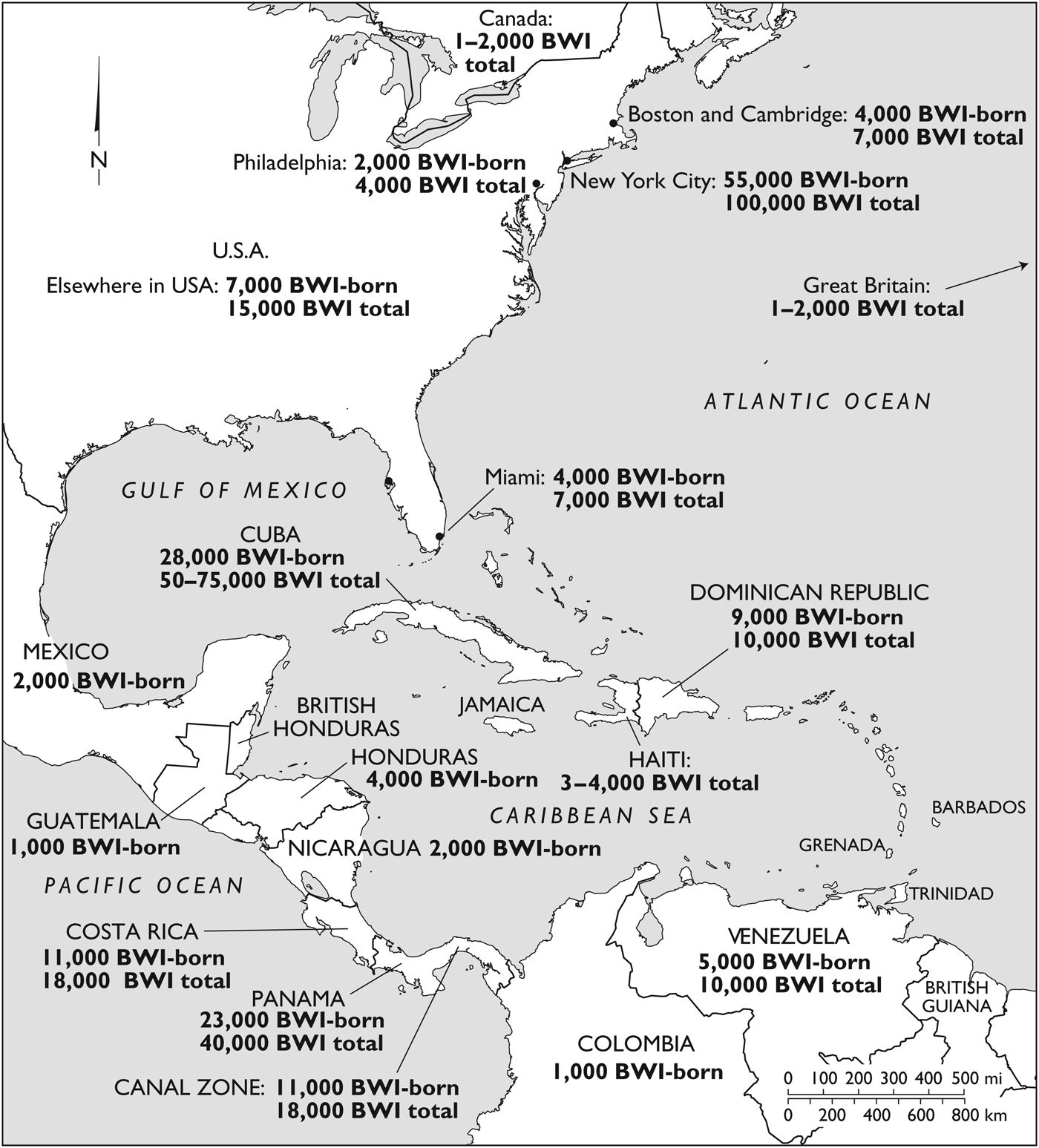
Debates over citizenship within empire were importantly driven by trends beyond the empire's borders. By 1930, over 170,000 British West Indians resided outside of British territory in circum-Caribbean republics from Venezuela to Panama to the United States. Each and every one of these lands imposed antiblack immigration laws in the late 1920s and 1930s. Was this the future the modern world held for subjects of color? In overseas communities and among activists and observers back home, the era saw passionate debates over the costs of political disfranchisement, the need for territorial belonging, and the role of race within empire.
This supraregional experience was a fundamental precursor to postwar Caribbean migration to Great Britain both materially—pushing emigrants toward a distant metropole that had become the only destination where they could claim the right to enter and work—and culturally—shaping the range of concerns and convictions men and women carried as they stepped down the gangway toward a cold and foggy new destination. Within the existing historiography on colonial migration to Great Britain, there is confusion over that backstory, even in its most basic elements. For instance, the impact of the de facto ban on British West Indian entry to the United States after 1924 has been obscured by the presumption that British subjects of color continued to enter the United States under the British quota. In a world where laws worked as written and states were race blind, they would have. However, as British West Indians knew fully well, they did not live in such a world.
Scholars in recent decades have reconstructed the long history of struggles by colonials of color in the metropole.Footnote 1 The present article suggests an alternative framing and a complementary history. In the interwar years, as one or two thousand British West Indians sought opportunity and rights in Great Britain, over two hundred thousand British West Indians lived out dilemmas and exclusions—some similar, some different—in Panama, Cuba, Costa Rica, Venezuela, the United States, and beyond. They debated the significance of their experiences on street corners, in rum shops, at United Negro Improvement Association halls, and in a print public sphere powered by editors of color, which linked home islands to receiving rimlands via newspapers read by scores of thousands.Footnote 2
Where would these debates lead? Let us glance ahead to London, 1948, noting the juxtaposition of three events apparently quite distinct in their origins and significance. On 22 June, the former troop transport Empire Windrush arrived, carrying 493 British West Indians planning to work. On 22 July, Parliament concluded debate on the British Nationality Act, creating the unprecedented category of “Citizen of the United Kingdom and the Colonies.” And at the London School of Economics, pioneering sociologist T. H. Marshall was preparing notes for a lecture he would deliver in 1949, and publish in 1950, titled “Citizenship and Social Class.” Each of these events has great significance in scholarly consideration of the evolution of political belonging in modern Britain. But how they fit together is unclear.
Stepping back in time and away from London, we will see the entanglement of the processes that produced the Windrush arrivals, the Nationality Act, and the insights and absences of T. H. Marshall's view of citizenship. The entangled backstory of these three events reflected a generation-long international process of state formation in which the growth of populist politics, the centering of popular welfare, and the construction of racialized barriers to entry were fundamentally fused. As a global trend, the entitlements citizens claimed on their home turf were expanding, in the form of nascent welfare states and proemployment policies, while the access accorded noncitizens was shrinking. By the 1930s, mobility rights—including both would-be emigrants' right to enter and labor elsewhere and their right of return—had joined political and civil rights as privileges that individuals could not claim without the support of their governing state.
Although Marshall and the members of Parliament who drafted the 1948 Nationality Act seemed almost willfully blind to the tensions these international trends foretold for an imperial Britain, men and women in the British Caribbean had been grappling explicitly with these tensions for a full generation. They had a detailed understanding of the racialized global hierarchies that made rights in practice unequal even in nominally color-blind polities, and they had developed a vernacular theorization of imperial citizenship as an ideal continually betrayed.
The imperial citizenship they believed theirs by right did not, for them or for any other subject, legally exist—nor did “British citizenship” as a state-recognized category. That did not stop British subjects from arguing about citizenship then, and it has not stopped scholars from using the concept since. I begin this article by surveying the many-layered scholarly literature on citizenship in Britain and beyond. I then establish the Edwardian baseline from which interwar debates took off, noting the role of race-based disparity in precluding formal codification of citizenship, on the one hand, and the routine use of the term “citizen” by British West Indians to recognize virtuous participants in the civic community, on the other. I next address the impact on the circum-Caribbean migratory sphere of the hemisphere-wide consolidation of mobility control in the 1920s, a process that confronted sojourners in Panama, Cuba, the United States, and beyond with an implacable new legal status under that same label, citizen. Turning back to the islands, I note the accelerating invocation of citizens' rights in the 1930s by reformers demanding political rights within colonies, in part with explicit reference to race-based exclusion abroad. Then I widen the view, showing that conflicts over who counted as citizens echoed across Britannia's realms in those years, the common aspirational term allowing distant disputes to become evidence in local debates. Finally, I move forward a decade to the immediate postwar era, analyzing the insights and blind spots of ideas about citizenship offered by metropolitan intellectuals in precisely the years when Caribbean labor migrants, for the first time, headed toward their governing state's home terrain.
Much of my analysis will rely on local newspapers published by and for British West Indians of color, which flourished in the interwar years in rimland receiving societies and island sending societies alike. Papers like the Grenada-based West Indian, the Barbados Weekly Herald, the Panama Tribune, and the Searchlight from Limón, Costa Rica, were each read by thousands of people, with subscribers near and far.Footnote 3 Impassioned readers' letters about issues local and global, personal and political filled their pages. This space was not limited to a small elite. Literacy among working-class British West Indian emigrants was particularly high: 80 to 90 percent in Panama and Costa Rica, and higher still in Harlem and Brooklyn.Footnote 4 In these local papers, mixed in among blood strengthener adverts and lodge meeting notes and disavowals of straying spouses, sits a political corpus of uncommon interest.
Scholarly Context
Recent decades have seen an outpouring of scholarship on the complexities of citizenship within Great Britain and beyond—although what exactly scholars have tracked under that label has varied significantly. The largest set of studies uses citizenship as an analytic construct to designate the patterning of political membership and civic participation within a given system. Those studying the history of citizenship in this sense have argued that two normative visions coexisted in early twentieth-century Britain: classical republican citizenship, understood with reference to the ancient Greek model, centered on the obligation of active civic participation; and liberal or “passive” citizenship, linked instead to the seventeenth-century English Revolution and the Enlightenment, stressing individual freedoms and rights.Footnote 5 Eugenia Low summarizes these alternative visions as a “conceptualization of citizenship as a form of social virtue” and a “conceptualization of citizenship as an instrument of equality.”Footnote 6 Despite the nominal ascendance of the latter in British political rhetoric by the middle third of the twentieth century, scholars suggest notions of political belonging and entitlement based in duty and community, articulated and popularized by turn-of-the-century idealist philosophers, continued to influence policy making and popular reactions.Footnote 7
The above scholarship focuses largely on the writings and speeches of intellectuals, policymakers, and elites, although in some cases exploring the degree to which these reached a wider (middlebrow) audience.Footnote 8 In contrast, a second strand of scholarly inquiry applies the rubric of citizenship to informal practices among the popular classes, reading them as contestatory claims to belonging and rights. We see this perspective in recent studies ranging from “street citizenship” in Georgian London to the boundaries of belonging during World War II.Footnote 9
While scholarship on citizenship in Britain sometimes reads like a historiographical island unto itself, in fact, these academic trends (including the new emphasis on popular claims making) are much wider. Among historians and historical sociologists writing on Europe, the Americas, and beyond, analyses of evolving patterns of political membership in terms of citizenship flowered in the 1990s and flourished in the 2000s.Footnote 10 Authors in these decades often cited T. H. Marshall's formulation as a touchstone as they explored the role of popular organizing and pressure in expanding rights. Palpable too is the influence of a Thompsonian view of popular agency: a desire to find citizens present at their own making. The approach has proved particularly fruitful for analyzing struggles over rights in postemancipation societies, where commitments to republican virtues and liberal freedoms coexisted with coercion, exclusion, and hierarchy.Footnote 11 The disjuncture between the nominal commitments and the reality of subjugation could, at times, scholars suggest, provide rallying grounds or leverage for those seeking to make rights real.Footnote 12
A separate set of scholarship—again, both within British studies and more broadly—has traced the history of citizenship as a formal legal category, one whose allocation regulates access to territory as well as rights. In essence, this scholarship tracks citizenship as a category of (state) practice rather than using it as a category of analysis.Footnote 13 In most countries, by the interwar years, the regulation of citizenship status had become tied to an array of bureaucratic and documentary procedures aimed at controlling entry and borders.Footnote 14
For historians of Britain, pursuing this story has meant explaining both the absence of any formal category of “citizen” within the United Kingdom or empire before the 1948 Nationality Act and the tumultuous array of subdivided citizenships proffered in law since then.Footnote 15 It also remits to both the regulation of mobility within empire (largely before 1948) and the regulation of entry to Great Britain (largely after 1948). In regard to mobility within empire, scholars highlight the nineteenth-century rise of demands for race-based protectionism from white working-classes in the dominions and the dilemmas these presented for the rhetoric of race-blind subjecthood so central to empire's claimed legitimacy.Footnote 16 In regard to the latter—the control of access to Britain itself—the place of racism, whether elite or popular, has been more disputed. Some historians have agued that racialist ideologies identifying British belonging with whiteness were crucial drivers of policy shifts; others see ethnocentrism or xenophobia rather than racism per se as the driver; still others insist British laws exemplified race-blind liberalism, “conspiratorial stories of . . . ‘racialisation’” not withstanding.Footnote 17
Attending to the political ideas of British subjects of color on the move, the present article brings the literatures on citizenship as patterned political belonging and citizenship as popular claims making into dialogue with the literature on “citizen” as category of state practice within hardened border regimes. How did the state-level shifts through which international mobility control was remade at the dawn of the twentieth century—ably detailed by Aristide Zolberg, Andreas Fahrmier, Adam McKeown, and Marilyn Lake and Henry Reynolds—impact the ideas and identifications of the excluded? The literature on citizenship-as-popular-practice would suggest that state making generates and is reshaped by resistance and claims making. But in the making of migratory control, the key moves were often those of states far away. When state building imposes rules and curtails rights far from home, does it still make sense to think of citizenship as in some meaningful way constructed “from below”? Do negotiation and struggle play any role in the story of citizenship-as-legal-status? Has the making of citizenship-as-legal-status played any role in popular claims to political voice?
Answering requires adjusting our sense of where history happens. My island-outward tracking of citizenship claims among colonial subjects of color will reveal important similarities to the dynamics other scholars have uncovered in Georgian, Edwardian, and blitz-era London. But it will show that those dynamics took place at a shifting set of sites, as is logical for people in motion. The nexus of mobility, political voice, state membership, and race—the question of how to make empire stand up for colored subjects abroad—was at the forefront of local debate in multiple locales.
In sum, the present article expands existing work on British citizenship on the one hand, and Commonwealth migration on the other. Scholarship in the 1990s on postwar migration illuminated the complex interplay of imperial, national, and racial identities.Footnote 18 Recent contributions have turned to the study of nonwhite subjects as authors rather than objects of identity formation, noting, for instance, the alternative framings of Britishness by “Britishers” of color.Footnote 19 The present article continues this attention to colonial subjects as active makers of meaning, but it shifts focus from imperial and national belonging (and their cultural, class, and gendered coordinates) to citizenship (and its material consequences). As we shall see, British West Indian sojourners knew well that some would never recognize them as fully British in a social or cultural sense. That did not stop them from asserting a moral right to full membership in the imperial state.
Historical Context: Traveling Subjects and Legal Categories of Empire
The debates I will trace took place in a transnational migratory sphere created by the travels of Jamaicans, Barbadians, and other British Caribbeans in the generations after emancipation. It stretched from Venezuela's Orinoco basin goldfields in the southeast to the banana plantations and cacao groves of Central America in the west, to Harlem's crowded sidewalks in the north. Panama's cities and canal works were the foremost destination in the first decade of the century, Cuba's canefields followed after the Great War, and New York City's burgeoning service economy surpassed them in the 1920s. By the end of that decade, over 170,000 British West Indies–born sojourners resided outside of British territory. That total does not include those who had worked abroad and returned home or those who lost their lives “in foreign.” Meanwhile, if we count not only island-born immigrants but also their locally born children (or in some cases, by 1930, grandchildren), the size of the British West Indian diaspora circa 1930 rises to over 300,000 (see map).Footnote 20
British West Indian immigrants and total British West Indian community sizes, ca. 1930. Drawn by Bill Nelson; data and design by Lara Putnam.

The decade from 1924 onward saw antiblack immigration bans enacted by every one of the significant receiving societies where those 300,000 dwelled—including Venezuela, Colombia, Panama, Costa Rica, Nicaragua, Honduras, Guatemala, Mexico, Cuba, the Dominican Republic, and the United Sates—as scientific racism among national elites and protectionist demands by national workers converged to make xenophobia an irresistible political platform.Footnote 21 All around the Greater Caribbean, British West Indians found visas denied, bribes demanded, employment barred, and family cut off at hundreds of sites they had previously called home. Interwar nativism was not solely about race, but its racial coordinates were unmistakable. Nationalist legislators explicitly named those of “black race” as “undesirable”; Britishers of color were barred and vilified even as white Britishers remained welcome. As we will see, British West Indian commentators read these events as part of a global pattern of white supremacist state making. Within the global panorama they sketched, color bars within empire formed bitter touchstones, from the immigration laws of Australia and Canada to the treatment of black seamen in British ports after the war.
The challenge of squaring the rhetoric of race-blind, egalitarian subjecthood with a colonial system dependent on deep inequality was not, of course, new in the 1920s. Indeed, this underlying dynamic contributed to the failure to create either “British citizen” or “imperial citizen” as a formal status before 1948. Rather, the populaces of the United Kingdom, the dominions, and the dependent colonies were by law British subjects (the nonwhite among them sometimes specified as “non-European British subjects”), while the populaces of the empire's other territories were classed as British Protected Persons.Footnote 22
The absence of a “citizen” status was out of step with modern state norms, but it persisted for a reason. In the Imperial Conference of 1911, Home Secretary Winston Churchill called for formalization of “a uniform and world-wide status of British citizenship which shall protect the holder of that certificate wherever he may be.”Footnote 23 But how could such a status be applied only to white British subjects—as Churchill clearly intended—without making racial barriers explicit? The procedural challenge echoed a policy dilemma that repeatedly enmeshed Whitehall between dominion legislatures and the broader empire. Australia, Canada, and South Africa kept insisting on banning the entry of nonwhite migrants, even those with unquestioned status as British subjects, and nonwhite British subjects kept insisting on objecting. Any proposed imperial citizenship would need to reconcile citizenship's promise of the right of abode with the continuance of race-based exclusion.
A 1912 debate among one imperial discussion circle explored the questions raised by Churchill's proposal. The former governor of New Zealand called for a straightforward race-based bar: “In my view full British citizenship, ‘good’ for any and every part of the Empire and entitled to recognition by foreign States, cannot be given to British subjects of colour.” In contrast, he continued, all individuals of “pure white stock” should have easy access to “full British citizenship,” be it from birth or, for foreign-born whites, through naturalization after brief residence.Footnote 24 Such an open enunciation of race was rare among the administrators of empire. Far more common was the forbearance exemplified by Walter Hely-Hutchinson, who acknowledged obliquely that “certain categories of British subjects” faced “special disabilities as regards franchise, admission to certain portions of the Empire, and so forth,” but insisted “it would be a grave mistake to label British subjects who suffer under such disabilities, with a name, connoting inferiority, different to that borne by their fellow-citizens: to say to them, in effect, ‘You are not a British citizen; you are only a subject.’”Footnote 25 Another contributor, carefully disclaiming “any intent” to enter into debate over policies under which “the coloured man is held to be unwelcome,” nevertheless acknowledged forthrightly that race was the crux of the issue, explaining, “British citizenship can carry no general meaning or value as long as any British subjects,” on grounds like “complexion,” “can be legally refused admittance into, and domicile in, any portion of the British empire.”Footnote 26
As their deliberations made clear, the ambiguities surrounding “imperial,” “British,” or other subsets of “citizenship” within empire stemmed not from Great Britain's lack of a written constitution but from the utility of ambiguity itself. At the end of the day, the debate's convener summed up, the diverse local laws and regulations that could be said to comprise implicit imperial citizenship drew “a much broader distinction between persons of European and non-European descent than between subject and alien.”Footnote 27 This was not a truth empire's boosters could speak.
Citizenship in Transit in the Greater Caribbean: Attainable Merit versus Implacable Credential
Nevertheless, if a good portion of the men who ran the empire presumed “British subjects of colour” to be categorically excluded from citizenship, a good portion of those subjects never doubted that citizenship was theirs. Among English-speaking Afro-Caribbeans, as among English speakers across the anglophone world, “citizen” had long been used to denote meritorious membership in the local community. For instance, since the mid-nineteenth century, parish-specific “Citizens' Associations” in Jamaica had hosted speakers and sponsored civic initiatives. Newspapers in Jamaica and Trinidad often carried complaints about the need to safeguard “respectable citizens” or “peaceful citizens” from this or that noisy urban nuisance.Footnote 28 This usage implied no state sanction, and it continued as British West Indians settled in lands far from home, where there was no question that the governing states considered them foreigners rather than members. Thus, a Jamaican-run newspaper in Bocas del Toro, Panama, described one local as a “native of Portland, Jamaica, who left Jamaica since 1904 via Costa Rica, thence to Colon and then to Bocas in the year 1905 [and] was settled here as a law abiding citizen until 1916.”Footnote 29 Meanwhile, on islands and rimlands alike, those concerned with child welfare often argued for their charges as “the citizens of tomorrow”; as one enthusiast in a British West Indian settlement in Costa Rica explained in 1930, “[G]ood boy scouts in a locality is a sign of good citizenship among the rising generations.”Footnote 30
As these examples suggest, the term “citizen” conveyed well-earned merit and public respect. As such, it was particularly resonant for those arguing that character transcended racial divides. A 1917 editorial from Bocas del Toro urged the “Labouring West Indians” who had written to denounce their mistreatment on a United Fruit banana plantation to take their complaint straight to the top:
Our people should not cringe whenever a question of right is concerned—nor at any other time. They should be respectful, and bold. Don't be afraid to approach Mr. Kyes, because he is a white man: besides being a white man, he is a gentleman. “A blooded white man hates a cringing citizen, be he black or white and he admires manhood, self-respect and courage in a Negro as much as he does in an Englishman, a Frenchman, or a German.”Footnote 31
As we shall see, the twinned reference to citizenship and manhood would continue to be a mainstay of Afro-Caribbean men's self-assertion. But the claim that white power brokers valued character over race would be disproven in loud lawmaking and silent betrayals alike over the following decades.
Meanwhile, Caribbeans sometimes demanded civil liberties in the name of their rights as “British citizens.” A 1904 article in a Grenadian paper denounced misrule in Trinidad by asking, “Are the people of that island entitled to the immunities of British citizens? or are they to be governed as a horde of rebels who must be butchered by a mad and infuriated soldiery so as to be kept in order?”Footnote 32 The questions were intended to be rhetorical: the rights stood as moral entitlements even as local officials betrayed them. Sixteen years later, spooked by island labor unrest and seeking to ban Marcus Garvey's Negro World and other race-conscious publications, colonial authorities rushed “Seditious Publications Ordinances” through legislatures across the region. Working-class protesters fruitlessly invoked multiple rights-bearing traditions that the ordinance betrayed: the law was “not only obviously unnecessary, but un-English”; it “threaten[ed] the rights and privileges of the people of the colony,” removing “our rightful freedom as British subjects” and “loyal subjects of the King.”Footnote 33 In response, the attorney general insisted that he recognized the people of Trinidad as “in every way worthy citizens,” although (he underlined elsewhere) they were deeply ignorant and dangerously easy to mislead. The legislation was pushed through.Footnote 34
What we see here and elsewhere is that civil liberties could be defended as “citizens'” rights, but were they equally or more likely to be supported with reference to national tradition and allegiance to the Crown. In contrast, when the question at stake was moral “worth,” the term citizen was the natural frame, conveying earned merit rather than inherent rights. Reference to citizenship, in other words, was for British Caribbeans deeply resonant with the republican/active model of citizenship promoted by Victorian and Edwardian idealists who saw civic participation as a transcendent ethic; it was also linked, but less integrally or uniquely so, to the liberal/passive vision of political membership centered on individual rights rather than on communal virtue.
International trends would soon put the protections due nonwhite subjects on trial in newly public and visible ways. Imperial lawmakers had ducked the question of formal citizenship's boundaries, but now other states were calling the question. As noted above, the years after the Great War saw the consolidation of a widely shared shift. Welfare states and border regimes were each in the making. Nation-states systematized birth certificates, passports, and visas, and began to make access to employment and nascent social services contingent on these documentary proofs of belonging.Footnote 35
In this new international system, “citizenship” was not a portmanteau term for civic virtue but a requisite component of individual identity, which only state action conferred. Sojourners sensed rumblings afoot. In January 1919, one British West Indian worker in the Canal Zone wrote to the British consul in Colón, “Is it true that by the termination of the war the status of the British subjects have been changed, and that we are no longer British subjects but citizens of Britain?” The consul seemed blithely confident in response: “There is no foundation whatever for the supposition that the status of British subjects will be changed as a result of the War.”Footnote 36 But while the formalities of empire had not changed, international practices of governance were changing, in ways that would impact British subjects' status, like it or not.
“EMIGRATION OF JAMAICANS TO U.S. STOPPED,” ran the banner headline of Kingston's Daily Gleaner just five years later, as the local impact of the restrictionist US Johnson-Reed Act became suddenly, frighteningly clear. “The American Consul has received instructions not to visae any more passports and thus only American citizens will be able to go North.”Footnote 37 “Citizen” as used in this sentence reflected nothing of local standing or civic worth. It was a legal status that states and only states could confer: within the emergent regime of visas and passports, without documentary proof that citizenship had been conferred it did not exist. Lacking citizenship, a visa was required for entry; lacking a visa, entry was denied. The Johnson-Reed Act brought the “non-self-governing” colonies of the Americas (e.g., the West Indies but not Canada) under quota-limited visa status for the first time, and the “quota control officer” at the US consulate in London cut visa allocation to the British West Indies to a trickle. Over 10,000 Afro-Caribbeans had entered the United States in the first six months of 1924; fewer than 250 did so under the British quota in the entirety of 1925.Footnote 38
Citizenship in this new sense was not negotiated between popular and legal understandings. Citizenship as restrictive right of abode could be legislated in Washington, regulated from London, and fracture families in Panama and Cuba without the restrictors having to negotiate anything—or even acknowledge that discrimination against colonials of color was under way.
Newspapers published by and for British Caribbeans abroad in the late 1920s and 1930s reflect both the continued usage of “citizen” to reference the standing conferred by community participation and the new meaning of “citizen” as a legal category governing mobility. Thus, a widower in 1930 Limon denounced the fraternal lodges that had failed to give his wife the funeral owed her “as a mark of respect to an old respectable citizen.”Footnote 39 The same newspapers carried extensive coverage of new requirements regarding registration, passports, and visas; of race-based bans near and far; and of the travails of individuals who for lack of papers found themselves with “No Nationality” and therefore no port of entry open to them.Footnote 40
The fraught new politics of territorial belonging made civic participation more vital than ever. So preached Sidney Young, the Jamaica-born founder of the Panama Tribune and a tireless crusader for the rights of British West Indians in Panama. Fighting the erosion of civil rights by the xenophobic populism sweeping the region required active engagement at multiple levels, Young insisted: community solidarity and economic self-help, assertion within empire, and supranational black solidarity.Footnote 41 In steps from 1926 to 1928, the Panamanian legislature declared all those “of black race whose native language is not Spanish” undesirable aliens and limited their entry, employment, and jus soli citizenship. Mass statelessness threatened. As British doctrine held, and local British diplomats gleefully (in private) confirmed, the two-thirds of locally born British West Indian children whose parents were not legally wed had no claim to British subject status.Footnote 42 How to ensure the future of these young men and women occupied hundreds of columns of ink in the newspaper sections Young published from the late 1920s onward.
Disputes over citizenship-as-state-status threatened to disrupt the forging of “citizens of tomorrow” in the rimlands—but not if Sidney Young could help it. Responding to outcry in the Panamanian press in 1932 over local British West Indian boy scouts' use of the Union Jack in drills and ceremonies, Young reviewed the new panorama of laws governing “Panamanian citizenship” and the transmission of what Young termed “British citizenship” (that which British law deemed British subjecthood). Above all, Young exhorted, the vital project of scouting must not be put on hold until the fraught issues of national belonging were resolved, for what scouting offered was “training for usefulness as citizens and men,” more vital now than ever.Footnote 43 The idea that citizenship as moral character transcended nationality was underlined the following week by local Scout Commissioner Clifford Bolt, who wrote that as he and others had founded scout troops over the past decade in Panama, “[t]he question of nationality did not seriously occupy our attention, we were working for the benefit of our future men and endeavoring to make citizens fit for any country when they come to the age of maturity.”Footnote 44 Citizenship here required communal roots but had cosmopolitan results: citizens must be made but would be “fit for any country.” Yet to fight state-mandated exclusion with civic participation was a battle of unequal arms.
“Why such animosity?” asked the editors of the (Limón) Searchlight in 1931, surveying the “hostile movements” threatening “coloured British subjects” around the region. “Cuba has had her turn, Honduras has had hers, Panama has had hers, Venezuela has had hers, Colombia also has put on the twitch, and now some sons of Costa Rica are thinking likewise.”Footnote 45 The question of the status of the next generation was critical. Some receiving societies (like Panama) revoked birthright citizenship in these years, while others, like Costa Rica, had never recognized it—a legal reality not yet clear on the ground. In this same article, the Searchlight editors declared it impossible to expel the “industrious coloured residents in Costa Rica,” long settled, with “their own farms and houses as well as grown up children in this country who are all citizens of the Republic.” In fact, Costa Rican law accorded those children no such status.Footnote 46
Indeed, despite the savvy born of necessity, the editors and correspondents of the rimland papers made assertions about legal citizenship that were patently wrong, if understood as descriptions of the documentary regime now surrounding them. Their claims suggest a persistent moral economy of territorial rights that infused elements of the established notion of citizenship as civic merit into the new and intransigent legal term. Thus, in 1930 the Limon papers denounced Costa Rican government discrimination in public works hiring, which froze out “unfortunate people who actually form (whether by birth or length of years of residence) joint citizenship here.”Footnote 47 Another article urged those heading back to Jamaica to “avail themselves of their necessary papers to prove themselves long citizens of this Country”—Costa Rica—before departure, lest they find themselves unable to reenter Costa Rica if they wished.Footnote 48 But, in fact, neither long residence nor local birth “actually” conveyed Costa Rican citizenship, and no such thing as “joint citizenship” existed. Costa Rican citizenship could only be claimed through formal registration or formal naturalization, procedures only a tiny fraction of British West Indians living there pursued in this era.Footnote 49 The notion that long residence conveyed at least partial entitlement to things increasingly restricted by formal national membership—things like employment, aid when destitute, and a right of abode—was heard frequently among circum-Caribbean migrants in this era. Just as frequently it was squashed by state authorities.
Differentiated Subjecthood and the Duty of Patriotic Dissent
Facing bars and mistreatment abroad, British West Indians demanded the formal protection of the state to which they nominally belonged, the British imperial state. In theory, there was no doubt they were entitled to it: extending protection to crown subjects in foreign lands, whatever their ancestry, formed part of the empire's raison d'être according to long tradition and copious rhetoric.Footnote 50 In 1921, the (near-white, elite) editors of Kingston's Daily Gleaner could trumpet the protective value to “the Jamaican abroad”—in Cuba and Panama, in this case—of “his British citizenship”: “He is loyal by sentiment, he is also loyal because he recognizes that British citizenship is of real and sterling value.”Footnote 51 A decade later and seven hundred miles to the west, that protection looked far less sterling. The lack of support from consuls and colonial officials for “the Coloured Britisher” in contrast to the “englishman” abroad was egregious, wrote the Searchlight editors from Costa Rica in 1930. State after state enacted race-based bans on entry (Panama, Nicaragua, and Colombia) and employment (Costa Rica and Cuba), “and with all this prejudicial discrimination of the coloured subjects of the king in foreign parts, no protest is entered or suggested by the Consuls to Downing Street for the protection of his subjects.”Footnote 52 Some Crown representatives went further than sins of omission and publicly differentiated on the basis of race, “assert[ing] that they are not here to attend to coloured British subjects, only the British Shipping and Englishmen.”Footnote 53 British West Indian commentators treated this as both common and appalling. If state agents declined to back rights in an era when state backing meant all, “what benefit does the black race obtain from being under the British Crown at home or abroad?”Footnote 54
The term “citizen,” carrying the affective charge of its older sense as meritorious civic membership alongside its new meaning as state-allocated status, served to denounce the betrayal with particular force. A 1924 editorial by Barbados-born, Panama-raised Eric Walrond in the Panama Workman suggested that while Latin American nativism was comprehensible, imperial silence in the face of “[a]buse, malignity and violence” was portentous. “How do West Indians stand in Central America? This question concerns the British Empire more than it does the Latin American Republics. The outspoken and evident antagonism to British West Indians is not only outrageous to the sufferers, but an insult to the British Government of which these people are bona fide citizens.”Footnote 55 This declaration of “bona fide citizen” status, like the discussion of “joint citizenship” above, willfully ignored the fact that the legal status asserted was denied by the state empowered to grant it. In 1924, Walrond concluded with a confident peroration that “the British Government should become actively conscious of its responsibility to protect the citizens of the empire in foreign lands.”Footnote 56 Seven years later, the Searchlight editors reviewed a worsening panorama of bans and exclusions in the same lands and ended not with confidence but a question, one that named racism explicitly as the problem: “what is the attitude of the British government toward her Negro Citizens?”Footnote 57
Empire was betraying empire's core virtues. Patriotism demanded action. “Cromwell, Toussaint L'Overture and the parliamentarians who forced John of Gaunt to sign the Magna Charta were all ardent patriots, yet they vigorously opposed the modus operandi of their governments when the necessity warranted it,” reminded a letter writer in Panama in 1927, asserting an unquestioned moral membership that carried the duty to criticize from within. “Intelligent West Indians need not cover themselves with the Union Jack to prove their nationality. They need not resort to cheap advertisements or blatant proclamations to be known as British. We are British at heart, British in culture.”Footnote 58 That national character was indelible, the author argued, in a way that neither state credentials nor bodily features could be: “A man's flag, his name, his very features might be changed but his culture is the very ego.”Footnote 59 Loyal Britishers, he wrote, must denounce the immigration laws of Canada and Australia, the exploitation in South Africa and Kenya, and the betrayal of black soldiers in England. “Intelligent West Indians do not forget their duty to the Empire . . . but they also have not forgotten that they are a colored people.”Footnote 60
Surveying racial distinction at the outskirts of empire—the widening gap between “West Indians” and “British” subjects in Panama, and the failures of consuls in Cuba—Sidney Young concluded the time for silent dependence was over. “In matters affecting the righting of our wrongs, it is we who must first protest,” he wrote. “We cannot sit supinely lamenting our woes, and leaving everything to the representatives of the king . . . and to those super-patriots who may cry ‘treason’ at our statements; we declare in the words of Patrick Henry, the American patriot: ‘If this be treason, make the most of it.’”Footnote 61 Individual rights required collective protest; making membership real required risking treason. Young's model of political belonging did not split duties from rights or civic life from equal treatment: it posited the former as crucial steps in achieving the latter.
Against this panorama, political voice within colonies of origin took on a new valence. We turn now to the islands and observe the accelerating use of “citizenship” to describe rights unconstrained by race or privilege.
Citizens of the World and Citizens of Tomorrow: Island Reformers and Political Rights
In the West Indian's opening editorial in 1915, Grenadian editor T. A. Marryshow laid out his paper's mission: to serve as “an untrammelled advocate of popular rights . . . an unswerving educator of the people in their duties as subjects of the State and citizens of the world.”Footnote 62 Capturing that twinned vision of “popular rights” and “duties,” the category of citizen suffused Marryshow's pages, not only in exhortations to future “citizens of the world,” but also as the default term for local residents in the context of discussions of governance. We read routinely here of “the better interests of the citizens as a whole,” “the treatment of an individual citizen,” and so forth. In 1915, Marryshow brooked no doubt that the expanded rights and duties his fellow citizens deserved could be sought within empire. Indeed, he described imperial Britain as like imperial Rome before it: the world's best hope for a polity that transcended color or creed. As the decade advanced, his faith in empire's immunity to racism was shaken. Only electoral reform, he concluded, could create the leverage needed to curve empire toward its potential.
Barbadian journalist Clennell Wickham agreed. In the mid-1920s, Wickham's Weekly Herald championed the Democratic League, a new opposition party struggling to break the grip of white planters on Barbados's House of Assembly.Footnote 63 Reformers called for freedom of political speech, a broader franchise, investment in education and public health, and at least minimally protective labor laws. They made the case through constant reference to the rights of “citizens”—which, they insisted, all Barbadians were. In their renderings, the term undergirded claims to political rights zealously denied them by local elites. “Representative Government” was Barbadians' “birthright” as “British citizens,” wrote one correspondent. That island elites currently deprived them of that birthright did not abrogate the underlying status. Citizenship derived from community membership. It could be ignored and insulted, but never erased.
A man, or woman, is a citizen of the town or district to which he or she belongs. He is a citizen of the United Kingdom, enjoying the advantages of its freedom and government and fulfilling the duties or bearing the responsibilities which are common to its people. He is a citizen of the British Empire. Hence belonging to Bridgetown, Christchurch, St Philip etc., one is a citizen in any of the circumstances, no matter how the local laws might be abridged; so long as he enters his claim.Footnote 64
The moral brief for inalienable citizenship as concentric belonging, grounded in duties and securing freedoms, was crystal clear. How one's “claim” was to be “entered” in the teeth of local laws was less so.
The argument that popular citizenship demanded political rights and social investment for Barbados's black masses put Wickham and the Democratic League on a collision course with the island's plantocracy. The “callous indifference and naked greed of the wealthier classes” imposed “poverty, nakedness and disease,” according to one letter writer. “They think it is no dishonour that our future citizens should be bred and rared like pigs in foul and overcrowded hovels.”Footnote 65 However, those future citizens would not suffer in silence forever, wrote another, self-described as a member of the enfranchised few. “The desire for political recognition by the masses strikes a deep note like the distant booming of a heavy swell,” and the privileged could not expect loyalty if all they offered was intransigence. “There can be no desire on our part to have them true citizens without granting the status of citizens,” he warned, “If we fail it will be our fault when they become something else.”Footnote 66 “True citizens” here meant loyal members of the polity; the “status of citizens” meant political rights within it. Passionate organizing won incremental change. The Democratic League finally elected several of its own to the House of Assembly in 1930, an unprecedented blow, wrote T. A. Marryshow from Grenada, against those white Barbadians who believed they had “inherited from their illustrious ancestors the right to regulate and ration a people's privileges of citizenship.”Footnote 67 Marryshow's insistence on the “privileges of citizenship” that no one, however illustrious, had the right to “ration,” still presented these as British rights due Caribbeans as British subjects. Yet gazing out at the region more broadly, it was hard to trust empire as the answer, for the rights of sojourners abroad were matters of high politics. And here, Britain was failing her subjects of color.Footnote 68
For instance, in 1932 Sidney Young's Panama Tribune covered at length the Canadian National Steamship Company's firing of 350 British West Indian seamen “on the ground of helping Canada's unemployed.” The Tribune first quoted the Port of Spain Daily Mirror, voice of that island's near-white merchants, which lamented the firings with reference to bilateral economic issues: trade relations and shipping subsidies. Then the Tribune quoted Marryshow's West Indian, which framed the event quite differently: as a matter of the rights of subjects of color within empire. As with the rimland press above, Marryshow here used the term “British citizens” to hammer home both the ideal of unity symbolized by flag and allegiance, and the betrayal of that ideal by racist differentiation.
In many respects the West Indian is nobody's child. Theoretically a citizen of the mightiest Empire the world has ever seen, he has only to put his claims to the test to find that between theory and actuality there is a wide and unbridgeable gulf fixed. Every day in every way the West Indian is made to feel that he is not as other men are, even in the Empire of which he is a part.
Generations of hard working people have poured the results of their labour into the coffers of haughty English aristocrats. The British Empire can never repay its debts to these little tropical isles in the broad Atlantic.
And yet the people born and bred under the shadow of the flag and owning allegiance to no other, are frequently denied their place among other British citizens; frequently they find that the alien is far more acceptable to their own flag relations than themselves.Footnote 69
We see here both the role of circum-Caribbean editors of color in fostering debate over racism within empire and the ascendance within these particular papers by the 1930s of a discourse of imperial citizenship as ideal betrayed.
Like Clennell Wickham and T. A. Marryshow, others in this era linked political rights within colonies to mobility and employment rights abroad. Lacking political voice within empire, they argued, West Indians were “nobody's child”—human beings without a backing state to substantiate their claims to basic protections. When Venezuela in 1930 began enforcing a law barring entry to all people “of black race,” Port of Spain municipal councilor Tito Achong put the lack of state backing front and center.
Just as the Searchlight editors the following year would ask “what is the attitude of the British government toward her Negro Citizens?” Achong proclaimed that he and others “were primarily concerned about evaluating their rights as citizens of the British Empire.” The evaluation was grim. Venezuelans in Trinidad “had the same domicillary rights as natives of Trinidad who had no rights of citizenship.” Lack of mobility rights abroad compounded the lack of economic rights on the island: “West Indians were excluded from places abroad and at home. Foreigners were given the best jobs and West Indians had to work as day laborers.” As the deputy mayor tried to cut him off for “straying from the subject,” Achong named the racial coordinates of imperial rightlessness: “Venezuelans were citizens of Venezuela, whether white or black. A West Indian must be a negro with no rights.”Footnote 70 In a single declamation, Achong had called for evaluation of West Indians' “rights as citizens” within empire and laid bare both their de jure lack of citizenship and their de facto lack of political, economic, and mobility rights. Here as elsewhere, talk of citizenship within empire both declared a moral claim to race-blind state backing and measured the weight of its absence.
Increasingly it was as self-proclaimed citizens rather than as self-described loyal subjects that colonials of color framed their pursuit of rights, even beyond the pages of the press. In the mid-1930s, Indo-Trinidadian activist Adrian Cola Rienzi founded first the “Citizens Welfare League” and later the “Trinidad Citizens League,” while on the same island Grenada-born organizer T. U. B. Butler named his (1936) movement the “British Empire Citizens' and Workers' Home Rule Party.” The term “citizen” conveyed the goal of transforming civic participation into formal political voice. The word, too, grounded that claim in race-blind political belonging rather than the culturalist or communitarian claims around which others in the same era were attempting to rally—separately—Trinidad's East Indian and Afro-Creole masses.Footnote 71 It is not happenstance that Rienzi and Butler both sought to mobilize followers across lines of race and ethnicity, fellow citizens all.
Given these trends, we should not be surprised that in 1937 it was as self-described “citizens of Port-of-Spain” that members of the “Friends of Ethiopia Committee” demanded His Majesty's Government hear both “our claim for increased representation on the Legislative Council of Trinidad and Tobago” and “our continued indignation over the treatment of Ethiopia and Ethiopians,” so contrary to British “obligations, as a member of the League of Nations.”Footnote 72 What had Port of Spain civic life to do with the Italian invasion of Ethiopia, on the one hand, and Trinidadian legislative reform, on the other? Everything. Political rights had local, regional, imperial, and international dimensions, as these “citizens of the world,” “bona fide citizens,” “true citizens,” and “Negro citizens of empire”—who were legal citizens of no state at all—knew full well.
Citizens of Empire: Intercolonial Observation of Racial Bars to Full Rights
By the late 1920s the terms “citizen of empire,” “imperial citizen,” or, when used by subjects of color, “British citizen” summoned up the links between political rights within colonies and mobility rights abroad. They also asserted the existence of a single status of full state membership that all British subjects should share but that those of color did not. This nomenclature, I suggest, helped interwar colonials of color make analytic and rhetorical use of a resource increasingly available: news from other corners of empire.
The 1912 debate among the mandarins of empire over a possible “British citizenship” had warned that it was nonwhite subjects' ability to hear and transfer claims from one site to the next that made codifying citizenship so risky. “British Indians” in South Africa and Canada, for instance, had generated a “mass of documents” relying on “[s]uch phrases as the ‘rights of British citizenship,’ or the ‘rights of British subjects,’ or the ‘liberties’ of one or other” to protest laws or acts that local colonial authorities deemed “perfectly legitimate.”Footnote 73
Two decades later, the growing circulation of local papers within and between colonies meant that news of “colour bars” or declarations of rights spread farther and faster than ever. T. A. Marryshow, setting out in Grenada in 1915 to channel the “voice of the people” and turn disempowered Grenadians into “citizens of the world” by means of the periodical press, had been part of an empire-wide trend. When colonials of color sought, in Tito Achong's phrase, to “evaluat[e] their rights as citizens of the British Empire,” they now had access to a panoramic view of racist innovations and imperial responses. Those local developments that “br[ought] home to men that they had no status at all in the British Empire” now reverberated on an international stage.Footnote 74
The growth of the independence movement in India made the stakes higher than ever—as British Caribbeans recognized. Not only did Clennell Wickham write at length in 1923 of the “social problem of tremendous dimensions” that Great Britain faced in Kenya, but he described precisely the long-distance stakes of race-based disenfranchisement there, noting, “The Indians in India have taken great interest in the matter and regard it as a test case to decide whether or no they really are partners in the British Empire.”Footnote 75 Leaders at empire's center knew to worry. Not for nothing was Wedgwood Benn, secretary of state for India, appointed to the 1930 Cabinet Committee on East Africa, and not for nothing was he among those arguing most forcefully that race-blind (in his words) “[e]quality of status for all British citizens” was “necessary to the solidarity of our Empire.”Footnote 76 His view did not prevail. But his argument that imperial stability required full local rights within an empire-wide status of state-backed belonging marked the irruption into policy circles of a vernacular theory of imperial citizenship articulated by colonials from the margins.
The attention of distant audiences might provide new kinds of leverage. When West Indian students in London protested in 1929 against the spreading “colour bar” in metropolitan restaurants and hotels, they demanded justice with reference to “our full rights of British citizenship” and pointedly reminded the secretary of state that “such acts of discrimination in Great Britain are likely to have far-reaching repercussive effects in different parts of the Empire.”Footnote 77 They were not wrong: their petition was given prominent coverage in the Panama Tribune. The League of Coloured People, organized by Jamaican physician Harold Moody in London in 1931, likewise framed the fight against discrimination in Britain as part of a broader struggle. As Moody asked a gathering in 1932, “Why should it be so difficult for a Coloured British Citizen to earn his living in this country? If the Empire is to be kept together, this is one of the problems which must be solved.” Moody was, he declared, “proud of my British citizenship. I am still more proud of my colour. I do not want to feel that my colour is robbing me of any of the privileges to which I am entitled as a British citizen.”Footnote 78 Moody sent the text of his address to Afro-American leader Dr. Carter Woodson in Washington, DC, for publication in the Journal of Negro History. But long before it appeared there, it had been republished in the Panama Tribune by Sidney Young, ever attentive to antiracist struggles afar.Footnote 79
Moody was anything but a typical British West Indian abroad. He was a leading elite within the tiny community of British Caribbeans in the United Kingdom, itself a small and atypical fraction of the hundreds of thousands of British Caribbeans “earn[ing] a living” outside the lands of their birth at the moment Moody wrote. But the ideas about labor, race, rights, and empire that Moody articulated, and his use of the terms “Coloured British Citizen” and “my British citizenship” to signal the gap between merited rights and racialized reality, were utterly typical of wider debate.
Consider the words of one Nathan Jackson, resident of Panama, weighing in on what patriotism mandated when empire betrayed its own pledges. Labor migration and print circulation made it possible to evaluate for oneself one's status in empire, he explained.
The West Indian if disloyal is becoming so by being driven to it—by force of circumstances, by his being more able to make comparisons between certain facts as they were thirty years ago and as they are now. Yesterday he saw things as they were pointed out to him; today on account of the fact that he has travelled to various countries and has read more, he is better able to understand his correct status as a “Subject” in the Empire.
Unmediated understanding revealed grim trends. Even setting aside the abuses in immigrant-receiving societies—which loomed large for Jackson, as they did for many—examples of race-based differentiation abounded.
If we leave out the questions of the wrongs done to and against the West Indians in foreign countries, you will find that he still has much to resent within the Empire itself: Such as, The Colour Bar Bill in Africa, Immigration Enactments in Canada, Australia and New Zealand and the Seamen Restrictions in England. These things Mr Editor make the British Negro feel that he has not the (De Facto) Status of other Britishers, which would permit him to come and go as a freeman wherever flies the Flag. . . . To sum up all, he is not a Citizen of Empire but a subject of the British people.Footnote 80
Like Marryshow, like Moody, like Tito Achong, Nathan Jackson summoned up the status of “Citizen of Empire” precisely to decry its “(De Facto)” betrayal. To be a loyal subject of the sovereign had long been a respected status in the British Caribbean. But to be a subject of the British People was a very different thing. It offered no scope for locally earned merit; it protected no hallowed liberties or rights. It defined a political community and declared you subordinate to it.
With the British West Indian not free to “come and go . . . wherever flies the Flag,” and the “wrongs done . . . in foreign countries” worsening every year, where could men like Nathan Jackson go? Their home islands had depended for the past three generations on emigration and remittances to counter the poverty of sugar regimes. Now the rise of xenophobic populism had closed every former migration outlet to them: the jobs and benefits of the region's emergent welfare states were reserved for citizens alone. As remittances ended and returnees crowded home, the crisis became acute. “Labour rebellions”—strikes and riots met with deadly force—shook the region in the late 1930s. Great Britain sent a commission of inquiry expressly forbidden to consider “constitutional” questions like the electoral franchise and home rule, and played for time.
Distant war came to the rescue, putting political demands on hold and temporarily shifting the calculus regarding “alien labor.” US naval base construction in Trinidad gave employment to thousands, including many from Grenada, Barbados, and other nearby islands.Footnote 81 A new guestworker program carried over 100,000 temporary laborers to the wartime United States.Footnote 82 Some 10,000 more traveled to England to meet the RAF's needs.Footnote 83 Yet with victory over fascism secured, the employment panorama reverted to its grim prewar norm. The US guestworker program was rewritten to ensure limited numbers and more limited rights.Footnote 84 Latin American republics jealously guarded their borders. Eager to travel and willing to sweat, where could “Coloured British Citizens” go?
Theorizing Citizenship in Holborn and Notting Hill
The decades leading up to World War II had found hundreds of thousands of British West Indians in lands where working-class citizens were increasingly able to turn political rights into social entitlements. Nonwhite imperial subjects found themselves outside the borders, literal and figurative, in an era of expanding rights. The broad trajectory of expanding entitlements within evolving democracies that confronted them may sound familiar. This was the history traced by T. H. Marshall in a lecture at the London School of Economics in 1949 and published the following year as “Citizenship and Social Class.”Footnote 85
Certain elements with which Marshall (born 1893) was wrestling had been at the forefront of discussion among his contemporaries T. A. Marryshow (born 1887), Clennell Wickham (born 1895), Sidney Young (born 1898), and their fellow British Caribbean reformers for the previous three decades. Notably absent from Marshall's discussion, however, were precisely the two entwined issues that Marryshow, Wickham, Young, and their peers identified as at the crux of modern British rights: race and empire. Marshall did not address racial hierarchies of differentiated political belonging, nor did he mention territorial access, mobility, or right of abode. In colonial debates over “British citizenship,” as we have seen, such issues were paramount. Marshall offered a narrower slice of the story.
Marshall argued that the centuries-long expansion of citizenship in Britain had been driven by demand from below—the demands of new social sectors for inclusion as full members in the rights-bearing community, and demands that new realms of human need be incorporated under the umbrella of state obligation, securing first civil, then political, and finally social rights. The model would have resonated with Marryshow and Wickham, although in their experience struggles by working-class Caribbeans for the “privileges of citizenship” and the prerogatives of “true citizens”—political and social rights—had been simultaneous and mutually dependent. Marshall argued, too, that town-based membership claims had been the building blocks for making demands of a consolidating national state. This echoed nonwhite subjects' trajectory from claiming merit as “an old respectable citizen” of Port Limon to claiming voice as “citizens of Port of Spain” to protest marches in pursuit of the civil, political, and economic rights due “British citizens” across empire and beyond its borders. Nevertheless, Marshall saw none of this history from the peripheries, although it had played out within his lifetime and was culminating in independence movements even as he spoke. Much less did he ask how this peripheral trajectory might have shaped, or might be poised to shape, developments in the metropole.
Poised it was. On 22 July 1948, Parliament created the formal category of Citizens of the United Kingdom and Colonies (CUKC), at one stroke giving 800,000,000 British subjects worldwide nominally equal standing and equal rights of entry to Great Britain. Legislative proponents, scholars report, saw the maintenance of a shared imperial status as a matter of “mystical” rather than material import: “no one imagined” that mass migration from the colonies might ensue.Footnote 86
The notion that colonial citizenship could remain a symbolic promise, or that the mobility rights reaffirmed by the status did not matter, was starkly myopic. Even as the Windrush docked at Tilbury, the Jamaican public debated the prospects of the metropole as a new migrant outlet.Footnote 87 For the previous four generations, British West Indian societies had depended, to differing degrees, on emigration and remittances. Within recent memory, restrictionist laws in the republics of the Americas had barred doors and fractured families across the region, as we have seen spawning intense debate in the reformist press over exactly what imperial citizenship should mean. Parliament might have intended CUKC status to confer no new rights, but there was little chance Grenadians and Barbadians and Jamaicans would let it end there. They had long experience with the Sisyphean task of turning nominal commitments into substantive rights through active civic engagement; that is, they knew citizenship inside and out.
Like Clennell Wickham, Sidney Young, and T. H. Marshall, Claudia Jones and Hannah Arendt belonged to the same generation. From distant points of departure, each found her life marked by the efforts of states to control borders and shape populations in the 1930s and by the Cold War of the 1950s. Born in Germany in 1906, the Jewish Arendt fled the Nazis in the late 1930s and escaped to the United States on an illegally issued visa in 1941; she became a naturalized citizen in 1950 and began building a respected career as an anticommunist public intellectual. Claudia Jones was born in Trinidad in 1915. At the age of nine, she traveled to New York to rejoin her parents, arriving just four months before the 1924 Johnson-Reed Act effectively barred further British Caribbean entry to the United States. She joined the American Communist Party in 1936 and by 1938 had become editor of the Weekly Review. In the same years in which Arendt found in New York a safe haven, Jones was harassed there and jailed along with hundreds of other American Communist Party activists; like many of the foreign-born among them, she was refused naturalization and threatened with deportation. Jones was finally deported in 1955, and when Trinidad refused her entry, she ended up in London.Footnote 88
She arrived just as tensions got worse. British West Indians in circum-Caribbean receiving societies in the 1930s had found elite eugenicists and working-class populists making common cause against them. Similarly, as new Commonwealth immigration accelerated, elites fretted over the impact on British “stock” of the arrival of “great quantities of negroes,” while some working-class Britons, competing for housing and employ, judged the visible newcomers as the cause of their straits.Footnote 89 In the decade after Claudia Jones's arrival, working-class white Londoners would assault British Caribbeans in Notting Hill, picket against immigrants' access to employment and housing, and vote into office politicians who promised to shut the door to further “coloured colonial” immigration.Footnote 90
While T. H. Marshall's account of citizenship saw only hard-won achievement when working-class natives claimed entitlements within states, Hannah Arendt saw clearly the systematic tension between popular sovereignty and “minorities'” standing. The emerging nation-state system created vicious, even deadly, shortfalls of rights. “Passports or birth certificates, and sometimes even income tax receipts, are no longer formal papers but matters of social distinction,” she wrote in 1942. In the new international order, persons without state membership were rendered mere “human beings who, unprotected by any specific law or political convention, are nothing but human beings.”Footnote 91 They were, as T. A. Marryshow put it a decade before, “nobody's child.” Without equating Britain's empire to Hitler's Germany, we can note that Arendt's experience of rightlessness as a Jew in 1930s Germany pushed her thinking about states and citizenship along lines parallel to those that emerged from British West Indian emigrants' experience of rightlessness in the contemporaneous circum-Caribbean.Footnote 92 As Arendt wrote in a seminal 1951 essay, “The Rights of Man, supposedly inalienable, proved unenforceable—even in countries whose constitutions were based upon them—whenever people appeared who were no longer citizens of any sovereign state.”Footnote 93
For Arendt, it was the dislocations and racial nationalisms that came with the dismantling of Europe's multiethnic empires in the wake of World War I that revealed the fierce cost of statelessness in the modern world. She wrote in 1951 about the 1930s that “[w]e became aware of the existence of a right to have rights . . . only when millions of people emerged who had lost and could not regain these rights because of the new global political situation.”Footnote 94 The statement is all too accurate, if by “we” one means Europeans and North Americans. What she missed was the longer trajectory through which hundreds of thousands of (non-European) people “became aware” of the right to have rights and of the price of its absence. They did so not by expulsion from homelands but by migrating within or beyond empire and discovering that their governing state was not prepared to enforce the rights they had been promised and that Britain's white subjects enjoyed.
In broad terms, this is the story of the reaction by the world's mobile people of color to the international borders-and-membership regime consolidated in the first decades of the twentieth century. Viewed globally, the building of those barriers was of a piece with the history of expanding citizenship for some that Marshall astutely captured. But this history was entwined with race—with color bars proclaimed by democracies and winked at by empire—in ways that escaped Marshall and Arendt alike.Footnote 95
We can now analyze more clearly the convergence of events with which this essay began: Marshall's 1949 encomium to expansive citizenship; Parliament's passage of the race-blind and inclusive 1948 Nationalities Act; and the arrival of the Empire Windrush. As Marshall heralded, a postwar consensus had emerged that held the state accountable for much-enhanced social citizenship for all Britons. As public investment in housing, health, and transportation boomed, Jamaicans, Barbadians, and other Caribbeans by the thousands found employment as laborers, nurses, and bus drivers. British West Indian migration to the United Kingdom was thus driven by consolidation of citizenship in two ways. On the one hand, jobs were created within the United Kingdom as public expenditure on social services grew; on the other hand, alternative receiving societies were now closed to British West Indian entry, precisely because those societies had consolidated their own border regimes as they built their own welfare states.
The fact that this did not end in a simple tale of labor relocation and political incorporation points to the need to understand what Marshall left out and what Arendt recognized only among white people: the history of citizenship as a state-backed credential, whose protections could be vitiated by racism and indeed could be taken away. Self-defined national communities were loath to give newcomers rights, and sojourners without full state backing were “nothing but human beings.” While the unitary CUKC status was on paper the epitome of full belonging, Clennell Wickham (and Tito Achong and Claudia Jones) would have known to expect otherwise. Imperial subjecthood too had offered nominal uniformity, atop a grievously differentiated reality. British Caribbean commentators had lived the reality of second-class subjecthood and knew the gap between their merit as citizens of empire and their standing as “subjects of the British people.” This story was an old one.
As colonial immigration and opposition to it swelled in tandem in the late 1950s, fervent organizing by Claudia Jones and her fellow British West Indian and British communist activists proved fruitless. Tories wooed working-class votes with warnings that a vote for Labour meant “a nigger for a neighbor.” Labour's leaders shifted from conflicted sympathy for immigration restriction to open embrace of the new nativism.Footnote 96 Only fourteen years after the 1948 act had created CUKC status, millions of Commonwealth citizens, British subjects at the moment of their birth, found the borders of Great Britain barred by the restrictive Commonwealth Immigration Act of 1962. The nominally race-neutral criteria of “patriality” differentiated between those of European and non-European ancestry quite as effectively as dictation tests, “continuous passage” requirements, and the Johnson-Reed Act's tidy visa allocation had done a generation before.Footnote 97
Viewed only from the perspective of metropolitan laws, the 1962 act seems a sharp reversal. But viewed in a longer timeframe on an empire-wide scale, it seems the culmination of a half century's trends. Those years had seen non-European British subjects unable to claim white Britishers' rights to mobility across the dominions, had seen non-European British subjects' supposedly inviolable right to consular protection made mockery from Venezuela to Havana, and had seen citizens of Bridgetown and Port of Spain unable to leverage their local civic participation into a persuasive brief for enfranchisement within empire.
The 1962 law that turned lifelong subjects into “non-patrials” with no right of abode and the discriminatory practices that made British residents of color into (in Claudia Jones's term) “second class citizens” carried all the more insult because they coincided with government efforts to join the European Common Market. As Jones explained, “[T]he doors would close on colored Commonwealth citizens, while open wide to white European workers.”Footnote 98 This choice was consistent with a long history in which, as members of the imperial discussion circle had concluded in 1912, the diverse local laws and regulations that could be said to comprise imperial citizenship in toto drew “a much broader distinction between persons of European and non-European descent than between subject and alien.”Footnote 99
Conclusion
Sonya Rose suggests citizenship is most usefully defined as “a discursive framework explicating the juridical relationship between people and political community,” which “provides the basis upon which people can make claims on the political community concerning juridical rights and duties, political and ethnical practices, and criteria of membership.”Footnote 100 As legal categories, neither imperial citizenship nor British citizenship existed in the interwar era. As discursive framework, they clearly did, though just what comprised that framework—which pronouncements, procedures, disavowals, paeans, and psalms—was neither fixed nor constant. There was a multisited dialogue under way about the boundaries of belonging within empire, and which authorities counted as authoritative and which traditions as traditional depended in part on where you stood.
British West Indian subjects summoned up a citizen status they insisted was theirs, regardless of official intent. They appealed to it with increasing frequency in the interwar years, as international developments made claims in the name of citizenship more weighty (the “discursive framework” did not stop at empire's borders). Threatened emigrés in Costa Rica and Panama, and frustrated reformers in Barbados, Grenada, and Trinidad spoke of imperial citizenship as a promise perpetually unfulfilled. Harold Moody, declaring himself a proud British citizen also proud of his color, echoed a broader pattern of colonial insistence that citizenship be race blind but racism aware. The Limón Searchlight editors, asking “what is the attitude of the British government toward her Negro Citizens?” did likewise. These were bitter years. But disappointment could drive crucial and creative shifts, a potential Sidney Young signaled as he quoted Patrick Henry: “If this be treason, make the most of it.”
T. H. Marshall and Hannah Arendt, writing in the immediate postwar era, stressed the fundamental political shifts of the preceding generation. This essay has traced the usage of the term “citizen” across that same era in one subsystem of the colonized world. Those who found themselves systematically excluded by the emerging international regime nevertheless insisted on seeing themselves as full members of the modern world. They never doubted their own right to have rights. They sought to turn local civic participation into portable state-backed rights through multiple routes: newspapers and new parties, petitions and protests. These processes, enacted at the margins of empire in the interwar era, would in the postwar era shift their stage to the metropolitan core, on the one hand, and postcolonial island nations, on the other, and for clear historical reasons: in the emergent international system, it was only in their “own” state that workers could stake a claim, or claim a stake.
Legal theorist Linda Bosniak has called on scholars to bring into dialogue the literatures on the “hard” external shell of citizenship—studies that tend to emphasize the prevalence and human price of exclusion—and its “soft” internal content—studies that often foreground the benefits of participatory inclusion.Footnote 101 Arendt, describing the loss of the right to have rights by refugees and displaced persons, was writing about the former; Marshall was writing about the latter. But the Caribbean sojourners discussed above knew the soft and the hard; the domestic and the international; the civic, the electoral, and the protective credential to be connected.
Scholars from Marshall to Rose and beyond have analyzed the making of citizenship as a participatory, sometimes conflictive, process. Is citizenship as external shell also the result of negotiation between people and state? No and yes, I suggest. Citizenship as a state-backed credential controlling access to territory and work hit British West Indians like a slow-moving train wreck. There was no space for negotiation, unless we stretch the concept to include the “weapons of the weak”: lying to consuls, faking birth certificates, and stowing away.
Yet this experience of state power did shift the terms of debate over political belonging. Seeing this requires widening our understanding of the geographic frame within which sociocultural processes reverberate. Looking at a New World and sometimes extra-imperial stage to track claims about British citizenship, we found that state building and restrictionism in the Americas shaped colonial subjects' demands vis-à-vis colonial governments back home (in terms of political rights) and the imperial state in London (in terms of mobility rights). By the 1930s, the questions of state support for those who wished to cross borders, and of the degree to which race negated such support, were central to British Caribbean debates over citizenship within empire. Postwar migration to Britain was both the outcome of those dynamics and the start of a new stage, in which they would be sorted out, not at the margins of empire, but at its very core.
The present article has attempted to recognize as part of a single historical moment individuals whose ideas about moral progress and political belonging are rarely treated in tandem: metropolitan political philosophers, crusading Afro-Caribbean editors, and West Indians seeking work. Much recent scholarship on “citizenship from the bottom up” comes down to a simple suggestion. Ordinary people have experiences of states and ideas about rights, and these experiences and ideas matter to the conflictive processes through which states and rights evolve. If we broaden our understanding of twentieth-century political theory to include the insights that all of these thinkers have to offer, we will be better prepared to tackle the dilemmas of mobility, belonging, and rights that confront us with urgency a half century later.