





1. Introduction
Galaxies experience perturbations that can broadly be classified into two types: gravitational and hydrodynamic. The nature, frequency, strength, speed, and effects of such perturbations are indeed environment dependent (Mihos Reference Mihos, Mulchaey, Dressler and Oemler2004; Sol Alonso et al. Reference Sol Alonso, Lambas, Tissera and Coldwell2006; Boselli and Gavazzi Reference Boselli and Gavazzi2006; Ellison et al. Reference Ellison, Patton, Simard, McConnachie, Baldry and Mendel2010). Gravitational perturbations can occur in both high- and low-density environments, while hydrodynamic perturbations are mostly confined to dense environments since low-density environments lack a hot, ionised plasma like an intracluster or intragroup medium. Such perturbations, in addition to altering the morphology, mass distribution, colour, star formation rate (SFR) and active galactic nucleus (AGN) activity (Dressler 1980 Park et al. Reference Park and Gott2008 Lambas et al. Reference Lambas, Alonso, Mesa and O’Mill2012; Alonso et al. Reference Alonso, Mesa, Padilla and Lambas2012; Comerford et al. Reference Comerford, Pooley, Barrows, Greene, Zakamska, Madejski and Cooper2015; Poggianti et al. Reference Poggianti2017a; Boselli, Boselli et al. Reference Boselli, Fossati and Sun2022; Wang et al. Reference Wang, Wang, Lee-Waddell, Yang, Lin and Staveley-Smith2025), can create peculiar structures outside the disk of galaxies, such as rings (collisional rings, polar rings, accretion rings) (Appleton Reference Appleton, Barnes and Sanders1999; Bournaud & Combes Reference Bournaud and Combes2003; Schweizer et al. Reference Schweizer, Ford, Jedrzejewski and Giovanelli1987), tails (tidal tails, ram-pressure stripped tails) (Duc & Renaud Reference Duc, Renaud, Souchay, Mathis and Tokieda2013; Poggianti et al. Reference Poggianti2019a), bridges, plumes, loops, streams and shells (Skryabina, et al. Reference Skryabina, Adams and Mosenkov2024). In many cases, substructures such as small star-forming knots and even dwarf galaxy-sized objects are formed in situ in these structures, offering unique opportunities to study and understand the origin and evolution of galaxies (Duc, et al. Reference Duc, Bournaud, Boquien, Elmegreen and Palous2007; Lora et al. Reference Lora, Smith, Fritz, Pasquali and Raga2024).
The environment has a significant impact on how galaxies form and evolve (Dressler 1980 Goto et al. Reference Goto, Yamauchi, Fujita, Okamura, Sekiguchi, Smail, Bernardi and Gomez2003; Skibba et al. Reference Skibba2009; Konstantopoulos et al. Reference Konstantopoulos2010; Lora et al. Reference Lora, Smith, Fritz, Pasquali and Raga2024). Galaxies in high-density environments are susceptible to multiple perturbing processes that drive rapid evolution (Boselli and Gavazzi Reference Boselli and Gavazzi2006). In rich environments like galaxy clusters, early-type galaxies and quiescent systems are the dominant populations (Whitmore, Gilmore, & Jones Reference Whitmore, Gilmore and Jones1993; Peng et al. Reference Peng2010). The minority population of spirals observed in clusters has a lower atomic and molecular gas content, and therefore they have reduced star formation rates (SFR) compared to their field counterparts (Solanes et al. Reference Solanes, Sanchis, Salvador-Solé, Giovanelli and Haynes2002; Gómez et al. Reference Gómez2003; Gavazzi et al. Reference Gavazzi, Boselli, van Driel and O’Neil2005; Boselli et al. Reference Boselli, Cortese, Boquien, Boissier, Catinella, Gavazzi, Lagos and Saintonge2014a,b). The reason for this is that spiral galaxies in dense environments are susceptible to a variety of physical processes, such as ram-pressure stripping (Gunn & Gott Reference Gunn and Gott1972), thermal evaporation (Cowie & Songaila Reference Cowie and Songaila1977), starvation or strangulation (Larson et al. Reference Larson, Tinsley and Caldwell1980), viscous stripping (Nulsen Reference Nulsen1982), galaxy harassment, (Moore et al. Reference Moore, Katz, Lake, Dressler and Oemler1996) and tidal interactions (Farouki & Shapiro Reference Farouki and Shapiro1981). These processes, particularly hydrodynamic interactions such as ram-pressure stripping, viscous stripping, and thermal evaporation, are capable of predominantly removing cold gas from the disk of a galaxy, causing the rate of star formation to decrease and eventually stop completely (Boselli and Gavazzi Reference Boselli and Gavazzi2006; Haines et al. Reference Haines2013; Vulcani et al. Reference Vulcani2020; Lee et al. Reference Lee, Kimm, Katz, Rosdahl, Devriendt and Slyz2020).
Ram-pressure stripping is often regarded as the dominant hydrodynamic perturbing mechanism that effectively strips spiral galaxies in dense clusters of their cold gas (Boselli and Gavazzi Reference Boselli and Gavazzi2006; Tonnesen et al. Reference Tonnesen, Bryan and van Gorkom2007; Gavazzi et al. Reference Gavazzi2013; Boselli et al. 2014b; Poggianti et al. Reference Poggianti2017b; Gullieuszik et al. Reference Gullieuszik2017; Ramatsoku et al. Reference Ramatsoku2019; Deb et al. Reference Deb2020; Luber et al. Reference Luber2022; Deb et al. Reference Deb2022; Boselli et al. Reference Boselli, Fossati and Sun2022). Ram pressure stripping can give rise to distinctive morphological features in galaxies, most notably the interstellar medium (ISM) being drawn out into extended tails. The gas tails of these stripped galaxies have been observed in atomic, molecular, ionised, and hot gas phases due to different physical processes acting on the stripped gas (Sun et al. Reference Sun, Jones, Forman, Nulsen, Donahue and Voit2006; Fumagalli et al. Reference Fumagalli, Fossati, Hau, Gavazzi, Bower, Sun and Boselli2014; Jáchym et al. Reference Jáchym2017 Moretti et al. 2018 Roberts et al. Reference Roberts2021a,b).
The most interesting process of ram-pressure stripping is the occurrence of in situ star formation in the stripped gas tails of galaxies (Owen et al. Reference Owen, Keel, Wang, Ledlow and Morrison2006; Cortese et al. Reference Cortese2007; Smith et al. Reference Smith2010; Owers et al. Reference Owers, Couch, Nulsen and Randall2012; Ebeling et al. Reference Ebeling, Stephenson and Edge2014; Rawle et al. Reference Rawle2014; Fumagalli et al. Reference Fumagalli, Fossati, Hau, Gavazzi, Bower, Sun and Boselli2014; Poggianti et al. Reference Poggianti2016; Consolandi et al. Reference Consolandi, Gavazzi, Fossati, Fumagalli, Boselli, Yagi and Yoshida2017; Poggianti et al. Reference Poggianti2017b; Gullieuszik et al. Reference Gullieuszik2017; Bellhouse et al. Reference Bellhouse2017; George et al. Reference George2018b; Vulcani et al. Reference Vulcani2018; Boselli et al. 2018; Poggianti et al. Reference Poggianti2019a,Reference Poggiantib; Bellhouse et al. Reference Bellhouse2019; Gullieuszik et al. Reference Gullieuszik2020; Giunchi et al. Reference Giunchi2023; George et al. Reference George2023, Reference George2025a). The triggering of star formation in the stripped gaseous tails is rather puzzling considering the hostile environment (ICM), with high temperatures of $\sim$
10
$\sim$
10 $^7$
–10
$^7$
–10 $^8$
K (Verdugo et al. Reference Verdugo, Combes, Dasyra, Salomé and Braine2015; Boselli et al. Reference Boselli, Fossati and Sun2022). Studies indicate that magnetic fields play a crucial role in this phenomenon (Müller et al. Reference Müller, Ignesti, Poggianti, Moretti, Ramatsoku and Dettmar2021a,b). The ICM magnetic fields are instrumental in protecting the stripped tails from the harsh environment of the ICM. As the galaxy moves through the magnetised plasma, a magnetic draping layer forms around the stripped tails. Such a layer helps shield the gas tails from evaporation, thereby enabling the cooling and condensation of gas within the stripped tails, leading to the formation of molecular clumps (Müller et al. Reference Müller, Ignesti, Poggianti, Moretti, Ramatsoku and Dettmar2021a). Galaxies that have undergone ram-pressure stripping, with enhanced star formation along their disks and in their stripped tails, are referred to as ‘jellyfish’ galaxies due to their appearance, which resembles jellyfish with tentacles.
$^8$
K (Verdugo et al. Reference Verdugo, Combes, Dasyra, Salomé and Braine2015; Boselli et al. Reference Boselli, Fossati and Sun2022). Studies indicate that magnetic fields play a crucial role in this phenomenon (Müller et al. Reference Müller, Ignesti, Poggianti, Moretti, Ramatsoku and Dettmar2021a,b). The ICM magnetic fields are instrumental in protecting the stripped tails from the harsh environment of the ICM. As the galaxy moves through the magnetised plasma, a magnetic draping layer forms around the stripped tails. Such a layer helps shield the gas tails from evaporation, thereby enabling the cooling and condensation of gas within the stripped tails, leading to the formation of molecular clumps (Müller et al. Reference Müller, Ignesti, Poggianti, Moretti, Ramatsoku and Dettmar2021a). Galaxies that have undergone ram-pressure stripping, with enhanced star formation along their disks and in their stripped tails, are referred to as ‘jellyfish’ galaxies due to their appearance, which resembles jellyfish with tentacles.
Dust and gas can be well mixed in galaxy disks; under ram pressure, dust can be stripped from the galaxy disks along with the gas, forming tails of gas and dust. (Crowl et al. Reference Crowl, Kenney, van Gorkom, Vollmer and Braun2005; Sivanandam et al. Reference Sivanandam, Rieke and Rieke2014; Abramson & Kenney Reference Abramson and Kenney2014; Abramson et al. Reference Abramson, Kenney, Crowl and Tal2016; Longobardi et al. Reference Longobardi, Boselli, Boissier, Bianchi, Andreani, Sarpa, Nanni and Miville-Deschênes2020a,b; Laudari et al. Reference Laudari2022; Boselli et al. Reference Boselli, Fossati and Sun2022). Abramson et al. (Reference Abramson, Kenney, Crowl and Tal2016) observed structures such as linear dust filaments and ridges in some ram-pressure stripped galaxies in the Virgo cluster. They propose that galactic magnetic fields can bind together the multi-phase, multi-density components of the ISM. This magnetic binding could explain the large, coherent dust structures observed in these galaxies (Abramson et al. Reference Abramson, Kenney, Crowl and Tal2016). Using far-infrared (FIR) data from the Herschel Space Telescope, Longobardi et al. (Reference Longobardi2020b) detected diffuse dust, in the HI and H $\alpha$
tails of three galaxies (NGC 4330, NGC 4522, and NGC 4654) in the Virgo cluster, undergoing ram-pressure stripping. The estimated values, of the gas-to-dust ratio in the tails, were typical of those observed in the outer disk of spirals, confirming ram-pressure stripping of the dust component along with the gas (Longobardi et al. Reference Longobardi2020b; Boselli et al. Reference Boselli, Fossati and Sun2022). Besides, Bianconi et al. (Reference Bianconi, Smith, Haines, McGee, Finoguenov and Egami2020) observed that cluster galaxies in general have lower dust-to-stellar mass ratios compared to similar galaxies in the field. Direct ram-pressure stripping of molecular gas has been observed in some galaxies in nearby clusters (Moretti et al. 2018 Zabel et al. Reference Zabel2019; Jáchym et al. Reference Jáchym2019 Cramer Reference Cramer2019; Moretti et al. 2020a,b; Cramer et al. Reference Cramer, Kenney, Cortes, Cortes, Vlahakis, Jáchym, Pompei and Rubio2020; Moretti et al. 2023). Since dust is primarily associated with molecular gas in galaxies, the stripping of molecular gas further strengthens the possibility of stripping of dust via ram-pressure. Dust found in the tails of ram-pressure stripped galaxies can originate in two different ways: dust that is stripped along with the gas from the galaxy disk, and dust that forms in situ within the star-forming clumps born in the stripped gas (Boselli et al. Reference Boselli, Fossati and Sun2022). Previous studies of dust extinction in jellyfish tails have found that the dust distribution is inhomogeneous. The distribution is clumpy, characterised by high-extinction star-forming knots (
$\alpha$
tails of three galaxies (NGC 4330, NGC 4522, and NGC 4654) in the Virgo cluster, undergoing ram-pressure stripping. The estimated values, of the gas-to-dust ratio in the tails, were typical of those observed in the outer disk of spirals, confirming ram-pressure stripping of the dust component along with the gas (Longobardi et al. Reference Longobardi2020b; Boselli et al. Reference Boselli, Fossati and Sun2022). Besides, Bianconi et al. (Reference Bianconi, Smith, Haines, McGee, Finoguenov and Egami2020) observed that cluster galaxies in general have lower dust-to-stellar mass ratios compared to similar galaxies in the field. Direct ram-pressure stripping of molecular gas has been observed in some galaxies in nearby clusters (Moretti et al. 2018 Zabel et al. Reference Zabel2019; Jáchym et al. Reference Jáchym2019 Cramer Reference Cramer2019; Moretti et al. 2020a,b; Cramer et al. Reference Cramer, Kenney, Cortes, Cortes, Vlahakis, Jáchym, Pompei and Rubio2020; Moretti et al. 2023). Since dust is primarily associated with molecular gas in galaxies, the stripping of molecular gas further strengthens the possibility of stripping of dust via ram-pressure. Dust found in the tails of ram-pressure stripped galaxies can originate in two different ways: dust that is stripped along with the gas from the galaxy disk, and dust that forms in situ within the star-forming clumps born in the stripped gas (Boselli et al. Reference Boselli, Fossati and Sun2022). Previous studies of dust extinction in jellyfish tails have found that the dust distribution is inhomogeneous. The distribution is clumpy, characterised by high-extinction star-forming knots ( $A_v$
$A_v$ $\gtrsim$
1 mag), and low-extinction inter-knot regions (
$\gtrsim$
1 mag), and low-extinction inter-knot regions ( $A_v$
$A_v$ $\lesssim$
0.5 mag) (Poggianti et al. Reference Poggianti2017b; Gullieuszik et al. Reference Gullieuszik2017).
$\lesssim$
0.5 mag) (Poggianti et al. Reference Poggianti2017b; Gullieuszik et al. Reference Gullieuszik2017).
As mentioned earlier, gravitational perturbations can also create unique structures outside galaxy disks. Signatures of gravitational perturbations can be observed in the form of peculiar extended features such as tidal tails, bridges, collisional rings, ripples, shells and warps. Tidal tails and collisional rings are two of the most conspicuous structures formed by galaxy-galaxy gravitational interactions. Tidal tails are formed when tidal forces pull out gas, dust and stars from the disks of interacting or merging galaxies. Collisional ring structures around galaxies do not have a direct tidal origin (Duc & Renaud Reference Duc, Renaud, Souchay, Mathis and Tokieda2013). They are formed when a disk galaxy experiences a high-speed nearly head-on collision with an intruder galaxy. This high-speed collision triggers radial density waves that move outwards from the center of the disk galaxy, forming a ring around the galaxy (Lynds & Toomre Reference Lynds and Toomre1976; Appleton Reference Appleton, Barnes and Sanders1999; Appleton & Struck-Marcell Reference Appleton and Struck-Marcell1996). Both tidal tails and collisional rings have been observed to host star-forming knots and dwarf galaxy-sized objects that are formed by the compression of gas removed from the parent galaxies during galaxy-galaxy interactions. Tidal tails and collisional rings contain dust, as gas, dust, and stars can be removed from a galaxy during gravitational interactions.
Though dust constitutes only a small fraction of the total mass of the ISM of a galaxy, it is a vital constituent as it plays a major role in galaxy growth by facilitating star formation. Dust grains act as substrates for the formation of H $_2$
molecules, shield these molecules from photodissociation and also act as an ISM cooling agent (Hollenbach & Salpeter Reference Hollenbach and Salpeter1971; Safranek-Shrader et al. Reference Safranek-Shrader, Krumholz, Kim, Ostriker, Klein, Li, McKee and Stone2017). Therefore, dust and molecular gas within galaxies are particularly closely linked with each other. Dust severely interferes with the detectability of star formation in the ultraviolet to optical regime. Dust in the debris of gravitational and hydrodynamic interactions – collisional rings, tidal tails, and ram-pressure stripped tails – can significantly obscure the emission from young stars. Emission from young stars is used as tracer for star formation activity, and in the quantification of star formation activity, such obscuration will lead to underestimation. Hence, analysing the dust content alongside of star formation is essential for a complete understanding of galactic evolution.
$_2$
molecules, shield these molecules from photodissociation and also act as an ISM cooling agent (Hollenbach & Salpeter Reference Hollenbach and Salpeter1971; Safranek-Shrader et al. Reference Safranek-Shrader, Krumholz, Kim, Ostriker, Klein, Li, McKee and Stone2017). Therefore, dust and molecular gas within galaxies are particularly closely linked with each other. Dust severely interferes with the detectability of star formation in the ultraviolet to optical regime. Dust in the debris of gravitational and hydrodynamic interactions – collisional rings, tidal tails, and ram-pressure stripped tails – can significantly obscure the emission from young stars. Emission from young stars is used as tracer for star formation activity, and in the quantification of star formation activity, such obscuration will lead to underestimation. Hence, analysing the dust content alongside of star formation is essential for a complete understanding of galactic evolution.
Both ram-pressure stripping and gravitational tidal interactions are outside-in processes where the peripheral HI gas is removed first (Boselli and Gavazzi Reference Boselli and Gavazzi2006). However, while hydrodynamic processes predominantly affect the diffuse ISM components, gravitational perturbations affect all the components of a galaxy, including stars, gas, dust and dark matter. Differential stripping can result in a gradient in dust content and star formation along the stripped tails. Besides, dust cannot survive long in hostile environments such as galaxy clusters due to its destruction by thermal sputtering (Draine & Salpeter Reference Draine and Salpeter1979; Vogelsberger et al. Reference Vogelsberger, McKinnon, O’Neil, Marinacci, Torrey and Kannan2019; Werle et al. Reference Werle2024). Hence, we may expect low dust content in the interaction debris of cluster galaxies undergoing perturbations (Werle et al. Reference Werle2024). Comparing the dust content and star formation activity in exotic extended structures like collisional rings and tidal tails (gravitational origin) and ram-pressure stripped tails (hydrodynamic origin) can provide crucial insights into the characteristic similarities and/or differences among the diverse perturbing mechanisms through which the galaxies evolve, and this study aims to explore this in detail.
The ultraviolet (UV) continuum serves as a direct probe of recent star formation as it is dominated by photospheric emission from hot, young, massive O, B, and A stars with ages $\leq$
200 Myr (Kennicutt & Evans Reference Kennicutt and Evans2012). While UV emission effectively traces ongoing star formation in galaxies, it is also very sensitive to dust attenuation (Kennicutt & Evans Reference Kennicutt and Evans2012; Kennicutt Reference Kennicutt1998). Ultraviolet dust obscuration can be quantified using the UV spectral slope (
$\leq$
200 Myr (Kennicutt & Evans Reference Kennicutt and Evans2012). While UV emission effectively traces ongoing star formation in galaxies, it is also very sensitive to dust attenuation (Kennicutt & Evans Reference Kennicutt and Evans2012; Kennicutt Reference Kennicutt1998). Ultraviolet dust obscuration can be quantified using the UV spectral slope ( $\beta$
) method (Meurer, Heckman, & Calzetti Reference Meurer, Heckman and Calzetti1999), which uses the slope of the ultraviolet continuum as an indicator of dust attenuation in galaxies (Cardelli, Clayton, & Mathis Reference Cardelli, Clayton and Mathis1989; Meurer et al. Reference Meurer, Heckman and Calzetti1999). This method is most commonly employed when infrared (IR) data are unavailable, such as in high-redshift studies, or when the available IR data do not offer sufficient depth or resolution to meet the scientific objectives.
$\beta$
) method (Meurer, Heckman, & Calzetti Reference Meurer, Heckman and Calzetti1999), which uses the slope of the ultraviolet continuum as an indicator of dust attenuation in galaxies (Cardelli, Clayton, & Mathis Reference Cardelli, Clayton and Mathis1989; Meurer et al. Reference Meurer, Heckman and Calzetti1999). This method is most commonly employed when infrared (IR) data are unavailable, such as in high-redshift studies, or when the available IR data do not offer sufficient depth or resolution to meet the scientific objectives.
The present study aims to compare the dust attenuation, estimated from UV slope $\beta$
derived from FUV-NUV colour, and dust-corrected far-ultraviolet (FUV) star formation rate (SFR) of the resolved star-forming knots outside galaxies undergoing gravitational and hydrodynamic interactions using a sample of four targets: the jellyfish galaxies JO201 and JW100 (hydrodynamic interactions) (Poggianti et al. Reference Poggianti2016; Bellhouse et al. Reference Bellhouse2017; Poggianti et al. Reference Poggianti2019b), and the galaxy systems NGC 5291 and NGC 7252 (gravitational interactions) (Toomre & Toomre Reference Toomre and Toomre1972; Boquien et al. Reference Boquien2009). The galaxies in our sample are characterised by extended structures – the ram-pressure stripped tails of JO201 and JW100, the collisional ring of the NGC 5291 system and the tidal tails of the NGC 7252 system – where substructures like star-forming clumps or even dwarf-like objects are observed.
$\beta$
derived from FUV-NUV colour, and dust-corrected far-ultraviolet (FUV) star formation rate (SFR) of the resolved star-forming knots outside galaxies undergoing gravitational and hydrodynamic interactions using a sample of four targets: the jellyfish galaxies JO201 and JW100 (hydrodynamic interactions) (Poggianti et al. Reference Poggianti2016; Bellhouse et al. Reference Bellhouse2017; Poggianti et al. Reference Poggianti2019b), and the galaxy systems NGC 5291 and NGC 7252 (gravitational interactions) (Toomre & Toomre Reference Toomre and Toomre1972; Boquien et al. Reference Boquien2009). The galaxies in our sample are characterised by extended structures – the ram-pressure stripped tails of JO201 and JW100, the collisional ring of the NGC 5291 system and the tidal tails of the NGC 7252 system – where substructures like star-forming clumps or even dwarf-like objects are observed.
The main objective of the study is to compare the dust content and star formation in the JO201 ( $z\sim 0.056$
) and JW100 (
$z\sim 0.056$
) and JW100 ( $z\sim 0.055$
) jellyfish tails with that in the collisional ring of the NGC 5291 system (
$z\sim 0.055$
) jellyfish tails with that in the collisional ring of the NGC 5291 system ( $z\sim 0.015$
) and tidal tails of the NGC 7252 post-merger system (
$z\sim 0.015$
) and tidal tails of the NGC 7252 post-merger system ( $z\sim 0.016$
). The study utilises high-resolution FUV and NUV imaging data from the Ultraviolet Imaging Telescope (UVIT) onboard AstroSat. For JO201 and JW100, we present results from our new analysis based on the UV slope method, while for NGC 5291 and NGC 7252, we use results from our recent UVIT study (Santhosh et al. Reference Santhosh, Rajalakshmi, George, Subramanian and Indulekha2025).
$z\sim 0.016$
). The study utilises high-resolution FUV and NUV imaging data from the Ultraviolet Imaging Telescope (UVIT) onboard AstroSat. For JO201 and JW100, we present results from our new analysis based on the UV slope method, while for NGC 5291 and NGC 7252, we use results from our recent UVIT study (Santhosh et al. Reference Santhosh, Rajalakshmi, George, Subramanian and Indulekha2025).
This paper is organised as follows: Section 2 is a brief overview of the selected sample galaxies and galaxy systems. Section 3 describes data reduction, source extraction, and identification of star-forming knots in JO201 and JW100. The results of the analysis of JO201 and JW100 are presented in Section 4. Section 5 presents the detailed comparison of dust attenuation and star formation in the debris of gravitational and hydrodynamic interactions. Conclusions are presented in Section 6.
Throughout this paper, we adopt the standard $\Lambda$
CDM cosmology with the following cosmological parameters,
$\Lambda$
CDM cosmology with the following cosmological parameters, ${\textrm{H}}_{0}$
= 70 km
${\textrm{H}}_{0}$
= 70 km $^{-1}$
s
$^{-1}$
s $^{-1}$
Mpc
$^{-1}$
Mpc $^{-1}$
,
$^{-1}$
, $\Omega_M$
= 0.3,
$\Omega_M$
= 0.3, $\Omega_\Lambda$
= 0.7.
$\Omega_\Lambda$
= 0.7.
2. Sample selection
2.1. Galaxies JO201 & JW100
The galaxies, JO201 and JW100 (Figure 1) are experiencing extreme ram-pressure stripping and have intense star formation in their disk and stripped tails (Bellhouse et al. Reference Bellhouse2019; Poggianti et al. Reference Poggianti2019a,b; George et al. Reference George2018b; Gullieuszik et al. Reference Gullieuszik2020; Giunchi et al. Reference Giunchi2023). The almost face-on galaxy JO201 belongs to the Abell 85 galaxy cluster (cluster redshift $\textrm{z} = 0.0559$
) and lies at a small projected radial distance of 360 kpc from the brightest cluster galaxy (BCG). The total stellar mass of the galaxy is
$\textrm{z} = 0.0559$
) and lies at a small projected radial distance of 360 kpc from the brightest cluster galaxy (BCG). The total stellar mass of the galaxy is $\sim$
3.55
$\sim$
3.55 $\times$
10
$\times$
10 $^{10}$ $M_{\odot}$
. The galaxy has a high velocity of 3364 km s
$M_{\odot}$
. The galaxy has a high velocity of 3364 km s $^{-1}$
relative to the cluster and is falling into the cluster for the first time, from behind. JO201 is moving towards the observer along the line of sight; due to a slight inclination of the velocity vector with respect to the line of sight, the projected jellyfish tails are pointing towards the east (Bellhouse et al. Reference Bellhouse2017). The almost edge-on galaxy JW100 is a member of the Abell 2626 galaxy cluster (cluster redshift
$^{-1}$
relative to the cluster and is falling into the cluster for the first time, from behind. JO201 is moving towards the observer along the line of sight; due to a slight inclination of the velocity vector with respect to the line of sight, the projected jellyfish tails are pointing towards the east (Bellhouse et al. Reference Bellhouse2017). The almost edge-on galaxy JW100 is a member of the Abell 2626 galaxy cluster (cluster redshift $\textrm{z} = 0.0548$
) and has a stellar mass of 3.2
$\textrm{z} = 0.0548$
) and has a stellar mass of 3.2 $\times$
10
$\times$
10 $^{11}$ $M_{\odot}$
(Poggianti et al. Reference Poggianti2017a). JW100 lies at a projected distance of only 83 kpc from the BCG and has a line-of-sight velocity of 1 807 km s
$M_{\odot}$
(Poggianti et al. Reference Poggianti2017a). JW100 lies at a projected distance of only 83 kpc from the BCG and has a line-of-sight velocity of 1 807 km s $^{-1}$
relative to the cluster (Poggianti et al. Reference Poggianti2019b).
$^{-1}$
relative to the cluster (Poggianti et al. Reference Poggianti2019b).
Colour composite images of JO201 (top) and JW100 (bottom) made using FUV (blue), NUV (green) and DECaLS r-band images (red).

George et al. (Reference George2018b) conducted a detailed study on star formation in the disk and tail of JO201 and estimated dust-corrected SFRs in FUV and H $\alpha$
. Vulcani et al. (Reference Vulcani2018) and Poggianti et al. (Reference Poggianti2019a) estimated the dust-corrected current SFR in JO201 and JW100 from H
$\alpha$
. Vulcani et al. (Reference Vulcani2018) and Poggianti et al. (Reference Poggianti2019a) estimated the dust-corrected current SFR in JO201 and JW100 from H $\alpha$
luminosities. Poggianti et al. (Reference Poggianti2019b) presented a preliminary UVIT analysis of star formation in JW100, identifying sites of recent star formation using UVIT NUV imaging data. More recently, a high-resolution, pixel-by-pixel study on star formation in JO201 and JW100 is presented by Tomičić et al. (Reference Tomičić2024) using UVIT FUV and NUV images. In these studies, the dust correction was performed using the Balmer decrement method. In the present study, we use the
$\alpha$
luminosities. Poggianti et al. (Reference Poggianti2019b) presented a preliminary UVIT analysis of star formation in JW100, identifying sites of recent star formation using UVIT NUV imaging data. More recently, a high-resolution, pixel-by-pixel study on star formation in JO201 and JW100 is presented by Tomičić et al. (Reference Tomičić2024) using UVIT FUV and NUV images. In these studies, the dust correction was performed using the Balmer decrement method. In the present study, we use the $\beta$
slope method to correct the FUV luminosities for dust attenuation. Since our main goal is to compare the dust attenuation and star formation in the JO201 and JW100 jellyfish tails with those in the NGC 5291 ring and NGC 7252 tails – where the
$\beta$
slope method to correct the FUV luminosities for dust attenuation. Since our main goal is to compare the dust attenuation and star formation in the JO201 and JW100 jellyfish tails with those in the NGC 5291 ring and NGC 7252 tails – where the $\beta$
slope method was employed (Santhosh et al. Reference Santhosh, Rajalakshmi, George, Subramanian and Indulekha2025), we adopt the same method here for the jellyfish galaxies to ensure methodological consistency.
$\beta$
slope method was employed (Santhosh et al. Reference Santhosh, Rajalakshmi, George, Subramanian and Indulekha2025), we adopt the same method here for the jellyfish galaxies to ensure methodological consistency.
2.2. Galaxy systems NGC 5291 & NGC 7252
The collisional ring system, NGC 5291 and the post-merger system, NGC 7252 (Figure 2) are two galaxy systems formed from the gravitational interaction (collision or merger) between galaxies. The NGC 5291 system, located on the edge of the Abell 3574 galaxy cluster, consists of two galaxies – NGC 5291 and the Seashell – along with a massive HI-dominated ring structure that surrounds the galaxies and hosts numerous young star-forming knots and candidate tidal dwarf galaxies (TDGs). The redshift of the NGC 5291 galaxy $\textrm{z} = 0.0146$
. The numerical model of Bournaud et al. (Reference Bournaud2007) predicts that a violent, high-speed, nearly head-on collision of the NGC 5291 galaxy with a massive elliptical galaxy, IC 4329, resulted in the formation of the NGC 5291 ring system. IC 4329 is currently outside the field of view at a projected distance of
$\textrm{z} = 0.0146$
. The numerical model of Bournaud et al. (Reference Bournaud2007) predicts that a violent, high-speed, nearly head-on collision of the NGC 5291 galaxy with a massive elliptical galaxy, IC 4329, resulted in the formation of the NGC 5291 ring system. IC 4329 is currently outside the field of view at a projected distance of $\sim$
430 kpc from the NGC 5291 galaxy. According to the model, NGC 5291 was initially a disc galaxy that transformed into an early-type galaxy after the collision. The model suggests that the Seashell galaxy – only weakly interacting with the NGC 5291 galaxy – is an unlikely progenitor for the ring and is probably an interloper (Bournaud et al. Reference Bournaud2007).
$\sim$
430 kpc from the NGC 5291 galaxy. According to the model, NGC 5291 was initially a disc galaxy that transformed into an early-type galaxy after the collision. The model suggests that the Seashell galaxy – only weakly interacting with the NGC 5291 galaxy – is an unlikely progenitor for the ring and is probably an interloper (Bournaud et al. Reference Bournaud2007).
Colour composite images of the NGC 5291 (top) and NGC 7252 (bottom) systems made using FUV (blue), NUV (green) and DECaLS r-band images (red).

The NGC 7252 post-merger system, located in a field environment, is of purely tidal origin and comprises the merger remnant and two prominent tidal tails, both of which are believed to have formed from the interaction and subsequent merger of two massive, gas-rich spiral galaxies. Star-forming knots and two bona fide TDGs are located along the tidal tails of the NGC 7252 system. The NGC 7252 galaxy has a redshift z $ = 0.0159$
. Boquien et al. (Reference Boquien, Duc, Braine, Brinks, Lisenfeld and Charmandaris2007) presented a multi-wavelength study of the star-forming knots in the NGC 5291 collisional system, and a more detailed study on star formation in the collisional debris using a sample of interacting galaxies including the NGC 5291 and NGC 7252 systems is later published in Boquien et al. (Reference Boquien2009). The bona fide TDGs in the NGC 5291 system were studied in detail in Fensch et al. (Reference Fensch2019). High-resolution ultraviolet studies on star formation in NGC 7252 and NGC 5291 systems using UVIT data were presented in George et al. (Reference George2018a) and Rakhi et al. (Reference Rakhi2023), respectively. Santhosh et al. (Reference Santhosh, Rajalakshmi, George, Subramanian and Indulekha2025) presented a detailed comparison of dust attenuation and star formation in the NGC 5291 and NGC 7252 interacting galaxy systems, where the dust attenuation is estimated from the
$ = 0.0159$
. Boquien et al. (Reference Boquien, Duc, Braine, Brinks, Lisenfeld and Charmandaris2007) presented a multi-wavelength study of the star-forming knots in the NGC 5291 collisional system, and a more detailed study on star formation in the collisional debris using a sample of interacting galaxies including the NGC 5291 and NGC 7252 systems is later published in Boquien et al. (Reference Boquien2009). The bona fide TDGs in the NGC 5291 system were studied in detail in Fensch et al. (Reference Fensch2019). High-resolution ultraviolet studies on star formation in NGC 7252 and NGC 5291 systems using UVIT data were presented in George et al. (Reference George2018a) and Rakhi et al. (Reference Rakhi2023), respectively. Santhosh et al. (Reference Santhosh, Rajalakshmi, George, Subramanian and Indulekha2025) presented a detailed comparison of dust attenuation and star formation in the NGC 5291 and NGC 7252 interacting galaxy systems, where the dust attenuation is estimated from the $\beta$
slope derived from UVIT FUV-NUV colour.
$\beta$
slope derived from UVIT FUV-NUV colour.
3. Observations and data analysis
In this section, we present the details of observation and data analysis for the jellyfish galaxies JO201 and JW100. The analysis of the NGC 5291 and NGC 7252 galaxy systems is detailed in Rakhi et al. (Reference Rakhi2023) and Santhosh et al. (Reference Santhosh, Rajalakshmi, George, Subramanian and Indulekha2025).
3.1. Ultraviolet imaging
To study the dust attenuation and recent star formation activity in the two jellyfish galaxies: JO201 in Abell 85 and JW100 in Abell 2626, the FUV and NUV imaging data from the UVIT instrument (Agrawal Reference Agrawal2006) are used (PI: Koshy George). UVIT consists of two co-aligned telescopes, one for FUV (1300–1800 Å) and the other for NUV (2000–3000 Å) and VIS (3200–5500 Å) ranges. The telescope observes simultaneously in the FUV, NUV and VIS channels with a circular field of view of $\sim$
28
$\sim$
28 $^{\prime}$
diameter and, spatial resolution of
$^{\prime}$
diameter and, spatial resolution of $\sim$
1.2
$\sim$
1.2 $^{\prime\prime}$
in NUV and
$^{\prime\prime}$
in NUV and $\sim$
1.4
$\sim$
1.4 $^{\prime\prime}$
in FUV. Multiple filters are provided for observation for both FUV and NUV channels (Subramaniam et al. Reference Series2016; Tandon et al. Reference Tandon2017, Reference Tandon2020). Details of the UVIT observations of the galaxies are given in Table 1.
$^{\prime\prime}$
in FUV. Multiple filters are provided for observation for both FUV and NUV channels (Subramaniam et al. Reference Series2016; Tandon et al. Reference Tandon2017, Reference Tandon2020). Details of the UVIT observations of the galaxies are given in Table 1.
Log of UVIT observations.
 $\lambda_{mean}$
and
$\lambda_{mean}$
and $\Delta\lambda$
, respectively are the effective wavelength and bandwidth of the filters. Details on the UVIT filters can be found in Tandon et al. (Reference Tandon2017). For JO201 and JW100, the redshifts given are the cluster redshifts (Poggianti et al. Reference Poggianti2019a). Distances to JO201 and JW100 are estimated from the cluster redshifts (https://www.astro.ucla.edu/wright/CosmoCalc.html).
$\Delta\lambda$
, respectively are the effective wavelength and bandwidth of the filters. Details on the UVIT filters can be found in Tandon et al. (Reference Tandon2017). For JO201 and JW100, the redshifts given are the cluster redshifts (Poggianti et al. Reference Poggianti2019a). Distances to JO201 and JW100 are estimated from the cluster redshifts (https://www.astro.ucla.edu/wright/CosmoCalc.html).
The Level 1 (L1) data of the targets are reduced to science-ready Level 2 (L2) images using CCDLAB which is a UVIT data reduction software (Postma & Leahy Reference Postma and Leahy2017, Reference Postma and Leahy2021). The L1 data comprises of multi-orbit data sets. CCDLAB extracts and digests the L1 data and then applies various corrections to the data sets, including fixed-pattern noise correction, distortion correction, and spacecraft drift correction. CCDLAB then aligns orbit-wise images to a common frame and merges them to create a single master image on which astrometric corrections are performed. The final science-ready images (L2 images) are in counts. The UVIT FUV and NUV images of the jellyfish galaxies are shown in Figure 3.
UVIT images of JO201 (top) and JW100 (bottom). The contrast level is adjusted to highlight the features.

FUV images of JO201 (top left) and JW100 (bottom left) with SF knots marked in red. The segmentation maps of JO201 (top right) and JW100 (bottom right) are shown in the right. The colours of the segments indicate the relative brightness of SF knots with brighter SF knots corresponding to darker shades of brown. z-band isophotes corresponding to 22 mag/arcsec $^2$
shown (green-dashed contours).
$^2$
shown (green-dashed contours).

The galaxy systems, NGC 5291 and NGC 7252, were also observed with AstroSat/UVIT (PI: Koshy George). The same FUV and NUV filters were used for observations, as in the cases of JO201 and JW100. Data reduction was carried out using the CCDLAB pipeline, following the same procedure described for the jellyfish galaxies. The details of UVIT observations, data reduction and the final integration times are given in Rakhi et al. (Reference Rakhi2023) and Santhosh et al. (Reference Santhosh, Rajalakshmi, George, Subramanian and Indulekha2025), and summarised in Table 1.
3.2. Optical imaging
We use r-band images to perform a detailed colour analysis of the star-forming knots in JO201 and JW100, which will be discussed in Section 4. The optical r-band images of the two galaxies are obtained from the DECaLSFootnote a (Dark Energy Camera Legacy Survey) database (Dey et al. Reference Dey2019). DECaLS makes use of the Dark Energy Camera (DECam; Flaugher et al. Reference Flaugher2015) mounted on the Victor M. Blanco 4m telescope at the Cerro Tololo Inter-American Observatory. The r-band (effective wavelength = 6 382.6 Å; Schlafly & Finkbeiner Reference Schlafly and Finkbeiner2011) coadded images of the target galaxies downloaded from the survey database are science-ready images that can be used directly for photometry.
A similar analysis was also performed for the NGC 5291 and NGC 7252 galaxy systems using DECaLS r-band imaging data, as presented in Santhosh et al. (Reference Santhosh, Rajalakshmi, George, Subramanian and Indulekha2025).
3.3. Source extraction and identification of star-forming knots
To identify the star-forming (SF) knots belonging to JO201 and JW100, particularly those outside the galaxy disks, we use the UVIT FUV images of the targets. For each galaxy, sources are extracted from the FUV image, and the FUV source segmentation map is forced on the NUV and r-band images for extracting NUV and r-band fluxes. The star-forming knots located outside the disks of the jellyfish galaxies are identified using the segmentation maps, by overlaying stellar disk contours to distinguish between knots within the disk and those in the tails. The procedure is detailed in the following subsections.
3.3.1. AGN flux removal
Both jellyfish galaxies, JO201 and JW100, host AGN. Before source extraction, flux from the AGN-dominated regions of the two galaxies is first removed by using the optical emission line ratio diagnostic diagrams given in Poggianti et al. (Reference Poggianti2019a). To remove the AGN flux from the UV and optical images, the area corresponding to the central AGN is outlined using an optimal polygon, and the pixels within the polygonal region are replaced with the per-pixel sky background values. The AGN-subtracted images thus obtained are then used for source extraction and the identification of SF knots.
3.3.2. Source extraction
Source extraction is performed on ultraviolet (FUV and NUV bands) and optical (r-band) images of target galaxies using the ProFound source extraction package (Robotham et al. Reference Robotham, Davies, Driver, Koushan, Taranu, Casura and Liske2018). The sources are identified from the FUV image first (the coarser resolution image). The FUV images are in counts. The counts image, along with the per-pixel sky and sky standard deviation values, is provided to the ProFound function.
Some of the ProFound function parameters – skycut, sigma, pixcut, ext and tolerance (see the documentationFootnote b and Robotham et al. (Reference Robotham, Davies, Driver, Koushan, Taranu, Casura and Liske2018) for details on these parameters) – are also modified from their default values to achieve optimal source extraction and source segmentation. ProFound identifies sources from the FUV image and generates the source segmentation map along with the statistics including right ascension (RA), declination (Dec), flux counts, and area for each extracted source (segment). Finally, forced photometry is performed on the NUV and r-band images using the FUV segmentation map.
To derive the FUV and NUV fluxes and magnitudes of the identified sources, the calibration equations provided in Tandon et al. (Reference Tandon2017) are used along with the zero-point magnitudes and unit conversion factors of the UVIT filters (Tandon et al. Reference Tandon2017, Table 4). The r-band magnitudes are calculated using the conversion equation, $AB\,mag=22.5$
–
$AB\,mag=22.5$
– $2.5\log \, (flux_{nanomaggy})$
, given in the header file of the DECaLS coadded images.
$2.5\log \, (flux_{nanomaggy})$
, given in the header file of the DECaLS coadded images.
3.3.3. Star-forming knots in JO201 and JW100
The identified star-forming knots and the corresponding ProFound segmentation map showing the extent of each knot are shown in Figure 4. The DECaLS z-band images of the jellyfish galaxies are used to generate isophotes corresponding to a surface brightness level of $\sim$
22 mag/arcsec
$\sim$
22 mag/arcsec $^2$
. This contour is defined to trace the stellar disk of the jellyfish galaxies and to distinguish SF knots in the disk from the tail.
$^2$
. This contour is defined to trace the stellar disk of the jellyfish galaxies and to distinguish SF knots in the disk from the tail.
For JO201, a total of 57 SF knots (5 in the diskFootnote c and 52 in the tails) are identified from the FUV image with sizeFootnote d ranging from 4.0 to 22.3 kpc. For JW100, 9 SF knots (3 in the disk and 6 in the tails) with size ranging from 8.3 to 21.5 kpc are identified. All identified SF knots have signal-to-noise ratio (SNR) greater than 4.
3.4. Galactic extinction correction
The observed UV (FUV and NUV) and r-band fluxes are corrected for foreground Galactic extinction using the Cardelli et al. (Reference Cardelli, Clayton and Mathis1989) and O’Donnell (Reference O’Donnell1994) extinction laws, respectively, assuming a visual extinction to reddening ratio, $R_v$
[
$R_v$
[ $=A_v/E$
(
$=A_v/E$
( $B-V$
)] = 3.1. The
$B-V$
)] = 3.1. The $E(B-V)$
values are taken from the reddening map of Schlafly & Finkbeiner (Reference Schlafly and Finkbeiner2011). For JO201, the estimated values for Galactic extinction in the FUV, NUV, and r bands are:
$E(B-V)$
values are taken from the reddening map of Schlafly & Finkbeiner (Reference Schlafly and Finkbeiner2011). For JO201, the estimated values for Galactic extinction in the FUV, NUV, and r bands are: $A_{FUV}$
(Galactic) = 0.261 mag,
$A_{FUV}$
(Galactic) = 0.261 mag, $A_{NUV}$
(Galactic) = 0.242 mag and
$A_{NUV}$
(Galactic) = 0.242 mag and $A_{r}$
(Galactic) = 0.081 mag. For JW100,
$A_{r}$
(Galactic) = 0.081 mag. For JW100, $A_{FUV}$
(Galactic) = 0.460 mag,
$A_{FUV}$
(Galactic) = 0.460 mag, $A_{NUV}$
(Galactic) = 0.427 mag, and
$A_{NUV}$
(Galactic) = 0.427 mag, and $A_{r}$
(Galactic) = 0.143 mag.
$A_{r}$
(Galactic) = 0.143 mag.
4. Results
This section presents the new results (dust attenuation estimated from slope $\beta$
) for JO201 and JW100. It is to be noted that the
$\beta$
) for JO201 and JW100. It is to be noted that the $\beta$
slope is also sensitive to the age distribution of stars in galaxies, i.e. the star formation history (SFH) (Hao et al. Reference Hao, Kennicutt, Johnson, Calzetti, Dale and Moustakas2011; Boquien et al. Reference Boquien2012). The presence of old stars could redden the intrinsic UV slope. This sensitivity could potentially bias our measurements of dust attenuation. This is particularly significant in the disks of the galaxies, where a mix of old and young stellar populations is present. However, the knots in the debris are characterised by relatively young ages as described in Section 4.2. To minimise the bias, we restrict our analysis to the SF knots in the stripped tails of JO201 and JW100, where the stellar populations have a relatively narrow age range (Werle et al. Reference Werle2024).
$\beta$
slope is also sensitive to the age distribution of stars in galaxies, i.e. the star formation history (SFH) (Hao et al. Reference Hao, Kennicutt, Johnson, Calzetti, Dale and Moustakas2011; Boquien et al. Reference Boquien2012). The presence of old stars could redden the intrinsic UV slope. This sensitivity could potentially bias our measurements of dust attenuation. This is particularly significant in the disks of the galaxies, where a mix of old and young stellar populations is present. However, the knots in the debris are characterised by relatively young ages as described in Section 4.2. To minimise the bias, we restrict our analysis to the SF knots in the stripped tails of JO201 and JW100, where the stellar populations have a relatively narrow age range (Werle et al. Reference Werle2024).
The corresponding results for the NGC 5291 and NGC 7252 galaxy systems are presented in Santhosh et al. (Reference Santhosh, Rajalakshmi, George, Subramanian and Indulekha2025) and also summarised in Table 4.
4.1 NUV-r colours
To confirm that the identified sources are indeed knots with recent star formation and to check for any contaminants such as background ellipticals exhibiting UV upturn phenomenon due to the presence of evolved population of stars on the horizontal branch (Dorman et al. Reference Dorman, Rood and O’Connell1993, Reference Dorman, O’Connell and Rood1995), we analyse their NUV-r colours. The NUV-r colours of the SF knots in the tails of the jellyfish galaxies JO201 and JW100 are estimated from the Galactic extinction-corrected NUV and r-band magnitudes and are presented in Figure 5. For the SF knots in the tails of JO201, the NUV-r colours range from 0.13 to 3.51. For JW100, the NUV-r colours of the SF knots in the tails range from 1.21 to 1.61. The mean and median NUV-r colours in the tails of JO201 are 1.30 and 1.22, respectively. For JW100, the mean and median NUV-r colours in the tails are 1.44 and 1.47, respectively. All the identified knots have NUV-r colours $\lt$
5.4, indicating recent star formation (Schawinski et al. Reference Schawinski2007; Kaviraj et al. Reference Kaviraj2007).
$\lt$
5.4, indicating recent star formation (Schawinski et al. Reference Schawinski2007; Kaviraj et al. Reference Kaviraj2007).
Distribution of NUV-r colours of the SF knots in the tails of JO201 and JW100.

4.2. Slope of the UV continuum and internal attenuation
In the present study, we use the slope of the UV continuum, $\beta$
, to estimate the internal attenuation in the resolved SF knots of the two jellyfish galaxies. The UV continuum slope
$\beta$
, to estimate the internal attenuation in the resolved SF knots of the two jellyfish galaxies. The UV continuum slope $\beta$
is an indicator of the dust attenuation in actively SF galaxies where the UV spectrum is dominated by the photospheric emission of young stars.
$\beta$
is an indicator of the dust attenuation in actively SF galaxies where the UV spectrum is dominated by the photospheric emission of young stars.
For the UVIT bands, $\beta$
is estimated using the relation given in Rakhi et al. (Reference Rakhi2023):
$\beta$
is estimated using the relation given in Rakhi et al. (Reference Rakhi2023):
 \begin{equation} \beta_{UVIT}=1.88(m_{FUV}-m_{NUV})-2.0 \end{equation}
where $m_{FUV}$
and
$m_{FUV}$
and $m_{NUV}$
are the FUV and NUV magnitudes corrected for Galactic extinction. The internal attenuation is then estimated using the Meurer relation (Meurer et al. Reference Meurer, Heckman and Calzetti1999, hereafter M99) (for starburst case):
$m_{NUV}$
are the FUV and NUV magnitudes corrected for Galactic extinction. The internal attenuation is then estimated using the Meurer relation (Meurer et al. Reference Meurer, Heckman and Calzetti1999, hereafter M99) (for starburst case):
 \begin{equation} A_{FUV}\,\,(Internal)=4.43+1.99\;\beta \end{equation}
where $\beta$
is determined using Equation (1).
$\beta$
is determined using Equation (1).
The $\beta$
values of the SF knots in JO201 and JW100 are shown in Figure 6. For the SF knots in the tails of JO201, the
$\beta$
values of the SF knots in JO201 and JW100 are shown in Figure 6. For the SF knots in the tails of JO201, the $\beta$
values range from
$\beta$
values range from $-2.65$
to
$-2.65$
to $-1.04$
. M99 relation assumes that, for dust-free SF regions, the UV continuum has an intrinsic slope
$-1.04$
. M99 relation assumes that, for dust-free SF regions, the UV continuum has an intrinsic slope $\beta_i = -2.23$
. Three SF knots in the JO201 tails have
$\beta_i = -2.23$
. Three SF knots in the JO201 tails have $\beta$
values:
$\beta$
values: $-2.65$
,
$-2.65$
, $-2.59$
and
$-2.59$
and $-2.39$
. M99 relation cannot be used for these knots as it yields negative attenuation values. Since the
$-2.39$
. M99 relation cannot be used for these knots as it yields negative attenuation values. Since the $\beta$
values of these SF knots are close to the
$\beta$
values of these SF knots are close to the $\beta$
of dust-free SF regions, they are assumed to be dust-free SF knots in the present study. For JW100, the
$\beta$
of dust-free SF regions, they are assumed to be dust-free SF knots in the present study. For JW100, the $\beta$
values of the SF knots in the tails range from
$\beta$
values of the SF knots in the tails range from $-2.00$
to
$-2.00$
to $-1.54$
.
$-1.54$
.
The distribution of $\beta$
of the SF knots in the tails of the jellyfish galaxies JO201 and JW100.
$\beta$
of the SF knots in the tails of the jellyfish galaxies JO201 and JW100.

For the SF knots in the tails of the jellyfish galaxy JO201, the estimated internal attenuation values range from 0 to 2.35 with a mean value of 0.85 and a median of 0.87. For JW100, the internal attenuation values of the SF knots in the tails range from 0.44 to 1.36 with mean and median values of 0.91 and 0.93, respectively.
From the internal attenuation map (Figure 7), we observe that the dust distribution is not uniform in JO201 and JW100. Knots with high internal attenuation values are seen on tails of the jellyfish galaxies. (The high attenuation values in the tails of the jellyfish galaxies could also be due to foreground/background contaminants.)
Estimated parameters of JO201 (top) and JW100 (bottom). The magenta contours trace the disks of the galaxies.

It is to be noted that while the UV continuum is dominated by emission from massive stars with ages $\lt 100$
Myr, stars with ages upto 1 Gyr can contribute to the UV emission, especially NUV (Hao et al. Reference Hao, Kennicutt, Johnson, Calzetti, Dale and Moustakas2011). Old stars can thus redden the FUV-NUV colour and hence the intrinsic UV slope. The knots in the debris, formed in situ from the gas removed during interactions, are characterised by relatively young ages. For JO201 and JW100, the knots have ages
$\lt 100$
Myr, stars with ages upto 1 Gyr can contribute to the UV emission, especially NUV (Hao et al. Reference Hao, Kennicutt, Johnson, Calzetti, Dale and Moustakas2011). Old stars can thus redden the FUV-NUV colour and hence the intrinsic UV slope. The knots in the debris, formed in situ from the gas removed during interactions, are characterised by relatively young ages. For JO201 and JW100, the knots have ages $\lesssim 100$
Myr (Werle et al. Reference Werle2024). The ages of the knots in the NGC 5291 ring range from
$\lesssim 100$
Myr (Werle et al. Reference Werle2024). The ages of the knots in the NGC 5291 ring range from $\sim$
5 Myr to a few
$\sim$
5 Myr to a few $10\times10^6$
yr (Boquien et al. Reference Boquien, Duc, Braine, Brinks, Lisenfeld and Charmandaris2007). While the exact ages of the identified knots in the NGC 7252 tails is not known, the dynamical model of Chien & Barnes (Reference Chien and Barnes2010) predict that the stellar populations have ages between
$10\times10^6$
yr (Boquien et al. Reference Boquien, Duc, Braine, Brinks, Lisenfeld and Charmandaris2007). While the exact ages of the identified knots in the NGC 7252 tails is not known, the dynamical model of Chien & Barnes (Reference Chien and Barnes2010) predict that the stellar populations have ages between $\sim$
10–600 Myr. Though the SF regions are dominated by young stars, the presence of an underlying old stellar component, such as those removed from the progenitors, can also contaminate the flux measured within a segment. In the jellyfish tails, which originate from hydrodynamic interactions, there cannot be the presence of such an old component. Wilkins et al. (Reference Wilkins, Gonzalez-Perez, Lacey and Baugh2012) predict that for SF galaxies with a constant SFR over a duration of 10 Myr–1 Gyr, the change in the FUV-NUV colour is small,
$\sim$
10–600 Myr. Though the SF regions are dominated by young stars, the presence of an underlying old stellar component, such as those removed from the progenitors, can also contaminate the flux measured within a segment. In the jellyfish tails, which originate from hydrodynamic interactions, there cannot be the presence of such an old component. Wilkins et al. (Reference Wilkins, Gonzalez-Perez, Lacey and Baugh2012) predict that for SF galaxies with a constant SFR over a duration of 10 Myr–1 Gyr, the change in the FUV-NUV colour is small, $\sim 0.12$
. Using Equation (1), this corresponds to a change in intrinsic slope,
$\sim 0.12$
. Using Equation (1), this corresponds to a change in intrinsic slope, $\delta \beta_i \sim 0.23$
, which corresponds to an uncertainty in attenuation,
$\delta \beta_i \sim 0.23$
, which corresponds to an uncertainty in attenuation, $\delta A_{FUV} \sim 0.5$
mag. Even for the limiting case of an instantaneous burst, for relatively young ages, the variation in the FUV-NUV colour is only
$\delta A_{FUV} \sim 0.5$
mag. Even for the limiting case of an instantaneous burst, for relatively young ages, the variation in the FUV-NUV colour is only $\sim 0.3$
over a duration of 10–100 Myr (Wilkins et al. Reference Wilkins, Gonzalez-Perez, Lacey and Baugh2012). Considering the relatively young ages of the knots and their locations outside the progenitor disks, the reddening of
$\sim 0.3$
over a duration of 10–100 Myr (Wilkins et al. Reference Wilkins, Gonzalez-Perez, Lacey and Baugh2012). Considering the relatively young ages of the knots and their locations outside the progenitor disks, the reddening of $\beta_i$
due to older stars can be considered modest over the SF timescale. However, it should also be noted that these predictions are for SF galaxies while the environment in collisional ring, tidal tails and ram-pressure stripped tails can be rather complex.
$\beta_i$
due to older stars can be considered modest over the SF timescale. However, it should also be noted that these predictions are for SF galaxies while the environment in collisional ring, tidal tails and ram-pressure stripped tails can be rather complex.
4.3. Star formation rate
For the estimation of SFR, we follow the relation given in Iglesias-Páramo et al. (Reference Iglesias-Páramo2006) which is based on the assumption of a constant SFR over a timescale of $10^8$
yr, with a Salpeter initial mass function (IMF) (Salpeter Reference Salpeter1955) for stars in the mass range 0.1–100 M
$10^8$
yr, with a Salpeter initial mass function (IMF) (Salpeter Reference Salpeter1955) for stars in the mass range 0.1–100 M $_\odot$
. The relation is:
$_\odot$
. The relation is:
 \begin{equation}{SFR}_{FUV} [{M}_\odot/{yr}] = \frac{L_{FUV} [{\rm erg/s}]}{3.83 \times 10^{33}}\times 10^{-9.51} \end{equation}
where, $L_{FUV}$
is the FUV luminosity of the source.
$L_{FUV}$
is the FUV luminosity of the source.
The SFR values in the tails of the jellyfish galaxies are given in Table 2. $SFR_{FUV} (uncorr)$
is the SFR uncorrected for both foreground Galactic extinction and internal attenuation,
$SFR_{FUV} (uncorr)$
is the SFR uncorrected for both foreground Galactic extinction and internal attenuation, $SFR_{FUV} (Galactic)$
is the SFR corrected for Galactic extinction but uncorrected for internal attenuation and,
$SFR_{FUV} (Galactic)$
is the SFR corrected for Galactic extinction but uncorrected for internal attenuation and, $SFR_{FUV}(corr)$
is the SFR corrected for both Galactic extinction and internal attenuation. The fraction of internal dust-obscured star formation,
$SFR_{FUV}(corr)$
is the SFR corrected for both Galactic extinction and internal attenuation. The fraction of internal dust-obscured star formation, $f_{obscured}$
(
$f_{obscured}$
( $=\frac{SFR_{FUV}(corr)-SFR_{FUV}(Galactic)}{SFR_{FUV}(corr)}$
) is also presented in Table 2.
$=\frac{SFR_{FUV}(corr)-SFR_{FUV}(Galactic)}{SFR_{FUV}(corr)}$
) is also presented in Table 2.
SFR and $f_{obscured}$
in the tails of the jellyfish galaxies: JO201 and JW100.
$f_{obscured}$
in the tails of the jellyfish galaxies: JO201 and JW100.

In the JO201 tail, the integrated SFR before internal attenuation correction is 4.6 $M_{\odot}/yr$
, while the integrated SFR after correction is 10.3
$M_{\odot}/yr$
, while the integrated SFR after correction is 10.3 $M_{\odot}/yr$
. In the JW100 tails, the total SFR before internal attenuation correction is 0.83
$M_{\odot}/yr$
. In the JW100 tails, the total SFR before internal attenuation correction is 0.83 $M_{\odot}/yr$
, while the total SFR after correction is 1.9 M
$M_{\odot}/yr$
, while the total SFR after correction is 1.9 M $_{\odot}$
/yr (Table 2). For both galaxies, the integrated SFR in the tails has increased by a factorFootnote
e
of
$_{\odot}$
/yr (Table 2). For both galaxies, the integrated SFR in the tails has increased by a factorFootnote
e
of $\sim$
2 after accounting for internal dust attenuation.
$\sim$
2 after accounting for internal dust attenuation.
The integrated SFRs derived from dust-corrected H $\alpha$
luminosities, assuming a Chabrier IMF (Chabrier Reference Chabrier2003), in the jellyfish tails are: JO201
$\alpha$
luminosities, assuming a Chabrier IMF (Chabrier Reference Chabrier2003), in the jellyfish tails are: JO201 $\sim 1$ $M_{\odot}/yr$
and JW100
$M_{\odot}/yr$
and JW100 $\sim 0.8$ $M_{\odot}/yr$
(Poggianti et al. Reference Poggianti2019a). However, our estimates are based on the assumption of a Salpeter IMF. On converting from Chabrier to Salpeter IMFFootnote
f
, the
$M_{\odot}/yr$
(Poggianti et al. Reference Poggianti2019a). However, our estimates are based on the assumption of a Salpeter IMF. On converting from Chabrier to Salpeter IMFFootnote
f
, the $SFR_{H\alpha}$
in the tails become: JO201
$SFR_{H\alpha}$
in the tails become: JO201 $\sim 1.6$ $M_{\odot}/yr$
and JW100
$M_{\odot}/yr$
and JW100 $\sim 1.3$ $M_{\odot}/yr$
. For JW100, our corrected
$M_{\odot}/yr$
. For JW100, our corrected $SFR_{FUV}$
is comparable to
$SFR_{FUV}$
is comparable to $SFR_{H\alpha}$
. Whereas, for JO201, both our corrected and uncorrected
$SFR_{H\alpha}$
. Whereas, for JO201, both our corrected and uncorrected $SFR_{FUV}$
values are higher than
$SFR_{FUV}$
values are higher than $SFR_{H\alpha}$
. We note that, for JO201, the definition of disk differs between Poggianti et al. (Reference Poggianti2019a) and our study. The disk considered in our study is smaller and consistent with the inner disk defined in Giunchi et al. (Reference Giunchi2023). If we consider a larger disk, roughly similar to the one defined in Poggianti et al. (Reference Poggianti2019a), then the corrected
$SFR_{H\alpha}$
. We note that, for JO201, the definition of disk differs between Poggianti et al. (Reference Poggianti2019a) and our study. The disk considered in our study is smaller and consistent with the inner disk defined in Giunchi et al. (Reference Giunchi2023). If we consider a larger disk, roughly similar to the one defined in Poggianti et al. (Reference Poggianti2019a), then the corrected $SFR_{FUV}$
in the JO201 tail decreases from 10.3
$SFR_{FUV}$
in the JO201 tail decreases from 10.3 $M_{\odot}/yr$
to
$M_{\odot}/yr$
to $\sim$
6–7
$\sim$
6–7 $M_{\odot}/yr$
. Therefore, a significant factor contributing to the discrepancy in the SFR values is how the galaxy boundary is defined. Besides, the discrepancy could also be due to differences in the choice of apertures, i.e., the sizes of the knots located outside the galactic disks.
$M_{\odot}/yr$
. Therefore, a significant factor contributing to the discrepancy in the SFR values is how the galaxy boundary is defined. Besides, the discrepancy could also be due to differences in the choice of apertures, i.e., the sizes of the knots located outside the galactic disks.
The distribution of SFR of the SF knots in JO201 and JW100 is shown in Figure 8. The SFR surface density, $\Sigma_{SFR_{FUV}}$
, of the resolved SF knots in JO201 and JW100 is shown in Figure 7 along with the NUV-r colour and internal attenuation. Table 3 gives the range, mean and median values of
$\Sigma_{SFR_{FUV}}$
, of the resolved SF knots in JO201 and JW100 is shown in Figure 7 along with the NUV-r colour and internal attenuation. Table 3 gives the range, mean and median values of $SFR_{FUV}(corr)$
and
$SFR_{FUV}(corr)$
and $\Sigma_{SFR_{FUV}}(corr)$
for the identified knots in the tails of JO201 and JW100 galaxies. Overall, we observe a significant change in the SFR and SFR densities after correcting the FUV luminosities for the effect of internal dust. The average corrected SFR and SFR surface densities in the tails of JW100 are observed to be higher than those in the tails of JO201.
$\Sigma_{SFR_{FUV}}(corr)$
for the identified knots in the tails of JO201 and JW100 galaxies. Overall, we observe a significant change in the SFR and SFR densities after correcting the FUV luminosities for the effect of internal dust. The average corrected SFR and SFR surface densities in the tails of JW100 are observed to be higher than those in the tails of JO201. $SFR_{FUV}(corr)$
and
$SFR_{FUV}(corr)$
and $\Sigma_{SFR_{FUV}}(corr)$
statistics of the resolved knots in the tails of JO201 and JW100.
$\Sigma_{SFR_{FUV}}(corr)$
statistics of the resolved knots in the tails of JO201 and JW100.

The distribution of $SFR_{FUV}(uncorr)$
(top) and
$SFR_{FUV}(uncorr)$
(top) and $SFR_{FUV}(corr)$
(bottom) of the SF knots in the disk and tail of JO201 and JW100.
$SFR_{FUV}(corr)$
(bottom) of the SF knots in the disk and tail of JO201 and JW100.

Distribution of internal attenuation, $A_{FUV}(Internal)$
, plotted over the UVIT FUV images. The magenta contours trace the disks of the galaxies.
$A_{FUV}(Internal)$
, plotted over the UVIT FUV images. The magenta contours trace the disks of the galaxies.

4.4 Ram-pressure stripping of dust
JW100 is an almost edge-on galaxy that is undergoing strong ram-pressure stripping, enabling a clear view of the ISM stripping. As mentioned in Section 1, dust can also get stripped due to ram-pressure (Crowl et al. Reference Crowl, Kenney, van Gorkom, Vollmer and Braun2005; Abramson & Kenney Reference Abramson and Kenney2014; Abramson et al. Reference Abramson, Kenney, Crowl and Tal2016; Longobardi et al. Reference Longobardi, Boselli, Boissier, Bianchi, Andreani, Sarpa, Nanni and Miville-Deschênes2020a,b; Boselli et al. Reference Boselli, Fossati and Sun2022; Laudari et al. Reference Laudari2022; George et al. Reference George2025b), and since stripping of dust is not as efficient as the stripping of the diffuse HI component of the galaxy, we expect dust to be stripped to a smaller extent compared to gas (Boselli et al. Reference Boselli, Fossati and Sun2022). Over the last two decades, studies have observed and confirmed the process of ram-pressure stripping of dust from the disk of galaxies, mostly by studying galaxies in the Virgo cluster (Crowl et al. Reference Crowl, Kenney, van Gorkom, Vollmer and Braun2005; Abramson & Kenney Reference Abramson and Kenney2014; Longobardi et al. Reference Longobardi2020b).
Gullieuszik et al. (Reference Gullieuszik2023) observed multiple dust lanes distributed irregularly in the nuclear regions of JW100 (see Figure 5 of Gullieuszik et al. (Reference Gullieuszik2023)). In our study, it is observed that some knots in the tails of JW100 – knots 4 and 7 in Figure 4 that lie very close to the galaxy’s disk in projection have high internal dust attenuation values. The high dust attenuation observed in knots 4 and 7 of the tails may result from the ram-pressure stripping of dust from the disk of JW100. Additionally, the NUV–r colours of knots 4 and 7 closely resemble those of other star-forming knots in the tail. Our observations, along with previous studies by Gullieuszik et al. (Reference Gullieuszik2023), suggest that strong ram-pressure is likely removing dust from the disk of JW100 and redistributing it into the tail regions.
The jellyfish galaxy, J0201 is also undergoing strong ram-pressure stripping similar to JW100. Unlike JW100, JO201 is an almost face-on galaxy (observer’s view), and we are observing the one-sided tails due to the slight inclination of the velocity vector with respect to the line of sight. We observe that the SF knots located at the outermost parts of the JO201 tail generally exhibit the lowest attenuation values.
Estimated parameters of the SF knots in the debris of gravitational versus hydrodynamic interactions.

5. Discussion
Gravitational and hydrodynamic interactions can remove and redistribute components of the interstellar medium (ISM), triggering star formation in the debris removed from and thus located outside galaxy disks. The ISM of a galaxy is made up of gas and dust. Although dust contributes only $\sim$
1% to the total mass budget of the ISM, it is an essential part of the ISM (Casasola et al. Reference Casasola2020). Dust can obscure more than half of the stellar radiation in the UV-optical range (Calzetti Reference Calzetti2001), limiting our ability to understand the true SFR of galaxies. However, the degree to which dust in the debris of hydrodynamic and gravitational interactions masks star formation activity is still unknown. The main objective of this study is to compare the dust attenuation and star formation activity in the debris of gravitational (collisional ring of NGC 5291 and tidal tails of NGC 7252) and hydrodynamic (ram-pressure stripped tails of JO201 and JW100) interactions. The study makes use of high-resolution AstroSat/UVIT data. The UV continuum slope (
$\sim$
1% to the total mass budget of the ISM, it is an essential part of the ISM (Casasola et al. Reference Casasola2020). Dust can obscure more than half of the stellar radiation in the UV-optical range (Calzetti Reference Calzetti2001), limiting our ability to understand the true SFR of galaxies. However, the degree to which dust in the debris of hydrodynamic and gravitational interactions masks star formation activity is still unknown. The main objective of this study is to compare the dust attenuation and star formation activity in the debris of gravitational (collisional ring of NGC 5291 and tidal tails of NGC 7252) and hydrodynamic (ram-pressure stripped tails of JO201 and JW100) interactions. The study makes use of high-resolution AstroSat/UVIT data. The UV continuum slope ( $\beta$
) method is employed to estimate the ultraviolet dust attenuation, and the SFR is derived from the dust-corrected FUV luminosities.
$\beta$
) method is employed to estimate the ultraviolet dust attenuation, and the SFR is derived from the dust-corrected FUV luminosities.
We present a detailed comparative analysis of the star-forming knots in the collisional ring of the NGC 5291 system, the tidal tails of the NGC 7252 system, and the ram-pressure stripped tails of JO201 and JW100. For the NGC 5291 and NGC 7252 systems, we utilise data and results from our previous study (Santhosh et al. Reference Santhosh, Rajalakshmi, George, Subramanian and Indulekha2025). The estimated parameters of the SF knots in the debris of gravitational (Santhosh et al. Reference Santhosh, Rajalakshmi, George, Subramanian and Indulekha2025) and hydrodynamic interactions (present study) are detailed in Table 4 and the results are discussed below.
5.1. Dust in collisional ring, tidal tails and ram-pressure stripped tails
Figure 9 gives the internal attenuation values ( $A_{FUV}(Internal)$
) corresponding to the location of the SF knots in the collisional ring of the NGC 5291 system, tidal tails of the NGC 7252 system (Top panel) and, ram-pressure stripped tails of JO201 and JW100 galaxies (Bottom panel). The attenuation values for the SF knots in the NGC 5291 ring and NGC 7252 tails have been computed in exactly the same way as those for the JO201 and JW100 tails. It is observed that the SF knots in the NGC 5291 ring show the least spread in attenuation (0–0.87 mag) compared to those in the NGC 7252 (1.12–2.33 mag), JO201 (0–2.35 mag) and JW100 tails (0.44–1.36 mag).
$A_{FUV}(Internal)$
) corresponding to the location of the SF knots in the collisional ring of the NGC 5291 system, tidal tails of the NGC 7252 system (Top panel) and, ram-pressure stripped tails of JO201 and JW100 galaxies (Bottom panel). The attenuation values for the SF knots in the NGC 5291 ring and NGC 7252 tails have been computed in exactly the same way as those for the JO201 and JW100 tails. It is observed that the SF knots in the NGC 5291 ring show the least spread in attenuation (0–0.87 mag) compared to those in the NGC 7252 (1.12–2.33 mag), JO201 (0–2.35 mag) and JW100 tails (0.44–1.36 mag).
Figure 10 gives the comparison of $A_{FUV}(Internal)$
(derived from the UV spectral slope) for the SF knots in the ring and tails of the galaxies. The attenuation values of the knots in the NGC 5291 ring and the NGC 7252 tails are observed to be within the range of attenuation values observed for the SF knots in the ram-pressure stripped tails. All the knots in the NGC 5291 collisional ring have attenuation values that are less than or equal to the median attenuation in the tails of JO201 (0.87 mag) and JW100 (0.93 mag) galaxies. In contrast, the attenuation values of the knots in the NGC 7252 tidal tails are all greater than the median attenuation in the jellyfish tails (see Figure 10). The jellyfish tails thus exhibit two types of star-forming knots: (a) knots with little or no dust, resembling those in the NGC 5291 ring, and (b) dusty knots, similar to those found in the NGC 7252 tidal tails. While star-forming knots with little or no dust are found farther from the galaxy disk, dusty knots are mainly concentrated closer to the disk.
$A_{FUV}(Internal)$
(derived from the UV spectral slope) for the SF knots in the ring and tails of the galaxies. The attenuation values of the knots in the NGC 5291 ring and the NGC 7252 tails are observed to be within the range of attenuation values observed for the SF knots in the ram-pressure stripped tails. All the knots in the NGC 5291 collisional ring have attenuation values that are less than or equal to the median attenuation in the tails of JO201 (0.87 mag) and JW100 (0.93 mag) galaxies. In contrast, the attenuation values of the knots in the NGC 7252 tidal tails are all greater than the median attenuation in the jellyfish tails (see Figure 10). The jellyfish tails thus exhibit two types of star-forming knots: (a) knots with little or no dust, resembling those in the NGC 5291 ring, and (b) dusty knots, similar to those found in the NGC 7252 tidal tails. While star-forming knots with little or no dust are found farther from the galaxy disk, dusty knots are mainly concentrated closer to the disk.
5.2. Star formation in collisional ring, tidal tails and ram-pressure stripped tails
Figure 11 shows the spatial distribution of corrected SFR density, $\Sigma_{SFR_{FUV}}(corr)$
, in the SF knots along the NGC 5291 ring, NGC 7252 tails (Top panel), and JO201 and JW100 tails (Bottom panel).
$\Sigma_{SFR_{FUV}}(corr)$
, in the SF knots along the NGC 5291 ring, NGC 7252 tails (Top panel), and JO201 and JW100 tails (Bottom panel).
A spatial gradient in the SFR density is observed for the SF knots in the stripped tails of the galaxies JO201 and JW100: $\Sigma_{SFR_{FUV}}(corr)$
is generally higher at the locations closer to the disk and decreases gradually with increasing distance from the disk. This can be attributed to the outside-in nature of ram-pressure stripping. In this process, the loosely bound, diffuse HI gas is stripped first and displaced to larger distances, while the denser, more gravitationally bound gas remains closer to the galaxy for a longer time. Therefore, high density gas will be concentrated at the vicinity of disk. Since the gas surface densities are higher, the SFR densities could also be higher near the disk. We also see a subtle trend in attenuation in the jellyfish galaxies, where knots of high attenuation are generally concentrated near the disk, while knots further out show lower attenuation. This could be partly due to the lower efficiency of dust stripping via ram pressure, which limits how far dust can be displaced from the disk (Boselli et al. Reference Boselli, Fossati and Sun2022; Werle et al. Reference Werle2024). In addition, in a hostile environment like a cluster, dust may also be destroyed through processes such as sputtering due to ISM-ICM interactions (Draine & Salpeter Reference Draine and Salpeter1979). Dust forms in dense gas, such as in molecular clouds, and is protected from sputtering losses by the higher density of the cloud; lower-density gas will suffer more sputtering losses. Molecular clouds, being more massive and presumably moving as a bulk, will suffer less acceleration and can be shifted out of a galaxy only at smaller velocities; hence, they will travel shorter distances compared to low-density gas. In contrast, lower-density gas can be stripped away at higher speeds and thus can move to greater distances from the jellyfish galaxy, and is more susceptible to dust loss due to sputtering.
$\Sigma_{SFR_{FUV}}(corr)$
is generally higher at the locations closer to the disk and decreases gradually with increasing distance from the disk. This can be attributed to the outside-in nature of ram-pressure stripping. In this process, the loosely bound, diffuse HI gas is stripped first and displaced to larger distances, while the denser, more gravitationally bound gas remains closer to the galaxy for a longer time. Therefore, high density gas will be concentrated at the vicinity of disk. Since the gas surface densities are higher, the SFR densities could also be higher near the disk. We also see a subtle trend in attenuation in the jellyfish galaxies, where knots of high attenuation are generally concentrated near the disk, while knots further out show lower attenuation. This could be partly due to the lower efficiency of dust stripping via ram pressure, which limits how far dust can be displaced from the disk (Boselli et al. Reference Boselli, Fossati and Sun2022; Werle et al. Reference Werle2024). In addition, in a hostile environment like a cluster, dust may also be destroyed through processes such as sputtering due to ISM-ICM interactions (Draine & Salpeter Reference Draine and Salpeter1979). Dust forms in dense gas, such as in molecular clouds, and is protected from sputtering losses by the higher density of the cloud; lower-density gas will suffer more sputtering losses. Molecular clouds, being more massive and presumably moving as a bulk, will suffer less acceleration and can be shifted out of a galaxy only at smaller velocities; hence, they will travel shorter distances compared to low-density gas. In contrast, lower-density gas can be stripped away at higher speeds and thus can move to greater distances from the jellyfish galaxy, and is more susceptible to dust loss due to sputtering.
The comparison of $\Sigma_{SFR_{FUV}}(corr)$
for the SF knots is given in Figure 12. The estimated dust-corrected SFR density values of the knots in the NGC 5291 ring and in the NGC 7252 tails are comparable and lie within the range of SFR density values of the SF knots in the jellyfish tails.
$\Sigma_{SFR_{FUV}}(corr)$
for the SF knots is given in Figure 12. The estimated dust-corrected SFR density values of the knots in the NGC 5291 ring and in the NGC 7252 tails are comparable and lie within the range of SFR density values of the SF knots in the jellyfish tails.
Comparison of internal attenuation, $A_{FUV}(Internal)$
, of the SF knots.
$A_{FUV}(Internal)$
, of the SF knots.

Similar to ram-pressure stripping, tidal stripping is also an outside-in process, where the peripheral HI is stripped first (Boselli and Gavazzi Reference Boselli and Gavazzi2006). NGC 7252, being a late-stage merger, is subject to a range of complex dynamical and astrophysical processes. Gas, stars, and dust may have been significantly redistributed through tidal interactions, extending even to the outermost regions of the tidal tails. These tails could exhibit enhanced dust content – not only due to tidally stripped dust from the progenitor galaxies but also due to dust produced within star-forming knots that have formed in situ. This is in contrast to systems in earlier stages of merging. Furthermore, observations indicate that gas is falling back from the tidal tails into the remnant body of the NGC 7252 system (Hibbard et al. Reference Hibbard, Guhathakurta, van Gorkom and Schweizer1994; Hibbard & Mihos Reference Hibbard and Mihos1995), potentially contributing to a radial gradient in star formation activity (George et al. Reference George2018a). Taken together, these factors likely contribute to the observed gradient in dust attenuation and star formation rate density along the tidal tails. In contrast, the collisional ring of NGC 5291 does not result from tidal interactions; but rather from a high-velocity, head-on collision. Consequently, this system does not undergo differential stripping, which may account for the lack of a clear gradient in star formation or dust attenuation. The ring is predominantly HI-rich, and the embedded star-forming knots are extremely young, exhibiting little to no dust content. The dust attenuation levels in these knots are comparable to those observed in the outermost parts of jellyfish galaxy tails, which are likewise associated with young stellar populations. Moreover, the NGC 5291 system is located near the periphery of the Abell 3574 galaxy cluster, where interactions with the intracluster medium – though not dominant – may have contributed to dust destruction within the star-forming knots.
The average $\Sigma_{SFR_{FUV}}(corr)$
values in NGC 5291 ring (mean: 0.0034
$\Sigma_{SFR_{FUV}}(corr)$
values in NGC 5291 ring (mean: 0.0034 $M_\odot/yr/kpc$ $^2$
) and JO201 tails (mean: 0.0034
$^2$
) and JO201 tails (mean: 0.0034 $M_\odot/yr/kpc$ $^2$
) are similar; the same trend is also observed for the NGC 7252 tails (mean: 0.0043
$^2$
) are similar; the same trend is also observed for the NGC 7252 tails (mean: 0.0043 $M_\odot/yr/kpc$ $^2$
) and JW100 tails (mean: 0.0044
$^2$
) and JW100 tails (mean: 0.0044 $M_\odot/yr/kpc$ $^2$
).
$^2$
).
Despite the similarities in SFR densities, the gas surface densities (and gas content) in the NGC 5291 ring, the NGC 7252 tails and the jellyfish tails are different (Ramatsoku et al. Reference Ramatsoku2020; Moretti et al. 2020 a,b; Kovakkuni et al. Reference Kovakkuni2023; Santhosh et al. Reference Santhosh, Rajalakshmi, George, Subramanian and Indulekha2025). The molecular gas surface density of the SF knots in the JW100 tails ranges from approximately 20 to 63 M $_{\odot}$
/pc
$_{\odot}$
/pc $^{-2}$
(Moretti et al. 2020b), which is significantly higher than the densities found in the NGC 5291 ring and NGC 7252 tails, which range from about 1.6 to 2.6 M
$^{-2}$
(Moretti et al. 2020b), which is significantly higher than the densities found in the NGC 5291 ring and NGC 7252 tails, which range from about 1.6 to 2.6 M $_{\odot}$
/pc
$_{\odot}$
/pc $^{-2}$
(Kovakkuni et al. Reference Kovakkuni2023; Santhosh et al. Reference Santhosh, Rajalakshmi, George, Subramanian and Indulekha2025). This indicates that in the ram-pressure stripped tails, the efficiency of conversion of molecular gas into stars is relatively low. This finding is consistent with previous observations indicating that jellyfish tails exhibit low star formation efficiencies (Moretti et al. 2020b).
$^{-2}$
(Kovakkuni et al. Reference Kovakkuni2023; Santhosh et al. Reference Santhosh, Rajalakshmi, George, Subramanian and Indulekha2025). This indicates that in the ram-pressure stripped tails, the efficiency of conversion of molecular gas into stars is relatively low. This finding is consistent with previous observations indicating that jellyfish tails exhibit low star formation efficiencies (Moretti et al. 2020b).
Distribution of SFR density, $\Sigma_{SFR_{FUV}}(corr)$
, plotted over the UVIT FUV images. The magenta contours trace the disks of the galaxy.
$\Sigma_{SFR_{FUV}}(corr)$
, plotted over the UVIT FUV images. The magenta contours trace the disks of the galaxy.

Table 5 gives the total SFR in the NGC 5291 ring, NGC 7252 tails, and JO201 and JW100 tails. The fraction of internal dust obscured star formation, $f_{obsccured}$
, in the interaction debris outside the galaxies is given as follows: NGC 5291 ring = 0.34, NGC 7252 tails = 0.76, JO201 tails = 0.55, and JW100 tails = 0.56. This indicates that along these structures, 30% or more of the star formation activity is obscured by dust.
$f_{obsccured}$
, in the interaction debris outside the galaxies is given as follows: NGC 5291 ring = 0.34, NGC 7252 tails = 0.76, JO201 tails = 0.55, and JW100 tails = 0.56. This indicates that along these structures, 30% or more of the star formation activity is obscured by dust.
SFR and $f_{obscured}$
in the collisional ring, tidal tails and ram-pressure stripped tails.
$f_{obscured}$
in the collisional ring, tidal tails and ram-pressure stripped tails.

6. Summary
In this paper, we investigate the dust content and star formation in two cluster galaxies undergoing strong hydrodynamic effects – the jellyfish galaxies JO201 in Abell 85 and JW100 in Abell 2626 undergoing intense ram-pressure stripping – using ultraviolet imaging observations from AstroSat/UVIT. For the resolved star-forming knots in these galaxies, we used the UV spectral slope ( $\beta$
) derived from the FUV–NUV colour, as an indicator of dust attenuation. The dust-corrected FUV luminosities were then used to estimate the SFRs. We then compared the dust attenuation and star formation activity in the jellyfish galaxy tails (formed by hydrodynamic interaction) with those in the collisional ring of the NGC 5291 system and the tidal tails of the NGC 7252 post-merger system (both formed by gravitational interactions), to investigate any variations in the dust content and star formation activity along these structures formed by gravitational or hydrodynamic perturbations.
$\beta$
) derived from the FUV–NUV colour, as an indicator of dust attenuation. The dust-corrected FUV luminosities were then used to estimate the SFRs. We then compared the dust attenuation and star formation activity in the jellyfish galaxy tails (formed by hydrodynamic interaction) with those in the collisional ring of the NGC 5291 system and the tidal tails of the NGC 7252 post-merger system (both formed by gravitational interactions), to investigate any variations in the dust content and star formation activity along these structures formed by gravitational or hydrodynamic perturbations.
Our key findings are summarised below:
-
– We identified a total of 52 star-forming knots in the JO201 tails and 6 in the JW100 tails from the UVIT FUV images.
-
– The fraction of internal dust-obscured star formation, $f_{obscured}$
, in the tails of JO201 is 0.55, while the same in JW100 is 0.56.
$f_{obscured}$
, in the tails of JO201 is 0.55, while the same in JW100 is 0.56. -
– On comparing the SF knots in the JO201 and JW100 tails with those in the NGC 5291 collisional ring and NGC 7252 tidal tails, we find that the attenuation of the SF knots in the jellyfish tails span a range of values which encompasses those of the SF knots in the NGC 5291 ring and NGC 7252 tails.
-
– The median internal attenuation values in the tails of JO201 and JW100 are 0.87 and 0.93 mag, respectively. All knots in the NGC 5291 ring show attenuation values that are less than or equal to the median values, whereas the knots in the NGC 7252 tails exhibit attenuation values that exceed these medians. The jellyfish tails therefore have (a) knots with attenuation values similar to those found in the NGC 5291 ring, located in the outermost parts of the jellyfish tails and (b) dusty knots similar to those present in the NGC 7252 tidal tails, mainly concentrated closer to the jellyfish disk.
-
– The dust-corrected SFR densities of the SF knots in the jellyfish galaxy tails are comparable to those found in the NGC 5291 ring and NGC 7252 tails. Additionally, the SFR densities of the SF knots in the NGC 5291 ring and NGC 7252 tails fall within the range of SFR densities observed in the jellyfish tails.
-
– The fraction of internal dust obscured star formation in the NGC 5291 ring, NGC 7252 tails, and jellyfish tails ranges from 0.34 to 0.76, indicating that more than 30% of the star formation in the structures is obscured by dust.

The present study uses AstroSat/UVIT ultraviolet imaging to compare star formation and dust attenuation in galaxies perturbed by gravitational interactions (NGC 5291, NGC 7252) and hydrodynamic interactions (jellyfish galaxies JO201, JW100). We see that both gravitational and hydrodynamic interactions can induce intense star formation in extended structures like tails and rings. This study enhances our understanding of how interactions trigger star formation outside galaxy disks – crucial for models of galactic growth and morphological transformation.
Comparison of corrected SFR density, $\Sigma_{SFR_{FUV}}(corr)$
, of the SF knots.
$\Sigma_{SFR_{FUV}}(corr)$
, of the SF knots.

Acknowledgements
The authors GS and RR acknowledge the support of Indian Space Research Organisation (ISRO) under AstroSat archival data utilisation program (No. DS_2B-13013(2)/9/2020-Sec.2). This publication uses data from the AstroSat mission of ISRO, archived at the Indian Space Science Data Centre (ISSDC). RR acknowledges visiting associateship of IUCAA, Pune.
Data availability statement
The Astrosat UVIT imaging data underlying this article are available in ISSDC Astrobrowse archive https://astrobrowse. browse.issdc.gov.in/astro_archive/archive/Home.jsp.


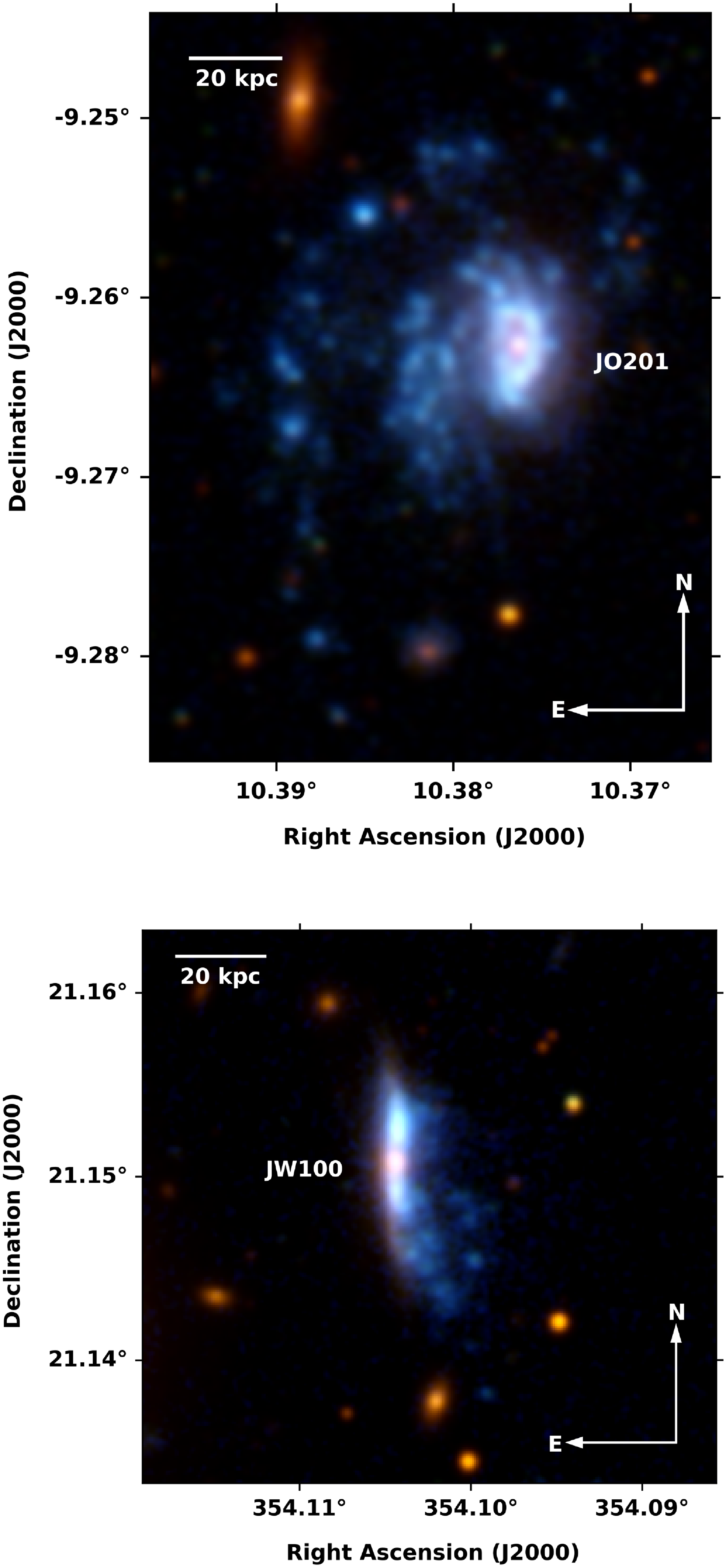
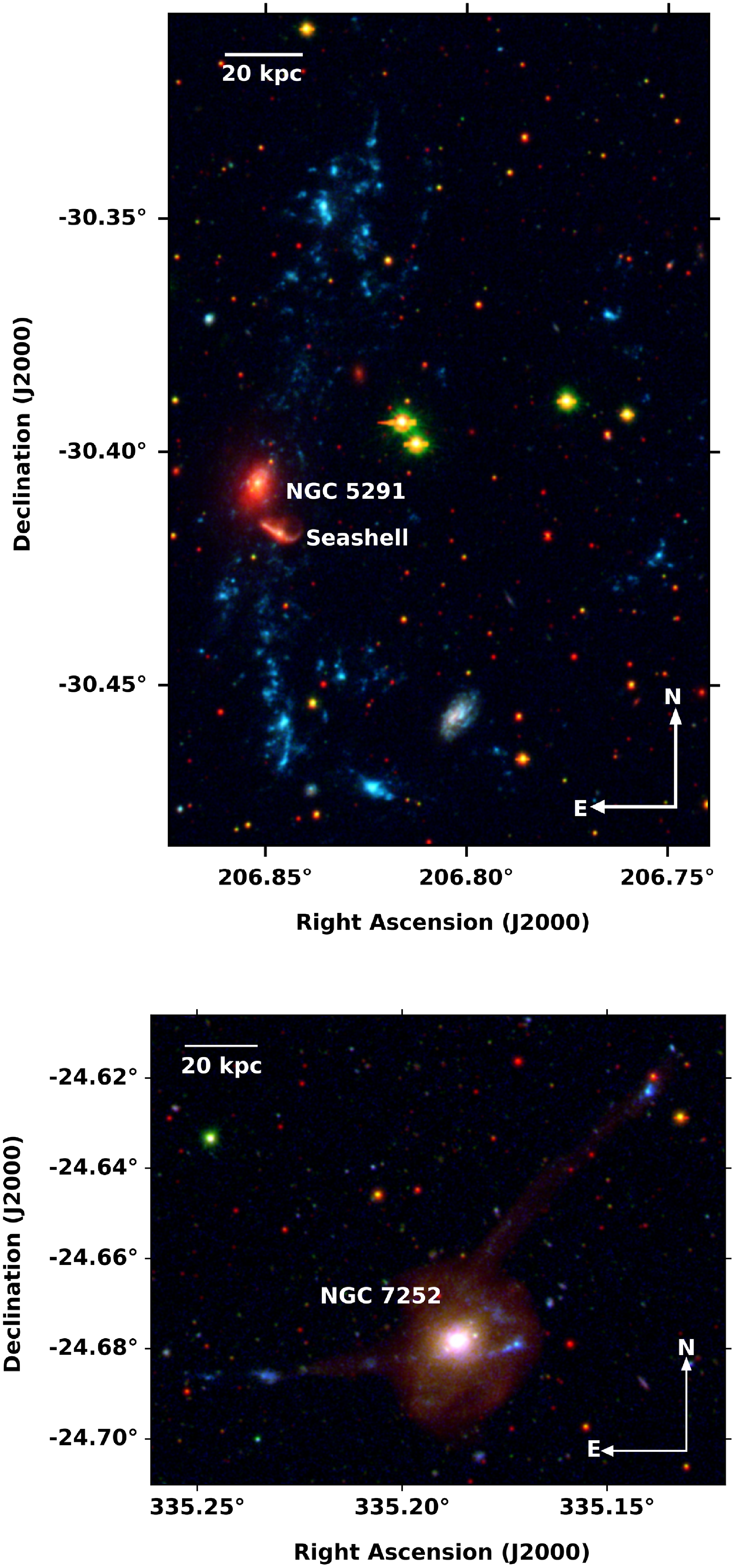
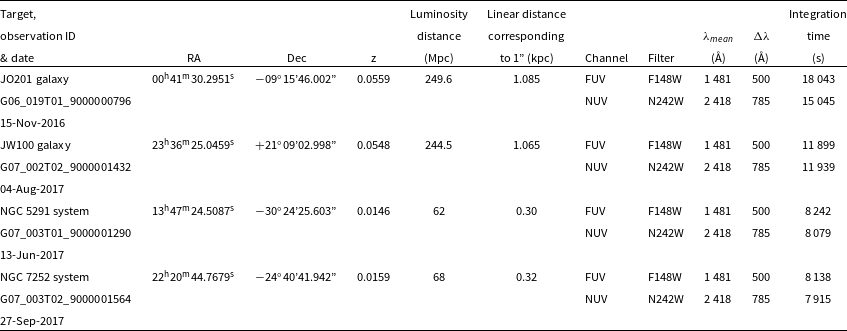
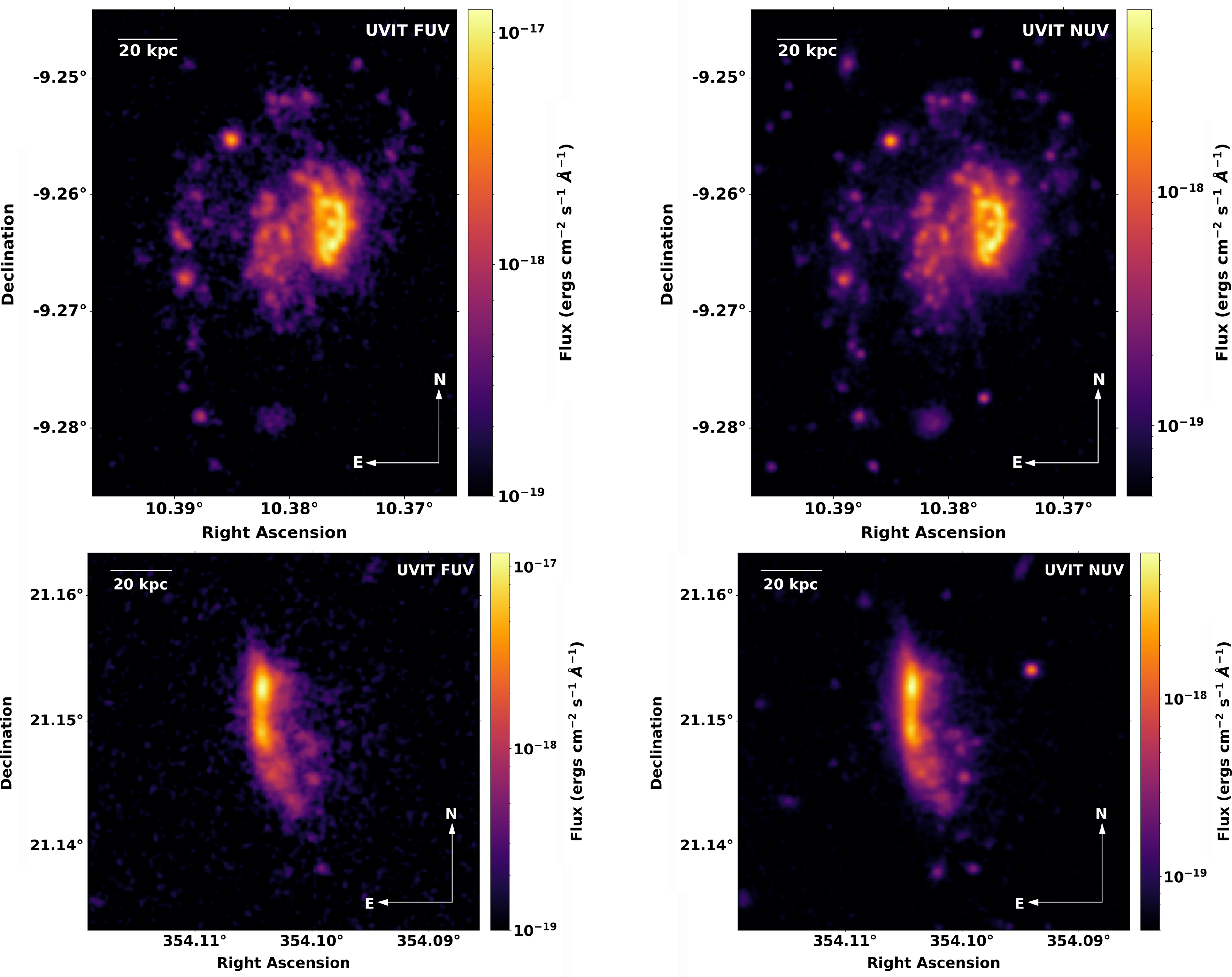
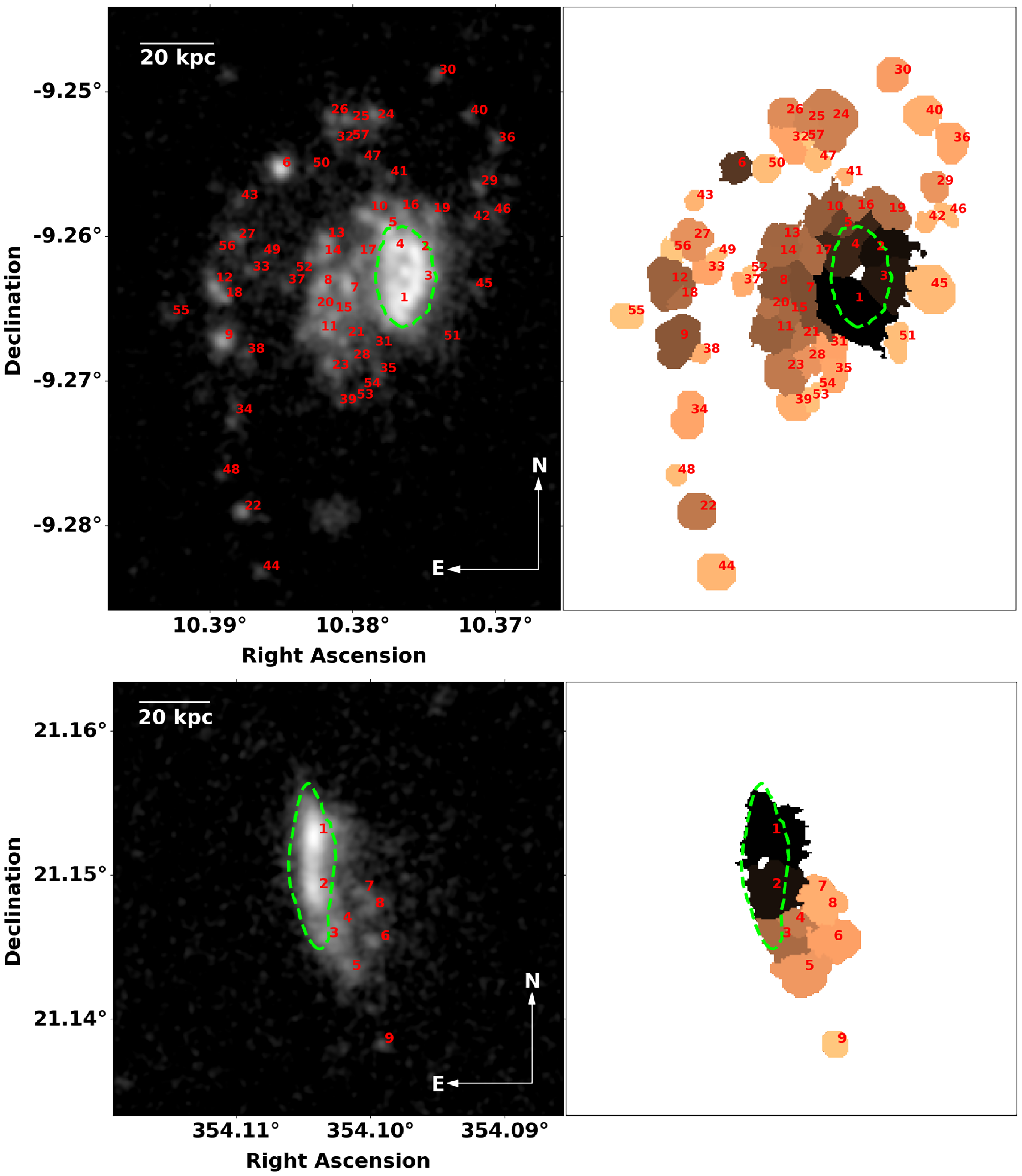

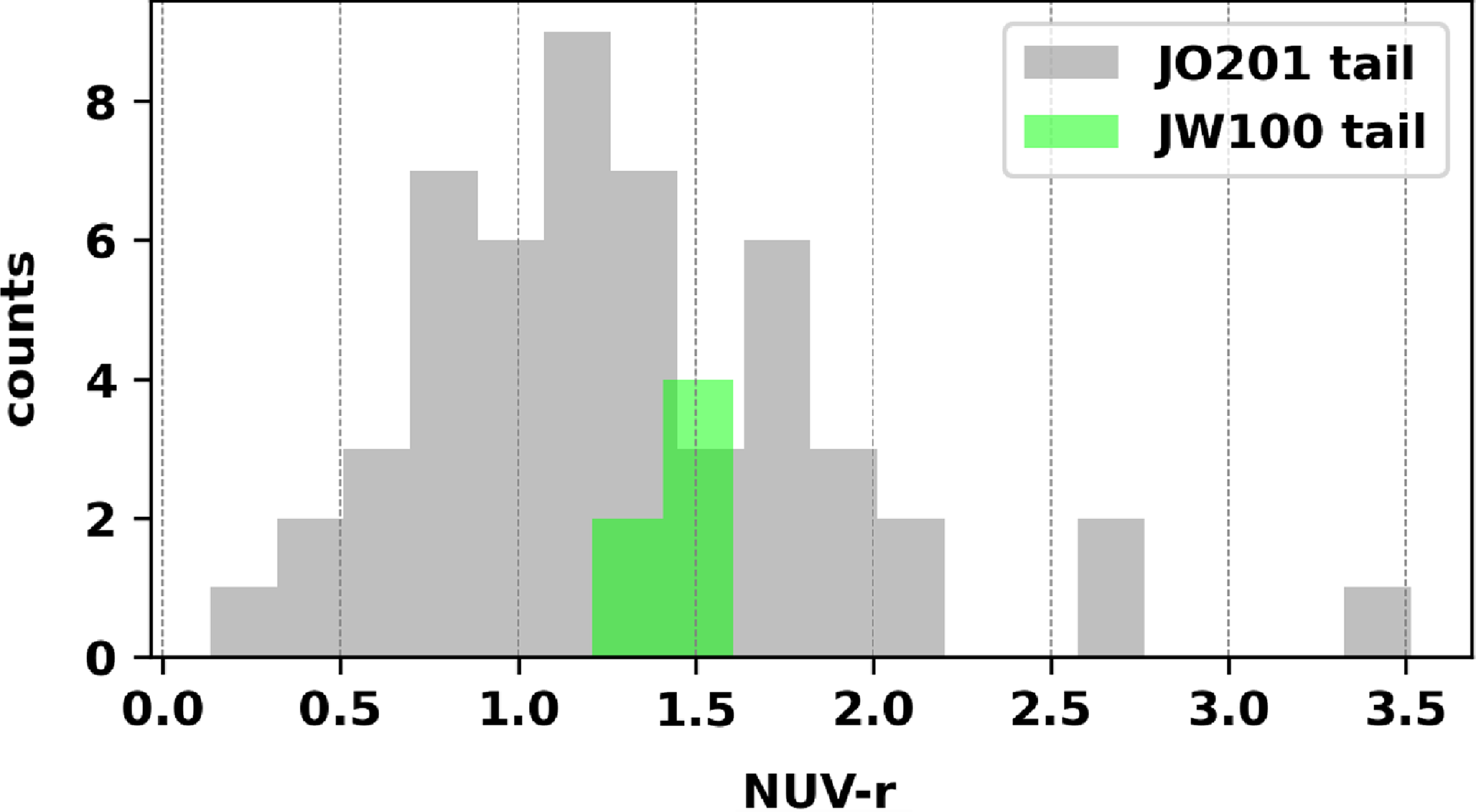
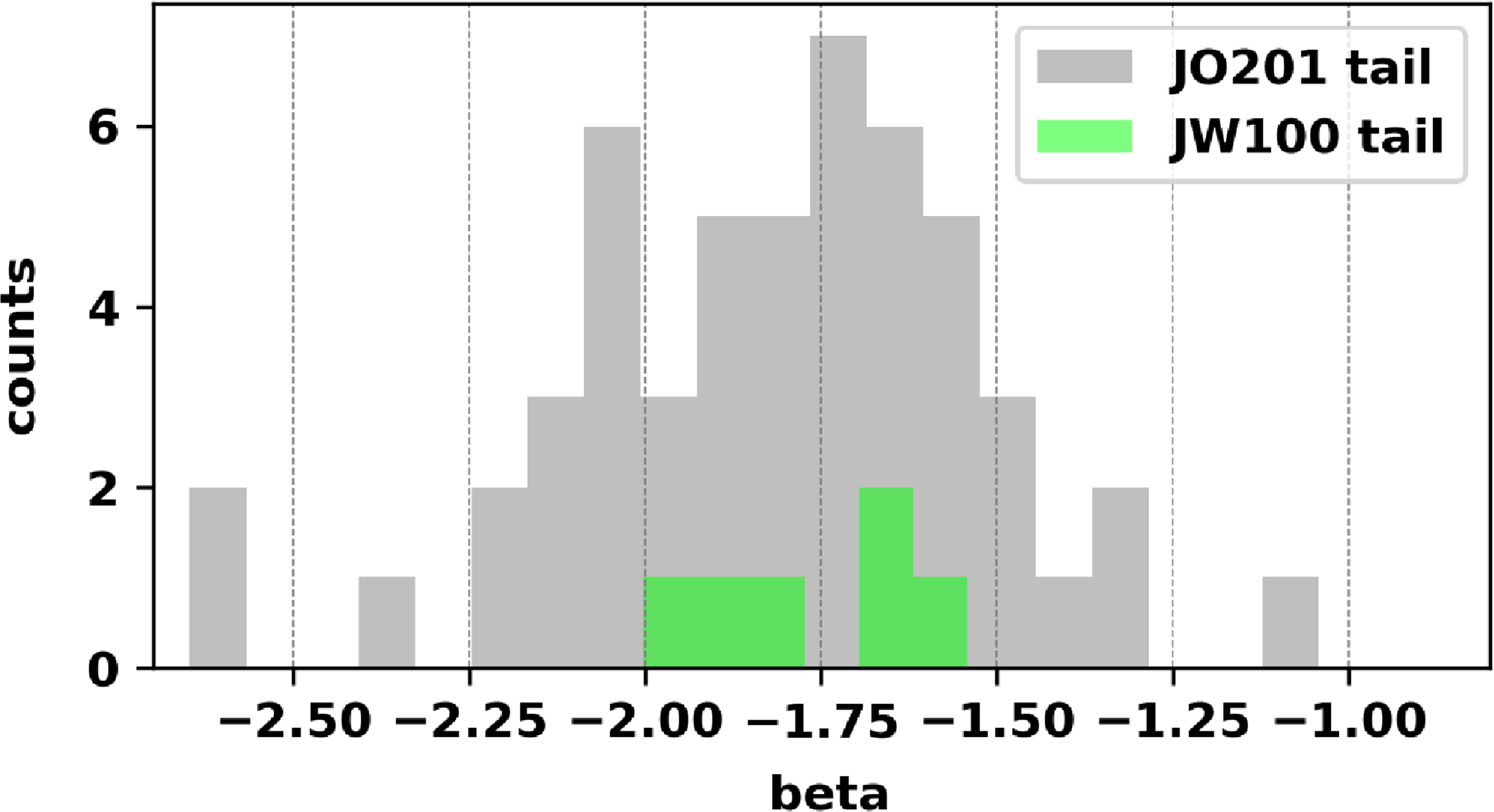

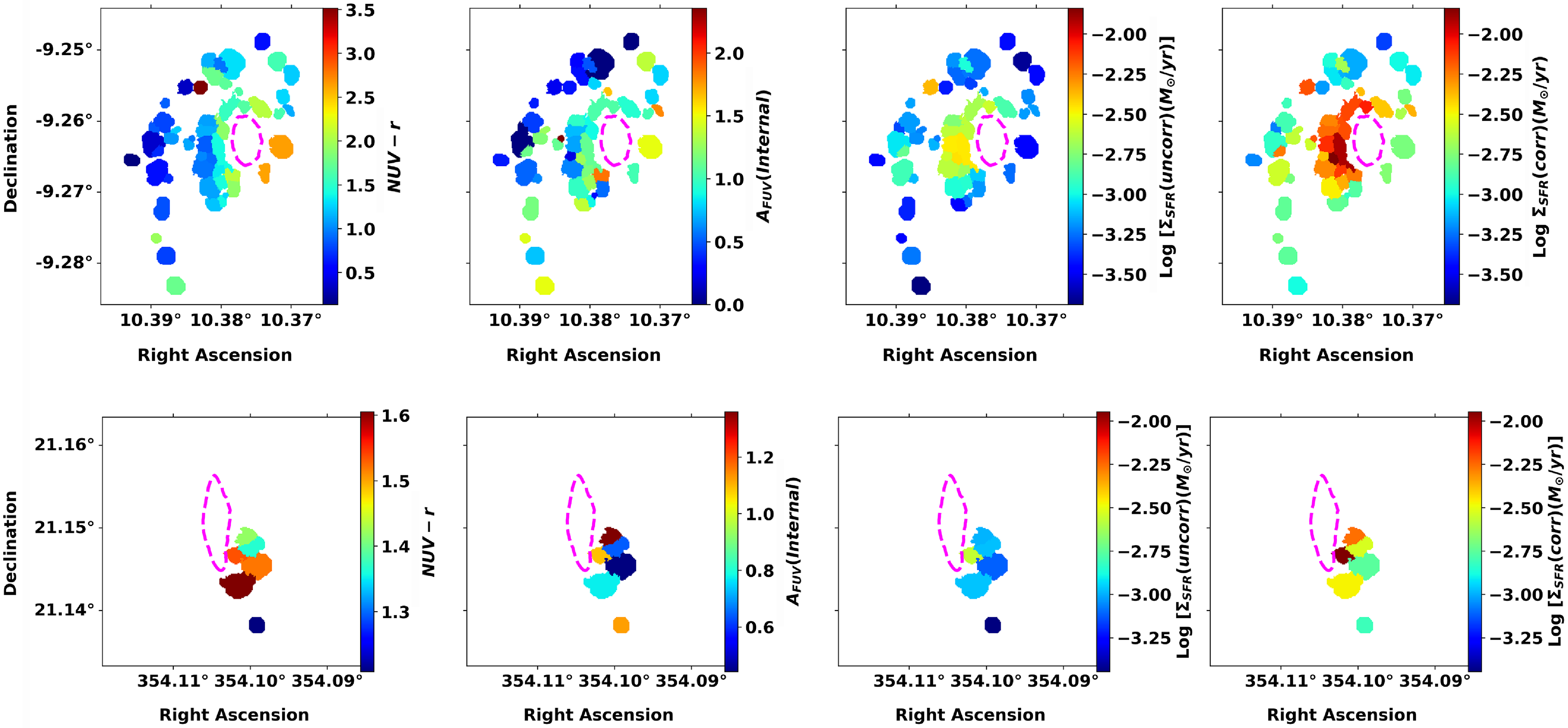
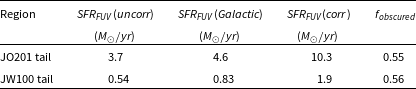

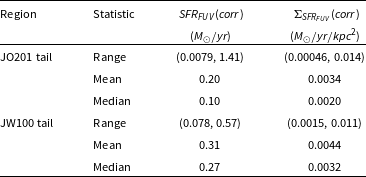


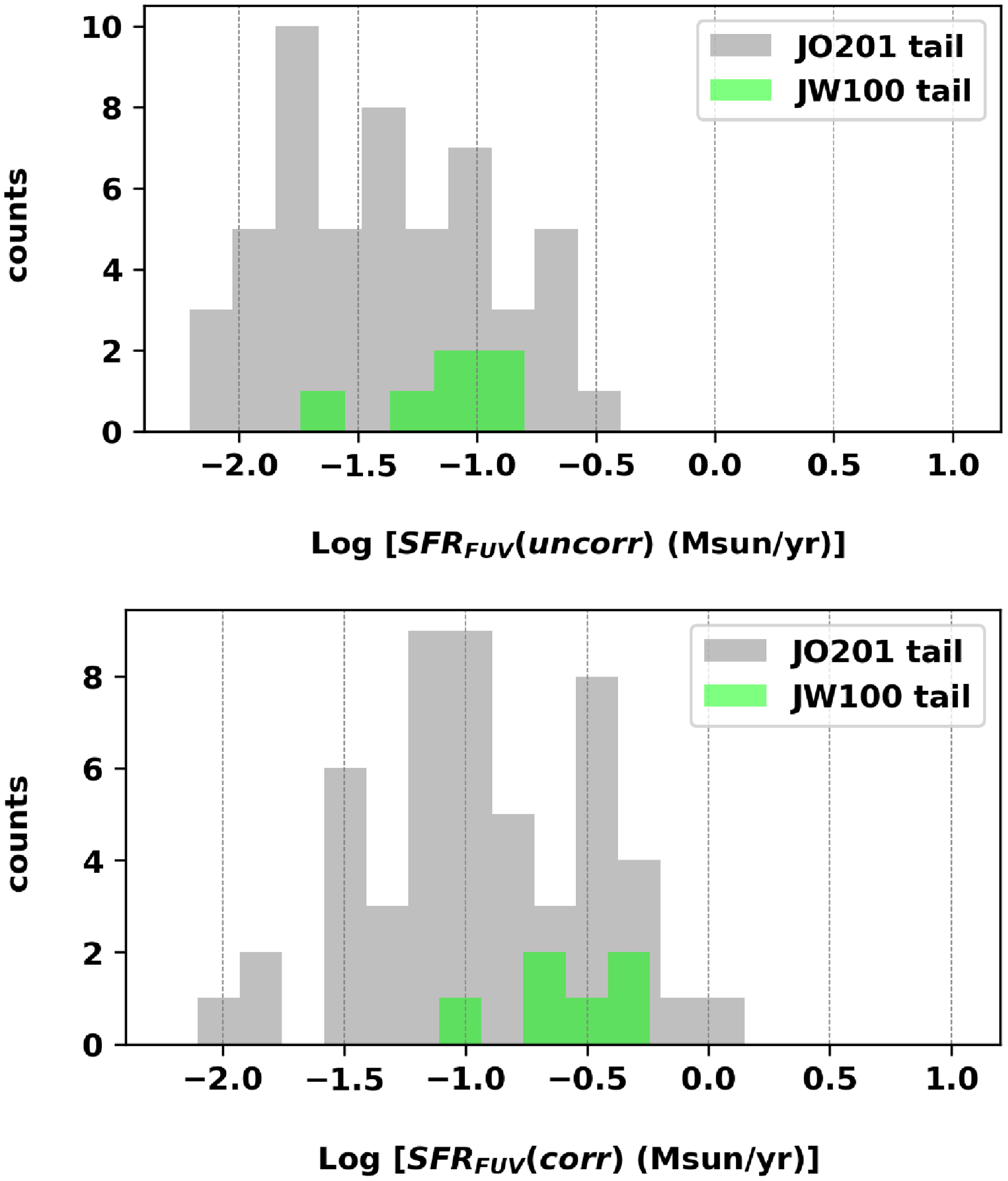


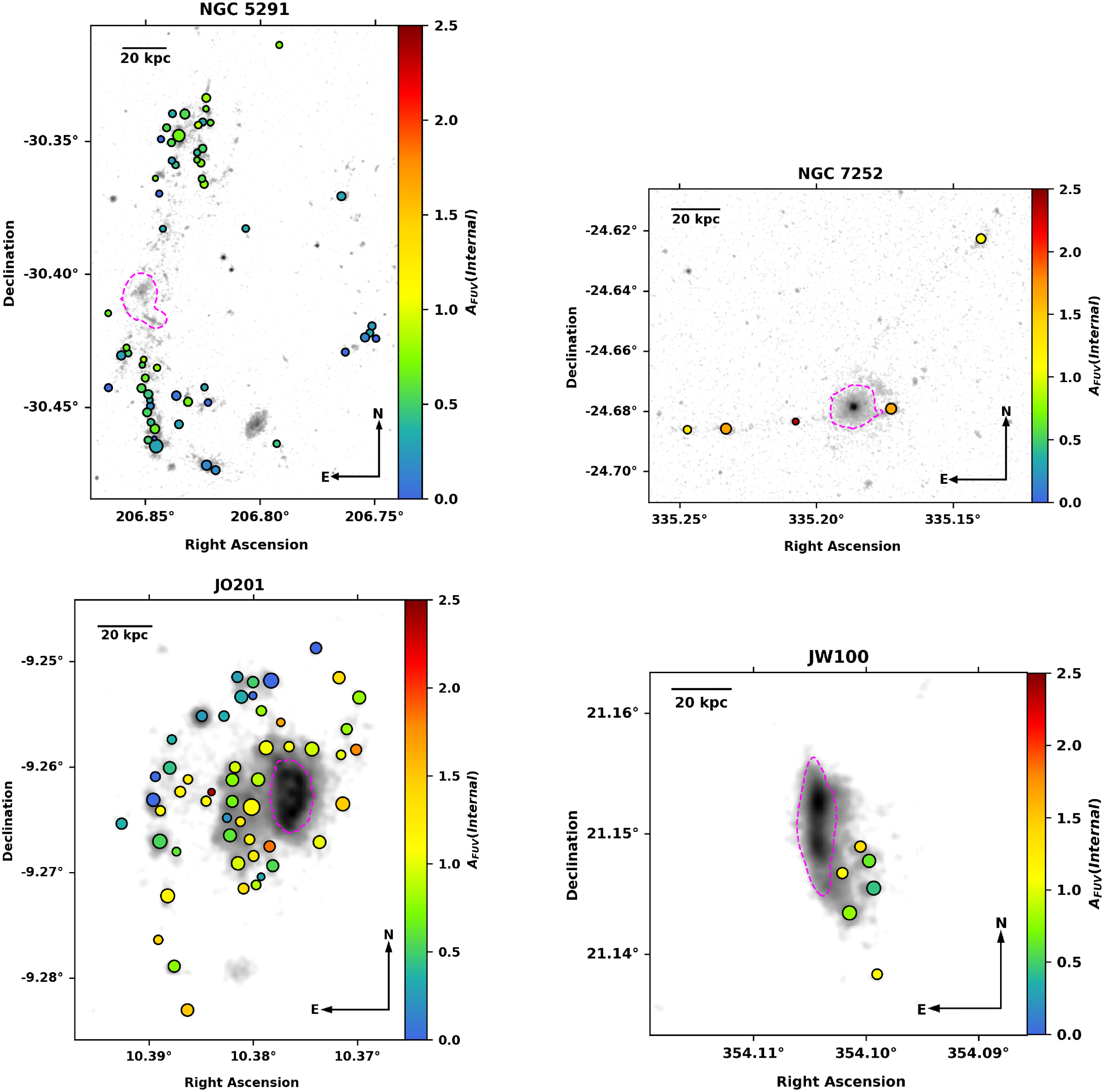

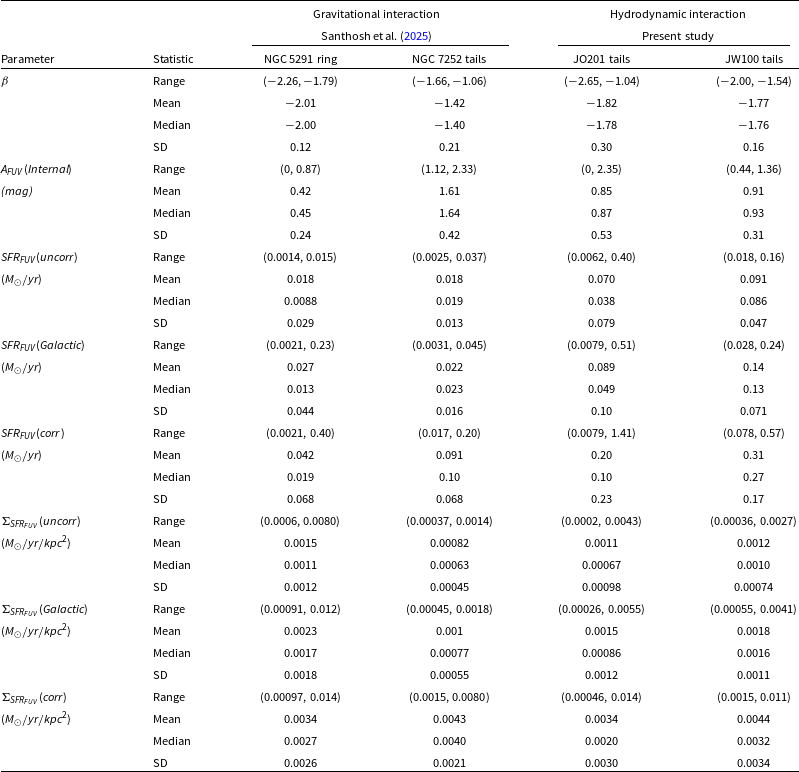
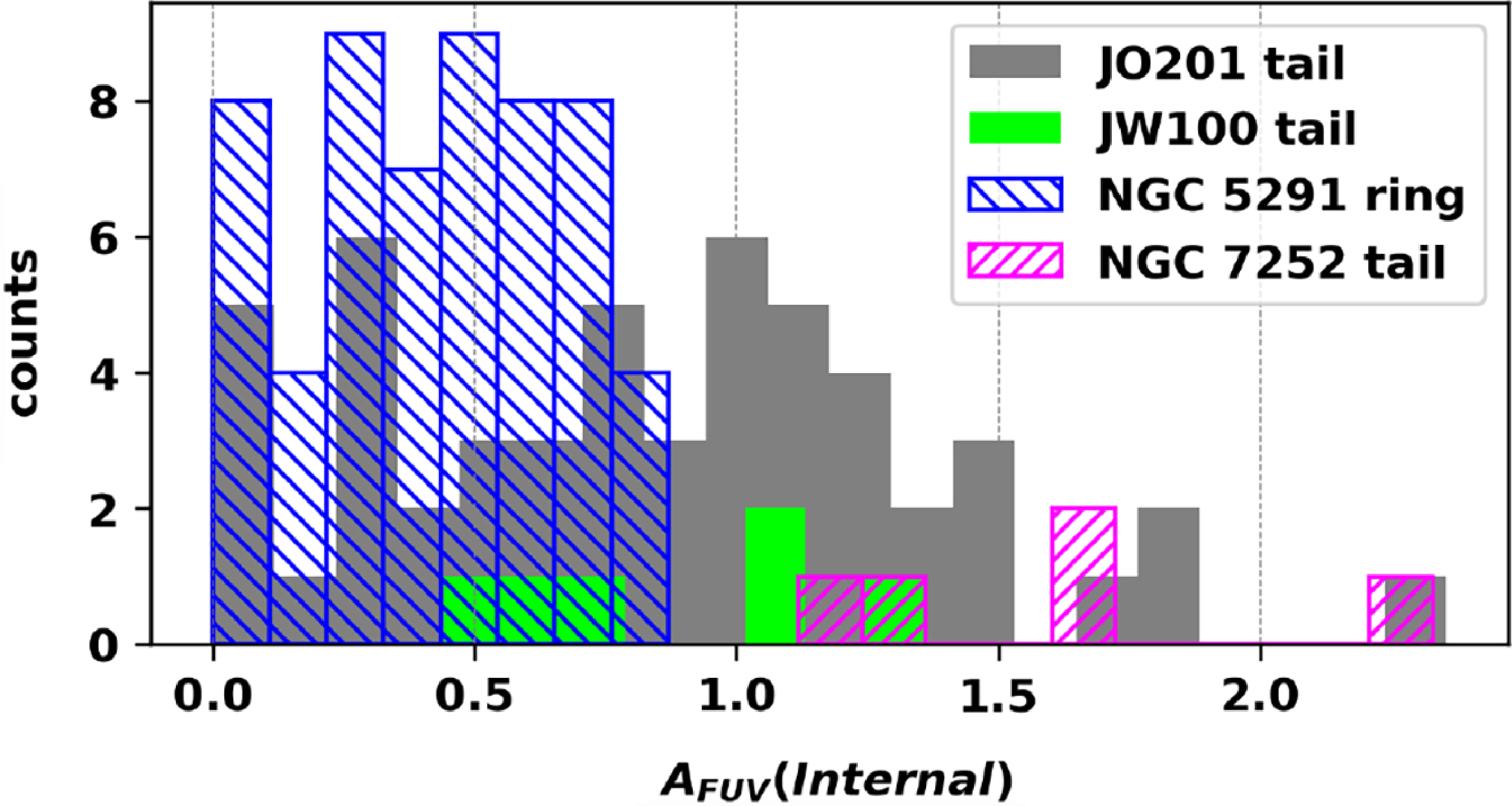

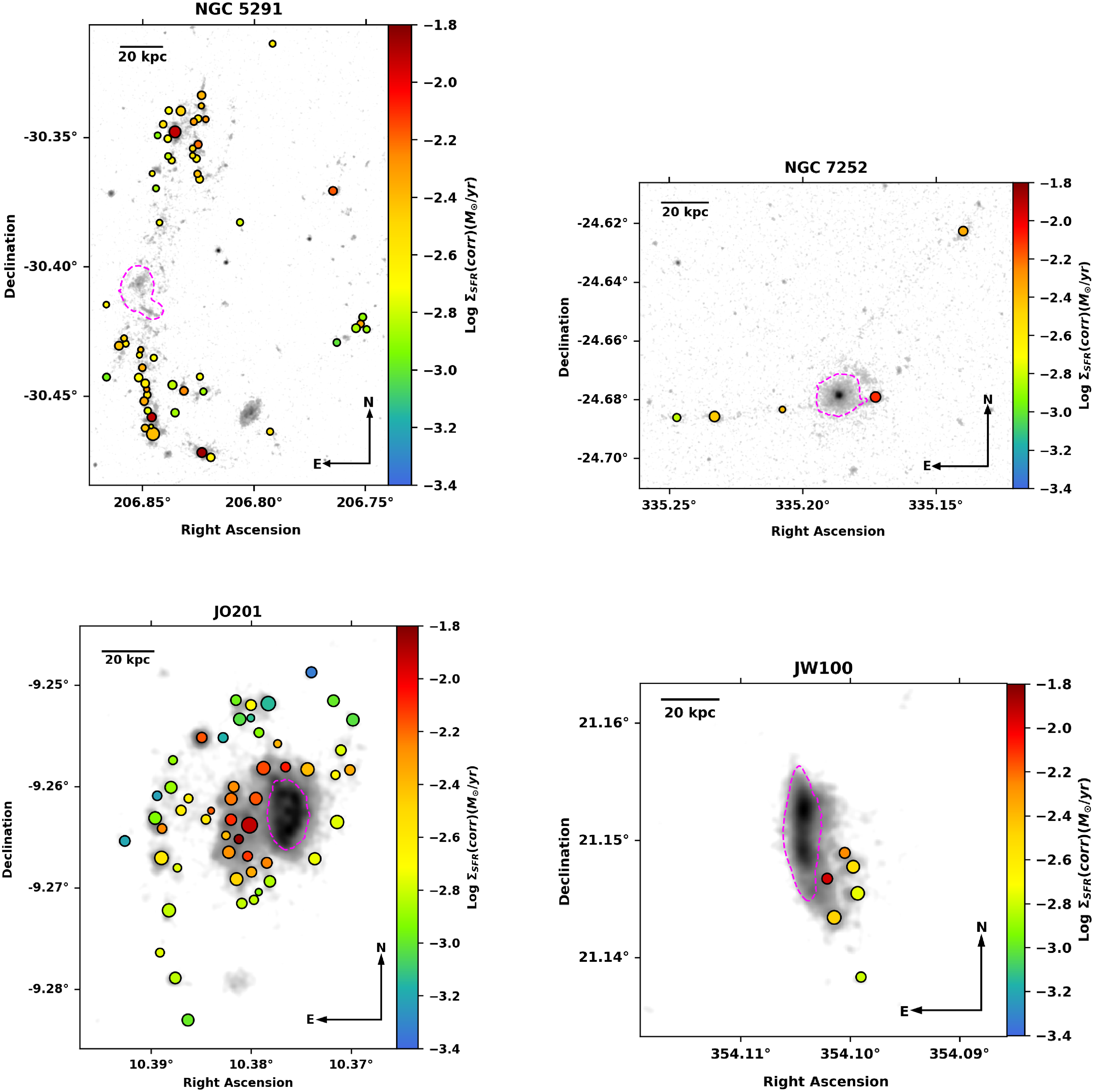

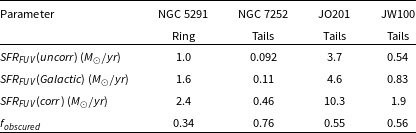

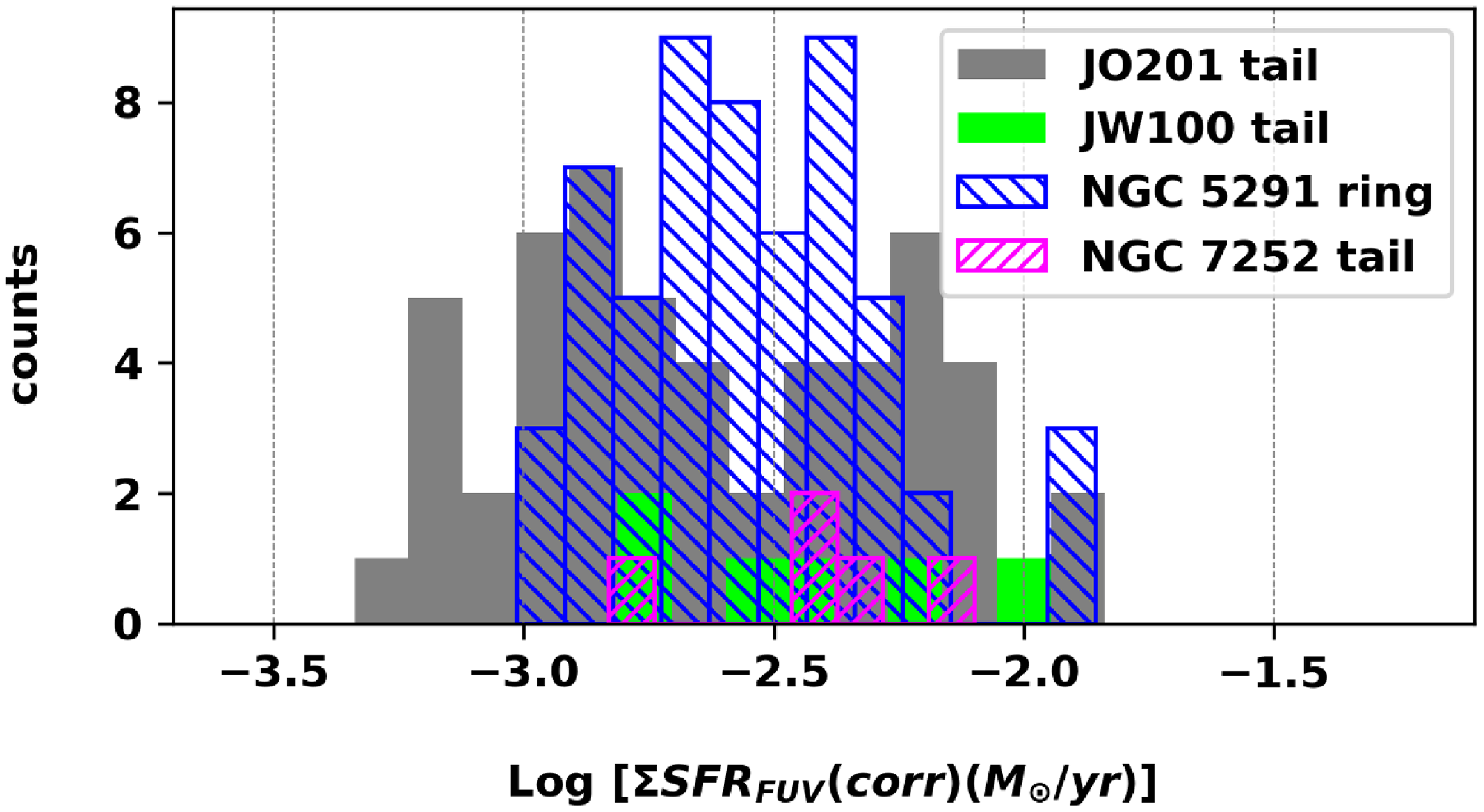


 Open access

