

Thirty years after the passage of the Native American Graves Protection and Repatriation Act (NAGPRA), many institutions have not fulfilled their legal requirement to repatriate Ancestors and cultural items. The lack of NAGPRA progress made by institutions, including universities, agencies, and museums, has compounded the ongoing curation crisis (Childs and Benden Reference Childs and Benden2017; Thompson et al. Reference Thompson, Thompson, Garland, Butler, deBeaubien, Panther and Hunt2023). As academic institutions increasingly comply with NAGPRA and attempt to uphold the “moral imperatives” to care for Ancestors and cultural items until they are returned, they must often create NAGPRA programs that are constrained by funding and lack of compliance education (Beisaw and Duus Reference Beisaw and Duus2016; Luby and Nelson Reference Luby and Nelson2008; Wheeler et al. Reference Wheeler, Arsenault and Taylor2022:9). Laboratories and museums that have prioritized a process such as descendant community–informed institutional integrity (DCIII), which redistributes authority and builds collaborative relationships beyond compliance, have successfully shifted from “what ‘must be done’ to what ‘should be done’” (Thompson et al. Reference Thompson, Thompson, Garland, Butler, deBeaubien, Panther and Hunt2023:237).
Institutions frequently hire part-time student employees to balance permanent staff workloads on NAGPRA teams; however, lack of transparency about student involvement may be problematic for descendant or source communities. As employees of institutions of higher education and NAGPRA practitioners, we are accountable to multiple stakeholders, including Tribal partners, university administrators, and our students. This article addresses the ethical and practical challenges of employing individuals with student status to perform tasks associated with NAGPRA and provides a model for doing so in consultation with Tribal partners. Employing student workers is a rewarding way to train the next generation of archaeologists about NAGPRA, collections stewardship, and the ethics of working with descendant communities. Student employees are also a practical solution for NAGPRA programs that need cost-effective support that aligns with university goals of experiential training and professionalization.
NAGPRA in a Higher Educational Context
Institutions of research and higher education are obligated to teach students to become professionals; however, student training cannot be prioritized over legal and ethical concerns associated with museum collections that are subject to NAGPRA. While some academics fear losing access to teaching collections, NAGPRA compliance is an opportunity to train future archaeologists in ethical collections care. Many museums have developed more collaborative exhibitions, holistic understandings of Indigenous communities past and present, respectful curation practices, and innovative student research projects through NAGPRA compliance (Teeter et al. Reference Teeter, Martinez and Lippert2021).
The Act and its regulations divide collections between what Wheeler and colleagues (Reference Wheeler, Arsenault and Taylor2022) call NAGPRA / not NAGPRA. When it comes to student learning, collections designated as “not NAGPRA” have functioned as teaching collections to train student workers to identify cultural items in the field or lab. Yet the NAGPRA / not NAGPRA designation reinforces the idea that institutions have the final say about access to, and the use of, Native American cultural items (Wheeler et al. Reference Wheeler, Arsenault and Taylor2022). This is especially problematic considering the questionable origins of many archaeological teaching collections (Shannon Reference Shannon2017). Successfully training students to be archaeologists and NAGPRA professionals requires supervisors to implement and model decolonized collection care practices that are inclusive of Indigenous voices and reduce harm to Ancestors and cultural items. However, a lack of transparency about student involvement in the NAGPRA process is problematic.
While NAGPRA has been a legal obligation for over 30 years, anthropology programs have minimally emphasized student education about the Act and its regulations. Programs such as the National Science Foundation–funded “Learning NAGPRA” initiative at Indiana University (IU) Bloomington are rare, and specialized programs such as the Wenner-Gren–funded Intensive NAGPRA Summer Training and Education Program (INSTEP), sponsored by IU and the University of Illinois Urbana-Champaign, and courses offered by the Center of Collections Care at Beloit College (C3) and the National Preservation Institute are financially out of reach for many students (though each of these offers scholarships, and C3 offers online options). NAGPRA-focused internships, such as those offered by the Mississippi Department of Archives and History and by the Alabama Department of Archives and History, may train an additional small number of students each year. Though focused NAGPRA training for students is limited, providing students with hands-on experience through Tribal Nation–approved, supervised work is essential for training the next generation of archaeologists. Therefore, we provide the following recommendations for respectfully integrating students into NAGPRA work (see Figure 1).
Recommendations for incorporating NAGPRA student workers.

This article includes recommendations for hiring, training, and supervising students as members of NAGPRA teams. We have broken our suggestions into five steps to integrate students into NAGPRA work: Consultation, University HR/Policy Check, Interview/Hiring Process, Onboarding/Training, and Supervised work. In doing so, we recognize the challenges of limited funding, lack of institutional will, and the necessity of stretching small-budget NAGPRA grants but argue that institutions should only hire employees with student status if the conditions of employment are fair, healthy, and compliant with NAGPRA and workplace law. Though we focus on the realities of managing student labor at institutions of higher learning, our recommendations will be useful for all institutions that hire student volunteers or interns.
Step 1: Consult about Student Participation in NAGPRA Work
According to the NAGPRA Code of Federal Regulations (CFR), museums (including government agencies and institutions of higher learning) are required to consult with lineal descendants, Indian Tribes (hereafter Tribal Nations), and Native Hawaiian Organizations (NHO) about the storage, treatment, and handling of human remains and cultural items (43 CFR 10.1[d]). They must also obtain consent for NAGPRA collections access. We suggest that these duty of care provisions also require institutions to consult about who stores, treats, handles, and accesses collections, particularly whether student employees are involved. Allowing student employees to handle or access collections that may contain human remains or cultural items necessitates exchange of information, discussion, and joint deliberations between institutional representatives, lineal descendants, Tribal Nations, and NHO. University personnel seeking to hire student employees for compliance assistance therefore begins with consultation under the duty of care provisions.
Suggested Methods
• When considering adding student employees to your team, invite consultation early on. Be sure to describe the specific goal of the consultation—in this case the roles of student employees—and request input on the desired mode of consultation (e.g., phone, virtual conferencing, in-person meetings) and availability. Invitations to consult should be delivered to the appropriate representative at each invited Tribal Nation, which can often be located on the official Tribal government website and shared via one or more of the modes required under the regulations (43 CFR 10.1[e]).
• Obtain consent from your Tribal Nation partners for the institutional plan to access collections and hire student employees. When requesting consent, present a clear and comprehensive plan that describes the timeline for collections access, what specific actions will be taken upon access (e.g., cataloging, checking faunal material, etc.), and who will access collections, including student employees (see Table 1). Explain your intention and rationale for using student labor, including specific tasks that you envision students performing. If your university requires a position description, solicitation, or other announcement, share the draft text with consultation partners.
• We acknowledge that there may be Tribal Nations who object to the use of student workers. This objection must be addressed in consultation and then within your institution. Through consultation, you can discuss specific tasks that may be appropriate for students that will assist NAGPRA supervisors, without having students work on the more sensitive aspects of the process. If Tribal Nation partners express reservations or object to student workers accessing collections that may contain cultural items, then we suggest limiting student work to document digitization or drafting summaries or descriptions of holdings for consultation.
Checklist of Questions for Consultation about Hiring Student Employees.

Step 2: Aligning University HR/Policy Check with NAGPRA Work
The daily realities of NAGPRA work may present new scenarios to supervisors of student employees. Supervisors will need to consider how to align human resource policies for hiring and managing student employees with the anticipated realities of NAGPRA work. NAGPRA work affects our mental health, no matter how remote a collections management task may seem from direct compliance. Mental health support is especially critical for student employees, who are often removed from family support structures, experiencing precarity, and navigating identity formation as new or early career professionals.
Suggested Methods
• Prepare a student employee handbook that conveys relevant human resource policy, including reporting structures (e.g., Ombudsman, Civil Rights and Title IX Offices, NAGPRA Committee).
• Individuals qualified to work in museum or laboratory environments are skilled laborers, regardless of student status. They should be paid in accordance with institutional, local, and state rates for fair pay; they should conduct work in safe environments as per the Occupational Safety and Health Administration; the number of hours they work should reflect both institutional and employee needs. It may be necessary to compensate graduate student employees via assistantships that cover tuition and health insurance, as they hold especially precarious positions in the university economy.
• Research mental health resources on campus. These may include student support programs and courses that can increase supervisor competency to understand mental health risks. Remain cognizant of the potential for workplace harassment, especially where other faculty and staff are barriers to NAGPRA compliance. Finally, seek institutional policy or programs about gender-affirming language to convey accommodations for traditional knowledge about appropriate treatment of Ancestors and cultural items based on gender or sex.
Step 3: Interview/Hiring Process
The interview and hiring process for student employees of NAGPRA teams should mirror the interview and hiring process for other professionals at the institution but with special considerations for student status and NAGPRA work. Students qualified to join a NAGPRA team will likely have an educational background in anthropology or archaeology, as well as the emotional maturity necessary for working with sensitive issues. In our experience, it is also helpful to employ students who can commit to at least six months to a year of employment. This way, NAGPRA supervisors can invest in training individuals who are serious about NAGPRA work and reduce the time commitment associated with constant employee turnover.
Suggested Methods
• Write a job description that prioritizes students with a background in anthropology or archaeology and the emotional maturity to be a part of a NAGPRA program. Include a brief explanation of NAGPRA and a specific list of duties, to ensure that students are aware of the sensitive nature of the task at hand. Duties that could be listed on the job advertisement might include review of archaeological collection boxes, artifact identification, crafting inventories, sorting and rehousing cultural items, review of documents, and lab or museum upkeep. Some classes that would be helpful to prepare students for this work include introductions to anthropology and archaeology, collections and curation, field methods, artifact identification, and osteology.
• During the interview, assess the student’s ability to successfully complete the required tasks necessary to do NAGPRA work and the ability to reframe their approach to archaeology and collections care. Students being considered for NAGPRA teams should recognize that while they may have their own beliefs associated with death, we are working with the Ancestors of people who also have their own understanding of the physical and spiritual process of death. While they don’t need to be an expert on NAGPRA, they do need to understand the emotional toll and history of trauma that comes with this work.
• Have an honest conversation about the NAGPRA history and status of your institution during the interview. While you should not disclose sensitive information about your holdings or information that Tribal Nation representatives have shared with you, modeling transparency and honesty with students is a teachable moment. Typically, this conversation will disclose to a student the current compliance status of the university and an overview of the timeline and goals of the NAGPRA team as related to repatriation efforts. Warn students who are considering employment in your lab if Ancestors are present. This way they can prepare themselves emotionally or spiritually for working in a space that houses Ancestors.
Step 4: Onboarding/Training Student Employees
Students hired on NAGPRA teams should be required to complete training in cultural sensitivity, NAGPRA, and specific institutional policies and procedures. For example, the University of Georgia Laboratory of Archaeology has students watch a lecture series that discusses archaeological practice with Tribal Nation perspectives included (Thompson et al. Reference Thompson, Thompson, Garland, Butler, deBeaubien, Panther and Hunt2023). Training that incorporates information on cultural sensitivity will educate students about components of NAGPRA that go beyond legal understanding. We suggest a variety of topics to support student success in the NAGPRA team.
Suggested Methods
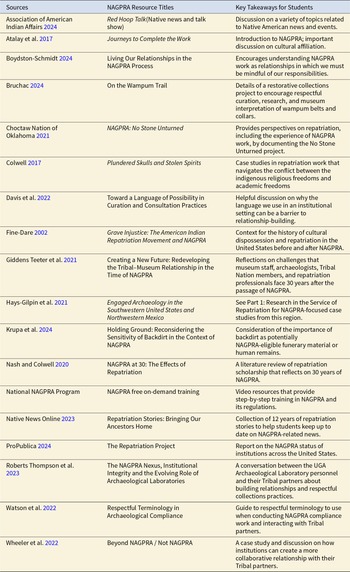
• Include institutional policies and procedures, a description of the collection and its history, NAGPRA law, and Tribal Nation histories. We recommend resources created by NAGPRA Comics, including Journeys to Complete the Work, as a starting point for student employees (Atalay et al. Reference Atalay, Shannon and Swogger2017). The National NAGPRA Program has a variety of lecture series available on their website and YouTube channel that take a step-by-step approach to teaching NAGPRA and its regulations (see Table 2 for more resources). To instruct students on Tribal Nation histories, include archaeological research articles or books, along with resources shared by Tribal Nation representatives.
• If it is necessary to teach a student about artifact identification, take care that no Ancestors or cultural items are included in student training, and that institutions look to the duty of care requirements (43 CFR 10.1[d]) and consultation for guidance. Regardless of student involvement in archaeology labs and collections, institutions should also conduct a thorough review of their teaching or type collections for NAGPRA items.
• Remain available to continue student training beyond the lectures and video and text resources. A lot of NAGPRA training, as well as instruction on collections care, occurs on the job. There are many teachable moments that occur day to day, when we encounter challenges associated with legacy collections. Students will learn to be critical thinkers, adaptable and resourceful, as they review holdings that do not meet curation standards or comply with NAGPRA.
NAGPRA Resources for Training Student Workers.

Step 5: Assigning Appropriate Tasks for Student Employees on NAGPRA Teams
Students working in museums and archaeology labs will possess different levels of experience and qualifications. The coordinator or supervisor will need to create a clear division of labor based on student strengths and task sensitivity. Depending on institutional needs and Tribal Nation preferences identified in Step 1, the supervisor can adjust the level of student involvement in NAGPRA compliance. They may also need to work directly with undergraduate student employees on most tasks and closely review any independent student work once it is completed.
Suggested Methods
• Assign students collection care tasks such as creating and updating inventories and catalog records, flagging boxes that need further review (e.g., unconfirmed faunal remains), and reviewing teaching collections for cultural items that were not previously included in summaries and inventories.
• Students can be very helpful in organizing and digitizing paper records. Scanning resources for the NAGPRA coordinator to review, summarize, and to send to Tribal Nations is a way for students to learn what kinds of information can help establish cultural affiliation.
Case Studies: Employing Student Workers on NAGPRA Teams
Auburn University at Montgomery (AUM)
At AUM, we are transparent about who makes up our NAGPRA staff, which is currently a NAGPRA coordinator and anywhere from two to four student workers. Our Tribal Nation partners were consulted about their comfort level with students assisting with different tasks in our archaeology lab. We also asked for input on resources or training activities for student workers. In the lab, there is a clear division of labor between coordinator and student tasks. Students assist me with tasks such as inventorying cultural items that are not Ancestors, digitizing records, and general collections management. During their interview, we look for understanding of the ethical significance of the law and its regulations. We ask questions such as, “Why do you think NAGPRA compliance is important for universities?” “How do you think Indigenous peoples are impacted by the lack of compliance with NAGPRA law and regulations?” and “Why is cultural sensitivity training important in archaeology?”
AUM’s Archaeology Lab primarily employs undergraduate students. Typically, we hire students that have the maturity necessary for NAGPRA work and have at least one year left at the university. This way, we can invest the necessary time in training the student. We begin with readings and resources related to archaeology and NAGPRA. We include other resources monthly to keep students engaged with the broader context of NAGPRA, its importance, and developments in the field. Students will locate, summarize, and digitize files related to NAGPRA sites on their own; however, inventorying collections is completed with the NAGPRA coordinator, so that if we find a previously unidentified Ancestor during our review, the coordinator can handle the situation appropriately.
South Carolina Institute of Archaeology and Anthropology (SCIAA)
SCIAA is also transparent with Tribal Nation partners about hiring students on the NAGPRA team. Before duty of care provisions were introduced in the recent regulatory revision, we discussed this ad hoc, but in the future will include the “who” of NAGPRA work during consultations. We typically hire three graduate students and three or four undergraduates. Graduate students must have prior experience of collections care, identification of archaeological materials, and NAGPRA. Undergraduates must have taken archaeological lab analysis and, preferably, osteology courses.
When onboarding students, we hold a team meeting to describe the workplace and set expectations. We ensure student employees understand what kinds of cultural items they may encounter in collections and cover protocols that honor Native American traditional knowledge (e.g., specialized handling or treatment of NAGPRA-eligible cultural items that may be discovered in collections). For undergraduate students new to NAGPRA, we assign articles from Table 2 and the NAGPRA: No Stone Unturned video created by the Choctaw Nation of Oklahoma Historic Preservation Department (Choctaw Nation of Oklahoma 2021).
We clearly distinguish between the responsibilities of the NAGPRA coordinator and the expectations of graduate and undergraduate students. Undergraduate students catalog collections of interest to Tribal Nations by entering information such as material and context into spreadsheets and replacing defective housing (e.g., bags, boxes) when encountered. Graduate students supervise undergraduate employees, and locate, pull, and replace collections in the state curation facility. We hold separate meetings with graduate student team leaders to discuss their supervisory responsibilities and check in regarding team morale.
Conclusions
In this article, we propose a five-step model to successfully and respectfully integrate students into a NAGPRA team. This process should begin in consultation with Tribal Nation partners to express your institution’s intention for student workers and receive their recommendations. Consultation then should complement and inform the interview and hiring process. This inclusive and transparent approach to student hiring also provides a model for training and supervision of students in your facility. As NAGPRA supervisors, it is our legal and ethical responsibility to safeguard the Ancestors and cultural items under our care, and our staff. We should follow university and Tribal Nation policies and recommendations for hiring and training. Once student employees are hired, we should provide resources to protect their physical and emotional well-being. Just as Tribal Nation partners should be continually informed about the NAGPRA practices and progress of an institution, supervisors should also be honest with students about their institution’s history with NAGPRA compliance, and relationships with Tribal Nations.
Consultation and transparency are key to developing trusting, effective relationships between museums, universities, and collections facilities and the people they interact with. The relationships extend to Tribal Nation partners, faculty, staff, students, and the broader community. We can begin to mend the trauma of the past by training future archaeologists to be respectful and collaborative caretakers of archaeological collections.
Acknowledgments
This article was inspired by the authors’ presentations from the “In Search of Solutions: Exploring Pathways to Repatriation for NAGPRA Practitioners” sessions (NAGPRA Day at the SAA) at the 89th Annual Meeting of the Society for American Archaeology in New Orleans. The authors would like to thank all of the sponsors and individuals who participated in that day’s success. We would also like to acknowledge the AUM and SCIAA student workers who have shown a passion for NAGPRA work and assisted us through the repatriation process.
Funding Statement
This research received no specific grant funding from any funding agency, commercial, or not-for-profit sectors.
Data Availability Statement
No original data appear in this article.
Competing Interests
The authors declare none.



 Open access

