





INTRODUCTION
In the last quarter of the 1st mil. BC to first half of the 1st mil. AD, the modern Altai Republic represented the periphery of the nomadic empires of the Xiongnu, Xianbei, and Rouran. The available sources do not make it possible to unequivocally state whether the region was an actual part of these major political entities, however, there is no doubt that the Altai population experienced significant influence from them. This was most clearly manifested in the appearance of the material culture—many types of objects found in these peripheral archaeological sites (weapons, costume elements, jewelry, horse harnesses) are associated with the material culture of Xiongnu and Xianbei. Furthermore, global political changes in the centre of empires inevitably affected the outskirts, particularly in the form of infiltrations of individual groups of nomads. The Great Migration Period (GMP) represents one of the most famous examples of such processes.
The main source for studying the history of Altai during the GMP is the results of archaeological excavations of the sites. In Altai, the GMP is represented by the single Bulan-Koby archaeological culture (2nd c. BC–5th c. AD). To date, more than 800 burials, considered within the framework of the Bulan-Koby, have been analysed in the region (e.g., Mamadakov Reference Mamadakov1990; Soenov Reference Soenov2003; Seregin and Matrenin Reference Seregin and Matrenin2016). The current state of knowledge of this community suggests its ethnic heterogeneity is due to the participation of local and foreign groups in its formation. The materials from archaeological excavations demonstrate a pronounced originality in the ritual practices of individual pastoralist groups (in particular, the existence of at least eight funerary traditions) and a significant heterogeneity in the anthropological appearance of the population. From available data, the emergence and development of the Bulan-Koby culture is associated with the dominant influence of nomads who were not directly genetically related to the preceding Pazyryk culture of the Scythian-Saka period (the second half of the 6th–3rd c. BC; Tishkin Reference Tishkin2007). The incorporation of the Altai territory into the area of influence of the Central Asian nomadic empires of the last quarter of the 1st mil. BC–the first half of the 1st mil. AD had a significant effect on the development of material and spiritual culture, military affairs, socio-political organization, and life sustaining system of the population of the region. Further historical significance of the pastoralists of the Bulan-Koby culture lay in the fact that some of the groups who practiced burial with a horse, took an active part in the formation of a community of early medieval Turks, who in the middle of the 6th c. founded the First Turkic Khaganate (Seregin and Matrenin Reference Seregin and Matrenin2016).
Research by different scientific centers has accumulated considerable experience in the interpretation of the monuments of the Bulan-Koby culture. At the same time, the lack of a coherent chronology of the sites remains the key problem. This lack of robust absolute chronologies is generally characteristic of the archaeological sites and cultures of the Altai-Sayan region and adjacent territories of the GMP. Until now, the dating of objects of this period is based on archaeological methods. The available radiocarbon (14C) dates of Altai sites (Tishkin Reference Tishkin2007:175–179; Konstantinov et al. Reference Konstantinov, Soenov, Trifanova and Svyatko2018: Table 1; Seregin et al. Reference Seregin, Matrenin and Svyatko2020; etc.), Tuva (Sadykov et al. Reference Sadykov, Caspari, Blochin, Lösch, Kapinus and Milella2021: Table 1–2), and Khakassia (Zaitseva et al. Reference Zaitseva, Pankova, Vasiliev, Dergachev, Scott, Sementsov, Jungner and Sonninen2009; Pankova et al. Reference Pankova, Makarov, Simpson and Cartwright2021; Tarasov et al. Reference Tarasov, Pankova, Long, Leipe, Kalinina, Panteleev, Brand, Kyzlasov and Wagner2022; etc.) are rather fragmentary and only draw a picture for individual complexes. Thus, the systematic building of absolute chronologies for the monuments on the periphery of nomadic empires remains a matter for future research.
AMS 14C dates, calibrated and modeled ages of humans from burials of the Bulan-Koby culture in the Karban-I necropolis.

Kurgans of the Bulan-Koby culture of the Karban-I necropolis, presence of chronological indicators, and calibrated age ranges for the dated samples.
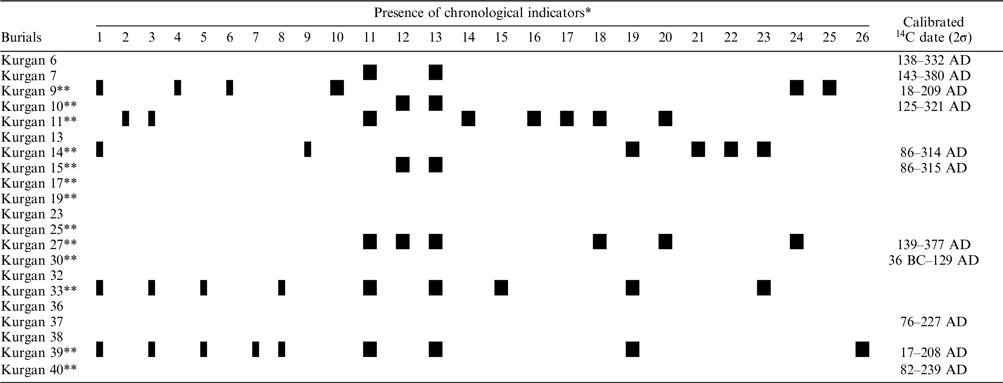
* The numbers refer to (also see the supplemental materials): 1–multi-compound bow with long median lateral crescent-shaped linings; 2–multi-compound bow with median lateral bow-shaped linings; 3–iron long-bladed knife with a straight and inclined handle; 4–iron dagger with straight grip without quillon with an oval-shaped wooden pommel; 5–iron tiered arrowheads with a small upper tier; 6–iron tiered arrowhead with even tiers without stopper; 7, 8–iron three-bladed arrowheads with asymmetrical-rhombic and rhombic body without stopper; 9–iron armor-piercing three-bladed arrowhead of pentagonal shape without stopper; 10–belt buckle with moving pin, equipped with an elongated-rectangular frame and a laminar shield in the form of open-ring plaque, quadrangular in terms of the shape of shortened proportions; 11–iron belt plaques-linings of sub-rectangular and rectangular shapes of different sizes, with a pin fastening; 12–iron rosette-shaped plaque-lining with a pin fastening; 13–iron open-ring plaques-linings with a moving ring; 14–bronze ringed earrings; 15–bronze braid piece; 16–bronze pendants; 17–bronze “tip-pendant” made of a plate folded into a tube with a cut spoon-shaped front edge; 18–bone “tip-pendant” of spoon-shaped type; 19–iron “block” in the form of a ring; 20–iron “block” of round-trapezoidal shape; 21–bone arrowhead with a body diamond-shaped in cross-section and clamping socket; 22–bone arrowhead with a body diamond-shaped in cross-section and protruding solid barrel-shaped whistler socket; 23–bone arrowheads with attached bone whistlers; 24–multifaceted and lens-shaped arrowheads triangular form with curved in barbs; 25–bone arrowhead with a body diamond-shaped in cross-section and leaf-like in contour; 26–iron adze with an open socket, smoothly transforming into a blade with an expanding arcuate edge.
** Kurgans contain associated artifacts representing objects not as precisely dated by archaeological methods, yet dating to after the 1st c. AD.
Archaeological excavations of the Bulan-Koby culture sites in Altai provide ample opportunities and materials for the purposeful implementation of a program of absolute dating due to a number of factors:
-
1. a significant number of excavated objects, including fully investigated complexes;
-
2. the undisturbed nature of the majority of the burials;
-
3. representative accompanying material recorded in the graves;
-
4. the possibility of using various materials for the analysis (anthropological and zoological remains, funerary structures and various wooden objects) with the subsequent correlation of the results;
-
5. the possibility of establishing the micro-chronology of burial grounds consisting of a large number of burials;
-
6. multiple cases of extension of superficial burial structures, clearly demonstrating the sequence of the burials.
As such, there is a strong potential for detailing the overall chronology of the Bulan-Koby complexes, as well as for determining the phases within the previously outlined stages of the development of this community. In particular, there is a possibility of clarification of the time of construction of individual GMP necropolises, many of which have traditionally been considered as “reference” sites, but virtually none have yet been published or 14C dated.
This article presents an attempt to establish the chronology of the GMP (i.e., Bulan-Koby culture) objects of the Karban-I necropolis based on correlation of AMS 14C data from human remains with data from archaeological dating methods. This is the first undertaking of such a combined targeted 14C and archaeological approach to the chronology of the GMP materials of northern Altai, and in particular the Bulan-Koby culture.
Site and Sampling: the Necropolis of Karban-I
The archaeological complex of Karban-I is located on the left bank of the Katun River, 1.7 km north-west from the village of Kuyus, Chemal District of the Altai Republic (Figure 1). The site was discovered during exploration work in 1983 by M. T. Abdulganeev (Abdulganeev Reference Abdulganeev1985). In 1989–1990, the expedition of the Barnaul State Pedagogical Institute (presently Altai State Pedagogical University) led by M. A. Demin excavated more than 40 burial mounds (kurgans) of various chronological periods on the site. Of these, 22 belonged to the Bulan-Koby archaeological culture (based on above-ground and internal burial structures, burial rite and the associated grave goods; see description below), with the rest of them dating to the early Scythian period (i.e., 8th–7th c. BC).
Location map and plan of the Karban-I archaeological site in the Altai region of Southern Siberia. The map is based on Shchukina (Reference Shchukina2005).

Burial mounds of the GMP (Bulan-Koby culture) are found in the northern part of Karban-I. They represented compactly localized stone mounds, lined up in several rows in the latitudinal direction. In some cases it was possible to identify an addition, or extension, of kurgan mounds relative to each other, reflecting the building sequence of the ground structures. It has been suggested that kurgan 39 was added to (i.e., built later than) kurgan 40, and kurgan 6 was added to kurgan 7. Yet, apart from the latter, the overall planigraphy and stratigraphy of the site (Figure 1) do not allow making clear observations on the relative chronology of its individual mounds. The recorded features of structures (a mound with an oval-shaped crepidoma masonry, shallow burial pit, stone cist) and inhumation method (a single inhumation on the back, head in the western sector of the horizon, without an accompanying burial of a horse; Figure 2:1,2) allow them to be attributed to the “Karban” tradition of ritual practice, the representatives of which were one of the largest groups of nomads in the Northern Altai during the GMP (Seregin and Matrenin Reference Seregin and Matrenin2016:159–160).
The Karban-I necropolis: funeral rite (1, 2), selected finds (3–10—iron and bone arrowheads, 11—fragment of a lash, 12–19—ornaments, 20–22—iron buckles), and reconstruction of the belt set from kurgan 11 (23).

Overall, the site of Karban-I reflects a cross-section of the history of a particular group within the broader Bulan-Koby community. The materials obtained during excavations proved informative for studying various aspects of the history and lifestyle of this GMP population of Altai, such as material culture, social and military aspects. In particular, based on the analysis of anthropological materials, a case of armed violence, which resulted from the interaction of local nomads with a foreign group, has been identified (Seregin et al. Reference Seregin, Demin, Matrenin and Tur2022a).
The majority of the burial mounds of the Bulan-Koby culture in the Karban-I archaeological complex were undisturbed and contained accompanying grave goods suitable for establishing their relative chronology (Figure 2:3–23). During the excavations, items of weaponry (5 bows, 15 iron arrowheads, 4 combat knives, a dagger), equipment (15 belt buckles, 38 belt metal plaques, 8 “blocks,” 2 “pendant-end pieces,” a piercing end, and a bone clasp), ornaments (6 plaques-patches of different materials, 2 earrings, 2 braids, 2 pendants, torc, 43 beads, and a pendant from a fish vertebra), tools (26 bone arrowheads, 4 knives, 5 awls, 2 whip handles, an adze, and a whetstone), and household utensils (ceramic vessel) have been found. The burial rite of the Bulan-Koby group interred in Karan-I, however, did not include placing of animal remains into the graves.
METHODS
The chronological analysis of objects of the Karban-I necropolis was carried out in several stages:
-
1. Morphological analysis of the grave goods from burials and their comparison with dated analogies from archaeological sites of Central and North Asia from the last quarter of the 1st mil. BC to the first half of the 1st millennium AD, including complexes of the Bulan-Koby culture of Altai. This is aimed at identifying artifacts with an established initial date of existence in Altai (i.e., chronological indicators).
-
2. After the morphological identification of the finds, the analysis of the mutual occurrence of chronologically indicative items among them for individual burials, and intercomparison of the results with other burial mounds of the necropolis. Such analysis requires screening of objects which were used throughout particular periods of the existence of the culture, ideally for no more than two phases of its chronology (Sharov Reference Sharov1992:164). The “narrow” archaeological dates can be defined “when all the components of the complex coexisted, i.e., between the beginning of use of the latest objects and the end of the existence of the earliest ones” (Shchukin Reference Shchukin1978:29–30).
-
3. The first two stages represent a rather convenient approach in archaeological dating, yet are not always exercised in Central and Northern Asian contexts.
-
4. AMS radiocarbon dating of a series of samples from burials of the Karban-I complex. In the absence of definite chronological indicators (such as coins), 14C analysis will provide absolute chronological markers, thus verifying and detailing the relative archaeological (i.e., essentially based on the system of analogies) dating of the site, and possibly narrowing the wide chronology based on the analysis of the material culture.
-
5. Comparison of the results from the analysis of artifacts and 14C dating. The importance of the correlation of the results from various lines of chronological evidence (analyses) essentially inherently increases the accuracy of the overall results and verifies them.
From the Bulan-Koby graves of Karban-1, only human remains were available for the AMS 14C analysis, and each of the preserved adult individuals (n = 11) was sampled. No other organic matter was preserved or available for sampling.
AMS 14C dating of human bone remains was carried out in 14CHRONO Centre for Climate, the Environment, and Chronology (Queen’s University Belfast, UK) using the Ionplus Mini Carbon Dating System (MICADAS). Sample pretreatment and the 14C analysis was carried out following the laboratory protocols and procedures presented in Reimer et al. (Reference Reimer, Hoper, McDonald, Reimer, Svyatko and Thompson2015). Collagen extraction was based on the ultrafiltration method (Brown et al. Reference Brown, Nelson, Vogel and Southon1988; Bronk Ramsey et al. Reference Bronk Ramsey, Higham, Bowles and Hedges2004), which included the following: (a) bone demineralization in 2% HCl, followed by MilliQ® ultrapure water wash; (b) gelatinization in pH=2 HCl at 58°C for 16 hr; (c) filtration, using ceramic filter holders, glass filter flasks and 1.2 µm glass microfiber filters; (d) ultrafiltration using Vivaspin® 15S ultrafilters with MWCO 30 kDa; 3000–3500 rpm for 30 min; and (e) freeze-drying. The dried collagen was stored in a desiccator.
About 1.0 mg of dry collagen samples were weighed into precleaned tin capsules and combusted in oxygen with a helium carrier gas in an Elemental Analyser (Elementar Vario Isotope), and then transferred to the AGE3 automated graphite system where they were reduced to graphite using the hydrogen reduction method (Wacker et al. Reference Wacker, Němec and Bourquin2010). Graphite was pressed into vacuum cleaned aluminium holders (targets) using an automated hydraulic press, transferred to the magazine, and loaded into the MICADAS AMS together with background (blank) samples, namely anthracite and mammoth bone.
The 14C/12C and 13C/12C ratios were measured with the MICADAS. The sample 14C/12C ratio was background corrected and normalzed to the HOXII standard (SRM 4990C; National Institute of Standards and Technology). The 14C/12C ratio was corrected for isotope fractionation using the AMS measured δ13C which accounts for both natural and machine fractionation. The dates were calibrated using Calib8.1 program (http://calib.org/calib/) and IntCal20 calibration curve (Reimer et al. Reference Reimer, Austin, Bard and Blackwell2020).
Statistical and Bayesian modeling was conducted using OxCal 4.4 (Bronk Ramsey Reference Bronk Ramsey2009a, using Phase, Sequence, First, Last, and Span functions for modeling) with the IntCal20 dataset (Reimer et al. Reference Reimer, Austin, Bard and Blackwell2020). Outlier analysis was carried out using both χ2-tests (Ward and Wilson Reference Ward and Wilson1978) and Outlier_Model function in OxCal 4.4 (Bronk Ramsey Reference Bronk Ramsey2009b). For modeling of sequences and phases a uniform phase model (distribution) is used as the underlying prior (Bronk Ramsey Reference Bronk Ramsey2009a). This is used as an exploratory and interpretative tool for the current work and does not exclude the possibility that another underlying distribution may better reflect the reality for the site. Modeling also used archaeological based priors that suggest Kurgan 40 preceded Kurgan 39, and Kurgan 7 preceded Kurgan 6.
RESULTS
AMS 14C Dating
For the AMS 14C dating, the best-preserved bone fragments from 11 adult individuals were selected (Table 1 and Figure 3). The results overall confirm the expected dating of the site based on material culture, and they show a continuous use of the site, with the earliest date from 36 BC to 129 AD (UBA-45831, kurgan 30) and the latest from 143–380 AD (UBA-45817, kurgan 7). Atomic C:N ratios for all samples were 3.2.
Bayesian model for the Bulan-Koby burials of Karban-I. Priors used: (a) a uniform phase; (b) Kurgan 40 predates Kurgan 39; (c) Kurgan 7 predates Kurgan 6.

The modeled results for Karban-I are presented in Figures 3 and 4. Under the assumption of a uniform phase, it can be observed that the posterior probability distributions (dark gray) are significantly refined with respect to the prior distributions (light gray, Figure 3). The modeled First and Last results, representative of the dates of the earliest and latest modeled events at the site (Figure 4a,b), allow for dated activity at the site from 81 cal. AD to 335 cal. AD. The duration (Span) of the site may have been up to 227 years (Figure 4c).
Modeled First (a), Last (b), and Span (c) results for the Bulan-Koby burials of Karban-I. First and Last correspond to the dates of the earliest and latest modeled events of the site.

Analysis of Archaeological Materials
To date, the chronology of the archaeological sites of Altai and the adjacent territories of the “Hunno-Sarmatian” time is based mainly on determining the time of use of specific types of objects originating from burial complexes. The accumulated experience of studying different groups of finds, including the identification of the most representative artifacts, has been widely presented (Gorbunov Reference Gorbunov2006; Matrenin Reference Matrenin2017; and others).
In the process of the analysis of materials from Karban-I, the main attention was paid to the determination of chronologically indicative categories of funerary items based on the analysis of analogies from the archaeological sites of Central, Inner and North Asia of the end of the 1st mil. BC to first half of the 1st mil. AD. In essence, all identified 26 chronologically indicative objects are represented by four groups of items, each including items with various chronological attribution:
-
1. Weaponry. Among them, complex bows date from the 2nd c. BC–3rd c. AD, and they appear as almost a complete copy of samples from the Xiongnu complexes of Mongolia and Transbaikalia, as well as sets of local modifications characteristic of the 2nd–5th c. AD (Konovalov Reference Konovalov1976: Tables III–V; Hudyakov Reference Hudyakov1986: Figure 3.-1–7; Gorbunov Reference Gorbunov2006:16–17; etc.). To the Xiongnu military tradition are also attributed tanged three-bladed tiered arrowheads, which are dated to the 2nd–5th c. AD (Gorbunov Reference Gorbunov2006:29, 38, Figure 23.-4, 24). A discovered iron dagger is associated with the blades of the Kushan-Yuezhi tradition and can be dated to no earlier than the end of the 1st c. AD. Other categories of weapons (combat knives, various types of arrowheads) are widely represented in the military arsenals of the Altai nomads of the 2nd–5th c. AD, and also have analogies in the Xianbei monuments of Central Asia.
-
2. Belt sets (n = 16). Most of these represent local processing by the Bulan-Koby cultural communities of copies of Xiongnu and Xianbei equipment and have an initial period of existence in the Altai of no earlier than the 2nd c. AD (Seregin et al. Reference Seregin, Demin and Matrenin2022b). The rare composition of the parts of the belt sets may indicate that they existed for a relatively short period, within the 2nd to first half of the 3rd c. AD.
-
3. Ornaments. Ringed earrings, widespread in Central Asia among the Xianbei (late 1st–early 3rd c. AD), and also known among the population of Tuva (late 1st–4th c. AD) and the Middle Yenisei (2nd–3rd c. AD; Vadetskaya Reference Vadetskaya1999; Figure 16.-26–28; 65; Table 8.-4; Yaremchuk Reference Yaremchuk2005:101, Figure 114.-6–7, 14–15, 25; Savinov et al. Reference Savinov, Dluzhnevskaja, Ovchinnikova and Lazarevskaja2010:61, 65; and others). The appearance of these objects in Altai apparently dates to the period of not earlier than the 2nd c. AD, and it reflects the influence of the cultural traditions of one of the ethnic groups of the northern Xianbei, whereas decorative bronze objects in the form of bronze braid pieces and pendants were an element of the costume of the Bulan-Koby culture population of the Northern and Central Altai in the 2nd–5th c. AD (Trifanova and Soenov Reference Trifanova and Soenov2019:49–52, 74, Figure 23-24; 27.-15-17).
-
4. Bone arrowheads (Seregin et al. Reference Seregin, Demin and Matrenin2022c), including both types already known, and specific modifications that do not have exact analogues in Altai. From the available data, such objects are not related to the bone-carving traditions of population of the Pazyryk culture of Altai (6th–3rd c. BC) and reflect local developments that appeared in the Xiongnu (2nd c. BC–1st c. AD) and Xianbei (2nd–first half of the 4th c. AD) time. In general, the bone arrowheads can be attributed to the 2nd–3rd c. AD. The iron adze, dated to the same time, is attributed to the typologically early examples of such artifacts.
The detailed description of each of the 26 chronologically indicative items and their associations is presented in the supplemental materials.
The rest of the grave goods are represented by functional and decorative categories of objects that have a longer period of existence (e.g., several phases throughout the culture), as well as artifacts, the chronological attribution of which cannot yet be unambiguously established based on the typology of available archaeological materials. The dating of these objects generally agrees with the determination of the time of construction of the necropolis after the 1st c. AD.
Table 2 presents all excavated kurgans of Karban-I of the Bulan-Koby culture. The combination of chronoindicators and 14C dates provide reliable dating for the Bulan-Koby section of the site within the 2nd–3rd c. AD.
DISCUSSION
Analysis of different categories of artifactual complexes from Karban-I, with reference to archaeologically dated analogies, forms the basis for the designation of certain “informative” items as chronological indicators (Table 2; Figure SI1). Unfortunately, within the Karban-I materials, as well those from the majority of other sites of the developed stage (2nd–first half of the 4th c. AD) of the Bulan-Koby culture, there are no objects with a reliably established initial date of their manufacture (such as coins, mirrors, silk), which could demonstrate the “terminus post quem” of closed archaeological complexes. Therefore, in this case, chronological indicators are considered to be, not only the artifacts that have been dated with sufficient (archaeological) accuracy or have a direct reference to an absolute chronology elsewhere, but also those that are dated in the process of cross-correlation of mass material (Bazhan and Gay Reference Bazhan and Gay1992:123). Under these conditions, the number of chronoindicators can be quite large, totalling several dozen types of items. Also, chronologically indicative items that are found in single instances at different sites can synchronize materials from these sites (Bazhan and Gay Reference Bazhan and Gay1992:124).
It has been established that most of the chronological markers from Karban-I, occurring as serial finds (presented earlier), had the initial period of existence among the Altai population not earlier than the 2nd c. AD. For some objects, there is a possibility of their appearance in the region in the second half of the 1st c. AD. The end-date of the use of most objects informative for dating the site is conditionally determined by the end of existence of the Bulan-Koby archaeological culture in the region (5th c. AD).
The analysis of the mutual occurrence of chronological indicators in individual burials of the Karban-I necropolis made it possible to identify a group with “reference” objects (kurgans 7, 9, 10, 11, 14, 15, 19, 27, 33, 39), the dating of which was in most cases confirmed by the 14C dating (Tables 1 and 2; Figure 3). In the remaining burials (kurgans 6, 13, 16, 17, 23, 25, 30, 32, 36, 37, 38, 40), there either was no accompanying grave goods, or objects that existed for a longer period or do not have dated analogues recorded within the 2nd c. BC–5th c. AD. The chronology of these burials was established by the 14C analysis of the burial remains, as well as based on information on their relationship to burials with an established archaeological age.
The calibrated AMS 14C dates for the 11 graves of Karban-I suggest a continuous, uninterrupted chronology for the necropolis. These dates span the period from the late 1st c. BC/early 1st c. AD to the late 4th c. AD, Figure 3. However, application of Bayesian modeling and an underlying assumption of a uniform distribution for the site (in effect assuming activity at the site was relatively constant for its duration), help refine the chronology, Figure 3. From this, the earliest activity at the site has a probability distribution of 81–225 cal. AD (95.4%) and the latest dated activity a distribution of 220–269 cal. AD (58%) and 274–335 cal. AD (37.5%), Figure 4:a,b (note also that the start boundary of the Bayesian model produced a distribution of 55–227 cal. AD [95.4%] and the end boundary a distribution of 220–365 cal. AD [95.4%]). Modeling also provides us with an interpretation for the duration of use of the site of 0–227 years (95.4%). These results are consistent or fall within the expected date ranges based on typology or stylistic features described earlier. Indeed, the radiocarbon dates and Bayesian modeling provides a refined chronology for the site that includes dating of burials where chronologically indicative artifacts were absent.
Due to the lack of alternative organic material for the 14C analysis, only human remains were analyzed, and at the moment it is difficult to assess the presence of a freshwater reservoir effect in the region and its potential effect on the resulting 14C dates. From the isotopic data (human δ15N ratios vary between 9.3–10.5‰, unpublished), consumption of freshwater fish is not obvious. This observation is consistent with the available conclusions about the complex economy of the population of the region in the 2nd c. BC–5th c. AD with a clear reliance on stock breeding (small cattle and horses), which is also confirmed by the exceptional sparsity of tools related to fishing in the burials of the Bulan-Koby population (Soenov and Trifanova Reference Soenov and Trifanova2019).
Thus, the correlation of indicators obtained from archaeological dating methods with the results of radiocarbon analysis provides grounds for establishing a plausible time of operation of the Karban-I necropolis within the interval of the 2nd–3rd c. AD, which corresponds to the beginning of the developed stage of the Bulan-Koby culture.
The study demonstrates the high degree of correspondence of dates obtained using archaeological (typological), AMS radiocarbon dating and Bayesian statistical methods. The conclusions clearly suggest the chronological homogeneity (consistency of use) of the site. Taking into account the proximity of the 14C intervals (calibrated dates) for the majority of the dates, homogeneity of the material culture, as well as the overall small number of burials, it is possible to suggest, that this necropolis functioned for a shorter period than the archaeological dating and radiocarbon analysis imply.
In general, there are strong grounds to believe that the Karban-I necropolis currently represents one of the basic, key complexes of the Northern Altai for the beginning of the GMP; its materials could be used to develop a detailed periodization of the Bulan-Koby culture of Altai and chronological interpretation of archaeological sites of the early GMP of other regions of Asia.
CONCLUSIONS
The analysis and interpretation of excavated material from 22 kurgans of the Bulan-Koby culture of the Karban-I complex is important for studying the chronology of the Altai cemeteries of the first half of the 1st mil. AD. The cemetery represents one of few accurately dated sites which mark the beginning of the Great Migration Period in Altai and the only one in the northern part of the region.
Systematic analysis of the mutual occurrence of dated types of certain grave good items, as well as 14C dating of a series of samples from 11 burials, made it possible to determine the archaeological age of the complex within the 2nd–3rd c. AD, which corresponds to the early Xianbei period. This study demonstrates a high degree of agreement between the indicators obtained by archaeological and radiocarbon methods. It could be argued that the necropolis functioned at the beginning of the GMP for at most 227 years but possibly much less based on archaeological considerations. There are no doubts that the correlation between the obtained new 14C dates with the indicators based on the analysis of artifactual complexes will further assist developing the absolute and relative chronologies for the sites of Altai and adjacent territories of the first centuries of the 1st mil. AD. The published results will further demonstrate the potential of the analysis of long ago excavated and unpublished necropolises of the developed stage (2nd to first half of the 4th c. AD) of the Bulan-Koby culture, not yet included in the practice of complex dating.
Supplementary material
To view supplementary material for this article, please visit https://doi.org/10.1017/RDC.2023.33
Acknowledgments
The study was supported by the Leverhulme Trust grant RPB-2019-372 and by the Support Program for Research and Pedagogical Workers of Altai State University. We are very thankful to the reviewers of this manuscript for their useful comments and suggestions.


 Open access

