




Introduction
A controversial high seas bottom longline fishery for Antarctic toothfish, Dissostichus mawsoni Norman (Nototheniidae), began in the Ross Sea in 1997 (Hanchet et al. Reference Hanchet, Mormede and Dunn2010). The stock assessment for Ross Sea toothfish, which indexed the abundance and demographics of the entire Ross Sea region (Fig. 1), indicated a 2013 stock status of c. 75% of the unfished spawning biomass (Mormede et al. Reference Mormede, Dunn and Hanchet2014a). Analysis of fishery data suggested that no change in catch per unit effort had occurred for the fishery as a whole, or for fishing in the southern Ross Sea (Hanchet et al. Reference Hanchet, Mormede and Dunn2010, Mormede et al. Reference Mormede, Parker, Hanchet, Dunn and Gregory2014b). However, a 40 year record of toothfish catches conducted for the purpose of biological specimen acquisition in McMurdo Sound (Fig. 1) showed a dramatic reduction in the catches of toothfish after 2001, and in 2006, 2007, 2009 and 2011 very few toothfish were collected (Ainley et al. Reference Ainley, Nur, Eastman, Ballard, Parkinson, Evans and DeVries2013). As these data were the main source of information regarding local toothfish abundance in McMurdo Sound, the results caused concern and were interpreted as indicating that the Ross Sea toothfish fishery had potentially diminished the abundance of large toothfish through range contraction, leaving McMurdo Sound with only juvenile toothfish (<100 cm) in low abundance (Ainley et al. Reference Ainley, Nur, Eastman, Ballard, Parkinson, Evans and DeVries2013).
Small Scale Research Units (SSRUs) in the Ross Sea roughly indicating northern (blue), slope (green) and shelf (white) regions, and three survey strata (A, B and I) from the 2014 Ross Sea shelf vessel-based survey (red lines, see Mormede et al. Reference Mormede, Parker, Hanchet, Dunn and Gregory2014b). The location of Scott Base, McMurdo Sound, is indicated by a red point. Grey line indicates the 1000 m depth contour.

It is important to resolve this discrepancy because Antarctic toothfish appear to be an important component of the diet of predators inhabiting McMurdo Sound and in the wider western Ross Sea (Ainley & Siniff Reference Ainley and Siniff2009, Ainley & Ballard Reference Ainley and Ballard2012, Eisert et al. Reference Eisert, Pinkerton, Newsome and Oftedal2013, Eisert et al. Reference Eisert, Pinkerton, Torres, Currey, Ensor, Ovsyanikova, Visser and Oftedal2014, Pinkerton & Bradford-Grieve Reference Pinkerton and Bradford-Grieve2014). Documenting the current status of the toothfish population in McMurdo Sound is therefore essential to ensure it is consistent with the ecosystem approach to fisheries as implemented by the Commission for the Conservation of Antarctic Marine Living Resources (SC-CAMLR 2013, Hanchet et al. Reference Hanchet, Sainsbury, Butterworth, Darby, Bizikova, Godøa, Ichiia, Kocka, López Abellána and Vacchi2015).
To address these issues, New Zealand began a monitoring programme, as recommended by Ainley et al. (Reference Ainley, Nur, Eastman, Ballard, Parkinson, Evans and DeVries2013), to monitor toothfish abundance and investigate interactions between Antarctic toothfish, Weddell seals (Leptonychotes weddellii Lesson), and killer whales (Orcinus orca L.) in McMurdo Sound. This study is also a key component of the research and monitoring plan for the proposed marine protected area in the Ross Sea, as agreed by CCAMLR (CCAMLR 2013). In the 2014/15 summer season, we conducted a collaborative pilot survey to determine the appropriate methods, gear configuration and survey locations for a longer term monitoring study by combining the sampling experience and techniques from the McMurdo toothfish sampling programme (DeVries) with fisheries survey techniques. Although only a single pilot season has been conducted, the purpose of this paper is to convey these initial results and their implications for the conclusions on the toothfish population and the effects of fishing on ecosystem dynamics in McMurdo Sound.
Methods
Fish collection procedures were similar to and used much of the same equipment (DeVries) previously reported by Ainley et al. (Reference Ainley, Nur, Eastman, Ballard, Parkinson, Evans and DeVries2013). A hole was made through fast ice, typically 2 m thick, and a heated hut was placed over the hole with a floor access port. An electric winch (Mount Sopris Instrument Company, Denver) holding 1000 m of 2.4 mm stainless steel wire was used to lower a 20 kg weight to the sea floor.
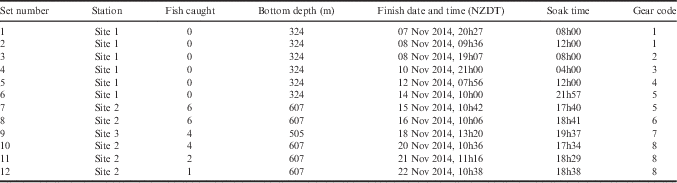
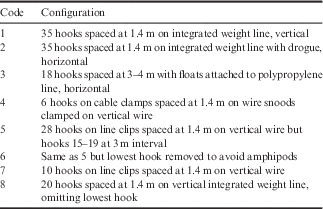
Several configurations of the sampling gear were trialled to develop a standardized method for future surveys so that the gear could be deployed through a hole in the ice on a vertical line from a winch. Above the weight, 15-0 “J” hooks (Mustad) were attached to the main wire every 1.4 m on 300 mm snoods (250 kg twisted nylon tied to line clips) and kept from sliding with copper crimps placed 100 mm apart. The actual configuration and the number of hooks used, as well as the composition of the line near the bottom, varied for the first few sets as the most feasible method was refined (detailed in Tables I and II). Hooks were baited with c. 200 g of squid (Nototodarus sloanii Gray, as one-third of a squid), and lines were set at various times of day (and tide) with a target soak time of 12 h, although this was also varied (Table I).
Details of the 12 sampling events in McMurdo Sound in 2014. Gear code refers to the specific gear configuration used as detailed in Table II.
Sampling gear configurations trialled in McMurdo Sound in 2014.
Water depth was verified using a calibrated Simrad 38 kHz EK-60 acoustic echosounder, and the winch wire deployed was typically within a few metres of this value (slightly longer due to currents and using a wire counter on the winch). Bottom could be manually detected via slack wire when the weight reached the bottom.
Sample locations were chosen based on records of previous sampling effort (Ainley et al. Reference Ainley, Nur, Eastman, Ballard, Parkinson, Evans and DeVries2013, DeVries) or based on a digital elevation model (Davey Reference Davey2004). Three sites were chosen; two sites were within 1.5 km of former collection sites and one site was in deeper water but still within the cluster of former collection sites (see Ainley et al. Reference Ainley, Nur, Eastman, Ballard, Parkinson, Evans and DeVries2013). The first site was situated in relatively shallow water (324 m), so that gear could be tested while close to Scott Base and was not a target sampling site (Fig. 2). This site was within 1 km of several former collection sites but was shallower than depths reported for those sites (415–495 m estimated from winch wire deployed; Ainley et al. Reference Ainley, Nur, Eastman, Ballard, Parkinson, Evans and DeVries2013, DeVries et al. Reference DeVries, Ainley and Ballard2008). The second site was in a bathymetric depression of 607 m in the middle of McMurdo Sound, chosen based on the digital elevation model and the depth distribution of toothfish from the Ross Sea commercial catches (550–1800 m, Hanchet et al. Reference Hanchet, Mormede and Dunn2010). The third site was a former collection site from 2000 (DeVries et al. Reference DeVries, Ainley and Ballard2008). Depth was 505 m and it was located 1.4 km from Site 1 (Fig. 2).
Bathymetric map of McMurdo Sound based on a digital elevation model (Davey Reference Davey2004). Points indicate locations sampled in 2014. Scott Base is referenced in Fig. 1. Note that the digital elevation model is coarse and shows indicative depths only. Measured depths for Sites 1–3 were 324 m, 607 m and 505 m, respectively.

When fish were brought to the surface, they were either immediately euthanized and retained for biological samples, or total length was recorded, the fish were tagged with two pink T-bar tags (Hallmark, AU) using CCAMLR tagging procedures (SC-CAMLR 2012) and released. Hook status at hauling (baited, empty, fish) and any invertebrate catch was also recorded.
For fish retained for biological purposes, data and tissue samples were collected for physiological experiments, including ovarian weight and tissue for histology, liver and muscle tissue for stable isotope studies, muscle tissue for genetic studies, stomach contents for diet, blood plasma for steroid profiles, and otoliths for age determination. Ages were determined for retained fish by otolith analysis according to Sutton et al. (Reference Sutton, Parker and Horn2012). Following processing for the above tissue samples, the entire fish was frozen for tissue composition analysis.
Results
During the period 6–20 November 2014, a total of 12 gear deployments were made at the three sites (Table I). No fish were caught at Site 1. However, a Weddell seal did cache one toothfish carcass in the ice hole and was recorded by video bringing another live toothfish to the hole.
At Site 2, toothfish were caught on every deployment, totalling 19 fish over five sets. Twelve fish were kept for biological samples and seven were tagged and released. The toothfish were typically caught on the hooks closest to the bottom; however, some fish were caught on hooks suspended up to 35 m off the bottom. Fish apparently interacted with hooks still further off the bottom as snoods holding hooks without bait were often observed twisted around the main line up to 43 m off the bottom.
At Site 3, no hut was available to protect electronics, so sampling was done through an unsheltered hole drilled through the ice. Four fish were caught on a single set of ten hooks, three were measured, tagged and released, and one fish was moribund due to amphipod predation was retained for biological samples.
Sites 2 and 3 comprised six sets, and fish were caught on every set (23 fish on 125 hooks=0.184 fish per hook). The fish were large (median=138 cm, 30 kg), relatively old (median=24 years), mostly female (85%), and all with gonads in a resting developmental stage (Table III). The stomachs of sampled fish were mostly empty, containing only traces of euphausiid or digested fish. Two stomachs contained one or two small Pleuragramma antarcticum Boulenger.
Details of individual Antarctic toothfish (Dissostichus mawsoni) sampled in McMurdo Sound in 2014. NA indicates not available as fish were tagged and released. Fish ID refers to the set number followed by the hook number (from shallowest to deepest) on which the fish was caught. Hook height indicates the distance of the hook from the bottom.

Discussion
The results from the 2014 research presented here are very similar to data available from before 2002. Comparing our results to data provided by Ainley et al. (Reference Ainley, Nur, Eastman, Ballard, Parkinson, Evans and DeVries2013), the catch rate achieved in 2014 was 0.184 fish per hook, higher than the median of the rates reported for the period from 1975 to 2001 (0.170, Fig. 3). The distributions of fish size and weight were consistent with the historical distributions reported by DeVries et al. (Reference DeVries, Ainley and Ballard2008) and Ainley et al. (Reference Ainley, Nur, Eastman, Ballard, Parkinson, Evans and DeVries2013), although the proportion of females in our limited sample was higher than the 75% females reported by Eastman & DeVries (Reference Eastman and DeVries2000). The age distribution and lengths-at-age were also consistent with the results of Horn et al. (Reference Horn, Sutton and DeVries2003), in that the toothfish from McMurdo Sound tended to be shorter at age compared with those sampled further north on the continental slope and northern seamounts (see Fig. 1).
Catch rates (fish per hook) for toothfish sampled in McMurdo Sound, Antarctica, 1975–2014. Circles indicate pre-2013 data recalculated from Ainley et al. (Reference Ainley, Nur, Eastman, Ballard, Parkinson, Evans and DeVries2013) and the triangle indicates the 2014 value from this study.

The sampling in 2014 occurred within the cluster of previously sampled sites reported by Ainley et al. (Reference Ainley, Nur, Eastman, Ballard, Parkinson, Evans and DeVries2013) and one site (showing a high catch rate) was at a former collection site. Prior to 2000, sampling sites were mainly from a single hole at c. 500 m depth with some trials in deeper or shallower water (Raymond Reference Raymond1975, Eastman & DeVries Reference Eastman and DeVries1985, Reference Eastman and DeVries2000). From 2000 to 2012, sites were typically shallower (415–495 m), which in itself may have influenced toothfish catch rates (DeVries et al. Reference DeVries, Ainley and Ballard2008, Ainley et al. Reference Ainley, Nur, Eastman, Ballard, Parkinson, Evans and DeVries2013). Although the sampling described here was a pilot survey, the results clearly demonstrated that i) toothfish were not absent or at very low catch rates in McMurdo Sound in November 2014, ii) the sizes of the fish sampled were similar to those observed in McMurdo Sound prior to 2002, and iii) the fish were old (median age 24 years), indicating that the toothfish present were not young fish just recruiting to McMurdo Sound.
The results from the 2014 ice-based work also match well with the size and age composition of toothfish sampled in outer McMurdo Sound during a vessel-based standardized bottom longline survey conducted in January 2014, where the closest surveyed area (west of Cape Evans) was only 30 km away from the sea ice sample sites (Mormede et al. Reference Mormede, Parker, Hanchet, Dunn and Gregory2014b, see survey strata in Figs 1 and 2). Vessel-based survey data showed relatively high catch rates near Cape Evans, and a higher proportion of large fish (120–160 cm) in/near McMurdo Sound compared with other areas of the Ross Sea shelf surveyed. However, the fish in the present study tended to be even older than the mode of large fish sampled in the survey (16–18 years in Mormede et al. Reference Mormede, Parker, Hanchet, Dunn and Gregory2014b).
The root cause for the decline in toothfish catches from 2003–12 in McMurdo Sound remains puzzling. Several possible causes have been considered (Hanchet et al. Reference Hanchet, Mormede and Dunn2010, SC-CAMLR 2012). These included the effects of two large grounded icebergs that changed the oceanography, productivity and seasonal ice dynamics in McMurdo Sound in the early 2000s (Robinson & Williams Reference Robinson and Williams2012). Other factors that may have contributed to the decline in observed numbers of toothfish include changes in abundance, the proximity of sampling sites to ice cracks providing access for predatory Weddell seals, or the use of sampling locations that were too shallow (SC-CAMLR 2012). Antarctic toothfish size and catch rates show a strong relationship with depth, with larger fish in deeper water and the highest catch rates typically in waters 1000–1600 m in depth, although large fish can be observed in shallow waters (Hanchet et al. Reference Hanchet, Mormede and Dunn2010, Hanchet et al. Reference Hanchet, Mormede, Parker, Dunn and Jo2012). Additional work to standardize historic catch rates for the effect of sampling depth and work to characterize the effects of seasonal ice dynamics on toothfish distribution and abundance are high priorities, as understanding these factors will aid in interpreting both past and future changes in observed toothfish abundance.
It is clear that catch rates and catch characteristics of toothfish in McMurdo Sound in 2014 were similar to observations before 2002. The remarkable change in the observed numbers of fish from 2003–12 could have been a temporary phenomenon (e.g. due to ice dynamics or other environmental effect), or the result of unstandardized changes in sampling effort (e.g. changes in depth). Monitoring the abundance and demographics of toothfish requires a spatially stratified survey approach using standardized sampling gear (Hanchet et al. Reference Hanchet, Mormede and Dunn2010), and will be a critical component in efforts to understand the dynamics of toothfish, their predators and their prey in McMurdo Sound.
Acknowledgements
This project was funded by the New Zealand Ministry for Primary Industries (MPI) through the University of Canterbury in contract ANT2014-02. We gratefully acknowledge the complex logistical support from Antarctica New Zealand and the US Antarctic Program to enable field work on the sea ice. The Ministry of Foreign Affairs and Trade and MPI provided technical and permitting support (AMLR permit AMLR14/R04/Eisert/K070, 4 September 2014), and the project was developed through discussions within the Antarctic working group of the MPI. We thank the reviewers for their thoughtful and constructive comments which improved the manuscript.
Author contribution
The authors were all involved in the original concept and design of the paper and have been involved in its subsequent drafting and revision.


 Open access

