




“The Middle East has oil; China has rare earths,” declared Deng Xiaoping 邓小平 in 1992 during a visit to the Bayan Obo mine in Inner Mongolia. Although framed as a geopolitical observation, Deng’s statement nodded to a national strategy that would propel China to global dominance in rare earth elements (REEs) – a group of 17 chemically similar metals essential to high-tech manufacturing, green energy systems and defence technologies. Once derided as cheap and environmentally destructive, although crucial for security,Footnote 1 China’s REE sector is increasingly portrayed as indispensable to sustainable development and the country’s low-carbon transition. This focus on “green” growth and the “green rebranding” of extractive industries marks a striking shift: regions long treated as “sacrifice zones” – where environmental degradation was tolerated for industrial development or other interests – are now recast in official narratives of climate salvation and technological advancement.Footnote 2
At the heart of this shift lies a tension between climate goals and ongoing extraction. China’s 30–60 climate targets – to peak carbon emissions before 2030 and reach carbon neutrality by 2060 – require rapid industrial upgrading, supply chain resilience and technological innovation. Reinforced by policies such as the 2024 Energy Transition White Paper and key Five-Year Plan goals, this agenda underscores the centrality of low-carbon technologies to China’s economic and environmental futures. REEs are central to these efforts as they feature prominently in renewable energy systems, digital infrastructure and advanced manufacturing. As such, Chinese policymakers have classified REEs as “strategic” materials, not only for national security but also for ecological civilization and sustainability.Footnote 3 However, this classification is not merely technocratic; it is political, contested and spatially uneven. Despite strong central directives to consolidate and green the sector, governance remains shaped by competing national, provincial and local agendas.
Existing scholarship has largely focused on China’s REE dominance as a product of its near-monopoly in mining, processing and, more recently, end-use products, emphasizing low environmental standards and protectionist measures, such as quotas, which have enabled this dominance.Footnote 4 Attention has also been drawn to the strategic dimensions of REE supplies, especially in the aftermath of the 2010 China–Japan REE dispute. Yet, REE extraction in China is not only about geopolitics and foreign leverage; it is equally shaped by domestic narratives and agendas.Footnote 5 Julie Klinger shows how, within China, past myths of REE scarcity – often exaggerated or misrepresented – historically helped to justify militarized extraction and intersected with deeper territorial and geopolitical anxieties amid China’s global integration.Footnote 6 Myths continue to animate China’s domestic REE “frontier,” encompassing both the physical sites of extraction and the imagined spaces where resource anxiety and national ambitions converge. Today, a new narrative of resource anxiety linked to decarbonization in a polarized world shapes the production of China’s REE frontiers. Building on Klinger’s insights, this article asks: how is China’s domestic REE production reshaped amid energy transition and increased securitization? And how do these shifts intersect with enduring tensions between central authorities and subnational actors?
We answer these questions by introducing the concept of “fractured extraction.” Drawing on Lee Jones and Shahar Hameiri’s conceptualization of “fractured China,” we mobilize this concept to describe a mode of governance that is neither uniformly top-down nor entirely fragmented, instead marked by cyclical realignments, loosely coordinated authority and ongoing negotiation between central and subnational actors.Footnote 7 Extending classic theorizations of fragmented authoritarianism, fracture captures the provisional, strategic and often contradictory ties that bind local governments, state-owned enterprises (SOEs), regulators and Party organs that shape resource governance. This dynamic mirrors longstanding patterns of fang-shou 放-收, the cyclical loosening and tightening of central control that has broadly characterized Chinese governance.Footnote 8
This article traces how fractured extraction plays out across China’s REE sector, situating contemporary developments within a longer historical arc of state-building, industrial policy and resource governance. Through provincial case studies of Inner Mongolia, Jiangxi and Sichuan, we show how subnational actors selectively enforce, reinterpret or contest central directives in pursuit of their developmental goals, and we identify four interrelated processes that animate this fractured terrain: innovation, industrial upgrading, financialization and formalization. These processes reflect overlapping and occasionally conflicting priorities related to technological self-sufficiency, high-value production, access to capital and regulatory control. Each unfolds unevenly, creating moments of alignment and disjuncture between central planning and local implementation. Together, they show how green industrialization in China is neither linear nor uniformly state-driven but mediated by a diverse constellation of actors operating under conditions of political economic constraint and opportunity. Although Xi Jinping’s 习近平 administration has centralized many policy domains, provincial governments remain indispensable to implementation and often shape the pace and direction of reform.Footnote 9 Specifically, as China’s top central leadership pushes to consolidate the REE sector to curb unlicensed mining, strengthen resource security and facilitate higher-value manufacturing, subnational governments and enterprises pursue diverse objectives that reflect, refract and/or reframe central agendas.Footnote 10
We adopt a qualitative, multi-level mapping of policies, stakeholders and investments across China’s REE industry, in light of REE data constraints in the country.Footnote 11 Using Chinese-language and select foreign-language policy documents and media (including China National Knowledge Infrastructure (CNKI) and provincial newspaper databases), speeches and statements, industry reports and investment data, we examine how REE governance is framed, executed and contested across administrative levels. We map mine investments and operations, identify moments among central, provincial and local actors of policy convergence (for example, curbing unlicensed mining) or divergence (for example, over revenue allocation, investment priorities), and assess how subnational strategies reinforce or complicate central objectives.
The article proceeds as follows. The next section analyses China’s national energy transition commitments at the nexus of climate and extractivism, and how levels of state bureaucracy and actors implement them.Footnote 12 We then elaborate on fractured extraction as an analytical framework for understanding China’s “green” extractive governance. We also offer a historical periodization of China’s REE sector, highlighting how changing industrial and geopolitical priorities have shaped extraction regimes. We then offer analyses of provincial cases in primary producing regions of Inner Mongolia, Sichuan and Jiangxi, illustrating the fractured dynamics of innovation, upgrading, financialization and formalization, and how subnational actors negotiate, advance and/or challenge central directives. We conclude by reflecting on the implications of fractured extraction for China’s domestic REE resources and global REE supply.
Strategic Minerals Governance and China’s Commitment to “Green Growth”
China’s evolving approach to “green growth” is intertwined with the governance of strategic minerals. As our analysis of policy documents demonstrates, green development goals are advanced alongside and through mineral extraction, technological upgrading and industrial policy. These shifts reflect broader policy efforts to channel investment into renewable energy and advanced manufacturing while reducing external dependencies and strengthening domestic resource security.
China’s commitment to green growth, then, is not only an environmental imperative but also a strategy for industrial competitiveness and national resilience. Documents such as the Renewable Energy Law (2017 revision) and the 2024 Mineral Resources Law reflect this dual focus: the former emphasizes renewable energy development aligned with sustainability objectives, the latter emphasizes economic security and resource sovereignty, prioritizing domestic extraction amid intensifying global competition. Notably, while the Renewable Energy Law articulates green growth goals, the 2024 Mineral Resources Law nods only briefly to environmental aims and omits direct reference to the “green development concept” (lüse fazhan linian 绿色发展理念), underscoring instead the central priorities of expanding domestic extraction and mitigating foreign reliance.
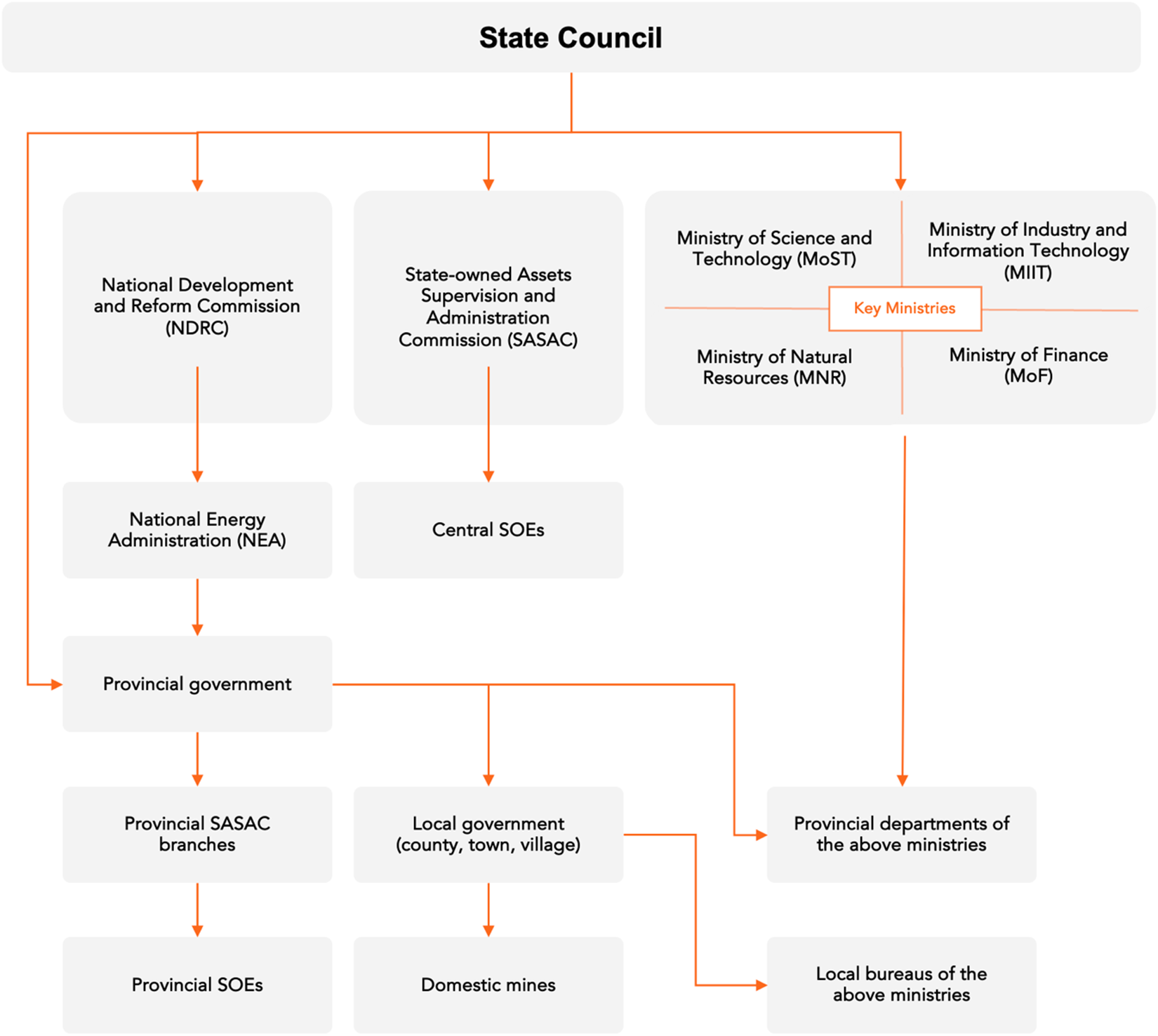
These priorities are operationalized through a multi-scalar governance apparatus that coordinates mineral production across central and local levels (Figure 1), forming the regulatory and bureaucratic scaffolding of China’s green developmental state. At the top sits the State Council, which oversees macro-strategy through three main bureaucratic pillars. For instance, the National Development and Reform Commission (NDRC) advances strategic objectives, while ministries and local bureaus implement them. Under the NDRC, the National Energy Administration (NEA) advances decarbonization efforts, spurring strategic mineral production and consumption across energy, cleantech, battery and electric vehicle (EV) sectors.Footnote 13 The State-owned Assets Supervision and Administration Commission (SASAC) oversees state-owned enterprises (SOEs) involved in mining, energy and infrastructure. Key ministries, including the Ministry of Industry and Information Technology (MIIT), the Ministry of Science and Technology (MoST), the Ministry of Natural Resources (MNR) and the Ministry of Finance (MoF), shape regulatory, financial and technical frameworks for mineral governance. These central institutions define national objectives, which are then interpreted and enacted by provincial and local actors, including provincial governments, enterprises and local branches of relevant ministries.
Bureaucratic and State Institutions Shaping Strategic Mineral Extractive Decisions and Governance Regimes

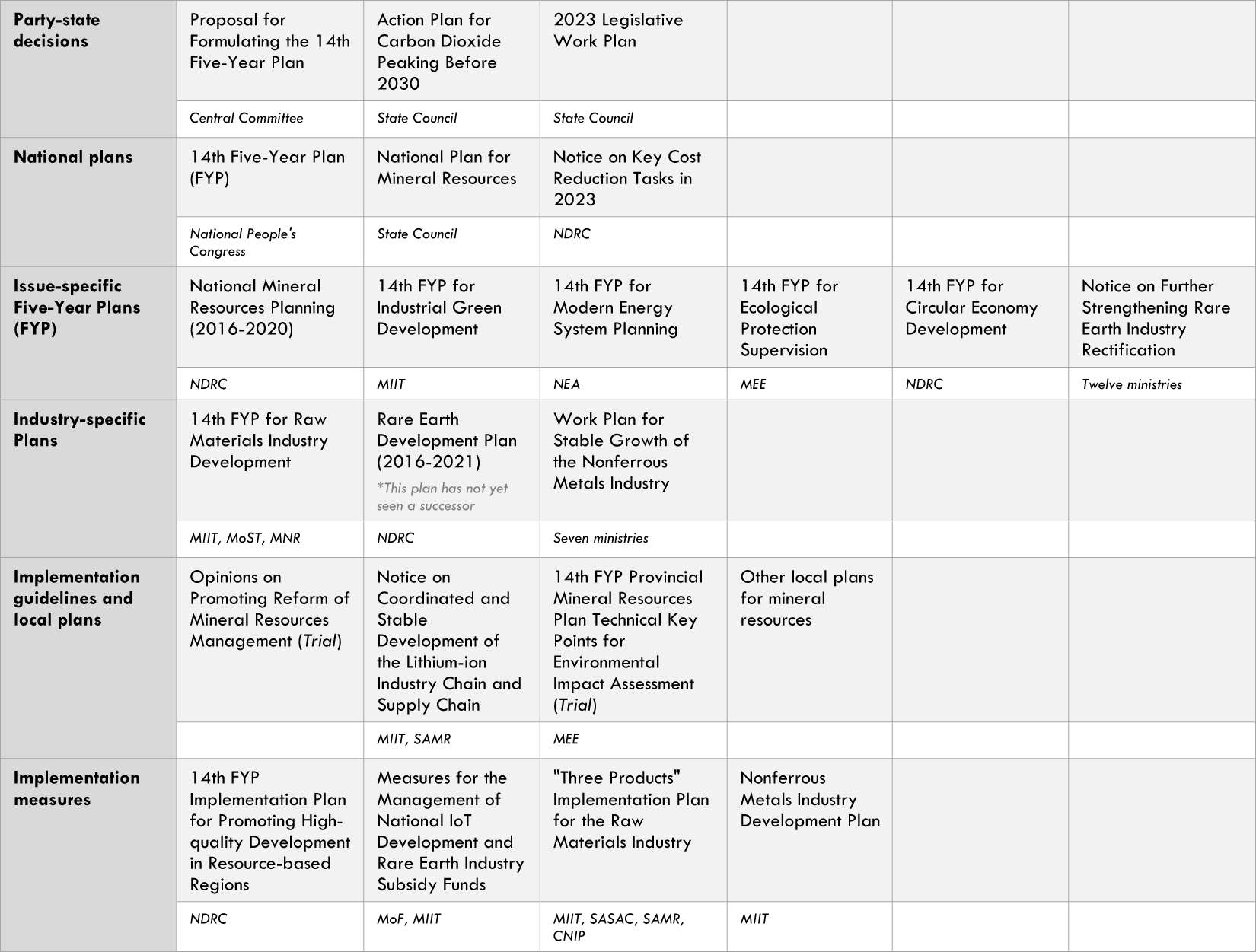
As such, central policies play a defining role in shaping mineral production in China (see Figure 2 for key central policies). Top Chinese Communist Party (CCP) and State Council leaders oversee key bureaucracies, setting the overarching direction for energy and industrial strategy that cascades downwards to influence provincial development plans and upstream industrial organization. While natural resource (ziyuan 资源) policy stems from broader strategic objectives, green technology and innovation policies typically fall under the umbrella of green growth, aiming to reconcile sustainability with industrial advancement.
Key Central Policies and Targets Related to Strategic Minerals Based on the 14th Five-Year Plan

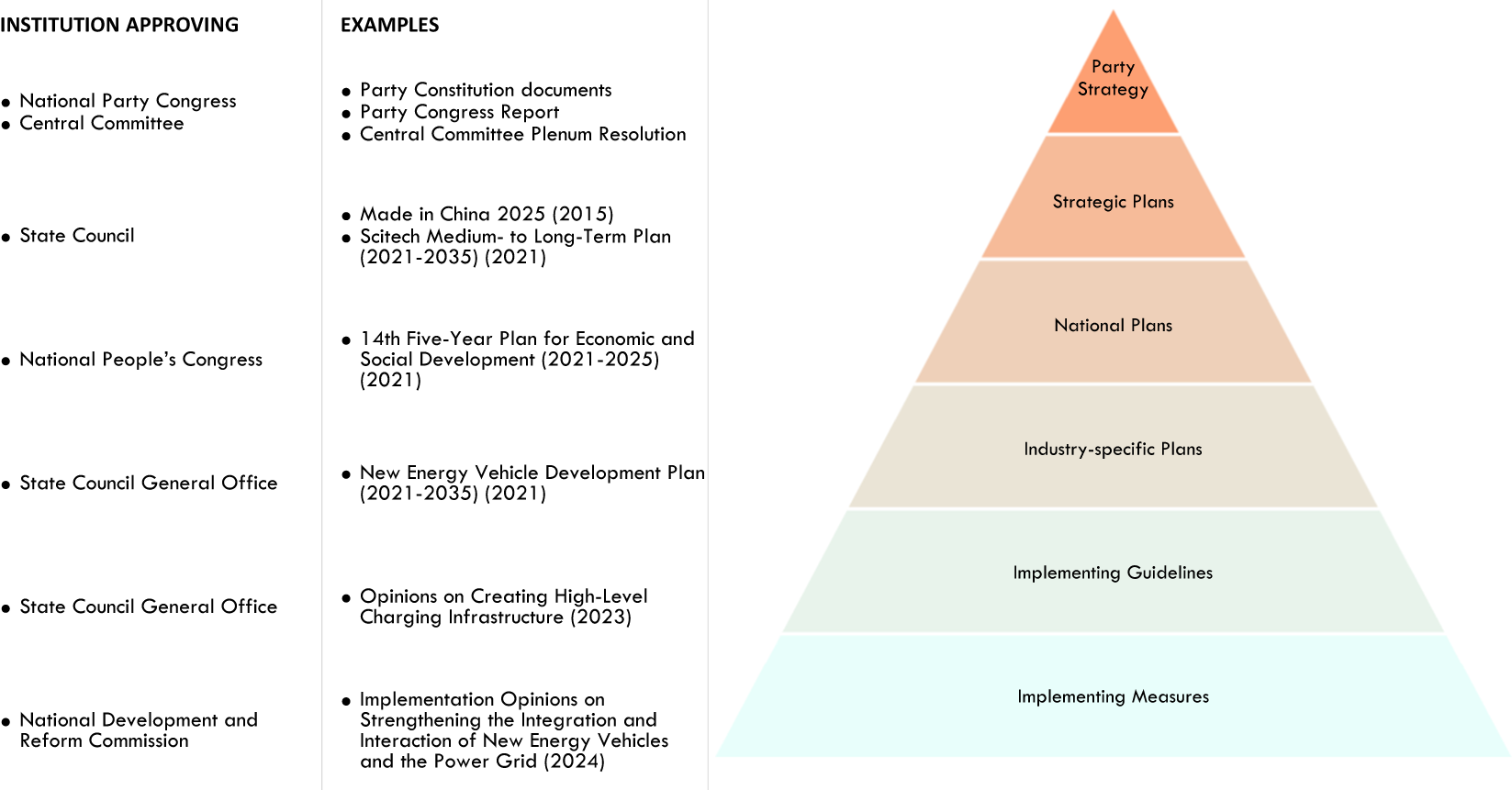
These policies function at different institutional levels and serve distinct purposes, from articulating strategic visions to guiding implementation (Figure 3). Strategic plans are followed by detailed implementation guidelines and technical measures, which guide local governments, SOEs and private firms. For example, recent measures mandate tighter environmental standards for REE mining zones. This policy architecture enables adaptive experimentation while maintaining strategic coherence. Within this framework, strategic minerals are governed through a dual logic: resource policies aim to secure stable domestic supplies, while industrial policies stimulate demand for such minerals. As China accelerates its transition towards a low-carbon economy, green technologies will directly shape its strategic mineral interests, driving up demand for these resources.Footnote 14
Implementation Structure for National Plans and Policies

Yet policy processes rarely proceed in a straightforward top-down manner. As in other sectors, subnational actors selectively adapt central mandates to serve local interests. While bodies like the CCP Central Committee, State Council, NDRC, MIIT and MNR articulate broad strategic goals, provinces and municipalities exercise significant discretion in pursuing those goals, often resulting in local innovation, negotiation and experimentation. Within climate policy, for instance, mid-level local bureaucrats often act as pivotal intermediaries, with their roles as “bridge leaders” proving instrumental in shaping implementation outcomes.Footnote 15 In the minerals domain, the central state often identifies relatively open-ended challenges, allowing space for lower-level experimentation and subnational actors to develop technical, solution-oriented plans for implementation while tailoring directives to fit regional priorities. The following section situates these dynamics within the China studies literature to conceptualize this fragmented yet coordinated extractive system as “fractured extraction.”
Fractured Extraction and the Politics of Green Governance in China
Although the CCP maintains overarching authority, scholarship on Chinese politics has long moved beyond viewing the party-state as monolithic, emphasizing instead the decentralized, fragmented and sometimes disjointed nature of bureaucracy and governance.Footnote 16 Foundational work on “fragmented authoritarianism” foregrounds how governance often hinges on bargaining among national ministries, provincial authorities and local governments.Footnote 17 This arrangement fosters flexibility and contradictions, allowing local officials to experiment or respond to local demands, even as central authorities periodically reassert control.Footnote 18 This cyclical pattern, marked by phases of local discretion followed by waves of recentralization, has become a defining feature of Chinese governance. Local officials routinely experiment with policy implementation, form industry alliances or compete with neighbouring jurisdictions to meet performance targets. This is often followed by cycles of recentralization, marked by new regulations or crackdowns on corruption or environmental damage.Footnote 19 Sebastian Heilmann terms this dynamic “experimentation under hierarchy”: a model that allows local initiative within an adaptive authoritarian framework while maintaining overall Party control.Footnote 20 Under Xi Jinping, this logic endures alongside renewed centralization characterized by Party discipline, environmental mandates and anti-corruption campaigns.Footnote 21 Nonetheless, China remains less centralized than in earlier decades, as subnational actors influence policy outcomes, particularly when resource allocation or revenue generation is at stake.Footnote 22
Resource and environmental governance illustrates these dynamics, as mining, energy infrastructure and heavy industry are recurrent targets of national regulation and political campaigns; however, local collusion persists.Footnote 23 Julia Kirkegaard’s “fragmented experimentalism” shows how central authorities selectively allow local experimentation (here, in the wind turbine industry) until misalignment prompts the centre to intervene and recalibrate national guidelines.Footnote 24 These patterns extend beyond resource sectors. In Belt and Road infrastructure projects, provincial and municipal authorities reinterpret national mandates to serve local priorities.Footnote 25 Whether through fiscal or administrative tools, local officials shape or circumvent central directives according to their own imperatives of revenue, stability or bureaucratic advancement. Consequently, even in an increasingly centralized political environment, local autonomy and competition persist.Footnote 26 The result is not a hollowed-out state but a deeply networked one, where power is multi-scalar, relational and contested.
Such dynamics reflect enduring tensions between tiao 条 (vertical, functional authority from central ministries) and kuai 块 (horizontal, territorial authority of local governments). Local governments often remain accountable to both, creating overlapping lines of control. Andrew Mertha notes that such forms of “soft centralization” may move control from counties to provinces without establishing full central authority, creating new layers of fragmentation rather than resolving them.Footnote 27 Scholars have thus called for closer attention to subnational and sector-specific actors to understand how authority is exercised through adaptation, circumvention and selective compliance.Footnote 28
In REE and other strategic mineral sectors, state–mining relations are marked by cyclical patterns of leniency and crackdown. Central mandates to curb pollution or standardize licensing often clash with local priorities such as job preservation and revenue generation. Crackdowns on unlicensed mining or polluting operations not only reassert central authority but also mitigate reputational risks, like environmental harm or corruption, that could threaten the Party’s legitimacy. Meanwhile, local actors actively reinterpret and adapt central policies, using signals of political legitimacy (for example, alignment with Xi-era slogans or support from the NDRC) to secure resources or regulatory flexibility.Footnote 29 They navigate institutional ambiguity through partial compliance and selective enforcement, shaping how extraction unfolds on the ground.
Rather than treating these patterns as signs of state incoherence or breakdown, we build on Gramscian insights to conceptualize fracture as the provisional and contested terrain through which authority is forged. A Gramscian perspective on “fractured China” clarifies how struggles over hegemony within the party-state balance coercion and consent to maintain legitimacy.Footnote 30 Rather than depicting the state as fully unified or entirely fragmented, fracture underscores the provisional connections that form, disintegrate and re-form between central authorities, subnational governments, enterprises and other participants. In this view, governance is not simply about command or fragmentation; it is about balance amid uneven and unstable conditions.
Fractured extraction, then, refers not simply to cycles of de- and re-centralization but to the dynamic, negotiated labour of constructing legitimacy across spatial and bureaucratic divides, especially under conditions of rapid economic, geopolitical and environmental transition. While fragmented authoritarianism stresses divergent or loosely coordinated authority, fracture captures the persistence of contested but meaningful connections, which periodically converge and disintegrate under shifting political, economic and ecological pressures. In this sense, fracture is not the absence of coordination but the terrain on which extractive projects are actively constructed, constrained and re-articulated across uneven institutional landscapes. Rather than a linear trajectory towards consolidation or environmental reform, the sector’s transformation reflects struggles to govern under conditions of transition, as concerns over decarbonization, geopolitical rivalry and national self-reliance intensify existing fractures even as the central government pushes for consolidation. Below, we examine how these tensions manifest first through historical analysis and second through contemporary policy and investments in three key REE-producing regions.
Rare Earths: From “Cheap and Dirty” to “Sustainable” and Securitized Development
REEs exemplify China’s evolving approach to economic development, reflecting the country’s broader transition from low-grade, “fast and cheap” growth, to the pursuit of “high-quality,”Footnote 31 sustainable development, as envisioned in its 2015 “new development concept.”Footnote 32 Chinese authorities have long recognized the strategic importance of REEs for high-value downstream industries, including wind turbines, lithium-ion batteries, EV manufacturing and defence technologies. The country’s REE policies thus fit within broader industrial policies that leverage state support, R&D investment and supply chain integration to position the country as a global leader in advanced technologies. However, in certain regions – for instance, where local development imperatives often conflict with central resource management – the industry has seen extensive pollution, overcapacity and difficulty moving up the value chain.Footnote 33 Chinese policymakers now frame REEs more explicitly in terms of “green development,” acknowledging that the sector’s future requires ecological remediation and tighter oversight.
Historicizing China’s REE production: domestic paradigms since 1949
The relationship between national goals, global market forces and local extractive interests has evolved through distinct historical paradigms.Footnote 34 Owing to recent geopolitical tensions and China’s use of mineral export controls in retaliatory trade measures since 2023, Western governments have tended to view the country’s REE dominance chiefly as a threat enabled by “resource nationalism.”Footnote 35 This is embedded in a common but incomplete explanation for China’s REE dominance that focuses on its resource endowment – estimated at 23–40 per cent of global REE deposits, which is roughly twice that of the second-largest holder, Vietnam (see Map in Appendix B online). China accounts for 60–70 per cent of global extractionFootnote 36 and around 90 per cent of processing.Footnote 37 However, availability alone does not account for China’s outsized dominance. Since the 1950s, both the central and local governments have substantially invested in R&D, which accelerated under the 1980s economic reforms, to build core technological capabilities and scale up extraction, refining and processing.Footnote 38 Throughout the 1980s and 1990s, Western countries largely offshored high-polluting, low-value REE mining to China, effectively abandoning domestic production.Footnote 39 By 2022, China produced roughly 90 per cent of REE permanent magnets, and according to the authors’ industry contacts, is likely to increase that share as Chinese companies move into manufacturing high-end magnets, which were once only produced in Japan.Footnote 40 As such, China not only secures cost-competitive supplies for domestic industries (from EVs to wind turbines) but also reduces vulnerability to foreign supply chain disruptions.Footnote 41 Tracing the continuities, disruptions and roles of localities and enterprises across these periods is essential to understanding the current REE sector.
1950–1980: National development, the “red frontier” and security drivers
China’s initial foray into REEs dates back to the early Cold War era, when the central government prioritized the development of non-ferrous metal mining in resource-rich regions like Baotou 包头.Footnote 42 The focus on securing strategic and industrial minerals aligned with broader national security and self-reliance concerns. Local governments welcomed the resulting infrastructure, seeking to leverage their resource endowments for developmental gains. Although central ministries drove resource policy, localities had a role in building processing facilities for coal, REEs and other minerals, laying the groundwork for what would become China’s key mines and foreshadowing the tensions between central strategic priorities and local economic imperatives that would intensify in later decades.Footnote 43
1980–2008: Economic reforms, Western offshoring and initial consolidation
Beginning in the 1980s, China’s economic reforms and openness to foreign investment dovetailed with Western offshoring of pollution-intensive industries. REEs were identified as strategically important under the 1986 “863” programme (863 jihua 计划, or “National high-tech R&D programme” Guojia gaojishu yanjiu fazhan jihua 国家高技术研究发展计划), prompting state-led efforts to build technological capacity and consolidate supply chains.Footnote 44 Local governments seeking greater growth and tax revenues rushed to meet Western demand, resulting in extreme fragmentation, enabled by the central government’s devolution of mineral licensing authority to provinces and prefectures. Through the late 1980s and early 1990s, hundreds of companies held exploration and mining licences. By the late 1990s, central government leadership sought to restructure the industry through consolidation. This culminated in the State Council approving a rollback of licence issuances and centralized output quotas.
Meanwhile, Western governments and companies chose to shut down domestic mines and processing capacity – famously including the 1998 closure of the US Mountain Pass separation plant and its 2002 mine closure – due to pollution and cost concerns. Chinese companies soon supplied up to 95 per cent of the global REE market.Footnote 45 During this period, the central government pursued export controls (introduced in 1999) and production quotas (instituted in 2006) to rein in unregulated operations that local governments had allowed to persist. While these measures supported consolidation, they also further complicated the market environment, with local alliances and unlicensed mining persisting, particularly where local authorities financially benefited.
2008–2020: Economic security, profitability and environmental regulation
As China’s high-tech and clean-energy industries expanded, central authorities – particularly the State Council, MIIT, NDRC supported by SASAC, the Ministry of Environmental Protection (MEP),Footnote 46 Ministry of Land and Resources (MLR),Footnote 47 the Ministry of Commerce (MofCom) and MoFFootnote 48 – sought to upgrade the REE industry to promote long-term economic security and secure profit and financing for industrial reinvestment.Footnote 49 To these ends, they aimed to reduce overproduction and unlicensed mining and further advance industrial consolidation. A 2012 State Council Information Office White Paper explicitly described the domestic REE industry of the preceding years as “small, scattered and chaotic,” underscoring the urgency of central efforts to streamline and regulate the sector.Footnote 50 Export quotas, originally introduced in 2006, led to a decrease in volumes and a surge in REE prices between 2008 and 2011, also boosted by the Senkaku episode.Footnote 51 However, a decline in REE prices, which began in 2011, saw prices plummet by 50 per cent in 2012. The fall exemplified the complexity of market dynamics, prompting the minister of industry and information technology to lament that Chinese REEs were sold at “earth” (dirt-cheap) prices rather than the “rare” prices that reflected their value.Footnote 52
Central consolidation efforts continued. By 2012, just ten firms still held REE exploration rights, and 67 held REE mining rights,Footnote 53 and by 2014, processing was consolidated among 28 enterprises.Footnote 54 Production quotas were set for light REEs (LREEs) and heavy REEs (HREEs), and by 2016 they had been primarily allocated to six SOEs, representing 85 per cent of production.Footnote 55 Meanwhile, mounting environmental crises in mining areas and resource depletion concerns prompted stricter environmental regulations, notably the environmental regulator’s “Emission standards of pollutants from rare earths industry” (GB No. 26451, MEE 2011).Footnote 56 Still, longstanding divisions persisted. While officials attempted to curb unlicensed mining, local governments facing budgetary pressures or benefiting from informal partnerships were slow to enforce. This period saw persistent conflicts between local development imperatives and the broader central push for environmental oversight.
2020–present: Green development, economic upgrading, geopolitical competition
Since 2020, the strategic importance of REEs has exploded, driven by China’s clean energy ambitions and intensifying geopolitical tensions. Central economic planners (primarily within the State Council and the NDRC) have championed centralized management by creating the China Rare Earth Group (CREG)Footnote 57 and tightening production quotas while emphasizing “green and low-carbon” mining. CREG now commands a significant share of China’s HREE production, spanning not only Jiangxi but Sichuan, Guangdong and Fujian (via Xiamen Tungsten), among others, and thus wields considerable pricing power. However, provincial players, such as Inner Mongolia’s China Northern Rare Earth Group (CNREG), continue to expand, creating competitive tensions as local producers contend with persistently low REE prices, ongoing unlicensed mining and an uneven ability to move up the value chain.
During a 2019 visit to a REE mine, President Xi underscored the importance of REEs in elevating China’s position in high-end manufacturing, particularly innovation-intensive sectors such as robotics, 5G communications and photolithography (a key process in semiconductor manufacturing).Footnote 58 Building on these priorities, the State Council’s (2023) directives reiterated the need to curb unlicensed mining and promote technological upgrading – an acknowledgement of the persistent tensions between ambitious national targets and the diverse realities of local economies. Later policy movements demonstrate that political prioritization has filtered down to lower levels. Notably, during the 2025 Two Sessions,Footnote 59 provincial officials doubled down on the need to promote the “green and low-carbon transformation of the mining industry.”Footnote 60 A Chinese People’s Political Consultative Conference (CPPCC) representative from Inner Mongolia submitted proposals for both “high-quality development of rare earth elements industry” and “the rapid development of the rare earth element waste recycling and reuse industry in Inner Mongolia.” This resulted in a special meeting of national industry regulators.Footnote 61
Meanwhile, intensifying US–China competition and global rearming have propelled REEs further into the spotlight. Amid concerns about supply chain security, China and the US have introduced targeted tariffs and trade measures to safeguard domestic industries and avoid technology transfers to geopolitical competitors. Since 2018, the US has sought to constrain Chinese tech upgrading, leading to the 2022 export controls on advanced semiconductors and myriad follow-up efforts. Starting in mid-2023, MofCom retaliated with critical mineral export controls targeting the US, EU, Japan and other entities that help to enforce US controls and new tariffs under the Trump administration. These regions now fear geopolitically driven supply disruptions, and many have begun to stockpile critical minerals, including REEs, and/or explore alternative suppliers to reduce vulnerability.Footnote 62
The preceding historical paradigms underscore the dominant priorities in each era: national security and development in the 1950s–1960s, export-led growth in the 1980s–1990s, environmental oversight and high-tech upgrading since the 2000s, and contemporary geopolitical tensions and securitization. These priorities have all come up against and were shaped by local decision-making and developmental imperatives. Over time, localities leveraged (or resisted) central directives, fashioning an uneven trajectory of extraction as “cheap and dirty” for production ends towards a model that simultaneously centres security and sustainability. As the sector moves into a new paradigm shaped by low-carbon imperatives and intensifying geopolitical competition, historical patterns help to illuminate how government interventions reshape long-standing local alliances and priorities within the REE industry. In what follows, we examine how these tensions play out across primary REE-producing provinces that exemplify different facets of China’s present REE landscape.
Contemporary REE production in Inner Mongolia, Jiangxi and Sichuan
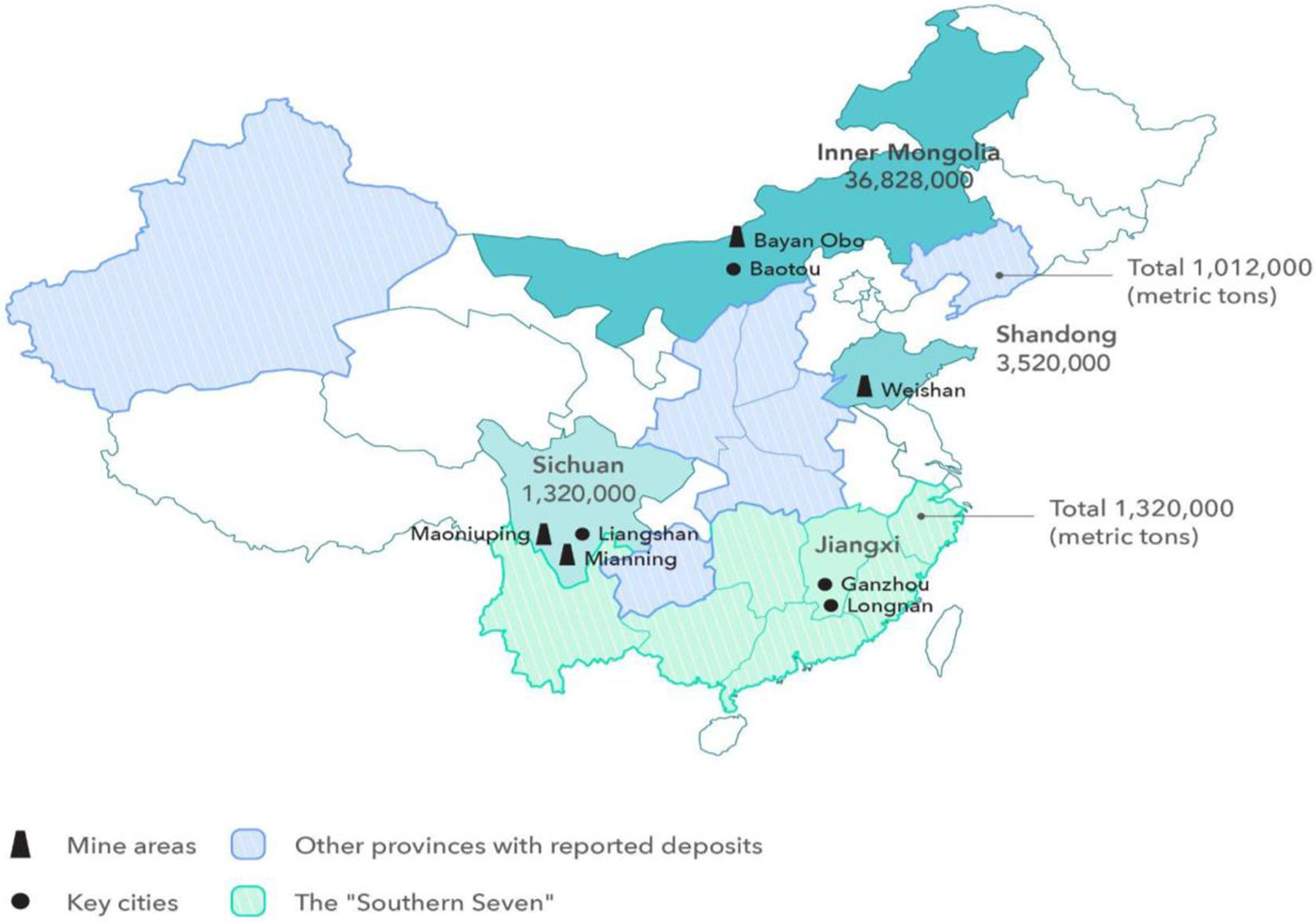
The three major REE-producing provinces – Inner Mongolia, Jiangxi and Sichuan (see Figure 4) – illustrate the geographical divide between LREEsFootnote 63 and HREEs,Footnote 64 as well as the varied local responses to central efforts at consolidation and oversight. Together, these cases show that while China’s national strategy promotes a vision of sustainable, “green” extraction, on-the-ground production and governance remain fractured and cyclical, echoing the broader historical forces that shaped the sector’s development.
Provincial Concentrations of China’s REE Oxide Reserves, 2022

Inner Mongolia
In Inner Mongolia’s Baotou region, multiple layers of authority intersect in China’s REE sector: central government objectives, provincial initiatives and local business strategies. Overlapping priorities often converge around shared interests in resource security and industrial upgrading, yet they also diverge when local revenue needs or corporate profitability conflict with central edicts. The world-renowned Bayan Obo mine is at the heart of Baotou’s REE industry. Administered by Baotou city and owned by CNREG, the mine contains an estimated 35–57.4 million tons of reserves.Footnote 65 The deposit was discovered in 1927, and the mine has produced REEs since 1957. It is the world’s largest-known LREE deposit, with at least 40 per cent of total global reserves by volume and nearly half of total production – a near-monopoly within China’s LREE productionFootnote 66 – underpinning Baotou’s status as the “rare earth capital of the world.”Footnote 67 Bayan Obo’s expansive development stems from its legacy within defence-oriented industrial policy and its capacity for local initiative in building supply chains and research infrastructure, which has influenced, rather than merely followed, national upgrading strategies. Here, early integration of REE extraction with mid-20th-century military-industrial planning laid the groundwork for China’s REE dominance, especially as liberalized global markets created new demand for these materials. Over time, central authorities pivoted from an export-centric model, prioritizing raw REE shipments, to one emphasizing transformation and higher-value downstream applications.
Despite overarching directives, Baotou’s local government has consistently exercised a high degree of autonomy to shape how REEs are mined, processed and utilized through its ownership of CNREG and broader policymaking. For instance, in 2021, the province proposed the Baotou Rare Earth New Materials Industrial Park to strengthen the development of REEs and accelerate the construction of a national REE innovation centre as officials harnessed central policy support, such as directives on new materials innovation, to advance local industrial growth.Footnote 68 As China’s only dedicated Rare Earth High-Tech Industrial Development Zone, Baotou has built five distinct REE supply chainsFootnote 69 through targeted local policies.Footnote 70 In August 2023, the provincial capital also established a new workforce training base for REE innovation to ensure future high-skilled labour to fuel continued local industry development.Footnote 71
Baotou’s ability to harness national and provincial co-funding models to spur industrial upgrading exemplifies fractured governance at work. A 2018 regional guideline allocated provincial funds to match national financial support for demonstration projects, layering central grants with local funds.Footnote 72 This model has accelerated the development of research institutes, talent pipelines and technology commercialization, aligning with central economic planners’ emphasis on high-value manufacturing while preserving local decision-making power. Financial instruments and preferential policies further illustrate this multi-scalar coordination. The Bank of Inner Mongolia’s Rare Earth Finance Special Branch, for instance, supports dedicated funding for REE ventures, while Baotou’s 2014 launch of China’s first REE exchange (championed by Baotou Steel Rare Earth Group) positions the city to influence pricing in both national and international markets.Footnote 73 Local authorities have actively bolstered these efforts with regulatory and financial incentives: two 2021 policies prioritized REE projects, providing direct subsidies for plant development and R&D, and offering preferential electricity pricing and lending rates.Footnote 74 In October 2023, additional resources were allocated in response to official requests, including talent development and commercialization.Footnote 75 These layered mechanisms have allowed Baotou to attract 57 “national high-tech enterprises,” 54 of which operate dedicated R&D centres and are poised to help Baotou’s REE sector reach a value of 160 billion yuan by 2030.
Local imperatives also reveal where Baotou diverges from – or selectively enforces – central directives. In 2011, officials worked alongside SOE Baotou Steel Group (the corporate entity administering Bayan Obo) to crack down on unlicensed mining, which meaningfully began only after it impacted the SOE’s profitability.Footnote 76 While this clampdown aligned with overarching goals of curbing unlicensed extraction, it was largely motivated by local economic concerns rather than a commitment to environmental or regulatory best practices. This selective compliance exemplifies a hallmark of fracture: central directives gain traction locally when they resonate with subnational interests. In other words, although it aligned with the central goal of reducing unlicensed mining, the crackdown only (conspicuously) materialized when profits were threatened.
Meanwhile, following a period of locally driven development, the State Council reasserted its influence in the 2020s. Municipal guidelines issued in 2023 aimed to expand the provincial rare earth sector to 100 billion yuan (US$14 billion) and positioned Baotou city as a global innovation hub, reflecting the State Council’s environmental and regulatory goals. Baotou municipality also extends political and financial support to the REE industry, echoing the executive vice-chairman of Inner Mongolia and member of the CCP’s Regional Standing Committee Huang Zhiqiang’s 黄志强 call to transform the province from being known for its “world-class reserves” into a “world-class industry,” pointing to the alignment of provincial backing with municipal ambitions.
In sum, Baotou’s REE development reflects alignment with and divergence from central planners’ and regulators’ strategic goals, including economic, climate and environmental aspirations. On one hand, the region’s push for cleaner mining techniques, expanded R&D and new materials innovation supports Beijing’s broader vision of green growth and technological leadership. On the other hand, local officials maintain the flexibility to delay or adapt central initiatives when they see potential threats to local revenue, corporate returns or political capital. These alignments and tensions materialize in strategies for innovation, upgrading, financialization and formalization of the sector. Such periodic realignments and selective enforcement reflect the challenges of replicating centrally devised policies across diverse subnational landscapes shaped not only by provincial officials but also by banks, city administrators and companies.
Jiangxi
Jiangxi province stands out for its significant HREE reserves, particularly around Ganzhou 赣州. Unlike Inner Mongolia’s more singular concentration of LREEs, Jiangxi’s HREE resources have historically received less direct central attention, providing space for provincial and local authorities to shape development trajectories. Over several decades, they have channelled substantial investment into R&D, fostering local academic and commercial research institutions that bolster Jiangxi’s technological capabilities.
The province’s vision for Ganzhou involves a high degree of vertical integration – linking upstream mining with downstream manufacturing – to consolidate the city’s role as a hub for medium and heavy REE production and high-value end products. Reflecting this priority, Jiangxi’s 14th Five-Year Plan for Natural Resources explicitly calls for building integrated production bases and downstream magnet industry clusters in Ganzhou. By responding to global pressure for lower-carbon and more transparent supply chains, this strategy positions Jiangxi to capture a larger share of higher-value segments in the REE market.
Although Jiangxi’s REE activities have largely been locally directed, SASAC is increasingly involved owing to the strategic importance of HREEs. In December 2021, three of China’s “big six” REE companies merged into the centrally owned CREG, a consolidation announced by SASAC to enhance market power and asset utilization weakened by decentralized oversight and a proliferation of small-scale operations.Footnote 77 Yet, rather than resolving structural tensions, the merger introduced new fractures, with competing interests between central directives and local implementation reshaping the industry’s spatial politics.Footnote 78 The headquarters of CREG were located in Ganzhou, reaffirming the city’s strategic position within the national HREE market. Now the world’s largest REE producer, CREG exercises massive control over pricing and manages nearly 62 per cent of China’s HREE supply (an estimated 31 per cent of the national total or 52,719 metric tons).
Despite the merger, REE development in Jiangxi remains rooted in provincial and municipal agendas as local governments pursue economic development through traditional industry-led and low-carbon growth.Footnote 79 In 2023, the provincial government released a sweeping industrial plan (2023–2035) prioritizing high-value REE products. While aligned with central environmental goals, it primarily aims to attract central support to upgrade local mines and reinforce Jiangxi’s comparative advantage in HREE production vis-à-vis other provinces. By concentrating resources in Ganzhou and building integrated local supply chains, the province has positioned itself to capture future global demand for low-carbon HREEs.
The subnational authorities in Jiangxi play a more prominent role in financially underwriting local REE firms compared to their counterparts in Inner Mongolia’s more mature REE industry. In Ganzhou, municipal subsidies and provincial grants sustain research, innovation and commercialization efforts. For instance, Jiangxi Yueci Rare Earth New Material Technology confirmed that “[i]n recent years, the company has received policy ‘gift packages’ of various financial incentives and subsidies every year, totalling RMB 7–8 million,” adding that this has “given the company more confidence to engage in research and development.”Footnote 80 Beyond direct funding, the provincial government also streamlines logistics and data-sharing across upstream and downstream enterprises, fortifying regional supply chains and bolstering the competitive edge of local firms.
The municipality of Ganzhou also wields considerable influence by channelling provincial and, in some cases, national support to local companies. In 2015, MoF earmarked 458 million yuan (approximately US$64 million) for REE development in Ganzhou, enabling the city to provide subsidies worth 5–7 per cent of peer companies’ sales.Footnote 81 In 2022, a city labour stabilization effort (including employment assistance and corporate relief) directed skilled workers to major local enterprises such as the Qiandong Rare Earth Group. In early 2020, Ganzhou also launched China’s second REEs exchange – six years after Baotou – to bolster its market power and ensure that local firms benefit from improved financial and policy coordination.Footnote 82 Ganzhou’s decision to create its own REE exchange underscores the city’s desire for greater autonomy and market influence, even as it remains subject to central efforts to consolidate pricing. Unlike many decisions in Baotou that were spurred by central policy, Ganzhou’s municipal decisions were generally not initiated by actors in Beijing.
Meanwhile, central macroeconomic planners have tried to coordinate interprovincial REE governance across southern HREE-producing provinces. In October 2023, a joint supervision initiative covering 15 cities in Guangdong, Guangxi, Fujian, Jiangxi and Hunan was launched to standardize REE development and address unlicensed mining. Although this interprovincial cooperation aims to harmonize the issuing of permits, enforce unified mining quotas and establish a single electronic trading platform, its efficacy depends on sustained local buy-in, coordinated enforcement and the status of interprovincial competition. Such cross-provincial action also indicates central intentions to rein in local fragmentation. Municipalities that have historically relied on revenue from less regulated or informal operations must balance short-term economic pressures with central demands for compliance and sustainability.
Sichuan
Sichuan’s REE sector, which is relatively nascent compared to those of Jiangxi and Inner Mongolia, has become a site for the contested implementation of REE consolidation. Two dynamics define its trajectory: ongoing central consolidation efforts led by giants like CREG and persistent localization through assertive provincial actors and firms, which generate coordination challenges and fracture. Endowed with LREE deposits – particularly in Liangshan 凉山 and the Mianning–Dechang 冕宁–德昌 belt – Sichuan is an emerging production hub. Provincial guidelines and Sichuan’s Mineral Resources Master Plan (2021–2025) underscore local ambitions to upgrade and expand REE production. While these goals ostensibly align with the central government’s push for industrial modernization, implementation diverges, particularly in light of environmental regulations and in reaction to geopolitical tensions.
Sichuan’s provincial and municipal bodies have introduced various incentives (subsidies, tax breaks and dedicated research grants) to boost REE production,Footnote 83 including for minerals and end products that are flagged by the NDRC, MIIT and other regulators as oversupplied, such as low-end goods made from excess cerium and lanthanum.Footnote 84 Officially, such measures are justified as necessary to move up the value chain, consistent with national calls for advanced extraction, refining and manufacturing.Footnote 85 However, the overriding provincial objective is to build a local ecosystem for higher-value downstream REE products, such as magnets for EVs and wind turbines.Footnote 86 These industries are proposed to support local economic development and, in principle, China’s broader environmental targets. In practice, provincial officials have selectively enforced environmental standards to reduce costs for local enterprises, as cases for several minerals across the province demonstrate, particularly in rural and peri-urban areas where enforcement failures skew towards small-scale operations and informal enterprises. In 2022, the provincial government publicly reported nine cases of environmental violations, many involving illegal dumping of industrial waste, unpermitted emissions and failure to implement emergency pollution controls.Footnote 87 These cases underscore weak oversight and the persistence of informal actors – often operating in tandem with licensed firms – despite repeated central efforts to formalize environmental governance.
Mianning and Dechang epitomize these tensions. Both localities hold abundant, easily extractable cerium-rich deposits, a mineral already overproduced at Bayan Obo.Footnote 88 If in line with central government consolidation efforts, Sichuan would be expected to curb redundant cerium production. Yet, provincial and local authorities continue to support smaller local mining operations that generate critical revenue and employment – support institutionalized through entities like the Sichuan Mianning Rare Earth Economic Development Zone and the Southwest China Institute of Rare Earth Materials.Footnote 89 Although couched in the language of “green upgrading,” such programmes often prioritize local revenue and jobs over long-term national goals of consolidation (often to reduce redundancies and overproduction) and environmental restraint.
However, the push for Sichuan ore intensified in 2025 following US tariffs under Trump, which prompted US-based MP Materials to suspend rare earth concentrate shipments to China. In response, Shenghe Resources – a leading company in China’s rare earth industry – publicly affirmed its diversified sourcing strategy, highlighting domestic alternatives, including ore from Sichuan. As a result, supply disruption has yet to significantly impact Shenghe’s operations, underscoring the adaptive role of firms in managing geopolitical volatility and the centrality of pre-existing provincial relationships.Footnote 90 At the same time, Sichuan’s position in this equation illustrates the fractured landscape: provincial support for expanded mining even as mining expansion runs counter to national efforts to curb overproduction and tighten environmental oversight.
Despite fractured implementation, Sichuan remains tethered to central policy through partnerships with conglomerates like CREG. Yet, local firms often fall between mining giants – too small to be integrated into consolidation schemes but too vital to local economies to ignore. These enterprises navigate overlapping provincial incentives, central quotas and inconsistent enforcement practices, leading to localization efforts in which authorities focus on local development goals, attracting investments, creating jobs and fuelling high-tech industries.Footnote 91 The result is a patchwork landscape of localized industrial growth that complicates national attempts to consolidate the REE sector, reduce low-value output and enforce environmental norms.
Conclusion
Once dismissed as “sacrifice zones” for cheap industrial development, regions like Inner Mongolia, Jiangxi and Sichuan are now reimagined as strategic hubs for green and defence-oriented production.Footnote 92 This shift raises questions. Has sacrifice ended or taken a new form under ecological modernization and critical mineral security? And how should we understand these shifts within the broader context of China’s politics? The central government’s efforts to rectify what was once called a “small, scattered and chaotic” REE industry have restructured – but not resolved – the contradictions of subnational resource control. Instead, they have produced a governance landscape that is neither entirely fragmented nor wholly centralized but fractured.
This paper argues that fractured extraction offers a useful framework for understanding these dynamics. It captures the cyclical, negotiated and provisional relationships through which central mandates, provincial ambitions, local economic imperatives and corporate strategies align, diverge and co-produce outcomes. Despite efforts to consolidate and upgrade the sector, tensions between different levels of governance and different localities continue to define how policies are interpreted, implemented or resisted across China’s vast administrative landscape. Subnational actors have played an enduring role in shaping the trajectory of the REE sector, from its origins as a fragmented, low-cost supplier to its current framing as a strategic industry essential to green and defence transitions. While reforms such as mergers enhance central oversight, they do not erase local imperatives. Even as Beijing consolidates production and pricing power through entities like CREG and CNREG, enforcement remains uneven, prices volatile and environmental abuses persistent.
Viewing REE governance through the lens of fractured extraction draws attention to the enduring agency of provincial and local actors, even within a nominally centralized system that is increasingly shaped by and responding to geopolitics. However, it urges a shift away from conventional supply-chain or geopolitical analyses to foreground contested authority, selective enforcement and how adaptive coordination shapes China’s extractive governance from within. Future research might extend this framework to other minerals and related domains, such as graphite, lithium or rare earth recycling, where interprovincial alliances and shifting market demands similarly test the limits of central control and draw subnational actors into geopolitics. Whether China’s REE frontiers escape long-standing extractive burdens or shoulder new environmental challenges in the name of green growth or security remains a question. What is clear, however, is that fracture is a core feature of China’s mineral landscape, one that not only shapes domestic development trajectories but also conditions the country’s capacity, strategy and leverage in global technological competition, the unfolding energy transition and wider arenas of security and defence.
Supplementary materials
Appendices are available online as supplementary materials at https://doi.org/10.1017/S0305741025101586.
Acknowledgements
The authors are grateful to several anonymous reviewers for their incisive feedback and support in strengthening this paper. They also thank Jing Li and Nancy Wei at Trivium China for their assistance with research and several figures in this article.
Competing interests
None.
Jessica DICARLO is an assistant professor in the School of Environment, Society and Sustainability at the University of Utah. A human geographer, she conducts ethnographic and field-based research on development, resource politics, infrastructure and global China.
Cory COMBS is head of critical minerals and supply chain research at Trivium China. His research centres on the political economy of the low-carbon transition, with a focus on Chinese natural resource extraction and industrial policy.
Raphael DEBERDT is a postdoctoral fellow in the department of management, society and communication at Copenhagen Business School. A trained anthropologist with a PhD from the University of British Columbia, he specializes in extractive industries, critical minerals and low-carbon transitions.


 Open access

