


Impact statement
Drylands host a disproportionate share of the world’s armed conflicts. This fact is often viewed through the lens of resource scarcity – where climate change and water stress are seen as key drivers of violence. While this framing highlights important environmental pressures, it risks overlooking the broader lived realities of these regions. This paper advocates a shift in perspective: recognizing drylands not as conflict-prone zones, but as landscapes of endurance, where communities face both harsh climatic conditions and prolonged insecurity that constrain agricultural productivity and deepen poverty. Furthermore, it explores the adaptive capacities of dryland communities and the valuable lessons they offer in navigating intertwined environmental and political challenges.
Introduction
“If the wars of this century were fought over oil, the wars of the next century will be fought over water – unless we change our approach to managing this precious and vital resource”.
This famous quote from 1995, by the then-World Bank Vice President Ismail Seralgeldin, not only brought attention to the importance of managing water resources, but also put the idea of scarcity-induced conflict on the political agenda. As concerns about climate change and its societal impacts started taking root, the climate-conflict nexus also began receiving increased research attention, leading to a surge in attempts to quantify the role of climate variability in conflict dynamics (Selby, Reference Selby2014).
Drylands cover more than 40% of the global land area, and over 2 billion people live in such environments, mainly in the Sahel, Horn of Africa, Middle East, Central Asia and parts of Latin America and Australia (United Nations Convention to Combat Desertification (UNCCD), 2017; Mirzabaev et al., Reference Mirzabaev, Wu, Evans, Garcia-Oliva, Hussein, Iqbal, Kimutai, Knowles, Meza, Nedjroaoui, Tena, Türkeş, Vázquez and Weltz2019). There is a common misrepresentation of drylands as inherently resource-scarce, which disregards the fact that drylands are biodiversity-rich (Myers et al., Reference Myers, Mittermeier, Mittermeier, Da Fonseca and Kent2000; Maestre et al., Reference Maestre, Quero, Gotelli, Escudero, Ochoa, Delgado-Baquerizo, García-Gómez, Bowker, Soliveres, Escolar, García-Palacios, Berdugo, Valencia, Gozalo, Gallardo, Aguilera, Arredondo, Blones, Boeken, Bran, Conceição, Cabrera, Chaieb, Derak, Eldridge, Espinosa, Florentino, Gaitán, Gatica, Ghiloufi, Gómez-González, Gutiérrez, Hernández, Huang, Huber-Sannwald, Jankju, Miriti, Monerris, Mau, Morici, Naseri, Ospina, Polo, Prina, Pucheta, Ramírez-Collantes, Romão, Tighe, Torres-Díaz, Val, Veiga, Wang and Zaady2012), home to 27% of the world’s forests and woodlands (Food and Agriculture Organization of the United Nations (FAO), 2019, and provide valuable resources for around a quarter of the global population (United Nations Convention to Combat Desertification (UNCCD), 2017.
Water scarcity is a major challenge for communities living in drylands, affecting 1–2 billion people globally (Stringer et al., Reference Stringer, Mirzabaev, Benjaminsen, Harris, Jafari, Lissner, Stevens and Tirado-von Der Pahlen2021). It can be characterized as physical (renewable resources per capita), economic (total population with access to safe drinking water), or scarcity of clean water, with many of the water scarcity types occurring in drylands across the world. Physical water scarcity is projected to increase in the future as an effect of both climate change and increased consumption, requiring new solutions for adaptation (Hanasaki et al., Reference Hanasaki, Fujimori, Yamamoto, Yoshikawa, Masaki, Hijioka, Kainuma, Kanamori, Masui and Takahashi2013; Wada et al., Reference Wada, Flörke, Hanasaki, Eisner, Fischer, Tramberend, Satoh, Van Vliet, Yillia and Ringler2016; Flörke et al., Reference Flörke, Schneider and McDonald2018). Ensuring water security in drylands is, however, not mainly a challenge related to availability, but rather a governance challenge, related to access, quality and stability (Stringer et al., Reference Stringer, Mirzabaev, Benjaminsen, Harris, Jafari, Lissner, Stevens and Tirado-von Der Pahlen2021).
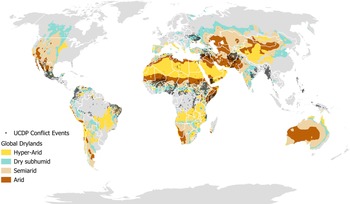
A simple overlay of georeferenced conflict events from the Uppsala Conflict Data Program (Sundberg and Melander, Reference Sundberg and Melander2013) and the UN Environment Programme World Conservation Monitoring Centre Global Drylands dataset (Sorensen, Reference Sorensen2007) shows that 73% of all conflict events recorded between 2019 and 2023 were located in drylands (Figure 1). Does this suggest that dryland communities are more prone to conflict, and that there is a link between environmental scarcity and armed conflict?
Conflict events between 2019 and 2024 recorded by the Uppsala Conflict Data Program (UCDP) overlaying Global Drylands from the UN Environment Programme World Conservation Monitoring Centre (UNEP-WCMC).

In this perspective article, I explore the discussions surrounding environmental scarcity, climate change and armed conflict, while critically analyzing the Syrian climate-conflict narrative as a case study of a conflict frequently associated with climate-induced resource scarcity in a dryland setting. Subsequently, I propose that we reframe our understanding of the Syrian climate-conflict narrative, as well as the notion of drylands being breeding grounds for armed conflict, to emphasize the lessons we can derive from communities that endure despite severe climatic and political challenges.
Environmental scarcity and the idea of drylands as scenes for climate-induced conflict
The idea that scarcity of vital renewable resources, such as freshwater or land, might contribute to political instability and even violent conflict is captured in Homer-Dixon’s Environmental Scarcity Theory. In that theory, scarcity can be caused by reduced supply of resources, increased demand, or by structural scarcity in which resources are distributed unequally (Homer-Dixon, Reference Homer-Dixon1999). Such scarcities may, in turn, impact livelihoods in vulnerable and poor communities reliant on natural resources, induce migration and displacement or weaken governance and state structures.
Critics have highlighted that the theory might oversimplify the complex social and political dynamics (Dalby, Reference Dalby1998; Hartmann, Reference Hartmann2001), that empirical studies find only weak or inconsistent correlations between resource scarcity and violence (see, e.g., Döring, Reference Döring2022 and Homer-Dixon, Reference Homer-Dixon1994), and that the theory fails to account for communities adapting to scarcity through, for example, cooperation (Barnett, Reference Barnett2000). Furthermore, concerns have been raised about increased securitization and militarization, diverting focus and funding away from, for example, climate adaptation (Barnett, Reference Barnett2000; Hartmann, Reference Hartmann2010; Olsson, Reference Olsson2017).
While the environmental scarcity theory focuses mainly on conflicts over scarce resources, the climate-conflict nexus is framed slightly differently. Here, climate change-induced hazards may lead to economic and food production shocks, which may lead to grievances and unrest (Theisen et al., Reference Theisen, Holtermann and Buhaug2011; Buhaug, Reference Buhaug2015; Mach et al., Reference Mach, Kraan, Adger, Buhaug, Burke, Fearon, Field, Hendrix, Maystadt, O’Loughlin, Roessler, Scheffran, Schultz and von Uexkull2019). The nexus has been a hotly debated topic in recent decades, but despite many empirical studies, the evidence for a direct climatic influence on conflict risk remains weak (Koubi, Reference Koubi2019; Mach et al., Reference Mach, Kraan, Adger, Buhaug, Burke, Fearon, Field, Hendrix, Maystadt, O’Loughlin, Roessler, Scheffran, Schultz and von Uexkull2019; Cissé et al., Reference Cissé, McLeman, Adams, Aldunce, Bowen, Campbell-Lendrum, Clayton, Ebi, Hess and Huang2022). Criticisms of this nexus have highlighted that studies have used selective evidence and questionable methods to support their claims (Buhaug, Reference Buhaug2010; Buhaug et al., Reference Buhaug, Nordkvelle, Bernauer, Böhmelt, Brzoska, Busby, Ciccone, Fjelde, Gartzke, Gleditsch, Goldstone, Hegre, Holtermann, Koubi, Link, Link, Lujala, O′Loughlin, Raleigh, Scheffran, Schilling, Smith, Theisen, Tol, Urdal and von Uexkull2014), as well as biased sampling approaches (Gemenne et al., Reference Gemenne, Barnett, Adger and Dabelko2014; Adams et al., Reference Adams, Ide, Barnett and Detges2018). Recent work has highlighted socioeconomic and political context as more important than climate for shaping conflict risk, although climate change is expected to influence future conflict risks (Mach et al., Reference Mach, Kraan, Adger, Buhaug, Burke, Fearon, Field, Hendrix, Maystadt, O’Loughlin, Roessler, Scheffran, Schultz and von Uexkull2019).
The Syrian climate-conflict narrative has been framed as an empirical example of a climate change and scarcity-induced conflict (Gleick, Reference Gleick2014; Kelley et al., Reference Kelley, Mohtadi, Cane, Seager and Kushnir2015; Werrell et al., Reference Werrell, Femia and Sternberg2015; Ash and Obradovich, Reference Ash and Obradovich2020). A severe drought, made worse by climate change (Kelley et al., Reference Kelley, Mohtadi, Cane, Seager and Kushnir2015), occurred just a few years before the popular uprising in 2011. This coincidence led to the suggestion that climate change had caused, or at least contributed to, the uprising, which quickly turned into a devastating civil war. The mechanisms suggested to link drought and conflict were a drought-induced agricultural collapse, and subsequent rural-to-urban migration, causing increased pressure on the cities where the uprising started (Ide, Reference Ide2018; Angermayr et al., Reference Angermayr, Anthony, Dinc and Eklund2023). Early on, analysts suggested both supply and demand-related scarcity had played a role, discussing water scarcity, reduced rainfall and population growth in Syria (Gleick, Reference Gleick2014; Kelley et al., Reference Kelley, Mohtadi, Cane, Seager and Kushnir2015; Werrell et al., Reference Werrell, Femia and Sternberg2015). These publications gave fuel to media reports linking the drought in Syria to the civil war and to the related surge of Syrian refugees fleeing not only to nearby countries but also to Europe (Wendle, Reference Wendle2016).
A major shortcoming of these early analyses was the limited engagement with historical and geographical context. Syria, characterized by semi-arid and arid conditions, covers a diverse landscape with vast steppe plains and rugged desert mountains in its interior, the coastal plain along the Mediterranean, the mountain range “Jabal al-Sahiliyah” that runs along the coast and the Euphrates River with its fertile riverbanks (Held et al., Reference Held, Cummings and Cotter2018). Droughts are common in the region, and have become more frequent and intense since 2000 (Eklund, Reference Eklund2023; von der Kammer et al., Reference von der Kammer, Dinc and Eklund2025). Before the civil war, the International Center for Agricultural Research in the Dry Areas was working on developing drought-resistant crops in Syria to reduce drought vulnerability (Solh, Reference Solh2010).
Agriculture constitutes an important part of the Syrian economy, and includes both irrigated (along the rivers) and rainfed (in the northwest and northeast) agricultural systems. Syria’s irrigation infrastructure developed in the 1970s under Hafez al-Assad, which led Syria to become an exporter of grains at the expense of lowered groundwater levels (Held et al., Reference Held, Cummings and Cotter2018; Rabo, Reference Rabo2019; Selby, Reference Selby2019; Daoudy, Reference Daoudy2020). During the 2000s, Syria’s economy was transformed toward a “social market economy” (Daoudy, Reference Daoudy2021), which included removal of subsidies and privatization of state farms, leading to increased vulnerability, raised costs and widespread land abandonment (Ababsa, Reference Ababsa2015; Selby, Reference Selby2019; Eklund, Reference Eklund2023). Interviews conducted with former Syrian farmers in Turkey confirmed that the Syrian government’s economic reforms had important impacts on rural livelihoods (Dinc and Eklund, Reference Dinc and Eklund2023).
With this background in mind, De Châtel (Reference De Châtel2014) warned of overstating the significance of climate change in the Syrian civil war, arguing that “the government’s failure to respond to the ensuing humanitarian crisis” was what constituted one of the many socioeconomic and political triggers of the uprising. In a similar vein, Selby (Reference Selby2019) highlighted extreme water degradation, increasing rural poverty and the political economy of Syria as far more important than the meteorological drought for the agrarian crisis.
The evidence supporting the major claims of the Syrian climate-conflict narrative is inconclusive (Ide, Reference Ide2018). First, the link between anthropogenic climate change and the Syrian drought is contested (Cook et al., Reference Cook, Anchukaitis, Touchan, Meko and Cook2016; Kelley et al., Reference Kelley, Mohtadi, Cane, Seager and Kushnir2017, Reference Kelley, Mohtadi, Cane, Seager and Kushnir2015; Selby et al., Reference Selby, Dahi, Fröhlich and Hulme2017). There is general agreement that the drought was severe; however, there is little agreement on the length of the drought (Eklund and Thompson, Reference Eklund and Thompson2017; Daoudy, Reference Daoudy2020).
Was there an agricultural collapse with subsequent outmigration? Satellite-based analyses of the agricultural system showed a short-lived response to drought of 1–2 years, with a full recovery of croplands in 2010, contrasting with the narratives of agricultural collapse, widespread abandonment and rural outmigration (Eklund et al., Reference Eklund, Theisen, Baumann, Forø Tollefsen, Kuemmerle and Østergaard Nielsen2022, Reference Eklund, Mohr and Dinc2024; von der Kammer et al., Reference von der Kammer, Dinc and Eklund2025). The migration-uprising links have also been questioned, as migration was found to be a common adaptation strategy both before and after the drought (Dinc and Eklund, Reference Dinc and Eklund2023) and the migrants did not take part in the protests to a wider extent (Fröhlich, Reference Fröhlich2016; Selby et al., Reference Selby, Dahi, Fröhlich and Hulme2017).
The Syrian example shows that it is easy to make deterministic assumptions based on a limited set of data, but when the perspective is broadened to include other epistemological perspectives and methods, the complexity increases, simple answers become futile and new questions emerge.
Why are conflicts so prevalent in drylands? The Syrian case, when looking at the broader perspective, does not support environmental determinism. Instead, it suggests that resource management and support to rural livelihoods were more important than drought, but only one part of the bigger picture that includes, for example, injustice, lack of democracy, corruption and a growing divide between rural and urban areas (De Châtel, Reference De Châtel2014; Hoffmann, Reference Hoffmann2018; Daoudy, Reference Daoudy2020). Thus, after spending about a decade researching these issues, I have reached the conclusion that while the question of climate-conflict causality is interesting, there are more important questions to ask that could help prevent the negative impacts of climate stress in the future.
Asking the “right” questions: What insights can we gain regarding adaptation to extreme climate conditions and water scarcity in multiple crisis scenarios?
What if we view and interpret Figure 1 from a completely different angle? Dryland communities not only endure challenging climate conditions, but many of them also suffer from protracted armed conflicts that limit resources for agriculture and increased vulnerability and poverty. They persevere despite difficult conditions, showing remarkable resilience. In a world with increasingly harsh climate conditions (Pörtner et al., Reference Pörtner, Roberts, Poloczanska, Mintenbeck, Tignor, Alegría, Craig, Langsdorf, Löschke and Möller2022), global water bankruptcy (Madani, Reference Madani2026) and with increasing political tensions (Institute for Economics and Peace (IEP), 2025), knowledge about how to cope becomes increasingly important. What can we learn from the people living at the intersection of climate and conflict?
Although the connection between climate and conflict remains a topic of debate, there is a substantial consensus that conflicts heighten vulnerability to climatic, water and various other risks (Marktanner et al., Reference Marktanner, Mienie and Noiset2015; Chandra et al., Reference Chandra, McNamara, Dargusch, Caspe and Dalabajan2017; Buhaug and Von Uexkull, Reference Buhaug and Von Uexkull2021; Brooks et al., Reference Brooks, Opitz-Stapleton, Daoust, Jobbins and Mayhew2022; Eklund et al., Reference Eklund, Theisen, Baumann, Forø Tollefsen, Kuemmerle and Østergaard Nielsen2022; Selby et al., Reference Selby, Daoust and Hoffmann2022; Raleigh et al., Reference Raleigh, Linke, Barrett and Kazemi2024; Kolmaš, Reference Kolmaš2025; Krampe et al., Reference Krampe, Kreutz and Ide2025). Armed conflict can indirectly result in alterations to governance, such as shifts in policy priorities, modifications to institutional and financial capabilities, decentralization and the reallocation of funds away from climate initiatives, which may diminish the adaptive capacity of the impacted populations (Brooks et al., Reference Brooks, Opitz-Stapleton, Daoust, Jobbins and Mayhew2022; Kolmaš, Reference Kolmaš2025; Schillinger and Özerol, Reference Schillinger and Özerol2025). Disasters in conflict settings were found to lead to 40% more deaths than in nonconflict settings between 1961 and 2010 (Marktanner et al., Reference Marktanner, Mienie and Noiset2015). Evidence also suggests that conflict can increase climate vulnerability among smallholder farmers, with female farmers being more at risk (Chandra et al., Reference Chandra, McNamara, Dargusch, Caspe and Dalabajan2017).
Climate adaptation is underway, also in places affected by armed conflicts (Sitati et al., Reference Sitati, Joe, Pentz, Grayson, Jaime, Gilmore, Galappaththi, Hudson, Alverio, Mach, van Aalst, Simpson, Schwerdtle, Templeman, Zommers, Ajibade, Chalkasra, Umunay, Togola, Khouzam, Scarpa and de Perez2021). Adaptation strategies in conflict zones (many of which are located in dryland regions) include agricultural adaptation strategies (e.g., changing crop varieties and planting times), seasonal and permanent migration and use of indigenous knowledge. In Afghanistan, farmers observed changes in climate and then used the available adaptation strategies, such as improved seeds, longer workdays and increased fertilizer use (Jawid and Khadjavi, Reference Jawid and Khadjavi2019). In Mali, livestock producers changed to more adaptive strategies in response to climate variability and access to land, incentivized by market evolution and trader strategies (Gautier et al., Reference Gautier, Locatelli, Corniaux and Alary2016).
Semplici and Campbell (Reference Semplici and Campbell2023) argue that pastoral communities hold important knowledge about coping with the uncertainty that comes with climate change, as for those communities, variability is “a constitutive element of the lived environment” (p. 787). With this in mind, they suggest a more flexible governance and the abandonment of the one-size-fit-all approach, reflecting the diversity of drylands, as noted by Schipper et al. (Reference Schipper, Revi, Preston, Carr, Eriksen, Fernandez-Carril, Glavovic, Hilmi, Ley, Mukerji, Muylaert de Araujo, Perez, Rose, Singh, Pörtner, Roberts, Tignor, Poloczanska, Mintenbeck, Alegría, Craig, Langsdorf, Löschke, Möller, Okem and Rama2022) in the IPCC Sixth Assessment Report. Stringer et al. (Reference Stringer, Simpson, Schipper and Eriksen2022) point out that while local knowledge about resource management in drylands has developed over generations, such knowledge does often not get used sufficiently in policymaking. Modern technologies, with all their advantages, may also come with risks of eroding such knowledge and of increasing vulnerability and inequalities (Birkmann et al., Reference Birkmann, Liwenga, Pandey, Boyd, Djalante, Gemenne, Leal Filho, Pinho, Stringer and Wrathall2022).
Rainwater harvesting is a traditional method in dryland systems, which has been largely abandoned due to more industrial agriculture becoming dominant (Pandey et al., Reference Pandey, Gupta and Anderson2003; Barghouth and Al-Saed, Reference Barghouth and Al-Saed2009). The Flood Water Spreading system (FWS), for example, is a way to harvest water during excessive rainfall, which saves water in subterranean systems, reduces the risk of floods and improves soil quality (Hashemi, Reference Hashemi2015). Studies have shown a clear increase in yields and potential for improved socioeconomic conditions among local communities in areas with FWS (Ahmadvand et al., Reference Ahmadvand, Karami and Iman2011; Ghahari et al., Reference Ghahari, Hashemi and Berndtsson2014). Another traditional system is the Qanat (also known as Kahrez, Aflaj, Foggara or Khettara), which can be found across dryland regions around the world (Lightfoot, Reference Lightfoot2009). A Qanat is a system of tunnels and wells that directs groundwater to an outlet where water for irrigation and other purposes can be extracted using only gravity, which prevents overuse (Wessels, Reference Wessels2011). Like other traditional systems, the Qanat has become forgotten and destroyed due to a lack of maintenance, but both larger and smaller reconstruction initiatives have been carried out during the early 2000s, efforts that have been portrayed as a possible source of community cooperation and environmental peacebuilding (Wessels, Reference Wessels2008; Moosa, Reference Moosa2018). These are two examples of traditional water management practices that may hold some solutions to enable sustainable adaptation in dryland regions. They may not be scalable across larger regions, but they can be ways to move away from the one-size-fits-all approach, to engage with local knowledge and integrate with scientific knowledge to generate new insights and innovations (Tengö et al., Reference Tengö, Brondizio, Elmqvist, Malmer and Spierenburg2014).
The concept of conflict-sensitive adaptation emerged in the late 2000s, proposing that strategies for climate change adaptation should consider the dynamics of armed conflict and fragility, while also aiming to prevent the emergence of conflicts as a consequence of adaptation interventions (Tänzler et al., Reference Tänzler, Carius and Maas2013; Nadiruzzaman et al., Reference Nadiruzzaman, Scheffran, Shewly and Kley2022). Bergman (Reference Bergman2025) found that climate adaptation projects rarely integrate aspects of conflict or peacebuilding into the project design, despite the projects taking place in conflict-affected contexts. He points out that while many of the projects suggested that they might contribute positively to peacebuilding, the empirical evidence for causal mechanisms between adaptation and peacebuilding is sparse, and maladaptation has been identified as a potential conflict risk (Tänzler et al., Reference Tänzler, Maas and Carius2010; Babcicky, Reference Babcicky2013; Nadiruzzaman et al., Reference Nadiruzzaman, Scheffran, Shewly and Kley2022).
Returning to the Syrian case, it becomes evident that too much focus has been put on trying to establish a causal connection between climate change-induced drought and the Syrian civil war. Research on how the protracted Syrian conflict has affected climate vulnerabilities, water security and the ability of local populations to adapt to climate change, despite the crisis (see, e.g., Selby et al., Reference Selby, Daoust and Hoffmann2022), has unfortunately received less attention. As Syria currently enters a transitional phase that may lead to the conclusion of the civil war, it is critically important to conduct research that can contribute to the development of a more resilient Syria in the future, not only through technological fixes but also through improved governance and policies.
Concluding remarks
Dryland communities face multiple stressors, like water scarcity, climate-related threats to livelihoods and, on top of that, a higher risk of being exposed to armed conflict and the associated governance challenges. Supporting such communities in their adaptation efforts will require a conflict-sensitive approach, which takes into account the barriers to adaptation caused by conflict, the level at which adaptation initiatives are most efficient and the risks of maladaptation.
More research is essential to deepen our understanding of how communities impacted by conflict respond to climate-related stressors, anticipate future adaptation pathways and overcome unique challenges in these fragile settings. Key areas of focus should include:
-
• Identification of conflict impacts on climate vulnerability and sensitivity
-
• Documentation of current climate adaptation practices in conflict-affected drylands
-
• Exploration of traditional, local and indigenous knowledge systems used for adaptation
-
• Strategies for blending indigenous approaches with contemporary technologies and methods
-
• Examination of gender-specific vulnerabilities and roles in climate adaptation
-
• Identification of conflict-related institutional, social and logistical barriers to effective adaptation
-
• Evaluation of external interventions and their alignment with community needs and knowledge
-
• Analysis of long-term sustainability and scalability of adaptation strategies in conflict contexts
I contend that research should prioritize understanding vulnerabilities and adaptation strategies in dryland and conflict-affected regions, instead of attempting to measure the extent to which a drought or flood has heightened the risk of conflict. Quantifying the role of climate change in armed conflict occurrence is unlikely to aid in preventing future violent conflicts, but focusing on developing feasible, conflict-sensitive and contextually appropriate climate adaptation strategies just might.
Open peer review
For open peer review materials, please visit http://doi.org/10.1017/dry.2026.10022.
Data availability statement
The data that support the findings of this study are openly available at https://ucdp.uu.se/downloads/ (Conflict Data) and https://data-gis.unep-wcmc.org/server/rest/services/Hosted/UNCCD_CBD_drylands2007/FeatureServer (World Dryland Areas).
Acknowledgments
The author would like to thank Pinar Dinç for valuable comments on the manuscript. This research was supported by two Strategic Research Areas: The Middle East in the Contemporary World (MECW) at the Centre for Advanced Middle Eastern Studies, Lund University, Sweden, and Biodiversity and Ecosystem Services in a Changing Climate (BECC), both funded by the Swedish Government and Formas – a Swedish Research Council for Sustainable Development (Grant 2019-01131). The author would like to acknowledge the use of Artificial Intelligence (AI) tools to search for relevant literature and to assist with the language and structure of the text.
Competing interests
The author declares none.

 Open access


Comments
No accompanying comment.