





1 Introduction
The aim of this paper is to study iterations of rational maps in one complex variable near degeneration. The emphasis is on a further exploration of the interplay between iterate maps and measures of maximal entropy, initiated by DeMarco [Reference DeMarco2, Reference DeMarco3] and continued by DeMarco and Faber [Reference DeMarco and Faber4], Favre [Reference Favre8], Favre and Gong [Reference Favre and Gong9] and Okuyama [Reference Okuyama15, Reference Okuyama16].
The space of rational functions $f \in \mathbb {C}(z)$
of degree
$f \in \mathbb {C}(z)$
of degree $d \ge 2$
, denoted by
$d \ge 2$
, denoted by ${\operatorname {Rat}_d}$
, is naturally identified with a Zariski open subset of
${\operatorname {Rat}_d}$
, is naturally identified with a Zariski open subset of $\mathbb {P}^{2d+1}$
. This identification furnishes
$\mathbb {P}^{2d+1}$
. This identification furnishes ${\operatorname {Rat}_d}$
with the compactification
${\operatorname {Rat}_d}$
with the compactification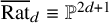 $\overline {\operatorname {Rat}}_d \equiv \mathbb {P}^{2d+1}$
. Elements of the codimension one algebraic set
$\overline {\operatorname {Rat}}_d \equiv \mathbb {P}^{2d+1}$
. Elements of the codimension one algebraic set $\partial {\operatorname {Rat}_d}:= \overline {\operatorname {Rat}}_d \setminus {\operatorname {Rat}_d}$
are called degenerate rational maps of degree d. See §2.2.
$\partial {\operatorname {Rat}_d}:= \overline {\operatorname {Rat}}_d \setminus {\operatorname {Rat}_d}$
are called degenerate rational maps of degree d. See §2.2.
For $n \ge 2$
, the n-th iterate map
$n \ge 2$
, the n-th iterate map $\Phi _n: {\operatorname {Rat}_d} \to {\operatorname {Rat}}_{d^n}$
, sending f to its n-th iterate
$\Phi _n: {\operatorname {Rat}_d} \to {\operatorname {Rat}}_{d^n}$
, sending f to its n-th iterate $f^{\circ n}$
, extends to a rational map between the corresponding projective spaces
$f^{\circ n}$
, extends to a rational map between the corresponding projective spaces $\overline {\operatorname {Rat}}_d$
and
$\overline {\operatorname {Rat}}_d$
and $\overline {\operatorname {Rat}}_{d^n}$
. According to DeMarco [Reference DeMarco2], the map
$\overline {\operatorname {Rat}}_{d^n}$
. According to DeMarco [Reference DeMarco2], the map $\Phi _n$
has a nonempty indeterminacy locus
$\Phi _n$
has a nonempty indeterminacy locus $I(d) \subset \partial {\operatorname {Rat}_d}$
which is independent of n. In particular,
$I(d) \subset \partial {\operatorname {Rat}_d}$
which is independent of n. In particular, $\Phi _n$
fails to have a continuous extension at any point of
$\Phi _n$
fails to have a continuous extension at any point of $I(d)$
. To resolve this situation, it is convenient to consider the embedding
$I(d)$
. To resolve this situation, it is convenient to consider the embedding
 $$ \begin{align*}\begin{array}{cccc} \Phi:&{\operatorname{Rat}_d}&\hookrightarrow&\Pi_{n\ge1} \overline{\operatorname{Rat}}_{d^n}\\ & f & \mapsto& (f, f^{\circ 2},\cdots). \end{array} \end{align*} $$
This yields a larger compactification of ${\operatorname {Rat}_d}$
:
${\operatorname {Rat}_d}$
:
 $$ \begin{align*}\widehat{{\operatorname{Rat}}}_d := \operatorname{closure} (\Phi({\operatorname{Rat}_d})) \subset \Pi_{n\ge1} \overline{\operatorname{Rat}}_{d^n}.\end{align*} $$
Trivially, every iterate map $\Phi _n$
extends continuously to
$\Phi _n$
extends continuously to $\widehat {{\operatorname {Rat}}}_d$
as the projection to the n-th coordinate.
$\widehat {{\operatorname {Rat}}}_d$
as the projection to the n-th coordinate.
On the other hand, every rational map $f \in {\operatorname {Rat}_d}$
has a unique measure of maximal entropy
$f \in {\operatorname {Rat}_d}$
has a unique measure of maximal entropy $\mu _f$
, see [Reference Freire, Lopes and Mañé10, Reference Lyubich12]. This measure is also characterized as the unique probability measure such that
$\mu _f$
, see [Reference Freire, Lopes and Mañé10, Reference Lyubich12]. This measure is also characterized as the unique probability measure such that
 $$ \begin{align*}\dfrac{1}{d^n} (f^{\circ n})^* \mu \to \mu_f,\end{align*} $$
for all probability measures $\mu $
(see §2.7) having no mass on the exceptional set of f. The support of
$\mu $
(see §2.7) having no mass on the exceptional set of f. The support of $\mu _f$
is the Julia set of f, denoted by
$\mu _f$
is the Julia set of f, denoted by  . Moreover,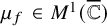 $\mu _f \in M^1(\overline {\mathbb {C}})$
depends continuously on
$\mu _f \in M^1(\overline {\mathbb {C}})$
depends continuously on $f\in {\operatorname {Rat}_d}$
, where
$f\in {\operatorname {Rat}_d}$
, where $M^1(\overline {\mathbb {C}})$
denotes the space of probability measures endowed with the weak*-topology, see [Reference Mañé13].
$M^1(\overline {\mathbb {C}})$
denotes the space of probability measures endowed with the weak*-topology, see [Reference Mañé13].
Given $g \in \partial {\operatorname {Rat}_d}$
, the pull-back operator on (nonexceptional) measures extends continuously to g. More precisely, the pull-back
$g \in \partial {\operatorname {Rat}_d}$
, the pull-back operator on (nonexceptional) measures extends continuously to g. More precisely, the pull-back $g^*$
can be defined by the property that, for all nonexceptional probability measures
$g^*$
can be defined by the property that, for all nonexceptional probability measures $\mu $
for g, as
$\mu $
for g, as $f\in {\operatorname {Rat}_d}$
converges to g, we have that
$f\in {\operatorname {Rat}_d}$
converges to g, we have that $f^* \mu $
converges to
$f^* \mu $
converges to $g^* \mu $
, (see §2.6).
$g^* \mu $
, (see §2.6).
Our first result, extending DeMarco’s and DeMarco-Faber’s results ([Reference DeMarco2, Theorem 0.1] and [Reference DeMarco and Faber4, Theorem A]), is about the limiting behavior at $\partial {\operatorname {Rat}}_d$
of the measure of maximal entropy:
$\partial {\operatorname {Rat}}_d$
of the measure of maximal entropy:
Theorem A. For any $\mathbf {g}=(g_n)_{n\ge 1} \in \widehat {{\operatorname {Rat}}}_d$
, there exists a probability measure
$\mathbf {g}=(g_n)_{n\ge 1} \in \widehat {{\operatorname {Rat}}}_d$
, there exists a probability measure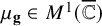 $\mu _{\mathbf {g}}\in M^1(\overline {\mathbb {C}})$
such that if
$\mu _{\mathbf {g}}\in M^1(\overline {\mathbb {C}})$
such that if $\mu \in M^1(\overline {\mathbb {C}})$
is nonexceptional for
$\mu \in M^1(\overline {\mathbb {C}})$
is nonexceptional for $\mathbf {g}$
, then as
$\mathbf {g}$
, then as $n \to \infty $
,
$n \to \infty $
,
 $$ \begin{align*}\dfrac{1}{d^n}(g_n)^* \mu \to \mu_{\mathbf{g}}.\end{align*} $$
Moreover, the map
 $$ \begin{align*}\begin{array}{cccc} \widehat{{\operatorname{Rat}}}_d&\to& M^1(\overline{\mathbb{C}})\\ \mathbf{g} & \mapsto & \mu_{\mathbf{g}} \end{array} \end{align*} $$
is continuous.
Note that $\overline {\operatorname {Rat}}_d \setminus I(d)$
can be identified with a subset of
$\overline {\operatorname {Rat}}_d \setminus I(d)$
can be identified with a subset of $\widehat {{\operatorname {Rat}}}_d$
via the continuous extension of
$\widehat {{\operatorname {Rat}}}_d$
via the continuous extension of $\Phi : {\operatorname {Rat}_d} \to \widehat {{\operatorname {Rat}}}_d$
. After this identification, the previous theorem for
$\Phi : {\operatorname {Rat}_d} \to \widehat {{\operatorname {Rat}}}_d$
. After this identification, the previous theorem for $\mathbf {g} \in \overline {\operatorname {Rat}}_d \setminus I(d)$
was established by DeMarco in [Reference DeMarco2, Theorem 0.1].
$\mathbf {g} \in \overline {\operatorname {Rat}}_d \setminus I(d)$
was established by DeMarco in [Reference DeMarco2, Theorem 0.1].
The limiting behavior of measures at the indeterminacy locus $I(d)$
was further studied by DeMarco and Faber in [Reference DeMarco and Faber4]. They showed that any limit of the measures
$I(d)$
was further studied by DeMarco and Faber in [Reference DeMarco and Faber4]. They showed that any limit of the measures $\mu _f$
as
$\mu _f$
as ${\operatorname {Rat}_d} \ni f \to g \in \partial {\operatorname {Rat}_d}$
is purely atomic, see [Reference DeMarco and Faber4, Theorem A]. We build on their techniques to prove Theorem A.
${\operatorname {Rat}_d} \ni f \to g \in \partial {\operatorname {Rat}_d}$
is purely atomic, see [Reference DeMarco and Faber4, Theorem A]. We build on their techniques to prove Theorem A.
Degeneration along holomorphic families can be studied with the aid of non-Archimedean dynamics. A holomorphic family of maps $f_t \in \overline {\operatorname {Rat}}_d$
, parameterized by t in a neighborhood of
$f_t \in \overline {\operatorname {Rat}}_d$
, parameterized by t in a neighborhood of $0 \in \mathbb {C}$
, is degenerate if
$0 \in \mathbb {C}$
, is degenerate if $f_t \in \partial {\operatorname {Rat}_d}$
only for
$f_t \in \partial {\operatorname {Rat}_d}$
only for $t=0$
. DeMarco and Faber showed that along any degenerate holomorphic family the measures of maximal entropy converge, see [Reference DeMarco and Faber4, Theorem B]. Moreover, they proved that the limit measure is closely related to an equidistribution measure associated to a non-Archimedean dynamical system. Related approaches studying the limit of measures and the corresponding Lyapunov exponents were implemented by Favre [Reference Favre8], Favre-Cong [Reference Favre and Gong9], and Okuyama [Reference Okuyama15, Reference Okuyama16]. It is worth mentioning that, for every degenerate family
$t=0$
. DeMarco and Faber showed that along any degenerate holomorphic family the measures of maximal entropy converge, see [Reference DeMarco and Faber4, Theorem B]. Moreover, they proved that the limit measure is closely related to an equidistribution measure associated to a non-Archimedean dynamical system. Related approaches studying the limit of measures and the corresponding Lyapunov exponents were implemented by Favre [Reference Favre8], Favre-Cong [Reference Favre and Gong9], and Okuyama [Reference Okuyama15, Reference Okuyama16]. It is worth mentioning that, for every degenerate family $f_t$
, there exists
$f_t$
, there exists $\mathbf {g}=(g_n) \in \widehat {{\operatorname {Rat}}}_d$
such that
$\mathbf {g}=(g_n) \in \widehat {{\operatorname {Rat}}}_d$
such that $f_t^{\circ n} \to g_n$
, as
$f_t^{\circ n} \to g_n$
, as $t \to 0$
, for all n. Thus, convergence of the measure of maximal entropy along degenerate holomorphic families can be deduced from Theorem A. Although the proof of Theorem A profits from non-Archimedean dynamics intuition, it does not rely on non-Archimedean tools.
$t \to 0$
, for all n. Thus, convergence of the measure of maximal entropy along degenerate holomorphic families can be deduced from Theorem A. Although the proof of Theorem A profits from non-Archimedean dynamics intuition, it does not rely on non-Archimedean tools.
There is a corresponding discussion in the moduli space, which was also initiated by DeMarco, in [Reference DeMarco3]. Consider the quotient ${\operatorname {rat}_d}:={\operatorname {Rat}_d}/\operatorname{PSL}(2,\mathbb{C})$
of
${\operatorname {rat}_d}:={\operatorname {Rat}_d}/\operatorname{PSL}(2,\mathbb{C})$
of ${\operatorname {Rat}_d}$
that identifies Möbius conjugate rational maps. Following Silverman [Reference Silverman17], its GIT-compactification
${\operatorname {Rat}_d}$
that identifies Möbius conjugate rational maps. Following Silverman [Reference Silverman17], its GIT-compactification $\overline {\operatorname {rat}}_d$
is a projective variety and the boundary
$\overline {\operatorname {rat}}_d$
is a projective variety and the boundary $\partial {\operatorname {rat}_d}:=\overline {\operatorname {rat}}_d\setminus {\operatorname {rat}_d}$
consists of the GIT-conjugacy classes of semistable maps in
$\partial {\operatorname {rat}_d}:=\overline {\operatorname {rat}}_d\setminus {\operatorname {rat}_d}$
consists of the GIT-conjugacy classes of semistable maps in $\overline {\operatorname {Rat}}_d$
. For
$\overline {\operatorname {Rat}}_d$
. For $n\ge 1$
, the n-th iterate map
$n\ge 1$
, the n-th iterate map $\Psi _n: {\operatorname {rat}}_d\to {\operatorname {rat}}_{d^n}$
, sending
$\Psi _n: {\operatorname {rat}}_d\to {\operatorname {rat}}_{d^n}$
, sending $[f]$
to
$[f]$
to $[f^{\circ n}]$
, extends to a rational map
$[f^{\circ n}]$
, extends to a rational map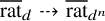 $\overline {\operatorname {rat}}_d \dashrightarrow \overline {\operatorname {rat}}_{d^n}$
with non trivial indeterminacy locus that depends on n, see [Reference DeMarco3, Theorem 5.1] and [Reference Kiwi and Nie11, Theorem A]. To resolve this situation, as above, we consider
$\overline {\operatorname {rat}}_d \dashrightarrow \overline {\operatorname {rat}}_{d^n}$
with non trivial indeterminacy locus that depends on n, see [Reference DeMarco3, Theorem 5.1] and [Reference Kiwi and Nie11, Theorem A]. To resolve this situation, as above, we consider
 $$ \begin{align*} \begin{array}{cccc} \Psi:&{\operatorname{rat}_d}&\hookrightarrow&\Pi_{n\ge1} \overline{\operatorname{rat}}_{d^n}\\ & [f] & \mapsto& ([f],[f^{\circ 2}],\cdots),\end{array} \end{align*} $$
and let
 $$ \begin{align*}\widehat{\operatorname{rat}}_d := \operatorname{closure} (\Psi({\operatorname{rat}_d})) \subset \Pi_{n\ge1} \overline{\operatorname{rat}}_{d^n}.\end{align*} $$
Iterate maps $\Psi _n$
extend continuously to
$\Psi _n$
extend continuously to $\widehat {{\operatorname {rat}}}_d$
as the projection to the corresponding coordinate.
$\widehat {{\operatorname {rat}}}_d$
as the projection to the corresponding coordinate.
In order to consider measures for elements in the moduli space, following DeMarco [Reference DeMarco3], it is convenient to work with conformally barycentered probability measures, see §5. The space of conformally barycentered probability measures modulo the push-forward action by $\operatorname {SO}(3)$
is locally compact. We denote by
$\operatorname {SO}(3)$
is locally compact. We denote by $\overline {M}^1_{dm}(\overline {\mathbb {C}})$
its one point (
$\overline {M}^1_{dm}(\overline {\mathbb {C}})$
its one point ( $=[\infty ]$
) compactification.
$=[\infty ]$
) compactification.
For any measure $\mu \in M^1(\overline {\mathbb {C}})$
with no atoms of weight
$\mu \in M^1(\overline {\mathbb {C}})$
with no atoms of weight $\ge 1/2$
, there exists a Möbius transformation such that
$\ge 1/2$
, there exists a Möbius transformation such that $\nu = A_\ast \mu $
is conformally barycentered. Moreover,
$\nu = A_\ast \mu $
is conformally barycentered. Moreover, $\nu $
is unique up to push-forward by an element in
$\nu $
is unique up to push-forward by an element in $\operatorname {SO}(3)$
. Thus, we have a well defined class
$\operatorname {SO}(3)$
. Thus, we have a well defined class $[\mu ] :=[\nu ] \in \overline {M}^1_{dm}(\overline {\mathbb {C}})$
. If
$[\mu ] :=[\nu ] \in \overline {M}^1_{dm}(\overline {\mathbb {C}})$
. If $\mu $
has an atom of weight
$\mu $
has an atom of weight $\ge 1/2$
, we let
$\ge 1/2$
, we let $[\mu ] := [\infty ]\in \overline {M}^1_{dm}(\overline {\mathbb {C}})$
. Since the measure of maximal entropy
$[\mu ] := [\infty ]\in \overline {M}^1_{dm}(\overline {\mathbb {C}})$
. Since the measure of maximal entropy $\mu _f$
of any rational map f is atom free, there exists a continuous map
$\mu _f$
of any rational map f is atom free, there exists a continuous map
 $$ \begin{align*}\begin{array}{ccc} {\operatorname{rat}_d}&\rightarrow&\overline{M}^1_{dm}(\overline{\mathbb{C}})\\ f & \mapsto& [\mu_{f}]. \end{array} \end{align*} $$
We show this map extends continuously to $\widehat {{\operatorname {rat}}}_d$
, answering positively the question posed by DeMarco in [Reference DeMarco3, Section 10]:
$\widehat {{\operatorname {rat}}}_d$
, answering positively the question posed by DeMarco in [Reference DeMarco3, Section 10]:
Theorem B. For any $[\mathbf {g}]=([g_n])_{n\ge 1} \in \widehat {{\operatorname {rat}}}_d$
, there exists
$[\mathbf {g}]=([g_n])_{n\ge 1} \in \widehat {{\operatorname {rat}}}_d$
, there exists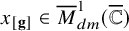 $x_{[\mathbf {g}]} \in \overline {M}^1_{dm}(\overline {\mathbb {C}})$
such that if
$x_{[\mathbf {g}]} \in \overline {M}^1_{dm}(\overline {\mathbb {C}})$
such that if $\mu \in M^1(\overline {\mathbb {C}})$
is nonexceptional for
$\mu \in M^1(\overline {\mathbb {C}})$
is nonexceptional for $(g_n)_{n\ge 1}$
, then as
$(g_n)_{n\ge 1}$
, then as $n \to \infty $
,
$n \to \infty $
,
 $$ \begin{align*}\left[\dfrac{1}{d^n}(g_n)^* \mu\right] \to x_{[\mathbf{g}]}.\end{align*} $$
Moreover, the map
 $$ \begin{align*}\begin{array}{cccc} \widehat{{\operatorname{rat}}}_d&\to& \overline{M}^1_{dm}(\overline{\mathbb{C}})\\ {[\mathbf{g}]} & \mapsto & x_{[\mathbf{g}]} \end{array} \end{align*} $$
is continuous.
The space $\widehat {{\operatorname {rat}}}_d$
coincides with the compactification of
$\widehat {{\operatorname {rat}}}_d$
coincides with the compactification of ${\operatorname {rat}_d}$
constructed by taking the inverse limit of the closure of
${\operatorname {rat}_d}$
constructed by taking the inverse limit of the closure of ${\operatorname {rat}_d}$
in
${\operatorname {rat}_d}$
in $\Pi _{i=1}^n\overline {\mathrm {rat}}_{d^i}$
under the iterate map
$\Pi _{i=1}^n\overline {\mathrm {rat}}_{d^i}$
under the iterate map ${\operatorname {rat}_d}\to \Pi _{i=1}^n\overline {\mathrm {rat}}_{d^i}$
. On the other hand, by considering the closure of the graph of the map
${\operatorname {rat}_d}\to \Pi _{i=1}^n\overline {\mathrm {rat}}_{d^i}$
. On the other hand, by considering the closure of the graph of the map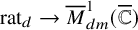 ${\operatorname {rat}_d}\rightarrow \overline {M}^1_{dm}(\overline {\mathbb {C}})$
in
${\operatorname {rat}_d}\rightarrow \overline {M}^1_{dm}(\overline {\mathbb {C}})$
in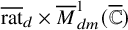 $\overline {\operatorname {rat}}_d\times \overline {M}^1_{dm}(\overline {\mathbb {C}})$
, DeMarco constructed a compactification
$\overline {\operatorname {rat}}_d\times \overline {M}^1_{dm}(\overline {\mathbb {C}})$
, DeMarco constructed a compactification $\overline {\overline {\operatorname {rat}}}_d$
of
$\overline {\overline {\operatorname {rat}}}_d$
of ${\operatorname {rat}_d}$
and established that, in the quadratic case, the compactifications
${\operatorname {rat}_d}$
and established that, in the quadratic case, the compactifications $\widehat {{\operatorname {rat}}}_2$
and
$\widehat {{\operatorname {rat}}}_2$
and $\overline {\overline {\operatorname {rat}}}_2$
are canonically homeomorphic [Reference DeMarco3, Theorem 1.1]. However, for higher degrees, the compactifications
$\overline {\overline {\operatorname {rat}}}_2$
are canonically homeomorphic [Reference DeMarco3, Theorem 1.1]. However, for higher degrees, the compactifications $\widehat {{\operatorname {rat}}}_d$
and
$\widehat {{\operatorname {rat}}}_d$
and $\overline {\overline {\operatorname {rat}}}_d$
are not homeomorphic and, in particular, there cannot exist a continuous map
$\overline {\overline {\operatorname {rat}}}_d$
are not homeomorphic and, in particular, there cannot exist a continuous map $\overline {\overline {\operatorname {rat}}}_d\to \widehat {{\operatorname {rat}}}_d$
which restricts to the identity on
$\overline {\overline {\operatorname {rat}}}_d\to \widehat {{\operatorname {rat}}}_d$
which restricts to the identity on ${\operatorname {rat}_d}$
, see [Reference DeMarco3, Section 10]. Our Theorem B immediately implies that there exists a continuous map
${\operatorname {rat}_d}$
, see [Reference DeMarco3, Section 10]. Our Theorem B immediately implies that there exists a continuous map $\widehat {{\operatorname {rat}}}_d\to \overline {\overline {\operatorname {rat}}}_d$
which restricts to the identity on
$\widehat {{\operatorname {rat}}}_d\to \overline {\overline {\operatorname {rat}}}_d$
which restricts to the identity on ${\operatorname {rat}_d}$
. In other words, the GIT limits of the iterates of an unbounded sequence in
${\operatorname {rat}_d}$
. In other words, the GIT limits of the iterates of an unbounded sequence in ${\operatorname {rat}_d}$
determine the limit of the barycentered measures of maximal entropy.
${\operatorname {rat}_d}$
determine the limit of the barycentered measures of maximal entropy.
Along a degenerating sequence of rational maps $\{f_k\}$
, the choice of coordinates in the domain and in the range become of central importance. The key to Theorems A and B is to analyze the case in which an iterate of
$\{f_k\}$
, the choice of coordinates in the domain and in the range become of central importance. The key to Theorems A and B is to analyze the case in which an iterate of $f_k$
uniformly converges to a nondegenerate rational map, modulo changes of coordinates in the domain and the range. We obtain a “Structure Theorem” that describes the limiting dynamics, in this case, see §3. The Structure Theorem yields, as a byproduct of independent interest, Theorem C, stated below.
$f_k$
uniformly converges to a nondegenerate rational map, modulo changes of coordinates in the domain and the range. We obtain a “Structure Theorem” that describes the limiting dynamics, in this case, see §3. The Structure Theorem yields, as a byproduct of independent interest, Theorem C, stated below.
Recall that a polynomial-like map of degree d is a triple $(U,V,\psi )$
, where U and V are open topological discs contained in
$(U,V,\psi )$
, where U and V are open topological discs contained in $\overline {\mathbb {C}}$
with U relatively compact in V and
$\overline {\mathbb {C}}$
with U relatively compact in V and $\psi :U\to V$
is a proper holomorphic map of degree d. Any polynomial-like map of degree d is quasi-conformally equivalent to a degree d polynomial, see [Reference Douady and Hubbard6, Theorem 1].
$\psi :U\to V$
is a proper holomorphic map of degree d. Any polynomial-like map of degree d is quasi-conformally equivalent to a degree d polynomial, see [Reference Douady and Hubbard6, Theorem 1].
Theorem C. Let $\{f_k\}$
be a sequence in
$\{f_k\}$
be a sequence in ${\operatorname {Rat}_d}$
such that
${\operatorname {Rat}_d}$
such that $\{[f_k]\}$
converges to an element in
$\{[f_k]\}$
converges to an element in $\partial {\operatorname {rat}}_d$
. Assume there exist
$\partial {\operatorname {rat}}_d$
. Assume there exist $\{A_k\}$
and
$\{A_k\}$
and $\{B_k\}$
such that
$\{B_k\}$
such that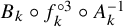 $B_{k}\circ f_k^{\circ 3}\circ A_{k}^{-1}$
converges in
$B_{k}\circ f_k^{\circ 3}\circ A_{k}^{-1}$
converges in ${\operatorname {Rat}}_{d^3}$
, as
${\operatorname {Rat}}_{d^3}$
, as $k\to \infty $
. Then for any sufficiently large k, there exist
$k\to \infty $
. Then for any sufficiently large k, there exist $U_k$
and
$U_k$
and $V_k$
such that
$V_k$
such that $(U_k,V_k, f_k)$
is a polynomial-like map of degree d. Moreover,
$(U_k,V_k, f_k)$
is a polynomial-like map of degree d. Moreover,  and
and $\overline {\mathbb {C}}\setminus U_k$
is contained in a completely invariant attracting Fatou component of
$\overline {\mathbb {C}}\setminus U_k$
is contained in a completely invariant attracting Fatou component of $f_k$
.
$f_k$
.
In our context, the assumption that $f_k^{\circ 3}$
converges to a nondegenerate map, modulo changes of coordinates in the domain and range, is sharp for the Structue Theorem to hold (see Remark 3.4). However, we do not know if
$f_k^{\circ 3}$
converges to a nondegenerate map, modulo changes of coordinates in the domain and range, is sharp for the Structue Theorem to hold (see Remark 3.4). However, we do not know if $3$
can be replaced by
$3$
can be replaced by $2$
in the statement of Theorem C.
$2$
in the statement of Theorem C.
Overview of the Proofs of Theorems A–C
We now outline the main ideas behind the proofs of our principal results.
To prove Theorem A, given $(g_n)$
in
$(g_n)$
in $\widehat {{\operatorname {Rat}}}_d \setminus {\operatorname {Rat}}_d$
and a nonexceptional probability measure
$\widehat {{\operatorname {Rat}}}_d \setminus {\operatorname {Rat}}_d$
and a nonexceptional probability measure $\mu $
, define
$\mu $
, define
 $$ \begin{align*}\lambda_n:=\dfrac{1}{d^n} (g_n)^* \mu. \end{align*} $$
Consider a sequence $\{f_k\}$
of degree d rational maps such that
$\{f_k\}$
of degree d rational maps such that $\{f_k^{\circ n}\}_k$
converges to the degenerate map
$\{f_k^{\circ n}\}_k$
converges to the degenerate map $g_n \in \partial {\operatorname {Rat}}_{d^n}$
for all n. Let
$g_n \in \partial {\operatorname {Rat}}_{d^n}$
for all n. Let $\mu _k$
be the equilibrium measure of
$\mu _k$
be the equilibrium measure of $f_k$
and assume, after passing to a subsequence, that
$f_k$
and assume, after passing to a subsequence, that $\mu _k \to \mu _\infty $
.
$\mu _k \to \mu _\infty $
.
Theorem A claims that $\{\lambda _n\}$
also converges to
$\{\lambda _n\}$
also converges to $\mu _\infty $
. We may further assume that
$\mu _\infty $
. We may further assume that $[f_k]\subset \mathrm {rat}_d$
diverge in moduli space, since the nondivergent case is not difficult to understand (see §4.3).
$[f_k]\subset \mathrm {rat}_d$
diverge in moduli space, since the nondivergent case is not difficult to understand (see §4.3).
Away from a finite subset of $\overline {\mathbb {C}}$
, called the holes of
$\overline {\mathbb {C}}$
, called the holes of $g_n$
, the sequence
$g_n$
, the sequence $\{f_k^{\circ n}\}_k$
converges locally uniformly to a rational map
$\{f_k^{\circ n}\}_k$
converges locally uniformly to a rational map $\tilde {g}_n$
of degree at most
$\tilde {g}_n$
of degree at most $d^n-1$
, called the reduction of
$d^n-1$
, called the reduction of $g_n$
(see §2.1). The reduction
$g_n$
(see §2.1). The reduction $\tilde {g}_n$
may be constant, and in general one has
$\tilde {g}_n$
may be constant, and in general one has $\deg \tilde {g}_n = o(d^n)$
. Degenerate maps
$\deg \tilde {g}_n = o(d^n)$
. Degenerate maps $g_n$
with constant reduction encode little information about the limiting dynamics of
$g_n$
with constant reduction encode little information about the limiting dynamics of $\{f_k\}$
and constitute one of the main difficulties in the study of measure convergence (cf. [Reference DeMarco2]).
$\{f_k\}$
and constitute one of the main difficulties in the study of measure convergence (cf. [Reference DeMarco2]).
A key idea is to regard the spheres in the domain and range of $f_k^{\circ n}$
as distinct spheres
$f_k^{\circ n}$
as distinct spheres $\overline {\mathbb {C}}_0$
and
$\overline {\mathbb {C}}_0$
and $\overline {\mathbb {C}}_n$
, and to introduce a dynamically meaningful normalization in the range. Indeed, a basic principle of degenerate rational dynamics applies: after passing to a subsequence, there exists a choice of coordinates
$\overline {\mathbb {C}}_n$
, and to introduce a dynamically meaningful normalization in the range. Indeed, a basic principle of degenerate rational dynamics applies: after passing to a subsequence, there exists a choice of coordinates $A_{n,k}$
in the image sphere such that
$A_{n,k}$
in the image sphere such that $A_{n,k} \circ f_k^{\circ n}$
converges to a map
$A_{n,k} \circ f_k^{\circ n}$
converges to a map $\varphi _n \in \overline {\operatorname {Rat}}_{d^n}$
having nonconstant reduction
$\varphi _n \in \overline {\operatorname {Rat}}_{d^n}$
having nonconstant reduction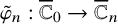 $\tilde {\varphi }_n:\overline {\mathbb {C}}_0 \to \overline {\mathbb {C}}_n$
(Proposition 2.1). The limit
$\tilde {\varphi }_n:\overline {\mathbb {C}}_0 \to \overline {\mathbb {C}}_n$
(Proposition 2.1). The limit $\varphi _n$
is unique modulo post-composition by a Möbius transformation. If the equilibrium measures
$\varphi _n$
is unique modulo post-composition by a Möbius transformation. If the equilibrium measures $\mu _k$
converge to
$\mu _k$
converge to $\mu _\infty $
and
$\mu _\infty $
and $(A_{n,k})_*\mu _k$
converges to
$(A_{n,k})_*\mu _k$
converges to $\nu _n$
, then by DeMarco and Faber [Reference DeMarco and Faber4] (see Proposition 2.10) we have
$\nu _n$
, then by DeMarco and Faber [Reference DeMarco and Faber4] (see Proposition 2.10) we have
 $$ \begin{align} \mu_\infty = \frac{1}{d^n}(\varphi_n)^* \nu_n. \end{align} $$
At this point, the behavior of $\deg \tilde {\varphi }_n$
becomes decisive. We distinguish two cases:
$\deg \tilde {\varphi }_n$
becomes decisive. We distinguish two cases: $\deg \tilde \varphi _n = o(d^n)$
or
$\deg \tilde \varphi _n = o(d^n)$
or $\deg \tilde \varphi _n \neq o(d^n)$
. In the former case, the techniques developed by DeMarco and Faber apply. More precisely, the right-hand side of (1.1) differs from
$\deg \tilde \varphi _n \neq o(d^n)$
. In the former case, the techniques developed by DeMarco and Faber apply. More precisely, the right-hand side of (1.1) differs from $\lambda _n$
by a measure of mass at most
$\lambda _n$
by a measure of mass at most $\deg \tilde {\varphi }_n/d^n$
(see Proposition 4.3
Footnote 1). Therefore
$\deg \tilde {\varphi }_n/d^n$
(see Proposition 4.3
Footnote 1). Therefore $\lambda _n \to \mu _\infty $
.
$\lambda _n \to \mu _\infty $
.
Thus, the proof of Theorem A reduces to the remaining case $\deg \tilde {\varphi }_n \neq o(d^n)$
, which requires a new ingredient: the Structure Theorem 3.1. To discuss it, we need to introduce fully ramified times.
$\deg \tilde {\varphi }_n \neq o(d^n)$
, which requires a new ingredient: the Structure Theorem 3.1. To discuss it, we need to introduce fully ramified times.
The maps $\tilde {\varphi }_n:\overline {\mathbb {C}}_0 \to \overline {\mathbb {C}}_{n+1}$
inherit a natural decomposition from iteration. For each n, there exists a rational map
$\tilde {\varphi }_n:\overline {\mathbb {C}}_0 \to \overline {\mathbb {C}}_{n+1}$
inherit a natural decomposition from iteration. For each n, there exists a rational map $\tilde {\varphi }_{n,n+1}:\overline {\mathbb {C}}_n \to \overline {\mathbb {C}}_{n+1}$
of degree at most d such that
$\tilde {\varphi }_{n,n+1}:\overline {\mathbb {C}}_n \to \overline {\mathbb {C}}_{n+1}$
of degree at most d such that $\tilde {\varphi }_{n+1} = \tilde {\varphi }_{n,n+1} \circ \tilde {\varphi }_n$
. When
$\tilde {\varphi }_{n+1} = \tilde {\varphi }_{n,n+1} \circ \tilde {\varphi }_n$
. When $d= \deg \tilde {\varphi }_{n,n+1}$
, we say that n is a fully ramified time. In the case
$d= \deg \tilde {\varphi }_{n,n+1}$
, we say that n is a fully ramified time. In the case $\deg \tilde {\varphi }_n \neq o(d^n)$
, all sufficiently large times are fully ramified.
$\deg \tilde {\varphi }_n \neq o(d^n)$
, all sufficiently large times are fully ramified.
The Structure Theorem asserts that the presence of just $3$
consecutive fully ramified times, say
$3$
consecutive fully ramified times, say $m, m+1$
and
$m, m+1$
and $m+2$
, imposes severe restrictions on the limiting dynamics. More precisely, it forces the spheres
$m+2$
, imposes severe restrictions on the limiting dynamics. More precisely, it forces the spheres $\overline {\mathbb {C}}_m, \overline {\mathbb {C}}_{m+1}, {\overline {\mathbb {C}}_{m+2}}, {\overline {\mathbb {C}}_{m+3}}, \dots $
, which a priori form a tree of bouquets of spheres (see Appendix A), to organize into a linear concatenation obtained by identifying
$\overline {\mathbb {C}}_m, \overline {\mathbb {C}}_{m+1}, {\overline {\mathbb {C}}_{m+2}}, {\overline {\mathbb {C}}_{m+3}}, \dots $
, which a priori form a tree of bouquets of spheres (see Appendix A), to organize into a linear concatenation obtained by identifying $0 \in \overline {\mathbb {C}}_n$
with
$0 \in \overline {\mathbb {C}}_n$
with $\infty \in \overline {\mathbb {C}}_{n+1}$
for all
$\infty \in \overline {\mathbb {C}}_{n+1}$
for all $n \ge m$
, in suitable coordinates. Moreover,
$n \ge m$
, in suitable coordinates. Moreover, $\tilde {\varphi }_{n,n+1}$
is a polynomial for all
$\tilde {\varphi }_{n,n+1}$
is a polynomial for all $n> m$
, and a monomial whenever both n and
$n> m$
, and a monomial whenever both n and $n+1$
are fully ramified times.
$n+1$
are fully ramified times.
In the proof of Theorem A, the Structure Theorem implies that the Julia sets of $f_k$
converge to
$f_k$
converge to $\infty \in \overline {\mathbb {C}}_n$
for all n sufficiently large. In particular,
$\infty \in \overline {\mathbb {C}}_n$
for all n sufficiently large. In particular, $(A_{n,k})_*\mu _k \to \delta _\infty $
(see Corollary 3.15), which provides the key input in §4.4 to complete the argument in the case
$(A_{n,k})_*\mu _k \to \delta _\infty $
(see Corollary 3.15), which provides the key input in §4.4 to complete the argument in the case $\deg \tilde {\varphi }_n \neq o(d^n)$
.
$\deg \tilde {\varphi }_n \neq o(d^n)$
.
The location of the Julia sets of $f_k$
is clarified by extracting polynomial-like maps. The mechanism enabling this extraction is provided by Proposition 3.7, which is also used in the proof of the Structure Theorem to rule out certain configurations of the initial spheres
$f_k$
is clarified by extracting polynomial-like maps. The mechanism enabling this extraction is provided by Proposition 3.7, which is also used in the proof of the Structure Theorem to rule out certain configurations of the initial spheres $\overline {\mathbb {C}}_m, \overline {\mathbb {C}}_{m+1}, \overline {\mathbb {C}}_{m+2}$
.
$\overline {\mathbb {C}}_m, \overline {\mathbb {C}}_{m+1}, \overline {\mathbb {C}}_{m+2}$
.
In this language, and modulo conjugacy, the hypothesis of Theorem C is that the sequence $\{f_k\}$
has fully ramified times
$\{f_k\}$
has fully ramified times $m = 0,1,2$
. Its proof relies on Lemmas 3.5 and 3.6, which determine the configuration of spheres and transition maps associated to an arbitrary number, at least
$m = 0,1,2$
. Its proof relies on Lemmas 3.5 and 3.6, which determine the configuration of spheres and transition maps associated to an arbitrary number, at least $3$
, of consecutive fully ramified times. Although to prove Theorem C we only need to study the initial spheres
$3$
, of consecutive fully ramified times. Although to prove Theorem C we only need to study the initial spheres $\overline {\mathbb {C}}_1,\overline {\mathbb {C}}_2, \overline {\mathbb {C}}_3$
, the lemmas are proved in greater generality without raising the level of difficulty.
$\overline {\mathbb {C}}_1,\overline {\mathbb {C}}_2, \overline {\mathbb {C}}_3$
, the lemmas are proved in greater generality without raising the level of difficulty.
The proof of Theorem B is also based on the Structure Theorem but is more subtle, since the arguments take place in quotient spaces formed by equivalence classes of maps and measures. Let $\{[f_k]\} \subset {\operatorname {rat}_d}$
be such that
$\{[f_k]\} \subset {\operatorname {rat}_d}$
be such that $[f_k^{\circ n}]$
converges to
$[f_k^{\circ n}]$
converges to $[g_n] \in \partial {\operatorname {rat}}_{d^n}$
for all
$[g_n] \in \partial {\operatorname {rat}}_{d^n}$
for all $n \ge 1$
. When the sequence
$n \ge 1$
. When the sequence $\{[\mu _k]\}$
, where
$\{[\mu _k]\}$
, where $\mu _k$
is the equilibrium measure of
$\mu _k$
is the equilibrium measure of $f_k$
, is bounded away from infinity, Theorem A applies almost directly. Otherwise, the setting of Theorem B leads to a family of sequences
$f_k$
, is bounded away from infinity, Theorem A applies almost directly. Otherwise, the setting of Theorem B leads to a family of sequences $\{f_{n,k}\} \subset {\operatorname {Rat}}_d$
, one for each iterate n. That is, for each n there exists a sequence of coordinate changes
$\{f_{n,k}\} \subset {\operatorname {Rat}}_d$
, one for each iterate n. That is, for each n there exists a sequence of coordinate changes $\{B_{n,k}\}$
such that
$\{B_{n,k}\}$
such that $f_{n,k}^{\circ n}$
converges to
$f_{n,k}^{\circ n}$
converges to $g_n$
, where
$g_n$
, where
 $$ \begin{align*}f_{n,k} := B_{n,k} \circ f_k \circ B_{n,k}^{-1}. \end{align*} $$
Passing to subsequences, for each n there exists $\{A_{n,k} \}$
such that
$\{A_{n,k} \}$
such that $A_{n,k} \circ f_{n,k}^{\circ n} \to \psi _n$
, where
$A_{n,k} \circ f_{n,k}^{\circ n} \to \psi _n$
, where $\psi _n \in \overline {{\operatorname {Rat}}}_{d^n}$
has nonconstant reduction
$\psi _n \in \overline {{\operatorname {Rat}}}_{d^n}$
has nonconstant reduction $\tilde {\psi }_n$
. At this stage, the basic distinction now arises between the cases
$\tilde {\psi }_n$
. At this stage, the basic distinction now arises between the cases $\deg \tilde \psi _n \neq o(d^n)$
and
$\deg \tilde \psi _n \neq o(d^n)$
and $\deg \tilde \psi _n = o(d^n)$
. In the former case, there exist arbitrarily large n for which
$\deg \tilde \psi _n = o(d^n)$
. In the former case, there exist arbitrarily large n for which $\{f_{n,k}\}$
exhibits
$\{f_{n,k}\}$
exhibits $3$
consecutive fully ramified times, and the Structure Theorem applies. In the latter case, a more delicate analysis is required, using the associated bouquet of trees of spheres described in Appendix A.
$3$
consecutive fully ramified times, and the Structure Theorem applies. In the latter case, a more delicate analysis is required, using the associated bouquet of trees of spheres described in Appendix A.
Outline
The paper is organized as follows. In §2, we discuss the basic properties of degenerate rational maps including their action on measures via pull-back. In §3, based on the trees of bouquets of spheres from Appendix A, we establish our Structure Theorem for the limiting dynamics of “fully ramified sequences.” As a byproduct, we obtain Theorem C. We prove Theorem A in §4 and Theorem B in §5. In Appendix A, we discuss maps acting on trees of bouquet of spheres. This is closely related to the work by Arfeux [Reference Arfeux1] regarding maps acting on trees of spheres.
2 Degenerate rational maps
A degenerate rational map $f \in \partial {\operatorname {Rat}_d}$
has a well defined action outside a finite set of points, called the holes of f. The action, known as the reduction
$f \in \partial {\operatorname {Rat}_d}$
has a well defined action outside a finite set of points, called the holes of f. The action, known as the reduction $\tilde {f}$
of f, is a lower degree rational map, possibly constant. Intuitively, the holes “map,” under f, onto
$\tilde {f}$
of f, is a lower degree rational map, possibly constant. Intuitively, the holes “map,” under f, onto $\overline {\mathbb {C}}$
with a degree, called its depth. The reduction
$\overline {\mathbb {C}}$
with a degree, called its depth. The reduction $\tilde {f}$
, the set of holes
$\tilde {f}$
, the set of holes $\operatorname {Hole}(f)$
and their depth
$\operatorname {Hole}(f)$
and their depth $d_h(f)$
, completely prescribe the degenerate map f. We discuss these definitions from [Reference DeMarco2] in §2.1. The parameter space of rational maps, degenerate or not, is discussed in §2.2. A well known formula for the depth of the holes of compositions is written in §2.3. As rational maps converge to a degenerate map, their action is better understood by changing coordinates, or scales, at the domain and the range. In §2.4, we consider the space of rational maps, possibly degenerate but with nonconstant reduction, modulo post-composition by Möbius maps. It is a compact space. In §2.5, we present a formula for the depth of holes in the setting of §2.4 as an analogue of a formula obtained by the authors in [Reference Kiwi and Nie11], and also furnish a formula to compute the depth counting preimages. In §2.6, we recall the definitions of the pull-back of measures by a rational map and, following DeMarco [Reference DeMarco2], by a degenerate rational map. We show that the degenerate pull-back is the continuous extension of the pull-back (Proposition 2.9). In §2.7, we summarize some general properties of the measures of maximal entropy. Continuity of the pull-back of measures yields a key result established by DeMarco and Faber (see [Reference DeMarco and Faber4, Theorem 2.4]), which provides us with an equation satisfied by suitable limits of the measures of maximal entropy.
$d_h(f)$
, completely prescribe the degenerate map f. We discuss these definitions from [Reference DeMarco2] in §2.1. The parameter space of rational maps, degenerate or not, is discussed in §2.2. A well known formula for the depth of the holes of compositions is written in §2.3. As rational maps converge to a degenerate map, their action is better understood by changing coordinates, or scales, at the domain and the range. In §2.4, we consider the space of rational maps, possibly degenerate but with nonconstant reduction, modulo post-composition by Möbius maps. It is a compact space. In §2.5, we present a formula for the depth of holes in the setting of §2.4 as an analogue of a formula obtained by the authors in [Reference Kiwi and Nie11], and also furnish a formula to compute the depth counting preimages. In §2.6, we recall the definitions of the pull-back of measures by a rational map and, following DeMarco [Reference DeMarco2], by a degenerate rational map. We show that the degenerate pull-back is the continuous extension of the pull-back (Proposition 2.9). In §2.7, we summarize some general properties of the measures of maximal entropy. Continuity of the pull-back of measures yields a key result established by DeMarco and Faber (see [Reference DeMarco and Faber4, Theorem 2.4]), which provides us with an equation satisfied by suitable limits of the measures of maximal entropy.
2.1 Holes and reduction
Although we mostly work in nonhomogeneous coordinates, to define reductions, holes and depths, homogeneous coordinates are convenient. A rational map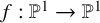 $f: \mathbb {P}^1 \to \mathbb {P}^1 $
of degree
$f: \mathbb {P}^1 \to \mathbb {P}^1 $
of degree $d\ge 2$
can be written as
$d\ge 2$
can be written as
 $$ \begin{align*}f: [z:w] \mapsto [P(z,w):Q(z,w)],\end{align*} $$
where $P,Q$
are relatively prime degree d homogeneous polynomials. For concreteness, one may write
$P,Q$
are relatively prime degree d homogeneous polynomials. For concreteness, one may write
 $$ \begin{align} \begin{aligned} P(z,w) & = a_0 w^d + a_1 z w^{d-1} + \cdots + a_d z^d,\\ Q(z,w) & = b_0 w^d + b_1 z w^{d-1} + \cdots + b_d z^d. \end{aligned} \end{align} $$
Then $f = [P:Q]$
is a degree d rational map if and only if
$f = [P:Q]$
is a degree d rational map if and only if $P,Q$
are relatively prime.
$P,Q$
are relatively prime.
A degree d degenerate rational map f is an expression $[P:Q]$
such that P and Q are not relatively prime. Consistent with the notation, for all
$[P:Q]$
such that P and Q are not relatively prime. Consistent with the notation, for all $\lambda \in \mathbb {C} \setminus \{0\}$
, we regard
$\lambda \in \mathbb {C} \setminus \{0\}$
, we regard $[P:Q]$
and
$[P:Q]$
and $[\lambda P: \lambda Q]$
as the same map. Let
$[\lambda P: \lambda Q]$
as the same map. Let $H_f$
be a common factor of P and Q of maximal degree. Then, there exist polynomials
$H_f$
be a common factor of P and Q of maximal degree. Then, there exist polynomials $\tilde {P}$
,
$\tilde {P}$
, $\tilde {Q}$
, such that
$\tilde {Q}$
, such that
 $$ \begin{align*}P = H_f \tilde{P}\ \ \ \ \text{and}\ \ \ \ Q= H_f \tilde{Q}.\end{align*} $$
We say that
 $$ \begin{align*}\operatorname{Hole} (f) := \{ h \in \mathbb{P}^1 : H_f(h) =0\}\end{align*} $$
is the set of holes of f. The depth $d_h(f)$
of a hole h is the multiplicity of h as a root of
$d_h(f)$
of a hole h is the multiplicity of h as a root of $H_f$
; that is, modulo multiplication by a constant,
$H_f$
; that is, modulo multiplication by a constant,
 $$ \begin{align*}H_f = \prod_{h \in \operatorname{Hole}(f)} L_h^{d_h(f)},\end{align*} $$
where $L_h$
is a homogeneous linear form vanishing at h; moreover, for notational convenience, we let
$L_h$
is a homogeneous linear form vanishing at h; moreover, for notational convenience, we let $d_h(f):=0$
whenever
$d_h(f):=0$
whenever $h \in \mathbb {P}^1\setminus \operatorname {Hole}(f)$
. We say that
$h \in \mathbb {P}^1\setminus \operatorname {Hole}(f)$
. We say that
 $$ \begin{align*}\tilde{f} := [\tilde{P}: \tilde{Q}]\end{align*} $$
is the reduction of f. Note that $\tilde {f}$
is a well defined self-map of
$\tilde {f}$
is a well defined self-map of $\mathbb {P}^1 $
. We write
$\mathbb {P}^1 $
. We write $f=H_f \cdot \tilde {f}$
.
$f=H_f \cdot \tilde {f}$
.
Given a nondegenerate rational map $\tilde {f}$
of degree
$\tilde {f}$
of degree $\deg \tilde {f} < d$
and a set of holes
$\deg \tilde {f} < d$
and a set of holes $\operatorname {Hole}(f)$
with prescribed depths such that the total number of holes, counted with depths, is
$\operatorname {Hole}(f)$
with prescribed depths such that the total number of holes, counted with depths, is $d-\deg \tilde {f}$
, there exists a unique degree d degenerate map f compatible with this information.
$d-\deg \tilde {f}$
, there exists a unique degree d degenerate map f compatible with this information.
For notational simplicity, we mostly work with nonhomogeneous coordinates, after identification of $\mathbb {P}^1 $
with
$\mathbb {P}^1 $
with $\overline {\mathbb {C}} := \mathbb {C}\cup \{\infty \}$
. Thus, we write
$\overline {\mathbb {C}} := \mathbb {C}\cup \{\infty \}$
. Thus, we write $f(z) = P(z,1)/Q(z,1)$
or simply
$f(z) = P(z,1)/Q(z,1)$
or simply $f(z) = P(z)/Q(z)$
.
$f(z) = P(z)/Q(z)$
.
2.2 Spaces of rational maps
The space of possibly degenerate rational maps $\overline {\operatorname {Rat}}_d$
is the
$\overline {\operatorname {Rat}}_d$
is the $(2d+1)$
-dimensional complex projective space
$(2d+1)$
-dimensional complex projective space $\mathbb {P}^{2d+1} $
. Its elements are identified with expressions of the form
$\mathbb {P}^{2d+1} $
. Its elements are identified with expressions of the form $f = [P:Q]$
by
$f = [P:Q]$
by
 $$ \begin{align*}\begin{array}{ccc} \overline{\operatorname{Rat}}_d & \leftrightarrow & \mathbb{P}^{2d+1} \\ f = [P:Q] & \leftrightarrow & [a_0: \cdots : a_d : b_0 : \dots :b_d], \end{array} \end{align*} $$
where $P,Q$
are polynomials of the form (2.1).
$P,Q$
are polynomials of the form (2.1).
The degree d homogeneous resultant of $P,Q$
is a homogeneous polynomial in the coefficients. Its vanishing locus
$P,Q$
is a homogeneous polynomial in the coefficients. Its vanishing locus $\partial {\operatorname {Rat}_d} := \{ \operatorname {Res} = 0\}$
is the set of degenerate maps in
$\partial {\operatorname {Rat}_d} := \{ \operatorname {Res} = 0\}$
is the set of degenerate maps in $\overline {\operatorname {Rat}}_d$
. Hence, the Zariski open subset
$\overline {\operatorname {Rat}}_d$
. Hence, the Zariski open subset ${\operatorname {Rat}}_d := \overline {\operatorname {Rat}}_d \setminus \partial {\operatorname {Rat}_d}$
is the space of rational maps of degree d. Convergence in
${\operatorname {Rat}}_d := \overline {\operatorname {Rat}}_d \setminus \partial {\operatorname {Rat}_d}$
is the space of rational maps of degree d. Convergence in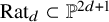 ${\operatorname {Rat}_d} \subset \mathbb {P}^{2d+1}$
coincides with uniform convergence of rational maps.
${\operatorname {Rat}_d} \subset \mathbb {P}^{2d+1}$
coincides with uniform convergence of rational maps.
Möbius transformations form the space ${\operatorname {Rat}}_1$
of degree
${\operatorname {Rat}}_1$
of degree $1$
rational maps that is naturally identified with
$1$
rational maps that is naturally identified with $\operatorname {PSL(2,\mathbb {C})}$
. Each element of
$\operatorname {PSL(2,\mathbb {C})}$
. Each element of $\partial {\operatorname {Rat}}_1$
is a degenerate Möbius transformation: a map with constant reduction and one hole, counted with depth.
$\partial {\operatorname {Rat}}_1$
is a degenerate Möbius transformation: a map with constant reduction and one hole, counted with depth.
2.3 Composition of degenerate maps
Given $d, d' \ge 1$
, consider the map
$d, d' \ge 1$
, consider the map
 $$ \begin{align*}\begin{array}{cccc} \circ :& {\operatorname{Rat}_d} \times {\operatorname{Rat}}_{d'} & \to & {\operatorname{Rat}}_{dd'}\\ & ( f, g) & \mapsto & f \circ g. \end{array} \end{align*} $$
It extends to a rational map from the projective variety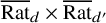 $\overline {\operatorname {Rat}}_d \times \overline {\operatorname {Rat}}_{d'}$
into
$\overline {\operatorname {Rat}}_d \times \overline {\operatorname {Rat}}_{d'}$
into $\overline {\operatorname {Rat}}_{dd'}$
with indeterminacy locus
$\overline {\operatorname {Rat}}_{dd'}$
with indeterminacy locus
 $$ \begin{align*}I(d,d') := \{ (f,g) : \tilde{g} \equiv h \in \operatorname{Hole}(f) \}.\end{align*} $$
Following [Reference DeMarco3, Lemma 2.6], for all $(f,g) \in \overline {\operatorname {Rat}}_d \times \overline {\operatorname {Rat}}_{d'} \setminus I(d,d')$
, we have that
$(f,g) \in \overline {\operatorname {Rat}}_d \times \overline {\operatorname {Rat}}_{d'} \setminus I(d,d')$
, we have that $f \circ g$
is the unique element of
$f \circ g$
is the unique element of $\overline {\operatorname {Rat}}_{dd'}$
with reduction
$\overline {\operatorname {Rat}}_{dd'}$
with reduction $\tilde {f} \circ \tilde {g}$
and holes
$\tilde {f} \circ \tilde {g}$
and holes $h\in \tilde {g}^{-1} (\operatorname {Hole}(f)) \cup \operatorname {Hole}(g)$
with depths
$h\in \tilde {g}^{-1} (\operatorname {Hole}(f)) \cup \operatorname {Hole}(g)$
with depths
 $$ \begin{align} d_h (f\circ g) = d_h (g) \cdot d + \deg_h (\tilde{g}) \cdot d_{\tilde{g}(h)} (f). \end{align} $$
2.4 Left classes of rational maps
To deal with degenerations towards maps with constant reduction, the key is the following “scaling” result:
Proposition 2.1 [Reference DeMarco and Faber4, Lemma 2.1].
Let $\{f_k\}$
be a sequence in
$\{f_k\}$
be a sequence in ${\operatorname {Rat}_d}$
. Then there exists a subsequence
${\operatorname {Rat}_d}$
. Then there exists a subsequence $\{f_{k_i} \}$
and a sequence
$\{f_{k_i} \}$
and a sequence $\{A_i\}$
in
$\{A_i\}$
in $\operatorname {PSL(2,\mathbb {C})}$
such that
$\operatorname {PSL(2,\mathbb {C})}$
such that
 $$ \begin{align*}A_i \circ f_{k_i} \to \varphi \in \overline{\operatorname{Rat}}_d,\end{align*} $$
and $\tilde {\varphi }$
is not constant. Moreover, if
$\tilde {\varphi }$
is not constant. Moreover, if $\{B_i\}$
is another such sequence, then
$\{B_i\}$
is another such sequence, then $\{B_i^{-1} \circ A_i\}$
converges in
$\{B_i^{-1} \circ A_i\}$
converges in $\operatorname {PSL(2,\mathbb {C})}$
.
$\operatorname {PSL(2,\mathbb {C})}$
.
This result may be understood as the compactness of certain orbit space. Let us denote the maps with nonconstant reduction by
 $$ \begin{align*}{\operatorname{Rat}}_d^*:=\{ f \in \overline{\operatorname{Rat}}_d : \deg \tilde{f} \neq 0 \}.\end{align*} $$
Then post-composition by $\operatorname {PSL(2,\mathbb {C})}$
leaves
$\operatorname {PSL(2,\mathbb {C})}$
leaves ${\operatorname {Rat}}_d^*$
invariant. An equivalent formulation of the above proposition is the following:
${\operatorname {Rat}}_d^*$
invariant. An equivalent formulation of the above proposition is the following:
Corollary 2.2. Each $\operatorname {PSL(2,\mathbb {C})}$
-orbit, under post-composition, is closed in
$\operatorname {PSL(2,\mathbb {C})}$
-orbit, under post-composition, is closed in ${\operatorname {Rat}}_d^*$
. The quotient topological space
${\operatorname {Rat}}_d^*$
. The quotient topological space  is compact.
Remark 2.3. In fact, ${\operatorname {Rat}}_d^*$
is the set of GIT-stable elements of
${\operatorname {Rat}}_d^*$
is the set of GIT-stable elements of $\overline {\operatorname {Rat}}_d$
, under post-composition by
$\overline {\operatorname {Rat}}_d$
, under post-composition by $\operatorname {PSL(2,\mathbb {C})}$
. There are no strictly semi-stable elements for this action. Hence,
$\operatorname {PSL(2,\mathbb {C})}$
. There are no strictly semi-stable elements for this action. Hence,  is a geometric quotient which is, naturally, a projective variety.
We denote the $\operatorname {PSL(2,\mathbb {C})}$
-orbit of
$\operatorname {PSL(2,\mathbb {C})}$
-orbit of $f \in {\operatorname {Rat}}_d^*$
under the post-composition action by
$f \in {\operatorname {Rat}}_d^*$
under the post-composition action by

Let $\{f_k\}\subset {\operatorname {Rat}}_d$
be a sequence such that
$\{f_k\}\subset {\operatorname {Rat}}_d$
be a sequence such that  converges to
  in
in  for each $n\ge 1$
. Omitting the dependence on the choice of
$n\ge 1$
. Omitting the dependence on the choice of $\varphi _n$
, we say that
$\varphi _n$
, we say that $\{ A_{n,k}: n,k \ge 1 \} \subset {\operatorname {Rat}}_1$
is a collection of scalings for
$\{ A_{n,k}: n,k \ge 1 \} \subset {\operatorname {Rat}}_1$
is a collection of scalings for $\{f_k\}$
if for all
$\{f_k\}$
if for all $n \ge 1$
, as
$n \ge 1$
, as $k \to \infty $
,
$k \to \infty $
,
 $$ \begin{align*}A_{n,k} \circ f^{\circ n}_k \to \varphi_n.\end{align*} $$
The following result is similar to [Reference DeMarco and Faber4, Lemma 2.5].
Lemma 2.4. Assume that  converges to
  in
in  for each $n\ge 1$
. Then for all
$n\ge 1$
. Then for all $n\ge 1$
, there exist
$n\ge 1$
, there exist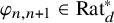 $\varphi _{n,n+1} \in {\operatorname {Rat}}_d^*$
such that
$\varphi _{n,n+1} \in {\operatorname {Rat}}_d^*$
such that
 $$ \begin{align*}\varphi_{n+1} = \varphi_{n,n+1} \circ \varphi_n.\end{align*} $$
Moreover, if $\{A_{n,k}\}$
is a collection of scalings for
$\{A_{n,k}\}$
is a collection of scalings for $\{f_k\}$
, then
$\{f_k\}$
, then
 $$ \begin{align*}A_{n+1,k} \circ f_k \circ A^{-1}_{n,k} \to \varphi_{n,n+1}.\end{align*} $$
Proof. For any $n \ge 1$
, let
$n \ge 1$
, let $\{ A_{n,k}\} \subset {\operatorname {Rat}}_1$
be a collection of scalings for
$\{ A_{n,k}\} \subset {\operatorname {Rat}}_1$
be a collection of scalings for $\{f_k\}$
. Modulo passing to a subsequence, by Proposition 2.1 applied to
$\{f_k\}$
. Modulo passing to a subsequence, by Proposition 2.1 applied to $\{ f_k \circ A^{-1}_{n,k}\}$
, there exists
$\{ f_k \circ A^{-1}_{n,k}\}$
, there exists $\{B_{n+1,k}\}$
such that, as
$\{B_{n+1,k}\}$
such that, as $k \to \infty $
,
$k \to \infty $
,
 $$ \begin{align*}B_{n+1,k} \circ f_k \circ A^{-1}_{n,k} \to \psi_{n,n+1},\end{align*} $$
for some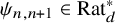 $\psi _{n,n+1} \in {\operatorname {Rat}}^*_{d}$
. Continuity of composition (§2.3) implies that
$\psi _{n,n+1} \in {\operatorname {Rat}}^*_{d}$
. Continuity of composition (§2.3) implies that $B_{n+1,k} \circ f_k^{\circ n+1} \to \psi _{n,n+1} \circ \varphi _n$
. Again by Proposition 2.1, we conclude that
$B_{n+1,k} \circ f_k^{\circ n+1} \to \psi _{n,n+1} \circ \varphi _n$
. Again by Proposition 2.1, we conclude that $A_{n+1,k} \circ B^{-1}_{n+1,k} \to M_{n+1}$
, for some Möbius transformation
$A_{n+1,k} \circ B^{-1}_{n+1,k} \to M_{n+1}$
, for some Möbius transformation $M_{n+1} \in {\operatorname {Rat}}_1$
. Let
$M_{n+1} \in {\operatorname {Rat}}_1$
. Let $\varphi _{n,n+1} := M_{n+1} \circ \psi _{n,n+1}$
. Thus, a map
$\varphi _{n,n+1} := M_{n+1} \circ \psi _{n,n+1}$
. Thus, a map $\varphi _{n,n+1} \in \overline {\operatorname {Rat}}_d$
as in the statement of the Lemma exists.
$\varphi _{n,n+1} \in \overline {\operatorname {Rat}}_d$
as in the statement of the Lemma exists.
Note that any accumulation point $\varphi \in \overline {\operatorname {Rat}}_d$
of
$\varphi \in \overline {\operatorname {Rat}}_d$
of $A_{n+1,k} \circ f_k \circ A^{-1}_{n,k}$
satisfies that
$A_{n+1,k} \circ f_k \circ A^{-1}_{n,k}$
satisfies that $\varphi \circ \varphi _n = \varphi _{n+1}$
. To finish the proof, it suffices to show that
$\varphi \circ \varphi _n = \varphi _{n+1}$
. To finish the proof, it suffices to show that $\varphi $
is uniquely determined by this property, that is,
$\varphi $
is uniquely determined by this property, that is, $\varphi = \varphi _{n,n+1}$
. Indeed, surjectivity of
$\varphi = \varphi _{n,n+1}$
. Indeed, surjectivity of $\tilde {\varphi }_n$
yields that
$\tilde {\varphi }_n$
yields that $\tilde {\varphi } = \tilde {\varphi }_{n,n+1}$
. Moreover, the depth
$\tilde {\varphi } = \tilde {\varphi }_{n,n+1}$
. Moreover, the depth $d_h(\varphi )$
, for any
$d_h(\varphi )$
, for any $h \in \overline {\mathbb {C}}$
, is completely determined by the equation
$h \in \overline {\mathbb {C}}$
, is completely determined by the equation
 $$ \begin{align*}d_h(\varphi_{n+1}) = d_h(\varphi_n) \cdot d + \deg_h \tilde{\varphi}_n \cdot d_{\tilde{\varphi}_n(h)}(\varphi).\end{align*} $$
Therefore, $\varphi = \varphi _{n,n+1}$
.
$\varphi = \varphi _{n,n+1}$
.
2.5 Depth formulas
The following result is the complex analytic analogue of [Reference Kiwi and Nie11, Lemma 2.9].
Lemma 2.5. Let $\{f_k\} \subset {\operatorname {Rat}_d}$
be a sequence converging to
$\{f_k\} \subset {\operatorname {Rat}_d}$
be a sequence converging to $g\in \partial {\mathrm {Rat}}_d$
with constant reduction. Assume that
$g\in \partial {\mathrm {Rat}}_d$
with constant reduction. Assume that 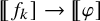 . Then there exists $a \in \overline {\mathbb {C}}$
such that
$a \in \overline {\mathbb {C}}$
such that
 $$ \begin{align*}\operatorname{Hole}(g) = \operatorname{Hole}(\varphi) \cup \tilde{\varphi}^{-1} (a).\end{align*} $$
Moreover,
 $$ \begin{align*}d_h(g) = \begin{cases} d_h(\varphi), & \text{ if } h \notin \tilde{\varphi}^{-1}(a), \\ d_h(\varphi) + \deg_h \tilde{\varphi}, & \text{ otherwise.} \end{cases} \end{align*} $$
Furthermore, if $A_k \circ f_k \to \varphi $
in
$A_k \circ f_k \to \varphi $
in ${\operatorname {Rat}}_d^*$
, then
${\operatorname {Rat}}_d^*$
, then $A_k \to A\in \partial {\operatorname {Rat}}_1$
with
$A_k \to A\in \partial {\operatorname {Rat}}_1$
with $\tilde {A}=a$
and
$\tilde {A}=a$
and $\operatorname {Hole}(A)=\{c\}$
where
$\operatorname {Hole}(A)=\{c\}$
where $\tilde {g} \equiv c$
.
$\tilde {g} \equiv c$
.
Proof. Consider a sequence $\{A_k\} \subset {\operatorname {Rat}}_1$
such that
$\{A_k\} \subset {\operatorname {Rat}}_1$
such that $A_k \circ f_k \to \varphi $
. Passing to a subsequence, suppose
$A_k \circ f_k \to \varphi $
. Passing to a subsequence, suppose $A_{k_i} \to A \in \partial {\operatorname {Rat}}_1$
and write
$A_{k_i} \to A \in \partial {\operatorname {Rat}}_1$
and write $a:=\tilde {A}$
. Then
$a:=\tilde {A}$
. Then $\operatorname {Hole}(A) = \{c\}$
where
$\operatorname {Hole}(A) = \{c\}$
where $\tilde {g} \equiv c$
; for otherwise
$\tilde {g} \equiv c$
; for otherwise $A_{k_i} \circ f_{k_i}(z)$
would converge to a outside
$A_{k_i} \circ f_{k_i}(z)$
would converge to a outside $\operatorname {Hole}(\varphi )$
, and hence
$\operatorname {Hole}(\varphi )$
, and hence $\tilde {\varphi }$
would be constant, contrary to our hypothesis.
$\tilde {\varphi }$
would be constant, contrary to our hypothesis.
It follows that $A^{-1}_{k_i}$
converges to some
$A^{-1}_{k_i}$
converges to some $B\in \partial {\operatorname {Rat}}_1$
with reduction c and hole a, that is,
$B\in \partial {\operatorname {Rat}}_1$
with reduction c and hole a, that is, $H_B(z) = z-a$
. Hence,
$H_B(z) = z-a$
. Hence,
 $$ \begin{align*}A^{-1}_{k_i} \circ (A_{k_i} \circ f_{k_i}) \to (H_B \circ \tilde{\varphi}) H_\varphi \cdot c = g.\end{align*} $$
Thus, the first two assertions hold. Since a is independent of the subsequence, the last assertion also holds.
Given $g \in \partial {\operatorname {Rat}}_d$
, we define the algebraically exceptional set
$g \in \partial {\operatorname {Rat}}_d$
, we define the algebraically exceptional set $Ex_g\subset \overline {\mathbb {C}}$
by
$Ex_g\subset \overline {\mathbb {C}}$
by
 $$ \begin{align*}Ex_g:= \begin{cases} \{\tilde g\}\ \ &\text{if}\ \deg\tilde g=0,\\ \emptyset\ \ &\text{if}\ \deg\tilde g\ge 1. \end{cases}\end{align*} $$
The next lemma provides a way to compute depths by counting preimages of nonexceptional points. It states precisely the sense in which holes “map onto $\overline {\mathbb {C}}$
” by a degenerate map (c.f. [Reference DeMarco2, Lemmas 4.5 and 4.6]).
$\overline {\mathbb {C}}$
” by a degenerate map (c.f. [Reference DeMarco2, Lemmas 4.5 and 4.6]).
Lemma 2.6. Let $\{f_k\} \subset {\operatorname {Rat}_d}$
be a sequence converging to
$\{f_k\} \subset {\operatorname {Rat}_d}$
be a sequence converging to $g\in \partial {\mathrm {Rat}}_d$
and assume that
$g\in \partial {\mathrm {Rat}}_d$
and assume that 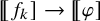 . Pick $z_0\in \overline {\mathbb {C}}$
. Then for any
$z_0\in \overline {\mathbb {C}}$
. Then for any $w \in \overline {\mathbb {C}}$
, there exists an arbitrarily small neighborhood U of w, such that the following hold for all sufficiently large k:
$w \in \overline {\mathbb {C}}$
, there exists an arbitrarily small neighborhood U of w, such that the following hold for all sufficiently large k:
-
1. If $z_0\not \in Ex_g$
, then, counting with multiplicities,
$$ \begin{align*}\#(f_k^{-1} (z_0) \cap U) = \begin{cases} d_w(g) & \text{ if } \tilde{g}(w) \neq z_0, \\ d_w(g) + \deg_w \tilde{g} & \text{ if } \tilde{g}(w) = z_0. \end{cases} \end{align*} $$
$z_0\not \in Ex_g$
, then, counting with multiplicities,
$$ \begin{align*}\#(f_k^{-1} (z_0) \cap U) = \begin{cases} d_w(g) & \text{ if } \tilde{g}(w) \neq z_0, \\ d_w(g) + \deg_w \tilde{g} & \text{ if } \tilde{g}(w) = z_0. \end{cases} \end{align*} $$
-
2. Counting with multiplicities,
$$ \begin{align*}\#(f_k^{-1} (z_0) \cap U)\le d_w(\varphi)+\deg_w\tilde\varphi\le d_w(g)+\deg_w\tilde\varphi.\end{align*} $$


Proof. Let $P,Q \in \mathbb {C}[z]$
be two degree d polynomials such that
$P,Q \in \mathbb {C}[z]$
be two degree d polynomials such that $g=P/Q$
. Let H be a common divisor of P and Q with maximal degree. Then
$g=P/Q$
. Let H be a common divisor of P and Q with maximal degree. Then $P=H\tilde {P}$
,
$P=H\tilde {P}$
, $Q= H \tilde {Q}$
and
$Q= H \tilde {Q}$
and $\tilde {g} =\tilde {P}/\tilde {Q}$
for some relatively prime polynomials
$\tilde {g} =\tilde {P}/\tilde {Q}$
for some relatively prime polynomials $\tilde {P},\tilde {Q}$
. If
$\tilde {P},\tilde {Q}$
. If $z_0 \notin Ex_g$
, we have that
$z_0 \notin Ex_g$
, we have that $\tilde {g} \not \equiv z_0$
. Hence, the multiplicity of w as a solution of
$\tilde {g} \not \equiv z_0$
. Hence, the multiplicity of w as a solution of
 $$ \begin{align*}0=P-z_0Q=H(\tilde{P}-z_0 \tilde{Q})\end{align*} $$
is $d_w(g)$
if
$d_w(g)$
if $\tilde {g}(w) \neq z_0$
, and
$\tilde {g}(w) \neq z_0$
, and $d_w(g) + \deg _w \tilde {g}$
if
$d_w(g) + \deg _w \tilde {g}$
if $\tilde {g}(w)=z_0$
. Thus writing
$\tilde {g}(w)=z_0$
. Thus writing $f_k=P_k/Q_k$
and observing that the number of solutions of
$f_k=P_k/Q_k$
and observing that the number of solutions of $P_k - z_0Q_k$
in a small neighborhood of w converge to the multiplicity of w as a solution of
$P_k - z_0Q_k$
in a small neighborhood of w converge to the multiplicity of w as a solution of $P-z_0Q=0$
, we obtain statement (1).
$P-z_0Q=0$
, we obtain statement (1).
In view of the above, for statement (2), it suffices to consider the case where $\deg \tilde g=0$
. Let
$\deg \tilde g=0$
. Let $\{A_k\}\subset {\operatorname {Rat}}_1$
such that
$\{A_k\}\subset {\operatorname {Rat}}_1$
such that $A_k\circ f_k\to \varphi $
. Passing to a subsequence in k, we can assume that
$A_k\circ f_k\to \varphi $
. Passing to a subsequence in k, we can assume that $A_k(z_0)\to a$
. Then given a small neighborhood U of w, we have that, for all sufficiently large k,
$A_k(z_0)\to a$
. Then given a small neighborhood U of w, we have that, for all sufficiently large k,
 $$ \begin{align*}\#(f_k^{-1} (z_0) \cap U)=\#((A_k\circ f_k)^{-1}(A_k(z_0))\cap U)= \begin{cases} d_w(\varphi)+\deg_w\tilde\varphi\ &\text{if}\ a=\tilde\varphi(w),\\ d_w(\varphi) \ &\text{if}\ a\not=\tilde\varphi(w),\\ \end{cases}\end{align*} $$
counted with multiplicities. Then statement (2) follows from Lemma 2.5.
2.6 Pull-back of measures
Given a continuous function $\varphi : \overline {\mathbb {C}} \to \mathbb {R}$
and a rational map
$\varphi : \overline {\mathbb {C}} \to \mathbb {R}$
and a rational map $f:\overline {\mathbb {C}}\to \overline {\mathbb {C}}$
, the push-forward of
$f:\overline {\mathbb {C}}\to \overline {\mathbb {C}}$
, the push-forward of $\varphi $
by f is the continuous function:
$\varphi $
by f is the continuous function:
 $$ \begin{align*}f_* \varphi (z) := \begin{cases} \sum\limits_{w \in f^{-1}(z)} \deg_w f \cdot \varphi(w)\ \ &\text{if}\ \deg f \ge 1,\\ \ \ \ 0 \ &\text{if}\ \deg f=0. \end{cases}\end{align*} $$
Clearly, $f_*$
is a nonnegative bounded linear operator on the space of continuous function with the
$f_*$
is a nonnegative bounded linear operator on the space of continuous function with the $\sup $
-norm. Its dual is the pull-back
$\sup $
-norm. Its dual is the pull-back $f^*$
, whose action on a (positive Radon) measure
$f^*$
, whose action on a (positive Radon) measure $\mu $
in
$\mu $
in $\overline {\mathbb {C}}$
is determined by the property that
$\overline {\mathbb {C}}$
is determined by the property that
 $$ \begin{align*}\int \varphi(w) d f^* \mu (w) = \int f_* \varphi (z) d \mu(z),\end{align*} $$
for all continuous functions $\varphi $
. Taking
$\varphi $
. Taking $\varphi \equiv 1$
, yields
$\varphi \equiv 1$
, yields $f^* \mu (\overline {\mathbb {C}}) = \deg f \cdot \mu (\overline {\mathbb {C}})$
. All measures considered here are nonnegative Radon measures.
$f^* \mu (\overline {\mathbb {C}}) = \deg f \cdot \mu (\overline {\mathbb {C}})$
. All measures considered here are nonnegative Radon measures.
For any $g \in \partial {\operatorname {Rat}}_d$
, we can obtain a natural measure of total mass
$g \in \partial {\operatorname {Rat}}_d$
, we can obtain a natural measure of total mass $d-\deg {\tilde {g}}$
induced by the depths of its holes:
$d-\deg {\tilde {g}}$
induced by the depths of its holes:
Definition 2.7. Given $g \in \partial {\operatorname {Rat}}_d$
, we say that the measure
$g \in \partial {\operatorname {Rat}}_d$
, we say that the measure
 $$ \begin{align*}\eta_g := \sum_{h \in \operatorname{Hole}(g)} d_h(g) \delta_h\end{align*} $$
is the depth measure of g.
Consider $g \in \overline {\operatorname {Rat}}_d$
. If
$g \in \overline {\operatorname {Rat}}_d$
. If $g\in \partial {\operatorname {Rat}_d}$
, recall from §2.5 the algebraically exceptional set
$g\in \partial {\operatorname {Rat}_d}$
, recall from §2.5 the algebraically exceptional set $Ex_g\subset \overline {\mathbb {C}}$
for g. If
$Ex_g\subset \overline {\mathbb {C}}$
for g. If $g \in {\operatorname {Rat}_d}$
, then the dynamically exceptional set
$g \in {\operatorname {Rat}_d}$
, then the dynamically exceptional set $E_g$
of g, is the one formed by all finite grand orbits, under g. We say that a measure
$E_g$
of g, is the one formed by all finite grand orbits, under g. We say that a measure $\mu $
in
$\mu $
in $\overline {\mathbb {C}}$
is nonexceptional for
$\overline {\mathbb {C}}$
is nonexceptional for $g \in \overline {\operatorname {Rat}}_d$
if
$g \in \overline {\operatorname {Rat}}_d$
if $\mu (Ex_g) =0$
when
$\mu (Ex_g) =0$
when $g \in \partial {\operatorname {Rat}_d}$
and
$g \in \partial {\operatorname {Rat}_d}$
and $\mu (E_g)=0$
when
$\mu (E_g)=0$
when $g \in {\operatorname {Rat}_d}$
. Moreover, given an element in
$g \in {\operatorname {Rat}_d}$
. Moreover, given an element in $\Pi _{i=1}^\infty \overline {\operatorname {Rat}}_{s_i}$
, we say a measure
$\Pi _{i=1}^\infty \overline {\operatorname {Rat}}_{s_i}$
, we say a measure $\mu $
in
$\mu $
in $\overline {\mathbb {C}}$
is nonexceptional for this element if
$\overline {\mathbb {C}}$
is nonexceptional for this element if $\mu $
is nonexceptional for each coordinate. Following DeMarco [Reference DeMarco2, Section 3], we introduce the pull-back of measures by g.
$\mu $
is nonexceptional for each coordinate. Following DeMarco [Reference DeMarco2, Section 3], we introduce the pull-back of measures by g.
Definition 2.8. Given $g \in \partial {\operatorname {Rat}}_d$
and a nonexceptional measure
$g \in \partial {\operatorname {Rat}}_d$
and a nonexceptional measure $\mu $
for g, we say that
$\mu $
for g, we say that
 $$ \begin{align*}g^* \mu = \tilde{g}^* \mu + \mu(\overline{\mathbb{C}}) \cdot \eta_g\end{align*} $$
is the pull-back of $\mu $
under g.
$\mu $
under g.
Given $g \in \partial {\operatorname {Rat}}_d$
and a continuous function
$g \in \partial {\operatorname {Rat}}_d$
and a continuous function $\varphi : \overline {\mathbb {C}} \to \mathbb {R}$
, we define the push-forward of
$\varphi : \overline {\mathbb {C}} \to \mathbb {R}$
, we define the push-forward of $\varphi $
by g
$\varphi $
by g
 $$ \begin{align*}g_* \varphi := \tilde{g}_* \varphi + \sum_{h \in \operatorname{Hole}(g)} d_h(g) \varphi(h);\end{align*} $$
then for any a nonexceptional measure $\mu $
for g, one obtains that
$\mu $
for g, one obtains that
 $$ \begin{align*}\int \varphi d g^* \mu = \int g_* \varphi d \mu.\end{align*} $$
Although not explicitly discussed in DeMarco [Reference DeMarco2] and DeMarco-Faber [Reference DeMarco and Faber4], a key fact is that the pull-back defined above is the continuous extension of the pull-back of (nonexceptional) measures:
Proposition 2.9. Let $g \in \partial {\operatorname {Rat}_d}$
and
$g \in \partial {\operatorname {Rat}_d}$
and $\mu $
be a nonexceptional measure for g. Then
$\mu $
be a nonexceptional measure for g. Then $f^*\nu $
converges to
$f^*\nu $
converges to $g^* \mu $
, as
$g^* \mu $
, as $f \in {\operatorname {Rat}}_d$
converges to g and
$f \in {\operatorname {Rat}}_d$
converges to g and $\nu $
converges to
$\nu $
converges to $\mu $
.
$\mu $
.
Proof. Let $W\subset \overline {\mathbb {C}}$
be a small neighborhood of the point in
$W\subset \overline {\mathbb {C}}$
be a small neighborhood of the point in $Ex_g$
if
$Ex_g$
if $Ex_g\not =\emptyset $
; and set
$Ex_g\not =\emptyset $
; and set $W=\emptyset $
if
$W=\emptyset $
if $Ex_g=\emptyset $
. Consider
$Ex_g=\emptyset $
. Consider $z \in \overline {\mathbb {C}} \setminus W$
. As
$z \in \overline {\mathbb {C}} \setminus W$
. As ${\operatorname {Rat}_d} \ni f \to g$
, the set
${\operatorname {Rat}_d} \ni f \to g$
, the set $f^{-1}(z)$
converges to
$f^{-1}(z)$
converges to $\operatorname {Hole}(g) \cup \tilde {g}^{-1}(z)$
; each point is counted with multiplicity. More precisely, given
$\operatorname {Hole}(g) \cup \tilde {g}^{-1}(z)$
; each point is counted with multiplicity. More precisely, given $w \in \operatorname {Hole}(g) \cup \tilde {g}^{-1}(z)$
, let
$w \in \operatorname {Hole}(g) \cup \tilde {g}^{-1}(z)$
, let $m_w := d_w(f)$
if
$m_w := d_w(f)$
if $w \notin \tilde {g}^{-1}(z)$
, and
$w \notin \tilde {g}^{-1}(z)$
, and $m_w := d_w(f) + \deg _w \tilde {g}$
otherwise. By Lemma 2.6 (1), given any small neighborhood of w, for all f sufficiently close to g, this neighborhood contains
$m_w := d_w(f) + \deg _w \tilde {g}$
otherwise. By Lemma 2.6 (1), given any small neighborhood of w, for all f sufficiently close to g, this neighborhood contains $m_w$
preimages of z under f, counted with multiplicities.
$m_w$
preimages of z under f, counted with multiplicities.
Now, consider a nonnegative continuous test function $\varphi :\overline {\mathbb {C}}\to \mathbb {R}$
. From the previous paragraph, as
$\varphi :\overline {\mathbb {C}}\to \mathbb {R}$
. From the previous paragraph, as $f \to g$
, we have that
$f \to g$
, we have that $f_* \varphi : \overline {\mathbb {C}} \setminus W \to \mathbb {R} $
pointwise converges to the continuous function
$f_* \varphi : \overline {\mathbb {C}} \setminus W \to \mathbb {R} $
pointwise converges to the continuous function $g_*\varphi :\overline {\mathbb {C}} \setminus W \to \mathbb {R}$
. Since
$g_*\varphi :\overline {\mathbb {C}} \setminus W \to \mathbb {R}$
. Since $\overline {\mathbb {C}} \setminus W$
is compact, the convergence is, in fact, uniform.
$\overline {\mathbb {C}} \setminus W$
is compact, the convergence is, in fact, uniform.
Given $\varepsilon>0$
, assume that W is sufficiently small with
$\varepsilon>0$
, assume that W is sufficiently small with $\mu (\partial W)=0$
and
$\mu (\partial W)=0$
and $\nu $
is sufficiently close to
$\nu $
is sufficiently close to $\mu $
so that both
$\mu $
so that both $\mu (W)$
and
$\mu (W)$
and $\nu (W)$
are less than
$\nu (W)$
are less than $\varepsilon $
. Then
$\varepsilon $
. Then
 $$ \begin{align*} \left|\int_{\overline{\mathbb{C}}} \varphi (f^* d\nu - g^* d\mu) \right| & = \left|\int_{\overline{\mathbb{C}}} f_* \varphi d\nu - \int_{\overline{\mathbb{C}}} g_* \varphi d\mu \right|\\ & = \left|\int_{\overline{\mathbb{C}} \setminus W} f_* \varphi d\nu - \int_{\overline{\mathbb{C}} \setminus W} g_* \varphi d\mu + \int_{W} f_* \varphi d\nu - \int _{W}g_* \varphi d\mu \right|\\ &\le \left|\int_{\overline{\mathbb{C}} \setminus W} f_* \varphi d\nu - \int_{\overline{\mathbb{C}} \setminus W} g_* \varphi d\mu\right| + \left|\int_{W} f_* \varphi d\nu\right|+\left| \int _{W}g_* \varphi d\mu \right|\\ &\le\left|\int_{\overline{\mathbb{C}} \setminus W} f_* \varphi d\nu - \int_{\overline{\mathbb{C}} \setminus W} f_* \varphi d\mu\right|+\left| \int_{\overline{\mathbb{C}} \setminus W} (f_* \varphi-g_* \varphi) d\mu\right| + d \|\varphi\|_\infty 2 \varepsilon, \end{align*} $$
where the last inequality follows from the fact that $\|F_* \varphi \|_\infty \le d \|\varphi \|_\infty $
for any
$\|F_* \varphi \|_\infty \le d \|\varphi \|_\infty $
for any $F \in \overline {\operatorname {Rat}}_d$
. The convergence of
$F \in \overline {\operatorname {Rat}}_d$
. The convergence of $\nu $
to
$\nu $
to $\mu $
and the uniform convergence of
$\mu $
and the uniform convergence of $f_* \varphi $
to
$f_* \varphi $
to $g_* \varphi $
in
$g_* \varphi $
in $\overline {\mathbb {C}} \setminus W$
, as
$\overline {\mathbb {C}} \setminus W$
, as $f \to g$
, yield that
$f \to g$
, yield that $f^* \nu \to g^* \mu $
as
$f^* \nu \to g^* \mu $
as $(f,\nu ) \to (g,\mu )$
.
$(f,\nu ) \to (g,\mu )$
.
2.7 Measures of maximal entropy
Recall that $M^1(\overline {\mathbb {C}})$
denotes the space of probability measures in
$M^1(\overline {\mathbb {C}})$
denotes the space of probability measures in $\overline {\mathbb {C}}$
endowed with the weak* topology. Given a rational map
$\overline {\mathbb {C}}$
endowed with the weak* topology. Given a rational map $f \in {\operatorname {Rat}_d}$
, there exists a unique probability measure
$f \in {\operatorname {Rat}_d}$
, there exists a unique probability measure $\mu _f$
such that
$\mu _f$
such that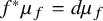 $f^* \mu _f = d \mu _f$
and
$f^* \mu _f = d \mu _f$
and 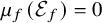 where
where  is the exceptional set for f (i.e., the elements of $\overline {\mathbb {C}}$
with finite grand orbit). Moreover, for any
$\overline {\mathbb {C}}$
with finite grand orbit). Moreover, for any $\mu \in M^1(\overline {\mathbb {C}})$
satisfying
$\mu \in M^1(\overline {\mathbb {C}})$
satisfying  ,
,
 $$ \begin{align*}\dfrac{1}{d^n} (f^{\circ n})^\ast \mu \to \mu_f.\end{align*} $$
Furthermore, $\mu _f$
is supported on the Julia set
$\mu _f$
is supported on the Julia set  of f and is the unique measure of maximal entropy for f. This measure $\mu _f$
varies continuously with f. See [Reference Freire, Lopes and Mañé10, Reference Lyubich12, Reference Mañé13].
$\mu _f$
varies continuously with f. See [Reference Freire, Lopes and Mañé10, Reference Lyubich12, Reference Mañé13].
The fundamental property of an accumulation point $\mu $
of measures
$\mu $
of measures $\mu _f$
as f approaches a degenerate map was formulated by DeMarco and Faber [Reference DeMarco and Faber4, Section 2.4] in terms of pairs of probability measures
$\mu _f$
as f approaches a degenerate map was formulated by DeMarco and Faber [Reference DeMarco and Faber4, Section 2.4] in terms of pairs of probability measures $(\mu ,\nu )$
that take into account the changes of scales involved. More precisely, let
$(\mu ,\nu )$
that take into account the changes of scales involved. More precisely, let $(\mu ,\nu )$
be a pair of probability measures on
$(\mu ,\nu )$
be a pair of probability measures on $\overline {\mathbb {C}}$
. For a sequence
$\overline {\mathbb {C}}$
. For a sequence $\{A_k\}\subset {\operatorname {Rat}}_1$
, we say that a sequence
$\{A_k\}\subset {\operatorname {Rat}}_1$
, we say that a sequence $\{\mu _k\}\subset M^1(\overline {\mathbb {C}})$
converges
$\{\mu _k\}\subset M^1(\overline {\mathbb {C}})$
converges $\{A_k\}$
-weakly to
$\{A_k\}$
-weakly to $(\mu , \nu )$
if
$(\mu , \nu )$
if $\mu _k$
converges to
$\mu _k$
converges to $\mu $
and
$\mu $
and $(A_k)_\ast \mu _k$
converges to
$(A_k)_\ast \mu _k$
converges to $\nu $
.
$\nu $
.
Proposition 2.10 [Reference DeMarco and Faber4, Theorem 2.4].
Let $\{f_k\}$
be a sequence in
$\{f_k\}$
be a sequence in $\mathrm {Rat}_d$
and let
$\mathrm {Rat}_d$
and let $\{A_k\}$
be a sequence in
$\{A_k\}$
be a sequence in ${\operatorname {Rat}}_1$
such that
${\operatorname {Rat}}_1$
such that $A_k\circ f_k$
converges to a map
$A_k\circ f_k$
converges to a map $\varphi \in {\operatorname {Rat}}_d^*$
. Assume that the
$\varphi \in {\operatorname {Rat}}_d^*$
. Assume that the $\{A_k\}$
-weak limit of
$\{A_k\}$
-weak limit of $\{\mu _{f_k}\}$
is
$\{\mu _{f_k}\}$
is $(\mu ,\nu )$
. Then
$(\mu ,\nu )$
. Then
 $$ \begin{align*}\mu =\frac{1}{d}\varphi^\ast\nu.\end{align*} $$
Proof. For all $k \ge 1$
,
$k \ge 1$
,
 $$ \begin{align*}(A_k \circ f_k)^* (A_k) _* \mu_k = d \cdot \mu_{f_k}.\end{align*} $$
Continuity of the pull-back at $(\varphi ,\nu )$
(Proposition 2.9) yields
$(\varphi ,\nu )$
(Proposition 2.9) yields $\varphi ^* \nu = d \cdot \mu .$
3 Limiting dynamics of fully ramified sequences
Recall from §2.4 that ${\operatorname {Rat}}^*_d$
denotes the space of degree d rational maps with nonconstant reduction. Möbius transformations act by post-composition on
${\operatorname {Rat}}^*_d$
denotes the space of degree d rational maps with nonconstant reduction. Möbius transformations act by post-composition on ${\operatorname {Rat}}^*_d$
. Its orbit space, denoted by
${\operatorname {Rat}}^*_d$
. Its orbit space, denoted by  , is a compact Hausdorff space, see Corollary 2.2.
Here we consider sequences $\{f_k\} \subset {\operatorname {Rat}_d}$
such that
$\{f_k\} \subset {\operatorname {Rat}_d}$
such that  converges to
  , for all n. From Lemma 2.4, there exists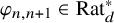 $\varphi _{n,n+1} \in {\operatorname {Rat}}_d^*$
such that
$\varphi _{n,n+1} \in {\operatorname {Rat}}_d^*$
such that $\varphi _{n+1} = \varphi _{n,n+1} \circ \varphi _n$
, for all n. We say that
$\varphi _{n+1} = \varphi _{n,n+1} \circ \varphi _n$
, for all n. We say that $n_0$
is a fully ramified time if
$n_0$
is a fully ramified time if $\varphi _{n_0,n_0+1}$
is a nondegenerate map of degree d.
$\varphi _{n_0,n_0+1}$
is a nondegenerate map of degree d.
In this section, we analyze the limiting dynamics for sequences having several successive fully ramified times. Our analysis is based on the trees of bouquet of spheres discussed in Appendix A and closely related to the work by Arfeux [Reference Arfeux1]. We establish the Structure Theorem 3.1 for sequences $\{f_k\}$
diverging in moduli space
$\{f_k\}$
diverging in moduli space ${\operatorname {rat}_d}$
and possessing at least
${\operatorname {rat}_d}$
and possessing at least $3$
successive fully ramified times. We also deduce Corollaries 3.15 and 3.16 which are crucial in our proofs of Theorems A and B. Moreover, we obtain Theorem C as a byproduct of the Structure Theorem 3.1.
$3$
successive fully ramified times. We also deduce Corollaries 3.15 and 3.16 which are crucial in our proofs of Theorems A and B. Moreover, we obtain Theorem C as a byproduct of the Structure Theorem 3.1.
Recall that we should regard $\tilde {\varphi }_{n,n+1}$
as a map between two spheres:
$\tilde {\varphi }_{n,n+1}$
as a map between two spheres: $\overline {\mathbb {C}}_n$
and
$\overline {\mathbb {C}}_n$
and $\overline {\mathbb {C}}_{n+1}$
. Assuming that for some
$\overline {\mathbb {C}}_{n+1}$
. Assuming that for some $m \ge 0$
, the times
$m \ge 0$
, the times $m,m+1$
and
$m,m+1$
and $m+2$
are fully ramified, the Structure Theorem asserts that the spheres
$m+2$
are fully ramified, the Structure Theorem asserts that the spheres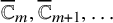 $\overline {\mathbb {C}}_m, \overline {\mathbb {C}}_{m+1}, \dots $
are organized in a linear concatenation and describes the maps
$\overline {\mathbb {C}}_m, \overline {\mathbb {C}}_{m+1}, \dots $
are organized in a linear concatenation and describes the maps $\tilde {\varphi }_{n,n+1}$
for
$\tilde {\varphi }_{n,n+1}$
for $n \ge m$
. The main tools are the results from Appendix A and Proposition 3.7. The general idea is to combine the simple connectivity, given by Proposition A.1, with the formula for the multiplicities of the critical points of
$n \ge m$
. The main tools are the results from Appendix A and Proposition 3.7. The general idea is to combine the simple connectivity, given by Proposition A.1, with the formula for the multiplicities of the critical points of $\tilde {\varphi }_{n,n+1}$
, given by Proposition A.3, to establish the linear concatenation for the initial segment of fully ramified times. Then, to show that the linear concatenation respects the order on the integers, we rely on the extraction of polynomial-like maps, given by Proposition 3.7. Finally, to extend our description beyond fully ramified times, we count preimages with the aid of Proposition A.2.
$\tilde {\varphi }_{n,n+1}$
, given by Proposition A.3, to establish the linear concatenation for the initial segment of fully ramified times. Then, to show that the linear concatenation respects the order on the integers, we rely on the extraction of polynomial-like maps, given by Proposition 3.7. Finally, to extend our description beyond fully ramified times, we count preimages with the aid of Proposition A.2.
3.1 Statement of the Structure Theorem
Let $\{f_k\} \subset {\operatorname {Rat}_d}$
be such that
$\{f_k\} \subset {\operatorname {Rat}_d}$
be such that  converges to
  in
in  for each $n\ge 1$
. Recall from §2.4 that
$n\ge 1$
. Recall from §2.4 that $\{ A_{n,k}: n, k \ge 1 \} \subset {\operatorname {Rat}}_1$
is a collection of scalings for
$\{ A_{n,k}: n, k \ge 1 \} \subset {\operatorname {Rat}}_1$
is a collection of scalings for $\{f_k\}$
if for any
$\{f_k\}$
if for any $n \ge 1$
, as
$n \ge 1$
, as $k \to \infty $
,
$k \to \infty $
,
 $$ \begin{align*}A_{n,k} \circ f^{\circ n}_k \to \varphi_n.\end{align*} $$
Such a collection $\{A_{n,k}\}$
has convergent changes of coordinates if for all
$\{A_{n,k}\}$
has convergent changes of coordinates if for all $n \neq n'$
,
$n \neq n'$
,
 $$ \begin{align*}A_{n',k} \circ A^{-1}_{n,k} \to A_{(n,n')} \in \overline{\operatorname{Rat}}_1.\end{align*} $$
When clear from context, $A_{(n,n')} \in \overline {\operatorname {Rat}}_1$
will be the limit of the corresponding coordinate changes
$A_{(n,n')} \in \overline {\operatorname {Rat}}_1$
will be the limit of the corresponding coordinate changes $A_{n',k} \circ A^{-1}_{n,k}$
and, if
$A_{n',k} \circ A^{-1}_{n,k}$
and, if $A_{(n,n')} \in \partial {\operatorname {Rat}}_1$
, write
$A_{(n,n')} \in \partial {\operatorname {Rat}}_1$
, write
 $$ \begin{align*}a_{n,n'}:= \tilde{A}_{(n,n')}\in\overline{\mathbb{C}}.\end{align*} $$
In the case that $A_{(n,n')} \in \partial {\operatorname {Rat}}_1$
for all
$A_{(n,n')} \in \partial {\operatorname {Rat}}_1$
for all $n \neq n'$
, we say that
$n \neq n'$
, we say that $\{A_{n,k}: n,k \ge 1\}$
is a collection of independent scalings. Note that
$\{A_{n,k}: n,k \ge 1\}$
is a collection of independent scalings. Note that $a_{n',n}$
is the unique hole of
$a_{n',n}$
is the unique hole of $A_{(n,n')}$
. By definition, independent collections of scalings have convergent changes of coordinates.
$A_{(n,n')}$
. By definition, independent collections of scalings have convergent changes of coordinates.
Let $m \ge 1$
and consider a collection
$m \ge 1$
and consider a collection $\{A_{n,k}: n \ge m \}$
of independent scalings, where we abuse of notation and omit writing
$\{A_{n,k}: n \ge m \}$
of independent scalings, where we abuse of notation and omit writing $k \ge 1$
and, sometimes, simply write
$k \ge 1$
and, sometimes, simply write $\{A_{n,k}\}$
. In view of Appendix A, given
$\{A_{n,k}\}$
. In view of Appendix A, given $\ell \ge m$
, the collection
$\ell \ge m$
, the collection $\{A_{n,k}: m \le n \le \ell \}$
is, in a certain sense, a tree of bouquets of spheres. More precisely, for each integer
$\{A_{n,k}: m \le n \le \ell \}$
is, in a certain sense, a tree of bouquets of spheres. More precisely, for each integer $n \ge 1$
, consider a copy
$n \ge 1$
, consider a copy $\overline {\mathbb {C}}_n$
of the Riemann sphere. Let
$\overline {\mathbb {C}}_n$
of the Riemann sphere. Let $\sim $
be the equivalence relation in
$\sim $
be the equivalence relation in $\overline {\mathbb {C}}_m \sqcup \cdots \sqcup \overline {\mathbb {C}}_\ell $
that identifies
$\overline {\mathbb {C}}_m \sqcup \cdots \sqcup \overline {\mathbb {C}}_\ell $
that identifies $a_{n,n'} \in \overline {\mathbb {C}}_{n'}$
with
$a_{n,n'} \in \overline {\mathbb {C}}_{n'}$
with $a_{n',n} \in \overline {\mathbb {C}}_n$
if and only if
$a_{n',n} \in \overline {\mathbb {C}}_n$
if and only if
 $$ \begin{align*}a_{n,n"} = a_{n',n"}\end{align*} $$
for all $n" \neq n, n'$
such that
$n" \neq n, n'$
such that $m \le n"\le \ell $
. All other
$m \le n"\le \ell $
. All other $\sim $
-classes are trivial. Let
$\sim $
-classes are trivial. Let

By Proposition A.1, the space  is simply connected. For each n, we have the retraction

which maps $\overline {\mathbb {C}}_{n'}$
onto
$\overline {\mathbb {C}}_{n'}$
onto $a_{n',n}$
, for all
$a_{n',n}$
, for all $n'\neq n$
. It is convenient to identify
$n'\neq n$
. It is convenient to identify $\overline {\mathbb {C}}_n$
with the corresponding subset of
$\overline {\mathbb {C}}_n$
with the corresponding subset of  .
.
Collapsing 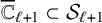 to a point produces a continuous map
  . The image of $\overline {\mathbb {C}}_{\ell +1}$
is the common point in
$\overline {\mathbb {C}}_{\ell +1}$
is the common point in  of all the spheres $\overline {\mathbb {C}}_j$
that intersect
$\overline {\mathbb {C}}_j$
that intersect $\overline {\mathbb {C}}_{\ell +1}$
in
$\overline {\mathbb {C}}_{\ell +1}$
in  . We say that the inverse limit of
  is the space
  associated to the collection of scalings $\{A_{n,k} : n \ge m\}$
.
$\{A_{n,k} : n \ge m\}$
.
In view of Lemma 2.4, $A_{n+1,k} \circ f_k \circ A_{n,k}^{-1}$
converges to a map
$A_{n+1,k} \circ f_k \circ A_{n,k}^{-1}$
converges to a map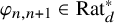 $\varphi _{n,n+1} \in {\operatorname {Rat}}^*_d$
. Recall that we regard
$\varphi _{n,n+1} \in {\operatorname {Rat}}^*_d$
. Recall that we regard $\tilde \varphi _{n,n+1}$
as a map from
$\tilde \varphi _{n,n+1}$
as a map from $\overline {\mathbb {C}}_n$
onto
$\overline {\mathbb {C}}_n$
onto $\overline {\mathbb {C}}_{n+1}$
, and also regard
$\overline {\mathbb {C}}_{n+1}$
, and also regard $A_{n,k}$
as a map from
$A_{n,k}$
as a map from $\overline {\mathbb {C}}$
onto
$\overline {\mathbb {C}}$
onto $\overline {\mathbb {C}}_n$
. We will show that, under certain conditions, the maps
$\overline {\mathbb {C}}_n$
. We will show that, under certain conditions, the maps $\tilde {\varphi }_{n,n+1}:\overline {\mathbb {C}}_n \to \overline {\mathbb {C}}_{n+1}$
produce a well defined map from
$\tilde {\varphi }_{n,n+1}:\overline {\mathbb {C}}_n \to \overline {\mathbb {C}}_{n+1}$
produce a well defined map from  to
to  .
.
Theorem 3.1 (Structure Theorem).
Let $\{f_k\}\subset {\operatorname {Rat}_d}$
be a sequence such that
$\{f_k\}\subset {\operatorname {Rat}_d}$
be a sequence such that  for each $n\ge 1$
, and
$n\ge 1$
, and $[f_k]\to [g]\in \partial {\operatorname {rat}}_d$
, as
$[f_k]\to [g]\in \partial {\operatorname {rat}}_d$
, as $k\to \infty $
. Let
$k\to \infty $
. Let $\{A_{n,k}\}$
be a collection of scalings for
$\{A_{n,k}\}$
be a collection of scalings for $\{f_k\}$
having convergent changes of coordinates.
$\{f_k\}$
having convergent changes of coordinates.
Assume that there exists $m \ge 1$
such that
$m \ge 1$
such that $m, m+1$
and
$m, m+1$
and ${m+2}$
are fully ramified times. Then
${m+2}$
are fully ramified times. Then $\{A_{n,k} :n \ge m\}$
is a collection of independent scalings and the following statements hold:
$\{A_{n,k} :n \ge m\}$
is a collection of independent scalings and the following statements hold:
-
1. The space
associated to
$\{A_{n,k}\}$
is the linear concatenation of
$\overline {\mathbb {C}}_{m}, \overline {\mathbb {C}}_{m+1}, \cdots $
. That is, in suitable coordinates, employed for the rest of the statement, is obtained by identifying
$0 \in \overline {\mathbb {C}}_n$
to
$\infty \in \overline {\mathbb {C}}_{n+1}$
, for all
$m \le n < \ell $
(see Figure 1).Figure 1Structure Theorem.
-
2. The map
is well defined and continuous. -
3. For all
$n> m$
,
$$ \begin{align*}\deg_{\infty} \tilde{\varphi}_{n,n+1}=\deg \tilde\varphi_{n,n+1}=\deg_0 \tilde{\varphi}_{n-1,n}.\end{align*} $$
-
4. If
$n>m$
and
$n+1$
is a fully ramified time, then
$\tilde {\varphi }_{n,n+1}$
is a monomial of degree d. -
5. If
$n>m$
is not a fully ramified time, then
$z=\infty $
is the unique hole of
$\varphi _{n,n+1}$
.
 associated to
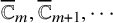
 is obtained by identifying


Continuity of  is equivalent, once (1) is established, to $\tilde {\varphi }_{n,n+1}(\infty )=\infty $
and
$\tilde {\varphi }_{n,n+1}(\infty )=\infty $
and $\tilde {\varphi }_{n-1,n}(0)=0$
for
$\tilde {\varphi }_{n-1,n}(0)=0$
for $n>m$
. Statement (3) yields that
$n>m$
. Statement (3) yields that $\deg \tilde {\varphi }_{n,n+1}$
is a nonincreasing function of
$\deg \tilde {\varphi }_{n,n+1}$
is a nonincreasing function of $n>m$
. Moreover, from statements (1)-(3),
$n>m$
. Moreover, from statements (1)-(3), $\tilde {\varphi }_{n,n+1}$
is a polynomial for all
$\tilde {\varphi }_{n,n+1}$
is a polynomial for all $n>m$
.
$n>m$
.
The map  should be regarded as a limiting action of the sequence $\{f_k\}$
. In general, let us assume that
$\{f_k\}$
. In general, let us assume that $\{A_{n,k}: n \ge m\}$
is a collection of independent scalings for a sequence
$\{A_{n,k}: n \ge m\}$
is a collection of independent scalings for a sequence $\{f_k\}$
. For any
$\{f_k\}$
. For any $\ell \ge m$
, let
$\ell \ge m$
, let
 $$ \begin{align*}J_\ell:=\{n : m \le n \le \ell \}\end{align*} $$
and consider the embedding

From Appendix A, the space  is naturally identified with the Hausdorff limit of the embedded copies
  of
of $\overline {\mathbb {C}}$
. Similarly, for
$\overline {\mathbb {C}}$
. Similarly, for $\ell +1$
, the space
$\ell +1$
, the space  is the limit of
  . Then, $f_k:\overline {\mathbb {C}} \to \overline {\mathbb {C}}$
acts on the embedded sphere as
$f_k:\overline {\mathbb {C}} \to \overline {\mathbb {C}}$
acts on the embedded sphere as

Roughly speaking, Proposition A.2 allows us to count preimages under $F_k$
. That is, consider
$F_k$
. That is, consider 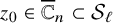 and
and  . Then, for sufficiently large k and for any
  close to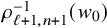 $\rho ^{-1}_{\ell +1,n+1}(w_0)$
, there exists
$\rho ^{-1}_{\ell +1,n+1}(w_0)$
, there exists $\delta $
preimages of w, under
$\delta $
preimages of w, under $F_k$
, close to
$F_k$
, close to $\rho ^{-1}_{\ell ,n}(z_0)$
where
$\rho ^{-1}_{\ell ,n}(z_0)$
where
 $$ \begin{align*}\delta = \begin{cases} d_{z_0} (\varphi_{n,n+1}), & \text{ if } \tilde{\varphi}_{n,n+1}(z_0)\neq w_0,\\ d_{z_0} (\varphi_{n,n+1})+ \deg_{z_0} \tilde{\varphi}_{n,n+1}(z_0), & \text{ if } \tilde{\varphi}_{n,n+1}(z_0)= w_0. \end{cases} \end{align*} $$
See Proposition A.2 for a precise statement.
Remark 3.2. In Berkovich space language, consider a type II point $x:=x_n$
that maps onto
$x:=x_n$
that maps onto $y:=x_{n+1}$
by a rational function F, and let
$y:=x_{n+1}$
by a rational function F, and let $D_x(z_0), D_y(w_0)$
be directions at x and y, respectively. Then the number of preimages in
$D_x(z_0), D_y(w_0)$
be directions at x and y, respectively. Then the number of preimages in $D_x(z_0)$
of a given point
$D_x(z_0)$
of a given point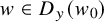 $w \in D_y(w_0)$
is prescribed by a well known formula that depends on the surplus multiplicity and multiplicity of the direction
$w \in D_y(w_0)$
is prescribed by a well known formula that depends on the surplus multiplicity and multiplicity of the direction $D_x(z_0)$
(see [Reference Faber7, Section 3]). The formula above is its Archimedean analogue. In this analogy,
$D_x(z_0)$
(see [Reference Faber7, Section 3]). The formula above is its Archimedean analogue. In this analogy, $x_n, x_{n+1}$
correspond to
$x_n, x_{n+1}$
correspond to $\overline {\mathbb {C}}_n, \overline {\mathbb {C}}_{n+1}$
.
$\overline {\mathbb {C}}_n, \overline {\mathbb {C}}_{n+1}$
.
Remark 3.3. A basic example to consider is
 $$ \begin{align*}f_k(z) = c_k z^2 + c_k \in {\operatorname{Rat}}_2,\end{align*} $$
where $c_k \to \infty $
. For
$c_k \to \infty $
. For $n \ge 1$
, let
$n \ge 1$
, let
 $$ \begin{align*}A_{n,k} (z) := c_k^{-2^{n-1}} z.\end{align*} $$
Note that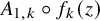 $A_{1,k} \circ f_k (z)$
converges to
$A_{1,k} \circ f_k (z)$
converges to $ z^2 + 1$
, and for
$ z^2 + 1$
, and for $n \ge 2$
,
$n \ge 2$
,
 $$ \begin{align*}A_{n,k} \circ f_k^{\circ n} (z) \to z^{2^{n-1}},\end{align*} $$
uniformly in compact subsets of $\mathbb {C}$
as
$\mathbb {C}$
as $k \to \infty $
. Consequently, all times are fully ramified for
$k \to \infty $
. Consequently, all times are fully ramified for $\{f_k\}$
. It is not difficult to construct similar examples of polynomials in any degree, not necessarily unicritical. In a certain sense, the Structure Theorem says that a degenerating sequence of rational maps
$\{f_k\}$
. It is not difficult to construct similar examples of polynomials in any degree, not necessarily unicritical. In a certain sense, the Structure Theorem says that a degenerating sequence of rational maps $\{f_k\}$
with at least three succesive fully ramified resembles a degeneration along polynomial maps (c.f. Theorem C).
$\{f_k\}$
with at least three succesive fully ramified resembles a degeneration along polynomial maps (c.f. Theorem C).
Remark 3.4. If we have just two consecutive ramified times $m=1,2$
, the spheres
$m=1,2$
, the spheres $\overline {\mathbb {C}}_1, \overline {\mathbb {C}}_2$
and
$\overline {\mathbb {C}}_1, \overline {\mathbb {C}}_2$
and $\overline {\mathbb {C}}_3$
are not necessarily organized in a linear concatenation. Indeed, consider the family of quadratic rational maps, parametrized by
$\overline {\mathbb {C}}_3$
are not necessarily organized in a linear concatenation. Indeed, consider the family of quadratic rational maps, parametrized by $0<t \ll 1$
:
$0<t \ll 1$
:
 $$ \begin{align*}f_t(z) :=\dfrac{1 + t^3 z^2}{t z^2} + t^{-1/2}.\end{align*} $$
Let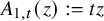 $A_{1,t} (z) := t z$
,
$A_{1,t} (z) := t z$
, $A_{2,t}(z):= -t^{-3/2} + z t^{-1}$
, and
$A_{2,t}(z):= -t^{-3/2} + z t^{-1}$
, and $A_{3,t} (z) = - 2^{-1} t^{-3/2} (z-t^{-1/2} -1)$
. As
$A_{3,t} (z) = - 2^{-1} t^{-3/2} (z-t^{-1/2} -1)$
. As $t \to 0$
, for a generic z, we have
$t \to 0$
, for a generic z, we have $A_{1,t} \circ f_t(z)\to z^{-2}$
,
$A_{1,t} \circ f_t(z)\to z^{-2}$
, $A_{2,t} \circ f_t \circ A_{1,t}^{-1} (z) \to z^{-2}$
, and
$A_{2,t} \circ f_t \circ A_{1,t}^{-1} (z) \to z^{-2}$
, and $A_{3,t} \circ f_t \circ A_{2,t}^{-1} (z) \to z $
. Thus,
$A_{3,t} \circ f_t \circ A_{2,t}^{-1} (z) \to z $
. Thus, $m=0,1$
are fully ramified times for any sequence
$m=0,1$
are fully ramified times for any sequence $\{f_{t_k}\}$
such that
$\{f_{t_k}\}$
such that $t_k \searrow 0$
. However, the space associated to the scalings
$t_k \searrow 0$
. However, the space associated to the scalings $\{ A_{1,t_k}, A_{2,t_k},A_{3,t_k}\}$
is a bouquet of three spheres with a common point. Note that, for k large,
$\{ A_{1,t_k}, A_{2,t_k},A_{3,t_k}\}$
is a bouquet of three spheres with a common point. Note that, for k large, $f_k$
has an attracting fixed point
$f_k$
has an attracting fixed point $z_k = t_k^{-1/2} + 1 + o(1)$
, and therefore, a quadratic-like restriction.
$z_k = t_k^{-1/2} + 1 + o(1)$
, and therefore, a quadratic-like restriction.
3.2 Proof of the Structure Theorem
We work under the hypothesis of the Structure Theorem and consider $n_0 \ge m+2$
such that n is a fully ramified time if
$n_0 \ge m+2$
such that n is a fully ramified time if $m \le n \le n_0$
. In §3.2.1 we establish that
$m \le n \le n_0$
. In §3.2.1 we establish that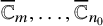 $\overline {\mathbb {C}}_m, \dots , \overline {\mathbb {C}}_{n_0}$
are organized in a linear concatenation respecting the order of the integers, and deduce Theorem C. The proof of the Structure Theorem will be by induction on
$\overline {\mathbb {C}}_m, \dots , \overline {\mathbb {C}}_{n_0}$
are organized in a linear concatenation respecting the order of the integers, and deduce Theorem C. The proof of the Structure Theorem will be by induction on $\ell \ge n_0$
. In §3.2.2, we reformulate the assertions of the theorem in a manner suitable for induction and establish the base case. In §3.2.3, the inductive step for
$\ell \ge n_0$
. In §3.2.2, we reformulate the assertions of the theorem in a manner suitable for induction and establish the base case. In §3.2.3, the inductive step for $\ell \ge n_0$
is proven. We rely on a series of lemmas, stated and established, under the assumptions and notation of Theorem 3.1.
$\ell \ge n_0$
is proven. We rely on a series of lemmas, stated and established, under the assumptions and notation of Theorem 3.1.
3.2.1 Fully ramified times
Choose $n_0\ge m+2$
and assume that n is a fully ramified time for all n such that
$n_0\ge m+2$
and assume that n is a fully ramified time for all n such that $m+2 \le n \le n_0$
.
$m+2 \le n \le n_0$
.
The spheres $\overline {\mathbb {C}}_m, \dots , \overline {\mathbb {C}}_{n_0+1}$
are pairwise distinct:
$\overline {\mathbb {C}}_m, \dots , \overline {\mathbb {C}}_{n_0+1}$
are pairwise distinct:
Lemma 3.5. If $m\le n < n' \le n_0+1$
, then
$m\le n < n' \le n_0+1$
, then $A_{(n',n)} \in \partial {\operatorname {Rat}}_1$
.
$A_{(n',n)} \in \partial {\operatorname {Rat}}_1$
.
Proof. By contradiction, suppose that $A_{(n',n)}$
is nondegenerate. Then
$A_{(n',n)}$
is nondegenerate. Then
 $$ \begin{align*}[f^{\circ n'-n}_k]=[ (A_{n,k} \circ A_{n',k}^{-1}) \circ (A_{n',k} \circ f^{\circ n'-n}_k \circ A_{n,k})] \to [A_{(n',n)} \circ \varphi_{n'-1,n'} \circ \cdots \circ \varphi_{n,n+1}] \in {\operatorname{rat}}_{d^{n'-n}},\end{align*} $$
which contradicts that $[f_k] \to [g] \in \partial {\operatorname {rat}}_d$
, since the
$[f_k] \to [g] \in \partial {\operatorname {rat}}_d$
, since the $(n'-n)$
-th iterate map is proper (see [Reference DeMarco3, Proposition 4.1]).
$(n'-n)$
-th iterate map is proper (see [Reference DeMarco3, Proposition 4.1]).
Let  be the space associated to $\{A_{n,k}: m+1\le n\le n_0+1\}$
. According to Proposition A.3,
$\{A_{n,k}: m+1\le n\le n_0+1\}$
. According to Proposition A.3,

given by

for $z \in \overline {\mathbb {C}}_n$
and
$z \in \overline {\mathbb {C}}_n$
and $n \in J_{n_0}$
, is continuous. Moreover, there exists a finite set
$n \in J_{n_0}$
, is continuous. Moreover, there exists a finite set  of critical points, each with an assigned multiplicity, such that the total number of critical points is $2d-2$
, counted with multiplicities. Furthermore,
$2d-2$
, counted with multiplicities. Furthermore,  has the following property: if $n \in J_{n_0}$
and
$n \in J_{n_0}$
and $z \in \overline {\mathbb {C}}_n$
, then the multiplicity of z as a critical point of
$z \in \overline {\mathbb {C}}_n$
, then the multiplicity of z as a critical point of $\tilde \varphi _{n,n+1}$
is the number of elements of
$\tilde \varphi _{n,n+1}$
is the number of elements of  in
in $\rho _{{n_0},n}^{-1} (z)$
, counted with multiplicities. A priori,
$\rho _{{n_0},n}^{-1} (z)$
, counted with multiplicities. A priori,  might contain intersection points of distinct spheres.
Lemma 3.6. There exists a total order $\prec $
in
$\prec $
in $J_{n_0}$
such that
$J_{n_0}$
such that
 $$ \begin{align*}\begin{array}{ccc} J_{n_0-1} &\to & J_{n_0} \\ n &\mapsto & n+1 \end{array} \end{align*} $$
is a monotone map. Moreover, given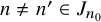 $n \neq n' \in J_{n_0}$
, for
$n \neq n' \in J_{n_0}$
, for 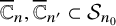 , the following hold:
-
1.
$\overline {\mathbb {C}}_n \cap \overline {\mathbb {C}}_{n'} \neq \emptyset $
if and only if n and
$n'$
are
$\prec $
-consecutive. -
2. If
$x \in \overline {\mathbb {C}}_{n}\cap \overline {\mathbb {C}}_{n'}$
, then
$\deg _x \varphi _{n,n+1} =d$
. -
3. If
$n,n'$
are
$\prec $
-consecutive in
$J_{n_0-1}$
, then
$n+1,n'+1$
are
$\prec $
-consecutive in
$J_{n_0}$
.
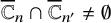


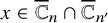



Proof. To lighten notation, when possible, we omit sub-indices and write  ,
, $J=J_{n_0}$
and
$J=J_{n_0}$
and  . Let us first show that given $n \in J$
, there are at most two spheres, distinct from
$n \in J$
, there are at most two spheres, distinct from $\overline {\mathbb {C}}_n$
, that intersect
$\overline {\mathbb {C}}_n$
, that intersect $\overline {\mathbb {C}}_n$
. Suppose on the contrary that there are three distinct numbers
$\overline {\mathbb {C}}_n$
. Suppose on the contrary that there are three distinct numbers $n_1, n_2, n_3 \neq n$
in J such that the corresponding spheres have nonempty intersection with
$n_1, n_2, n_3 \neq n$
in J such that the corresponding spheres have nonempty intersection with $\overline {\mathbb {C}}_n$
at
$\overline {\mathbb {C}}_n$
at $p_1, p_2, p_3$
, respectively. Simple connectivity of
$p_1, p_2, p_3$
, respectively. Simple connectivity of  yields that $X_j:=\overline {\mathbb {C}}_{n_j} \setminus \{p_j\}$
are pairwise disjoint for
$X_j:=\overline {\mathbb {C}}_{n_j} \setminus \{p_j\}$
are pairwise disjoint for $j=1,2,3$
, and hence
$j=1,2,3$
, and hence 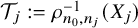 are also pairwise disjoint for $j=1,2,3$
. Since
$j=1,2,3$
. Since $\varphi _{n_j,n_j+1}$
has degree d, its local degree at
$\varphi _{n_j,n_j+1}$
has degree d, its local degree at $p_j$
is at most d. Thus
$p_j$
is at most d. Thus $X_j$
contains at least
$X_j$
contains at least $d-1$
critical points of
$d-1$
critical points of $\varphi _{n_j,n_j+1}$
, counted with multiplicities. Therefore,
$\varphi _{n_j,n_j+1}$
, counted with multiplicities. Therefore,  contains at least $d-1$
points of
$d-1$
points of  , counted with multiplicity, by Proposition A.3. Then
  has at least $3d-3> 2d -2$
points, counted with multiplicities, which contradicts Proposition A.3. A similar argument shows that three distinct spheres do not share a common point.
$3d-3> 2d -2$
points, counted with multiplicities, which contradicts Proposition A.3. A similar argument shows that three distinct spheres do not share a common point.
To define the order in J. Declare $m \prec m +1$
. Consider the graph
$m \prec m +1$
. Consider the graph  with vertex set J and edges given by all pairs $\{n,n'\}$
such that
$\{n,n'\}$
such that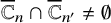 $\overline {\mathbb {C}}_n \cap \overline {\mathbb {C}}_{n'} \neq \emptyset $
in
$\overline {\mathbb {C}}_n \cap \overline {\mathbb {C}}_{n'} \neq \emptyset $
in  . Since there are no triple intersection points and
  is simply connected, by Proposition A.1, we conclude that
  is a connected tree. Moreover, the previous paragraph also implies that each vertex of
  has valence at most $2$
. Thus
$2$
. Thus  is isomorphic to an interval graph: it has exactly two valence $1$
vertices, say a and b. Without loss of generality,
$1$
vertices, say a and b. Without loss of generality, $m+1$
belongs to the subtree connecting m with b. Declare
$m+1$
belongs to the subtree connecting m with b. Declare $n \prec n'$
if and only if n belongs to the connected component of
$n \prec n'$
if and only if n belongs to the connected component of  containing a; equivalently, generic elements of $\overline {\mathbb {C}}_{n}$
and
$\overline {\mathbb {C}}_{n}$
and $\overline {\mathbb {C}}_a$
lie in the same connected component of
$\overline {\mathbb {C}}_a$
lie in the same connected component of  .
.
Suppose that $n \prec n'$
are two consecutive elements of
$n \prec n'$
are two consecutive elements of $J_{n_0}$
. Denote by
$J_{n_0}$
. Denote by  the intersection point of $\overline {\mathbb {C}}_n$
and
$\overline {\mathbb {C}}_n$
and $\overline {\mathbb {C}}_{n'}$
. We claim that the local degree of
$\overline {\mathbb {C}}_{n'}$
. We claim that the local degree of $\varphi _{n,n+1}$
at x is d. Indeed, the critical multiplicity of
$\varphi _{n,n+1}$
at x is d. Indeed, the critical multiplicity of $\varphi _{n,n+1}$
at x is the number of elements of
$\varphi _{n,n+1}$
at x is the number of elements of  , counted with multiplicity, in $\rho _{n_0,n}^{-1}(x) \supset \rho _{n_0,n}^{-1}(\overline {\mathbb {C}}_{n'}\setminus \{x\})$
, which is at least
$\rho _{n_0,n}^{-1}(x) \supset \rho _{n_0,n}^{-1}(\overline {\mathbb {C}}_{n'}\setminus \{x\})$
, which is at least $d-1$
since
$d-1$
since $\deg \varphi _{n',n'+1} = d$
. Therefore,
$\deg \varphi _{n',n'+1} = d$
. Therefore, $\deg _x \varphi _{n,n+1}=d$
. A similar argument shows that
$\deg _x \varphi _{n,n+1}=d$
. A similar argument shows that $\deg _x \varphi _{n',n'+1} =d$
.
$\deg _x \varphi _{n',n'+1} =d$
.
Finally, if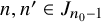 $n,n' \in J_{n_0-1}$
are
$n,n' \in J_{n_0-1}$
are $\prec $
-consecutive, then
$\prec $
-consecutive, then $n +1$
and
$n +1$
and $n'+1$
are consecutive in
$n'+1$
are consecutive in $J\setminus \{m\}$
, since
$J\setminus \{m\}$
, since  lies in the intersection of the corresponding spheres. Moreover, the translation map $n \mapsto n+1$
is injective and, being consecutive preserving, must also be monotone.
$n \mapsto n+1$
is injective and, being consecutive preserving, must also be monotone.
We conclude that if the translation by $1$
is
$1$
is $\prec $
-monotone increasing, then
$\prec $
-monotone increasing, then
 $$ \begin{align*}m \prec m+1 \prec \cdots \prec n_0-1 \prec n_0.\end{align*} $$
That is, the order $\prec $
coincides with the standard order of the integers. Otherwise, if the translation by
$\prec $
coincides with the standard order of the integers. Otherwise, if the translation by $1$
is
$1$
is $\prec $
- monotone decreasing, then either
$\prec $
- monotone decreasing, then either
 $$ \begin{align*} m \prec m+2 \prec \cdots \prec m+3 \prec m+1, \end{align*} $$
or
 $$ \begin{align*} \cdots\prec m+2 \prec m \prec m+1 \prec m+3 \prec \cdots. \end{align*} $$
However, studying the location of the Julia set  of
of $f_k$
for sufficiently large k, we will obtain an obstruction for translation to be decreasing. The location of the Julia set is controlled by the following general result whose statement is illustrated in Figure 2.
$f_k$
for sufficiently large k, we will obtain an obstruction for translation to be decreasing. The location of the Julia set is controlled by the following general result whose statement is illustrated in Figure 2.
Illustration of Proposition 3.7.

Proposition 3.7. Consider $\{h_k\} \subset {\operatorname {Rat}_d}$
. Assume that
$\{h_k\} \subset {\operatorname {Rat}_d}$
. Assume that $\{B_{n,k}:n=0,1 \}$
are a pair of independent scalings such that the associated space is obtained from the identification of
$\{B_{n,k}:n=0,1 \}$
are a pair of independent scalings such that the associated space is obtained from the identification of $ a \in \overline {\mathbb {C}}_0$
with
$ a \in \overline {\mathbb {C}}_0$
with $b \in \overline {\mathbb {C}}_{1}$
, and fix a point
$b \in \overline {\mathbb {C}}_{1}$
, and fix a point $w\in \overline {\mathbb {C}}_0$
. Suppose that the following hold:
$w\in \overline {\mathbb {C}}_0$
. Suppose that the following hold:
-
1.
$B_{1,k} \circ h_k \circ B^{-1}_{0,k}$
converges uniformly to
$ \varphi \in {\operatorname {Rat}_d}$
. -
2.
$\deg _w \varphi = d$
. -
3.
$\varphi (w)\begin {cases} \neq b\ \text {if}\ w=a,\\ = b\ \text {if}\ w\not =a. \end {cases}$
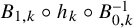


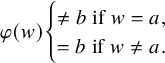
Given a neighborhood V of b, for any k sufficiently large, the following statements hold:
-
(i)
and
$\overline {\mathbb {C}} \setminus B_{1,k}^{-1}(V)$
is contained in a completely invariant attracting Fatou component of
$h_k$
. -
(ii) There exist Jordan domains
$U_k'$
and
$U_k:=h_k(U^{\prime }_k)$
such that
$(U_k',U_k,h_k)$
is a degree d polynomial-like map with the modulus of
$U_k\setminus \overline {U^{\prime }_k}$
tending to
$\infty $
, as
$k\to \infty $
. Moreover,-
(a)
$B_{0,k}(U^{\prime }_k)$
converges to a Jordan domain
$U'$
in
$\overline {\mathbb {C}}_0$
, -
(b) if
$w=a$
, then
$\overline {\mathbb {C}}_0 \setminus \overline {U'}$
is a small neighborhood of a; -
(c) if
$w\not =a$
, then
$U'$
is a small neighborhood of w.
-
 and
and 


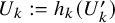
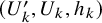


As illustrated in Figure 2, we will choose a domain $U'$
in
$U'$
in $\overline {\mathbb {C}}_0$
that is mapped onto a domain
$\overline {\mathbb {C}}_0$
that is mapped onto a domain $\varphi (U')$
in
$\varphi (U')$
in $\overline {\mathbb {C}}_1$
with degree d by
$\overline {\mathbb {C}}_1$
with degree d by $\varphi $
. One should think that
$\varphi $
. One should think that $U'$
maps under
$U'$
maps under $\varphi $
onto a domain that “properly contains”
$\varphi $
onto a domain that “properly contains” $U'$
; although
$U'$
; although $\varphi (U')$
is in a different sphere. The idea is that for k large, in the sphere
$\varphi (U')$
is in a different sphere. The idea is that for k large, in the sphere $\overline {\mathbb {C}}$
where
$\overline {\mathbb {C}}$
where $h_k$
acts, the domain
$h_k$
acts, the domain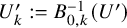 $U_k':=B_{0,k}^{-1}(U')$
is, in fact, compactly contained in
$U_k':=B_{0,k}^{-1}(U')$
is, in fact, compactly contained in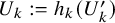 $U_k:=h_k(U^{\prime }_k)$
since
$U_k:=h_k(U^{\prime }_k)$
since $B_{1,k}(U_k)$
converges to
$B_{1,k}(U_k)$
converges to $\varphi (U')$
.
$\varphi (U')$
.
Proof. Changing $B_{1,k}$
by
$B_{1,k}$
by $B \circ B_{1,k}$
for a suitable Möbius transformation B, we may assume that
$B \circ B_{1,k}$
for a suitable Möbius transformation B, we may assume that $b=\infty $
and
$b=\infty $
and $\varphi (a) =0$
. Similarly, changing
$\varphi (a) =0$
. Similarly, changing $B_{0,k}$
, we may assume that
$B_{0,k}$
, we may assume that $a=0$
and, in the case
$a=0$
and, in the case $w\not =a$
, we may also assume
$w\not =a$
, we may also assume $w=\infty $
Let $C_k:=B_{0,k}\circ B^{-1}_{1,k}$
. Since
$C_k:=B_{0,k}\circ B^{-1}_{1,k}$
. Since $b=\infty \in \overline {\mathbb {C}}_1$
is identified with
$b=\infty \in \overline {\mathbb {C}}_1$
is identified with $a=0\in \overline {\mathbb {C}}_0$
, it follows that
$a=0\in \overline {\mathbb {C}}_0$
, it follows that $C_k$
converges to
$C_k$
converges to $C \in \partial {\operatorname {Rat}}_1$
such that
$C \in \partial {\operatorname {Rat}}_1$
such that $\tilde {C}=0$
and the hole of C is at
$\tilde {C}=0$
and the hole of C is at $\infty $
. Write
$\infty $
. Write $T_k:=B_{1,k} \circ h_k \circ B_{0,k}^{-1}$
and
$T_k:=B_{1,k} \circ h_k \circ B_{0,k}^{-1}$
and $H_k:= B_{0,k}\circ h_k \circ B^{-1}_{0,k}$
.
$H_k:= B_{0,k}\circ h_k \circ B^{-1}_{0,k}$
.
In view of (2) and (3), let D be a Jordan neighborhood of $z=0$
(
$z=0$
( $=\varphi (a)$
) so that
$=\varphi (a)$
) so that $D':=\varphi ^{-1}(D)$
is a Jordan neighborhood of
$D':=\varphi ^{-1}(D)$
is a Jordan neighborhood of $z=0$
(
$z=0$
( $=a$
) which maps d-to-
$=a$
) which maps d-to- $1$
onto D, under
$1$
onto D, under $\varphi $
. Note that
$\varphi $
. Note that $\overline {\mathbb {C}}_1\setminus \overline D$
is a small neighborhood of
$\overline {\mathbb {C}}_1\setminus \overline D$
is a small neighborhood of $z=\infty (=b)$
if
$z=\infty (=b)$
if $w\not =a$
. The uniform convergence of
$w\not =a$
. The uniform convergence of $T_k$
to
$T_k$
to $\varphi $
implies that
$\varphi $
implies that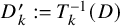 $D^{\prime }_k:=T_k^{-1}(D)$
is a Jordan neighborhood of
$D^{\prime }_k:=T_k^{-1}(D)$
is a Jordan neighborhood of $z=0$
converging to
$z=0$
converging to $\varphi ^{-1}(D)$
in the Hausdorff topology. We will show that
$\varphi ^{-1}(D)$
in the Hausdorff topology. We will show that $U' = \overline {\mathbb {C}}_0 \setminus \varphi ^{-1}(\overline {D})$
is the Jordan domain claimed in (ii-a). Note that
$U' = \overline {\mathbb {C}}_0 \setminus \varphi ^{-1}(\overline {D})$
is the Jordan domain claimed in (ii-a). Note that $H_k=C_k \circ T_k $
maps
$H_k=C_k \circ T_k $
maps $D^{\prime }_k$
onto
$D^{\prime }_k$
onto $D_k:= C_k(D)$
with degree d. The uniform convergence of
$D_k:= C_k(D)$
with degree d. The uniform convergence of $C_k$
to
$C_k$
to $0$
, in D, yields that
$0$
, in D, yields that $D_k \Subset D^{\prime }_k$
for k large. Then
$D_k \Subset D^{\prime }_k$
for k large. Then $H_k: \overline {\mathbb {C}}_0 \setminus \overline {D^{\prime }_k} \to \overline {\mathbb {C}}_0 \setminus \overline {D}_k$
is a degree d polynomial-like map. Moreover, the modulus
$H_k: \overline {\mathbb {C}}_0 \setminus \overline {D^{\prime }_k} \to \overline {\mathbb {C}}_0 \setminus \overline {D}_k$
is a degree d polynomial-like map. Moreover, the modulus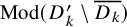 $\text {Mod}(D^{\prime }_k\setminus \overline {D_k})$
tends to infinity, as
$\text {Mod}(D^{\prime }_k\setminus \overline {D_k})$
tends to infinity, as $k\to \infty $
, since
$k\to \infty $
, since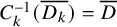 $ C_k^{-1}(\overline {D_k})=\overline D$
and
$ C_k^{-1}(\overline {D_k})=\overline D$
and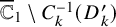 $\overline {\mathbb {C}}_1\setminus C_k^{-1}(D^{\prime }_k)$
converges, in the Hausdorff topology, to
$\overline {\mathbb {C}}_1\setminus C_k^{-1}(D^{\prime }_k)$
converges, in the Hausdorff topology, to $\{\infty \}$
. After conjugacy by
$\{\infty \}$
. After conjugacy by $B^{-1}_{0,k}$
, the polynomial-like map
$B^{-1}_{0,k}$
, the polynomial-like map $(\overline {\mathbb {C}}_0 \setminus \overline {D^{\prime }_k}, \overline {\mathbb {C}}_0 \setminus \overline {D}_k, H_k)$
becomes the desired polynomial-like restriction of
$(\overline {\mathbb {C}}_0 \setminus \overline {D^{\prime }_k}, \overline {\mathbb {C}}_0 \setminus \overline {D}_k, H_k)$
becomes the desired polynomial-like restriction of $h_k$
. Thus, statement (ii) holds. Note that
$h_k$
. Thus, statement (ii) holds. Note that $D_k'$
must be contained in a completely invariant attracting Fatou component of
$D_k'$
must be contained in a completely invariant attracting Fatou component of $H_k$
. Since
$H_k$
. Since $C_k^{-1}$
converges uniformly to
$C_k^{-1}$
converges uniformly to $\infty $
outside
$\infty $
outside $D^{\prime }_k$
, it follows that
$D^{\prime }_k$
, it follows that  converges, in the Hausdorff topology, to $\{\infty \}$
. In particular, for k large,
$\{\infty \}$
. In particular, for k large,  , for any given neighborhood of $b=\infty $
. Similarly,
$b=\infty $
. Similarly, $C^{-1}_{k}(D_k')$
contains
$C^{-1}_{k}(D_k')$
contains $\overline {\mathbb {C}}\setminus V$
for k large; therefore,
$\overline {\mathbb {C}}\setminus V$
for k large; therefore, $\overline {\mathbb {C}} \setminus B_{1,k}^{-1}(V)$
is contained in a completely invariant attracting Fatou component of
$\overline {\mathbb {C}} \setminus B_{1,k}^{-1}(V)$
is contained in a completely invariant attracting Fatou component of $h_k$
.
$h_k$
.
We remark that the above polynomial-like map is extracted from a sequence $\{h_k\}$
with just
$\{h_k\}$
with just $1$
fully ramified time. However, this extraction requires that assumptions (2) and (3) are satisfied. To prove Theorem C, we will show that assumptions (2) and (3) always hold for sequences with
$1$
fully ramified time. However, this extraction requires that assumptions (2) and (3) are satisfied. To prove Theorem C, we will show that assumptions (2) and (3) always hold for sequences with $3$
consecutive fully ramified times.
$3$
consecutive fully ramified times.
Now we are ready to rule out monotone decreasing translations. Note that translation by $2$
is always monotone increasing from
$2$
is always monotone increasing from $J_{n_0-2}$
into
$J_{n_0-2}$
into $J_{n_0}$
.
$J_{n_0}$
.
Lemma 3.8. The map $n \mapsto n +1$
is
$n \mapsto n +1$
is $\prec $
-monotone increasing in
$\prec $
-monotone increasing in $J_{n_0-1}$
.
$J_{n_0-1}$
.
Proof. We proceed by contradiction and suppose that $n \mapsto n +1$
is
$n \mapsto n +1$
is $\prec $
-orientation reversing. Then one of following concatenations of spheres occurs:
$\prec $
-orientation reversing. Then one of following concatenations of spheres occurs:
-
(i)
$\overline {\mathbb {C}}_{m} \prec \overline {\mathbb {C}}_{m+2}\prec \overline {\mathbb {C}}_{m+1}. $
-
(ii)
$\overline {\mathbb {C}}_{m+2}\prec \overline {\mathbb {C}}_{m} \prec \overline {\mathbb {C}}_{m+1}.$


Set $a:=a_{m+1,m}, b:=a_{m,m+1}, c:=a_{m+1,m+2}$
, and consider small neighborhoods
$a:=a_{m+1,m}, b:=a_{m,m+1}, c:=a_{m+1,m+2}$
, and consider small neighborhoods $W \subset \overline {\mathbb {C}}_m$
of a,
$W \subset \overline {\mathbb {C}}_m$
of a, $V \subset \overline {\mathbb {C}}_{m+1}$
of b and
$V \subset \overline {\mathbb {C}}_{m+1}$
of b and $U \subset \overline {\mathbb {C}}_{m+2}$
of c. See Figure 3 for an illustration of these and other neighborhoods that we introduce below.
$U \subset \overline {\mathbb {C}}_{m+2}$
of c. See Figure 3 for an illustration of these and other neighborhoods that we introduce below.
Illustration of proof of Lemma 3.8: case (i) on the left and case (ii) on the right.

Let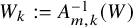 $W_k := A_{m,k}^{-1} (W)$
,
$W_k := A_{m,k}^{-1} (W)$
,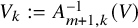 $V_k := A_{m+1,k}^{-1}(V)$
and
$V_k := A_{m+1,k}^{-1}(V)$
and $U_k := A_{m+2,k}^{-1}(U)$
. We will freely assume that k is sufficiently large for the assertions below to hold.
$U_k := A_{m+2,k}^{-1}(U)$
. We will freely assume that k is sufficiently large for the assertions below to hold.
We first show that, in both cases,
 $$ \begin{align*}\tilde\varphi_{m,m+1}(a)=b \ \ \text{and}\ \ \tilde\varphi_{m+1,m+2}(b)=c,\end{align*} $$
by counting preimages of generic points in $\overline {\mathbb {C}}_{m+2}$
and in
$\overline {\mathbb {C}}_{m+2}$
and in $\overline {\mathbb {C}}_{m+1}$
.
$\overline {\mathbb {C}}_{m+1}$
.
Indeed, if $\tilde \varphi _{m,m+1}(a)\not =b$
, then for a generic point
$\tilde \varphi _{m,m+1}(a)\not =b$
, then for a generic point $z\in \overline {\mathbb {C}}_{m+2}$
, under
$z\in \overline {\mathbb {C}}_{m+2}$
, under $f_k$
, the point
$f_k$
, the point $A_{m+2,k}^{-1}(z)$
has at least
$A_{m+2,k}^{-1}(z)$
has at least $1$
preimage outside
$1$
preimage outside $W_k$
. However,
$W_k$
. However, $\deg \tilde \varphi _{m+1,m+2}=d$
, so all d preimages of
$\deg \tilde \varphi _{m+1,m+2}=d$
, so all d preimages of $A_{m+2,k}^{-1}(z)$
lie in
$A_{m+2,k}^{-1}(z)$
lie in $W_k$
. It is a contradiction.
$W_k$
. It is a contradiction.
Similarly, if $\tilde \varphi _{m+1,m+2}(b)\not =c$
, then for a generic point
$\tilde \varphi _{m+1,m+2}(b)\not =c$
, then for a generic point $w\in \overline {\mathbb {C}}_{m+1}$
, under
$w\in \overline {\mathbb {C}}_{m+1}$
, under $f_k$
, the point
$f_k$
, the point $A_{m+1,k}^{-1}(w)$
has at least
$A_{m+1,k}^{-1}(w)$
has at least $1$
preimage outside
$1$
preimage outside $V_k$
. However,
$V_k$
. However, $\deg \tilde \varphi _{m,m+1}=d$
, so all d preimages of
$\deg \tilde \varphi _{m,m+1}=d$
, so all d preimages of $A_{m+1,k}^{-1}(w)$
lie in
$A_{m+1,k}^{-1}(w)$
lie in $V_k$
. This is again a contradiction.
$V_k$
. This is again a contradiction.
With $ \tilde \varphi _{m,m+1}(a)=b$
and
$ \tilde \varphi _{m,m+1}(a)=b$
and $\tilde \varphi _{m+1,m+2}(b)=c$
, we now consider cases (i) and (ii) separately.
$\tilde \varphi _{m+1,m+2}(b)=c$
, we now consider cases (i) and (ii) separately.
Case (i): Let $U'$
be a small neighborhood of
$U'$
be a small neighborhood of $c'=a_{m,{m+2}}$
and
$c'=a_{m,{m+2}}$
and $U^{\prime }_k:=A_{m+2,k}^{-1}(U')$
. By Proposition 3.7, applied to
$U^{\prime }_k:=A_{m+2,k}^{-1}(U')$
. By Proposition 3.7, applied to $w=a$
and
$w=a$
and $\varphi =\varphi _{m+1,m+2} \circ \varphi _{m,m+1}$
, we have that
$\varphi =\varphi _{m+1,m+2} \circ \varphi _{m,m+1}$
, we have that  converges to $c' \in \overline {\mathbb {C}}_{m+2}$
. Viewed in
$c' \in \overline {\mathbb {C}}_{m+2}$
. Viewed in $\overline {\mathbb {C}}_{m+1}$
, the Julia sets converge to b. More precisely,
$\overline {\mathbb {C}}_{m+1}$
, the Julia sets converge to b. More precisely,  . But, $\varphi _{m+1,m+2}(b)=c$
, so
$\varphi _{m+1,m+2}(b)=c$
, so  . This is impossible because $U_k$
and
$U_k$
and $U^{\prime }_k$
are disjoint. Hence (i) cannot occur.
$U^{\prime }_k$
are disjoint. Hence (i) cannot occur.
Case (ii): To proceed with the argument, we first fix some notation. Let $a':=a_{m+2,m}$
and note that
$a':=a_{m+2,m}$
and note that $b':=\tilde \varphi _{m,m+1}(a')\not = b$
. Choose a small neighborhood
$b':=\tilde \varphi _{m,m+1}(a')\not = b$
. Choose a small neighborhood $W'$
of
$W'$
of $a'\in \overline {\mathbb {C}}_m$
such that
$a'\in \overline {\mathbb {C}}_m$
such that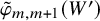 $\tilde \varphi _{m,m+1}(W')$
, a neighborhood of
$\tilde \varphi _{m,m+1}(W')$
, a neighborhood of $b'$
, is properly contained in
$b'$
, is properly contained in $V^c:=\overline {\mathbb {C}}_{m+1}\setminus \overline V$
. Let
$V^c:=\overline {\mathbb {C}}_{m+1}\setminus \overline V$
. Let $W^{\prime }_k:= A_{m,k}^{-1}(W')$
, and
$W^{\prime }_k:= A_{m,k}^{-1}(W')$
, and $V^c_k := A_{m+1,k}^{-1}(V^c)$
. Keep in mind that
$V^c_k := A_{m+1,k}^{-1}(V^c)$
. Keep in mind that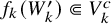 $f_k(W^{\prime }_k) \Subset V_k^c$
.
$f_k(W^{\prime }_k) \Subset V_k^c$
.
By Proposition 3.7, for a choice of a small neighborhood W of $a \in \overline {\mathbb {C}}_m$
, the map
$a \in \overline {\mathbb {C}}_m$
, the map $g_k:=(W_k,N_k,f_k^{\circ 2})$
is a degree
$g_k:=(W_k,N_k,f_k^{\circ 2})$
is a degree $d^2$
polynomial-like map where
$d^2$
polynomial-like map where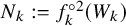 $N_k:=f_k^{\circ 2}(W_k)$
. Moreover, the modulus
$N_k:=f_k^{\circ 2}(W_k)$
. Moreover, the modulus $\text {Mod}(N_k\setminus \overline {W_k})$
diverges to
$\text {Mod}(N_k\setminus \overline {W_k})$
diverges to $\infty $
, as
$\infty $
, as $k\to \infty $
. By shrinking V if necessary, we may assume that
$k\to \infty $
. By shrinking V if necessary, we may assume that $V_k$
is properly contained in
$V_k$
is properly contained in $f_k(W_k)$
.
$f_k(W_k)$
.
We now show that the filled Julia set  of
of $g_k$
is connected. Since
$g_k$
is connected. Since $c \notin \varphi _{m+1,m+2}(V^c) \subset \overline {\mathbb {C}}_{m+2}$
, we have that
$c \notin \varphi _{m+1,m+2}(V^c) \subset \overline {\mathbb {C}}_{m+2}$
, we have that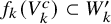 $f_k(V^c_k) \subset W_k'$
. Therefore,
$f_k(V^c_k) \subset W_k'$
. Therefore,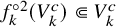 $f_k^{\circ 2} (V_k^c) \Subset V^c_k$
, which yields that
$f_k^{\circ 2} (V_k^c) \Subset V^c_k$
, which yields that $V_k^c$
is in the basin of an attracting fixed point
$V_k^c$
is in the basin of an attracting fixed point $z_k$
of
$z_k$
of $g_k$
. We claim that all the critical values of
$g_k$
. We claim that all the critical values of $g_k$
lie in this basin. The set of critical values of
$g_k$
lie in this basin. The set of critical values of $g_k$
is the union of
$g_k$
is the union of $X_k:=g_k(\operatorname {Crit}(f_k) \cap W_k)$
and
$X_k:=g_k(\operatorname {Crit}(f_k) \cap W_k)$
and $Y_k:=f_k(\operatorname {Crit}(f_k)\cap f_k(W_k))$
. Note that, counting multiplicities,
$Y_k:=f_k(\operatorname {Crit}(f_k)\cap f_k(W_k))$
. Note that, counting multiplicities, $d-1$
critical points of
$d-1$
critical points of $f_k$
are contained in
$f_k$
are contained in $V_k^c \subset W_k$
and,
$V_k^c \subset W_k$
and, $d-1$
in
$d-1$
in $W_k'$
. Thus,
$W_k'$
. Thus, $X_k \subset V_k^c$
and
$X_k \subset V_k^c$
and $Y_k \subset f_k(W_k') \subset V_k^c$
. Therefore, all critical values of
$Y_k \subset f_k(W_k') \subset V_k^c$
. Therefore, all critical values of $g_k$
are contained in the basin of
$g_k$
are contained in the basin of $z_k$
and
$z_k$
and $g_k$
has connected filled Julia set.
$g_k$
has connected filled Julia set.
Composing with appropriate coordinate changes and passing to a subsequence, if necessary, we claim that the sequence $f_k^{\circ 2}$
converges to a degree
$f_k^{\circ 2}$
converges to a degree $d^2$
polynomial. Consider a scaling
$d^2$
polynomial. Consider a scaling $B_k$
such that
$B_k$
such that  has Euclidean diameter $1$
and contains
$1$
and contains $0$
. Then
$0$
. Then
 $$ \begin{align*}(B_k(W_k), B_k(N_k), B_k\circ f_k^{\circ 2}\circ B_k^{-1})\end{align*} $$
is a polynomial-like map whose filled Julia set is connected, has Euclidean diameter $1$
and contains
$1$
and contains $0$
. Since the modulus of
$0$
. Since the modulus of $B_k(N_k)\setminus \overline {B_k(W_k)}$
tends to
$B_k(N_k)\setminus \overline {B_k(W_k)}$
tends to $\infty $
, as
$\infty $
, as $k\to \infty $
, by [Reference McMullen14, Theorem 5.8] and a diagonal argument, the sequence
$k\to \infty $
, by [Reference McMullen14, Theorem 5.8] and a diagonal argument, the sequence $B_k\circ f_k^{\circ 2}\circ B_k^{-1}:B_k(W_k)\to B_k(N_k)$
has a convergent subsequence whose limit is a polynomial-like map with infinite modulus. Thus, this limit is a polynomial of degree
$B_k\circ f_k^{\circ 2}\circ B_k^{-1}:B_k(W_k)\to B_k(N_k)$
has a convergent subsequence whose limit is a polynomial-like map with infinite modulus. Thus, this limit is a polynomial of degree $d^2$
.
$d^2$
.
Therefore, passing to a subsequence if necessary, $[f_k^{\circ 2}]$
converges in
$[f_k^{\circ 2}]$
converges in ${\operatorname {rat}}_{d^2}$
. Since the iterate map
${\operatorname {rat}}_{d^2}$
. Since the iterate map ${\operatorname {rat}}_d\to {\operatorname {rat}}_{d^2}$
is proper, it follows that
${\operatorname {rat}}_d\to {\operatorname {rat}}_{d^2}$
is proper, it follows that $[f_k]$
converges in
$[f_k]$
converges in ${\operatorname {rat}}_d$
. This contradicts the assumption that
${\operatorname {rat}}_d$
. This contradicts the assumption that $[f_k]$
accumulates at a point of
$[f_k]$
accumulates at a point of $\partial {\operatorname {rat}}_d$
. Hence (ii) cannot occur, and the proof is complete.
$\partial {\operatorname {rat}}_d$
. Hence (ii) cannot occur, and the proof is complete.
We are now ready to deduce Theorem C.
Proof of Theorem C.
Assume that $\{f_k\} \subset {\operatorname {Rat}}_d$
,
$\{f_k\} \subset {\operatorname {Rat}}_d$
, $\{A_k\}$
and
$\{A_k\}$
and $\{B_k\}$
are as in the statement of the theorem. We proceed by contradiction. After passing to a subsequence, we suppose that
$\{B_k\}$
are as in the statement of the theorem. We proceed by contradiction. After passing to a subsequence, we suppose that $f_k$
lacks of a degree d polynomial-like restriction for all k. Then
$f_k$
lacks of a degree d polynomial-like restriction for all k. Then $h_k:=A_k \circ f_k \circ A_k^{-1}$
also has no degree d polynomial-like restriction. Passing to a further subsequence,
$h_k:=A_k \circ f_k \circ A_k^{-1}$
also has no degree d polynomial-like restriction. Passing to a further subsequence,  converges to some
  for all n. Moreover, $\varphi _3 \in {\operatorname {Rat}}_{d^3}$
. From Lemma 2.4, the sequence
$\varphi _3 \in {\operatorname {Rat}}_{d^3}$
. From Lemma 2.4, the sequence $\{h_k\}$
has fully ramified times
$\{h_k\}$
has fully ramified times $n=1,2,3$
. Let
$n=1,2,3$
. Let $\{A_{n,k}\}$
be the collection of scalings such that
$\{A_{n,k}\}$
be the collection of scalings such that $A_{n,k} \circ h_k^{\circ n} \to \varphi _n$
. Then we are under the hypothesis of Theorem 3.1 for
$A_{n,k} \circ h_k^{\circ n} \to \varphi _n$
. Then we are under the hypothesis of Theorem 3.1 for $\{h_k\}$
and
$\{h_k\}$
and $m=1$
. By Lemma 3.8,
$m=1$
. By Lemma 3.8,  is the concatenation of $3$
spheres
$3$
spheres $\overline {\mathbb {C}}_1,\overline {\mathbb {C}}_2,\overline {\mathbb {C}}_3$
. Moreover,
$\overline {\mathbb {C}}_1,\overline {\mathbb {C}}_2,\overline {\mathbb {C}}_3$
. Moreover, $\varphi _{2,3}$
maps
$\varphi _{2,3}$
maps $\overline {\mathbb {C}}_2$
onto
$\overline {\mathbb {C}}_2$
onto $\overline {\mathbb {C}}_3$
by a degree d map. By Lemma 3.6 (2), the intersection point of
$\overline {\mathbb {C}}_3$
by a degree d map. By Lemma 3.6 (2), the intersection point of $\overline {\mathbb {C}}_2$
with
$\overline {\mathbb {C}}_2$
with $\overline {\mathbb {C}}_1$
maps, by
$\overline {\mathbb {C}}_1$
maps, by $\varphi _{2,3}$
, to the intersection point of
$\varphi _{2,3}$
, to the intersection point of $\overline {\mathbb {C}}_3$
with
$\overline {\mathbb {C}}_3$
with $\overline {\mathbb {C}}_2$
with local degree d. Thus, we are under the hypothesis of Proposition 3.7, for
$\overline {\mathbb {C}}_2$
with local degree d. Thus, we are under the hypothesis of Proposition 3.7, for $\{A_{n,k}: n=1,2\}$
, that yields the existence of a degree d polynomial-like restriction of
$\{A_{n,k}: n=1,2\}$
, that yields the existence of a degree d polynomial-like restriction of $h_k$
and, therefore, of
$h_k$
and, therefore, of $f_k$
.
$f_k$
.
3.2.2 Inductive hypothesis
Given $\ell \ge n_0$
, consider the following assertions:
$\ell \ge n_0$
, consider the following assertions:
-
(0.ℓ) For all
$m \le n , n' \le \ell $
, if
$n \neq n'$
, then
$A_{(n,n')} \in \partial {\operatorname {Rat}}_1$
. -
(1.ℓ)
is obtained by identifying
$a_{n+1,n} \in \overline {\mathbb {C}}_n$
with
$a_{n,n+1} \in \overline {\mathbb {C}}_{n+1}$
for
$m \le n < \ell $
. Moreover,
$a_{n-1,n} \neq a_{n+1,n}$
for
$m < n < \ell $
. -
(2.ℓ)
$ \tilde \varphi _{n,n+1}(a_{n-1,n}) = a_{n,n+1}$
if
$m < n < \ell $
, and
$\tilde \varphi _{n,n+1}(a_{n+1,n}) = a_{n+2,n+1}$
if
$m \le n < \ell -1$
. -
(3.ℓ)
$ \deg \tilde \varphi _{n,n+1}=\deg _{a_{n,n-1}} \tilde \varphi _{n-1,n}$
for
$m<n < \ell $
. -
(4.ℓ) If
$m<n<\ell $
and
$n+1$
is a fully ramified time, then the local degree of
$\varphi _{n,n+1}$
at
$a_{n\pm 1,n}$
is d. -
(5.ℓ) For
$m < n <\ell $
,
$$ \begin{align*}d= d_{a_{n-1,n}} (\varphi_{n,n+1})+ \deg_{a_{n-1,n}} \tilde{\varphi}_{n,n+1}.\end{align*} $$



 is obtained by identifying
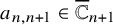








In other words, $(0.\ell )$
states that, for
$(0.\ell )$
states that, for $m \le n \le \ell $
, the scalings
$m \le n \le \ell $
, the scalings $\{A_{k,n}\}$
are independent, so the corresponding spheres
$\{A_{k,n}\}$
are independent, so the corresponding spheres $\overline {\mathbb {C}}_m, \dots , \overline {\mathbb {C}}_{\ell }$
are distinct. Then
$\overline {\mathbb {C}}_m, \dots , \overline {\mathbb {C}}_{\ell }$
are distinct. Then $(1.\ell )$
says that these spheres are organized in a linear concatenation
$(1.\ell )$
says that these spheres are organized in a linear concatenation  . Accordingly, $(2.\ell )$
claims that the induced map on this linear concatenation
$(2.\ell )$
claims that the induced map on this linear concatenation  is continuous. The inductive hypothesis $(4.\ell )$
asserts that the maps
$(4.\ell )$
asserts that the maps $\tilde {\varphi }_{n,n+1}$
are monomials in appropriate coordinates if n and
$\tilde {\varphi }_{n,n+1}$
are monomials in appropriate coordinates if n and $n+1$
are fully ramified times. Finally,
$n+1$
are fully ramified times. Finally, $(3.\ell )$
and
$(3.\ell )$
and $(5.\ell )$
are formulas describing the degree of
$(5.\ell )$
are formulas describing the degree of $\tilde {\varphi }_{n,n+1}$
and the depth of the holes of
$\tilde {\varphi }_{n,n+1}$
and the depth of the holes of $\varphi _{n,n+1}$
, which encode assertions (3) and (5) of the theorem, as explained below:
$\varphi _{n,n+1}$
, which encode assertions (3) and (5) of the theorem, as explained below:
Proof of Theorem 3.1 assuming (0.
$\ell $
)–(5.
$\ell $
) for all
$\ell \ge n_0$
.


Clearly (0. $\ell $
) for all
$\ell $
) for all $\ell $
yields the independence of
$\ell $
yields the independence of $\{A_{n,k}:n\ge m\}$
. Moreover, (1.
$\{A_{n,k}:n\ge m\}$
. Moreover, (1. $\ell $
) implies statement (1) of Theorem 3.1. For statement (2), we only need to check continuity at the intersection of consecutive spheres, which is the content of (2.
$\ell $
) implies statement (1) of Theorem 3.1. For statement (2), we only need to check continuity at the intersection of consecutive spheres, which is the content of (2. $\ell $
). Provided we normalize
$\ell $
). Provided we normalize $a_{n,n-1}=0 \in \overline {\mathbb {C}}_{n-1}$
and
$a_{n,n-1}=0 \in \overline {\mathbb {C}}_{n-1}$
and $a_{n-1,n} = \infty \in \overline {\mathbb {C}}_n$
, for all n, statement (3.
$a_{n-1,n} = \infty \in \overline {\mathbb {C}}_n$
, for all n, statement (3. $\ell $
) for all
$\ell $
) for all $\ell $
is the second equality in (3). Statement (4) is exactly (4.
$\ell $
is the second equality in (3). Statement (4) is exactly (4. $\ell $
) for all
$\ell $
) for all $\ell $
. For statement (5) and the remaining part of statement (3), note that
$\ell $
. For statement (5) and the remaining part of statement (3), note that $d-\deg \tilde {\varphi }_{n,n+1}$
is the total number of holes of
$d-\deg \tilde {\varphi }_{n,n+1}$
is the total number of holes of $\varphi _{n,n+1}$
, counted with depths. Therefore,
$\varphi _{n,n+1}$
, counted with depths. Therefore,
 $$ \begin{align*}d_{a_{n-1,n}} (\varphi_{n,n+1}) \le d-\deg\tilde{\varphi}_{n,n+1}\le d- \deg_{a_{n-1,n}} \tilde{\varphi}_{n,n+1}.\end{align*} $$
Thus, (5. $\ell $
) for all
$\ell $
) for all $\ell $
yields equality between all these quantities. Equivalently,
$\ell $
yields equality between all these quantities. Equivalently, ${a_{n-1,n}}$
is the unique hole of
${a_{n-1,n}}$
is the unique hole of $\varphi _{n,n+1}$
and the local degree of
$\varphi _{n,n+1}$
and the local degree of $\tilde {\varphi }_{n,n+1}$
at this point is
$\tilde {\varphi }_{n,n+1}$
at this point is $\deg \tilde {\varphi }_{n,n+1}$
. Statements (3) and (5) now follow.
$\deg \tilde {\varphi }_{n,n+1}$
. Statements (3) and (5) now follow.
Lemma 3.9. Statements (0. $n_0$
)–(5.
$n_0$
)–(5. $n_0$
) hold.
$n_0$
) hold.
Proof. As observed above, Lemma 3.5 is (0. $n_0$
). By Lemmas 3.6 and 3.8, the space
$n_0$
). By Lemmas 3.6 and 3.8, the space  is the concatenation of spheres indexed by $J_{n_0}$
in the standard order of the integers. Therefore, statement (1.
$J_{n_0}$
in the standard order of the integers. Therefore, statement (1. $n_0$
) holds. Statement (2.
$n_0$
) holds. Statement (2. $n_0$
) follows from the continuity of
$n_0$
) follows from the continuity of  , furnished by Proposition A.3. Statement (3. $n_0$
) is trivially true and statement (4.
$n_0$
) is trivially true and statement (4. $n_0$
) is a direct consequence of Lemma 3.6 (2). Finally, statement (5.
$n_0$
) is a direct consequence of Lemma 3.6 (2). Finally, statement (5. $n_0$
) follows since
$n_0$
) follows since $\varphi _{n,n+1}$
has no holes and the local degree at
$\varphi _{n,n+1}$
has no holes and the local degree at $a_{n-1,n}$
is d.
$a_{n-1,n}$
is d.
3.2.3 Proof of the Structure Theorem for not fully ramified times
We continue with the induction. Assume that (0. $\ell $
)–(5.
$\ell $
)–(5. $\ell $
) from §3.2.2 hold for some
$\ell $
) from §3.2.2 hold for some $\ell \ge n_0$
. The proofs of the corresponding statements for
$\ell \ge n_0$
. The proofs of the corresponding statements for $\ell +1$
are organized in a series of lemmas below. Specifically, Lemma 3.10 shows that the scaling
$\ell +1$
are organized in a series of lemmas below. Specifically, Lemma 3.10 shows that the scaling $\{A_{\ell +1,k}\}$
is independent of the ones corresponding to the spheres
$\{A_{\ell +1,k}\}$
is independent of the ones corresponding to the spheres $\overline {\mathbb {C}}_m, \dots , \overline {\mathbb {C}}_\ell $
. Thus,
$\overline {\mathbb {C}}_m, \dots , \overline {\mathbb {C}}_\ell $
. Thus,  consists of pairwise distinct spheres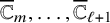 $\overline {\mathbb {C}}_m,\dots , \overline {\mathbb {C}}_{\ell +1}$
, which are shown to be organized in a linear concatenation in Lemma 3.11. Then, Lemma 3.12 shows that the transition map
$\overline {\mathbb {C}}_m,\dots , \overline {\mathbb {C}}_{\ell +1}$
, which are shown to be organized in a linear concatenation in Lemma 3.11. Then, Lemma 3.12 shows that the transition map $\tilde {\varphi }_{\ell ,\ell +1}\colon \overline {\mathbb {C}}_\ell \to \overline {\mathbb {C}}_{\ell +1}$
is a polynomial with a unique hole at the intersection point with
$\tilde {\varphi }_{\ell ,\ell +1}\colon \overline {\mathbb {C}}_\ell \to \overline {\mathbb {C}}_{\ell +1}$
is a polynomial with a unique hole at the intersection point with $\overline {\mathbb {C}}_{\ell -1}$
. In Lemma 3.13, continuity of the induced map on
$\overline {\mathbb {C}}_{\ell -1}$
. In Lemma 3.13, continuity of the induced map on  is established. Finally, Lemma 3.14 studies the degree of $\tilde {\varphi }_{\ell ,\ell +1}$
. We end this subsection by summarizing how all these lemmas yield the inductive step.
$\tilde {\varphi }_{\ell ,\ell +1}$
. We end this subsection by summarizing how all these lemmas yield the inductive step.
We employ the definitions and results from Appendix A. Let $J := \{ n : m \le n \le \ell \}$
and consider the collection of independent scalings
$J := \{ n : m \le n \le \ell \}$
and consider the collection of independent scalings $\mathbf {A}:= \{A_{n,k}: n \in J \}$
indexed by J. The space associated to
$\mathbf {A}:= \{A_{n,k}: n \in J \}$
indexed by J. The space associated to $\mathbf {A}$
is
$\mathbf {A}$
is  , the concatenation of the spheres $\overline {\mathbb {C}}_m,\dots ,\overline {\mathbb {C}}_\ell $
. Denote by
$\overline {\mathbb {C}}_m,\dots ,\overline {\mathbb {C}}_\ell $
. Denote by  the corresponding embedding of $\overline {\mathbb {C}}$
into
$\overline {\mathbb {C}}$
into $\overline {\mathbb {C}}^{J}$
and by
$\overline {\mathbb {C}}^{J}$
and by $\rho _{\ell ,j}$
the retraction of
$\rho _{\ell ,j}$
the retraction of  onto
onto $\overline {\mathbb {C}}_j$
. For all
$\overline {\mathbb {C}}_j$
. For all $n \neq j$
, note that
$n \neq j$
, note that $\rho _{\ell ,j}(\overline {\mathbb {C}}_n) = \{a_{n,j}\}\subset \overline {\mathbb {C}}_j$
.
$\rho _{\ell ,j}(\overline {\mathbb {C}}_n) = \{a_{n,j}\}\subset \overline {\mathbb {C}}_j$
.
Lemma 3.10. $A_{(\ell +1,j)}$
is degenerate for all
$A_{(\ell +1,j)}$
is degenerate for all $j \in J$
.
$j \in J$
.
Proof. By contradiction, suppose $A_{(\ell +1,j)}$
is nondegenerate. Without loss of generality, we may assume that
$A_{(\ell +1,j)}$
is nondegenerate. Without loss of generality, we may assume that $A_{\ell +1,k} = A_{j,k}$
, for all k. In the language of Appendix A, the sequence
$A_{\ell +1,k} = A_{j,k}$
, for all k. In the language of Appendix A, the sequence $\{f_k\}$
maps
$\{f_k\}$
maps $\mathbf {A}$
to
$\mathbf {A}$
to $\mathbf {A}$
by
$\mathbf {A}$
by $\tau :J\to J$
where
$\tau :J\to J$
where $\tau (n) = n+1$
for
$\tau (n) = n+1$
for $n < \ell $
and
$n < \ell $
and $\tau (\ell )=j$
. Consider
$\tau (\ell )=j$
. Consider  defined by

In view of the inductive hypothesis (5. $\ell $
) and Proposition A.2 applied to
$\ell $
) and Proposition A.2 applied to $j-1$
, every point in
$j-1$
, every point in  , contained in a small neighborhood $W_0$
of
$W_0$
of $\rho _{\ell ,j}^{-1}(a_{j-1,j})= \overline {\mathbb {C}}_{m} \cup \cdots \cup \overline {\mathbb {C}}_{j-1}$
, has d preimages under
$\rho _{\ell ,j}^{-1}(a_{j-1,j})= \overline {\mathbb {C}}_{m} \cup \cdots \cup \overline {\mathbb {C}}_{j-1}$
, has d preimages under $G_k$
, close to
$G_k$
, close to $\rho _{\ell ,j-1}^{-1} (a_{j-2,j-1})=\overline {\mathbb {C}}_m \cup \dots \cup \overline {\mathbb {C}}_{j-2}$
, which is bounded away from
$\rho _{\ell ,j-1}^{-1} (a_{j-2,j-1})=\overline {\mathbb {C}}_m \cup \dots \cup \overline {\mathbb {C}}_{j-2}$
, which is bounded away from $\overline {\mathbb {C}}_{\ell }$
. But
$\overline {\mathbb {C}}_{\ell }$
. But $W_0$
contains points
$W_0$
contains points $w_0$
in
$w_0$
in $\overline {\mathbb {C}}_{j}$
close to
$\overline {\mathbb {C}}_{j}$
close to $a_{j-1,j}$
with a preimage
$a_{j-1,j}$
with a preimage $z_0$
in
$z_0$
in $\overline {\mathbb {C}}_{\ell }$
, under
$\overline {\mathbb {C}}_{\ell }$
, under $\tilde \varphi _{\ell ,j}= \tilde \varphi _{\ell ,\ell +1}$
. It follows that points in
$\tilde \varphi _{\ell ,j}= \tilde \varphi _{\ell ,\ell +1}$
. It follows that points in  , close to $w_0$
, simultaneously have a
$w_0$
, simultaneously have a $G_k$
-preimage close to
$G_k$
-preimage close to $z_0 \in \overline {\mathbb {C}}_{\ell }$
and d preimages close to
$z_0 \in \overline {\mathbb {C}}_{\ell }$
and d preimages close to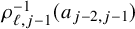 $\rho _{\ell ,j-1}^{-1} (a_{j-2,j-1})$
, which is impossible.
$\rho _{\ell ,j-1}^{-1} (a_{j-2,j-1})$
, which is impossible.
Let $J':=\{ j : m \le n \le \ell +1 \}$
. From the previous lemma,
$J':=\{ j : m \le n \le \ell +1 \}$
. From the previous lemma, $\mathbf {B} := \{ A_{n,k} : n \in J'\}$
is a collection of independent scalings indexed by
$\mathbf {B} := \{ A_{n,k} : n \in J'\}$
is a collection of independent scalings indexed by $J'$
. It follows that
$J'$
. It follows that $\{f_k\}$
maps
$\{f_k\}$
maps $\mathbf {A}$
to
$\mathbf {A}$
to $\mathbf {B}$
by
$\mathbf {B}$
by $\tau (n)=n+1$
. For all
$\tau (n)=n+1$
. For all $j \in J'$
, recall that
$j \in J'$
, recall that $\rho _{\ell +1,j}$
is the retraction from
$\rho _{\ell +1,j}$
is the retraction from  , the space associated to $\mathbf {B}$
, onto
$\mathbf {B}$
, onto $\overline {\mathbb {C}}_j$
. Let
$\overline {\mathbb {C}}_j$
. Let  be the corresponding embedding of $\overline {\mathbb {C}}$
into
$\overline {\mathbb {C}}$
into $\overline {\mathbb {C}}^{J'}$
and
$\overline {\mathbb {C}}^{J'}$
and

Lemma 3.11. $a_{\ell +1,\ell } \neq a_{\ell -1,\ell } \in \overline {\mathbb {C}}_{\ell }$
. Moreover,
$a_{\ell +1,\ell } \neq a_{\ell -1,\ell } \in \overline {\mathbb {C}}_{\ell }$
. Moreover,  is obtained from the union of $\overline {\mathbb {C}}_m,\dots ,\overline {\mathbb {C}}_{\ell +1}$
by identifying
$\overline {\mathbb {C}}_m,\dots ,\overline {\mathbb {C}}_{\ell +1}$
by identifying $a_{n+1,n}$
with
$a_{n+1,n}$
with $a_{n,n+1}$
for
$a_{n,n+1}$
for $m\le n < \ell +1$
.
$m\le n < \ell +1$
.
Proof. By contradiction, suppose that $a_{\ell +1,\ell } = a_{\ell -1,\ell }\in \overline {\mathbb {C}}_{\ell }$
. Then
$a_{\ell +1,\ell } = a_{\ell -1,\ell }\in \overline {\mathbb {C}}_{\ell }$
. Then $\overline {\mathbb {C}}_{\ell -1}, \overline {\mathbb {C}}_{\ell }, \overline {\mathbb {C}}_{\ell +1}$
intersect at
$\overline {\mathbb {C}}_{\ell -1}, \overline {\mathbb {C}}_{\ell }, \overline {\mathbb {C}}_{\ell +1}$
intersect at $a_{\ell ,\ell -1} \in \overline {\mathbb {C}}_{\ell -1}$
, which is identified with
$a_{\ell ,\ell -1} \in \overline {\mathbb {C}}_{\ell -1}$
, which is identified with $a_{\ell -1,\ell } \in \overline {\mathbb {C}}_\ell $
. Thus
$a_{\ell -1,\ell } \in \overline {\mathbb {C}}_\ell $
. Thus $\rho _{\ell +1,\ell }^{-1} (a_{\ell -1,\ell })$
contains
$\rho _{\ell +1,\ell }^{-1} (a_{\ell -1,\ell })$
contains $\overline {\mathbb {C}}_{\ell +1}$
. Any point in
$\overline {\mathbb {C}}_{\ell +1}$
. Any point in  close to a generic point $w_0$
of
$w_0$
of $\overline {\mathbb {C}}_{\ell +1}$
has a
$\overline {\mathbb {C}}_{\ell +1}$
has a $F_k$
-preimage in
$F_k$
-preimage in  close to
  . Proposition A.2 and (5. $\ell $
) yield a contradiction, since the d preimages of
$\ell $
) yield a contradiction, since the d preimages of $w_0$
are close to
$w_0$
are close to $\rho _{\ell , \ell -1}^{-1} (a_{\ell -2,\ell -1})= \overline {\mathbb {C}}_{m} \cup \cdots \cup \overline {\mathbb {C}}_{\ell -2}$
, which is bounded away from
$\rho _{\ell , \ell -1}^{-1} (a_{\ell -2,\ell -1})= \overline {\mathbb {C}}_{m} \cup \cdots \cup \overline {\mathbb {C}}_{\ell -2}$
, which is bounded away from $\overline {\mathbb {C}}_{\ell }$
by (1.
$\overline {\mathbb {C}}_{\ell }$
by (1. $\ell $
). Thus,
$\ell $
). Thus, $a_{\ell +1,\ell } \neq a_{\ell -1,\ell }\in \overline {\mathbb {C}}_{\ell }$
We conclude that in  the sphere $\overline {\mathbb {C}}_{\ell +1}$
has nonempty intersection only with
$\overline {\mathbb {C}}_{\ell +1}$
has nonempty intersection only with $\overline {\mathbb {C}}_\ell $
; for otherwise, if
$\overline {\mathbb {C}}_\ell $
; for otherwise, if $\overline {\mathbb {C}}_{\ell +1} \cap \overline {\mathbb {C}}_n \neq \emptyset $
for some
$\overline {\mathbb {C}}_{\ell +1} \cap \overline {\mathbb {C}}_n \neq \emptyset $
for some $n \le \ell -1$
, then
$n \le \ell -1$
, then $a_{\ell +1,\ell } = a_{\ell -1,\ell }$
. Therefore,
$a_{\ell +1,\ell } = a_{\ell -1,\ell }$
. Therefore,  is the claimed concatenation of spheres.
According to the next lemma, in coordinates for $\overline {\mathbb {C}}_\ell $
and
$\overline {\mathbb {C}}_\ell $
and $\overline {\mathbb {C}}_{\ell +1}$
where
$\overline {\mathbb {C}}_{\ell +1}$
where $a_{\ell -1,\ell }$
and
$a_{\ell -1,\ell }$
and $a_{\ell ,\ell +1}$
are at
$a_{\ell ,\ell +1}$
are at $\infty $
, the map
$\infty $
, the map $\tilde {\varphi }_{\ell ,\ell +1}$
becomes a polynomial. Moreover,
$\tilde {\varphi }_{\ell ,\ell +1}$
becomes a polynomial. Moreover, $a_{\ell -1,\ell }$
is the unique hole of
$a_{\ell -1,\ell }$
is the unique hole of $\varphi _{\ell , \ell +1}$
, if
$\varphi _{\ell , \ell +1}$
, if $\varphi _{\ell ,\ell +1}\in \partial {\operatorname {Rat}}_d$
. In particular, (5.
$\varphi _{\ell ,\ell +1}\in \partial {\operatorname {Rat}}_d$
. In particular, (5. $\ell +1$
) and the first assertion of (2.
$\ell +1$
) and the first assertion of (2. $\ell +1$
) hold.
$\ell +1$
) hold.
Lemma 3.12. Let $a :=a_{\ell -1,\ell }$
,
$a :=a_{\ell -1,\ell }$
, $a':= a_{\ell ,\ell +1}$
and
$a':= a_{\ell ,\ell +1}$
and $\varphi :={\varphi }_{\ell ,\ell +1}$
. Then
$\varphi :={\varphi }_{\ell ,\ell +1}$
. Then $\tilde {\varphi }^{-1}(a') = a$
and
$\tilde {\varphi }^{-1}(a') = a$
and
 $$ \begin{align*}d= \deg_a \tilde{\varphi}+ d_a (\varphi).\end{align*} $$
Proof. Let z be such that $\tilde {\varphi }(z)=a'$
. Since
$\tilde {\varphi }(z)=a'$
. Since $\rho ^{-1}_{\ell +1,\ell +1}(a')$
contains
$\rho ^{-1}_{\ell +1,\ell +1}(a')$
contains $\overline {\mathbb {C}}_n$
for all
$\overline {\mathbb {C}}_n$
for all $n \le \ell $
, in particular, it contains
$n \le \ell $
, in particular, it contains $\overline {\mathbb {C}}_{\ell -1}$
. If
$\overline {\mathbb {C}}_{\ell -1}$
. If  is sufficiently close to a generic point of $\overline {\mathbb {C}}_{\ell -1}$
, then it has a preimage close to
$\overline {\mathbb {C}}_{\ell -1}$
, then it has a preimage close to $\rho ^{-1}_{\ell ,\ell }(z)$
. However, all the
$\rho ^{-1}_{\ell ,\ell }(z)$
. However, all the $F_k$
-preimages of
$F_k$
-preimages of $w_k$
are close to of
$w_k$
are close to of $\overline {\mathbb {C}}_m \cup \dots \cup \overline {\mathbb {C}}_{\ell -2}$
, by (5.
$\overline {\mathbb {C}}_m \cup \dots \cup \overline {\mathbb {C}}_{\ell -2}$
, by (5. $\ell $
) and Proposition A.2. It follows that
$\ell $
) and Proposition A.2. It follows that $\rho ^{-1}_{\ell ,\ell }(z)$
is contained in
$\rho ^{-1}_{\ell ,\ell }(z)$
is contained in $\overline {\mathbb {C}}_m \cup \dots \cup \overline {\mathbb {C}}_{\ell -2}$
, whose
$\overline {\mathbb {C}}_m \cup \dots \cup \overline {\mathbb {C}}_{\ell -2}$
, whose $\rho _{\ell ,\ell }$
-image is
$\rho _{\ell ,\ell }$
-image is $\{a\}$
. Thus
$\{a\}$
. Thus $z=a$
is the unique
$z=a$
is the unique $\tilde {\varphi }_{\ell ,\ell +1}$
-preimage of
$\tilde {\varphi }_{\ell ,\ell +1}$
-preimage of $a'$
. Moreover, since all the
$a'$
. Moreover, since all the $F_k$
-preimages of
$F_k$
-preimages of $w_k$
are close to
$w_k$
are close to $\rho ^{-1}_{\ell ,\ell } (a)$
, by Proposition A.2, the second assertion holds.
$\rho ^{-1}_{\ell ,\ell } (a)$
, by Proposition A.2, the second assertion holds.
Now we prove the second assertion of (2. $\ell +1$
):
$\ell +1$
):
Lemma 3.13. Let $b:=a_{\ell , \ell -1}$
,
$b:=a_{\ell , \ell -1}$
, $b':=a_{\ell +1,\ell }$
and
$b':=a_{\ell +1,\ell }$
and $\varphi :={\varphi }_{\ell -1,\ell }$
. Then
$\varphi :={\varphi }_{\ell -1,\ell }$
. Then $\tilde {\varphi } (b) = b'$
.
$\tilde {\varphi } (b) = b'$
.
Proof. By contradiction, suppose that $\tilde {\varphi }(b) \neq b'$
. Then
$\tilde {\varphi }(b) \neq b'$
. Then $\tilde {\varphi }^{-1}(b')$
consists of finitely many points in
$\tilde {\varphi }^{-1}(b')$
consists of finitely many points in $\overline {\mathbb {C}}_{\ell -1}$
bounded away from the rest of the spheres, by (1.
$\overline {\mathbb {C}}_{\ell -1}$
bounded away from the rest of the spheres, by (1. $\ell $
) and (2.
$\ell $
) and (2. $\ell $
). Thus,
$\ell $
). Thus, $\rho _{\ell ,\ell -1}^{-1}(z)=\{z\}$
for all
$\rho _{\ell ,\ell -1}^{-1}(z)=\{z\}$
for all $z \in \tilde {\varphi }^{-1}(b')$
. Therefore, the
$z \in \tilde {\varphi }^{-1}(b')$
. Therefore, the $F_k$
-preimages of points in
$F_k$
-preimages of points in  close to a generic point of $\overline {\mathbb {C}}_{\ell +1}=\rho _{\ell +1,\ell }^{-1}(b')$
are close to the finite set
$\overline {\mathbb {C}}_{\ell +1}=\rho _{\ell +1,\ell }^{-1}(b')$
are close to the finite set $\tilde {\varphi }^{-1}(b') \subset \overline {\mathbb {C}}_{\ell -1}$
far from
$\tilde {\varphi }^{-1}(b') \subset \overline {\mathbb {C}}_{\ell -1}$
far from $\overline {\mathbb {C}}_\ell $
. This is impossible since
$\overline {\mathbb {C}}_\ell $
. This is impossible since $\tilde {\varphi }$
maps
$\tilde {\varphi }$
maps $\overline {\mathbb {C}}_{\ell }$
onto
$\overline {\mathbb {C}}_{\ell }$
onto $\overline {\mathbb {C}}_{\ell +1}$
.
$\overline {\mathbb {C}}_{\ell +1}$
.
We also have the following result on degrees, which gives (3. $\ell +1$
):
$\ell +1$
):
Lemma 3.14. Let $b:=a_{\ell , \ell -1}$
. Then
$b:=a_{\ell , \ell -1}$
. Then $\deg \tilde {\varphi }_{\ell -1,\ell } \ge \deg _b \tilde {\varphi }_{\ell -1,\ell } = \deg \tilde {\varphi }_{\ell ,\ell +1}$
.
$\deg \tilde {\varphi }_{\ell -1,\ell } \ge \deg _b \tilde {\varphi }_{\ell -1,\ell } = \deg \tilde {\varphi }_{\ell ,\ell +1}$
.
Proof. Let $b':=a_{\ell +1,\ell }$
. Note that b is not a hole of
$b':=a_{\ell +1,\ell }$
. Note that b is not a hole of $\tilde {\varphi }_{\ell -1,\ell }$
by (5.
$\tilde {\varphi }_{\ell -1,\ell }$
by (5. $\ell $
). Let
$\ell $
). Let $w_0$
be a generic point of
$w_0$
be a generic point of $\overline {\mathbb {C}}_{\ell +1}=\rho ^{-1}_{\ell +1,\ell }(b')$
. There are exactly
$\overline {\mathbb {C}}_{\ell +1}=\rho ^{-1}_{\ell +1,\ell }(b')$
. There are exactly $\deg _b \tilde {\varphi }_{\ell -1,\ell }$
preimages, under
$\deg _b \tilde {\varphi }_{\ell -1,\ell }$
preimages, under $F_k$
, of every point in
$F_k$
, of every point in  close to $w_0$
, which are close to
$w_0$
, which are close to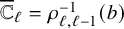 $\overline {\mathbb {C}}_\ell = \rho ^{-1}_{\ell ,\ell -1}(b)$
. But there are
$\overline {\mathbb {C}}_\ell = \rho ^{-1}_{\ell ,\ell -1}(b)$
. But there are $\deg \tilde {\varphi }_{\ell ,\ell +1}$
preimages of
$\deg \tilde {\varphi }_{\ell ,\ell +1}$
preimages of $w_0$
in
$w_0$
in $\overline {\mathbb {C}}_\ell $
, so
$\overline {\mathbb {C}}_\ell $
, so $\deg \tilde {\varphi }_{\ell ,\ell +1}= \deg _b \tilde {\varphi }_{\ell -1,\ell } \le \deg \varphi _{\ell -1,\ell }.$
We now conclude the induction by certifying that (0. $\ell +1$
)–(5.
$\ell +1$
)–(5. $\ell +1$
) follow from the above lemmas. Indeed, (0.
$\ell +1$
) follow from the above lemmas. Indeed, (0. $\ell +1$
) is a consequence of Lemma 3.10, (1.
$\ell +1$
) is a consequence of Lemma 3.10, (1. $\ell +1$
) is Lemma 3.11. Lemma 3.12 implies the first assertion of (2.
$\ell +1$
) is Lemma 3.11. Lemma 3.12 implies the first assertion of (2. $\ell +1$
) together with (5.
$\ell +1$
) together with (5. $\ell +1$
). The second assertion of (2.
$\ell +1$
). The second assertion of (2. $\ell +1$
) is obtained from Lemma 3.13. Statement (3.
$\ell +1$
) is obtained from Lemma 3.13. Statement (3. $\ell +1$
) is contained in Lemma 3.14. Suppose that
$\ell +1$
) is contained in Lemma 3.14. Suppose that $n_0+1=\ell $
is not a fully ramified time. Then (4.
$n_0+1=\ell $
is not a fully ramified time. Then (4. $\ell +1$
) reduces to (4.
$\ell +1$
) reduces to (4. $n_0$
), which we have already proven (Lemma 3.6 (2)). This finishes the proof of Theorem 3.1.
$n_0$
), which we have already proven (Lemma 3.6 (2)). This finishes the proof of Theorem 3.1.
3.3 Measures and depths
Consider a sequence $\{f_k\}$
with a collection of scaling
$\{f_k\}$
with a collection of scaling $\{A_{n,k}\}$
for which the Structure Theorem 3.1 applies. Proposition 3.7 says that the Julia set
$\{A_{n,k}\}$
for which the Structure Theorem 3.1 applies. Proposition 3.7 says that the Julia set  , viewed in $\overline {\mathbb {C}}_n$
for
$\overline {\mathbb {C}}_n$
for $n>m$
, converges to
$n>m$
, converges to $a_{n-1,n}$
. Measure-theoretically we have the following consequence:
$a_{n-1,n}$
. Measure-theoretically we have the following consequence:
Corollary 3.15. Under the assumption and notation of Theorem 3.1, for any $n>m$
, let
$n>m$
, let $A_n:=\lim A_{n,k}$
and
$A_n:=\lim A_{n,k}$
and $a_n:= \tilde {A}_n$
. Then the following hold:
$a_n:= \tilde {A}_n$
. Then the following hold:
-
1.
$a_n=a_{n-1,n}$
. -
2.
converges in the Hausdorff topology on compact sets to
$\{a_n\}$
. In particular,
$$ \begin{align*}(A_{n,k})_* \mu_{f_k} \to \delta_{a_n}.\end{align*} $$

 converges in the Hausdorff topology on compact sets to

Proof. Consider $n> m$
. By Theorem 3.1,
$n> m$
. By Theorem 3.1,
 $$ \begin{align*}T_k:=A_{n+m,k} \circ f_k^{\circ m} \circ A_{n,k}^{-1}\end{align*} $$
converges to a map $\varphi \in {\operatorname {Rat}}^*_{d^m}$
with a unique hole at
$\varphi \in {\operatorname {Rat}}^*_{d^m}$
with a unique hole at $a_{n-1,n}=\infty $
. If
$a_{n-1,n}=\infty $
. If $a_n \neq a_{n-1,n}$
, then
$a_n \neq a_{n-1,n}$
, then $A_{n+m,k} \circ f_k^{\circ m} = T_k \circ A_{n,k}$
converges to
$A_{n+m,k} \circ f_k^{\circ m} = T_k \circ A_{n,k}$
converges to $\tilde {\varphi }(a_n)$
for generic
$\tilde {\varphi }(a_n)$
for generic $z \in \overline {\mathbb {C}}$
. By Theorem 3.1 (4), the unique preimage of
$z \in \overline {\mathbb {C}}$
. By Theorem 3.1 (4), the unique preimage of $a_{m,n+m}=\infty $
under the polynomial
$a_{m,n+m}=\infty $
under the polynomial $\tilde {\varphi }$
is
$\tilde {\varphi }$
is $a_{n-1,n}=\infty $
. Thus,
$a_{n-1,n}=\infty $
. Thus, $\tilde {\varphi } (a_n) \neq \infty $
. However,
$\tilde {\varphi } (a_n) \neq \infty $
. However, $A_{m,k}\circ f_k^{\circ m}$
converges to map with nonconstant reduction
$A_{m,k}\circ f_k^{\circ m}$
converges to map with nonconstant reduction $\tilde {\varphi }_m$
. We conclude that, generically,
$\tilde {\varphi }_m$
. We conclude that, generically,
 $$ \begin{align*}(A_{m+n,k}\circ A_{m,k}^{-1})\circ (A_{m,k}\circ f_k^{\circ m})(z)\to a_{m,m+n}=\infty.\end{align*} $$
This is a contradiction. Hence statement (1) holds.
For statement (2), consider a small neighborhood W of $a_n$
. By statement (1), we have that
$a_n$
. By statement (1), we have that $a_n=a_{n-1,n}$
and, by Proposition 3.7 and Theorem 3.1, we conclude that W contains
$a_n=a_{n-1,n}$
and, by Proposition 3.7 and Theorem 3.1, we conclude that W contains  for all sufficiently large k. The conclusion follows since
  is the support of $(A_{n,k})_* \mu _{f_k}$
.
$(A_{n,k})_* \mu _{f_k}$
.
Sequences with $3$
consecutive fully ramified times have well-behaved limits in
$3$
consecutive fully ramified times have well-behaved limits in $\widehat {{\operatorname {Rat}}}_d$
:
$\widehat {{\operatorname {Rat}}}_d$
:
Corollary 3.16. Under the assumption and notation in Theorem 3.1, if $f_k^{\circ n}$
converges to
$f_k^{\circ n}$
converges to $g_n \in \overline {\operatorname {Rat}}_{d^n}$
for all n (i.e.,
$g_n \in \overline {\operatorname {Rat}}_{d^n}$
for all n (i.e., $\{ f_k \}$
converges to
$\{ f_k \}$
converges to $(g_n)$
in
$(g_n)$
in $\widehat {{\operatorname {Rat}}}_d$
), then for any given
$\widehat {{\operatorname {Rat}}}_d$
), then for any given $n>m$
the following hold:
$n>m$
the following hold:
-
1.
$\eta _{g_n} = \eta _{g_{m+1}}$
; -
2.
$\tilde g_n=\tilde g_{m+1}$
is a constant in
$\overline {\mathbb {C}}$
; and -
3. for any
$z\in \overline {\mathbb {C}}$
,
$$ \begin{align*}\frac{d_z(g_n)}{d^n}=\frac{d_z(g_{m+1})}{d^{m+1}}.\end{align*} $$


Proof. Consider $n> m$
. Recall that, in convenient coordinates, we put
$n> m$
. Recall that, in convenient coordinates, we put $a_{n-1,n}$
at
$a_{n-1,n}$
at $\infty $
. Let us first prove statement (2). The hole h of
$\infty $
. Let us first prove statement (2). The hole h of $A_n = \lim A_{n,k}$
is
$A_n = \lim A_{n,k}$
is $\tilde g_n$
. By Corollary 3.15 (1), generically,
$\tilde g_n$
. By Corollary 3.15 (1), generically, $A_{n,k}$
converges to
$A_{n,k}$
converges to $a_n = a_{n-1,n}=\infty \in \overline {\mathbb {C}}_n$
. Off
$a_n = a_{n-1,n}=\infty \in \overline {\mathbb {C}}_n$
. Off $a_n$
, we have that
$a_n$
, we have that $A_{n,k}^{-1}$
converges to h. Since
$A_{n,k}^{-1}$
converges to h. Since $A_n \circ A_{n+1}^{-1}$
converges generically to
$A_n \circ A_{n+1}^{-1}$
converges generically to $a_{n+1,n} \neq a_n$
, it follows that
$a_{n+1,n} \neq a_n$
, it follows that $A_{n+1,k}^{-1} = A_{n,k}^{-1} \circ (A_n \circ A_{n+1}^{-1})$
also converges to h. Thus the hole of
$A_{n+1,k}^{-1} = A_{n,k}^{-1} \circ (A_n \circ A_{n+1}^{-1})$
also converges to h. Thus the hole of $A_{n+1}$
is also h and
$A_{n+1}$
is also h and $\tilde {g}_{n+1} =h$
.
$\tilde {g}_{n+1} =h$
.
We now show statement (3), which immediately implies statement (1). It is sufficient to show that $d_z(g_{n+1})=d_z(g_n)\cdot d$
for all
$d_z(g_{n+1})=d_z(g_n)\cdot d$
for all $z \in \overline {\mathbb {C}}$
. By Lemma 2.5, if
$z \in \overline {\mathbb {C}}$
. By Lemma 2.5, if $\tilde {\varphi }_{m+1} (z) \neq a_{m, m+1}$
, then
$\tilde {\varphi }_{m+1} (z) \neq a_{m, m+1}$
, then $d_z (g_n) = d_z (\varphi _n)$
; and if otherwise,
$d_z (g_n) = d_z (\varphi _n)$
; and if otherwise, $d_z (g_n) = d_z (\varphi _n)+ \deg _z \tilde {\varphi }_n$
. To compute
$d_z (g_n) = d_z (\varphi _n)+ \deg _z \tilde {\varphi }_n$
. To compute $d_z(g_{n+1})$
, we consider two cases according to whether
$d_z(g_{n+1})$
, we consider two cases according to whether $\tilde {\varphi }_{m+1} (z) = a_{m,m+1}$
or not, equivalently,
$\tilde {\varphi }_{m+1} (z) = a_{m,m+1}$
or not, equivalently, $\tilde {\varphi }_n (z) = a_{n-1,n} =\infty \in \overline {\mathbb {C}}_n$
or not since all transition maps are polynomials (Theorem 3.1 (4)).
$\tilde {\varphi }_n (z) = a_{n-1,n} =\infty \in \overline {\mathbb {C}}_n$
or not since all transition maps are polynomials (Theorem 3.1 (4)).
Suppose that $\tilde {\varphi }_{m+1} (z) \neq a_{m,m+1}$
. That is,
$\tilde {\varphi }_{m+1} (z) \neq a_{m,m+1}$
. That is, $\tilde {\varphi }_n(z) \neq a_{n-1,n}=a_n$
. Then
$\tilde {\varphi }_n(z) \neq a_{n-1,n}=a_n$
. Then $\tilde {\varphi }_n(z)$
is not a hole of
$\tilde {\varphi }_n(z)$
is not a hole of $\varphi _{n,n+1}$
and
$\varphi _{n,n+1}$
and $\tilde {\varphi }_{n+1} (z) \neq a_{n+1}$
. Therefore, using the formula (2.2), we obtain that
$\tilde {\varphi }_{n+1} (z) \neq a_{n+1}$
. Therefore, using the formula (2.2), we obtain that
 $$ \begin{align*}d_z(g_{n+1}) = d_z (\varphi_{n+1}) = d_z (\varphi_{n}) \cdot d = d_z(g_n) \cdot d.\end{align*} $$
Suppose that $\tilde {\varphi }_{m+1} (z) = a_{m,m+1}$
. That is,
$\tilde {\varphi }_{m+1} (z) = a_{m,m+1}$
. That is, $\varphi _n(z) = a_{n-1,n}=a_n$
. Then
$\varphi _n(z) = a_{n-1,n}=a_n$
. Then $\varphi _n(z)$
is the hole of
$\varphi _n(z)$
is the hole of $\varphi _{n,n+1}$
, which has depth
$\varphi _{n,n+1}$
, which has depth $d - \deg \tilde {\varphi }_{n,n+1}$
and the local degree at
$d - \deg \tilde {\varphi }_{n,n+1}$
and the local degree at $a_n$
is
$a_n$
is $\deg \tilde {\varphi }_{n,n+1}$
. It follows that
$\deg \tilde {\varphi }_{n,n+1}$
. It follows that
 $$ \begin{align*} d_z(g_{n+1}) & = d_z (\varphi_{n+1}) + \deg_z \tilde{\varphi}_{n+1}\\ &= d_z(\varphi_n) \cdot d + \deg_z \tilde{\varphi}_{n} \cdot d_{a_n} (\varphi_{n,n+1}) + \deg_z \tilde{\varphi}_{n} \cdot \deg_{a_n} \tilde{\varphi}_{n,n+1}\\ &= d_z(\varphi_n) \cdot d + \deg_z \tilde{\varphi}_{n} \cdot d\\ &= d_z(g_{n}) \cdot d.\\[-37pt] \end{align*} $$
4 Iterations and measures for degenerate maps
In this section, we prove Theorem A. Given $\mathbf {g} = (g_n) \in \widehat {{\operatorname {Rat}}}_d$
, we aim at proving the existence of a probability measure
$\mathbf {g} = (g_n) \in \widehat {{\operatorname {Rat}}}_d$
, we aim at proving the existence of a probability measure $\mu _{\mathbf {g}}$
, continuously depending on
$\mu _{\mathbf {g}}$
, continuously depending on $\mathbf {g}$
, such that
$\mathbf {g}$
, such that
 $$ \begin{align*}\dfrac{1}{d^n}(g_n)^* \mu \to \mu_{\mathbf{g}},\end{align*} $$
for a generic probability measure $\mu $
. To this end, we consider a sequence
$\mu $
. To this end, we consider a sequence $\{f_k\}\subset {\operatorname {Rat}_d}$
converging to
$\{f_k\}\subset {\operatorname {Rat}_d}$
converging to $\mathbf {g}$
. First we make some assumptions on the sequence
$\mathbf {g}$
. First we make some assumptions on the sequence $\{f_k\}$
and prove Theorem A under these assumptions. Later, using compactness of
$\{f_k\}$
and prove Theorem A under these assumptions. Later, using compactness of $\widehat {{\operatorname {Rat}}}_d$
and
$\widehat {{\operatorname {Rat}}}_d$
and $M^1(\overline {\mathbb {C}})$
, we deduce Theorem A in full generality.
$M^1(\overline {\mathbb {C}})$
, we deduce Theorem A in full generality.
We may simultaneously consider the limits of $f_k^{\circ n}$
and of
$f_k^{\circ n}$
and of  ; to record these limits, let us introduce the following definition:
Definition 4.1. A sequence $\{f_k\}\subset {\operatorname {Rat}_d}$
is totally convergent if for any
$\{f_k\}\subset {\operatorname {Rat}_d}$
is totally convergent if for any $n\ge 1$
, there exist
$n\ge 1$
, there exist $g_n \in \overline {\operatorname {Rat}}_{d^n}$
and
$g_n \in \overline {\operatorname {Rat}}_{d^n}$
and $\varphi _n\in {\operatorname {Rat}}_{d^n}^*$
such that the following hold:
$\varphi _n\in {\operatorname {Rat}}_{d^n}^*$
such that the following hold:
-
1.
$f_k^{\circ n}$
converges to
$g_n \in \overline {\operatorname {Rat}}_{d^n}$
(i.e.,
$\{ f_k \}$
converges to
$(g_n)$
in
$\widehat {{\operatorname {Rat}}}_d$
), and -
2.
converges to .


 converges to
  .
.We say that $\{f_k\}$
totally converges to
$\{f_k\}$
totally converges to $(g_n,\varphi _n)$
.
$(g_n,\varphi _n)$
.
To prove Theorem A, we assume that $\{f_k\} \subset {\operatorname {Rat}_d}$
totally converges to
$\{f_k\} \subset {\operatorname {Rat}_d}$
totally converges to $(g_n, \varphi _n)$
, as
$(g_n, \varphi _n)$
, as $k \to \infty $
(see Definition 4.1). We also assume that the conjugacy classes
$k \to \infty $
(see Definition 4.1). We also assume that the conjugacy classes $\{ [f_k] \} \subset \overline {\operatorname {rat}}_d$
converge in moduli space to some
$\{ [f_k] \} \subset \overline {\operatorname {rat}}_d$
converge in moduli space to some $[g] \in \overline {\operatorname {rat}}_d$
. Then we consider the following cases:
$[g] \in \overline {\operatorname {rat}}_d$
. Then we consider the following cases:
-
1.
$\deg \tilde {\varphi }_n = o(d^n)$
. -
2.
$\deg \tilde {\varphi }_n \neq o(d^n)$
and-
(a)
$[g] \in {\operatorname {rat}_d}$
or, -
(b)
$[g] \in \partial {\operatorname {rat}_d}$
.
-




In each case, we show that a measure $\mu _{\mathbf {g}}$
with the desired properties exists and that
$\mu _{\mathbf {g}}$
with the desired properties exists and that $\mu _{f_k}$
converges to
$\mu _{f_k}$
converges to $\mu _{\mathbf {g}}$
. After discussing some preliminary facts in §4.1, case (1) is considered in §4.2, case (2a) in §4.3, and case (2b) in §4.4. Finally, in §4.5, we assemble these results to produce a proof of Theorem A.
$\mu _{\mathbf {g}}$
. After discussing some preliminary facts in §4.1, case (1) is considered in §4.2, case (2a) in §4.3, and case (2b) in §4.4. Finally, in §4.5, we assemble these results to produce a proof of Theorem A.
4.1 Convergence of depth measures
Recall from Definition 2.7 that the depth measure of a map $g \in \partial {\operatorname {Rat}_d}$
is
$g \in \partial {\operatorname {Rat}_d}$
is
 $$ \begin{align*}\eta_g := \sum_{h \in \operatorname{Hole}(g)} d_h(g) \delta_h.\end{align*} $$
Lemma 4.2. Let $\{f_k\} \subset {\operatorname {Rat}_d}$
be a sequence such that
$\{f_k\} \subset {\operatorname {Rat}_d}$
be a sequence such that 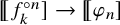 in
in  for each $n\ge 1$
, as
$n\ge 1$
, as $k \to \infty $
. Then there exists a purely atomic measure
$k \to \infty $
. Then there exists a purely atomic measure $\eta $
such that, as
$\eta $
such that, as $n\to \infty $
,
$n\to \infty $
,
 $$ \begin{align*}\frac{1}{d^n} \eta_{\varphi_n}\to \eta.\end{align*} $$
Proof. Apply Lemma 2.4 to write $\varphi _{n+1} = \varphi _{n,n+1} \circ \varphi _n$
where
$\varphi _{n+1} = \varphi _{n,n+1} \circ \varphi _n$
where $\deg \tilde {\varphi }_{n,n+1} \ge 1$
. For all
$\deg \tilde {\varphi }_{n,n+1} \ge 1$
. For all $h \in \overline {\mathbb {C}}$
, in view of (2.2), we have
$h \in \overline {\mathbb {C}}$
, in view of (2.2), we have
 $$ \begin{align*}d_h (\varphi_{n+1}) = d_h (\varphi_n) \cdot d + \deg_{h} \tilde\varphi_n \cdot d_{\tilde\varphi_n(h)}(\varphi_{n,n+1}).\end{align*} $$
Division by $d^{n+1}$
yields that
$d^{n+1}$
yields that
 $$ \begin{align*}\frac{\eta_{\varphi_n} (\{h\})}{d^n} = \dfrac{d_h(\varphi_n)}{d^n}\end{align*} $$
is nondecreasing. Let $\eta $
be the purely atomic measure defined by
$\eta $
be the purely atomic measure defined by
 $$ \begin{align*}\eta(\{h\}) := \lim_n\frac{\eta_{\varphi_n} (\{h\})}{d^n}.\end{align*} $$
It follows that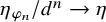 $\eta _{\varphi _n}/d^n \to \eta $
.
$\eta _{\varphi _n}/d^n \to \eta $
.
4.2 Small degree growth
Let $\{ f_k\}\subset {\operatorname {Rat}_d}$
be a sequence totally converging to
$\{ f_k\}\subset {\operatorname {Rat}_d}$
be a sequence totally converging to $(g_n,\varphi _n)$
. The growth of
$(g_n,\varphi _n)$
. The growth of $\deg \tilde {\varphi }_n$
plays a crucial role in our argument. In the case of small degree growth, that is,
$\deg \tilde {\varphi }_n$
plays a crucial role in our argument. In the case of small degree growth, that is, $\deg \tilde {\varphi }_n = o(d^n)$
, we have the following convergence of measures.
$\deg \tilde {\varphi }_n = o(d^n)$
, we have the following convergence of measures.
Proposition 4.3. Consider a sequence $\{f_k\} \subset {\operatorname {Rat}_d}$
totally converging to
$\{f_k\} \subset {\operatorname {Rat}_d}$
totally converging to $(g_n, \varphi _n)$
. Suppose
$(g_n, \varphi _n)$
. Suppose $\mu $
is a nonexceptional probability measure for
$\mu $
is a nonexceptional probability measure for $(g_n)$
. Let
$(g_n)$
. Let $\eta := \lim (\eta _{\varphi _n}/d^n)$
. Assume that
$\eta := \lim (\eta _{\varphi _n}/d^n)$
. Assume that
 $$ \begin{align*}\deg \tilde{\varphi}_n = o(d^n).\end{align*} $$
Then
 $$ \begin{align*}\eta = \lim_{n\to\infty} \dfrac{1}{d^n} (g_n)^* \mu = \lim_{k\to\infty} \mu_{f_k}.\end{align*} $$
Proof. Let $\nu $
be an accumulation point of
$\nu $
be an accumulation point of $\mu _{f_k}$
. Consider
$\mu _{f_k}$
. Consider $A_{n,k} \in {\operatorname {Rat}}_1$
such that
$A_{n,k} \in {\operatorname {Rat}}_1$
such that $A_{n,k} \circ f_k^{\circ n} \to \varphi _n$
, as
$A_{n,k} \circ f_k^{\circ n} \to \varphi _n$
, as $k \to \infty $
, for all n. Passing to a subsequence of
$k \to \infty $
, for all n. Passing to a subsequence of $\{f_k\}$
, we may assume that
$\{f_k\}$
, we may assume that $\mu _{f_k}$
converges to
$\mu _{f_k}$
converges to $ \nu $
and
$ \nu $
and $(A_{n,k})_* \mu _{f_k}$
converges to some measure
$(A_{n,k})_* \mu _{f_k}$
converges to some measure $\nu _n$
for all n. By Proposition 2.10,
$\nu _n$
for all n. By Proposition 2.10,
 $$ \begin{align*}\nu = \dfrac{1}{d^n} (\varphi_n)^* \nu_n = \frac{1}{d^n}\eta_{\varphi_n} + \dfrac{1}{d^n}(\tilde{\varphi}_n)^*\nu_n \to \eta,\end{align*} $$
since $(\tilde {\varphi }_n)^* \nu _n (\overline {\mathbb {C}}) = \deg \tilde {\varphi }_n = o(d^n)$
. Therefore, the measures
$(\tilde {\varphi }_n)^* \nu _n (\overline {\mathbb {C}}) = \deg \tilde {\varphi }_n = o(d^n)$
. Therefore, the measures $\mu _{f_k}$
converge to
$\mu _{f_k}$
converge to $\eta $
.
$\eta $
.
To show the measure $(g_n)^* \mu /d^n$
converges to
$(g_n)^* \mu /d^n$
converges to $\eta $
, we now prove that the measures
$\eta $
, we now prove that the measures $(g_n)^*\mu $
and
$(g_n)^*\mu $
and $\eta _{\varphi _n}$
differ in at most
$\eta _{\varphi _n}$
differ in at most $o(d^n)$
. Although the conclusion is the same, there are two cases, according to whether
$o(d^n)$
. Although the conclusion is the same, there are two cases, according to whether $\tilde {g}_n$
is constant or not.
$\tilde {g}_n$
is constant or not.
For all n such that $\tilde {g}_n$
is constant, from Lemma 2.5, the sequence
$\tilde {g}_n$
is constant, from Lemma 2.5, the sequence $\{A_{n,k} \}$
converges to some
$\{A_{n,k} \}$
converges to some ${A_n \in \partial {\operatorname {Rat}}_1}$
, as
${A_n \in \partial {\operatorname {Rat}}_1}$
, as $k \to \infty $
, and
$k \to \infty $
, and
 $$ \begin{align*} (g_n)^*\mu = \eta_{g_n} = \eta_{\varphi_n} + \sum_{z \in \tilde{\varphi}_n^{-1}(\tilde{A}_n)} \deg_z \tilde{\varphi}_n \cdot \delta_z = \eta_{\varphi_n} + \varepsilon_n, \end{align*} $$
where $\varepsilon _n (\overline {\mathbb {C}}) = \deg \tilde {\varphi }_n$
.
$\varepsilon _n (\overline {\mathbb {C}}) = \deg \tilde {\varphi }_n$
.
If $\tilde {g}_n$
is not constant, then
$\tilde {g}_n$
is not constant, then
 $$ \begin{align*} (g_n)^* \mu = \eta_{g_n} + (\tilde{g}_n)^* \mu = \eta_{\varphi_n} + (\tilde{g}_n)^* \mu = \eta_{\varphi_n} + \varepsilon^{\prime}_n, \end{align*} $$
where $\varepsilon ^{\prime }_n (\overline {\mathbb {C}}) = \deg \tilde {g}_n$
.
$\varepsilon ^{\prime }_n (\overline {\mathbb {C}}) = \deg \tilde {g}_n$
.
For all $n \ge 1$
, we have that
$n \ge 1$
, we have that $\deg \tilde {g}_n \le \deg \tilde {\varphi }_n = o (d^n)$
. Therefore, both
$\deg \tilde {g}_n \le \deg \tilde {\varphi }_n = o (d^n)$
. Therefore, both $\varepsilon _n(\overline {\mathbb {C}})$
and
$\varepsilon _n(\overline {\mathbb {C}})$
and $\varepsilon ^{\prime }_n(\overline {\mathbb {C}})$
are
$\varepsilon ^{\prime }_n(\overline {\mathbb {C}})$
are $o(d^n)$
, and hence
$o(d^n)$
, and hence
 $$ \begin{align*}\lim_{n\to\infty} \dfrac{1}{d^n}(g_n)^* \mu = \lim_{n\to\infty} \dfrac{1}{d^n} \eta_{\varphi_n} =\eta.\end{align*} $$
This completes the proof.
We will deal with sequences such that $\deg \tilde {\varphi }_n \neq o(d^n)$
in the next two subsections, but before, let us record the following observation:
$\deg \tilde {\varphi }_n \neq o(d^n)$
in the next two subsections, but before, let us record the following observation:
Lemma 4.4. Let $\{ f_k\}$
be a sequence totally converging to
$\{ f_k\}$
be a sequence totally converging to $(g_n, \varphi _n)$
and
$(g_n, \varphi _n)$
and $g_1 \in \partial {\operatorname {Rat}_d}$
. Suppose that
$g_1 \in \partial {\operatorname {Rat}_d}$
. Suppose that $\deg \tilde {\varphi }_n \neq o(d^n)$
. Then
$\deg \tilde {\varphi }_n \neq o(d^n)$
. Then
 $$ \begin{align*}0<\dfrac{1}{d^n} \deg \tilde{\varphi}_n\le 1\end{align*} $$
is eventually constant (independent of n). Moreover, for all n
 $$ \begin{align*}\deg \tilde{g}_n =0.\end{align*} $$
Proof. Let $\varphi _{n,n+1} \in {\operatorname {Rat}}^*_d$
be such that
$\varphi _{n,n+1} \in {\operatorname {Rat}}^*_d$
be such that $\varphi _{n+1}=\varphi _{n,n+1} \circ \varphi _n$
, as in Lemma 2.4. Since
$\varphi _{n+1}=\varphi _{n,n+1} \circ \varphi _n$
, as in Lemma 2.4. Since $\deg \tilde {\varphi }_{n+1} = \deg \tilde {\varphi }_{n,n+1} \cdot \deg \tilde {\varphi }_{n}$
and
$\deg \tilde {\varphi }_{n+1} = \deg \tilde {\varphi }_{n,n+1} \cdot \deg \tilde {\varphi }_{n}$
and $\deg \tilde {\varphi }_n \neq o(d^n)$
, it follows that
$\deg \tilde {\varphi }_n \neq o(d^n)$
, it follows that $\deg \tilde \varphi _{n,n+1} = d$
for all n sufficiently large. Therefore,
$\deg \tilde \varphi _{n,n+1} = d$
for all n sufficiently large. Therefore, $\deg \tilde {\varphi }_n/d^n$
is eventually constant in
$\deg \tilde {\varphi }_n/d^n$
is eventually constant in $(0,1]$
.
$(0,1]$
.
We now prove that $\deg \tilde {g}_n =0$
, by contradiction. First observe that
$\deg \tilde {g}_n =0$
, by contradiction. First observe that $g_n \in \partial {\operatorname {Rat}}_{d^n}$
because
$g_n \in \partial {\operatorname {Rat}}_{d^n}$
because $g_1 \in \partial {\operatorname {Rat}_d}$
and iteration is a proper map. Suppose that, for some
$g_1 \in \partial {\operatorname {Rat}_d}$
and iteration is a proper map. Suppose that, for some $n_0$
, we have
$n_0$
, we have $\deg \tilde {g}_{n_0} \ge 1$
. Then
$\deg \tilde {g}_{n_0} \ge 1$
. Then $\deg \tilde {\varphi }_{\ell n_0}=\deg \tilde {g}_{\ell n_0} = \deg \tilde {g}_{n_0}^{\circ \ell } = o(d^{n_0 \ell })$
, as
$\deg \tilde {\varphi }_{\ell n_0}=\deg \tilde {g}_{\ell n_0} = \deg \tilde {g}_{n_0}^{\circ \ell } = o(d^{n_0 \ell })$
, as $\ell \to \infty $
, since
$\ell \to \infty $
, since $\deg \tilde {g}_{n_0} < d^{n_0}$
. Therefore,
$\deg \tilde {g}_{n_0} < d^{n_0}$
. Therefore, $\deg \tilde {\varphi }_{\ell n}/d^{n\ell }$
is not eventually constant, as
$\deg \tilde {\varphi }_{\ell n}/d^{n\ell }$
is not eventually constant, as $\ell \to \infty $
, which is a contradiction.
$\ell \to \infty $
, which is a contradiction.
4.3 Potential good reduction
Here we consider the case in which $\{ f_k\}$
totally converges to
$\{ f_k\}$
totally converges to $(g_n,\varphi _n)$
with
$(g_n,\varphi _n)$
with $\deg \tilde {\varphi }_n \neq o(d^n)$
and
$\deg \tilde {\varphi }_n \neq o(d^n)$
and $\{ [f_k]\} \subset {\operatorname {rat}_d}$
converges in
$\{ [f_k]\} \subset {\operatorname {rat}_d}$
converges in ${\operatorname {rat}_d}$
. In order to state the hypothesis that are really used, we consider a slightly more general case:
${\operatorname {rat}_d}$
. In order to state the hypothesis that are really used, we consider a slightly more general case:
Proposition 4.5. Let $\{ f_k\}\subset {\operatorname {Rat}_d}$
be a sequence converging to
$\{ f_k\}\subset {\operatorname {Rat}_d}$
be a sequence converging to $g \in \partial {\operatorname {Rat}_d}$
. Assume that
$g \in \partial {\operatorname {Rat}_d}$
. Assume that $\{[f_k]\}$
converges in moduli space
$\{[f_k]\}$
converges in moduli space ${\operatorname {rat}_d}$
. Then g has a unique hole, say h. Moreover, if
${\operatorname {rat}_d}$
. Then g has a unique hole, say h. Moreover, if $f_k^{\circ n} \to g_n$
, as
$f_k^{\circ n} \to g_n$
, as $k \to \infty $
and
$k \to \infty $
and $\tilde {g}_n$
is constant, for all n, then
$\tilde {g}_n$
is constant, for all n, then
 $$ \begin{align*}\lim_{k\to\infty} \mu_{f_k}=\delta_h = \lim_{n\to\infty}\dfrac{1}{d^n}(g_n)^* \mu\end{align*} $$
for all probability measures $\mu $
that are nonexceptional for
$\mu $
that are nonexceptional for $(g_n)$
.
$(g_n)$
.
Proof. Let $\{ L_k \} \subset {\operatorname {Rat}}_1$
be such that
$\{ L_k \} \subset {\operatorname {Rat}}_1$
be such that $\psi _k:=L_k \circ f_k \circ L^{-1}_k$
converges (uniformly) to some
$\psi _k:=L_k \circ f_k \circ L^{-1}_k$
converges (uniformly) to some $ \psi \in {\operatorname {Rat}_d}$
, as
$ \psi \in {\operatorname {Rat}_d}$
, as $k\to \infty $
. We may assume that
$k\to \infty $
. We may assume that $\{L_k\}$
converges to a degenerate Möbius transformation with a hole at h and with constant reduction a. By contradiction we prove that h is the unique hole of g. Suppose that
$\{L_k\}$
converges to a degenerate Möbius transformation with a hole at h and with constant reduction a. By contradiction we prove that h is the unique hole of g. Suppose that $h' \neq h$
is a hole of g. Consider a small neighborhood U of
$h' \neq h$
is a hole of g. Consider a small neighborhood U of $h'$
. Pick a generic point
$h'$
. Pick a generic point $z_0\in \overline {\mathbb {C}}$
such that
$z_0\in \overline {\mathbb {C}}$
such that $z_0\neq \psi (a)$
. For sufficiently large k, from Lemma 2.6 (1), we deduce that
$z_0\neq \psi (a)$
. For sufficiently large k, from Lemma 2.6 (1), we deduce that $z_0 \in L_k \circ f_k(U)$
; therefore,
$z_0 \in L_k \circ f_k(U)$
; therefore, $z_0 \in \psi _k \circ L_k(U)$
. The uniform convergence, in U, of
$z_0 \in \psi _k \circ L_k(U)$
. The uniform convergence, in U, of $\{L_k\}$
to the constant a implies that
$\{L_k\}$
to the constant a implies that $z_0 = \psi (a)$
, which contradicts the choice of
$z_0 = \psi (a)$
, which contradicts the choice of $z_0$
. Thus the first assertion holds.
$z_0$
. Thus the first assertion holds.
We now prove the second assertion. Since the delta measure $\mu _\psi $
is nonexceptional for
$\mu _\psi $
is nonexceptional for $L=\lim L_k$
and
$L=\lim L_k$
and $\mu _{\psi _k} \to \mu _\psi $
, we conclude that
$\mu _{\psi _k} \to \mu _\psi $
, we conclude that $\mu _{f_k} = (L_k)^* \mu _{\psi _k} \to \delta _h$
, as
$\mu _{f_k} = (L_k)^* \mu _{\psi _k} \to \delta _h$
, as $k\to \infty $
, by Proposition 2.9. To establish
$k\to \infty $
, by Proposition 2.9. To establish $\delta _h = (g_n)^* \mu /d^n$
, note that
$\delta _h = (g_n)^* \mu /d^n$
, note that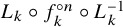 $L_k\circ f_k^{\circ n}\circ L_k^{-1}$
converges to
$L_k\circ f_k^{\circ n}\circ L_k^{-1}$
converges to $\psi ^{\circ n}\in \mathrm {Rat}_{d^n}$
. From the previous paragraph, we conclude that h is the unique hole of
$\psi ^{\circ n}\in \mathrm {Rat}_{d^n}$
. From the previous paragraph, we conclude that h is the unique hole of $g_n$
, for all
$g_n$
, for all $n \ge 1$
. Moreover,
$n \ge 1$
. Moreover, $d_h(g_n)=d^n$
because
$d_h(g_n)=d^n$
because $\deg \tilde {g}_n=0$
. Hence
$\deg \tilde {g}_n=0$
. Hence $(g_n)^* \mu /d^n = \delta _h$
, for all probability measures
$(g_n)^* \mu /d^n = \delta _h$
, for all probability measures $\mu $
that are nonexceptional for
$\mu $
that are nonexceptional for $(g_n)$
.
$(g_n)$
.
4.4 Degeneration with large degree growth
The aim of this section is to apply the Structure Theorem 3.1 and its corollaries, to prove the following:
Proposition 4.6. Let $\{f_k\}$
be a sequence in
$\{f_k\}$
be a sequence in ${\operatorname {Rat}_d}$
totally converging to
${\operatorname {Rat}_d}$
totally converging to $(g_n,\varphi _n)$
such that
$(g_n,\varphi _n)$
such that $[f_k]$
converges to
$[f_k]$
converges to $[g] \in \partial {\operatorname {rat}_d}$
. Assume that
$[g] \in \partial {\operatorname {rat}_d}$
. Assume that $\deg \tilde {\varphi }_{n} \neq o(d^n)$
. Then there exists a probability measure
$\deg \tilde {\varphi }_{n} \neq o(d^n)$
. Then there exists a probability measure $\nu $
such that
$\nu $
such that
 $$ \begin{align*}\nu = \lim_{k\to\infty} \mu_{f_k} = \lim_{n\to\infty} \dfrac{1}{d^n} (g_n)^* \mu ,\end{align*} $$
for any probability measure $\mu $
that is nonexceptional for
$\mu $
that is nonexceptional for $(g_n)$
.
$(g_n)$
.
Proof. Consider an accumulation point $\nu $
of
$\nu $
of $\{\mu _{f_k}\}$
. After passing to a subsequence, we may assume
$\{\mu _{f_k}\}$
. After passing to a subsequence, we may assume $\mu _{f_k} \to \nu $
. We may also assume that there exists a collection of scalings
$\mu _{f_k} \to \nu $
. We may also assume that there exists a collection of scalings $\{A_{n,k} : n,k \ge 1\}$
for
$\{A_{n,k} : n,k \ge 1\}$
for $\{f_k\}$
with convergent changes of coordinates. Since
$\{f_k\}$
with convergent changes of coordinates. Since $\deg \tilde {\varphi }_n \neq o(d^n)$
, any sufficiently large n is a fully ramified time. Thus, we may apply Corollary 3.15 (2) to conclude that
$\deg \tilde {\varphi }_n \neq o(d^n)$
, any sufficiently large n is a fully ramified time. Thus, we may apply Corollary 3.15 (2) to conclude that $(A_{n,k})_*\mu _{f_k} \to \delta _{a_n}$
, for all sufficiently large n. By Proposition 2.10, we have that
$(A_{n,k})_*\mu _{f_k} \to \delta _{a_n}$
, for all sufficiently large n. By Proposition 2.10, we have that
 $$ \begin{align*}\nu=\frac{1}{d^n}(\varphi_n)^\ast\delta_{a_n},\end{align*} $$
and, therefore,
 $$ \begin{align*} \nu&=\frac{1}{d^n}\left(\sum_{h\in\mathrm{Hole}(\varphi_n)}d_h (\varphi_n) \cdot \delta_h+(\tilde{\varphi}_n)^\ast\delta_{a_n}\right)\\ &=\frac{1}{d^n}\left(\sum_{h\in\mathrm{Hole}(\varphi_n)}d_h (\varphi_n) \cdot \delta_h+\sum_{\tilde{\varphi}_n(h)=a_n}\deg_h \tilde{\varphi}_n \cdot \delta_{h}\right). \end{align*} $$
By Lemma 4.4, we may assume that $g_n$
has constant reduction and apply Lemma 2.5 to conclude that
$g_n$
has constant reduction and apply Lemma 2.5 to conclude that $\operatorname {Hole}(g_n) = \operatorname {Hole}(\varphi _n) \cup \tilde {\varphi }^{-1}_n(a_n)$
. Then
$\operatorname {Hole}(g_n) = \operatorname {Hole}(\varphi _n) \cup \tilde {\varphi }^{-1}_n(a_n)$
. Then
 $$ \begin{align*}\nu=\frac{1}{d^n}\sum_{h\in\mathrm{Hole}(g_n)} d_h(g_n) \cdot \delta_h = \dfrac{1}{d^n} g_n^\ast \mu,\end{align*} $$
for any probability measure $\mu $
that is nonexceptional for
$\mu $
that is nonexceptional for $g_n$
and, as a consequence,
$g_n$
and, as a consequence, $\mu _{f_k}$
converges to
$\mu _{f_k}$
converges to $\nu $
.
$\nu $
.
4.5 Proof of Theorem A
Given any sequence $\{f_k\} \subset {\operatorname {Rat}_d}$
converging to
$\{f_k\} \subset {\operatorname {Rat}_d}$
converging to $\mathbf {g} = (g_n) \in \widehat {{\operatorname {Rat}}}_d$
, we simultaneously show that there exists a probability measure
$\mathbf {g} = (g_n) \in \widehat {{\operatorname {Rat}}}_d$
, we simultaneously show that there exists a probability measure $\mu _{\mathbf {g}}$
such that
$\mu _{\mathbf {g}}$
such that
 $$ \begin{align*}\dfrac{1}{d^n}(g_n)^* \mu \to \mu_{\mathbf{g}},\end{align*} $$
and that if along a subsequence of $\{f_k \}$
we have convergence of the measures
$\{f_k \}$
we have convergence of the measures $\mu _{f_k}$
to a measure
$\mu _{f_k}$
to a measure $\nu $
, then
$\nu $
, then $\nu = \mu _{\mathbf {g}}$
.
$\nu = \mu _{\mathbf {g}}$
.
So given a subsequence such that the measures of maximal entropy converge, there exists a further subsequence $\{f_{k_i}\}$
such that
$\{f_{k_i}\}$
such that $\{f_{k_i}\}$
totally converges to
$\{f_{k_i}\}$
totally converges to $(g_n,\varphi _n)$
and
$(g_n,\varphi _n)$
and $[f_{k_i}] \to [g] \in \overline {\operatorname {rat}}_d$
. If
$[f_{k_i}] \to [g] \in \overline {\operatorname {rat}}_d$
. If $\deg \tilde {\varphi }_n = o(d^n)$
or
$\deg \tilde {\varphi }_n = o(d^n)$
or $[g] \in {\operatorname {rat}_d}$
, by Propositions 4.3 and 4.5, there exists a probability measure
$[g] \in {\operatorname {rat}_d}$
, by Propositions 4.3 and 4.5, there exists a probability measure $\mu _{\mathbf {g}}$
such that
$\mu _{\mathbf {g}}$
such that
 $$ \begin{align*}\dfrac{1}{d^n}(g_n)^* \mu \to \mu_{\mathbf{g}}=\nu.\end{align*} $$
If $[g] \in \partial {\operatorname {rat}_d}$
and
$[g] \in \partial {\operatorname {rat}_d}$
and $\deg \tilde {\varphi }_n \neq o(d^n)$
, then we apply Proposition 4.6 to obtain the same conclusion.
$\deg \tilde {\varphi }_n \neq o(d^n)$
, then we apply Proposition 4.6 to obtain the same conclusion.
5 Continuous extension of barycentered measures
The moduli space ${\operatorname {rat}_d}$
is a complex orbifold of dimension
${\operatorname {rat}_d}$
is a complex orbifold of dimension $2d- 2$
. Its compactification
$2d- 2$
. Its compactification $\overline {\operatorname {rat}}_d$
is the categorical quotient of semistable points in
$\overline {\operatorname {rat}}_d$
is the categorical quotient of semistable points in $\overline {\operatorname {Rat}}_d$
by the
$\overline {\operatorname {Rat}}_d$
by the $\mathrm {SL}(2,\mathbb {C})$
conjugation action, see [Reference Silverman17]. According to [Reference DeMarco3, Section 3], the (semi)stable points can be characterized by the depths; more precisely,
$\mathrm {SL}(2,\mathbb {C})$
conjugation action, see [Reference Silverman17]. According to [Reference DeMarco3, Section 3], the (semi)stable points can be characterized by the depths; more precisely,
-
• a point
$\varphi \in \overline {\operatorname {Rat}}_d$
is semistable if
$d_z(\varphi )\le (d+1)/2$
for any
$z\in \overline {\mathbb {C}}$
and
$\tilde \varphi (h)\not =h$
for any
$h\in \overline {\mathbb {C}}$
with
$d_h(\varphi )\ge d/2$
; -
• a point
$\varphi \in \overline {\operatorname {Rat}}_d$
is stable if
$d_z(\varphi )\le d/2$
for any
$z\in \overline {\mathbb {C}}$
and
$\tilde \varphi (h)\not =h$
for any
$h\in \overline {\mathbb {C}}$
with
$d_h(\varphi )\ge (d-1)/2$
.








In §5.1, we review basic facts from [Reference DeMarco3]. In particular, to each element in ${\operatorname {rat}_d}$
one may continuously assign a well-defined barycentered measure of maximal entropy, modulo push-forward by a rotation in
${\operatorname {rat}_d}$
one may continuously assign a well-defined barycentered measure of maximal entropy, modulo push-forward by a rotation in $\operatorname {SO}(3)$
. In §5.2, we establish Theorem B, which asserts continuous extension of this assignment to the resolution space
$\operatorname {SO}(3)$
. In §5.2, we establish Theorem B, which asserts continuous extension of this assignment to the resolution space $\widehat {{\operatorname {rat}}}_d \subset \Pi _{n\ge 1} \overline {\operatorname {rat}}_{d^n}$
of the iterate map
$\widehat {{\operatorname {rat}}}_d \subset \Pi _{n\ge 1} \overline {\operatorname {rat}}_{d^n}$
of the iterate map  discussed in the introduction §1.
5.1 Barycentered measures
Recall that $M^1(\overline {\mathbb {C}})$
is the space of probability measures endowed with the weak*-topology. Let
$M^1(\overline {\mathbb {C}})$
is the space of probability measures endowed with the weak*-topology. Let $M^1_o(\overline {\mathbb {C}})\subset M^1(\overline {\mathbb {C}})$
be the subset of probability measures with no atom of weight
$M^1_o(\overline {\mathbb {C}})\subset M^1(\overline {\mathbb {C}})$
be the subset of probability measures with no atom of weight $\ge 1/2$
. Then, under the identifications of
$\ge 1/2$
. Then, under the identifications of $\overline {\mathbb {C}}$
with
$\overline {\mathbb {C}}$
with $S^2\subset \mathbb {R}^3$
by the stereographic projection and of hyperbolic space
$S^2\subset \mathbb {R}^3$
by the stereographic projection and of hyperbolic space ${\mathbb {H}}^3$
with the unit ball in
${\mathbb {H}}^3$
with the unit ball in $\mathbb {R}^3$
, the conformal barycenter
$\mathbb {R}^3$
, the conformal barycenter $C(\mu ) \in {\mathbb {H}}^3$
of
$C(\mu ) \in {\mathbb {H}}^3$
of $\mu \in M^1_o(\overline {\mathbb {C}})$
is well-defined and continuous on
$\mu \in M^1_o(\overline {\mathbb {C}})$
is well-defined and continuous on $M^1_o(\overline {\mathbb {C}})$
. More precisely, given
$M^1_o(\overline {\mathbb {C}})$
. More precisely, given $\mu \in M^1_o(\overline {\mathbb {C}})$
, the barycenter
$\mu \in M^1_o(\overline {\mathbb {C}})$
, the barycenter $C(\mu )$
is uniquely determined by the following two properties:
$C(\mu )$
is uniquely determined by the following two properties:
-
1.
$C(\mu )=0\in {\mathbb {H}}^3$
if and only if
$\int _{S^2}xd\mu (x)=0$
; and -
2.
$C(A_*\mu )=A(C(\mu ))$
for any
$A\in {\operatorname {Rat}}_1\cong \text {Isom}^+{\mathbb {H}}^3$
.

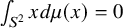


The conformal barycenter $C(\mu )$
of any
$C(\mu )$
of any $\mu \in M^1(\overline {\mathbb {C}})\setminus M^1_o(\overline {\mathbb {C}})$
is undefined. For more details, see [Reference DeMarco3, Section 8] and [Reference Douady and Earle5].
$\mu \in M^1(\overline {\mathbb {C}})\setminus M^1_o(\overline {\mathbb {C}})$
is undefined. For more details, see [Reference DeMarco3, Section 8] and [Reference Douady and Earle5].
A measure $\mu \in M^1(\overline {\mathbb {C}})$
is barycentered if
$\mu \in M^1(\overline {\mathbb {C}})$
is barycentered if $C(\mu )$
is well-defined and equals
$C(\mu )$
is well-defined and equals $0$
. Denote by
$0$
. Denote by $M_{bc}^1(\overline {\mathbb {C}})\subset M^1(\overline {\mathbb {C}})$
the subset of barycentered measures, and let
$M_{bc}^1(\overline {\mathbb {C}})\subset M^1(\overline {\mathbb {C}})$
the subset of barycentered measures, and let $\overline {M}^1_{bc}(\overline {\mathbb {C}})$
be the closure of
$\overline {M}^1_{bc}(\overline {\mathbb {C}})$
be the closure of $M_{bc}^1(\overline {\mathbb {C}})$
in
$M_{bc}^1(\overline {\mathbb {C}})$
in $M^1(\overline {\mathbb {C}})$
. Each element in
$M^1(\overline {\mathbb {C}})$
. Each element in $\overline {M}^1_{bc}(\overline {\mathbb {C}})$
is either barycentered or of the form
$\overline {M}^1_{bc}(\overline {\mathbb {C}})$
is either barycentered or of the form $(\delta _a+\delta _{-1/\bar a})/2$
. for some
$(\delta _a+\delta _{-1/\bar a})/2$
. for some $a\in \overline {\mathbb {C}}$
, see [Reference DeMarco3, Lemma 8.3]. Then both
$a\in \overline {\mathbb {C}}$
, see [Reference DeMarco3, Lemma 8.3]. Then both $M^1_{bc}(\overline {\mathbb {C}})$
and
$M^1_{bc}(\overline {\mathbb {C}})$
and $\overline {M}^1_{bc}(\overline {\mathbb {C}})$
are invariant under the push-forward action of the compact group of rotations
$\overline {M}^1_{bc}(\overline {\mathbb {C}})$
are invariant under the push-forward action of the compact group of rotations $\operatorname {SO}(3)\subset \operatorname{PSL}(2,\mathbb{C})$
. Consider the quotient topological spaces
$\operatorname {SO}(3)\subset \operatorname{PSL}(2,\mathbb{C})$
. Consider the quotient topological spaces
 $$ \begin{align*}M^1_{dm}(\overline{\mathbb{C}}):=M^1_{bc}(\overline{\mathbb{C}})/\operatorname{SO}(3)\ \ \text{and}\ \ \overline{M}^1_{dm}(\overline{\mathbb{C}}):=\overline{M}^1_{bc}(\overline{\mathbb{C}})/\operatorname{SO}(3).\end{align*} $$
The space $M^1_{dm}(\overline {\mathbb {C}})$
is locally compact, Hausdorff and its one-point compactification is
$M^1_{dm}(\overline {\mathbb {C}})$
is locally compact, Hausdorff and its one-point compactification is $\overline {M}^1_{dm}(\overline {\mathbb {C}})$
, see [Reference DeMarco3, Theorem 8.1]. Denote by
$\overline {M}^1_{dm}(\overline {\mathbb {C}})$
, see [Reference DeMarco3, Theorem 8.1]. Denote by $[\infty ]$
the unique point in
$[\infty ]$
the unique point in $\overline {M}^1_{dm}(\overline {\mathbb {C}})\setminus M^1_{dm}(\overline {\mathbb {C}})$
.
$\overline {M}^1_{dm}(\overline {\mathbb {C}})\setminus M^1_{dm}(\overline {\mathbb {C}})$
.
For each $\mu \in M^1_o(\overline {\mathbb {C}})$
, there exists
$\mu \in M^1_o(\overline {\mathbb {C}})$
, there exists $A\in {\operatorname {Rat}}_1$
such that
$A\in {\operatorname {Rat}}_1$
such that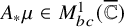 $A_*\mu \in M^1_{bc}(\overline {\mathbb {C}})$
. Writing
$A_*\mu \in M^1_{bc}(\overline {\mathbb {C}})$
. Writing $[\mu ]:=[A_*\mu ]\in M^1_{dm}(\overline {\mathbb {C}})$
, one obtains a continuous map
$[\mu ]:=[A_*\mu ]\in M^1_{dm}(\overline {\mathbb {C}})$
, one obtains a continuous map
 $$ \begin{align*}\begin{array}{cccc} &M^1_o(\overline{\mathbb{C}})&\rightarrow& M^1_{dm}(\overline{\mathbb{C}})\\ & \mu & \mapsto & [\mu ], \end{array} \end{align*} $$
which induces a continuous map ${\operatorname {rat}}_d\to M^1_{dm}(\overline {\mathbb {C}})$
, sending
${\operatorname {rat}}_d\to M^1_{dm}(\overline {\mathbb {C}})$
, sending $[f]$
to
$[f]$
to $[\mu _f]$
. We remark here that the above continuous map can not extend continuously to
$[\mu _f]$
. We remark here that the above continuous map can not extend continuously to $M^1(\overline {\mathbb {C}})$
; for instance, considering
$M^1(\overline {\mathbb {C}})$
; for instance, considering $\mu _n\in M^1(\overline {\mathbb {C}})$
such that
$\mu _n\in M^1(\overline {\mathbb {C}})$
such that $\mu _n(\{0\})=\mu _n(\{1/n\})=\mu _n(\{1\})=1/3$
, we have that
$\mu _n(\{0\})=\mu _n(\{1/n\})=\mu _n(\{1\})=1/3$
, we have that $[\lim _{n\to \infty }\mu _n]=[\infty ]\not =\lim _{n\to \infty }[\mu _n]$
.
$[\lim _{n\to \infty }\mu _n]=[\infty ]\not =\lim _{n\to \infty }[\mu _n]$
.
5.2 Proof of Theorem B
Consider a sequence $\{[f_k]\}\subset {\operatorname {Rat}_d}$
converging to
$\{[f_k]\}\subset {\operatorname {Rat}_d}$
converging to $([g_n])$
in
$([g_n])$
in $\widehat {{\operatorname {rat}}}_d$
. Let
$\widehat {{\operatorname {rat}}}_d$
. Let $\mu \in M^1(\overline {\mathbb {C}})$
be a nonexceptional measure for
$\mu \in M^1(\overline {\mathbb {C}})$
be a nonexceptional measure for $(g_n)$
. For notational simplicity,
$(g_n)$
. For notational simplicity,
 $$ \begin{align*} \mu_k &:= \mu_{f_k}\\ \nu_n &:= \dfrac{(g_n)^*\mu}{d^n}. \end{align*} $$
Given accumulation points $[\mu _\infty ]$
of
$[\mu _\infty ]$
of $\{[\mu _k]\}$
and
$\{[\mu _k]\}$
and $[\nu ]$
of
$[\nu ]$
of $\{[\nu _n]\}$
, after some work, we will show that
$\{[\nu _n]\}$
, after some work, we will show that ${[\nu ]=[\mu _\infty ]}$
, that is, Theorem B holds. By continuity of the measure of maximal entropy for nondegenerate rational maps [Reference Mañé13], if
${[\nu ]=[\mu _\infty ]}$
, that is, Theorem B holds. By continuity of the measure of maximal entropy for nondegenerate rational maps [Reference Mañé13], if $[g_1]\in {\operatorname {rat}}_d$
, equivalently,
$[g_1]\in {\operatorname {rat}}_d$
, equivalently, $[f_k]$
converges in
$[f_k]$
converges in ${\operatorname {rat}}_d$
, then
${\operatorname {rat}}_d$
, then $[\nu ]=[\mu _\infty ]$
. Thus we work under the assumption that
$[\nu ]=[\mu _\infty ]$
. Thus we work under the assumption that
 $$ \begin{align*}[g_1]\in\partial{\operatorname{rat}}_d.\end{align*} $$
Passing to a subsequence in k, we assume that $[\mu _k]$
converges to
$[\mu _k]$
converges to $[\mu _\infty ]$
. Passing to a subsequence
$[\mu _\infty ]$
. Passing to a subsequence $n_i$
, we assume that
$n_i$
, we assume that $[\nu _{n_i}]$
converges to
$[\nu _{n_i}]$
converges to $[\nu ]$
. It is sufficient to establish that
$[\nu ]$
. It is sufficient to establish that $[\mu _\infty ]$
and
$[\mu _\infty ]$
and $[\nu ]$
coincide when
$[\nu ]$
coincide when $[\mu _\infty ] \neq [\infty ]$
or
$[\mu _\infty ] \neq [\infty ]$
or $[\nu ] \neq [\infty ]$
.
$[\nu ] \neq [\infty ]$
.
Lemma 5.1. Assume that $[\mu _\infty ]\not =[\infty ]$
. Then
$[\mu _\infty ]\not =[\infty ]$
. Then
 $$ \begin{align*}[\nu]=\lim_{n\to\infty}[\nu_n]=[\mu_\infty].\end{align*} $$
Proof. After changing the representative of $[f_k]$
, we may assume that
$[f_k]$
, we may assume that $\mu _{f_k}$
is barycentered, for all k. Passing to a subsequence,
$\mu _{f_k}$
is barycentered, for all k. Passing to a subsequence, $\{f_k\}$
converges in
$\{f_k\}$
converges in $\widehat {{\operatorname {Rat}}}_d$
, say to
$\widehat {{\operatorname {Rat}}}_d$
, say to $\mathbf {h}=(h_n)$
. By Theorem A, we have that
$\mathbf {h}=(h_n)$
. By Theorem A, we have that $\mu _{f_k}$
converges to some measure
$\mu _{f_k}$
converges to some measure $\mu _{\mathbf {h}}$
. Since
$\mu _{\mathbf {h}}$
. Since $[\mu _\infty ] \neq [\infty ]$
, we have
$[\mu _\infty ] \neq [\infty ]$
, we have $[\mu _{\mathbf {h}}]=[\mu _\infty ] \neq [\infty ]$
. Therefore,
$[\mu _{\mathbf {h}}]=[\mu _\infty ] \neq [\infty ]$
. Therefore, $\mu _{\mathbf {h}}(z) < 1/2$
for all
$\mu _{\mathbf {h}}(z) < 1/2$
for all $z \in \overline {\mathbb {C}}$
. Hence, for n sufficiently large,
$z \in \overline {\mathbb {C}}$
. Hence, for n sufficiently large, $h_n$
is GIT-stable. Therefore,
$h_n$
is GIT-stable. Therefore, $[f_k^{\circ n}]$
converges to
$[f_k^{\circ n}]$
converges to $[h_n]$
and
$[h_n]$
and $[h_n]=[g_n]$
. In particular,
$[h_n]=[g_n]$
. In particular, $[(h_n)^* \mu /d^n]= [\nu _n]$
provided that
$[(h_n)^* \mu /d^n]= [\nu _n]$
provided that $\mu $
is not exceptional for
$\mu $
is not exceptional for $h_n$
, for all n. The sequence
$h_n$
, for all n. The sequence $(h_n)$
is uniquely determined up to
$(h_n)$
is uniquely determined up to $\operatorname {SO}(3)$
conjugacy (the same for all n). For any given n, there are at most countably many elements of
$\operatorname {SO}(3)$
conjugacy (the same for all n). For any given n, there are at most countably many elements of $\operatorname {SO}(3)$
so that
$\operatorname {SO}(3)$
so that $\mu $
is exceptional for the conjugacy of
$\mu $
is exceptional for the conjugacy of $h_n$
by that element. Hence we may find a conjugate so that
$h_n$
by that element. Hence we may find a conjugate so that $\mu $
is not exceptional for all
$\mu $
is not exceptional for all $h_n$
. Thus the conclusion holds.
$h_n$
. Thus the conclusion holds.
Now we assume that $[\nu ] \neq [\infty ]$
. Passing to a further subsequences of
$[\nu ] \neq [\infty ]$
. Passing to a further subsequences of $\{f_k\}$
and
$\{f_k\}$
and $\{g_{n_i}\}$
the following hold:
$\{g_{n_i}\}$
the following hold:
-
1. There exists
$\varepsilon>0$
such that, for all
$n_i$
and all
$z\in \overline {\mathbb {C}}$
,
$$ \begin{align*}d_z(g_{n_i}) < \left(\dfrac{1}{2} - 2 \varepsilon\right) \cdot d^{n_i}.\end{align*} $$
-
2. For each
$n_i$
, there exists
$B_{n_i,k} \in {\operatorname {Rat}}_1$
such that, as
$k \to \infty $
,
$$ \begin{align*}B_{n_i,k} \circ f_k^{\circ n_i} \circ B_{n_i,k}^{-1} \to g_{n_i}.\end{align*} $$
-
3. Let
$$ \begin{align*}f_{n_i,k}:=B_{n_i,k} \circ f_k \circ B_{n_i,k}^{-1}.\end{align*} $$
Then, for all
$n_i$
and m there exists
$g_{n_i,m} \in \overline {\operatorname {Rat}}_{d^{m}}$
such that
$$ \begin{align*}f_{n_i,k}^{\circ m} \to g_{n_i,m}.\end{align*} $$
-
4. For each
$n_i$
and each
$m\ge 1$
, there exist a collection of scalings
$\{A_{n_i,m,k}\}$
and maps
$\psi _{n_i,m} \in {\operatorname {Rat}}^*_{d^{m}}$
such that, as
$k\to \infty $
,
$$ \begin{align*}A_{n_i,m,k} \circ f_{n_i,k}^{\circ m} \to \psi_{n_i,m}.\end{align*} $$
-
5. There exists
$c \in [0,1]$
such that, as
$n_i \to \infty $
,
$$ \begin{align*}\dfrac{\deg \tilde\psi_{n_i,n_i}}{d^{n_i}} \to c \in [0,1].\end{align*} $$








Note that $g_{n_i}$
is GIT-stable for each
$g_{n_i}$
is GIT-stable for each $n_i$
by statement (1). Thus we may choose
$n_i$
by statement (1). Thus we may choose $B_{n_i, k}$
as in statement (2). Statements (3) and (4) say that
$B_{n_i, k}$
as in statement (2). Statements (3) and (4) say that $\{f_{n_i,k}\}$
totally converges to
$\{f_{n_i,k}\}$
totally converges to $(g_{n_i,m},\psi _{n_i,m})$
with associated scalings
$(g_{n_i,m},\psi _{n_i,m})$
with associated scalings $\{A_{n_i,m,k}\}$
.
$\{A_{n_i,m,k}\}$
.
Observe that $g_{n_i,n_i} = g_{n_i}$
. If
$g_{n_i,n_i} = g_{n_i}$
. If $\tilde {g}_{n_i,m}$
is nonconstant, then in (4) we choose the scaling
$\tilde {g}_{n_i,m}$
is nonconstant, then in (4) we choose the scaling $A_{n_i,m,k}$
to be the identity and, therefore,
$A_{n_i,m,k}$
to be the identity and, therefore, $\psi _{n_i,m}={g}_{n_i,m}$
.
$\psi _{n_i,m}={g}_{n_i,m}$
.
For brevity, write $\psi _{n_i}:=\psi _{n_i,n_i}$
. We establish the following two lemmas according to the growth of
$\psi _{n_i}:=\psi _{n_i,n_i}$
. We establish the following two lemmas according to the growth of $\deg \tilde \psi _{n_i}$
; more precisely, according to whether
$\deg \tilde \psi _{n_i}$
; more precisely, according to whether $c>0$
or
$c>0$
or $c =0$
.
$c =0$
.
Lemma 5.2. Suppose that $c>0$
, that is,
$c>0$
, that is, $\deg \tilde \psi _{n_i}\not =o(d^{n_i})$
. Given a sufficiently large
$\deg \tilde \psi _{n_i}\not =o(d^{n_i})$
. Given a sufficiently large $n_i$
, for any
$n_i$
, for any $\ell \ge n_i$
and any
$\ell \ge n_i$
and any $z\in \overline {\mathbb {C}}$
,
$z\in \overline {\mathbb {C}}$
,
 $$ \begin{align*}\frac{d_z(g_{n_i,\ell})}{d^\ell}=\frac{d_z(g_{n_i})}{d^{n_i}}.\end{align*} $$
Moreover,
 $$ \begin{align*}[\nu] = [\nu_{n_i}] = [\mu_\infty].\end{align*} $$
Proof. Since $c>0$
, for sufficiently large
$c>0$
, for sufficiently large $n_i$
, the number of times
$n_i$
, the number of times $m<n_i$
such that
$m<n_i$
such that $\deg \tilde \psi _{n_i,m+1} < d \cdot \deg \tilde \psi _{n_i,m}$
is bounded independently of
$\deg \tilde \psi _{n_i,m+1} < d \cdot \deg \tilde \psi _{n_i,m}$
is bounded independently of $n_i$
. Thus, we can pick N sufficiently large so that for any
$n_i$
. Thus, we can pick N sufficiently large so that for any $n_i\ge N$
, there is
$n_i\ge N$
, there is $1\le m_i\le n_i-3$
satisfying that
$1\le m_i\le n_i-3$
satisfying that $A_{n_i,m_i+3,k}\circ f_{n_i,k}^{\circ 3}\circ A_{n_i,m_i,k}^{-1}$
converges in
$A_{n_i,m_i+3,k}\circ f_{n_i,k}^{\circ 3}\circ A_{n_i,m_i,k}^{-1}$
converges in ${\operatorname {Rat}}_{d^3}$
. Since we are working under the assumption that
${\operatorname {Rat}}_{d^3}$
. Since we are working under the assumption that $[g_1]\in \partial {\operatorname {rat}}_d$
, by Corollary 3.16, we conclude that for any
$[g_1]\in \partial {\operatorname {rat}}_d$
, by Corollary 3.16, we conclude that for any $\ell \ge n_i$
and any
$\ell \ge n_i$
and any $z\in \overline {\mathbb {C}}$
, the reduction
$z\in \overline {\mathbb {C}}$
, the reduction $\tilde g_{n_i,\ell }$
is a constant independent of
$\tilde g_{n_i,\ell }$
is a constant independent of $\ell $
and
$\ell $
and
 $$ \begin{align*}\frac{d_z(g_{n_i,\ell})}{d^\ell}=\frac{d_z(g_{n_i})}{d^{n_i}}.\end{align*} $$
Hence
 $$ \begin{align*}\frac{(g_{n_i,\ell})^*\mu}{d^\ell}=\frac{(g_{n_i})^*\mu}{d^{n_i}}=\nu_{n_i}.\end{align*} $$
Since by Theorem A
 $$ \begin{align*}\lim_{\ell\to\infty}\frac{(g_{n_i,\ell})^*\mu}{d^\ell}=\lim\limits_{k\to\infty}\mu_{f_{n_i,k}},\end{align*} $$
we have that
 $$ \begin{align*}\nu_{n_i}=\lim_{k\to\infty}\mu_{f_{n_i,k}}.\end{align*} $$
Observing that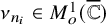 $\nu _{n_i}\in M^1_o(\overline {\mathbb {C}})$
since
$\nu _{n_i}\in M^1_o(\overline {\mathbb {C}})$
since $g_{n_i}$
is stable, by the continuity of the map
$g_{n_i}$
is stable, by the continuity of the map $M^1_o(\overline {\mathbb {C}})\rightarrow M^1_{dm}(\overline {\mathbb {C}})$
, we obtain that
$M^1_o(\overline {\mathbb {C}})\rightarrow M^1_{dm}(\overline {\mathbb {C}})$
, we obtain that
 $$ \begin{align*}[\nu_{n_i}]=\lim\limits_{k\to\infty}[\mu_{f_{n_i,k}}]=\lim_{n\to\infty}[\mu_{f_k}]=[\mu_\infty].\end{align*} $$
Thus the conclusion follows.
Lemma 5.3. Suppose that $c=0$
, that is,
$c=0$
, that is, $\deg \tilde \psi _{n_i}=o(d^{n_i})$
. Then
$\deg \tilde \psi _{n_i}=o(d^{n_i})$
. Then
 $$ \begin{align*}[\nu]=[\mu_\infty].\end{align*} $$
Proof. By Lemma 5.1, we may assume that $[\mu _\infty ]=[\infty ]$
. Passing to a subsequence in k we can assume that
$[\mu _\infty ]=[\infty ]$
. Passing to a subsequence in k we can assume that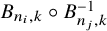 $B_{n_i,k}\circ B_{n_j,k}^{-1}$
converges to some
$B_{n_i,k}\circ B_{n_j,k}^{-1}$
converges to some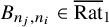 $B_{n_j,n_i}\in \overline {\operatorname {Rat}}_1$
for any
$B_{n_j,n_i}\in \overline {\operatorname {Rat}}_1$
for any $n_i\not =n_j$
. Then passing to a further subsequence in
$n_i\not =n_j$
. Then passing to a further subsequence in $n_i$
if necessary, we can assume that
$n_i$
if necessary, we can assume that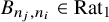 $B_{n_j,n_i}\in {\operatorname {Rat}}_1$
for all
$B_{n_j,n_i}\in {\operatorname {Rat}}_1$
for all $n_i,n_j$
or
$n_i,n_j$
or $B_{n_j,n_i}\in \partial {\operatorname {Rat}}_1$
for all
$B_{n_j,n_i}\in \partial {\operatorname {Rat}}_1$
for all $n_i,n_j$
.
$n_i,n_j$
.
Case 1: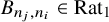 $B_{n_j,n_i}\in {\operatorname {Rat}}_1$
for all
$B_{n_j,n_i}\in {\operatorname {Rat}}_1$
for all $n_i\not =n_j$
. Since
$n_i\not =n_j$
. Since $\{f_{n_1,k}\}$
totally converges to
$\{f_{n_1,k}\}$
totally converges to $(g_{n_1,m}, \psi _{n_1,m})$
, passing to a subsequence in k, we may choose
$(g_{n_1,m}, \psi _{n_1,m})$
, passing to a subsequence in k, we may choose $\{A_{n_1,n_i,k}\}$
so that
$\{A_{n_1,n_i,k}\}$
so that $\psi _{n_i} = \psi _{n_1,n_i} \circ C_{n_i}$
for some
$\psi _{n_i} = \psi _{n_1,n_i} \circ C_{n_i}$
for some $C_{n_i} \in {\operatorname {Rat}}_1$
.
$C_{n_i} \in {\operatorname {Rat}}_1$
.
By Lemma 4.2, let
 $$ \begin{align*}\nu':=\lim_{i\to\infty}{\eta_{\psi_{n_1,n_i}}} \in M^1(\overline{\mathbb{C}}),\end{align*} $$
where $\eta _{\psi _{n_1,n_i}}$
is the corresponding depth measure from Definition 2.7. We claim that
$\eta _{\psi _{n_1,n_i}}$
is the corresponding depth measure from Definition 2.7. We claim that $\nu '\in M^1_o(\overline {\mathbb {C}})$
and hence
$\nu '\in M^1_o(\overline {\mathbb {C}})$
and hence $[\nu ']\not =[\infty ]$
. Indeed, given
$[\nu ']\not =[\infty ]$
. Indeed, given $z \in \overline {\mathbb {C}}$
, let
$z \in \overline {\mathbb {C}}$
, let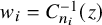 $w_i = C_{n_i}^{-1}(z)$
, then
$w_i = C_{n_i}^{-1}(z)$
, then
 $$ \begin{align*}\nu'(\{z\}) =\lim \dfrac{d_z (\psi_{n_1,n_i})}{d^{n_i}} = \lim \dfrac{d_{w_i} (\psi_{n_i})}{d^{n_i}} \le \lim \dfrac{d_{w_i}(g_{n_i})}{d^{n_i}} \le \dfrac12 - 2 \varepsilon.\end{align*} $$
The first equality follows from the proof of Lemma 4.2 since $\nu '(\{z\})$
is the limit of the nondecreasing sequence
$\nu '(\{z\})$
is the limit of the nondecreasing sequence $\{\eta _{\psi _{n_1,n_i}}(\{z\})=d^{-{n_i}} \cdot d_z (\psi _{n_1,n_i})\}$
. The second equality follows from
$\{\eta _{\psi _{n_1,n_i}}(\{z\})=d^{-{n_i}} \cdot d_z (\psi _{n_1,n_i})\}$
. The second equality follows from $\psi _{n_i} = \psi _{n_1,n_i} \circ C_{n_i}$
. The first inequality is Lemma 2.5 applied to
$\psi _{n_i} = \psi _{n_1,n_i} \circ C_{n_i}$
. The first inequality is Lemma 2.5 applied to $z = w_i$
and
$z = w_i$
and $\{f_{n_i,k}^{\circ n_i}\}$
. The second inequality is statement (1).
$\{f_{n_i,k}^{\circ n_i}\}$
. The second inequality is statement (1).
Moreover, since $\deg \tilde \psi _{n_i}=o(d^{n_i})$
, we have that
$\deg \tilde \psi _{n_i}=o(d^{n_i})$
, we have that $\deg \tilde {\psi }_{n_1, n_i} = o (d^{n_i})$
, as
$\deg \tilde {\psi }_{n_1, n_i} = o (d^{n_i})$
, as $i\to \infty $
, and hence
$i\to \infty $
, and hence $\deg \tilde {\psi }_{n_1,n} = o(d^n)$
, as
$\deg \tilde {\psi }_{n_1,n} = o(d^n)$
, as $n\to \infty $
. Thus, applying Proposition 4.3 to
$n\to \infty $
. Thus, applying Proposition 4.3 to $\{f_{n_1,k}\}$
, we conclude that
$\{f_{n_1,k}\}$
, we conclude that
 $$ \begin{align*}\lim_{k\to\infty} \mu_{f_{n_1,k}} = \lim_{i\to\infty}\frac{(g_{n_1,n_i})^* \mu'}{d^{n_i} } =\nu',\end{align*} $$
whenever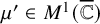 $\mu '\in M^1(\overline {\mathbb {C}})$
is any nonexceptional measure for
$\mu '\in M^1(\overline {\mathbb {C}})$
is any nonexceptional measure for $(g_{n_1,n})$
. Continuity of the map
$(g_{n_1,n})$
. Continuity of the map $M^1_o(\overline {\mathbb {C}})\rightarrow M^1_{dm}(\overline {\mathbb {C}})$
yields
$M^1_o(\overline {\mathbb {C}})\rightarrow M^1_{dm}(\overline {\mathbb {C}})$
yields
 $$ \begin{align*}[\mu_\infty]= \lim_{n\to\infty}[\mu_{f_k}]=\lim_{k\to\infty}[\mu_{f_{n_1,k}}]=[\nu'].\end{align*} $$
Hence $[\mu _\infty ]\neq [\infty ]$
, which is a contradiction.
$[\mu _\infty ]\neq [\infty ]$
, which is a contradiction.
Case 2: $B_{n_j,n_i}\in \partial {\operatorname {Rat}}_1$
for any
$B_{n_j,n_i}\in \partial {\operatorname {Rat}}_1$
for any $n_i\not =n_j$
. We show that this case cannot occur under our assumptions; more precisely, by counting preimages, we will obtain a contradiction with statement (1).
$n_i\not =n_j$
. We show that this case cannot occur under our assumptions; more precisely, by counting preimages, we will obtain a contradiction with statement (1).
Since $\deg \tilde \psi _{n_i}=o(d^{n_i})$
, we consider
$\deg \tilde \psi _{n_i}=o(d^{n_i})$
, we consider $n_{i_0}$
such that for
$n_{i_0}$
such that for $n_i \ge n_{i_0}$
,
$n_i \ge n_{i_0}$
,
 $$ \begin{align*}\deg\tilde\psi_{n_i}<\varepsilon\cdot d^{n_i}.\end{align*} $$
Let $\ell :=n_{i_0}$
and
$\ell :=n_{i_0}$
and $s:=n_{i_0+1}$
. For brevity write
$s:=n_{i_0+1}$
. For brevity write
 $$ \begin{align*} \gamma_k := B_{\ell,k} \circ B_{s,k}^{-1} \end{align*} $$
with $\gamma _k \to B_{(s,\ell )}$
and
$\gamma _k \to B_{(s,\ell )}$
and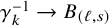 $\gamma _k^{-1} \to B_{(\ell ,s)}$
in
$\gamma _k^{-1} \to B_{(\ell ,s)}$
in $\overline {\operatorname {Rat}}_1$
. Let
$\overline {\operatorname {Rat}}_1$
. Let $b_{\ell }:=\tilde B_{s,\ell }$
and
$b_{\ell }:=\tilde B_{s,\ell }$
and $b_{s}:=\tilde B_{\ell ,s}$
.
$b_{s}:=\tilde B_{\ell ,s}$
.
Intuitively, our argument is as follows. We restrict our attention to the collection of scalings $\{B_{\ell ,k}, B_{s,k} \}$
with associated space formed by two spheres
$\{B_{\ell ,k}, B_{s,k} \}$
with associated space formed by two spheres $\overline {\mathbb {C}}_\ell $
and
$\overline {\mathbb {C}}_\ell $
and $\overline {\mathbb {C}}_s$
. We consider the set of preimages S of a generic point in
$\overline {\mathbb {C}}_s$
. We consider the set of preimages S of a generic point in $\overline {\mathbb {C}}_s$
, under an appropriate iterate
$\overline {\mathbb {C}}_s$
, under an appropriate iterate $f_{s,k}^{\circ s}$
. Then statement (1) implies that less than half of the elements of S map, under
$f_{s,k}^{\circ s}$
. Then statement (1) implies that less than half of the elements of S map, under $f_{s,k}^{\circ s}\circ \gamma _k^{-1}$
, close to
$f_{s,k}^{\circ s}\circ \gamma _k^{-1}$
, close to $b_\ell $
, the hole of
$b_\ell $
, the hole of $B_{(\ell ,s)}$
. So more than half of the elements are bounded away from
$B_{(\ell ,s)}$
. So more than half of the elements are bounded away from $b_\ell $
. Applying the change of coordinates
$b_\ell $
. Applying the change of coordinates $\gamma _k^{-1}$
, one concludes that more than half of the elements of S are close to
$\gamma _k^{-1}$
, one concludes that more than half of the elements of S are close to $b_s$
, which is a contradiction with statement (1).
$b_s$
, which is a contradiction with statement (1).
More precisely, consider
 $$ \begin{align*} \alpha_k &:= B_{s,k} \circ f_k^{\circ s-\ell} \circ B_{\ell,k}^{-1},\\ \beta_k &:= B_{\ell,k} \circ f_k^{\circ \ell} \circ B_{\ell,k}^{-1}. \end{align*} $$
Note that
 $$ \begin{align*}f_{s,k}^{\circ s} =\alpha_k \circ \beta_k \circ \gamma_k \to g_s.\end{align*} $$
Let V be a small neighborhood of $b_{s}$
. For
$b_{s}$
. For $w\in \overline {\mathbb {C}}$
, we now estimate
$w\in \overline {\mathbb {C}}$
, we now estimate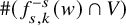 $\#(f_{s,k}^{-s}(w)\cap V)$
. First observe that
$\#(f_{s,k}^{-s}(w)\cap V)$
. First observe that $\#(\alpha _k)^{-1}(w)=d^{s-\ell }$
. Given a small neighborhood D of
$\#(\alpha _k)^{-1}(w)=d^{s-\ell }$
. Given a small neighborhood D of $b_{\ell }$
, since
$b_{\ell }$
, since $d_{b_{\ell }}(g_\ell ) < (1/2-2\varepsilon )\cdot d^\ell $
from the statement (1) in the assumptions on
$d_{b_{\ell }}(g_\ell ) < (1/2-2\varepsilon )\cdot d^\ell $
from the statement (1) in the assumptions on $\{f_k\}$
and
$\{f_k\}$
and $\{g_{n_i}\}$
, by Lemma 2.6 (2), we have that
$\{g_{n_i}\}$
, by Lemma 2.6 (2), we have that
 $$ \begin{align*}\#((\alpha_k\circ\beta_k)^{-1}(w)\cap D)< (1/2-2\varepsilon)\cdot d^s+\varepsilon\cdot d^s=(1/2-\varepsilon)\cdot d^s.\end{align*} $$
Therefore,
 $$ \begin{align*}\#((\alpha_k\circ\beta_k)^{-1}(w)\cap(\overline{\mathbb{C}}\setminus D))\ge(1/2+\epsilon)\cdot d^s.\end{align*} $$
In $ \overline {\mathbb {C}} \setminus D$
, we have uniform convergence of
$ \overline {\mathbb {C}} \setminus D$
, we have uniform convergence of $\gamma ^{-1}_k$
to the constant
$\gamma ^{-1}_k$
to the constant $b_s$
. We conclude that
$b_s$
. We conclude that
 $$ \begin{align*}\#(f_{s,k}^{\circ -s}(w)\cap V)\ge(1/2+\varepsilon)\cdot d^s.\end{align*} $$
By Lemma 2.6 (2), we have that $d_{b_{s}}(g_s)\ge d^s/2$
, which contradicts statement (1).
$d_{b_{s}}(g_s)\ge d^s/2$
, which contradicts statement (1).
This completes the proof of Theorem B.
Acknowledgments
Part of this work was done when the authors were in the Institute for Mathematical Sciences (IMS) at Stony Brook University. The authors are grateful to the IMS for its hospitality. We thank the anonymous referees for their careful reading and constructive comments, which helped improve the paper.
Competing interests
The authors have no competing interests to declare.
Financial support
The first author acknowledges the support of ANID/FONDECYT Regular 1240508.
A Trees of bouquets of spheres
A.1 Hausdorff limits of spheres
Let J be a finite set of indices. Consider a collection of scalings
 $$ \begin{align*}\mathbf{A}:=\{ A_{n,k}: n \in J,k \ge 1 \} \subset {\operatorname{Rat}}_1,\end{align*} $$
indexed by J. Assume that for all $n,n' \in J$
with
$n,n' \in J$
with $n \neq n'$
, there exists
$n \neq n'$
, there exists $A_{(n,n')} \in \partial {\operatorname {Rat}}_1$
such that
$A_{(n,n')} \in \partial {\operatorname {Rat}}_1$
such that
 $$ \begin{align*}A_{n',k} \circ A_{n,k}^{-1} \to A_{(n,n')}\ \ \text{as}\ \ k \to \infty.\end{align*} $$
We say that $\mathbf {A}$
is a collection of independent scalings indexed by J.
$\mathbf {A}$
is a collection of independent scalings indexed by J.
For $ n \neq n'$
, let
$ n \neq n'$
, let
 $$ \begin{align*}a_{n,n'} := \widetilde{A}_{(n,n')}.\end{align*} $$
Note that
 $$ \begin{align*}a_{n',n} = \operatorname{Hole}(A_{(n,n')}).\end{align*} $$
For each $n \in J$
, consider a copy of
$n \in J$
, consider a copy of $\overline {\mathbb {C}}$
inside
$\overline {\mathbb {C}}$
inside $\overline {\mathbb {C}}^{J}$
:
$\overline {\mathbb {C}}^{J}$
:
 $$ \begin{align*}\overline{\mathbb{C}}_n:= \left\{ (w_j) \in \overline{\mathbb{C}}^{J} : w_j = a_{n,j} \text{ for all } j \neq n \right\}.\end{align*} $$
Denote by $\rho _n:\overline {\mathbb {C}}^{J} \to \overline {\mathbb {C}}$
the projection to the n-th coordinate. This projection provides a standard coordinate for
$\rho _n:\overline {\mathbb {C}}^{J} \to \overline {\mathbb {C}}$
the projection to the n-th coordinate. This projection provides a standard coordinate for $\overline {\mathbb {C}}_n$
. That is,
$\overline {\mathbb {C}}_n$
. That is,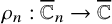 $\rho _n : \overline {\mathbb {C}}_n \to \overline {\mathbb {C}}$
is a conformal isomorphism.
$\rho _n : \overline {\mathbb {C}}_n \to \overline {\mathbb {C}}$
is a conformal isomorphism.
Consider the union of Riemann spheres

We will show that  is a tree of bouquets of spheres that arises as the Hausdorff limit of Riemann spheres. We say that
  is the space associated to $\mathbf {A}$
.
$\mathbf {A}$
.
For all $n \neq n' \in J$
, note that
$n \neq n' \in J$
, note that $\rho _n (\overline {\mathbb {C}}_{n'}) = \{a_{n',n}\}$
. Moreover, the intersection
$\rho _n (\overline {\mathbb {C}}_{n'}) = \{a_{n',n}\}$
. Moreover, the intersection $\overline {\mathbb {C}}_{n'} \cap \overline {\mathbb {C}}_{n}$
is not empty if and only if
$\overline {\mathbb {C}}_{n'} \cap \overline {\mathbb {C}}_{n}$
is not empty if and only if
 $$ \begin{align*}a_{n',n"} = a_{n,n"}\end{align*} $$
for all $ J \ni n" \neq n,n'$
. In this case, the intersection point is
$ J \ni n" \neq n,n'$
. In this case, the intersection point is $a_{n',n} \in \overline {\mathbb {C}}_{n}$
and
$a_{n',n} \in \overline {\mathbb {C}}_{n}$
and $a_{n,n'} \in \overline {\mathbb {C}}_{n'}$
in the respective standard coordinates.
$a_{n,n'} \in \overline {\mathbb {C}}_{n'}$
in the respective standard coordinates.
An alternative description of  can be given as the quotient of the disjoint union of abstract Riemann spheres $\sqcup _{n \in J}\overline {\mathbb {C}}_{n}$
by an equivalence relation
$\sqcup _{n \in J}\overline {\mathbb {C}}_{n}$
by an equivalence relation $\sim $
. In fact, let
$\sim $
. In fact, let $\sim $
be the equivalence relation such that
$\sim $
be the equivalence relation such that $a_{n',n} \in \overline {\mathbb {C}}_{n}$
is identified with
$a_{n',n} \in \overline {\mathbb {C}}_{n}$
is identified with $a_{n,n'} \in \overline {\mathbb {C}}_{n'}$
if and only if
$a_{n,n'} \in \overline {\mathbb {C}}_{n'}$
if and only if
 $$ \begin{align*}a_{n,n"} = a_{n',n"}\end{align*} $$
for all $ n" \neq n, n'$
. All other
$ n" \neq n, n'$
. All other $\sim $
-classes are trivial. Then
$\sim $
-classes are trivial. Then

Associated to $\mathbf {A}$
we also have a sequence of embedding of
$\mathbf {A}$
we also have a sequence of embedding of $\overline {\mathbb {C}}$
in
$\overline {\mathbb {C}}$
in $\overline {\mathbb {C}}^{J}$
:
$\overline {\mathbb {C}}^{J}$
:

Proposition A.1. Consider a collection $\mathbf {A}$
of independent scalings indexed by J. Let
$\mathbf {A}$
of independent scalings indexed by J. Let  be the space associated to $\mathbf {A}$
. If
$\mathbf {A}$
. If 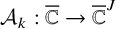 is the associated sequence of embeddings, then

Moreover,  is simply connected.
Proof. Consider points  such that $w_{\ell } \neq a_{j,\ell }$
and
$w_{\ell } \neq a_{j,\ell }$
and $w_j=a_{\ell ,j}$
for all
$w_j=a_{\ell ,j}$
for all $j \neq \ell $
. Such elements are dense in
$j \neq \ell $
. Such elements are dense in $\overline {\mathbb {C}}_\ell $
. Denoting by
$\overline {\mathbb {C}}_\ell $
. Denoting by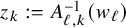 $z_k := A^{-1}_{\ell ,k}(w_\ell )$
, we have that
$z_k := A^{-1}_{\ell ,k}(w_\ell )$
, we have that  . So
. So  is contained in the Hausdorff limit of
  .
.
We prove that the Hausdorff limit of  is contained in
  . Suppose on the contrary that $\{z_k\}$
is a sequence such that
$\{z_k\}$
is a sequence such that  converges to some
  . Then for all $j\in J$
, we may choose
$j\in J$
, we may choose $J \ni s(j) \neq j$
such that
$J \ni s(j) \neq j$
such that $u_{s(j)} \neq a_{j,s(j)}$
. Therefore,
$u_{s(j)} \neq a_{j,s(j)}$
. Therefore, $u_j = a_{s(j),j}$
since the change of coordinates
$u_j = a_{s(j),j}$
since the change of coordinates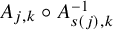 $A_{j,k} \circ A_{s(j),k}^{-1}$
converges uniformly in compact subsets of
$A_{j,k} \circ A_{s(j),k}^{-1}$
converges uniformly in compact subsets of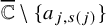 $\overline {\mathbb {C}}\setminus \{a_{j,s(j)}\}$
to
$\overline {\mathbb {C}}\setminus \{a_{j,s(j)}\}$
to $a_{s(j),j}$
. Now consider
$a_{s(j),j}$
. Now consider $j_0\in J$
and let
$j_0\in J$
and let $j_i =s^{\circ i}(j_0)$
for
$j_i =s^{\circ i}(j_0)$
for $i\ge 1$
. We may assume that
$i\ge 1$
. We may assume that $j_p=j_0$
for a minimal
$j_p=j_0$
for a minimal $p \ge 2$
. Since
$p \ge 2$
. Since $a_{j_0,j_1} \neq u_{j_1} = a_{j_2,j_1}$
, it follows that
$a_{j_0,j_1} \neq u_{j_1} = a_{j_2,j_1}$
, it follows that $a_{j_2, j_0} = a_{j_1,j_0}$
. Recursively, we obtain that
$a_{j_2, j_0} = a_{j_1,j_0}$
. Recursively, we obtain that $a_{j_{p-1},j_0}=a_{j_1,j_0}=u_{j_0}$
. However,
$a_{j_{p-1},j_0}=a_{j_1,j_0}=u_{j_0}$
. However, $u_{j_0}=u_{s(j_{p-1})} \neq a_{j_{p-1},j_0}$
. It is a contradiction.
$u_{j_0}=u_{s(j_{p-1})} \neq a_{j_{p-1},j_0}$
. It is a contradiction.
Any Hausdorff limit of connected sets is connected, so  is connected. We now show that
  is simply connected. By contradiction, suppose that for some $q \ge 2$
, there exists a cycle of spheres of length q. That is, there exist a chain of pairwise distinct spheres
$q \ge 2$
, there exists a cycle of spheres of length q. That is, there exist a chain of pairwise distinct spheres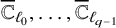 $\overline {\mathbb {C}}_{\ell _0},\dots ,\overline {\mathbb {C}}_{\ell _{q-1}}$
that intersect at pairwise distinct points
$\overline {\mathbb {C}}_{\ell _0},\dots ,\overline {\mathbb {C}}_{\ell _{q-1}}$
that intersect at pairwise distinct points $x_0, \cdots , x_{q-1}$
; that is,
$x_0, \cdots , x_{q-1}$
; that is, $\{ x_i \}= \overline {\mathbb {C}}_{\ell _i} \cap \overline {\mathbb {C}}_{\ell _{i+1}} $
for all
$\{ x_i \}= \overline {\mathbb {C}}_{\ell _i} \cap \overline {\mathbb {C}}_{\ell _{i+1}} $
for all $0 \le i <q$
, subscripts mod q. Then
$0 \le i <q$
, subscripts mod q. Then $x_{j+1}-x_j$
is a vector in
$x_{j+1}-x_j$
is a vector in $\mathbb {C}^J$
with unique nonvanishing component in its
$\mathbb {C}^J$
with unique nonvanishing component in its $\ell _j$
-coordinate for all j. But
$\ell _j$
-coordinate for all j. But $\sum x_{j+1}-x_j =x_0-x_0=0$
, which is a contradiction.
$\sum x_{j+1}-x_j =x_0-x_0=0$
, which is a contradiction.
A.2 Maps between trees of bouquets of spheres
Let $J, J'$
be finite sets. Consider collections
$J, J'$
be finite sets. Consider collections
 $$ \begin{align*}\mathbf{A}:=\{A_{n,k} : n \in J, k \ge 1\} \subset {\operatorname{Rat}}_1,\end{align*} $$
 $$ \begin{align*}\mathbf{B}:=\{B_{n,k} : n \in J', k \ge 1\} \subset {\operatorname{Rat}}_1.\end{align*} $$
Assume that $\mathbf {A}$
and
$\mathbf {A}$
and $\mathbf {B}$
are collections of independent scalings.
$\mathbf {B}$
are collections of independent scalings.
Consider a sequence $\{f_k\} \subset {\operatorname {Rat}_d}$
. We say that
$\{f_k\} \subset {\operatorname {Rat}_d}$
. We say that $\{f_k\}$
maps
$\{f_k\}$
maps $\mathbf {A}$
into
$\mathbf {A}$
into $\mathbf {B}$
by
$\mathbf {B}$
by $\tau : J \to J'$
if for all
$\tau : J \to J'$
if for all $n \in J$
,
$n \in J$
,
 $$ \begin{align*}B_{\tau(n),k} \circ f_k \circ A^{-1}_{n,k}\end{align*} $$
converges to some element $\varphi _{n,\tau (n)}\in {\operatorname {Rat}}^*_d$
. When
$\varphi _{n,\tau (n)}\in {\operatorname {Rat}}^*_d$
. When $\varphi _{n,\tau (n)}\in {\operatorname {Rat}}_d$
, for all
$\varphi _{n,\tau (n)}\in {\operatorname {Rat}}_d$
, for all $n \in J$
, we say that
$n \in J$
, we say that $\{f_k\}$
is fully ramified at
$\{f_k\}$
is fully ramified at $\mathbf {A}$
.
$\mathbf {A}$
.
In coordinates, given by the associated embeddings  and
and  of
of $\overline {\mathbb {C}}$
into
$\overline {\mathbb {C}}$
into $\overline {\mathbb {C}}^J$
and
$\overline {\mathbb {C}}^J$
and $\overline {\mathbb {C}}^{J'}$
, the maps
$\overline {\mathbb {C}}^{J'}$
, the maps $f_k$
become
$f_k$
become

In the limit, $F_k$
is, in a certain sense, semiconjugate to the action of
$F_k$
is, in a certain sense, semiconjugate to the action of ${\varphi }_{n,\tau (n)}$
on
${\varphi }_{n,\tau (n)}$
on $\overline {\mathbb {C}}_n$
. More precisely, provided that z is not a hole of
$\overline {\mathbb {C}}_n$
. More precisely, provided that z is not a hole of ${\varphi }_{n,\tau (n)}$
,
${\varphi }_{n,\tau (n)}$
,
 $$ \begin{align*}\rho_{\tau (n)} \circ F_k (z) \to \tilde{\varphi}_{n,\tau(n)} (\rho_n(z)).\end{align*} $$
In general, we have the following:
Proposition A.2. Consider a sequence $\{f_k\} \subset {\operatorname {Rat}_d}$
and collections of independent scalings
$\{f_k\} \subset {\operatorname {Rat}_d}$
and collections of independent scalings $\mathbf {A}$
and
$\mathbf {A}$
and $\mathbf {B}$
indexed by J and
$\mathbf {B}$
indexed by J and $J'$
with associated spaces
$J'$
with associated spaces  and
and  , respectively, such that $\{f_k\}$
maps
$\{f_k\}$
maps $\mathbf {A}$
to
$\mathbf {A}$
to $\mathbf {B}$
by
$\mathbf {B}$
by $\tau :J \to J'$
. Let
$\tau :J \to J'$
. Let  and
and  be the associated embeddings of $\overline {\mathbb {C}}$
into
$\overline {\mathbb {C}}$
into $\overline {\mathbb {C}}^{J}$
and
$\overline {\mathbb {C}}^{J}$
and $\overline {\mathbb {C}}^{J'}$
, respectively. Let
$\overline {\mathbb {C}}^{J'}$
, respectively. Let

Consider 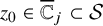 and
and  . Then, for every small neighborhood $U_0 \subset \overline {\mathbb {C}}^{J} $
of
$U_0 \subset \overline {\mathbb {C}}^{J} $
of $z_0$
, there exists a neighborhood
$z_0$
, there exists a neighborhood $W_0 \subset \overline {\mathbb {C}}^{J'}$
of
$W_0 \subset \overline {\mathbb {C}}^{J'}$
of $w_0$
such that for all
$w_0$
such that for all  ,
,
 $$ \begin{align*}\#F_k^{-1} (w) \cap U_0 = \begin{cases} d_{z_0}(\varphi_{j,\tau(j)}), & \text{ if } \tilde{\varphi}_{j,\tau(j)}(z_0) \neq w_0,\\ d_{z_0}(\varphi_{j,\tau(j)}) + \deg_{z_0}\tilde{\varphi}_{j,\tau(j)}, & \text{ if } \tilde{\varphi}_{j,\tau(j)}(z_0) = w_0. \end{cases} \end{align*} $$
Proof. For simplicity, let  and
and 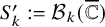 . Note that
  for any $U \subset \overline {\mathbb {C}}$
. A similar statement holds of
$U \subset \overline {\mathbb {C}}$
. A similar statement holds of $S_k'$
.
$S_k'$
.
Given a small neighborhood $U_0$
of
$U_0$
of $z_0$
, by compactness, it contains
$z_0$
, by compactness, it contains $\rho _j^{-1}(U_0')$
for some neighborhood
$\rho _j^{-1}(U_0')$
for some neighborhood $U_0'$
of
$U_0'$
of $\rho _j(z_0)$
in
$\rho _j(z_0)$
in $\overline {\mathbb {C}}$
. Let
$\overline {\mathbb {C}}$
. Let $h_k := A_{\tau (j),k} \circ f_k \circ A_{j,k}^{-1}$
. Then
$h_k := A_{\tau (j),k} \circ f_k \circ A_{j,k}^{-1}$
. Then $h_k \to \varphi _{j,\tau (j)}$
. By Lemma 2.6 (1), there exists a neighborhood
$h_k \to \varphi _{j,\tau (j)}$
. By Lemma 2.6 (1), there exists a neighborhood $W_0'$
of
$W_0'$
of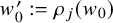 $w^{\prime }_0:=\rho _j(w_0)$
in
$w^{\prime }_0:=\rho _j(w_0)$
in $\overline {\mathbb {C}}$
such that
$\overline {\mathbb {C}}$
such that
 $$ \begin{align*}\# h_k^{-1} (w') \cap U_0' = d_{z_0} (\varphi_{j,\tau(j)}) + \deg_{z_0}\varphi_{j,\tau(j)},\end{align*} $$
for all $w' \in W_0'$
. Let
$w' \in W_0'$
. Let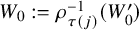 $W_0: = \rho ^{-1}_{\tau (j)} (W_0')$
. Given
$W_0: = \rho ^{-1}_{\tau (j)} (W_0')$
. Given $w \in S_k \cap W_0$
, consider
$w \in S_k \cap W_0$
, consider $w' \in W_0'$
such that
$w' \in W_0'$
such that  . Now, $z' \in U^{\prime }_0$
is such that
$z' \in U^{\prime }_0$
is such that $h_k(z') = w'$
if and only if
$h_k(z') = w'$
if and only if  is such that $F_k (z) =w$
. That is,
$F_k (z) =w$
. That is,  is a bijection between $F_k$
-preimages of w in
$F_k$
-preimages of w in $U_0$
and
$U_0$
and $h_k$
-preimages of
$h_k$
-preimages of $w'$
in
$w'$
in $U_0'$
.
$U_0'$
.
A.3 Fully ramified maps
Let us now consider the special case in which the limiting degree at each sphere is maximal.
Proposition A.3. Consider a sequence $\{f_k\} \subset {\operatorname {Rat}_d}$
that maps
$\{f_k\} \subset {\operatorname {Rat}_d}$
that maps $\mathbf {A}$
to
$\mathbf {A}$
to $\mathbf {B}$
by a bijection
$\mathbf {B}$
by a bijection $\tau : J \to J'$
, where
$\tau : J \to J'$
, where $\mathbf {A}$
and
$\mathbf {A}$
and $\mathbf {B}$
are independent collections of scalings with associated spaces
$\mathbf {B}$
are independent collections of scalings with associated spaces  and
and  . If
. If $\{f_k\}$
is fully ramified at
$\{f_k\}$
is fully ramified at $\mathbf {A}$
, then there is a well defined and continuous map
$\mathbf {A}$
, then there is a well defined and continuous map  given by:

for $z \in \overline {\mathbb {C}}_n$
and
$z \in \overline {\mathbb {C}}_n$
and $n \in J$
. Moreover, there exist a finite set
$n \in J$
. Moreover, there exist a finite set  and a (multiplicity) function
  such that the following hold:
-
1.
-
2. The multiplicity of a critical point x of
$\varphi _{n,\tau (n)}$
is


We say that  is a critical point of multiplicity $m(\omega )$
of
$m(\omega )$
of  .
.
Proof. Recall that to obtain  , we identify $a_{n,n'}$
with
$a_{n,n'}$
with $a_{n',n}$
if and only if
$a_{n',n}$
if and only if
 $$ \begin{align*}a_{n',n"} = a_{n,n"}\end{align*} $$
for all $ J \ni n" \neq n,n'$
. Similarly, we identify points of different spheres in
$ J \ni n" \neq n,n'$
. Similarly, we identify points of different spheres in  . Since $\tau : J \to J'$
is a bijection, for the continuity of
$\tau : J \to J'$
is a bijection, for the continuity of  , it suffices to check that $\varphi _{n,\tau (n)}(a_{n',n}) = a_{\tau (n'),\tau (n)}$
for all
$\varphi _{n,\tau (n)}(a_{n',n}) = a_{\tau (n'),\tau (n)}$
for all $n \neq n' \in J$
. Choose
$n \neq n' \in J$
. Choose $z \in \overline {\mathbb {C}}_{n'}$
such that
$z \in \overline {\mathbb {C}}_{n'}$
such that $z \neq a_{n,n'}$
and
$z \neq a_{n,n'}$
and $\varphi _{n',\tau (n')} (z) \neq a_{\tau (n),\tau (n')}$
. Then, uniformly in a neighborhood of z, the change of coordinates
$\varphi _{n',\tau (n')} (z) \neq a_{\tau (n),\tau (n')}$
. Then, uniformly in a neighborhood of z, the change of coordinates $A_{n,k} \circ A^{-1}_{n',k}$
converges to
$A_{n,k} \circ A^{-1}_{n',k}$
converges to $a_{n',n}$
. Thus
$a_{n',n}$
. Thus
 $$ \begin{align*}(A_{\tau(n),k} \circ f_k \circ A_{n,k}^{-1} ) \circ (A_{n,k} \circ A^{-1}_{n',k}) (z) \to \varphi_{n,\tau(n)}(a_{n',n}).\end{align*} $$
Reorganizing the above expression yields
 $$ \begin{align*}(A_{\tau(n),k} \circ A^{-1}_{\tau(n'),k} )\circ (A_{\tau(n'),k} \circ f_k \circ A_{n',k}^{-1} ) (z) \to a_{\tau(n'),\tau(n)}.\end{align*} $$
Hence $\varphi _{n,\tau (n)}(a_{n',n}) = a_{\tau (n'),\tau (n)}$
, as claimed.
$\varphi _{n,\tau (n)}(a_{n',n}) = a_{\tau (n'),\tau (n)}$
, as claimed.
Passing to a subsequence, we may label the critical points of $f_k$
by
$f_k$
by $c_k(1), \dots , c_k(2d-2)$
with repetitions according to multiplicity. We may also assume that
$c_k(1), \dots , c_k(2d-2)$
with repetitions according to multiplicity. We may also assume that  converges to
  , as
, as $k\to \infty $
, for all i. We say that
$k\to \infty $
, for all i. We say that  is a critical point of
  of multiplicity m if there exist exactly m indices i such that $c(i) =\omega $
. Let
$c(i) =\omega $
. Let  be the set formed by the critical points. Note that, a priori,
  depends on the choice of the subsequence. It can be shown that it is independent, but we will not use nor prove this fact.
Given $x \in \overline {\mathbb {C}}$
, since
$x \in \overline {\mathbb {C}}$
, since $A_{n+1,k} \circ f_k \circ A_{n,k}^{-1}$
converges locally uniformly to
$A_{n+1,k} \circ f_k \circ A_{n,k}^{-1}$
converges locally uniformly to $\tilde \varphi _{n,n+1}$
away from the holes of
$\tilde \varphi _{n,n+1}$
away from the holes of $\varphi _{n,n+1}$
, the number of critical points of
$\varphi _{n,n+1}$
, the number of critical points of $A_{n+1,k} \circ f_k \circ A_{n,k}^{-1}$
in a neighborhood W of x, counted with multiplicity, is
$A_{n+1,k} \circ f_k \circ A_{n,k}^{-1}$
in a neighborhood W of x, counted with multiplicity, is $m: = \deg _x\tilde \varphi _{n, n+1} -1$
. That is, the number of critical point of
$m: = \deg _x\tilde \varphi _{n, n+1} -1$
. That is, the number of critical point of $f_k$
in
$f_k$
in $A_{n,k}^{-1}(W)$
is m. Therefore,
$A_{n,k}^{-1}(W)$
is m. Therefore, 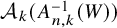 contains m critical points of
  for all k sufficiently large. That is, $\rho _n^{-1}(x)$
contains m critical points
$\rho _n^{-1}(x)$
contains m critical points  , counted with multiplicities.
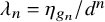


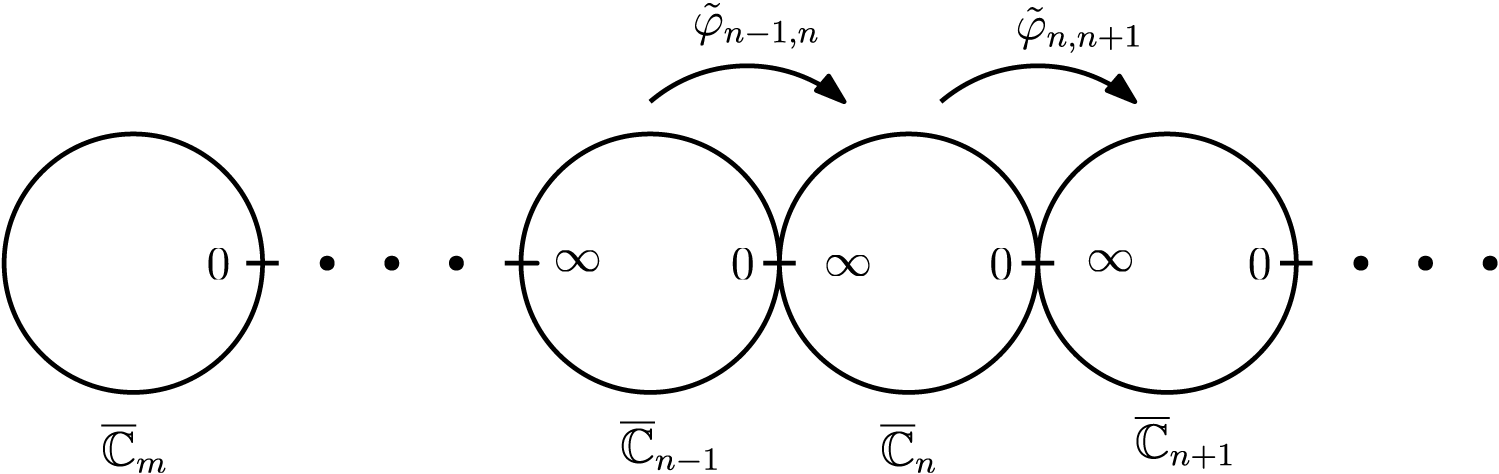
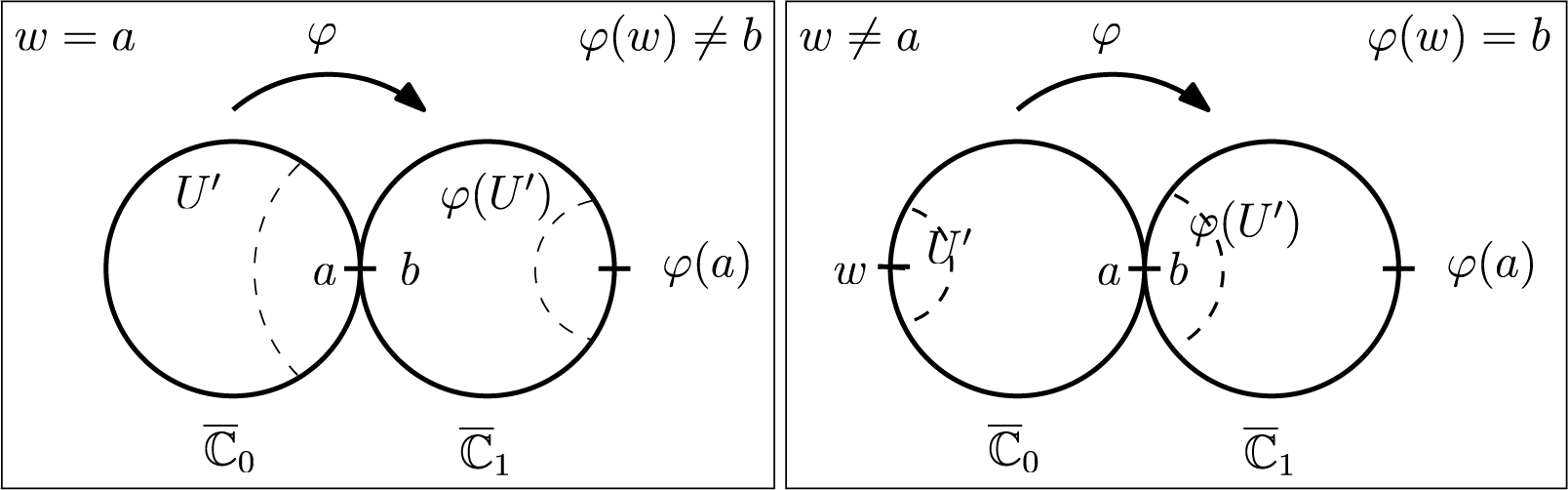
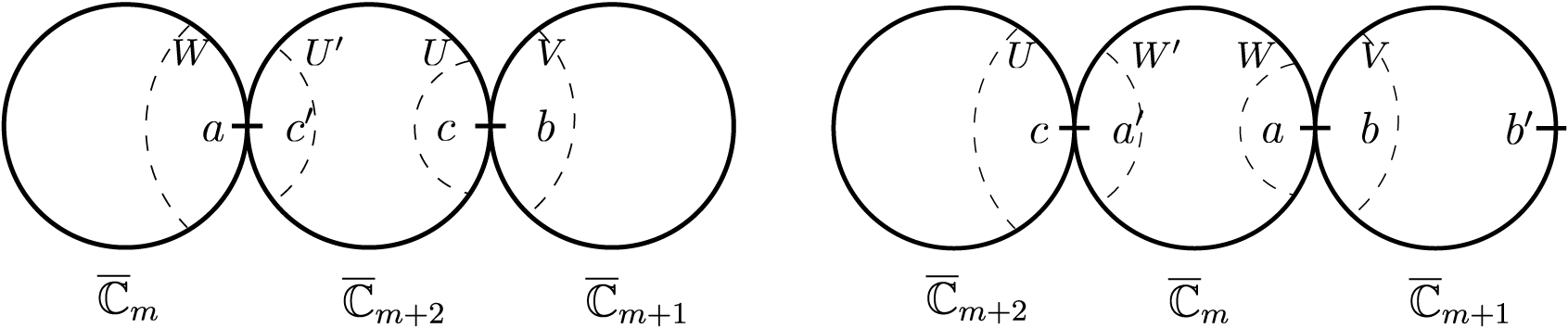

 Open access

