





1 Introduction: Maillet’s property and Mahler’s problem
A Liouville number is an irrational real number x for which $|x-p/q|<q^{-N}$
has a rational solution
$|x-p/q|<q^{-N}$
has a rational solution $p/q$
for any N. Denote by
$p/q$
for any N. Denote by $\mathscr {L}=\mathscr {L}_{1,1}$
the set of Liouville numbers. It is well known that
$\mathscr {L}=\mathscr {L}_{1,1}$
the set of Liouville numbers. It is well known that $\mathscr {L}$
is comeagre, equivalently a dense
$\mathscr {L}$
is comeagre, equivalently a dense $G_{\delta }$
set, and of Hausdorff dimension
$G_{\delta }$
set, and of Hausdorff dimension $0$
; see [Reference Oxtoby20]. Maillet [Reference Maillet12] proved that if f is a nonconstant rational function with rational coefficients, then
$0$
; see [Reference Oxtoby20]. Maillet [Reference Maillet12] proved that if f is a nonconstant rational function with rational coefficients, then $f(a)\in \mathscr {L}$
for any
$f(a)\in \mathscr {L}$
for any $a\in \mathscr {L}$
, or equivalently,
$a\in \mathscr {L}$
, or equivalently, $f(\mathscr {L})\subseteq \mathscr {L}$
. We say a real function
$f(\mathscr {L})\subseteq \mathscr {L}$
. We say a real function $f: I\subseteq \mathbb {R}\to \mathbb {R}$
, with I a nonempty open interval, has the Maillet property if
$f: I\subseteq \mathbb {R}\to \mathbb {R}$
, with I a nonempty open interval, has the Maillet property if $f(I\cap \mathscr {L})\subseteq \mathscr {L}$
or equivalently,
$f(I\cap \mathscr {L})\subseteq \mathscr {L}$
or equivalently, $f^{-1}(\mathscr {L})=f^{-1}(\mathscr {L})\cap \mathscr {L}= \mathscr {L}\cap I$
. An open question by Mahler [Reference Mahler11] asks the following in the classical setup
$f^{-1}(\mathscr {L})=f^{-1}(\mathscr {L})\cap \mathscr {L}= \mathscr {L}\cap I$
. An open question by Mahler [Reference Mahler11] asks the following in the classical setup $I=\mathbb {R}$
.
$I=\mathbb {R}$
.
Problem 1.1. Do there exist transcendental entire functions having Maillet’s property?
Recall that a function f is called transcendental if $P(z,f(z))\ne 0$
for any nontrivial bivariate polynomial
$P(z,f(z))\ne 0$
for any nontrivial bivariate polynomial $P(X,Y)= \sum c_{i,j} X^i Y^j$
with complex coefficients
$P(X,Y)= \sum c_{i,j} X^i Y^j$
with complex coefficients $c_{i,j}$
, otherwise f is called algebraic. Some advances to Mahler’s question by providing entire transcendental functions f mapping large subclasses of Liouville numbers into
$c_{i,j}$
, otherwise f is called algebraic. Some advances to Mahler’s question by providing entire transcendental functions f mapping large subclasses of Liouville numbers into $\mathscr {L}$
(or even itself) were made in [Reference Marques and Moreira13, Reference Marques and Schleischitz16]; see also [Reference Marques and Ramirez14]. Conversely, claims mildly indicating towards a negative answer of Problem 1.1 in the context of [Reference Marques and Schleischitz16, Corollary 2.2] were obtained in [Reference Lelis and Marques9, Reference Lelis, Marques and Moreira10, Reference Marques, Ramirez and Silva15, Reference Marques and Silva17]. In addition to Maillet’s result, it is known that any ‘reasonable’ function enjoys the weaker property that, while not all, many Liouville numbers are mapped to Liouville numbers. Indeed, as shown in [Reference Alniaçik and Saias2] for any continuous function f that is nowhere constant as above, the set
$\mathscr {L}$
(or even itself) were made in [Reference Marques and Moreira13, Reference Marques and Schleischitz16]; see also [Reference Marques and Ramirez14]. Conversely, claims mildly indicating towards a negative answer of Problem 1.1 in the context of [Reference Marques and Schleischitz16, Corollary 2.2] were obtained in [Reference Lelis and Marques9, Reference Lelis, Marques and Moreira10, Reference Marques, Ramirez and Silva15, Reference Marques and Silva17]. In addition to Maillet’s result, it is known that any ‘reasonable’ function enjoys the weaker property that, while not all, many Liouville numbers are mapped to Liouville numbers. Indeed, as shown in [Reference Alniaçik and Saias2] for any continuous function f that is nowhere constant as above, the set $f^{-1}(\mathscr {L})\cap \mathscr {L}$
is a dense
$f^{-1}(\mathscr {L})\cap \mathscr {L}$
is a dense $G_{\delta }$
subset of Liouville numbers on I. In fact, we can intersect over countably many preimages under such functions
$G_{\delta }$
subset of Liouville numbers on I. In fact, we can intersect over countably many preimages under such functions $f_k$
at once. See also the preceding papers [Reference Erdős6, Reference Rieger22, Reference Schwarz24].
$f_k$
at once. See also the preceding papers [Reference Erdős6, Reference Rieger22, Reference Schwarz24].
In this paper, we want to discuss analogous claims for Liouville matrices to be defined. Let $\Vert .\Vert $
denote the supremum norm on a Euclidean space of any dimension.
$\Vert .\Vert $
denote the supremum norm on a Euclidean space of any dimension.
Definition 1.2. We call a real $m\times n$
matrix A a Liouville matrix if
$m\times n$
matrix A a Liouville matrix if
 $$ \begin{align} A\cdot \textbf{q}-\textbf{p} \ne \textbf{0}, \quad (\textbf{q},\textbf{p})\in\mathbb{Z}^{n+m}\setminus \{ \textbf{0}\}, \end{align} $$
and $\Vert A\textbf {q}-\textbf {p}\Vert < \Vert \textbf {q}\Vert ^{-N}$
has a solution in integer vectors
$\Vert A\textbf {q}-\textbf {p}\Vert < \Vert \textbf {q}\Vert ^{-N}$
has a solution in integer vectors $\textbf {p}\in \mathbb {Z}^m,\textbf {q}\in \mathbb {Z}^n\setminus \{ \textbf {0}\}$
for any N. We denote by
$\textbf {p}\in \mathbb {Z}^m,\textbf {q}\in \mathbb {Z}^n\setminus \{ \textbf {0}\}$
for any N. We denote by $\mathscr {L}_{m,n}$
the set of
$\mathscr {L}_{m,n}$
the set of $m\times n$
Liouville matrices.
$m\times n$
Liouville matrices.
This agrees with the definition of Liouville numbers if $m=n=1$
, so
$m=n=1$
, so $\mathscr {L}=\mathscr {L}_{1,1}$
. Studying small values of
$\mathscr {L}=\mathscr {L}_{1,1}$
. Studying small values of $\Vert A\textbf {q}-\textbf {p}\Vert $
is an intensely studied topic in Diophantine approximation, for example, [Reference Moshchevitin18], so the definition appears very natural. Property (1-1) means that the sequence of best approximating integer vectors associated to A does not terminate (called good matrices in [Reference Moshchevitin18]), so we consider it more natural than the less restrictive condition
$\Vert A\textbf {q}-\textbf {p}\Vert $
is an intensely studied topic in Diophantine approximation, for example, [Reference Moshchevitin18], so the definition appears very natural. Property (1-1) means that the sequence of best approximating integer vectors associated to A does not terminate (called good matrices in [Reference Moshchevitin18]), so we consider it more natural than the less restrictive condition $A\notin \mathbb {Q}^{m\times n}$
; see however Theorem 3.9 on the latter. Since approximation becomes easier the more free variables we have and the fewer equations we need to satisfy, the following observations are obvious but may be helpful for the reader.
$A\notin \mathbb {Q}^{m\times n}$
; see however Theorem 3.9 on the latter. Since approximation becomes easier the more free variables we have and the fewer equations we need to satisfy, the following observations are obvious but may be helpful for the reader.
Proposition 1.3. If $A\in \mathscr {L}_{m,n}$
, then any line
$A\in \mathscr {L}_{m,n}$
, then any line $(a_{j,1},\ldots ,a_{j,n})$
of A either has
$(a_{j,1},\ldots ,a_{j,n})$
of A either has $\mathbb {Z}$
-linearly dependent coordinates together with
$\mathbb {Z}$
-linearly dependent coordinates together with $\{1\}$
or lies in
$\{1\}$
or lies in $\mathscr {L}_{1,n}$
. If some column of A lies in
$\mathscr {L}_{1,n}$
. If some column of A lies in $\mathscr {L}_{m,1}$
and A satisfies (1-1), then
$\mathscr {L}_{m,1}$
and A satisfies (1-1), then $A\in \mathscr {L}_{m,n}$
.
$A\in \mathscr {L}_{m,n}$
.
In general, $\mathscr {L}_{n,m}\ne \mathscr {L}_{m,n}^{t}$
, superscript t denoting the transpose; moreover,
$\mathscr {L}_{n,m}\ne \mathscr {L}_{m,n}^{t}$
, superscript t denoting the transpose; moreover, $A\in \mathscr {L}_{n,m}$
by no means implies that its entries are Liouville numbers, nor is the converse true.
$A\in \mathscr {L}_{n,m}$
by no means implies that its entries are Liouville numbers, nor is the converse true.
2 Mahler’s question has a negative answer for matrices
We focus on $m=n$
in this section. Given
$m=n$
in this section. Given $I\ni 0$
an open interval and any analytic function
$I\ni 0$
an open interval and any analytic function $f: I\to \mathbb {R}$
, we extend f to (a nonempty open connected subset of) the ring of
$f: I\to \mathbb {R}$
, we extend f to (a nonempty open connected subset of) the ring of $n\times n$
matrices via the same local power series expansion. More precisely, we know that
$n\times n$
matrices via the same local power series expansion. More precisely, we know that $f(z)= \sum c_j z^j$
converges absolutely in some subinterval
$f(z)= \sum c_j z^j$
converges absolutely in some subinterval $(-r,r)\subseteq I$
,
$(-r,r)\subseteq I$
, $r>0$
, and for
$r>0$
, and for $A\in \mathbb {R}^{n\times n}$
, we denote by
$A\in \mathbb {R}^{n\times n}$
, we denote by  the extension of f to the matrix ring via
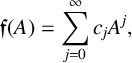
which converges absolutely as soon as A has operator norm less than r. Denoting by $I_n$
the identity matrix, this setup appears natural and contains, for example, any rational function
$I_n$
the identity matrix, this setup appears natural and contains, for example, any rational function $(c_0 I_n+c_1 A+\cdots +c_uA^u)\cdot (d_0 I_n+\cdots +d_v A^v)^{-1}$
,
$(c_0 I_n+c_1 A+\cdots +c_uA^u)\cdot (d_0 I_n+\cdots +d_v A^v)^{-1}$
, $d_0\ne 0$
, the matrix exponential function
$d_0\ne 0$
, the matrix exponential function $e^A=\sum _{j\ge 0} A^j/j!$
and its inverse
$e^A=\sum _{j\ge 0} A^j/j!$
and its inverse $\log (I_n+A)= \sum _{j\ge 1} (-1)^{j+1} A^{j}/j$
.
$\log (I_n+A)= \sum _{j\ge 1} (-1)^{j+1} A^{j}/j$
.
The following is not hard to see and we provide a sketch of the proof in Section 8.
Proposition 2.1. If $A\in \mathscr {L}_{n,n}$
, and
$A\in \mathscr {L}_{n,n}$
, and $R_1, R_2, S, T\in \mathbb {Q}^{n\times n}$
and
$R_1, R_2, S, T\in \mathbb {Q}^{n\times n}$
and $R_i$
are invertible, then
$R_i$
are invertible, then
 $$ \begin{align} R_1AR_2+S, \quad (R_1AR_2+T)^{-1}+ S \end{align} $$
again belong to $\mathscr {L}_{n,n}$
(if defined in the latter case).
$\mathscr {L}_{n,n}$
(if defined in the latter case).
Remark 2.2. The regularity of $R_i$
is only needed to avoid rational matrices in (2-2) which do not satisfy (1-1), especially if A is not invertible. A refined claim on invariance of the irrationality exponent defined below can be obtained. Moreover, some claims can be generalized to rectangular matrices.
$R_i$
is only needed to avoid rational matrices in (2-2) which do not satisfy (1-1), especially if A is not invertible. A refined claim on invariance of the irrationality exponent defined below can be obtained. Moreover, some claims can be generalized to rectangular matrices.
Let us extend naturally Maillet’s property for real f to given $n\ge 1$
via imposing
$n\ge 1$
via imposing  for the induced
  from (2-1). Taking in (2-2) diagonal matrices
 $$ \begin{align*} R_1=rI_n,\; (r\ne 0),\quad R_2=I_n,\quad S=sI_n,\quad T=tI_n, \end{align*} $$
Maillet’s property holds for any $n\ge 1$
and the two types of algebraic functions
$n\ge 1$
and the two types of algebraic functions
 $$ \begin{align} f(z)= r z+s, \quad f(z)=s+ (rz+t)^{-1} \end{align} $$
with $0\ne r,s,t\in \mathbb {Q}$
. Equivalently, Maillet’s property holds for Möbius maps
$0\ne r,s,t\in \mathbb {Q}$
. Equivalently, Maillet’s property holds for Möbius maps $f$
with rational coefficients
$f$
with rational coefficients
 $$ \begin{align} f(z)=\tau_{a,b,c,d}(z):= \frac{ az+b}{cz+d}, \quad a,b,c,d\in\mathbb{Q},\; ad-bc\ne 0. \end{align} $$
However, we show that for $n\ge 2$
, Maillet’s property fails for any other analytic function not of the form (2-3) with real parameters. Thereby, we get an almost comprehensive description of analytic functions with Maillet’s property for
$n\ge 2$
, Maillet’s property fails for any other analytic function not of the form (2-3) with real parameters. Thereby, we get an almost comprehensive description of analytic functions with Maillet’s property for $n\ge 2$
, leaving only a small gap of the case (2-3) (or (2-4)) with nonrational constants. In fact, we show a refined claim that needs some more preparation. For general rectangular matrices
$n\ge 2$
, leaving only a small gap of the case (2-3) (or (2-4)) with nonrational constants. In fact, we show a refined claim that needs some more preparation. For general rectangular matrices $A\in \mathbb {R}^{m\times n}$
, let
$A\in \mathbb {R}^{m\times n}$
, let $\omega ^{m\times n}(A)$
be the irrationality exponent of A, defined as the supremum of w such that
$\omega ^{m\times n}(A)$
be the irrationality exponent of A, defined as the supremum of w such that
 $$ \begin{align*} \Vert A \textbf{q}-\textbf{p}\Vert < \Vert \textbf{q}\Vert^{-w} \end{align*} $$
for infinitely many integer vector pairs $\textbf {p}\in \mathbb {Z}^m, \textbf {q}\in \mathbb {Z}^n$
. We notice that
$\textbf {p}\in \mathbb {Z}^m, \textbf {q}\in \mathbb {Z}^n$
. We notice that
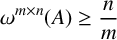 $$ \begin{align*} \omega^{m\times n}(A)\ge \frac{n}{m} \end{align*} $$
for any real A by a well-known variant Dirichlet’s theorem, in particular, for quadratic matrices, the lower bound is $1$
. Let us just write
$1$
. Let us just write $\omega (A)$
when the dimensions are clear. A real
$\omega (A)$
when the dimensions are clear. A real $m\times n$
matrix A is a Liouville matrix if and only if (1-1) holds and
$m\times n$
matrix A is a Liouville matrix if and only if (1-1) holds and $\omega (A)=\infty $
. In the following, we always naturally identify
$\omega (A)=\infty $
. In the following, we always naturally identify
 $$ \begin{align*} \mathbb{R}^{m\times n}\cong \mathbb{R}^{mn}, \end{align*} $$
where we can assume that the lines of the matrix are put one by one into a vector (we can choose any coordinate ordering; however, we must stick to it as $\mathscr {L}_{m,n}$
is not invariant under entry bijections as soon as
$\mathscr {L}_{m,n}$
is not invariant under entry bijections as soon as $\min \{ m,n\}\ge 2$
). This induces a topology and a Lebesgue measure (generally Hausdorff measures) on the matrix set. Our main result is the following theorem.
$\min \{ m,n\}\ge 2$
). This induces a topology and a Lebesgue measure (generally Hausdorff measures) on the matrix set. Our main result is the following theorem.
Theorem 2.3. Let $n\ge 2$
be an integer and
$n\ge 2$
be an integer and $I\subseteq \mathbb {R}$
an open interval containing
$I\subseteq \mathbb {R}$
an open interval containing $0$
. Let
$0$
. Let $f_k: I\to \mathbb {R}$
be any sequence of real analytic functions not of the form (2-3) for real numbers
$f_k: I\to \mathbb {R}$
be any sequence of real analytic functions not of the form (2-3) for real numbers $r, s, t$
(possibly
$r, s, t$
(possibly $0$
) and
$0$
) and  their extensions as in (2-1). Then, there exists a set $\Omega \subseteq \mathscr {L}_{n,n}\subseteq \mathbb {R}^{n^2}$
of Hausdorff dimension
$\Omega \subseteq \mathscr {L}_{n,n}\subseteq \mathbb {R}^{n^2}$
of Hausdorff dimension $\dim _H(\Omega )=(n-2)^2+1$
so that for any
$\dim _H(\Omega )=(n-2)^2+1$
so that for any $A\in \Omega $
and
$A\in \Omega $
and $k\ge 1$
,
$k\ge 1$
,  is defined but
  , and thus,
  . In short,

In fact, for any $A\in \Omega $
,
$A\in \Omega $
,

If $f_k(0)=0$
for some k, then equality
$f_k(0)=0$
for some k, then equality  can be obtained.
Remark 2.4. When $m = n$
, we may additionally impose for Liouville matrices the constraint of being transcendental, that is, imposing
$m = n$
, we may additionally impose for Liouville matrices the constraint of being transcendental, that is, imposing $P(A)\ne \textbf {0}$
for any nonzero
$P(A)\ne \textbf {0}$
for any nonzero $P\in \mathbb {Z}[X]$
. This would exclude especially nilpotent matrices (it is not hard to construct nilpotent Liouville matrices in our setting for
$P\in \mathbb {Z}[X]$
. This would exclude especially nilpotent matrices (it is not hard to construct nilpotent Liouville matrices in our setting for $n\ge 2$
). Our results remain valid in this setting as well with minor modifications in some proofs. Another reasonable restriction would be to only consider invertible matrices.
$n\ge 2$
). Our results remain valid in this setting as well with minor modifications in some proofs. Another reasonable restriction would be to only consider invertible matrices.
Remark 2.5. Note that we exclude all real $r,s,t$
, not only rationals. We believe that when choosing any
$r,s,t$
, not only rationals. We believe that when choosing any $r,s, t$
within the uncountable subset of
$r,s, t$
within the uncountable subset of $\mathscr {L}_{1,1}$
of so-called strong Liouville numbers, the functions
$\mathscr {L}_{1,1}$
of so-called strong Liouville numbers, the functions  derived from f in (2-3) satisfy
  . By a result of Petruska [Reference Petruska21], this is true for $n=1$
; indeed if
$n=1$
; indeed if $c_0, c_1$
are strong Liouville numbers, then, for example,
$c_0, c_1$
are strong Liouville numbers, then, for example, $f(a)=c_0+c_1 a$
is a Liouville number for any Liouville number a. In fact, a weaker property of
$f(a)=c_0+c_1 a$
is a Liouville number for any Liouville number a. In fact, a weaker property of $c_i$
being so-called semistrong Liouville numbers [Reference Alniaçik1] suffices. The general case
$c_i$
being so-called semistrong Liouville numbers [Reference Alniaçik1] suffices. The general case $n\ge 1$
seems to admit a similar proof of
$n\ge 1$
seems to admit a similar proof of  for any $A\in \mathscr {L}_{n,n}$
.
$A\in \mathscr {L}_{n,n}$
.
Remark 2.6. We believe that  can be reached as well in the framework of the theorem. It may be possible to obtain a stronger result, that the $f_k(A)$
are badly approximable, that is,
$f_k(A)$
are badly approximable, that is,  for any integer vectors $\textbf {p},\textbf {q}\ne \textbf {0}$
and absolute
$\textbf {p},\textbf {q}\ne \textbf {0}$
and absolute $d_k>0$
(maybe even with uniform
$d_k>0$
(maybe even with uniform $d_k=d$
). However, even considering only one function, this would require new ideas in the proof.
$d_k=d$
). However, even considering only one function, this would require new ideas in the proof.
There is no reason to believe that the stated lower bound on $\dim _H(\Omega )$
is sharp; see also Section 9 below. However, topologically,
$\dim _H(\Omega )$
is sharp; see also Section 9 below. However, topologically, $\Omega $
is small. Indeed, it follows from Theorem 3.3 below that even for only one function
$\Omega $
is small. Indeed, it follows from Theorem 3.3 below that even for only one function $f=f_1$
, it must be meagre. For our proof of Theorem 2.3, it is convenient to use a deep result by Kleinbock and Margulis [Reference Kleinbock and Margulis8]. However, weaker partial claims can be obtained with elementary methods.
$f=f_1$
, it must be meagre. For our proof of Theorem 2.3, it is convenient to use a deep result by Kleinbock and Margulis [Reference Kleinbock and Margulis8]. However, weaker partial claims can be obtained with elementary methods.
Since the functions in (2-3) (or (2-4)) are algebraic, Theorem 2.3 also shows that Mahler’s Problem 1.1 has a negative answer in higher dimensions.
Corollary 2.7. Let $n\ge 2$
. For any transcendental entire function f, its extension
$n\ge 2$
. For any transcendental entire function f, its extension  to the $n\times n$
matrix ring via (2-1) does not have the Maillet property.
$n\times n$
matrix ring via (2-1) does not have the Maillet property.
It is however not clear if Corollary 2.7 can be regarded a strong indication for a negative answer in the case where $n=1$
(Mahler’s Problem 1.1) as well. Indeed, the following remarks illustrate that the situation over the matrix ring is different from the scalar one.
$n=1$
(Mahler’s Problem 1.1) as well. Indeed, the following remarks illustrate that the situation over the matrix ring is different from the scalar one.
Remark 2.8. The proof of Theorem 2.3 shows that we can choose the matrix in the corollary to be an ultra-Liouville matrix defined analogously to [Reference Marques and Moreira13] for $n=1$
, so the main claim from [Reference Marques and Moreira13] of the invariance of this set under certain entire transcendental maps fails for
$n=1$
, so the main claim from [Reference Marques and Moreira13] of the invariance of this set under certain entire transcendental maps fails for $n\ge 2$
as well. The result [Reference Marques and Schleischitz16, Theorem 4.3], stating that the parametrized subclasses of Liouville numbers from [Reference Marques and Schleischitz16, Definition 3.1] are mapped to Liouville numbers for certain transcendental functions f, fails for
$n\ge 2$
as well. The result [Reference Marques and Schleischitz16, Theorem 4.3], stating that the parametrized subclasses of Liouville numbers from [Reference Marques and Schleischitz16, Definition 3.1] are mapped to Liouville numbers for certain transcendental functions f, fails for $n\ge 2$
as well by similar arguments.
$n\ge 2$
as well by similar arguments.
Remark 2.9. In [Reference Marques and Schleischitz16, Corollary 2.2], it is shown that if an entire function ${f:\mathbb {R}\to \mathbb {R}}$
satisfies
${f:\mathbb {R}\to \mathbb {R}}$
satisfies $f(\mathbb {Q})\subseteq \mathbb {Q}$
with denominators of order
$f(\mathbb {Q})\subseteq \mathbb {Q}$
with denominators of order $\mathrm {denom}(f(p/q))\ll q^{N}$
for some absolute N, then f has Maillet’s property. This property fails over the matrix ring. Indeed, for any polynomial
$\mathrm {denom}(f(p/q))\ll q^{N}$
for some absolute N, then f has Maillet’s property. This property fails over the matrix ring. Indeed, for any polynomial $f\in \mathbb {Z}[X]$
, the according properties
$f\in \mathbb {Z}[X]$
, the according properties  and
and  for
for $A\in \mathbb {Z}^{n\times n}$
hold (with
$A\in \mathbb {Z}^{n\times n}$
hold (with $N=\deg f$
), but f does not have Maillet’s property by Theorem 2.3 if
$N=\deg f$
), but f does not have Maillet’s property by Theorem 2.3 if $\deg f\ge 2$
. The reason is basically that A being Liouville according to Definition 1.2 does not imply that A is well approximable by rational matrices
$\deg f\ge 2$
. The reason is basically that A being Liouville according to Definition 1.2 does not imply that A is well approximable by rational matrices $B/q$
,
$B/q$
, $B\in \mathbb {Z}^{n\times n}$
,
$B\in \mathbb {Z}^{n\times n}$
, $q\in \mathbb {N}$
, as a function of q with respect to supremum norm on
$q\in \mathbb {N}$
, as a function of q with respect to supremum norm on $\mathbb {R}^{n\times n}$
; see also Proposition 1.3.
$\mathbb {R}^{n\times n}$
; see also Proposition 1.3.
The claim of Corollary 2.7 holds for any transcendental analytic function defined on any open neighbourhood of $0$
. Since the setting above is almost completely solved, we ask the following variants of Mahler’s question for wider classes of functions.
$0$
. Since the setting above is almost completely solved, we ask the following variants of Mahler’s question for wider classes of functions.
Problem 2.10. Characterize all functions $f: \mathbb {R}^{m\times n}\to \mathbb {R}^{m\times n}$
with the Maillet property that are (a) continuous and (b) analytic in the sense that each of the
$f: \mathbb {R}^{m\times n}\to \mathbb {R}^{m\times n}$
with the Maillet property that are (a) continuous and (b) analytic in the sense that each of the $mn$
output entry functions is a power series in the
$mn$
output entry functions is a power series in the $mn$
entries of A.
$mn$
entries of A.
For $m=n=1$
, part (b) just reduces to Problem 1.1. Any piecewise defined continuous function that is locally a rational function function with rational coefficients is an example for part (a). Possibly, the set for part (a) is too large to allow a natural classification.
$m=n=1$
, part (b) just reduces to Problem 1.1. Any piecewise defined continuous function that is locally a rational function function with rational coefficients is an example for part (a). Possibly, the set for part (a) is too large to allow a natural classification.
3 Continuous images of Liouville matrices
3.1 A converse property for analytic functions and a conjecture
By contrast to the results in Section 2, while not all, there is still a large subset of quadratic Liouville matrices of any dimension that are mapped to Liouville matrices under any given nonconstant analytic function f (more precisely, by its extension  ). Indeed, via a diagonalization argument and a result from [Reference Alniaçik and Saias2] for $n=1$
(see Section 1), we obtain the following theorem.
$n=1$
(see Section 1), we obtain the following theorem.
Theorem 3.1. Let $n\ge 2$
be an integer and
$n\ge 2$
be an integer and $I\subseteq \mathbb {R}$
an open interval containing
$I\subseteq \mathbb {R}$
an open interval containing $0$
. Let
$0$
. Let $f_k: I\to \mathbb {R}$
be any sequence of nonconstant real analytic functions on I and
$f_k: I\to \mathbb {R}$
be any sequence of nonconstant real analytic functions on I and  their extensions via (2-1). Then, there is a set $\Omega \subseteq \mathscr {L}_{n,n}\subseteq \mathbb {R}^{n^2}$
of Hausdorff dimension
$\Omega \subseteq \mathscr {L}_{n,n}\subseteq \mathbb {R}^{n^2}$
of Hausdorff dimension ${(n-1)^2}$
so that for any
${(n-1)^2}$
so that for any $A\in \Omega $
and any
$A\in \Omega $
and any $k\ge 1$
, we have
$k\ge 1$
, we have  . In other words, the set
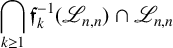
has Hausdorff dimension at least $(n-1)^2$
; in particular, it is not empty.
$(n-1)^2$
; in particular, it is not empty.
While the main idea of the proof is simple, the condition (1-1) causes some technicality, so we move it to Section 6. The lower bound on the Hausdorff dimension is presumably again not optimal, possibly it is the same value $n(n-1)$
as for the full set
$n(n-1)$
as for the full set $\mathscr {L}_{n,n}$
; see for example [Reference Beresnevich and Velani3] for a considerably stronger result. The set (3-1) is also large in a topological sense; see Section 3.2 below.
$\mathscr {L}_{n,n}$
; see for example [Reference Beresnevich and Velani3] for a considerably stronger result. The set (3-1) is also large in a topological sense; see Section 3.2 below.
The combination of Theorems 2.3 and 3.1 suggests the following conjecture, in the spirit of the open problem closing Burger’s paper [Reference Burger4] or [Reference Marques and Schleischitz16, Theorem 6.2].
Conjecture 3.2. Let $n, I$
be as above. Suppose
$n, I$
be as above. Suppose $f_k: I\mapsto \mathbb {R}$
and
$f_k: I\mapsto \mathbb {R}$
and $g_k: I\mapsto \mathbb {R}$
,
$g_k: I\mapsto \mathbb {R}$
, $k\ge 1$
, are sequences of analytic functions, with the properties that:
$k\ge 1$
, are sequences of analytic functions, with the properties that:
-
(i) for any $k\ge 1$
, the functions
$g_k$
are not of the form (2-4) for any
$a,b,c,d\in \mathbb {R}$
;
$k\ge 1$
, the functions
$g_k$
are not of the form (2-4) for any
$a,b,c,d\in \mathbb {R}$
; -
(ii) for
$\tau _{a,b,c,d}$
as in (2-4) with any
$a,b,c,d\in \mathbb {R}$
, we have the nonidentity of functions on I
$$ \begin{align*} f_{k_1}(z)\ne \tau_{a,b,c,d}(g_{k_2})(z), \quad k_1, k_2\in \mathbb{N}. \end{align*} $$


Then, there exist $A\in \mathscr {L}_{n,n}$
such that
$A\in \mathscr {L}_{n,n}$
such that  and
and  for any $k\ge 1$
, with definitions as in (2-1). Equivalently,
$k\ge 1$
, with definitions as in (2-1). Equivalently,

The assumptions are natural in view of our results and cannot be relaxed apart from possibly restricting $a,b,c,d$
to subsets of
$a,b,c,d$
to subsets of $\mathbb {R}$
. We point out that if the conjecture holds for some
$\mathbb {R}$
. We point out that if the conjecture holds for some $n=\ell $
, then it does also for any
$n=\ell $
, then it does also for any $n\ge \ell $
. This can be shown by considering
$n\ge \ell $
. This can be shown by considering ${A=\mathrm {diag}(A_{\ell },B)}$
with
${A=\mathrm {diag}(A_{\ell },B)}$
with $A_{\ell }\in \mathscr {L}_{\ell ,\ell }$
any such matrix and B any
$A_{\ell }\in \mathscr {L}_{\ell ,\ell }$
any such matrix and B any $(n-\ell )\times (n-\ell )$
matrix so that
$(n-\ell )\times (n-\ell )$
matrix so that  for every $k\ge 1$
. Such matrices B are easily seen to exist by metrical means; see the proof of Theorem 2.3 below for more details. However, even for just one pair of functions
$k\ge 1$
. Such matrices B are easily seen to exist by metrical means; see the proof of Theorem 2.3 below for more details. However, even for just one pair of functions $f=f_1, g=g_1$
satisfying the hypotheses (i), (ii) with
$f=f_1, g=g_1$
satisfying the hypotheses (i), (ii) with $k=k_1=k_2=1$
, the claim of Conjecture 3.2 is far from obvious.
$k=k_1=k_2=1$
, the claim of Conjecture 3.2 is far from obvious.
When $n=1$
, for a similar claim, we would certainly need to exclude more relations in view of Maillet’s result, and a complete description requires a comprehensive understanding of Mahler’s problem in the original formulation.
$n=1$
, for a similar claim, we would certainly need to exclude more relations in view of Maillet’s result, and a complete description requires a comprehensive understanding of Mahler’s problem in the original formulation.
3.2 One-to-one continuous maps
We now study the images of Liouville matrices under functions $f_k: U\subseteq \mathbb {R}^{m\times n}\to \mathbb {R}^{m\times n}$
. Following the short topological argument in [Reference Schwarz24], a similar result to Theorem 3.1 can be obtained for injective continuous maps.
$f_k: U\subseteq \mathbb {R}^{m\times n}\to \mathbb {R}^{m\times n}$
. Following the short topological argument in [Reference Schwarz24], a similar result to Theorem 3.1 can be obtained for injective continuous maps.
Theorem 3.3. Let $m,n$
be positive integers. Let
$m,n$
be positive integers. Let $U\subseteq \mathbb {R}^{m\times n}$
be a nonempty open set and
$U\subseteq \mathbb {R}^{m\times n}$
be a nonempty open set and $f_k: U\to \mathbb {R}^{m\times n}$
a sequence of injective, continuous functions. Then, there exists a dense
$f_k: U\to \mathbb {R}^{m\times n}$
a sequence of injective, continuous functions. Then, there exists a dense $G_{\delta }$
subset
$G_{\delta }$
subset $\Omega \subseteq U\cap \mathscr {L}_{m,n}$
within U such that
$\Omega \subseteq U\cap \mathscr {L}_{m,n}$
within U such that $f_k(A)\in \mathscr {L}_{m,n}$
for any
$f_k(A)\in \mathscr {L}_{m,n}$
for any $A\in \Omega $
and any
$A\in \Omega $
and any $k\ge 1$
. In other words,
$k\ge 1$
. In other words,
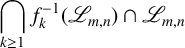 $$ \begin{align*} \bigcap_{k\ge 1} f_k^{-1}(\mathscr{L}_{m,n})\cap \mathscr{L}_{m,n} \end{align*} $$
is a dense $G_{\delta }$
subset of U.
$G_{\delta }$
subset of U.
In the proof, we use the famous result of Brouwer that injective continuous self-maps on an Euclidean space are open onto their images and thus locally induce homeomorphisms. A variant of Theorem 3.3 assuming instead the weaker property of the $f_k$
being open can be formulated, leading to a slightly more general claim.
$f_k$
being open can be formulated, leading to a slightly more general claim.
Proof. As indicated, we use an analogous argument as in [Reference Schwarz24]. First, notice that, similar to $n=1$
, for any integer
$n=1$
, for any integer $h\ge 1$
,
$h\ge 1$
,
 $$ \begin{align*} Y_h:= \bigcup_{\textbf{q}\in \mathbb{Z}^n: \Vert \textbf{q}\Vert\ge 2 } \bigcup_{\textbf{p}\in \mathbb{Z}^m} Z_h(\textbf{p},\textbf{q}), \quad Z_h(\textbf{p},\textbf{q}):= \{ A\in \mathbb{R}^{m\times n}: 0<\Vert A\textbf{q}-\textbf{p}\Vert < \Vert \textbf{q}\Vert^{-h}\} \end{align*} $$
is an open dense set in $\mathbb {R}^{mn}$
. Indeed, it is open by continuity of the maps
$\mathbb {R}^{mn}$
. Indeed, it is open by continuity of the maps $\varphi _{\textbf {p},\textbf {q}}: A\mapsto A\textbf {q}-\textbf {p}$
, and it is dense since for any
$\varphi _{\textbf {p},\textbf {q}}: A\mapsto A\textbf {q}-\textbf {p}$
, and it is dense since for any $A\in \mathbb {Q}^{m\times n}$
, there are obviously
$A\in \mathbb {Q}^{m\times n}$
, there are obviously $\textbf {p}\in \mathbb {Z}^m, \textbf {q}\in \mathbb {Z}^n\setminus \{ \textbf {0}\}$
so that
$\textbf {p}\in \mathbb {Z}^m, \textbf {q}\in \mathbb {Z}^n\setminus \{ \textbf {0}\}$
so that $A\textbf {q}-\textbf {p}=\textbf {0}$
and again by continuity of
$A\textbf {q}-\textbf {p}=\textbf {0}$
and again by continuity of $\varphi _{\textbf {q},\textbf {p}}\not \equiv \textbf {0}$
. So, the intersection of
$\varphi _{\textbf {q},\textbf {p}}\not \equiv \textbf {0}$
. So, the intersection of $Y_h$
over
$Y_h$
over $h\ge 1$
is a dense
$h\ge 1$
is a dense $G_{\delta }$
set. Moreover, if
$G_{\delta }$
set. Moreover, if $(L_h)_{h\ge 1}$
denotes the countable collection of rational hyperplanes in
$(L_h)_{h\ge 1}$
denotes the countable collection of rational hyperplanes in $\mathbb {R}^{mn}$
, then
$\mathbb {R}^{mn}$
, then $\bigcap _{h\ge 1} L_h^c$
is obviously a dense
$\bigcap _{h\ge 1} L_h^c$
is obviously a dense $G_{\delta }$
set as well. Hence,
$G_{\delta }$
set as well. Hence,
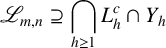 $$ \begin{align*} \mathscr{L}_{m,n} \supseteq \bigcap_{h\ge 1} L_h^c \cap Y_h \end{align*} $$
is again dense $G_{\delta }$
(there is equality in the inclusion if we restrict to a subset of
$G_{\delta }$
(there is equality in the inclusion if we restrict to a subset of $L_h$
inducing
$L_h$
inducing $\mathbb {Z}$
-dependent columns), so
$\mathbb {Z}$
-dependent columns), so $\mathscr {L}_{m,n} \cap U$
is dense
$\mathscr {L}_{m,n} \cap U$
is dense $G_{\delta }$
within U.
$G_{\delta }$
within U.
The remaining, short argument based on Baire’s theorem is precisely as for ${m=n=1}$
in [Reference Schwarz24]. Since the
${m=n=1}$
in [Reference Schwarz24]. Since the $f_k$
are injective by Brouwer’s result, we have that the images
$f_k$
are injective by Brouwer’s result, we have that the images $U_k:= f_k(U)$
are open sets, and hence we can find a dense
$U_k:= f_k(U)$
are open sets, and hence we can find a dense $G_{\delta }$
-subset of
$G_{\delta }$
-subset of $\mathscr {L}_{m,n}$
in each
$\mathscr {L}_{m,n}$
in each $U_k$
, say
$U_k$
, say $\emptyset \ne \Lambda _k:= U_k\cap \mathscr {L}_{m,n}$
. However, since the
$\emptyset \ne \Lambda _k:= U_k\cap \mathscr {L}_{m,n}$
. However, since the $f_k$
induce homeomorphisms, this means their preimages
$f_k$
induce homeomorphisms, this means their preimages $Z_k=f_k^{-1}(\Lambda _k)$
are again dense
$Z_k=f_k^{-1}(\Lambda _k)$
are again dense $G_{\delta }$
-sets (in U). Hence, the countable intersection
$G_{\delta }$
-sets (in U). Hence, the countable intersection $\Omega :=\bigcap _{k\ge 1} Z_k\cap \mathscr {L}_{m,n}$
is a dense
$\Omega :=\bigcap _{k\ge 1} Z_k\cap \mathscr {L}_{m,n}$
is a dense $G_{\delta }$
subset of U as well. Any matrix in this set
$G_{\delta }$
subset of U as well. Any matrix in this set $\Omega $
has the claimed property.
$\Omega $
has the claimed property.
The same topological result can be obtained in the setting of Theorem 3.1 as well, meaning (3-1) is again a dense $G_{\delta }$
set for
$G_{\delta }$
set for  derived from nonconstant scalar analytic $f_k$
via (2-1). However, as it cannot be directly deduced from Theorem 3.3 and the complete proof we found is slightly technical, we prefer to omit it here. (For instance, a technical problem is that the derivatives
$f_k$
via (2-1). However, as it cannot be directly deduced from Theorem 3.3 and the complete proof we found is slightly technical, we prefer to omit it here. (For instance, a technical problem is that the derivatives $f_k^{\prime }$
may vanish within I, and then
$f_k^{\prime }$
may vanish within I, and then $f_k$
and
$f_k$
and  are not locally injective everywhere. This is related to Lemma 5.1 and its proof below.) However, it is not clear to us if a positive Hausdorff dimension result can be obtained in the context of Theorem 3.3.
A special case is the following generalization of a result by Erdős [Reference Erdős6] for $m=n=1$
.
$m=n=1$
.
Corollary 3.4. Any $A\in \mathbb {R}^{m\times n}$
can be written
$A\in \mathbb {R}^{m\times n}$
can be written $A=B+C$
with
$A=B+C$
with $B,C\in \mathscr {L}_{m,n}$
.
$B,C\in \mathscr {L}_{m,n}$
.
Proof. Apply Theorem 3.3 with $f(X)=A-X$
.
$f(X)=A-X$
.
We should notice that the ideas in all papers [Reference Alniaçik and Saias2, Reference Schwarz24, Reference Senthil Kumar, Thangadurai and Waldschmidt25] as well as our proof of Theorem 3.3 above originate in this work of Erdős. See also [Reference Rieger22]. By Theorem 3.3, we can further directly extend several results from [Reference Senthil Kumar, Thangadurai and Waldschmidt25] to the matrix setting; we only state the analogue of [Reference Senthil Kumar, Thangadurai and Waldschmidt25, Corollary 7].
Corollary 3.5. Let $U\subseteq \mathbb {R}^{m\times n}$
be a nonempty open connected set and
$U\subseteq \mathbb {R}^{m\times n}$
be a nonempty open connected set and $\varphi : U\to U$
be an injective, continuous self-map. Then, there exists a dense
$\varphi : U\to U$
be an injective, continuous self-map. Then, there exists a dense $G_{\delta }$
set of
$G_{\delta }$
set of $A\in \mathscr {L}_{m,n}\cap U$
so that the orbit
$A\in \mathscr {L}_{m,n}\cap U$
so that the orbit $\varphi ^k(A)=\varphi \circ \varphi \cdots \circ \varphi (A)$
,
$\varphi ^k(A)=\varphi \circ \varphi \cdots \circ \varphi (A)$
, $k\ge 1$
, consists only of elements in
$k\ge 1$
, consists only of elements in $\mathscr {L}_{m,n}\cap U$
.
$\mathscr {L}_{m,n}\cap U$
.
In the original formulation in [Reference Senthil Kumar, Thangadurai and Waldschmidt25], it is assumed that $\varphi $
is bijective; however, surjectivity is not needed.
$\varphi $
is bijective; however, surjectivity is not needed.
Proof. Apply Theorem 3.3 to $f_k=\varphi ^k$
, which are defined and easily seen to inherit the properties of being continuous and injective from
$f_k=\varphi ^k$
, which are defined and easily seen to inherit the properties of being continuous and injective from $\varphi $
.
$\varphi $
.
3.3 On relaxing conditions of Theorem 3.3
For $m=n=1$
, the assumption of injectivity in Theorem 3.3 can be relaxed. As stated before, indeed, it was shown in [Reference Alniaçik and Saias2] that we only need
$m=n=1$
, the assumption of injectivity in Theorem 3.3 can be relaxed. As stated before, indeed, it was shown in [Reference Alniaçik and Saias2] that we only need $f_k$
to be nowhere constant on an interval I, meaning not constant on any nonempty open subinterval of I, for the implication of Theorem 3.3. The latter indeed defines a strictly larger set of functions. In higher dimensions, a priori the most natural way to extend the concept of nowhere constant seems to be the following.
$f_k$
to be nowhere constant on an interval I, meaning not constant on any nonempty open subinterval of I, for the implication of Theorem 3.3. The latter indeed defines a strictly larger set of functions. In higher dimensions, a priori the most natural way to extend the concept of nowhere constant seems to be the following.
Definition 3.6. Let $m_1,m_2,n_1,n_2$
be positive integers and
$m_1,m_2,n_1,n_2$
be positive integers and $U\subseteq \mathbb {R}^{m_1\times n_1}\cong \mathbb {R}^{m_1n_1}$
be an open, nonempty set. We call a matrix function
$U\subseteq \mathbb {R}^{m_1\times n_1}\cong \mathbb {R}^{m_1n_1}$
be an open, nonempty set. We call a matrix function $f: U\to \mathbb {R}^{m_2\times n_2}$
nowhere constant if it is not constant on any nonempty open subset of U.
$f: U\to \mathbb {R}^{m_2\times n_2}$
nowhere constant if it is not constant on any nonempty open subset of U.
When $n\ge 2$
, it is easy to see that the analogue of [Reference Alniaçik and Saias2] fails. Consider the function that maps
$n\ge 2$
, it is easy to see that the analogue of [Reference Alniaçik and Saias2] fails. Consider the function that maps $A=(a_{i,j})_{1\le i\le m,1\le j\le n}\in U$
to the
$A=(a_{i,j})_{1\le i\le m,1\le j\le n}\in U$
to the $m\times n$
matrix
$m\times n$
matrix $f(A)=B=(b_{i,j})_{1\le i\le m,1\le j\le n}$
with each entry
$f(A)=B=(b_{i,j})_{1\le i\le m,1\le j\le n}$
with each entry $b_{i,j}=a_{1,1}$
. Indeed, this function is continuous and nowhere constant but any point in the image satisfies a fixed linear dependence of columns relation over
$b_{i,j}=a_{1,1}$
. Indeed, this function is continuous and nowhere constant but any point in the image satisfies a fixed linear dependence of columns relation over $\mathbb {Z}$
, and hence
$\mathbb {Z}$
, and hence $f(U)$
has empty intersection in a trivial way with
$f(U)$
has empty intersection in a trivial way with $\mathscr {L}_{m,n}$
as (1-1) fails for any
$\mathscr {L}_{m,n}$
as (1-1) fails for any $B\in f(U)$
. So, it seems reasonable to also consider the following additional property.
$B\in f(U)$
. So, it seems reasonable to also consider the following additional property.
Definition 3.7. A function $f: U\subseteq \mathbb {R}^{m\times n}\to \mathbb {R}^{m\times n}$
satisfies the
$f: U\subseteq \mathbb {R}^{m\times n}\to \mathbb {R}^{m\times n}$
satisfies the $LIC$
property (linearly independent columns) if for every set
$LIC$
property (linearly independent columns) if for every set $\Omega \subseteq U$
with nonempty interior, there are no fixed
$\Omega \subseteq U$
with nonempty interior, there are no fixed $\textbf {p}\in \mathbb {Z}^m, \textbf {q}\in \mathbb {Z}^n\setminus \{ \textbf {0}\}$
such that
$\textbf {p}\in \mathbb {Z}^m, \textbf {q}\in \mathbb {Z}^n\setminus \{ \textbf {0}\}$
such that $B\textbf {q}-\textbf {p}=\textbf {0}$
for any
$B\textbf {q}-\textbf {p}=\textbf {0}$
for any $B\in f(\Omega )$
.
$B\in f(\Omega )$
.
The LIC property is easily seen to be independent from the condition of being nowhere constant. However, even assuming both the nowhere constant and LIC properties is not enough to guarantee the conclusion of Theorem 3.3 in general.
Theorem 3.8. Let $m,n$
be positive integers and
$m,n$
be positive integers and $U\subseteq \mathbb {R}^{m\times n}$
be an open, nonempty set.
$U\subseteq \mathbb {R}^{m\times n}$
be an open, nonempty set.
-
(i) If
$m=n=1$
, then for every nowhere constant continuous function
$f: U\to \mathbb {R}$
, the set
$f^{-1}(\mathscr {L}_{1,1})\cap \mathscr {L}_{1,1}$
is dense
$G_{\delta }$
in U; in particular, nonempty. -
(ii) If
$(m,n)\ne (1,1)$
, then there exists a nowhere constant continuous function
${f: U\to \mathbb {R}^{m\times n}}$
such that
$f(A)\notin \mathscr {L}_{m,n}$
for any matrix
$A\in U$
, so
$f^{-1}(\mathscr {L}_{m,n})=\emptyset $
. -
(iii) If
$m\ge 2$
, there exists a nowhere constant continuous function with the LIC property
$f: V\to \mathbb {R}^{m\times n}$
such that
$f(A)\notin \mathscr {L}_{m,n}$
for any matrix
$A\in U$
, so
$f^{-1}(\mathscr {L}_{m,n})=\emptyset $
.


Proof. Claim (i) is just [Reference Alniaçik and Saias2]; if $n\ge 2$
, claim (ii) has already been observed above. Note that claim (iii) also contains the remaining case
$n\ge 2$
, claim (ii) has already been observed above. Note that claim (iii) also contains the remaining case $n=1, m\ge 2$
of claim (ii). So it remains to prove claim (iii). Let
$n=1, m\ge 2$
of claim (ii). So it remains to prove claim (iii). Let $m\ge 2$
and consider a function f that acts as the identity on the first line
$m\ge 2$
and consider a function f that acts as the identity on the first line $\textbf {a}_1=(a_{1,1},\ldots ,a_{1,n})$
of a matrix
$\textbf {a}_1=(a_{1,1},\ldots ,a_{1,n})$
of a matrix $A=(a_{i,j})\in U$
and is constant on the remaining lines. Hereby, we choose the constant image vectors
$A=(a_{i,j})\in U$
and is constant on the remaining lines. Hereby, we choose the constant image vectors $\textbf {b}_2,\ldots ,\textbf {b}_m\in \mathbb {R}^n\setminus (\mathscr {L}_{1,n}\cup \Pi (L_j))$
, where the
$\textbf {b}_2,\ldots ,\textbf {b}_m\in \mathbb {R}^n\setminus (\mathscr {L}_{1,n}\cup \Pi (L_j))$
, where the $L_j$
are the countable collection of all rational hyperplanes of
$L_j$
are the countable collection of all rational hyperplanes of $\mathbb {R}^{n+1}$
and
$\mathbb {R}^{n+1}$
and $\Pi : \mathbb {R}^{n+1}\to \mathbb {R}^n$
is the restriction by chopping off the last coordinate. Such
$\Pi : \mathbb {R}^{n+1}\to \mathbb {R}^n$
is the restriction by chopping off the last coordinate. Such $\textbf {b}_i$
clearly exist: in fact, this set has full n-dimensional Lebesgue measure as
$\textbf {b}_i$
clearly exist: in fact, this set has full n-dimensional Lebesgue measure as $\mathscr {L}_{m,n}$
and
$\mathscr {L}_{m,n}$
and $\Pi (L_j)$
are all nullsets. Then, f is clearly continuous and nowhere constant, and satisfies the LIC property since
$\Pi (L_j)$
are all nullsets. Then, f is clearly continuous and nowhere constant, and satisfies the LIC property since $\textbf {b}_2\notin \cup \Pi (L_j)$
implies (1-1) for any matrix
$\textbf {b}_2\notin \cup \Pi (L_j)$
implies (1-1) for any matrix $B\in f(U)$
. However, since the second line
$B\in f(U)$
. However, since the second line $\textbf {b}_2\notin \mathscr {L}_{1,n}$
, we conclude
$\textbf {b}_2\notin \mathscr {L}_{1,n}$
, we conclude $f(A)\notin \mathscr {L}_{m,n}$
by Proposition 1.3; indeed,
$f(A)\notin \mathscr {L}_{m,n}$
by Proposition 1.3; indeed, $\infty>\omega ^{2\times n}(\textbf {b}_2)\ge \omega ^{m\times n}( f(A))$
.
$\infty>\omega ^{2\times n}(\textbf {b}_2)\ge \omega ^{m\times n}( f(A))$
.
Observe that claims (ii), (iii) apply to all matrices A, not only Liouville matrices. The main reason for the failure in claims (ii), (iii) for $m\ge 2$
is that in higher dimensions, the property of being nowhere constant for a function is insufficient to guarantee that its image contains an open set, which was used in the argument for
$m\ge 2$
is that in higher dimensions, the property of being nowhere constant for a function is insufficient to guarantee that its image contains an open set, which was used in the argument for $m=n=1$
in [Reference Alniaçik and Saias2].
$m=n=1$
in [Reference Alniaçik and Saias2].
There is a gap in Theorem 3.8 for $m=1, n\ge 2$
and nowhere constant, continuous functions with the LIC property. The converse result of the next theorem illustrates why this case is more complicated. Define
$m=1, n\ge 2$
and nowhere constant, continuous functions with the LIC property. The converse result of the next theorem illustrates why this case is more complicated. Define $\mathscr {L}^{\ast }_{m,n}\supseteq \mathscr {L}_{m,n}$
to be the set of irrational real matrices
$\mathscr {L}^{\ast }_{m,n}\supseteq \mathscr {L}_{m,n}$
to be the set of irrational real matrices $A\notin \mathbb {Q}^{m\times n}$
such that
$A\notin \mathbb {Q}^{m\times n}$
such that $\Vert A\textbf {q}-\textbf {p}\Vert < \Vert \textbf {q}\Vert ^{-N}$
has a solution in integer vectors
$\Vert A\textbf {q}-\textbf {p}\Vert < \Vert \textbf {q}\Vert ^{-N}$
has a solution in integer vectors ${\textbf {p}\in \mathbb {Z}^m,\textbf {q}\in \mathbb {Z}^n\setminus \{ \textbf {0}\}}$
for any N. As indicated in Section 1, for
${\textbf {p}\in \mathbb {Z}^m,\textbf {q}\in \mathbb {Z}^n\setminus \{ \textbf {0}\}}$
for any N. As indicated in Section 1, for $n=1$
, we have
$n=1$
, we have $\mathscr {L}^{\ast }_{m,1}=\mathscr {L}_{m,1}$
, but for
$\mathscr {L}^{\ast }_{m,1}=\mathscr {L}_{m,1}$
, but for $n\ge 2$
, the inclusion is proper.
$n\ge 2$
, the inclusion is proper.
Theorem 3.9. Let $m=1$
and
$m=1$
and $U\subseteq \mathbb {R}^{1\times n}$
be an open, nonempty set. For any sequence of nowhere constant continuous functions
$U\subseteq \mathbb {R}^{1\times n}$
be an open, nonempty set. For any sequence of nowhere constant continuous functions $f_k: U\to \mathbb {R}^{1\times n}$
, there exists a dense
$f_k: U\to \mathbb {R}^{1\times n}$
, there exists a dense $G_{\delta }$
set
$G_{\delta }$
set $\Lambda \subseteq \mathscr {L}_{1,n}\cap U$
such that
$\Lambda \subseteq \mathscr {L}_{1,n}\cap U$
such that $f_k(A)\in \mathscr {L}_{1,n}^{\ast }$
for any
$f_k(A)\in \mathscr {L}_{1,n}^{\ast }$
for any $A\in \Lambda $
and every
$A\in \Lambda $
and every $k\ge 1$
. In other words,
$k\ge 1$
. In other words,
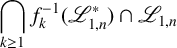 $$ \begin{align*} \bigcap_{k\ge 1} f_k^{-1}(\mathscr{L}_{1,n}^{\ast})\cap \mathscr{L}_{1,n} \end{align*} $$
is a dense $G_{\delta }$
subset of U.
$G_{\delta }$
subset of U.
We believe the claim remains true for $\mathscr {L}_{1,n}$
in place of
$\mathscr {L}_{1,n}$
in place of $\mathscr {L}_{1,n}^{\ast }$
throughout, but a proof would be desirable. However, for
$\mathscr {L}_{1,n}^{\ast }$
throughout, but a proof would be desirable. However, for $m\ge 2$
, the analogue of Theorem 3.8(iii) holds as well for
$m\ge 2$
, the analogue of Theorem 3.8(iii) holds as well for $\mathscr {L}^{\ast }_{m,n}$
by the same proof, which is formally a stronger claim.
$\mathscr {L}^{\ast }_{m,n}$
by the same proof, which is formally a stronger claim.
Proof. We can assume $n\ge 2$
as the case
$n\ge 2$
as the case $m=n=1$
reduces to [Reference Alniaçik and Saias2]. First, note that by Proposition 1.3, case
$m=n=1$
reduces to [Reference Alniaçik and Saias2]. First, note that by Proposition 1.3, case $m=1$
, a line vector belongs to
$m=1$
, a line vector belongs to $\mathscr {L}_{1,n}^{\ast }$
(but not necessarily
$\mathscr {L}_{1,n}^{\ast }$
(but not necessarily $\mathscr {L}_{1,n}$
) as soon as some entry is a Liouville number. Hence, for any nonempty open interval I, if
$\mathscr {L}_{1,n}$
) as soon as some entry is a Liouville number. Hence, for any nonempty open interval I, if $L_I=\mathscr {L}_{1,1}\cap I\subseteq I$
denotes the dense
$L_I=\mathscr {L}_{1,1}\cap I\subseteq I$
denotes the dense $G_{\delta }$
set of Liouville numbers in I, the cylinder sets
$G_{\delta }$
set of Liouville numbers in I, the cylinder sets
 $$ \begin{align*} Z_j=\mathbb{R}^{j-1}\times L_I\times \mathbb{R}^{n-j}, \quad 1\le j\le n, \end{align*} $$
consist only of elements of $\mathscr {L}_{1,n}^{\ast }$
, so
$\mathscr {L}_{1,n}^{\ast }$
, so
 $$ \begin{align*} Z_j\subseteq \mathscr{L}_{1,n}^{\ast}. \end{align*} $$
Take any nonempty open box $\mathcal {B}$
in
$\mathcal {B}$
in $U\subseteq \mathbb {R}^n$
. First, consider just one function
$U\subseteq \mathbb {R}^n$
. First, consider just one function $f=f_1$
. Then, since
$f=f_1$
. Then, since $f=(f^1,\ldots ,f^n)$
is nowhere constant, some coordinate function
$f=(f^1,\ldots ,f^n)$
is nowhere constant, some coordinate function $f^j$
is not constant on
$f^j$
is not constant on $\mathcal {B}$
. So, since connectedness is preserved under continuous maps, its image
$\mathcal {B}$
. So, since connectedness is preserved under continuous maps, its image $f^j(\mathcal {B})\subseteq \mathbb {R}$
contains a nonempty open interval I. However, this means
$f^j(\mathcal {B})\subseteq \mathbb {R}$
contains a nonempty open interval I. However, this means $f(\mathcal {B})$
has nonempty intersection with the cylinder set
$f(\mathcal {B})$
has nonempty intersection with the cylinder set $Z_j$
above, or equivalently,
$Z_j$
above, or equivalently, $f^{-1}(Z_j)\cap \mathcal {B}\subseteq f^{-1}(\mathscr {L}_{1,n}^{\ast })\cap \mathcal {B}$
is nonempty. Thus, as
$f^{-1}(Z_j)\cap \mathcal {B}\subseteq f^{-1}(\mathscr {L}_{1,n}^{\ast })\cap \mathcal {B}$
is nonempty. Thus, as $\mathcal {B}$
was arbitrary in U, the set
$\mathcal {B}$
was arbitrary in U, the set $f^{-1}(\mathscr {L}_{1,n}^{\ast })$
is dense in U. Moreover, as f is continuous and
$f^{-1}(\mathscr {L}_{1,n}^{\ast })$
is dense in U. Moreover, as f is continuous and $\mathscr {L}_{1,n}^{\ast }\supseteq \mathscr {L}_{1,n}$
is dense
$\mathscr {L}_{1,n}^{\ast }\supseteq \mathscr {L}_{1,n}$
is dense $G_{\delta }$
(see the proof of Theorem 3.3),
$G_{\delta }$
(see the proof of Theorem 3.3), $f^{-1}(\mathscr {L}_{1,n}^{\ast })$
is a
$f^{-1}(\mathscr {L}_{1,n}^{\ast })$
is a $G_{\delta }$
set. Hence, it is a dense
$G_{\delta }$
set. Hence, it is a dense $G_{\delta }$
set. Now, we apply this to
$G_{\delta }$
set. Now, we apply this to $f=f_k$
for all
$f=f_k$
for all $k\ge 1$
simultaneously, and again, since
$k\ge 1$
simultaneously, and again, since $\mathscr {L}_{1,n}$
is dense
$\mathscr {L}_{1,n}$
is dense $G_{\delta }$
as well, we see that the set
$G_{\delta }$
as well, we see that the set
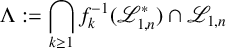 $$ \begin{align*} \Lambda:= \bigcap_{k\ge 1} f_k^{-1}(\mathscr{L}_{1,n}^{\ast}) \cap \mathscr{L}_{1,n} \end{align*} $$
is a dense $G_{\delta }$
set in
$G_{\delta }$
set in $U\subseteq \mathbb {R}^n$
as well, with the property of the theorem that
$U\subseteq \mathbb {R}^n$
as well, with the property of the theorem that $f_k(A)\in \mathscr {L}_{1,n}^{\ast }$
for any
$f_k(A)\in \mathscr {L}_{1,n}^{\ast }$
for any $A\in \Lambda \subseteq \mathscr {L}_{1,n}$
and every
$A\in \Lambda \subseteq \mathscr {L}_{1,n}$
and every $k\ge 1$
.
$k\ge 1$
.
Even if assuming the LIC property, the counterexamples in Theorem 3.8(ii), (iii) are still slightly artificial as the image has certain constant entry functions. To avoid this, we propose an alternative to our definition of a nowhere constant function. Since, very similarly to Proposition 2.1, the Liouville property of $A\in \mathbb {R}^{m\times n}$
is preserved under actions
$A\in \mathbb {R}^{m\times n}$
is preserved under actions
 $$ \begin{align} A\mapsto R_1AR_2+T,\quad R_1\in \mathbb{Q}^{m\times m}, R_2\in \mathbb{Q}^{n\times n}, T\in \mathbb{Q}^{m\times n} \end{align} $$
with invertible matrices $R_j$
, the following strengthening seems natural.
$R_j$
, the following strengthening seems natural.
Definition 3.10. We refer to $A,B\in \mathbb {R}^{m\times n}$
as
$A,B\in \mathbb {R}^{m\times n}$
as $\mathscr {L}$
-equivalent and write
$\mathscr {L}$
-equivalent and write $A\sim B$
if B arises from A via (3-2). We write
$A\sim B$
if B arises from A via (3-2). We write $[A]_{\sim }$
for the class of A. We say functions
$[A]_{\sim }$
for the class of A. We say functions $f,g: U\subseteq \mathbb {R}^{m\times n}\to \mathbb {R}^{m\times n}$
are
$f,g: U\subseteq \mathbb {R}^{m\times n}\to \mathbb {R}^{m\times n}$
are $\mathscr {L}$
-equivalent and write
$\mathscr {L}$
-equivalent and write $f\sim g$
if
$f\sim g$
if $g(A)=R_1 f(A)R_2+T$
for fixed
$g(A)=R_1 f(A)R_2+T$
for fixed $R_j, T$
as in (3-2) and any
$R_j, T$
as in (3-2) and any $A\in U$
, and again write
$A\in U$
, and again write $[f]_{\sim }$
for the class of f. We finally call f strongly nowhere constant if for every
$[f]_{\sim }$
for the class of f. We finally call f strongly nowhere constant if for every $g\in [f]_{\sim }$
, every scalar entry function
$g\in [f]_{\sim }$
, every scalar entry function ${g^{i,j}: U\to \mathbb {R}}$
,
${g^{i,j}: U\to \mathbb {R}}$
, $1\le i\le m, 1\le j\le n$
, is nowhere constant in the sense of Definition 3.6.
$1\le i\le m, 1\le j\le n$
, is nowhere constant in the sense of Definition 3.6.
Plainly, we can restrict to $g\in [f]_{\sim }$
derived via
$g\in [f]_{\sim }$
derived via $T=\textbf {0}$
for testing the property strongly nowhere constant. Thus, the property means that the
$T=\textbf {0}$
for testing the property strongly nowhere constant. Thus, the property means that the $\mathbb {Z}$
-span of the entries
$\mathbb {Z}$
-span of the entries $f^{i,j}(A)$
of
$f^{i,j}(A)$
of $f(A)$
together with the
$f(A)$
together with the $\textbf {1}$
function can only generate the
$\textbf {1}$
function can only generate the $\textbf {0}$
function in the trivial way. For strongly nowhere constant functions, we prove the following result on column vectors.
$\textbf {0}$
function in the trivial way. For strongly nowhere constant functions, we prove the following result on column vectors.
Theorem 3.11. Let $m\ge 2$
,
$m\ge 2$
, $n=1$
. Then, there exists a strongly nowhere constant continuous function
$n=1$
. Then, there exists a strongly nowhere constant continuous function $f: \mathbb {R}^{m\times 1}\to \mathbb {R}^{m\times 1}$
with the LIC property and such that
$f: \mathbb {R}^{m\times 1}\to \mathbb {R}^{m\times 1}$
with the LIC property and such that $f(A)\notin \mathscr {L}_{m,1}$
for any
$f(A)\notin \mathscr {L}_{m,1}$
for any $A\in \mathbb {R}^{m\times 1}$
, in other words,
$A\in \mathbb {R}^{m\times 1}$
, in other words, $f^{-1}(\mathscr {L}_{m,1})=\emptyset $
.
$f^{-1}(\mathscr {L}_{m,1})=\emptyset $
.
This is stronger than Theorem 3.8(ii), (iii), for the special case $m\ge 2, n=1$
. The principal idea of the proof is to consider a function whose image is contained in an algebraic variety without rational points, which by a result in [Reference Schleischitz23] means they contain no Liouville (column) vectors.
$m\ge 2, n=1$
. The principal idea of the proof is to consider a function whose image is contained in an algebraic variety without rational points, which by a result in [Reference Schleischitz23] means they contain no Liouville (column) vectors.
Proof. Write $A=(a_1,\ldots ,a_m)^{t}$
and define the coordinate functions of
$A=(a_1,\ldots ,a_m)^{t}$
and define the coordinate functions of $f=(f^1,\ldots ,f^m)^{t}$
by
$f=(f^1,\ldots ,f^m)^{t}$
by
 $$ \begin{align*} f^j(a_{1}, \ldots, a_{m})=a_{j},\; (1\le j\le m-1),\quad f^m(a_{1},\ldots, a_{m})=\sqrt[3]{a_{m-1}^2-N}, \end{align*} $$
where $N\in \mathbb {Z}$
is so that
$N\in \mathbb {Z}$
is so that $Y^2=X^3+N$
has no rational solution (see [Reference Nakagawa and Horie19] for existence). It is not hard to see that this induces a continuous, strongly nowhere constant function on
$Y^2=X^3+N$
has no rational solution (see [Reference Nakagawa and Horie19] for existence). It is not hard to see that this induces a continuous, strongly nowhere constant function on $\mathbb {R}^m$
with the LIC property. Consider the projection
$\mathbb {R}^m$
with the LIC property. Consider the projection $\Pi :\mathbb {R}^{m\times 1}\to \mathbb {R}^{2\times 1}$
onto the last two coordinates, so that
$\Pi :\mathbb {R}^{m\times 1}\to \mathbb {R}^{2\times 1}$
onto the last two coordinates, so that $\Pi (f(\mathbb {R}^{m\times 1}))$
equals the variety
$\Pi (f(\mathbb {R}^{m\times 1}))$
equals the variety $X_{m}^3+N=X_{m-1}^2$
defined over
$X_{m}^3+N=X_{m-1}^2$
defined over $\mathbb {Q}[X_{m-1},X_m]$
, without rational points. As there is no rational point in
$\mathbb {Q}[X_{m-1},X_m]$
, without rational points. As there is no rational point in $\Pi (f(\mathbb {R}^{m\times 1}))\subseteq \mathbb {R}^{2\times 1}$
, from [Reference Schleischitz23, Theorem 2.1], we see that any such projected vector
$\Pi (f(\mathbb {R}^{m\times 1}))\subseteq \mathbb {R}^{2\times 1}$
, from [Reference Schleischitz23, Theorem 2.1], we see that any such projected vector $\textbf {a}\in \Pi (f(\mathbb {R}^{m\times 1}))\subseteq \mathbb {R}^2$
has irrationality exponent
$\textbf {a}\in \Pi (f(\mathbb {R}^{m\times 1}))\subseteq \mathbb {R}^2$
has irrationality exponent $\omega ^{2\times 1}(\textbf {a})\le 2$
, and hence
$\omega ^{2\times 1}(\textbf {a})\le 2$
, and hence $\textbf {a}\notin \mathscr {L}_{2,1}$
. However, as clearly the irrationality exponent of a column vector cannot decrease under the projection
$\textbf {a}\notin \mathscr {L}_{2,1}$
. However, as clearly the irrationality exponent of a column vector cannot decrease under the projection $\Pi $
(see Proposition 1.3), a fortiori, any
$\Pi $
(see Proposition 1.3), a fortiori, any $\textbf {b}\in \Pi ^{-1}(\textbf {a})$
has exponent at most
$\textbf {b}\in \Pi ^{-1}(\textbf {a})$
has exponent at most $\omega ^{m\times 1}(\textbf {b})\le \omega ^{2\times 1}(\textbf {a})\le 2$
as well, and thus
$\omega ^{m\times 1}(\textbf {b})\le \omega ^{2\times 1}(\textbf {a})\le 2$
as well, and thus $\textbf {b}\notin \mathscr {L}_{m,1}$
. So, since
$\textbf {b}\notin \mathscr {L}_{m,1}$
. So, since $\Pi ^{-1}(\Pi (f(\mathbb {R}^{m\times 1})))\supseteq f(\mathbb {R}^{m\times 1})$
and
$\Pi ^{-1}(\Pi (f(\mathbb {R}^{m\times 1})))\supseteq f(\mathbb {R}^{m\times 1})$
and $\textbf {a}\in \Pi (f(\mathbb {R}^{m\times 1}))$
was arbitrary, we have
$\textbf {a}\in \Pi (f(\mathbb {R}^{m\times 1}))$
was arbitrary, we have $f(\mathbb {R}^{m\times 1})\cap \mathscr {L}_{m,1}=\emptyset $
, which is equivalent to the claim.
$f(\mathbb {R}^{m\times 1})\cap \mathscr {L}_{m,1}=\emptyset $
, which is equivalent to the claim.
Remark 3.12. The function $f^m(a_{1}, \ldots , a_{m})=\sqrt {3-a_{m-1}^2}$
is an example of lower degree due to
$f^m(a_{1}, \ldots , a_{m})=\sqrt {3-a_{m-1}^2}$
is an example of lower degree due to $X^2+Y^2=3$
having no rational points again; however, it is not globally defined.
$X^2+Y^2=3$
having no rational points again; however, it is not globally defined.
For $m=1$
, a converse result in the form of an analogue of Theorem 3.9 clearly holds for strongly nowhere constant functions a fortiori, and presumably also for
$m=1$
, a converse result in the form of an analogue of Theorem 3.9 clearly holds for strongly nowhere constant functions a fortiori, and presumably also for $\mathscr {L}_{1,n}$
(without the ‘star’). This leaves the nonvector cases
$\mathscr {L}_{1,n}$
(without the ‘star’). This leaves the nonvector cases $\min \{m,n\}>1$
open where the situation seems unclear.
$\min \{m,n\}>1$
open where the situation seems unclear.
Problem 3.13. Determine all pairs $m,n$
for which the analogue of Theorem 3.11 holds.
$m,n$
for which the analogue of Theorem 3.11 holds.
Above, we have only considered self-mappings. We want to finish this section with an open problem for a function $f:\mathbb {R}\to \mathbb {R}^{n\times n}$
.
$f:\mathbb {R}\to \mathbb {R}^{n\times n}$
.
Problem 3.14. Given $A\in \mathbb {R}^{n\times n}$
, what can be said about the set
$A\in \mathbb {R}^{n\times n}$
, what can be said about the set
 $$ \begin{align*} \mathcal{X}_A=\{ \lambda\in \mathbb{R}: A-\lambda I_n \in \mathscr{L}_{n,n}\}? \end{align*} $$
Is it always nonempty/uncountable/dense $G_{\delta }$
?
$G_{\delta }$
?
It is not hard to see by topological arguments similar to Theorem 3.3 that for any A, all rows of $A-\lambda I_n$
can be made Liouville vectors in
$A-\lambda I_n$
can be made Liouville vectors in $\mathbb {R}^{1\times n}$
simultaneously for many (dense
$\mathbb {R}^{1\times n}$
simultaneously for many (dense $G_{\delta }$
set of)
$G_{\delta }$
set of) $\lambda $
; however, this is in general insufficient for
$\lambda $
; however, this is in general insufficient for $A-\lambda I_n$
being in
$A-\lambda I_n$
being in $\mathscr {L}_{n,n}$
. This argument works if A is diagonalizable via a rational base change matrix (in particular, if A is diagonal), via Proposition 2.1. However, it is easy to construct A such that for no
$\mathscr {L}_{n,n}$
. This argument works if A is diagonalizable via a rational base change matrix (in particular, if A is diagonal), via Proposition 2.1. However, it is easy to construct A such that for no $\lambda $
, is any column of
$\lambda $
, is any column of $A-\lambda I_n$
a Liouville vector in
$A-\lambda I_n$
a Liouville vector in $\mathbb {R}^{m\times 1}$
; however, this is not necessary for
$\mathbb {R}^{m\times 1}$
; however, this is not necessary for $A-\lambda I_n$
being in
$A-\lambda I_n$
being in $\mathscr {L}_{n,n}$
. If
$\mathscr {L}_{n,n}$
. If $\mathcal {X}_A$
is nonempty, it is dense in
$\mathcal {X}_A$
is nonempty, it is dense in $\mathbb {R}$
by its invariance under rational translations via Proposition 2.1 again. In general, we do not know what to conjecture, but remark that Problem 3.14 can be naturally generalized to
$\mathbb {R}$
by its invariance under rational translations via Proposition 2.1 again. In general, we do not know what to conjecture, but remark that Problem 3.14 can be naturally generalized to $\mathcal {X}_{A,B}=\{ \lambda \in \mathbb {R}: A-\lambda B \in \mathscr {L}_{m,n}\}$
for
$\mathcal {X}_{A,B}=\{ \lambda \in \mathbb {R}: A-\lambda B \in \mathscr {L}_{m,n}\}$
for $A,B\in \mathbb {R}^{m\times n}$
.
$A,B\in \mathbb {R}^{m\times n}$
.
4 On a property of Burger
Let us return to quadratic matrices. As noticed in Section 3.2, it was shown by Erdős [Reference Erdős6] and is a special case of Corollary 3.4 that any real number can be written as the sum of two Liouville numbers. Burger [Reference Burger4] noticed that Erdős’ proof can be adapted to show that any transcendental real number can be written as a sum of two algebraically independent Liouville numbers. The converse is easy to prove, giving a characterization of transcendental real numbers. See also [Reference Senthil Kumar, Thangadurai and Waldschmidt25, Proposition 3] for a generalization. Let us consider the problem in the matrix setting. Naturally, we call a quadratic real matrix algebraic (over $\mathbb {Z}$
) if
$\mathbb {Z}$
) if $P(A)=\textbf {0}$
for some nonzero polynomial
$P(A)=\textbf {0}$
for some nonzero polynomial $P\in \mathbb {Z}[X]$
, otherwise we call it transcendental. Similarly, let us call two real
$P\in \mathbb {Z}[X]$
, otherwise we call it transcendental. Similarly, let us call two real $n\times n$
matrices
$n\times n$
matrices $B,C$
algebraically dependent (over
$B,C$
algebraically dependent (over $\mathbb {Z}$
) if there exists nonzero
$\mathbb {Z}$
) if there exists nonzero $P\in \mathbb {Z}[X,Y]$
so that
$P\in \mathbb {Z}[X,Y]$
so that ${P(B,C)=\textbf {0}}$
, otherwise they are algebraically independent. Note hereby that bivariate polynomials over a noncommutative matrix ring have a more complicated form as in the commutative case
${P(B,C)=\textbf {0}}$
, otherwise they are algebraically independent. Note hereby that bivariate polynomials over a noncommutative matrix ring have a more complicated form as in the commutative case $n=1$
, for example,
$n=1$
, for example, $5X^{2}Y^{3}X-5X^3Y^3$
is not the
$5X^{2}Y^{3}X-5X^3Y^3$
is not the $0$
polynomial when
$0$
polynomial when $n\ge 2$
. We study Burger’s property in this setting.
$n\ge 2$
. We study Burger’s property in this setting.
Problem 4.1. For $n\ge 2$
, is it true that
$n\ge 2$
, is it true that $A\in \mathbb {R}^{n\times n}$
is transcendental if and only if it has a representation as a sum of two algebraically independent Liouville matrices?
$A\in \mathbb {R}^{n\times n}$
is transcendental if and only if it has a representation as a sum of two algebraically independent Liouville matrices?
For $n=2$
, Problem 4.1 has a negative answer in a trivial sense, as it turns out that we have the following proposition.
$n=2$
, Problem 4.1 has a negative answer in a trivial sense, as it turns out that we have the following proposition.
Proposition 4.2. For $n\ge 2$
, there are no algebraically independent matrix pairs at all.
$n\ge 2$
, there are no algebraically independent matrix pairs at all.
Proof. For $n=2$
, this is due to Hall’s identity
$n=2$
, this is due to Hall’s identity
 $$ \begin{align*} X(YZ-ZY)^2= (YZ-ZY)^2X \end{align*} $$
for any integer (or real) $2\times 2$
matrices
$2\times 2$
matrices $X,Y,Z$
. Indeed, it suffices, for example, to let
$X,Y,Z$
. Indeed, it suffices, for example, to let $X=Y=A, Z=B$
to see that any two
$X=Y=A, Z=B$
to see that any two $2\times 2$
matrices
$2\times 2$
matrices $A, B$
are algebraically dependent according to our definition above. Similar examples can be found for general
$A, B$
are algebraically dependent according to our definition above. Similar examples can be found for general $n\ge 2$
, as the matrix rings are all so-called polynomial identity rings, by the Amitsur–Levitzki theorem. We refer to [Reference Drensky and Formanek5].
$n\ge 2$
, as the matrix rings are all so-called polynomial identity rings, by the Amitsur–Levitzki theorem. We refer to [Reference Drensky and Formanek5].
It appears that the ordinary concept of algebraic independence is too strong over our matrix rings. However, if we modify our definitions of transcendence and algebraic independence, Burger’s problem becomes more interesting. We propose to work with the following concepts.
Definition 4.3.
-
(i) Call
$A\in \mathbb {R}^{n\times n}$
weakly algebraic if there exists an integer
$\ell \ge 0$
and a polynomial
$P\in \mathbb {Z}[X_0,\ldots ,X_{\ell }]$
such that for any
$$ \begin{align*} P(A,B_1,\ldots,B_{\ell})=\textbf{0} \end{align*} $$
$B_1,\ldots ,B_{\ell }\in \mathbb {R}^{n\times n}$
, but for some
$$ \begin{align*} P(C_0,\ldots,C_{\ell})\ne \textbf{0} \end{align*} $$
$C_0,\ldots ,C_{\ell }\in \mathbb {R}^{n\times n}$
.
-
(ii) Call
$A,B\in \mathbb {R}^{n\times n}$
weakly algebraically independent if
$P(A,B)=\textbf {0}$
for
$P\in \mathbb {Z}[X,Y]$
implies
$P(C_0,C_1)=\textbf {0}$
for all matrices
$C_0,C_1\in \mathbb {R}^{n\times n}$
.


We only want the polynomials as functions to act nontrivially in definitions (i), (ii), so essentially, we factor out the nontrivial polynomial relations in $\mathbb {Z}[X,Y]$
over the matrix ring. Algebraic implies weakly algebraic as we may let
$\mathbb {Z}[X,Y]$
over the matrix ring. Algebraic implies weakly algebraic as we may let $\ell =0$
, and the ring
$\ell =0$
, and the ring $\mathbb {Z}[X]$
in a single real
$\mathbb {Z}[X]$
in a single real $n\times n$
,
$n\times n$
, $n\ge 2$
, matrix variable is not a polynomial identity ring (it is a principal ideal domain). The implication follows also from Theorem 4.5 below. The concepts algebraic and weakly algebraic may however be equivalent; this question forms part of Problem 4.6 below. Moreover, it is immediate that weakly algebraically independent implies algebraically independent in the classical sense. For
$n\ge 2$
, matrix variable is not a polynomial identity ring (it is a principal ideal domain). The implication follows also from Theorem 4.5 below. The concepts algebraic and weakly algebraic may however be equivalent; this question forms part of Problem 4.6 below. Moreover, it is immediate that weakly algebraically independent implies algebraically independent in the classical sense. For $n=1$
, the respective concepts coincide, if we assume that we are working over a commutative ring (that is, identifying
$n=1$
, the respective concepts coincide, if we assume that we are working over a commutative ring (that is, identifying $AB$
with
$AB$
with $BA$
). However, we have the following.
$BA$
). However, we have the following.
Proposition 4.4. For $n\ge 2$
, weakly algebraically independent matrix pairs exist.
$n\ge 2$
, weakly algebraically independent matrix pairs exist.
Thus, comparing with Proposition 4.2, weakly algebraically independent is a strictly weaker concept than algebraically independent.
Proof. Fix for now $P\in \mathbb {Z}[X,Y]$
that does not induce the
$P\in \mathbb {Z}[X,Y]$
that does not induce the $\textbf {0}$
function. Then, as any entry
$\textbf {0}$
function. Then, as any entry $P_{i,j}(A,B)$
,
$P_{i,j}(A,B)$
, $1\le i,j\le n$
, of
$1\le i,j\le n$
, of $P(A,B)$
is a scalar-valued multivariate polynomial in the entries of
$P(A,B)$
is a scalar-valued multivariate polynomial in the entries of $A=(a_{i,j})$
and
$A=(a_{i,j})$
and $B=(b_{i,j})$
, and some
$B=(b_{i,j})$
, and some $P_{i_0,j_0}(A,B)$
is not identical to
$P_{i_0,j_0}(A,B)$
is not identical to $0$
, we find many (a full Lebesgue measure set in
$0$
, we find many (a full Lebesgue measure set in $\mathbb {R}^{2n^2}$
) real matrix pairs
$\mathbb {R}^{2n^2}$
) real matrix pairs $A,B$
so that
$A,B$
so that $P_{i_0,j_0}(A,B)\ne 0$
and thus also
$P_{i_0,j_0}(A,B)\ne 0$
and thus also $P(A,B)\ne \textbf {0}$
. Since
$P(A,B)\ne \textbf {0}$
. Since $\mathbb {Z}[X,Y]$
is only countable, we are still left with a full measure set that avoids all algebraic varieties.
$\mathbb {Z}[X,Y]$
is only countable, we are still left with a full measure set that avoids all algebraic varieties.
Alternatively, the claim follows from the next Theorem 4.5. It generalizes Burger’s result, with similar underlying proof ideas. However, we use a topological argument rather than a cardinality consideration as in [Reference Burger4], and a few more twists.
Theorem 4.5. Let $n\ge 1$
and
$n\ge 1$
and $A\in \mathbb {R}^{n\times n}$
. Then:
$A\in \mathbb {R}^{n\times n}$
. Then:
-
(i) if
$A=B+C$
holds for some weakly algebraically independent
$B,C\in \mathbb {R}^{n\times n}$
, then A is transcendental; -
(ii) if A is not weakly algebraic (in particular, A is transcendental), then there exist weakly algebraically independent
$B,C\in \mathscr {L}_{n,n}$
with
$B+C=A$
.


In fact, in claim (ii), we only need to assume that A is not weakly algebraic for $\ell =1$
, which is a stronger claim. As stated above, for
$\ell =1$
, which is a stronger claim. As stated above, for $n=1$
, we get a new proof of Burger’s result avoiding Bezout’s theorem. However, for
$n=1$
, we get a new proof of Burger’s result avoiding Bezout’s theorem. However, for $n\ge 2$
, claims (i), (ii) do not give rise to any logical equivalence. Consider the claims: (I) A is transcendental; (II) A is not weakly algebraic; (III) A can be written
$n\ge 2$
, claims (i), (ii) do not give rise to any logical equivalence. Consider the claims: (I) A is transcendental; (II) A is not weakly algebraic; (III) A can be written $A=B+C$
with
$A=B+C$
with $B,C$
weakly algebraically independent. Then, Theorem 4.5 is equivalent to
$B,C$
weakly algebraically independent. Then, Theorem 4.5 is equivalent to $(II)\Longrightarrow (III)\Longrightarrow (I)$
. Indeed, the following remains open.
$(II)\Longrightarrow (III)\Longrightarrow (I)$
. Indeed, the following remains open.
Problem 4.6. When $n\ge 2$
, is it actually true that
$n\ge 2$
, is it actually true that $(I)\Longleftrightarrow (III)$
or even
$(I)\Longleftrightarrow (III)$
or even $(I)\Longleftrightarrow (II)\Longleftrightarrow (III)$
?
$(I)\Longleftrightarrow (II)\Longleftrightarrow (III)$
?
Clearly if (and only if) weakly algebraic is actually the same as algebraic, then we have the full equivalence. Possibly, generalizations of Theorem 4.5 as in [Reference Senthil Kumar, Thangadurai and Waldschmidt25, Proposition 3] to more general expressions (polynomials) in $B,C$
in place of the plain sum
$B,C$
in place of the plain sum $B+C$
hold; however, our proofs of neither claim (i) nor claim (ii) extend in an obvious way. Moreover, there may be alternative natural variants of Burger’s problem for matrices to that discussed above worth studying. We stop our investigation here.
$B+C$
hold; however, our proofs of neither claim (i) nor claim (ii) extend in an obvious way. Moreover, there may be alternative natural variants of Burger’s problem for matrices to that discussed above worth studying. We stop our investigation here.
5 Proof of Theorem 2.3
To get the full metrical statement, we use the following structural lemma on extensions  . Possibly, the result is known, but we found no reference.
Lemma 5.1. Let $f:I\to \mathbb {R}$
with
$f:I\to \mathbb {R}$
with $I\subseteq \mathbb {R}$
open containing
$I\subseteq \mathbb {R}$
open containing $0$
be a nonconstant analytic function. Then, the extension
$0$
be a nonconstant analytic function. Then, the extension  via (2-1) is locally bi-Lipschitz and open onto its image on a set $\mathcal {Y}\subseteq U$
of full
$\mathcal {Y}\subseteq U$
of full $n^2$
-dimensional Lebesgue measure.
$n^2$
-dimensional Lebesgue measure.
Proof. Since f is nonconstant analytic, $f^{\prime }$
is analytic and vanishes at most on a discrete countable set (complex included) R. So, by the Lagrange inversion theorem, outside this set R, the function f is invertible with its inverse locally being an analytic function.
$f^{\prime }$
is analytic and vanishes at most on a discrete countable set (complex included) R. So, by the Lagrange inversion theorem, outside this set R, the function f is invertible with its inverse locally being an analytic function.
Let $\mathcal {Y}\subseteq \mathbb {R}^{n^2}$
be the set of real
$\mathcal {Y}\subseteq \mathbb {R}^{n^2}$
be the set of real $n\times n$
matrices avoiding the discrete set R of eigenvalues and also avoiding multiple (possibly complex) eigenvalues. Then,
$n\times n$
matrices avoiding the discrete set R of eigenvalues and also avoiding multiple (possibly complex) eigenvalues. Then, $\mathcal {Y}$
has full
$\mathcal {Y}$
has full $n^2$
-dimensional Lebesgue measure by the sigma-additivity of measures and if we prescribe a fixed eigenvalue
$n^2$
-dimensional Lebesgue measure by the sigma-additivity of measures and if we prescribe a fixed eigenvalue $\lambda $
, this defines an algebraic equation via
$\lambda $
, this defines an algebraic equation via $\det (A - \lambda I) = 0 $
; a similar argument applies to double roots using the discriminant of the characteristic polynomial.
$\det (A - \lambda I) = 0 $
; a similar argument applies to double roots using the discriminant of the characteristic polynomial.
We claim that the restriction of  to
to $\mathcal {Y}$
is bijective and locally bi-Lipschitz onto its image. Let
$\mathcal {Y}$
is bijective and locally bi-Lipschitz onto its image. Let $A\in \mathcal {Y}$
and write
$A\in \mathcal {Y}$
and write $A=PJP^{-1}$
with J the diagonal Jordan matrix of A and P its matrix of eigenvectors. Note that
$A=PJP^{-1}$
with J the diagonal Jordan matrix of A and P its matrix of eigenvectors. Note that  since f is analytic. We first show local injectivity. Let $U^{\prime }\ni A$
be an open neighbourhood of A within
$U^{\prime }\ni A$
be an open neighbourhood of A within $\mathcal {Y}$
, so that all its matrices, like A, avoid eigenvalues in R and repeated eigenvalues. Clearly, such a
$\mathcal {Y}$
, so that all its matrices, like A, avoid eigenvalues in R and repeated eigenvalues. Clearly, such a $U^{\prime }$
exists by continuity (in other words,
$U^{\prime }$
exists by continuity (in other words, $\mathcal {Y}$
is open). Assume
$\mathcal {Y}$
is open). Assume  for some $B\in U^{\prime }$
. Then,
$B\in U^{\prime }$
. Then,  has the same eigenvalues as
  and the same eigenvectors (we may scale them to length one without loss of generality). However, since f is locally injective and
  if
if $J=\mathrm {diag}(J_i)$
, this means A and B have the same Jordan matrix J as well provided
$J=\mathrm {diag}(J_i)$
, this means A and B have the same Jordan matrix J as well provided $U^{\prime }$
was chosen small enough. However, then they must have the same eigenvector matrices (that is, P) as well, as otherwise, we would have
$U^{\prime }$
was chosen small enough. However, then they must have the same eigenvector matrices (that is, P) as well, as otherwise, we would have  . Hence, $A=B$
is necessary, showing local injectivity. From Brouwer’s result, it follows immediately that
$A=B$
is necessary, showing local injectivity. From Brouwer’s result, it follows immediately that  restricted to $\mathcal {Y}$
is an open map, and thus, in particular, has a continuous inverse.
$\mathcal {Y}$
is an open map, and thus, in particular, has a continuous inverse.
Clearly,  is locally Lipschitz. The Lipschitz property of the inverse is not immediate. Recall $U^{\prime }\subseteq U$
as above is an open neighbourhood of A, where
$U^{\prime }\subseteq U$
as above is an open neighbourhood of A, where  is injective. If $B\in U^{\prime }$
and
$B\in U^{\prime }$
and  lies in the image of
  , then if we write the Jordan form of B as $B=\tilde {P} \tilde {J}\tilde {P}^{-1}$
, then
$B=\tilde {P} \tilde {J}\tilde {P}^{-1}$
, then $C=\tilde {P}\cdot \mathrm {diag}(f(\tilde {J}_i))\cdot \tilde {P}^{-1}$
by analyticity of f. Moreover, the inverse is
$C=\tilde {P}\cdot \mathrm {diag}(f(\tilde {J}_i))\cdot \tilde {P}^{-1}$
by analyticity of f. Moreover, the inverse is  , with the same $\tilde {P}=\tilde {P}(B)$
. Since
$\tilde {P}=\tilde {P}(B)$
. Since $\tilde {P}, \tilde {J}$
depend locally Lipschitz continuously on
$\tilde {P}, \tilde {J}$
depend locally Lipschitz continuously on $B\in U^{\prime }$
and, thus, also on
$B\in U^{\prime }$
and, thus, also on  (for this step, we use that
  is Lipschitz as well so we may multiply their Lipschitz constants), and $f^{-1}$
is real analytic and thus Lipschitz. Putting all this together, indeed
$f^{-1}$
is real analytic and thus Lipschitz. Putting all this together, indeed  is Lipschitz on the open set
  as well.
First, let $n=2$
. The principal idea is to consider matrices of the form
$n=2$
. The principal idea is to consider matrices of the form
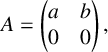 $$ \begin{align*} A=\begin{pmatrix} a & b \\ 0 & 0 \end{pmatrix}, \end{align*} $$
where $b\in \mathscr {L}_{1,1}$
is any fixed Liouville number and a is to be chosen later. Then,
$b\in \mathscr {L}_{1,1}$
is any fixed Liouville number and a is to be chosen later. Then, $A\in \mathscr {L}_{2,2}$
for any a not linearly dependent with
$A\in \mathscr {L}_{2,2}$
for any a not linearly dependent with $\{1,b\}$
over
$\{1,b\}$
over $\mathbb {Z}$
, since for any
$\mathbb {Z}$
, since for any $p,q$
$p,q$ $\vert q b{\kern-1pt}-{\kern-1pt}p\vert {\kern-1pt}={\kern-1pt}\Vert A\cdot (0,q)^{t}{\kern-1pt}-{\kern-1pt}(0,p)^{t}\Vert $
. First, consider just one function
$\vert q b{\kern-1pt}-{\kern-1pt}p\vert {\kern-1pt}={\kern-1pt}\Vert A\cdot (0,q)^{t}{\kern-1pt}-{\kern-1pt}(0,p)^{t}\Vert $
. First, consider just one function $f(z){\kern-1pt}={\kern-1pt}f_1(z){\kern-1pt}={\kern-1pt} \sum _{j\ge 0} c_j z^j$
. We find many a such that
$f(z){\kern-1pt}={\kern-1pt}f_1(z){\kern-1pt}={\kern-1pt} \sum _{j\ge 0} c_j z^j$
. We find many a such that  is not Liouville. Note first that
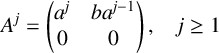 $$ \begin{align*} A^j= \begin{pmatrix} a^j & b a^{j-1} \\ 0 & 0 \end{pmatrix}, \quad j\ge 1 \end{align*} $$
so
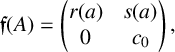
where
 $$ \begin{align*} r(z)=\sum_{j\ge 0} c_{j} z^j= f(z), \quad s(z)= \sum_{j\ge 0} bc_{j+1} z^{j}. \end{align*} $$
Hence,
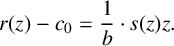 $$ \begin{align} r(z)-c_0 = \frac{1}{b}\cdot s(z)z. \end{align} $$
Then, for $\textbf {v}_a:=(r(a), s(a))\in \mathbb {R}^{1\times 2}$
, Proposition 1.3 implies
$\textbf {v}_a:=(r(a), s(a))\in \mathbb {R}^{1\times 2}$
, Proposition 1.3 implies  , with equality if $c_0=0$
(as the additional Diophantine condition on
$c_0=0$
(as the additional Diophantine condition on $|q_2 c_0-p_2|$
holds for
$|q_2 c_0-p_2|$
holds for $p_2=0$
if
$p_2=0$
if $c_0=0$
). So, it suffices to show
$c_0=0$
). So, it suffices to show $\omega ^{1\times 2}(\textbf {v}_a)= 2$
for many a.
$\omega ^{1\times 2}(\textbf {v}_a)= 2$
for many a.
Now, $\mathcal {C}: =\{ (r(a), s(a)): a\in \mathbb {R}\}$
defines an analytic curve in
$\mathcal {C}: =\{ (r(a), s(a)): a\in \mathbb {R}\}$
defines an analytic curve in $\mathbb {R}^2$
. We use a deep result from [Reference Kleinbock and Margulis8] to conclude. Let us call a planar curve locally parametrized by
$\mathbb {R}^2$
. We use a deep result from [Reference Kleinbock and Margulis8] to conclude. Let us call a planar curve locally parametrized by $(x,f(x))$
nondegenerate if the critical points of
$(x,f(x))$
nondegenerate if the critical points of $f^{\prime \prime }(x)$
, that is, where it vanishes or does not exist, occur only within a set x of Lebesgue measure
$f^{\prime \prime }(x)$
, that is, where it vanishes or does not exist, occur only within a set x of Lebesgue measure $0$
.
$0$
.
Theorem 5.2 (Kleinbock, Margulis).
Let $\mathcal {C}$
be a nondegenerate planar curve given by parametrization
$\mathcal {C}$
be a nondegenerate planar curve given by parametrization $(x(t),y(t))$
,
$(x(t),y(t))$
, $t\in I$
. Then, for almost all
$t\in I$
. Then, for almost all $t\in I$
with respect to Lebesgue measure, we have
$t\in I$
with respect to Lebesgue measure, we have $\omega ^{1\times 2}(x(t),y(t))=2$
.
$\omega ^{1\times 2}(x(t),y(t))=2$
.
So, if $\mathcal {C}$
above is nondegenerate, we know that for almost all a, the point
$\mathcal {C}$
above is nondegenerate, we know that for almost all a, the point $\textbf {v}_a$
indeed has Diophantine exponent
$\textbf {v}_a$
indeed has Diophantine exponent $2$
. By omitting additionally the countable set of a where (1-1) fails, that is, excluding elements
$2$
. By omitting additionally the countable set of a where (1-1) fails, that is, excluding elements $\mathbb {Q}$
-linearly dependent with
$\mathbb {Q}$
-linearly dependent with $\{ b,1\}$
, to make A a Liouville matrix, we are still left with a full measure set, so we are done. (In fact, such a do not exist as
$\{ b,1\}$
, to make A a Liouville matrix, we are still left with a full measure set, so we are done. (In fact, such a do not exist as $\mathbb {Q}$
-linear dependence directly implies
$\mathbb {Q}$
-linear dependence directly implies $\omega ^{1\times 2}(\textbf {v}_a)=\infty>2$
.)
$\omega ^{1\times 2}(\textbf {v}_a)=\infty>2$
.)
So, suppose conversely that $\mathcal {C}$
is degenerate. Since
$\mathcal {C}$
is degenerate. Since $\mathcal {C}$
is defined via analytic entry functions, the zeros of the according second derivative form a countable discrete set unless the second derivative is constantly zero, so the second derivative must vanish everywhere. However, this requires
$\mathcal {C}$
is defined via analytic entry functions, the zeros of the according second derivative form a countable discrete set unless the second derivative is constantly zero, so the second derivative must vanish everywhere. However, this requires
 $$ \begin{align*} \frac{d^2s(z)}{d^2r(z)}= \frac{ d (s_z/r_z) }{dr_z} = \frac{\frac{d(s_z/r_z)}{dz} }{\frac{dr}{dz}}= \frac{ s_{zz} r_z - s_z r_{zz} }{ r_z^3 }= 0 \end{align*} $$
identically or is identically undefined. If $s_z\equiv 0$
by (5-1), this yields
$s_z\equiv 0$
by (5-1), this yields $f(z)=r(z)=c_0+c_1 z$
for some real numbers
$f(z)=r(z)=c_0+c_1 z$
for some real numbers $c_0, c_1$
, among the functions (2-3) excluded in the theorem. So, assume
$c_0, c_1$
, among the functions (2-3) excluded in the theorem. So, assume $s_z\not \equiv 0$
. Then,
$s_z\not \equiv 0$
. Then, $r_z/s_z\equiv d$
is constant. We may assume
$r_z/s_z\equiv d$
is constant. We may assume $d\ne 0$
as
$d\ne 0$
as $d=0$
leads to
$d=0$
leads to $f(z)=r(z)=c_0$
constant, again excluded. Then, again by (5-1), the condition becomes
$f(z)=r(z)=c_0$
constant, again excluded. Then, again by (5-1), the condition becomes
 $$ \begin{align*} \frac{1}{b}\cdot \frac{s_z(z)z+s(z)}{s_z}= \frac{1}{b} (z+s/s_z) \equiv d \end{align*} $$
or $z+s/s_z\equiv g$
for a new constant
$z+s/s_z\equiv g$
for a new constant $g=bd$
. This is further equivalent to
$g=bd$
. This is further equivalent to
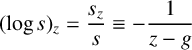 $$ \begin{align*} (\log s)_z= \frac{s_z}{s} \equiv -\frac{1}{z-g} \end{align*} $$
or $\log s= - \log |z-g|+ h$
for some h, and finally
$\log s= - \log |z-g|+ h$
for some h, and finally $s(z)= H/(z-g)$
for
$s(z)= H/(z-g)$
for $H=e^h$
. Hence,
$H=e^h$
. Hence,
 $$ \begin{align*} f(z)=r(z)= \frac{1}{b}\cdot s(z)z+c_0= c_0 + J\frac{z}{z-g}= c_0+J+\frac{Jg}{z-g}= \tilde{c}_0+ \frac{ \tilde{c}_1 }{z-g} \end{align*} $$
for some real numbers $J=H/b$
and
$J=H/b$
and $\tilde {c}_i=Jg$
, again of the form (2-3) excluded in the theorem. The argument for a single function is complete.
$\tilde {c}_i=Jg$
, again of the form (2-3) excluded in the theorem. The argument for a single function is complete.
We can apply this argument for any $f=f_k$
. Since we get a full measure set of
$f=f_k$
. Since we get a full measure set of $a\in \mathbb {R}$
for any
$a\in \mathbb {R}$
for any $k\ge 1$
, their countable intersection again has full measure. So
$k\ge 1$
, their countable intersection again has full measure. So $n=2$
is done.
$n=2$
is done.
For larger n, let us for simplicity denote simultaneously  derived from $f_k$
via (2-1) for matrices in arbitrary dimension (we use dimension
$f_k$
via (2-1) for matrices in arbitrary dimension (we use dimension $2$
,
$2$
, $n-2$
and n). Then, we can just take a matrix consisting of two diagonal blocks
$n-2$
and n). Then, we can just take a matrix consisting of two diagonal blocks
 $$ \begin{align*} A= \mathrm{diag}( A_2 , B ) \end{align*} $$
with $A_2\in \mathscr {L}_{2,2}$
as above and B any real
$A_2\in \mathscr {L}_{2,2}$
as above and B any real $(n-2)\times (n-2)$
matrix so that all
$(n-2)\times (n-2)$
matrix so that all  ,
, $k\ge 1$
, have irrationality exponents
$k\ge 1$
, have irrationality exponents  . For any k, it is easily seen that such B form a full Lebesgue measure set in $\mathbb {R}^{(n-2)^2}$
. Indeed, this follows from the locally bi-Lipschitz property of the analytic maps
$\mathbb {R}^{(n-2)^2}$
. Indeed, this follows from the locally bi-Lipschitz property of the analytic maps  obtained in Lemma 5.1 and a standard Khintchine-type result that the set of matrices
 $$ \begin{align*} \{ C\in \mathbb{R}^{(n-2)\times (n-2)}:\omega^{(n-2)\times (n-2)}(C)=1\} \end{align*} $$
has full Lebesgue measure in $\mathbb {R}^{(n-2)^2}$
. So, the same holds for the infinite intersection over
$\mathbb {R}^{(n-2)^2}$
. So, the same holds for the infinite intersection over $k\ge 1$
as requested. It is easily checked that any resulting
$k\ge 1$
as requested. It is easily checked that any resulting $A\in \mathscr {L}_{n,n}$
since
$A\in \mathscr {L}_{n,n}$
since $A_2\in \mathscr {L}_{2,2}$
and the system is decoupled. However, for
$A_2\in \mathscr {L}_{2,2}$
and the system is decoupled. However, for $n\ge 2, k\ge 1$
,
$n\ge 2, k\ge 1$
,

with equality in the inequality if $f_{k}(0)=0$
, where for the first identity, again we use that the system is decoupled (see also [Reference Hussain, Schleischitz and Ward7, Lemma 9.1]). So,
$f_{k}(0)=0$
, where for the first identity, again we use that the system is decoupled (see also [Reference Hussain, Schleischitz and Ward7, Lemma 9.1]). So,  .
.
Finally, as the set of suitable $a\in \mathbb {R}$
and
$a\in \mathbb {R}$
and $B\in \mathbb {R}^{(n-2)\times (n-2)}$
have full Lebesgue measure in the respective Euclidean spaces, the metrical claim follows from a standard estimate on the Hausdorff dimension Cartesian products
$B\in \mathbb {R}^{(n-2)\times (n-2)}$
have full Lebesgue measure in the respective Euclidean spaces, the metrical claim follows from a standard estimate on the Hausdorff dimension Cartesian products $\dim _H(X\times Y)\ge \dim _H (X)+\dim _H (Y)$
for measurable
$\dim _H(X\times Y)\ge \dim _H (X)+\dim _H (Y)$
for measurable $X,Y$
; see Tricot [Reference Tricot26].
$X,Y$
; see Tricot [Reference Tricot26].
Remark 5.3. By choosing b an ultra-Liouville number as defined in [Reference Marques and Ramirez14], the arising matrix A has an analogous property. This justifies Remark 2.8.
Remark 5.4. Alternatively, for $n\ge 3$
, we can consider
$n\ge 3$
, we can consider $A=\mathrm {diag}(A_2, A_2,\ldots ,A_2)$
for n even and
$A=\mathrm {diag}(A_2, A_2,\ldots ,A_2)$
for n even and $A=\mathrm {diag}(A_2, A_2,\ldots ,A_2, \{ \ell \})$
for n odd, where
$A=\mathrm {diag}(A_2, A_2,\ldots ,A_2, \{ \ell \})$
for n odd, where $\ell \in \mathbb {R}$
is a number all of whose evaluations
$\ell \in \mathbb {R}$
is a number all of whose evaluations $f_k(\ell )$
have exponent
$f_k(\ell )$
have exponent $\omega ^{1\times 1}(f_k(\ell ))=1$
(which again exists by the same metrical argument as in the proof above). However, this gives a weaker metrical bound
$\omega ^{1\times 1}(f_k(\ell ))=1$
(which again exists by the same metrical argument as in the proof above). However, this gives a weaker metrical bound $\lceil n/2\rceil $
.
$\lceil n/2\rceil $
.
6 Proof of Theorem 3.1
In view of condition (1-1), we need the following technical lemma. As for Lemma 5.1, possibly stronger claims are known, but we have found no reference, so we prove it directly using the metrical sparsity of zeros of multivariate real power series and the aforementioned Lemma 5.1.
Lemma 6.1. Let $n\ge 1$
be an integer,
$n\ge 1$
be an integer, $I\ni 0$
be an open interval and
$I\ni 0$
be an open interval and $f: I\to \mathbb {R}$
be any nonconstant analytic map. Let
$f: I\to \mathbb {R}$
be any nonconstant analytic map. Let $\mathcal {S}\subseteq \mathbb {R}^{n\times n}\cong \mathbb {R}^{n^2}$
be a proper affine subspace. Then, for
$\mathcal {S}\subseteq \mathbb {R}^{n\times n}\cong \mathbb {R}^{n^2}$
be a proper affine subspace. Then, for  the extension of f via (2-1), the preimage
  has
has $n^2$
-dimensional Lebesgue measure zero.
$n^2$
-dimensional Lebesgue measure zero.
Proof. The image  of some $A=(a_{i,j})$
has each entry a scalar power series in its
$A=(a_{i,j})$
has each entry a scalar power series in its $n^2$
scalar entries, say
$n^2$
scalar entries, say $P_{i,j}(a_{1,1},\ldots ,a_{n,n})\in \mathbb {R}[[X_1,\ldots ,X_{n^2}]]$
for
$P_{i,j}(a_{1,1},\ldots ,a_{n,n})\in \mathbb {R}[[X_1,\ldots ,X_{n^2}]]$
for $1\le i, j\le n$
. So, if
$1\le i, j\le n$
. So, if  lies in a proper affine subspace $\mathcal {S}$
with equation
$\mathcal {S}$
with equation $d_{0}+d_{1,1} x_1+\cdots + d_{n,n}x_{n^2}=0$
,
$d_{0}+d_{1,1} x_1+\cdots + d_{n,n}x_{n^2}=0$
, $d_0, d_{i,j}\in \mathbb {R}$
not all
$d_0, d_{i,j}\in \mathbb {R}$
not all $0$
, it satisfies some fixed scalar power series equation
$0$
, it satisfies some fixed scalar power series equation
 $$ \begin{align*} Q(a_{1,1},\ldots,a_{n,n})= \sum_{1\le i,j\le n} d_{i,j} P_{i,j}(a_{1,1},\ldots,a_{n,n})=0 \end{align*} $$
for $Q(a_{1,1},\ldots ,a_{n,n})\in \mathbb {R}[[X_1,\ldots ,X_{n^2}]]$
a power series in
$Q(a_{1,1},\ldots ,a_{n,n})\in \mathbb {R}[[X_1,\ldots ,X_{n^2}]]$
a power series in $n^2$
variables
$n^2$
variables $a_{1,1},\ldots ,a_{n,n}$
. If
$a_{1,1},\ldots ,a_{n,n}$
. If $Q\not \equiv 0$
does not vanish identically, it is well known and, for example, a consequence of the Lebesgue density theorem that only a set of Lebesgue measure zero in
$Q\not \equiv 0$
does not vanish identically, it is well known and, for example, a consequence of the Lebesgue density theorem that only a set of Lebesgue measure zero in $\mathbb {R}^{n^2}$
can satisfy such an identity, and we are done. So, assume
$\mathbb {R}^{n^2}$
can satisfy such an identity, and we are done. So, assume $Q\equiv 0$
. This means every
$Q\equiv 0$
. This means every $A\in \mathbb {R}^{n\times n}$
satisfies
$A\in \mathbb {R}^{n\times n}$
satisfies  , so
, so  . However, this forces f to be constant by Lemma 5.1, as otherwise, if f is not constant then the image $f(U)$
contains an open set, which is a contradiction.
$f(U)$
contains an open set, which is a contradiction.
For $n=1$
, the claim follows directly from [Reference Alniaçik and Saias2], noticing that any nonconstant analytic function on an interval I is nowhere constant on I by identity theorem (see also Section 1). For
$n=1$
, the claim follows directly from [Reference Alniaçik and Saias2], noticing that any nonconstant analytic function on an interval I is nowhere constant on I by identity theorem (see also Section 1). For $n>1$
, we reduce it to this case. Consider
$n>1$
, we reduce it to this case. Consider $A= \mathrm {diag}(a, B)$
for
$A= \mathrm {diag}(a, B)$
for $a\in \mathscr {L}_{1,1}$
any Liouville number as above, that is, such that
$a\in \mathscr {L}_{1,1}$
any Liouville number as above, that is, such that $f_k(a)\in \mathscr {L}_{1,1}$
as well, and B for the moment an arbitrary real
$f_k(a)\in \mathscr {L}_{1,1}$
as well, and B for the moment an arbitrary real $(n-1)\times (n-1)$
matrix. Since the
$(n-1)\times (n-1)$
matrix. Since the $f_k$
are analytic,
$f_k$
are analytic,

where by abuse of notation, we keep the notation  for the maps
  defined in the same way as in (2-1). Hence, the system of inequalities induced by
  decouples. So, $|q_1 f_k(a)- p_1|< q_1^{-N}$
for some
$|q_1 f_k(a)- p_1|< q_1^{-N}$
for some $p_1,q_1, N$
implies
$p_1,q_1, N$
implies $\textbf {p}=(p_1,0,\ldots ,0)^{t}$
and
$\textbf {p}=(p_1,0,\ldots ,0)^{t}$
and $\textbf {q}=(q_1,0,\ldots ,0)^{t}$
induce equally good approximations
$\textbf {q}=(q_1,0,\ldots ,0)^{t}$
induce equally good approximations  and
and $\Vert \textbf {q}\Vert =|q_1|$
, so
$\Vert \textbf {q}\Vert =|q_1|$
, so  . By irrationality of a, clearly
  and
and  ,
, $k\ge 0$
, satisfying (1-1) is equivalent, with
$k\ge 0$
, satisfying (1-1) is equivalent, with  the identity map. So, it suffices to show that a full measure set of B also gives rise to
  ,
, $k\ge 0$
, satisfying (1-1).
$k\ge 0$
, satisfying (1-1).
Choose B with the property that for any  ,
, $k\ge 0$
, there is no nontrivial relation
$k\ge 0$
, there is no nontrivial relation $C_k\textbf {q}_k-\textbf {p}_k=\textbf {0}$
with
$C_k\textbf {q}_k-\textbf {p}_k=\textbf {0}$
with $(\textbf {p}_k,\textbf {q}_k)\in \mathbb {Z}^m\times \mathbb {Z}^n$
. We show that this is possible. Indeed, any such relation restricts
$(\textbf {p}_k,\textbf {q}_k)\in \mathbb {Z}^m\times \mathbb {Z}^n$
. We show that this is possible. Indeed, any such relation restricts $C_k$
to a proper affine rational subspace
$C_k$
to a proper affine rational subspace $\mathcal {S}_k$
of
$\mathcal {S}_k$
of $\mathbb {R}^{(n-1)^2}$
, so the exceptional
$\mathbb {R}^{(n-1)^2}$
, so the exceptional  lie in the preimage of this subspace, and thus, by Lemma 6.1 applied for dimension $n-1$
and
$n-1$
and $\mathcal {S}=\mathcal {S}_k$
, form a set of Lebesgue measure zero. Since there are only countably many
$\mathcal {S}=\mathcal {S}_k$
, form a set of Lebesgue measure zero. Since there are only countably many $f_k$
and countably many relations (affine rational subspaces), a full measure set in the complement remains to choose B from those giving rise to A as in the theorem.
$f_k$
and countably many relations (affine rational subspaces), a full measure set in the complement remains to choose B from those giving rise to A as in the theorem.
7 Proof of Theorem 4.5
For claim (i), assume $A\in \mathbb {R}^{n\times n}$
is algebraic over
$A\in \mathbb {R}^{n\times n}$
is algebraic over $\mathbb {Z}[X]$
. Then,
$\mathbb {Z}[X]$
. Then, $P(A)=\textbf {0}$
for some nonzero
$P(A)=\textbf {0}$
for some nonzero $P\in \mathbb {Z}[X]$
. Assume
$P\in \mathbb {Z}[X]$
. Assume $A=B+C$
for some
$A=B+C$
for some $n\times n$
matrices
$n\times n$
matrices $B,C$
. Then, also
$B,C$
. Then, also $P(B+C)=\textbf {0}$
. However,
$P(B+C)=\textbf {0}$
. However, $P(X+Y)$
can be expanded into a bivariate (noncommutative) polynomial
$P(X+Y)$
can be expanded into a bivariate (noncommutative) polynomial $Q(X,Y)\in \mathbb {Z}[X,Y]$
, so that, in particular,
$Q(X,Y)\in \mathbb {Z}[X,Y]$
, so that, in particular, $P(A)=P(B+C)=Q(B,C)$
. Now, Q does not induce the zero function as otherwise, putting
$P(A)=P(B+C)=Q(B,C)$
. Now, Q does not induce the zero function as otherwise, putting $C=\textbf {0}$
, we would get that
$C=\textbf {0}$
, we would get that $Q(B,\textbf {0})=P(B)=\textbf {0}$
vanishes for all B, but since the polynomial ring in one variable is not a polynomial identity ring, this implies
$Q(B,\textbf {0})=P(B)=\textbf {0}$
vanishes for all B, but since the polynomial ring in one variable is not a polynomial identity ring, this implies $P(X)\equiv \textbf {0}$
, which is against our assumption. This means
$P(X)\equiv \textbf {0}$
, which is against our assumption. This means $B,C$
are not weakly algebraically independent. Taking the contrapositive, if
$B,C$
are not weakly algebraically independent. Taking the contrapositive, if $A=B+C$
holds for some weakly algebraically independent
$A=B+C$
holds for some weakly algebraically independent $B,C$
, then A is transcendental.
$B,C$
, then A is transcendental.
For claim (ii), given any real $n\times n$
matrix A, by Theorem 3.3, there is a dense
$n\times n$
matrix A, by Theorem 3.3, there is a dense $G_{\delta }$
set
$G_{\delta }$
set $\mathscr {H}_A\subseteq \mathscr {L}_{n,n}$
consisting of real
$\mathscr {H}_A\subseteq \mathscr {L}_{n,n}$
consisting of real $n\times n$
Liouville matrices B so that
$n\times n$
Liouville matrices B so that $A-B\in \mathscr {L}_{n,n}$
as well. We need to show that if A is not weakly algebraic, then for some B as above, the matrices
$A-B\in \mathscr {L}_{n,n}$
as well. We need to show that if A is not weakly algebraic, then for some B as above, the matrices $B, A-B$
are weakly algebraically independent over
$B, A-B$
are weakly algebraically independent over $\mathbb {Z}[X,Y]$
.
$\mathbb {Z}[X,Y]$
.
For given A and $P\in \mathbb {Z}[X,Y]$
not inducing the zero function over the matrix ring, denote by
$P\in \mathbb {Z}[X,Y]$
not inducing the zero function over the matrix ring, denote by $\mathscr {G}_{P,A}$
the set of
$\mathscr {G}_{P,A}$
the set of $B\in \mathbb {R}^{n\times n}$
with
$B\in \mathbb {R}^{n\times n}$
with $P(B,A-B)=\textbf {0}$
. Then,
$P(B,A-B)=\textbf {0}$
. Then, $\mathscr {G}_{P,A}$
is closed in
$\mathscr {G}_{P,A}$
is closed in $\mathbb {R}^{n\times n}$
by continuity. Assume
$\mathbb {R}^{n\times n}$
by continuity. Assume $\mathscr {G}_{P,A}$
has empty interior for all P. Then, by countability of
$\mathscr {G}_{P,A}$
has empty interior for all P. Then, by countability of $\mathbb {Z}[X,Y]$
, the complement of the union
$\mathbb {Z}[X,Y]$
, the complement of the union $\cup \mathscr {G}_{P,A}$
, taken over all
$\cup \mathscr {G}_{P,A}$
, taken over all $P\in \mathbb {Z}[X,Y]$
not inducing
$P\in \mathbb {Z}[X,Y]$
not inducing $\textbf {0}$
, is a dense
$\textbf {0}$
, is a dense $G_{\delta }$
set. Hence, as
$G_{\delta }$
set. Hence, as $\mathscr {H}_A$
is also dense
$\mathscr {H}_A$
is also dense $G_{\delta }$
, the set
$G_{\delta }$
, the set $\mathcal {T}_A:=(\cup \mathscr {G}_{P,A})^c\cap \mathscr {H}_A$
is again dense
$\mathcal {T}_A:=(\cup \mathscr {G}_{P,A})^c\cap \mathscr {H}_A$
is again dense $G_{\delta }$
, in particular, nonempty. Then, any
$G_{\delta }$
, in particular, nonempty. Then, any $B\in \mathcal {T}_A$
is suitable.
$B\in \mathcal {T}_A$
is suitable.
So assume otherwise for some nonzero $P\in \mathbb {Z}[X,Y]$
not inducing the
$P\in \mathbb {Z}[X,Y]$
not inducing the $\textbf {0}$
function, the set
$\textbf {0}$
function, the set $\mathscr {G}_{P,A}$
has nonempty interior. Since every entry of
$\mathscr {G}_{P,A}$
has nonempty interior. Since every entry of $P(B,A-B)\in \mathbb {R}^{n\times n}$
is a multivariate scalar polynomial in the
$P(B,A-B)\in \mathbb {R}^{n\times n}$
is a multivariate scalar polynomial in the $n^2$
entries of B, it is clear that then
$n^2$
entries of B, it is clear that then $\mathscr {G}_{P,A}=\mathbb {R}^{n\times n}$
is the entire matrix set. However, this means that there is a relation
$\mathscr {G}_{P,A}=\mathbb {R}^{n\times n}$
is the entire matrix set. However, this means that there is a relation $P(B,A-B)=\textbf {0}$
for some
$P(B,A-B)=\textbf {0}$
for some $P\in \mathbb {Z}[X,Y]$
not inducing the
$P\in \mathbb {Z}[X,Y]$
not inducing the $\textbf {0}$
function, and every B. However, we can expand
$\textbf {0}$
function, and every B. However, we can expand $P(Y,X-Y)$
into a bivariate polynomial in (noncommutative) standard form
$P(Y,X-Y)$
into a bivariate polynomial in (noncommutative) standard form $R(X,Y)$
,
$R(X,Y)$
, $R\in \mathbb {Z}[X,Y]$
, so that, in particular,
$R\in \mathbb {Z}[X,Y]$
, so that, in particular, $P(B,A-B)=R(A,B)$
for any B. On the one hand,
$P(B,A-B)=R(A,B)$
for any B. On the one hand, $R(A,B)=P(B,A-B)=\textbf {0}$
for all B. On the other hand, R does not induce the zero function either. Indeed, if so, this would mean
$R(A,B)=P(B,A-B)=\textbf {0}$
for all B. On the other hand, R does not induce the zero function either. Indeed, if so, this would mean $R(C_0, C_1)=P(C_1, C_0-C_1)=\textbf {0}$
for all
$R(C_0, C_1)=P(C_1, C_0-C_1)=\textbf {0}$
for all $C_0, C_1\in \mathbb {R}^{n\times n}$
, implying further that for any
$C_0, C_1\in \mathbb {R}^{n\times n}$
, implying further that for any $D_0, D_1\in \mathbb {R}^{n\times n}$
, if we let
$D_0, D_1\in \mathbb {R}^{n\times n}$
, if we let $C_1=D_0, C_0=D_0+D_1$
, we get
$C_1=D_0, C_0=D_0+D_1$
, we get $P(D_0, D_1)=P(C_1, C_0-C_1)=R(C_0, C_1)=\textbf {0}$
, which contradicts the assumption that P does not induce the
$P(D_0, D_1)=P(C_1, C_0-C_1)=R(C_0, C_1)=\textbf {0}$
, which contradicts the assumption that P does not induce the $\textbf {0}$
function. Combining these properties, we see that A is weakly algebraic (for
$\textbf {0}$
function. Combining these properties, we see that A is weakly algebraic (for $\ell =1$
), which is against our assumption. This argument shows that if A is not weakly algebraic, then there exist weakly algebraically independent
$\ell =1$
), which is against our assumption. This argument shows that if A is not weakly algebraic, then there exist weakly algebraically independent $B,C\in \mathscr {L}_{n,n}$
with
$B,C\in \mathscr {L}_{n,n}$
with $B+C=A$
.
$B+C=A$
.
8 Proof of Proposition 2.1 (Sketch)
We show that the Liouville property is invariant under the maps $A\to RA$
,
$A\to RA$
, $A\to AR$
for regular
$A\to AR$
for regular $R\in \mathbb {Q}^{n\times n}$
,
$R\in \mathbb {Q}^{n\times n}$
, $A\to A+T$
for
$A\to A+T$
for $T\in \mathbb {Q}^{n\times n}$
and
$T\in \mathbb {Q}^{n\times n}$
and $A\to A^{-1}$
for regular A. Then, clearly it is preserved for the matrices in the proposition that arise from composition of these operations. For
$A\to A^{-1}$
for regular A. Then, clearly it is preserved for the matrices in the proposition that arise from composition of these operations. For $A\to RA$
, it suffices to modify good approximation pairs
$A\to RA$
, it suffices to modify good approximation pairs $(\textbf {p}, \textbf {q})\in \mathbb {Z}^m\times \mathbb {Z}^n$
with respect to A via
$(\textbf {p}, \textbf {q})\in \mathbb {Z}^m\times \mathbb {Z}^n$
with respect to A via $(\textbf {p}^{\prime }, \textbf {q}^{\prime }):=(MN\cdot R\textbf {p}, MN\cdot \textbf {q})$
, for
$(\textbf {p}^{\prime }, \textbf {q}^{\prime }):=(MN\cdot R\textbf {p}, MN\cdot \textbf {q})$
, for $M,N\in \mathbb {Z}$
the common denominators of the rational entries of
$M,N\in \mathbb {Z}$
the common denominators of the rational entries of $R,S$
. Similarly, for
$R,S$
. Similarly, for $A\to AR$
, we take
$A\to AR$
, we take $(\textbf {p}^{\prime }, \textbf {q}^{\prime }):=(M^{\prime }\cdot \textbf {p}, M^{\prime }\cdot R^{-1} \textbf {q})$
for
$(\textbf {p}^{\prime }, \textbf {q}^{\prime }):=(M^{\prime }\cdot \textbf {p}, M^{\prime }\cdot R^{-1} \textbf {q})$
for $M^{\prime }\in \mathbb {Z}$
the common denominator of the rational matrix
$M^{\prime }\in \mathbb {Z}$
the common denominator of the rational matrix $R^{-1}$
. For
$R^{-1}$
. For $A\to A+T$
with a rational matrix T, write
$A\to A+T$
with a rational matrix T, write $T=T^{\prime }/N^{\prime }$
with an integer matrix
$T=T^{\prime }/N^{\prime }$
with an integer matrix $T^{\prime }$
and an integer
$T^{\prime }$
and an integer $N^{\prime }$
. Then, we take
$N^{\prime }$
. Then, we take $(\textbf {p}^{\prime }, \textbf {q}^{\prime }):=(N^{\prime }\cdot T^{\prime }\textbf {p}+ N^{\prime }\textbf {p}, N^{\prime }\cdot \textbf {q})$
. For
$(\textbf {p}^{\prime }, \textbf {q}^{\prime }):=(N^{\prime }\cdot T^{\prime }\textbf {p}+ N^{\prime }\textbf {p}, N^{\prime }\cdot \textbf {q})$
. For $A\to A^{-1}$
, we take the reversed vector
$A\to A^{-1}$
, we take the reversed vector $(\textbf {p}^{\prime }, \textbf {q}^{\prime }):=(\textbf {q}, \textbf {p})$
. Moreover, using
$(\textbf {p}^{\prime }, \textbf {q}^{\prime }):=(\textbf {q}, \textbf {p})$
. Moreover, using $R_i$
are invertible, it is clear that (1-1) is preserved for the obtained matrices. We leave the details to the reader.
$R_i$
are invertible, it is clear that (1-1) is preserved for the obtained matrices. We leave the details to the reader.
9 Final remarks on Theorem 2.3
We believe the metrical bound in Theorem 2.3 can be improved at least to ${(n-2)^2+2}$
. As the full set
${(n-2)^2+2}$
. As the full set $\mathscr {L}_{n,n}$
has Hausdorff dimension
$\mathscr {L}_{n,n}$
has Hausdorff dimension $n(n-1)$
; see [Reference Beresnevich and Velani3] for a considerably more general claim, in particular, this would be optimal for
$n(n-1)$
; see [Reference Beresnevich and Velani3] for a considerably more general claim, in particular, this would be optimal for $n=2$
. We sketch the proof of a special case. Let us restrict to finitely many polynomials
$n=2$
. We sketch the proof of a special case. Let us restrict to finitely many polynomials $f_k(z)= c_{0,k}+\cdots +c_{J,k} z^J$
,
$f_k(z)= c_{0,k}+\cdots +c_{J,k} z^J$
, $1\le k\le K$
, of degrees
$1\le k\le K$
, of degrees $J=J(k)$
at least two. For
$J=J(k)$
at least two. For $n=2$
, to obtain this result, we consider the larger class of matrices
$n=2$
, to obtain this result, we consider the larger class of matrices
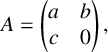 $$ \begin{align*} A=\begin{pmatrix} a & b \\ c & 0 \end{pmatrix}, \end{align*} $$
where again $b\in \mathscr {L}_{1,1}$
is fixed but
$b\in \mathscr {L}_{1,1}$
is fixed but $a,c$
are real parameters. Again,
$a,c$
are real parameters. Again, $A\in \mathscr {L}_{2,2}$
is easily seen as soon as a avoids some countable set. The powers of such matrices have the form
$A\in \mathscr {L}_{2,2}$
is easily seen as soon as a avoids some countable set. The powers of such matrices have the form
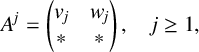 $$ \begin{align*} A^j= \begin{pmatrix} v_j & w_j \\ \ast & \ast \end{pmatrix}, \quad j\ge 1, \end{align*} $$
with $v_j, w_j$
polynomials in
$v_j, w_j$
polynomials in $a,c$
satisfying the recursions
$a,c$
satisfying the recursions
 $$ \begin{align*} v_j= a r_{j-1}+bc v_{j-2},\quad w_j= b v_{j-1}. \end{align*} $$
Now it can be shown with the inverse function theorem in place of the deep result from [Reference Kleinbock and Margulis8] that on a joint nonempty open set $V\subseteq \mathbb {R}^2$
, the maps
$V\subseteq \mathbb {R}^2$
, the maps $\theta _k: V\to \mathbb {R}^2$
,
$\theta _k: V\to \mathbb {R}^2$
, $1\le k\le K$
, defined by
$1\le k\le K$
, defined by
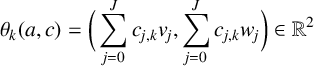 $$ \begin{align*} \theta_k(a,c)=\bigg(\sum_{j=0}^{J} c_{j,k} v_j, \sum_{j=0}^{J} c_{j,k} w_j\bigg)\in\mathbb{R}^2 \end{align*} $$
with image the first line of  , induce local diffeomorphisms onto their open images $\theta _k(V)=:V_k$
in
$\theta _k(V)=:V_k$
in $\mathbb {R}^2$
. By a Khintchine-type result, the images contain large (full measure within the total image
$\mathbb {R}^2$
. By a Khintchine-type result, the images contain large (full measure within the total image $V_k$
) subsets
$V_k$
) subsets $\mathscr {S}_k\subseteq V_k\subseteq \mathbb {R}^2$
of line vectors
$\mathscr {S}_k\subseteq V_k\subseteq \mathbb {R}^2$
of line vectors $\textbf {z}_{k}$
with exponents
$\textbf {z}_{k}$
with exponents $\omega ^{1\times 2}(\textbf {z}_{k})=2$
. Intersecting finitely many preimages
$\omega ^{1\times 2}(\textbf {z}_{k})=2$
. Intersecting finitely many preimages $\mathscr {S}:= \cap \theta _k^{-1}(\mathscr {S}_k)$
over
$\mathscr {S}:= \cap \theta _k^{-1}(\mathscr {S}_k)$
over $1\le k\le K$
, by the locally Lipschitz property of
$1\le k\le K$
, by the locally Lipschitz property of $\theta _k^{-1}$
, we still get a full measure set
$\theta _k^{-1}$
, we still get a full measure set $\mathscr {S}\subseteq V\subseteq \mathbb {R}^2$
within V. For any pair
$\mathscr {S}\subseteq V\subseteq \mathbb {R}^2$
within V. For any pair $(a,c)\in \mathscr {S}$
with corresponding matrix A, as
$(a,c)\in \mathscr {S}$
with corresponding matrix A, as $\textbf {z}_k$
is the first row of
$\textbf {z}_k$
is the first row of  , by Proposition 1.3, we have
  , in fact,

This finishes the proof for $n=2$
. The extension to larger n works by considering diagonal blocks analogously to the proof of Theorem 2.3. This method also allows us to show that regular matrices A satisfy this relaxed version of Theorem 2.3.
$n=2$
. The extension to larger n works by considering diagonal blocks analogously to the proof of Theorem 2.3. This method also allows us to show that regular matrices A satisfy this relaxed version of Theorem 2.3.
Presumably, the case of countably many analytic functions not of the form (2-4), as in Theorem 2.3, instead of finitely many polynomials, can be treated with some refined argument. The finiteness is only used in the above argument to guarantee a joint open set for all functions $f_k$
simultaneously on which to apply the inverse function theorem; as for transitioning to (almost) arbitrary analytic functions, it may be intricate to verify the regularity hypothesis of the inverse function theorem in this general setup. It may happen that some more analytic functions have to be excluded to achieve this.
$f_k$
simultaneously on which to apply the inverse function theorem; as for transitioning to (almost) arbitrary analytic functions, it may be intricate to verify the regularity hypothesis of the inverse function theorem in this general setup. It may happen that some more analytic functions have to be excluded to achieve this.
Acknowledgement
The author thanks the referee for their careful reading and for providing a reference to the recent relevant article [Reference Lelis, Marques and Moreira10].


 Open access

