





Impact statement
This article explores the relevance of NBS scenarios for coastal risk management in the Authie Bay, compared to the present-day system of coastal protection and a reinforcement scenario. What are the concerns and misconceptions that limit the implementation of these projects on the coast? To what extent are they justified and objective? To address this issue, we compared perception data from a social survey with modelling data. Thus, this article aims to go beyond the general misconceptions that surround coastal NBS. The results provide a useful basis for discussion (on the advantages and disadvantages) of NBS with local stakeholders (to determine the best coastal management strategy).
Introduction
The concept of nature-based solutions (NBSs) first appeared in 2008, in a report from the World Bank, and is defined by the International Union for Conservation of Nature (IUCN) as:
“Nature-based Solutions (NBS) are actions to address societal challenges through the protection, sustainable management and restoration of ecosystems, benefiting both biodiversity and human well-being.” (Cohen-Shacham et al., Reference Cohen-Shacham, Walters, Janzen and Maginnis2016).
This definition is currently the most widely used (Sowińska-Świerkosz and García, Reference Sowińska-Świerkosz and García2022). The notion is vast and raises several challenges that are social, economic and environmental in nature (Eggermont et al., Reference Eggermont, Balian, Azevedo, Beumer, Brodin, Claudet, Fady, Grube, Keune, Lamarque, Reuter, Smith, Van Ham, Weisser and Le Roux2015). It is supposed to apply to any type of environment or context, from the urban “heat island” effect to coastal risk management.
In the latter case, the notion of NBS seems to uphold the principles of managed realignment and depoldering – developed in Western Europe since the 1980s (Goeldner-Gianella, Reference Goeldner-Gianella2013; Esteves, Reference Esteves2014), and in Northern America since the 2000s (Murphy et al., Reference Murphy, Cornett, van Proosdij and Mulligan2024). First developed from an environmental and compensation perspective, this type of project gradually started taking risk management objectives into account (Goeldner-Gianella, Reference Goeldner-Gianella2013) and, more recently, blue carbon targets. The managed realignment principle, in the United Kingdom, pursues three types of objectives to compensate for the loss of intertidal habitats resulting from anthropic pressure, develop sustainable coastal risk management, and provide ecosystem services (Esteves, Reference Esteves2014). These goals echo the objectives of NBS (IUCN, 2016). Moreover, these types of policies tend to compensate for the 50% of the salt marshes lost or degraded around the world due to the intensification of human activities and reaffirm their importance in terms of ecosystem services (Barbier et al., Reference Barbier, Hacker, Kennedy, Koch, Stier and Silliman2011; Dale and Arnall, Reference Dale and Arnall2024). Coastal and estuarine NBS projects tend to increase in Europe, with the diffusion of the notion (Moraes et al., Reference Moraes, Reguero, Mazarrasa, Ricker and Juanes2022).
Despite these commendable objectives, depoldering and managed realignment projects can encounter social rejection, as people often feel a deep-rooted connection to the land and perceive a heritage value (Goeldner-Gianella and Imbert, Reference Goeldner-Gianella and Imbert2005). This may be compounded by a general overestimation of the protection provided by the dykes (Baan and Klijn, Reference Baan and Klijn2004) and the lack of knowledge on ecosystem services and natural coastal habitats (Goeldner-Gianella and Imbert, Reference Goeldner-Gianella and Imbert2005; Goeldner-Gianella et al., Reference Goeldner-Gianella, Grancher, Avdeew, Godoy Leski, Carré and Douillard2024). On the other hand, salt marshes have been subject to many monitoring projects (Bertrand et al., Reference Bertrand, Goeldner-Gianella, Anselme, Durand, Thomas, Sottolichio, Sénéchal, Meur-Férec and Hénaff2014), and numerical models illustrate the conditions required for them to be effective in flood risk mitigation (Vuik et al., Reference Vuik, Borsje, Willemsen and Jonkman2019; Shah et al., Reference Shah, Xu, Carisi, De Paola, Di Sabatino, Domeneghetti, Gerundo, Gonzalez-Ollauri, Nadim, Petruccelli, Polderman, Pugliese, Pulvirenti, Ruggieri, Speranza, Toth, Zieher and Renaud2023), along with the optimal positioning of breeches for restoration (Esteves, Reference Esteves2014). This can provide evidence-based data for managed realignment as an NBS. However, although modelling is increasingly used as a tool to raise awareness among stakeholders (Taillandier et al., Reference Taillandier, Moaty, Curt, Di Maiolo, Beullac, Brueder and Cépaduès2022; Antoine et al., Reference Antoine, Abasq, Loudin, Rinaudo, David and Poussin2023; Cornejo et al., Reference Cornejo, Sherren, Lundholm, van Proosdij and Bennett2025), modelling results have rarely been used to illustrate the misconceptions surrounding flood risk and marshland restoration in public perception (Elineau et al., Reference Elineau, Longépée, Goeldner-Gianella, Nicolae-Lerma, Durand and Anselme2021).
This article therefore sets out to make such a comparison, through the modelling of dyke relocation scenarios previously presented to the population during a perception survey in the Authie Bay on the coast of the English Channel in northern France. This study addresses several research questions: (a) does the population in the Authie Bay understand flood risks? (b) What factors encourage the social acceptability of flood management scenarios such as hard defence or managed realignment? (c) Is there a gap between perceived performance of flood risk management options and evidence-based (i.e. model-simulated) outcomes and, if so, what are possible reasons for this? (d) What role could this comparison between public perception and model outcomes play in coastal risk management decision-making? Following a more detailed description of the Authie Bay area and of the methodologies used for the perception survey and the numerical model, this article presents the results of each study. They are then cross-referenced and discussed to highlight potential misalignments between perceptions and model outcomes, and the insights these results can offer regarding the relevance of dyke realignment and informed decision-making.
Study area
French context
Historically characterised by a strict separation of risk management and aquatic environment management responsibilities, the French context has gradually shifted towards more integrated and flexible coastal management approaches since the 1980s, under the influence of environmental movements (Goeldner-Gianella, Reference Goeldner-Gianella2013). It was, however, Storm Xynthia in 2010 that led to a major increase in risk management awareness, with the creation of the Programmes d’actions de prevention des inondations (PAPI) – local-level flood prevention programmes (Mercier and Chadenas, Reference Mercier and Chadenas2012). This policy paved the way for the 2018 implementation of the Gestion des milieux aquatiques et la prevention des inondations (GEMAPI), the French framework for aquatic environment and flood protection management. This new legislation aims to bring together two areas of responsibility that were previously separate. In this way, the GEMAPI appears to offer a favourable context for the development of NBS in coastal risk management projects.
The notion of NBS is now widespread at the local level in France, based on the IUCN definition and adopted by the water boards and semi-public structures like the Centre for Studies on Risks, Environment, Mobility and Urban Planning (CEREMA) or the Conservatoire du Littoral – the French coastal protection agency. Depoldering projects for coastal risk management have proliferated over the past 10 years – especially through the Life Adapto and Adapto + projects, led by the Conservatoire du Littoral since 2015 – and are gradually requalified as NBS. The water boards, regions and the European Union have also begun tying funding allocations to NBS projects and a national funding programme for pilot coastal projects was launched in 2024.Footnote 1 Despite this favourable context, on-the-ground implementation of NBS remains limited.
The Authie Bay: Morphology and governance
Located between the Pas-de-Calais and Somme counties in northern France, the bay is formed by the mouth of the Authie River. The interior of the bay is a low-lying salt marsh area, periodically flooded by the tide and offering a wide variety of landscapes, ranging from mudflats to high marsh. The high marsh is flooded during the spring tides, and on the southern side of the bay, the marshes are subject to sedimentation (Verger, Reference Verger1988).
These marshes are significantly less extensive than they once were, owing to the dyking and drainage practices conducted in the area since the 12th century to gain farmland (Verger, Reference Verger2009). Based on data collected on site, land reclamation continued until 1835 for the northern area of the bay and 1862 for the southern area (Figure 1) (Verger, Reference Verger2009); this southern area is examined further here. Nowadays, the old dykes that line the low-lying areas are barely visible to the naked eye but still serve as historical markers. Two breaches formed in the southern line of dykes due to consecutive storms during the spring tides in 1984 and 1985, allowing water to enter the reclaimed areas.
Map of the dyking stages of the Authie Bay (Diasparra and Avdeew, 2025), based on Dallery (Reference Dallery1955, p. 3).

The Authie Bay area now reflects a mix of recreational activities and environmental priorities within a challenging context for flood-protection governance. Tourism competes with agricultural and hunting uses in the low-lying areas; there are around 70 waterbird hunting huts in the marshes and adjacent lands. The site is also chequered with protected areas owing to its fragile marshland biodiversity.
Following Storm Xynthia in 2010, a PAPI plan was implemented for the three estuaries of the Bresle, the Somme and the Authie rivers (an area known as “BSA”) (Figure 1), bringing together the inter-municipal local authorities of the northern and southern parts of Authie Bay. This first PAPI recommended a reinforcement and raising of the main part of the dykes, and the creation of a second line of dykes in the inner area of the bay (Artelia, 2015). The 2016 and 2019 PAPI updates reaffirmed this approach, given the poor condition of the first line of dykes and their exposure to strong currents (Artelia, 2021). In addition, the 2018 implementation of the GEMAPI plan brought about an evolution in governance dynamics, leading stakeholders to better consider NBS scenarios, through the partial opening of some of the dyked areas.
Research methodologies
The results presented in this article are part of a PhD supervised by the Laboratory of Physical Geography (UMR 8591, or LGP), in collaboration with the firm Artelia. The Authie Bay has been analysed by both the LGP – as part of the ANR DIGUES research programme (2019–2024) – and Artelia, which has been working with local stakeholders since 2014 to define and implement the PAPI Bresle-Somme-Authie (BSA) plan. These studies were unrelated. However, as part of the research collaboration required by the PhD, we found it useful to cross-reference the LGP’s field data with Artelia’s technical records.
Social survey
The first part of the data used in this research comes from the DIGUES research programme. Seven sites were studied in all, including the Authie Bay. The aim was to analyse the perception of coastal and river dykes in France in a context of global change, whether climatic, social or legislative (GEMAPI). The programme set out to define potential dyke evolutions, covering four angles: flood protection, uses, nature and landscape. A questionnaire-based survey was conducted in 2021 to collect perceptions and representations of the dykes, both from residents and non-resident users of the site (Goeldner-Gianella et al., Reference Goeldner-Gianella, Grancher, Avdeew, Godoy Leski, Carré and Douillard2024).
The first part of the questionnaire, common to all sites, comprised a series of questions grouped in four subsections: landscape, uses, protection and nature. For this article, we drew on questions from all but the “uses” subsection (Table 1) (the complete list of the questions from the survey is available in Goeldner-Gianella et al. (Reference Goeldner-Gianella, Grancher, Avdeew, Godoy Leski, Carré and Douillard2024).
DIGUES survey questions used in this article

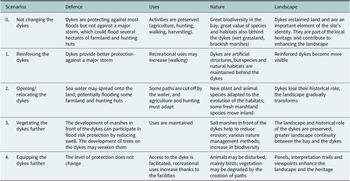
The second part focused on potential dyke evolution scenarios, projected 30 years forward. For each site, five similar scenarios were defined and adapted to the local context (Table 2). During the survey, a detailed table for each scenario was shown to the respondents, presenting both their positive and negative effects. They were then asked whether they thought the scenario was desirable for the future. For the present study, we consider that scenarios 2 (opening or relocating dykes) and 3 (vegetating the dykes further) are consistent with an NBS, insofar as the marshes are restored and mobilised for flood risk reduction. It is, however, important to mention that the term “NBS” was not explicitly used to describe these scenarios during the survey.
DIGUES survey scenarios as presented to the respondents

A total of 129 people in the Authie Bay answered the survey. The respondents are mainly residents (84%), of whom only 14% are secondary residents. The group was 64% male, 43% retired and 44% aged over 60, reflecting the area’s demographics. The sample of respondents also includes 15% dyke owners and 6% farmers – two profiles specifically targeted because they would be the first to be affected by the dyke evolution scenarios.Footnote 2 For this study, we chose to focus only on answers given by residents (109 respondents). A detailed table of questions and answers – for both overall and residents’ answers – with percentages is listed in the Supplementary Material.
Numerical modelling
A numerical model was developed by Artelia for the PAPI BSA. It simulates sea flooding caused by meteorological events of various intensities, overflow of the dykes due to surge (with or without breach) and wave overtopping (Artelia, 2015; Bertrand et al., Reference Bertrand, Oudart, David, Le Dissez and Coulet2019). It is based on the TELEMAC software (version V8P2R0). It maps water levels under the combined effects of tide, swell and river flow, making it a dedicated tool for local-scale flood-risk mapping. The configuration of the numerical model was calibrated and validated based on historical events, both in the Somme Bay and the Authie Bay (Levasseur et al., Reference Levasseur, Arnaud, Daou, Sigwald, Janin and Avdeew2025).
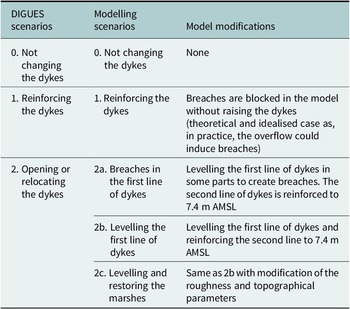
For research purposes – and not as part of the PAPI BSA – this model was later used to illustrate the scenarios studied in the DIGUES research programme. As scenario 2 (opening or relocating dykes) is closer to an NBS, according to the IUCN definition, it seemed useful to represent it in the model, to analyse potential gaps between the population’s perception of it and the more objective model outputs. Using scenario 2 along with the baseline scenarios (0 and 1: dykes maintained in their current state and reinforced dykes) for comparison, five modelling scenarios were defined for the Authie Bay (Table 3):
Modelled scenarios based on DIGUES scenarios (Janin, Reference Janin2024)

Here, the NBS is defined as dyke relocation combined with salt marsh restoration, achieved by creating breaches in the first line of defence. Scenarios 2a, 2b and 2c in the model correspond to scenario 2 (opening or relocating dykes) in the DIGUES survey. Scenario 2c is equivalent to scenario 2b several decades after the opening of the dykes, with the salt marsh restored. The topography of the open area was thus adjusted to match that of the existing marshlands before the dykes. For these relocation scenarios, the second dyke line was reinforced to an elevation of 7.4 m above mean sea level (AMSL).
As the elevation of the dyked area is quite low, it was assumed that breaching the dykes and restoring the salt marsh would result in sedimentation of the land, raising it to the altimetric level of the existing marsh. Furthermore, the evolution of the natural environment would most likely expand the high marsh, which is currently sparse in the area before the dykes, and encourage the growth of taller vegetation that could help attenuate water flow. The breach locations in the model were determined based on sensitive points identified during an exploratory field mission in April 2024, as well as the location of the breaches that occurred during the 1984 and 1985 storms. Drawing on the results of the PAPI BSA plan and discussions with local stakeholders, it was decided to test a more ambitious relocation of the dykes, involving the use of the second line of defence.
The configuration of the initial model (bathymetry, mesh and configuration of the dykes) was modified for these scenarios (Janin, Reference Janin2024). Each modelled scenario was tested for two types of hydro-meteorological events (E):
-
- E1: Annual water levels and annual wave conditions – as for a spring tide coupled with a weak storm in the Authie Bay.
-
- E2: Centennial water levels and annual wave conditions.
The mean annual discharge of the Authie River is used in both cases.
Results
Social survey
The DIGUES survey revealed two interesting types of results that contribute to a better understanding of how flood risk and management options are perceived locally: the attachment to the current landscape of the bay and the sense of protection associated with the dykes.
First, the survey showed a strong appreciation of the bay’s landscape among the respondents. When asked about the dyke landscape, 57% described it as “both natural and artificial,” 73% saw it as “protecting nature” and 47% considered it “nature-friendly.” These results can be explained by the dykes’ heavily vegetated state, resulting from a lack of maintenance. This fixed perception of the landscape is closely linked to an appreciation of the heritage value of the dykes: 90% of the locals agreed that the dykes are part of the local heritage, and 83% of them reported feeling personally attached to them. This appreciation for the bay’s landscape is further reflected in the response to scenario 0 (not changing the dykes), which was the most favoured, with 70% answering positively to the question, “Do you think this scenario is desirable for the future?”
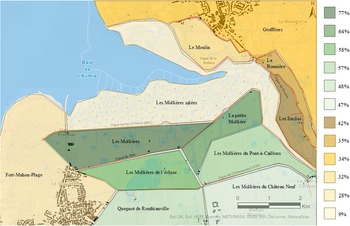
Second, the survey showed a general sense of protection among the population. When asked about the protection provided by the dykes, 92% of the locals believed that they are fulfilling their role in their current state. Moreover, when asked to show the areas protected by the dykes on a map of the bay, respondents mainly pointed to the areas located immediately behind the southern dykes (Figure 2).
Map of the percentages per answers to the question “Can you indicate on the map the areas protected by the dykes against sea flooding?” (109 respondents, Avdeew, Reference Avdeew2021).

The importance placed on the protection provided by the dykes is confirmed in the responses to scenario 1 (reinforcing the dykes). This scenario is better accepted by the locals (49% of positive responses) than scenario 2 (opening or relocating), despite its greater visual impact on the landscape with more prominent dykes. Scenario 2 (opening or relocating) was one of the least well received in the study, with 78% of locals expressing a negative opinion (including “not really,” “not at all” and “don’t know” answers). When asked to explain their reasons for rejecting this option, respondents mentioned their attachment to the existing landscape and the fear of too great a change (34% of respondents), but also concerns over reduced protection (25%) and potential land loss (17%). Ultimately, the perceived protective value of scenario 1 (reinforcing the dykes) appears to be the main reason for its more favourable reception compared to scenario 2 (opening or relocating).
Although the survey revealed significant reservations about dyke relocation, scenario 3 (further vegetating dykes) offers more interesting perspectives on the potential acceptability of NBS, with 61% of locals viewing it positively. Unlike scenario 2 (opening or relocating), the wording of Scenario 3 (further vegetating dykes) explicitly mentions the role of both the salt marshes in front of the dykes and the vegetation on the dykes themselves in reducing flood risk. It should, however, be noted that this scenario is relatively close to the current situation in the Authie Bay, where the dykes are already heavily vegetated. This similarity may partly explain the greater acceptance of Scenario 3 (further vegetating dykes), which was perceived as an improvement on Scenario 0 (not changing the dykes), offering better protection through the presence of the salt marshes.
Modelling study
The tests conducted using the numerical model yielded three types of results, concerning (i) the poor state of the current dykes, (ii) the limitations of scenario 1 (reinforcing the dykes) and (iii) the effects of various dyke relocation options on flood risk mitigation.
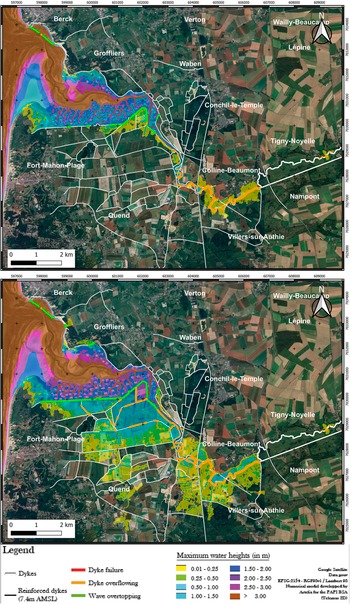
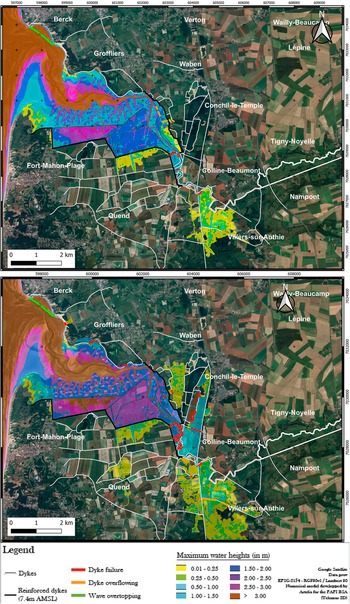
The modelling results for scenario 0 (not changing the dykes) highlight the degraded state of the dykes (Figure 3), in line with findings from the PAPI BSA studies (Artelia, 2021). In fact, under event E1, both the first and second dyke lines would be breached, with some overflow occurring at the third line, leading to the flooding of farmland (Figure 3). Under event E2, the flooding intensifies and extends upstream into the Colline-Beaumont and Villers-sur-Authie areas, again due to breaches in the dykes (Figure 3). With this type of event, the flooding is so severe that the waters spread as far as the Somme Bay, approximately 11 km south.
Scenario 0 (not changing) modelled for event E1 (top) and event E2 (bottom) (Janin, Reference Janin2024).

The first flood management option modelled is scenario 1 (reinforcing the dykes). It shows a highly idealised situation in which the dykes are considered unbreakable and retain the same height as the existing dykes. In this configuration, flooding only occurs through overflow with no breaches, regardless of the type of storm. Under event E1, this scenario limits the flooding around the bay itself but directs tidal waters further upriver, causing floods in the Colline-Beaumont and Tigny-Noyelle areas (Figure 4). This could also lead to increased soil salinity in the affected farmland. Under E2, overflow intensifies around the bay for Scenario 1 (reinforcing the dykes) and inland flooding worsens due to reduced flow capacity associated with the rise in the Authie River’s water level (Figure 4). The current dyke height is insufficient to contain an extreme event, even in this reinforced scenario. Overall, this scenario would imply a complete reconstruction of the dyke system and involve significant maintenance costs. It would also have a greater visual impact on the landscape, due to the removal of the existing shrubbery.
Scenario 1 (reinforcing) modelled for E1 (top) and E2 (bottom) (Janin, Reference Janin2024, p. 10).

The second flood management option modelled is scenario 2a (relocation with breaches). Under event E1, the reopened area effectively contains the floodwaters, preventing them from progressing upriver (Figure 5). However, this would also imply a transformation of the landscape, as the flooded areas would gradually evolve into salt marshes, like the rest of the bay. For event E2, scenario 2a (relocation with breaches) indicates an absence of overflow along the relocated dyke line. Nonetheless, the flooding extends into the Conchil-le-Temple and Villers-sur-Authie sectors upstream (Figure 5). These results demonstrate the effectiveness of relocating and reinforcing the second dyke line to 7.4 m AMSL, but also reveal that they are not sufficient to withstand an extreme storm event.
Scenario 2a (relocation with breaches) modelled for E1 (top) and E2 (bottom) (Janin, Reference Janin2024, p. 11).

The third and fourth flood management options modelled are scenarios 2b (relocation with levelling) and 2c (2b combined with salt marsh restoration), designed to explore the potential role of a high marsh in flood mitigation. The results obtained for these scenarios differ slightly from those for scenario 2a (relocation with breaches).
Under event E1, scenario 2b (relocation with levelling) results in some flooding behind the second dyke line and along the river (Figure 6). Levelling the first line of dykes increases tidal energy across the estuary floor and raises water levels upstream, placing greater pressure on the riverbanks and leading to flooding along the Authie River. Unlike scenario 2a (relocation with breaches), this could also lead to salinisation of riverine habitats, under frequent events. Similarly, in scenario 2c (2b with salt marsh restoration) under event E1, minor flooding can be observed behind the dykes and upstream (Figure 7).
Scenario 2b (relocation with levelling) modelled for E1 (top) and E2 (bottom) (Janin, Reference Janin2024, p. 12).

Scenario 2c (2b with salt marsh restoration) modelled for E1 (top) and E2 (bottom) (Janin, Reference Janin2024, p. 13).

For E2, neither scenario 2b (relocation with levelling) nor scenario 2c (2b with salt marsh restoration) is able to fully contain the flooding – much like scenario 2a (relocation with breaches) (Figure 6 and Figure 7). In both cases, flooding behind the second dyke line remains limited, but more significant flooding occurs along the Authie River, caused by dyke breaching and overflow (Figures 6–7).
Scenario 2a (relocation with breaches) helps to limit flooding along the river during an annual event, by containing part of the floodwaters and reducing the areas at risk. Scenarios 2b (relocation with levelling) and 2c (2b with salt marsh restoration) increase the flood hazard due to the levelling of the dykes. The breaches in Scenario 2a (relocation with breaches) therefore contribute to reducing flood risks by slowing water flow, as the older dyke sections act as barriers. However, in the event of a major storm, none of the modelled scenarios successfully contain the full extent of flooding.
Discussion
A clear gap between perceived and modelled protection
First, the modelling results indicate a clear gap between how NBS-like scenarios are perceived and their potential effectiveness in the event of flooding. While the term “nature-based solution” was not explicitly used during the survey, the details provided for scenarios 2 (opening or relocating the dykes) and 3 (further vegetating the dykes) are consistent with the expectations of an NBS and offer insight into how such approaches are perceived locally. However, the wording of scenario 2 (opening or relocating – not emphasising the potential restoration of a salt marsh in the opened area) can partly explain why it was rejected. It is likely that it was not perceived as a solution but rather as an admission of failure in the face of rising sea levels.
The widespread attachment to the existing landscape appears central to the rejection of dyke relocation (Goeldner-Gianella and Imbert, Reference Goeldner-Gianella and Imbert2005) and to greener solutions like NBS. This attachment can be explained by the historical and cultural context, in which a fixed landscape holds symbolic value. The respondents expressed significant confidence in the dykes built by the “ancestors,” frequently emphasising that these structures had “always held up.”Footnote 3 This connection to the past and the perceived heritage value leads to an underestimation of the dykes’ current condition and of the effects of climate change and rising sea levels – factors that could justify dyke relocation (Baan and Klijn, Reference Baan and Klijn2004). Moreover, the perception of the dykes as “natural” explains the limited enthusiasm for the realignment scenario. For many respondents, restoring natural habitats does not appear necessary, as they already view the dykes as natural features (Goeldner-Gianella et al., Reference Goeldner-Gianella, Grancher, Avdeew, Godoy Leski, Carré and Douillard2024). Together, these elements help explain the gap between public perception and the outcomes of the modelled scenarios.
While the rejection of scenario 2 (opening or relocating) in the survey can be partly be explained by how it was worded, it also reflects a lack of public knowledge regarding dyke realignment and the role of natural habitats in flood protection. Several surveys conducted in the 2000s in the Netherlands (Baan and Klijn, Reference Baan and Klijn2004), France and the United Kingdom (Goeldner-Gianella and Imbert, Reference Goeldner-Gianella and Imbert2005) confirm this tendency. The DIGUES survey further reinforces this interpretation, highlighting an underestimation of the risk among respondents.
The strong support for scenario 0 (not changing the dykes) and the population’s expressed confidence in the protection provided by the dykes are challenged by the model outputs. The current dyke system cannot be relied upon to withstand even a moderate event combining annual water levels and wave conditions – let alone a centennial event. In their current state, they may breach, leading to the flooding of several kilometres of land south of the bay. Moreover, reinforcing the first line of dykes could exacerbate upstream flooding. The modelling of the survey scenarios reveals a clear mismatch between perceived protection and potential risks.
This gap is clearly illustrated by comparing the population’s perception map of protected areas (Figure 2) with the modelling results for Scenario 0 (not changing the dykes) under events E1 and E2 (Figure 3). Although both maps identify similar areas as at risk, the model shows floodwaters extending further south, particularly during a centennial event. A similar pattern was observed in Leucate, where residents displayed a highly localised perception of risks, despite modelled scenarios indicating a more extensive spread of flooding (Elineau et al., Reference Elineau, Longépée, Goeldner-Gianella, Nicolae-Lerma, Durand and Anselme2021). Consequently, fears about a lack of protection may be unfounded – at least in the case of an annual event. In fact, scenario 2a (relocation with breaches) offers better protection for upstream sectors, compared to scenario 1 (reinforcing the dykes), which mainly protects the areas immediately adjacent to the bay. By modelling the three variations of scenario 2 (opening or relocating), the concern over inadequate protection can be addressed and the most effective form of realignment identified.
Assessing the relevance of dyke relocation and the allocated area
Second, the comparison between public perception and the model outcomes highlights the relevance of dyke relocation in the local context. The modelling provides useful insight into how a combination of NBS and reinforcement of the second dyke line could be optimised. However, the strong attachment to the existing, fixed landscape of the bay does not leave a lot of room for the other evolution scenarios.
These results underscore the importance of scaling NBS projects and, more generally, marshland restoration projects. Two factors must be considered here. First, the scale of the NBS must be adapted to the magnitude of the event, whether an annual or a centennial storm event. In this study, the proposed dyke relocation is further back than the alignment defined in the 2019 PAPI BSA.
The second factor concerns the conditions for implementation of the NBS. The modelling results show that dyke relocation with breaches offers considerable benefits in the case of an annual event E1: the remaining sections of the old dyke help slow water flow and therefore reduce overflow risks along the reinforced second line. Moreover, these remaining sections of the dyke facilitate marshland restoration by contributing sediments as they gradually erode (Bertrand et al., Reference Bertrand, Goeldner-Gianella, Anselme, Durand, Thomas, Sottolichio, Sénéchal, Meur-Férec and Hénaff2014; Goeldner-Gianella and Bertrand, Reference Goeldner-Gianella and Bertrand2014). Thus, despite its lack of public support and based on the model outcomes, scenario 2 (opening or relocating) with realignment of the second dyke line could contain flooding within the reopened area (Figure 4).
In the case of the Authie Bay, an NBS without dyke relocation is not feasible. The site’s geomorphology makes such a scenario unlikely in the short term since the dyked areas link the Authie Bay to Somme Bay, 11 km to the south. Moreover, the presence of agricultural and hunting activities in the low-lying lands further restricts the potential for reopening these areas. The relocated dyke alignment proposed in this study accounts for these constraints, as well as the ongoing salinisation of land closer to the first dyke line. In this context, the model outcomes support the relevance of a mixed approach, combining an NBS through reopening and restoration of a salt marsh, with maintenance of a relocated dyke line.
The choice between reinforcement and NBS is less about the perceived lack of protection highlighted by the survey and more about managing which areas are exposed to flooding. In this specific case, the relocation scenario provides the opportunity to choose the flooded areas, whereas reinforcement of the existing line may exacerbate the risks upstream.
The value of modelling for NBS acceptability
The dyke relocation proposed by the PAPI BSA has already encountered significant opposition from the local population, who feel excluded from the decision-making process – an exclusion that could lead to a loss of trust in the governance structures (Baan and Klijn, Reference Baan and Klijn2004). Relocating the dyke further back would therefore require transparency and clearer communication regarding the rationale, expected benefits and the effects on both natural habitats and local vulnerability. Public participation is often a key factor in the success of a dyke reopening project. However, it is frequently overlooked or marginalised in the decision-making process (Goeldner-Gianella, Reference Goeldner-Gianella2013).
Awareness-raising and public information are essential for improving the acceptability of NBS. In France, dyke reopening projects tend to be better received in areas where the population has a better understanding of natural habitats and their functions (Goeldner-Gianella, Reference Goeldner-Gianella2013). Some studies also indicate that people are more concerned about deliberate breaches than accidental ones (Baan and Klijn, Reference Baan and Klijn2004) – a finding echoed in our study results. The relocation scenario was less well received, with respondents perceiving habitat evolution resulting from dyke breaching as negative, even harmful, to an environment they already considered natural (Goeldner-Gianella et al., Reference Goeldner-Gianella, Grancher, Avdeew, Godoy Leski, Carré and Douillard2024).
In this context, these modelling results were presented to local stakeholders with the aim of supporting the decision-making process. The maps generated from these results proved to be a valuable tool for illustrating the potential benefits of an NBS. Similar approaches have already been implemented using participative modelling to raise awareness and address uncertainties surrounding NBS in the Seudre basin in western France (Antoine et al., Reference Antoine, Abasq, Loudin, Rinaudo, David and Poussin2023) and in Nova Scotia in eastern Canada (Cornejo et al., Reference Cornejo, Sherren, Lundholm, van Proosdij and Bennett2025). The MANA research project also applied this principle through a serious game, using flood simulations to raise awareness among public stakeholders (Taillandier et al., Reference Taillandier, Moaty, Curt, Di Maiolo, Beullac, Brueder and Cépaduès2022). The results obtained for the Authie Bay were thus presented to local governance stakeholders (inter-municipal authorities and public bodies) at a discussion workshop focused on the potential for dyke relocation.
Modelling can also be a valuable tool for illustrating the role of coastal NBS. When used during project design phases and public participation workshops, it can support the decision-making and awareness-raising processes (Antoine et al., Reference Antoine, Abasq, Loudin, Rinaudo, David and Poussin2023). For example, Artelia uses modelling during workshops with public stakeholders as part of various projects (Artelia, 2015, 2021).
Modelling limitations
Modelling results can, however, be subject to criticism. They entirely depend on the parameters defined to represent features such as dykes and topography (Paulik et al., 2024; Wiles, Reference Wiles2006). For scenario 2c (2b with salt marsh restoration), for instance, the choice was made to raise the topography of the reopened area to match the existing marshland in front of the dykes and to increase the roughness to simulate restoration. These parameters certainly do not fully reflect the real effects of a restored saltmarsh.
Moreover, small variations in parameters can lead to different results in terms of flooded areas, reflecting the model’s sensitivity (Wiles, Reference Wiles2006; Paulik et al., Reference Paulik, Zorn, Wotherspoon and Harang2024). This is illustrated by the results of scenario 0 (not changing the dykes) for an E2 event in this study, where the model suggests the possibility of more extensive flooding to the north of the river with this kind of storm event.
Conclusion
Cross-referencing the 2021 social survey with the modelling of NBS-like scenarios reveals that the population of the Authie Bay has limited understanding of flooding risks. This is illustrated by their perception of the current dykes as fully functioning, and their view of protected areas mainly confined to the zones immediately behind the dykes. This lack of flood risk awareness, paired with a strong attachment to the landscape and the heritage value of the dykes, leads the respondents to reject any scenario bringing about change. Thus, scenario 2 (opening or relocating) is highly unpopular among respondents, despite its clear benefits for flood risk mitigation, as proved by the model outcomes. While the fear of inadequate protection was a key concern for respondents, the modelling indicates that a more ambitious dyke relocation than currently defined in the PAPI BSA is necessary to achieve significant flood risk reduction.
The modelling results show that dyke relocation involving breaches and reinforcement of the second line of defence would provide better protection than the current situation. Therefore, these results could serve as an effective tool to raise awareness among stakeholders and local communities, helping to clarify flooding risks and the benefits of dyke relocation and coastal habitat restoration.
Nonetheless, this study faced some limitations related to the parameter choices for scenario 2c (2b with salt marsh restoration), which warrant further investigation. In particular, this research was unable to capture the effects of high marsh vegetation on risk reduction (Bertrand et al., Reference Bertrand, Caillon, Decroix, Goeldner-Gianella and Rezende2024), as the modules available in the PAPI model do not address this aspect yet. Additional research on the types of habitats and vegetation likely to be restored through dyke opening in the area could also help inform flood risk management strategies and provide insight into potential co-benefits, such as carbon sequestration.
Open peer review
To view the open peer review materials for this article, please visit http://doi.org/10.1017/cft.2025.10009.
Supplementary material
The supplementary material for this article can be found at http://doi.org/10.1017/cft.2025.10009.
Data availability statement
The authors confirm that the data supporting the findings of this study are available within the article and/or its Supplementary Material.
Acknowledgements
The authors would like to thank Frédéric Bertrand for his reflections on the Authie Bay for the DIGUES research programme, Delphine Grancher for her precious help during the survey and Mathilde Ravoyard for her participation in the survey. Special thanks go to Agnès Diasparra for her cartographic support, which saved us considerable time. The authors would also like to thank the SMBSGLP (the joint public authority responsible for the Baie de Somme and the adjacent Grand Littoral Picard coastal area in northern France) for its interest in this research. The authors would also like to thank the Conservatoire du Littoral for the fruitful discussions. Finally, special thanks to Clair Pickworth for her availability and the valuable adjustments she made to the text in English.
Author contribution
Conceptualisation: M.A., L.G.-G., R.S., J.L.; Literature review: M.A., L.J.; Investigation: M.A., L.J., L.G.-G., R.S., A.L., J.L.; Social survey: M.A, L.G.-G.; Modelling: L.J., A.L.; First draft writing: M.A.; Critical revision and editing: L.G.-G., R.S., J.L, A.L.; Visualisation: M.A.; Funding Acquisition: L.G.-G., M.A., R.S., J.L.
Financial support
The social survey used in this research was funded by the LabEx DynamiTe, grant number ANR-11-LABX-0046 – Investissements d’Avenir, and the French National Research Agency, grant number ANR-18-CE03-0008-01. The PhD is funded by the ANRT and Artelia.
Competing interests
This study was conducted for PhD research and is not part of the ongoing local PAPI projects. It does not reflect any decision made by the local governance and is purely theoretical.






 Open access


Comments
No accompanying comment.