




Introduction
Similar to other ancient oral traditions, formulas or standardized styles and expressions have played a crucial role in the South Asian Buddhist tradition. One of the most important elements differentiating Buddhism is its reliance on lists, as noted by Rupert Gethin: “Most people coming into contact with Buddhist literature and thought outside traditional Buddhist cultures are probably struck by the fact that it seems to be full of lists.”Footnote 1 These lists can further expand into more comprehensive “lists of lists,”Footnote 2 sometimes referred to as ‘matrix’ (mātikā in Pali; mātṛkā in Sanskrit – hereinafter P. for Pali and S. for Sanskrit). Such expanded lists are often not unified and can change depending on the context; however, certain expanded lists are repeatedly presented in a fixed order and with fixed items in Buddhist scripture. Examining these fixed lists reveals instances in which a slightly different list appears in places where the same list was expected. This suggests that tracking variations in fixed lists can unveil variations in the South Asian Buddhist tradition. Hence, this study focuses on the variations of the lists of the seven practices and their alternative lists (hereinafter referred to as ‘the Seven-SetFootnote 3 Variations’) and aims to elucidate how they evolved over time.
The seven practices are as follows: the four establishings of mindfulness (P. satipaṭṭhāna; S. smṛtyupasthāna), the four right endeavors/abandonings (P. sammappadhāna; S. samyakpradhāna/samyakprahāṇa),Footnote 4 the four bases of success (P. iddhipāda; S. ṛddhipāda), the five faculties (P./S. indriya), the five powers (P./S. bala), the seven factors of awakening (P. bojjhaṅga; S. bodhyaṅga), and the noble eightfold path (P. ariyo aṭṭhaṅgiko maggo; S. āryāṣṭaṅgo mārgaḥ).Footnote 5 As is well known, the Seven Sets later came to be represented in a conceptualized formFootnote 6 as ‘the thirty-seven dharmasFootnote 7 contributing to awakening’Footnote 8 (P. sattatiṃsa bodhipakkhiyā dhammā; S. saptatriṃśad bodhipakṣyāḥ dharmāḥ).Footnote 9
Rupert GethinFootnote 10 has made the most significant contribution to the study of the Seven Sets. He elucidated the function of the Seven Sets in facilitating the path to awakening and has recognized their variations.Footnote 11 However, as the scope of his research was largely confined to Pali and Sanskrit literature, he was unable to delve deeply into alternative lists distinct from the Seven Sets.Footnote 12 Additionally, his aim to assert the doctrinal consistency within Pali literature narrows his perspective on tracing the historical development of these traditions.Footnote 13 In contrast, incorporating Chinese and Tibetan translation scriptures and the recently burgeoning research on Gandhāran manuscripts into the analysis allows for a reevaluation of the Seven-Set Variations. This broader approach sheds light on the pluralistic development of their transmission over time and how the tradition of the Seven Sets developed dynamically within a pluralistic context, interacting with and influencing other traditions.
The following discussion begins by providing an overview of the Seven-Set tradition and its alternatives, presenting a comprehensive picture of the Seven-Set Variations based not on the school divisions but on the lists themselves. Subsequently, we examine the tradition of the Seven Sets, which achieved the widest dissemination, and analyze how some groups of this tradition asserted its legitimacy. Finally, we focus on the sole alternative tradition among the Seven-Set Variations, that is, the Eight-Set tradition, that maintained its transmission to some extent, showing the process by which it was ultimately absorbed and supplanted by the dominant Seven-Set tradition.
The variety of the traditions – the Seven Sets and their alternatives
The tradition of the Seven Sets and its alternatives can be roughly categorized into four distinct traditions: (1) the Seven Sets and their conceptualized forms, (2) the forty-one dharmas contributing to awakening, (3) the Eight Sets, and (4) the forty-three dharmas contributing to awakening. I now outline these traditions.
(1) The Seven Sets and their conceptualized forms
As Edmund Hardy highlighted over a century ago (in the preface to the Nettippakaraṇa, Nett p. xxx),Footnote 14 this Seven-Set tradition was widely circulated in Buddhist cultures, irrespective of age, region, or school. Within the extant literature, the Seven Sets and their conceptualized forms are first identifiable in the Yin chi ru jing 陰持入經,Footnote 15 dated to the mid-second century. By the fifth century, they had disseminated across South Asia, Southeast Asia, Central Asia, and East Asia and were widely regarded as one of the symbols of the Buddha’s teachings.Footnote 16 Moreover, the Seven Sets or their conceptualized forms appear not only in the Āgamas and Nikāyas,Footnote 17 but also in a wide range of philosophical treatises and Bodhisattva-yāna literature, such as the Abhidharmakośabhāṣya (AKBh 382ff), the Prajñāpāramitā literature,Footnote 18 the Kāśyapa-parivarta (KPs 75), the Vimalakīrtinirdeśa (Vkn 36, 70, 78, etc.), the Bodhisattvabhūmi (BBh 259, etc.), and the Madhyamakāvatārabhāṣya (MABh 60). Although these are only a few examples, they are sufficient to demonstrate how the Seven Sets and their conceptualized forms spread widely across various literary genres.Footnote 19
(2) The forty-one dharmas contributing to awakening
The list of the forty-one dharmas comprises the Seven Sets and the four noble lineages (S. āryavaṃśa), and only the conceptualized form, the forty-one dharmas contributing to awakening, has been transmitted. The four noble lineages within the forty-one dharmas contributing to awakening consist of the following four items: contentment with any robe he may receive, contentment with any almsfood, contentment with any lodging and bedding, and delighting in cutting off and cultivation.Footnote 20
Notably, this tradition has become known not through its proponents but through its critics, the Vaibhāṣika school. According to four Chinese translation scriptures affiliated with the Vaibhāṣika schoolFootnote 21 – the *Abhidharmavibhāṣāśāstra (Apitan piposha lun 阿毘曇毘婆沙論 T1546, below Vibhāṣā-B) translated by Buddhavarman and Daotai 道泰, the *Abhidharmamahāvibhāṣāśāstra (Apidamo da piposha lun 阿毘達磨大毘婆沙論 T1545, below Vibhāṣā-XFootnote 22 ) translated by Xuanzang 玄奘, the *Abhidharmanyāyānusāraśāstra (Apidamo shun zhengli lun 阿毘達磨順正理論 T1562, below NAŚ) translated by Xuanzang, and the *Abhidharmasamayapradīpikāśāstra (Apidamo cang xian zong lun 阿毘達磨藏顯宗論 T1563, below SPŚ) translated by XuanzangFootnote 23 – this tradition is attributed to the Vibhajyavādins.Footnote 24
Among these four scriptures, the earliest one, dating back to the beginning of the fifth century, is Vibhāṣā-B, which presents the following:
Question: Why are the (four) noble lineages not established as the dharmas contributing to awakening (助道法)?
Answer: Some establish (them as the dharmas contributing to awakening), as the Vibhajyavādins (毘婆闍婆提) say that there are forty-one dharmas contributing to awakening.Footnote 25
The remaining three texts convey the same message.Footnote 26 The question of who exactly the Vibhajyavādins were remains a matter of inquiry. However, based on current scholarship,Footnote 27 it has become increasingly clear that the term ‘Vibhajyavādin’ appearing in the Vibhāṣāśāstra does not consistently refer to a specific, unified group. Consequently, beyond the texts mentioned here, there are no other sources that reference the forty-one dharmas contributing to awakening, which include the four noble lineages. Therefore, any distinct groups that explicitly advocated for this set of teachings under the name Vibhajyavādin cannot be identified. Nevertheless, considering that this tradition is only found in the Vaibhāṣika school’s texts and that no additional information has emerged beyond what is presented in the fifth-century Vibhāṣāśāstra (Vibhāṣā-B), it is reasonable to infer that this tradition may have already become extinct by that time.
(3) The Eight Sets
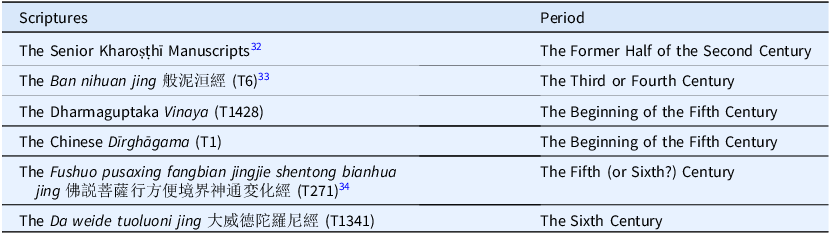
The Eight-Set tradition, which incorporates the four meditations (P. jhāna; S. dhyāna) alongside the Seven Sets,Footnote 28 has been more frequently discussed than (2) and (4). Although it was suggested about a century ago that the list of the Eight Sets is an alternative formula to the Seven Sets,Footnote 29 it was not until Ito’s achievementFootnote 30 that we were made aware of all examples of the lists of the Eight Sets in the extant materials. Drawing on Ito’s work,Footnote 31 the chronological arrangement of these examples is presented in Table 1.
The Eight Sets were once widely recognized as a tradition of the Dharmaguptaka school. However, recent studies have challenged this view. This issue is explored in detail later in this study.
(4) The forty-three dharmas contributing to awakening
All existing instances of the Eight Sets

The concept of the ‘forty-three dharmas contributing to awakening’ appears only once in the Nettippakaraṇa. Although the text itself provides no explanation for the peculiar number (forty-three), its commentary claims that the six perceptions (P. saññā)Footnote 35 are added to the Seven Sets. It remains unclear on what basis the author of the commentary concludes that the six elements added to the Seven Sets are the six perceptions, and the validity of this interpretation is uncertain.Footnote 36 Therefore, whether the forty-three dharmas contributing to awakening constituted a firmly established tradition, and why it appears solely in the texts of the Mahāvihāra school, remain questions requiring further evidence.Footnote 37
Summarizing the four traditions outlined above, the tradition of the Seven Sets undeniably held a dominant position, as it spread much more widely than the others among the four transmission lineages. It can be inferred from the extant sources that the tradition of the Eight Sets maintained a certain degree of influence. However, the remaining two traditions are scarcely mentioned in the available materials, suggesting they likely did not have a significant influence in ancient South Asia. Nevertheless, these two traditions were recognized by the groups that maintained the Seven-Set tradition. Thus, the Seven-Set Variations illustrate a pluralistic intellectual environment in which each tradition developed its own claims while remaining aware of the others’ existence.
Exploring the method of legitimizing of the Seven Sets
The superiority of the tradition of the Seven Sets, or their conceptualized forms, over other traditions lies not only in its broad dissemination but also in the depth of the intellectual sophistication of its proponents. A key example is the claim to legitimacy made by inseparably linking the dharmas contributing to awakening with the Seven Sets while systematically excluding other elements from recognition within the structure of the dharmas contributing to awakening. The groups advancing this claim are the Mahāvihāra school and the Vaibhāṣika school.
Mahāvihāra School
First, focusing on the Mahāvihāra school, its earliest extant commentarial work, the Visuddhimagga (Vism),Footnote 38 states the following after enumerating the Seven Sets:
These thirty-seven dhammas are called ‘contributing to awakening (bodhipakkhiyā)’ due to their being in the party of the noble path which has the name ‘awakening (bodhi)’ in the sense of waking up.Footnote 39
Thus, once the Seven Sets are established as the dharmas contributing to awakening, the commentaries explicitly clarify that references in the canonical texts (P. Tipiṭaka) to the ‘dhammas contributing to awakening’ or the ‘seven dhammas contributing to awakening’ indeed refer to the thirty-seven dharmas contributing to awakening.
A particularly striking example occurs where the canonical text describes the dharmas contributing to awakening as the seven factors of awakening (P. bojjhaṅga),Footnote 40 while the commentary interprets this as including all thirty-seven dharmas contributing to awakening:
Of the dhammas contributing to the awakening: of the dhammas, which are on the path of knowledge, which is designated as the realization of the four truths (for the spiritually ennobledFootnote 41 ). Even by this (the dhammas contributing to awakening), summarizing all thirty-seven dhammas contributing to awakening collectively and showing only the seven factors of awakening, which are capable of arising together on a single object even by mundane cultivation, it says the seven factors of awakening and so forth. These should be understood to be indeed described as combinations of the mundane and supramundane.Footnote 42
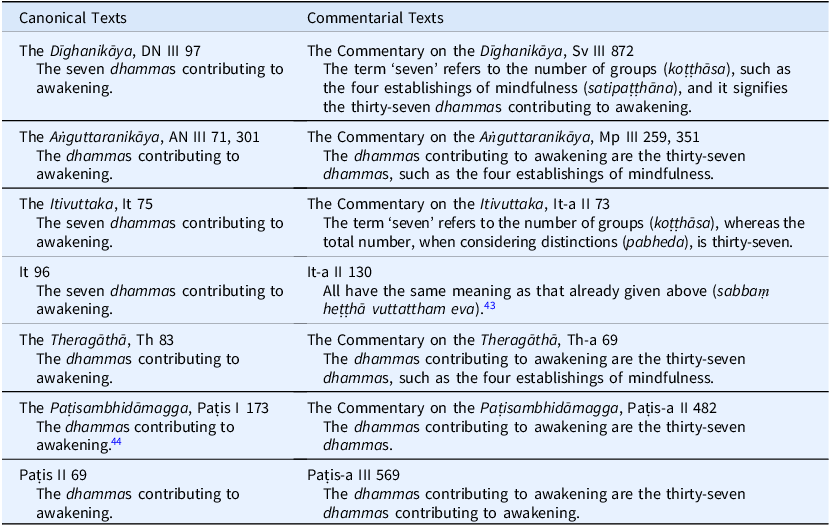
All instances in which the annotated texts include the dharmas contributing to awakening and their commentaries interpret them as the thirty-seven dharmas contributing to awakening (excluding previously mentioned case)

The table below (Table 2) provides a comprehensive account of all instances in which the commentarial literature interprets references to the dharmas contributing to awakening in the canonical texts as the thirty-seven dharmas contributing to awakening, excluding the aforementioned case.
Furthermore, a detailed examination of the commentarial literature reveals discussions that argue for the exclusion of certain dharmas from the list of the dharmas contributing to awakening.
In Chapter 22 of the Visuddhimagga, titled Ñāṇadassanavisuddhi, there is a section called Bodhipakkhiyakathā.Footnote 45 At the end of the commentary on this section,Footnote 46 a discussion emerges regarding why meditation (P. jhāna) is not included among the dharmas contributing to awakening. The discussion opens with a hypothetical objection: “Now, why is the group of the meditation (jhāna) not included among the dhammas contributing to awakening? Is it not the case that the noble path cannot exist without the meditation?”Footnote 47 The argument proceeds by refuting this objection and ultimately asserts that meditation is not one of the dharmas contributing to awakening.Footnote 48
Another example found in commentarial literature is the discussion that excludes feeling (P. vedanā) and perception (P. saññā) from the dharmas contributing to awakening.Footnote 49 Although the connection between the argument for excluding these two from the dharmas contributing to awakening and the surrounding context is somewhat unclear, feeling and perception are deemed not to be among the dharmas contributing to awakening because they lack the capacity to perform the function of insight (P. vipassanā).
Vaibhāṣika School
The Vaibhāṣika school, similar to the Mahāvihāra school, introduces the argument that the dharmas contributing to awakening are constituted by thirty-seven dharmas. Vibhāṣā-BFootnote 50 initially presents the thirty-seven dharmas contributing to awakening, comprising the Seven Sets.Footnote 51 Following this, a hypothetical objection is raised, referencing the canonFootnote 52 in which the Blessed One is said to teach only the seven factors of awakening as the dharmas contributing to awakening without mentioning the thirty-seven dharmas.Footnote 53 In response, three views are introduced to counter this objection, asserting that the dharmas contributing to awakening indeed refer to the thirty-seven dharmas.Footnote 54
The first view is that the Blessed One presented only the seven factors of awakening as the dharmas contributing to awakening because the bhikṣus specifically inquired about them, rather than indicating that these were the sole dharmas contributing to awakening. The second perspective holds that, among the thirty-seven dharmas contributing to awakening, only the seven factors of awakening are exclusively free from influence (S. anāsrava), whereas the remaining dharmas can be either connected with influence (S. sāsrava) or be free from influence. Consequently, the Blessed One expounded only the seven factors of awakening, as only they are purely free from influence. The final view posits that the Blessed One did teach the thirty-seven dharmas contributing to awakening. Nevertheless, the canons containing this teaching were gradually lost.Footnote 55
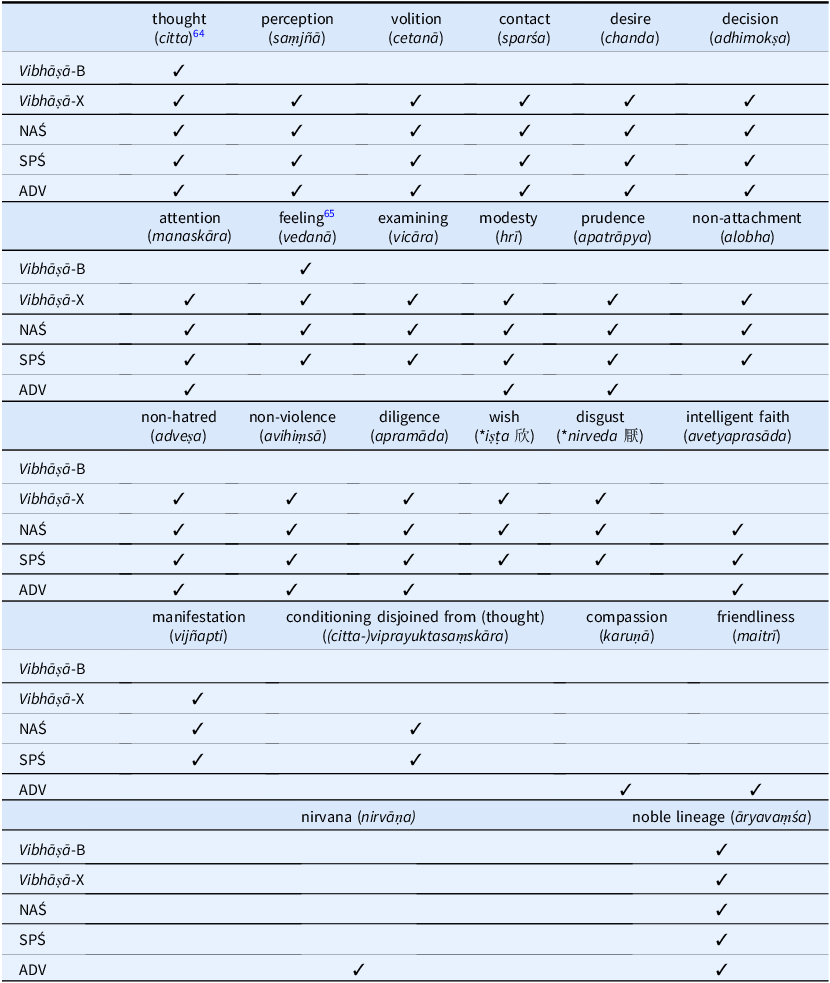
The Vaibhāṣika school also formulates an argument for excluding certain dharmas from the list of the dharmas contributing to awakening. Drawing on the parts of the well-known classification system of seventy-five dharmas into five categories,Footnote 56 they present a more sophisticated argument compared with the Mahāvihāra school.Footnote 57 This argument for exclusion is found not only in Vibhāṣā-B,Footnote 58 Vibhāṣā-X,Footnote 59 *Abhidharmanyāyānusāraśāstra (NAŚ),Footnote 60 and *Abhidharmasamayapradīpikāśāstra (SPŚ)Footnote 61 but also in Abhidharmadīpa and its commentary, the Vibhāṣāprabhāvṛtti (ADV).Footnote 62 When summarizing the dharmas addressed in each text, the following table (Table 3) provides a comprehensive overview.Footnote 63
The lists of the dharmas excluded from dharmas contributing to awakening in each text

Among the dharmas listed in Table 3, seven – wish (*iṣṭa), disgust (*nirveda), intelligent faith (avetyaprasāda), compassion (karuṇā), friendliness (maitrī), nirvana (nirvāṇa), noble lineage (āryavaṃśa) – are analyzed outside the classification system of seventy-five dharmas into five categories.Footnote 66 The discussion of excluding the noble lineages is particularly noteworthy because, even in comparison to the dharmas discussed under the system of seventy-five dharmas divided into five categories, this discussion identifies only its proponents (Vibhajyavādins) and engages in a rebuttal against them.Footnote 67
Therefore, we will analyze the arguments for excluding the noble lineages from the dharmas contributing to awakening. Based on the Vibhāṣā-B, two reasons are proposed for this.Footnote 68 First,Footnote 69 the dharmas contributing to awakening are considered superior in two aspects for both ascetics and lay followers: the resolve of mind (期心) and the practice (受行). However, the noble lineages are deemed superior in both aspects for the ascetics but only in the resolve of mind for the lay followers. To illustrate that the lay-followers lack the practice, several figures are mentioned, such as Śakra, King Bimbisāra, and the wealthy elder Sudatta. Among them, Śakra is highlighted as an example: seated on a throne lavishly adorned with many flowers, surrounded by twelve million maidens, and accompanied by the music of sixty thousand instruments. This extreme example appears to be used to point out that non-ascetics are incapable of fully living in accordance with the lifestyle prescribed by the four noble lineages. However, the definition of the dharmas contributing to awakening as both excellent in terms of resolve of mind and practice for both monastics and laypeople is introduced only in the argument that excludes the four noble lineages. Based on this definition, there is no analysis of whether the remaining Seven Sets are valid as the dharmas contributing to awakening. From the outset, it appears that the discussion assumes the exclusion of the noble lineages as a given.
Second,Footnote 70 the fourth element of the four noble lineages, that is, delighting in cutting off and cultivation, corresponds to the factor of strength (精進, S. vīrya), aligning with the awakening-factors of strength (精進覺支). Thus, the fourth element can only be integrated into the dharmas contributing to awakening. This argument is based on the premise that the dharmas contributing to awakening comprise solely the Seven Sets, excluding the four noble lineages from the dharmas contributing to awakening, predetermined from the outset.
Thus, the tradition of the Seven Sets and their conceptualized forms was not merely diffused broadly, but both the Mahāvihāra and Vaibhāṣika schools reinforced their claim that only the Seven Sets constituted the dharmas contributing to awakening through repeated scriptural interpretations and exclusionary arguments, asserting the legitimacy of the Seven-Set tradition. This assertion was motivated in part by the existence of alternative traditions beyond the Seven Sets. Considering this situation, to better understand how other traditions of the Seven-Set Variations were transmitted, I next focus on the tradition of the Eight Sets.
Tracing the entangled lineage of the Eight Sets
When examining the tradition of the Seven-Set Variations comprehensively, the Eight-Set tradition, which, as mentioned above, incorporates the four meditations alongside the Seven Sets, holds particular significance as it is the only tradition that can be distinctly traced apart from the Seven-Set tradition. A frequently raised point concerning the transmission of the Eight Sets is the possibility that this tradition may be unique to the Dharmaguptaka school.Footnote 71 The basis for this claim is that the tradition is reflected in the Chinese Dīrghāgama and the Dharmaguptaka Vinaya (Sifen lü 四分律), which are most likely attributed to the Dharmaguptaka school.
Recently, a counterargument has emerged suggesting that the Eight Sets may not be unique to the Dharmaguptaka school but rather a local tradition specific to the greater Gandhāra region.Footnote 72 One of the bases for this claim is that the Eight Sets are found not only in the Chinese Dīrghāgama and Dharmaguptaka Vinaya but also in the Chinese Madhyamāgama, assumedly affiliated with the Sarvāstivāda school. However, the claim that the Eight Sets are also presented in the Chinese Madhyamāgama is highly dubious. The text in question appears in Sutra No. 222 of the Chinese Madhyamāgama,Footnote 73 where ten items are not simply enumerated but presented with some explanations as essential for those seeking to abandon (斷), repeatedly abandon (數斷), attain liberation from (解脫), cross over (過度), root out (拔絕), extinguish (滅止), completely know (總知), and understand with discrimination (別知) the twelve links of dependent arising from ignorance to old age and death. The ten items, in order, are as follows: the four establishings of mindfulness, the four right abandonings, the four bases of success, the four meditations, the five faculties, the five powers, the seven factors of awakening, the noble eightfold path, the ten all-encompassing spheres (十一切處), and the ten qualities of one beyond training (十無學法).
Although the Eight Sets are truly included in the listed items, the addition of two further items raises uncertainty regarding whether it should be regarded as a distinct and independent list. Furthermore, within the Chinese Madhyamāgama, the Seven Sets are consistently referenced as a formulaic expression,Footnote 74 whereas the enumeration of the Eight Sets occurs solely in this specific text and in no other context. As such, it is improbable that the Eight Sets, rather than the Seven Sets, were considered a standardized or formulaic lists. Therefore, the assertion that the Eight Sets are also included in the Chinese Madhyamāgama is unfounded.
Another basis for the claim that the Eight Sets are specific to the region of Greater Gandhāra is their presence in Gandhāran manuscripts. As has been mentioned, the manuscripts containing the Eight Sets, specifically the Senior Kharoṣṭhī Manuscripts,Footnote 75 are linked to the Dharmaguptaka school. Consequently, this evidence, while demonstrating the presence of the Eight Sets in the region of Greater Gandhāra, could, in fact, enhance the possibility that the Eight Sets are a tradition uniquely associated with the Dharmaguptaka school.
Is the argument that the tradition of the Eight Sets is unique to the Dharmaguptaka school valid? Recent studies call for a cautious approach when investigating the relationship between specific traditions and particular schools.Footnote 76 A more detailed investigation is, therefore, necessary before drawing any premature conclusions. Indeed, no study has yet undertaken a thorough examination of individual instances of the Eight Sets.
Let us first examine the Youxing jing 遊行經 found in the Chinese Dīrghāgama. This text is one of the ‘Nirvana Sutras,’Footnote 77 recognized in eight distinct versions since the publications of Waldschmidt’s critical edition of the Sanskrit Mahāparinirvāṇa Sūtra (MPS). In the Youxing jing, the Eight Sets are as follows:
At that time, the Blessed One … addressed the bhikṣus as follows: ‘You should know that I myself have accomplished the direct experience and realization of perfect awakening through these dharmas, namely the four establishings of mindfulness, the four right abandonings, the four bases of success, the four meditations, the five faculties, the five powers, the seven factors of awakening, and the noble eightfold path. (a) You should be harmonious in and respectful to these dharma s, without creating disputes, sharing the recitation [of the same rules], Footnote 78 like a single mixture of water and milk, and should strive to learn my dharma s, illuminating it together and dwell in pleasant feeling together. (b) Bhikṣu s, you should know that I have realized and taught these dharma s, namely the * sūtra , the * geya , the * vyākaraṇa , the * gāthā , the * udāna , the * ityuktaka , the * nidāna , the * jātaka , the * vaipulya , the * adbhutadharma , the * avadāna , and the * upadeśa . Footnote 79 You should learn [these dharma s] well, think and analyze them thoroughly, and practice them accordhingly. Why? Because the Tathāgata will shortly reach perfect nirvana three months from now.’Footnote 80
These passages stand out from other versions of the Nirvana Sutras owing to their reference to the Eight Sets. However, two additional aspects are equally significant for the comparative analysis: Points (a) and (b), which merit close attention when evaluating the uniqueness of this version against others. First, regarding Point (a), the phrasing in this passage closely parallels expressions found in Vinaya literature, the tenth and eleventh offenses entailing temporary penance (S. saṅghāvaśeṣa/saṃghātiśeṣa; P saṅghādisesa),Footnote 81 which pertain to prohibitions against causing and supporting, respectively, schism within the monastic community. As Hirakawa has clearly demonstrated,Footnote 82 these offenses exhibit a consistent meaning across various Vinaya literature, although there are some differences in phrasing. A key point of interest is the shared expression present in both offenses. This expression is either identical or displays only minimal differences between the two. To illustrate, examining the wording in the Sanskrit Mūlasarvāstivāda Bhikṣu-Prātimokṣasūtra,Footnote 83 it reads in exactly the same wording between the tenth offense and the eleventh offense as follows: “You must come together with community, because the community must dwell in pleasant feeling, being harmonious, united, joyful, and without dispute, having one goal, sharing the recitation [of the same rules], like a single mixture of water and milk, and illuminating the teaching of the teacher.”Footnote 84
Upon comparing the expression found in the Mūlasarvāstivāda Bhikṣu-Prātimokṣasūtra with the phrasing from Point (a) of the Youxing jing, it becomes evident at first glance that both encompass common content. While the expression found in the Mūlasarvāstivāda Bhikṣu-Prātimokṣasūtra is shared among other Vinayas, the phrasing in the Youxing jing is absent from other Nirvana Sutras. Furthermore, thoroughly examining the examples of the Seven Sets reveals that instances in which the expressions of the tenth and eleventh offenses are explicitly linked to the Seven Sets are virtually nonexistent. Given that it is improbable that the compilers of the Chinese Dīrghāgama inserted this phrase without being aware of the corresponding expression in the Vinaya literature, the influence from the tenth and eleventh offenses entailing temporary penance into the Youxing jing is evident.
Next, regarding Point (b), the twelve elements enumerated in this part, from sūtra to upadeśa, represent one of the classifications of the Buddhist canon. This passage suggests that the Eight Sets are presented as dharmas realized by the Buddha upon attaining perfect awakening, while the twelvefold division is introduced as dharmas disseminated by the Buddha. The link between the Eight Sets and the twelvefold dharmas found in the Youxing jing reflects a particularly distinctive tradition, as instances where the twelvefold dharmas are directly associated with the Seven Sets are rare. This uniqueness is not only evident in comparison to other versions of the Nirvana Sutras, but also within the broader context of the transmission of Buddhist scriptures as a whole.
The two distinctive points found in the Youxing jing have been examined above, and it is noteworthy that both points are also mentioned in conjunction with the Eight Sets in another text from the Chinese Dīrghāgama, the Qingjing jing 清淨經.Footnote 85 Considering the complete absence of examples linking these two elements to the Seven Sets, it can be argued that not only the Eight Sets, but also its association with these two Points, serves as a defining feature that differentiates the Chinese Dīrghāgama from other traditions.
The following question then arises: Is this feature intrinsically linked to the transmission of the Eight Sets? To investigate this further, it is essential to examine another text from the Nirvana Sutras where the Eight Sets are mentioned, that is, the Ban nihuan jing. In the Ban nihuan jing, the corresponding passages reads as follows:
The Buddha addressed the bhikṣus, saying: ‘The world is impermanent, there is nothing solid, and everything will eventually disperse…Three months later, I the Buddha shall reach perfect nirvana, but do not doubt, and do not be anxious about it…Only those who practice the dharmas can attain rest and peace in this life. You should uphold them well, learn them well, recite them, calm your mind, and contemplate it. In doing so, my pure dharmas will endure for a long time, easing the suffering of the people in this world and bringing benefits and peace to both humans and gods. Bhikṣus, you should understand the following. What are the dharmas? They are the four establishings of mindfulness, the four right endeavors, the four bases of success, the four meditations, the five faculties, the five powers, the seven factors of awakening, and the noble eightfold path. If they are practiced, one can attain liberation and ensure that the dharmas do not decline.’Footnote 86
The passages clearly reveal that, aside from the presence of the Eight Sets, the description diverges entirely from that found in the Youxing jing. When comparing it with other versions of the Nirvana Sutras, one could argue that it most closely parallels the MPS and the corresponding section of the Kṣudrakavastu in the Mūlasarvāstivāda Vinaya. This observation aligns with Iwamatsu’s assertion that, when examined in its entirety, the strongest similarity is found between the Ban nihuan jing and the MPS.Footnote 87
Moreover, Waldschmidt has reported additional fragments of the manuscript consistent with the Nirvana Sutras that contain elements corresponding to Points (a) and (b) aforementioned. However, interestingly, it is not the Eight Sets, but the Seven Sets that are presented in this manuscript.
Having personally recognized, realized, and obtained, I declared the dharmas – namely, the four establishings of mindfulness, the four right abandonings, the four bases of success, the five faculties, the five powers, the seven factors of awakening, and the noble eightfold path – (a)there, all of you should dwell in pleasant feeling, being united, harmonious, joyful, and without dispute, having one goal, sharing the recitation [of same rules], like a single mixture of water and milk, and illuminating the teaching of the teacher. Therefore, then, bhikṣus, (b) I have expounded the dharma s – namely, the sūtra , the geya , the vyākaraṇa , the gāthā , the udāna , the nidāna , the avadāna , the itivṛttaka , the jātaka , the vaipulya , the adbhutadharma , and the upadeśa – you should learn those dharma s well and excellently; Having learned them, you should remember them; Having remembered them, you should consider them; Having considered them, you should heed them; Having heeded them, you should act precisely according to them. Footnote 88
Waldschmidt hypothesized that, based on its script, this manuscript fragment likely dates to the seventh or eighth century,Footnote 89 definitively placing its composition later than that of the Youxing jing.Footnote 90
Regarding the Nirvana Sutras, the historical development of the Seven Sets and Eight Sets, as well as Points (a) and (b)

Regarding the two Nirvana Sutras and the one fragment mentioned above, focusing on whether they reflect the Seven Sets or the Eight Sets and whether Points (a) and (b) can be identified, the chronological arrangement based on the lower limit of the dating is presented in Table 4.
This table indicates that the transmission of the distinctive tradition concerning the Eight Sets and the two Points is nonlinear. If interpreted diachronically, one could argue that at least by the fifth century, a tradition linking the Eight Sets with the two Points was established in the Chinese Dīrghāgama affiliated with the Dharmaguptaka school, after which the tradition of the Eight Sets faded away. On the other hand, a synchronic interpretation suggests that multiple traditions concerning the Eight Sets and the two Points coexisted. However, regardless of the interpretation, what remains crucial is the absence of any fixed, unchanging tradition concerning the Eight Sets, which were subject to revision or extinction at any given moment.
Ito’s findingsFootnote 92 support this argument. Ito presents the appearance of the Eight Sets in two previously undiscussed texts and the unique manner in which they appear. The first text is the Foshuo pusaxing fangbian jingjie shentong bianhua jing 佛説菩薩行方便境界神通変化經 T271. In this text, where the Eight Sets appear (T271, 9. 310b13–16), two other versions – the Da sazhe niganzi suoshuo jing 大薩遮尼乾子所説經 (T272), translated by Bodhiruci, and the ’Phags pa byang chub sems dpa’i spyod yul gyi thabs kyi yul la rnam par ’phrul pa bstan pa zhes bya ba theg pa chen po’i mdo, translated by Prajñāvarman and Ye shes sde – present either the Seven Sets or the thirty-seven dharmas contributing to awakening (T272, 9. 348c10–13 and Derge 146: 125a2–4, respectively).
Furthermore, in another text presented by Ito, the Da weide tuoluoni jing 大威德陀羅尼經 (T1341), the Eight Sets, the Seven Sets, and the thirty-seven dharmas contributing to awakening coexist within a single text. This indicates that the Eight Sets no longer function as an alternative formula to the Seven Sets.
Considering the above two examples in conjunction with their usages in the Nirvana Sutras,Footnote 93 the following two points can be asserted. First, the Dharmaguptaka school appears to have been crucial in the transmission of the Eight Sets, as their philosophical uniqueness was emphasized exclusively in texts affiliated with the Dharmaguptaka school. Although recent discussions have approached the topic of school affiliation with skepticism, there remains ample room for debate regarding the strength of the connections between specific traditions and particular schools. Nevertheless, the current examination of the Eight Sets strongly suggests the existence of multiple traditions within the Dharmaguptaka school. This implies that, regarding its doctrinal tradition, the Dharmaguptaka school should be considered as a plural (Dharmaguptaka schools) rather than a singular entity (the Dharmaguptaka school).Footnote 94
Second, the tradition of the Eight Sets experienced relatively early discontinuation after the fifth century. Considering the widespread adoption and assertion of legitimacy surrounding the Seven-Set tradition across various schools, it is plausible to conclude that the Eight-Set tradition, particularly after the fifth century, was gradually subsumed by the dominant narrative of the Seven-Set tradition.Footnote 95
Conclusion
One of the most significant “lists” contributing to the transmission of Buddhist traditions in South Asia – eventually forming a “list of lists” by combining various lists – is the Seven Sets and their conceptualized forms. However, despite receiving limited attention to date, three alternative lists existed with the tradition of the Seven Sets. By the second century at the latest, the tradition of the Eight Sets coexisted, and by the fifth century, the traditions of the forty-one dharmas contributing to awakening and the forty-three dharmas contributing to awakening were also present. This study explored how these four traditions, that is, the Seven-Set Variations, are interrelated in an attempt to elucidate Buddhist transmission by examining the Seven Sets and their alternative lists.
Among the Seven-Set Variations, the most dominant in South Asian Buddhism was the tradition of the Seven Sets. This tradition not only spread widely across various periods, regions, and schools, but it is also particularly noteworthy that both the Vaibhāṣika and Mahāvihāra schools asserted the legitimacy of the Seven Sets. As frequently highlighted, the Seven Sets were conceptualized at a specific point in historical development, eventually crystallized into what is known as the dharmas contributing to awakening (bodhipakṣyadharma/bodhipakkhiyadhamma). Both the Vaibhāṣika and Mahāvihāra schools ardently defended the Seven Sets as the definitive framework for the dharmas contributing to awakening, rejecting the inclusion of either fewer or more than the Seven Sets. Consequently, they constructed arguments to exclude additional elements from the framework of the dharmas contributing to awakening. For example, the Vaibhāṣika school rejected the tradition of the forty-one dharmas contributing to awakening as heretical, recording it only within this school. On the other hand, the Mahāvihāra school excluded the four meditations that were incorporated into the Eight Sets, although it remains unclear whether the school was aware of this tradition.
As the Seven-Set tradition progressively marginalized other traditions, the only lineage whose development could still be traced was the Eight Sets. Established no later than the second century and exhibiting intellectual distinctiveness by the fifth century, this tradition gradually declined around the sixth century and was ultimately absorbed into the prevailing Seven-Set tradition. Additionally, no significant evidence suggests the diffusion of the tradition of the forty-three and forty-one dharmas contributing to awakening, and there is no indication that any other tradition persisted for a notable duration. Therefore, it is reasonable to conclude that the tradition of the Seven Sets eventually supplanted all others, dominating the entire Buddhist landscape. The evolution of South Asian Buddhist traditions, as reflected in the Seven-Set Variations, illustrates the transition from a pluralistic system to one that became increasingly unified.
Competing interests
The author declares none.
Financial support
This research was supported by JSPS KAKENHI (grant number 23KJ0763).
Abbreviations and References
List of Abbreviations
Abbreviations of titles of Pali texts in the article, with the exception of what is presented below, follow the standard system set out in Trenckner V. et al., A Critical Pāli Dictionary (Copenhagen: Royal Danish Academy of Sciences and Letters, 1924−2011).
ADV Abhidharmadīpa with Vibhāṣāprabhāvṛtti. Jaini P. S. (ed.), Tibetan Sanskrit Works Series 4, Patna: Kashi Prasad Jayaswal Research Institute, 1977.
AKBh Abhidharmakośabhāṣya of Vasubandhu. Pradhan P. (ed.), Tibetan Sanskrit Works Series 8, Patna: Kashi Prasad Jayaswal Research Institute, 1967.
AsP Aṣṭasāhasrikā Prajñāpāramitā with Haribhadra’s Commentary Called Āloka. Vaidya P. L. (ed.), Buddhist Sanskrit Texts 4, Parbhanga: The Mithila Institute, 1960.
BBh Bodhisattvabhūmi. A Statement of Whole Course of the Bodhisattva (Being Fifteenth Section of Yogācārabhūmi). Wogihara U. (ed.), Tokyo: Sankibo Buddhist Book Store, 1971.
KPs The Kāśyapaparivarta. A Mahāyānasūtra of the Ratnakūṭa Class, Edited in the Original Sanskrit in Tibetan and in Chinese. Staël-Holstein A. von (ed.), Shanghai: The Commercial Press, 1926.
MABh Candrakīrti’s Madhyamakāvatārabhāṣya Chapter 1 to 5. Lasic H., Li X. and Macdonald A. (eds.), Vienna: Austrian Academy of Sciences, Beijing: China Tibetology Research Center, 2022.
MPS Das Mahāparinirvāṇasūtra: Text in sanskrit und tibetisch, verglichen mit dem pāli nebst einer Übersetzung der chinesischen Entsprechung im Vinaya der Mūlasarvāstivādins Teil 1–3. Waldschmidt E. (ed.), Berlin: Akademie Verlag, 1950–1951.
NAŚ T1562 阿毘達磨順正理論 *Abhidharmanyāyānusāraśāstra
P. Pali
PrMoSū(Ma-L) Prātimokṣasūtram of the Lokottaravādimahāsāṅghika School. Tatia N. (ed.), Tibetan Sanskrit Works Series 16, Patna: Kashi Prasad Jayaswal Research Institute, 1976.
PrMoSū(Mū) Das Bhikṣu-Prātimokṣasūtra der Mūlasarvāstivādins: anhand der Sanskrit-Handschriften aus Tibet und Gilgit sowie unter Berücksichtigung der tibetischen und chinesischen Ubersetzungen kritisch herausgeeben. Hinüber H. Hu-von (ed.), Online publication of the Universität Freiburg, 2003. Available online at https://freidok.uni-freiburg.de/files/9535/QaZFsCZpJqeiml3g/hu_pratimosu_mula.pdf. (Accessed 5th Apr 2025).
PrMoSū(Sa) Prātimokṣasūtra der Sarvāstivādins Teil 2. Simson G. von (ed.), Sanskrittexte aus den Turfanfunden 11, Göttingen: Vandenhoeck & Ruprecht, 2000.
S. Sanskrit
SBhV The Gilgit Manuscript of the Saṅghabhedavastu. Being the 17th and Last Section of the Vinaya of the Mūlasarvāstivādin Part II. Gnoli R. (ed.), Roma: Istituto italiano per Medio ed Estremo Oriente, 1978.
SPŚ T1563 阿毘達磨藏顯宗論 *Abhidharmasamayapradīpikāśāstra
T Taishō Shinshū Daizōkyō 大正新脩大蔵経. Takakusu J. and Watanabe K. (eds.). 1924–1934. Tokyo: Daizō Shuppan 大蔵出版.
Vibhāṣā-B T1546 阿毘曇毘婆沙論 *Abhidharmavibhāṣāśāstra
Vibhāṣā-X T1545 阿毘達磨大毘婆沙論 *Abhidharmamahāvibhāṣāśāstra
Vism-mhṭ
Be: Visuddhimaggassa Atthasaṃvaṇṇanābhūtā Bhadantācariyadhammapālattherena katā Paramatthamañjūsā nāma Visuddhimaggamahāṭīkā. Dutiyo Bhāgo. Yangon: Marammaraṭṭhe Buddhasāsanasamitiyā Muddaṇayantālaye Muddāpitā, 1960.
Se: Paramatthamañjusā nāma Visuddhimagga Saṃvaṇṇanā Mahāṭīkāsammatā. Tatiyo Bhāgo. Bangkok: Rongphim Phanitsuphapol, 1927.
Vkn Vimalakīrtinirdeśa Transliterated Sanskrit Text Collated with Tibetan and Chinese Translations. Study Group on Buddhist Sanskrit Literature (ed.), Tokyo: Taisho University Press, 2004.


 Open access

