


Introduction
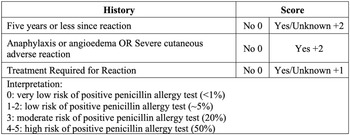
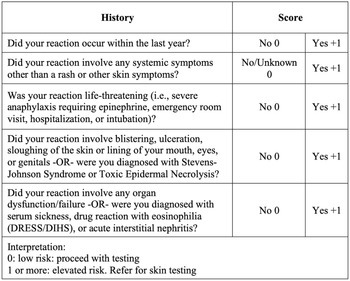
Approximately 15% of hospitalized patients and 10% of the general United States population report a penicillin allergy. However, the actual immunoglobulin-E (IgE)-mediated allergy rate is less than 1%. Reference Gray, Kellum, Kirisci, Boyce and Kane-Gill1 This discrepancy in allergy label rates is associated with significant health consequences, including inappropriate use of broad-spectrum antibiotics, prolonged hospital stays, elevated healthcare costs, a 50% increased risk of postoperative infection, and a 14% increased risk of all-cause mortality. Reference Blumenthal, Lu, Zhang, Walensky and Choi2,Reference Blumenthal, Lu, Zhang, Li, Walensky and Choi3 Historically, penicillin allergy delabeling has been performed by allergists through a two-step process: a skin test followed by oral provocation testing. Reference Gray, Kellum, Kirisci, Boyce and Kane-Gill1,Reference Chua, Vogrin and Waldron4 Recent evidence has demonstrated the safety and cost-effectiveness of single-dose direct oral provocation testing (DOPT) in select patients when combined with a scoring tool based on clinical history of the allergic reaction such as the Penicillin Allergy Decision Rule (PEN-FAST; Figure 1) and the Penicillin Allergy Risk Stratification Score (PARSS; Figure 2). Reference Gray, Kellum, Kirisci, Boyce and Kane-Gill1,Reference Chua, Vogrin and Waldron4,Reference Grant Day, DeNora, Shields, Otto, Banks and Dore5 A patient can be considered low risk if they have a score of 2 or less using PEN-FAST or a score of 0 using PARSS. Reference Chua, Vogrin and Waldron4,Reference Grant Day, DeNora, Shields, Otto, Banks and Dore5
PEN-FAST Reference Trubiano, Vogrin and Chua13 .

PARSS Reference Grant Day, DeNora, Shields, Otto, Banks and Dore5 .

Given the high prevalence of reported penicillin allergies, low rate of true penicillin allergies, and the benefits to the individual and health care system, nonallergist-initiated delabeling is recommended by multiple medical professional organizations but has never been widely implemented. One barrier to widespread implementation is lingering safety concerns, potentially due to published studies with small sample sizes. Another potential barrier is protocol variability. Numerous DOPT protocols have been published with varying doses (ie, amoxicillin 250 mg vs 500 mg) or the number of doses (ie, a grade challenge). There are currently no randomized controlled trials comparing the different DOPT. Systematic reviews by Blumenthal, Cooper, and Powell highlight these heterogeneities in protocols while finding insufficient evidence to recommend one protocol over another. Reference Powell, Stephens and Kohl6–Reference Blumenthal, Smith and Mann8 To date, no systematic reviews have examined a single-dose DOPT. We present a systematic review to address these limitations by evaluating the safety of single-dose (amoxicillin 250 mg), nongraded DOPT performed by nonallergists in low-risk patients.
Methods
This work is a systematic review. It was carried out using the Cochrane Handbook for Systematic Reviews of Interventions and was reported following the PRISMA 2020 statement: an updated guideline for reporting systematic reviews. Reference Page, McKenzie and Bossuyt9 The protocol was registered on PROSPERO (2023 CRD42023423873). Available rom: https://www.crd.york.ac.uk/prospero/display_record.php?ID=CRD42023423873
Eligibility criteria
Inclusion criteria were: (1) adults aged 18 or older with reported penicillin allergy in either inpatient or outpatient settings; (2) allergy history deemed as low risk based on a validated scoring system such as PEN-FAST or PARSS; and (3) DOPT performed with a single-dose of oral amoxicillin (250 mg) followed by a 60-minute observation period. Exclusion criteria were: (1) pregnancy; (2) pediatric-aged patients (<18 yr of age); (3) skin testing before DOPT; (4) graded oral challenge; or (5) amoxicillin dose other than 250 mg.
Data sources and search strategy
MEDLINE (via Ovid), Embase (via Elsevier), Cochrane Library Central Register of Controlled Trials (via Wiley), and Web of Science—SCI Expanded and SSCI (via Clarivate) were searched from database inception to May 2025.
A professional medical librarian (SC) developed and conducted the search strategy with input on keywords from the other authors. The search strategies included database-specific controlled vocabulary terms and keywords searched in the titles and abstracts for the following concepts: penicillin and derivatives, allergy, and direct oral challenge. The searches were independently peer-reviewed by a librarian using a modified PRESS Checklist and validated against preselected articles. The original searches were conducted on May 8, 2023. A search update across all databases was conducted on May 5, 2025, to identify newly published studies. The full, reproducible search strategies for all included databases are in the Appendices and available online (http://hdl.handle.net/2193/TH83M010F ).
All citations were imported into Covidence, a systematic review screening software (Covidence systematic review software, Veritas Health Innovation, Melbourne, Australia. Available at www.covidence.org.
Selection process
Two reviewers screened articles at the title and abstract level, two reviewers at the full-text level, and two reviewers at the data extraction level using Covidence systematic review screening software. At each level, any conflicts were resolved by consensus. Study types included randomized controlled trials and prospective cohort trials, while published articles or abstracts were limited to those in the English language. Studies were excluded if they did not meet the eligibility criteria. The investigator was contacted if data were unavailable in the published study.
Data items
The primary outcomes were: 1) severe adverse reactions defined as anaphylaxis, angioedema, any respiratory distress requiring intubation, or treatment with epinephrine, and 2) any reaction following DOPT.
Study risk of bias assessment
The quality of the included studies was assessed using the JBI Critical appraisal tool for cohort studies.
Results
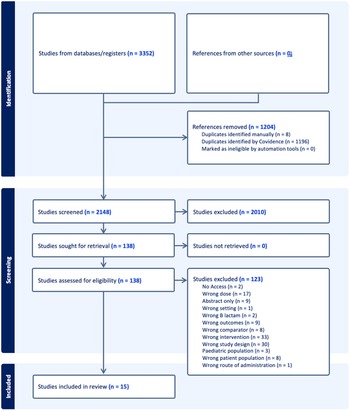
The search yielded 3 352 studies. 1 204 were removed as duplicates. 2 148 were screened at the title and abstract level. 138 were screened at the full-text level. After screening, 15 studies met the inclusion criteria and were included in the analysis (Figure 3). Of these studies, a total of 1786 patients (68%) completed DOPT. There was considerable variation in the number of individual participants in the studies, with a mean of 119 (range 7–675). The 15 studies were conducted in various settings: 5 (33%) in the outpatient setting, 10 (66%) in the inpatient setting, and 1 (7%) in the intensive care unit (ICU), with 2 having multiple settings. Risk stratification scoring systems included the PEN-FAST in 4 (27%), PARSS in 2 (13%), and 9 (60%) used their own definition. DOPT was performed by physicians in 10 (66%), 5 (33%) by pharmacists, 3 (20%) were unknown, and 1 (7%) included advanced practice providers, with 3 studies having multiple types of providers. Overall, 66 (3.7%) patients experienced any reaction following DOPT. Of the 1786 patients who completed DOPT, 66 (3.7%) experienced any reaction: 27 (1.5%) immediate rashes, 24 (1.3%) delayed rashes, and 15 (.8%) other reactions. These reactions included 26 (1.8%) immediate rashes, 13 (.9%) delayed rashes, and 11 (.7%) classified as “other reactions” (Table 1). No cases of anaphylaxis, angioedema, or need for epinephrine were reported. All 15 studies were deemed low risk for bias by JBI criteria (Table 2).
PRISMA flow.

Summary of included studies

Reported Reactions:
#: mild flushing reaction
α: “delayed urticaria,” maculopapular rash on day 3
β: 14 with an “immunologically mediated reaction;” 1 maculopapular exanthem less than 2 hours after amoxicillin administration; 13 delayed onset maculopapular exanthem.
π: 10 presumed immune-related reactions and 10 non-immune-related reactions (2 itchiness, 4 gastrointestinal, 1 decreased consciousness, 1 self-resolving throat tightness, 1 fever, and 1 unknown)
†: 1 “delayed reaction”
* 7 with delayed onset maculopapular rashes and 4 nonimmune mediated reactions
‡ 2 with flushing sensation and 2 with delayed (days later) benign rash
APP: advanced practice practitioner (NP, PA)
JBI critical appraisal for cohort

Discussion
Penicillin allergy labels (PAL) are ubiquitous and associated with increased morbidity, mortality, and cost. Direct provocation testing is the gold standard for removing or verifying penicillin allergy, as skin testing and in vitro tests alone do not demonstrate 100% sensitivity or specificity. Reference Cooper, Harbour, Sneddon and Seaton7 Challenging low-risk penicillin allergies via single-dose DOPT is safe, as shown by our study of over 1700 patients with zero severe reactions (anaphylaxis, angioedema, need for epinephrine) and a low rate of any reaction (3.7%). This low-risk profile contrasts with the significant risks of maintaining a false penicillin allergy label, such as increased use of broad-spectrum antibiotics, Clostridium difficile infections, and increased healthcare costs. Reference Blumenthal, Lu, Zhang, Walensky and Choi2,Reference Blumenthal, Lu, Zhang, Li, Walensky and Choi3
Our findings are consistent with a previously published meta-analysis and systematic reviews by Powell, Cooper, and Blumenthal et al, all of which reported that DOPT in low-risk patients was associated with very low rates of severe reactions. Reference Powell, Stephens and Kohl6–Reference Blumenthal, Smith and Mann8 Our study adds significant value by focusing solely on a single-dose, nongraded DOPT performed by a nonallergist. Our inclusion and exclusion criteria were intentional. First, we aimed for simplicity. Despite the several well-designed systematic reviews and meta-analyses, the 2022 drug allergy guidelines found insufficient evidence to recommend a particular DPT protocol over another. Reference Khan, Banerji and Blumenthal10 Similarly, a 2023 study found ∼ 50% of patients believed their PAL were permanent, while only 4% of primary care providers referred low-risk PAL patients for testing. Reference Coleman, Stone, Wei and Phillips11 Second, we selected the least resource-dependent protocol. In resource-limited areas, a single dose of amoxicillin at 250 mg would enable twice as many patients to undergo DOPT as an amoxicillin 500 mg protocol would. Similarly, the longer the observation period (60 mins vs 120 mins, e.g.,), the fewer patients a single provider can evaluate and the less likely a patient is willing or able to undergo the testing. Thus, at the cost of excluding additional studies and a larger sample size, we gained simplicity, with the hope of improving scalability.
There are several limitations to our study. The primary limitation is the lack of a comparator group. While we demonstrate the safety of single-dose DOPT, we cannot directly compare its effectiveness to other delabeling strategies, such as skin testing followed by oral challenge. When considering this limitation from an effectiveness perspective, it is important to remember that DPT is the gold standard for allergy testing; any patient who undergoes skin testing still requires DPT. Similarly, the recently published PALACE trial mitigates this limitation from a safety perspective. Reference Copaescu, Vogrin and James12 This randomized controlled trial found no difference in the rate of severe reactions between single-dose DOPT in low-risk patients and those who underwent skin testing + DOPT. Reference Copaescu, Vogrin and James12 Next, as all of the studies were observational with no comparator, they were at risk for selection bias. The investigators may have consciously or unconsciously selected patients with PALs who were at lower risk than the general population. Lastly, while all the included studies used risk stratification tools with similar criteria, there was no consensus on defining a low-risk patient. Moving forward, we recommend uniformly adopting the PEN-FAST assessment tool, given that it is the only scoring system validated in a randomized controlled trial. Therefore, our findings cannot and should not be extrapolated to high-risk patients for true penicillin allergy.
Despite these limitations, our findings provide compelling evidence for the safety and feasibility of single-dose DOPT by nonallergists in low-risk patients. This approach has the potential to significantly improve penicillin allergy delabeling rates, reduce the burden of false PAL, and improve patient outcomes. Healthcare providers should feel comfortable evaluating and challenging low-risk penicillin allergies using this simplified protocol. Future research should focus on implementing this approach in broader clinical settings, evaluating its cost-effectiveness, and assessing long-term outcomes.
Acknowledgements
None.
Funding statement
None.
Competing interests
All authors report no financial or other conflicts of interest.


 Open access

