


INTRODUCTION
The use of decorative glass millefiori insets on metalwork in Roman Britain is well recognised, particularly on dress accessories such as disc brooches, which were domestically produced and manufactured throughout the Western Empire.Footnote 1 The extent to which millefiori use continued after the late third century ad has been debated, with a consensus now emerging that, by the early medieval period, its production had ceased on the Continent and almost certainly in Britain as well.Footnote 2 The occasional appearance of millefiori in metalwork found in Anglo-Saxon England is sometimes explained as the reuse of earlier Roman glass,Footnote 3 presumably scavenged from scrap and reset in new pieces. However, this idea can be easily discounted on both practical and stylistic grounds. Relying on occasional finds of Roman millefiori seems unlikely to account for the increasing corpus of early medieval material, and even if such a supply were available, removing and resetting delicate slices of glass that could be less than one millimetre thick would have proven difficult without damaging them. Furthermore, as this paper will highlight, almost all millefiori designs found on early medieval metalwork have no parallels with Roman styles. Instead, the evidence suggests that a later manufacturing tradition emerged during the late sixth century, initially in Ireland and subsequently in England, which appears to have continued until the ninth century.
While there have been some attempts to produce more comprehensive studies of the early medieval millefiori found in England, notably by Bimson and Laing,Footnote 4 and in Ireland by Carroll,Footnote 5 more often than not its presence is merely noted in passing during in-depth studies of metalwork, where it is usually taken to be a further signifier of Insular provenance. However, in recent years, two developments have highlighted the need for a greater consideration of millefiori, especially in England. First, as this paper will demonstrate, millefiori, far from being an Irish phenomenon, was manufactured in Anglo-Saxon workshops, and potentially elsewhere in Britain. In addition to the published manufacturing evidence at Jarrow,Footnote 6 and the new data from Barking Abbey, this research also highlights the presence of millefiori canes at other locations across the archipelago, hinting at their wider use. The second development has been the significant expansion of the corpus of millefiori-decorated objects brought about since the inception of the Portable Antiquities Scheme (PAS). For the first time, a sufficient dataset is available to allow for a more comprehensive categorisation, phasing and provenance of styles found, as well as the possibility of cross-referencing these with the manufacturing evidence. This task presents challenges, partly due to the bias inherent in the PAS’s scope, which only includes material from England and Wales. With the lack of similar databases covering Scotland and Ireland, our understanding of millefiori use in these regions is less developed.
The purpose of this paper is twofold. The first is to draw together the evidence for the production of millefiori from across the British Isles; the second is to provide a typological classification and chronology for the range of known styles. This foundational work will see research into millefiori develop into a distinct study in its own right, resulting in it being treated as more than merely a decorative appendage to early medieval metalwork.
THE PRODUCTION OF MILLEFIORI
Although the production of millefiori canes was a process that required significant skill on the part of the craftsperson, the technology used was simple and easily accessible.Footnote 7 Coloured glasses, in the form of collected cullet or Roman tesserae, the latter of which were being traded extensively around northern Europe by at least the eighth century,Footnote 8 were heated until they were sufficiently melted to be manipulated. This process could be achieved using a simple crucible or even a stone palette over a small hearth, in much the same manner as making beads.Footnote 9 The softened glass was picked up with a tool and then stretched into a thick strand, which was rolled on a flat surface before being further shaped as it cooled with a paddle known as a ‘battledore’ to produce a square or triangular cross-sectioned rod. Bundles of these rods, arranged in the desired pattern, were then heated again at high enough temperature to fuse but not disturb their design, before being stretched once more to produce a fine finished millefiori cane. Inevitably, the heating and stretching could cause some minor distortions to the pattern, especially to those rods on the outside of the bundle, which can often be seen in the finished canes. Likewise, the millefiori cane would vary considerably in width depending on the extent of stretching and how close the portion was to the tools holding it at each end. Nonetheless, the resulting patterns remained consistent and thus enable typological analysis.
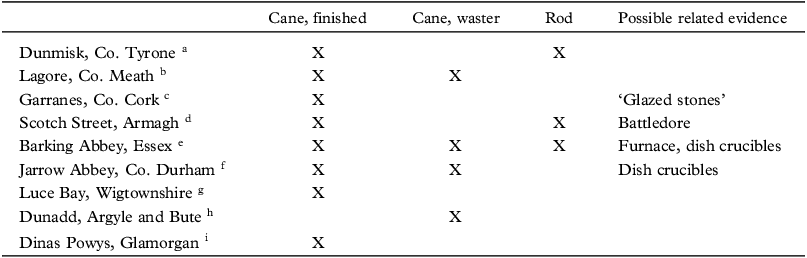
It is important to note that the presence of a finished millefiori cane alone on a site does not necessarily indicate its production there; it is likely that they would have been traded to metal workshops to be sliced and incorporated into products in these locations, although demonstrating this archaeologically is difficult. However, if complete canes are found in association with millefiori production waste and the solid plain rods used in their manufacture, they can, with some certainty, be said to have been made at that location. To date, nine sites from across the British Isles have produced convincing evidence for either finished millefiori canes and rods, or other waste associated with their manufacture (table 1, fig 1).
Sites with millefiori canes and related manufacturing evidence.

a Henderson Reference Henderson1988, 115–17; b Hencken Reference Hencken1950, 127–30; c Ó Ríordáin Reference Ó Ríordáin1942, 118–19; d Crothers and Gahan Reference Crothers and Gahan1999, 63; Hamlin and Lynn Reference Hamlin and Lynn1988, 57–61; e unpublished; f Cramp Reference Cramp and Cramp2006 263–6; g Cramp Reference Cramp1970, 330; h Lane and Campbell Reference Lane and Campbell2001, 172–4; i Alcock Reference Alcock1963, 186–7.
Location of key sites mentioned in the text. Map: author.

It is necessary to emphasise that another type of glass, the twisted cable rod (often erroneously referred to as reticella), while superficially similar and created by a near-identical process, is unrelated to millefiori or its use. Cable rods were made by heating opaque glass rods (usually white or yellow) over a translucent core (usually blue/green) and then stretching and twisting them into a decorative spiral. Cable rods primarily were used either as surface decoration on beadsFootnote 10 or, by the seventh century, vessel glass,Footnote 11 where they were pressed into the still-hot surface. While cable rods have been found in association with millefiori production at Barking and Jarrow in England,Footnote 12 and Armagh in Ireland,Footnote 13 this is unsurprising given the similar production methods employed. However, they also occur as isolated finds, for instance, at Kirkdale, North Yorkshire,Footnote 14 Iona, Inner Hebrides,Footnote 15 and Movilla, Co. Down,Footnote 16 and they were clearly being manufactured at Whitby Abbey, North Yorkshire,Footnote 17 and probably Glastonbury, Somerset, as well.Footnote 18
MILLEFIORI PRODUCTION IN IRELAND
The manufacture and presence of millefiori canes is well attested in Ireland, with four sites having produced similar evidence (fig 1). At Dunmisk, Co. Tyrone, an opaque yellow square rod and five millefiori canes were recovered.Footnote 19 Three of these millefiori canes consisted of simple blue and opaque white patterns formed from nine rods, and a fourth ‘failed end’ was probably originally of the same design (see fig 4, 1–2). The fifth fragment was a circular cane created from opaque white and blue rods being rolled together into a spiral, a variation not found elsewhere (fig 4, 3). At Lagore, Co. Meath, more extensive glassworking evidence was recovered, including moulds for casting glass mounts or studs.Footnote 20 This assemblage also included two blue circular rods, although these might have been used for various glassworking activities, and a single millefiori cane. Despite being distorted, this cane can be reconstructed as having originally been formed from eighty-one rods, creating an opaque white and blue chequerboard design (fig 4, 4). A single fragment of millefiori cane came from Garranes, Co. Cork.Footnote 21 Its main pattern was formed in alternating opaque yellow and blue rods, with a blue rod surrounded by red at its centre, and a casing of opaque red glass framed the whole cane (see fig 3, 1). At Garranes, a range of other evidence for glassworking was encountered, including ‘glazed stones’, which Gordon Childe remarked looked ‘as if a glass had been poured over them’.Footnote 22 Interpreting this is challenging, but it is possible that the stone was used as a palette to soften and melt the glass, allowing it to be worked into rods. A final fragment of millefiori cane was found at Scotch Street, Armagh, associated with other glassworking debris, including twisted cable rods and an iron ‘battledore’.Footnote 23 Unfortunately, this cane is not published clearly, but, from an imperfect photograph, it appears to take the form of a nine-rod bundle in black and white glass.Footnote 24
The dating of material found in Ireland is also challenging. Most secure is the glassmaking phase at Dunmisk, radiocarbon dated to ad 570–890.Footnote 25 The site of Lagore is believed to have been occupied between the seventh and tenth centuries ad, based on documentary sources; however, the excavations did not provide a more precise phasing of the deposits.Footnote 26 Likewise, at Garranes, although the excavator was unable to identify ‘stratigraphical differences’, activity there was said to be confined to the late fifth and early sixth centuries;Footnote 27 moreover, this is confirmed by more recent excavations on the site, which have produced similar radiocarbon dates.Footnote 28 Finally, little accurate dating is available for the millefiori cane from Armagh. It was recovered from a property boundary ditch, so potentially residual, and found in association with ceramics that were only noted to be ‘medieval’ in date.Footnote 29
MILLEFIORI PRODUCTION IN ENGLAND
The most comprehensive evidence for early medieval glassmaking in England comes from Barking Abbey, Essex. Excavations revealed the well-preserved remains of a furnace dating from the mid-eighth to early ninth centuries, along with fragments from jar-shaped crucibles and blowing waste, suggesting that high-quality vessel, and possibly window, glass was being manufactured there.Footnote 30 Also included in the assemblage was evidence for the production of millefiori canes (fig 2), which took the form of square rods in black and opaque white glass, with several examples featuring pincered end pieces that attested to their on-site manufacture. Sections from both finished and waste millefiori canes were also found, representing four different designs. The first was formed from nine alternating black and white rods in a cruciform pattern. The remaining three consisted of compositions formed from eighty-one rods: a chequerboard in black, white and khaki; a blue/green and white cruciform design; and a black, blue/green, light blue and opaque white arrangement.
Millefiori manufacturing waste from Barking Abbey. Image: author.

A further element possibly connected to millefiori manufacture was identified in the Barking assemblage. In addition to jar-shaped crucibles made from highly refined clays, several dish-shaped crucibles were recovered in local coarse fabrics. These were too shallow to have held sufficient glass for blowing, but contained residues that suggest they were for melting smaller quantities of glass, probably at a lower temperature. Analysis using portable X-ray fluorescence indicated that at least some of these deposits had elevated levels of tin oxide, which hints at the melting of opaque white glasses.Footnote 31 Consequently, while these crucibles cannot be conclusively linked to the production of rods for millefiori, it remains a distinct possibility.
The only other site in England where the use, and probable manufacture, of millefiori canes has been found is at the monastery in Jarrow,Footnote 32 Co. Durham, a site that also produced significant evidence for other glassworking activities, including crucibles and waste. Here, five fragments of millefiori canes were recovered, three of which were pinched ends. Two were formed from nine rods of red, blue and white, one taking a standard cruciform pattern with blue cross arms, white centre and red corners (see fig 8, 6), while the other was shaped so that the red formed the arms of a broad saltire cross (see fig 8, 7). There was also a fragment of a partially formed cane formed from one blue and three opaque white rods (fig 8, 8). A more complex variation was also present, consisting of sixteen black and opaque white triangular-sectioned rods (fig 8, 9). Significantly, a fragmented but finished plaque from the paired monastery at Monkwearmouth incorporated slices of a cane of this exact design into its wider scheme, leading the excavator to suggest that they were connected.Footnote 33 A further fragment from Jarrow is also constructed from triangular rods, but, being a pinched end piece, this is too distorted to reconstruct. Finally, as at Barking, fragments of dish-shaped crucibles containing thick internal ‘glazes’ were also found at Jarrow. The elevated lead levels present in these crucibles led to the suggestion that they were used for melting metal compounds and litharge in particular;Footnote 34 however, the glassy nature of their deposits and their direct association with other glassworking debris led to the intriguing possibility that they were used for other purposes, including the melting of coloured glasses, although the connection might be coincidental.
MILLEFIORI PRODUCTION IN SCOTLAND AND WALES
To date, there is far less definitive evidence for the use of millefiori canes elsewhere in Britain. In Scotland, a beach find from Luce Bay, Wigtownshire, consists of a single cane formed from forty-nine blue and white glass rods (see fig 8, 1).Footnote 35 The presence of this cane is hard to interpret without a secure archaeological context; however, its location, only a few miles north of Whithorn, presents the possibility that it originated in the monastic settlement. Although, to date, no direct evidence for glassmaking has been found at Whithorn, the presence of an unusual group of excavated vessels has led to the suggestion that they were manufactured there.Footnote 36 Equally enigmatic is a fragment of a glass tube from Dunadd Fort, Argyle and Bute.Footnote 37 It appears to be only partially formed from rods of purple/brown and opaque white glass, although, as it is a waster, its intended form and design are uncertain. From Wales, there is a single millefiori cane from Dinas Powys, Glamorgan, formed from sixty-four black and white rods in a chequerboard pattern (see fig 4, 5).Footnote 38 This cane is an isolated find, and, without further evidence of glassworking, it is best interpreted as an import to the site.
A TYPOLOGY OF MILLEFIORI FOUND IN ENGLAND
Laing produced the first comprehensive overview of millefiori-decorated objects from early medieval England;Footnote 39 however, as already noted, the corpus has been significantly expanded through metal-detected finds recorded by the PAS. Given the increase in data, it is now possible to group the entire millefiori corpus into three broad, if overlapping, traditions. These develop chronologically and correspond to an expanding range of metal objects to which they were affixed. While the emergence of new millefiori styles broadly defines these phased traditions, it is worth noting that earlier patterns sometimes continued in use alongside newer introductions.
A point of caution is needed when making comparisons based solely on colour. There is no consistent terminology used to describe colour in publications, and this is particularly the case for glasses noted as ‘black’, which were in reality either a very dark green, dark blue or potentially a range of other colours. Likewise, the thickness of the millefiori slice, the metal background against which it is set and, most significantly, the extent to which it has undergone surface weathering in the soil affect the ability to define colours between objects consistently. Consequently, the number of canes used and the style of the composition should be the primary factors in differentiating between them.
Early millefiori (late sixth to mid-seventh centuries)
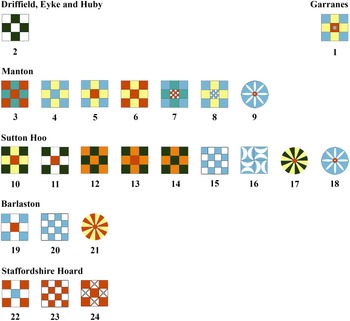
The earliest use of millefiori, dating from the late sixth to the mid-seventh centuries, is typified by the almost exclusive use of slices formed from nine-rod arrangements. However, occasional examples of sixteen-rod groupings are known. They almost always appear on hanging bowl escutcheons and fit what Laing termed a ‘late Roman tradition’,Footnote 40 despite the colour compositions being without earlier parallel in many cases. Often these nine-rod arrangements are in a simple alternating black and white pattern, as identified on early hanging bowl escutcheons from Northumberland,Footnote 41 Driffield in East Yorkshire,Footnote 42 Eyke in SuffolkFootnote 43 and Huby in North YorkshireFootnote 44 (fig 3, 2). However, a wide range of other colours are also known; indeed, more colour variations occur in earlier millefiori than at any subsequent time, including the use of yellow and orange, which are exclusive to this period (see below). This range is typified by the millefiori found on the hanging bowls from Manton Warren, Lincolnshire (fig 3, 3–6) and Sutton Hoo, Suffolk (fig 3, 10–14). The former is dated to the late sixth or early seventh century,Footnote 45 while the latter comes from the Mound 1 ship burial, which has a terminus ante quem of ad 635 based on the associated coins.Footnote 46 Similar nine-rod designs can also be found on a bowl escutcheon from Barlaston, Staffordshire,Footnote 47 and a rectangular mount from the Staffordshire Hoard, found near Hammerwich.Footnote 48
Early millefiori designs. Image: author.

Several other features typify these earlier nine-rod examples. They are occasionally enclosed by a fine outer casing of an alternative-coloured glass, often red, such as those on the Manton Warren and Sutton Hoo bowls.Footnote 49 They are also sometimes combined with millefiori roundels featuring a sunburst or petal design (fig 3, 9, 17–18 and 21), types not typically seen in later groupings. Furthermore, in early nine-rod insets, the darker, more prominent colours appear in the corners and centre of the cane, creating a visual X-shape; in later nine-rod arrangements, the opposite is usually the case, and they are more cruciform in appearance. Finally, two millefiori insets from the Manton Warren bowl contain a more complex central asymmetric checkerboard (fig 3, 7–8), while two mid-seventh-century pyramid mounts from the Staffordshire Hoard incorporate a red saltire set against a white ground (fig 3, 24).Footnote 50 While the use of a saltire in this last example might be considered a later feature (see below), the overall composition of the cane and the range of colours employed mark it as very different from those from the late seventh to early ninth centuries.
A further characteristic shared by some of these early millefiori designs, such as Manton, Sutton Hoo and Barlaston, as well as the production site at Garranes, is the use of opaque yellow glass in the compositions. Apart from St Paul in the Bail, Lincoln (discussed and contextualised below), yellow and the darker variation of orange do not appear in any millefiori schemes dating to after the mid-seventh century and characterised here as ‘transitional’ or ‘late’. Opaque yellow glass has a distinctive and uniform chemical composition throughout Europe, suggesting the use of similar raw materials, although it is difficult to know if this points to a common source.Footnote 51 However, it is a standard colour used in Anglo-Saxon beads of the sixth and seventh centuries,Footnote 52 and, although yellow glass residues dating to as late as the ninth century have been found at Tarbat Ness in Ross and Cromarty,Footnote 53 its use in millefiori ceases after c ad 650. Consequently, the presence of yellow, and almost certainly orange, within millefiori designs can be seen as an indicative marker of earlier manufacture.
Two final, slightly more complex, arrangements are found in conjunction with these typical early nine-rod designs. The first is an asymmetric chequerboard formed from twenty-five rods, which appears in blue and white on the hanging bowls from Sutton Hoo (fig 3, 15) and Barlaston (fig 3, 20)Footnote 54 and in red and white on a sword pommel from the Staffordshire Hoard (fig 3, 23), dating to the first half of the seventh century.Footnote 55 The second, again from the Sutton Hoo bowl, is very different in style and without parallel.Footnote 56 The cane is formed of twenty-four rods of crescent opaque white and blue, set so that each design quadrant is at ninety degrees to the adjoining cell, creating an effect superficially resembling a swastika (fig 3, 16). A variation of this is also found on the same vessel, whereby the quadrants are set at 180 degrees to each other, creating a lobed petal design.
Transitional millefiori (mid to late seventh century)
The next phase of millefiori, dating to the second half of the seventh century and termed ‘transitional’ here, is perhaps best typified by two Kentish pendants from SarreFootnote 57 and Sibertswold.Footnote 58 A twenty-five-rod inset was used in both cases (fig 4, 6 and 9), accompanied by others formed from sixteen and nine-rod clusters (fig 4, 7–8, 10). Such ‘transitional’ patterns almost always are unembellished checkerboards, and the colours are restricted to blue, white and black. Variations on this theme occur on the hanging bowls from Wollaston, Northamptonshire,Footnote 59 and Maltby-le-Marsh, Lincolnshire,Footnote 60 which both incorporate sixty-four-rod chequerboard insets (fig 4, 11 and 13), and a buckle from Melton Mowbray, Leicestershire,Footnote 61 that has an interrupted checkerboard design in black and white (fig 4, 16). Interestingly, the Maltby-le-Marsh bowl also incorporates a sunburst roundel (fig 4, 15), indicating some overlap with earlier styles and suggesting that millefiori rods may have been in circulation for some time before being cut into insets.
Transitional millefiori designs. Image: author.

The Sarre pendant (fig 5) is the earliest of this category, being found on a necklace alongside a solidus of Heraclius, c ad 610–41,Footnote 62 and is the only one of the group where the insets are encased in a thin red glass. The Sibertswold pendant was in a burial containing, among other items, a worn gold tremissis argued by Rigold to date to ad 660–80.Footnote 63 The Wollaston bowl, Maltby-le-Marsh bowl and the Melton Mowbray buckle are all suggested to be late seventh century in date,Footnote 64 so broadly contemporary with the Sibertswold pendant.
The Sarre pendant, Kent. Photograph: © The British Museum.

Late millefiori (late seventh–early ninth century)
Late phase millefiori, from the late seventh to early ninth centuries, is characterised by a more complex and diverse range of compound designs, along with a resurgence in the range of colours, but not yellow or orange. An example is a mount from Eastchurch, Kent,Footnote 65 which is divided into cells forming an equal-arm cross, loosely filled with millefiori insets of several designs. Two varieties are twenty-five-rod chequerboards in black and white, and red and white (fig 6, 1–2), so they might ordinarily be considered to belong to the ‘transitional’ phase. However, insets from a compound cane forming a saltire in black, red and white are also included in the scheme (fig 6, 3). Perhaps the most recognised appearance of this distinctive saltire design, but used in a wider grouping (fig 6, 4), is on the basal escutcheon of the hanging bowl found in a burial at St Paul in the Bail, Lincoln.Footnote 66 Somewhat incongruously, it appears in association with inset sunburst roundels (fig 6, 5), a feature of early millefiori, the only example of a late compound design thus far identified as doing so. Therefore, it may represent the expedient use of an available millefiori cane. However, several authors have suggested that the bowl from St Paul in the Bail is a composite piece formed from three different vessels.Footnote 67 While this would not explain the presence of the two contrasting millefiori designs appearing in the same escutcheon, it highlights that the object is complex and might be viewed as ‘atypical’.
Late millefiori designs, containing saltire arrangements. Image: author.

Canes combining the saltire cross design into more complex patterns, usually in the corners, can be found on various other objects. A disc mount from Stourton Caundle, Dorset,Footnote 68 cast with cells in the clear representation of an equal-armed cross, features such insets in the spaces between the arms (fig 7). The centre of the cross contains a simple nine-rod black and white pattern, while the apexes of the arms incorporate a broad saltire cross design, in red and white, formed from just nine rods (fig 6, 6–8). Further variations in the use of the complex saltire can be seen on finds from Kingsclere, Hampshire,Footnote 69 and Colyton, Devon.Footnote 70 The Kingsclere find is a complete, riveted, triangular box mount, and here saltire patterns are set within its central decorative panel combined into a broader cruciform design, as seen at Lincoln and Stourton Caundle. However, this box mount has a further cane variation, where saltire canes are combined to form a trellis pattern (fig 6, 9). An inverted version of this trellis design is found on the decorative disc from Colyton. Again, this disc is cast with cells forming an elaborate equal-armed cross; the arms each have a single inset of trellised saltires, but with the cross in white set against a black ground (fig 6, 11). The spaces between the arms are filled with the more usual saltires combined into a broad cross (fig 6, 12).
Mount from Stourton Caundle, Dorset. Photograph: PAS ref DOR-E48B7B.

The potential significance of the saltire design has only become apparent in recent years, as, except for the St Paul in the Bail bowl, all the objects to which they were applied have been recovered through metal detecting and not published archaeological contexts. This lack of proper context also leads to problems in their dating, which is further complicated by continued confusion over the phasing of the grave in which the St Paul in the Bail bowl was found.Footnote 71 However, it is worth noting that all the metal-detected objects with this particular saltire design are either discs and plaques (and not hanging bowl escutcheons) decorated with explicitly Christian cruciform designs, or, in the case of the Kingsclere box mount, may have had an ecclesiastical connection or function.
Fragments of a hanging bowl recovered from Ravensworth, North Yorkshire, provide further examples of millefiori that are as puzzling as the vessel itself.Footnote 72 The bowl consists of a variety of features that cross between types and date ranges in Bruce-Mitford’s Reference Bruce-Mitford2005 classification; consequently, the vessel might be viewed as a composite created from several different constituent parts. Nonetheless, the form of the hooked escutcheon discs indicates that the bowl reached its final state in the eighth century. Likewise, the millefiori insets comprise both early and late types. Two variations of blue and white petal roundels closely mirror those early designs found at Manton and Sutton Hoo (fig 8, 14–15), although they lack a red centre. Two further cane designs are based on schemes using blue rods thinly encased in white glass (fig 8, 12–13). Although these are without parallel, as already noted, the thin casing of the rods in a millefiori composition typically indicates an earlier manufacturing tradition, as does the colour combination of light blue and white. However, the two remaining designs are more firmly in the late tradition. These are complex canes in black and white and employ a variation of the saltire in a slightly more triangular form (fig 8, 10–11). Consequently, as in the case of the hanging bowl from St Paul in the Bail, the somewhat incongruous juxtaposition of both ‘early’ and ‘late’ millefiori designs at Ravensworth probably reflects the composite nature of the vessel itself.
Late millefiori designs, containing other arrangements Image: author.

Two further complex compound designs that do not feature the characteristic saltire can be confidently assigned to the late period of millefiori use in England. The first occurs on a mount from Pulham Market, Norfolk, decorated with an unambiguous Christian motif.Footnote 73 Unfortunately, this metal-detected find is poorly recorded, and the glass has significantly degraded in the ploughsoil. This weathering has led to some confusion in the description of the millefiori’s colour; the report describes these as ‘uncertain’, while the accompanying illustration suggests they are a combination of blue and white, although this must be treated with some caution. Nonetheless, several observations can still be made. The mount itself contains a central cast cruciform cell filled with five millefiori insets. The central one is in a standard nine-cane arrangement (fig 8, 17). Another inset on one arm is a variation of a saltire design, but little more can be discerned from the record. However, the remaining three insets are clearer. They are formed from clusters of nine rods of alternating colours in the corners and centre, interspaced between seemingly broader single-coloured rods (fig 8, 16), indicating that a minimum of forty-nine rods were required for the design. However, in light of the findings from Barking Abbey, these broader plain rods themselves may have been composed of subtly different colours, which have become obscured through weathering. The mount is thought to be eighth- to ninth-century in date due to the style of the champlevé enamelling surrounding the insets,Footnote 74 so broadly contemporaneous with the Barking material.
The final millefiori design discussed here is an alternative composition of sixteen triangular black and white rods. These are set in the cane so that no rods of the same colour are contiguous, although if multiple insets of the same rod were used together, this neat arrangement could have been interrupted. Two different objects incorporating this style have thus far been identified: the Witham bowl, Lincolnshire (fig 8, 18)Footnote 75 and two glass plaques from Monkwearmouth (fig 8, 19). Although now lost, the Witham bowl is well documented in a series of woodblock prints held by the Society of Antiquaries. These show the escutcheons of the bowl decorated with squared panels formed from around nine cane slices, much like the surviving Monkwearmouth plaque. The Witham bowl is argued to date from the late eighth or early ninth centuries,Footnote 76 and, while the Monkwearmouth plaques are not securely dated contextually, they are likely to be of a similar age. Cramp suggested that these plaques may have been used as insets on a liturgical object,Footnote 77 and, in addition to the triangular-rod canes, they also incorporate two types of coloured nine-rod designs (fig 8, 20–21) as well as a unique cane design of interlocking black and white T-shapes (fig 8, 22).
THE PROVENANCE OF MILLEFIORI INSETS FOUND IN ENGLAND
Two fundamental patterns emerge when comparing the evidence for millefiori insets on objects in England with the manufacturing waste from across the British Isles. First, for the earliest styles, dating to the late sixth to early seventh centuries, which employed primarily nine-rod canes in highly coloured glasses, the only broadly comparable piece of manufacturing waste is from Garranes in Ireland, and of presumed late fifth- to early sixth-century date.Footnote 78 This piece, in blue, yellow and red, almost exactly mirrors one of the insets on the Manton Warren bowl, the latter differing only in the addition of a fine central blue element. Likewise, parallels for manufacturing waste potentially relating to what has been termed here as ‘transitional’ designs can only be found in Ireland; the simple blue and white nine-rod canes found on the Sarre pendant and the Wollaston bowl are the same design as the cane found at Dunmisk in a late sixth- to late ninth-century context.Footnote 79 The cane from Lagore parallels the sixty-four-rod blue and white chequerboard inset on the Wollaston bowl,Footnote 80 while a cane from Dinas Powys matches the sixty-four-rod black and white chequerboard on the same object.Footnote 81
The second observable pattern occurs in the last phase of millefiori use, from the late seventh to early ninth centuries, when more apparent parallels with manufacturing waste from English sites begin to emerge. Two of the three canes excavated at Jarrow have close associations with finished objects: the broad saltire inset from the Stourton Caundle disc, which only lacks the blue to its outer sides, and the identical triangular rod arrangements on the Witham bowl and the Monkwearmouth plaque. Likewise, the simple black and white nine-rod insets on the Stourton Caundle disc and the Pulham Market mount directly parallel the cane from Barking, although, given the relative simplicity of the design, this might be coincidental. A closer association might be suggested for the other complex inset on the Pulham Market mount and the best-preserved cane from Barking. They share the same overall conceptual pattern; indeed, if the true colours of the Pulham Market insets were properly discernible, they could be an exact match.
Despite the limited evidence, it is possible to offer an interpretation regarding the chronological development and regional distribution of millefiori production and usage. Millefiori insets, identified here as either early or transitional and dating from the late sixth to the late seventh century, appear to have parallels only with manufacturing waste from Ireland. However, during the eighth century, closer associations with the monastic sites of Jarrow and Barking start to emerge, hinting that this was a point at which English manufacturers began to supply at least some of the millefiori. However, the use of millefiori across the British Isles ceased during the ninth century. In Ireland, this has been attributed to the effects of Norse raiding.Footnote 82 In England, this was already a period of ongoing monastic decline,Footnote 83 which was only hastened by the Scandinavian attacks; these occurred at Jarrow between ad 794–c 860, and Barking is thought to have been abandoned for similar reasons in ad 870. Consequently, it appears that a hiatus in religious life led to the end of the tradition of millefiori production and use across the entire British Isles.
One final issue deserves brief consideration here, and that is the origin of the metalwork into which the millefiori was set. This paper has already suggested that early and transitional styles of millefiori find their closest parallels in manufacturing waste in Ireland, which conforms to the provenance of the objects into which they were incorporated. Except for the Sutton Hoo bowl, none of the earlier hanging bowls display elements of typical Anglo-Saxon decoration, whether in Style I, Style II or the Mercian style. Likewise, many of the champlevé mounts with millefiori insets would typically be considered Insular in style and execution. Nevertheless, by the eighth century, millefiori was being manufactured on at least two prominent monastic sites in eastern England. The simplest explanation for this is that Anglo-Saxon sources began supplying Insular workshops with premade canes, possibly a result of a resurgent glass industry associated with the growing eighth-century church in England. However, another intriguing possibility remains: that at least some of the later ‘Insular’ metalwork was, in fact, produced in English workshops. Such a line of argument is not inconceivable as a way of explaining the evidence found at Jarrow; Northumbria had traditionally been in the sphere of the Insular church, and this artistic influence persisted long after the Synod of Whitby in ad 664.Footnote 84 Such an explanation does not align with the evidence from Barking Abbey, given its geographical location. However, by the eighth century, the religious community there may have been attempting to supply a market that extended well beyond the Kingdom of the East Saxons. Unfortunately, in the absence of targeted and comparative metallurgical analysis of the objects, such possibilities must remain speculative.
CONCLUSION
This paper presents the first comprehensive overview of millefiori manufacture in the British Isles and the range of styles found in Anglo-Saxon England. While all existing production evidence has been considered, it is not intended to be a comprehensive gazetteer of every known design. Inevitably, there will be examples that have escaped the author’s notice, and new styles will continue to emerge as hobby metal detecting and systematic excavation continue. Instead, this paper presents a foundational stylistic framework and chronology that will remain the basis for future studies.
Nonetheless, several clear conclusions can be drawn. As previously noted by Laing,Footnote 85 millefiori production began at the end of the sixth century, and all the earliest evidence for its manufacture points to Ireland. What stimulated this is less clear, but it seems likely it was connected to the growth of early Christian communities and the Insular church in particular. However, items decorated with millefiori quickly found a market in England, appearing on bowls at Manton Warren at the end of the sixth century and at Sutton Hoo in the early seventh century; types classified here as ‘early styles’. In England, from the mid to late seventh century, millefiori, while still occurring on hanging bowls at Wollaton and Maltby-le-Marsh, is also found on a greater range of objects, such as the Sarre and Sibertswold pendants and the buckle from Melton Mowbray. In this transitional phase, the range of designs narrowed to plainer chequerboard patterns, and the colours used were restricted to white, black and blue. The reasons behind this simplification are uncertain, although the source of the millefiori still seems to have been Ireland.
In the late phase of millefiori use, from the late seventh to early ninth centuries, the most significant changes in designs take place. New and complex patterns are introduced, typified by the appearance of a saltire design in several variations. These were now utilised on plaques, discs and box fittings, most of which incorporate other explicitly Christian designs. This developing range of styles hints that it was the church, in addition to secular patrons, that stimulated demand. By the late eighth to early ninth centuries, the first definitive evidence for millefiori manufacture can be found at the monasteries at Jarrow and Barking. The distinctive black and white triangle arrangement of the cane from Jarrow finds an exact parallel in the Witham bowl’s insets, while the millefiori on a mount from Pulham Market is of the same overall design as one in the manufacturing waste from Barking Abbey. It can be concluded that, by this later period, the demand for millefiori had risen and English workshops were now meeting the supply. Whether these same English workshops were also producing finished metal objects in an Insular style is as yet unknown, but the glassworking evidence certainly raises this as a possibility and one that demands further investigation.
Through this research, it is now possible to provide a comprehensive chronology for millefiori insets based on their designs, rather than relying solely on the metalwork to which they are affixed. Some caution, however, is still required. The paper has discussed the confusing picture presented by the hanging bowls from St Paul in the Bail and Ravensworth; both contain early and late styles of millefiori, possibly the result of their construction from composite parts of other vessels. Likewise, millefiori canes could have been in circulation for years or even decades between manufacture and eventual use. In these cases, only the latest millefiori style can be used to date the finished vessel when several variations are present. Despite these challenges, this research presents the first comprehensive classification of this overlooked material, successfully providing a novel framework for understanding the development of millefiori production and its use in the British Isles.
ACKNOWLEDGEMENTS
The genesis of this paper is research undertaken with Kate Welham, FSA, and Camila Bertini on the glassmaking evidence from Barking Abbey. However, it quickly became apparent the topic of millefiori deserved far more detailed attention, and I am grateful for their encouragement to pursue the study. Adam Daubney, FSA, and Duncan Wright, FSA, provided comment on an early draft of the paper, and I am particularly grateful to Kevin Leahy, FSA, for his advice and opinions, particularly regarding metalwork styles and provenance. Any errors or misunderstandings remain my own.
ABBREVIATIONS AND BIBLIOGRAPHY
Abbreviations
- PAS
-
Portable Antiquities Scheme




 Open access

