


General practitioners (GPs) treating patients with depression are faced with a difficult dilemma. Should they recommend anti-depressants, which are of proven efficacy although unlikely to be the patient's first choice, or counselling, which the patient is likely to want but is of no proven efficacy. Apart from an absence of empirical data to guide the clinician (Reference Churchill, Dewey and GrettonChurchill et al, 1999), what is at issue here is whether a failure to ‘match’ the treatment with the patient's wishes, when a treatment requires active patient participation, results in an under-estimate of its effectiveness (Reference Brewin and BradleyBrewin & Bradley, 1989; Reference Silverman and AltmanSilverman & Altman, 1996)? Brewin & Bradley (Reference Brewin and Bradley1989) proposed a partially randomised preference trial (PRPT) as a means of investigating this effect. In a PRPT, patients without a preference for either treatment are assigned to the treatment at random, whereas those with a preference are given the treatment of their choice. Then, by comparing the outcome for those who have been randomised with those who have exercised a preference for the same treatment, the contribution of the latter to the treatment response can be assessed to the degree that other differences between the groups can be ruled out. We employed a PRPT design to answer the following questions in patients with depression treated in a primary care setting.
-
(a) Are patients who exercise a treatment choice significantly different from those who are randomised?
-
(b) Which treatment (antidepressants or counselling) is the more effective?
-
(c) Do patients allocated to the treatment of their choice fare better than those who are randomised?
-
(d) Does treatment allocation affect patients' satisfaction with their treatment?
METHOD
Patient selection and allocation to treatment
We invited a random sample of 425 general practices in the Trent region to enter patients into the trial. To be eligible, patients had to be aged between 18 and 70 years and meet the Research Diagnostic Criteria (RDC) for major depression (Reference Spitzer, Endicott and RobinsSpitzer et al, 1978) as assessed by the GP. Patients were excluded if they had a psychosis, postnatal depression, a recent bereavement, comorbid drug/alcohol misuse or were actively suicidal. The GP recruited the patient, explained the purpose of the trial and obtained informed consent. The GP completed the RDC and a researcher collected additional demographic information on each patient by a telephone interview. This took place a median of 5 weeks after recruitment (range 2-20). In addition to their clinical assessment, all patients were asked to complete the Beck Depression Inventory (BDI; Reference Beck, Ward and MendelsonBeck et al, 1961), the Eysenck Personality Inventory (EPI; Reference Eysenck and EysenckEysenck & Eysenck, 1964) and the SF-36, a self-report measure of disability (Reference Ware and SherbourneWare & Sherbourne, 1992).
The patient was first offered randomisation and, if willing, was randomised to either antidepressants or counselling using block randomisation in blocks of size 4 stratified by practice. The randomisation schedule was held centrally and allocation was made by telephone. Patients who refused randomisation but who nevertheless agreed to participate, provided that they were given the treatment of their choice, were then entered into a patient preference trial. The provision of the treatment and follow-up was identical in the randomised and patient preference groups. Thus, there were four treatment arms: randomised patients treated with antidepressant (RA); randomised patients treated with counselling (RC); preference patients treated with antidepressants (PA); and preference patients treated with counselling (PC). As the trial progressed, it was apparent that the majority of those patients with a preference wished to have counselling. At 8 weeks after randomisation and then at 12 months, RDC information was obtained again from the GP and the patient again completed both the BDI and SF-36.
The treatments
We aimed to assess a treatment for depression as it might be delivered routinely in a primary care setting (i.e. assess its effectiveness). Hence, the treatments were not standardised although we did provide a written protocol on what was currently routine drug use in psychiatric practice (i.e. treatment with a choice of one of three antidepressants given at adequate dose and continued for at least 4-6 months after the individual had responded). This was only a guide and there was no obligation for the GP to follow this regimen. For the alternative treatment, we selected counsellors with at least 2000 hours of supervised experience or counsellors who were already attached to primary care teams. These could adopt whichever approach they believed was most suitable for their patient - knowing that the patient had been diagnosed with depression. The recommended number of counselling sessions was six and this had to be adhered to except under exceptional circumstances.
Outcome
As originally planned, the study was to use a binary outcome (recovery) based on a change in BDI. Recovery for patients with an initial BDI of <20 was defined as a BDI falling below 10; for an initial BDI of >20, recovery was defined as falling below 20. Based on a recovery rate of 50% in one group and 40% in the other, with a two-sided significance level of 0.05 and a power of 0.90, we calculated that we would require about 400 patients per arm. As the trial progressed, it was clear that these numbers would never be reached. We therefore resized the study using a change in the BDI as outcome. Based on what the clinicians agreed was a clinically significant difference between the groups, namely a reduction in the BDI score of 5 points, and assuming a standard deviation of 8.3 with a two-sided significance level of 0.05, we required 44 patients per arm for a power of 0.80 and 60 per arm for a power of 0.90. The additional outcome measures were a reduction in the RDC below 4 or an increase in the SF-36 that again had been measured at entry and at 8 weeks.
Statistical analysis
We compared the randomised group (as a whole) with the two preference groups across a series of baseline variables to determine if any selection biases operated in the process of randomisation. To detect if having a preference had any effect on outcome, we compared the response to antidepressants and counselling both for the groups as a whole (i.e. all randomised v. all preference patients) and separately (i.e. randomised v. preference patients for each treatment), as recommended by Brewin & Bradley (Reference Brewin and Bradley1989). Results were expressed in terms of odds ratios (ORs) or mean difference, as appropriate, in each case with 95% confidence intervals (95% CIs). We also analysed quantitative outcomes, adjusting for baseline values. All significance levels were two-sided. We also performed a sensitivity analysis, replacing missing outcomes by success or failure to determine its effect. The 12 local research ethics committees approved the study.
RESULTS
Of the 425 practices invited to participate in Trent, 31 (7.3%) enrolled one or more patients. In the randomised group, 103 patients were recruited from 24 practices; 52 and 51, respectively, being allocated to the counselling and antidepressant treatments. In the preference group, almost twice as many patients opted for counselling as for antidepressants (140 v. 80).
Effect of selection
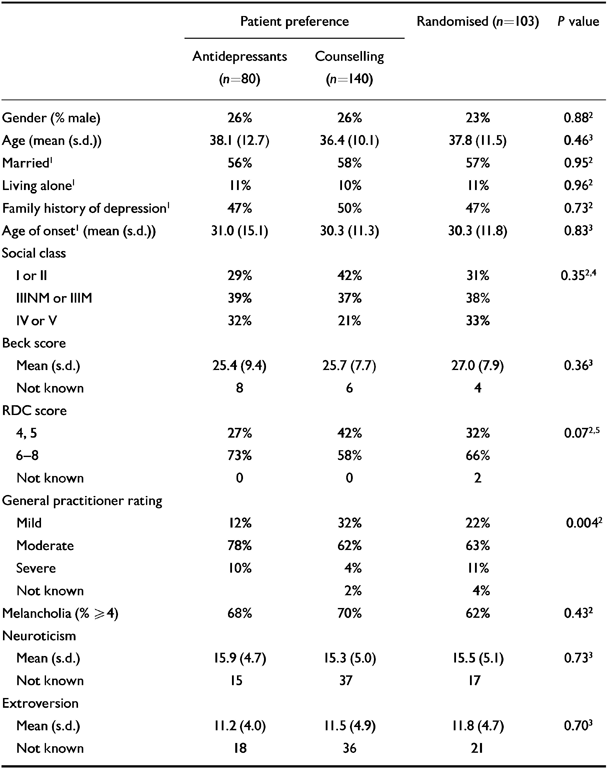
The patients in the study were predominantly women, had a mean age of mid-30s and had a moderate level of depression as indicated by their BDI score. The data in Table 1 enable one to examine whether a selection bias operates in the randomisation process, because it compares the baseline data for all randomised patients (i.e. RA+RC, n=103) with the data from those who opted for either anti-depressants (i.e. PA, n=80) or counselling (PC, n=140). The only difference between the three groups was that those who preferred antidepressants (PA) were more likely to have a more severe depressive illness as rated by the GP or by the number of RDC that they satisfied, and there was a trend for those who preferred counselling to have a more middle-class profile. There were also no differences between the three groups for any of the domains in the SF-36 (data not shown).
Summary of baseline values
| Patient preference | Randomised (n=103) | P value | ||
|---|---|---|---|---|
| Antidepressants (n=80) | Counselling (n=140) | |||
| Gender (% male) | 26% | 26% | 23% | 0.882 |
| Age (mean (s.d.)) | 38.1 (12.7) | 36.4 (10.1) | 37.8 (11.5) | 0.463 |
| Married1 | 56% | 58% | 57% | 0.952 |
| Living alone1 | 11% | 10% | 11% | 0.962 |
| Family history of depression1 | 47% | 50% | 47% | 0.732 |
| Age of onset1 (mean (s.d.)) | 31.0 (15.1) | 30.3 (11.3) | 30.3 (11.8) | 0.833 |
| Social class | ||||
| I or II | 29% | 42% | 31% | 0.352 , 4 |
| IIINM or IIIM | 39% | 37% | 38% | |
| IV or V | 32% | 21% | 33% | |
| Beck score | ||||
| Mean (s.d.) | 25.4 (9.4) | 25.7 (7.7) | 27.0 (7.9) | 0.363 |
| Not known | 8 | 6 | 4 | |
| RDC score | ||||
| 4, 5 | 27% | 42% | 32% | 0.072,5 |
| 6-8 | 73% | 58% | 66% | |
| Not known | 0 | 0 | 2 | |
| General practitioner rating | ||||
| Mild | 12% | 32% | 22% | 0.0042 |
| Moderate | 78% | 62% | 63% | |
| Severe | 10% | 4% | 11% | |
| Not known | 2% | 4% | ||
| Melancholia (% ≥ 4) | 68% | 70% | 62% | 0.432 |
| Neuroticism | ||||
| Mean (s.d.) | 15.9 (4.7) | 15.3 (5.0) | 15.5 (5.1) | 0.733 |
| Not known | 15 | 37 | 17 | |
| Extroversion | ||||
| Mean (s.d.) | 11.2 (4.0) | 11.5 (4.9) | 11.8 (4.7) | 0.703 |
| Not known | 18 | 36 | 21 | |
Outcome of treatment
Initially, we determined effectiveness by using the ‘gold standard’ randomised controlled trial (i.e. by comparing the response to treatment of those in the RA and RC arms). The 8-week follow-up visit to the GP took place for 78 of the 103 patients (76%) at a median of 10 weeks (i.e. 2 weeks after the scheduled time). By this stage, the depression had resolved (using the RDC criteria) for the majority of patients (54/78, 69%), but there was no difference between the two treatment groups (antidepressants: 29/42, 69%, counselling: 25/36, 69%; difference: 0.4% (95% CI 20-21; OR=0.98, 95% CI 0.33-2.86). If we make the assumption that all the patients who did not keep the 8-week appointment were treatment failures, this changes the rates to 29/51 (57%) and 25/52 (48%); difference ‒9% (95% CI ‒28 to 10) and OR=1.42 (95% CI 0.61-3.33). If they were all successes, the rates change to 38/51 (75%) and 41/52 (79%); difference 4% (95% CI ‒12 to 21) and OR=0.78 (95% CI 0.28-2.16). These assumptions leave the conclusions essentially unchanged.
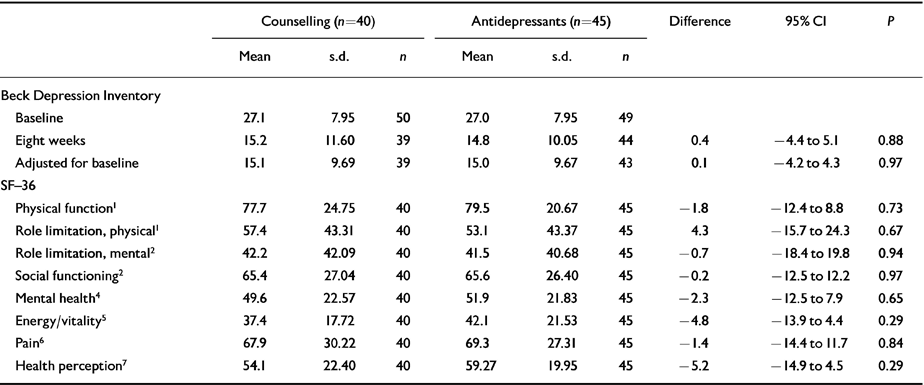
Patients were also asked to complete the BDI at 8 weeks and this was done by 45/51 and 40/52 from the antidepressant and counselling groups, respectively, at a median of 11 weeks after randomisation. There was a general fall in the BDI score but no difference between the groups: difference 0.4 points, 95% CI ‒4.4 to 5.1, P=0.88 (Table 2). Adjusting for the baseline BDI score, while reducing variability, leaves the conclusions unchanged: difference 0.1 points (-4.2 to 4.3), P=0.97. Similarly, there were no differences on any domains in the SF-36 between those randomised to antidepressants or counselling (Table 2).
Outcome at 8 weeks: randomised trial only
| Counselling (n=40) | Antidepressants (n=45) | Difference | 95% Cl | P | |||||
|---|---|---|---|---|---|---|---|---|---|
| Mean | s.d. | n | Mean | s.d. | n | ||||
| Beck Depression Inventory | |||||||||
| Baseline | 27.1 | 7.95 | 50 | 27.0 | 7.95 | 49 | |||
| Eight weeks | 15.2 | 11.60 | 39 | 14.8 | 10.05 | 44 | 0.4 | -4.4 to 5.1 | 0.88 |
| Adjusted for baseline | 15.1 | 9.69 | 39 | 15.0 | 9.67 | 43 | 0.1 | -4.2 to 4.3 | 0.97 |
| SF-36 | |||||||||
| Physical function1 | 77.7 | 24.75 | 40 | 79.5 | 20.67 | 45 | -1.8 | -12.4 to 8.8 | 0.73 |
| Role limitation, physical1 | 57.4 | 43.31 | 40 | 53.1 | 43.37 | 45 | 4.3 | -15.7 to 24.3 | 0.67 |
| Role limitation, mental2 | 42.2 | 42.09 | 40 | 41.5 | 40.68 | 45 | -0.7 | -18.4 to 19.8 | 0.94 |
| Social functioning2 | 65.4 | 27.04 | 40 | 65.6 | 26.40 | 45 | -0.2 | -12.5 to 12.2 | 0.97 |
| Mental health4 | 49.6 | 22.57 | 40 | 51.9 | 21.83 | 45 | -2.3 | -12.5 to 7.9 | 0.65 |
| Energy/vitality5 | 37.4 | 17.72 | 40 | 42.1 | 21.53 | 45 | -4.8 | -13.9 to 4.4 | 0.29 |
| Pain6 | 67.9 | 30.22 | 40 | 69.3 | 27.31 | 45 | -1.4 | -14.4 to 11.7 | 0.84 |
| Health perception7 | 54.1 | 22.40 | 40 | 59.27 | 19.95 | 45 | -5.2 | -14.9 to 4.5 | 0.29 |
Effect of allocation on outcome
We examined this effect in two ways. First, we combined both of the randomised groups and compared their outcome with the combined outcome of all those who had expressed a preference (i.e. (RA+RC) v. (PA+PC)). We obtained BDI data at 8 weeks on 85 and 164 patients from these combined randomised and preference groups, respectively. Their mean (s.d.) BDI scores were 15 (10.7) and 14.3 (9.6), respectively, with a difference in means and 95% CI of 0.7 (-1.0 to 3.4); P=0.59. Similarly, there were no significant differences between these two groups across any of the eight domains of the SF-36 (data not shown).
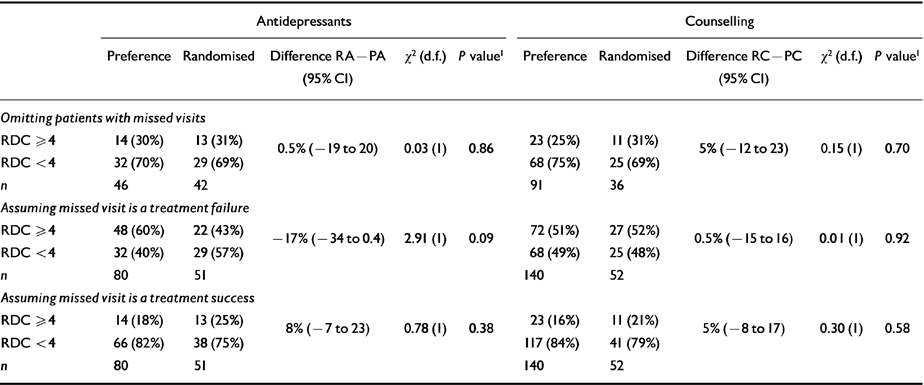
Second, we compared each randomised group with those who had exercised a preference for that treatment (that is, RA v. PA and RC v. PC), evaluating their outcome as measured by changes in RDC, the BDI and SF-36. For the RDC, we compared these groups using an 8-week outcome criterion of patients being either below or above the cut-off RDC of 4. We found no differences between the two groups (Table 3). In the RA v. PA comparison on the BDI, we had 8-week outcome data on 45 randomised and 56 preference patients, with mean (s.d.) BDI scores of 14.8 (10.1) and 14.0 (9.3), respectively, with a difference in means and 95% CI of 0.85 (-3.01 to 4.72); P=0.66. Similarly, there were no statistically significant differences on any of the eight domains of the SF-36. In the RC v. PC comparison on the BDI, we had 8-week outcome data on 40 randomised and 108 preference patients, with mean BDI (s.d.) scores of 15.2 (11.6) and 14.4 (9.8), respectively, with a difference in means and 95% CI of 0.78 (-3.04 to 4.59); P=0.69. Again, there were no statistically significant differences between the two groups on the SF-36.
Comparison of preference v. randomised patients treated with antidepressants (PA v. RA) and preference v. randomised patients treated with counselling (PC v. RC) on the Research Diagnostic Criteria (RDC) at the 8-week follow-up visit
| Antidepressants | Counselling | |||||||||
|---|---|---|---|---|---|---|---|---|---|---|
| Preference | Randomised | Difference RA—PA (95% Cl) | χ2 (d.f.) | P value1 | Preference | Randomised | Difference RC—PC (95% Cl) | χ2 (d.f.) | P value1 | |
| Omitting patients with missed visits | ||||||||||
| RDC ≥4 | 14 (30%) | 13 (31%) | 23 (25%) | 11 (31%) | ||||||
| 0.5% (-19 to 20) | 0.03 (1) | 0.86 | 5% (- 12 to 23) | 0.15 (1) | 0.70 | |||||
| RDC < 4 | 32 (70%) | 29 (69%) | 68 (75%) | 25 (69%) | ||||||
| n | 46 | 42 | 91 | 36 | ||||||
| Assuming missed visit is a treatment failure | ||||||||||
| RDC ≥ 4 | 48 (60%) | 22 (43%) | 72 (51%) | 27 (52%) | ||||||
| -17% (-34 to 0.4) | 2.91 (1) | 0.09 | 0.5% (-15 to 16) | 0.01 (1) | 0.92 | |||||
| RDC < 4 | 32 (40%) | 29 (57%) | 68 (49%) | 25 (48%) | ||||||
| n | 80 | 51 | 140 | 52 | ||||||
| Assuming missed visit is a treatment success | ||||||||||
| RDC ≥ 4 | 14 (18%) | 13 (25%) | 23 (16%) | 11 (21%) | ||||||
| 8% (-7 to 23) | 0.78 (1) | 0.38 | 5% (-8 to 17) | 0.30 (1) | 0.58 | |||||
| RDC < 4 | 66 (82%) | 38 (75%) | 117 (84%) | 41 (79%) | ||||||
| n | 80 | 51 | 140 | 52 | ||||||
Analysis of combined groups
Since these results showed that there were few differences between those who had been randomised to either treatment, we extended the analysis and compared the outcome of the two treatments irrespective of their mode of allocation. Thus, we compared the outcome of (RA+PA) v. (RC+PC). There were 101 and 148 patients and their mean (s.d.) BDI scores at 8 weeks were 14.3 (9.6) and 14.6 (10.3), with a difference in means and 95% CI of 0.3 (-2.3 to 2.8); P=0.84. Again, there were no statistically significant differences on any of the SF-36 measures. Thus, there were no differences on outcome between the two treatments, irrespective of how the patients had been allocated to them.
Attitudes towards treatment in the different groups
Finally, we compared the attitudes towards treatment in those who were randomised and those who expressed a preference (Table 4). This showed that the mode of treatment allocation (patient preference or randomisation) had little, if any, effect on the degree of satisfaction for either of the treatments offered. There were few differences between the groups, although there was some evidence that patients randomised to antidepressants were more dissatisfied with their treatment compared with those who had expressed a preference for that treatment. Based on counsellors' invoices, there was some evidence that patients choosing counselling attended more sessions than patients randomised to counselling (P=0.003).
Attitudes to treatment in randomised patients and preference patients

| Antidepressants | Counselling | |||||
|---|---|---|---|---|---|---|
| Preference (n=56) | Randomised (n=45) | P value1 | Preference (n=108) | Randomised (n=40) | P value1 | |
| The treatment helped me to recover from my depression | ||||||
| Agree | 33 (62%) | 25 (62%) | 0.90 | 71 (69%) | 20 (59%) | 0.51 |
| Neither agree or disagree | 16 (30%) | 11 (28%) | 24 (23%) | 11 (32%) | ||
| Disagree | 4 (8%) | 4 (10%) | 8 (8%) | 3 (9%) | ||
| I am prepared to continue to have this treatment in the future, should the need arise | ||||||
| Agree | 45 (86%) | 31 (74%) | 0.24 | 88 (85%) | 27 (79%) | 0.53 |
| Neither agree or disagree | 5 (10%) | 6 (14%) | 10 (10%) | 3 (9%) | ||
| Disagree | 2 (4%) | 5 (12%) | 6 (6%) | 4 (12%) | ||
| I think it was the best form of treatment I could have received for my depression | ||||||
| Agree | 31 (61%) | 15 (37%) | 0.07 | 71 (68%) | 19 (56%) | 0.38 |
| Neither agree or disagree | 15 (29%) | 19 (46%) | 22 (21%) | 10 (29%) | ||
| Disagree | 5 (10%) | 7 (17%) | 11 (11%) | 5 (15%) | ||
| Compared to previous treatments, this treatment has been more satisfactory | ||||||
| Agree | 22 (46%) | 7 (22%) | 0.06 | 35 (39%) | 12 (39%) | 0.33 |
| Neither agree or disagree | 24 (50%) | 22 (69%) | 50 (56%) | 14 (45%) | ||
| Disagree | 2 (4%) | 3 (9%) | 4 (4%) | 5 (16%) | ||
| I am satisfied with this treatment | ||||||
| Agree | 41 (80%) | 28 (73%) | 0.70 | 79 (77%) | 23 (67%) | 0.45 |
| Neither agree or disagree | 6 (12%) | 6 (16%) | 18 (18%) | 8 (24%) | ||
| Disagree | 4 (8%) | 4 (11%) | 5 (5%) | 3 (9%) | ||
| I felt uncomfortable about my treatment | ||||||
| Agree | 19 (35%) | 16 (42%) | 0.83 | 32 (32%) | 8 (24%) | 0.38 |
| Neither agree or disagree | 13 (25%) | 9 (24%) | 12 (12%) | 7 (21%) | ||
| Disagree | 21 (40%) | 13 (34%) | 57 (56%) | 19 (55%) | ||
| I found my treatment inconvenient | ||||||
| Agree | 6 (12%) | 6 (15%) | 0.93 | 18 (17%) | 5 (15%) | 0.90 |
| Neither agree or disagree | 5 (10%) | 4 (10%) | 12 (12%) | 5 (15%) | ||
| Disagree | 41 (78%) | 30 (75%) | 74 (71%) | 24 (70%) | ||
| This treatment has caused me a lot of unnecessary trouble | ||||||
| Agree | 0 | 3 (8%) | 0.004 | 2 (2%) | 0 (0%) | 0.18 |
| Neither agree or disagree | 7 (14%) | 0 | 6 (6%) | 5 (15%) | ||
| Disagree | 44 (86%) | 36 (92%) | 96 (92%) | 28 (85%) | ||
DISCUSSION
The main findings from this study were:
-
(a) the baseline characteristics of the randomised group and of patients expressing a preference for either antidepressants or counselling were similar;
-
(b) patients who were randomised to either treatment did equally well at 8 weeks; further, the treatments were equally effective when the randomised and preference groups for either treatment were combined;
-
(c) expressing a preference for a particular treatment conferred no additional benefit on outcome;
-
(d) there were few differences in treatment satisfaction between the randomised and patient preference groups.
Question I: Does random allocation produce a highly selected group?
Although randomised controlled trials are considered to be the gold standard in providing evidence of clinical efficacy, their generalisability may be limited because they are rarely carried out under routine clinical conditions (Reference Hotopf, Churchill and LewisHotopf et al, 1999). Ellenberg (Reference Ellenberg1994) has also criticised randomised controlled trials because the process of randomisation may exert a selective bias at recruitment, with those agreeing to participate not being representative of patients at large. Our investigation allows an exploration of Ellenberg's criticism. In those baseline characteristics that we measured, we found no evidence that the process of randomisation creates a highly selected group of patients with depression willing to accept random allocation, because the randomised and patient preference groups were similar in almost all of the baseline comparisons. The one exception was that those with more severe depression expressed a preference for antidepressants and those with milder depression expressed a preference for counselling. One possible explanation for this is that doctors and/or the patients may have been influenced by the evidence (Reference Elkin, Shea and WatkinsElkin et al, 1989) that the more severely depressed are more likely to benefit from antidepressants. Hence, the GP may direct those with more severe depression to have drug treatment and those with milder depression to have counselling.
We could investigate other factors relating to the generalisability of our results only in a limited way, for the following reasons. First, the patients entering this trial may not have been representative of all patients attending their GP with depression because only about one in ten practices that we approached agreed to participate. Nevertheless, these were a mix of urban/rural and single-handed/group practices. Second, we have no information on how many suitable patients were approached and declined. We are therefore unable to comment on whether our patients are representative of the larger group of patients who either refused entirely to enter the trial or may have been attending practices that refused to participate. Third, we compared the two groups only on their baseline demographic and clinical characteristics, and other crucial variables (e.g. a detailed examination of their attitude towards treatment) were not measured.
One area of the selection process that we are able to comment on is the choice of the treatment in this group. We found, as have others (e.g. Reference Priest, Vize and RobertsPriest et al, 1996), that patients with depression prefer ‘talking treatments’ because, among those who expressed a choice, twice as many opted for counselling as for antidepressants. Because counselling was being offered free to GPs in the trial, however, we were anxious to exclude the possibility of GP influence in this preference for counselling. Put simply, might the offer of free counselling in the trial lead the GP to suggest overtly or covertly to the patient that this might be the best treatment? If this were so, then what we were observing was the GP's preference rather than that of the patient.
To investigate this possibility, we performed a survey of a random sample of over 800 patients who were attending GP surgeries for routine consultations who were asked to indicate which form of treatment would be most acceptable to them if they became depressed (Reference Churchill, Khaira and GrettonChurchill et al, 2000). We found a three-to-one majority in preference for counselling over antidepressants, together with a belief that their GP would be as likely to prescribe one treatment as another. This suggests that the majority of our sample who opted for counselling were really expressing their own choice rather than that of their GP.
Question 2: Which treatment is most effective for depression in primary care?
Our second finding, both from the randomised controlled trial and from the larger comparison when both the randomised controlled trial and the preference arms were combined, indicated that there was no difference between antidepressants and counselling on outcome at 8 weeks. Although this result has a familiar ring from comparisons of the efficacy of different treatments in the psychotherapy literature, namely, that ‘everyone has won and all must have prizes’, it nevertheless challenges the assumption that generic counselling is an intervention of little proven benefit for depressive disorder in primary care. One of the caveats to the generalisability of this equity of effect is that some of the counsellors in this study were more highly trained and experienced than might be expected in the usual primary care setting.
Question 3: Does being prescribed what you choose improve your response to treatment?
Our third finding, namely, that having a preference for either treatment conveyed no extra benefit in the response, was both unexpected and counterintuitive. There may be a number of explanations for this finding. First, it may have been caused by the small sample size. However, the confidence interval around the mean difference in Beck score between the randomised and patient preference arms is still narrow enough (from ‒3 to almost 5) to rule out differences of substantial clinical significance. Similarly, the point estimates of the differences between preference patients and randomised patients (differences of 0.85 and 0.78 in the mean Beck scores for antidepressants and counselling, respectively) are very small and not of any clinical significance. Second, we have only analysed the outcome data at 8 weeks. Depression is a relapsing and recurrent condition and analysis of outcomes over a longer period may demonstrate a difference not evident at 8 weeks. Third, because the design specified that patients were offered a preference only after they had declined the possibility of randomisation, the randomised group may have included patients who would have expressed a preference had they been offered it. Offering both the randomisation and the preference options contemporaneously would therefore have been a more powerful comparison.
Fourth, it could be argued that our failure to find a difference resulted from our design, which allowed every patient to get the treatment that he/she preferred. The fact that the drop-out rates in the two treatment groups were similar and much lower than in other drug trials in depression supports this. Hence, the crucial question that we did not examine in this study is what would have been the effect on the response if the patient had been given the treatment that he/she was averse to. This situation could arise where a new treatment with limited accessibility is being trialed in a randomised design so that individuals might enter the trial in the hope of obtaining the new treatment. If such individuals were then randomised to the conventional rather than to the treatment of their choice, their response may be affected by their original preference. More commonly, this situation would also arise when a patient has a preference for one treatment but is then given an alternative by the doctor. As described earlier, this could apply if a depressed patient wished to have counselling yet was prescribed antidepressants. The impact of this mismatch was not examined in this study and merits further work.
An alternative approach to the PRPT design is where the strength and direction of the patient preference is determined before randomisation and then all consenting patients are randomised (Reference Torgerson, Klaber-Moffett and RussellTorgerson et al, 1996). Although it is claimed that this design combines the best of the PRPT with the rigour of the randomised design, it could equally be argued that those who would agree to participate in such a design are likely to be even more highly selected and may also, at best, be half-hearted about their preference. Hence, they may not truly represent those who have a preference for one or other of the two treatments on offer.
Question 4: Does treatment allocation affect patients' satisfaction with their treatment?
Finally, we examined how satisfied those in the preference and randomised groups were with their treatment. One might expect that the former would be more satisfied but what we found was that there was no difference across most of the comparisons between the two groups. There was evidence from two of the comparisons that those randomised to antidepressants were more dissatisfied compared with those in the counselling group. However, those in the randomised group were equally prepared to have drugs again in the future, should the need arise.
The difficulties experienced in recruiting patients into a randomised controlled trial in primary care in this study have been paralleled elsewhere (e.g. Reference Fairhurst and DowrickFairhurst & Dowrick, 1996), and this leads to problems in producing sound evidence to guide practice (Reference Pringle and ChurchillPringle & Churchill, 1995). There is an argument then for not making the design even more complicated by adding a patient preference arm. However, by so doing, we were able to examine a number of additional issues. We found not only that anti-depressants and counselling had a considerable effect in improving mood (as measured at 8 weeks), but also that there were no differences between the treatments or between those who were randomised or offered the treatment of their choice. For many, these findings are surprising but the limitations of our investigation suggest that further replications are necessary before one would be confident about accepting them.
Clinical Implications and Limitations
CLINICAL IMPLICATIONS
-
▪ This study suggests that counselling and antidepressants are equally effective for depression treated in a primary care setting, with outcome assessed at 8 weeks.
-
▪ Our evidence suggests that data from randomised trials are generalisable to the degree that patients agreeing to randomisation do not differ significantly from those who participated but refused randomisation.
-
▪ Allowing patients to exert a preference between antidepressants and counselling appears to confer no additional benefit.
LIMITATIONS
-
▪ The numbers recruited to the trial were less than anticipated and this reduces both the power of the sample and the generalisability of the findings.
-
▪ The fact that the choice of randomisation and preference was offered sequentially rather than contemporaneously may have affected the lack of a difference between the randomised and patient preference groups.
-
▪ Although the treatment effects were substantial, the absence of a non-treatment control (which was excluded on ethical grounds) meant that we cannot eliminate the contribution of natural remission in a primary care setting.
ACKNOWLEDGEMENTS
We thank Chris Brewin and Clare Bradley for their helpful comments on earlier drafts of the manuscript. We thank Helen Bounds and Joanne Elliott, who provided secretarial support, and Paddy Hawtin, who assisted with data collection. Professor David Wellor assisted with the development of the study protocol and recruitment of practices. We thank the GPs who recruited the patients, and their primary care teams, the counsellors and the patients who participated in the study. The study was funded by the NHS Executive, Trent.




eLetters
No eLetters have been published for this article.