

Introduction
Innovation defined as the creation or the adoption of new ideas, products, services, programs, technology, policy, structure or new administrative systems (Damanpour, Reference Damanpour1991) is acknowledged as a source of sustained competitive advantage of many organizations. The concept of newness, crucial in defining innovation, is essential to distinguish the generation of innovation from its adoption (Damanpour & Wischnevsky, Reference Damanpour and Schneider2006). Such a distinction is associated with the differences between the exploration and the exploitation in the organizational learning literature (March, Reference March1991) or between the innovation and the imitation in previous innovation research (Schumpeter, Reference Schumpeter1961). The generation of innovation results in the introduction and the use of a product, service, process or practice that is at least new to an organizational population (Damanpour & Wischnevsky, Reference Damanpour and Schneider2006). The adoption of innovation results in the assimilation of a product, service, process or practice that is new to an adopting organization (Hameed, Counsell, & Swift, Reference Hameed, Counsell and Swift2012).
Prior research has given considerable insights either into the innovation adoption process (Tornatzky & Klein, Reference Tornatzky and Klein1982; Gopalakrishnan & Damanpour, Reference Gopalakrishnan and Damanpour1997; Frambach & Schillewaert, Reference Frambach and Schillewaert2002; Damanpour & Schneider, Reference Damanpour, Chiu and Wischnevsky2006) or the antecedents of the adoption of innovation in organizations (Kimberly & Evanisko, Reference Kimberly and Evanisko1981; Dewar & Dutton, Reference Dewar and Dutton1986; Galende & de la Fuente, Reference Galende and de la Fuente2003; Wischnevsky, Damanpour, & Mendez, Reference Wischnevsky, Damanpour and Mendez2011; Hameed & Counsell, Reference Hameed and Counsell2012; Kapoor, Dwivedi, & Williams, Reference Kapoor, Dwivedi and Williams2014; Prajogo & McDermott, Reference Prajogo and McDermott2014). In spite of the significance of this body of work and the vast amount of literature available, the knowledge of the innovation adoption process is still limited. The general areas of omission in this field relate to the fact that much of this literature has examined the predictors of the innovation adoption process separately, according to the specific dimensions of variables (Wolfe, Reference Wolfe1994; Subramanian & Nilakanta, Reference Subramanian and Nilakanta1996). Those researchers who have made an attempt to examine the broader sets of variables within several dimensions have done so but their analyses have not distinguished among phases of the innovation adoption process (Kimberly & Evanisko, Reference Kimberly and Evanisko1981; Nystrom, Ramamurthy, & Wilson, Reference Nystrom, Ramamurthy and Wilson2002). The other innovation theorists have mainly focused on developing the wide, integrative conceptual models of the innovation adoption process but they have renounced the empirical examinations of the proposed interactions (Frambach & Schillewaert, Reference Frambach and Schillewaert2002; Hameed, Counsell, & Swift, Reference Hameed, Counsell and Swift2012).
Drawing on a wide range of the innovation literature sources, the study aims to identify the top-most determinants that influence the technological innovation adoption in organizations on the various stages of the innovation adoption process. Consequently, the following study develops a synthesized framework of the innovation adoption and empirically examines the conceptual model that integrates previous innovation research in several dimensions. It combines the two widely recognized agendas of the innovation adoption research: the process approach and the factor approach. The innovation adoption process is considered as a sequence of three stages – initiation, adoption decision and implementation – where initiation constitutes the preadoption activities; adoption decision concerns the managerial decision to adopt an innovation; and implementation emphasizes the postadoption activities. Then, following Hameed, Counsell, and Swift (Reference Hameed, Counsell and Swift2012) suggestion to integrate research on the innovation adoption in the very multidimensional contexts, the study empirically examines the perceived significance of the broad sets of factors covering: environmental characteristics, attributes of an organization, characteristics of top managers and features of the innovation itself as well as the user acceptance attributes (i.e., factors often neglected in the previous innovation research) at the various stages of the innovation adoption process. As the factors included in the study are simultaneously drawn from the ‘individualist’ and ‘structuralist’ perspectives (Slappendel, Reference Slappendel1996), the study will shed light on the variety of critical characteristics of the innovation adoption process.
The developed research perspective characterizes a theorizing approach that focuses on explicit constructs and combines multiple bodies of innovation literature (Suddaby & Hardy, Reference Suddaby and Hardy2011). It is also consistent with Downs and Mohr (Reference Downs and Mohr1976) statement that the innovation process is one of the most complex organizational phenomena. Consequently, the following study aims at widening the existing innovation literature by linking theories of innovation adoption and diffusion, general agendas of innovation acceptance with common frameworks developed by scholars to determine the possible factors that may influence the innovation adoption process. Such blending explicit constructs can produce more creative, insightful findings by aspiring to consider this process as a very complex and multidimensional phenomenon.
The paper is organized as follows: first a review of the relevant literature along with the proposed conceptual model is presented. This is followed by a brief discussion of the research methodology. Next, the results of the empirical analysis and their implications are considered. A concluding section summarizes the paper and outlines limitations and future research directions.
Theoretical Background
The innovation adoption has been conceptually and empirically analyzed from multiple perspectives at different levels of analysis. King (Reference King1990) has identified three levels of analysis: (1) individual level; (2) group level; and (3) organizational level research. Gopalkrishnan and Damanour (Reference Gopalakrishnan and Damanpour1997) have described studies of the innovation adoption at four levels: (1) industry level; (2) organizational level; (3) subunit level; and (4) innovation level. Most studies on innovation in psychology is considered at the individual level, in economics – at the industry level and in management – at the organizational level (Damanpour & Schneider, Reference Damanpour, Chiu and Wischnevsky2006). In this study all the variables are aggregated to the organizational level.
The innovation adoption research at the organizational level has been categorized as a dichotomy of the process approach and the factor approach. Studies taking the process approach have sought to describe an organization’s behavior in the adoption and the implementation of new solutions by examining a broad class of events vital to the innovation adoption process. Thus, the existing frameworks vary from the two-stage (Gopalkrishnan & Damanour, Reference Gopalakrishnan and Damanpour1997) to the more detailed models that cover three (Damanpour & Schneider, Reference Damanpour, Chiu and Wischnevsky2006; Hameed, Counsell, & Swift, Reference Hameed, Counsell and Swift2012), five (Klein & Sorra, Reference Klein and Sorra1996), six (Frambach & Schillewaert, Reference Frambach and Schillewaert2002) or more stages (Kwon & Zmud, Reference Kwon and Zmud1987) and typically differ in the level of generalization. Moreover, some theorists have viewed this process in the sequential and linear way and thus they have used the stage gate approach to describe how ideas are progressed within an organization (Howieson, Lawley, & Selen, Reference Howieson, Lawley and Selen2014). Other scholars have argued for dynamic and recursive approach in describing the innovation adoption process characterized by feedback and feed-forward loops (Adams, Bessant, & Phelps, Reference Adams, Bessant and Phelps2006). However, the most frequently, the innovation adoption process has been viewed as the ‘unitary sequence model’ and divided into three more general phases: initiation, adoption decision and implementation, consistent with the Lewin’s (Reference Lewin1952) model of the change process.
The initiation (pre-adoption) stage reflects the activities related to recognizing a need, searching for solutions (Damanpour & Schneider, Reference Damanpour, Chiu and Wischnevsky2006), acquiring knowledge or awareness of existing innovation, forming an initial attitude towards it and proposing innovation for adoption (Rogers, Reference Rogers1995; Hameed, Counsell, & Swift, Reference Hameed, Counsell and Swift2012; Patwardhan & Patwardhan, Reference Patwardhan and Patwardhan2012). The adoption decision stage involves the decision to accept the proposed idea by evaluating the desired solution from practical, strategic, financial and/or technological perspectives (Damanpour & Schneider, Reference Damanpour, Chiu and Wischnevsky2006), and allocating resources for its acquisition (Hameed, Counsell, & Swift, Reference Hameed, Counsell and Swift2012). In this stage top managers expand perceptions of an innovation to decide whether it will support the development of organizational goals and objectives (Kirkman, Reference Kirkman2012). The implementation (postadoption) stage deals with the activities related to modifying the innovation, preparing the organization for its general use (Damanpour & Schneider, Reference Damanpour, Chiu and Wischnevsky2006), performing a trial for its confirmation and providing the acceptance of an innovation by an organization and its employees (Rogers, Reference Rogers1995; Hameed, Counsell, & Swift, Reference Hameed, Counsell and Swift2012). This simple conceptualization of the innovation adoption process seems to be the most representative approach of the models presented in the literature, thus this paper focuses upon these rather universally noted and implied phases.
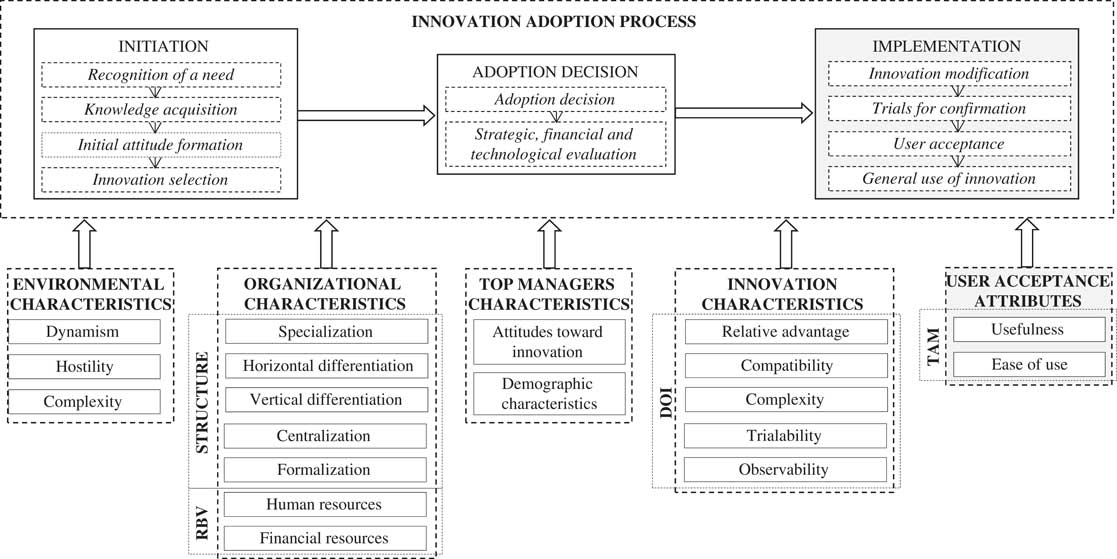
Studies taking the factor approach have usually conceptualized the innovation adoption as a multidimensional phenomenon (Kimberly & Evanisko, Reference Kimberly and Evanisko1981; Dewar & Dutton, Reference Dewar and Dutton1986; Damanpor, Reference Damanpour1991; Nystrom, Ramamurthy, & Wilson, Reference Nystrom, Ramamurthy and Wilson2002). Pierce and Delbecq (Reference Pierce and Delbecq1977) have presented the three perspectives of the innovation adoption research. The first perspective assumes that context and structure play the crucial role in determining organizational innovation. The second perspective gives attention to the attitudes of the organizational members as the major source of changes. Finally, the last perspective undertakes the holistic view of an organizational innovation and assumes that it is a dynamic and continuous phenomenon thus it may be interactively influenced by both structure and membership through an analysis of their interconnection (Kautz & Nielsen, Reference Kautz and Nielsen2004). Slappendel (Reference Slappendel1996) has provided concurrence with these three viewpoints and referred them to ‘structuralist,’ ‘individualist,’ and ‘interactive process’ perspectives. The implication of the ‘individualist’ and ‘structuralist’ perspectives for this study reveals in the proposed conceptual model presented in Figure 1 which consists of five categories of attributes that affect initiation, adoption decision and implementation stages of the innovation adoption in organizations.
Conceptual framework for the determinants of the innovation adoption process. DOI=diffusion of innovation theory; RBV=resource-based view; TAM=technology acceptance model
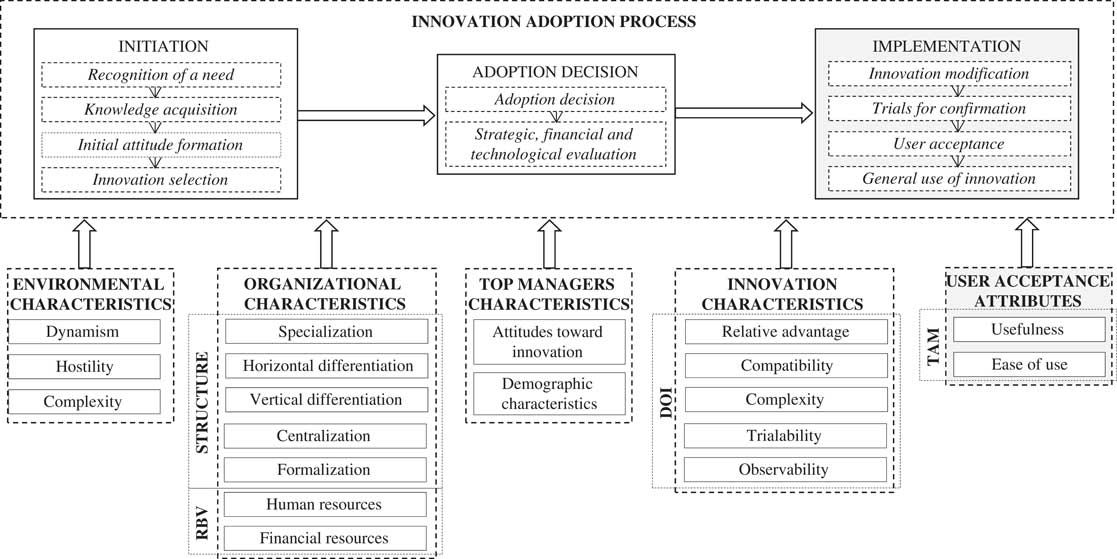
Researchers have been investigating the contextual factors that change the nature of the innovation adoption process (Premkumar & Roberts, Reference Premkumar and Roberts1999; Frambach & Schillewaert, Reference Frambach and Schillewaert2002; Damanpour & Schneider, Reference Damanpour, Chiu and Wischnevsky2006; Wischnevsky, Damanpour, & Mendez, Reference Wischnevsky, Damanpour and Mendez2011; Matta, Koonce, & Jeyaraj, Reference Matta, Koonce and Jeyaraj2012). It has been recognized that organizations conduct innovation activities within an environmental context – they obtain market related information, technology and significant resources from the environment (Frambach & Schillewaert, Reference Frambach and Schillewaert2002) as well as they deal both with the predictable and the unexpected environmental threats (regulation, limitation in external funding, knowledge and information) (Tornatzky & Fleischer, Reference Tornatzky and Fleischer1990; Damanpour & Schneider, Reference Damanpour, Chiu and Wischnevsky2006). Innovation researches have generally concurred that the adoption of innovation can be a means of an organization’s response to the changing environmental conditions in which it operates (Wischnevsky, Damanpour, & Mendez, Reference Wischnevsky, Damanpour and Mendez2011). Therefore, characteristics of an organization’s external environment may be critical to its ability to adopt innovation.
The different conceptualizations that have been used in previous innovation literature to describe the changing environmental conditions fall generally into three dimensions: dynamism, hostility and complexity in the environment. Dynamism in the environment (often called as uncertainty) generally refers to the rate of change within an industry as well as to the degree of unpredictability and instability of consumer preferences, modes of technology intensity and actions of competitors (Miller & Friesen, Reference Miller and Friesen1983; Bstieler, Reference Bstieler2005). Hostility in the environment is related to the level of resources available from the environment and to the competition for these resources (e.g., complicated legislation, limited sources of innovation funding, decreasing markets) that influence the extent to which the environment can hinder an organization’s innovation activity (Miller & Friesen, Reference Miller and Friesen1983; Covin & Slevin, Reference Covin and Slevin1989). Complexity in the environment refers to the degree of heterogeneity in the environment (environmental differences that involve different organizational practices) and encompasses the level of a complex knowledge related to diversity in production and marketing orientations that is required to understand the environment (Miller & Friesen, Reference Miller and Friesen1983). This paper focuses on all these environmental dimensions.
While analyzing the organizational antecedents of the innovation adoption scholars have generally agreed that the description of the organizational structure seems to be the most important impetus for organizational change and innovation. Drawing on Burns and Stalker (Reference Burns and Stalker1961) work and their distinction between ‘mechanistic’ and ‘organic’ organizational structures, innovation researches have tried to evaluate the effect of holistic descriptions of the organizational structure on an organization’s ability to innovate (Aiken & Hage, Reference Aiken and Hage1971; Hull & Hage, Reference Hull and Hage1982). On the other hand, more recent research has focused on the understanding of the individual attributes of the organizational structure and investigated the effects of a wide range of – examined separately – structural antecedents of the innovation adoption such as: specialization, horizontal and vertical differentiation, centralization, formalization and professionalism (Baldridge & Burnham, Reference Baldridge and Burnham1975; Pierce & Delbecq, Reference Pierce and Delbecq1977; Kimberly & Evanisko, Reference Kimberly and Evanisko1981; Damanpour, Reference Damanpour1991; Damanpour & Schneider, Reference Damanpour, Chiu and Wischnevsky2006). This paper relates the above mentioned structural variables to different phases of the innovation adoption process in order to address how an organization’s structural characteristics affect the innovation adoption. Since professionalism, that reflects professional knowledge of the organizational members (Damanpour, Reference Damanpour1991) is analogous to the notion of human capital described further, this study covers only five remaining structural variables.
Specialization (quite often named as occupational complexity or role specialization) represents the number of different specialties found in an organization (Kimberly & Evanisko, Reference Kimberly and Evanisko1981; Damanpour, Reference Damanpour1991). Horizontal differentiation (named as functional differentiation or structural differentiation) represents the extent to which an organization is divided into a number of subunits (Kimberly & Evanisko, Reference Kimberly and Evanisko1981; Damanpour, Reference Damanpour1991). Vertical differentiation reflects the number of levels in an organization’s hierarchy below the chief executive level (Damanpour, Reference Damanpour1991). Centralization refers to the locus of authority and decision making rights among the organizational members and thus reflects the extent to which a decision-making autonomy is distributed or concentrated within an organization (Damanpour, Reference Damanpour1991). Centralization may limit the free flow of ideas (Prajogo & McDermott, Reference Prajogo and McDermott2014) and therefore hinder the development of more innovative solutions (Atuahene-Gima, Reference Atuahene-Gima2003). Finally, formalization reflects the emphasis on the rigid rules and the procedures within an organization in conducting organizational activities (Damanpour, Reference Damanpour1991). Although the previous research has provided many insights into the impact of the structural characteristics on the innovation adoption, it is evident that the organizational structure must be viewed dynamically (Lewis & Seibold, Reference Lewis and Seibold1993), for example, it is necessary to examine the impact of the structural attributes for all phases of the innovation adoption process.
Regardless of whether an organization is ‘organic’ or ‘mechanistic,’ an innovation activity requires considerable resources (Galende & de la Fuente, Reference Galende and de la Fuente2003; Akgul & Gozlu, Reference Akgul and Gozlu2015). In a significant amount of research, innovation activity has been examined by utilizing the resource-based view of the company (Barney, Reference Barney1991) according to which organization’s characteristic resources may be the source of its sustainable competitive advantage. Organization’s resources are generally strengths of the effective innovation activity and include the two major categories: financial resources and human resources constituting the most basic inputs to the innovation adoption process (Adams, Bessant, & Phelps, Reference Adams, Bessant and Phelps2006; Ahuja, Lampert, & Tandon, Reference Ahuja, Lampert and Tandon2008).
Human resources personify the creativity of skilled, qualified employees with their expertise in specific domains (Harris & Helfat, Reference Harris and Helfat1997; Akgul & Gozlu, Reference Akgul and Gozlu2015). Employees’ tacit and codified knowledge creates an effect of complementarity (Pichlak & Bratnicki, Reference Pichlak and Bratnicki2011), which significantly increases the positive consequences of the adoption of innovation in organizations. Financial resources allow an organization to conduct the effective innovation activity by making a use of chances and neutralizing a risk (Barney, Reference Barney1991), absorbing the cost of failure (Damanpour, Chiu, & Wischnevsky, Reference Damanpour and Wischnevsky2009), promoting the development of the creative solutions (Scopelliti, Cillo, Busacca, & Mazursky, Reference Scopelliti, Cillo, Busacca and Mazursky2014) and investing in innovation in advance of the actual need (Nohria & Gulati, Reference Nohria and Gulati1996). A higher level of financial investment enables development of multiple innovation projects, which gives an organization higher flexibility in reacting to the market challenges. Simultaneous development of many innovation projects often leads to their ‘cross-fertilization’ (Pichlak & Bratnicki, Reference Pichlak and Bratnicki2011) and enables pursuit of innovations even in the face of their uncertain outcomes (Nohria & Gulati, Reference Nohria and Gulati1996).
An important element of the resource-based view of the company is also an assumption that leaders – or top managers – as powerful internal actors, have a significant role in promoting the innovation adoption process by stimulating the employees’ creativity and their openness to new internal as well as external knowledge (Pichlak & Bratnicki, Reference Pichlak and Bratnicki2011), influencing major decisions, especially strategic ones (Damanpour & Schneider, Reference Damanpour, Chiu and Wischnevsky2006; Hameed & Counsell, Reference Hameed and Counsell2012) and allocating resources for the successful implementation of innovations (Matta, Koonce, & Jeyaraj, Reference Matta, Koonce and Jeyaraj2012). Top managers may have different attitudes toward an innovation, for example, they may be conservative and prefer to use the typical methods and procedures, no matter what the nature of the problem is (Dewar & Dutton, Reference Dewar and Dutton1986), or they may encourage creativity and promote the overall capacity for change. This is because such individuals usually concentrate the majority of decision making power and by their attitude towards innovation (which is a derivative of their demographic characteristics) they impact the full spectrum of the innovative activities undertaken (Premkumar & Roberts, Reference Premkumar and Roberts1999).
In examining the innovation adoption within an organization researchers have investigated various innovation attributes in order to describe different patterns of the innovation adoption, in the context of the adopter’s decision to accept and use an innovation (Tornatzky & Klein, Reference Tornatzky and Klein1982). Among the multitude of the frameworks developed in previous innovation literature, the most widely recognized theoretical basis for the study of the innovation adoption is diffusion of innovation theory developed by Rogers (Reference Rogers1995). This theory is based on the general assumption that an innovation is adopted more quickly by individuals if it is perceived as possessing the five qualities, that is, relative advantage, complexity, compatibility, trialability and observability (Tornatzky & Klein, Reference Tornatzky and Klein1982; Kapoor, Dwivedi, & Williams, Reference Kapoor, Dwivedi and Williams2014).
Relative advantage reflects the degree to which an innovation is perceived by the potential adopters as more advantageous than the earlier ways of undertaking the same task (Rogers, Reference Rogers1995). Innovation compatibility is defined as ‘the degree to which an innovation is perceived as being consistent with the existing values, past experiences, and needs of potential adopters’ (Rogers, Reference Rogers1995: 15). Innovation complexity relates to the degree to which an innovation is perceived as difficult to understand, learn and use by the members of a social system (Rogers, Reference Rogers1995). Innovation trialability is defined as the degree to which an innovation is perceived as possible to learn by doing, as it may be experimented on a limited basis (Rogers, Reference Rogers1995). Finally, innovation observability is defined as ‘the degree to which the results of an innovation are visible to others’ (Rogers, Reference Rogers1995: 16).
Although this theory was originally formulated to describe patterns of the innovation adoption at the individual level, this study applies diffusion of innovation theory to examining the innovation adoption process at the organizational level. In doing so, the study assumes that innovation perceived attributes directly relate to an adopter’s behavior which will, in turn, determine the organizational usage of an innovation (Hameed, Counsell, & Swift, Reference Hameed, Counsell and Swift2012).
A similar notion may arise when considering the user acceptance attributes. Although the innovation literature has not paid as much attention to the behavioral factors as to the structural antecedents of the innovation adoption, researchers have utilized several theories – for example, theory of reasoned action developed by Fishbein and Ajzen (Reference Fishbein and Ajzen1975), theory of planned behavior proposed by Ajzen (Reference Ajzen1991) and technology acceptance model developed by Davis (Reference Davis1989) – to explain the behavior of adopters and their attitude towards an innovation. It should be noted, however, that the first two theories have been applied to studies assessing the individual level adoption (Agarwal & Prasad, Reference Agarwal and Prasad2000), while the latter one has introduced a general set of behavioral beliefs that might be applied at the organizational level. Two general, unweighted beliefs – ‘perceived usefulness’ and ‘perceived ease of use’ – proposed by Davis (Reference Davis1989), are not idiosyncratic and thus they are not limited in applicability to the given technology or particular context (Agarwal & Prasad, Reference Agarwal and Prasad2000). Perceived usefulness is defined by Davis (Reference Davis1989: 320) as ‘the degree to which a person believes that using a particular system would enhance his or her job performance.’ Perceived ease of use, on the other hand, reflects ‘the degree to which a person believes that using a particular system would be free of effort’ (Davis, Reference Davis1989: 320). Since the number of researchers has claimed that these two general constructs affect the behavior of adopter’s and their attitude towards an innovation (Frambach & Schillewaert, Reference Frambach and Schillewaert2002; Hameed, Counsell, & Swift, Reference Hameed, Counsell and Swift2012; Bresciani & Eppler, Reference Bresciani and Eppler2015), the following study incorporates ‘perceived usefulness’ and ‘perceived ease of use’ as the essential determinants of the innovation adoption at the organizational level.
Methodology
Since the following study reflects the innovation adoption process as a very complex and multidimensional phenomenon and considers different sets of incomparable variables, the Delphi method has been selected as the most suitable data gathering technique to be applied. Moreover, the best source of information regarding the specificity of the innovation adoption process is mainly vested in experts who are familiar with the activities regarding initiation, adoption decision and implementation of innovations within organizations.
Delphi approach is the procedure most commonly applied to obtain reliable consensus between the participating experts by a series of intensive questionnaires interspersed with controlled opinion feedback (Lindstone & Turoff, Reference Lindstone and Turoff1975; Nayan, Zaman, & Sembuk, Reference Nayan, Zaman and Sembuk2010). The Delphi method allows for a systematic, interactive, iterative collection of the independent experts’ opinions and their critical evaluation by the involved researchers (Ononiwu, Reference Ononiwu2013). The strength of this method is the validation of experience and expertise of participants by discovering key aspects and identifying their agreement (Rowe & Wright, Reference Rowe and Wright1999). It is based on the general assumption that viewpoints from a structured group of experts are more precise than those obtained from unstructured groups or individuals (Lindstone & Turoff, Reference Lindstone and Turoff1975).
Delphi study was conducted in four Polish Voivodeships, including Mazovian, Lodz, Podlasie and Silesian Regions. Mazovian Voivodeship, located in the middle Poland, is characterized by the high degree of the synthetic statistical innovation indicators, while Silesian Voivodeship, located in southern Poland, is characterized by one of the highest levels of industrialization. All data were collected from June 2013 till April 2014.
Previously to the proper Delphi procedure, the detailed analyses of the relevant studies were independently conducted by two researchers. Time was spent on browsing a wide body of literature in which a comprehensive discussion of the specificity of the innovation adoption process might be located. Then the researchers formed a review panel consisting of eight participants – both theorists and practitioners in the innovation and technology management, who have great knowledge and experience in the topic undertaken – in order to discuss the most important factors mentioned in the piecemeal studies from a diverse literature. In doing so, the qualitative brainstorming session was made. A few open questions were used such as: ‘What organizational factors influence or hinder the technological innovation adoption in organizations and do these factors differ during the innovation adoption process?’ The results of two previous independent searching were compared to identify a broad list of factors that have been formerly found to influence the technology adoption in organizations. The discrepancies were exhaustively discussed among the participants, until a consensus was reached. Finally, the review panel prepared the resulting list of determinants as showed in Figure 1.
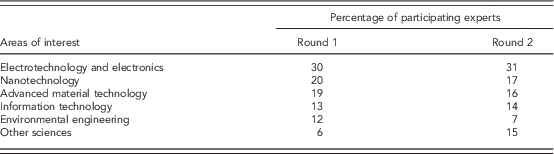
The Delphi survey was conducted among 264 experts (in the first round) and 216 experts (in the second round) of a diverse professional and academic experience. The structure of respondents is shown in Table 1.
Structure of respondents for the first and the second rounds of Delphi survey

Active participation of such a large number of panelists ensured a greater objectivity of the results obtained and provided a more precise identification of the determinants at the various stages of the innovation adoption process. As the selection of experts is an important element in Delphi method ensuring the accuracy of results obtained, the detailed criteria were identified to guide the selection of the participants to be the experts.
First of all, to combine views of the practitioners and the theorists, the sample included both kinds of participants (27% and 73% in the first round; 29% and 71% in the second round, respectively). In order to be able to judge the different issues, the experts were required to have experience in the innovation management. The theorists were asked to participate based on their research experience in the innovation generation and the adoption either in consultancy or in the basic and applied research in the implementation and the commercialization of innovations. The expert practitioners had to have experience in leading innovation projects already performed successfully in their organizations over a longer period of time. The opinions of the theorists were expected to enhance and verify the opinions of the practitioners and the opinions of the practitioners to help the theorists build a sensible view of the innovation implementation and its continued use within an organization.
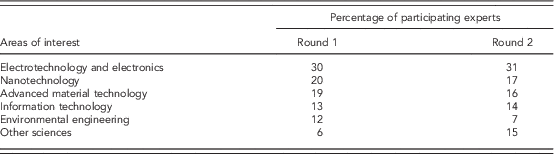
Moreover, the experts selection was combined with the key enabling technologies defined by the European Commission as ‘knowledge intensive and associated with high R&D intensity, rapid innovation cycles, high capital expenditure and highly skilled employment. They enable process, goods and service innovation throughout the economy and are of systemic relevance. They are multidisciplinary, cutting across many technology areas with a trend towards convergence and integration.’ (European Commission Report, 2012: 2–3). Key enabling technologies include: advanced material technology, nanotechnology, biotechnology, photonics, micro- and nanoelectronics and advanced manufacturing systems. A distribution of involved participants is shown in Table 2.
Distribution of experts participating in the first and the second rounds of Delphi survey
In the group of entrepreneurs the largest percentage of participants was micro-entrepreneurs (83%) usually representing small innovative companies. The remaining part of panelists (17%) was entrepreneurs working in large companies with the well-developed R&D subunits.
While considering the professional experience of all participants a significant group of experts declared that they have been working for >10 years (35% of the panelists in the first round and 36% in the second declared <20 years’ experience, while 38% of the participants in both rounds – >20 years). The remaining group of experts declared that they have been working for <5 (7% in the first round and 6% in the second) or 10 (20% in both rounds) years.
In the beginning of the proper Delphi survey all experts were invited by email to participate. The participants received information about the background and the procedure of the study. An online questionnaire was sent to the participating experts. The first round of Delphi questionnaire was designed to identify the impact of the previously selected determinants on the various stages of the innovation adoption process on a 5-point Likert scale (1=‘no impact’; 2=‘a weak influence’; 3= ‘a moderate influence’; 4=‘a strong influence’; 5=‘a very strong influence’). The framework presented in Figure 1 has constituted a conceptual taxonomy of determinants identified for further investigation in the first round of Delphi study. The following are examples of the statements from Delphi questionnaire, each beginning with the phrase: ‘Dynamism in the environment (e.g., the rate of change within an industry, the degree of unpredictability and instability of consumer preferences, modes of technology intensity and actions of competitors) has an impact on…’: ‘activities related to searching for new technological solutions, acquiring knowledge of the key enabling technologies and proposing innovation for adoption’ (the initiation stage), ‘activities related to evaluating the desired technological solution from practical and strategic perspectives and allocating resources for its acquisition’ (the adoption decision stage), ‘activities related to preparing the organization for general use of the key enabling technology and providing its acceptance by organizational members’ (the implementation stage).
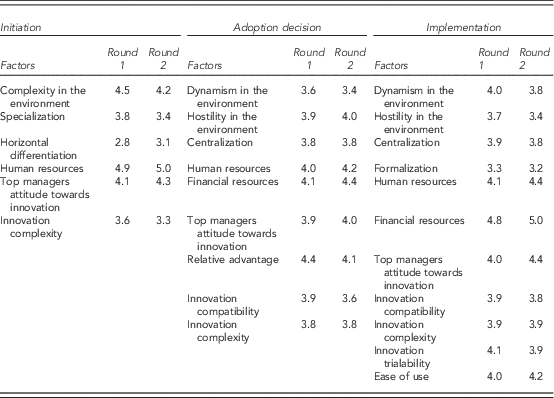
After results were returned, they were summarized according to their associated assessment. The new questionnaire used in the second round of Delphi survey was formulated on the basis of the feedback from the first round. Therefore, in this round of Delphi study only selected elements (presented in Table 4) have been given to the experts to be evaluated. The main objective of the second round of Delphi survey was to confirm the impact of various factors on the three stages of the innovation adoption process. As previously respondents rated the statements on a 5-point Likert scale choosing a number that best reflected their opinion (1=‘no impact’; 2=‘a weak influence’; 3=‘a moderate influence’; 4=‘a strong influence’; 5=‘a very strong influence’). Consensus among the rankings of the determinants provided by the participating experts in the second round of Delphi survey was measured by using the Kendall’s W nonparametric statistic. Ononiwu (Reference Ononiwu2013) has proposed that a Kendall’s coefficient of concordance (W) value of 0.7 indicates high consensus among the panelists. Since Kendall’s W was computed and indicated the participating experts sufficient unanimity (W=0.701, p<.05) the Delphi process was terminated. Finally, results of the second round of Delphi survey were analyzed according to descriptive statistics – mean, median and quartile deviation. The experts’ opinions were summed up in order to identify the most important determinants of the innovation adoption process.
Results
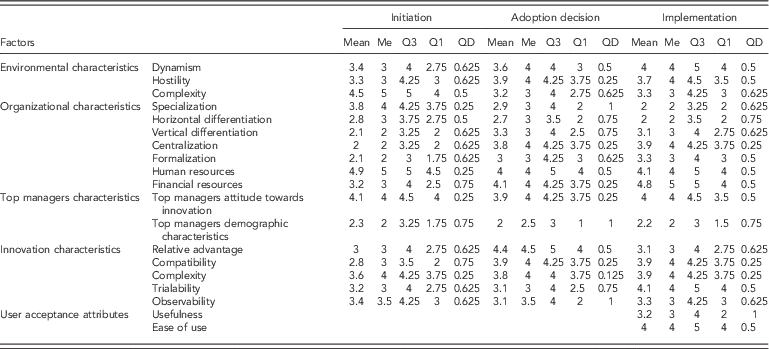
In the first round of Delphi survey 19 factors within five dimensions (environmental, organizational, top managers’ and innovation characteristics, as well as the user acceptance attributes) were converted to the first questionnaire. Participating experts were asked to assess the impact of these factors on the various stages of the innovation adoption process (initiation, adoption decision and implementation of innovation) on a 5-point Likert scale from 1=‘no impact’ to 5=‘a very strong influence.’ Table 3 shows the analysis for all 19 factors in division into the three stages of the innovation adoption process.
Analysis for the first round of Delphi study

Note.
Me=median; Q=quartile; QD=quartile deviation.
Based on the analysis conducted, quartile deviation value for 49 elements is <1. That means, all experts agreed with the influence of this factors on the various stages of the innovation adoption process (Nayan, Zaman, & Sembuk, Reference Nayan, Zaman and Sembuk2010; Ononiwu, Reference Ononiwu2013). Only for four factors (specialization, top managers’ demographic characteristics, innovation observability for the adoption decision stage and usefulness of innovation for the implementation stage) participating experts did not achieve a sufficient degree of unanimity. A total of 23 elements (11 for the initiation stage, five for the adoption decision stage and seven for the implementation stage) were valued as average, meaning that participating experts reached an agreement, but in the middle range with a quartile deviation value from 0.6 to 1.0 (Nayan, Zaman, & Sembuk, Reference Nayan, Zaman and Sembuk2010). These factors have a median split value <3.5 for a 5-point Likert scale and thus they were rejected in the second round of Delphi survey (Ononiwu, Reference Ononiwu2013). Finally, participating experts strongly agreed with 26 factors (six for the initiation stage, nine for the adoption decision stage and 11 for the implementation stage) as they were valued ≤0.5 (see Table 3).
In the second round of Delphi survey only these 26 factors were given to the panelists to be evaluated. Similarly as in the first round participating experts were asked to assess the impact of the selected factors from the first round on the initiation, adoption decision and implementation stage on the same 5-point Likert scale. The results from the both rounds are shown in Table 4.
Mean ranks for the first and the second round of Delphi study

Based on the detailed analysis of data gathered in the second round of Delphi survey, quartile deviation value for all factors is <0.5 and confirms the strong agreement of participating experts in terms of all factors given.
The Delphi panel of experts agreed on a list of determinants that need to be taken into account when dealing with the various stages of the innovation adoption process as indicated in Tables 3 and 4. An interesting conclusion arising from the research conducted is the fact that according to the experts’ opinion three of the analyzed factors (vertical differentiation, top managers demographic characteristics and innovation observability) did not have a significant impact on neither initiation, nor adoption decision or implementation.
Discussion
As expected, according to the experts’ opinions, environmental complexity significantly affects the first stage of the innovation adoption process. The greater is the heterogeneity in the environment, the greater is the need and motivation to search for new solutions. However, contrary to the previous expectation, dynamism and hostility in the environment do not have a significant effect on the first phase of the innovation adoption process. A possible explanation may be the fact that organizations are willing to adopt a more conservative attitude towards innovation which leads to the resistance to searching for new solutions but rather focusing on increasing the competitiveness and efficiency of the operational activity conducted in the conditions of growing competition for the scarce resources and rising unpredictability of the environmental change. However, dynamism and hostility in the environment seem to be the significant determinants of both adoption decision and implementation stages. It is consistent with Wischnevsky, Damanpour, and Mendez’s (Reference Wischnevsky, Damanpour and Mendez2011) conclusion that industry regulation and market concentration influence organizational decisions to adopt a given type of innovation (changes in products as well as in technological and administrative processes). The rapidly changing environment with a great competition for resources available from the environment determines the scope of activities that have been already conducted within an organization, and the scale of resources utilized (Bstieler, Reference Bstieler2005). For example, if top managers recognized the need and found the solution that would improve the operational activity and thus faced a decision to adopt an innovation, the environmental factors such as dynamism and hostility would gain more importance.
Innovation researchers have generally found that all environmental factors may encourage the adoption of innovation as they constitute the major determinants of an organization’s innovation behavior (Baldridge & Burnham, Reference Baldridge and Burnham1975). Even studies that have distinguished the different phases of the innovation adoption process confirmed that these antecedents affect all the phases with the same strength and direction (Pierce & Delbecq, Reference Pierce and Delbecq1977; Damanopur & Schneider, Reference Damanpour, Chiu and Wischnevsky2006). The findings obtained in the following study add by indicating that environmental complexity affects adoption decision more positively than initiation or implementation, whereas dynamism and hostility in the environment are more associated with the second and the third stage of the innovation adoption process in an organization.
The participating experts strongly agreed that two indicators of organizational complexity (specialization and horizontal differentiation) significantly affect the initiation stage. It is in line with Damanpour and Schneider’s (Reference Damanpour, Chiu and Wischnevsky2006) finding that organizational complexity has a positive effect on initiation but not on adoption decision and implementation. Previous innovation researchers have claimed that the cross-fertilization of ideas (Pierce & Delbecq, Reference Pierce and Delbecq1977), depth and diversity of the knowledge base (Damanpour, Chiu, & Wischnevsky, Reference Damanpour and Wischnevsky2009) in complex organizations stimulate creativity, increase awareness of new solutions and thus encourage initiation of innovation proposals. More complex organizations have a better access to information and knowledge about diverse innovations and thus are more likely to identify those (Damanopur & Schneider, Reference Damanpour, Chiu and Wischnevsky2006).
According to the experts’ opinions centralization typically associated with efficiency in decision processes (Prajogo & McDermott, Reference Prajogo and McDermott2014) strongly determines (but in a negative way) the second and the third stage of the innovation adoption process. It may reduce the organizational members’ involvement and commitment by narrowing the locus of authority and decision-making rights among the organizational members (Aiken & Hage, Reference Aiken and Hage1971; Pierce & Delbecq, Reference Pierce and Delbecq1977). The flexibility of the decision-making procedure, on the other hand, encourages the adoption of innovation, by involving the formation of ad hoc committees and social networks and making more information available to them (Lewis & Seibold, Reference Lewis and Seibold1993; Damanopur & Schneider, Reference Damanpour, Chiu and Wischnevsky2006). Thus, coalitions within organizational subsystems could pressure the organization into a higher level of the adoption and the implementation (Pierce & Delbecq, Reference Pierce and Delbecq1977).
Formalization, indicating emphasis on rigid rules and job descriptions within an organization, strongly inhibits only implementation stage. This is because the norms and rules concerning the postadoption activities and authority relationships that offer employees more rigid work roles became particularly relevant in the acceptance of an innovation by an organization and its employees. Through formalization, organizations encourage synergy by creating standardized activities and systems and incorporating these activities for existing routines (Prajogo & McDermott, Reference Prajogo and McDermott2014). The findings obtained indicate that formalization influences the organizational members to accept and use an innovation more than it stimulates the decision makers to take risk and invest in such an innovation.
The participating experts strongly agreed that human resources as well as top managers attitude toward innovation are conducive to all the stages of the innovation adoption process. The results of the study confirmed the previous ones (e.g., Premkumar & Roberts, Reference Premkumar and Roberts1999; Damanpour & Schneider, Reference Damanpour, Chiu and Wischnevsky2006; Matta, Koonce, & Jeyaraj, Reference Matta, Koonce and Jeyaraj2012) by indicating that the influence of both analyzed factors is relatively high. It means that the number of qualified employees as well as the top management support proved crucial for the adoption process over time. Moreover, the results obtained are partially in line with Scarbrough, Robertson, and Swan’s (Reference Scarbrough, Robertson and Swan2015) suggestion that greater attention needs to be given to the role of such organizational actors across the analyzed process. Top managers modulate the process of scanning the environment during the initiation stage (Damanpour & Schneider, Reference Damanpour, Chiu and Wischnevsky2006). They deal with the allocation of the resources during the adoption decision stage (Damanpour, Chiu, & Wischnevsky, Reference Damanpour and Wischnevsky2009). Finally, they have the necessary influence and authority to successfully fulfill innovation implementation during the last stage of the innovation adoption process (Matta, Koonce, & Jeyaraj, Reference Matta, Koonce and Jeyaraj2012). Similarly, the qualified employees bring the benefits in the form of introduction of innovative solutions and additional benefits from the better use of other resources in response to perceived unique problems (Pichlak & Bratnicki, Reference Pichlak and Bratnicki2011). However, contrary to the prior expectation, but partially in line with Damanpour and Schneider’s (Reference Damanpour, Chiu and Wischnevsky2006) findings, financial resources influence only adoption decision and implementation stage. It suggests that financial resources are more essential when dealing with the adoption and postadoption activities rather than with the activities related to initiation of the innovation proposals. Moreover, higher expenditures favor decision-making processes and implementation of new solutions, since more resources are allocated to adopt an innovation (Adams, Bessant, & Phelps, Reference Adams, Bessant and Phelps2006; Ahuja, Lampert, & Tandon, Reference Ahuja, Lampert and Tandon2008).
A contribution of the following study is its examination of the innovation characteristics, for example, factors often neglected in previous multidimensional studies of the innovation adoption. The results obtained indicate that while innovation complexity strongly affects all the stages of the innovation adoption process, the impact of innovation compatibility has been perceived as more significant on adoption decision and implementation stages than on initiation stage. The first conclusion is consistent with Tornatzky and Klein’s (Reference Tornatzky and Klein1982) suggestion that complexity has been widely assumed to be negatively related to innovation adoption and implementation, but the second conclusion is quite surprising. Innovation compatibility, that is, the degree to which an innovation is perceived as being consistent with the existing values, past experiences and needs of the receivers (Rogers, Reference Rogers1995) should be connected with initiation stage rather than with adoption decision or the postadoption activities. However, according to the experts’ opinions it is quite the opposite. A possible explanation of this unexpected conclusion may be the fact, that the participating experts viewed innovation compatibility closer to practical experience of the organizational members rather than to their needs and existing values. Tornatzky and Klein (Reference Tornatzky and Klein1982) have convincingly argued that innovation compatibility may refer to compatibility with the norms and values of the potential adopters or may represent congruence with the existing practices of the organizational members. The first interpretation indicates the normative or cognitive compatibility (and thus refers to what the organizational members feel or think about an innovation), while the second implies a more practical compatibility (and thus refers to what the organizational members do). Moreover, according to the experts’ opinions relative advantage is crucial for adoption decision and innovation trialability for implementation of innovations. As the last stage of the innovation adoption process deals with the inclusion of an innovation within an organization (Matta, Koonce, & Jeyaraj, Reference Matta, Koonce and Jeyaraj2012) as well as the installation of the adopted solution into a sustained recognizable behavior patterns (Pierce & Delbecq, Reference Pierce and Delbecq1977), the degree to which this solution may be experimented with seems to be crucial not only for the time of adoption but also for the rate of adoption.
Finally, ‘ease of use’ has been confirmed by the participating experts as the essential for the postadoption activities. Agarwal and Prasad (Reference Agarwal and Prasad2000) have argued that ‘ease of use’ may be seen as a related construct to the innovation complexity, which has been found in the following study as an important factor for implementation of an innovation. Such perception of an innovation affects users evaluation of and propensity to adopt an innovation, especially when the perceived benefits of adopting an innovation exceed those of other alternatives (Frambach & Schillewaert, Reference Frambach and Schillewaert2002).
The results obtained indicated that three of the analyzed factors (vertical differentiation, top managers demographic characteristics and innovation observability) did not have a significant impact on neither initiation, nor adoption decision or implementation. These findings do not necessarily correspond with previous innovation adoption studies. While previous researchers have generally agreed that horizontal differentiation is a better predictor of the innovation adoption than vertical differentiation (Kimberly & Evanisko, Reference Kimberly and Evanisko1981; Damanpour, Chiu, & Wischnevsky, Reference Damanpour and Wischnevsky2009), the Damanpour’s (Reference Damanpour1991) meta-analysis has exposed that the number of levels in an organization’s hierarchy, significantly affects the adoption of innovation in organization by making communication between levels more difficult. Thus, contrary to the result obtained, one might have expected that vertical differentiation would be an important determinant of the various innovation adoption stages (although in a negative way).
When dealing with the top managers demographic characteristics (age, gender, tenure, education level) previous studies have reported mixed findings. For example, studies on the top managers age and gender have generally supported the assertion that despite possible differences in characteristics and values between younger and older executives, or between men and women, they could exhibit similar behaviors regarding innovation adoption (Nystrom, Ramamurthy, & Wilson, Reference Nystrom, Ramamurthy and Wilson2002). Moreover, other scholars have found a nonsignificant (Damanpour, Reference Damanpour1991) or positive effect of managerial tenure (Damanpour & Schneider, Reference Damanpour, Chiu and Wischnevsky2006) and similarly nonsignificant (Bantel & Jackson, Reference Bantel and Jackson1989) and positive effect of the education level of top managers on the adoption of innovation (Kimberly & Evanisko, Reference Kimberly and Evanisko1981). Thus, the ambiguous impact of the top managers demographic characteristics on the adoption of innovation, similar to the findings obtained in the following study, makes a good case for its further investigation and validation. Moreover, some of the mentioned studies have not distinguished among the different stages of innovation adoption; therefore, the findings obtained should be confirmed by the future multiphase studies of the innovation adoption process.
Finally, the innovation observability did not significantly affect neither initiation, nor adoption decision or implementation. In spite of the ample evidence for the diffusion of innovation theory, the findings obtained indicate that such innovation characteristic would not be particularly significant in predicting the innovation adoption at the organizational level.
Limitations of the Study and Future Research
The effort towards revealing the variety of critical determinants of the various stages of the innovation adoption process is constrained by several limitations, which also represent a broader perspective for further research. Building on the conducted examination of the broad sets of factors that influence the innovation adoption, other variables could be included in further analysis; for example: (1) structural factors such as: administrative intensity, internal and external integration; (2) organizational factors such as: technical knowledge resources and slack resources; (3) characteristics of top managers such as: cosmopolitanism, the nature of their organizational involvement and tolerance for ambiguity. Moreover, in addition to the phases of the innovation adoption process considered in the following study, the distinction among different types of innovation (product and process, radical and incremental, administrative and technical) is necessary for a better understanding of the multidimensional nature of the innovation adoption process. Thus, the findings obtained would need to be confirmed for the different types of innovation. Since the Delphi method requires participants with varied professional and academic expertise, scholars had to rely on the recommendations of the experts constituting the Delphi panel. This process is known as daisy chaining and sometimes leads to new difficulties, for example, in the form of the creation of various cliques or fractions (Ononiwu, Reference Ononiwu2013). Finally, although the results undoubtedly contributed to the identifying the variety of critical determinants of the innovation adoption, the Delphi panel was composed only from Polish experts. Hence, future studies should explore these relationships in different contexts and cultures, especially in other emerging economies.
Implications for Theory and Practice
Despite its limitations, this study has the implications for both practitioner and academic communities. In principle, the findings provide insights into how organizations deal with the adoption of technological innovations. Managers can assess the condition of the innovation adoption process and focus on the possible factors that would enable them to successfully adopt an innovation within their organizations. More specifically, they can utilize the findings obtained to develop the strategy for the innovation adoption and establish smooth conditions for the easier acceptance of an innovation by the organizational members in order to avoid their resistance to change. From the academic perspective, this study provides a holistic framework covering the vital antecedents of the various stages of the innovation adoption process by indicating that the influences of the considered factors on the three phases of the innovation adoption process are generally different.
Conclusions
Management researchers have made considerable efforts to increase the understanding of the innovation process and during the past decades the innovation adoption has become the focal point in the relevant literature (Tornatzky & Klein, Reference Tornatzky and Klein1982; Frambach & Schillewaert, Reference Frambach and Schillewaert2002; Damanpour & Schneider, Reference Damanpour, Chiu and Wischnevsky2006; Hameed & Counsell, Reference Hameed and Counsell2012; Hameed, Counsell, & Swift, Reference Hameed, Counsell and Swift2012; Kirkman, Reference Kirkman2012; Kapoor, Dwivedi, & Williams, Reference Kapoor, Dwivedi and Williams2014). Despite many studies, however, some theorists have emphasized the growing inconsistency in results (Wolfe, Reference Wolfe1994) and thus have recommended more research to identify the nature of the innovation adoption process (Gopalkrishnan & Damanour, Reference Gopalakrishnan and Damanpour1997; Wischnevsky, Damanpour, & Mendez, Reference Wischnevsky, Damanpour and Mendez2011). By using the Delphi method the study identifies the top-most determinants that influence the innovation adoption in organizations and highlights that they are fundamentally different on the different phases of the innovation adoption process. The initiation stage is significantly affected by specialization, horizontal differentiation, complexity in the environment as well as innovation complexity, human resources and their attitude towards innovation. The significant determinants of both adoption decision and implementation stages are: dynamism and hostility in the environment, centralization, human and financial resources, top managers attitude towards innovation as well as two innovation perceived attributes (compatibility and complexity). In addition, the last stage is significantly affected by organizational formalization, innovation trialability and its perceived ease of use while the adoption decision stage is strongly determined by innovation relative advantage. An underlying conceptual model developed in the following paper along with the presented empirical investigation allows for (1) deeper understanding of the innovation adoption process by integrating theories of innovation adoption and diffusion, general agendas of innovation acceptance with common frameworks developed by previous researchers; (2) prioritization of the factors for management’s attention that may confirm the practical contribution of the study. Besides, considering the limitations of the study featured in the previous section, a further research could reflect the other types of determinants with reference to other kinds of innovation.
Acknowledgements
The manuscript is an original work that has not been submitted to nor published anywhere else. The author has read and approved the paper and has met the journal’s criteria for authorship. The study analyses the broad sets of factors that influence the innovation adoption process in the environmental, organizational, top managers’, innovation and user acceptance context. The innovation adoption process is presented as a sequence of stages, progressing from initiation through adoption decision to implementation of an innovation and it is considered at the organizational level. The Delphi survey conducted among 264 experts of a diverse professional and academic experience allowed examining the perceived significance of each factor for the various stages of the innovation adoption process. The results of the analysis show that the considered factors do not affect the innovation adoption process with the same strength but exert varying levels of influence on the subsequent stages. The study discusses the implications of these findings and suggests ideas for future research.
Financial Support
This work was supported by Polish Ministry of Science and Higher Education under the grant no. UDA-POIG.01.01.03-00-001/08-00 within the National Foresight Programme – implementation of the results.
Conflicts of Interest
None.