




For individuals diagnosed with breast cancer, treatment poses substantial challenges to quality of life (QoL), particularly in the first year after diagnosis (Montazeri Reference Montazeri2008). In addition to the direct side effects of treatment such as pain and nausea, common difficulties include heightened anxiety and psychological distress, fatigue, insomnia, perceived cognitive decline, and sexual dysfunction (Montazeri Reference Montazeri2008; Heidary et al. Reference Heidary, Ghaemi and Hossein Rashidi2023). Additional challenges may include changes in social roles and identity, worries about children and family, and fear of cancer recurrence (Heidary et al. Reference Heidary, Ghaemi and Hossein Rashidi2023). Collectively, these factors undermine health-related QoL.
Religion and spirituality are coping resources that may bolster health-related QoL in women with breast cancer (Peteet and Balboni Reference Peteet and Balboni2013). Yet, findings are mixed regarding the direct positive effects of religion and spirituality on health-related QoL, particularly in relation to physical well-being (Hebert et al. Reference Hebert, Zdaniuk and Schulz2009; Counted et al. Reference Counted, Possamai and Meade2018; Peres et al. Reference Peres, Kamei and Tobo2018). Some studies suggest that the constructs of spirituality, including meaning and peace, play a more direct role in bolstering QoL than religion or faith alone (Whitford and Olver Reference Whitford and Olver2012; Bai and Lazenby Reference Bai and Lazenby2015; Bai et al. Reference Bai, Dixon and Williams2016; Walker et al. Reference Walker, Chen and Paik2017). Conversely, spiritual pain has a clear association with adverse physical and mental health outcomes in individuals with cancer (Hebert et al. Reference Hebert, Zdaniuk and Schulz2009; Delgado-Guay et al. Reference Delgado-Guay, Palma and Duarte2021; Canada et al. Reference Canada, Murphy and Stein2023).
The Functional Assessment of Chronic Illness Therapy–Spiritual Well-Being Scale (FACIT-Sp) was developed to measure spirituality in diverse oncology patient populations including both religious and nonreligious people (Peterman et al. Reference Peterman, Fitchett and Brady2002). The scale comprises 3 subscales: Meaning – assessing the cognitive dimension of spirituality; Peace – assessing affective dimension of spirituality; and Faith – assessing the impact of one’s spiritual beliefs in the context of illness (Canada et al. Reference Canada, Murphy and Fitchett2008; Ahmad et al. Reference Ahmad, Sinaii and Panahi2022). Many studies have examined the relative contribution of Meaning, Peace, and Faith, as assessed by the FACIT-Sp, in accounting for variability in QoL among various cancer populations (e.g., Stefanek et al. Reference Stefanek, McDonald and Hess2005; Yanez et al. Reference Yanez, Edmondson and Stanton2009; Bai and Lazenby Reference Bai and Lazenby2015). Previous research has generally found the Meaning and Peace subscales to have a stronger association with QoL relative to the Faith subscale, leading some to conclude that faith is less consequential to health-related QoL.
However, other investigators have proposed a more nuanced, theoretically informed association among these constructs (Park Reference Park, Paloutzian and Park2013; Canada et al. Reference Canada, Murphy and Fitchett2016). For example, Park (Reference Park2005) posits that religious faith can be understood as a system which informs the process of meaning-making when faced with situations that challenge one’s previously held beliefs (e.g., receiving a cancer diagnosis). In other words, “a person’s global framework of beliefs (i.e., faith) plays an important role in ascribing significance (i.e., meaning) to events, such as a cancer diagnosis or long-term symptoms” (Canada et al. Reference Canada, Murphy and Fitchett2016). Several researchers have explored this model, proposing that Faith indirectly effects QoL as a result of its association with Meaning and Peace (Edmondson et al. Reference Edmondson, Park and Blank2008; Park et al. Reference Park, Malone and Suresh2008; Canada et al. Reference Canada, Murphy and Fitchett2016; Merluzzi et al. Reference Merluzzi, Salamanca-Balen and Philip2023). Indeed, their findings suggest that Faith is not directly associated with QoL but promotes QoL indirectly by fostering a sense of Meaning and Peace.
Importantly, most studies examining the indirect effect of faith on QoL via meaning and peace have used cross-sectional data, which limits the ability to examine mediation due to the lack of longitudinal measures over time (Maxwell and Cole Reference Maxwell and Cole2007; Fairchild and McDaniel Reference Fairchild and McDaniel2017). It also introduces a challenge of shared variability, given that the Meaning and Peace subscales of the FACIT-Sp include indicators of mental health, which are also aspects of health-related QoL, thus their associations could be considered “tautological” (Koenig and Carey Reference Koenig and Carey2025). Modeling spirituality subscales that are “contaminated” with mental health-related content as mediators is one way to remedy this issue (Koenig and Carey Reference Koenig and Carey2025).
Additionally, cross-sectional data precludes the ability to examine the impact of faith on change in meaning and/or peace during critical times during the cancer treatment experience (e.g., active treatment), and the association of this change with subsequent health-related QoL. One study of ovarian cancer survivors found that changes in spiritual well-being from pretreatment to one-year later were small but common, with 25–30% experiencing a decline and 35–55% experiencing an increase in each facit of spiritual well-being (Davis et al. Reference Davis, Cuneo and Thaker2018). Further, change in spiritual well-being scores was associated with mental health 1-year posttreatment. It is reasonable to posit that faith, likened to one’s worldview, may inform the extent to which a person experiences an increase or decrease in their sense of spiritual meaning or peace, and this change may be particularly predictive of subsequent health-related QoL.
Existing research has also focused on cancer survivors, which limits the ability to examine the effects of spirituality early in the disease and treatment process on later meaning, peace, and health outcomes. Longitudinal and prospective studies including newly diagnosed patients are needed to clarify the complex association between these psychosocial factors and subsequent health-related QoL.
The present study
The present study examined the extent to which Faith early in breast cancer diagnosis and treatment was associated with mental and physical health-related QoL assessed 15 months later by exploring the direct and mediating roles of Meaning and Peace assessed 3-months after study entry. Additional analyses also examined change in Meaning and Peace as mediators of the association between Faith and subsequent health-related QoL.
The current study is a secondary analysis of a randomized controlled trial assessing the effects of a Tibetan Yoga program compared to stretching or waitlist control conditions on sleep and fatigue over a 15-month follow-up period (Chaoul et al. Reference Chaoul, Milbury and Spelman2018). We hypothesized that Faith at study entry (baseline) would be positively associated with Meaning and Peace assessed 3 months later, which in turn would be positively associated with mental and physical health-related QoL at 15 months. Additionally, we hypothesized that higher Faith at study entry would be associated with a greater increase in 3-months Meaning and Peace (i.e., controlling for Meaning and Peace at study entry), and greater increase in Meaning and Peace would be associated with higher 15-month mental and physical health-related QoL.
Methods
Participants
The sample for the present study is comprised of 114 participants enrolled from Chaoul et al. (Reference Chaoul, Milbury and Spelman2018) who completed the study measures at the time points used in the present study (i.e., FACT-Sp at baseline and 3-months; SF-36 at baseline and 15-months). Recruitment procedures and detailed methodology are outlined in the original study (Chaoul et al. Reference Chaoul, Milbury and Spelman2018). Eligible participants were English-speaking women over the age of 18 diagnosed with stage I–III breast cancer. They were either currently receiving chemotherapy, scheduled for neoadjuvant or adjuvant chemotherapy, or had completed chemotherapy within the past year. Individuals were excluded if they had lymphedema, deep vein thrombosis, a diagnosed thought disorder (such as schizophrenia), a Mini-Mental State Examination score of 23 or lower, severe mobility limitations, were participating in psychological counseling or support groups, or had engaged in regular yoga practice in the year prior to their breast cancer diagnosis.
Measures
Meaning, peace, and faith (spiritual well-being)
Spiritual well-being was measured with the 3-factor model of the FACIT-Sp (Peterman et al. Reference Peterman, Fitchett and Brady2002; Canada et al. Reference Canada, Murphy and Fitchett2008). The 3 subscales of Meaning, Peace, and Faith each include 4 items with Likert scale responses from 0 (not at all) to 4 (very much). Examples of items representing each subscale are “I have a reason for living” (Meaning), “I feel a sense of harmony within myself” (Peace), and “I find strength in my faith or spiritual beliefs” (Faith). The subscales demonstrated adequate internal consistency in the present sample (Cronbach α for Meaning > 0.73, Peace > 0.83, Faith > 0.85 at baseline at 3-months).
Health-related quality of life
Health-related QoL was measured using the 36-item Short Form Health Survey (SF-36) developed by the Medical Outcomes Study (Ware Reference Ware and Maruish1999). This tool captures patients’ self-reported perceptions of their health-related QoL. Responses were collected using both 3-point and 6-point Likert-type scales. The SF-36 includes 8 subscales: physical functioning, role limitations due to physical health, bodily pain, general health, vitality, social functioning, role limitations due to emotional problems, and mental health. For the current study, emphasis was placed on the 2 summary scores – the Physical Component Summary (PCS) and the Mental Component Summary (MCS) – which reflect overall physical and mental health, respectively. Higher scores on the PCS and MCS indicate better perceived health-related QoL. Due to the varied weighting of items across the scales, internal consistency (Cronbach’s α) was not calculated for this sample. However, previous studies involving similar populations have demonstrated acceptable reliability for these component scores (Reulen et al. Reference Reulen, Zeegers and Jenkinson2006).
Procedure
Approval for the study protocol was granted by the University of Texas MD Anderson Cancer Center Institutional Review Board (protocol number 2005-0035), and participants were recruited between 2007 and 2012 during routine clinic visits. After providing informed consent, participants completed a baseline assessment and were randomly assigned to 1 of 3 groups: a yoga program, a stretching program, or a waitlist control group. Data collection took place at study entry (baseline), 3 months (immediately following the intervention), 6 months (3 months post-intervention), 9 months (6 months post-intervention), and 15 months (12 months post-intervention). Additional procedural details and a CONSORT diagram outlining participant flow from recruitment through the final follow-up are available in the original study report (Chaoul et al. Reference Chaoul, Milbury and Spelman2018).
Statistical methods
Bivariate associations between demographic factors and the primary outcome variables (SF-36 MCS and PCS) were examined to determine relevant covariates. Pearson correlations were conducted for continuous variables, t-tests were conducted for dichotomous categorical variables, and ANOVA was conducted for multi-categorical variables. Demographic variables associated with the outcome (p < .05), the baseline level of the outcome variable, and treatment group (yoga, stretching, or waitlist) were included in the initial models; covariates that did not account for significant variance in the model (i.e., variables associated with the outcome variable at p > .2) were removed from final models for simplicity. Detection-tolerance and the variance inflation factor (VIF) were used to assess multicollinearity before testing for mediation.
Given that parallel mediation models (i.e., a single model that includes 2 proposed mediators) require considerably larger sample sizes to achieve adequate power than single mediation models (Sim et al. Reference Sim, Kim and Suh2022), the present study conducted 4 single mediation models to examine the indirect effect of baseline Faith on 15-month PCS and MCS via 3-month Meaning and Peace using the bias-corrected bootstrap test of indirect effects via the PROCESS-macro v 3.3 for SPSS (model 4) (Hayes Reference Hayes2013). To explore changes in Meaning and Peace as mediators of the association between Faith and health-related QoL, the 4 models were rerun including the baseline level of the mediator variable as a covariate. All mediation model results are presented as standardized regression coefficients.
Power was estimated using the method proposed by Pan et al. (Reference Pan, Liu and Miao2018) to determine the sample size needed to detect mediation effects using longitudinal data. Given moderate interclass correlations between measures at the 3 time points (ICC of .5), a sample size of 109 would allow a simple indirect effect to be detected as statistically significant at alpha of .05 with 80% power using a bootstrapped approach if the associations between the predictor and mediator and between the mediator and outcome were small-to-moderate (e.g., β = .26).
Results
Sample characteristics
Participant characteristics can be seen in Table 1. Most (85%) were still undergoing active treatment and 92% were within 6 weeks of their diagnosis at study entry. Most identified as Protestant Christian (n = 47, 41%), followed by Catholic (n = 31, 27%), and Other (n = 26, 23%), with few identifying as nonreligious (n = 6, 5%). In the parent study, there were 332 participants, but 222 had missing self-report data and were not included in these analyses. There were no systematic differences between those with complete self-report data (N = 110) and those without (N = 222) on self-report variables; yet there were 2 differences in demographic variables: those with incomplete data were younger (M = 48 vs. 51 years, p = .03) and less likely to have a college education (53% vs. 74% college educated, p < .001).
Demographic and medical characteristics

Table 1 Long description
The table summarizes demographic and medical characteristics for 123 participants, reporting mean and standard deviation for age and time since diagnosis, and counts with percentages for categorical variables. Mean age was 51.42 years with a standard deviation of 10.02. Ethnicity was mostly White or European American (75, 64.0%), with Hispanic or Latino and Black or African American each at 17 (14.9%), Asian American at 5 (4.4%), and Native American at 1 (0.9%). Most participants were married or living with a partner (81, 71.7%); smaller groups were divorced (13, 11.4%), never married (7, 6.1%), or widowed (2, 1.8%). Education was highest for college graduates (49, 43.0%) and graduate degrees (34, 29.8%), with fewer reporting high school or less. Income was split between 75 thousand or less (46, 40.3%) and above 75 thousand (54, 47.4%), with 14 (12.3%) preferring not to answer. Employment was most often full-time (44, 38.6%) or retired (30, 26.3%), and religion was most commonly Protestant (47, 41.2%) or Catholic (31, 27.2%). Disease stage was primarily stage two (64, 56.1%), followed by stage three (27, 23.7%) and stage one (23, 20.2%); time since diagnosis averaged 23.36 days with a standard deviation of 31.02. Most patients had chemotherapy currently underway (98, 86.0%), and 62 participants (54.4%) were menopausal; some categories include small “prefer not to answer” groups, so totals may not align perfectly across sections.
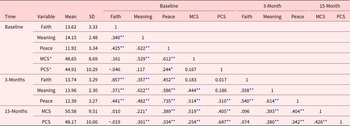
Means of and correlations among study variables at each time point are in Table 2. When examining bivariate correlations, baseline and 3-month Peace and Meaning were significantly positively associated with 15-month MCS and PCS (r’s > .3), whereas Faith was not. Additionally, when assessed at the same time point (baseline), MCS was strongly correlated with Peace (r = .61) and Meaning (r = .53), and Peace and Meaning were correlated with one another (r = .62), suggesting these measures are strongly correlated but likely represent distinct constructs.
Means and correlations of study variables

Table 2 Long description
The table reports means and standard deviations for spirituality subscales (faith, meaning, peace) at baseline and 3 months, and health-related quality of life (mental and physical component scores) at baseline and 15 months, along with correlations within and across time points. At baseline, meaning and peace are strongly related to each other and both are moderately to strongly related to baseline mental health, while faith has weaker links to mental health. Baseline physical health shows little relationship with faith or meaning and only a small positive relationship with peace. Spirituality scores are stable from baseline to 3 months, with baseline faith strongly predicting 3-month faith and baseline peace strongly predicting 3-month peace. At 15 months, mental health is moderately related to baseline mental health and shows small to moderate positive relationships with baseline and 3-month meaning and peace, but little relationship with faith. At 15 months, physical health is strongly related to baseline physical health and shows moderate positive relationships with baseline and 3-month peace and with meaning, again with minimal relationship to faith. Correlations marked as statistically significant indicate more confidence in those associations, and sample size is slightly smaller for the baseline health measures than for other variables.
Note: +N = 110, all other variables N = 114 (the participants included in the mediation analyses); *p < .05, **p < .01. PCS = Physical Component Summary; MCS = Mental Component Summary. Participants reported MCS and PCS similar to the normative mean of 50 (SD = 10) at study entry (MCS M = 48.7, SD = 8.7; PCS M = 44.9, SD = 10.3) and 15-months later (MCS M = 50.6, SD = 9.5; PCS M = 48.2, SD = 10.0). The average FACT-Sp total score at study entry (M = 39.7, SD = 7.3) and 3-months later (M = 40.1, SD = 7.3) was similar to the normative value reported by Peterman et al. (Reference Peterman, Fitchett and Brady2002) (M = 38.5, SD = 8.1) and Canada et al. (Reference Canada, Murphy and Fitchett2016) (M = 37.4, SD = 8.6). Similarly, the means of Faith, Meaning, and Peace subscales were comparable to previous studies of cancer survivors (Peterman et al. Reference Peterman, Fitchett and Brady2002; Canada et al. Reference Canada, Murphy and Fitchett2008, Reference Canada, Murphy and Fitchett2016).
Determining covariates
Mental health-related QoL (Mental Component Summary; MCS)
Individuals employed at baseline reported higher 15-month MCS compared to unemployed individuals (p = .021; Cohen’s d = .49) and higher baseline income was associated with higher 15-month MCS (r = .37, p < .001). Additionally, baseline employment status, income, and MCS were associated with 15-month MCS at p < .2 in the initial mediation models, and so were retained in the final models in which MCS was the outcome variable; group was not associated with MCS (p > .6) in the initial mediation models and so was removed from the final models.
Physical health-related QoL (Physical Component Summary; PCS)
Younger age (r = −.22), less time since diagnosis (r = −.17), and higher income (r = .27) were associated with greater 15-month PCS (p’s < .05). Women who were employed at baseline (p = .001; Cohen’s d = .71), premenopausal (p = .040, Cohen’s d = .39), and college educated (p = .016, Cohen’s d = .63) reported higher 15-month PCS compared to women who were unemployed/retired, postmenopausal, without college degrees. Additionally, women who identified as being Catholic or Protestant reported higher 15-month PCS compared to those who indicated Other as their religious affiliation (p = .008). Income, education, menopausal status, religious affiliation, and baseline PCS were associated with 15-month PCS in initial mediation models at p < .2 and so were retained in final mediation models. Age, time since diagnosis, employment, and group were not associated with PCS (p > .6) in initial mediation models and so were removed from the final models.
Indirect effects of baseline faith on 15-month health-related QoL (MCS and PCS) via 3-month meaning and peace and via change in 3-month meaning and peace
Standardized regression coefficients for each mediation model can be seen in Figure 1. There was no direct effect of baseline Faith on 15-month MCS in the model that included 3-month Meaning as a mediator (β = −.12, p = .23); however, as hypothesized, the indirect effect of baseline Faith on 15-month MCS via 3-month Meaning was significant [n = 94, effect = .07 (95% CI: .002, .17)]. Specifically, baseline Faith was positively associated with 3-month Meaning (β = .31, p = .001), which was in turn positively associated with 15-month MCS (β = .22, p = .057). The model remained the same when controlling for baseline Meaning [n = 94, effect = .07 (95% CI: .001, .18)], with the association between 3-month Meaning and 15-month MCS becoming stronger (β = .36, p = .004), suggesting that increases in Meaning during active treatment were especially relevant for improving long-term mental health-related QoL.
Mediation models exploring the indirect effect of baseline faith on 15-month health-related QOL through the proposed mediators of 3-month meaning and peace.

Figure 1 Long description
Insufficient visual information to describe this element accurately.
There was no significant direct effect of baseline Faith on 15-month MCS in the model that included 3-month Peace as the mediator (β = −.19, p = .08); however, as hypothesized, the indirect effect of baseline Faith on 15-month MCS via 3-month Peace was significant [n = 93, effect = .13 (95% CI: .02, .28)]. Specifically, baseline Faith was positively associated with 3-month Peace (β = .38, p < .001), which was in turn positively associated with 15-month MCS (β = .35, p = .011). Contrary to hypotheses, these effects became nonsignificant when controlling for baseline Peace.
There was a direct effect of baseline Faith on 15-month PCS in the model that included 3-month Meaning as a moderator, such that higher baseline Faith was associated with lower 15-month PCS (β = −.23, p = .033). Additionally, as hypothesized, the indirect effect of baseline Faith on 15-month PCS via 3-month Meaning was significant [n = 92, effect = .08 (95% CI: .002, .21)]. Specifically, baseline Faith was positively associated with 3-month Meaning (β = .32, p = .010), which was in turn positively associated with 15-month PCS (β = .26, p = .006). The indirect effect became nonsignificant when controlling for baseline Meaning, but the negative direct effect of baseline Faith on 15-month PCS remained significant (β = −.22, p = .037)
There was no direct effect of baseline Faith on 15-month PCS in the model that included 3-month Peace as the mediator (β = −.17, p = .14), and contrary to hypothesis, the indirect effect of baseline Faith on 15-month PCS via 3-month Peace was also not significant [n = 91, .03 (95% CI: −.03, .12)]. Though, baseline Faith was positively associated with 3-month Peace (β = .32, p = .004), 3-month Peace was not significantly associated with 15-month PCS (β = .11, p = .32). These effects remained nonsignificant when controlling for baseline Peace.
Discussion
This study examined how patient-reported spiritual well-being in newly diagnosed women with breast cancer undergoing chemotherapy was associated with health-related QoL over 1 year. As 90% of the sample was within the first 6 weeks of initial cancer diagnosis, these results contribute to the literature by clarifying the longitudinal impact of spirituality during the challenging early treatment period including during chemotherapy. Consistent with hypotheses and extending the findings of prior cross-sectional research, this study found that greater faith at baseline was associated with higher levels of meaning and peace 3 months later, which in turn was associated with greater mental health-related QoL assessed 15 months after study entry. Additionally, meaning, but not peace, mediated the association between baseline faith and physical health-related QoL, consistent with previous research suggesting a stronger association between meaning and physical QoL (Peterman et al. Reference Peterman, Reeve and Winford2014) and other studies suggesting that meaning is a particularly robust mediator (Canada et al. Reference Canada, Murphy and Stein2023).
Thus, faith appears to be indirectly associated with subsequent health-related QoL via greater meaning and peace. Further, by controlling for baseline meaning in the model, we were able to demonstrate that the indirect association of faith on mental health-related QoL was also mediated by the change in meaning over time. In other words, greater faith was associated with an increase in meaning during active treatment, which led to greater mental health-related QoL 1 year later.
These findings replicate and extend prior work by several researchers who have found faith to be indirectly associated with health-related QoL via meaning and peace in cross-sectional samples (Edmondson et al. Reference Edmondson, Park and Blank2008; Park et al. Reference Park, Malone and Suresh2008; Canada et al. Reference Canada, Murphy and Fitchett2016; Merluzzi et al. Reference Merluzzi, Salamanca-Balen and Philip2023). For example, Canada et al. (Reference Canada, Murphy and Fitchett2016) highlighted the indirect role of faith in promoting well-being through existential factors such as meaning and peace in a large cross-sectional sample of cancer survivors. Using the same sample, Canada et al. (Reference Canada, Murphy and Stein2023) reported that the positive associations of religious service attendance and certainty regarding one’s belief in God with mental and physical health QoL were mediated by meaning, further suggesting that religious faith informs one’s meaning-making in difficult circumstance, which in turn influence QoL. Like the current study, peace was not found to be a mediator in Canada et al.’s study (Canada et al. Reference Canada, Murphy and Stein2023).
Current results also align with Merluzzi et al. (Reference Merluzzi, Salamanca-Balen and Philip2023), who found that surrendering control to a higher power – one specific aspect of faith – was indirectly associated with well-being through a combined meaning/peace variable in a cross-sectional sample of over 500 cancer survivors. The longitudinal nature of our study provides further evidence that one’s faith, or system of meaning, informs subsequent perceptions of meaning and peace, which in turn shape QoL.
Examining the direct association between baseline faith and 15-month QoL was not the primary goal of this study, given existing evidence that faith has a weaker direct association with QoL relative to meaning or peace (Canada et al. Reference Canada, Murphy and Fitchett2016) and the theoretical and empirical rational for examining faith in conjunction with meaning and peace when considering QoL outcomes (Park Reference Park, Paloutzian and Park2013). Thus, it is not surprising that 3 of the 4 mediation models did not support a direct association between Faith and QoL. However, one model did suggest a surprising direct negative association between Faith and subsequent physical health-related QoL: greater baseline faith was associated with poorer physical health-related QoL in the model including Meaning as the mediator. This suggests that, when variance in physical health-related QoL explained by Meaning is accounted for, the association between Faith and physical health-related QoL may be negative. In other words, faith in the absence of meaning may be unhelpful in terms of physical QoL. It is possible that individuals with high faith but low meaning might experience more spiritual distress that would impede health-promoting behaviors. However, this finding needs to be interpreted with caution due to the exploratory nature of these analyses.
Limitations
Limitations of the current study are primarily related to selection of participants for the original Tibetan yoga study. The current sample was relatively financially wealthy, and greater income was associated with better mental and physical QoL. Older women and those with higher levels of education may be over-represented as they were more likely to provide complete self-report data in the parent study. This study also excluded women engaged in psychological treatment or support or who believed they needed psychological or psychiatric services. The current sample reported normative levels of QoL, particularly mental health-related QoL, which may also reflect selection bias for women who chose to join this study of a yoga intervention. It may have been more challenging to detect significant associations between aspects of spirituality and mental health-related QoL due to ceiling effects in this sample.
Implications and conclusions
This study suggests that faith, understood as strength and comfort in one’s beliefs in the face of adversity, may be an important precursor to spiritual peace and especially meaning, which demonstrates robust associations with better long-term mental and physical QoL. Importantly, participants in this study were newly diagnosed and undergoing active treatment, suggesting that spiritual resources at the outset of the cancer experience can impact later functioning. One recent study suggests that meaning changed the most over time among cancer survivors (compared to faith and peace) and was positively associated with social support and adaptive coping, suggesting that this is a malleable factor (Park et al. Reference Park, Magin and Bellizzi2024). Clinicians working with this population may benefit from attending to patients’ spiritual needs early in care, particularly to foster meaning and peace. Psychological interventions such as Meaning-Centered Psychotherapy (MCP) may be particularly useful in helping patients reconnect with a sense of meaning during cancer treatment. MCP is a brief, structured, cancer-specific psychological intervention designed to address loss of meaning, identity, and purpose after cancer diagnosis. In fact, in writing about how MCP might be useful for breast cancer survivors, Lichtenthal et al. (Reference Lichtenthal, Roberts, Jankauskaite and Breitbart2017) echoed the current findings: “meaning is hypothesized to be both an intermediary outcome (a construct to be enhanced in its own right) and a mediator, driving improvement in multiple psychological distress outcomes (e.g., by redirecting attention toward meaningful activities)” (p. 57). MCP is flexible, allowing individuals to integrate their own religious or spiritual beliefs into the therapeutic process. Other interventions that may help to bolster meaning in cancer include Dignity Therapy and Acceptance and Commitment Therapy (Sauer et al. Reference Sauer, Haussmann and Weissflog2024; Seiler et al. Reference Seiler, Amann and Hertler2024). Each of these interventions elicit the patient’s most important values and beliefs to encourage behaviors that are ultimately health-promoting.
The current study builds on a substantial body of research suggesting that religion and strength or comfort in one’s faith work through intermediary constructs of meaning and peace to improve cancer patients’ QoL. Longitudinal studies are especially needed to examine how religiosity, spirituality, and meaning evolve over time, how best to intervene upon these constructs, and what impact such changes have on individuals with cancer, their families, and the healthcare teams who support them.
Acknowledgments
This study was performed in line with the principles of the Declaration of Helsinki. Approval was granted by the MD Anderson Institutional Review Board (Protocol#: 2005–0035). Informed consent was obtained from all individual participants included in the study.
Author contributions
E.C.C.: Conceptualization, Methodology, Writing – Original Draft.
C.G.R.: Conceptualization, Methodology, Formal Analysis, Writing – Original Draft, Visualization.
A.C.: Conceptualization, Methodology, Investigation.
L.C.: Conceptualization, Methodology, Investigation, Writing – Review and Editing, Supervision, Funding acquisition
Funding
This work was supported in part by the National Cancer Institute grants [R01CA105023 and P30CA016672], and the Richard E. Haynes Distinguished Professorship for Clinical Cancer Prevention at The University of Texas MD Anderson Cancer Center.
Competing interests
The authors have no relevant financial or nonfinancial interests to disclose. AI (Microsoft Copilot) was used for minor editing of short portions of the abstract and manuscript after the initial draft had been completed.



 Open access

