


I. Introduction
The European Union is an imperfect global actor in that it must often act jointly with its Member States. This is not meant critically: the Union’s external action is necessarily subject to the limits of its conferred competences.Footnote 1 Moreover, there may well be political reasons for the Union to act alongside Member States, even where this is not required as a matter of law. Joint EU and Member State action is particularly prominent in treaty-making, often resulting in the EU’s negotiation and conclusion of mixed international agreements. Mixity characterises international treaties which are jointly concluded by the EU and (some of) its Member States, in addition to a third country or international organisation. Mixity poses some of the thorniest questions of EU law and has been scrutinised accordingly. Analyses have often focused on the distribution of external competences as such, procedural modalities of treaty-making, the implications thereof for the effectiveness of EU external action, or salient international law aspects.Footnote 2
The present article rather focuses on how the Court of Justice of the European Union (CJEU or Court) has metabolised mixity in its adjudicatory practice for jurisdictional purposes. Namely, it examines the Court’s approach to establishing its jurisdiction to interpret mixed agreements. First, the article seeks to clarify and systematise the Court’s methodology, as it has emerged—organically if not anarchically—from case law starting from Haegeman and Demirel, and Hermès and Dior, leading all the way to Komstroy and ÖBB-Infrastruktur.Footnote 3 More than merely reviewing the case law, the article endeavours to look beyond (perceived) inconsistencies, identify common principles, and set out concrete steps and criteria subject to which the Court can delineate its jurisdiction. The Court’s case law will be discussed mostly chronologically, structured by reference to identified methodological steps. This does not mean that the Court was faced with pertinent issues in neat chronological order; the intention is rather to trace the trajectory of the Court’s approach by elucidating its historical rationale(s), with a view to fostering doctrinal coherence. In this sense, the article serves both an analytical and a normative function.
Second, the article will argue that the Court has recently expanded its jurisdiction over the interpretation of mixed agreements in order to fill gaps in judicial protection and assert the autonomy of the EU legal order. As will be seen, this occurred in the context of arbitration between an investor from an EU Member State and another Member State (intra-EU investment arbitration) under investment treaties.Footnote 4 The article will discuss this only to inform the analysis of the Court’s overall approach to asserting jurisdiction over mixed agreements.
II. Mixity and mixed agreements
A brief overview of mixity and mixed agreements will first be provided. Mixity is a result of the division of competences between EU institutions and Member States. It therefore stems from the principle of conferral under Article 5(2) Treaty of European Union (TEU), according to which the ‘Union shall act only within the limits of the competences conferred upon it by the Member States in the Treaties to attain the objectives set out therein’. The principle is a structural principle of EU law in that it helps ‘define’ and is ‘inherent to the deep structure of the EU’.Footnote 5 Its relevance in the Union’s external relations is particularly pronounced: the principle of conferral not only reflects the internal allocation of powers between the EU institutions and Member States but also governs the EU’s capacity for external action.
This means that the EU can conclude international agreements solely (that is, without the participation of Member States) only insofar as these fall within its competences. The CJEU has recently confirmed that the EU can solely conclude an agreement irrespective of whether its competence in the respective area is exclusive or shared.Footnote 6 Mixity is obligatory—required by law—only where an international agreement would include provisions that fall within EU competence (exclusive or shared) as well as Member States’ exclusive competence. Mixity is also selected for political or pragmatic reasons where it is not required as a matter of (EU) law—in these circumstances, mixity is said to be facultative.Footnote 7 For instance, as acknowledged by the Court, the required majority at the Council was unable to be reached concerning the conclusion of the EU–Singapore Free Trade Agreement, even with respect to provisions falling within EU competence.Footnote 8
From an EU perspective, mixed agreements are concluded like any other: treaty-making follows the procedure set out in Article 218 Treaty on the Functioning of the European Union (TFEU).Footnote 9 In the context of the common commercial policy, within which mixed agreements have often been concluded, treaty-making rules are further specified in Article 207 TFEU. The EU has concluded numerous international agreements jointly with Member States. Such agreements cover a wide range of policy areas, such as inland waterway transport,Footnote 10 the law of the sea,Footnote 11 access to justice in environmental matters,Footnote 12 and international trade in services and intellectual property.Footnote 13 In some cases, the mixed nature of a (proposed) agreement reflects its far-reaching scope or political sensitivity, such as the 2014 Association Agreement between the EU and UkraineFootnote 14 and the 2016 EU–Canada Comprehensive Economic and Trade Agreement (CETA).Footnote 15
III. Step 1: international agreements as an integral part of Union law
The first step of the Court’s approach to interpreting a provision of an international agreement was famously set out in Haegeman.Footnote 16 This concerns all international agreements.
Haegeman concerned the Association Agreement between the then European Economic Community (EEC) and Greece, before its accession to the former. The Court noted that that Agreement ‘was concluded by the Council’ and ‘is therefore, in so far as concerns the Community, an act of one of the institutions of the Community’.Footnote 17 Therefore, ‘[t]he provisions of the Agreement, from the coming into force thereof, form an integral part of Community law’.Footnote 18 This sufficed to establish that the Court has jurisdiction ‘to give preliminary rulings concerning the interpretation’ thereof.Footnote 19 Haegeman expressed a monist dynamic as regards international agreements, whereby the conclusion of an international treaty brings the latter fully within the domestic legal order.Footnote 20 While this prima facie signalled an openness to international law on behalf of the Union, it effectively asserted the CJEU’s jurisdiction to interpret and review international agreements in light of EU law.
The French versions of Haegeman and subsequent judgments speak of l’ordre juridique communautaire. English versions of early case law varied. Haegeman merely used the term ‘Community law’, whereas in Kupferberg it was found that agreements concluded by the then-Community ‘form an integral part of the Community legal system’.Footnote 21 Over time, the Court has tended to refer to the Union ‘legal order’.Footnote 22 In any event, Haegeman is now part of the EU jurisprudential canon: according to a recent count by Wessel, at least 35 judgments, orders and opinions, and at least 52 Opinions of Advocates General have referred to the case.Footnote 23
The Court’s finding in Haegeman is often seen as intrinsically connected to the procedural context in which it arose, that is, the preliminary reference procedure under Article 267 TFEU. As Advocate General Ćapeta noted in her Opinion in ÖBB-Infrastruktur, ‘[t]he Haegeman argument has become the standard justification of the Court’s jurisdiction to interpret international agreements in the preliminary-ruling procedure, repeated in all such cases’.Footnote 24 This does not mean that Haegeman is of no relevance in other types of proceedings. Inter alia, the Court has also recalled that an international agreement concluded by the EU forms an integral part of Union law in Opinions rendered pursuant to Article 218(11) TFEU,Footnote 25 infringement proceedings under Article 258 TFEU,Footnote 26 annulment proceedings under Article 263 TFEU,Footnote 27 and actions for damages under Articles 268 and 340 TFEU.Footnote 28 More recently, Haegeman was referenced by the Court of Justice in KaiKai, an appeal brought against a General Court judgment which annulled a decision by the Board of Appeal of the European Union Intellectual Property Office.Footnote 29
Though the Haegeman argument applies to all types of CJEU jurisdiction, it cannot be disputed that its origins were specific to the preliminary reference procedure. It is well known that the dialogue between the Court and national courts constitutes the ‘keystone’ of the EU judicial system.Footnote 30 Requests for a preliminary ruling historically represent the main source of activity for the Court of Justice.Footnote 31 Against this context, Haegeman empowered the Court to review ‘the validity and interpretation’ of international agreements on an ad hoc and ex post basis, whenever a related question arose in national proceedings, after such agreements assumed the status of an EU act.Footnote 32
This must be contrasted with the Court’s jurisdiction to render opinions on the ‘compatibility’ of the EU’s international agreements with the Treaties under Article 218(11) TFEU. First, this concerns ‘envisaged’, rather than already concluded, agreements. Article 218(11) provides for the Court’s ex ante involvement which may well block the conclusion of an agreement: prominently, in Opinion 2/13, the Court rejected the proposed accession of the EU to the European Convention on Human Rights.
Second, opinions rendered on this basis can engage in a far-reaching assessment of the proposed agreement, which necessarily entails a degree of interpretation of particular provisions. Preliminary rulings, on the other hand, are in principle limited to the question referred to the Court by a national court. Of course, it is well established that the Court of Justice in practice often reformulates questions, offers obiter comments, and, overall, retains significant control of whether and how to answer a question.Footnote 33 Importantly, the Court can only deliver an opinion under Article 218(11) TFEU following a request by a Union institution or a Member State. Such a request is often motivated by (domestic) political considerationsFootnote 34 and is, in any event, a highly visible gesture that institutions or Member States could hesitate to make owing to potential economic and political implications.Footnote 35 Only 26 opinions have been rendered so far. While the Court’s jurisdiction under Article 267 TFEU with regard to the interpretation of international agreements qua EU acts may not (in principle) be as far-reaching as that under Article 218(11) TFEU, the decentralised nature of the preliminary reference procedure allows it, following Haegeman, to be exercised more easily.
IV. Step 2: mixed agreements and the exercise of Union competence
Regarding the Court’s jurisdiction to interpret mixed agreements in particular, the case law has, over time, arguably developed a criterion concerning the exercise of EU competence in relation to specific agreement provisions. This second step establishes the Court’s jurisdiction, as regards provisions at issue, in principle. The present section does not intend to merely revisit established case law. Rather, it specifically aims to trace the above development in CJEU jurisprudence which is often seen as lacking in clarity and consistency. The analysis that follows proposes an approach which essentially accords with adjudicatory practice but also provides greater legal certainty.
For a more structured analysis, the present section will separately consider the Court’s approach in preliminary reference and infringement proceedings. While the different procedural contexts have undoubtedly shaped the Court’s approach, it will be explained that, overall, a common approach can still be identified in substance.
A. Preliminary reference proceedings
1. Demirel
The first case in which the jurisdiction of the Court to interpret the provisions of a mixed agreement was challenged is Demirel.Footnote 36 Germany and the United Kingdom argued that the Court lacked jurisdiction to interpret provisions on the free movement of workers in the Association Agreement between the EEC and Turkey, in relation to which these states had ‘exercise[d] their own powers’.Footnote 37
The Court disagreed, finding that these provisions did not fall within the exclusive competence of Member States because the agreement at issue sought to create ‘special, privileged links with [a third country] which must, at least to a certain extent, take part in the Community system’.Footnote 38 Moreover, the Court found that its interpretative jurisdiction ‘cannot be called in question’ simply because the EU did not directly ‘give effect’ to the agreement’s provisions and instead relied on its Member States to do so.Footnote 39 On this point, the Court extrapolated the reasoning of Kupferberg, a case concerning an EU-only international agreement, to mixed agreements as follows: ‘in ensuring respect for commitments arising from an agreement concluded by the Community institutions the Member States fulfil, within the Community system, an obligation in relation to the Community, which has assumed responsibility for the due performance of the agreement’.Footnote 40
Demirel can be criticised for its strategic lack of clarity. Arguably, by focusing on the issue of competence, the Court ‘left open’ the question of its jurisdiction.Footnote 41 Demirel could well be read as establishing the Court’s jurisdiction to interpret all provisions of any international agreement, insofar as these do not fall within Member States’ exclusive competences.Footnote 42
2. Hermès, Dior, and Merck
It is argued that the case law progressed since Demirel as follows. The assertion that an agreement concluded by the EU forms an integral part of Union law remains essential for establishing the Court’s jurisdiction vis-à-vis mixed agreements. However, this does not suffice. Rather, the Court must also consider its jurisdiction as regards a particular provision of a mixed agreement, by determining the extent to which the Union has exercised its competence in relation to it.
This echoes the findings of Advocate General Ćapeta in her Opinion in ÖBB-Infrastruktur, who has similarly observed that the case law ‘links its jurisdiction over a particular provision of a mixed agreement to the exercise of EU competence’.Footnote 43 As she rightly conceded, not all judgments recognise the above in a straightforward manner.Footnote 44 For instance, the Hermès and Dior judgments can be read as casting the Court’s jurisdiction widely, merely by virtue of the agreements’ conclusion by the Union.Footnote 45 The article will demonstrate why, notwithstanding perceived inconsistencies, this is not so.
Both Hermès and Dior concerned the interpretation of Article 50 of the mixed Agreement on Trade-Related Aspects of Intellectual Property Rights (TRIPs Agreement), regarding provisional measures for the protection of the interests of proprietors of intellectual property rights.Footnote 46 In Hermès, the Netherlands, France, and the United Kingdom argued that the Court lacked jurisdiction to determine whether an interim measure, as provided by Dutch law, constituted a ‘provisional measure’ under Article 50 of the TRIPs Agreement. The case concerned a Benelux (rather than Community) trade mark. The three governments drew on Opinion 1/94 which provided for the joint conclusion of the Agreement by both the then-Community and its Member States, as the former had essentially not exercised its internal competence in the area.Footnote 47 The Court disagreed, observing, first, that the Agreement itself did not provide for an allocation of obligations between the Community and Member States; and, second, that a Community Regulation on Community trade marks was already in force at the time when the Agreement was signed.Footnote 48 The TRIPs provision effectively applied to the adoption of provisional measures to protect proprietors of Community trade marks falling within the scope of this Regulation.Footnote 49 The Court therefore was held to have, ‘in any event’, jurisdiction to interpret Article 50.Footnote 50 The scope of the Court’s jurisdiction, conceived so broadly in Hermès, was not immediately clear.Footnote 51 As Advocate General Cosmas remarked in his Opinion in Dior, though Hermès did not indicate that the Court’s jurisdiction is unlimited, it ‘cannot be stated with certainty … that [it] disclaimed all interpretative jurisdiction in areas not concerned with protection of the Community trade mark and, in more general terms, relating to (potential) Community powers not yet exercised’.Footnote 52 However, the Court’s emphasis that Article 50 became part of Community law on trade marks, as of the Community’s conclusion of the Agreement, can be seen as confirming that the Community had exercised its competence in that regard.
In Dior, the Court began with a very broad statement as follows: ‘where a case is brought before the Court in accordance with the provisions of the [Treaties], in particular Article [267 TFEU], the Court has jurisdiction to define the obligations which the Community has thereby assumed and, for that purpose, to interpret TRIPs’.Footnote 53 However, its reasoning thereafter was more specifically tailored to the TRIPs provision at issue, namely Article 50. Though the Community had not yet legislated on the protection of industrial design rights, the Court emphasised that Article 50 of the TRIPs Agreement constitutes a ‘procedural provision’ which is not merely applicable in relation to trade marks.Footnote 54 Criticism as to the clarity of the Court’s reasoning in Dior is understandable.Footnote 55 However, Dior should not be read as confirming the Court’s jurisdiction to interpret a provision which covers an area falling within the shared competence of the EU but in which the Union has not legislated. Rather, the Court’s rationale specifically reflected the procedural, horizontal nature of Article 50 TRIPs. Article 50 must apply to all substantive TRIPs provisions, in respect of which the Union has, at least partly, exercised its competence as established in Hermès. After all, the Court later stated that, insofar as a provision of a mixed agreement applies ‘in a field in respect of which the Community has not yet legislated and which consequently falls within the competence of the Member States’, Union law does not bind Member States regarding the enforcement or effects of said provision.Footnote 56 In light of the above, the Court’s conclusion that it had the jurisdiction to interpret Article 50 in the circumstances of Dior essentially confirmed a requirement concerning the exercise of the Union’s competence.
The Court built on this approach in Merck, another preliminary ruling on the interpretation of the TRIPs Agreement concerning the term of protection of patent rights under Article 33 thereof.Footnote 57 As decided in Dior, EU law may determine whether Member States can or must grant direct effect to a provision of a mixed agreement depending on whether that provision falls within a field in which the EU has legislated.Footnote 58 To make such a determination in the circumstances of Merck, the Court found that ‘it is necessary to examine the matter of the sharing of competence between the Community and its Member States’.Footnote 59 Merck found that the ‘sphere’ of patents is not covered by any (important) Community legislation.Footnote 60 Therefore, as Article 33 falls within an area in which Member States ‘remain principally competent, they may choose whether or not to give direct effect to that provision’.Footnote 61 In Dior and, a fortiori, Merck, the Court’s assessment of whether the Union has exercised its competence vis-à-vis a particular field not only determined whether the Court has jurisdiction to interpret a provision of a mixed agreement but also defined the interpretation as such (namely, whether that provision has direct effect).Footnote 62 Still, the link between the Court’s jurisdiction to interpret a particular provision of a mixed agreement and the question of EU competence was established firmly, albeit not entirely explicitly.
3. Brown Bear case
A similar approach to the aforementioned cases was followed in the Brown Bear case concerning the interpretation of the Aarhus Convention as regards the granting of derogations to protections of species such as the brown bear.Footnote 63 The Court noted that, ‘[s]ince the Aarhus Convention was concluded by the Community and all the Member States on the basis of joint competence, it follows that where a case is brought before the Court in accordance with the provisions of the [Treaties], in particular Article [267 TFEU] thereof, the Court has jurisdiction to define the obligations which the Community has assumed and those which remain the sole responsibility of the Member States in order to interpret the Aarhus Convention’.Footnote 64
Having confirmed its jurisdiction generally, the Court subsequently focused on whether the EU had exercised its competence ‘in the field covered’ by the Aarhus Convention provision at issue, concerning access to administrative or judicial review on environmental matters.Footnote 65 This was found to have been the case: the EU has ‘explicit external competence’ in the field of environmental protection and has inter alia legislated domestically for the protection of animal species.Footnote 66
4. Komstroy
In Komstroy, the Court was asked whether the term ‘investment’, under Articles 1(6) and 26(1) of the Energy Charter Treaty (ECT), should be interpreted as including a contract for the sale of electricity which ‘did not involve any economic contribution … in the host State’.Footnote 67 The dispute in the main proceedings in Komstroy will be discussed further in Section V.B. For now, it will be demonstrated that the ruling also recognised that the Court’s jurisdiction to interpret a provision of a mixed agreement depends on the Union’s competence in this regard.
Dashwood has noted that Komstroy ‘appears to confirm (without saying so) that the … justification for the assertion of jurisdiction [of the CJEU to interpret mixed international agreements] applies irrespective of whether the EU’s internal legislative competence has been exercised in the relevant field’.Footnote 68 Though this was not meant critically, it appears to conflate (a) the exercise of Union competence with (b) the Union interest in the uniform interpretation of an agreement provision. The latter element will be discussed in Section V. Rather, the Court observed that ‘[s]ince the entry into force of the Treaty of Lisbon, the European Union has exclusive competence, as regards foreign direct investment’ (FDI) under the EU’s common commercial policy (CCP) per Article 207 TFEU.Footnote 69 According to Opinion 2/15, substantive investment protection provisions fall, except as regards non-direct investments, within the CCP.Footnote 70 Only provisions establishing a system of investor–State arbitration fall within shared EU competence.Footnote 71 Neither Article 1 nor Article 26 ECT is merely relevant in the arbitral context: the former defines ECT terms thereby delineating its very scope of application, while the latter concerns all envisaged dispute settlement avenues, including both judicial and arbitral proceedings.Footnote 72 Therefore, at least in part, these provisions covered matters falling within EU exclusive competence.Footnote 73 As a result, the Court did not need to consider the exercise of competence: where a provision is found to fall (even in part) within EU exclusive competence, the Court’s jurisdiction to interpret it is beyond question. Thus, the Court did, in principle, have jurisdiction to interpret ‘investment’ within the meaning of the ECT.
If the Court was asked by a national court to only interpret provisions establishing investor–State arbitration as such, the determination of whether it would have jurisdiction would first require an extensive discussion of whether the EU has exercised its competence. The EU could be deemed to have exercised its competence internally via legislation or simply via the conclusion of an international agreement.Footnote 74 This assessment was plainly not necessary in the circumstances of Komstroy.
5. ÖBB-Infrastruktur
Finally, ÖBB-Infrastruktur concerned the interpretation of an appendix forming part of the mixed Convention Concerning International Carriage by Rail (COTIF).Footnote 75 The judgment drew on the case law examined earlier, reiterating that agreements concluded by the Union form an integral part of the Union legal order, and that in principle the Court has jurisdiction to define Union obligations thereunder.Footnote 76 For the first time in a preliminary ruling, the Court stated so explicitly that ‘the Court has jurisdiction to interpret the provisions of a mixed agreement that relate to the obligations assumed by the European Union provided they are in a field in which the European Union has exercised its powers’.Footnote 77 In the circumstances of the case, the Court did have jurisdiction to interpret the COTIF, as it pertained to transport—a field in which the EU has joint competence which it has exercised legislatively.Footnote 78
B. Infringement proceedings
In a series of enforcement proceedings under Article 258 TFEU, the Court had also recognised, in a different way, that its jurisdiction to interpret a provision of a mixed agreement was subject to the exercise of Union competence. These include the Berne Convention case, Étang de Berre, and MOX Plant.Footnote 79 In these cases, the Court examined whether a provision of a mixed agreement falls within an area in respect of which the Union has exercised its competence, before determining whether a Member State breached its obligations under EU law. In the three cases mentioned, the Court’s answer to the former question was affirmative. In the Berne Convention judgment, the Court found that ‘there can be no doubt that the provisions of the Berne Convention cover an area which comes in large measure within the scope of Community competence’, and that this is ‘to a very great extent governed by Community legislation’.Footnote 80 As Koutrakos noted, the Court substantiated this in a single paragraph listing (related) areas in which the Union had legislated, without specific references to any secondary legislation.Footnote 81 The same approach was followed in Étang de Berre: using identical language, the Court found that the provisions of the 1976 Convention for the protection of the Mediterranean Sea against pollution and its 1980 Protocol ‘without doubt cover a field which falls in large measure within Community competence’.Footnote 82 They further ‘create[d] rights and obligations in a field covered in large measure by Community legislation’.Footnote 83 In both Berne Convention and Étang de Berre judgments, the Court used vague language (‘in large measure’) when describing the degree to which the EU has exercised its competence. Arguably, the Union’s legislation ‘in large measure’ in an area within which provisions of a mixed agreement lie suffices to deem the Union as having exercised its competence for jurisdictional purposes. According to a different view, first suggested by Advocate General Maduro, it was implicit in these cases that, by concluding the respective agreements, the EU exercised its shared competence over the areas in respect of which it had not previously legislated.Footnote 84 The link between the exercise of Union competences and the Court’s jurisdiction was in any event recognised. Nevertheless, the lack of clarity in this regard is again notable—this rendered the scope of the Court’s jurisdiction itself partly unclear.
In MOX Plant, the Court again considered whether the EU has exercised its competence in relation to the provisions at issue of the United Nations Convention on the Law of the Sea (UNCLOS),Footnote 85 before determining whether Ireland breached its obligations under Union law.Footnote 86 Though the then-Community’s competence over environmental protection, in particular relating to the marine environment, was in principle shared with Member States, the EU could still act alone: ‘the Community can enter into agreements in the area of environmental protection even if the specific matters covered by those agreements are not yet, or are only very partially, the subject of rules at Community level, which, by reason of that fact, are not likely to be affected’.Footnote 87 Thereafter, the Court analysed at length the extent to which Community competences had been exercised,Footnote 88 and found that the Convention provisions which were at issue in that case ‘come within the scope of Community competence which the Community has elected to exercise by becoming a party to the Convention’.Footnote 89 The Court therefore had jurisdiction to assess Ireland’s compliance with them.Footnote 90 Though the Court eschewed the vague language used in earlier cases to describe the degree to which the EU had exercised its competence, MOX Plant can also be criticised for its reliance on the ‘declaration of competence’ used for the same purpose.Footnote 91
The above analysis sought to explain how the case law has developed since Haegeman and Demirel in the mixity context. As demonstrated, the Court’s approach to delineating its jurisdiction vis-à-vis mixed agreements has not always appeared clear or consistent. The preceding examination acknowledged the different procedural context of each judgment, that is, whether each was delivered under the preliminary reference or infringement proceeding. This has arguably shaped the directness with which the Court has, in each instance, recognised that its jurisdiction to interpret a provision of a mixed agreement depends on the exercise of Union competence. Notwithstanding procedural differences, the Court’s approach to making the latter assessment has often been unstructured, resulting in inconsistencies: for instance, Hermès considered a single Regulation to be noteworthy when considering the Community’s exercise of its competence, whereas Merck found that the Community’s legislative track-record in the area, arguably consisting of more than one measures, ‘ha[d] not to date been of sufficient importance’.Footnote 92 Moreover, the language used in the Berne Convention and Étang de Berre judgments was strikingly vague. Therefore, the specific criteria by which the Court ought to determine whether—and the extent to which—the Union has exercised its competence remain largely unclear. Still, as discussed, as a matter of principle, the link between the Court’s jurisdiction and the exercise of the Union’s competences has finally been made explicit—in the Article 267 TFEU context—in ÖBB-Infrastruktur. In a different way, this had already been established much earlier in infringement cases.
V. Step 3: the Union’s interest in a uniform interpretation of provisions in Article 267 TFEU proceedings
The third step for establishing the Court’s jurisdiction to interpret a provision of a mixed agreement, after reiterating that such an agreement forms an integral part of Union law and determining that the EU has exercised its competence in this regard, concerns the Union interest in the provision’s uniform interpretation. While the present section partly revisits case law already discussed, it specifically focuses on the latter aspect.
It must be emphasised that this third step is specific to the Article 267 TFEU procedure and therefore cannot be traced in all of the judgments reviewed so far. Arguably, this step concerns the admissibility of the referred question rather than the Court’s jurisdiction stricto sensu. Having established its jurisdiction to interpret a provision of a mixed agreement in principle (as explained in Section IV), the Court must at this stage consider whether it should provide such an interpretation in response to the referred question, given the circumstances of the dispute in the main proceedings. This highlights how closely tailored the Court’s interpretation of mixed agreements under Article 267 TFEU can be to the modalities of the preliminary reference procedure. The line between admissibility and jurisdiction is often blurred in European law and beyond.Footnote 93 The present article conceives this discussion in jurisdictional terms, in keeping with the Court’s practice, which has never explicitly cast it as part of its admissibility assessment.Footnote 94 The analysis that follows should therefore be read as examining the circumstances in which the Court can exercise its jurisdiction (as already established in principle) in interpreting a mixed agreement in preliminary reference proceedings.
A. The uniform interpretation of provisions and forestalling future differences of interpretation
In Hermès, after the Court found that it ‘has, in any event, jurisdiction to interpret Article 50 of the TRIPS Agreement’,Footnote 95 it observed that it is ‘immaterial’ that the dispute in the main proceedings concerns Benelux-registered (rather than Community-registered) trade marks.Footnote 96 In this regard, it first explained that it is for the national court to decide whether a need for a preliminary ruling has arisen.Footnote 97 Second, and more appositely for present purposes, the Court found thatFootnote 98
where a provision [of a mixed international agreement] can apply both to situations falling within the scope of national law and to situations falling within the scope of Community law, it is clearly in the Community interest that, in order to forestall future differences of interpretation, that provision should be interpreted uniformly, whatever the circumstances in which it is to apply.
Such an interest seems to arise, by analogy, from case law which purely concerns the relationship of EU law with Member States’ national law, namely Dzodzi and Giloy.Footnote 99 Giloy, which Hermès cites directly,Footnote 100 refers to the Union interest in the uniform interpretation of provisions of Member States’ national law where, ‘in regulating internal situations, domestic legislation adopts the same solutions as those adopted in Community law so as to provide for one single procedure in comparable situations’.Footnote 101 Dzodzi, to which Giloy refers, concerns the Court’s jurisdiction to interpret a provision of Union law ‘in the specific case where the national law of a Member State refers to the content of that provision in order to determine rules applicable to a situation which is purely internal to that State’.Footnote 102 Hermès, however, transposed this rationale to the Union’s external relations, by establishing a role for the CJEU where there is a risk of interpretative fragmentation, vis-à-vis international agreement provisions, across the EU legal order.
In short, Hermès declared that the Union has an interest to ensure the uniform interpretation of a provision of a mixed agreement, even where that interpretation is to be applied in a dispute which is covered by national—rather than EU—law. This appears grounded in a rationale of effectiveness and judicial empowerment: even though a dispute may not as such fall within the scope of EU law, precluding the Court from interpreting an agreement provision which otherwise falls within its jurisdiction would undermine the ability of the Court to safeguard the uniform interpretation of EU law. Hermès thus sought to enable the Court to make full use of the preliminary reference procedure in interpreting provisions which fall within the Union—rather than national—sphere, notwithstanding the narrow factual circumstances of the dispute in the main proceedings. In this sense, the Court prioritised the pre-emption of ‘future differences of interpretation’ over the strictly construed procedural architecture of Article 267 TFEU.
The Union interest in the uniform interpretation of provisions of mixed agreements has been reiterated in virtually all cases examined earlier. In Dior, the Court cast this in even stronger terms, given that Article 50 of the TRIPs Agreement, as a procedural provision, ‘should be applied in the same way in every situation falling within its scope’ and is capable of applying both to situations covered by national law and to situations covered by Community law’.Footnote 103 This ‘requires the judicial bodies of the Member States and the Community, for practical and legal reasons, to give it a uniform interpretation’.Footnote 104 The ruling further emphasised that ‘only’ the Court, acting ‘in cooperation’ with national courts under the preliminary reference procedure, ‘is in a position to ensure such uniform interpretation’.Footnote 105 Similarly, in Merck, the Court repeated that ‘the Court alone is capable of supplying’ a ‘uniform reply [on the interpretation of Article 33 TRIPs] at Community level’.Footnote 106 It is because of this that there was ‘some Community interest’ in establishing jurisdiction in that case.Footnote 107 Though adopting slightly different formulations—speaking of ‘the Community interest’ and ‘some Community interest’, respectively—both Dior and Merck emphatically linked the Union legal order’s objective of uniform interpretation of provisions of mixed agreements with the Court’s constitutional task to secure this.Footnote 108 This amounts not to a material development of the rationale of the Hermès ruling but rather to its explication.Footnote 109
B. Interpreting a provision in situations not covered by EU law: the Komstroy twist
While the above seemed to have been a settled view of the case law, the Komstroy ruling drastically recast the Union’s interest in forestalling future differences of interpretation of provisions of mixed agreements. A specific examination of Komstroy is merited for two reasons: first, because it constitutes, as will be demonstrated, an important distinct development in the Court’s jurisprudence on the interpretation of mixed agreements under Article 267 TFEU; second, because it illustrates how context-sensitive the Court’s approach to establishing jurisdiction over mixed agreement is, and highlights the need for greater theoretical coherence.
The proceedings originated from a dispute between Energoalians, a Ukrainian electricity distributor, and Moldtranselectro, a Moldovan public undertaking exporting electricity to Moldova.Footnote 110 Energoalians initiated ad hoc arbitral proceedings under Article 26(4)(b) ECT against the Republic of Moldova, seeking compensation for breach of commitments made under that treaty. As such, the parties to the dispute, as well as the economic activity in question, were altogether external to the EU. The arbitral tribunal was seated in Paris, France.
The ECT is a multilateral agreement, which includes substantive provisions on investment protection in the energy sector and establishes mechanisms for dispute settlement. As it stood at the time of the proceedings, all EU Member States were parties to it, with the exception of Italy, while the EU was also a party in its own right.Footnote 111
The Paris-seated arbitral tribunal found that there had been a breach and ordered Moldova to pay a compensation to the claimant. Challenging the tribunal’s jurisdiction, Moldova brought an action for annulment of the arbitral award before the Paris courts. The cour d’appel requested a preliminary ruling by the Court of Justice. In order for the French court to decide whether to set aside the award on the basis of a lack of jurisdiction, it would first need to determine whether the dispute concerned an ‘investment’ within the meaning of Article 26(1) ECT in light of Article 1(6) ECT. It is in this context that the Court was asked if ‘investment’ under the ECT should be interpreted as including a contract for the sale of electricity which ‘did not involve any economic contribution … in the host State’.Footnote 112
In its response, the Court first established that it, in principle, had the jurisdiction to interpret the ECT, in light of the inclusion of FDI within the scope of the common commercial policy with the Treaty of Lisbon.Footnote 113 The Court’s jurisdiction as a matter of principle (that is, removed from the circumstances in casu) to interpret ECT provisions was established by reference to the Union’s competence in that regard. As explained previously, this accords with the Court’s case law since Hermès.
As regards the next step, the Court conceded that it ‘does not, in principle, have jurisdiction to interpret an international agreement as regards its application in the context of a dispute not covered by EU law’, as was the dispute between an investor of a third country and another third country.Footnote 114 On this matter, the ruling invoked the Union interest in the uniform interpretation of provisions of mixed agreements. In particular, it found thatFootnote 115
where a provision of an international agreement can apply both to situations falling within the scope of EU law and to situations not covered by that law, it is clearly in the interest of the European Union that, in order to forestall future differences of interpretation, that provision should be interpreted uniformly, whatever the circumstances in which it is to apply.
While this ostensibly reiterated established case law, in particular Hermès, the phrasing used in Komstroy is different in an important aspect. While Hermès concerned a provision of a mixed agreement which ‘can apply both to situations falling within the scope of national law and to situations falling within the scope of [Union] law’,Footnote 116 Komstroy replaced the former with ‘situations not covered by [Union] law’.Footnote 117 In this regard, the Court was in agreement with Advocate General Szpunar who also spoke of ‘situations not falling within that scope’, that is, the scope of EU law.Footnote 118
The Komstroy twist expanded the reach of the CJEU’s jurisdiction to interpret mixed agreement provisions, not just in situations covered by Member States’ national law, of which EU law after all forms part,Footnote 119 but in situations covered by all external laws. Conceivably, ‘situations not covered by EU law’ can refer to those covered by EU Member States’ and third states’ national laws as well as international law, including treaties such as the ECT.
According to Komstroy, for the Court to interpret a provision of a mixed agreement which is to apply to a situation falling altogether outside the scope of EU law, it suffices that a risk of divergent interpretations across the Union legal order may arise. This was justified as follows: a national court ‘could find it necessary, in a case falling directly within the scope of EU law, such as an action concerning a dispute between an operator of a third country and a Member State, to rule on the interpretation of those same provisions of the ECT’ as the ones in the main dispute.Footnote 120 In other words, the mere potentiality of the application of a provision in a dispute falling within EU law suffices to establish the jurisdiction of the Court to interpret that provision in any context at all. Maintaining the interpretative uniformity of EU law, which includes Articles 1 and 26 ECT per Haegeman, constitutes an overriding judicial objective, and is to take precedence in seemingly all disputes, so long as the EU has exercised its competence in the relevant area. Overall, the ruling suggested that the CJEU is precluded from interpreting a provision of a mixed agreement only if it can never apply to situations falling within the scope of EU law. This sets a remarkably high threshold for the Court’s non-engagement and correspondingly expands the reach of EU law.
Perhaps the Court is itself conflicted about the Komstroy twist. In ÖBB-Infrastruktur, the Court referred to Komstroy as regards the Union interest in forestalling future differences of interpretation of a provision of a mixed agreement—however, it reverted to the pre-Komstroy formulation:Footnote 121
where a provision of an international agreement can apply both to situations falling within the scope of national law and to situations falling within the scope of EU law, it is clearly desirable, in order to forestall future differences of interpretation, that the provision should be interpreted uniformly, whatever the circumstances in which it is to apply.
The combined effect of Komstroy and ÖBB-Infrastruktur is to further obscure the scope of the Court’s jurisdiction over mixed agreements. Of course, because of the dispute in the main proceedings in ÖBB-Infrastruktur, the Komstroy formulation was not strictly necessary: the former concerned provisions of an international agreement which can indeed apply both to situations falling within national law and to those within Union law. Still, nothing precluded the Court from restating the broader Komstroy formulation in those circumstances. One can only speculate as to the reasons why the Court nominally referred to Komstroy without endorsing the Komstroy twist in substance. One can read ÖBB-Infrastruktur as an effort to limit, once again, the Court’s jurisdiction to interpreting a mixed agreement provision only where that interpretation is to apply to a situation falling within the scope of national law in particular. However, more direct confirmation by the Court would be needed if the judgment is to be understood as a judicial change of heart. An alternative, less charitable reading would be that the expansion of the Court’s jurisdiction in Komstroy was not meant to decisively shift its long-standing approach, but was rather merely motivated by the circumstances of that specific case. This does not appear to be fully convincing either. As Section VII will explain, while these circumstances were undoubtedly important in shaping judicial reasoning, the Komstroy twist should be understood as a lasting shift in the Court’s stance vis-à-vis mixed agreements.
VI. Alternative step 3: lex fori as an arbitration-specific alternative ground for the Court’s jurisdiction in Article 267 TFEU proceedings
It is recalled that the arbitral tribunal in Komstroy was seated in Paris, where the award was also delivered. This is the reason why French courts were seised concerning a dispute which is otherwise unconnected not merely from France but from the EU as a whole. French courts are competent to annul arbitral awards delivered in France pursuant to Article 1520 of the French Code of Civil Procedure.Footnote 122 As the Court noted, the parties chose to submit their dispute before an ad hoc tribunal under rules which left the choice of seat to them.Footnote 123 They then chose Paris as the seat of arbitration. The choice of the arbitral seat typically determines the law governing or supervising the arbitral proceedings (lex fori).Footnote 124
In the above context, the Court developed a new ground for establishing its jurisdiction to interpret a provision of a mixed agreement where it is to be applied in the context of a dispute which is not covered by Union law. This is specific to preliminary reference proceedings where the main dispute relates to arbitral awards delivered in the EU or arbitral proceedings before an EU-seated tribunal. It applies ‘in any event’,Footnote 125 ‘presumably, without the need to demonstrate any risk of possible future differences of interpretation’.Footnote 126 It therefore is an alternative to the assessment discussed in Section V, about whether the potential application of the same provision in situations both covered and not covered by EU law would lead to divergent interpretations.
In particular, the Court found that the decision, by the parties to the dispute in the main proceedings, to submit their dispute to an arbitral tribunal established in ParisFootnote 127
has the effect of rendering applicable French law as the lex fori to the dispute in the main proceedings under the conditions and within the limits laid down by that law. … [T]he French courts have jurisdiction to hear actions to set aside an arbitral award made in France for lack of jurisdiction of the arbitral tribunal. EU law forms part of the law in force in every Member State.
The parties’ choice to establish the tribunal on the territory of a member ‘entails … the application of EU law, compliance with which the court hearing the case is obliged to ensure in accordance with Article 19 TEU’.Footnote 128 What emerged therefrom is an additional jurisdictional basis concerning the interpretation of mixed agreements which is specific to preliminary references relating to arbitral proceedings. The selection of a Member State’s law—entailing the application of EU law—as governing arbitral proceedings sufficed for the Court to establish its jurisdiction vis-à-vis any resulting preliminary references. It must be said that the above applies only where the EU has exercised its competence with regard to the agreement provision which is to be interpreted.Footnote 129 Given the ‘free’ character of the parties’ decision to select the seat of the ad hoc arbitral tribunal,Footnote 130 the Court asserted that it can, subject to the relevant provision falling within exercised EU competence, interpret any international agreement providing for arbitration insofar as tribunals are seated in an EU Member State. In addition to the ECT, this could concern newer investment agreements negotiated by the EU with third countries, once these enter into force.Footnote 131
In the future, the practical relevance of the above jurisdictional ground as regards the ECT may become more limited, but will not necessarily be eliminated. The EU, alongside many Member States, has withdrawn from the ECT.Footnote 132 Investors from a third country may still bring proceedings against another third country before an arbitral tribunal seated within the EU.Footnote 133 A dispute such as the one at issue in the main proceedings in Komstroy is therefore still conceivable. However, as the EU has ceased to be a party to the ECT, this would ordinarily be sufficient to neutralise the lex fori as a basis for the CJEU’s jurisdiction. In principle, a treaty to which the Union is no longer party cannot be considered an agreement forming an integral part of the Union legal order per Haegeman. Nevertheless, a party’s withdrawal from the ECT triggers, in principle, a 20-year sunset period under Article 47(3) thereof. During that time, the withdrawn party is still bound by its provisions as regards existing investments. Insofar as the sunset clause applies, ECT provisions will continue to be part of the Union legal order after the EU’s withdrawal. In this light, the Court’s approach may well justify the assertion of its jurisdiction over a dispute which is altogether external to the EU under an international agreement to which the Union is no longer formally a party.
The parties’ choice of lex fori in arbitral proceedings cannot be invoked as grounds to establish the Court’s jurisdiction in proceedings submitted to the International Centre for Settlement of Investment Disputes (ICSID).Footnote 134 No national procedural law governs ICSID arbitrations. Under Articles 53(1) and 54(1) of the ICSID Convention, such awards cannot be set aside by national courts, nor are they subject to recognition and enforcement judicial proceedings. If the arbitration at issue in Komstroy was governed by the ICSID Convention, the proceedings before the French courts would have never materialised.
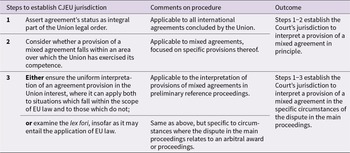
The following table (Table 1) provides an overview of the Court’s approach, as examined so far.
The Court’s approach to establishing its jurisdiction to interpret mixed agreements

Still, the introduction of such an alternative ground for the Court’s jurisdiction illustrates the highly contextual, if not outright unsystematic, development of the case law regarding the interpretation of mixed agreements. Grounding the Court’s jurisdiction in the choice of lex fori does not directly pursue the uniform interpretation of EU law. Rather, it was cast as a natural consequence of the parties’ choice to establish the tribunal on the territory of a Member State. That choice brings the dispute into the EU legal order, even though it is ‘not covered’ by EU law as such.Footnote 135 It is immaterial to consider whether a provision of an international agreement can apply both to situations covered by EU law and to those not covered by that law. The jurisdiction of the CJEU to interpret a provision over which the Union has exercised its competence can be established merely by virtue of the supervisory role of a court of a Member State over the arbitral process. In effect, Komstroy declared that a request properly made under Article 267 TFEU by a court of a Member State enjoys, in principle, a far-reaching presumption of CJEU jurisdiction, irrespective of whether or not the dispute in the main proceedings is covered by EU law.Footnote 136
VII. Expansion of the Court’s jurisdiction and its underpinnings
This article has so far demonstrated that the criteria according to which the Court examined its jurisdiction to interpret mixed agreements have not always been clearly expressed or consistently applied. The tone was set in Demirel, which first grappled, without sufficient clarity, with the limits of the Court’s jurisdiction vis-à-vis mixed agreements. Much of this lack of clarity is owed to both procedural and substantive factors: notably, the Court’s stance evolved depending on the type of jurisdiction it exercised in each case,Footnote 137 and on the content and function of the provision of the agreement at issue.Footnote 138 While such factors are not unprecedented, they rendered the delineation of the Court’s jurisdiction over mixed agreements a somewhat context-specific exercise. The article has sought to mitigate legal uncertainty as regards the Court’s jurisdiction.
Komstroy marked the culmination of the volatility in the Court’s position in two respects. First, it broadly provided that the Court may interpret a provision of a mixed agreement where the dispute in the main proceedings is not covered by EU law, as long as it can also apply to situations covered by EU law.Footnote 139 As has been observed in Section V.B, ‘situations not covered by EU law’ can refer to those covered by EU Member States’ and third states’ national laws as well as international law. This runs counter to the jurisprudential pedigree of the Union interest in the uniform interpretation of agreement provisions, which exclusively lies in the relationship between EU law and Member States’ national law.Footnote 140 While it is imperative for the Union legal order to pre-empt interpretative fragmentation internally, forestalling divergent interpretations vis-à-vis the international legal order appears distinctly less existential. It is recalled that the dispute in Komstroy was entirely unconnected from the EU, other than by reason of the governing procedural law of the arbitration. The Court’s reversion to the pre-Komstroy formulation in ÖBB-Infrastruktur, whereby the Court may interpret a provision of a mixed agreement only where the main dispute is covered by national law in particular, simply adds to the confusion. However, it seems that, since Komstroy, the proverbial genie is out of the bottle: the Court has asserted its jurisdiction to interpret mixed agreements in all circumstances, so long as the Union has exercised its competence in that regard.
Second, Komstroy developed a new, alternative ground for establishing jurisdiction to interpret mixed agreements in an arbitration context, where the dispute in the main proceedings relates to arbitral proceedings governed by the law of an EU Member State. This development arguably signifies that the Court was conscious that, in the absence of any reasoning, its assertion of jurisdiction to interpret provisions applicable in virtually all situations not covered by EU law can appear tenuous. Still, Komstroy introduced new, subject matter-specific jurisdictional considerations ex nihilo. This aspect of the ruling opened up the possibility that additional alternative grounds for the Court’s jurisdiction over mixed agreements may exist. While the Treaties have granted the Court far-reaching jurisdiction,Footnote 141 the Court is bound to exercise its Kompetenz-Kompetenz with prudence, in line with expectations of legal certainty.
It is difficult to view such developments as much more than a means to an end: they permitted the Court to interpret the ECT and, in this context, to hold that Article 26(2) ECT ‘must be interpreted as not being applicable to [intra-EU] disputes’.Footnote 142 It is beyond the scope of the article to discuss why taking such a position was not ‘necessary’ given the referred questions.Footnote 143 Suffice it to say that the ruling transposed—albeit by obiter—the Court’s rationale in Achmea, which held that investor–State arbitration under intra-EU bilateral investment treaties is incompatible with EU law,Footnote 144 to the ECT context.Footnote 145 The Court’s expansion of its own jurisdiction served the foreclosure of intra-EU investor–State arbitration, as triggered in Achmea. This in turn directed disputes which would otherwise be arbitrable to the EU judicial system. In short, the mixed nature of the ECT was effectively leveraged by the Court to transplant, to the ECT context, a finding concerning certain Member States’ inter se agreements. In this sense, the Komstroy ruling should be seen as an exercise not so much in ‘jurisdictional imperialism’Footnote 146 as in unsparing consequentialism, whereby the end justifies the means.
It is no surprise that the Court’s approach has been perceived as a sign of hostility towards or disregard for international law.Footnote 147 However, it is without question underpinned by constitutional imperatives relating to judicial review and the autonomy of the EU legal order. Autonomy is generally understood as expressing the structural integrity of the EU legal order and the Union’s normative self-sufficiency—in this context, the maintenance of the uniform interpretation of EU law has emerged as a primary consideration.Footnote 148
By understanding its jurisdiction so broadly in this light, the Court took a fiercely functionalist stance: it enhanced the capacity of the preliminary reference procedure to be used for the judicial review of mixed agreements. Whereas the provisions at issue in Hermès or the Brown Bear case, for instance, concerned national measures or national remedies, other agreements are envisaged to merely apply at the international-law level.Footnote 149 The latter category of agreements include, but are not limited to, investment treaties such as the ECT, which provide a set of investment protection standards under (customary) international law and a bespoke international-law system of dispute settlement.Footnote 150 As these are ex hypothesi not applicable to situations covered by national law, a narrower circumscription of the Court’s jurisdiction would altogether carve related disputes outside the system of judicial remedies established by the EU Treaties. This formed part of the Court’s rationale in Komstroy (drawing from Achmea), pertaining to the autonomy of the EU legal order, as regards the substantive compatibility of intra-EU investment arbitration with EU law.Footnote 151
It is true that the Court has the capacity to make such a review ex ante under Article 218(11) TFEU. In Opinion 1/17, the Court extensively assessed the compatibility of the investment arbitration provisions of the EU–Canada CETA with the autonomy principle, and reached a positive conclusion.Footnote 152 As explained in Section III, however, this depends on whether an institution or Member State will give that opportunity to the Court in the first place. Moreover, Article 218(11) TFEU does not allow for the resolution of interpretative issues which have arisen after the conclusion of an agreement. The Court’s jurisdictional approach vis-à-vis mixed agreements, including its apotheosis in Komstroy, therefore seeks to fill gaps in judicial protection and ensure the preservation of the autonomy of the EU legal order. In this sense, Komstroy loudly sings the Haegeman refrain by integrating, in the fullest sense, mixed agreements in the Union legal order.
The article need not take a stance as to whether the pursuit of these constitutional objectives justifies such a jurisdictional expansion on behalf of the Court. Even if the normative underpinnings thereof are noble, the Court’s approach can still be seen as opportunistic. At the very least, the Court should more clearly articulate the reasons why it asserted its jurisdiction to interpret mixed agreements in virtually all circumstances. This is crucial as, given the subject-matter of Komstroy, its stance may be perceived as motivated by jurisdictional self-interest.Footnote 153
VIII. Conclusion
The preceding discussion has demonstrated the immense jurisdictional complexity which mixity generates. When interpreting mixed agreements, the Court historically tried to navigate such complexity by reconciling, on the one hand, its far-reaching powers over the interpretation and application of EU law with, on the other hand, limits stemming from the division of competences between the Union and its Member States. The review of the case law suggested that, in each instance, the Court’s stance was significantly affected by procedural and factual considerations. The article sought to trace the principles lying at the essence of these judgments, with a view to crystallising the Court’s approach to establishing its jurisdiction to interpret mixed agreements.
The article systematised the Court’s methodology as follows. First, the Court asserts the status of the international agreement at issue as an integral part of the Union legal order, insofar as it has been concluded by an EU act. Second, to interpret a mixed agreement in particular, the Court must assess whether the specific provisions at issue fall within an area over which the Union has exercised its competence. While the need for some flexibility in making this assessment is recognised, the Court’s approach in both preliminary reference proceedings and infringement cases has often evinced a regrettable lack of clarity. The obscure criteria applied by the Court in that context and the strikingly vague language often used have emerged as a significant shortcoming. Still, these first two steps establish the Court’s jurisdiction to interpret provisions of a mixed agreement in principle, across the entire ambit of the Court’s jurisdiction and procedural contexts.
The third step concerns the Court’s jurisdiction to specifically interpret provisions of a mixed agreement in preliminary reference proceedings, in light of the circumstances of the dispute in the main proceedings. Generally, where the main proceedings concern a situation which is not covered by EU law, the Court grounds its jurisdiction in the Union’s interest to ensure the uniform interpretation of that provision if it can also apply to situations covered by EU law. This marks a recent expansion of the Court’s capacity to interpret a mixed agreement no matter the circumstances of the main dispute. Moreover, where the dispute concerns arbitral proceedings established or an arbitral award delivered in an EU Member State, the Court can instead establish its jurisdiction without any assessment of the risk of interpretative divergence.
The article finally turned to the underpinnings of the jurisdictional expansion of the Court, given that the reasoning behind important case-law developments, culminating in Komstroy, was not clearly articulated. The Court’s assertiveness can be explained by its desire to fill gaps in judicial protection and preserve the autonomy of the EU legal order. Though the Court was demonstrated to respect the division of competences, notably by conditioning its jurisdiction on the exercise of Union competence, its interest seems to primarily lie with ensuring the effectiveness of its judicial review and the preliminary reference procedure. While this is an understandable—some would no doubt say laudable—objective under EU law, it does not absolve the Court of its responsibility to pursue this in a transparent and doctrinally coherent manner.
Acknowledgements
An early version of this article was presented at the 21st Dubrovnik Jean Monnet Seminar on Advanced Issues of EU Law. The author is grateful to participants for their helpful comments. All errors and omissions are the author’s own.

 Open access

