


1. Introduction
Products and product platforms are often designed to be insensitive to variation within a tolerance range (Reference Murphy, Tsui and AllenMurphy et al., 2005), which is normally defined after testing, modelling, and simulation. However optimized, products often encounter unknown events (e.g., changes in loading conditions) that cause variation outside the “most likely” expected ranges. For these reasons, products often experience failures or malfunctions no matter how well simulation and testing have been performed.
The objective of this paper is to discuss design strategies to protect a system from variations in conditions outside expected bounds, leveraging the fact that variation acts with a ‘non-linear’ payoff function on the designed system. In Computer Science, a “payoff function” is a utility function that assigns a numerical value to each potential action in a decision-making process, with higher values indicating more favourable actions for the player. Translated into the design domain, this means that the system’s response to variation is often non-linear. A small variation of minor magnitude may cause a minor malfunction, while a large variation may result in a catastrophic consequence, such as an explosion.
The paper suggests that it would be helpful and cost-effective to recognize these non-linearities at the interplay between design features and design conditions so that they can be controlled or even leveraged when designing a new system. One way to do this is to examine the modelled and simulated data and check whether the differences in payoff between consecutive observations increase or decrease as they approach their boundary. Mathematically, this involves analysing the first and second derivatives of the payoff function near the sample’s boundary. In the case of an increase, we could modify the design so that variation beyond the simulated boundary does not result in an uncontrolled event.
This paper begins by introducing the concept of a non-linear payoff function in Section 2 and applies it to the context of design in Section 3. Section 4 describes why knowing the shape characteristics of a design’s payoff function can be helpful in preparing for the unexpected. Section 5 discusses the findings compared to other design strategies.
2. Background: non-linear payoff functions
Other fields, such as economics (Reference TalebTaleb, 2014), have observed that many human-made systems (e.g., a city, an economic system) exhibit a non-linear response to variation, which can lead to severe consequences when the variation is caused by an unexpected event (Reference Taleb and DouadyTaleb & Douady, 2013).
To explain this, consider the examples in Figure 1(a). Suppose a city experiences events that vary the number of cars according to the two distributions shown in purple. The same variation does not produce the same effects (traffic congestion) when the number of cars is small versus when it is large. This means that the city can tolerate a large variation in a small number of cars, but even a small increase in an already large number of cars can cause major congestion. Therefore, the system’s response is non-linear.
Non-linear payoff functions of a) human-made system and b) organic systems. Adapted from Taleb (Reference Taleb2014)

The effects of non-linearity may also have negative consequences for a small number of cars, although they may not be as critical as in the case of a large number of cars. If a “better-than-planned” scenario occurs, where traffic is lower than expected, the city is over-designed, and resources have been wasted. The effects of non-linearity in systems are considered a major cause of negative events, such as economic bubbles and financial crises (Reference LeRoyLeRoy, 2010), as non-linearities are often “hidden” in the complexity of the system (Reference TalebTaleb, 2014). In cases where non-linearities are identified, they can even be exploited rather than avoided. This happens, for example, in trading, where extremely safe assets (e.g., bonds) are combined with speculative high-risk assets (Reference Eraker and WangEraker & Wang, 2015).
The same authors have observed that, compared to human-made systems, organic systems incorporate positive non-linear responses and often leverage them to their benefit. This can be illustrated by how the human body responds to training. It benefits from training up to a certain point but can suffer from overtraining. Additionally, it gains from varying training intensity, ranging from low to high, such as slow walks to heavy lifting. A similar effect is observed in vaccine response, where injecting a small amount of a pathogen triggers the immune system, thereby increasing protection.
These observations have led researchers to further explore the idea of exploiting the non-linear responses of organic systems for drug dosage (Reference Taleb and WestTaleb & West, 2023) and pandemic responses (Reference Cirillo and TalebCirillo & Taleb, 2020). In fields closer to product design, the idea of leveraging non-linearities is not new. For example, Chaos Engineering in software design (Reference Basiri, Behnam, Rooij, Hochstein, Kosewski, Reynolds and RosenthalBasiri et al., 2016) and Kaizen Engineering in production (Reference Ghasemi and SohrabiGhasemi & Sohrabi, 2023) deliberately introduce “random” disruptions into the system as early as possible to allow modifications while the system’s impact is still minimal.
3. Hidden non-linear payoff functions in design: from components to systems
Ideally, one would aim to design the components of an engineering system to exhibit the same type of responses as an organic system (Figure 1), such as our muscles and immune system. Unfortunately, this is not easy to replicate. In fact, attempting to replicate the non-linear responses of organic systems by design may be misleading.
This section aims to highlight, through examples, how certain systems may exhibit a positive non-linear payoff function while their individual components do not, and vice versa. Additionally, we seek to illustrate how these non-linear payoff functions can be hidden and may differ from the intended design response. To achieve this, we use a simple model of an engineering system subjected to unexpected events.
In this scheme, the emergent behaviour in response to an unexpected event depends on the responses of the individual components of the system (the coloured dots) and the interactions between them (the coloured arrows).
The components and arrows are indicated in green if they are designed to gain from variation (Reference Murphy, Tsui and Alleni.e., they exhibit a positive non-linear response) or in grey if they are designed to be insensitive to variation (i.e., robust; Murphy et al., 2005). Elements in red represent components or interactions included in the design because they contribute to the overall functionality of the system within expected ranges; however, they suffer from variation outside this range due to physical constraints or other limiting factors.
Figure 2 illustrates the possible combinations observed in a system, resulting in three types of emergent behaviour. We will first analyse individual components before examining the non-linear behaviour of systems composed of different types of components and interactions.
General scheme for an engineering system subject to unexpected events

3.1. Non-linear payoff functions of individual components
Many components are typically designed to perform within specified parameters (or slightly sub-optimized) for a distribution of design conditions defined after testing or simulations (Reference Eckert, Isaksson and EarlEckert et al., 2019). To achieve this, typical design strategies such as robust design (Reference Murphy, Tsui and AllenMurphy et al., 2005), design margins (Reference Eckert, Isaksson, Lebjioui, Earl and EdlundEckert et al., 2020), or other “ilities” such as flexibility (Reference De Neufville and Scholtese.g., De Neufville & Scholtes, 2011) are applied.
In Figure 3, we consider a simple component—a beam fixed to a wall that must sustain a load. In our generic scheme, we represent this system as a single grey dot. This section aims to highlight that, while designed to be insensitive to variation, the component’s hidden payoff function can have non-linear consequences if the actual distribution of conditions differs from what was expected.
Non-linear payoff function of a single component

In Figure 3, the red line represents the beam’s payoff function, the purple distribution represents the expected probability distribution of the load, and the grey distribution represents the actual (unexpected) distribution of the loading conditions.
From Figure 3, it can be seen that while the beam is insensitive to variations when the loading conditions remain within the expected distribution, the consequences become highly negative—painful—if the actual loading conditions exceed the worst-case expectation, as the beam will break. Conversely, the design also loses (negative payoff function) even if the actual loading conditions fall below the “best-case” scenario given by the expected distribution. In such cases, the system becomes over-designed, which, according to Taguchi (Reference Taguchi, Chowdhury and WuTaguchi et al., 2004), should be considered a waste or a loss.
From Figure 2, it is evident that the loss associated with the beam design is highly non-proportional depending on whether the actual variation falls to the right or left of the expected distribution—i.e., higher versus lower loading conditions. Simply put, a broken beam is not the same as an over-designed beam, although both result in losses.
This example aims to highlight that even a simple component designed to be insensitive to variations (which, in theory, would have a linear payoff function along the x-axis) may, in reality, exhibit a non-linear payoff function. We will now examine examples of the non-linear functions of systems composed of different types of components and interactions.
3.2. Non-linear payoff functions of systems
This section wants to highlight that in systems, the non-linear payoff response (positive or negative) is dependent on the payoff functions of the single components as well as the linkages between them. The analysis identified three types of systems (a, b and c, Figure 4). We may have systems with a negative payoff function made out of components that may present a positive one (type a), and systems with a positive payoff function made out of components that may present a negative one (type b). For many of our designed systems (type c), the payoff function is unknown, since both the components and the linkages are designed to be insensitive to variation. This could lead to catastrophic failures, or even could constrain the ability to withstand an unexpected conditions simply because we do not know it could.
Non-linear payoff functions of systems made of different components and interactions: a) System with a negative emerging behaviour made of components that gain from variation b) System with a positive emerging behaviour made of components that suffer from variation c) Systems with an unpredictable emerging behaviour made of components intended to be insensitive to variation

a) System with a negative emerging behaviour made of components that gain from variation: This scenario leverages components that exhibit positive non-linear payoff functions. For example, recent discoveries have shown that Roman concrete benefits from small shocks, such as minor earthquakes, which create micro-cracks that strengthen the material (Reference Seymour, Maragh, Sabatini, Di Tommaso, Weaver and MasicSeymour et al., 2023). Similarly, shape-memory polymers take advantage of external disturbances to enhance functionality through repeated deformation and recovery cycles.
While these characteristics are beneficial at the component level, their combination can result in a negatively non-linear system response. Consider a bi-metallic thermostat (which operates on the principle of differential thermal expansion) linked to a control loop that overcompensates for even small temperature variations reported by the sensor. Both the sensor and the control logic are designed to gain from variation, yet their interaction leads to a problematic oscillatory behaviour—continually overshooting the target temperature—resulting in inefficiency and discomfort.
In our scheme in Figure 3, this type of system is represented by two green dots (indicating positive non-linear functions of individual components) connected by a red linkage, which introduces instability and causes a negative emergent behavior at the system level.
b) System with a positive emerging behaviour made of components that suffer from variation: w hile rare, some designs exhibit a positive emergent behaviour despite their individual components suffering from variation. A good example is kinetic sculptures, such as Jean Tinguely’s Méta-Matic No. 6 (Figure 4). This sculpture creates drawings by harnessing the interplay of mechanical systems, moments of inertia, and random interactions with its environment. What is particularly interesting about this sculpture is that it incorporates elements that typically struggle with large variations—such as rotating arms and gears, each with distinct moments of inertia, leading to uneven, oscillatory motions. However, in this case, the large variation is introduced through the linkages between elements. Despite the randomness, the machine’s design ensures that all motions remain within functional bounds. Gears and linkages constrain the chaotic elements, producing a positive emergent behaviour that actually increases with greater variation—otherwise, the generated drawings would be too similar. Of course, the positive emergent behaviour is not limitless; beyond a certain threshold of variation, the sculpture would break, resulting in a negative payoff function. In our scheme in Figure 3, this type of system is represented by two red dots (indicating negative non-linear functions of the components) connected by a green linkage, which facilitates a positive emergent behaviour at the system level.
c) Systems with an unpredictable emerging behaviour made of components intended to be insensitive to variation: These types of systems are typically designed using principles such as robust design (Reference Murphy, Tsui and AllenMurphy et al., 2005), design margins (Reference Eckert, Isaksson, Lebjioui, Earl and EdlundEckert et al., 2020), or other ilities such as flexibility (Reference De Neufville and Scholtese.g., De Neufville & Scholtes, 2011). These strategies aim to design components and interfaces that perform within specified parameters for a distribution of design conditions defined after testing or simulations (Reference Eckert, Isaksson and EarlEckert et al., 2019). In Figure 3, this type of system—designed to be insensitive to variation—is represented by two grey dots (indicating components with insensitive non-linear functions) connected by a grey linkage, resulting in a “straight” non-linear function within the known distribution.
However, the system’s insensitivity to variation (i.e., having an implicit straight payoff function) within the expected range can lead to severe non-linearities outside that range. When this happens, components may begin to interact unpredictably, potentially causing cliff-edge effects (Reference Earl, Eckert and ClarksonEarl et al., 2005). In Figure 3-c, this is represented by the red arrows, which drive the payoff function into the pain range.
Since the system’s payoff function is designed to be linear (though in reality, it is not), it does not reveal which component is the system’s weakest point. At the same time, it is impossible to determine whether certain components could enable a positive emergent behaviour (as shown by the positive curves in Figure 3-c). This phenomenon has been observed in successful product platforms, where unexpected combinations of elements may function effectively—or with minor adjustments—in new markets and applications. This is possible because platforms are typically designed with a balance: high-cost parts are optimized and highly robust, while cheaper parts are designed with greater margins. However, the inability to accurately map the non-linear payoff functions of components and linkages (i.e., whether the dots and arrows in our scheme are green or red) limits our ability to predict whether a system is truly prepared for unexpected events.
The next section will introduce a simple heuristic method that can be applied to identify the non-linear payoff functions of components and linkages, allowing for better prediction of a system’s preparedness for unexpected conditions.
4. Why knowing the shapes of the non-linear payoff functions of a design can be useful to prepare for the unexpected?
In most situations, we do not know how components and interfaces behave under conditions outside the empirical distribution observed through testing and simulations (i.e., whether they will catastrophically fail or perhaps even benefit from an unexpected condition). In other words, we can determine the payoff function within the empirical distribution but cannot predict its behavior beyond its boundaries.
However, what we can do is leverage the observation that the payoff function is non-linear. For instance, we can examine whether the difference in payoff between consecutive ordered observations within the distribution increases or decreases as one approaches the boundary. Mathematically, this corresponds to analyzing the first and second derivatives of the payoff function near the sample boundary. To illustrate this, we build upon an example of sealing solutions provided by Ebro & Howard (Reference Ebro and Howard2016, p. 82), modifying it to demonstrate how analyzing the direction and shape of the payoff function curvature at the boundary of the system response can provide useful insights for preparing for unexpected events.
Suppose we have test observations for two sealing solutions—an O-ring and a lip seal—designed to contain a pressurized fluid. The tests measure the sealing strength (in N/m) of each solution at increasing pressure levels within low ranges. The sample consists of seven observations for the O-ring (represented by red bars in Figure 5) and seven for the lip seal (represented by green bars). Note that the red bars overlap the green bars and are positioned behind them in the graph. By interpolating these observations, we can estimate the payoff functions of the two solutions (depicted by the red and green lines). We observe that, in both cases, sealing strength increases and is higher for the O-ring within the observed range.
Comparison between the payoff functions of an O-ring and a lip seal payoff at low pressures

At first glance, the two curves may appear to have a similar shape. However, upon closer examination of the observations near the boundary, we can see that the curvature of the payoff function for the O-ring is decelerating—meaning that the increase in the payoff function between consecutive observations is decreasing. Mathematically, this indicates that the first derivative is positive while the second derivative is negative.
In contrast, the curvature of the payoff function for the lip seal is accelerating—the increase in the payoff function between consecutive observations is growing. Mathematically, this means that the second derivative is positive. This insight suggests that the O-ring is approaching its peak performance, and any further increase in pressure due to an unexpected event could have negative consequences for the system. Conversely, the lip seal appears to be better prepared for unexpected events—it may even benefit from an increase in pressure. The key takeaway from this example is that the curvature of the payoff function could serve as an additional criterion in engineering design trade-offs during concept selection. While the O-ring may exhibit better performance within the observed distribution, it could lead to negative outcomes outside this range due to its decelerating curve. If the goal is to prepare the system for unexpected events, the lip seal may be the preferable choice.
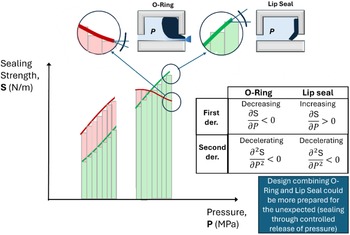
Alternatively, a combination of both an O-ring and a lip seal could be considered. Such a configuration might yield positive effects in response to increased pressure, leveraging the non-linearity of the payoff functions of the two design solutions together. Now, suppose we conduct another set of seven observations for the O-ring and seven for the lip seal, this time at higher pressure levels (Figure 6).
Comparison between the payoff functions of an O-ring and a lip seal payoff at high pressures

We now observe that the payoff function for the O-ring is lower than that of the lip seal (indicating fluid leakage) and is decreasing (negative first derivative). In contrast, the payoff function of the lip seal is increasing (positive first derivative). While choosing the lip seal may seem like the obvious decision from a performance perspective, it is important to note that the curvature of its payoff function is decelerating (negative second derivative). This suggests that the lip seal may be unprepared to withstand any further unexpected increases in pressure, as it is approaching its peak performance.
At this point, it becomes valuable to examine the curvature of the O-ring’s payoff function. Upon closer inspection, we see that while the function is decreasing (negative first derivative), the rate of decrease is itself decelerating (negative second derivative)—meaning that the system is leaking but stabilizing. By combining the stabilizing leakage of the O-ring with the superior performance of the lip seal, the system could be better prepared for an unexpected further increase in pressure. This again supports the idea of integrating a solution that incorporates both an O-ring and a lip seal.
Sealing and leakage prevention at these pressure levels could also be achieved with a more complex solution, such as a proportional control valve connected to a pressure transducer through a control unit. However, each of these components has its own payoff function, often spanning multiple domains (e.g., mechanical and software). The interactions between these elements could lead to highly non-linear negative effects. The risks associated with complex, highly interconnected systems in the face of unexpected events have been studied in design (Reference Eckert and Clarksone.g., Eckert & Clarkson, 2023). An alternative approach would be to combine a set of simpler, less interconnected solutions where the non-linear payoff functions are known within defined ranges. This would allow us to leverage these non-linearities (such as accelerating and decelerating second derivatives). An anecdotal example is Jean Tinguely’s kinetic machine, where large variations in performance arise from small non-linear variations in individual elements (such as minor rotations and oscillations), facilitated by simple mechanical linkages. Since all interfaces remain within the mechanical domain, the system’s behaviour is easier to understand and predict.
Thus, understanding the payoff function of a system requires analysing the payoff functions of its individual components and their interfaces. A seemingly positive payoff function may be counterbalanced by its effects on neighbouring components. For instance, while a small leakage tolerated by the O-ring may help stabilize pressure, it could also cause damage to the system or harm its surrounding environment. Therefore, the benefits of a component’s payoff function must be weighed against its impact on connected components. Nevertheless, we propose that identifying the non-linear payoff functions of components with simple interfaces is a crucial first step toward better understanding how well a system is prepared for unexpected events—and even how it might benefit from the non-linearities introduced by those events.
5. Discussion
Understanding what happens outside expected design conditions is desirable for both products and product platforms, but it is not always possible. While testing and simulations are becoming more affordable, certain phenomena still cannot be replicated realistically, meaning that simulations inherently contain a significant degree of uncertainty. This remains true even within the range of expected design conditions. For example, in our sealing case study (Figure 6), variations in the material composition of the two sealing solutions during production could affect their sealing strength in response to pressure fluctuations—even within the expected range. In these situations when there is uncertainty outside expected design conditions we recommend to:
1. Check whether it is possible to analyse what happens out of the expected ranges.
2. If this is not possible, at least analyse not just the value but also the trend (first and second derivatives) of the payoff function in the known range so as to gain expectations on what might happen outside.
Characterizing the trends of these payoff functions for individual system components and their interfaces can provide valuable insights into a system’s preparedness to withstand unexpected events. Such preparation is already embedded in systems designed around a common product platform, thanks to their substantial hidden design margins (Reference Jones, Eckert and GarthwaiteJones et al., 2020), which are often developed for the worst-case scenario of the most demanding application (Reference Eckert, Isaksson, Lebjioui, Earl and EdlundEckert et al., 2020).
However, relying solely on the margins embedded in the system—without a more granular characterization—can have negative consequences (Brahma et al., Reference Brahma, Hallstedt, Wynn and Isaksson2024; El Fassi et al., Reference El Fassi, Chen, Riaz, Guenov, van Heerden and Altelarrea2024). First, margins are often added to different components without a clear understanding of redundancy between them, leading to costlier and more resource-intensive systems (Jones et al., 2024). Second, margins can introduce cliff-edge effects (Reference Earl, Eckert and ClarksonEarl et al., 2005): in many cases, the margin of the entire system is dictated by the weakest component, meaning that even a minor change in a design parameter near a margin can have a significant—and potentially catastrophic—impact on both individual parts and the overall design. While behaviour near each margin is theoretically predictable, the combined impact of approaching multiple margins in different areas becomes unpredictable and chaotic (Reference Earl, Eckert and ClarksonEarl et al., 2005).
The concept of a non-linear payoff function offers a way to characterize design margins beyond their buffer and excess values (Reference Eckert, Isaksson, Lebjioui, Earl and EdlundEckert et al., 2020). This characterization can help identify the system’s weakest point from a payoff function perspective, allowing for the implementation of mitigation strategies. At the same time, it can also inform the design of components that serve as strongest points in the system, helping absorb the combined impact of multiple margins across different areas (Reference Panarotto and Alonso FernándezPanarotto & Alonso Fernández, 2024).
The application of the non-linear payoff function concept is particularly relevant for product platforms, as they are designed with longer lifespans than individual products. However, these considerations are becoming increasingly important for standalone products as well, especially given recent trends aimed at extending product lifespans beyond traditional ranges (Reference StahelStahel, 2016). Other valuable applications include strategies for repurposing components for use in other products, enabling a second life for them. Extending the life of individual components through different applications will likely expose them to unexpected events of a different nature, potentially undermining the sustainability benefits of a repurposing strategy (Reference Brahma, Hallstedt, Wynn and IsakssonBrahma et al., 2024).
Modelling margins with non-linear payoff functions can be useful in assessing whether certain margins possess non-linear positive excesses that could be repurposed to meet new requirements.
6. Conclusion
This study emphasizes the importance of understanding non-linear payoff functions in engineering design, particularly for assessing system behavior under conditions beyond observed distributions. Analyzing the first and second derivatives of these functions near boundaries provides critical insights into a system’s resilience to unexpected events. The examples illustrate that trends in payoff function curvature—whether accelerating, decelerating, or stabilizing—can inform design trade-offs.
The concept of non-linearity in payoff functions could be incorporated into design practices, particularly when repurposing decommissioned products—an approach commonly suggested to promote circular economy initiatives (Reference Witharanage, Otto and LiHewa Witharanage et al., 2025). Repurposing refers to the process of taking a product or material that is no longer serving its original purpose and reusing it for a different, often higher-value function. In the context of repurposing, non-linear payoff functions can be particularly useful. For example, many small, inexpensive, short-life products (e.g., kitchen appliances and razors) experience minor failures (such as a stuck switch button), which may render them unusable for their original function but do not result in complete disintegration. At the same time, while a failed or worn component may no longer serve its intended purpose, it could still provide a new function. For instance, a stuck switch button may obstruct the flow of material, potentially serving a different useful role in another application—even one vastly different from the original product. By controlling how failures occur after minor deviations from designed conditions, it may be possible to develop systems with graceful degradation (Reference Ploeg, Lijster, van de Wouw and NijmeijerPloeg et al., 2014), allowing small failures to be repurposed effectively.



 Open access

