

Introduction
Street-level bureaucrats (SLBs), faced with high workloads and limited resources, routinely decide which citizen requests to handle first, making prioritization one of the most consequential forms of bureaucratic coping (Davidovitz and Cohen Reference Davidovitz and Cohen2022; Li and Yu Reference Li and Yu2025; Tummers et al. Reference Tummers, Bekkers, Vink and Musheno2015). Prioritization directly affects citizens’ access to timely public services and shapes the distribution of state attention across different social groups (Jilke and Tummers Reference Jilke and Tummers2018). Existing research shows that SLBs’ prioritization is influenced by a wide range of factors, including expected administrative workload, bureaucratic control, and organizational pressures (Friedrich Reference Friedrich2025; Hansen Reference Hansen2019; Jilke and Tummers Reference Jilke and Tummers2018; Lipsky Reference Lipsky1980; Yang et al. Reference Yang, Huang and Li2022a). Despite the extensive knowledge on street-level bureaucracy and the linguistic turn in social science research (Jiang et al. Reference Jiang, Zhang and Zhang2025), we have “little knowledge of the relationship between the discourse of opinion expression and government response” (Li et al. Reference Li, Liu and Meng2019, p. 2).
This research gap is striking given the heightened interest in the role of language-in-use in public encounters (Baekgaard et al. Reference Baekgaard, Döring and Thomsen2023; Hand and Catlaw Reference Hand and Catlaw2019). Discourse has become the most immediate and influential tool citizens use to construct moral claims or exert pressure on the state, especially within digital governance platforms (Kumar Reference Kumar2024; Li et al. Reference Li, Liu and Meng2019). In the absence of physical interaction, the linguistic content of complaints becomes the primary – sometimes the only – source of information available to SLBs for inferring urgency, risk, and potential consequences (Zhao et al. Reference Zhao, Li and Yu2025). Research in public administration has demonstrated that citizen–bureaucrat interactions are shaped by linguistic cues and framing strategies (Baekgaard et al. Reference Baekgaard, Döring and Thomsen2023; Chen et al. Reference Chen, Pan and Xu2016; Eckhard and Friedrich Reference Eckhard and Friedrich2022; Eckhard et al. Reference Eckhard, Friedrich, Hautli-Janisz, Mueden and Espinoza2024; Hand and Catlaw Reference Hand and Catlaw2019; Senn et al. Reference Senn, Schwaderer, Hayek and Dingler2025; Zhou et al. Reference Zhou, Ju, Yuan, Liu and Feng2025). However, the relevant literature chiefly focuses on how bureaucratic language shapes citizens’ perceptions, including their satisfaction with public service (Eckhard and Friedrich Reference Eckhard and Friedrich2022), willingness to co-produce (Zhou et al. Reference Zhou, Ju, Yuan, Liu and Feng2025), and perceived administrative burdens (Baekgaard et al. Reference Baekgaard, Döring and Thomsen2023). Limited attention has been paid to the influence of citizens’ discursive strategies on SLBs’ decision-making, including prioritization decisions examined in this study.
To remedy this gap, we define discursive strategies as deliberate or habitual linguistic choices through which citizens frame their demands, shaping how SLBs interpret the stakes, urgency, or legitimacy of a complaint (Bartels Reference Bartels2013; Nielsen et al. Reference Nielsen, Nielsen and Bisgaard2020), and focus on three strategies employed by citizens to submit their complaints to SLBs: showing deservingness, threatening to petition higher-level authorities, and threatening to engage in self-harm. These strategies have been selected for two reasons. First, they are selected based on three key insights that inform SLBs’ frontline decisions in citizen-state interactions: the deservingness heuristics (Hansen Reference Hansen2019; Halling et al. Reference Halling, Christensen, Hansen and Petersen2025; Petersen et al. Reference Petersen, Slothuus, Stubager and Togeby2011), citizen voice behavior (O’Donnell Reference O’Donnell1986), and citizen resistance strategies (Chen Reference Chen2009; Nisar Reference Nisar2018). The deservingness heuristic indicates that citizens can frame their complaints by highlighting their vulnerability during bureaucratic encounters (Jilke and Tummers Reference Jilke and Tummers2018). Citizen voice behavior, particularly the vertical voice, empowers citizens to influence SLBs by escalating their dissatisfaction to superiors (Hirschman Reference Hirschman1970). Citizen resistance strategies are frequently employed for citizens to engage in resistance or extreme tactics to articulate grievances when other channels fail (Chen Reference Chen2009). Second, these three strategies can be understood from the cost-benefit perspective (Chen Reference Chen2009; Edin Reference Edin2003; Mikkelsen et al. Reference Mikkelsen, Madsen and Baekgaard2024). We develop three costs faced by SLBs, including moral cost, political cost, and social cost, and further theorize that showing deservingness, petitioning higher-level authorities, and engaging in self-harm influence SLBs’ prioritization by signaling these costs imposed on SLBs, respectively (Chen Reference Chen2009; Edin Reference Edin2003; Mikkelsen et al. Reference Mikkelsen, Madsen and Baekgaard2024).
Based on the above reasoning, we articulate the central question guiding this study: How do three discursive strategies, namely showing deservingness, threatening to petition high-level authorities, and threatening to engage in self-harm, influence SLBs’ prioritization? To answer this research question, we employed China’s government service hotline system (hereafter 12345 hotline) as the empirical context and analyzed a dataset of 254,257 transcribed interactions between citizens and hotline operators in J City, China during 2019. Our findings reveal that all three strategies significantly increase the likelihood of hotline operators’ prioritization assignment, with showing deservingness having the weakest effect. By conceptualizing and validating the linkage between discursive strategies of citizens and prioritization decisions of SLBs, this study contributes to governance and policy scholarship by revealing how language expressions shape street-level decision-making.
Analytic framework and hypotheses
SLBs’ prioritization decisions
SLBs, also referred to as frontline workers, are public employees who directly interact with clients and are responsible for delivering public services (Lipsky Reference Lipsky1980). Typical examples include teachers, caseworkers, police officers, and general practitioners (Chang and Brewer Reference Chang and Brewer2022). They operate in complex and dynamic environments involving numerous actors with heterogeneous and often conflicting expectations (Nielsen and Andersen Reference Nielsen and Andersen2024). Meeting all these expectations is a formidable challenge for SLBs (Tummers et al. Reference Tummers, Bekkers, Vink and Musheno2015; Tummers Reference Tummers2017). In response, SLBs widely adopt coping as a critical behavioral mechanism to manage these challenges (Davidovitz and Cohen Reference Davidovitz and Cohen2022; Tummers Reference Tummers2017). Common coping strategies include routinizing, rule-bending or breaking, and prioritizing, among others.
In this study, we focus on one type of SLBs’ coping, i.e., prioritization, which refers to the practice of allocating certain clients more time, resources, or attention than others (Tummers et al. Reference Tummers, Bekkers, Vink and Musheno2015). The street-level bureaucracy literature has revealed that SLBs’ prioritization decisions could be largely explained by numerous context-specific factors, specifically including the client-related factors, such as clients’ gender, age, ethnicity, and their motivation (Guul et al. Reference Guul, Pedersen and Petersen2021; Keiser et al. Reference Keiser, Mueser and Choi2004; Lu et al. Reference Lu, Xu and Wang2021; Schmidt et al. Reference Schmidt, Bernards and van der Pas2025; Yang et al. Reference Yang, Huang and Li2022a), as well as the bureaucrat-related factors, manifested by SLBs’ empathy, gender, among others (Jensen and Pedersen Reference Jensen and Pedersen2017; Wang et al. Reference Wang, Ma and Christensen2024). Our study shifts attention to a largely overlooked driver of variation among SLBs’ prioritization: the discursive strategies citizens employ to articulate their complaints in digital public encounters (Li et al. Reference Li, Liu and Meng2019). In the next section, the definition and key features of discursive strategies will be elaborated in detail.
To clarify the relationship between discursive strategies of citizens and SLBs’ prioritization, we introduce a conceptual distinction between two types of prioritization. First, discretion-driven prioritization refers to situations in which SLBs use their own professional judgment to decide whether a complaint warrants prioritized attention (Cecchini and Harrits Reference Cecchini and Harrits2022). In such cases, SLBs actively assess the potential risks, consequences, and moral stakes of non-responsiveness and decide whether to prioritize the case. Second, rule-triggered prioritization describes instances in which prioritization is mandated by institutional procedures that require immediate handling. When certain linguistic cues, such as explicit threats of self-harm, are detected, SLBs’ discretionary space is effectively crowded out. Facing this, SLBs have little room to delay, reinterpret, or ignore the complaint; institutional rules compel them to prioritize it. However, in practice, these two types of prioritization often converge, particularly in the case of hotline operators, whose decisions are influenced both by established rules and their own discretion.
Three discursive strategies of citizens and their influence on SLBs’ prioritization
We define discourse not to all forms of citizen-bureaucrat interaction but to the linguistic content of citizen complaints, namely, the specific words, phrases, and framings through which citizens construct the meaning and moral implications of their requests (Fairclough Reference Fairclough1993; Van Van Dijk and van Dijk Reference Van Van Dijk and van Dijk1997). Discursive strategies are defined as recurrent specific verbal communication through which citizens seek, or sometimes inadvertently manage, to amplify their complaints and attract the attention of SLBs (Bartels Reference Bartels2013; Nielsen et al. Reference Nielsen, Nielsen and Bisgaard2020). These strategies may reflect deliberate attempts to influence bureaucratic outcomes or arise spontaneously from emotional or habitual communicative patterns (Chen Reference Chen2009; Davidovitz and Cohen Reference Davidovitz and Cohen2022; Peeters et al. Reference Peeters, Gofen and Meza2020). We specifically focus on three key discursive strategies typically employed by citizens in their interactions with SLBs: showing deservingness, threatening to petition higher-level authorities, and threatening self-harm (Zhao et al. Reference Zhao, Li and Yu2025). These three discursive strategies are highly related to three key insights widely adopted by authors in investigating SLBs’ decision-making in governance: the deservingness heuristics (Hansen Reference Hansen2019; Halling et al. Reference Halling, Christensen, Hansen and Petersen2025; Petersen et al. Reference Petersen, Slothuus, Stubager and Togeby2011), citizen voice behavior (O’Donnell Reference O’Donnell1986), and citizen resistance strategies (Chen Reference Chen2009).
First, the discursive strategy of showing deservingness is grounded in the literature on the deservingness heuristics (Hansen Reference Hansen2019; Petersen et al. Reference Petersen, Slothuus, Stubager and Togeby2011). The literature suggests that heuristic cues signaling vulnerability, hardship, or moral worthiness can shape SLBs’ perceptions, thereby influencing their discretionary decisions (Halling et al. Reference Halling, Christensen, Hansen and Petersen2025; Lu et al. Reference Lu, Xu and Wang2021). Citizens often employ this strategy as their initial choice because it does not require substantial additional effort or resources. Instead, it communicates deservingness typically by portraying the complaint expressed by a member of a vulnerable group, or claiming that the event involved in complaints influences such a group.
The second discursive strategy, i.e., petitioning higher-level authorities, is inspired by citizen voice behavior suggested by Hirschman (Reference Hirschman1970). The voice literature has long suggested that citizens frequently express dissatisfaction with governance through the vertical voice (Hirschman Reference Hirschman1970; O’Donnell Reference O’Donnell1986). It refers to the escalated submission of citizen complaints to the service provider’s superior (Du and Zhu Reference Du and Zhu2024; O’Donnell Reference O’Donnell1986). The Weberian bureaucracy emphasizes hierarchical control by superiors over subordinates (Weber Reference Weber2009), rendering this discursive strategy an effective approach to influencing frontline decisions of SLBs.
Third, citizens can also resort to extreme behavior, such as self-harm, to articulate their complaints, aligning with the literature on citizen resistance strategies. Since the conception of everyday resistance (Scott Reference Scott1989), scholars have shown that individuals facing structural power asymmetries often adopt noninstitutional, disruptive, or emotionally charged tactics to contest authority. In China, citizens have developed various forms of contentious expression to push the state to respond. Threats of self-harm represent one of the most extreme manifestations of such resistance (Chen Reference Chen2009).
We investigate the effect of citizens’ discursive strategies on SLBs’ prioritization, primarily focusing on the Chinese context, a country characterized by a high power-distance institutional environment where public authority is considered to be rarely questioned by citizens (Hofstede Reference Hofstede1984). However, and even so, we argue that the substantial effect of discursive strategies also occurs on frontline implementation. This is because the discursive strategies examined here is not merely treated as a communication tool for citizens, but rather can convey different moral, political or social implications for the state and SLBs.
Specifically, SLBs are assumed to frequently engage in a careful evaluation of the associated costs and benefits involved in their decision-making processes, including prioritization. When they receive the three discursive strategies citizens adopted during public encounters, these discursive cues cannot be solely treated as the specific discourse usage, but signal three types of costs that SLBs must consider meticulously when making prioritization decisions: moral, political, and social costs (Chen Reference Chen2009; Edin Reference Edin2003; Mikkelsen et al. Reference Mikkelsen, Madsen and Baekgaard2024). Deservingness signals moral costs, petitioning higher authorities signals political costs, and threats of self-harm signal social costs. All three discursive strategies increase the perceived cost of non-prioritization, outweighing its benefits. SLBs are compelled to prioritize the case.
Scattered literature based on the Chinese context has demonstrated that such discursive cues do, in fact, alter government agencies’ decision-making in China. Chen et al. (Reference Chen, Pan and Xu2016) find that if online complaints submitted by citizens mention the discourse of tattling to higher governments, this would elicit a greater likelihood of responses from the government. Similarly, when citizens add extra linguistic cues of invoking the relevant law in their request for information, public agencies are more likely to comply with such requests, as suggested by Yang et al. (Reference Yang, Qin and Fan2022b).
Showing deservingness, moral cost, and SLBs’ prioritization
In public service delivery, deservingness functions as a tool for differentiating clients for SLBs in prioritization assignment (Hansen Reference Hansen2019; Lu et al. Reference Lu, Xu and Wang2021; Petersen et al. Reference Petersen, Slothuus, Stubager and Togeby2011; Raaphorst et al. Reference Raaphorst, Groeneveld and Van de Walle2018). Following Jilke and Tummers (Reference Jilke and Tummers2018), deservingness can be signaled through three categories: earned, needed, and resource deservingness. Earned deservingness concerns citizens’ efforts put into work, with hard-working citizens expected to receive prioritized help from bureaucrats. Needed deservingness relates to the characteristics of citizens in their needy and vulnerable states. Resource deservingness relates to the performance of citizens (Jilke and Tummers Reference Jilke and Tummers2018). In this study, we focus on the needed deservingnessFootnote 1 , and argue that this type of deservingness exerts influence on SLBs’ prioritization via their perceived moral cost.
Moral cost refers to the psychological discomfort, guilt, or moral conflict that SLBs experience when their actions deviate from the normative expectations associated with their public service role (Maynard-Moody and Musheno Reference Maynard-Moody and Musheno2000). For SLBs, their role carries strong moral expectations to protect vulnerable individuals and uphold equitable treatment, acting as the citizen agent (Maynard-Moody and Musheno Reference Maynard-Moody and Musheno2000). When citizens signal high deservingness by demonstrating their disadvantaged identity in their complaints, these cues heighten SLBs’ sensitivity to their moral obligations to help those groups. The anticipated moral cost of non-prioritization is further amplified if ignoring or delaying a vulnerable or disadvantaged claimant. Because this would violate SLBs’ role expectations and cause moral dissonance. Motivated by this, SLBs become more inclined to exercise their professional discretion to prioritize the complaints of those who appear morally deserving as a means of mitigating their moral cost (Zhao et al. Reference Zhao, Li and Yu2025). Empirical research has supported this conjecture (Guul et al. Reference Guul, Pedersen and Petersen2021). For example, Jilke and Tummers (Reference Jilke and Tummers2018) show that teachers are more likely to prioritize support for vulnerable learners because ignoring them would generate a higher moral cost for them. Based on this, the first hypothesis is formulated as:
H1: Citizen complaints that include the discursive strategy of showing deservingness are more likely to receive prioritization from SLBs than those that do not mention the discursive strategy.
Threatening to petition higher-level authorities, political cost, and SLBs’ prioritization
Petitioning higher-level authorities is a formally sanctioned channel for SLBs if the escalation of citizen complaints to superiors is triggered by their unsatisfactory resolution to these complaints (Cai Reference Cai2004; Wong and Peng Reference Wong and Peng2015). In this study, we focus on the effect of the discourse-level of petitioning higher-level authorities articulated by citizens, rather than their actual behavior, on SLBs’ frontline prioritization decision. Conceptually, such discursive threats work by communicating potential political costs perceived by SLBs, thereby further influencing their prioritization. Political cost refers to the anticipated performance penalties, disciplinary consequences, and adverse career repercussions imposed by higher-level authorities for local governments and, by extension, for SLBs (Edin Reference Edin2003).
In China, local governments and their agents are monitored and regulated by superiors, and they are routinely evaluated on their performance in addressing citizen grievances. These outcomes serve as key indicators in upper-level decisions about rewards or sanctions (Balla et al. Reference Balla, Wan, Xie, Yeung and Zhai2025). When citizens signal an intention to “petition upward,” such discursive threats themselves increase the likelihood that higher authorities will detect frontline misconduct, and more relatedly, impose sanctions on bureaucrats (Zhao et al. Reference Zhao, Li and Yu2025). In response, SLBs seek to avert these potential political costs by preemptively engaging in discretionary actions that prevent complaint escalation (Cecchini and Harrits Reference Cecchini and Harrits2022). Accordingly, we conjecture that SLBs are more likely to prioritize complaints that contain petition threats to minimize the perceived political costs of inaction or delayed action. Empirical evidence corroborates this mechanism. Chen et al. (Reference Chen, Pan and Xu2016), for example, find that citizen expressions of intent to tattle to superiors lead to more proactive and responsive behavior from government agencies due to high political costs characterized by potential penalties from higher-level governments. Based on this reasoning, we hypothesize:
H2: Citizen complaints that include the discursive strategy of petitioning higher-level authorities are more likely to receive prioritization from SLBs than those that do not mention the discursive strategy.
Threatening to engage in self-harm, social cost, and SLBs’ prioritization
Threatening self-harm is an extreme discursive strategy that citizens may employ to trigger prioritized responses from SLBs (Johansson and Vinthagen Reference Johansson and Vinthagen2016). When formal grievance channels like letters and visits are occasionally perceived as ineffective, some citizens resort to such drastic measures. We regard social cost as the mechanism through which the discursive strategy of engaging in self-harm influences SLBs’ prioritization. Social cost is defined as the risks of social instability and their influence on government legitimacy (Hou et al. Reference Hou, Liu and Zhang2022). Mitigating social cost matters because it is rooted in the state’s overarching priority of maintaining social stability in China (Lee and Zhang Reference Lee and Zhang2013). The Chinese state adopts a zero-tolerance stance toward incidents that may generate instability, and local governments, public officials, including SLBs, are institutionally obligated to prevent events that could escalate into public disorder or collective unrest (Hou et al. Reference Hou, Liu and Zhang2022).
For hotline operators handling citizen grievances, their frontline decisions follow the same underlying logic. During public encounters on the 12345 hotline platform, when operators receive discursive threats, i.e., citizens expressing an intention to engage in self-harm, even if not acting on it, these statements signal a significant threat to social stability. Because once such extreme discourse materializes, it can attract rapid and heightened attention from both traditional mass and social media (Chen Reference Chen2009). The resulting public exposure increases the potential of collective unrest and induces social instability, thereby amplifying the perceived social costs caused by the self-harm threats (Zhao et al. Reference Zhao, Li and Yu2025). Based on this reasoning, we predict that when self-harm signals are detected, SLBs significantly increase the likelihood that they prioritize the case, as such signals are associated with heightened perceived pressure from social cost for delayed response.
Several concrete revealing cases further demonstrate this logic. On November 24, 2021, a local Public Security Bureau received a suicide threat from a woman, prompting immediate official intervention to prevent potential instability. Similarly, on November 30, 2021, a man who called the 12345 hotline claimed to jump from a building, leading operators to dedicate significant time and effort to de-escalate the crisisFootnote 2 . When that is the case, we hypothesize:
H3: Citizen complaints that include the discursive strategy of engaging in self-harm are more likely to receive prioritization from SLBs than those that do not mention the discursive strategy.
Although the three discursive strategies, showing deservingness, petitioning higher-level authorities, and engaging in self-harm, can independently shape SLBs’ frontline decisions, citizens sometimes deploy more than one strategy in a single complaint. Here, we argue that these pairwise combinations of discursive strategies may generate stronger costs for bureaucratic action than any individual cue alone, as prior research has shown that combining citizen voice approaches often produces synergistic effects (Valentino et al. Reference Valentino, Hutchings and White2002; Zhao et al. Reference Zhao, Li and Yu2025). For example, pairwise combinations of showing deservingness and petitioning higher-level authorities can amplify costs perceived by SLBs, as the co-occurrence of moral and political costs makes the potential consequences of inaction more severe and more credible for SLBs. This rationale is also applied to the other two combinations, i.e., the combination of showing deservingness and engaging in self-harm, and the combination of petitioning higher-level authorities and engaging in self-harm. We hypothesize that complaints that employ any pairwise combination of discursive strategies, rather than a single strategy alone, are more likely to be prioritized by hotline operators (H4). This hypothesis can be specified as three sub-hypotheses:
H4a: Compared to complaints that only mention showing deservingness, the combination of showing deservingness and petitioning higher authorities will elicit a higher probability of SLBs’ prioritization; the combination of showing deservingness and engaging in self-harm will elicit a higher probability of SLBs’ prioritization.
H4b: Compared to complaints that only mention petitioning higher authorities, the combination of petitioning higher authorities and showing deservingness will elicit a higher probability of SLBs’ prioritization; the combination of petitioning higher authorities and engaging in self-harm will elicit a higher probability of SLBs’ prioritization.
H4c: Compared to complaints that only mention engaging in self-harm, the combination of engaging in self-harm and showing deservingness will elicit a higher probability of SLBs’ prioritization; the combination of engaging in self-harm and petitioning higher authorities will elicit a higher probability of SLBs’ prioritization.
Method
Empirical context and data collection
Background
The 12345 hotline has been widely established by most Chinese cities as a crucial channel for citizens to express concerns, report problems, and request government assistance regarding local governance (Wei et al. Reference Wei, Wang, Zhai and Li2023). The 12345 hotline allows citizens to lodge numerous types of complaints or requests (Wei et al. Reference Wei, Wang, Zhai and Li2023), including public infrastructure (e.g., road maintenance, street lighting), environmental sanitation, housing and community management, public health and medical services, consumer disputes, and education- or employment-related concerns.
We focus on J City’s 12345 hotline for both theoretical and empirical reasons. First, J City’s hotline system is highly institutionalized and representative of the broader hotline model widely adopted across Chinese municipalities (Zhao et al. Reference Zhao, Li and Yu2025). It operates under standardized national regulations, employs professionalized operators, and follows clearly codified procedures for registering, classifying, and forwarding citizen complaints. These features make it a theoretically suitable setting for examining how discursive strategies influence SLBs’ prioritization decisions. Second, the volume and granularity of J City’s hotline data, covering large transcribed citizen–operator interactions throughout 2019, allow us to identify discursive strategies mentioned by citizens in their complaints. Such richness is rare in street-level bureaucracy research, where real-time interactions are often difficult to access.
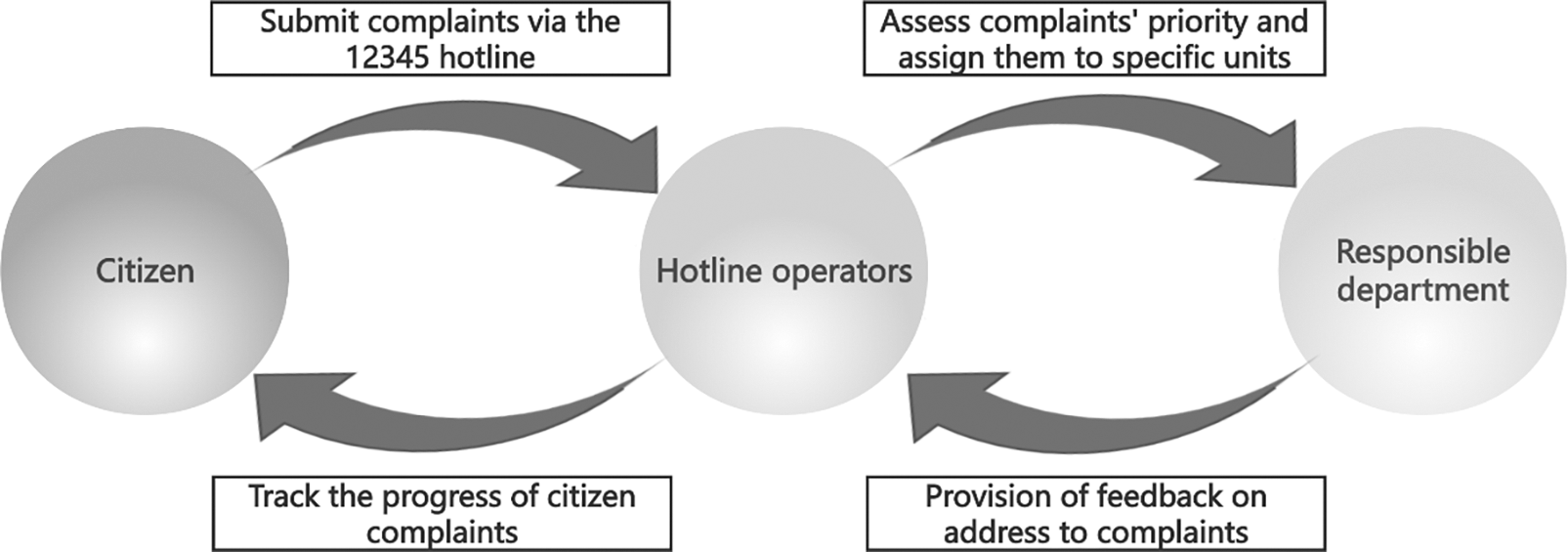
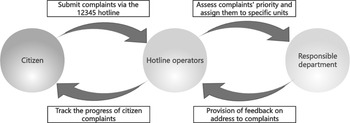
The interaction between citizens and hotline operators in J City’s 12345 hotline can be depicted as follows: A citizen typically calls the hotline when confronted with unsatisfactory experiences in governance. Upon receiving the call, a hotline operator, serving as a SLB, records the case details through a technology-based system. The operator then interacts directly with the citizen to clarify the problem and assess its prioritization (Zhao et al. Reference Zhao, Li and Yu2025). During this process, citizens may deploy various discursive strategies to persuade the operator that their issue deserves immediate attention (Li et al. Reference Li, Liu and Meng2019). After the conversation, the operator must decide whether the case qualifies for prioritization dispatch, which means forwarding it immediately to a relevant government department for rapid handling, rather than placing it in the regular queue (Zhao et al. Reference Zhao, Li and Yu2025). This decision is normally made at the end of the call, based on the operator’s assessment. Citizens can subsequently track the progress of their complaints through follow-up calls (Wei et al. Reference Wei, Wang, Zhai and Li2023). The interaction between citizens and hotline operators is visualized in Figure 1.
Visualization of the interaction between citizens and hotline operators on the 12345 hotline.
Data collection
The dataset used in this study was obtained through a formal collaboration with the Housing and Urban–Rural Development Bureau (住建局) of City J, which is responsible for handling a subset of 12345 hotline calls related to property management, heating services, construction issues, and other urban affairs. As part of an applied research project commissioned by the Bureau, our team provided technical support in the analysis of large-scale textual complaint records. To facilitate this collaboration, the Bureau provided us with de-identified transcripts of complaints under its administrative jurisdiction and granted explicit permission to use these data for academic research. All personal identifiers were anonymized by the Bureau before data transfer, in accordance with local data protection regulations. The study received ethical approval from the first author’s institutionFootnote 3 .
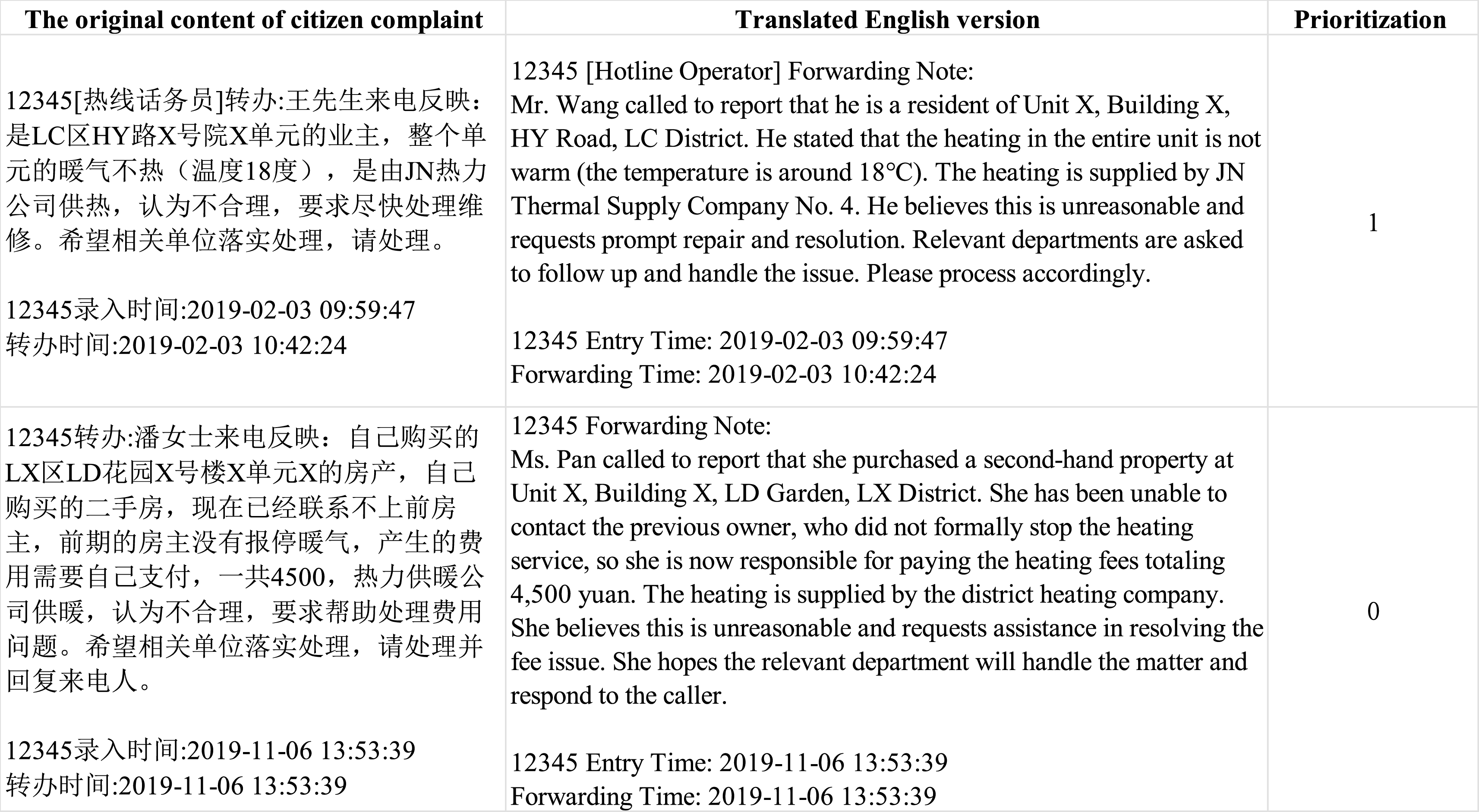
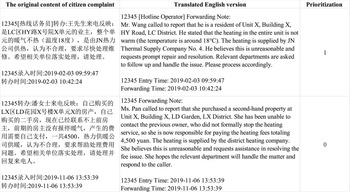
Our final dataset, as Excel files, was accessible only to the authors of this study, including 254,257 transcribed records of citizen complaints spanning the entire year of 2019. An illustrative example of our data format is shown in Figure 2. The first column records the original content of citizen complaints, while the second column indicates their English translationFootnote 4 . The richness of the content of citizen complaints can render us extract numerous information cues, such as the date citizens submit their complaints and their gender, etc. The third column records the prioritization made by hotline operators (1 = prioritized, 0 = not prioritized).
Two examples of raw records of citizens’ complaints in our dataset.
Measurement
Dependent variable
The prioritization of SLBs is directly measured by the prioritization decisions made by 12345 hotline operatorsFootnote 5 . The back-end data records whether each citizen complaint was assigned prioritization status, as suggested by Figure 2. Accordingly, we create a binary variable coded as 1 if a citizen’s complaint was designated as a prioritized case, and 0 otherwise.
Independent variables
For the measurement of discursive strategies employed by citizens when contacting the 12345 hotline. Drawing on the protocols established in previous studies (Anastasopoulos and Whitford Reference Anastasopoulos and Whitford2018; Chen et al. Reference Chen, Christensen and Ma2023; Hu and Zhong Reference Hu and Zhong2023), we employed a combination of human annotation and a supervised machine learning (SML) approach to detect their presence/absence in the text of citizen complaints (N = 254,257). This is separated into three proceduresFootnote 6 .
Step 1. Manual label. We used the three discursive strategies identified in our analytical framework as the defined coding themes. The discursive strategies are not mutually exclusive when employed, and so each citizen’s complaint can be coded for all discursive strategies. Two authors of this article were charged with the human annotation, and performed the pilot coding for a random 1000-sample of citizen submissions from the entire textual corpus based on the initial coding scheme. The coding results reached an inter-rater agreement of 91.4%, 96.8%, and 96.9% for showing deservingness, petitioning higher authorities, and engaging in self-harm, with a Cohen’s Kappa of 0.678, 0.887, and 0.786, respectively. They addressed the differences and developed a keyword list used to guide the following manual annotation during this round of pilot coding (more details about the definitions, criteria, and keywords for each discursive strategy can be seen in Appendices 1 and 2). Subsequently, the coders manually annotated another sample of 4000 citizen complaints. The coding outcome indicates an acceptable level of inter-rater agreement of above 0.9, and of Cohen’s Kappa being above 0.7 (see details in Appendix 3).
Step 2. SML algorithm training and classification. We use the coded 5,000 citizen complaints as a dataset to train and test the SML algorithm, specifically referring to the eXtreme Gradient Boosting (XGBoost). This model advantage of being among the most transparent and interpretable SML algorithms currently available and has been found to perform better compared to other algorithms (Anastasopoulos and Whitford Reference Anastasopoulos and Whitford2018). We implemented this algorithm through Python’s xgboost module. This classification pipeline consists of three steps.
-
• Train–test split. We randomly divided the 5,000 annotated complaints into a training set (70%) and a test set (30%) to evaluate model performance.
-
• Model training. We trained and tested the XGBoost model on the entire set of 5,000 annotated complaints. The fit statistics of this algorithm indicate an adequate fit for execution (see details in Appendix 4). For the robustness considerations, we also employed two other SML algorithms of the Gradient Boost Decision Tree (GBDT) and Random Forest (RF)
-
• The classification of remaining unannotated citizen complaints (N =249,257). Each complaint was converted into numerical features (e.g., TF-IDF representations of words and phrases), fed into the trained XGBoost classifier, and assigned a predicted label indicating which discursive strategy (if any) the text exhibits.
Step 3. Constructing the discursive strategy variable. Based on the classification outcome of Step 2, we measure discursive strategies by creating a categorical variable, including seven conditions. Specifically, this variable is coded as 0 if the citizen complaint is classified into none of three discursive strategies, 1 if only classified as the discourse of showing deservingness, 2 if only classified as the discourse of petitioning higher authorities, 3 if only classified as the discourse of engaging in self-harm, and 4 if only classified into the discourses of both showing deservingness and petitioning higher authorities simultaneously, 5 if only classified into the discourses of both showing deservingness and engaging in self-harm simultaneously, 6 if only classified into the discourses of both petitioning higher authorities and engaging in self-harm simultaneously. The condition of co-existence of three discursive strategies is very rare in citizen complaints, and this is hence excluded.
Control variables
In addition to the effects of citizens’ discursive strategies, hotline operators’ prioritization decisions are also shaped by topic characteristics and other informational cues of citizen complaints. For the topic characteristics, we include topic salience and the substantive content of complaints. Other information cues incorporate citizens’ gender, the channel used to contact the hotline, repeated complaints, whether complaints have already been submitted to other platforms, required prioritization, negative sentiment charged in complaints, focusing event, performance pressure undertaken by hotline operators, and urgency of complaints. The measurements of control variables can be seen in detail in Appendix 5.
Analysis results
Descriptive statistics of variables
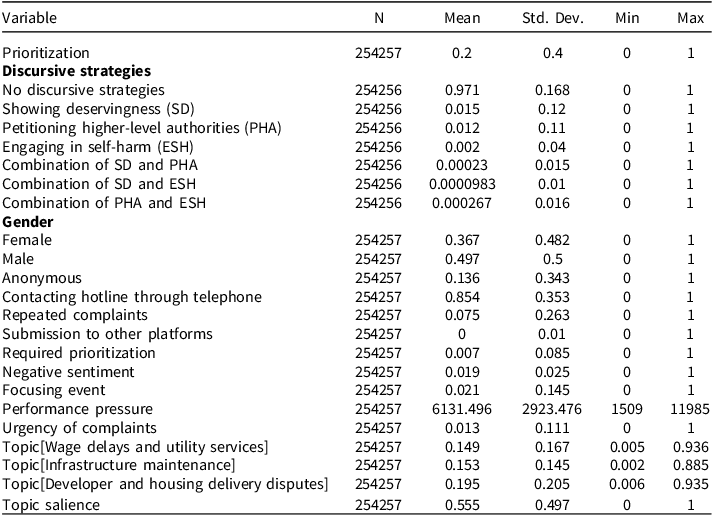
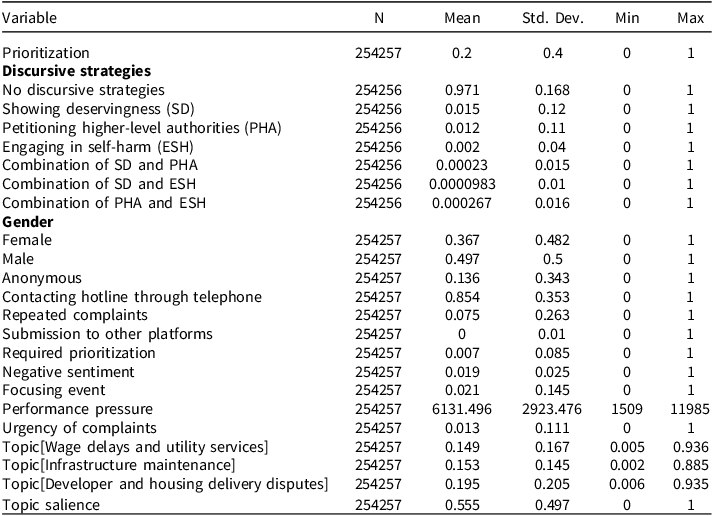
Descriptive statistics for all variables are presented in Table 1. As shown, complaints submitted by citizens to the 12345 hotline that were determined as prioritized cases account for approximately 20% of the entire complaint corpus. Regarding the discursive strategies identified by the XGBoost algorithm, the vast majority of citizens do not employ any strategy in their complaints, with a mean value of 0.971. Among single strategies, the frequencies of showing deservingness (SD), petitioning higher-level authorities (PHA), and engaging in self-harm (ESH) are 1.5%, 1.2%, and 0.2%, respectively. Notably, citizens rarely combine discursive strategies: the pairwise combinations of SD and PHA, SD and ESH, and PHA and ESH occur with frequencies of 0.023%, 0.00983%, and 0.0267%, respectively.
Descriptive statistics of variables
Regression results
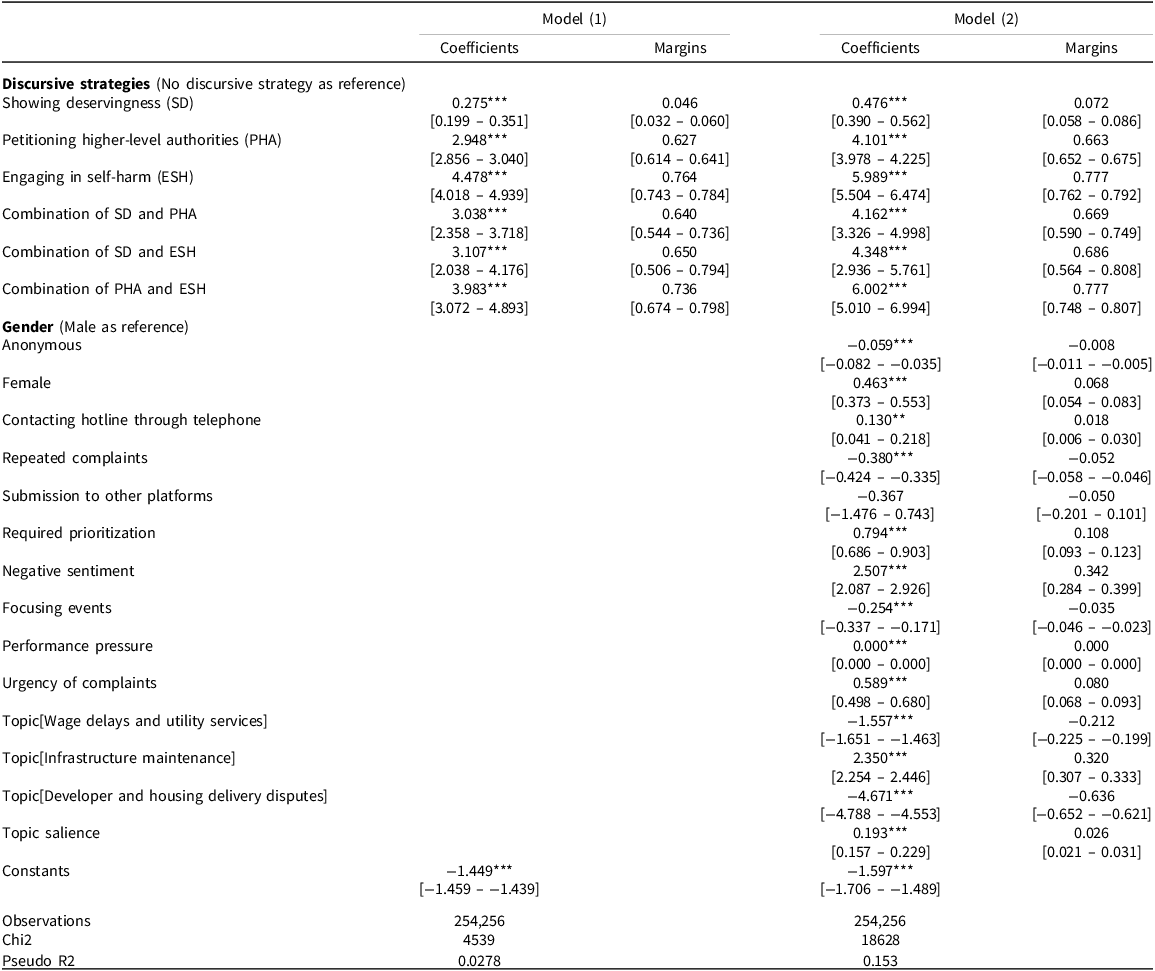
Table 2 presents the results of the logit estimation. Model (1) only includes the three discursive strategies, while Model (2) incorporates the control variables mentioned above as well as the discursive strategies. Because the coefficient of the logit estimation cannot be directly interpreted as the effect magnitude, we report two indicators in each model, i.e., coefficients and margins, following the study of Tsai and Xu (Reference Tsai and Xu2018). The former indicates whether the relationship between discursive strategies and prioritization is statistically significant, while the latter is used to reflect the probability change of prioritization made by hotline operators contingent on the presence of discursive strategies in citizen complaints.
Hotline operators’ prioritization decisions in responding to citizens’ complaints (logit regression model)
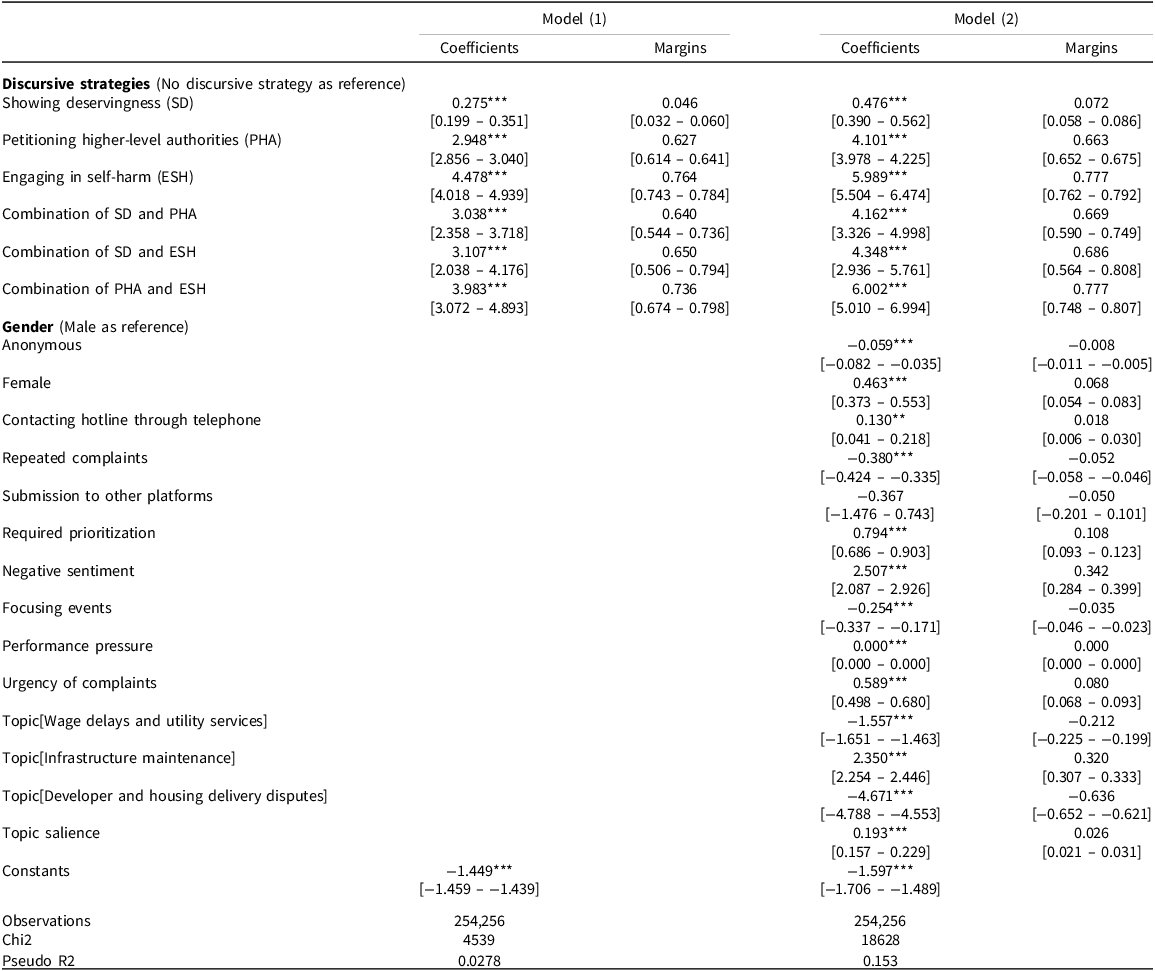
Note: The coefficient column indicates the variables’ coefficients, while the margins column indicates the marginal effects of the independent variables over all samples. Level of significance: * p < 0.05, ** p < 0.01, *** p < 0.001. The 95% confidence interval is reported in brackets.
H1, H2, and H3 are empirically supported: all three discursive strategies are positively associated with the prioritization tendency of hotline operators, as shown in the two models presented in Table 2. We focus on Model (2), which includes control variables, as the illustration. The coefficient for showing deservingness (SD) is 0.476, significant at the 0.001 level, with a marginal effect of 0.072. This suggests that when citizens express deservingness, the probability that their complaint is prioritized by hotline operators increases by 7.2%. Similarly, the discursive strategy of threatening to petition higher-level authorities (PHA) is positively related to prioritization, raising the likelihood of prioritized handling by 66.3%, as indicated by a significant coefficient of 4.101 and a marginal effect of 0.663. Finally, the coefficient for threatening to engage in self-harm (ESH) is 5.989, with a corresponding marginal effect of 0.777, implying that this strategy increases the likelihood of prioritization by 77.7%. Further, the comparison of the magnitude of effects across the three strategies reveals that the impact of SD (marginal effect = 0.072) is substantially smaller than that of PHA (marginal effect = 0.663) and ESH (marginal effect = 0.777). For the pairwise combinations of discursive strategies, we find their positive association with the prioritization of hotline operators.
As for the covariates, we find a significant gender effect on the prioritization decisions of hotline operators: complaints submitted by female citizens are more likely to be prioritized than those by male citizens. Moreover, hotline operators show a higher likelihood of prioritizing complaints when (1) citizens contact the 12345 hotline by telephone; (2) the more sentimentally negative charged in citizen complaints; (3) citizens explicitly require prioritization; (4) the performance pressure faced by SLBs is high; (5) complaints are more likely to be associated with the topic of Infrastructure maintenance, and regarded as the salient topic; and (6) the complaints pertains to urgent issue. In contrast, repeated complaints and complaints submitted during focusing events are negatively associated with prioritization. The topics of Wage delays and utility services, and Developer and housing delivery disputes are negatively associated with prioritization. Finally, complaints that have already been submitted through other online platforms are insignificantly related to operators’ prioritization.
The effect of the pairwise combinations of discursive strategies
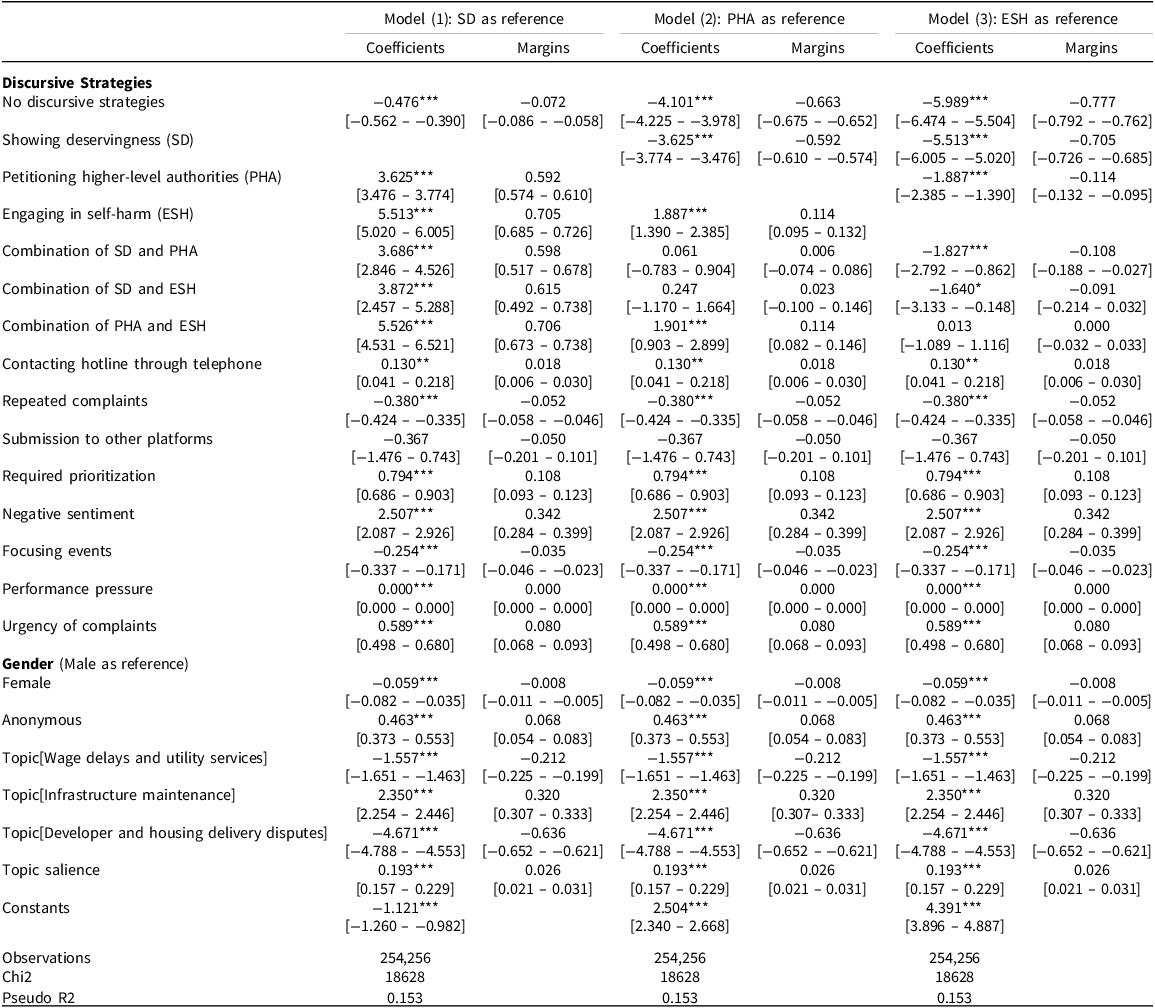
To test H4, we specify each of the three discursive strategies, showing deservingness (SD), petitioning higher-level authorities (PHA), and engaging in self-harm (ESH), as the reference category in turn, as reported in Table 3. Model (1), which takes SD as the reference, indicates that the pairwise combinations of SD and PHA and the pairwise combinations of SD and ESH increase the likelihood of prioritization by 59.8% and 61.5%, respectively, compared to the presence of SD alone. Thus, H4a is supported. Model (2), using PHA as the reference, shows that only when this strategy is combined with ESH, hotline operators are 11.4% more likely to prioritize complaints than when PHA occurs alone. The co-existence of this discursive strategy with SD does not exert a stronger prioritization facilitating effect. Therefore, H4b is partially supported. Finally, Model (3), which treats ESH as the reference, reveals that the combination of ESH and SD unexpectedly decreases the likelihood of prioritization by 9.1%, relative to the single use of ESH. Hence, H4c is rejected.
Regression results on the effect of the pairwise combinations of discursive strategies on hotline operators’ prioritization
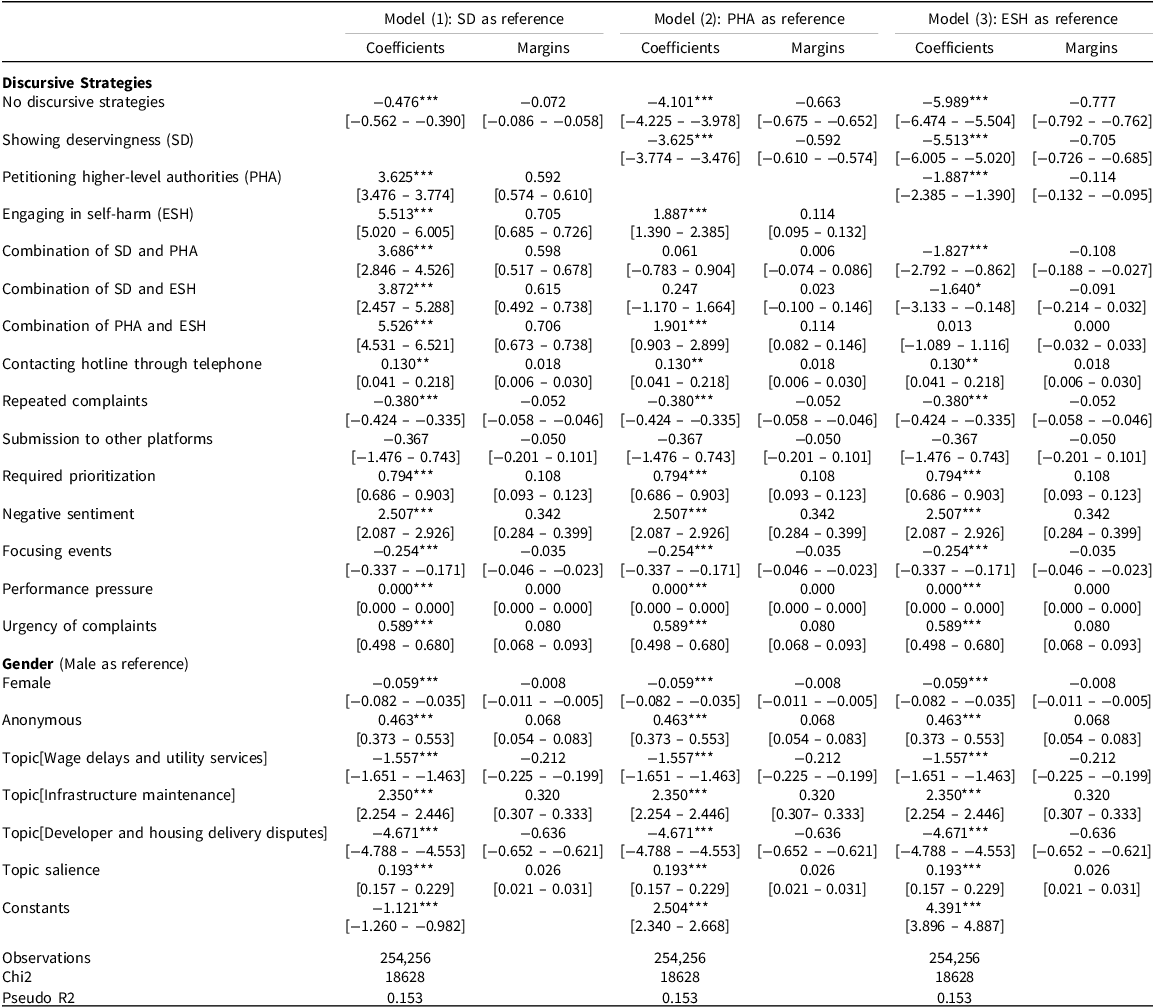
Note: The coefficient column indicates the variables’ coefficients, while the margins column indicates the marginal effects of the independent variables over all samples. Level of significance: * p < 0.05, ** p < 0.01, *** p < 0.001. The 95% confidence interval is reported in brackets.
Heterogeneous and subgroup analysis
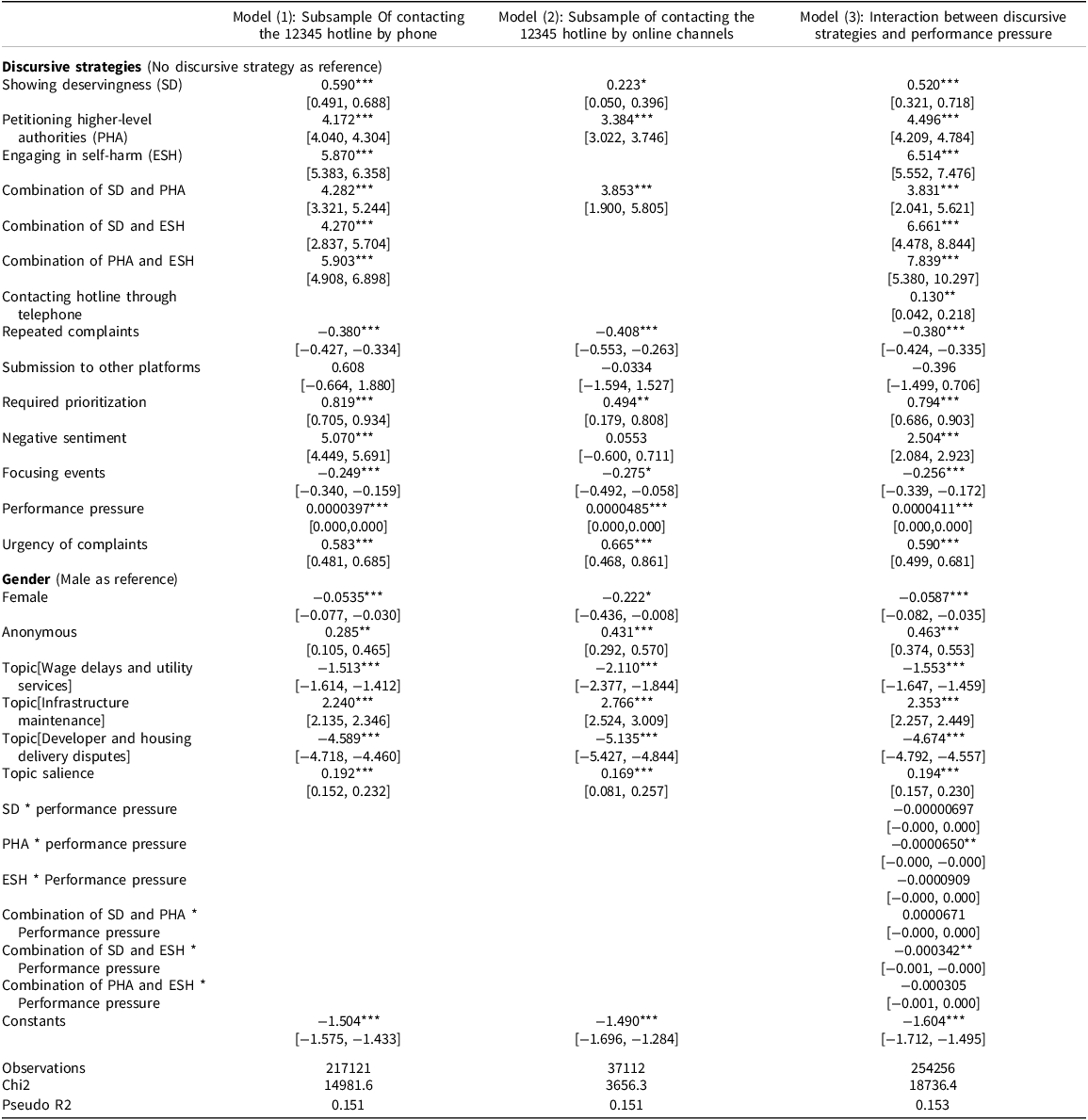
We also performed heterogeneous and subgroup analyses to examine whether the discursive effect on SLBs’ prioritization varies contingent on the channels citizens used to contact the 12345 hotline and the performance pressure by hotline operators. First, we introduced interaction terms to examine whether the influence of discursive strategies changes under varying levels of performance pressure. The heterogeneous results, reported in Model (3) in Table 4, indicate that, while the performance pressure negatively attenuates the positive effect of petitioning higher-level authorities on prioritization, the direct effect of three discursive strategies remains salient. Second, we performed subgroup analyses by separating complaints submitted via phone calls from those submitted via online channels, e.g., WeChat and Weibo. We find that the effects of all three discursive strategies remain significant across two samples. The subgroup analysis results are presented in Models (1) and (2) in Table 4.
Heterogeneous and subgroup analysis
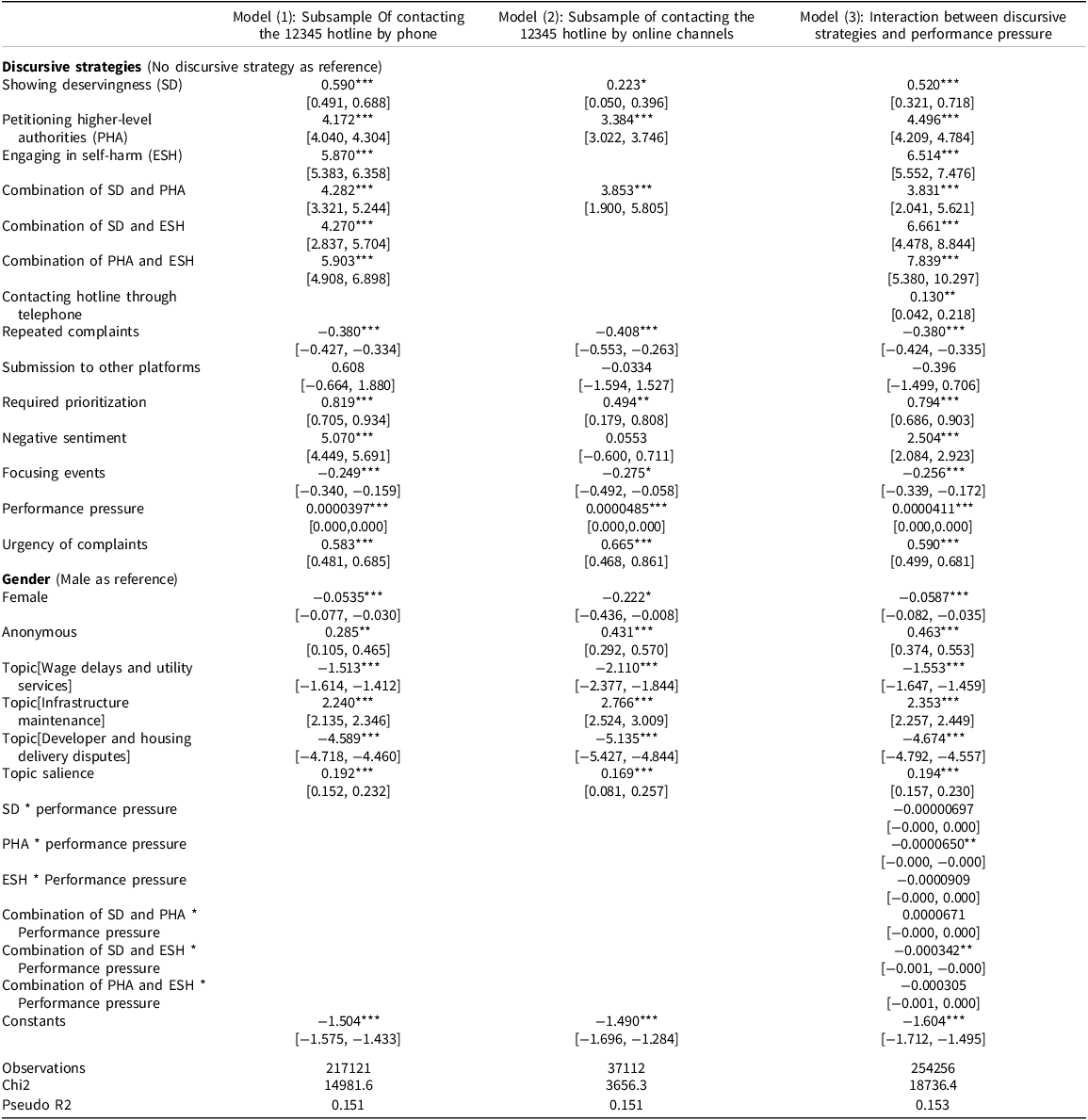
Note: Level of significance: * p < 0.05, ** p < 0.01, *** p < 0.001. The 95% confidence interval is reported in brackets.
Robustness checks
To ensure the robustness of our findings, we conducted three additional analyses. First, we classified the citizen complaints into three discursive strategies by employing two other interpretable SML algorithms, i.e., GBDT and RF, following the suggestions of Anastasopoulos and Whitford (Reference Anastasopoulos and Whitford2018). The findings demonstrated by Appendices 8 and 9 indicate that the relationship between discursive strategies and hotline operators’ prioritization remains unchanged compared with the results from logit regression model.
Second, we re-estimated the baseline models using alternative specifications, including probit models and linear probability model. These alternative specifications yield results consistent with our logit regressions, indicating that the observed discursive effect on SLBs’ prioritization is not sensitive to model choice. The findings are reported in Appendix 10.
Third, one may be concerned that the characteristics of hotline operators could influence their prioritization. To address this, we restrict our analysis to the subset of complaints that explicitly include cues identifying the responsible hotline operator. In our dataset, 169,895 citizen complaints – accounting for 67% of the entire corpus – specify which operator handled the case. Based on these identifiers, we retrieve the names of 36 operators and collect information on their age, educational attainment, and tenure. Operators’ age is measured as their age in 2019. Educational attainment is measured using a binary indicator equal to 1 if an operator holds a bachelor’s degree or above. Tenure is calculated as the number of months between the operator’s inauguration date and the end of 2019. As all operators in our sample are female, gender is excluded from the analysis. Descriptive statistics of operator-level variables are presented in Appendix 11. Given that complaint-level variables are nested within hotline operators, we employ a hierarchical logit modeling approach to estimate the effects of discursive strategies on prioritization. Additionally, we exclude operators who handle a relatively small number of citizen complaints (<= 1,000) to ensure the reliability of operator-level estimates. The results, reported in Appendix 12, are consistent with our logit regression findings.
Discussion
Our findings reveal that all three discursive strategies significantly shape SLBs’ prioritization decisions, whether driven by discretion or triggered by institutional rules, through distinct cost-based mechanisms, i.e., moral, political, and social costs. This aligns closely with the theoretical framework developed in this study. Although analytically distinct, these two forms of prioritization are intertwined in practice. Hotline operators often rely on their own judgment to interpret whether a case meets rule-based thresholds or constitutes a morally prioritized situation. Consequently, discursive strategies employed by citizens can meaningfully shape both forms of prioritization by altering the cost perceptions of SLBs.
Additionally, the findings can also make theoretical implications for studies on deservingness heuristics, citizen voice behavior, and citizen resistance strategies. First, the deservingness heuristic is extensively discussed as the motive for public opinion (Hansen Reference Hansen2019; Oorschot Reference Oorschot2000; Petersen Reference Petersen2012; Petersen et al. Reference Petersen, Slothuus, Stubager and Togeby2011), and the relevant literature chiefly reveals how deservingness cues influence the intention of frontline employees by manipulating a hypothesized vignette (Jilke and Tummers Reference Jilke and Tummers2018; Lu et al. Reference Lu, Xu and Wang2021). Scarce attention is devoted to examining its effect on the actual behavior of SLBs. This study sheds new light on the role of deservingness in frontline implementation by revealing the enabling effect of the discursive form of deservingness on SLBs’ behavior, i.e., hotline operators’ prioritization.
Second, citizen voice behavior has informed us that citizens can engage in multiple channels to express their dissatisfaction with service outcomes, including vertical and horizontal voice types. However, the consequence of different voices on the outcome of public service has been insufficiently investigated (Nielsen et al. Reference Nielsen, Nielsen and Bisgaard2020). We use a case of the 12345 hotline, and further examine how the prioritization of hotline operators varies contingent on the presence of the discursive strategy of petitioning higher-level authorities. More crucially, we develop political cost as the mechanism through which vertical voice is associated with the frontline policy implementation. All of these can advance the understanding of the application of citizen voice behavior in public administration research.
Third, previous studies have suggested that citizen resistance strategies become effective and powerful levers for them to challenge public questions (Chen Reference Chen2009). This study theoretically formulates the effect of the linguistic form of an extreme resistance strategy, i.e., self-harm, on SLBs’ prioritization through their perceived social cost, and empirically examines its effect within real interactions between citizens and hotline operators. In doing so, we extend the research on citizen resistance strategies by demonstrating that the impact of extreme resistance tactics lies not only in the actions themselves but also in their discursive articulation (Li et al. Reference Li, Liu and Meng2019).
Fourth, the pattern of least influence for the strategy of showing deservingness can be interpreted in light of institutional logics governing the 12345 hotline. The Chinese bureaucratic system emphasizes political accountability and social stability, creating structural incentives for hotline operators to prioritize complaints that pose potential political or social risks. In contrast, citizen appeals based solely on moral deservingness, although easily recognized by hotline operators, do not automatically trigger institutional imperatives or escalate political pressure. Consequently, while deservingness may trigger moral obligation of SLBs, it often carries less weight in the prioritization calculus than other discursive threats that signal possible sanctions or social instability.
Conclusion
Key findings
Using the case of the 12345 hotline in City J, China, we empirically investigate how three discursive strategies, showing deservingness, threatening to petition higher-level authorities, and threatening to engage in self-harm, influence SLBs’ prioritization decisions. The results reveal that three discursive strategies all increase the likelihood that hotline operators will assign a complaint prioritization status. A comparison analysis reveals that the effect of showing deservingness appears weaker than that of threatening to petition higher-level authorities or threatening self-harm. Additionally, our pairwise combinations have suggested that only the referenced discursive strategy targeted at showing deservingness, the pairwise combinations of discursive strategies are found to have a stronger effect on SLBs’ prioritization. When the referenced group is anchored at the petitioning higher authorities, the stronger effect on SLBs’ prioritization solely occurs in the pairwise combination of this strategy integrated with engaging in self-harm. If the selected reference is engaging in self-harm, the synergetic effect of the pairwise combination of discursive strategies vanishes and even generates the reverse effect.
Theoretical contribution
Our study contributes to the governance and policy literature in several ways. First, our findings contribute to the street-level bureaucracy literature by examining the effect of discursive strategy on SLBs’ prioritization. Previous studies have shown that language cues matter for citizen-bureaucrat interaction, for example, exemplified by the findings that the characteristics of bureaucratic language influence citizens’ satisfaction with service outcomes (Eckhard and Friedrich Reference Eckhard and Friedrich2022) and their perceived administrative burdens (Baekgaard et al. Reference Baekgaard, Döring and Thomsen2023). As we mentioned previously, the influence of language cues derived from citizens on SLBs’ decisions has received scant scholarly attention; our study remedies this gap by uncovering how three discursive strategies adopted by citizens influence hotline operators’ prioritization decisions. Findings drawn in this study enrich our understanding of the mechanisms underlying SLBs’ decision-making.
Second, related to the first, this study shifts the scholarly focus from elite-driven communication to bottom-up communicative acts by showing that citizens also engage in strategic framing to advance their claims, and, more importantly, that these discourse practices matter for bureaucrats’ actions. Prior research has emphasized how political elites use framing, or rhetorical strategies, to shape public opinion or to interpret bureaucratic organizations (Druckman Reference Druckman2001; Hendriks et al. Reference Hendriks, Damhuis and Overman2024; OsnabrÜGge et al. Reference OsnabrÜGge, Hobolt and Rodon.2021). Yet this literature has paid far less attention to how ordinary citizens strategically use language to affect state actors. By examining whether and how citizens’ discursive strategies alter the prioritization of hotline operators, this study extends the scope of bureaucratic communication by bridging political communication literature with street-level communicative practices.
Third, this study sheds new light on citizen-government interaction by revealing how citizens employ individualized discursive tactics to elicit bureaucratic responsiveness. Traditional studies of citizen-government interactions have focused on collective mobilization, resource aggregation, and public protest as mechanisms for influencing the state (McAdam et al. Reference McAdam, Tarrow and Tilly2001; Tilly Reference Tilly1978). In general, these strategies are action-oriented and highly inspired by social mobilization literature (McAdam et al. Reference McAdam, Tarrow and Tilly2001). However, in digital conversation, the traditional approaches to citizen-government interactions become less popular, and the relevance of discursive cues is elevated, representing a form of micro-level contention or everyday resistance (Cai Reference Cai2002; O’Brien and Li Reference O’Brien and Li2006; Scott Reference Scott1989). Our study brings the language cues into the study of citizen-government interactions, providing new directions for authors to better uncover the dynamics underlying these interactions in governance.
Ethical implications and practical recommendations
It is worthwhile to note that although our empirical results suggest that mentions of self-harm are strongly associated with a higher probability of prioritization, it is crucial not to interpret this strategy as legitimizing or normalize such extreme expressions as a viable “citizen strategy.” The pattern we observe should be understood as diagnosing a governance problem in bureaucratic responsiveness: when institutional channels do not reliably address urgent needs, some citizens may feel compelled to articulate grievances through extreme discourse. In other words, the emergence of threats of self-harm can be linked to the interaction between institutional constraints and citizen participation. In a high-volume service system where hotline operators must triage a large number of citizen complaints under limited time and resources, routine expressions may be insufficient to signal urgency or attract bureaucratic attention. As a result, some citizens may escalate their claims by adopting more extreme forms of discursive expression. Threats of self-harm, in this context, function as high-intensity signals that convey immediacy and severity, thereby triggering social costs and increasing the likelihood that a complaint is prioritized within the hotline system. And so, this finding underscores the need for improved institutional capacity so that genuine emergencies are addressed without requiring citizens to resort to dangerous or harmful rhetoric.
The practical recommendations of this study are twofold. First, policymakers should enhance the institutionalization and accessibility of participatory channels such as the 12345 hotline by ensuring adequate staffing, training, and resource support. Our findings show that citizens’ discursive strategies, especially those invoking political escalation or social stability costs, substantially shape SLBs’ prioritization decisions. Strengthening formal participation channels may reduce citizens’ reliance on extreme or informal tactics, such as threatening to petition higher authorities or engaging in self-harm, by providing clearer, more reliable avenues for expressing grievances. Second, establishing more standardized protocols for complaint triage and response can help improve the consistency and equity of prioritization decisions. By reducing the degree of discretionary interpretation required from hotline operators, such protocols can diminish potential biases arising from divergent discourse styles and enhance procedural fairness.
Generalizability
Considering the unique institutional characteristics that distinguish China from Western democracies, it is important to clarify how these broader governance arrangements shape the meanings and generalizability of citizens’ discursive strategies. In China’s governance context, channels for citizen participation in policy processes are structured differently from those in Western democratic systems (Chen et al. Reference Chen, Pan and Xu2016; Tsai and Xu Reference Tsai and Xu2018). Consequently, citizens often tailor their expressions strategically to maximize the likelihood of eliciting a response from SLBs, sometimes resorting to stronger or more extreme forms of articulation when routine communication channels fail (Cai Reference Cai2002; O’Brien and Li Reference O’Brien and Li2006). Within this institutional environment, the three discursive strategies examined in this study, particularly threatening self-harm, are rarely used in everyday interactions in other countries.
Additionally, the mechanisms through which discursive cues of citizens can influence bureaucratic prioritization by imposing moral, political, or social costs are of wider relevance. These discursive strategies are grounded in well-established literature on deservingness heuristics, citizen voice behavior, and citizen resistance strategies, which can be observed across diverse administrative settings, even though linguistic expressions may differ. For example, in the study by Nielsen et al. (Reference Nielsen, Nielsen and Bisgaard2020), the authors summarize numerous coping ways employed by Danish citizens to react to the public authorities, including appealing to compassion or showing friendliness. For the discursive strategies studied here, the deservingness heuristics has also been widely discussed in Western democracies (Hansen Reference Hansen2019; Oorschot Reference Oorschot2000; Petersen Reference Petersen2012; Petersen et al. Reference Petersen, Slothuus, Stubager and Togeby2011), and relevant studies have explicitly shown that clients’ deservingness would increase SLBs’ moral costs, which shapes their coping strategies in coping with citizens’ requests (Lu et al. Reference Lu, Xu and Wang2021). Likewise, citizens in Western democracies might strategically express their concerns and disagreements to mass media, which would also impose high political and social costs for SLBs, thereby compelling them to respond to these concerns instantly (Nielsen et al. Reference Nielsen, Nielsen and Bisgaard2020).
Limitations and suggested research avenues
This study comes with some limitations. First, a key limitation of this study relates to the possibility of common method bias, which arises from the fact that the citizen-bureaucrat interaction transcripts are recorded by hotline operators rather than captured as verbatim audio. This means that the measurement of discursive strategies employed by citizens may reflect operators’ interpretations or summaries, rather than the citizens’ actual words. And so, both the independent variables (discursive strategies) and the dependent variable (prioritization decisions) are embedded within the same actor; in other words, operator-level factors shape both how citizen complaints are recorded and interpreted, and how they are prioritized. Accordingly, the findings should be interpreted as capturing how operator-mediated or -perceived citizen discourses influence SLBs’ prioritization decisions. Future research could address this limitation by leveraging audio data that more clearly separates the measurement of citizen discourses from bureaucratic interpretation.
Second, we acknowledge that the use of hotline data from a single city and a single year limits the generalizability of our findings. Although J City’s hotline system is institutionally similar to other 12345 hotlines, contextual factors, such as hotline design, political oversight, and bureaucratic practices, may differ and further shape how discursive strategies are interpreted and acted upon. External validity needs to be strengthened by extending the temporal scope or comparing settings across different institutional environments.
Third, despite the inclusion of a rich set of control variables, the study cannot fully eliminate concerns about omitted-variable bias or endogeneity. Unobserved factors, such as operators’ training experiences, personal traits not captured in the data, or contextual shocks, may still influence both citizens’ use of discursive strategies and operators’ prioritization decisions. Experimental designs can be employed to strengthen causal inference.
Fourth, we acknowledge that the likelihood of citizens employing extreme discursive strategies, such as threatening to petition higher authorities or threatening self-harm, may correlate with the underlying severity or urgency of their complaints. While the urgency of complaints is incorporated into our statistical model to reduce the bias introduced by problem seriousness, future research is encouraged to employ more direct and comprehensive indicators to better disentangle the effect of citizens’ discursive strategies from the objective severity of their complaints.
Supplementary material
The supplementary material for this article can be found at https://doi.org/10.1017/S0143814X26101147.
Data availability statement
Replication materials are available in the Journal of Public Policy Dataverse at https://doi.org/10.7910/DVN/KZNZZC.
Acknowledgements
The author thanks the anonymous reviewers for their constructive feedback, which greatly improved this manuscript.
Funding statement
This study was supported by the National Social Science Fund of China [grant number 25CZZ032].


 Open access

