

Introduction
City-eating wildfires, century floods, and the hottest year on record—again—show that anthropogenic climate change has turned the atmosphere and oceans into systemic threats, particularly for the world’s most vulnerable populations. While climate change affects all life, human costs are deeply unequal. Social groups and whole nations with fewer resources bear the brunt of climate risk and adaptation hurdles (Hallegatte et al., Reference Hallegatte, Bangalore, Bonzanigo, Fay, Kane, Narloch, Rozenberg, Treguer and Vogt-Schilb2016; IPCC, Reference Lee and Romero2023). The idea of global social inclusion—including universal protection from climate and social risk—was already strained by pandemic shocks, fiscal austerity, and global conflict; now, climate upheaval raises the stakes. Countries with similar levels of income and democracy display strikingly different patterns of climate vulnerability and adaptation readiness. Which countries can marshal the fiscal and institutional capacity to protect their residents, which will be left behind, and how do differences in social inclusion and welfare institutions shape that divide?
This study asks how cross-national differences in welfare states and social inclusion regimes are related to countries’ adaptation readiness and climate vulnerability, as measured by the ND-GAIN indices. Drawing on comparative welfare regime theory and recent work on social inclusion, I treat these regimes as complementary lenses on state-organized protection against social and climate risks. I hypothesize that higher levels of adaptation will be observed in more inclusive and more encompassing welfare regimes—even after accounting for cross-national differences in GDP per capita, democracy, and location in the Global North or South. Empirically, I operationalize social inclusion using Brown and Brik’s (Reference Brown and Brik2025) six-cluster typology of “worlds of social inclusion” and welfare institutions using a global welfare regime typology (Aspalter, Reference Aspalter2023). I frame this overlap as a problem of “ecosocial adaptation,” in which welfare and inclusion institutions shape societies’ collective capacity to live with climate risk (Brown and Chang, Reference Brown and Chang2024; Brown, Reference Brown and Brik2025). This framing aligns with recent ecosocial policy debates that conceptualize integrated interventions pursuing social protection and ecological objectives (Mandelli, Reference Mandelli2022; Cotta, Reference Cotta2024; Domorenok and Trein, Reference Domorenok and Trein2024; Domorenok et al., Reference Domorenok, Graziano and Zimmermann2025). The study’s central question is whether, and to what extent, cross-national differences in social inclusion and welfare regimes help explain why some countries are more adaptive than others, net of income, democracy, and location in the Global North or South.
I use “ecosocial policy” as an umbrella term for integrated policies pursuing social and ecological goals (e.g., decarbonizing redistribution). “Ecosocial adaptation” is a key function of this set, defined as institutional and policy reconfigurations that reduce climate vulnerability and enhance adaptation readiness, here observed through the ND-GAIN indices. While ecosocial policy covers mitigation (e.g., green industrial policy), ecosocial adaptation foregrounds how social protection, inclusion, and care infrastructures function as adaptation capacity. Thus, this study advances an expanded notion of climate adaptation—not just technocratic infrastructure innovation (in agriculture, communication, energy, and transportation), but as ecosocial adaptation that links social inclusion, welfare institutions, and climate risk. Drawing on recent ecosocial policy work (Mandelli, Reference Mandelli2022; Brown and Chang, Reference Brown and Chang2024; Domorenok and Trein, Reference Domorenok and Trein2024; Brown, Reference Brown and Brik2025; Domorenok et al., Reference Domorenok, Graziano and Zimmermann2025), this study treats national adaptation capacity as a joint property of social and ecological systems, not a purely technical problem. This approach foregrounds how welfare and inclusion regimes function as adaptation infrastructures that structure who can adapt and on what terms.
Using a balanced panel of 173 countries across the Global North and South from 1995–2020, this study employs correlated random-effects (CRE/Mundlak) regressions with multiply imputed data to distinguish within-country changes in economic and political covariates from between-country differences in social inclusion clusters and welfare regimes. This design enables a global, longitudinal test of how social inclusion regimes, welfare regimes, and a Global North/Global South divide relate to adaptation readiness and vulnerability, alongside economic development and politics. The study thus connects separate debates in climate adaptation, ecosocial policy, and comparative welfare theory, clarifying why adaptation must be understood as a question of social inclusion and welfare, not just technology and infrastructure, particularly for the world’s most vulnerable populations. We turn now to a discussion of social inclusion, social welfare, climate change, and adaptation to contextualize the study.
Theoretical framework and literature review
Inequality in climate vulnerability and adaptive capacity
Climate risk is unequally stratified between and within countries. Communities in the Global South face greater exposure to climate risk and lower adaptive capacity, creating systemic global inequities (IPCC, Reference Lee and Romero2023). Vulnerability hotspots like Sub-Saharan Africa, South Asia, and small island developing states face compound risks of poverty, weak infrastructure, and climate-sensitive livelihoods (Hallegatte et al., Reference Hallegatte, Bangalore, Bonzanigo, Fay, Kane, Narloch, Rozenberg, Treguer and Vogt-Schilb2016; Islam and Winkel, Reference Islam and Winkel2017). These structural conditions shape both the severity of climate impacts and the feasibility of adaptation.
Colonial inequalities are amplified by climate change. Diffenbaugh and Burke (Reference Diffenbaugh and Burke2019) estimate that anthropogenic climate change has increased between-country income inequality by roughly 25 percent since the 1960s, disproportionately slowing growth in already-poor nations. Moreover, climate change is expected to push an additional 100 million people into extreme poverty by 2030 (Hallegatte et al., Reference Hallegatte, Bangalore, Bonzanigo, Fay, Kane, Narloch, Rozenberg, Treguer and Vogt-Schilb2016), reinforcing the cycle between vulnerability and underdevelopment. In this context, national capacity to adapt is conditioned not just by physical exposure or income levels, but by institutional choices—such as the extension of inclusive social policies and welfare states that support resilience.
Despite a shared global mandate for adaptation under the Paris Agreement, substantial North–South divides persist in both policy capacity and financing. Many countries in the Global North have integrated adaptation into infrastructure, public health, and urban planning (Berrang-Ford et al., Reference Berrang-Ford, Biesbroek, Ford, Lesnikowski, Tanabe, Wang, Chen, Hsu, Hellmann, Pringle, Grecequet, Amado, Huq, Lwasa and Heymann2019), while many countries in the Global South rely on externally funded National Adaptation Plans with limited domestic capacity for implementation (UNEP, 2023). Adaptation finance exemplifies this divide. Industrialized countries pledged to mobilize USD 100 billion annually for climate action, but much of this funding has favoured mitigation over adaptation, and the actual delivery of adaptation finance remains well below need (OECD, 2021; UNEP, 2023). Financing is often structured as loans rather than grants and frequently fails to reach the most vulnerable (Islam and Winkel, Reference Islam and Winkel2017).
Parallel gaps exist in the welfare and social protection infrastructure. While high-income countries maintain expansive welfare states, only a small share of people in low- and middle-income countries have access to even one social protection benefit; for example, with only 17 percent estimated to receive at least one benefit in Africa (ILO, 2021). This leaves large populations without safety nets and unprotected from climate risk. Taken together, these disparities suggest that adaptation readiness and climate vulnerability are jointly shaped by global political economy and by national institutions of social protection and inclusion.
Climate change impacts are commonly conceptualized in terms of vulnerability and adaptive capacity. Vulnerability captures the extent to which societies are susceptible to climate-related harm, typically understood as a function of exposure, sensitivity, and capacity to cope and adapt (IPCC, Reference Lee and Romero2023). We follow this relational understanding of vulnerability, which combines biophysical exposure with social and institutional capacity (Brown, Reference Brown and Brik2025). Adaptation readiness, by contrast, refers to the political, institutional, and social conditions that enable adaptation policies and investments (Berrang-Ford et al., Reference Berrang-Ford, Biesbroek, Ford, Lesnikowski, Tanabe, Wang, Chen, Hsu, Hellmann, Pringle, Grecequet, Amado, Huq, Lwasa and Heymann2019).
Treating these dimensions as related but distinct allows for a clearer distinction between structural exposure and institutional preparedness—an analytical distinction that is central to linking climate outcomes to welfare and social inclusion regimes. Yet most cross-national adaptation research, however, treats welfare and social protection institutions only indirectly, typically through generic governance or economic indicators (e.g., Davies et al., Reference Davies, Guenther, Leavy, Mitchell and Tanner2008; Chen et al., Reference Chen, Hellmann, Berrang-Ford, Noble and Regan2018; Dolšak and Prakash, Reference Dolšak and Prakash2018; Berrang-Ford et al., Reference Berrang-Ford, Biesbroek, Ford, Lesnikowski, Tanabe, Wang, Chen, Hsu, Hellmann, Pringle, Grecequet, Amado, Huq, Lwasa and Heymann2019; Bowen et al., Reference Bowen, Del Ninno, Andrews, Coll-Black, Johnson, Kawasoe and Williams2020), rather than as explicit adaptation infrastructures. This leaves an unresolved question of whether welfare state design and social inclusion systematically shape national patterns of adaptation readiness and climate vulnerability.
Welfare regimes, social inclusion, and ecosocial adaptation
To explain unequal climate outcomes, I draw on three intertwined strands of theory: comparative welfare theory, social inclusion, and ecosocial policy. Comparative welfare state theory provides a foundational framework for understanding cross-national differences in social inclusion. Esping-Andersen and Standing’s (Reference Esping-Andersen and Standing1990) typology of liberal, corporatist, and social-democratic welfare regimes conceptualized how state–market–family relations shape levels of decommodification and social stratification, but was initially limited to the Global North. Subsequent extensions expanded this analysis globally, identifying regime types in the Global South—such as “insecurity” or “informal security” regimes—marked by low coverage and reliance on kinship or informal networks (Gough et al., Reference Gough, Wood, Barrientos, Bevan, Davis and Room2004; Abu Sharkh and Gough, Reference Abu Sharkh and Gough2010). Aspalter’s (Reference Aspalter2023) “10 worlds of welfare capitalism” synthesizes this broader literature into a global welfare regime landscape.
At the same time, scholars have argued for multidimensional approaches to social inclusion that go beyond welfare generosity alone. Social inclusion is widely understood as a multidimensional, multilevel, and relational concept encompassing participation in economic, social, political, and cultural life (Brik and Brown, Reference Brik and Brown2024). The concept has broadened from labour-market detachment and material poverty to concerns with rights, recognition, and belonging (Silver, Reference Silver1994, Reference Silver2015; Sen, Reference Sen2000). Inclusion is not reducible to income poverty or inequality: one can be above the poverty line yet remain excluded due to discrimination, isolation, or lack of political voice; alternatively, one can be poor yet socially integrated in certain contexts (UNDESA, 2016; UNECE, 2022).
Following recent work on “worlds of social inclusion” (Brik and Brown, Reference Brik and Brown2024; Brown and Brik, Reference Brown and Brik2025), this study treats social inclusion regimes as multidimensional institutional configurations that combine income security, access to services, labour-market integration, and recognition/participation. Empirically, these regimes are operationalized as six global social inclusion clusters derived from country scores across these domains.
While social protection, social insurance, and labour market initiatives are all core welfare-state functions, I focus on social inclusion as the primary regime-level lens for three reasons. First, inclusion regimes are explicitly multidimensional: they bundle income security, service access, labour-market integration, and recognition/participation, rather than privileging any single policy instrument. Second, this relational focus aligns closely with the concern for ecosocial adaptation, foregrounding not only whether benefits exist but also who is effectively able to access protection, services, and voice in collective decision-making around climate risk. Third, the global “worlds of social inclusion” clusters capture cross-national differences along these underlying welfare functions, allowing social inclusion regimes to be compared across both OECD and non-OECD settings in a conceptually consistent way. In this sense, social inclusion regimes do not replace social protection, insurance, or investment, but synthesize their distributive and participatory effects into a single regime construct that is especially relevant for climate adaptation.
Building on this relational understanding, ecosocial policy scholars argue that social protection and welfare institutions are also adaptation infrastructures. Recent ecosocial policy debates conceptualize ecosocial policies as integrated policy outputs and mixes that jointly pursue social and environmental objectives, and that can be classified by the direction of integration and relationship to economic growth or sufficiency (Mandelli, Reference Mandelli2022). Inclusive welfare states not only redistribute income but also build capabilities, reduce baseline vulnerabilities, and create institutional channels for participation in collective decision-making (Närhi and Matthies, Reference Närhi and Matthies2018); they also contribute to “worlds of ecowelfare states,” where welfare effort and environmental performance form distinct regime constellations (Zimmermann and Graziano, Reference Zimmermann and Graziano2020). Recent work develops this insight under the concept of ecosocial adaptation, emphasizing how welfare, care, and environmental systems jointly shape societies’ ability to live with climate risk (Brown, Reference Brown and Brik2025). I use the term ecosocial adaptation here to denote a specific function of these ecosocial mixes—those that reconfigure welfare and inclusion institutions so as to reduce climate vulnerability and enhance adaptation readiness, particularly for marginalized populations (Domorenok and Trein, Reference Domorenok and Trein2024; Domorenok et al., Reference Domorenok, Graziano and Zimmermann2025). From this perspective, adaptation is not solely a matter of physical or technological investments in agriculture, energy, and infrastructure. It is also an ecosocial process in which welfare regimes and social inclusion regimes shape who is protected from climate risk, who can access adaptation resources, and whose knowledge and interests are recognized in adaptation governance. However, comparative welfare-regime and social-inclusion literatures have rarely been linked to climate adaptation outcomes, particularly in postcolonial and lower-income contexts, typically evaluating regimes in terms of poverty, inequality, or labour-market outcomes rather than climate risk and adaptive capacity. By reframing welfare and inclusion regimes as ecosocial adaptation infrastructures and examining their association with ND-GAIN readiness and vulnerability, this study extends these debates into the climate domain.
Social inclusion clusters and welfare regime typologies
Against this background, Brown and Brik (Reference Brown and Brik2025) propose a Social Inclusion Index using 10 indicators aligned with the Sustainable Development Goals and identify six global “worlds of social inclusion” via inductive cluster analysis. These social inclusion clusters range from high-inclusion to high-exclusion regimes and reflect cross-national differences in social rights, service provision, political participation, and the reduction of exclusion across marginalized populations. Their analysis shows that these inclusion worlds both converge with and diverge from classic welfare regime classifications, indicating that welfare generosity and formal regime type do not fully capture the lived experience of inclusion.
This study builds on that work in two ways. First, it treats Brown and Ben Brik’s six social inclusion clusters as social inclusion regimes—configurations of policies and institutions that structure opportunities for participation and protection. Second, it explicitly compares these inclusion regimes to more familiar welfare regime typologies. Classic welfare regimes, including global extensions such as Aspalter’s (Reference Aspalter2023) worlds of welfare capitalism, and newer ecowelfare mappings that combine welfare effort and environmental performance (Zimmermann and Graziano, Reference Zimmermann and Graziano2020), provide an important point of reference and anchor this analysis in established comparative social policy debates. However, they are often derived from Global North experiences and may understate the diversity of inclusion arrangements in postcolonial and industrializing contexts.
From a postcolonial perspective, inclusion regimes in the Global South have been shaped by colonial administrative legacies, structural adjustment, and ongoing forms of imperial debris that constrain domestic policy space (Ferguson, Reference Ferguson1990; Escobar, Reference Escobar1995; Patel and Moore, Reference Patel and Moore2017; Hick and Burchardt, Reference Hick and Burchardt2021). Formal welfare institutions may be thin or fragmented, while informal safety nets, communal care networks, and local governance traditions play central roles in social protection. Social inclusion clusters incorporating political access, service provision, and group-based inequalities thus offer a way to observe de facto inclusion regimes that cut across canonical welfare families and North–South categories. In the context of ecosocial adaptation, these regimes can be interpreted as distinct configurations of adaptation infrastructure, structuring how climate risk and protection are distributed across populations. A fuller postcolonial critique lies beyond this article’s scope, but these insights are drawn on selectively to contextualize regime differences and North–South patterns in ecosocial adaptation.
In what follows, I treat social inclusion clusters and welfare regime families as parallel regime-level lenses on ecosocial adaptation, situated within a broader Global North/Global South divide. This perspective allows us to examine whether these regimes capture distinct dimensions of ecosocial adaptation and to interpret systematic differences across them as evidence of unequal ecosocial adaptation.
Expectations and research questions
Bringing these strands together, the framework suggests three expectations. First, countries belonging to more inclusive social inclusion regimes should exhibit higher adaptation readiness, net of GDP per capita, democracy, and other covariates, because inclusive institutions build capabilities, extend protections, and facilitate collective action. Second, more inclusive regimes should exhibit lower climate vulnerability on average, although this relationship may be weaker or more heterogeneous where structural exposures and colonial legacies overwhelm domestic institutional capacity. Third, social inclusion regimes may reorder familiar hierarchies—some Global South countries may appear as inclusion leaders and some Global North countries as laggards, challenging assumptions that wealth or classic welfare regime type alone determine adaptation outcomes. Together, these expectations treat ecosocial adaptation as a regime-level property, not just a function of income or geography.
These expectations structure the empirical analysis in terms of three research questions. All models adjust for relevant background covariates (social, political, and economic):
RQ1: Are there significant differences in climate change adaptation readiness and climate vulnerability between social inclusion clusters over time?
RQ2: Are there significant differences in climate change adaptation readiness and climate vulnerability between welfare regimes over time?
RQ3: Are there significant differences in climate change adaptation readiness and climate vulnerability between countries in the Global North (OECD members) and the Global South (non-members) over time?
RQ1 examines social inclusion regimes as the primary ecosocial adaptation lens. RQ2 clarifies whether classic welfare regime families yield similar patterns or if social inclusion captures distinct, adaptation-relevant differences. RQ3 situates these regime findings within the broader OECD/non-OECD divide. Read together, they trace a single argument about how social inclusion regimes, welfare institutions, and global political economy jointly structure ecosocial adaptation.
Methods
Data and variables
This study assembles an annual country–year panel for 173 countries from 1995–2020 using public, administrative data. Variables cover national adaptation readiness (ND-GAIN), climate exposure, social-inclusion clusters, 10 welfare-regime typologies, and macro-political controls.
To select an adequate number of imputations, we implemented a small grid search over $ m\in \left\{10,20,\dots 200\right\} $
using a seedless stability procedure. For each m, the full pipeline was re-estimated twice (with different random draws), and coefficients were pooled using Rubin’s rules. A maximum absolute difference of 0.01 in the pooled coefficient estimates was defined as an acceptable tolerance. Based on this stability analysis, the final number of imputations was set to m = 100. Additional explanation of the imputation process can be found in Supplementary Appendix A1.
$ m\in \left\{10,20,\dots 200\right\} $
using a seedless stability procedure. For each m, the full pipeline was re-estimated twice (with different random draws), and coefficients were pooled using Rubin’s rules. A maximum absolute difference of 0.01 in the pooled coefficient estimates was defined as an acceptable tolerance. Based on this stability analysis, the final number of imputations was set to m = 100. Additional explanation of the imputation process can be found in Supplementary Appendix A1.
Adaptation outcomes are operationalized using the ND-GAIN composite index and its sub-indices for climate vulnerability and adaptation readiness. These measures follow ND-GAIN’s standard methodology—underlying sectoral indicators are normalized, aggregated into the sub-indices, and rescaled to a 0–100 metric, where higher scores indicate lower vulnerability or higher readiness. Institutional arrangements are captured along three dimensions: social inclusion regimes, welfare regimes, and OECD membership, with macro-political and economic controls included to adjust for structural differences.
Dependent variables include the ND-GAIN’s adaptation readiness and climate vulnerability indices. These outcomes were chosen because they are widely used, globally comparable measures available for a large number of countries over time (Chen et al., Reference Chen, Noble, Hellmann, Coffee, Murillo and Chawla2024). This approach explicitly distinguishes between structural exposure/sensitivity and institutional preparedness, aligning with our conceptual distinction between exposure/vulnerability and ecosocial adaptation capacity. ND-GAIN vulnerability operationalizes the propensity to be adversely affected by climate change; the sub-index combines exposure, sensitivity in six sectors (food, water, health, ecosystem services, infrastructure, habitat), and baseline adaptive capacity. Readiness captures the governance, economic, and social capacity to attract and deploy adaptation investments efficiently (Chen et al., 2016; Fagbemi et al., Reference Fagbemi, Oke and Fajingbesi2023). To ensure conceptual precision, we use national adaptation capacity to refer to this country-level ability to adjust to climate risks, operationalized here via ND-GAIN readiness. We distinguish this from institutional capacity (the broader quality of welfare and inclusion regimes) and fiscal capacity (resource mobilization). References to administrative or policy capacity are interpretive descriptions of bureaucratic mechanisms, rather than separate quantitative indicators. Vulnerability and readiness are treated as two separate but related dependent variables to test whether welfare and inclusion regimes are more strongly associated with institutional readiness, reduced vulnerability, or both. This allows the results to distinguish between structurally exposed yet institutionally prepared countries, and those both exposed and unprepared.
ND-GAIN has been validated in cross-national studies (Chen et al., 2016; Chakraborty and Sherpa, Reference Chakraborty and Sherpa2021) and is frequently used to track adaptation progress (Berrang-Ford et al., Reference Berrang-Ford, Biesbroek, Ford, Lesnikowski, Tanabe, Wang, Chen, Hsu, Hellmann, Pringle, Grecequet, Amado, Huq, Lwasa and Heymann2019; UNEP, 2023). It is a widely accepted proxy for national adaptation readiness and is particularly useful in comparative quantitative research. Its explicit incorporation of governance and social indicators also makes it a natural outcome measure when assessing the influence of institutional structures, such as social inclusion regimes and welfare regimes.
Key independent variables include social inclusion cluster, welfare regime, and OECD status. Countries were classified into six social inclusion clusters (Brown and Brik, Reference Brown and Brik2025). The social inclusion variable is a six-category regime typology generated via model-based clustering on a principal-component index of 10 United Nations Sustainable Development Goals indicators, combined with social expenditure, government effectiveness, and control of corruption. This process identifies six regimes: Low, Mid, and High Social Inclusion and Low, Mid, and High Social Exclusion. Despite modest empirical overlap with ND-GAIN indicators (e.g., slum population, control of corruption), we treat social inclusion regimes as independently measured institutional predictors, capturing broader patterns of distributive and participatory inclusion rather than adaptation-specific governance capacity. Countries were also classified by one of 10 welfare regimes (Aspalter, Reference Aspalter2023), with unclassified countries labelled as “unclassified.” OECD membership (OECD, 2025) is a time-invariant characteristic, interpreted as an institutional Global North/South indicator (OECD vs non-OECD) rather than a geographical divide. Given that available global typologies are cross-sectional/long-run classifications, each country’s cluster membership is treated as time-invariant over the 1995–2020 period to capture temporal dynamics using time-varying macro-political covariates and year fixed effects. Together, these typologies allow the analysis to compare the predictive power of social inclusion and welfare regimes and assess their overlap and divergence. For reference, Supplementary Appendix B Figure B1 maps each country’s social inclusion cluster membership, while Figure B2 does the same for welfare regimes. Table B1 then lists each country by its membership.
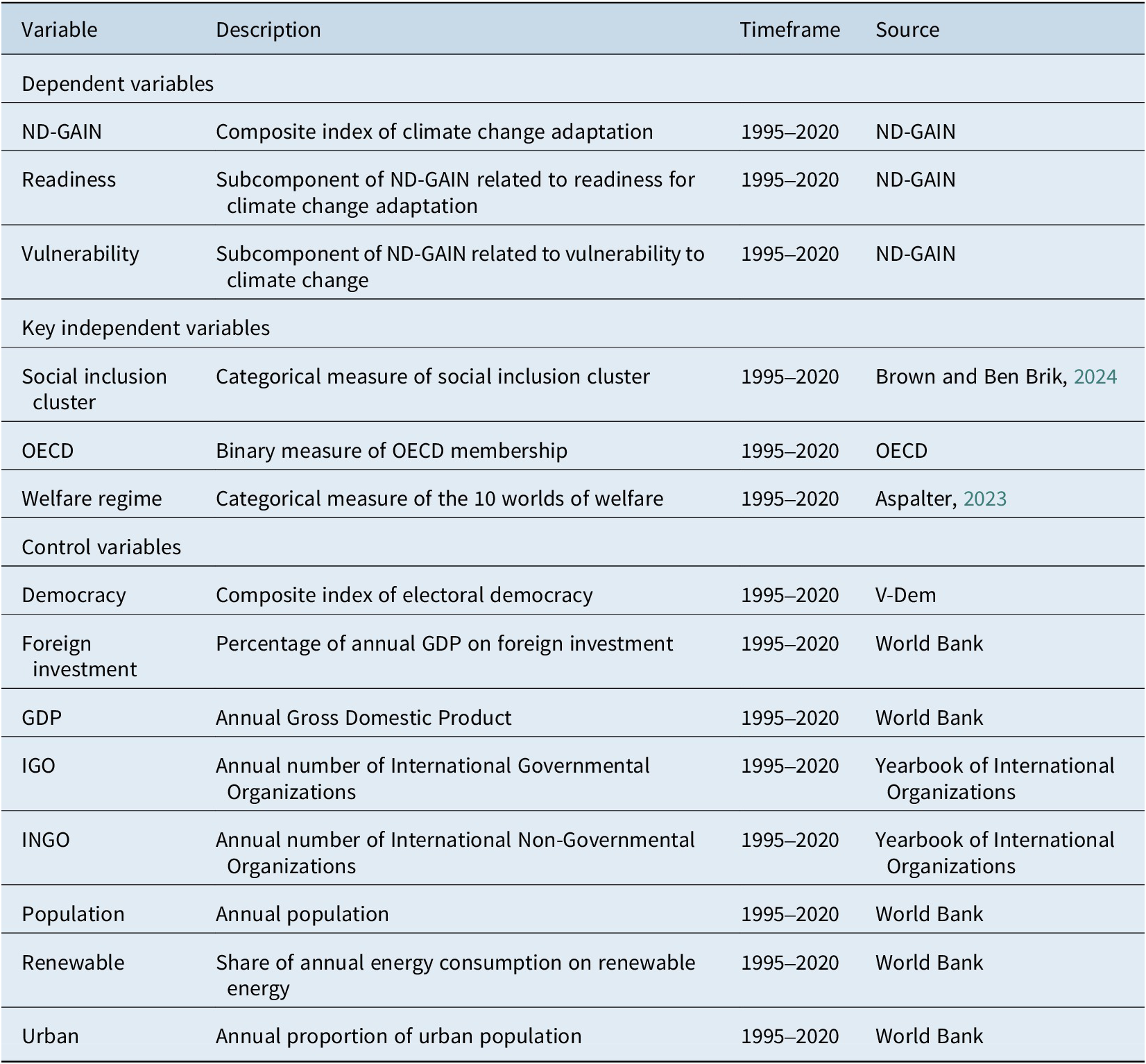
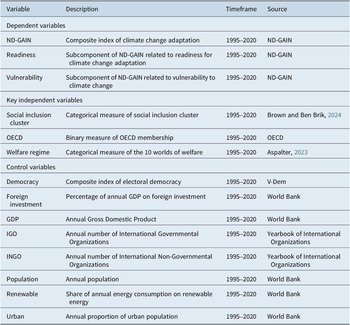
Control variables included electoral democracy (V-Dem; Coppedge et al., Reference Coppedge, Gerring, Knutsen, Lindberg, Teorell, Altman, Angiolillo, Bernhard, Cornell, Fish, Fox, Gastaldi, Gjerløw, Glynn, God, Grahn, Hicken, Kinzelbach, Krusell, Marquardt, McMann, Mechkova, Medzihorsky, Natsika, Neundorf, Paxton, Pemstein, Römer, Seim, Sigman, Skaaning, Staton, Sundström, Tannenberg, Tzelgov, Wang, Wiebrecht, Wig, Wilson and Ziblatt2025) to adjust for political institutions and accountability, foreign investment (% GDP), GDP, and GDP squared (to allow for a non-linear, Kuznets-type relationship between economic development and adaptation capacity), and population size (World Bank Group, 2025) to capture differences in economic resources and scale, renewable energy share and urban population share (World Bank Group, 2025) to account for structural features of energy systems and settlement patterns that shape exposure and capacity, and the number of IGOs and INGOs (UIA, 2024) to proxy international embeddedness and access to transnational support. Table 1 describes each of the variables and their sources.
Variable descriptions and their sources
Analytic approach
To address the research questions, parallel Correlated Random Effects (CRE) models are estimated for two dependent variables: the ND-GAIN adaptation readiness and climate vulnerability indices. For each outcome, two models are estimated—one using social inclusion cluster as the primary institutional predictor, and another using welfare regimes. Both control for OECD membership and the full set of macro-political covariates. This design allows for the assessment of whether social inclusion regimes are associated with adaptation outcomes, whether classic welfare regimes exhibit similar or distinct patterns, and whether these associations differ between OECD and non-OECD countries.
The study employs the CRE model with Mundlak formulation because it provides a robust estimation strategy for panel data that includes time-invariant predictors (social inclusion cluster, welfare regimes, OECD membership). Unlike standard Fixed-Effects models (FE), the CRE framework allows us to retain these crucial time-invariant institutional characteristics while still accounting for the correlation between country-specific effects and time-varying covariates. Relative to conventional Random-Effects models (RE), CRE relaxes the restrictive assumption that unobserved country effects are uncorrelated with the covariates, while preserving many of the efficiency advantages of RE when this assumption is approximately satisfied. This approach effectively facilitates the decomposition of observed associations into within-unit (temporal change) and between-unit (cross-national difference) components.
In substantive terms, the “within” coefficients (βW) capture how changes over time within a country in covariates (e.g., democracy, GDP) are associated with changes in adaptation outcomes. The “between” coefficients (βB) capture how long-run differences between countries in these same covariates relate to average differences in readiness and vulnerability. Because the research questions focus primarily on the cross-national differences explained by institutional regimes, I interpret the between components of the macro-political controls as adjusting for structural differences between countries.
The models use robust standard errors clustered by country and are estimated separately for each imputed dataset before coefficients and covariances are pooled via Rubin’s rules across 100 multiple imputations. As a sensitivity check, I also re-estimate all models using conventional FE and RE estimators; these yield virtually identical within-country coefficients and somewhat larger institutional contrasts under naive RE, confirming that the main substantive conclusions do not hinge on the CRE specification. The structural equation, detailed definition of terms, and full technical discussion of the CRE/Mundlak specification are provided in Supplementary Appendix A2.
Results
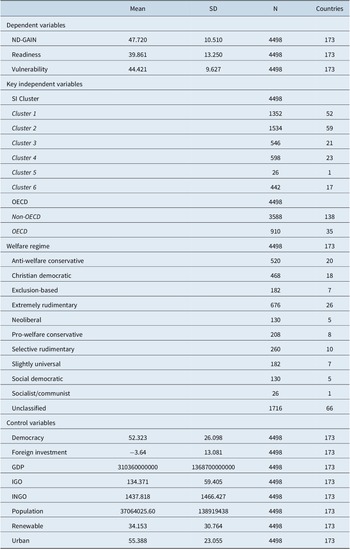
This section presents the key insights from the analysis. A more technical discussion of the sample (C1) and results (C2) can be found in Supplementary Appendix C. The sample’s descriptive statistics are presented in Table 2. Across all 173 countries from 1995–2020, average adaptation readiness is roughly 40, and average climate vulnerability is approximately 44. Countries are unevenly distributed across the six social inclusion (SI) clusters. The least inclusive clusters (e.g., “Low–Low”) account for the majority of cases, while the most inclusive ones (“High–High,” “High–Mid”) contain a smaller group. OECD members make up roughly one-fifth of the sample. Welfare regimes are similarly heterogeneous, featuring sizeable groups in six main typologies (Anti-Welfare Conservative, Extremely Rudimentary, Selective Rudimentary, Pro-Welfare Conservative, Neoliberal, and Social Democratic) and a large Unclassified category.
Descriptive statistics
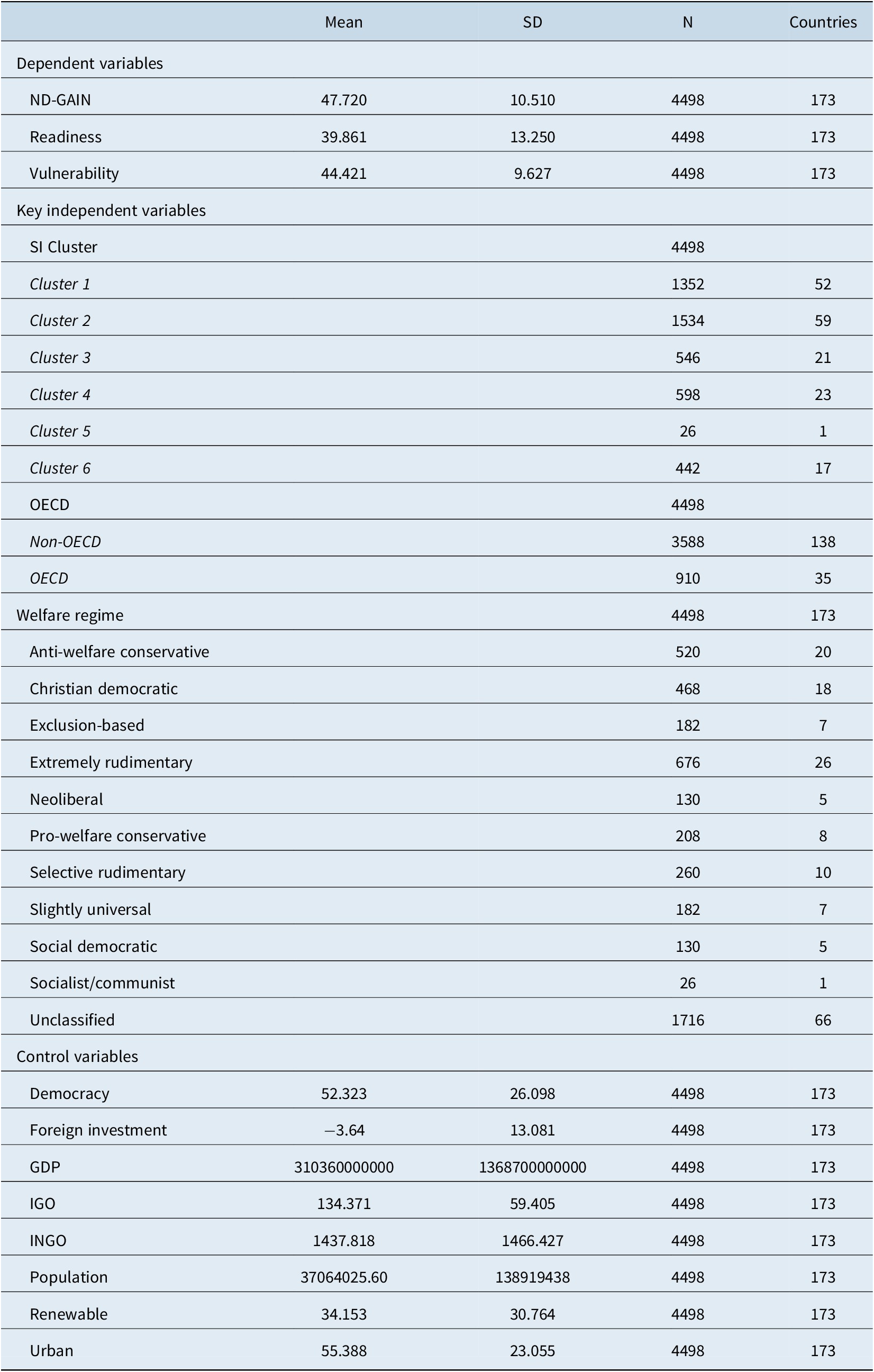
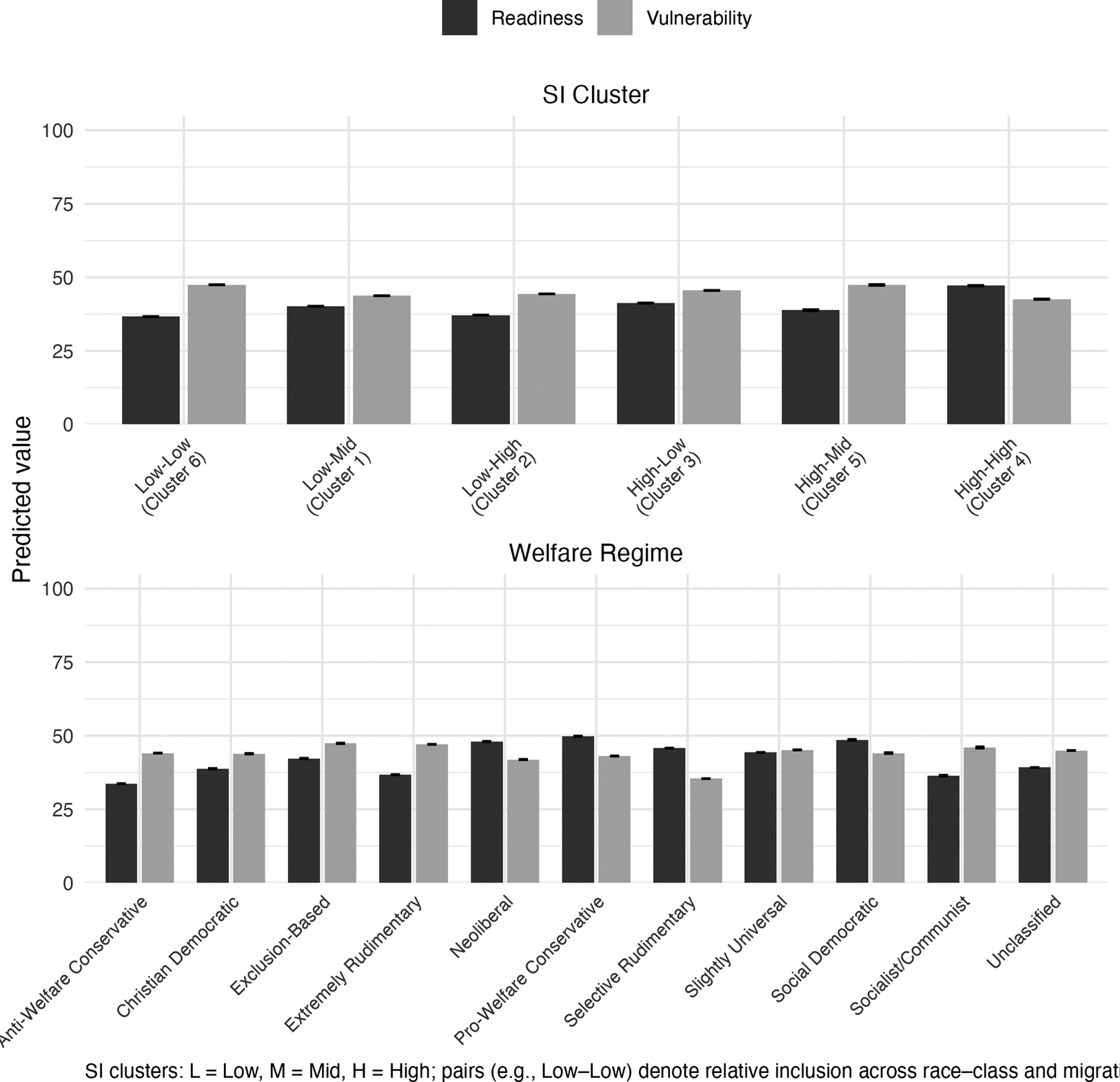
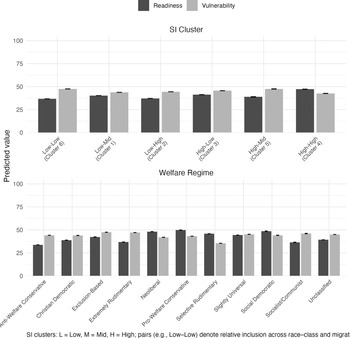
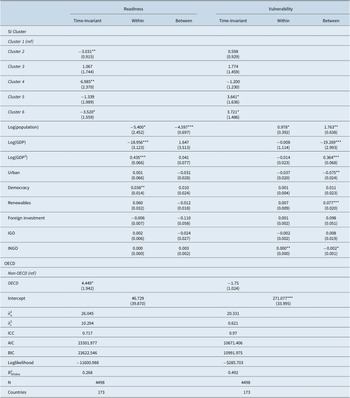
Figure 1 plots the model-based predicted readiness and vulnerability by SI cluster and welfare regime. Table 3 and Figure 1 reveal clear differences in adaptation outcomes across SI clusters. The most inclusive clusters (“High–High,” “High–Mid,” including many high-income democracies) have substantially higher predicted readiness and lower vulnerability than the least inclusive clusters (“Low–Low,” dominated by low- and middle-income countries). Mixed clusters (“Low–High,” “High–Low”) fall in between. Importantly, these differences are not simply artifacts of income or OECD membership. Even with controls, belonging to a more inclusive SI cluster remains associated with noticeably higher readiness and lower vulnerability. Substantively, these results suggest that countries combining higher race–class and migration inclusion may be better positioned to prepare for and absorb climate risk.
Predicted Adaptation Readiness and Climate Vulnerability by Social Inclusion Cluster and Welfare Regime.
Correlated-random-effects model coefficient table for social inclusion clusters
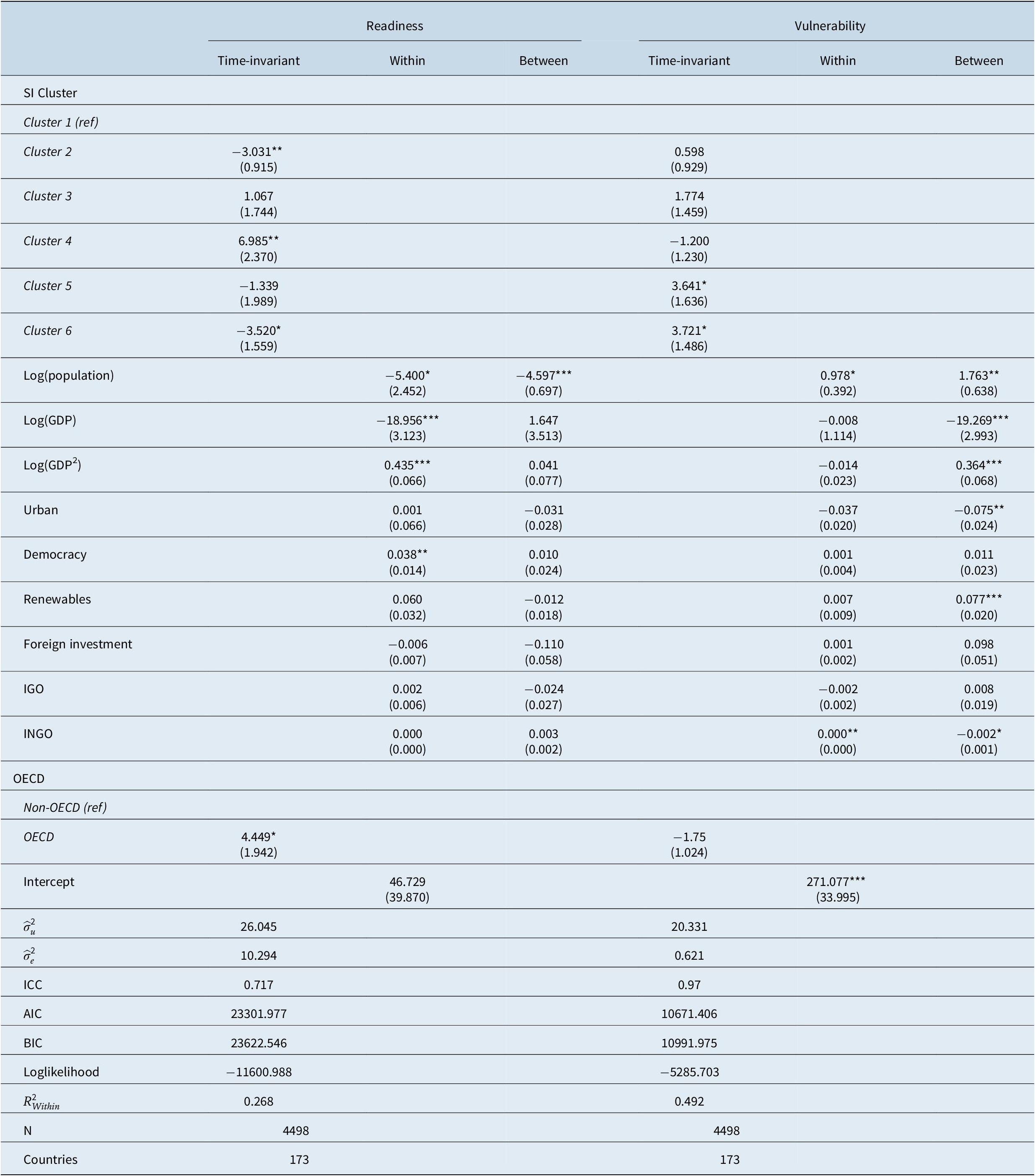
Note: * p < .05, ** p < .01, *** p < .001; pooled across m = 100 Amelia imputations using Rubin’s rule; SEs clustered at country level; values rounded to three decimals.
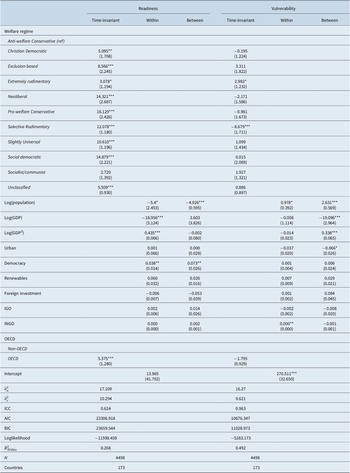
Table 4 and Figure 1 examine the adaptation performance differentiation by classic welfare regimes. Overall, welfare regimes matter, though in different ways than SI clusters. Highest predicted readiness scores are found in Social Democratic, Pro-Welfare Conservative, Neoliberal, and Selective Rudimentary regimes, while Anti-Welfare Conservative and Extremely Rudimentary regimes show lower readiness, even after controlling for macro-political and economic covariates. While high-readiness regimes overlap with inclusive SI clusters and OECD members, this relationship is fuzzy (e.g., some non-OECD Selective Rudimentary regimes perform well). Vulnerability, by contrast, is more homogeneous across welfare regimes, with most types clustering around similar levels. The notable exception is that Selective Rudimentary regimes exhibit substantially lower vulnerability than the Anti-Welfare Conservative and Extremely Rudimentary types. This pattern suggests that welfare institutions are strongly related to readiness, but their association with exposure and sensitivity to harm (vulnerability) is more limited and concentrated.
Correlated-random-effects model coefficient table for Welfare regimes
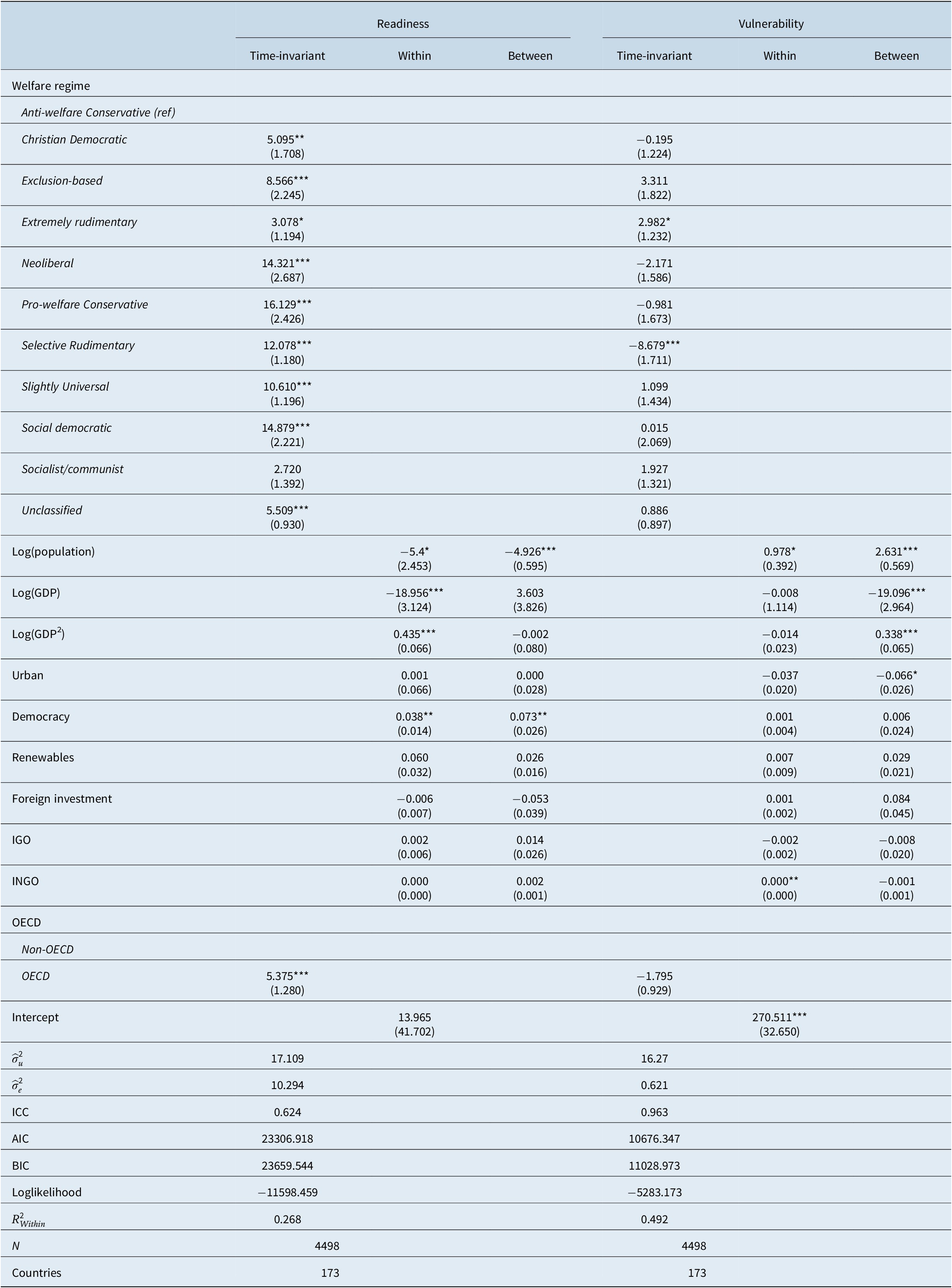
Note: + p < .10, * p < .05, ** p < .01, *** p < .001; pooled across m = 40 Amelia imputations; SEs clustered at country level; MI-Hausman F(9,390) = 0.00, p = 1.00; values rounded to three decimals.
Initially, OECD members show higher average readiness and lower vulnerability. However, including SI clusters and welfare regimes shrinks this gap, implying the apparent OECD advantage reflects, in part, differences in underlying social inclusion and welfare institutions, rather than membership per se. That is, OECD countries may perform better because they are disproportionately located in more inclusive SI clusters and more protective welfare regimes.
The CRE specification allows us to distinguish between-country differences from within-country changes. Most unexplained variation lies between countries, indicating that long-standing institutional and structural differences are central. Within countries, temporal changes in democracy, GDP, and other covariates are associated with modest adaptation improvements, but these temporal effects are small compared to the cross-national gaps defined by SI cluster and welfare regime. Sensitivity checks re-estimating all models with conventional Fixed-Effects and Random-Effects estimators show that the within-country coefficients on time-varying covariates are essentially identical across FE and CRE, with RE yielding similar but slightly attenuated estimates, while the largest differences across estimators arise for the time-invariant institutional predictors, for which CRE produces more conservative cross-regime contrasts.
More inclusive social inclusion clusters consistently perform better even after adjusting for income, democracy, and OECD membership. Welfare regimes matter most for readiness, while vulnerability is more similar across types, barring the notably low vulnerability in Selective Rudimentary regimes. The observed OECD advantage seems to be partially explained by institutional positioning in inclusive SI clusters and more generous welfare regimes. These patterns show that cross-national differences in adaptation outcomes are strongly structured by social inclusion and welfare institutions, even when accounting for macro-political controls.
Discussion
This study offers evidence that national climate adaptation readiness and vulnerability differ between social inclusion and welfare regimes across 173 countries between 1995 and 2020. These differences persist even after adjusting for GDP per capita, levels of democracy, and OECD membership. Countries in the most inclusive regimes score substantially higher on ND-GAIN readiness—and somewhat lower on vulnerability. These patterns indicate that institutionalized inclusion functions as a distinct dimension of national adaptation capacity, separate from wealth, regime type, or regional location.
The ordering of social inclusion clusters suggests a gradation of climate resilience. Countries in the “High–High” and “High–Mid” clusters exhibit the highest readiness and lowest vulnerability, followed by mixed and then exclusionary “Low–Low” and “Low–Mid” clusters. These results align with theories linking social protection to ex ante risk management. Inclusive regimes appear better able to coordinate the complex policy mix required for adaptation. This enhanced coordination may stem from denser administrative infrastructures, stronger state-society feedback loops, and more stable political mandates. In essence, social inclusion regimes operate as adaptation infrastructures that may help states shift from reactive disaster response toward anticipatory and preventive strategies.
The Correlated Random-Effects models underscore that economic development is an important but incomplete explanation. The curvilinear association between GDP and readiness suggests that growth enhances adaptation capacity up to a point, after which gains depend on how resources are distributed and organized institutionally. While within-country improvements in GDP, democracy, and international embeddedness are associated with modest increases in readiness, cross-national differences in inclusion regimes remain sizeable even after accounting for these factors. This pattern implies that inclusive welfare and social-inclusion institutions may help translate fiscal and administrative resources into effective adaptation, whereas exclusionary regimes may struggle, despite comparable income levels.
Findings for welfare regimes further support and nuance this interpretation. Highest readiness is exhibited by Social Democratic, Pro-Welfare Conservative, Neoliberal, and Selective Rudimentary regimes, while Anti-Welfare Conservative and Extremely Rudimentary regimes lag. Vulnerability is more homogeneous, with the notable exception of Selective Rudimentary regimes showing lower vulnerability than the Anti-Welfare Conservative and Extremely Rudimentary types. These patterns suggest that welfare states may be more tightly associated with readiness than with underlying exposure and sensitivity. Crucially, this demonstrates that modest but well-targeted welfare arrangements—such as those in Selective Rudimentary regimes—can support adaptation by extending basic protections and services to vulnerable groups, even outside high-spending social-democratic contexts.
The persistent association between OECD membership and higher readiness points to broader asymmetries in the global political economy. Many lowest-performing countries (often in exclusionary regimes) are low- and middle-income states bearing the legacies of colonialism. While these models cannot trace these historical pathways, the findings align with research showing that colonial legacies and unequal financial architectures constrain fiscal and administrative capacity for adaptation (Escobar, Reference Escobar1995; Mbembe, Reference Mbembe2001). A fuller postcolonial analysis of ecosocial adaptation—examining how imperial histories shape regime configurations and climate finance access—remains an important agenda for future research.
Taken together, these empirical patterns reframe climate adaptation as a sociopolitical and institutional project rather than a purely technocratic exercise in risk management. Countries combining higher social inclusion with encompassing welfare institutions seem to better build and sustain adaptation readiness, even where vulnerability remains elevated. This is consistent with ecosocial policy frameworks that define ecosocial adaptation as the institutional function of mediating climate risks (Brown, Reference Brown and Brik2025). These frameworks conceptualize welfare states as ecosocial institutions that not only buffer market risks but also mediate climate risks through income security, basic services, and channels for voice and participation (Zimmermann and Graziano, Reference Zimmermann and Graziano2020; Mandelli, Reference Mandelli2022; Brown and Chang, Reference Brown and Chang2024). From this perspective, inclusion is a precondition for climate resilience. Integrating relational understandings of social inclusion into adaptation policy means investing in social protection systems, public services, and participatory governance to extend protection to the most exposed. Consequently, international actors should treat support for inclusive welfare and social protection institutions as a core component of adaptation finance, justifying longer-term investments in institutional capacity over solely project-based interventions to foster durable readiness.
This study contributes to the literature in several ways. For climate adaptation research, the results extend evidence on governance and state capacity by showing that specific architectures of welfare and social inclusion regimes are systematically associated with national readiness and vulnerability, net of income and democracy (Pelling, Reference Pelling2010; IPCC, Reference Pörtner, Roberts, Tignor, Poloczanska, Mintenbeck, Alegría, Craig, Langsdorf, Löschke, Möller, Okem and Rama2022). For comparative welfare-regime research, the findings suggest that climate risk is another policy domain where regime families organize cross-national differences, and that social inclusion regimes add explanatory power beyond classic welfare typologies. Finally, for ecosocial policy debates, the study provides a global, quantitative test of ecosocial adaptation. More inclusive regimes appear as means of adaptation, supporting ecowelfare arguments (e.g., Zimmermann and Graziano, Reference Zimmermann and Graziano2020; Cotta, Reference Cotta2024) while also highlighting the limits of these institutions in low-income and postcolonial contexts where capacities remain constrained (Escobar, Reference Escobar1995; Pereira, Reference Pereira2019).
This study has several limitations that point to future research directions. First, regarding data quality, although model-based multiple imputation was used, future analyses need more complete longitudinal data and should incorporate sensitivity checks and uncertainty in outcome and predictor measures. Second, concerning subnational granularity, ND-GAIN provides only country-level summaries of readiness and vulnerability, potentially obscuring subnational inequalities; therefore, linking regime-based analyses to subnational datasets and case studies is needed to clarify how adaptation unfolds across regions and communities. Third, time-invariant institutional typologies may mask hybrid cases and within-country institutional change over the period; developing longitudinal typologies and dynamic clustering approaches could better track regime evolution alongside adaptation reforms. Fourth, addressing causality and endogeneity, the CRE models, while controlling for macro-covariates, cannot fully resolve potential endogeneity or unobserved dimensions of state capacity; causal designs and mixed-methods studies are needed to identify specific mechanisms. Finally, regarding global political economy, this analysis treats colonial legacies and global financial flows only indirectly; future postcolonial and political-economy research should more explicitly examine how international finance, debt, and conditionality interact with domestic welfare and inclusion institutions.
Conclusion
This study shows that social inclusion and welfare regimes are critical institutional factors of global variation in climate adaptation readiness and vulnerability, particularly between the Global North and South. The results find that countries in more inclusive social inclusion regimes exhibit substantially higher readiness and lower vulnerability than exclusionary regimes, a pattern that persists net of income, levels of democracy, and OECD membership. Moreover, welfare state regime matters for adaptation readiness—with Social Democratic, Neoliberal, and Selective Rudimentary regimes showing higher readiness than Anti-Welfare Conservative and Extremely Rudimentary regimes. The models suggest that institutionalized inclusion is a dimension of adaptation capacity, as economic and political factors alone are incomplete explanations for cross-national differences.
These findings provide a global, quantitative analysis of ecosocial adaptation, showing that inclusive regimes seem to function as adaptation infrastructures that translate resources into readiness. They extend comparative welfare research into the climate domain and connect adaptation and state-capacity debates by highlighting that climate resilience is a sociopolitical challenge rooted in institutionalized inclusion, not a purely technical one. Embedding social inclusion in climate adaptation is thus not just a normative goal, but a practical necessity for climate resilience in an era of systemic climate risk.
Supplementary material
The supplementary material for this article can be found at http://doi.org/10.1017/ics.2026.10090.
Competing interests
The author declares none.
Artificial intelligence use statement
ChatGPT and Google Gemini were lightly used in the editing of this manuscript.


 Open access

