


A series of studies has shown elevated rates of schizophrenia, depression and dementia in adults who had low childhood scores on standard IQ tests (Reference Whalley, Starr and AthawesWhalley et al, 2000; Reference Zammit, Allebeck and DavidZammit et al, 2004). However, the possibility that pre-adult IQ may be linked with later total psychiatric illness, in addition to these specific conditions, has rarely been examined. The only two studies examining this association reveal null (Reference Deary, Whiteman and StarryDeary et al, 2004) and inverse relationships (Reference Walker, McConville and HunterWalker et al, 2002). In these studies, case ascertainment was based on hospital admissions databases established when study participants were already middle-aged, raising concerns that earlier cases had not been captured. Moreover, there was limited information on potential confounding variables: adjustment for socio-economic position was based on area-rather than individual-level characteristics and there was a lack of data on other candidate confounders, such as foetal growth. Analyses of data from a Danish birth cohort (Reference Osler, Andersen and LundOsler et al, 2004) allow us to explicitly address the aforementioned issues in a more contemporary cohort.
METHOD
In 1965, all male school children born in the metropolitan area of Copenhagen (Denmark) in 1953 (n=12 270) were invited to participate in a schools-based survey (Reference Hogh, Wolf, Mednick and BaertHøgh & Wolf, 1981); a total of 9537 (77.7%) did so. Teachers group-administered the Härnqvist IQ test (Reference HarnqvistHärnqvist, 1968), which consisted of three sub-categories (spatial, inductive and verbal), the results of which were aggregated to produce a combined score. Paternal occupation was reported by the child and allocated to one of five social class strata (Reference HansenHansen, 1978). Birth weight was extracted from registers and certificates.
Study participants were linked to the Danish Psychiatric Central Register (Reference Munk-Jorgensen and MortensenMunk-Jorgensen & Mortensen, 1997) using their CPR number, a unique person identifier. In the present study, a psychiatric disorder was defined as any psychiatric discharge diagnosis from a psychiatric ward. IQ scores and covariate data (birth weight and paternal social class) were available for 7022 singleton-born men who were known to be alive and living in Denmark or Greenland on 1 April 1969 when the Danish psychiatric register was established. Follow-up ended upon first discharge date from a psychiatric ward for a psychiatric disorder, or death or emigration, or 22 January 2002, whichever came first.
RESULTS
During 209 310 man-years of follow-up, 746 (10.6%) men were found to have developed a psychiatric disorder. This outcome comprised specific psychiatric disorders related to alcohol (21%) or drug misuse (14%); personality disorder (13%); transitional situational disturbance (12%); schizophrenia (9%); depression (8%); anxiety neurosis (4%); and ‘other’ conditions (19%).
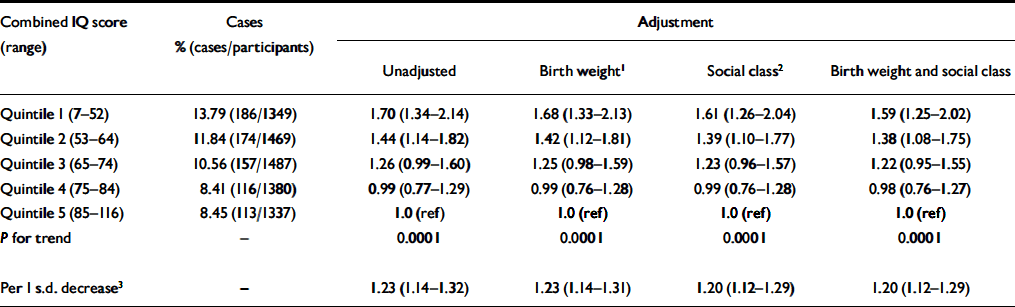
The combined IQ score was inversely related to total psychiatric disorder (Table 1). The highest rates in adulthood were evident in children who had lower IQ test scores (HRlowest quintile v. highest=1.70, 95% CI 1.34-2.14). This effect was incremental (P value for linear trend 0.0001). Adjusting for paternal social class and birth weight resulted in little attenuation of this association. When we related the three IQ sub-test scores to psychiatric disorder, the patterns of association were essentially the same as that for the combined score (data not shown).
Hazards ratios (95% Cl) for the association between combined psychometric IQ score and total psychiatric disorders (n=7022)
| Combined IQ score (range) | Cases % (cases/participants) | Adjustment | |||
|---|---|---|---|---|---|
| Unadjusted | Birth weight1 | Social class2 | Birth weight and social class | ||
| Quintile 1 (7-52) | 13.79 (186/1349) | 1.70 (1.34-2.14) | 1.68 (1.33-2.13) | 1.61 (1.26-2.04) | 1.59 (1.25-2.02) |
| Quintile 2 (53-64) | 11.84 (174/1469) | 1.44 (1.14-1.82) | 1.42 (1.12-1.81) | 1.39 (1.10-1.77) | 1.38 (1.08-1.75) |
| Quintile 3 (65-74) | 10.56 (157/1487) | 1.26 (0.99-1.60) | 1.25 (0.98-1.59) | 1.23 (0.96-1.57) | 1.22 (0.95-1.55) |
| Quintile 4 (75-84) | 8.41 (116/1380) | 0.99 (0.77-1.29) | 0.99 (0.76-1.28) | 0.99 (0.76-1.28) | 0.98 (0.76-1.27) |
| Quintile 5 (85-116) | 8.45 (113/1337) | 1.0 (ref) | 1.0 (ref) | 1.0 (ref) | 1.0 (ref) |
| P for trend | − | 0.0001 | 0.0001 | 0.0001 | 0.0001 |
| Per 1 s.d. decrease3 | − | 1.23 (1.14-1.32) | 1.23 (1.14-1.31) | 1.20 (1.12-1.29) | 1.20 (1.12-1.29) |
DISCUSSION
In the present study, Danish men with high IQ test scores at 12 years of age had lower rates of later psychiatric disorder, an effect evident across the range of IQ scores. Similar results have been reported elsewhere (Reference Walker, McConville and HunterWalker et al, 2002).
Chance, confounding, selection bias and reverse causality are all alternative explanations for the IQ-psychiatric disorder gradient. Given the large sample size in this study, chance is unlikely to explain the results; moreover, the IQ-psychiatric disorder relationship was apparent in all our analyses. A deprived social background is a candidate confounder given its association with both some psychiatric disorders (Reference Bruce, Takeuchi and LeafBruce et al, 1991) and childhood IQ (Reference Neisser, Boodoo and BouchardNeisser et al, 1996). Following adjustment for paternal social class and birth weight, the IQ-psychiatric disorder relationship was only slightly weakened. We did not, however, have data on other potentially important covariates (e.g. alcohol and drug use).
The present analyses are based on 7022 men (57% of the target population). The analytical sample had more favourable levels of some characteristics: they had higher mean IQ test scores (68.28 v. 62.69; P <0.001), and were more likely to come from the highest social group (6.71% v. 5.08%, P=0.002) and be in the heaviest (43500 g) birth weight group (46.55% v. 43.70%;. 43.70%; P≤0.001). However, importantly, absolute differences between the groups were small. Our study sample would only be biased if the IQ-psychiatric disorder gradient differed between those included and those who were not. Although this is of course possible, we believe it to be very unlikely. Finally, the IQ assessment was performed early in life but was not accompanied by psychiatric screening. This raises the issue of reverse causality whereby existing illness, either clinical or subclinical, led to reduced IQ test performance and this generated the observed inverse IQ-psychiatric disorder relationship.
Although these alternative explanations for the IQ-psychiatric disorder association cannot be disregarded, a direct mechanism underpinning the relationship may be that low IQ scores are an indicator of early subclinical cerebral disease processes that precede a psychiatric event. Childhood IQ may also represent a ‘record’ of psychological and physiological insults (e.g. postnatal illness) occurring prior to test administration, which are predictive of some psychiatric conditions.
The strengths of this study are its size; the representative nature of the childhood survey; the availability of covariate data, particularly socio-economic position; and the use of a population-based case register. The study has its limitations. First, by using data on hospital discharge from a psychiatric ward we have identified males with disorders serious enough to warrant contact with mental health services, so under-estimating the incidence of mental illness by failing to capture more minor episodes. Second, because only males participated in the schools-based survey, it is not clear whether the present findings are generalisable to women. Third, we will have missed some cases that occurred between the childhood survey (1965) at age 12 years and the inception of the hospital admissions register (1969) at age 15 years that did not require subsequent hospitalisation.
Acknowledgements
We thank all those who initiated or have continued involvement in the study: K. Svalastoga, E. Høgh, P. Wolf, T. Rishø j, G. Strande-Sørensen, E. Manniche, B. Holten, I. A. Weibull and A. Ortman. The study is supported by the Danish Heart Association, the Lund-beck Foundation and the Health Insurance Fund. G.D.B. held a University of Copenhagen Visiting Senior Research Fellowship. He is now the recipient of a Wellcome Advanced Training Fellowship.




eLetters
No eLetters have been published for this article.