


Social media summary
We argue that concepts of privacy reflect evolved information-management psychology and mental models of information flow.
1. Introduction
Concerns over privacy are central to contemporary debates surrounding digital technology. A 2019 study found that most U.S. residents express unease about how their data are used by corporate and governmental agencies (Auxier et al., Reference Auxier, Rainie, Anderson, Perrin, Kumar and Turner2019). Coupled with dramatic advancements in information technologies, such concerns have inspired extensive research on privacy attitudes and privacy-related behaviour online. Largely absent from this work is an analysis of what privacy is and why privacy exists outside of relatively novel digital environments. Noting that the privacy concept extends far beyond the context of digital technology, a few scholars of online behaviour have highlighted the concept’s seemingly deep roots in antiquity, and some have even discussed the possibility of an evolutionary basis for the cultural concept (Acquisti et al., Reference Acquisti, Brandimarte and Hancock2022, Reference Acquisti, Brandimarte and Loewenstein2015; Shariff et al., Reference Shariff, Green and Jettinghoff2021).
Here, we build on digital privacy researchers’ conjectures regarding the deep history of privacy concepts, as well as evolutionary scholarship on the transmission of information, to propose an evolutionary approach to studying privacy. While a large amount of research has considered how individuals acquire knowledge from others, the converse scenario, in which the individual attempts to restrict others’ information acquisition, has received considerably less attention despite being a plausibly recurrent evolutionary challenge. Information here can be defined as sensory input that, once processed, results in some reduction of uncertainty (Scott-Phillips, Reference Scott-Phillips2008).
Considering this dimension of cultural transmission, we propose that cultural concepts of privacy reflect mental models of information flow, or internalized representations of how information moves in the social environment (Westbrook, Reference Westbrook2006). These mental models of information flow are shaped by universal psychological mechanisms that evolved via natural selection to regulate information dissemination. We outline key components of this framework and present the results of two initial studies designed to examine some of its components. We argue this perspective can shed critical light on digital privacy research – which has often produced inconsistent findings regarding the extent to which individuals value privacy in online environments (Kokolakis, Reference Kokolakis2017) – as well as a diversity of privacy concepts and privacy-related behaviours.
1.1. Outlining an evolved psychology of information management
Privacy is a difficult concept to pin down as it spans a wide swath of domains (Solove, 2009). The term generally describes an individual or group’s ability to seclude themselves from or be free from the observation of others, including freedom from unwelcome literal or figurative intrusions (Longman Dictionary of Contemporary English, n.d.; Merriam-Webster, n.d.). Consonant with such definitions, accounts of privacy-related behaviour in humans indicate that one commonality connecting many different types of privacy is consideration of what information others have access to, with concerns often centring on avoidance of watchful eyes and listening ears. For example, studying U.S. college students, Pedersen (Reference Pedersen1997) explores the psychological functions of such types of privacy as solitude, isolation, and anonymity. Interviewing women in Durban, South Africa, regarding privacy, Scorgie et al. (Reference Scorgie, Foster, Stadler, Phiri, Hoppenjans, Rees and Muller2016) describe participants’ emphasis on the importance of visually obscuring evidence that one has menstruated. Limbago et al.’s (Reference Limbago, Welsch, Müller and Di Francesco2025) Finnish university participants cite uncertainty about others’ ability to overhear conversations as a primary factor inhibiting socializing in virtual-reality settings.
Taken together, privacy concerns often strikingly parallel behaviours clearly aimed at moderating information flow, such as monitoring other animals’ gaze direction, or sensitivity to auditory cues produced by conspecifics (Bateman & Fleming, Reference Bateman and Fleming2011; Heffner, Reference Heffner1998). Our understanding of privacy attitudes and behaviour may thus benefit from a consideration of how humans and other organisms have responded to the adaptive challenge of regulating information dissemination, including their attempts to control who is able to acquire, and potentially transmit, any given piece of information about them. Before turning to this question, however, we must first consider the advantages of acquiring information.
1.1.1. Humans seek out information about others
The ability to obtain information about the physical and social environment can be an important determinant of fitness, informing decision-making in many domains. Information acquisition can arise from asocial interactions with the environment, such as trial-and-error learning, or via social learning influenced by observation of, or interaction with, others (Heyes, Reference Heyes1994). Social learning is widespread in the animal kingdom, as it can reduce the time, energy, and opportunity costs associated with individual learning. Humans are heavily dependent on social learning for survival and reproduction, relying on skill-intensive food acquisition strategies which often involve learning a body of accumulated socially transmitted information that would be impossible to accrue individually (Boyd & Richerson, Reference Boyd and Richerson1985; Dean et al., Reference Dean, Vale, Laland, Flynn and Kendal2014). Additionally, human behavioural strategies are dependent on cooperation with kin and non-kin, as well as coordinating collective action, all of which hinge on imitative capacities to learn and adhere to social norms (Cosmides et al., Reference Cosmides, Barrett and Tooby2010).
In addition to acquiring skills, knowledge about the environment, and cultural information, humans are adept at acquiring information about other people. Experimental studies indicate participants transmit social information with greater accuracy and in larger quantities than non-social information (Mesoudi et al., Reference Mesoudi, Whiten and Dunbar2006; Stubbersfield et al., Reference Stubbersfield, Tehrani and Flynn2015). Information about others is obtained for many reasons, two of which are important here: (1) to discriminate among potential models in the context of social learning and (2) to discriminate among potential cooperative partners.
Social learners are selective in whom they learn from in order to minimize the risk of, and costs associated with, learning inaccurate or irrelevant information. Theoretical and empirical work indicate individuals have context-dependent preferences for potential models based on characteristics such as age, social status, expertise, and success (Atkisson et al., Reference Atkisson, O’Brien and Mesoudi2012; Chudek et al., Reference Chudek, Heller, Birch and Henrich2012; Henrich & Broesch, Reference Henrich and Broesch2011; Wood et al., Reference Wood, Harrison, Lucas, McGuigan, Burdett and Whiten2016). For example, studies show that children preferentially imitate behaviour based on the age and gender of models (Lew-Levy et al., Reference Lew-Levy, van den Bos, Corriveau, Dutra, Flynn, O’Sullivan, Pope-Caldwell, Rawlings, Smolla, Xu and Wood2023). Likewise, Henrich and Henrich (Reference Henrich and Henrich2010) report pregnant Fijian women preferentially learn food taboos from older and locally prestigious women. Generally, the presence of model-biased transmission patterns suggests a sensitivity to cues pertinent to discerning such characteristics about others as age, status, or expertise.
Information about others is also obtained to discriminate among potential cooperative partners. Because cooperating with free riders can erode the adaptive benefits of cooperation as a strategy, the capacity to correctly identify who is and who is not a beneficial cooperative partner is of great importance. In kin-selected cooperation systems, cooperators must discriminate between kin and non-kin to preferentially provide aid to kin (Stevens et al., Reference Stevens, Cushman and Hauser2005; West et al., Reference West, Griffin and Gardner2007). In models of direct reciprocity, individuals must be able to discern between cooperators and defectors, keeping track of past interactions and estimating future interactions with multiple different partners over long periods of time (Delton et al., Reference Delton, Krasnow, Cosmides and Tooby2011; Lehmann & Keller, Reference Lehmann and Keller2006). In indirect reciprocity systems, individuals must do still more, tracking the behaviour of all others in the social network to discriminate among partners based on past behaviour as cooperators or defectors (Manrique et al., Reference Manrique, Zeidler, Roberts, Barclay, Walker, Samu, Fariña, Bshary and Raihani2021). The aggregated beliefs and evaluative judgements made about someone constitute their reputation (Wu et al., Reference Wu, Balliet and Van Lange2016a). In systems of indirect reciprocity where actors do not directly observe the actions of others, decisions regarding whom to cooperate with are made on the basis of the other’s reputation as a good cooperator (Nowak & Sigmund, Reference Nowak and Sigmund2005).
Employing language, humans engage in fully referential and displaced communication (i.e., communication that is ‘about’ something, and can refer to things not immediately present) (Rendall et al., Reference Rendall, Owren and Ryan2009). Gossip is ubiquitous and frequent in human societies (Beersma & Van Kleef, Reference Beersma and Van Kleef2012; Robbins & Karan, Reference Robbins and Karan2020), proving a rich source of information about others’ past behaviour in cooperative endeavors (Dunbar, Reference Dunbar2004; Pan et al., Reference Pan, Hsiao, Nau and Gelfand2024); correspondingly, information gleaned from gossip is used when selecting cooperative partners (Piazza & Bering, Reference Piazza and Bering2008; Sommerfeld et al., Reference Sommerfeld, Krambeck, Semmann and Milinski2007). For example, in a cross-cultural study of Mechanical Turk workers and Ngandu horticulturalists, Hess and Hagen (Reference Hess and Hagen2023) find that participants informed of negatively valenced information about a hypothetical target are less likely to transfer resources to the target; notably, this effect is mediated by the extent to which the information affected the target’s reputation.
1.1.2. Humans also limit what knowledge others can learn about them
As the cursory overview above indicates, a substantial body of work is dedicated to understanding how and under what conditions individuals benefit by acquiring information from – and about – others. Comparatively less has been said regarding the flip side of this situation, namely, contexts in which one benefits by limiting others’ ability to learn about them. However, ample empirical and theoretical work suggests this topic may play a similarly significant role in governing human communication.
Studies of non-human animal communication reveal that moderating other organisms’ access to information is a widespread adaptive challenge. For example, though not intended to convey information, cues are nonetheless an information source for other organisms. Danchin et al. (Reference Danchin, Giraldeau, Valone and Wagner2004) use the term inadvertent social information to describe cues that, when observed by nearby organisms, provide valuable information about the environment, such as the location or quality of nearby resources. For the animal producing the cue, others’ vicarious information acquisition can be costly. Predators may be alerted to an organism’s presence, or competitors may discover the location of a food cache. Correspondingly, researchers have demonstrated that numerous species monitor and attempt to manipulate what information other organisms can acquire. Carter et al. (Reference Carter, Lyons, Cole and Goldsmith2008) show that starlings monitor other animals’ cranial orientation, the presence of eyes, and gaze direction as indices of predation risk. Leaver et al. (Reference Leaver, Hopewell, Caldwell and Mallarky2007) report Eastern grey squirrels preferentially dig their caches when oriented away from conspecifics, potentially limiting others’ ability to pilfer. Hare et al. (Reference Hare, Call, Agnetta and Tomasello2000) present research indicating common chimpanzees display some understanding of conspecifics’ knowledge about the environment, and utilize this to gain advantages in competitive situations.
Humans face adaptive challenges related to information management similar to those of other animals, such as predator avoidance and the strategic acquisition of food resources. However, humans’ capacity for symbolic communication allows a far larger quantity of information to be transmitted between conspecifics, marking a point of departure from the informational ecosystems of other social animals (Gärdenfors, Reference Gärdenfors2004). As discussed above, information about the behaviour of group members flows through gossip networks. Combined with reputation-based systems of cooperation, this means that information management is a significant, uniquely complex concern for humans (Wu et al., Reference Wu, Balliet and Van Lange2016a).
When resource allocation is determined by one’s reputation, it pays to be strategic regarding others’ perception of oneself. Costly signalling theories of cooperation highlight this reality: one need not engage in costly forms of prosociality at all times, but should instead preferentially do so when potential observers are present (Gintis et al., Reference Gintis, Smith and Bowles2001; Van Vugt & Hardy, Reference Van Vugt and Hardy2010) and likely to gossip (Beersma & Van Kleef, Reference Beersma and Van Kleef2011; Piazza & Bering, Reference Piazza and Bering2008). By the same logic, we should expect individuals to preferentially engage in reputationally damaging behaviour when others are absent, or, if present, when others are unlikely to spread information through gossip networks. We may also expect individuals to limit sharing information that poses a reputational risk.
Because the realm of reputationally salient information can span innumerable domains, it is difficult to specify a priori exactly what forms of information any given culture will consider reputationally impactful (Garfield et al., Reference Garfield, Schacht, Post, Ingram, Uehling and Macfarlan2021). However, it is plausible that key areas related to fitness, such as social status (von Rueden et al., Reference von Rueden, Gurven and Kaplan2010), somatic capital (Lancaster & Kaplan, Reference Lancaster, Kaplan and Muehlenbein2010), prosociality (Jaeggi et al., Reference Jaeggi, Burkart and Van Schaik2010), honesty (Gintis et al., Reference Gintis, Smith and Bowles2001), sexual behaviour (Scelza, Reference Scelza and Buss2022), alliances (DeScioli & Kurzban, Reference DeScioli and Kurzban2009), and resources (Borgerhoff Mulder & Beheim, Reference Borgerhoff Mulder and Beheim2011), are common domains. Indeed, at a proximate level, individuals may not have access to the full suite of social norms to which they may be held to account (Kelly & Davis, Reference Kelly and Davis2018). It is thus plausible that individuals opt for a cautious strategy, being hesitant regarding what information they share with others to prevent potentially damaging information from being learned and transmitted. Furthermore, individuals may use situational cues, such as the presence of others, and the likelihood of future information transmission, to aid in evaluating when information-management concerns should take priority.
Human sensitivity to the presence of others is evident in audience effects, changes in behaviour when one believes they are being observed by another person (Hamilton & Lind, Reference Hamilton and Lind2016). A functional magnetic resonance imaging study by Somerville et al. (Reference Somerville, Jones, Ruberry, Dyke, Glover and Casey2013) found participants who believed a camera was transmitting a feed of their face to a friend outside the scanner evinced increased medial prefrontal cortex (mPFC) activation and striatum–mPFC connectivity when a signal indicated the camera was on. The mPFC is associated with complex social cognition and self-referential processing (Gallagher & Frith, Reference Gallagher and Frith2003; Northoff & Bermpohl, Reference Northoff and Bermpohl2004), while the striatum is associated with reward processing (Delgado, Reference Delgado2007). A similar study by Izuma et al. (Reference Izuma, Saito and Sadato2010) found that both neural regions were active when participants engaged in a task evaluating their adherence to various social norms within view of other people. Taken together, such studies suggest humans have deeply engrained psychological mechanisms for information management.
Empirical work also indicates that people are responsive to the potential downstream impacts of gossip (Nieper et al., Reference Nieper, Beersma, Dijkstra and van Kleef2022). Wu et al. (Reference Wu, Balliet and Van Lange2016b) find that individuals are sensitive to the social connectivity of observers and behave more generously in conditions where observers can gossip to more people. Nieper et al. (Reference Nieper, Beersma, Dijkstra and Kleef2025) report that participants are less likely to engage in dishonest behaviour when observed by individuals who can gossip to future interaction partners as opposed to those who cannot.
These lines of evidence suggest the socio-informational environment humans occupy, wherein cooperation is critical to success, jockeying for advantage often occurs, and reputational information is a critical resource, plausibly selected for psychological mechanisms designed to attend to and regulate the dissemination of information towards broadly adaptive ends. We thus propose that people’s concepts of privacy, and the deployment of those concepts in judgement and decision-making, should reflect three distinct but interacting capacities, namely the ability to monitor and regulate:
A) Others’ acquisition of information: An individual’s ability to assess the likelihood that others will acquire information in the future, as well as the actuality of any current information acquisition.
B) Others’ transmission of information: An individual’s ability to assess the probable extent of transmission beyond the initial acquirer, possibly considering the content of the information, social norms regarding transmission, and (if known) the identity of the person acquiring the information.
C) Consequences of information dissemination: The ability to assess whether dissemination (hereafter used to refer to any combination of acquisition and/or transmission) will be costly or beneficial, given both one’s position in an information transfer event and the content of the information. This also includes the ability to assess, based on the identity of the individual to whom the information is transmitted, the likelihood and ramifications of further transmission.
In this framework, people’s conceptualizations of privacy, centrally concerned with regulating the information to which others have access, should reflect mental models of how information spreads in the social environment. These models constitute an individual’s internal representation of the social world, including their expectations about the shape and structure of social networks, and assumptions about how information travels through those networks (Westbrook, Reference Westbrook2006). We propose that these models are, in turn, shaped by the aforementioned cognitive capacities to monitor and regulate others’ acquisition and transmission of information and the downstream consequences of information flow. This framework provides an empirical and evolutionarily grounded foundation for theories of privacy that state individuals should feel their privacy has been breached when information flow exceeds an anticipated or accepted extent (Nissenbaum, Reference Nissenbaum2009).
Common definitions of privacy as solitude, or as being free from the observation of others, can be understood in this framework via the first two components, monitoring the acquisition and transmission of information. In terms of the third component, it is worth considering both how a variety of factors might influence the risk of negative consequences and how human psychology is designed to estimate those consequences when making decisions. Costs of dissemination may include direct bodily harm (as in the case of violence), reputational harms, or material harms (which may, themselves, be downstream of reputational harms). The dissemination of information regarding certain actions, such as defection in cooperation, sexual infidelity, or murder of kin, may pose a significant risk of negative consequences regardless of the cultural group. Nevertheless, even in a simplified model of human social interactions, such as a multi-shot interaction game, context looms large. Defection against a cooperator may lead to sanctioning, whereas defection against a defector may be permitted or even rewarded as a form of norm enforcement (Andrés Guzmán et al., Reference Andrés Guzmán, Rodríguez-Sickert and Rowthorn2007; Panchanathan & Boyd, Reference Panchanathan and Boyd2003). Because context matters, at a proximate level, individuals are likely to rely on socially transmitted norms, stories, and knowledge of what consequences have befallen past norm violators as heuristics to approximate the potential costs of disseminating any given piece of information. It should therefore be understood that, while the above theory predicts overarching similarities in cultural concepts of privacy across groups/societies, it in no way predicts uniformity in this regard, and, indeed, given the centrality of culture as a determinant of the meaning of actions and characteristics, extensive variation across cultures in privacy concepts is to be expected.
As discussed above, as an obligate social and cultural species, obtaining more information about the physical and social environment generally promotes human fitness. However, while gathering information is frequently profitable, it is not always in one’s best interests to divulge information, especially reputationally harmful information that could decrease one’s access to shared resources and cooperative partners. Therefore, there is a clash of interests governing information management, as an individual’s incentives to carefully regulate the flow of information about themselves are often in direct conflict with others’ incentives to acquire information they possess. Hess and Hagen (Reference Hess, Hagen, Giardini and Wittek2019) suggest that societies can be expected to sanction gossip less than physical aggression because the benefits obtained by group members from gossip outweigh the risk that reputationally damaging information about any one individual will be disseminated.
Moreover, it seems likely that cultural evolutionary processes likely favour cultural models of privacy that standardize social norms about what information is or is not appropriate to acquire and spread, facilitating coordination and cooperation by balancing the utility of gossip against the costs of conflict. Culturally sanctioned forms of information guarding, such as sexual modesty, may be examples of such equilibria. In the U.S. cultural context, the single-family home is such a site of equilibria. The U.S. legal system designates the home as a site specially protected from governmental intrusion (Kyllo v. United States, Reference Kylo2001), and it is common for homes to utilize features such as walls, hedges, or fences to facilitate information guarding (Day, Reference Day2000). More generally, restrictions on whom it is appropriate to tell what information may also serve a similar purpose, for example, by constraining dissemination to kin or cooperative partners, thereby both maximizing the benefits of information sharing and minimizing the associated risks.
It should be emphasized that, although we assume some degree of domain specificity in human evolved psychology, our proposed framework is also compatible with a general-purpose learning mechanism. Many topics in the evolutionary social sciences are the subject of debates between those arguing for domain specificity and those championing general-purpose learning, but the merits of these positions are beyond the scope of this paper. Moreover, while an extensive discussion of cultural evolution is likewise beyond the scope of this paper, it is highly likely that processes of cultural evolution play a key role in shaping ideas of privacy. The evolved information-management psychology discussed above plausibly constitutes cognitive factors of attraction (Buskell, Reference Buskell2017), biasing the generation and transmission of cultural variants of privacy concepts towards these psychological predispositions, while cultural models of privacy that facilitate coordination and cooperation likely arise through processes of cultural group selection.
2. Study overview
If cultural concepts of privacy are underpinned by evolved information-management psychology, then notions of privacy should reflect this psychology, such that an individual feels their privacy has been breached when information is acquired and/or transmitted beyond an expected or desired extent. Accordingly, moral and emotional judgements concerning situations bearing on issues of privacy – judgements constituting operationalized models of privacy – should centre on the evaluation of information acquisition and transmission, as well as the potential consequences of information dissemination.
In Sections 3 and 4, we present two vignette-based studies designed to explore some of the core features of our theoretical model by testing whether situational features of a social interaction predict privacy judgements. In Study 1, we consider how three independent variables – how information was acquired (‘Manner of Acquisition’ or ‘Acquisition’), the extent to which it was transmitted (‘Transmission’), and the relative position of the participant in the information transfer event (‘Position’) – affect explicit judgements of privacy, as well as participants’ moral judgements and emotional responses. Each of the three independent variables represents a feature of information transfer events that is theoretically central to evolved information-management psychology. We manipulate Transmission via a within-subjects design, while Acquisition and Position via a between-subjects design. In Study 2, we conduct a partial replication to test the effect of Transmission in a between-subjects design, using a select subset of the vignettes used in Study 1.
In each vignette, the information in question was described simply as ‘personal medical information’. As the current study focuses on how individuals use situational cues to calculate privacy risk, and not on comparisons among different forms of information, information with a clear reputational valence risked biasing responses. At the same time, information that was banal or otherwise lacked any potential risk would confuse participants. Personal medical information was chosen because this type of information is commonly considered private in the United States (the population of study), and neither possession of one’s own personal medical information nor attempting to limit its dissemination is likely to be seen as indicating a norm violation or moral failure on the part of the first party.
3. Study 1
We sought to measure how select features of an information transfer event, each theoretically central to evolved information-management psychology, affect U.S. crowdsourced participants’ privacy perceptions. In Study 1, using a mixed between- and within-subjects design, we created vignettes varying the (i) manner of information acquisition, (ii) extent of information transmission, and (iii) relative position of the participant in the information transfer event.
3.1. Study 1 predictions
To evaluate our theoretical model, we tested four pre-registered predictions (see https://osf.io/2kgwx/).
H1: The manner in which information is acquired, specifically the intentionality of the acquirer, will influence judgements of privacy and related reactions.
Previous research has shown that intentionality plays an important, albeit culturally and contextually variable, role in moral judgements (Barrett et al., Reference Barrett, Bolyanatz, Crittenden, Fessler, Fitzpatrick, Gurven, Henrich, Kanovsky, Kushnick, Pisor, Scelza, Stich, Von Rueden, Zhao and Laurence2016). If notions of privacy are rooted in the utility of regulating what others know, then a second party’s (Person B’s) intentional efforts to access information without the first party’s (Person A’s) consent should be viewed as inflicting an unwelcome cost. Additionally, if individuals use situational cues to evaluate when information-management concerns should take priority, voluntary disclosure of information may be one cue indicating decreased risk of reputational or other harm. We therefore predict that intentional acquisition of information from Person A without their consent will be judged as more wrong, more harmful, causing greater discomfort, and a greater violation of privacy than unintentional acquisition of information or information acquisition via Person A’s voluntary disclosure.
H2: Information transmission to a third party will result in more severe judgements of a privacy violation and related reactions.
The costs of dissemination increase with each additional person to whom information is transmitted. Each person is both a potential competitor or cooperative partner whose future behaviour could be influenced by acquired information, as well as a new node in the transmission chain, multiplying the possibility of future transmission. Empirical evidence suggests individuals may be sensitive to the possibility of future transmission when being observed (Nieper et al., Reference Nieper, Beersma, Dijkstra and Kleef2025). If concepts of privacy are shaped by evolved information-management psychology, then the risk incurred via transmission will be reflected in privacy perceptions such that subsequent transmission to a third party (i.e., from Person B to Person C) will be viewed as more wrong, more harmful, causing greater discomfort, and a greater violation of privacy.
H3: Information transmission to a third party who shares social networks with the first party will be regarded as a greater violation of privacy than transmission to socially unconnected third parties.
Evaluating the consequences of information dissemination is a central component of the postulated evolved information-management psychology. For most of human history, transmission to individuals within one’s social network likely entailed higher risks than transmission to socially unconnected individuals, as, within one’s network, cooperative partners who obtain negative information may withhold resources or support, competitors may gain an edge, and hostile individuals may cause greater harm. Additionally, the likelihood of further transmission occurring is greater via socially connected than socially unconnected individuals (Lind et al., Reference Lind, da Silva, Andrade and Herrmann2007; Miritello et al., Reference Miritello, Moro and Lara2011). Extant research indicates individuals may be sensitive to the probable extent of future transmission when observed by others (Wu et al., Reference Wu, Balliet and Van Lange2016b). We therefore expect that cues to a third party’s (Person C’s) location in shared social networks will be used as a proxy for the potential risk associated with transmission of private information; hence, within-network transmission will be viewed as more wrong, more harmful, causing greater discomfort, and a greater violation of privacy than transmission to a socially unconnected third party.
H4: Position in an information transfer event will predict judgements of privacy and related reactions.
As noted, the various actors in an information transfer event often have opposing interests in information dissemination. While regulating dissemination is in Person A’s interests, second and third parties may benefit from acquiring the given information. If reasoning about privacy is shaped by evolved information-management psychology, the divergent costs and benefits engendered by one’s position in an information transfer event should be reflected in privacy perceptions, such that the first party (Person A, who may stand to suffer a cost) will evaluate the situation as more wrong, more harmful, more uncomfortable, and a greater violation of privacy than those in the position of a second or third party (Person B or C, who may stand to reap a benefit).
3.2. Study 1 methods
Study 1 consisted of 36 vignettes, each depicting a hypothetical information transfer event between two or three people. The basic structure was as follows:
Person A has personal medical information about themselves that Person B learns about.
(In some vignettes) Person B conveys this information to Person C.
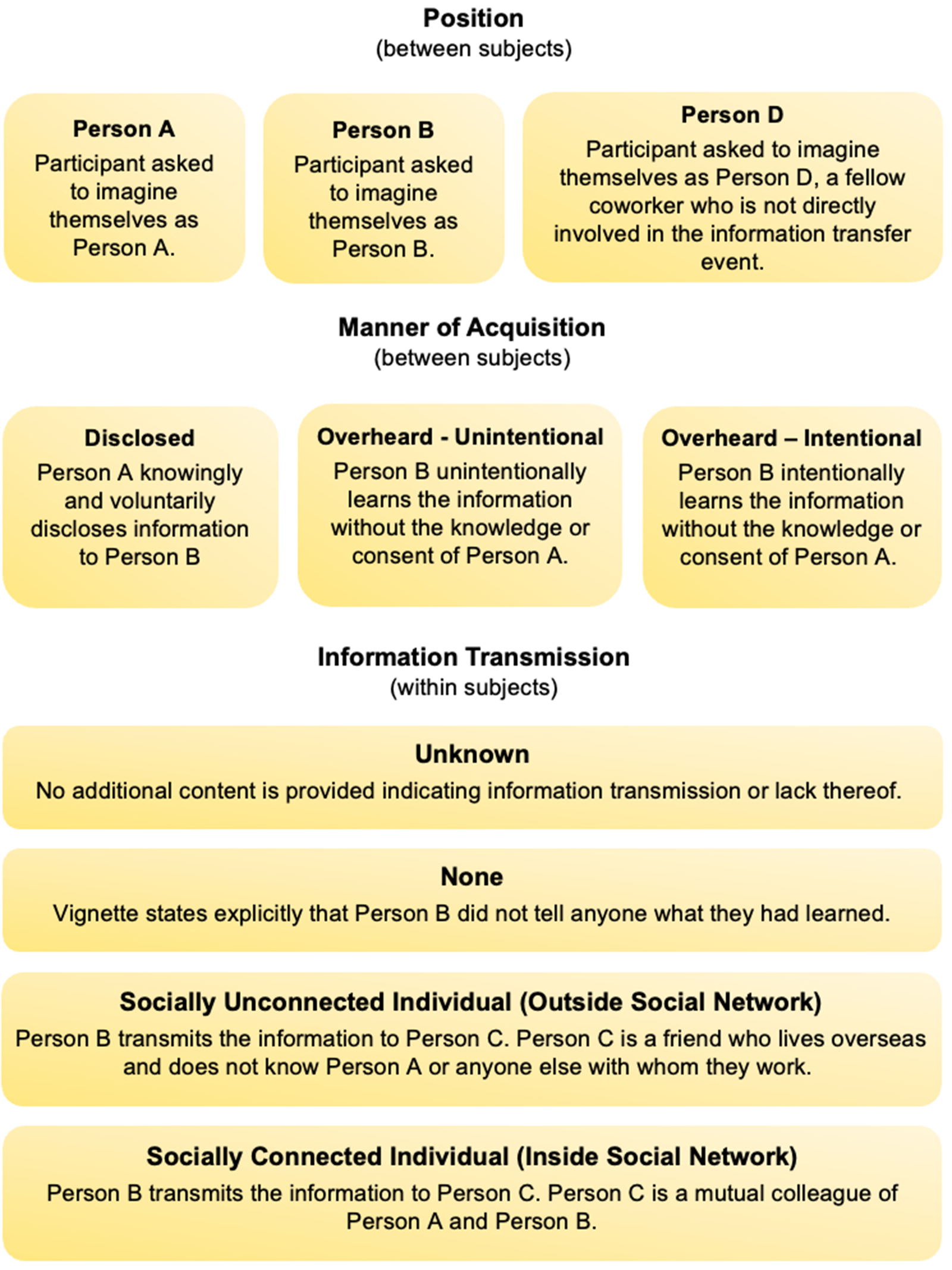
Each vignette altered a feature of the information transfer event hypothesized to be relevant to privacy perceptions (for discussion of principles of vignette design, see Atzmüller & Steiner, Reference Atzmüller and Steiner2010). Participants were assigned one of nine base vignettes, each composed of a unique combination of the two between-subject variables, Manner of Acquisition, i.e., how Person B obtained the information that Person A possessed, and Position, i.e., whether the participant was asked to imagine themselves as Person A, Person B, or another individual not involved in the event (Person D). In addition to one of the nine possible base vignettes, each participant was shown four within-subject Information Transmission conditions. These conditions varied the extent to which information was transmitted beyond Person B. Due to the structure of the vignettes, full randomization of Information Transmission was deemed likely to create confusion amongst participants; therefore, the order of conditions was randomized, save for the Unknown condition, which was always presented first. See Figure 1 for details on independent variables.
Schematic representation of vignette conditions for Study 1.

1 Long description
An infographic that lists out the three independent variables used in Study 1. These include two between-subject variables, Manner of Acquisition and Position, and one within-subjects variable, Information Transmission Condition. Manner of Acquisition has three levels: Disclosed (Person A knowingly and voluntarily discloses information to Person B), Overheard – Unintentional (Person B unintentionally learns the information without the knowledge or consent of Person A), and Overheard – Intentional (Person B intentionally learns the information without the knowledge or consent of Person A). Position has three levels: Person A (Participant asked to imagine themselves as Person A), Person B (Participant asked to imagine themselves as Person B), and Person D (Participant asked to imagine themselves as Person D, a fellow coworker who is not directly involved in the information transfer event). Information Transmission Condition has four levels: Unknown (No additional content is provided indicating information transmission or lack thereof), None (Vignette states explicitly that Person B did not tell anyone what they had learned), Socially Unconnected Individual (Outside Social Network) (Person B transmits the information to Person C. Person C is a friend who lives overseas and does not know Person A or anyone else with whom they work), and Socially Connected Individual (Inside Social Network) (Person B transmits the information to Person C. Person C is a mutual colleague of Person A and Person B).
Following each vignette, participants were asked to evaluate the scenario along four dimensions: Discomfort, Wrongness, Harmfulness, and Violation of Privacy. Save for Violation of Privacy (measured on an unbalanced 4-point scale), all were measured on a balanced 7-point scale intended to minimize demand effects. Violation of Privacy was measured on an unbalanced 4-point measure because, during pretesting, the alternative balanced 7-point scale was deemed overly confusing. These measures were chosen to allow for multiple indicators of negative reactions to an information transfer event.
Studies 1 and 2 were approved by the University of California, Los Angeles IRB. All data and materials used can be accessed at https://osf.io/c9emx/overview?view_only=1a31b5e0d1524526a0dba95584a3687a.
3.3. Study 1 participants
Participants (n = 453; 47.4% female), recruited via the Prolific crowdsourcing platform for a study described as ‘Privacy-Related Perceptions’, were native English-speaking U.S. residents ages 18–70 (mean = 36). Participants were randomly assigned to one of nine base vignettes, each constituting a unique combination of the two between-subjects variables. Participants’ responses were removed for incompleteness, survey completion times above 1140 or below 120 seconds, or for failing an attention check, leaving n = 425 in the final sample.
3.4. Study 1 data analysis
For each dependent measure, the lme4 and lmertest R packages (Bates et al., Reference Bates, Mächler, Bolker and Walker2015; Kuznetsova et al., Reference Kuznetsova, Brockhoff and Christensen2017) were used to fit a three-way linear mixed effects model designed to test the association between Position (three levels), Manner of Acquisition (three levels, ‘Acquisition’ for short), and Information Transmission (four levels, ‘Transmission’ for short) and all interactions. Transmission was a within-subject variable, with each participant shown all four conditions for a given combination of the two between-subject variables, Acquisition and Position. The linear mixed effects model enabled accounting for the lack of independence between repeated observations in Transmission as a random effect associated with participant ID, while also accounting for the fixed effects of Acquisition and Position.
To compare differences between Information Transmission conditions as well as differences between Position conditions, we conducted tests of contrasts between estimated marginal means (EMMs) using the linear mixed effects models discussed above. EMMs were obtained using the emmeans R package (Lenth, Reference Lenth2025).
3.5. Study 1 results
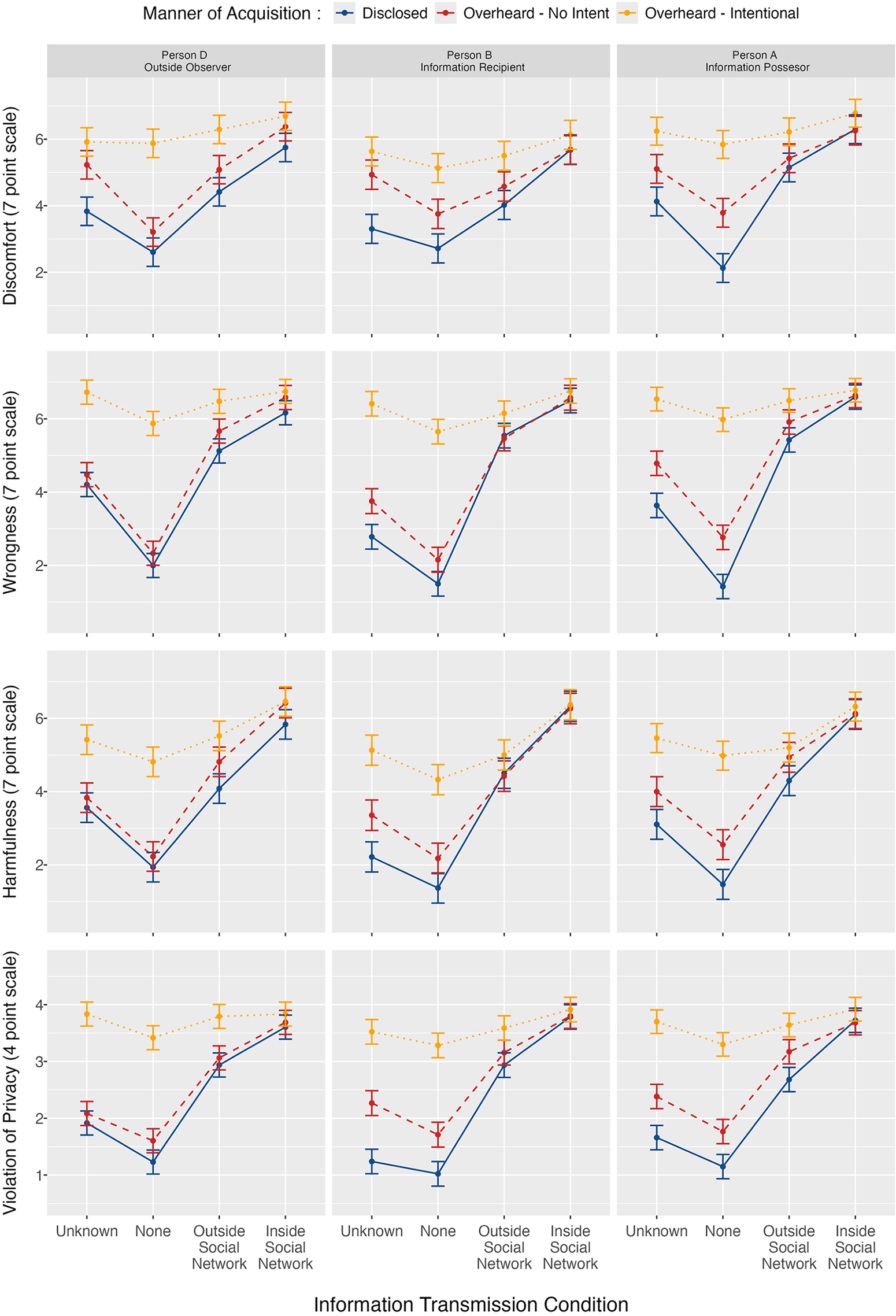
Overall, the results of Study 1 demonstrate a highly consistent structure across all four dependent measures in how the three independent variables – Position, Manner of Acquisition, and Information Transmission – affect participant responses (see Figure 2). The largest effects were observed for Transmission and Acquisition, with both factors producing strong main effects and highly significant two-way interactions across models. The effect of Position was, in contrast, weaker and less stable. While Position did show a significant main effect for Discomfort, Wrongness, and Harmfulness, it did not for Violation of Privacy. For interaction effects, Position × Acquisition did not reach significance in any model, whereas Position × Transmission was significant in all four models. These results suggest that, while Position influences how participants respond to different types of information flow, it has a limited influence as a main effect.
Results of Study 1: interactions between Manner of Acquisition and Transmission across Position conditions.

Figure 2 Long description
Four by three display of graphs showing how each of the four dependent variables (discomfort, harm, wrong, and violation-of-privacy) vary as a function of the three independent variables (position, acquisition, and transmission). On the upper label of the X Axis, Person D/B/A represents the Position variable, indicating the point of view presented in the vignette. The lower labels on the X axis demarcate the four within-subjects Information Transmission conditions. Manner of Acquisition is represented by line color/type (Voluntarily Disclosed = solid blue, Overheard–No Intent = dashed red, Overheard–Intentional = dotted orange). Bars indicate 95% CI.
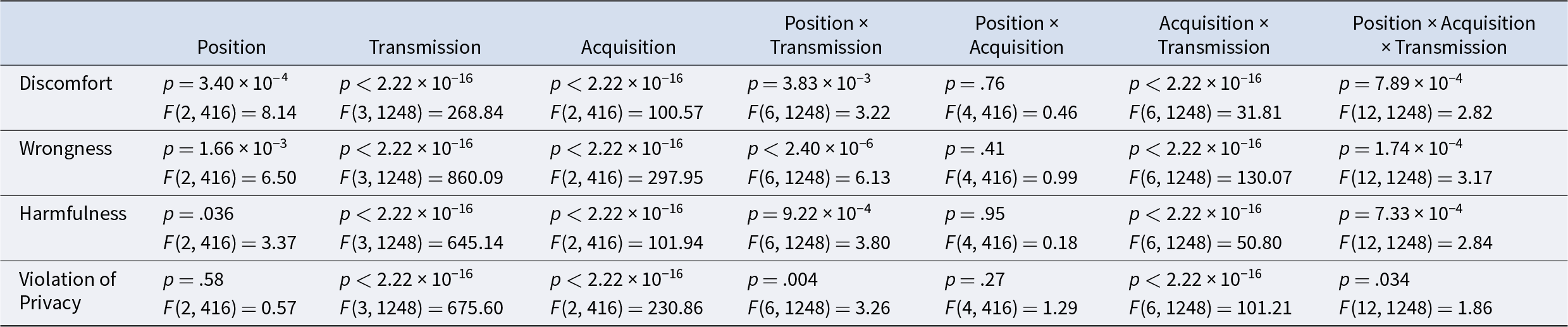
It is possible that the influence of Position as a variable may be strongest in particular combinations of Acquisition and Transmission contexts. Fixed-effect tests from the linear mixed effects models were conducted on each of the four dependent variables to examine this possibility. For each model, Table 1 reports Type III F-tests with Satterthwaite degrees of freedom and associated p-values for all independent and dependent variables.
Summary of fixed-effect tests from linear mixed-effects models for four dependent variables

Table 1 Long description
Summary of fixed-effect tests from the linear mixed-effects models examining how Position, Information Transmission, and Manner of Acquisition predict four evaluative judgments (Discomfort, Wrongness, Harmfulness, Violation of Privacy). The table reports Type III F-tests with Satterthwaite degrees of freedom and associated p-values. All models included random intercepts for Participant_ID.
Notes: Summary of fixed-effect tests from the linear mixed-effects models examining how Position, Information Transmission, and Manner of Acquisition predict four evaluative judgements (Discomfort, Wrongness, Harmfulness, Violation of Privacy). The table reports Type III F-tests with Satterthwaite degrees of freedom and associated p-values. All models included random intercepts for Participant_ID.
The results of fixed-effect tests suggest that the effect of Position is generally weaker than the other two independent variables, and expresses most strongly in the Discomfort and Wrongness dependent measures. Overall, these results indicate that participants rated situations in which Person B actively sought to obtain information as significantly different from those in which information was obtained unintentionally. Additionally, transmission to a third party predicted privacy-related perceptions, as participants rated situations in which transmission occurred beyond the initial recipient of information as more uncomfortable, wrong, harmful, and a greater violation of privacy than situations in which transmission either was not mentioned or was explicitly ruled out. One’s position in the information transfer event exerted a relatively smaller effect on privacy-related judgements, though this effect was still significant across multiple measures, meaning participants who imagined themselves as the target of acquisition and transmission evaluated the scenario more negatively.
Post hoc Bonferroni-corrected pairwise comparisons of EMMs with Satterthwaite-adjusted degrees of freedom confirmed these findings. Large, significant differences were observed due to the main effects of Acquisition and Transmission. These differences were observed across all levels for all dependent measures (all ps < .001, except for the Discomfort rating comparison between the Unknown and Outside Social Network conditions, which had a smaller estimate of −.263, p = 7.4 × 10⁻³).
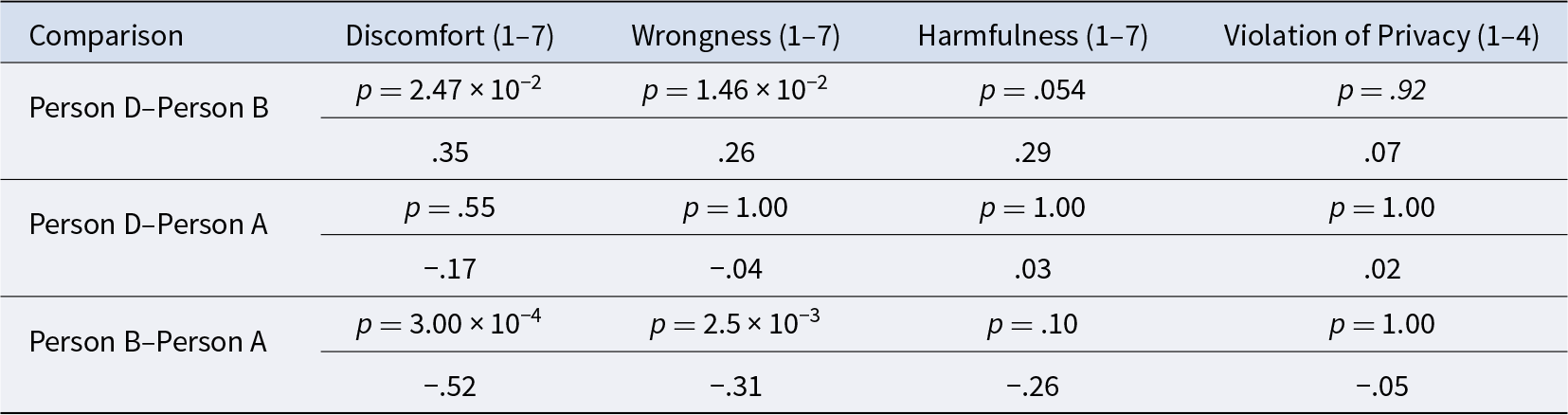
Pairwise comparisons for the main effect of Position revealed mixed results (see Table 2). Overall, Discomfort and Wrongness appeared to be more sensitive to variation in Position conditions, though those effects are limited to the Person D–B contrast and the Person B–A contrast. Across all dependent variables, the Person D–A contrast was small and insignificant. See Supplementary Information for full model results.
Study 1 pairwise comparisons, main effect of position

Table 2 Long description
The table reports pairwise comparisons among Persons D, B, and A across four outcomes: discomfort, wrongness, harmfulfulness (all on 1–7 scales), and violation of privacy (1–4), giving p-values and an associated difference estimate for each comparison. For Person D minus Person B, discomfort is significant (p=2.47×10⁻²; estimate 0.35) and wrongness is significant (p=1.46×10⁻²; estimate 0.26), while harmfulfulness is marginal (p=0.054; estimate 0.29) and privacy violation is not significant (p=0.92; estimate 0.07). For Person D minus Person A, none of the outcomes are significant (all p≥0.55), with small estimates (−0.17 discomfort, −0.04 wrongness, 0.03 harmfulfulness, 0.02 privacy). For Person B minus Person A, discomfort (p=3.00×10⁻⁴; estimate −0.52) and wrongness (p=2.5×10⁻³; estimate −0.31) are significant, while harmfulfulness (p=0.10; estimate −0.26) and privacy violation (p=1.00; estimate −0.05) are not. Overall, statistically reliable differences appear mainly for discomfort and wrongness, not for privacy violation; interpretation should rely on the sign and magnitude of the reported estimates alongside p-values.
To analyse the significant interactions of Position × Transmission and Acquisition × Transmission in the mixed-effects models, additional Bonferroni-corrected post hoc comparisons of EMMs were conducted.
Regarding the Position × Transmission interaction, pairwise comparisons were conducted among Position levels within each Transmission condition. Across all four models, Position differences emerged only when the Transmission target was Unknown. Within the Unknown condition, participants who imagined themselves as Person B produced significantly lower ratings than both Person A (ps < .01) and Person D (ps < .01), whereas Persons A and D did not differ (all ps > .10). In contrast, no Position differences were observed in other Transmission conditions in any model (all ps > .10), which may indicate the influence of Position is highly conditional, emerging only when there is no stated target of transmission. This result may also be due to the ordering of conditions, a possibility investigated in Study 2.
The linear mixed effects models showed that the Transmission × Acquisition interaction was strong across all dependent variables. Simple-effects tests of EMMs confirmed this result. When Acquisition was Disclosed or Overheard Unintentionally, all Transmission levels differed significantly from one another (all ps < .001), with the lowest ratings observed for Inside Social Network and the highest for Unknown or None, depending on the model. In the Intentional Acquisition condition, the pattern was weaker: only a subset of contrasts reached significance (generally Unknown > None and Outside Social Network > Inside Social Network), and effect sizes were substantially smaller. Generally, the magnitude of the Transmission effect decreased as the intentionality of Acquisition increased. This is possibly due to a ceiling effect, with ratings across all dependent variables for Intentional Acquisition hovering at the maximum.
4. Study 2
In light of possible demand characteristics introduced by Study 1’s within-subjects design, we conducted a partial replication study to test the effect of Information Transmission conditions in a between-subjects design. This enabled full randomization of Transmission conditions. This study held constant Position (set at Person A) and Manner of Acquisition (set at Overheard–Unintentional). To strengthen the results given growing concerns regarding artificial data (Zulkey, Reference Zulkey2024), this follow-up study was conducted with more extensive anti-AI safeguards, including additional IP address analysis, Prolific’s authenticity check tool (a Qualtrics integration), and reCAPTCHA v3 verification (reCAPTCHA V3, n.d.).
4.1. Study 2 predictions
Predictions for Information Transmission remained the same as in Study 1, namely that the risk incurred via transmission will be reflected in privacy perceptions such that subsequent transmission to a third party (i.e., from Person B to Person C) will be viewed as more wrong, more harmful, causing greater discomfort, and a greater violation of privacy than no transmission. Additionally, we expect cues to Person C’s location in shared social networks will be used as a proxy for the potential risk associated with transmission of private information; hence, transmission to an individual inside Person A’s social network will be viewed as more wrong, more harmful, causing greater discomfort, and a greater violation of privacy than transmission to an individual outside Person A’s social network.
4.2. Study 2 methods
Study 2 consisted of four vignettes, each mirroring the Information Transmission conditions of Study 1. Each vignette read as follows:
Imagine you work in an office. During the day, you call your spouse on the phone and discuss a personal medical issue you have. While accessing the printer located near your office, your coworker happens to overhear your conversation through the closed door.
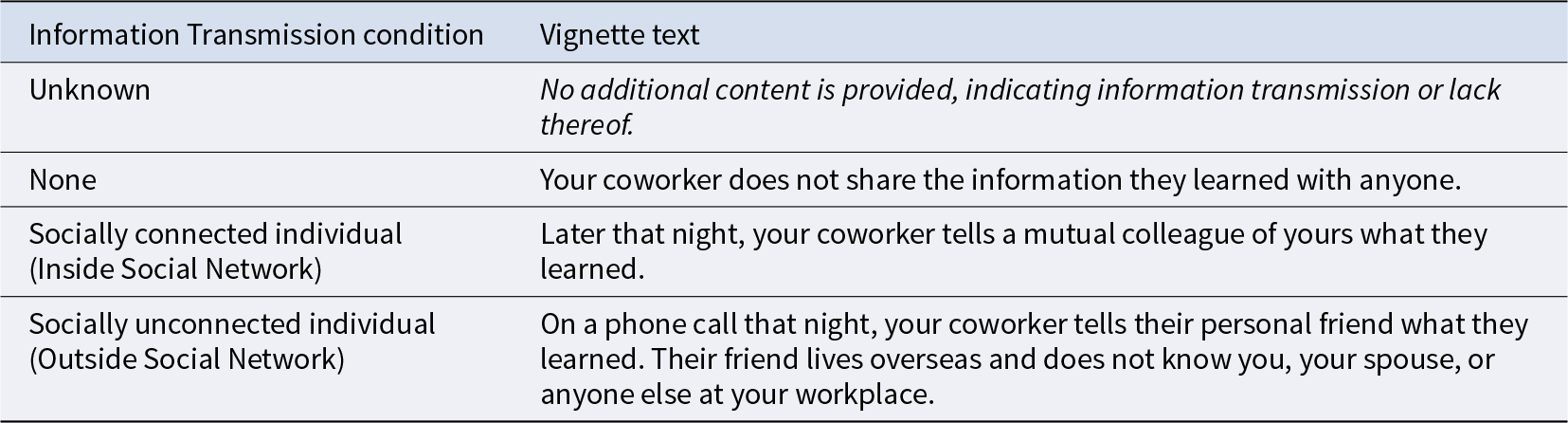
Additional information about Information Transmission was added to the end of the vignette, as outlined in Table 3. Following each vignette, participants were asked to evaluate the scenario along the same four dimensions as in Study 1: Discomfort, Wrongness, Harmfulness, and Violation of Privacy. As in Study 1, save for Violation of Privacy (measured on an unbalanced 4-point scale), all were measured on a balanced 7-point scale intended to minimize demand effects.
Between-subjects conditions for Study 2

Table 3 Long description
The table defines four between-subjects conditions describing whether and to whom a coworker passes along information they learned. In the “Unknown” condition, no extra details indicate either transmission or non-transmission. In the “None” condition, the coworker does not share the information with anyone. In the “Socially Connected Individual (Inside Social Network)” condition, the coworker tells a mutual colleague later that night. In the “Socially Unconnected Individual (Outside Social Network)” condition, the coworker tells a personal friend on a phone call that night; the friend lives overseas and has no connection to you, your spouse, or your workplace. The conditions differ by presence of sharing and whether the recipient is inside versus outside the participant’s social network.
4.3. Study 2 participants
A power analysis based on the effect sizes observed in Study 1, F(3, 1248) = 268.84, η2 ≈ .39, conservatively adjusted to f = .4 for a between-subjects design) indicated 30 participants per group would be sufficient to achieve 80% power at α = .05 for detecting the main effect of Transmission. Participants for Study 2 (n = 120; 49% female) were native English-speaking U.S. residents ages 18–74 (mean = 43.42) recruited via Prolific for a study described as ‘Privacy-Related Perceptions’. Participants were randomly assigned to one of four Information Transmission conditions. All participants completed the survey within the time parameters (45 seconds to 15 minutes), and all passed the reCAPTCHA and other safeguards against artificial responses.
4.4. Study 2 results
A MANOVA designed to test if Transmission influenced the four dependent measures showed a statistically significant difference in Discomfort, Wrongness, Harmfulness, and Violation of Privacy based on Transmission condition, Wilks’ λ = .459, F(12, 299.26) = 8.53, p = 6.35 × 10⁻¹⁴. Follow-up univariate ANOVAs revealed Transmission accounted for substantial variance in Wrongness (F(3, 116) = 33.81, p = 8.90 × 10⁻¹⁶, η2 = .47), Harmfulness (F(3, 116) = 13.67, p = 1.07 × 10⁻⁷, η2 = .26), and Violation of Privacy ratings (F(3, 116) = 27.42, p = 1.78 × 10⁻¹³, η2 = .41), and comparatively moderate variance in Discomfort ratings (F(3, 116) = 4.72, p = .0038, η2 = .11).
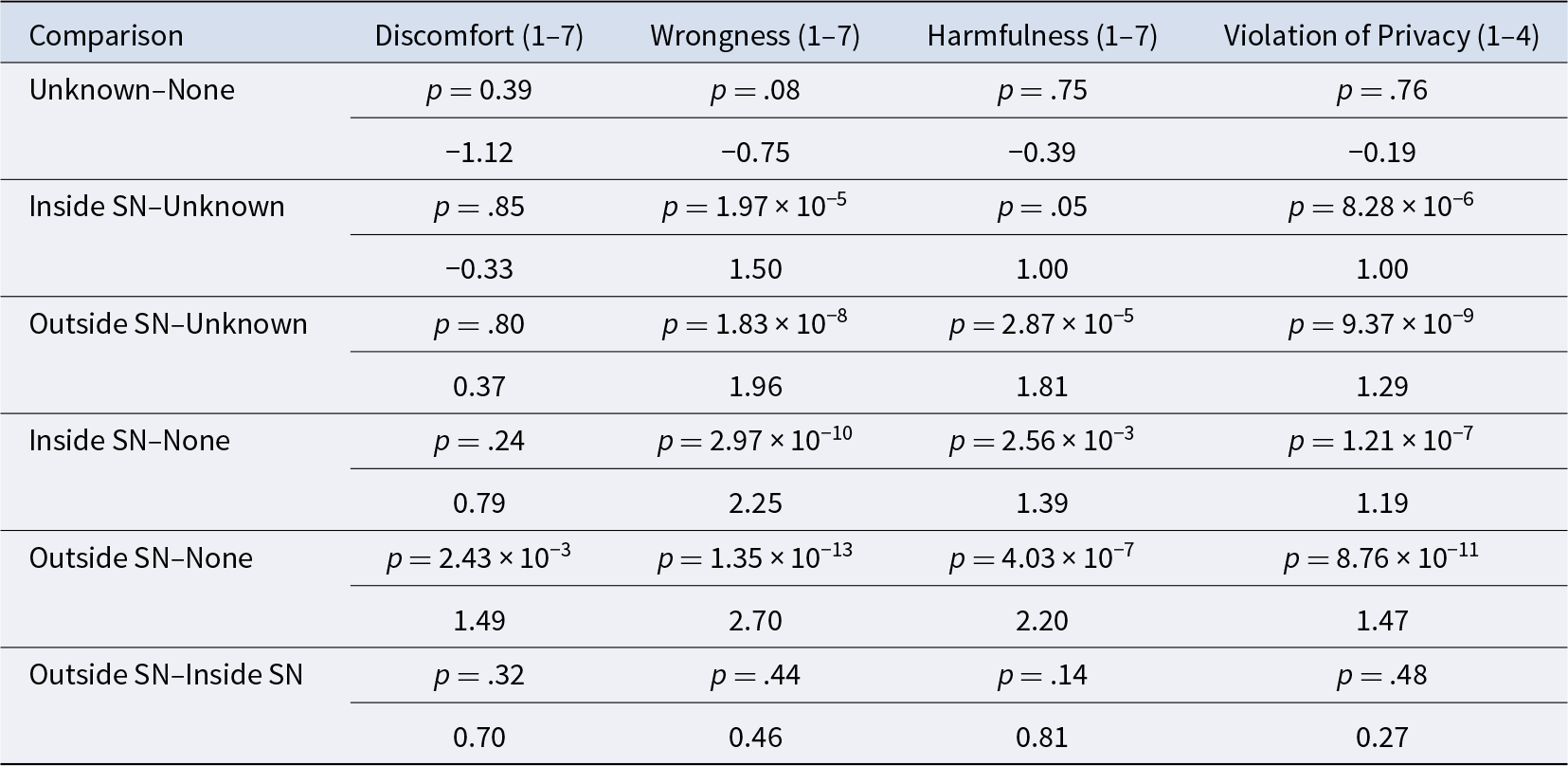
Tukey Honestly Significant Difference (HSD) post hoc tests indicated evaluative judgements were consistently higher in conditions with a stated third-party recipient of transmission (either Outside or Inside Social Network) when compared to conditions with no recipient (Unknown and None) (see Table 4). The Discomfort rating dependent measure revealed the least significant variation overall, though ratings were significantly lower in the Unknown and Outside Social Network conditions compared to the None condition (p = .39 and .002, respectively). For Wrongness, Harmfulness, and Violation of Privacy measures, ratings in the Outside and Inside Social Network conditions were consistently higher than in the Unknown or None conditions (all ps < .001).
Study 2 results of Tukey HSD post hoc tests, mean differences, and significance levels

Table 4 Long description
Post hoc Tukey HSD pairwise comparisons report mean differences and p-values for four outcomes: discomfort (1–7), wrongness (1–7), harmfulness (1–7), and privacy violation (1–4). Unknown vs None shows no significant differences (p=.39, .08, .75, .76; mean differences −1.12, −0.75, −0.39, −0.19). Inside SN vs Unknown is significant for wrongness and privacy (p=1.97×10⁻⁵ and 8.28×10⁻⁶; mean differences 1.50 and 1.00), with harmfulness borderline (p=.05; 1.00) and discomfort not significant (p=.85; −0.33). Outside SN vs Unknown is strongly significant for wrongness, harmfulness, and privacy (p=1.83×10⁻⁸, 2.87×10⁻⁵, 9.37×10⁻⁹; mean differences 1.96, 1.81, 1.29) but not for discomfort (p=.80; 0.37). Compared with None, Inside SN and Outside SN show large, significant increases in wrongness, harmfulness, and privacy (Inside: p=2.97×10⁻¹⁰, 2.56×10⁻³, 1.21×10⁻⁷; mean differences 2.25, 1.39, 1.19; Outside: p=1.35×10⁻¹³, 4.03×10⁻⁷, 8.76×10⁻¹¹; mean differences 2.70, 2.20, 1.47). Discomfort differs significantly only for Outside SN vs None (p=2.43×10⁻³; mean difference 1.49), not for Inside SN vs None (p=.24; 0.79). Outside SN vs Inside SN shows no significant differences on any outcome (p=.32, .44, .14, .48; mean differences 0.70, 0.46, 0.81, 0.27). P-values indicate statistical significance but do not convey effect size beyond the reported mean differences or any multiple-testing thresholds beyond Tukey adjustment.
Note: SN = social network.
Tukey post hoc tests revealed no significant difference between Outside and Inside Social Network conditions. To specifically test the differences between these two conditions, planned comparisons were conducted using linear models with custom contrasts. Results produced coefficient estimates in the expected direction, though few reached conventional significance. Harmfulness showed a significant difference at b = −.41, SE = 0.19, t(116) = −2.15, p = .03. Discomfort, Wrongness, and Violation of Privacy all failed to reach significance.
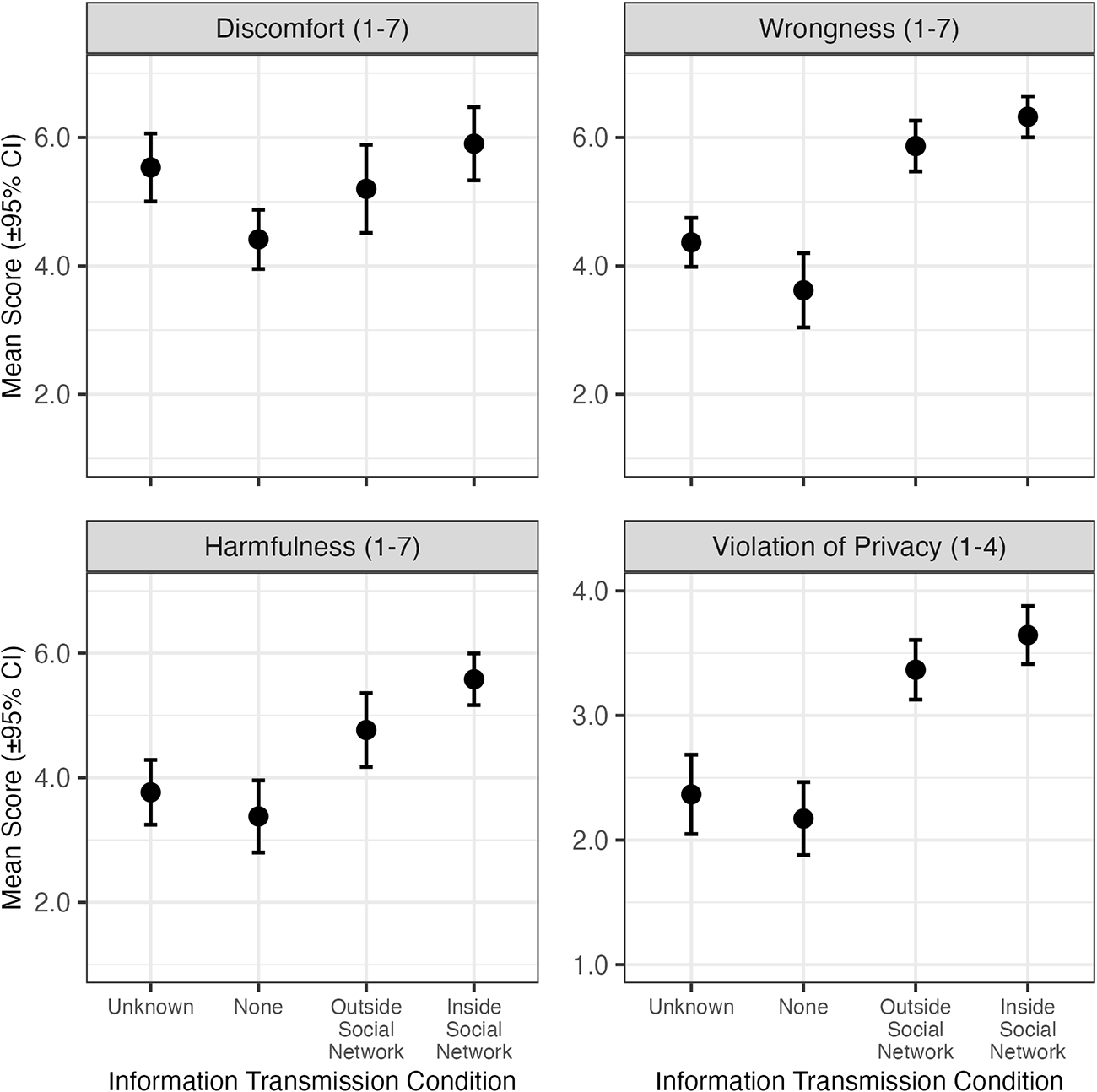
It is possible these results are due to a ceiling effect (see Figure 3). As such, and because of the ordinal nature of the data, we also conducted Wilcoxon rank-sum tests with continuity correction to evaluate the differences between conditions. Results failed to indicate significant differences for Discomfort (p = .067), Wrongness (p = .089), and Violation of Privacy (p = .054) ratings, though did for significant differences for Harmfulness ratings (p = .039).
Results of Study 2: evaluative judgements of discomfort, wrongness, harmfulness, and violation of privacy across information transmission conditions.

Figure 3 Long description
The image A showing a point and error bar plot titled Discomfort (1-7). The vertical axis label is Mean Score plus or minus CI. The horizontal axis label is Information Transmission Condition. The horizontal axis categories are Unknown, None, Outside Social Network, Inside Social Network. The plotted mean scores are approximately: Unknown about 5.2, None about 4.4, Outside Social Network about 5.0, Inside Social Network about 5.6. Each point has a vertical error bar. The image B showing a point and error bar plot titled Wrongness (1-7). The vertical axis label is Mean Score plus or minus CI. The horizontal axis label is Information Transmission Condition. The horizontal axis categories are Unknown, None, Outside Social Network, Inside Social Network. The plotted mean scores are approximately: Unknown about 4.4, None about 3.6, Outside Social Network about 5.9, Inside Social Network about 6.2. Each point has a vertical error bar. The image C showing a point and error bar plot titled Harmfulness (1-7). The vertical axis label is Mean Score plus or minus CI. The horizontal axis label is Information Transmission Condition. The horizontal axis categories are Unknown, None, Outside Social Network, Inside Social Network. The plotted mean scores are approximately: Unknown about 3.8, None about 3.5, Outside Social Network about 4.5, Inside Social Network about 5.5. Each point has a vertical error bar. The image D showing a point and error bar plot titled Violation of Privacy (1-4). The vertical axis label is Mean Score plus or minus CI. The horizontal axis label is Information Transmission Condition. The horizontal axis categories are Unknown, None, Outside Social Network, Inside Social Network. The plotted mean scores are approximately: Unknown about 2.4, None about 2.2, Outside Social Network about 3.4, Inside Social Network about 3.7. Each point has a vertical error bar.
Further testing was also done to evaluate differences between the None and Unknown conditions. Planned comparisons were conducted using linear models with custom contrasts. Results showed a significant contrast for the Discomfort (b = .56, SE = 0.21, t(116) = 2.70, p = .008) and Wrongness (b = .37, SE = 0.15, t(116) = 2.41, p = .018) dependent measures. Harmfulness and Violation of privacy both failed to reach significance. Wilcoxon rank-sum tests with continuity correction followed this pattern, with significant differences for Discomfort (p = 3.80 × 10⁻³) and Wrongness (p = .026) but not Harmfulness or Violation of Privacy.
5. Discussion
In contemporary behavioural literature, privacy is often theorized in terms of the sensitivity of information (Gerber et al., Reference Gerber, Gerber and Volkamer2018; Schwartz & Solove, Reference Schwartz and Solove2011). Although this is undoubtedly important to privacy-related psychology, an evolutionary perspective suggests other reliable features of human interaction may be equally important. While reflecting the judgements of a limited online sample of U.S. residents, our findings indicate three distinct features of an information transfer event – the way in which information is acquired, the extent of transmission, and an individual’s position in the event – influence judgements concerning privacy and perceptions of wrongness, harm, and discomfort.
As predicted, how information was acquired strongly predicted participants’ evaluative judgements. Vignettes in which the acquirer actively and intentionally obtained information were evaluated as significantly more wrong, harmful, uncomfortable, and a greater violation of privacy than those in which information was unintentionally obtained or disclosed consensually by Person A – consistent with the unwelcome acquisition of information being considered a transgression. These results suggest participants classify violations of privacy as moral violations. Accordingly, judgements of privacy may conform with other observed trends for moral judgement, including patterns in judgements of permissibility, fault, causality, and responsibility (e.g., see Leslie et al., Reference Leslie, Knobe and Cohen2006).
Notably, though the contrasts were smaller, differences persisted even without an intentional transgression: participants consistently rated vignettes where Person B unintentionally overheard information as significantly more uncomfortable, harmful, wrong, and a greater violation of privacy than those in which Person A volunteered information to Person B.
Where information went once acquired also had a strong influence on evaluative judgements. Across both studies, participants rated transmission to a third party as significantly more harmful, uncomfortable, wrong, and a greater violation of privacy than conditions in which there was no transmission to a third party. Additionally, unsanctioned transmission predicted privacy judgements even when initial disclosure was voluntary. These results support the proposal that individuals have implicit, unstated assumptions about how, when, and to whom information will be transmitted after the initial point of acquisition. This is exactly what would be expected if privacy judgements are shaped by a psychology that evolved to minimize the costs associated with information dissemination, as each additional person adds risk both of direct negative consequences and of further transmission.
We hypothesized that participants would use an individual’s location in shared social networks as a proxy for the potential costs of information dissemination. While results in a within-subjects design provided strong support for this hypothesis, the between-subjects design provided only marginal support. Study 2 results trended in the predicted direction, though often failed to reach high levels of significance. It is possible that this was due to a ceiling effect, as mean scores for both conditions were clustered around the tail end of the ordinal scale. The most significant difference across the third-party recipient conditions in Study 2 was observed in the harmfulness measure. The stronger results of Study 1 may indicate these differences have more salience when placed in direct comparison. Overall, we interpret these results as demonstrating that transmission to a third party who shares social connections with the first party was regarded as more harmful than transmission to a socially unconnected third party, and as suggesting similar patterns for other privacy-related judgements. More research is needed to fully illuminate this effect.
The effect of variation in the Position condition is also consistent with a broader understanding of evolved information-management psychology. Participants asked to imagine themselves as Person A evaluated vignettes as more harmful, more uncomfortable, and more wrong than those adopting the perspective of Person B or C. While the observed effect of variation in Position was weaker than the effects of the other two independent variables (Information Transmission and Manner of Acquisition), this pattern is nevertheless consistent with the diverging interests between the initial possessor of information and those who might benefit from its acquisition and dissemination. It remains to be explored why the effect of variation in Position conditions failed to reach significance for the Violation of Privacy measure.
Interestingly, ratings of wrongness and discomfort were higher across both studies when future transmission was unspecified (the Unknown condition) than when it was explicitly ruled out. While not a predicted result, this may signify that, lacking additional information with which to evaluate risk, participants followed an error-management strategy, inferring some risk of further transmission.
5.1. Limitations and future work
The present study has notable limitations and, as such, should be considered preliminary. First, we utilized hypothetical situations requiring participants to adopt another’s perspective; hence, responses may differ from behaviour in analogous real-world situations. Minor variations exist between vignette conditions in Study 1, such as the implication that the focal individual has a spouse in some conditions. Additionally, due to the nature of the manipulations, some vignettes are longer than others. Though these variations were produced for logical cohesion, they may constitute minor confounds. Although we believe it is unlikely that this affected the core results of the study, further work is needed to entirely rule out this possibility.
Our vignettes employed medical information in an effort to enhance plausibility and avoid implications of moral wrongdoing. While we think it unlikely that employing an equally ecologically valid and morally neutral type of information would produce substantially different results, we cannot rule out this possibility. More generally, it is unsurprising that medical information is considered private in our study population, as this category of information would have held adaptive significance throughout much of human history. In many environments, information about an individual’s health, including physical injury or illness, has substantial importance in a variety of fitness-relevant social domains, including the selection of mates (Stephen & Luoto, Reference Stephen and Luoto2023), models from whom to learn (Henrich & Broesch, Reference Henrich and Broesch2011), and cooperative partners (Krupp et al., Reference Krupp, DeBruine and Jones2011). Therefore, while the present study does not test how the valence or details of this information affects privacy judgements, this type of information, more broadly, is likely to be a salient locus of individuals’ efforts to regulate information acquisition and transmission in many cultures.
More broadly, while the predictions addressed in the current study derive from a consideration of postulated panhuman psychological mechanisms, cultural evolution is certainly a key force shaping concepts of privacy. Because all humans are members of a culture-dependent species, any given participant’s judgements regarding privacy necessarily reflect the combined effects of biologically evolved psychological mechanisms and culturally evolved ideas. Our sample and vignettes are specific to an English-speaking, North American cultural context; hence, we are unable to differentiate the relative contributions of these two factors to participants’ judgements from these studies alone. Future work must therefore be conducted across disparate cultures to best understand notions of privacy as the product of these two forces. Such cross-cultural research will afford testing hypotheses regarding a variety of functional configurations potentially produced by cultural evolution; below, we consider some possibilities.
5.1.1. Interdependence, group size, and mobility
Extrapolating from the core logic of our model, we suggest a number of ways in which cultures may systematically vary. First, the more that, in multiple domains, the individual’s welfare is tied to that of the group, the lower the conflict between the interests of information-holders and the interests of would-be information-acquirers within the group. We can therefore expect concepts of privacy and related norms to be more socially expansive in cultures in which people are highly dependent on one another, i.e., individuals will be more willing to share personal information with group members, and group members will feel more entitled to acquire and disseminate such information within the group.
Largely separate from issues of interdependence, the intersection of group size and both physical and social mobility may shape the degree of conflict between the interests of information holders and the interests of would-be information acquirers. In small groups with low physical and social mobility, the actions of one individual can impact a large percentage of those around them, and this can occur even when cooperation levels are relatively low. This increases third parties’ stake in acquiring information about a given individual, as such information can inform interventions to preclude or punish disruptive behaviour. This likely results in contests and conflicts between the individual who seeks to avoid prying eyes and their neighbours who, both figuratively and literally, peer over the fence.
Interdependence, group size, and mobility are some of the more prominent factors likely to play a role in the cultural evolution of privacy concepts, norms, and practices. However, neither this list nor our conjectures concerning it are exhaustive, as we expect that a functionalist evolutionary approach to privacy will prove a productive source of testable hypotheses concerning similarities and differences in privacy across cultures.
5.1.2. Digital privacy
We end this paper where we began, namely with the matter of privacy-related judgements and behaviours in the digital age. While we did not explicitly test predictions about digital privacy, we believe the present work provides an invaluable foundation upon which to understand issues of privacy online. In seeking to explain behaviours and sentiments online, an evolutionary approach asks scholars to first consider how people think, feel, and behave outside of such a radically novel environment. If perceptions of privacy are indeed shaped by evolved aspects of socio-informational cognition, then notions of digital privacy should reflect similar dynamics to those evident in in-person situations, including those demonstrated in this study. Fundamental to this proposal is the argument that, regardless of whether a user is interacting on- or offline, consistent in both settings is the human mind – a mind that does not change in its core structure when switching between these two environments.
Importantly, while the mind does not change across the digital/analogue divide, the cues and signals that it has evolved to detect in in-person situations do not map cleanly onto digital environments. In this sense, what Acquisti et al. (Reference Acquisti, Brandimarte and Hancock2022) refer to as the ‘privacy gap’, or the dichotomy between contemporary digital situations and those in the physical world, can be understood as an evolutionary mismatch between novel online environments and their analogue counterparts, a conceptualization that Shariff et al. (Reference Shariff, Green and Jettinghoff2021) similarly explored. Both sets of authors highlight how the cues that would have historically alerted someone to an increased likelihood of information acquisition – specifically, cues of the physical presence of others – are starkly limited, if not entirely absent, in digital environments. We concur, but add that the scope of a privacy evolutionary mismatch likely extends well beyond the ability to accurately gauge the likelihood of information acquisition occurring.
Our results suggest people may have implicit assumptions regarding how information spreads in social environments, assumptions that may be out of step with digital technology. These discrepancies are the locus of many possible hypotheses regarding privacy perceptions. For example, we postulate that evaluations regarding to whom information is likely to spread depend on assumptions regarding the size and structure of social networks and the likelihood of communication within and between those social networks. The environments created by modern communication technology present many opportunities for these expectations to be violated. Rather than flow through organic social networks, social media algorithms disregard expected paths of transmission by artificially biasing what content is shown to which users. Likewise, the speed of transmission is not constrained by the rate of contact within social networks, and the audience size has few upward boundaries. Furthermore, rather than being indexed in the minds of discrete individuals, information in the digital environment is highly searchable, including visual information and facial identification.
Features of individual agents within social networks are additional sites of contrast between digital and analogue information environments. Assessments of what information is likely to spread depend on assumptions regarding what information others are likely to pay attention to, remember, recall, and transmit. In-person interactions are characterized by the reliably fallible memories and limited attention of participants, who may only transmit information if it has some relevance to their life or the lives of those whom they know. In contrast, written information communicated between individuals via online messaging platforms, or the visual information acquired via photo sharing or security cameras, may exist indefinitely in its entirety. Hence, if concepts of privacy centre around the expected extent of information dissemination, the key to understanding the misalignment of digital privacy attitudes and online behaviours may lie in a better understanding of the ways in which the information environment created by digital technology radically diverges from evolutionarily longstanding regularities in the speed, accuracy, and direction in which information can travel. These are but a few of the ways in which a fuller understanding of biologically and culturally evolved information-management systems can illuminate the privacy challenges posed by the rapidly changing information environments of the 21st century.
Supplementary material
The supplementary material for this article can be found at https://doi.org/10.1017/ehs.2026.10051.
Acknowledgements
We thank Clark Barrett, Rick Dale, Grace Wang, and the other members of the UCLA XBA group for vital assistance and feedback.
Author contributions
SK conceived, designed, and ran the study; conducted analyses, and composed the primary draft of the manuscript. DF assisted in the formulation of hypotheses and study design, and contributed to the writing of the manuscript.
Financial support
This work was supported by the National Science Foundation Graduate Research Fellowship under Grant No. DGE-2034835 and the UCLA Gold Shield Faculty Prize; DF received support from the U.S. Air Force Office of Scientific Research under award no. FA9550-23-1-0694.
Competing interests
Authors declare none.
Research transparency and reproducibility interest
The data associated with this research are available at https://osf.io/c9emx/overview?view_only=1a31b5e0d1524526a0dba95584a3687a.


 Open access

