


1 Introduction
The COVID-19 outbreak, which started in early 2020, revealed many underlying social problems. Many enterprises and businessmen became less socially cooperative than they were before the pandemic. For example, 71% of manufacturing suppliers planned to withdraw from countries with severe epidemics at the time (Sohu.com, 2020), and several fruit and vegetable merchants took this opportunity to drive up prices and make huge profits (Tencent.com, 2021a). This raises a question: Do people pay more attention to personal interests than social interests, and become less cooperative in the loss domain (vs. the gain domain)?
Social dilemmas involving gain and loss contexts are commonly encountered in interactions between countries, enterprises, or individuals (Reference Fosgaard, Hansen and WengströmFosgaard et al., 2019; Reference Goerg, Rand and WalkowitzGoerg et al., 2020; Reference Ispano and SchwardmannIspano & Schwardmann, 2017), such as in the competition for oil resources, market investment, coping with an economic crisis, controlling epidemics, and avoiding bankruptcy. In a social dilemma, both parties must weigh personal interests and overall interests. If both parties cooperate, overall interests are maximized. If both sides choose to defect, overall interests are minimized. If one party cooperates and the other defects, the personal interest of the defector is maximized and the personal interest of the cooperator is minimized. The domains of gain and loss in a social dilemma can be graphically illustrated through the Prisoner’s Dilemma game (i.e., PD game; see Figure 1; Reference Aksoy and WeesieAksoy & Weesie, 2013).
The general structure and example of the PD game according to the gain and loss domains.

On the left side of Figure 1 (gain domain), each party receives three tokens as an initial participation fee. If both parties choose A (cooperation), the overall profit (beyond the participation fee) is four tokens, and each party gets two tokens. If both parties choose B (defection), the overall profit is two tokens, and each party gets one token. If one party chooses A and the other party chooses B, then the one who chooses B gets three tokens, but the one who chooses A gets no tokens.
On the right side of Figure 1 (loss domain, formed by subtracting a constant from all payoffs in the gain domain), each party receives three tokens as an initial participation fee (the same as in the gain domain). If both parties choose A (cooperation), the total loss is two tokens, and each party loses one token. If both parties choose B (defection), the total loss is four tokens, and each party loses two tokens. If one party chooses A and the other party chooses B, the one who chooses B loses no tokens, and the one who chooses A loses three tokens.
Some studies have compared the cooperative difference between gain-frame and loss-frame (Reference De Dreu and McCuskerDe Dreu & McCusker, 1997; Reference De Heus, Hoogervorst and Van Dijkde Heus, Hoogervorst & Van Dijk, 2010). For example, de Heus et al. (2010) divided the participants into two groups. In the gain-frame group, participants received no tokens as an initial participation fee, and in the loss-frame group, participants received three tokens as an initial participation fee. The participants engaged in the activity shown in Figure 1, in pairs. In their studies, the final payoff matrix, including the participation fee, was the same between the two groups. No difference in cooperation was found between the two groups. The effects of frame are not the focus of the present research. Here, the initial status-quo is the same for both domains (gain/loss), unlike studies of framing effects.
In our research, two groups receive the same initial fee. One group plays the gain game and the other group plays the loss game, as illustrated in Figure 1. The concepts of frames and domains reflect two different classifications of social dilemmas that are common in daily life (Reference Highhouse and PaeseHighhouse & Paese, 1996). The former involves how the presentation format (e.g., presenting the government’s propaganda or reporting methods in a positive frame vs. negative frame) affects cooperation. The latter involves how the actual consequences (e.g., a bad vs. good economic situation, or threat vs. opportunity) influences people’s cooperation (Reference KühbergerKühberger, 1998).
Although prior studies used the gain or loss domains of the PD game to explore cooperative human behaviors (Reference Li, Wang, Rao and LiLi et al., 2010; Rand & Nowk, 2013), they did not examine the domain effects that we examine here.
In a social dilemma, social motives and beliefs play important roles in an individual’s strategic choice (see the review by Reference Aksoy and WeesieAksoy & Weesie, 2013). Other studies imply that a change of domain (gain/loss) may affect people’s social motives, thus affecting the relative weight of their own interests and others’ interests (Reference Fiedler and HillenbrandFiedler & Hillenbrand, 2018). A change of domain may also change people’s expectations of their partner’s choice (Reference MartinangeliMartinangeli, 2017), and this change could affect their own cooperative behavior. Thus, we aimed to explore the relationship between domain and cooperation on the basis of social motives and beliefs (expectations).
1.1 Social motives
Social motives reflect individual preferences for the distribution of outcomes or interests between the self and others (Reference McClintockMcClintock, 1972; Reference Maccrimmon and MessickMaccrimmon & Messick, 1976). When a pro-self motive is aroused, people tend to pay more attention to self-related results or benefits and behave more selfishly. When a prosocial motive is aroused, people are more concerned about collective results or benefits and behave more altruistically and generously (Reference Murphy and AckermannMurphy & Ackermann, 2014; Reference Neel, Kenrick, White and NeubergNeel et al., 2016). Social motives are affected not only by individual differences, but also by environmental cues (Reference McClintock, Messick, Kuhlman and CamposMcClintock et al., 1973; Reference Poppe and ValkenbergPoppe & Valkenberg, 2003).
1.2 Gain-Loss domain and social motives
Studies showed that a change of domain influences an individual’s social motives as measured in a choice situation. Reference Poppe and ValkenbergPoppe and Valkenberg (2003) revealed that more participants chose the more self-interested and less altruistic option when placed in the loss domain as compared to the gain domain (e.g., choosing the option with –20 for the self and –50 for the other person more often than choosing +50 for the self and +20 for other person; choosing the option with –80 for the self and –50 for other person less often than choosing +50 for the self and +80 for other person). This result indicates that the loss (vs. gain) domain can enhance motivation toward self-interest and weakens altruism. Similarly, Fiedler and Hillenbrand (2018) observed that the allocation scheme of dictators (in a dictator game) was more pro-self when placed in the loss domain than in the gain domain. By recording their visual fixations, Fiedler and Hillenbrand found that dictators focused more on their own interest and less on the receivers’ interest when placed in the loss domain than in the gain domain.
1.3 Social motives and cooperation
Social motives affects an individual’s cooperation in social dilemmas (Reference Bogaert, Boone and DeclerckBogaert et al., 2008; Reference Boun My, Lampach, Lefebvre and MagnaniBoun My et al., 2018). A meta-analysis of 82 studies (Reference Balliet, Parks and JoiremanBalliet et al., 2009) reports a medium effect size of social motives and cooperation (r=.30). Individuals tend to be less cooperative under pro-self motives than under prosocial motives. Since social motive influences personal and social interests as well as the judgment criteria in decision-making (Reference SimpsonSimpson, 2004), individuals with pro-self motives pay more attention to their own interests and use self-interested rationality as the basis for judgment. In the social dilemma matrix (see Figure 1), choosing defection increases the probability of maximizing self-interest and decreases the risk of minimizing self-interest. Individuals with a high degree of prosocial motives pay more attention to the interests of both parties and use collective rationality as the basis for judgment. The resulting matrix indicates that choosing cooperation increases the possibility of maximizing collective interests and decreases the risk of minimizing collective interests. This finding has received considerable empirical support (Reference Fiedler and HillenbrandFiedler et al., 2013; Reference Utz, Ouwerkerk and Van LangeUtz et al., 2004). Therefore, we predict that being placed in the loss domain may increase individuals’ self-interested motive and weaken their altruistic motive, leading to decreased cooperation in social dilemmas.
1.4 Belief
Belief reflects an individual’s prediction or expectation of how others are likely to behave (Reference Fischbacher and GächterFischbacher & Gächter, 2010). In social dilemmas the final results are jointly influenced by the choices of both parties. Therefore, individuals often speculate their partner’s possible choice before making their own choices. Studies have shown that beliefs are affected by environmental cues and social motives (Reference Bogaert, Boone and DeclerckBogaert et al., 2008; Reference Charness, Rigotti and RustichiniCharness et al., 2016). People may want to reciprocate the choices of the other player.
1.5 Gain-loss domain and belief
Although there is a lack of direct evidence, some studies indirectly suggest that a change of domain may affect individual beliefs about others’ behaviors. Being placed in a more negative domain in a social dilemma makes individuals tend to perceive their partner as less cooperative. For instance, Charness et al. (2016) found that in the PD game, participants believed their partner to be less cooperative when the payoff was low than when the payoff was high. Similarly, Martinangeli (2017) observed that the participants with a low initial participation fee guessed that their partners would choose the less cooperative option than those who received a higher initial participation fee. Thus, we expect that individuals may have a stronger belief that their partner would choose to defect when placed under the loss domain as opposed to the gain domain.
1.6 Social motive and belief
Individuals often predict other’s social motives based on their own social motives. Prior studies showed that individuals with a particular social value orientation expect others to have the same orientation more frequently than having another orientation (Reference Bogaert, Boone and DeclerckBogaert, Boone & Declerck, 2008; Reference Kelley and StahelskiKelley & Stahelski, 1970). Smeesters et al (2003) pointed out that individuals with pro-self motives expect all other parties to act purely out of self-interest and that they would cooperate less than those with prosocial motives, who expect that at least some parties will value mutual cooperation.
1.7 Belief and cooperation
Belief affects individuals’ decisions in social dilemmas (Reference Aksoy and WeesieAksoy & Weesie, 2013; 2014). Holding different expectations about other’s behaviors often leads to different strategic choices. If individuals believe that their partners have a high probability of cooperating, they may choose to cooperate; otherwise, they may choose defection (Reference Charness, Rigotti and RustichiniCharness et al., 2007). Charness (2016) analyzed the relationship between belief in the behavior of others and cooperative behavior in the PD game, and found that the two are highly correlated. Thus, we expect that a change in domain may directly influence an individual’s belief about their partner’s behavior. Additionally, this effect may indirectly influence their belief by changing their social motives, ultimately affecting their cooperative behavior.
Based on the above analysis, we hypothesize:
H1:
Individuals would be less cooperative under the loss domain than under the gain domain.
H2:
Individuals’ social motives and beliefs differ according to the domain, thus, influencing cooperation. The loss domain (vs. gain domain) enhances individuals’ pro-self motives, weakens their prosocial motives, and strengthens their belief that their partners would defect, leading them to be less cooperative in social dilemmas.
In addition, factors such as the payoff amount of the PD game (Reference Charness, Rigotti and RustichiniCharness et al., 2007), cooperation index (R-P)/(T-S) (see Figure 1; Reference RapoportRapoport, 1967), domain comparisons (Reference De Dreu, Lualhati and McCuskerDe Dreu et al., 1994), and loss aversion (Reference Raub and SnijdersRaub & Snijders, 1997), which may affect the relationship between domain and cooperation, were taken into consideration in the current research.
In Study 1, we adopted a within-subject design, explored the difference in cooperation between the gain and loss social dilemmas, and tested whether this difference was moderated by the payoff amount and cooperation index. The results showed that the participants were less cooperation in the loss domain than in the gain domain, and this stable difference was not moderated by the payoff amount and cooperation index.
In Study 2, we adopted a between-subject design to rule out the possibility that the cooperative difference between the loss domain and gain domain was derived because of domain comparison due to the within-subject design. We still found a difference in cooperation between the gain domain and the loss domain, ruling out this possibility.
In Study 3, we measured participants’ social motives, beliefs, and personal loss aversion during the gain and loss PD games. The results illustrated that social motives and beliefs can explain the effect of domain on cooperation.
Based on calculations, 237 participants (power = 0.95; tails: two) were needed for the formal Studies 1, 3, and 264 participants for the formal Study 2 (power = 0.95; tails: two) following the pilot test (N= 100; paired McNemar analysis, effect size: φ=0.413).
2 Study 1
Using a within-subjects design, Study 1 explored how the gain/loss domain affected participants’ cooperative behaviors in social dilemmas, and whether such an effect was moderated by the payoff amount and the index of cooperation.
2.1 Method
2.1.1 Participants
Based on the calculated sample size above, we collected 237 valid participants (132 females, M age=29.10, SD=7.90) from Sojump (http://www.Wjx.cn), an online platform similar to Mechanical Turk or Qualtrics, which is used to launch nationwide e-surveys in China and is widely employed in behavioral and psychological studies.
2.1.2 Design and Procedure
We used an online PD game to measure participants’ cooperative behaviors. Participants received ¥40 basic participation fee. They participated in pairs and completed eight games. The system matched two participants randomly and anonymously. Individuals in each pair could not communicate with their partners and had to choose between A (cooperation) and B (defection) separately. After the experiment, the system randomly selected one game, calculated each participant’s experimental payment based on both players’ choices, and this was added to or subtracted from the basic participation fee.
Taking the top-left game in Figure 2 as an example, the red number represents the participant’s own profit, and the blue number represents their partner’s profit. If both chose A, each would obtain ¥12. If one participant chose A and their partner chose B, then the participant would obtain ¥4 and their partner would obtain ¥16. If the participant chose B and their partner chose A, then the participant would obtain ¥16 and their partner ¥4. If both chose B, each would obtain ¥8.
PD Games (Study 1). The red number represents the participant’s profit, while the blue number represents their partner’s profit.

Prior to the formal experiment, we presented one sample and one practice game, and a six-item test on game rule comprehension to check whether the participants understood the game and the payment system. The participants who did not pass these tests were marked as invalid. See Supplementary Material A for the original materials.
The formal task included four pairs of PD games (Figure 2). Each pair included a gain-version PD game and a corresponding loss-version of the game. Comparing the results of each pair under these two domains, we can test the cooperative difference between the gain and loss domains. For Pairs 1 to 3, the index of cooperation ((R−P)/(T−S)=1/3) was the same, but the payoff amount increased for every ¥10. By comparing these pairs, we can test the moderating effect of the payoff amount. In Pairs 1 and 4, for example, the amount of payoff was similar, but the cooperation index is different (Pair 1= 1/3, Pair 4=2/3). By comparing Pair 1 with Pair 4, we can test the moderating effect of the cooperation index. These games were presented randomly (the coefficient of internal consistency of these games was α =.86). Finally, we recorded the participants’ gender, age, and the amount paid.
2.2 Results
2.2.1 How is cooperation different between the gain and loss domains?
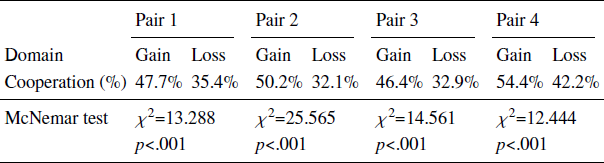
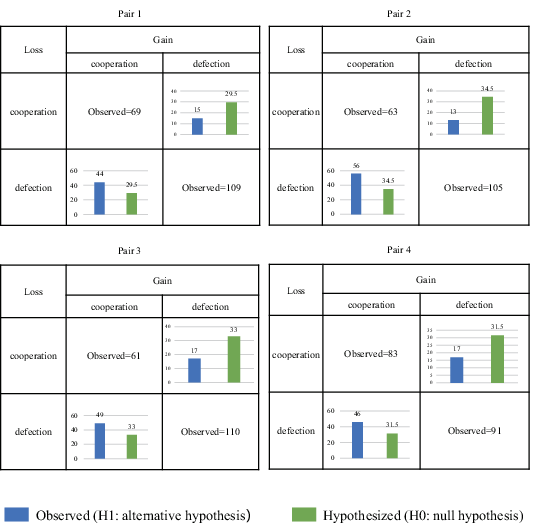
The paired-samples McNemar test showed that the participants were more cooperative in the gain domain (M=49.68%) than in the loss domain (M=35.65%) (ps<.01; Table 1). The proportion of participants choosing defection in both the gain and loss domains was 43.78%, and the proportion choosing cooperation in both the gain and loss domains was 29.11%. More importantly, the proportion of cooperation in the gain domain and defection in the loss domain (20.57%) was 2.54 times higher than that of defection in the gain domain and cooperation in the loss domain (6.54%) (95% CIs > 1; Table 2 and Figure 3).

Observed (H1: alternative hypothesis) and hypothesized (H0: null hypothesis) frequencies of which participants chose to either cooperate or defect under the gain and loss domains (Study 1).
2.2.2 Are the gain-loss cooperation differences moderated by the payoff amount?
To test whether payoff amounts moderated differences in cooperation, we conducted binary logistic regression (0=defection, 1=cooperation) with cooperation as the dependent variable. In the first step, data regarding the domains (0=loss,1=gain) and payoff amounts (1=Pair 1, 2=Pair 2, 3=Pair 3) were analyzed. In the second step, data on the interaction between the domain and payoff amount was analyzed. The results showed that neither payoff amount as a main effect (β =0.040, Z=0.601, Wals=0.362, p=.548), nor the interaction between domain and payoff amount (β = –0.032, Z=–0.231, Wals=0.055, p=.814) was significant. The payoff amount has no detectable moderating effect.
2.2.3 Is the gain-loss cooperation difference moderated by the cooperation index?
To test whether the difference was moderated by the cooperation index, we conducted binary logistic regression with cooperation as the dependent variable. In the first step, data regarding the domain and cooperation index (0=Pair 1, 1=Pair 4) were analyzed; in the second step, the interaction between the domain and cooperation index was analyzed. The results showed that the cooperation index had a significant effect (β =–0.093, Z=–2.104, Wals=4.425, p=.035), whereas the interaction between domain and cooperation had no significant effect (β =0.005, Z=0.054, Wals=0.003, p=.957). Therefore, the cooperation index has no moderating effect.
In sum, we found a difference in cooperation between the gain and loss domain, and this difference was stable and did not change depending on the payoff amount and cooperation index.
3 Study 2
In Study 1, the cooperative difference between gain and loss domains may have been driven by the contrast of one game to the next, due to the within subjects design.Footnote 1 For example, playing a gain game may subsequently influence the choice of participants when placed in the loss domain due to domain comparison. In order to exclude this possibility, Study 2 adopted a between-subjects design, with one group playing a gain PD game and the other group playing a loss PD game. The difference in cooperation between the social dilemmas of gain and loss remained in this experiment.
3.1 Method
3.1.1 Participants
Based on the calculated sample size, 264 valid participants (159 females, M age=28.19, SD=7.10) participated in Study 2.
3.1.2 Design and Procedure
The procedure of Study 2 was similar to Study 1, except for two aspects:
-
1. In order to avoid participants from being influenced by the sample and practice games when making choices in the formal games, the payoff matrix in the sample and practice games were replaced by letters (X, Y, Z, W) (see Supplementary Material B).
-
2. The participants were randomly divided into two groups, and each group completed one game. Half of the participants completed a gain PD game (i.e., upper game in Pair 2, Figure 2), while the others completed a loss PD game (i.e., bottom game in Pair 2, Figure 2).
Finally, the system calculated each participant’s experimental payment based on their and their partner’s choices, and this was added to or subtracted from the basic participation fee.
3.2 Results
The results showed that the participants in the gain domain (M=58.3%, 77/132) were more cooperative than those in the loss domain (M=43.9%, 58/132), χ 2 (1, N = 264) = 5.47, p = .019, ϕ = 0.14. This suggests that the difference in cooperation between gain and loss domains is not the result of domain comparison.
4 Study 3
In Study 3, we explored the underlying mechanisms for the effect of domain on cooperation in social dilemmas. We measured participants’ social motives and beliefs before they made choices in the PD game. In addition, considering that personal loss aversion may affect participant’s cooperative behaviors in the gain and loss domain, we also measured participant’s loss aversion.
4.1 Method
4.1.1 Participants
A total of 237 valid participants (128 females, M age=28.65, SD=6.92) participated in Study 3.
4.1.2 Design and Procedure
We used the same within-subject PD games in Study 1 to measure participants’ cooperative behavior. Considering that the cooperative index did not affect the gain-loss cooperation difference, we deleted Pair 4 to simplify the task.
Prior to conducting the PD game, we measured participants’ social motives, beliefs, and personal loss aversion.
Social motives:
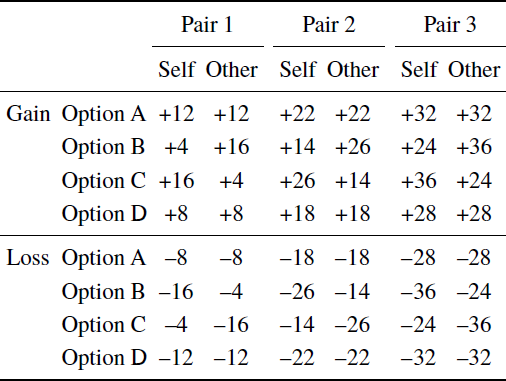
The participants completed a dictator task (including 6 games; see De Dreu & McCusker, 1997 for a similar method to measure social motives). As shown in Table 3, the participants were told that “You have the decision to allocate the payments (or losses) between you and your partner, choose among these four options.” The four options each represented different social motives (A: prosocial, B: pro-self, C: altruism, D: competitiveness) (α =.87).
Beliefs
: The participants were asked to predict their partner’s choice in the PD games (“Which option do you think your partner will choose?”) (α =.86).
Loss aversion:
We measured the participants’ personal loss aversion using the method of Reference Tversky and KahnemanTversky and Kahneman (1992). The participants indicated the least acceptable X, which would make them willing to change their choice from A to B (Item1: A. 50% lose 0 yuan, 50% gain 0 yuan; B. 50% lose 20 yuan, 50% gain X1 yuan; Item 2: A. 50% lose 20 yuan, 50% gain 50 yuan; B. 50% lose 50 yuan, 50% gain X2yuan).Footnote 2
The measuring order of these tasks was counterbalanced across participants. The participants indicated their choices in the PD games (α =.85), and were then thanked, debriefed, and paid. See Supplementary Material C for the original materials.
4.2 Results
4.2.1 Calculation of variables
Social motive:
we calculated the number of choosing pro-self optionFootnote 3 and the total number of the dictator games for each domain. Social motive was computed according to Equations (1). This index had a range between 0 and 1. A larger value indicates the stronger individualistic motive and less prosocial motive.

Belief:
We used the number of beliefs in partner’s defection and the total number of belief games for each domain. Belief was computed according to Equations (2). This index had a range between 0 and 1. A larger value indicates the stronger belief in their partner’s defection.

Loss aversion:
Based on prior study (Reference Tversky and KahnemanTversky & Kahneman, 1992), we calculated participant’s index of loss aversion according to Equation (3). The larger value indicates stronger personal loss aversion.

Cooperation:
We used the number of cooperation option choices and the total number of PD games for each domain. Cooperation was computed according to Equations (4). This index had a range between 0 and 1. A larger value indicates the more cooperative behaviors.

4.2.2 Cooperative difference
A paired-samples T test showed that the participants were less cooperative in the loss domain (M=34.32%, SD=0.41) than in the gain domain (M=46.13%, SD=42%; t(236) = –4.97, p < .001).
4.2.3 Social motive
A paired-samples T test showed that the participants had higher pro-self motives in the loss domain (M=63%, SD=42%) than in the gain domain (M=48%, SD=43%; t(236) = 6.43, p < .001).
4.2.4 Belief
A paired-samples T test showed that the participants believed that their partners were more likely to defect in the loss domain (M=64%, SD=41%) than in the gain domain (M=55%, SD=41%), t(236) = 4.07, p < .001, Cohen’s d = 0.53.
4.2.5 Loss aversion
To test whether the participants with stronger loss aversion would show
larger differences in gain-loss cooperation, we conducted an analysis of
variance with domain as the independent variable, the index of loss aversion
as a potential co-variate, and cooperation as the dependent variable. The
results showed no significant interaction between the domain and index of
loss aversion (F(1, 235) = 0.47, p
= .494,  < .01), suggesting
that the effect of domain on cooperation was not moderated by the
participant’s personal loss aversion.
< .01), suggesting
that the effect of domain on cooperation was not moderated by the
participant’s personal loss aversion.
4.2.6 Mediation analysis
A regression analyses and bootstrapping analyses (Hayes & Preacher, 2014) were conducted with the domain (0=gain domain, 1=loss domain) as the independent variable, social motive (0=prosocial, 1=pro-self) and belief (0=their partner would cooperate, 1=their partner would defect) as potential mediating variables, cooperation as the dependent variable. We tested three potential mediation paths:
Path 1: domain → social motive → cooperation;
Path 2: domain → belief → cooperation;
Path 3: domain → social motive → belief → cooperation.
The results (Figure 4) showed that the total effect of domain on cooperation was significant (coefficient –.14, p =.002, 95% CI[–.23, –.05]). After entering the mediating variables (social motive and belief), the indirect effects of domain on cooperation were significant (–.10, p <.01, 95% CI[–.16, –.05]), but the direct effect of domain on cooperation was not significant (–.04, p =.325, 95% CI[–.11, .04]). This suggests that the effect of domain on cooperation was explained by the two mediating variables.
Path analysis demonstrates that the cooperation difference between the gain and loss domains was driven by social motive and belief (Study 3). All path coefficients represent standardized regression weights. (*p<.05, **p<.01, ***p<.001.)
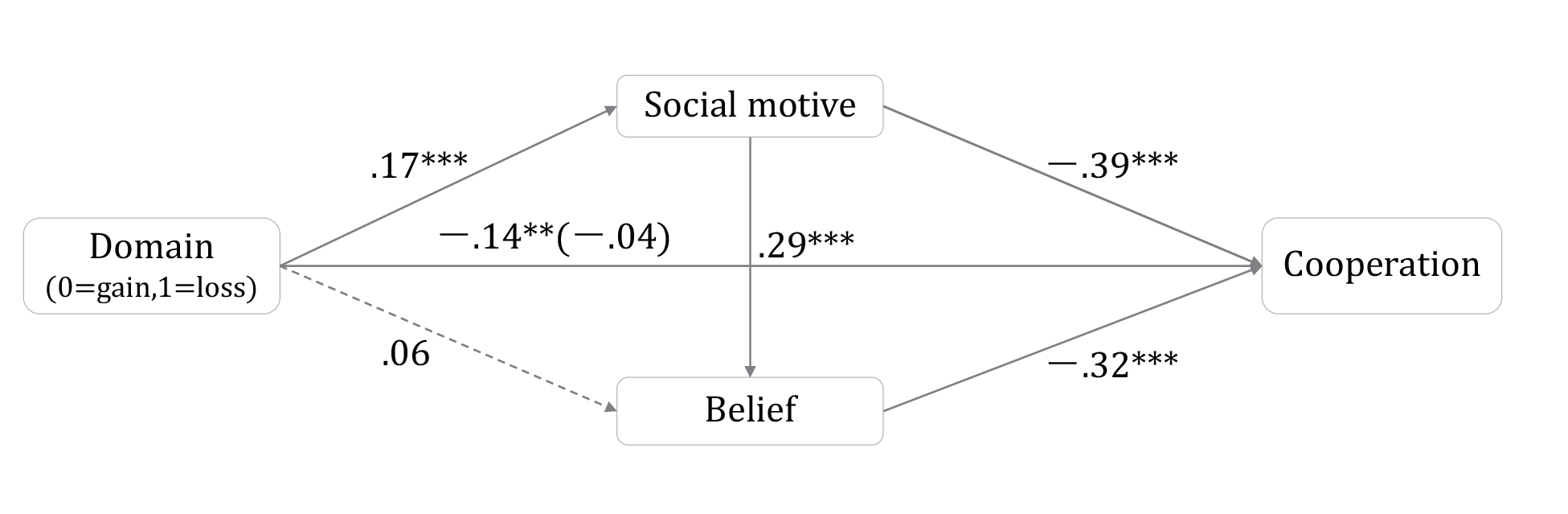
Next, we compared the three mediating paths. Paths 1 and 3 were supported (Path 1: –.07, 95% CI[–.11, –.03]; Path 3: –.02, 95% CI[–.03, –.01]). Path 2 was not supported (–.02, 95% CI[–.05, .01]). In Path 1, the loss (vs. gain) domain increased participants’ pro-self motives and decreased their prosocial motives (.17, 95% CI[.08, .26]), which led them cooperate less (–.39, 95% CI[–.47, –.32]). In Path 3, the loss (vs. gain) domain increased pro-self motive and decreased their prosocial motive (.17, 95% CI[.08, .26]). The change in their social motive strengthened their beliefs about others’ defection (.29, 95% CI[.01, .20]), thus, leading them to cooperate less (–.32, 95% CI[–.40, –.25]). This result suggests that domains don’t directly influence cooperation through beliefs, but indirectly affect cooperation through the following pathway: domain → social motive → belief → cooperation. Finally, we compared the mediating effect of Paths 1 and 3, and found that the effect of Path 1 was significantly greater than that of Path 3 (=–.05, 95% CI[–.09, –.02]).
Study 3 showed that the loss (vs. gain) domain affected participants’ social motive and belief, and then influenced their cooperative behaviors in social dilemmas.
5 Discussion
The current study explored the difference in cooperation between the gain domain and the loss domain in social dilemmas. The results showed that participants were less cooperative in the loss domain than in the gain domain, and this difference was stable, not relying on the payoff amount, cooperation index, domain comparison, and personal loss aversion. Social motives and belief explained this effect: Compared to the gain domain, participants in the loss domain aroused more pro-self motive and less prosocial motive, and had stronger beliefs that their partner would defect, which apparently led them cooperate less.
The current findings suggest that the effect of domain on cooperation may be different from that of framing. We found a stable phenomenon wherein individuals were less cooperative in the loss domain than in the gain domain, in contrast to Heus et al. (2010) and De Dreu and McCusker (1997), who found no difference between the gain frame and the loss frame.
To better illustrate this issue, we also conducted a study to compare the effect of domain and frame on cooperation.Footnote 4 The results showed that individuals were less cooperative in the loss domain than in the gain domain, whereas there was no significant difference in cooperation between the gain frame and the loss frame. The reason may be that in the comparison of the gain and loss frames, the effects of the initial status quo and the domain may offset each other. Previous studies suggested that the better the initial status quo (e.g., initial participation fee), the more people cooperate (Reference MartinangeliMartinangeli, 2017). Our findings revealed that the more negative the domain, the less people cooperate. The gain frame consisted of a “bad” initial status quo and a “good” domain, while the loss frame consisted of a “good” initial status quo and a “bad” domain. Therefore, the two effects may offset, minimizing the difference in cooperation between the gain and loss frames.
The present study reveals that domain influences cooperation by changing social motives and beliefs. In the loss domain (vs. gain domain), individuals had stronger pro-self motives, weaker prosocial motives, and a stronger belief that their partner would defect, and participants ultimately show less cooperation in social dilemmas. These results imply that the change of domain affects an individual’s motivation and beliefs, which in turn affect their strategic choices in social interactions.
Two aspects need to be pointed out: First, the comparison of the two mediating paths (Path 1: domain → social motive → cooperation; Path 3: domain → social motive → belief → cooperation) showed that the effect of Path 1 was significantly greater than that of Path 3. This difference suggests that social motive plays a more important role in explaining the effect of domain on cooperation. Second, the domain did not directly influence cooperation through beliefs, but indirectly affected cooperation through social motives. This results suggests that, when the domain changes, individuals may guess other’s motives and behaviors based on their own motives, which is consistent with the findings of Bogaert et al. (2008).
This study has some practical implications. In the current situation of the COVID-19 pandemic — wherein there are economic crises, epidemic outbreaks, and flood disasters — cooperation rate among countries, enterprises, and individuals may decrease, as compared to situations with good economic conditions and a safe environment. For example, in July 2021, there was a heavy rainstorm in Zhengzhou, China. At the end of a tunnel, three car owners stalled the exit in order to prevent their own vehicles from passing through the water. This caused other vehicles in the tunnel to be submerged by the rainstorm, resulting in many deaths (Tencent.com, 2021b). This distressing incident reflects that people, when placed in negative domains, may be more concerned about self-interest than social interest. Combined with the mediating mechanisms found in the study, in order to increase cooperation in some loss domains, governments, managers, and investors must take the appropriate measures to change people’s social motives (e.g., strengthening social norms, Forquesato, 2016; changing information focus, Reference Kwak and HuettelKwak & Huettel, 2018) or beliefs (e.g., expressing the intent to cooperate with your partner, Schroeder et al., 2019; using time pressure, Reference Cone and RandCone & Rand, 2014).
6 Conclusion
Being placed under a loss domain (vs. gain domain) decreases individuals’ cooperative behaviors in social dilemmas because it strengthens individuals’ pro-self motive, weakens their prosocial motive, and increases their belief that their partner would defect.


 Open access

