




According to a large epidemiological study based on data from the national network for congenital heart disease (CHD), the incidence of CHD in Germany nowadays amounts to 1%. Reference Schwedler, Lindinger and Lange1 Due to progress made in the fields of early diagnostics, surgical techniques, and follow-up, the percentage of patients reaching adulthood has constantly risen over the last few decades and is now over 90%. Reference Warnes, Liberthson and Danielson2–Reference Müller, Amberger and Berg4 With higher life expectancy, new aims develop that go far beyond reaching adulthood and move focus on lifestyle and quality of life. One key aspect contributing to the improvement of quality of life in these patients is their physical well-being and fitness. Reference Hager and Hess5,Reference Amedro, Picot and Moniotte6
Multiple studies have shown a reduced cardiopulmonary exercise capacity amongst patients with CHD. Reference Kempny, Dimopoulos and Uebing3,Reference Rhodes, Curran and Camil7–Reference Ten Harkel and Takken11 This phenomenon can in part be traced back to consequences of the cardiac defect itself or its surgical or medical therapy, for example valve stenosis or insufficiencies, Reference Kempny, Dimopoulos and Uebing3 stenosis of vessels as in coarctation of the aorta or Tetralogy of Fallot, Reference Takken, Giardini and Reybrouck12 multiple thoracotomies, Reference Hawkins, Taylor, Sillau, Mitchell and Rausch13 or chronotropic incompetence under medical beta-blockade Reference Buber and Rhodes14 or following Fontan procedure. Reference Ohuchi15 However, a lack of physical activity amongst these patients has also been identified as part of the reason for their reduced cardiopulmonary exercise capacity. Reference Takken, Giardini and Reybrouck12,Reference Buys, Budts, Delecluse and Vanhees16–Reference Buys, Budts, Delecluse and Vanhees18
In the past, the approach towards physical activity of patients with CHD amongst paediatric cardiologists and parents has been rather restrictive. Reference Pinto, Marino and Wernovsky19,Reference Bar-Mor, Bar-Tal, Krulik and Zeevi20 With improved life expectancy and a better understanding of the benefits of physical activity in these patients, a shift towards the promotion of physical fitness can be seen in current guidelines. Reference Takken, Giardini and Reybrouck12,Reference Nishimura, Otto and Bonow21
In order to ensure a safe implementation of physical activity into patient’s lifestyle, regular evaluation of their current physical capacity is essential. Various studies emphasise the importance of objective evaluation methods, such as cardiopulmonary exercise testing using a treadmill or bicycle protocol, which provide a non-invasive method to unveil risk factors and affect the timing of therapeutic consequences. Reference Kempny, Dimopoulos and Uebing3,Reference Nishimura, Otto and Bonow21
The necessity of objective testing methods also results from possible misinterpretations that could generate from assessing fitness solely through patient’s report. Some studies have shown a correlation between self-estimated and objectively assessed exercise capacity, however, with a tendency of subjective estimations outmatching objective results. Reference Hager and Hess5,Reference Chen, Su and Wang22–Reference Gratz, Hess and Hager24
However, it is unclear if the problem of overestimation of physical fitness observed in existing literature concerns the population of patients with CHD as a whole, as the accuracy of self-estimated physical fitness has, to our knowledge, rarely been examined for subgroups of patients with CHD.
This study aims to examine the accuracy of self-estimated exercise capacity compared to objective assessments by cardiopulmonary exercise testing in patients with CHD. Furthermore, a possible impact of severity of cardiac defects as well of patient’s gender on the accuracy of self-estimated exercise capacity will be evaluated.
Materials and methods
Study design and study population
We conducted a single centre, cross-sectional study with retrospective analysis on children and adults with CHD who underwent cardiopulmonary exercise testing at the German Heart Institute Berlin between March, 2014 and November, 2015. Data of 604 consecutive cardiopulmonary exercise tests were collected as part of our patient’s regular checkup, out of which 382 patients aged from 8 to 68 years, with CHD, given consent, completed questionnaire prior to testing and reaching formal criteria of exhaustion during exercise testing were included in this study.
Patients were grouped according to their diagnosis and complexity of their cardiac defect, as explicitly stated under results, along with the demographic data of each group.
For all patients enrolled in this study informed consent was obtained. The study was reviewed and approved by the Charité Universitätsmedizin Berlin Ethics Committee (entry number EA2/106/14).
Exercise testing protocol
We used a continuous ramp bicycle protocol adapted to the standards of the American Heart Association. Reference Nishimura, Otto and Bonow21 The test started with 2 minutes of rest followed by 2 minutes of minimally loaded pedaling (<6 watts), after which the incremental phase of exercise, adapted to an individual load maximum estimated for each patient, lasted over 8–12 minutes until reaching formal criteria of exhaustion. Finally, the test ended after another 3 minutes of unloaded cycling. Objective criteria of reaching peak oxygen uptake at full exhaustion used were: maximal heart rate of at least 85% of expected values (220/minute – age), or heart rate of at least 180/minute regardless of age, and respiratory exchange ratio (calculated as ratio of carbon dioxide exhaled to oxygen uptake per unite time) of at least 1.0. Reference Cooper, Purdy, White, Pollock and Linnerud25–Reference Takken, Blank and Hulzebos27
We calculated peak oxygen uptake in relation to body weight as well as percentage of expected values using age and gender specific formulas. For adult patients, formulas by Cooper and Storer were used. Reference Cooper and Storer28 For patients aged 17 and younger, expected values were calculated using formulas by Cooper and Weiler-Ravell. Reference Cooper and Weiler-Ravell29 Our study population was then grouped according to percentage of expected peak oxygen uptake, labelling exercise capacity of oxygen uptake less than 50% of expected peak values as strongly reduced, between 50 and 65% as reduced, between 65 and 85% as slightly reduced, and above 85% as normal, in adaption to existing guidelines. Reference Nishimura, Otto and Bonow21
Questionnaire
Our questionnaire was based on epidemiologic studies conducted by Robert Koch Institute on health status of German general public. Reference Krug, Jordan and Mensink30,Reference Manz, Schlack and Poethko-Muller31 Two versions of the questionnaire were provided, one for children up to 11 years and one for older patients, differing only in the wording, either addressing the parents or the patients themselves. One item specifically developed for this study asked “How would you judge your physical exercise capacity?”, with possible answers very good, good, moderate, bad, and very bad. The questionnaires were filled out prior to exercise testing on the same day.
Statistics
Statistics were calculated on SPSS Version 22.0 (SPSS Inc., Chicago, IL, USA) using non-parametric testing. In all analysis at least one variable was not in normal distribution, therefore non-parametric tests were used. Distribution was analysed using histograms and Kolmogorov-Smirnov tests. Differences between two groups were verified by Mann–Whitney U-test. For more than two groups the Kuskal–Wallis test was applied.
Correlations were calculated as partial rank-correlations. Since this procedure is not provided by SPSS 22.0 by default, a workaround provided by IBM was used. 32
All tests were calculated two-sidedly. Results were viewed as statistically significant with p-values lower than 0.05. This level of significance was determined in advance.
Results
Patient’s demographics and categorisation of cardiac defects
382 patients with an age median of 27 years (range 8–68 years) were in included in our analysis, out of which 196 (51.3%) were male, 186 (48.7%) female.
Patients were grouped according to their cardiac defect. Each group was then classified as either complex or non-complex cardiac defects, see Table 1. The category of complex heart defects combined patients with morphological right systemic ventricle, univentricular heart, Ebstein anomaly as well as patients with uncorrected cyanotic heart defects, who could not be allocated to any other group. In the category of non-complex heart defects all patients have a biventricular anatomy with a morphologically left systemic ventricle. This partly resembled the classification system used in the PAN study of the German Competence Network for Congenital Heart Defects. Reference Schwedler, Lindinger and Lange1
Classification of congenital heart defects (CHDs).

AS = aortic stenosis, ASO = arterial switch operation, AVSD = atrioventricular septal defect, ccTGA = congenitally corrected TGA, CoA = coarctation of the aorta, PS = pulmonary stenosis, TGA = transposition of great arteries, ToF = Tetralogy of Fallot, VSD = ventricular septal defect
Cardiopulmonary exercise capacity
Cardiopulmonary exercise capacity was determined by peak oxygen uptake in relation to bodyweight. Taking into account the whole group of 382 patients, peak oxygen uptake was 25.5 ± 7.9 ml/minute/kg, which corresponds to 75.1 ± 18.8% of age- and sex-specific reference values (data is provided as mean and standard deviation). Lowest values were found in patients with Fontan circulation, with an average peak oxygen uptake of 60.0 ± 2.7% of reference values, see Table 2. In the combined group of complex defects, peak oxygen uptake was 67.4 ± 1.7% and significantly lower compared to the group of non-complex defects with peak oxygen uptake of 78.1 ± 1.1% (U-test(n1 = 107; n2 = 275): z = −5.089; p < 0.001).
Peak oxygen uptake (VO2peak) in ml/minute/kg and as percentage of calculated reference values.
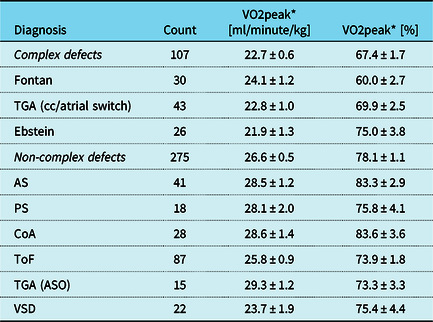
AS = aortic stenosis, ASO = arterial switch operation, ccTGA = congenitally corrected TGA, CoA = coarctation of the aorta, PS= pulmonary stenosis, TGA= transposition of great arteries, ToF = Tetralogy of Fallot, VSD = ventricular septal defect
* Data is provided as mean and standard-deviation
Patient’s self-estimated exercise capacity
In total, 382 patients rated their subjective exercise capacity according to our questionnaire, assigning it to one of five levels as stated in Table 3. In total, 31% of patients with complex cardiac defects and 43% of patients with non-complex cardiac defects rated their exercise capacity as good or very good. About 40% found their exercise capacity to be moderate, as well in patients with complex as in non-complex defects. Overall, 29% of patients with complex and 19% of patients with non-complex defects rated their exercise capacity as bad or very bad.
Count, sex, age, peak oxygen uptake (VO2peak, in ml/minute/kg as well as percentage of calculated reference values), divided by subjective evaluation of own exercise capacity; p calculated using Kuskal–Wallis test for metric variables.
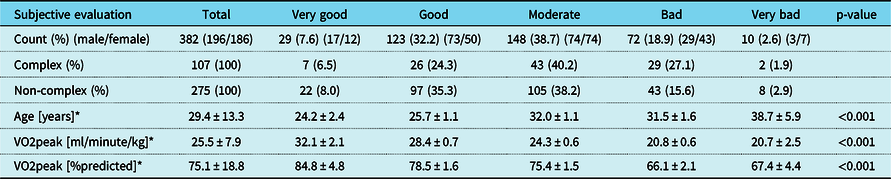
* Data is provided as mean and standard-deviation
Comparison of self-estimated and objectively assessed exercise capacity
There were significant differences in peak oxygen uptake in percent of estimated values between the groups (Kuskal–Wallis test: χ2(n = 382) = 31.425; df = 4; p < 0.001). Higher values were seen in patients with higher subjective rating of exercise capacity. However, oxygen uptake in patients rating their exercise capacity as good (mean VO2peak 78.5 ± 1.6%) or very good (mean VO2peak 84.8 ± 4.8%) was on average still reduced compared to normal.
For further analysis, patients were divided according to their diagnosis into the group of complex cardiac defects and non-complex cardiac defects. Figure 1 provides a comparison between complex and non-complex cardiac defects divided by their subjective rating of exercise capacity, with regard to their peak oxygen uptake. It shows a tendency of higher values of peak oxygen uptake with higher subjective ratings of exercise capacity, also reflecting a difference between complex and non-complex cardiac defects.
Peak oxygen uptake as percentage of calculated reference values and subjective rating of exercise capacity, divided by complex versus non-complex cardiac defects; data is provided as median and quartile (25–75) distribution.

Further, we checked for correlations between peak oxygen uptake and self-estimated physical fitness. In patients with non-complex cardiac defects, we saw a significant correlation (partial spearman-rho controlled for age and sex: −0.368, p < 0.001). In patients with complex cardiac defects, no correlation was found (partial spearman-rho controlled for age and sex: −0.183, p = 0.062).
In a similar type of analysis, we abolished the separation into complex and non-complex defects and split our group of patients into males and females instead. For females as well as for males, we saw significant correlations between peak oxygen uptake and self-estimated physical fitness (partial spearman-rho, controlled for age and complexity of cardiac defects, female: −0.315, p < 0.001; male: −0.318, p < 0.001).
Discussion
Cardiopulmonary exercise capacity in CHD
The majority of patients with CHD today reach adulthood, a development mainly achieved by improvements in congenital heart surgery and long-term follow-up in paediatric cardiology. Reference Warnes, Liberthson and Danielson2–Reference Müller, Amberger and Berg4 With higher life expectancy, focus shifts towards patients lifestyle and quality of life, with patient’s physical fitness taking a crucial role. Reference Hager and Hess5,Reference Amedro, Picot and Moniotte6 Cardiopulmonary exercise testing plays an important part in routine checkups in patients with CHD. Reference Kempny, Dimopoulos and Uebing3,Reference Nishimura, Otto and Bonow21 Peak oxygen uptake is regarded as the best indicator of cardiopulmonary function in children and adults. Reference Takken, Blank and Hulzebos27
In our group of 382 patients, cardiopulmonary exercise capacity represented by peak oxygen uptake was reduced at 25.5 ± 7.9 ml/minute/kg correspondent to 75.1 ± 18.8% of age and sex-specific reference values. Reduced peak oxygen uptake in patients with CHD has previously been described by various studies. Reference Kempny, Dimopoulos and Uebing3,Reference Rhodes, Curran and Camil7–Reference Ten Harkel and Takken11
We could see that in patients with complex cardiac defects, peak oxygen uptake as percentage of reference values was significantly lower than in the group of non-complex defects. There were also differences between the groups separated by diagnosis, in which peak oxygen uptake showed a similar distribution as in the study by Kempny et al, with lowest values seen in patients with Fontan circulation. Reference Kempny, Dimopoulos and Uebing3
Self-estimated exercise capacity
Comparable to existing literature, exercise capacity determined by peak oxygen uptake is reduced in our group of patients with CHD. Our next step was to examine if this reduction of objectively determined exercise capacity could also reliably be estimated by patient’s subjective impression of their own physical fitness.
After division of our study population into groups in regard to their subjective rating, we observed significant differences in peak oxygen uptake between the different groups. Peak oxygen uptake tended to be higher on average in groups with higher subjective rating, as we would also expect in a normal population. This tendency was also seen in regard to peak oxygen uptake as percentage of age- and sex-specific reference values and can therefore not solely be traced back to a higher age level in groups of lower self-rated exercise capacity. Interpreting the association between subjective and objective evaluation of exercise capacity, it should be noted that peak oxygen uptake was reduced, even amongst patients perceiving their exercise capacity as good or very good. These findings correspond to results from other studies that showed a tendency towards overestimation of own exercise capacity in patients with CHD. Reference Hager and Hess5,Reference Chen, Su and Wang22–Reference Gratz, Hess and Hager24 A study by Chen et al showed higher self-perceived physical condition in patients with CHD, even when compared to a healthy control group. Reference Chen, Chen, Beckstead, Kennel and Evans23
This might have a negative impact on patient’s willingness to exercise, as patients being accustomed to their reduced exercise capacity might not see any call for action.
Accuracy of self-estimated exercise capacity in regard to complexity of CHD
Most of the studies that show a tendency of overestimation of physical fitness refer to the population of patients with CHD as a whole. The main aim of this study was to examine a possible impact of severity of cardiac defects as well of patient’s gender on the accuracy of self-estimated exercise capacity.
While we could see a significant correlation between self-estimated and objectively assessed exercise capacity in patients with non-complex cardiac defects, no correlation was found in patients with complex cardiac defects. No difference was found in female versus male patients.
One possible explanation for the observed overestimation could be that limitations and linked precautions have often followed through the patient’s whole life. Therefore, physical capacity meets the patient’s own standards and is not perceived as reduced. Reference Hager and Hess5 As reduction of exercise capacity is highest in patients with complex cardiac defects, Reference Kempny, Dimopoulos and Uebing3 these patients might also be especially accustomed to their circumstances, including to their level of physical fitness. This would suggest that due to a high level of adaption, the mismatch between self-estimated and objectively assessed exercise capacity is most prominent in patients with complex CHD.
Another explanation might result from the assumption that a sedentary lifestyle seen in patients with CHD would be more dominant in patients with complex defects. Based on this assumption, it could be argued that patients with mild defects tend to be more physically active and might therefore be more familiar with their physical abilities and limitations, while patients with complex defects might have less experience in being physically active to judge from. However, this assumed difference of physical activity in regard to the complexity of underlying cardiac defects could not be found in existing literature. Reference Muller, Hess and Hager33,Reference Voss, Duncombe, Dean, de Souza and Harris34
Another aspect contributing to the mismatch between self-estimated and objectively assessed exercise capacity might become apparent from a psychological perspective. Patients with CHD show high prevalence of depressive symptoms and lower self-esteem, both affected by disease severity. Reference So, Li and Ho35,Reference O’Donovan, Painter, Lowe, Robinson and Broadbent36 This might also partly account for the misperception of physical abilities amongst these patients, since depressive symptoms have been associated with an altered self-concept. Reference O’Donovan, Painter, Lowe, Robinson and Broadbent36 Another interesting finding in this context is that sport participation was found to be independently associated with reduced depressive symptoms in patients with CHD. Reference Ko, White and Kovacs37 The study by Ko et al concluded that sport programs uniquely designed for patients with CHD may improve depression status in these patients. Reference Ko, White and Kovacs37 These findings suggest that the high prevalence of depressive symptoms in patients with CHD might be connected to the inaccurate self-estimation of exercise capacity in these patients. Thus, specialised sport programs could improve both self-perception in terms of physical abilities as well as depressive symptoms. Moreover, such programs could provide a possibility to get motivated and accustomed to physical activity in a safe and controlled environment. Another benefit is feedback experiencing the body’s response to training as well as from comparison with peers that, with a weekly training interval, is way more frequent than cardiopulmonary exercise testing performed in routine checkups usually every 6 to 12 months. A training program specialised in patients with CHD has already been introduced at German Heart Centres in Berlin and other locations. Reference Dirks38,Reference Hager39
Considering an increasing prevalence of severe CHD as seen in a large demographic study by Pfitzer et al, Reference Pfitzer, Helm and Ferentzi40 capacities for cardiopulmonary exercise testing might have to be adapted in the future.
Conclusions
The mismatch between self-estimated and objectively assessed exercise capacity is most prominent in patients with complex CHD.
Subjective self-evaluation can contribute to but not replace objective assessments, as many patients tend to overestimate their own exercise capacity. It can still provide valuable information, as declines of perceived exercise capacity can be noticed during their everyday lives, directly and independently of checkup intervals and can speed up necessary diagnostics.
Our findings support the key role of cardiopulmonary exercise testing in evaluating physical fitness, especially in patients with complex cardiac defects.
Limitations
One difficulty resulted from our inhomogeneous study population, especially present in evaluating exercise capacity. In order to make peak oxygen consumption comparable between patients of different characteristics, it is commonly not only stated in millilitre per minute and kilogram, but also as a percentage of age- and sex-specific reference values. The formulas available for calculating these reference values stem from relatively small studies performed on healthy subjects Reference Cooper and Storer28,Reference Cooper and Weiler-Ravell29,Reference Jones, Makrides, Hitchcock, Chypchar and McCartney41,Reference Bruce, Kusumi and Hosmer42 Most studies included only very few subjects in middle childhood or approaching retirement age, if any. Therefore, anthropometric margins were not represented and could only be extrapolated from existing data. Reference Dubowy, Baden, Bernitzki and Peters43 Due to various age groups, reference values had to be calculated using multiple formulas, which might strictly speaking still not fully account for the wide range of age (8–68 years) in this study. Reference values derived from one large study including all age groups and both sexes are needed. A study of this kind was performed by Dubowy et al, however, only for treadmill testing, not covering tests performed on also commonly used bicycle ergometers. Reference Dubowy, Baden, Bernitzki and Peters43
Further research on the subject, including the impact of sports intervention programs on patient’s subjective experience of physical fitness, is necessary.
Acknowledgments
Our thanks goes to the patients and their families for providing their data for our research.
Financial support
This research received no specific grant from any funding agency, commercial, or not-for-profit sectors.
Conflicts of interest
None.
Ethical standards
The authors assert that all procedures contributing to this work comply with the ethical standards of the relevant national guidelines on human experimentation (Deutsche Forschungsgemeinschaft, 2019. Guidelines for Safeguarding Good Research Practice. Code of Conduct. http://doi.org/10.5281/zenodo.3923602) and with the Helsinki Declaration of 1975, as revised in 2008, and has been approved by the institutional committees (Charité Universitätsmedizin Berlin Ethics Committee).


 Open access

