

1. Introduction
Geographical location has become the basis for interactions between people and politicians (Agnew, Reference Agnew2014). In modern representative democracy, lawmakers are elected to represent the interests of regional voters residing within certain geographical boundaries. This implies that voters face systematically different socioeconomic outcomes, depending on their political representation.
Korea is famous for its politics based on regionalism. Since an authoritarian government took office in the 1960s under President Park Chung-hee, the confrontations between Gyeongsang-do (Yeongnam) and Jeolla-do (Honam), referred to as the East–West conflicts, have been evident in various elections until the present day.Footnote 1 Clientelistic politics based on region, that is, regional favoritism by the ruling elites who seek to secure their political power and interests, is considered one main reason for this (Choi, Reference Choi and Koo1993; Horiuchi and Lee, Reference Horiuchi and Lee2008). Regions have been politically mobilized, and politicians have expediently adopted political strategies that use regional characteristics as a major resource for gaining political power and influence (Browne and Kim, Reference Browne and Kim2003).Footnote 2 Even after the election, politicians implemented regionally discriminatory policies, such as assigning many high-ranked governmental positions to people from specific regions or allocating government funds to specific areas in a lopsided manner (Kang and Bae, Reference Kang and Bae2018).
Under a long history of regional-based clientelistic politics, different political and economic interests have been established between Gyeongsang-do and Jeolla-do, and regional sentiments have also deepened. In elections, Yeongnam residents have supported conservative parties, while Honam residents have backed liberal parties, strengthening the local voting patterns; this phenomenon has persisted for half a century. Indeed, the support levels for the presidential elections in Yeongnam and Honam, from the seventh presidential election in 1971 to the nineteenth presidential election in 2017, show extreme disparities. This has been true not only for presidential elections but also for parliamentary elections. Scholars have noted a number of side effects from the regionalist politics that appeal to regional loyalty, symbols, and stereotypes (Kang, Reference Kang2000; Park, Reference Park2003). It is feared that regionalism across Korean society can negatively affect sustainable democracy (Cho, Reference Cho1998). Moreover, regional imbalances in resource allocation triggered by political regionalism are a major factor causing social division in Korean society.
In the midst of deep-rooted regional politics, a historic incident occurred in the 2014 parliamentary by-election. Lee Jung-hyun of the Saenuri conservative party was elected for the first time in Suncheon-si, Jeollanam-do, which is a stronghold of the liberal party. This was the first time that had happened in Jeollanam-do and the second time in Jeolla-do since the introduction of the local autonomy system in 1996.Footnote 3 The results of Lee Jung-hyun's previous elections had been disastrous, but he made history after three attempts. He was then re-elected in the same region in the 20th parliamentary election in 2016.Footnote 4 This can be seen as the result of economic voting in which voters responded to Lee's pledges to ‘save the local economy by securing more budget through an influential politician’ (Kang, Reference Kang2016). Lee Jung-hyun's election was considered to be an indicative event that could break down old-fashioned politics based on regional conflicts that have been deeply rooted and have caused harm to Korean society (Lee, Reference Lee2011). The media also praised him for his achievement.Footnote 5
This study systematically analyzes the changes that have occurred with Suncheon-si's budget, in which conservative party lawmakers were chosen, unlike other regions in the Honam area. While much literature has discussed intergovernmental budget transfers associated with a candidate's victory, this study narrows the focus to examining the budgetary effect of a conservative legislator's victory in a traditional opposition stronghold region. Further, it shows the counterfactual trajectory and infers one main channel of these results from economic voting theory, which can be a strong factor for overcoming parochial regionalism in Korea.
Among the various indicators of the local government, the reason for paying particular attention to the budget is that local government budgets are a good proxy for measuring the impact of economic voting on the community. From the perspective of local government in Korea where fiscal decentralization has not advanced, both the significance and influence of the budget supported by the central government are paramount. While local governments can secure their own resources through local taxes, their ability to do so is not huge.Footnote 6 The central government allocates funds to local governments through an intergovernmental transfer channel (Kim et al., Reference Kim, Lee and Park2000), by which the level of projects that are carried out independently depends on the size of the allocated budget. Therefore, securing funding from the central government is a very important issue for local governments. Indeed, one of Lee Jung-hyun's pledges during the election was to ask voters to make practical choices beyond ideological or regional sentiment, saying that he would bring a ‘budget bomb’ to Suncheon-si to help the community.
What if a significant change occurred in the local government's budget after Lee Jung-hyun's election in Suncheon-si? Such a change could be interpreted as having a positive influence on the welfare of local residents as well as the growth and survival of local governments, which are in danger because of a rapid decline in population. Thus, this study first presents empirical results on how voters' practical choices have actually caused changes in the local government budget. Moreover, the results of the study can serve as an opportunity to substantially assess the possibility of developing into a modern politics that can pursue the economic interests of local people, away from the outdated politics that appeal to local sentiments. Despite a growing amount of normative content and increasing research on the causes of regionalism in Korean political society and voting behavior (Choi, Reference Choi1999; Cho, Reference Cho2000; Kang, Reference Kang2003; Jang and Eom, Reference Jang and Eom2015), the empirical claims are not well established. In particular, there is a lack of empirical studies on how regionalism actually affects the local economy, and no studies have focused on financial factors. Given the impact of government funds on the local areas, research to complement the extant literature is significant. The study will be a good reference as the literature lacks empirical analysis from the fiscal perspective of regionalism.
This study also has advantages in terms of its empirical methodology. It examines budget changes in Suncheon-si through the synthetic control method (SCM), which is a strictly designed quantitative approach. Information on local government in the Honam area was collected from 2001 to 2019, and the SCM was applied to construct a synthetic control group that is most similar to Suncheon-si. Based on this framework, we examined what significant budgetary changes were made in this local district. The SCM has two advantages. First, the SCM can identify causal effects of a certain event by creating the control group that is most similar to the treatment unit based on observable characteristics. Second, we can conduct the counterfactual experiment by comparing the outcomes that would occur had Lee Jung-hyun not been elected. We also conduct various robustness checks including a placebo test and a difference-in-difference method on alternative variables to verify the credibility of the basic results.
While we focus on the political experience of a single country in a new democracy, our approach is widely applicable elsewhere in the world where representative democracy and regionalism coexist (Lee et al., Reference Lee, Min and Seo2018). The example of South Korea, in which the global debate over regionalism is popular, has beneficial lessons for academic researchers and the public, which can be referred to in countries that undergo similar situations, as regionalism is a common experience worldwide.
To summarize our main findings, the budget of Suncheon increased significantly after Lee Jung-hyun was elected as a member of the National Assembly, compared to other local governments in the Honam area with similar political terrain and social culture. The effect was sizable; that is, it was estimated at approximately KRW50 billion (US$50 millionFootnote 7) per year, or about 10 percent of the average budget during the analysis period. Various robustness experiments support the basic estimation outcomes. The results are meaningful in that they empirically exhibit how voters' practical choices that help the local economy through economic voting have led to actual benefits, and they provide implications for how we can overcome a parochial regionalism through rational choice.
The rest of this paper is organized as follows. Chapter 2 describes regionalism, economic voting, and local government budgets based on the literature reviews. Chapter 3 introduces the SCM and explains relevant variables. Chapter 4 shows the empirical results. Chapter 5 discusses policy implications. Chapter 6 concludes this paper.
2. Background
2.1 Regionalism in South Korea
Akerlof and Kranton (Reference Akerlof and Kranton2000) stress the importance of identity for individual decision-making and behavior, and region becomes a major component of one's individual and social identity. Cohen (Reference Cohen1986) argues that a common sense of experience in the same place can create a source of attachment to the place. In general, people feel closer to those living nearby than to those far away, as they interact more frequently and feel a sense of psychological homogeneity. This connectivity is amplified when the area is considered as a community of fate, with individuals' material interests and group well-being strongly intertwined based on the conditions and prospects of the local region (Cutler, Reference Cutler2007; Agnew, Reference Agnew2014). For prominent examples, in the context of deep-rooted regional consciousness, many residents in Catalunya and the Basque country of Spain vote for parties such as the Basque Nationalist Party or Together for Catalonia, and the same is true of the Bloc Québécois in Canada. In the context of South Korea, seminal literature has defined regionalism that focuses on the significance of location as a social, cultural, political, and economic identity, explaining that regional sentiments are politically mobilized and consolidated throughout the electoral cycles (Kang and Bae, Reference Kang and Bae2018). Such literature includes various viewpoints such as regional awareness and emotion (Kim, Reference Kim1997), spatial unification through shared membership (Kim, Reference Kim1995; Choi, Reference Choi1999), and collective consciousness beyond personal prejudices (Moon, Reference Moon2004). These can be integrated into the definition of ‘regional benefits of pursuing collective consciousness, together with the region including both the place of residence and birthplace’ (Jang and Eom, Reference Jang and Eom2015).
Place as an identity is effective in dividing people into different social groups. As a result, regional identities, which greatly affect individual's lives, are also widely adopted politically. For this reason, regionalism-based politics or regionalism-based elections can be understood in terms of territorial definition and mobilization of political and economic interests. In political geography, it is widely accepted that political activities and processes are deeply rooted in a place or locality. To name a few, Agnew (Reference Agnew2014) emphasizes that place is crucial in constructing our political life. He argues that it creates social relationships and interactions both on a personal and a socioeconomic scale, and it has a significant impact on the way in which people interpret and represent political and economic realities, bringing homogeneity and a sense of belonging with them. Cox (Reference Cox2008) notes that the region can be used for political purposes, as the territorialization of politics defends a specific place by including those who will enhance what it is in the territory that they want to defend.
In South Korea, regionalism typically means a confrontation between Yeongnam (Gyeongsang-do) and Honam (Jeolla-do). Figure 1 shows the Yeongnam and Honam areas on a full map of South Korea. Yeongnam, located in the east, consists of Busan, Daegu, Ulsan, Gyeongsangbuk-do, and Gyeongsangnam-do, while Honam, located in the west, consists of Gwangju, Jeollabuk-do, and Jeollanam-do. The confrontations between the two regions have their historical roots in Korean society (Kim, Reference Kim, Cho, Surendra and Cho2012). The historical origin of these regional conflicts can be traced back to the Three Kingdoms period (BC 18–AD 660), in which present-day Korea was divided into the three independent kingdoms of Goguryeo, Baekje (located in current Jeolla-do), and Silla (located in current Gyeongsang-do). Wang Geon, who founded Goryeo in 718 after the Three Kingdoms period, later announced the ‘Ten Injunctions (hun-yo-sib-jo)’ that discriminated against the Honam area.
Map of South Korea.

Over a long time period, regionalism has evolved into one of the most salient characteristics of Korean contemporary politics (Stockton and Heo, Reference Stockton and Heo2004; Moon, Reference Moon2005; Horiuchi and Lee, Reference Horiuchi and Lee2008; Kang, Reference Kang2013; Kang and Bae, Reference Kang and Bae2018; Lee and Repkine, Reference Lee and Repkine2020). Before democratization, the confrontation between democracy and authoritarianism led to the formation of regimental bloc voting between the Yeongnam and Honam areas. When the military dictatorship ended in 1987, candidates' regional backgrounds became a major component of voters' choice beyond the democratic–authoritarian structure. Voters felt closer to and chose candidates from their own birthplace since they felt solidarity with people from similar backgrounds and expected them to represent their interests. Since the 1987 election, ties between locals and political parties have been solidified, and competition between regional-based parties in Jeolla-do and Gyeongsang-do is considered the most prominent feature of South Korea's electoral politics (Lee and Brunn, Reference Lee and Brunn1996; Kwon, Reference Kwon2005, Reference Kwon2010). In the modern politics of Korea, connectedness among residents living in proximity to each other has developed into an enduring political cleavage.
In particular, elections in Korea have an ideological voting tendency based on ‘hero-centered politics’ and ‘party-centered politics.’ For several decades, Korean political parties have typically been imprinted with their leader's main characteristics, through whom they can appeal for support from voters through a common and shared locality. Political rivalry in the course of political transition such as those of Park Chung-hee and Kim Dae-jung during the 1970s and the ‘Three Kims’ after the June Democratic Struggle in 1987 is a typical example of the hero-centered politics that solidifies regionalism. In this way, Korean politics became regionally caesaristic (Morriss, Reference Morriss1996), through which the leaders of political parties could represent regional constituents. Moreover, defining regionalism-based voting as ‘a phenomenon in which voters mainly consider the candidate's birthplace or the birthplace of [the] affiliated party's leader, or, most comprehensively, where the candidate is represented by the party to which the candidate belongs,’ Kim (Reference Kim2004) and Moon (Reference Moon2004) explain that the voting behavior of regionalism, which is based on loyalty to a particular party leader, has changed to loyalty to a particular party. Regionalism was adopted as a means of securing the party's approval rating, and influential politicians of the party, who were considered heroes, strengthened the support and solidarity of the local people by linking their backgrounds, such as their hometowns, with the party's identity.Footnote 8 Thus, regional politics has been strengthened as party-oriented voting coupled with the expansion of the hero-centered election strategy (Moon, Reference Moon2009; Kang, Reference Kang2013; Jang and Eom, Reference Jang and Eom2015).
In general, regionalism in political sociology is considered negative because of the partiality and irrationality it leads to. Browne and Kim (Reference Browne and Kim2003) stress that regionalism often hinders modernization. Demolishing the structure that supports the surrounding society is interpreted as progress, and the obsession with local customs and loyalty is construed as nostalgia. In this sense, the continuation and revival of ‘regionalism’ in a country is seen as a source of retrograde action. It promotes nepotism and cronyism, impeding national unity, and undermining the requirements of the ‘modernism’ of economic efficiency and administrative neutrality.
The side effects of regionalism are nowhere as evident as in Korea. Regionalism, coupled with local sentiment (which is referred to as ji-yeok-gam-jeong), has exerted influential and tenaciously persistent power in Korean society. It not only promotes uneven distribution of economic and political resources but also affects the aspects of everyday life such as an individual's job opportunities and promotions, marriage prospects, and social relations. In addition, it has brought about decisions and confrontations based on irrational thinking, leading to social deformation and obstacles. Regionalism is generally thought to have a negative impact on society as well as to hinder social integration.
2.2 Economic voting
Elections in a representative democracy are a major source of accountability for politicians to citizens, and factors that affect voters' choices vary so that it is by no means simple to grasp the mechanism (Powell and Powell, Reference Powell and Powell2000). Many determinants affect the election decision, including a candidate's personal background and capacity as well as the institutional environment and economic situation. Among these, we note the role of economic voting as one main channel of electoral decision-making. Economic voting is a concept by which voters value economic benefits when evaluating and selecting candidates (Anderson, Reference Anderson2007). While many important issues may affect electoral competition, the influence of economic voting is getting stronger as economic gains have a significant impact on individual life and regional economic development (Singer, Reference Singer2011). Economic voting has been much studied in advanced democracies (Gomez and Wilson, Reference Gomez and Wilson2001), and the practice has recently been growing in new democracies (Hsieh et al., Reference Hsieh, Lacy and Niou1998; Tucker et al., Reference Tucker, Tucker and Martin2006; Lewis-Beck and Stegmaier, Reference Lewis-Beck and Stegmaier2008; Alcañiz and Hallig, Reference Alcañiz and Hellwig2011). It becomes more crucial when the judgment of economic perception mediates the relationship between the accountability of politicians and candidate voting behavior (Peffley, Reference Peffley1984).
Lee Jung-hyun's election in Suncheon-si serves as an interesting episode to pay attention to the role of economic voting. While his personal background, such as his hometown, was not much different from that of other candidates, Lee's election slogan made a special point by emphasizing the economic benefits to the local community, which were depicted as ‘budget bombs,’ and pledging that he would overcome regionalism through the local budget. Under these special circumstances, economic voting can become a strong determinant of voter choice and a key mechanism to break down regionalism.Footnote 9
Political science recognizes two kinds of regionalism leading to regional bloc voting, namely, birthplace-based regionalism and residence-based regionalism (Lee, Reference Lee1997, Reference Lee1998; Kang, Reference Kang2016). Under the principle of birthplace-based regionalism, support for local political parties is based on one's sociopsychological attachment to one's birthplace, which intensifies prejudices against other local regions (Lee, Reference Lee1998). In general, along with historical evidence and regional sentiments, birthplace-based regionalism is interpreted as prejudicial to people from the Jeolla area in Korea (Kim, Reference Kim1987). This psychological distance between the Gyeongsang and Jeolla regions was reinforced under the authoritarian regime during the 1970s, which promoted both political and economic discrimination based on birthplace (Kim, Reference Kim1995). This trend widened after democratization in 1987 when political support from residents in each local district became associated with specific political parties (Lee and Park, Reference Lee and Park2011). Birthplace-based regionalism is considered to be destructive of enhanced democratic accountability and to hinder any form of economic voting because the constituents' behaviors and decision-making processes are not based on the practical interests of the local areas (Choi, Reference Choi2002).
Politicians' attempts to win the election while promoting irrational regional sentiments can be seen as a result of birthplace-based voting and the side-effect of regionalism (Kang, Reference Kang2016). In particular, birthplace-based regionalism, coupled with ji-yeok-gam-jeong, has been a pathology in Korean politics that irrationally dominates all election types (Kim, Reference Kim, Cho, Surendra and Cho2012). It has led people to vote for a candidate simply based on regional identification, thus undermining national integration and provoking political cleavages among regions. A number of studies point out that birthplace-based regionalism is a sociopsychological prejudice fabricated by politicians who attempt to gain support by paralyzing rational political judgments, thereby hampering the adoption of economic voting in the political arena through which voters can choose the most competent candidates to help the community (Lee, Reference Lee1998; Kwon, Reference Kwon2004).
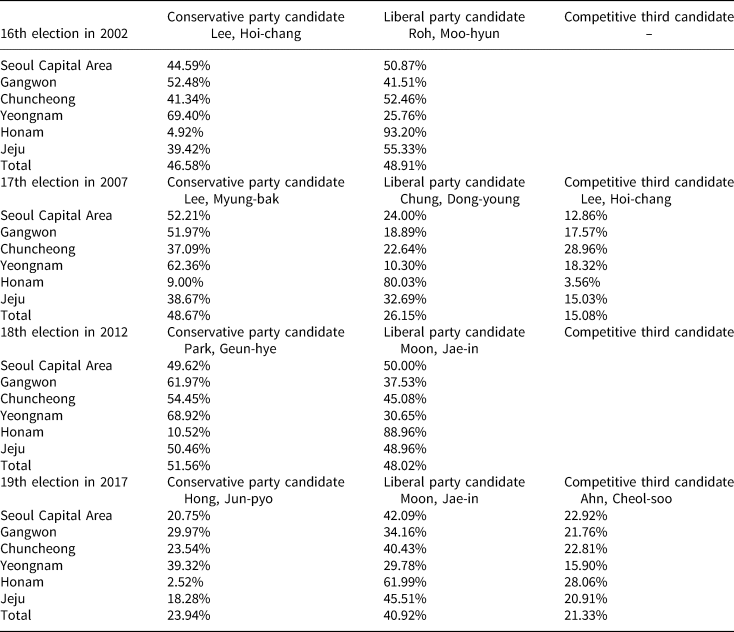
Birthplace-centered regionalism has taken root even in modern Korean society. In Korea's four presidential elections since 2000, conservative party candidates won overwhelmingly in the Yeongnam area, and liberal party candidates won in the Honam area. Table 1 shows the cross-regional results of presidential elections since 2000. Further, it demonstrates a stark difference in the support level in the Yeongnam and Honam areas. The Yeongnam–Honam confrontation is also evident in the local parliamentary elections. For instance, in Jeolla-do, only two conservative party candidates were elected in 2016: Jeonju-si, Jeollabuk-do, and Suncheon-si, Jeollanam-do.Footnote 10
Results of presidential elections across regions

In the face of rampant birthplace-based regionalism and the partisan voting that followed in the Korean election, Lee Jung-hyun was considered to be an unusual case as a conservative legislator in local liberal regions. This result is an exemplary case of economic voting and residence-based regionalism (Lee, Reference Lee2011; Kang, Reference Kang2016). He was elected as a parliamentary member in Suncheon-si, Jeollanam-do, in the 2014 by-election and re-elected in 2016 in the same region.Footnote 11 As a member of the Saenuri Party, he achieved something remarkable by being the first conservative party candidate to be elected in Jeollanam-do. Until then, no one from the same-affiliated party had won the election in these liberal party-dominated local districts. One of the main reasons for his victory may have been his pledge that he ‘[would] lead practical changes in the region through budget bombs.’ This is a case that emphasizes the economic voting of constituents and residents responding to his pledges, which differs from the previous elections in Korea. His promise to bring about government funds for the districts appealed to the residents, and if these commitments turned out to be true, the city might have had an opportunity to transform the local economy by drawing on more funding.
2.3 Role of budget for local government
The structure of the local government affects the representation of the interests of each region (Park, Reference Park2005; Hankla and Downs, Reference Hankla and Downs2010). In particular, how government authority is allocated between central and local governments can have a significant impact on the intensity and scale in which political and economic interests are defined and formed. For instance, a more decentralized government structure can promote more active territorial representation on a smaller local scale. Local governments have a greater degree of independence because they are not only more autonomous in spending and legislation but also less dependent on revenue from the central government. That is, local entities enhance the territorial rights and interests more aggressively at smaller and more local scales. On the other hand, in a more centralized state that places revenue and decision-making power on a central level, the territorial representations of smaller and more local interests are dampened even when a lack of power makes local governments aggressive. The form of the centralized national structure may limit the mobilization of the place-dependent interests at a local scale.
In South Korea, the central government has a considerable influence on local governments. Under the bureaucratic hierarchy, the central government plays a more directive role in regional economic development, and territorial interests are more likely to be mobilized through top-down regulations organized at a more centralized level. The spatial selectivity of the central government plays a crucial role in explaining the rise and fall of the local areas. As policies carried out by the central government result in an unequal distribution of resources across the region, people with local interests are likely to be organized around geographical connections.
The government budget is also heavily concentrated and dependent on the central government (Jung, Reference Jung2020a, Reference Jung2020b; Kim et al., Reference Kim, Lee and Park2020). Korea's total tax revenue comes from two main sources: national and local taxes. According to statistics from the Ministry of Economy and Finance, about 77 percent of all tax revenues in 2018 were national tax revenues, amounting to KRW293 trillion (US$293 billion). Each municipality has the authority to collect and use local taxes. Local taxes tend to be uneven across regions because the demographic and socioeconomic environments vary depending on the region, and the resources depend on its economic conditions.Footnote 12
One interesting fact about the Korean budgetary system is that there is a big difference in central and provincial shares in terms of revenue and expenditure. When it comes to revenue, the central government collects about 75–80 percent, while the local government collects only 20–25 percent of it. However, the central government spends 60–65 percent of the total budget, while local governments account for the remaining 35–40 percent of the budget. This gap is filled through intergovernmental transfers, the Local Finance Equalization Scheme, which mainly consists of local-share tax and national subsidy. Local governments use a large portion of the national tax revenue through these intergovernmental transfers, which suggests that much of local government spending is financed by the central government. This imbalance has become more pronounced since the introduction of the local autonomy system in the 1990s. Government policies and projects executed independently at the local government level are on the rise, but the central government still collects taxes and allocates revenues to local governments.
As the intergovernmental transfers are a crucial source of local government finance, legislators attempt to increase these funds when they seek to financially benefit their constituents. Niskanen (Reference Niskanen1971) explained the bureaucrats' budget maximization behaviors in terms of the potential for budgetary slack to serve bureaucratic self-interest, and Wildavsky (Reference Wildavsky1964) pointed out the interactions in the budget process between bureaucrats and politicians along with individual preferences. These classical theories suggest a possible interplay between regionalism and bureaucratic clientelism because highlighting regional identity can help to secure more funding through satisfying both politicians' re-election incentives and bureaucrats' career concerns. Indeed, it is common for local constituencies to form social connections with influential government and congressional members. For example, local governments seek to secure intergovernmental funds by using social capital, such as hometown connections, or by joining the National Assembly's Special Committee on Budget and Accounts. This is especially evident in the case of remote local areas, in which the autonomous revenue is not sufficient, so the intergovernmental transfer is more critical.
Among the changes in Suncheon where Lee Jung-hyun was elected, special attention should be paid to the budget because of its importance for local governments. Because of shrinking populations and declining competitiveness, local provinces are facing a risk of extinction. Various programs such as childbirth incentives, welfare projects for the elderly, and urban regeneration projects are necessary to revive the community. To perform these projects, the budget secured by the central government plays a significant role. In particular, with regard to the implementation of social and economic policies, the central government's control over local governments gives voters a strong incentive to use them as an opportunity to maximize the benefits expected through elections by considering the extent of the distributive benefits each candidate can bring to its region.
If the conservative party candidate is elected through economic voting in liberal party-dominated districts and contributes to the region's budget growth and regional development, it can be seen as a case of faithfulness to the original goal of government finance, which must pursue both efficiency and equity. In the case of Lee Jung-hyun, he appealed for support beyond regional sentiment, addressing the budget bombs as his campaign pledge. This study is meaningful in assessing how the results of economic voting have helped the region with respect to finance and deriving the implications of this for resolving regional conflicts.
3. Empirical strategy
3.1 Synthetic control method
It is important to accurately assess the causal effect of the election of conservative party lawmakers in the Honam area on the regional budget; the SCM is applied for this purpose. Following Abadie and Gardeazabal (Reference Abadie and Gardeazabal2003), the SCM has been widely applied to estimate the causal effect from the economic shock and policy treatment (Abadie et al., Reference Abadie, Diamond and Hainmueller2010; Borjas, Reference Borjas2017; Peri and Yasenov, Reference Peri and Yasenov2019), including in the Korean context when a single unit was exposed to the treatment (Kim and Lee, Reference Kim and Lee2019; Lee, Reference Lee2021).
The first thing we should consider when applying the SCM is to select the predictors of interest and form a synthetic control unit using the given information. The control unit should be similar to the treated unit, and the difference between them should be derived from the policy that is experienced only by the latter. A set of untreated units is referred to as a ‘donor pool,’ and the control synthetic group consists of several units from the donor pool. The weight is allocated to each unit to make the reproduction of the synthetic group as close as possible to the treated unit. In the context of the study, Suncheon-si experienced a unique situation whereby a conservative legislator was elected in a liberal local region, and his influence was limited to the constituency of Suncheon-si. The remaining regions, which were not affected by the intervention implemented in Suncheon-si, were composed of a donor pool that constructed the control synthetic group.
In a simple mathematical representation, suppose we have local districts i ∈ {1, 2, …, n}, where i ∈ {1} is the treated unit, i ∈ {2, …, n} are other local regions in the donor pool that potentially construct the synthetic control unit, and n implies each local district. The period is t, which spans t ∈ {1, …, T 0, …, T}. The event occurs in T 0, so the pre-intervention period is {1, …, T 0}, and the post-intervention period is {T 0 + 1, …, T}. Let y it be the outcome variable (here, budget-related variables), which is categorized as  $y_{it}^I $ for the outcome variable of i at t under intervention, and $y_{it}^N $ under no-intervention (the upper-case I implies the treated unit, and the upper-case N implies the untreated unit). Then, the policy effect of the treated unit can be represented as follows:
 $$\beta _{1t} = y_{1t}^I -y_{1t}^N \,{\rm for}\,\,t\in \{ {T_0 + 1, \;{\rm \;} \ldots , \;T} \} $$
 In the real world, only  $y_{1t}^I $ is observed, while $y_{1t}^N $ is not observed as it is the counterfactual for the treated unit in the post-intervention period.
The SCM helps to predict  $y_{1t}^N $ from the donor pool i ∈ {2, …, n} through a data-driven way. Let X 0 and X 1 be matrices of the pre-intervention traits as well as outcome variables for the donor pool and the treated unit, respectively. The difference between the treated unit and the synthetic control unit is described as X 1 − X 0W in a vector form, in which W is the vector of weight for each unit. W* is the vector of optimal weights that minimize ||X 1 − X 0W||, which is the distance of pre-intervention characteristics between the treated and control unit. The dynamic path from this optimal vector of weights reproduces a counterfactual, $y_{1t}^N $, of the treated unit.
The main idea of the SCM is similar to the difference-in-difference method that compares the treatment and control group (Angrist and Pischke, Reference Angrist and Pischke2008). However, while the difference-in-difference framework adopts the single or not-synthetized combined group as the controlled unit, the SCM applies a weighted average of individual observations in the donor pool that comprises the control group. The weights are selected to make the weighted average group more similar to the treated unit.Footnote 13 The advantage of the SCM is that more accurate causal identification is possible by weighting control groups, since the set of weights can achieve the best fit of the pre-intervention between the treated and control group. It is also useful in that the SCM enables us to conduct the counterfactual analysis, so we can compare how the effects of the real world are different from those of the virtual situation in which Lee Jung-hyun was not elected.
Moreover, the SCM is advantageous in that it makes less restrictive assumptions (Abadie et al., Reference Abadie, Diamond and Hainmueller2010). To identify the causal effect, it requires the following assumption: Only the treated unit is affected by the policy change, and the policy in the treated unit cannot affect the outcome of units in the donor pool. In the context of this study, the assumption is likely to hold. First, the effect of Lee Jung-hyun's election is not realized before his winning. Second, the jurisdiction of the elected lawmaker and local government is clearly defined, making influences of the lawmaker on the budget limited to the local district boundary and spillovers of the local government budget to other areas constrained.
Data and variable
The credibility of the SCM estimates relies on the quality of the pre-intervention fit across variables of attributes.Footnote 14 Abadie et al. (Reference Abadie, Diamond and Hainmueller2010) recommend that donor pool units should have similar pre-intervention attributes to the treated unit to improve the fit of pre-intervention and the internal validity to identify a clear causal inference.
Based on this recommendation, first, we restrict local districts to the Honam area (Jeolla-do), and the weighted average of a comparison group is constructed from this donor pool. If we include local districts outside Jeolla-do, other factors may confound the results because the affiliated party of the elected legislators in these regions, in contrast to Jeolla-do, has changed over time. Since the purpose of this study is to examine the budgetary effect of the economic voting that selects the conservative candidate in liberal local regions, restricting the donor pool to the Honam region in which shares a common political ideology of supporting the liberal party is advantageous in drawing causal relations because we can overcome the analytical limits that may arise from including areas outside Jeolla-do.
Next, as the unit of analysis, we mainly focus on the administrative district, which is the standard of intergovernmental transfers, and adjust it by considering the electoral constituency. In Korea, the local administrative districts are not exactly matched to electoral districts. For example, one local district may include multiple electoral districts in populated urban areas that lead to multiple representatives representing the same administrative district, while less populous local districts may share the same legislator even if the administrative districts are different (Kim et al., Reference Kim, Lee and Park2020). This mismatch between the administrative unit that receives intergovernmental transfers and the electoral unit that is represented in the National Assembly can confound the effect of lawmakers on the local government budget (Berry et al., Reference Berry, Barry and Howell2010). To alleviate these concerns, we exclude Gwangju-si and Jeonju-si in the basic regression framework, since these two cities have different characteristics from other regions because of urbanization, and another level of local district, ‘gu,’ exists. While Suncheon-si, which is our main subject of the analysis, does not have the local district ‘gu,’ it has two elected lawmakers. Thus, we include cities that have similar election rules, such as Iksan-si and Yeosu-si, in the donor pool. From this process, we have 35 units in the donor pool, 13 in Jeollabuk-do, and 22 in Jeollanam-do. Figure 2 illustrates a map of Jeolla-do, and regional names of local governments are indicated.Footnote 15
Map of Jeolla-do (Honam area).

Second, we collect and set up the length of the pre-treatment period, which is enough to fit the pre-intervention characteristics between the treated and synthetic control unit. On the basis of the data availability, we set 2001–2014 as the pre-treatment period, and 2015–2019 as the post-treatment period, since Lee Jung-hyun was first elected in 2014.
Third, we apply various characteristics of local districts as variables. To observe the effect on the government budget, the general accounting budget and the government-subsidized project budget by the level of local government are mainly adopted as outcome variables of interest.Footnote 16 For the predictor variables, the fiscal autonomy ratio (which is the total revenue of local government divided by the general accounting budget), total volume of local tax revenue, gross regional domestic product (GRDP) per capita, senior population ratio (age 65 or above), infant population ratio (age 5 or below), and female population ratio are used to account for the socio-demographic characteristics and economic status of each region (Jung, Reference Jung2020a, Reference Jung2020b). In addition, the pre-period yearly averages of the outcome variables are controlled in the covariates, and the variation of the average value is examined to check the robustness.Footnote 17
The data are extracted from the Statistics Korea website, the local finance integrated open system, and the national election database.
Table 2 shows descriptive statistics. Wide differences exist in demographic and economic characteristics between Suncheon and other regions in the same Honam area. If we restrict a comparative group to si (city), socioeconomic characteristics become more homogeneous. If we reflect on the characteristics of the urban area, Suncheon has a larger population and a lower senior population ratio than other regions. GRDP is high, but GRDP per capita is relatively low, which shows the influential impact of the population on the overall economy in these regions. Suncheon's average general accounting budget was KRW551.3 billion (US$551.3 million) during the entire period. If we distinguish between the periods before and after Lee Jung-hyun's election, the average value of each is KRW450 billion and KRW834.9 billion (US$834.9 million), respectively, indicating that the budget of local governments has increased significantly in recent years.
Descriptive statistics

Rest (si) is a group of local governments that only include si, such as Suncheon-si.
GRDP, GRDP per capita, and National Subsidy have been measured since 2008.
Senior population is 65 years or older, infant population is five years or younger, and the fiscal autonomy ratio is the total revenue of local government divided by the general accounting budget.
The unit of GRDP, general accounting budget, government-subsidized project budget, local tax revenue, and national subsidy is a hundred million KRW, and that of GRDP per capita is one million KRW. |KRW1,000 corresponds approximately to US$1
4. Estimation results
4.1 Main findings
Using two main outcome variables, the general accounting budget, as well as the government-subsidized project budget, we examine the budgetary effect of conservative legislator Lee Jung-hyun on the liberal local region of Suncheon-si. If there exist noticeable deviations between the treated unit and the synthetic control group after the election, the results demonstrate that the different choices of Suncheon's residents via economic voting yield different outcomes for the finances of their local government. The election occurred in 2014, so the effect on the budget would appear after 2015.
Figure 3 shows the impact of Lee Jung-hyun's election on Suncheon's general accounting budget. The black solid line shows the general accounting budget of actual Suncheon, while the dotted line shows the general accounting budget of synthetic Suncheon. Based on predictor variables, the synthetic Suncheon group is made up of other local districts that share similar characteristics: optimal weights given to Gunsan-si, Jeollabuk-do (35.6 percent); Wanju-gun, Jeollabuk-do (19.2 percent); Yeosu-si, Jeollanam-do (36.8 percent); and Muan-gun, Jeollanam-do (8.5 percent).
Regression result (1): general accounting budget. The unit of general accounting budget is a hundred million KRW.

This illustrates a sharp increase in Suncheon's general account budget since Lee Jung-hyun's election. From 2000 to 2014, before the election, the budget trend lines of actual Suncheon and synthetic Suncheon are similar to each other. This implies that the model is fitting and effective in reasoning causality. In particular, there is little difference between the two trend lines from 2010, which is close to the 2014 election. Thus, if there is a disparity between the two lines after 2014, the divergence in the budget can be attributed to Lee Jung-hyun's election.
The positive effect on the budget has been shown to last until 2020 when Lee Jung-hyun served as a lawmaker in this district. The average effect is about KRW50–100 billion (US$50–100 million) per year. It corresponds to 10–20 percent of Suncheon's KRW550 billion (US$550 million) budget during the analysis period. Considering that the construction cost of the grand bridge built in the southern coastal island area of South Korea was about KRW200 billion (US$200 million), the effect can be interpreted as attracting more than one large social overhead capital project during the four-year tenure.Footnote 18
Figure 4 shows the results when we limit the scope of the dependent variable to the government-subsidized project budget, which is directly supported by the central government. Since the focus is on the local government budget supported by the central government, it further highlights the link between Lee Jung-hyun's ‘budget bomb’ campaign pledge and the constituents' response to it through economic voting. Of the synthetic Suncheon group, optimal weights are given to Gunsan-si, Jeollabuk-do (40.5 percent); Gimje-si, Jeollabuk-do (1.9 percent); Mokpo-si, Jeollanam-do (17.1 percent); Yeosu-si, Jeollanam-do (14.6 percent); Gwangyang-si, Jeollanam-do (9.5 percent); and Muan-gun, Jeollanam-do (16.4 percent).
Regression result (2): government-subsidized project budget.
Note: The unit of government-subsidized project budget is hundred million KRW.

Figure 4 also clearly demonstrates a positive impact on the government-subsidized project budget of Suncheon since Lee Jung-hyun's election. The size of the effect accounts for a significant portion of the effect from the general accounting budget in Figure 3. Therefore, it can be inferred that the positive effect of Lee Jung-hyun's election on Suncheon's budget stems from the funding for subsidized projects secured from the central government.
4.2 Robustness tests
A battery of sensitivity analysis is conducted to support the credibility of the basic results. The results of the robustness tests can provide – a necessary condition for the original hypothesis – evidence to confirm that the results of the basic analysis stem from the main hypothesis of Lee Jung-hyun's election rather than from various alternative hypotheses.
First, we change the predictor variables to ensure that the sensitivity of the results does not depend on the selection of variables. Specifically, we perform the examination with only a single-year value without the use of the average value of an outcome variable so that it could be free from over-fitting issues (Kaul et al., Reference Kaul, Klößner, Pfeifer and Schieler2015). In this case, the synthetic group changed to 47.4 percent in Gunsan-si, Jeollabuk-do; 30.1 percent in Yeosu-si, Jeollanam-do; 2.5 percent in Gwangyang-si, Jeollanam-do; and 20 percent in Muan-gun, Jeollanam-do.
Figure 5 shows the results. Even when the predictors are alternatively changed, the two trend lines follow similar trends before the 2014 election, and a big gap in the budget can be seen since Lee Jung-hyun was elected in 2014.
Robustness test (1): changing predictor variables.
Note: The unit of general accounting budget is a hundred million KRW.

Second, we restrict the donor pool to 22 local districts in Jeollanam-do. In this case, the internal validity to infer causal linkage feasibility becomes higher because the synthetic unit is constructed from local areas with a political orientation, regional sentiment, and culture similar to Suncheon. The make-up of the synthetic Suncheon group is as follows: 63.5 percent in Yeosu-si, Jeollanam-do, and 36.5 percent in Gwangyang-si, Jeollanam-do. These two cities are in neighboring areas bordering Suncheon. Considering that residents of these regions share their living areas, the fact that the weighted vector chooses these two cities as the synthetic group further enhances the credibility of the model.
Figure 6 displays that Suncheon's budget increased after Lee Jung-hyun's election even when the donor pool is limited to Jeollanam-do. In particular, it should be noted that Suncheon's budget increased significantly compared to the neighboring areas of Yeosu and Gwangyang in that the meaningful effect appears only in the region where economic voting took place. Such an effect is not witnessed in the adjacent governments in the same living area.
Robustness test (2): donor pool restriction.
Note: The unit of general accounting budget is a hundred million KRW.

Third, the SCM is expanded to include not only Suncheon-si but also Gokseong-gun in the treatment unit. In the 2014 by-election in which Lee Jung-hyun was first elected as a member of the National Assembly, Gokseong-gun, as well as Suncheon-si, belonged to the same constituency. The constituencies were separated in the 2016 election. Therefore, Gokseong-gun was affected by Lee Jung-hyun's election from 2015 to 2016. Although Gokseong-gun has not been a constituency of Lee Jung-hyun since 2016, it may be under his influence because it had been his parliamentary district for two years. To this end, the multi-treatment effect is examined (Kreif et al., Reference Kreif, Grieve, Hangartner, Turner, Nikolova and Sutton2016; Galiani and Quistorff, Reference Galiani and Quistorff2017).
Figure 7 shows the results. The black solid line represents the adjust-combined general accounting budget of Suncheon and Gokseong, while the dotted line is the synthetic group. Using zero as the basis, the left side is the trend before Lee Jung-hyun's election, and the right side is the trend after the election. The trends of the two lines on the left side are similar, indicating that the model is fitting properly. On the right side, we can see that the effect is insignificant in the first year, which increases after two years. This shows that the effect of Lee Jung-hyun's election is more attributable to the influence of Suncheon.
Robustness test (3): multiple treatment units.
Note: The treated includes Suncheon and Gokseong.

Fourth, we conduct a permutation test assuming that each region in the donor pool is treated respectively. That is, we proceed as if 34 local districts other than Suncheon in the donor pool were affected by Lee Jung-hyun and iteratively estimate the budgetary effect by constructing a corresponding synthetic control group. It is also called the placebo test because it falsely assumes that each region other than Suncheon is considered to have Lee Jung-hyun as a lawmaker.
Figure 8 is the result of the placebo test. Each line represents the treatment effect, calculated as the gap between the effect of the synthetic unit and that of the local district. In the case of the black-dashed line, which marks Suncheon, the treatment effect was around zero before 2014, but the effect became remarkable after the influence of Lee Jung-hyun on the budget materialized. In the case of gray lines representing other regions, the absolute value of the effect is less significant than that of Suncheon and some of them are even greater than zero. The results of this permutation test add to the reliability of the analysis.
Robustness test (4): permutation test.
Note: The unit of treatment effect is a hundred million KRW. Black-dashed line is Suncheon, and gray lines are the placebo test of each region.

Fifth, a standard differences-in-differences estimation is applied, and we examine whether the results are similar to those of the SCM. According to the literature (Choi and Kim, Reference Choi and Kim2008; Hur and Kwon, Reference Hur and Kwon2009; Choi and Lee, Reference Choi and Lee2011; Hur and Kim, Reference Hur and Kim2017; Jung, Reference Jung2020a, Reference Jung2020b), the possible type of local government budgets that are affected by high-ranked officials includes not only the general accounting budget and government-subsidized project budget but also the national subsidy and special share tax. As the dataset of the national subsidy and special share tax has been collected since 2008, it is difficult to apply the SCM, which requires a longer period of data before the treatment. Thus, we use the difference-in-difference framework on these four categories of the local government budget. The design is as follows:
 $$Y_{it} = \beta _1{\rm Treate}{\rm d}_i + \beta _2{\rm Afte}{\rm r}_t + \beta _3( {{\rm Treate}{\rm d}_i \times {\rm Afte}{\rm r}_t} ) + X_{it} + {\rm \varepsilon }_{it}$$
where Treatedi is an indicator variable of whether the district i has Lee Jung-hyun as a member of the National Assembly, and Aftert is equal to 1 when t is 2015 and after, and 0 otherwise. Y it covers various types of budgets: the general accounting budget, government-subsidized project budget, national subsidy, and special share tax. X it is the set of control variables that are identically used in the SCM estimation such as the fiscal autonomy ratio, the total volume of local tax revenue, GRDP per capita, senior population ratio (65 or above), infant population ratio (5 or below), and female population ratio. The coefficient β 3 of the interaction term between Treatedi and Aftert is the focus of our interest.
Table 3 shows the difference-in-difference estimation result. Lee Jung-hyun's election has a positive impact on all budget variables. These results are also valid when the covariates are controlled. The size of the effect is KRW61.9 billion (US$61.9 million) for the general accounting budget and KRW41.5 billion (US$41.5 million) for the government-subsidized project budget, indicating that the outcomes are similar to those of the SCM analysis. The budgetary effect is also evident in the case of the national subsidy and special share tax shown in columns (5)–(8).
Robustness test (5): difference-in-difference estimation

Standard in parentheses, ***P < 0.01; **P < 0.05; *P < 0.1
Covariates include fiscal autonomy ratio, total volume of local tax revenue, GRDP per capital, senior population ratio (65 or above), infant population ratio (5 or below), and female population ratio.
5. Discussion: beyond regionalism with budget
The results show that the local government of Suncheon-si financially benefited through economic voting. This is a glimpse into the possibility of overcoming parochial birthplace-based regionalism and bringing substantial benefits to the region through its constituents making rational choices. In particular, Jeolla-do has been a historically marginalized area. If regional development can be realized through practical choices, rather than ideological choices, in elections, it will help promote reasonable choices based on substantial benefits and resolve obsolete politics.
Overcoming regionalism completely, of course, is difficult and will take a long time. Even Lee Jung-hyun winning the election was based on a certain degree of regional attachment, not complete economic voting, considering that Lee's birthplace is Jeolla-do. Several studies in the Korean context still reveal that economic conditions tend to have a secondary influence on voters' decision-making (Pak, Reference Pak1993; Kang, Reference Kang2013; Park, Reference Park2019; Lee and Repkine, Reference Lee and Repkine2020).
However, according to Cox and Mair (Reference Cox and Mair1988), voters pay attention to securing channels such as localized social relations that can benefit the community when they are embedded in various local places. In the process, activities and support from politicians who can represent the interests of their regions can be organized. Indeed, it is possible, based on many overseas examples, that constituents consider regional economic conditions when choosing a government or a member of the National Assembly (Cutler, Reference Cutler2002, Reference Cutler2007). The ability of the representative to bring about material benefits is becoming an important factor (Levitt and Snyder, Reference Levitt and Snyder1997).
It can be noted that Lee Jung-hyun's election was at least a practical choice based on material advantages rather than abstract ideologies. Lee Jung-hyun appealed for voters' support for his pledge to bring about practical benefits to the local community, and the public reacted positively to his commitments for the first time in Jeollanam-do history. The case of Lee Jung-hyun, a conservative party legislator, being elected in an area that a liberal party candidate had been in power for decades suggests that voters can make reasonable choices while being sensitive to the real situation in the region.
If such cases accumulate and voters obtain the right information on how the lawmakers contribute to their local district, ideologically oriented regionalism, even if it is difficult right now, will likely dissipate. This will result in grassroots politics that will effectively respond to the well-being of the residents. This approach also looks at the possibility of overcoming party-centered regionalism through practical benefits such as government funds in the mid to long term, seeking a possible shift from a party vote to a policy vote in elections (Hong and Park, Reference Hong and Park2016).
Last but not least, a new evolution of the concept of the region can be expected. A shift from birthplace-based to residence-based regionalism will overcome wasteful regional confrontations based on parochial emotional attachment and irrational prejudice, and it can contribute to a change to win-win regionalism based on the practical well-being among local governments currently undergoing a local extinction crisis. In other words, we can overcome the concept of ‘region’ that promotes conflict and develops regional concepts to a new dimension that seeks practical development.
6. Conclusion
The study focuses on the election of Lee Jung-hyun, a conservative party candidate, as a lawmaker in Suncheon-si, Jeollanam-do, in South Korea, where liberal parties have long been in power. It empirically examines how this affects the budget of the local government. The continued pathological regionalism in South Korea has caused problems such as undermining democratic values and distorting the allocation of resources. If practical changes take place in Suncheon after the election, wherein different choices have been made in the past through economic voting, this can serve as a clue to overcoming regionalism, which also leads to a new Korean political landscape.
The results using the SCM confirm that the budget of Suncheon has increased sharply since Lee Jung-hyun's election. The effect is estimated to be greater than 10 percent of the total average budget each year. This can be interpreted as indicating that the practical judgment of constituents who overcame partial and emotional regionalism helped revive the local economy.
This study has limitations. First, external validity was sacrificed to enhance internal validity through rigorous causal inference. Because it is the story of Suncheon-si, it would be rather difficult to generalize the result to the rest of Korea and other countries.Footnote 19 Second, the effect of the budget on Suncheon-si may be attributed to Lee Jung-hyun's individual capabilities. Lee Jung-hyun is not a common politician in many respects in that he competed several times in a similar liberal local region (see footnote 3) and became a chairman of the ruling conservative party in 2016. Similar to studies that have analyzed the effects of one influential figure (Larcinese et al., Reference Larcinese, Rizzo and Testa2006; Fisman et al, Reference Fisman, Fisman, Galef, Khurana and Wang2012), the result may be attributed to the effects of individual lawmakers. Third, there may be limits in terms of actual welfare measurement, such as real GDP measurement and satisfaction with local government. The analysis of whether there have been any changes in socioeconomic indicators other than the budget also needs to be supplemented through adopting alternative available variables.
Despite these issues, the study's contribution can be found in the quantitative effects that economic voting has brought to the region by demonstrating changes in budget aspect and in the application of SCM as the main methodology to clarify causality and to conduct the counterfactual experiment. Both the practical choice made by local residents who have overcome region-based ideological confrontations and the empirical evaluation of its contribution to local community development through securing the government budget suggest a clue to overcoming negative regionalism. As the side effects and evils of regionalism based on old-fashioned politics are witnessed, modern Korean civil society is making great efforts to go beyond them. This has sufficient significance, given not only the practical implication of achieving economic regional development but also the symbolic interpretation of contributing to social integration while addressing regional sentiments.
Unlike the 2014 by-election and 2016 election, which raised hopes of overcoming regionalism, birthplace-based regionalism was once again solidified in the 2020 election. Lee Jung-hyun could not run in the same constituency, and Kim Boo-kyum, a former liberal party lawmaker from Daegu, where conservative parties are influential, also failed to win the election. Nevertheless, critics have consistently noted that the existing regionalism will bring about a political isolation of the region, thus leading the local district backward.Footnote 20 In this regard, the possibility of overcoming regionalism through economic voting will still be hopeful.
To this end, it will be important to realize the accountability of local politicians by resolving the problem of citizens' lack of information. Various efforts to address this information asymmetry are required because the principle of democratic responsiveness by which the incumbent is responsible for voters is put at risk when information is lacking (Powell and Whitten, Reference Powell and Whitten1993; Anderson, Reference Anderson2007, Lewis-Beck and Stegmaier, Reference Lewis-Beck and Stegmaier2008; Jung, Reference Jung2020a, Reference Jung2020b). Improving local residents' political knowledge and participation will be necessary so that it can be followed by strict evaluations of lawmakers' parliamentary activities and their performance in their constituencies. If these results are perceived by voters, regionalism, the appeal of which has long been based on local sentiments, can be gradually resolved in a voluntary manner through elections and political participation by residents.
Conflict of interest
None.
Hoyong Jung is an assistant professor in the Department of Economics, Kookmin University, South Korea. He worked as a deputy director in the Ministry of Economy and Finance at South Korea during 2010–2019 and as an assistant professor in the Department of Economics, Chonnam National University during 2019–2020. He holds Ph.D. in economics at the University of Wisconsin-Madison. His recent work appeared in Asian Survey, Asian Studies Review, Asia Pacific Education Review, Educational Studies, Applied Economics Letters, Korean Journal of Policy Studies, and among others.