

Introduction
Remote work, or telework, is broadly viewed as working at an off-site location, such as at home, and is facilitated by using technology to communicate and collaborate. Prior to 2020, relatively few knowledge workers were working anywhere other than on-site. Estimates suggest that, as recently as 2019, only approximately 1 in 20 employees in the United States, Canada, the United Kingdom, and Australia were officially designated as remote workers (Barrero, Bloom & Davis, Reference Barrero, Bloom and Davis2021; Clarke & Hardy, Reference Clarke and Hardy2022; Felstead & Reuschke, Reference Felstead and Reuschke2020; Jeudy, Reference Jeudy2022). Yet, the COVID-19 pandemic struck at a time when advances in information and communication technology were enabling a slow but steady increase in the proportion of employees capable of working from home or off-site. These advances culminated in a dramatic and rapid transition to remote work in early 2020, allowing employees to work from home at length, many for the first time.
The sudden and widespread shift to working from home provided many workers with an opportunity to assess whether they could work capably in an alternative work arrangement that had often previously been reserved for exceptional circumstances (Allen, Golden & Shockley, Reference Allen, Golden and Shockley2015; Golden, Reference Golden2009; Vega, Reference Vega2003). Since having experienced – positively, in many cases – the reality of remote work, the question of where a person works has become much more salient to both individuals and employers (Donald, Reference Donald2023). The opportunity to experience other ways of working has had lingering effects on how employees perceive their work and its environment and, as a result, how they appraise their work environment in the post-pandemic era (Donald, Reference Donald2023). The continued widespread practice of remote work suggests that a complete return to office-only work is unlikely. Despite employee opposition, many CEOs seem steadfast and eager to have employees back in the office, largely due to reasons of (dis)trust and a desire for oversight (Elliott, Reference Elliott2024). Yet, now that technology has advanced to support extensive virtual collaboration and greater numbers of employees have had the experience of working remotely, it is unreasonable to expect a complete return to the pre-pandemic work landscape (Barrero, Bloom & Davis, Reference Barrero, Bloom and Davis2021). Rather, overarching economic forces may be a more potent arbiter of whether employers can leverage their power to get employees back into the office versus whether employees can leverage labour market power or collective bargaining to demand more flexible work arrangements.
We contend that the nature of one’s work location arrangement will likely become a job characteristic that affects employee recruitment, engagement, and productivity. Though scholars have long proposed that the fit between an employee and their work environment (i.e., person-environment or person-job fit) influences their appraisals of the work environment (Kristof-Brown & Guay, Reference Kristof-Brown, Guay and Zedeck2011; Kristof-Brown, Zimmerman & Johnson, Reference Kristof-Brown, Zimmerman and Johnson2005; Van Vianen, Reference Van Vianen2018), prior research has not specifically examined the importance of one’s work arrangement as an aspect of their work environment.
We propose that the fit between an individual’s desired and actual work arrangement (i.e., work arrangement fit) constitutes an important and salient component of the job fit aspect of person-environment fit. We thus introduce the notion of work arrangement fit and examine its relationship with important personal (e.g., work-life balance, stress) and work-related (e.g., satisfaction, commitment, engagement) outcomes beyond the impacts of work arrangements themselves. Doing so acknowledges that individuals may differ in their work arrangement needs and/or desires, and the satisfaction of those needs or desires may be consequential to organizational outcomes and individual wellbeing (Donald, Reference Donald2023). This research is relevant, as many organizations have yet to fully solidify their policies regarding employee work arrangements post-pandemic (e.g., May, Reference May2024; Tsipursky, Reference Tsipursky2023). Our research expands the theoretical application of person-job and person-environment fit frameworks and provides practitioners with a better understanding of the relationships between employee work arrangements and individual and work-related outcomes.
Literature review: Working from home and hybrid work
Despite the relatively slow adoption of fully remote and hybrid work arrangements throughout the preceding decades, there is a strong foundation of literature discussing the effects of remote work arrangements on employees and organizations. Research conducted prior to the COVID-19 pandemic revealed that remote work was positively associated with outcomes such as employees’ perceived flexibility and autonomy, job satisfaction, and employee performance at the individual level (Baker, Moon & Ward, Reference Baker, Moon and Ward2006; Baruch, Reference Baruch2000; Charalampous, Grant, Tramontano & Michailidis, Reference Charalampous, Grant, Tramontano and Michailidis2019; Daniels, Lamond & Standen, Reference Daniels, Lamond and Standen2001; Felstead & Henseke, Reference Felstead and Henseke2017; Gajendran & Harrison, Reference Gajendran and Harrison2007; Harker Martin & MacDonnell, Reference Harker Martin and MacDonnell2012). In turn, remote work has been shown to be associated with lower work stress and exhaustion (Duxbury & Halinski, Reference Duxbury and Halinski2014; Kurland & Bailey, Reference Kurland and Bailey1999; Melo & Silva, Reference Melo and Silva2017; Sardeshmukh, Sharma & Golden, Reference Golden2012; Suh & Lee, Reference Suh and Lee2017). In a recent meta-analysis of remote work research conducted prior to and during the pandemic, Gajendran, Ponnapalli, Wang, and Javalagi (Reference Gajendran, Ponnapalli, Wang and Javalagi2024) affirmed the relationship between remote work and many of these outcomes. Their findings also showcase the importance of considering the extent to which employees work remotely (i.e., remote work intensity), suggesting that someone who works a half-day at home each week may not have the same outcomes as someone who works remotely full-time (Gajendran et al., Reference Gajendran, Ponnapalli, Wang and Javalagi2024).
Nevertheless, remote work has also been detrimentally associated with team-level performance (Coenen & Kok, Reference Coenen and Kok2014; Van der Lippe & Lippényi, Reference Van der Lippe and Lippényi2020), feelings of social exclusion and isolation from colleagues and supervisors (Baker, Moon & Ward, Reference Baker, Moon and Ward2006; Baruch, Reference Baruch2000; Sewell & Taskin, Reference Sewell and Taskin2015; Van der Lippe & Lippényi, Reference Van der Lippe and Lippényi2020), fear of a negative effect on one’s career advancement prospects, work intensification (Felstead & Henseke, Reference Felstead and Henseke2017), and concerns about the separation of work and personal life (Eddleston & Mulki, Reference Eddleston and Mulki2017; Golden, Reference Golden2012).
The results of existing research have many boundary conditions; however, studies demonstrate that personality factors and skills (e.g., emotional stability, self-discipline, ability to handle remote working; Eddleston & Mulki, Reference Eddleston and Mulki2017; Perry, Rubino & Hunter, Reference Perry, Rubino and Hunter2018; Smollan, Morrison & Cooper-Thomas, Reference Smollan, Morrison and Cooper-Thomas2023), relationships with supervisors and coworkers (e.g., supportive and trusting versus unsupportive and suspicious; Charalampous et al., Reference Charalampous, Grant, Tramontano and Michailidis2019; Mulki & Jaramillo, Reference Mulki and Jaramillo2011; Tietze & Nadin, Reference Tietze and Nadin2011), personal and work systems (Gajendran & Harrison, Reference Gajendran and Harrison2007; Montreuil & Lippel, Reference Montreuil and Lippel2003), and remote work history (Collins, Hislop & Cartwright, Reference Collins, Hislop and Cartwright2016) can all influence the relationships between remote work and these outcomes.
Research on remote work conducted during the COVID-19 pandemic further elucidated how factors within employees’ work and personal lives (e.g., self-efficacy, job autonomy, trust in coworkers, motivation, work-family conflict, previous remote work experience) might influence their appraisal and response to remote work (Franken, Bentley, Shafaei, Farr-Wharton, Onnis, & Omari, Reference Franken, Bentley, Shafaei, Farr-Wharton, Onnis and Omari2021; Kifor, Săvescu & Dănuț, Reference Kifor, Săvescu and Dănuț2022). This research also investigated how personality factors (e.g., neuroticism, agreeableness, conscientiousness; Parra, Gupta & Cadden, Reference Parra, Gupta and Cadden2022), need variance (e.g., low need for autonomy; Sonnenschein, Hagen, Rostad & Wiik, Reference Sonnenschein, Hagen, Rostad and Wiik2022), and employer support (Sutarto, Wardaningsih & Putri, Reference Sutarto, Wardaningsih and Putri2022) influenced employees’ reactions to remote work.
Taken together, past research suggests that different work arrangements are not necessarily better or worse (Boell, Cecez‐Kecmanovic & Campbell, Reference Boell, Cecez‐Kecmanovic and Campbell2016); rather, individual circumstances and characteristics may make one more amenable to a particular work arrangement and can influence important personal and organizational outcomes. We, therefore, integrate the concepts of person-job and person-environment fit as a foundation for our research.
Theoretical framework: Person-environment and person-job fit
In the wake of the shift to remote work during the COVID-19 pandemic, work arrangement has become an important and salient aspect of the work environment for many knowledge workers (Donald, Reference Donald2023). Individual differences in the impacts of different work arrangements on worker attitudes and motivation may then be expressions of person-environment (P-E) fit (e.g., Caplan, Reference Caplan1987; Edwards, Caplan & Van Harrison, Reference Edwards, Caplan, Van Harrison and Cooper1998), which is defined as ‘the compatibility that occurs when individual and work environment characteristics are well matched’ (Kristof-Brown & Guay, Reference Kristof-Brown, Guay and Zedeck2011, p. 3). Individuals innately seek a strong similarity or complementarity between themselves (e.g., their abilities, characteristics, goals, values, and desires) and their environment (e.g., job demands, job resources, organizational culture and the physical work environment, among others; Kristof-Brown & Guay, Reference Kristof-Brown, Guay and Zedeck2011; Van Vianen, Reference Van Vianen2018) in order to meet their own needs within that environment (Edwards, Reference Edwards2008). Positive attitudes towards one’s work, such as job satisfaction and organizational commitment, result in part ‘from the comparison between what the job provides and what the employee needs, wants, or desires from the job’ (Edwards, Reference Edwards2008, p. 175; see also Arthur, Bell, Villado & Doverspike, Reference Arthur, Bell, Villado and Doverspike2006; Kristof-Brown, Zimmerman & Johnson, Reference Kristof-Brown, Zimmerman and Johnson2005; Verquer, Beehr & Wagner, Reference Verquer, Beehr and Wagner2003). From the perspective of the organization, a good fit occurs when the knowledge, skills, abilities, personality, needs, values, and other characteristics of the individual are well matched to the demands, requirements, or needs of the organization (Kristof-Brown, Zimmerman & Johnson, Reference Kristof-Brown, Zimmerman and Johnson2005). It is this complementarity between the characteristics of the individual and the organization that jointly results in P-E fit.
Kristof-Brown, Zimmerman and Johnson (Reference Kristof-Brown, Zimmerman and Johnson2005) define person-job (P-J) fit as a specific aspect of P-E fit that represents the relationship between the characteristics of an individual and those of a job. P-J fit (or job fit) has been found to be positively related to job satisfaction, organizational commitment, and motivation, while negatively related to strain and turnover (Edwards, Reference Edwards, Cooper and Robertson1991; Kristof-Brown, Zimmerman & Johnson, Reference Kristof-Brown, Zimmerman and Johnson2005). Within the theoretical structure of P-J fit, Edwards (Reference Edwards, Cooper and Robertson1991) conceptually distinguished between demands-abilities fit and needs-supply fit. Demands-abilities fit represents the alignment of the employee’s education, experience, and aptitudes with the knowledge, skills, and abilities required to do a specific job (Edwards, Reference Edwards, Cooper and Robertson1991). In contrast, needs-supply fit relates to the match between the individual’s preferences, desires, interests, values, goals, and psychological needs with the characteristics and attributes of the job. The latter, needs-supply fit, is conceptually closer to P-E fit and, as noted by Kristof-Brown, Zimmerman and Johnson (Reference Kristof-Brown, Zimmerman and Johnson2005), “has been the emphasis of various theories of adjustment, well-being, and satisfaction” (p. 285). It is this perspective of P-J fit that is the focus of our study.
Theoretical expansion: Work arrangement fit
Recent research suggests that P-E fit is best conceptualized as a formative construct comprising one’s fit with various environmental facets (e.g., supervision, job, group, organization, vocation), rather than as a unidimensional construct (Darrow & Behrend, Reference Darrow and Behrend2017). We contend that one’s work arrangement is a significant element of one’s work environment, specific to one’s job, and, as such, is an important aspect of job fit. The central tenets of P-E fit suggest several reasons why a shift in one’s work arrangement might result in a change in their attitudes. Where an individual works is fundamental to the work environment, and the characteristics of in-officeFootnote 1 work can differ dramatically from work done from home. For example, much has been written about the differences in interpersonal interactions that occur when one is working in the office as compared to at home (e.g., Bilotta et al., Reference Bilotta, Cheng, Ng, Corrington, Watson, Paoletti, Hebl and King2021; Coenen & Kok, Reference Coenen and Kok2014; Kurland & Bailey, Reference Kurland and Bailey1999). Communication and collaboration between employees who are co-located have been described as more efficient than communicating and collaborating virtually, and relationships can be easier to build when employees share time in the office together (e.g., Bilotta et al., Reference Bilotta, Cheng, Ng, Corrington, Watson, Paoletti, Hebl and King2021; Jogulu, Green, Franken, Vassiley, Bentley, & Onnis, Reference Jogulu, Green, Franken, Vassiley, Bentley and Onnis2024). Alternatively, working in a busy office environment can be noisy and present a challenge to work that requires deep concentration (e.g., Kaarlela-Tuomaala, Helenius, Keskinen & Hongisto, Reference Kaarlela-Tuomaala, Helenius, Keskinen and Hongisto2009; Sander, Marques, Birt, Stead & Baumann, Reference Sander, Marques, Birt, Stead and Baumann2021), and may be particularly disruptive to individuals with sensory sensitivities (Lennox, Reference Lennox2025). It therefore follows that individuals with high interpersonal needs, whose jobs are highly interdependent, who are unbothered by extraneous noise, or who lack the skills and experience to work effectively from home might perceive a stronger fit between themselves and an in-office work environment than those who are more introverted, whose jobs are more independent, and who get their best work done in silence.
When the taken-for-granted assumption was that ‘work’ meant ‘working in the office,’ those who were better suited to working from home may not have been able to choose the most productive work environment for themselves. Instead, they may have developed coping mechanisms, honed other skills, or emphasized other needs that allowed them to create a reasonable fit with their (in-office) work environment (e.g., Roberts & Robins, Reference Roberts and Robins2004; Wille, Beyers & De Fruyt, Reference Wille, Beyers and De Fruyt2012). One example might be the use of noise-cancelling headphones to maintain focus in an open office space (Lennox, Reference Lennox2025). Being mandated to work from home during the COVID-19 pandemic may have shown these individuals that their needs would be better met, and their skills better utilized, in a remote work environment (Jogulu et al., Reference Jogulu, Green, Franken, Vassiley, Bentley and Onnis2024). Working from home during the pandemic also allowed individuals to develop their remote working skills and reassess their workplace needs (Babapour Chafi, Hultberg & Bozic Yams, Reference Babapour Chafi, Hultberg and Bozic Yams2022; Jogulu et al., Reference Jogulu, Green, Franken, Vassiley, Bentley and Onnis2024; Lomas et al., Reference Lomas, Gerstenberg, Kennedy, Fletcher, Ivory, Whitaker, Russ, Fitzroy and Short2022). With the waning of the pandemic and the rise of return-to-office mandates, those who found their needs (e.g., work-life balance, flexibility, autonomy), skills and abilities (e.g., strong virtual communication skills), values (e.g., ability to integrate work and home life), and personality fit well with a virtual work environment might have developed an understanding that the in-office environment is no longer their best (or only) fit (Donald, Reference Donald2023; Jogulu et al., Reference Jogulu, Green, Franken, Vassiley, Bentley and Onnis2024). Emerging research regarding career crafting supports that individuals will seek to design a career that best suits their needs, characteristics, values, and well-being over the long-term and (to the extent possible) will search for job and career opportunities that are mutually beneficial for themselves and the organizations for which they work (Donald, Van der Heijden & Manville, Reference Donald, Van der Heijden and Manville2024; Tims & Akkermans, Reference Tims, Akkermans, Hedge and Carter2020). Thus, in cases where individuals perceive themselves to fit best in a predominantly virtual work environment, the P-E fit and career crafting frameworks suggest that these employees would return to the office less satisfied and, in some cases, might choose to leave the organization for one that offers virtual work opportunities (Donald, Reference Donald2023; Tims & Akkermans, Reference Tims, Akkermans, Hedge and Carter2020).
At the same time, since the rise of the COVID-19 pandemic, the in-office work experience has changed for many workers. For those whose organizations permit some virtual work, in-office employees may still need to engage regularly in virtual communication with colleagues. Such virtual communication may require different skills than those foundational to in-person communication (Bilotta et al., Reference Bilotta, Cheng, Ng, Corrington, Watson, Paoletti, Hebl and King2021), including the skills needed to obtain the level of interpersonal connection that one might desire through virtual channels (Dery & Hafermalz, Reference Dery, Hafermalz and Lee2016); thereby leading to an incongruence between employees’ characteristics and the organization’s requirements and offerings, predicting a worse P-E fit and worsening attitudes (Donald, Reference Donald2023). Moreover, interacting with colleagues who are tense and dissatisfied with their work situation might be less fulfiling and prompt one’s own dissatisfaction with the interactions (e.g., Bakker, Westman & Hetty van Emmerick, Reference Bakker, Westman and van Emmerik2009; Härtel & Page, Reference Härtel and Page2009; Westman & Etzion, Reference Westman and Etzion1999). Conversely, others might find that a hybrid work arrangement allows them to meet a broader range of their needs and utilize a wider variety of their skills, thereby improving P-E fit (Donald, Reference Donald2023).
There are undoubtedly those whose needs are still well met and whose skills are well matched while working exclusively from the office, even if their in-office experiences have changed, with many workplaces having some individuals working remotely at least some of the time. Forced flexibility, therefore, is not likely to be perceived as a universal benefit (Jogulu et al., Reference Jogulu, Green, Franken, Vassiley, Bentley and Onnis2024). If an individual’s characteristics (e.g., knowledge, skills) are being best leveraged and their needs are predominantly being met while working in the office, then the notion of P-E fit would support that these individuals would be most satisfied while working from the office, perhaps even if they appreciate some of the benefits of working from home.
Building on the theoretical groundwork of P-E fit and specifically job fit, it is likely that there is no work arrangement that is inherently better or worse for all employees. Rather, the varied work arrangements are a facet of the work environment, and a particular work arrangement will meet the needs and require the abilities of some, while for others, this same environment may be unfulfilling or require knowledge and skills they do not possess. Thus, P-E fit explains why there might be differences between appraisals of different work arrangements (e.g., one meets many employees’ needs better than another) as well as differences between employees who have the same work arrangement (e.g., differences in skills, personalities, needs). The extent to which individuals can design their work arrangement to best fit their needs, characteristics, and values will arguably support both their contributions to the organization and their own well-being over time (e.g., Tims & Akkermans, Reference Tims, Akkermans, Hedge and Carter2020).
We thus propose that work arrangement fit is an integral aspect of P-E and job fit and represents the extent to which the characteristics of a work arrangement match the needs and preferences of the individual. How employees perceive their work arrangements – particularly once they have had the opportunity to test their fit in several types – remains to be fully explored. For example, recent global surveys (e.g., Aksoy, Barrero, Bloom, Davis, Dolls & Zarate, Reference Aksoy, Barrero, Bloom, Davis, Dolls and Zarate2023) suggest that many employees around the world desire to work from home at least some of the time, providing early indications that hybrid and work-from-home arrangements might be here to stay. Yet, the relationships between employees’ current and desired work arrangements and their personal and work-related outcomes must still be elucidated. Hence, the overarching impetus for our study.
Hypotheses
P-E fit theory supports the prediction that differences will emerge in employees’ evaluations of different work environments, with one’s current work arrangement (objectively measured) and one’s ideal work arrangement combining to contribute to these effects.
Hypothesis 1: The extent to which an individual’s work arrangement (WA) fits with their desired work arrangement (i.e., percent desired WA) will be significantly positively associated with (a) job satisfaction, (b) organizational commitment, (c) engagement, and (d) work-life balance, yet negatively associated with (e) work stress.
Moreover, P-E fit suggests that those who can self-select into, or find themselves in, a work arrangement that best matches their personal characteristics will similarly demonstrate better outcomes. Applying this to work arrangement fit suggests that one’s subjective perception of their fit with their current work arrangement will be related to work and personal outcomes.
Hypothesis 2: The extent to which an individual perceives that their work arrangement meets their needs and values (i.e., perceived WA fit) will be significantly and positively associated with (a) job satisfaction, (b) organizational commitment, (c) engagement, and (d) work-life balance, yet negatively associated with (e) work stress.
Finally, we hypothesize that both an individual’s objectively measured work arrangement fit and their subjectively perceived fit of their work arrangement with their personal needs and values will impact personal and work-related outcomes beyond the influence of their fit with other aspects of their job (e.g., skills, goals, motivations).
Hypothesis 3: (a) Percent desired WA and (b) perceived WA fit will explain a significant proportion of the variance in outcomes beyond that predicted by job fit.
Methods
Participants and procedure
Participants were adult employees working more than 20 hours per week in a hybrid work arrangement for Canadian or American employers. They were recruited as part of a larger study on hybrid work in December 2024 via the Prolific crowdsourcing platform (https://prolific.com) before being redirected to complete a survey hosted on Qualtrics. Prolific is a crowdsourcing platform recognized for its adherence to the ethical treatment of participants and support for research integrity (Douglas, Ewell & Brauer, Reference Douglas, Ewell and Brauer2023; Peer, Rothschild, Gordon, Evernden & Damer, Reference Peer, Rothschild, Gordon, Evernden and Damer2022); through the platform, it was possible to screen into the study only individuals who met the recruitment criteria mentioned above. The ethics boards of two Canadian universities approved the study, and participants provided their informed consent before responding to the questionnaire. The survey was released in two parts, separated by one week, with the first part focusing on demographics and work arrangements and the second part measuring outcomes, including job satisfaction, organizational commitment, engagement, work-life balance, and stress.
The first part of the survey had 511 participants; the second part had 459, for a retention rate of 90%. Of the 459 participants who responded to the second part of the survey, we removed the responses of individuals who did not meet the attention check criteria and those who did not fully complete Part 2 (n = 24). Additionally, responses from seven individuals who indicated that their work arrangements had changed since they completed the first survey were also removed. The final sample consisted of 427 participants with an average age of 37.6 years (see Table 1 for sample characteristics). The representation of women (51.1%) and men (48.6%) was fairly balanced, while 1.4% of participants identified as transgender, non-binary, or gender fluid. Participants represented a diverse range of racial and ethnic backgrounds, as 54% identified as White, 16.4% as Black, 9.4% as East Asian, 7.5% as South Asian, 6.1% as Latin or South American, 3.7% as Southeast Asian, 2.6% as Middle Eastern, 0.9% as Indigenous, and 1.4% as mixed race (total sums to greater than 100% as respondents were able to provide multiple responses). Participants were highly educated, with 79.1% reporting having achieved a bachelor’s or graduate degree. About half of the participants worked for an employer with fewer than 500 employees. Individuals occupying supervisory or management positions comprised 64.9% of the sample. More than half (57.1%) had been in their current job for more than three years. These demographics align with those of hybrid workers in Canada and the United States, who are slightly more likely than the general population to be highly educated but otherwise largely reflect the demographic proportions of the general workforce (Wray, Reference Wray2024).
Sample profile (N = 427)

Participants reported that they worked 5.00 days per week on average, with roughly half of that time at home (2.53 days; 50.6% WFH). They indicated that, if given the choice, they would like to WFH 3.63 days per week on average (a little more than one day in addition to their current work arrangement). One-third (31.3%) indicated that they would like to WFH full-time. Conversely, 1.8% would prefer to be based in the office (i.e., spend less than one day a week at home). Twenty-two percent would choose to split their time 50/50 between the office and home.
Measures
Percent desired work arrangement
To test H1, we computed an index of fit between the person’s current work arrangement and their ideal work arrangement. Percent desired work arrangement was calculated as follows:
 \begin{equation*}Percent{\text{ }}Desired{\text{ }}WA = 1 - \left| {\frac{{Ideal{\text{ }}weekly{\text{ }}WFH{\text{ }}days - Current{\text{ }}weekly{\text{ }}WFH{\text{ }}days{\text{ }}}}{{Weekly{\text{ }}work{\text{ }}days}}} \right|\end{equation*}
We calculated the difference between the number of ideal and current weekly work-from-home days as a proportion of the total weekly workdays. Since this proportion varies from − 1 to + 1, with 0 representing a good fit, we took the absolute value and subtracted this number from 1. The final Percent desired work arrangement index ranges from 0 to 1, where 1 represents a perfect fit between the participant’s current and ideal work arrangement (e.g., wanting to WFH 3 out of 5 days per week and doing exactly that), and 0 represents a complete lack of fit between the participant’s current and ideal work arrangement (e.g., wanting to WFH 5 days per week but currently working in the office five days per week, or vice-versa).
Perceived work arrangement fit
As the purpose of this paper is to propose the concept of work arrangement fit, there was no existing validated scale available for measurement. As such, to test H2, we modified the nine-item Job Fit scale from Brkich, Jeffs, and Carless (Reference Brkich, Jeffs and Carless2002) for the purpose of assessing Perceived work arrangement (WA) fit (e.g., changing ‘job’ to ‘work arrangement’: ‘All things considered this work arrangement suits me’). Although we are not aware of past precedent for modifying this scale for the purposes of measuring work arrangement fit in particular, such a modification follows Kristof-Brown and Guay’s (Reference Kristof-Brown, Guay and Zedeck2011) theorization surrounding the subjective perception of one’s work environment, which is what Brkich, Jeffs, and Carless (Reference Brkich, Jeffs and Carless2002) were aiming to capture with their self-report job fit measure. Furthermore, there is past precedent for adapting the scale to measure individuals’ fit in other work-related environments (e.g., fit with one’s selected academic major; Conklin, Dahling & Garcia, Reference Conklin, Dahling and Garcia2012).
When introducing the scale, we informed participants that ‘work arrangement refers to where you work (e.g., how many days a week you work at home versus the office/workplace) and the scheduling of your work location (i.e., when you work at each location).’ Three of the original items were related to skills fit – these were replaced by one item assessing needs fit (‘My work arrangement accommodates my needs (e.g., disability, family, etc.)’), as well as two items regarding balance and separation of work and personal life (‘In terms of the way I want to combine work and private life, this work arrangement suits me well’ and ‘In terms of the way I want to separate work and private life, this work arrangement suits me well’). The resulting nine items performed reliably (α = .929) when participants provided their ratings along a five-point Likert scale (1 = Strongly disagree to 5 = Strongly agree).
Job fit
To test H3, we measured Job fit using the six highest loading factors from Brkich, Jeffs, and Carless (Reference Brkich, Jeffs and Carless2002), with the original scale wording. The six items were assessed along a five-point scale (1 = Strongly disagree to 5 = Strongly agree) and performed reliably (α = .914).
Outcomes
We used the Job satisfaction subscale of the MOAQ-JSS (Cammann, Fichman, Jenkins & Klesh, Reference Cammann, Fichman, Jenkins, Klesh, Seashore, Lawler, Mirvis and Cammann1983), finding that the three items (e.g., ‘All in all, I am satisfied with my job’) performed reliably (α = .926) when participants provided their ratings along the recommended seven-point Likert scale (1 = Strongly disagree to 7 = Strongly agree).
Organizational commitment (Mowday, Steers & Porter, Reference Mowday, Steers and Porter1979) was assessed using nine items (e.g., ‘I really care about the fate of this organization’) rated along a seven-point Likert scale (1 = Strongly disagree to 7 = Strongly agree), demonstrating a reliability of α = .945.
We used the three-item UWES-3 (Schaufeli, Shimazu, Hakanen, Salanova & De Witte, Reference Schaufeli, Shimazu, Hakanen, Salanova and De Witte2019) Engagement scale, finding that the items measuring vigour, dedication, and absorption (e.g., ‘I am enthusiastic about my job’) performed reliably (α = .836) with a five-point Likert scale (1 = Strongly disagree to 5 = Strongly agree).
Brough et al.’s (Reference Brough, Timms, O’Driscoll, Kalliath, Siu, Sit and Lo2014) four-item Work-life balance scale (e.g., ‘Overall, I believe that my work and non-work life are well balanced’) was employed along a five-point scale (1 = Strongly disagree to 5 = Strongly agree) and performed reliably (α = .834).
Nine items were used to assess Work stress (Shukla & Srivastava, Reference Shukla and Srivastava2016; e.g., ‘I have a lot of work and fear that I have very little time to do it’), measured reliably (α = .873) along a five-point scale (1 = Strongly disagree to 5 = Strongly agree).
Analytical procedure
Using IBM SPSS (Version 29), we began by computing the percent desired WA (as outlined above) and mean-aggregating the remainder of the focal variables before next examining the descriptive statistics and Pearson bivariate intercorrelations of all study variables. To explore the outcomes associated with percent desired WA and perceived WA fit beyond that of job fit, we performed hierarchical linear regressions, controlling for age, supervisory status, and WFH intensity (i.e., percent WFH) in the first step. We then added job fit in the second step, before adding both percent desired WA and perceived WA fit measures to the model during the third and final step for each of our five outcome variables (i.e., job satisfaction, organizational commitment, engagement, work-life balance, and work stress).
Results
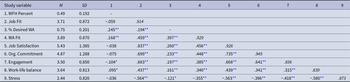
The means, standard deviations, and inter-correlations of our study variables are presented in Table 2. WFH intensity (i.e., the extent to which an individual works from home) was significantly correlated with percent desired WA (r = .245, p < .001) and perceived WA fit (r = .168, p < .001). WFH intensity was also significantly positively correlated with work-life balance (r = .095, p = .050), but was notably negatively correlated with engagement (r = − .104, p = .031).
Means, standard deviations, reliabilities, and inter-correlations of study variables (N = 427)

Note: Cronbach’s alphas are italicized and presented along the diagonal.
* Significantly different at p < .05; **Significantly different at p < .01.
Percent desired work arrangement
The average score for the percent desired WA was 0.75 (see Table 2). For an employee working five days per week, this average signifies that they are spending slightly more than one day per week working in a location that is different from their ideal location. The extent to which individuals have the split of work locations that they desire was significantly correlated with all of the study outcomes: job satisfaction (r = .260, p < .001), organizational commitment (r = .233, p < .001), engagement (r = .197, p < .001), work-life balance (r = .161, p < .001), and stress (r = − .121, p = .012). All were in the expected direction. Hypotheses 1a to 1e were fully supported: the extent to which an individual’s actual work arrangement matches their desired work arrangement was significantly associated with better outcomes in all variables.
Perceived work arrangement fit
The average score for the nine-item perceived WA fit scale was 3.89 (see Table 2). The extent to which an individual perceives a good fit with their work arrangement was significantly correlated with all of the study outcomes: job satisfaction (r = .456, p < .001), organizational commitment (r = .448, p < .001), engagement (r = .385, p < .001), work-life balance (r = .340, p < .001), and stress (r = − .355, p = .012). All were in the expected direction. Hypotheses 2a to 2e were fully supported: the extent to which an individual indicates a perceived fit with their WA was significantly associated with better outcomes in all variables.
Perceived WA fit was also significantly correlated with job fit (r = .459, p < .001), indicating a strong but not perfect association between the two constructs.
Beyond job fit
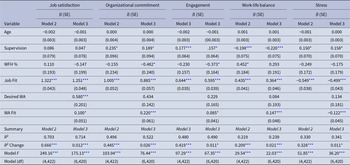
In the second step of our hierarchical regression analyses, job fit was a significant predictor of all the study outcome variables (see Table 3). When percent desired WA and perceived WA fit were added to the model, they accounted for small but statistically significant proportions of the variance in all of the outcomes beyond that of job fit: job satisfaction (ΔR2 = .012, ΔF = 8.758, p < .001), organizational commitment (ΔR2 = .026, ΔF = 11.281, p < .001), engagement (ΔR2 = .011, ΔF = 4.376, p = .013), work-life balance (ΔR2 = .021, ΔF = 5.680, p = .004), and stress (ΔR2 = .011, ΔF = 3.619, p = .028). Thus, Hypothesis 3 was supported.
Regression of WA on outcome variables

Notes:
* p < .05, ** p < .01, *** p < .001.
In the final model, percent desired WA was a significant predictor of job satisfaction (B = .580, p < .001). In turn, even with job fit in the model, perceived WA fit was a significant predictor of all the outcomes: job satisfaction (B = .100, p = .050), organizational commitment (B = .220, p < .001), engagement (B = .085, p = .050), work-life balance (B = .147, p < .001), and stress (B = − .122, p < .001).
Discussion
Contrary to previous research (e.g., Gajendran et al., Reference Gajendran, Ponnapalli, Wang and Javalagi2024), we did not find that WFH intensity alone was universally associated with better outcomes; those who WFH more often reported higher work-life balance but lower levels of engagement. However, our study findings align with Aksoy et al. (Reference Aksoy, Barrero, Bloom, Davis, Dolls and Zarate2023), who demonstrated that employees in their Canadian and American samples, on average, desired to WFH approximately 1.5 days per week more than their current work arrangement. The data from our sample reinforce that, though Canadian and American employees may WFH relatively often (as compared to employees in many other countries; Aksoy et al., Reference Aksoy, Barrero, Bloom, Davis, Dolls and Zarate2023), they are similar to employees worldwide in their general desire to WFH slightly more often than they currently do.
Our results further indicate that the alignment between an individual’s work arrangement and their personal desires, needs, and values matters with respect to both work-related and personal wellbeing outcomes. In our initial analyses, the extent to which an individual’s split between WFH and in-office fits their ideal – percent desired WA – was significantly positively associated with important work and personal outcomes (i.e., job satisfaction, organizational engagement, and work-life balance) and significantly negatively associated with work stress, supporting H1. Furthermore, the extent to which an individual’s perceived fit with their work arrangement was significantly positively associated with the same work and personal outcomes (i.e., job satisfaction, organizational engagement, and work-life balance) and significantly negatively associated with work stress, supporting H2. Moreover, in support of H3b, perceived WA fit was significantly associated with job satisfaction, organizational commitment, engagement, work-life balance, and job stress beyond the effects of job fit and WFH intensity. Providing partial support for H3a, desired WA was significantly associated with job satisfaction after partialing out the variance attributed to job fit and WFH intensity. Taken together, in line with P-E fit theory, these findings suggest that different people are seeking different kinds of work arrangements, and the extent to which those arrangements fit with the individual’s desires, needs, and values has important organizational and personal implications.
Theoretical implications
It is well acknowledged that P-E fit is a broad term and that various facets contribute to one’s environment. A newly salient and emergent facet of the environment is that of work arrangement. Work arrangement is an aspect of one’s job, but it is broader, given that it affects the way an individual interacts with their organization, their peers, their work environment, and their own life. Accordingly, we argue that P-E fit should be expanded to include work arrangement fit as an integral facet for theoretical consideration.
From the perspective of the organization, a good fit occurs when the knowledge, skills, abilities, personality, needs, values, and other characteristics of the individual worker are well-matched to the demands, requirements, or needs of the job and organization (Brkich, Jeffs & Carless Reference Brkich, Jeffs and Carless2002; Kristof-Brown, Zimmerman & Johnson, Reference Kristof-Brown, Zimmerman and Johnson2005). It is this complementarity between the characteristics of the individual, the job, and the organization that jointly results in P-E and job fit. Due to the important relationships between work arrangement, work arrangement fit, and personal and work-related outcomes that our study has revealed, we argue that it is important to consider work arrangement as an integral facet of job and P-E fit moving forward. Though it has been overlooked in the past, likely due to the taken-for-granted nature of in-office work, as the work landscape has shifted, the expansion of P-E fit to include the vital element of work arrangement should also be considered. Ours is part of a series of emerging studies (e.g., Stamate & Denis, Reference Stamate and Denis2023; Stefaniec, Brazil, Whitney & Caulfield, Reference Stefaniec, Brazil, Whitney and Caulfield2022) supporting the importance of considering work arrangement when examining employees’ relationships with their work.
We found that the extent of fit between one’s work arrangement – measured both objectively as percent desired work arrangement and subjectively as perceived work arrangement fit – remained strongly associated with the outcomes in our study beyond job fit. This suggests that individuals consider the fit between the needs and desires addressed by their work arrangement to be separate from the fit between their knowledge, skills, abilities, needs, and values and their job requirements. Those interested in better understanding job fit or P-E fit should, therefore, consider integrating work arrangement fit into their research.
Practical implications
Managers and other organizational leaders concerned with improving work outcomes for their employees should similarly consider investing in the assessment and improvement of work arrangement fit for their workforce. This individualized approach is necessary because we also found that the extent to which individuals prefer or need to work from home (or in the office) varies with the individual. This is critical, as the alignment of an individual’s desires, needs, and preferences with their work arrangement is related to notable outcomes (Donald, Reference Donald2023). Although employers who are adopting or even embracing hybrid work will gain some benefits, such as employee satisfaction and performance (Gajendran et al., Reference Gajendran, Ponnapalli, Wang and Javalagi2024), strict remote work policies, along with partial but prescriptive and/or arbitrary return-to-office mandates, may negatively affect satisfaction, commitment, engagement, work-life balance, and work stress, many of which are associated with critical business outcomes like employee turnover (Donald, Reference Donald2023; Tett & Meyer, Reference Tett and Meyer1993). Allowing employees the flexibility to craft their jobs and careers to best fit their needs, characteristics, and values can benefit both the individual and the organization over the long-term and has the potential to be a strong strategic decision that supports the sustainability of both parties over time (Donald, Van der Heijden & Manville, Reference Donald, Van der Heijden and Manville2024; Tims & Akkermans, Reference Tims, Akkermans, Hedge and Carter2020).
Our research supports that, as much as is feasible, employees should have work arrangements that match their needs and preferences. For example, if an employee prefers to WFH three days per week, a work arrangement that meets that need may positively contribute to their overall job satisfaction. Similarly, employers should accommodate those employees who prefer to work solely in the office. Consistent with research demonstrating the positive effects of flexible work design (e.g., ter Hoeven & van Zoonen, Reference ter Hoeven and van Zoonen2015), our results demonstrate that flexible, customizable work arrangements are much more likely to address employees’ needs than a one-size-fits-all policy. It should be noted that an individual’s needs and work preferences may evolve (e.g., Donald, Reference Donald2023; Lennox, Reference Lennox2025), suggesting that work arrangements should be reviewed and adapted periodically. Allowing for flexibility and revision in employees’ work arrangements – rather than enforcing strict policies – allows individuals to proactively adapt their work arrangements to better match their life circumstances as they themselves change over time, while still maintaining the strength of their fit with the organization and theoretically precluding the rise of turnover intentions (Donald, Reference Donald2023; Tims & Akkermans, Reference Tims, Akkermans, Hedge and Carter2020). For example, changes in caregiving responsibilities or disability challenges and symptoms may necessitate a change in one’s work arrangement that would prevent the individual contributor from staying with the organization if there is insufficient flexibility (Donald, Reference Donald2023; Lennox, Reference Lennox2025). In consequence, this has the potential for a loss of talent and knowledge within the organization, as well as an increase in replacement costs, threatening organizational functioning and long-term sustainability (Donald, Reference Donald2023).
Limitations & future directions
Despite the contributions of our research, there are some limitations that warrant addressing. Foremost is the short measurement timeframe (i.e., one week) of the current study. These data were collected at a time when some work arrangements were still in flux, and some participants may not have had a clear understanding of how their organization’s policies might shift over time. Because remote and hybrid work arrangements have only recently become widespread, their general acceptance (or lack thereof) might change over time. Longitudinal designs could examine employees’ reactions to organizational policy changes (e.g., return-to-office mandates) as they are implemented over a longer period of time.
Moreover, as we are introducing the notion of work arrangement fit and presenting it as a facet of one’s work environment, there was no established, validated scale available for measurement within our study. As such, we adapted a well-performing existing scale (i.e., Brkich, Jeffs & Carless, Reference Brkich, Jeffs and Carless2002) to measure perceived work arrangement fit, guided by both theory (i.e., Kristof-Brown & Guay, Reference Kristof-Brown, Guay and Zedeck2011) and earlier adaptations of this same scale for a different work-related context (Conklin, Dahling & Garcia, Reference Conklin, Dahling and Garcia2012). Although the logic and process underlying our modification are both robust and the items hung together reliably, we recommend that this measure undergo more thorough statistical validation before repeated use in the future.
Given that our data were collected as part of a larger project, we further elected to reduce the number of items in certain scales, as we were concerned about the length of the surveys and participants’ attention. To prevent waning attention and protect against consequent measurement error, we elected to reduce the number of items in our implementation of the Brkich, Jeffs and Carless (Reference Brkich, Jeffs and Carless2002) job fit scale as described above, given there was past precedent to support this decision (i.e., Conklin, Dahling & Garcia, Reference Conklin, Dahling and Garcia2012) and a shorter measure of this construct has not yet been published (cf. Brough et al., Reference Brough, Timms, O’Driscoll, Kalliath, Siu, Sit and Lo2014; Schaufeli et al., Reference Schaufeli, Shimazu, Hakanen, Salanova and De Witte2019). Despite the high reliability score of the items measured, this survey design choice nevertheless constitutes a limitation.
Future research should also examine the personal factors that contribute to work arrangement fit (i.e., the factors related to the ‘P’ in P-E fit). For example, one’s personality (e.g., extroversion, conscientiousness) or other personal characteristics (e.g., gender, marginalized identity, caregiving) might make certain work arrangements more desirable (Bakaç, Zyberaj & Barela, Reference Bakaç, Zyberaj and Barela2023; Couch, O’Sullivan & Malatzky, Reference Couch, O’Sullivan and Malatzky2020; Russell & Frachtenberg, Reference Russell and Frachtenberg2021; Schur, Ameri & Kruse, Reference Schur, Ameri and Kruse2020; Tomczak, Mpofu & Hutson, Reference Tomczak, Mpofu and Hutson2022). In turn, younger employees who are now entering the workforce may have different assumptions and work arrangement preferences than those who began their careers pre-pandemic (Donald, Reference Donald2023; Stefaniec et al., Reference Stefaniec, Brazil, Whitney and Caulfield2022). Future quantitative or qualitative studies might investigate whether and how personal identity, family responsibilities, age, and/or personality influence employees’ preferences for various work arrangements and their fit with given mandated arrangements.
Furthermore, recent popular press discussions have highlighted return-to-office mandates (e.g., Adams Otis, Reference Adams Otis2023; Fung, Reference Fung2023; May, Reference May2024) and it remains to be seen whether they will have deleterious effects on employee satisfaction, commitment, engagement, work-life balance, and stress. The relationships we observed may strengthen if and when return-to-office mandates subside and employees are able to self-select into work arrangements that best fit their needs, preferences, and characteristics (Donald, Reference Donald2023). Future research will need to affirm this proposition as time passes, given that P-E fit changes over time (Barrero, Bloom & Davis, Reference Barrero, Bloom and Davis2021; Donald, Reference Donald2023).
Our regression analyses also revealed that holding a supervisory position was beneficially associated with organizational commitment and engagement, while detrimentally associated with work-life balance and stress. These findings align with the limited previous scholarship on workplace leader wellbeing (e.g., Center for Creative Leadership, 2023; Howe, Menges & Monks, Reference Howe, Menges and Monks2021). Post-hoc analyses further demonstrated that supervisors within our sample generally spent less time WFH than did working-level employees. This begs the question of whether supervisors’ stress and work-life balance could benefit from more time spent WFH, if desired. Alternatively, it is possible that leading in hybrid environments is more challenging for supervisors, particularly if they have not been trained in the skills needed to lead a hybrid team. Given these findings, we recommend that future research continue to inquire into the wellbeing effects of work arrangement mandates and hybrid work with regard to supervisors, in particular. We suspect that more training may be needed to support supervisors navigating the transition to hybrid work, in order to make it fully functional and sustainable in the long term.
Moreover, we recommend further investigation into work arrangements as an aspect of job and P-E fit. There is emerging research supporting the inclusion of work arrangements into work preference scales (e.g., Stamate & Denis, Reference Stamate and Denis2023), but more work is still needed. Because the workplace is a shared environment, scholars might further consider the impacts of others’ work arrangements (e.g., team, supervisor) on an individual’s work arrangement fit. As it can no longer be taken for granted that the workplace of an individual is in the office, constructs and measures related to various aspects of work (e.g., work preferences, job satisfaction, job fit, P-E fit) may need to expand accordingly. Finally, we should not assume that work arrangement fit is fixed. It may be possible to develop workplace interventions that support better fit by making the workplace more engaging and better suited to individual needs and by helping individuals better adapt to their work arrangements.
Conclusion
In this paper, we introduced work arrangement fit as a newly salient aspect of job and P-E fit. The extent to which individuals’ desires, needs, and preferences align with their work arrangements is related to important work (e.g., job satisfaction, organizational commitment, engagement) and personal (e.g., work-life balance, stress) outcomes. Our findings demonstrate that working where one wants matters, and there are individual differences in how employees respond to various work arrangements. We contend that this evidence supports a reconsideration of job fit and P-E fit models to incorporate work arrangement fit moving forward. Organizations are encouraged to acknowledge that individualized work arrangement policies, which consider the needs, desires, and preferences of individual employees, have the potential to fit best with those individuals and to support their career sustainability, as well as the sustainability of the organization. We call for future research on this topic as both adoption and perceptions of remote and hybrid work change over time.
Conflicts of interest
The authors have no conflicts of interest to report.
Ethical standards
Ethics clearance was granted for this project by the Carleton University Research Ethics Board (CUREB-A #112786) and the University of Guelph Research Ethics Board (REB #20-04-017). Adherence to ethical standards and informed consent precludes publicly posting the data.


 Open access

