Barry Buzan is without a doubt one of the most prolific writers in the discipline of International Relations (hereafter IR). He has authored (individually and with others) nearly 150 articles. He has written, co-written and edited over twenty-five books, including People, States and Fear (Reference Buzan1983 and Reference Buzan1991); From International to World Society? English School Theory and the Social Structure of Globalisation (Reference Buzan2004a); The United States and the Great Powers: World Politics in the Twenty-First Century (Reference Buzan2004b) and Making Global Society (Reference Buzan2023). As well as, with Ole Wæver and Jaap de Wilde, Security: A New Framework for Analysis (Reference Buzan, Wæver and de Wilde1998); with Lene Hansen, The Evolution of International Security Studies (Reference Buzan and Hansen2009); with George Lawson, The Global Transformation (Reference Buzan and Lawson2015); and with Richard Little, International Systems in World History (Reference Little2000), and many other co-authored books with a range of scholars besides. The sheer quantity of work he has produced means that any student of IR will inevitably have to engage with some of Buzan’s research. The quality of the work has meant that many are lastingly influenced and inspired by Buzan’s oeuvre. Notably Buzan’s call and action to revive the English School in Reference Buzan2001 has garnered a huge response and moved the ES from the margins of the discipline into many mainstream journals. While, in security studies, Buzan’s importance to the field is such that, as Ken Booth (Reference Booth1991: 317) once put it, everyone else has been busy writing footnotes to Buzan’s work.
While Buzan has made multiple seminal contributions to IR theory, security studies, the ES (international society) and to the study of global history, nearly all his work is united by the specific and in many ways unique way in which Buzan approaches research, namely by zooming out to a bird’s-eye view, enabling him to see his research object/subject placed in a large contextual area. Once on this elevated plain, Buzan’s specific skill is to spot patterns and to draw out the most important parameters relevant to the research and to categorise these into concepts and theoretical tools. Thus, making complex and (in IR) often convoluted topics easy to grasp, Buzan’s objective tends to be to provide analytical tools that enable ordering of the always complex subject matter: be that IR theory, international security, international society, global history and, most recently (with Robert Falkner), international political economy. We call Buzan’s procedure of zooming out to the grand vista, spotting patterns and offering large-scale explanations a big picture approach. While this label is our invention, it arises from passages in Buzan’s published work and from interviews/talks where he often comes back to his interest in the big picture. In 2021, for example, he states: ‘I am the kind of person who likes to think from a high altitude […] my particular strengths is a very high altitude view of what’s going on’ (Buzan Reference Buzan2021). And, in Pursuing the Big Picture: A Reply to Forsyth, Pal, and Pardesi, he argues that: ‘In principle, I am in favour of grand narrative approaches. I like them because I think holism adds a value that cannot be found by looking at parts and their interactions. Wholes are more than the sum of their parts’ (Buzan, Reference Buzan2024).
Importantly, Buzan’s big picture approach does not lay claim to grand theory or universalism of either scope or explanation (more on this below). Moreover, Buzan’s way does not bind researchers to a specific epistemological or ontological outlook. The phrase ‘big picture approach’, (note, when applied to specific topics we also speak of big picture analysis), is intended to capture Buzan’s interest in developing analytical frameworks that render hugely complex issues easily accessible. It necessarily includes the building of bridges between distinct sub-fields (e.g. between international political economy, IR, security studies, area studies, sociology and so on) as well as between different theoretical approaches (realism, constructivism, liberalism, etc.).
The aim of this book is to examine the meaning, nature and value of Buzan’s big picture as an approach to IR. This book fills a major gap in the literature. While countless works engage with Buzan’s writings, these works tend to be about what Buzan has said, not about how he conducts research in IR – his, in Ole Wæver’s (Reference Wæver2009) terms, ‘theory of theory’. Ultimately, it is our intention to give IR scholars, and our colleagues in cognate disciplines, an opportunity to reflect on the value of a big picture approach through the prism of Buzan’s work. To achieve that goal, all chapters in the present book are concerned with one or more of the following research questions:
1 What is the big picture approach?
2 What are its opportunities and shortfalls?
3 Is the big picture approach reproducible by anyone?
The remainder of this introductory chapter explains why we think Buzan’s approach to studying IR (this includes security studies and global history, which can be considered sub-fields of IR for some purposes) can be thought of in this way. While this inevitably leads us to suggest what we, the editors, mean by the big picture approach, we do not wish to foreclose discussion on the nature of big picture approaches. In short, our analysis in the introduction is not supposed to be a guide or prescription that the contributors to this volume must embrace and themselves follow, it is rather one way of viewing the big picture approach. This flexibility is important to this volume for another reason. It should be obvious that we would not have conceived of the idea for this book if we did not see value and promise in big picture analysis. Again, however, this does not mean that the contributors must share our favourable view. To the contrary, we have actively encouraged our contributors to challenge the value of Buzan’s big picture approach, including on grounds of, for example, its rampant parsimoniousness (see Chapters 8 and 12), the lack of normative theory (Chapter 4) and the ease of replicability (Chapter 2). While we have tried to keep the range of contributors to this book diverse, many have previously co-authored with Buzan. This does not mean that these scholars are beholden to following Buzan in his approach. Indeed the contributors’ reasons for not adopting a big picture approach following collaboration with Buzan are worthwhile exploring. But also, these co-authors know Buzan’s work and thinking very well.
In this introduction, we follow our explication of the big picture approach à la Buzan by examining how this differs from alternative macro perspectives to understanding and explaining IR, international security and global history, before offering a few thoughts on research questions two and three. Finally, we organise the substantive chapters of the book by homing in on a range of specific themes that connect the chapters in the different sub-sections. These emerged either in discussion as part of a series of mini-workshops that accompanied the editing and writing of this book and/or from the chapters themselves.
1.1 Buzan’s Big Picture Approach
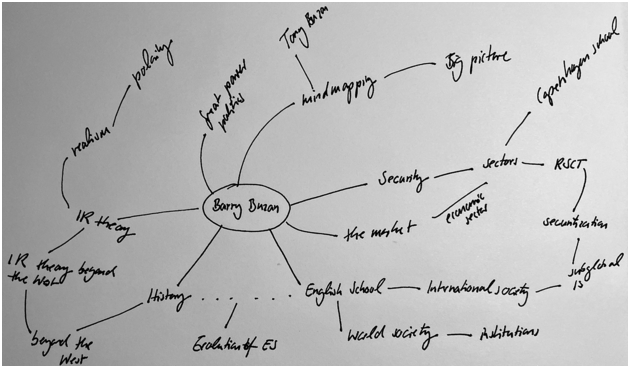
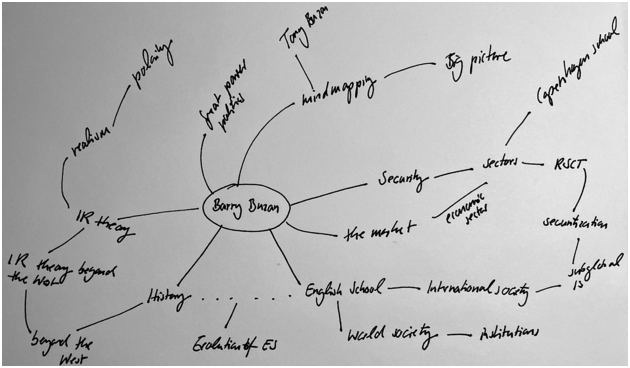
No one is born a big picture theorist. To do it well, it takes much learning and studying. However, all of us from a young age display diverse interests and talents. Any parent of multiple children will have marvelled at how different their respective children are, and most siblings will have wondered – at times at least – how they can possibly be related. Buzan often tells the tale of how from a young age he had an interest in history. As a young boy, he was once expelled from class during social studies for disruption and sent to the school library. Evidently equipped with what the Germans call Sitzfleisch, which modern-day children and teens muster only for gaming, he was fortuitous to stumble across H. G. Wells’ Outline of History. This book left him with an interest in history he later pursued at the University of British Columbia. However, because he considered pure history ‘too dry’, he found himself in classes taught by Kalevi Holsti on broadly IR and was blown away by ‘how (here polarity theory) you could simplify something so complicated in that way’ and was deeply influenced by Holsti’s 1976 textbook on IR. We hasten to suggest that – in much the same way as Buzan’s big picture approach showed many of ‘us’ that doing IR in that way is possible – Buzan learned of the possibility from Holsti. Even so, we do not wish to suggest that Buzan – at first – consciously set out developing this method, and/or that he planned to write all the books he did. Books that progressively focus on explaining an ever-bigger picture: for example strategy, security, international society, global society and global history, leaving nowhere bigger to go than outer space (conversation with Buzan). Instead, Buzan’s big picture approach grew organically. Initially, fuelled by a natural curiosity and interest, but no doubt, also by being good at it and by getting relevant results (e.g. in book sales, citations and promotion). According to Buzan, his ability to do big picture analysis is helped by Mind Mapping, a note-taking method and brain-storming tool that was instrumentally developed by Buzan’s older brother, the psychology author Tony Buzan. Although people develop individualistic styles of Mind Mapping, all mind maps contain four elements.
1 The subject of attention crystallised in a central image.
2 The main themes of the subject radiate from the central image as branches.
3 Branches comprise a key image or keyword printed on an associated line. Topics of lesser importance are also represented as branches attached to higher-level branches.
4 The branches form a nodal structure (Buzan and Buzan, Reference Buzan and Buzan1993: 59).
To visualise this, Figure 1.1 is an attempt of a mind map leading up to this book project.
Mind map attempt for this book.
While Mind Mapping does not lead to a specific way of thinking about or doing IR, in Buzan’s case this method clearly facilitated the big picture approach. ‘Mind Mapping gave me a tremendous competitive advantage. […] It has made it possible for me to remain a generalist in a field where the weight of information forces most people to become specialists’ (Buzan and Buzan, Reference Buzan and Buzan1993: 13). Buzan’s long-term friend Professor Cornelia Navari put it to us in one of the workshops for the present book that the big picture is Buzan’s approach, Mind Mapping is his method.
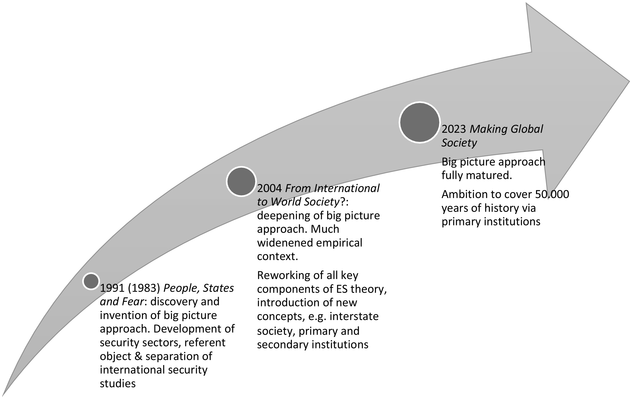
To substantiate our point that Buzan’s work is united by a focus on the big picture, let us look at three of his most impactful monographs a little more closely. Doing this will also help to explain what – in our view – the big picture approach à la Buzan is. Our selections are?: People, States and Fear (PSF); From International to World Society? (FIWS) and Making Global Society (MGS). To be sure, lending to the fact that it was published in 2023, MGS has not (yet) had the impact of the other books. We include it because it is – according to Buzan himself – the cumulation of all his thinking (Buzan, preface).
PSF was first published in 1983, and a revised second edition was published in 1991. Our analysis refers strictly to the second edition. The objective of PSF is to examine the meaning and nature of security (in IR) with the objective of establishing International Security Studies as separate from Strategic Studies. We argue that Buzan pursues his goals by zooming out to the grand vista. There are several concrete elements to his big picture approach in this book. Notably, first, Buzan rejects the utility of using one or more case studies to ascertain the meaning of security (14). Instead, throughout the book he uses short, real-world illustrative examples from different periods in history and in different locations. Second, he approaches the topic not with a view of what security is (other than recognising its contested nature) or should be, but instead settles for large-scale mapping of the ‘domain of security’ as used by policymakers and practitioners, taking account of different groups’ positionality and their vested interests. Third, by drawing out contradictions and differences between, for example, security and defence, national and international security, he works to delimit what different analytical categories mean. Fourth, Buzan offers a range of ordering tools. In this book specifically the notion of the referent object (the thing endangered and in need of rescue) and the sectors of security. These are analytical lenses designed to bring order into the messy reality of a broadened security agenda whereby any issue could – at least rhetorically – rise to the level of a security threat to the state, groups of people and beyond. Security sectors enable researchers to ascertain security threats, actors and referent objects (threatened entities) in five different, but often overlapping domains, namely the military, political, societal, economic and environmental sectors. Importantly, these sectors combine knowledge of inter alia: strategic studies, economics, conservation, environmentalism, finance, nationalism and political science.
Fifth, although Buzan discusses a whole range of security issues, his work remains analytical. That is, at no point does he take a position on what ought to be done, by whom and why. Although this book bears all the major hallmarks of Buzan’s big picture approach, we do not think that Buzan purposefully developed big picture analysis and then attended to the problem of security. Indeed, he never even planned to write PSF at all. In the preface to the 2007 version, he writes that ‘[…] PSF was a failed attempt to write what later became An Introduction to Strategic Studies. It started out as the first chapter of that book, intending to introduce the concept of security as the central idea of Strategic Studies. But it quickly took on a life of its own and became a separate book’ (Buzan, Reference Buzan2007: 4).
Following publication of PSF, big picture analysis becomes synonymous with Buzan’s style. The co-authored Security: A New Framework for Analysis and Regions and Powers contain many of the concepts developed in PSF and follow the method of illustrative examples as opposed to in-depth empirical case studies. In both books, the authors develop theories and concepts of security by taking a holistic look at security, including how it interacts with other factors, for example, economics, at all times remaining at the grand vista (cf. Chapters 10 and 11).
From International to World Society? was published in 2004. It is Buzan’s attempt to revise and revive the English School in IR. Opinion on this effort is more divided than on PSF. Overall, however, it has been accepted into the ES (Buzan, 2005). As far as we are concerned FIWS is the most important and comprehensive statement on analytical ES theory. The book offers answers to hitherto ignored and sometimes unseen issues such as: the meaning of international society, the meaning and nature of the pluralist-solidarist debate, the difference between world and international society, the role and nature of institutions and the existence of sub-global international societies. Buzan achieves all this by doing what he did all those years ago with security. He zooms out to a higher perspective and examines what analysts have meant by these terms previously – looking for overlap and contradictions. He carves a way through a jungle of work by either defining existing terms much more precisely and/or by coining new concepts and terms. The result is a theoretical framework that can be used to, for example, compare distinct sub-global international societies, make predictions about the nature of securitization (Buzan, Reference Buzan2015), examine the nature of solidarism and much else besides.
The coauthored book with Laust Schouenborg, Global International Society, as well as the co-edited with Yongjin Zhang, Contesting International Society in East Asia, inevitably work with (but are not constrained by) many of the concepts developed in Buzan’s 2004 book. But more is afoot here. Sometime in the noughties Buzan’s chief research concern moves from an interest in security studies to an interest in world society and the ES. We suggest that the main reason for this change is that the ES in IR is eminently compatible with Buzan-style big picture analysis, which is to say developing analytical frameworks that render hugely complex issues easily accessible, while still providing enough detail. Indeed, the ES is not a theory but rather a synopsis of IR (Buzan, Reference Buzan2021) that allows thinking ‘from a high altitude’ (Reference Buzan2021). This is not to say that all ES scholars are involved in big picture analysis, only that – from this position – such theorising is possible because allegiance to the ES does not commit one to more than methodological pluralism (see Little, Reference Little2000) and the idea of international society. Moreover, even within the ES Buzan has not expressed preference for either solidarism or pluralism. Instead, he has shown how elements of both co-exist in different sub-global international societies (Buzan, Reference Buzan2004a). In other words, Buzan has found a natural home in the ES because the ES is most easily compatible with how he thinks, works and what he seeks to achieve with his work.
Over the course of the past decade or so Buzan has turned his considerable talents to the topic of global history. There are two strands to this work: first, a sociology of the history of global IR, most prominently in The Global Transformation (with George Lawson) and The Making of Global International Relations and Re-imagining International Relations (both with Amitav Acharya). And second, an ES history of global society with Making Global Society: A Study of Humankind across Three Eras (MGS) published in 2023. The subject of these works is empirical (global history and/or the history of the discipline of IR), but Buzan’s aim – especially in MGS – is to provide a new theory of the history of humankind. Buzan tells this story via primary institutions, which emerge, die, change or evolve over time, conditioned by ‘the state of the planet’ (e.g. the climate) and ‘material conditions’ (e.g. technologies) affecting human life (Buzan, Reference Buzan2023: 2–3). By focusing on primary institutions Buzan aims to tell more than 50.000 years of human development without being bogged down in detail (e.g. via personal stories) but without reducing all global history to one abstract driving force (e.g. capitalism, or in IR neo-realist-structure) (Reference Buzan2023:2).
These are not the only publications of Buzan’s that we could have used to showcase his big picture approach. But these three are among Buzan’s most important single-authored monographs, and they are also among his most ambitious works. Moreover, in each one Buzan’s subject of study – likely in line with becoming ever more comfortable and proficient in big picture analysis – becomes ever bigger. In Figure 1.2. the increasing thickness of the arrow aims to depict precisely this.
Big picture analysis in focus.
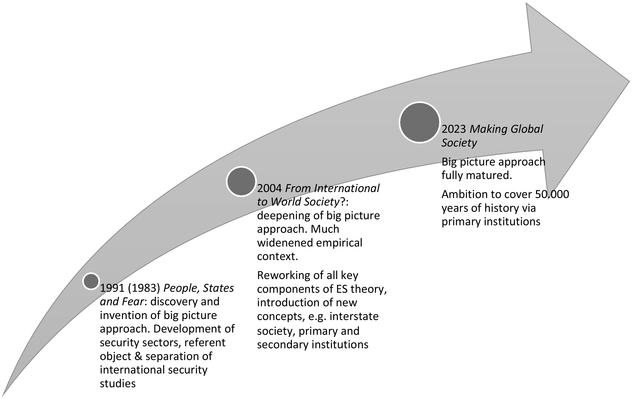
Figure 1.2 Long description
The text reads as follows.
1. 1991, 1983, People, States and Fear, discovery and invention of big picture approach. Development of security sectors, referent object and separation off of international security studies.
2. 2004 From International to World Society, deepening of Big picture approach. Much widened empirical context. Reworking of all key components of ES theory, introduction of new concepts, for example, interstate society, and primary and secondary institutions.
3. 2023 Making Global Society. Big picture approach fully matured. Ambition to cover 50,000 years of history, via primary institutions.
This brief overview of the nature and approach of each of these three books suggests that big picture research Buzan-style combines the following traits:
The subjects of analysis are large-scale events/developments/concepts, not specific or singular events, for example, a specific war. Instead, they refer to international security, international society or global history.
It aims at simplifying and ordering hugely complex issues, and often operates at several levels of analysis at the same time.
It does not profess allegiance to one theoretical camp, but pragmatically utilizes and combines a diverse range of theoretical perspectives, including those from other disciplines which are relevant to the area/issue of enquiry.
It takes a long-term view, emphasizing the importance of history for our understanding of the world today, and it is not averse to prediction and scenario-building.
It is overtly apolitical, or else non-normative.
It has a fundamental sense-making quality in the way it attempts to clarify basic concepts, as demonstrated by the fact that several of Buzan’s major works started out as failed textbooks (e.g. PSF and International Systems in World History).
1.2 The Big Picture Approach Vis-à-Vis Other Macro Approaches
Having established the – in our view – constitutive parts of Buzan’s big picture approach, it remains to discuss how this differs from other macro approaches to IR. One obvious candidate here is structural realism. Structural realism is a grand theory. The term grand theory was coined by sociologist C. Wright Mills in 1959. Mills, according to Johan Eriksson, used it to refer ‘to abstract theorizing on a general level, in which formal organization and logic take priority, and in which theorizing aspires to universal validity, more or less separate from the empirical differences and varieties over time and across space’ (Eriksson, Reference Eriksson2014: 94). By focusing on system structure as a constraining and enabling variable, this theory (or family of theories) offers a macro perspective that seeks to explain ‘broad patterns of state behaviour’ (Mearsheimer and Walt, Reference Mearsheimer and Walt2013: 432). Concretely this means that structural realism does not aim to explain each individual foreign policy decision; its purview is foreign policy decisions in the long durée. A good way of thinking about the difference is that structural realism is to foreign policy what climate change is to weather. Compared to Buzan’s approach, however, this is extremely narrow, as everything is explained via a fixed social-structural lens (anarchy and polarity).Footnote 1
Marxism is another macro approach to inter alia, IR, insofar as everything is reducible to capitalism, the class struggle and exploitation. Marxist explanations have fallen out of fashion in IR, and yet elements of Marxist thought are central to, for example, political ecology and critical security studies. Marxist-inspired theories are also overtly normative. Their aim is to change the world rather than to simply explain it.
Post-modernism defies easy classification. Thus, on the one hand, post-modernists continuously invoke the universal truths of othering and power/knowledge, while they reject the possibility of universal truth on the other. So perhaps the relative grandness of a theory rests not with whether it is universally applicable, but with whether it foregrounds universality. In any case, there clearly is a tangible difference between formal – and often positivist – theorising and post-modernists’ purposefully ‘fragmented narratives’ (Javadzadeh, Reference Javadzadeh2011: 19; see also Skinner, Reference Skinner1985).
To our minds, however, there is a more fundamental difference between Buzan-style big picture analysis and any of the above-mentioned approaches. Buzan does not offer a theory of IR, security or international society. Instead, he offers theoretical frameworks for how these areas can be studied. And this he does from the position of the grand vista. From this position he develops theoretical frameworks telling readers what international society is, or that security operates across different sectors, but these theoretical frameworks are not bound by an ideological commitment (e.g. freeing the oppressed, the national interest and so on). Instead, the theoretical framework is purely analytical with no agenda, and no judgement on what should or shouldn’t be the case.
Returning to the issue of grand theory, there is no doubt that other IR scholars adopt a grand vista perspective on the world. Besides the realists Waltz and Mearsheimer, one can point to Wendt, Ikenberry, Reus-Smit, Deudney and arguably many more. And they all do so in particular and unique ways. Some start with political theory and some take theoretical inspiration from sociology, to provide just two examples. It seems to us that these alternative macro perspectives can fruitfully be compared to Buzan’s approach to tease out the analytical steps involved and the knowledge ends these alternative perspectives serve. This is our open invitation to other scholars to debate the comparative advantages of big picture approaches to IR (see also Chapters 2, 7 and 12).
However, there is no reason to stop there. Going beyond IR, there is a wealth of macro perspectives available, some of which Buzan has drawn on in his own work. The obvious examples are world systems analysis associated with Wallerstein and his followers (e.g. Wallerstein, Reference Wallerstein1974, Reference Wallerstein, Frank and Gills1993 and Reference Wallerstein2004), as well as Mann’s work on the sources of social power (Reference Mann1986, Reference Mann1993, Reference Mann2012 and Reference Mann2013). These are examples of research heavily indebted to macro analysis of history. Yet a macro perspective does not necessarily have to mean grand and historical. There is certainly other grand vista work out there in the social sciences in which history occupies a less prominent role in the exposition or where its frame of historical reference is more closely tied to the modern age. One may point to Castell’s research on the network society (Reference Castells1996, Reference Castells1997 and Reference Castells1998) or Hardt and Negri’s book Empire (Reference Hardt and Negri2000). For more examples, see Buzan and Schouenborg (Reference Buzan and Schouenborg2018: 6).
There is also the larger debate about the meaning and value of grand theory in the human sciences more broadly. This brings us back to Wright Mills’ Reference Mills1959 book and his critique of Parsons as an exponent of this form of abstract theory, seemingly too detached from the empirical details of reality. That debate is far from settled. An important 1985 volume edited by Skinner was entitled The Return of Grand Theory in the Human Sciences, and as recently as 2021 Staubmann challenged Mills’ and other scholars’ construction of Parsons as a grand theorist. And it bears mentioning that in these debates grand theory does not necessarily imply a particular philosophy of science perspective. Here the reader should consult Skinner’s introduction to the volume just cited, as well note the inclusion of chapters on such diverse ‘grand theorists’ as Derrida, Foucault, Kuhn and Althusser.
Another reason for bringing up this particular 1985 volume is that it, based on our reading and the index of names at the end, does not include a single reference to anyone we would identify as an IR scholar. This speaks to the limited impact that IR has made on the social and human sciences – back in 1985, but also today. IR has exported relatively little theory, as Buzan rightly noted with a collaborator some twenty-five years ago (Buzan and Little, Reference Buzan and Little2001). This is equally an open invitation from us to other scholars to do comparative work on big picture approaches in the human sciences, and to further reflect on the potential for IR to deliver something that will have an impact beyond its own disciplinary boundaries (see also Chapters 3 and 8). Buzan has already taken up this challenge in the concluding chapter of the present book, in which he, amongst other things, ponders the differences between grand theory and macro-history, agents and structures, as well as the role of grand narratives in society. The debate continues.
Thus far we have reviewed Buzan’s approach in favourable terms. But not everyone agrees. A recent symposium on Making Global Society takes issue with the big picture approach adopted by Buzan (cf. Buzan, Reference Buzan2024). Maïa Pal (Reference Pal2024), for example, argues that ‘Its [read: MGS’s] limitations are based on the singular narrative and conceptual framework of the book, which flies in the face of a range of critical approaches that desperately seek to avoid singular narratives about human history.’ While the historian Hannah Forsyth (Reference Forsyth2024) laments the many factual errors included in Buzan’s sweeping analysis.
Other criticisms are possible. Arguably, with Buzan’s frameworks, one cannot make any concrete suggestions to policymakers at all. To be sure policymakers, who are often not trained in IR or global history, would benefit from seeing a bigger picture, but – in the absence of concrete solutions or warnings (as, e.g., uttered by realists) – what is offered? This is especially the case without any normative recommendations (cf. Dunne, 2005: 168).
It is also the case that in contemporary IR theory traditional macro theories are losing ground to ‘middle-range theories’ (Jackson and Nexon, Reference Jackson and Nexon2013; Buzan and Acharya, Reference Acharya and Buzan2019: 387). That is, theories that seek to explain empirical phenomena invoking causal mechanisms, for example, the democratic peace thesis. Buzan’s big picture approach does none of that (Dunne, 2005: 168).
Finally, how plausible is it for non-established scholars to adopt the big picture approach? Not only does it require an awful lot of knowledge on a wide range of subjects to see relevant inter-connections, but peer reviewers are also more likely to be comfortable with detailed case studies that draw on their own experience and will likely view anything big picture as too sweeping and lacking in details and methodological rigour.
These are just some of the possible criticisms of Buzan’s way of doing things. The contributors to this volume will critically interrogate Buzan’s big picture approach. They will ponder its value, its problems and its blind spots. They will think with and beyond Buzan to provide a more rounded appreciation of the big picture as an approach to the study of IR. It is essentially an exploratory, question-driven exercise. One that will generate competing meanings of big picture analysis, as well as refutation of the same. Some of the contributors have been selected because they have collaborated directly with Buzan, and thus possess unique insights into his work and thinking. Others have been chosen because they are themselves prominent contributors to specific subfields covered by the book. Or because they are uniquely competent to comment on different aspects of the big picture approach. Or a combination of the above.
Overview of Chapters and Emerging Issues
This book contains thirteen substantive chapters, ordered into five different sections: (1) the big picture and IR theory; (2) the big picture and international society; (3) the big picture and global history; (4) the big picture and security studies; and (5) the big picture and international political economy. These categories are Buzanian in two senses. First, they align with the different areas on which Buzan has worked over the course of his long career. Here it does not matter that he has spent vastly more time and published output on some themes more than others. What matters is that he has taken his specific and unique approach to these topics, in such a way that it merits sustained discussion as an area of big picture analysis. The categories are Buzanian in a second sense. Very much like Buzan’s sectors of security, they are imperfect ordering tools of a complex picture. Not all of Buzan’s works fall neatly into just one of these categories; consequently neither do this book’s contributors sit only within one. In fact during the writing of this book, musical chairs were performed by moving contributors from one section to another. Still we decided to stick with the section headings. We believe that the themes make this book more accessible. Some readers may only be interested in one of the many aspects of Buzan’s work, not in his entire oeuvre. Beyond that the groupings into sections informed a series of mini-workshops (held online) that brought together section contributors. These workshops served to make chapters more coherent, they built a sense of this being a communal project, but above all they allowed participants to identify a range of overarching themes that run across all chapters within a given section.
In Part I, The Big Picture and International Relations Theory, Mathias Albert, in Chapter 3, raises the question of whether the big picture approach, as practised by Buzan, does not necessarily take reader and writer beyond IR. He argues that anyone doing Buzanian-style big picture analysis is artificially constrained, indeed constricted by the notoriously ill-defined concept of ‘the international’, which in his view arbitrarily demarcates IR from sociology. Albert predicts, or perhaps incites, Buzan to ‘cross the barrier’ and effectively leave behind the confines of IR theory. But Buzan values IR. For him, the same can be understood as a ‘master discipline’ that is able to house and use ideas from a disparate number of other fields, onto yes, macro issues. Most obviously, perhaps issues that involve states (or polities) and are thus unquestionably within the realm of IR.
Ole Wæver’s contribution to this volume (Chapter 2) starts firmly within IR by using Waltz to think about Buzan’s theory of theory. This leads to a number of intriguing observations on the kind of work that Buzan engages in and the inherent difficulties involved in trying to replicate his approach.
John Williams’ contribution (Chapter 4) also goes to the heart of what IR theory is, and is for. Aligned with a critical ontology he believes that theory is a form of praxis, or rather that theory is normative because it is informed by the way a theorist views the world, what he or she focuses on, etc. This means that you can’t claim bona fide big picture analysis if you exclude the normative angle in the way Buzan does.
In Part II, The Big Picture and International Society, Robert Falkner (Chapter 5) and Fillipo Costa Buranelli (Chapter 6) discuss the meaning, merit and shortfalls of big picture analysis in international society. Admittedly, this section may have been called big picture analysis in the English School, as neither scholar focuses explicitly on the meaning and concept of international society. Both take Buzan’s 2004 rewriting of the ES’ concept of international society as interstate society as unproblematic, cementing Buzan’s role as having surpassed Bull (on the analytical side of the school). Working with Buzan’s concepts does not mean stasis. Falkner traces the history of world society in Buzan’s writings. World society was a term coined by Bull, but not very much defined. In 2004 Buzan gives distinct meaning to world society as a combination of his interstate, interhuman and transnational domains. In later work, Buzan’s understanding shifts and evolves in interesting ways.
One of the unifying themes that emerges from this part is the speed and matter-of-factness with which Buzan progresses. While this has echoes of the lack of detail explored by Hamati-Ataya (Chapter 8) and Diez and Midilli (Chapter 11), the emphasis of Falkner (Chapter 5) and Buranelli (Chapter 6) is different: they both view Buzan as an ice-breaker opening new terrain, leaving others to fill in the detail. In an unexpected way, then, Falkner’s chapter also touches on the issue of whether big picture analysis Buzan-style is reproducible by others?
In Part III, The Big Picture and Global History, contributors are stunned (in a good way) by Buzan’s audacity to take the big picture to all of world history. They differ, though, on the implications of this move. Inanna Hamati-Ataya (Chapter 8) chooses to point her spotlight on deep history and Buzan’s relative neglect of it in Making Global Society. In the course of this, she shows that a case can be made for a richer and more complex understanding of the institutional development of human social organisation before the ‘invention’ of agriculture (and civilisation). Cornelia Navari (Chapter 9) explores the issue of the mechanics of Buzan’s overall approach to the writing of history and his understanding of the historical subject of ‘international society’. In this, she draws on her enviable knowledge of the history of ideas and the work of the British Committee. Finally, Ayşe Zarakol (Chapter 7) explores the development of IR as an American social science and writes sympathetically about Buzan’s role in carving out a legitimate space for combining history and IR over the past three decades.
In Part IV, The Big Picture and Security Studies, Rita Floyd (Chapter 10) and Thomas Diez and Emre Midilli (Chapter 11) debate the issue of parsimony. Floyd argues that the Copenhagen School’s version of securitisation theory facilitates, and is used to deliver, Buzan-style big picture theorizing. Diez and Midilli’s chapter holds that big picture analysis requires detail, of the kind largely absent from Buzan. In a word, this chapter contests that Buzan is doing big picture theorizing. The chasm of sweeping view versus detail is a recurring feature in this book. The emphasis in this part goes beyond simply whether or not the big picture requires more or less detail; it concerns the autonomy of the analyst vis-à-vis what goes on in practice. That is, whether the big picture in security studies can be partially top-down, or whether it should be bottom-up. Or in other words, somewhat or fully constructivist. In essence, this part is about whether analysts can set the parameters for the big picture, or whether the big picture emerges from practice, with analysts relegated to mere mappers. It is interesting in this context that when it comes to the institutions of international society, Buzan is interested in practices and thus, to some extent, the bottom-up. What is at issue, though, is the balance and purpose of the analysis.
Part V, The Big Picture and International Political Economy, is united by a concern with the relevance of IPE to IR. Contributors hold that the role of the market and money are central in underpinning IR. History cannot be understood without money and the flow of capital, security is affected by financial stability and vice versa, and international society cannot be fully grasped without the market. So, Buzan writing about the market in his recent book with Falkner is, in a way, an inevitable result of having done big picture analysis on all these other topics. Pauly (Chapter 14) ends up endorsing big picture analysis as almost a normative imperative for dealing with the global problems inherent in finance in the contemporary world. Hobson (Chapter 12) extends Buzan and Lawson’s work on the global transformation of the nineteenth century by sketching in the outlines of another earlier significant transformation in the global political economy c.1500–c.1850. And Helleiner (Chapter 13) uses the tools of Buzan (and Acharya) to tell a novel story about the historical development of ideas about international political economy in the non-West.
1.3 Conclusion
As already indicated above, Buzan has the final word in this book in a concluding chapter in which he reflects on his impressions of this whole exercise. However, we, the editors, also have some preliminary conclusions to offer.
First, we hope that this introductory chapter has served the purpose of outlining some of the enduring modalities of Buzan’s big picture approach and how it has developed over time. To that extent, the chapter has had a pedagogical function. Other perspectives on Buzan’s approach are certainly possible, and the reader will encounter some of them in the following chapters. Ours is not authoritative, but it does have the advantage of combining the gazes of two scholars who have had quite different entry points into Buzan’s work (Rita through security studies and Laust through history and later the English School), as well as the benefit of reflecting on the approach over the roughly five years of the present book’s gestation, together with our many exchanges with the contributors and Buzan.
Second, and building on the first point, one of the insights we have reached is that there are many elements to Buzan’s big picture approach, and that rivalling approaches can probably be equally complex. For example, is the big picture approach informed by a basic intellectual inclination towards the grand vista? Does the approach serve a pedagogical function, a methodological purpose, a theoretical end or all of them combined? Is a big picture approach a basic normative imperative, as Pauly seems to suggest, and which would depart from Buzan’s normatively agnostic approach? There are probably more aspects to this, and we and the contributors have only taken the first steps to explore this topic. We invite others to continue the effort.
Third, there is the whole debate about discipline and disciplinarity. We hope that junior, mid-career and senior scholars alike will use this book as an opportunity to reflect on and debate the opportunities and difficulties involved in replicating Buzan’s big picture approach – or in going beyond it. Is it a viable pathway for junior scholars? Should mid-career and senior scholars do more to facilitate space for this approach individually and institutionally? The latter returns us to the title of the book: the big picture as an approach to the study of IR. Do we, individually as scholars and collectively as a discipline, want to venture down this particular path? That raises the larger question of what we want of IR as a discipline and the related question of whether IR should be a discipline or something else (see, e.g., Rosenberg Reference Rosenberg2016; Corry Reference Corry2022). While these questions can often be avoided in our day-to-day work as teachers and scholars, they do not go away, and engagement with Buzan’s oeuvre has brought these questions into sharp relief for us.