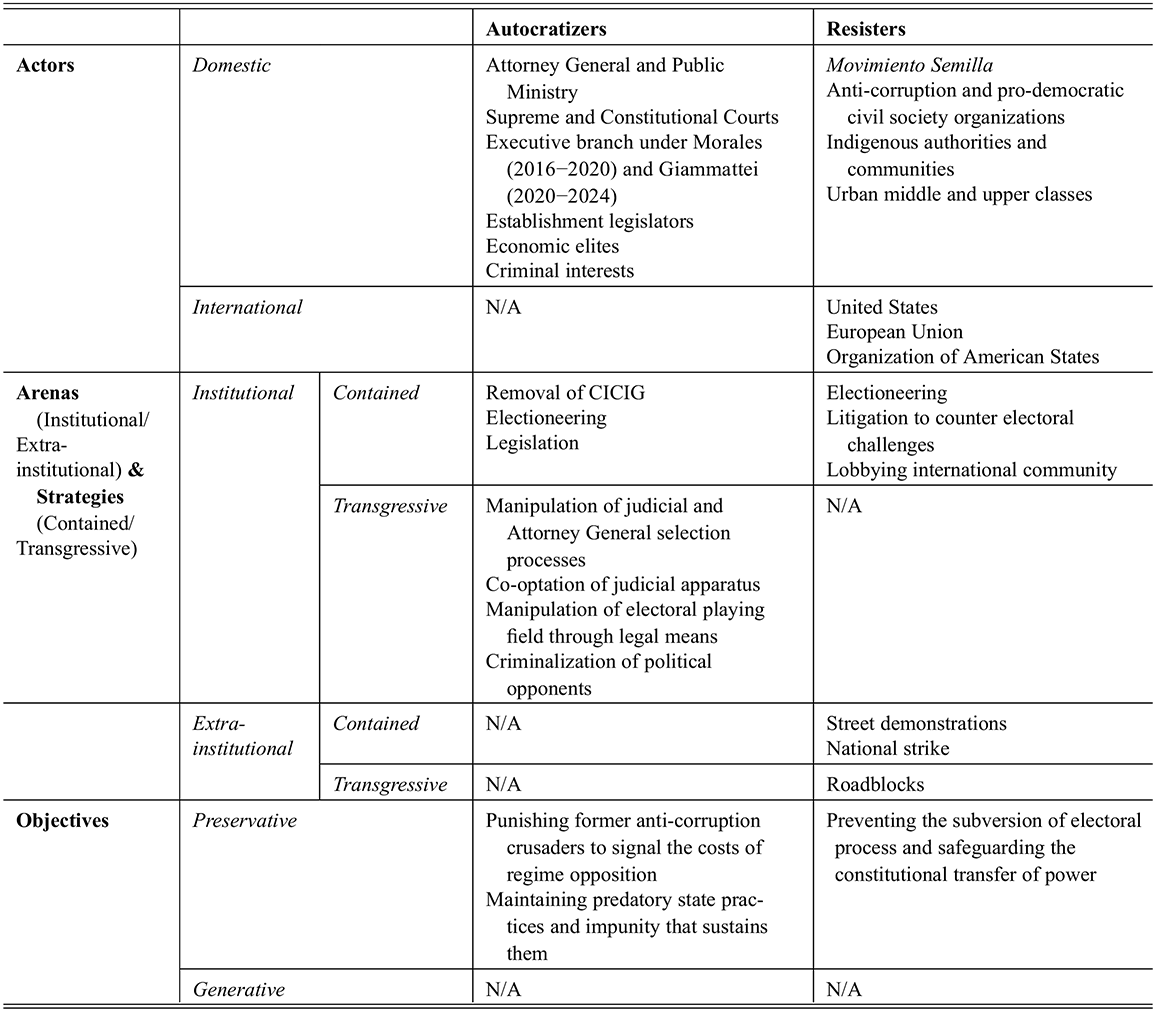
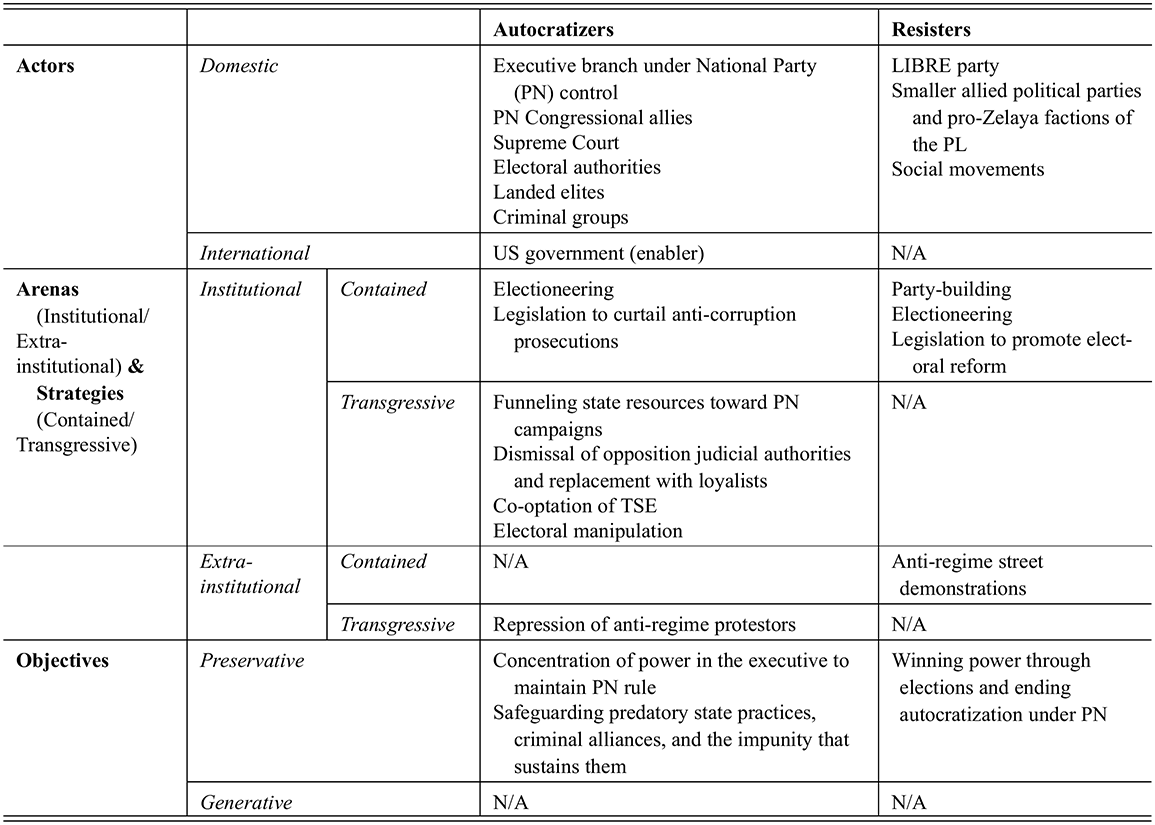
1 Introduction
Democratic erosion has become a leading global challenge. Literature conceptualizing, explaining, and assessing the magnitude of democratic backsliding, as well as research on how to resist it has boomed in the past decade (Cleary and Öztürk Reference Cleary and Öztürk2022; Gamboa Reference Gamboa2022a; Grumbach Reference Grumbach2022; Lührmann and Lindberg Reference Lührmann and Lindberg2019; Riedl et al. Reference Riedl, Friesen, McCoy and Roberts2024; Tomini, Gibril, and Bochev Reference Tomini, Gibril and Bochev2023; Tomini and Wagemann Reference Tomini and Wagemann2018; Waldner and Lust Reference Waldner and Lust2018). But as global attention has grown, so too have the forms that democratic erosion assumes. With few exceptions (Grumbach Reference Grumbach2022; Sánchez-Sibony Reference Sánchez-Sibony2023; Schwartz and Isaacs Reference Schwartz and Isaacs2023), most of the literature on autocratization has focused on “executive aggrandizement”: a particular kind of democratic backsliding led by elected executives (Bermeo Reference Bermeo2016). While the most common type of democratic erosion, executive aggrandizement is not the only one. In the past ten years we have seen the emergence of other forms of autocratization that encompass different actors, arenas of contention, strategies, and objectives.
Nowhere is this diversifying landscape of democratic erosion more evident than in Latin America. A brief glance at the universe of cases reveals that, in some places, the executive is not the engine of democratic backsliding. While the strongman-led erosion of democracy in El Salvador by Nayib Bukele (2019–present) has followed the classic executive aggrandizement playbook, in México, autocratization – while driven by populist executive Andrés Manuel López Obrador (2018–2024) – has been more focused on securing partisan rather than personal dominance. Distinct from both of these cases, in Perú (2016–present) and Guatemala (2017–2024) democratic backsliding has been a coalitional endeavor involving legislators, economic elites, and organized criminal groups. These last two efforts have also had different protagonists. In Perú, Congress has spearheaded the assault on institutions; meanwhile, judicial and prosecutorial authorities have taken the lead in undermining democracy in Guatemala. Present-day Latin America thus illustrates that populism is far from the only threat to democratic systems today. Weak and unpopular leaders outside the executive branch can also erode democratic institutions.
Autocratizing strategies are similarly diverse. Besides executive capture of legislative and judicial institutions, other tactics such as the weaponization of legal statutes, anti-corruption campaigns, and media and NGO restrictions vary across episodes of autocratization, warranting greater scrutiny. Likewise, the ends of democratic erosion – traditionally assumed to be the concentration of executive power in a single person – have diversified. In some cases, the goal is limiting partisan turnover, while in others, it is binding the executive’s hands to consolidate corruption and impunity for a broader elite coalition.
To better understand the dynamics of democratic erosion amid this varied landscape, this Element proposes a novel analytical framework that allows scholars to compare and explain episodes of democratic backsliding according to their most important dimensions: (1) the actors that promote autocratization and those that resist it, (2) the strategies that autocratizers and oppositions employ, (3) the arenas of contention in which they struggle over democratic norms and institutions, and (4) the objectives that these different actors pursue in the promotion of or resistance to democratic erosion. While this work is not the first to recognize the different pathways of democratic backsliding (Riedl et al. Reference Riedl, Friesen, McCoy, Roberts and Somer2023, Reference Riedl, Friesen, McCoy and Roberts2024, Reference Riedl, McCoy, Roberts and Somer2025), it improves upon previous approaches because of its attention to time and the dynamic interactions between autocratizers and their opponents. Incorporating concepts from the literature on contentious politics (largely neglected by most comparative studies of democratic erosion), this study better captures the relevant actors, strategies, arenas, and goals that result from the interplay between those leading the erosion of democracy and those opposing it.
In addition, we apply our new approach to five cases representative of Latin America’s second wave of democratic erosion: El Salvador, México, Perú, Guatemala, and Honduras. These cases vary significantly in terms of the protagonists and objectives of autocratization, reflecting scenarios of executive and partisan aggrandizement, elite collusion spearheaded by legislative and judicial actors, as well as cases that combine these patterns or shift between them over time. They thus provide opportunities to analyze and derive preliminary insights on the kinds of strategies pursued by different constellations of autocratizers and opposition actors, in hopes of stimulating future avenues of research and contributing to scholar and practitioner efforts to reverse alarming autocratic trends in the region.
This Element makes several contributions to the study of democratic erosion and resilience in Latin America and beyond. First, we unpack the diverse forms of democratic erosion that have developed in the last decade but remain underexplored. In so doing, we move beyond the predominant focus on strongman-led erosion propelled from the executive branch, thus decoupling democratic backsliding and populism and bringing a wider range of actors and processes into the picture.
Second, we contribute a novel analytical framework that better captures the processual quality and dynamic interactions that characterize episodes of democratic erosion. Building on existing ideal-type pathways, our framework further disaggregates backsliding episodes into four constituent components – actors, strategies, arenas of contention, and objectives – and focuses on capturing changes in these dimensions over time. In so doing, our approach makes room for the more diverse modalities of democratic erosion that have emerged in recent years, while also laying the groundwork for more generalizable concepts and theories.
This Element also makes important contributions to the study of democratic backsliding in Latin America specifically by integrating cases that have received less scholarly attention. Through our comparative perspective and focus on the interactions between incumbents and opposition, we contribute to growing conversations on the conditions and strategies that promote democratic resilience in a region that has seen alarming patterns of autocratization, as well as democratic breakthroughs.
In the remainder of this introductory section, we define democratic erosion and distinguish it from other parallel concepts. We also take stock of existing approaches to democratic backsliding and their limitations.
1.1 What Is Democratic Erosion?
Definitions of democratic erosion have proliferated over the past decade (Bermeo Reference Bermeo2016; Ginsburg and Huq Reference Tom and Huq2019; Haggard and Kaufman Reference Haggard and Kaufman2021; Lührmann and Lindberg Reference Lührmann and Lindberg2019; Waldner and Lust Reference Waldner and Lust2018). In this Element, we define democratic erosion as a type of regime transition from democracy toward autocracy that happens over time and originates from within the state (Gamboa 2022, 24–25). Like many military or civilian coups, successful democratic erosion pushes a regime outside the democratic camp. During episodes of democratic erosion, autocratizers target institutions of horizontal accountability (i.e. courts, congress, and oversight agencies) to such an extent that, when successful, they end up limiting vertical accountability (i.e. the ability of citizens to hold leaders accountable) as well. A democracy that has undergone a process of democratic erosion is, therefore, no longer a democracy – not even a delegative one (O’Donnell Reference O’Donnell1994, Reference O’Donnell2007) – but a competitive authoritarian regime. Unlike military or civilian coups, however, the erosion of democracy happens gradually and cumulatively. It may take years for autocratizers to capture and/or dismantle democratic institutions to such an extent that they undermine mechanisms of vertical accountability like elections.
Critically, we contend that democratic erosion comes from within the state. The quality of democracy can be negatively affected by myriad variables, some of which are captured by important indices like those of Freedom House or V-Dem. Yet not all these correlates indicate a process of regime change. Factors such as economic inequality, non-state violence, or vote-buying are pervasive in Latin America. Though negative for democracy, they do not necessarily signal a process of democratic erosion. We, therefore, focus on instances where governing authorities use and abuse institutions and institutional reforms to undermine democracy. Importantly, our definition considers how non-state actors, such as economic elites, criminal organizations, media, international actors, or other civil society groups, collude with governing authorities to debilitate democratic institutions. Yet, we contend that democratic erosion ultimately comes from within the state, even if other societal actors play an important role in the process.
The relatively gradual nature of democratic backsliding has important implications for the opposition. With sudden authoritarian ploys like military or executive coups, the violation of democratic norms and institutions is often blatant and unmistakable. The overthrow of a democratically elected government, a president’s order to close congress, or the overt stealing of an election is more likely to set off alarm bells domestically and abroad. On the contrary, the incremental changes and legal façade that characterize democratic erosion introduce what Somer and Tekirnirk (Reference Somer and Tekinırk2024) call “regime uncertainty,” whereby opposition actors struggle to assess the gravity of the threat to democracy. As a result, it is more difficult for pro-democratic forces to mobilize a united front against autocratization.
However, the cumulative nature of democratic erosion is also a blessing in disguise. Unlike sudden democratic ruptures, it affords the opposition time and resources to fight back and stall democratic decline. For this reason, it is critical to examine democratic erosion as a series of dynamic interactions and decisions – a tug-of-war – on the part of autocratizers and opposition actors (García Holgado Reference García Holgado2023, 85; Tomini and Gerschewski Reference Tomini and Johannes2025) – coalitions that themselves may shift over time too.
1.2 Existing Approaches to Democratic Erosion
Scholars have undertaken systematic efforts to explain how and why democratic erosion occurs. Some of this literature has focused on the factors that propel would-be autocrats to power. One set of explanations draws our attention to sweeping structural factors, such as deepening inequality, stagnating economies or mineral wealth (Haggard Reference Haggard2016; Mazzuca Reference Mazzuca, Domínguez and Shifter2013; Rau and Stokes Reference Rau and Stokes2025), poor governance (Handlin Reference Handlin2017; Mainwaring and Pérez-Liñán Reference Mainwaring and Pérez-Liñán2023a), technological and communicative innovations (Meléndez-Sánchez Reference Meléndez-Sánchez2021), widening political polarization (Graham and Svolik Reference Graham and Svolik2020; McCoy, Rahman, and Somer Reference McCoy, Rahman and Somer2018), the influence of global autocratic powers (Corrales Reference Corrales2015; Cottiero and Haggard Reference Cottiero and Haggard2023; Meyerrose Reference Meyerrose2020), and institutional weakness (Weyland Reference Weyland2024, Reference Weyland2025).
More recently, however, the literature has paid greater attention to the agency of political actors (Tomini, Gibril, and Bochev Reference Tomini, Gibril and Bochev2023). Certain social, economic, and institutional characteristics may be correlated with democratic erosion, but it is elites’ contingent decision-making and fluid interactions that shape the process itself (Carrión Reference Carrión2022; Cleary and Öztürk Reference Cleary and Öztürk2022; Gamboa Reference Gamboa2022a; García Holgado and Mainwaring Reference García Holgado2023; Garcia-Holgado Reference García-Holgado2025; Somer, McCoy, and Luke Reference Murat, McCoy and Luke2021).
Though we side with agentic theories of democratic erosion, we also find conventional agency-based approaches limiting in two ways. First, existing frameworks assume that the central political actor promoting democratic erosion is the head of government and that its core objective is the concentration of power in the executive. Under this executive aggrandizement model, anti-democratic leaders with hegemonic aspirations come to power via elections and steadily dismantle the checks on their power by rewriting electoral rules, transforming the legislature into a rubberstamp, co-opting the judiciary, and weaponizing the law to neutralize challengers, among other actions. The ends of these incremental efforts to subvert democracy appear to be straightforward: for the executive to accumulate total control and remain in power.
While executive aggrandizement may remain the modal pathway of democratic erosion, it is far from the only one. As we discussed earlier, even a brief glance at the universe of cases within Latin America, especially in the last decade, suggests that alternative protagonists may propel democratic erosion in the pursuit of distinct goals. The locus of democratic backsliding may reside in other branches of government, or in elite coalitions that reflect diverse interests. Efforts to examine and explain contemporary forms of democratic erosion thus require more expansive frameworks capable of analyzing episodes that are not executive-led.
A second shortcoming of existing approaches is their tendency to isolate the process of democratic erosion and the strategies and actions of those fighting back. Scholarship on backsliding and resistance to it has largely evolved as two separate strands of research with limited attention to the inherent push and pull involved in struggles over democracy. Even accounts that incorporate greater focus on agency miss the dynamic interactions between the motivations, strategies, and actions of autocratizers and those of their opponents. Yet, if democratic erosion is a process that consists of incremental changes to debilitate democratic institutions, incumbent actions and opposition responses cannot be divorced from one another. Any viable approach to understanding democratic backsliding must capture the full array of erosion and opposition agents and their fluid and dynamic interactions over time.
One recent approach put forward by Rachel Beatty Riedl, Jennifer McCoy, Kenneth Roberts, and Murat Somer (Reference Riedl, McCoy, Roberts and Somer2025) addresses some of these limitations and delineates four pathways of democratic backsliding. Three of the four pathways reflect forms of executive aggrandizement. They include: (1) legislative capture, in which the executive enjoys the backing of a “strong and disciplined political party” that allows her to dismantle democracy by passing laws or approving constitutional reforms; (2) plebiscitary override, which occurs when the executive lacks legislative muscle but enjoys mass support and uses popular referenda to impose her will and subvert democracy; and (3) executive power grabs, in which incumbents use decree powers, coercive capacities, and/or the co-optation of independent agencies to concentrate power. The fourth pathway, elite collusion, recognizes that the executive may not be the protagonist of democratic erosion and instead reflects a scenario in which other elite actors align and collaborate “to share power and the spoils of office” (23).
The theorized pathways entail specific predictions for the possibilities of resistance. For instance, Riedl and co-authors note that legislative capture is particularly difficult for the opposition to confront because the use of legislative avenues provides a veneer of legality and legitimacy to the dismantling of democratic institutions. Yet, because incumbents rely on the legislative arena, the separation of powers remains intact and makes it possible to contest this institutional space via elections (Riedl et al. Reference Riedl, McCoy, Roberts and Somer2025, 13–15). Meanwhile, in contexts of elite collusion, contentious politics alongside electioneering may be useful to disarticulate the dominant autocratic coalition (24).
These pathways offer significant contributions to the study of democratic erosion, namely by helping “to clarify which sites have been captured and which remain open for contestation and resistance” (25). Yet, while this framework better accounts for the diverse modalities of democratic erosion, it is ultimately too rigid and does not incorporate the array of erosion agents and shifts in arenas of contention and strategies as incumbent-opposition interactions play out.
This is especially the case for elite collusion. Though this pathway captures erosion processes that are not executive-led, it is more of a catch-all category and does not specify which elites matter, how, or when. Even in the cases of elite collusion cited by Riedl et al. (Reference Riedl, McCoy, Roberts and Somer2025), such as Nicaragua, Guatemala, Benin, and Indonesia, elite coalitions play vastly different roles in democratic erosion. In Nicaragua, a pact between political elites paved the way for executive aggrandizement (McConnell Reference McConnell2025), a dynamic similar to that seen in Benin (Koter Reference Koter2025). Meanwhile, in Indonesia, elite collusion has, in some moments, enabled executive aggrandizement and, in others, restrained it (Mietzner Reference Mietzner2025). Elite collusion in Guatemala, however, is quite distinct; here, elected officials, business elites, criminal groups, and judicial authorities have routinely closed ranks when rent-seeking and impunity come under threat (Meléndez-Sánchez and Perelló Reference Meléndez-Sánchez and Perelló2025). Over time, the executive did not come to dominate Guatemala’s autocratic coalition but remained subordinate to it. Amid this variation, understanding how elite collusion propels democratic erosion requires a deeper analysis of its constituent parts and their cohesiveness, the resources different elites bring to bear, and how they respond to opposition challenges.
Relatedly, the approach put forward by Riedl and co-authors assumes that the ends of democratic erosion are to centralize power in the incumbent, even in cases of elite collusion. In these instances, however, the goal may be to undermine rather than concentrate political authority to secure corruption and impunity. Indeed, the objective(s) of backsliding may in fact be multiple and varied, as in the case of Perú’s “legislative authoritarianism” (Sosa-Villagarcia, Incio, and Arce Reference Sosa-Villagarcia, Incio and Arce2025) – a form of elite collusion not contemplated within Riedl et al.’s (Reference Riedl, McCoy, Roberts and Somer2025) pathways. Here, short-term, particularistic incentives among lawmakers of different political stripes first drove members of Congress to undermine state capacity and then concentrate power in the legislature. It is also possible that the ends of democratic erosion shift over time in response to the fluid nature of the anti-democratic coalition itself. Rather than assume that autocratizers hold the same objectives across time and space, we posit that this aspect of democratic erosion ought to be an object of analysis itself.
A final critique of Riedl et al.’s pathways approach is that it conflates the arenas in which autocratizers and opposition actors contest democratic institutions and the strategies that they deploy to do so. While the authors concede that the pathways they identify are not mutually exclusive, implicit in their framework is the idea that actors deploy strategies within specific institutional (or extra-institutional) spaces based on the strategic resources they possess. For example, autocratizers recur to plebiscitary override when they lack the robust and loyal parties necessary to capture the legislature. Yet, the empirical record suggests that these dynamics are not so straightforward. For example, in the United States, the second Donald Trump administration (2025–present) has preferred executive orders to challenge democratic institutions despite having a Republican majority in both houses of Congress. Likewise, in Venezuela, the opposition disregarded elections early in the process of erosion when electoral contests were still free and minimally fair, but used them later when the incumbent regime had serious advantages (Gamboa Reference Gamboa2025b). For these reasons, we posit that the study of democratic erosion requires separating the arenas in which autocratization is advanced and contested and the strategies used to promote or oppose it.
In sum, research to describe, analyze, and explain democratic erosion has progressed significantly in recent years, bringing much needed rigor to scholarly debates on this topic. While recognizing the possible structural underpinnings of democratic erosion, extant theories place actors at the center of backsliding processes – and rightfully so. We contend, however, that existing frameworks still remain too reductive and rigid, especially as scholars pinpoint a wider array of erosion agents and the ways in which interactions between autocratizers and opposition shape erosion trajectories. In the following section, we put forward a new analytical framework that accounts for these shortcomings.
2 Unpacking Democratic Erosion: An Analytical Framework
Our approach takes seriously the contingencies and complexities of episodes of democratic erosion. For this reason, we incorporate earlier theories of regime change and dominant theories of contentious politics that highlight both the role of perceived threats (Almeida Reference Almeida, Snow, Soule, Kriesi and McCammon2019; Jasper and Polletta Reference Jasper, Polletta, Snow, Soule, Kriesi and McCammon2019; McAdam Reference McAdam1999; Tilly Reference Tilly1978) and opportunities (McAdam, McCarthy, and Zald Reference Doug, McCarthy and Zald1996; McAdam and Tarrow Reference McAdam, Tarrow, van Stekelenburg, Roggeband and Klandermans2013, Reference McAdam, Tarrow, Snow, Soule, McCammon and Kriesi2019), as well as agents’ decision-making (Linz Reference Linz1978; O’Donnell and Schmitter Reference O’Donnell and Schmitter1986) – all of which shape and are shaped by the structural and institutional environment and the erosion process’ relational dynamics.
To this end, we borrow several insights from the literature on contentious politics to construct our framework for analyzing episodes of democratic erosion and resistance. First, ours is a mechanism-based account that is more concerned with the “how” of democratic erosion and opposition to it than the “why” (McAdam, Tarrow, and Tilly Reference Doug, Tarrow and Tilly2001; Tarrow Reference Tarrow2011, 185–193). Our overall objective is not to identify the variables that explain democratic erosion or that enable democratic resilience. Instead, we approach backsliding through “the analysis of small-scale causal mechanisms that recur in different combinations with different aggregate consequences in varying historical settings” (McAdam, Tarrow, and Tilly Reference Doug, Tarrow and Tilly2001, 24). In so doing, we recognize that no two episodes of democratic erosion and opposition will unfold in exactly the same way (even within the same country at distinct moments in time); however, similar kinds of events or actions – whether external shocks, shifts in perceptions, or new linkages between groups – may be present across cases.
Relatedly, like O’Donnell and Schmitter (Reference O’Donnell and Schmitter1986) and Linz (Reference Linz1978) analyzing earlier waves of regime change, we conceive of democratic erosion and resistance to it as highly dynamic and relational processes. Our framework thus allows us to account for the critical dimension of time. In addition to disaggregating democratic backsliding and opposition into their constituent parts, we put each of these parts “into motion” (McAdam, Tarrow, and Tilly Reference Doug, Tarrow and Tilly2001, 43), recognizing how the actors, strategies, arenas of contention, and goals may shift in response to evolving opportunities, threats, decisions, and actions.
In opting to more slowly chip away at democratic institutions, the perceptions, decisions, and strategies of autocratizers may be shaped by the responses to their rhetoric and actions. Likewise, the protracted nature of democratic erosion adds a relational element to opposition approaches, providing opportunities to forge new coalitions, marshal new resources, and adapt strategic actions to confront the evolving challenge.
In short, while specific actors may set off this process by deploying specific strategies to achieve specific ends, none of these dimensions remains static throughout the life cycle of an erosion episode. The constellations of actors maneuvering to undermine or safeguard democracy shift over time – whether due to executive capture of new political blocs and spheres of influence, or because state and non-state actors defect from the ruling coalition and join the opposition. Similarly, the goals for furthering or resisting democratic erosion evolve in response to this fluid environment. While opposition goals shift between moderate and radical depending on how events unfold, autocratizers may vary from wanting to extend the leader’s rule, seeking to consolidate party domination, and/or angling to safeguard illicit, rent-seeking activities regardless of who is in power.
The analytical framework we elaborate in this Element invites scholars to track over time the evolution of four key dimensions: (1) the actors that promote autocratization and those that resist it, (2) the strategies that autocratizers and oppositions employ, (3) the arenas of contention in which they struggle over democratic norms and institutions, and (4) the objectives that these different actors pursue in the promotion of or resistance to democratic erosion.Footnote 1 Our approach is meant to provide scholars the tools to systematically analyze different episodes of democratic erosion according to their constituent parts. It does not on its own offer a unified theory or testable hypotheses for why or how backsliding processes or opposition to them occur. However, our hope is that, by proposing an analytical framework that applies widely to different modalities of backsliding, empirical research can uncover broader theoretical insights on how different combinations of actors, strategies, arenas of contention, and objectives shape erosion trajectories.
We provide a menu of options within each of our four analytical categories (see Table 1). The relevant constellations of incumbent and opposition actors, for example, can include governmental and nongovernmental, domestic and international players. Moreover, depending on the context, similar kinds of actors may find themselves on different sides of the autocratizer–opposition divide. Some judges, for example, may uphold the rule of law against the wishes of autocratizers, while others may greenlight the dismantling of democratic checks. It is also conceivable that the same actors shift their postures over time. For instance, as we illustrate in the Guatemalan case, key institutional actors like the magistrates of the Supreme Electoral Tribunal (TSE) initially aligned with autocratizing forces but eventually became leading democracy defenders when judicial officials sought to overturn the 2023 election results.
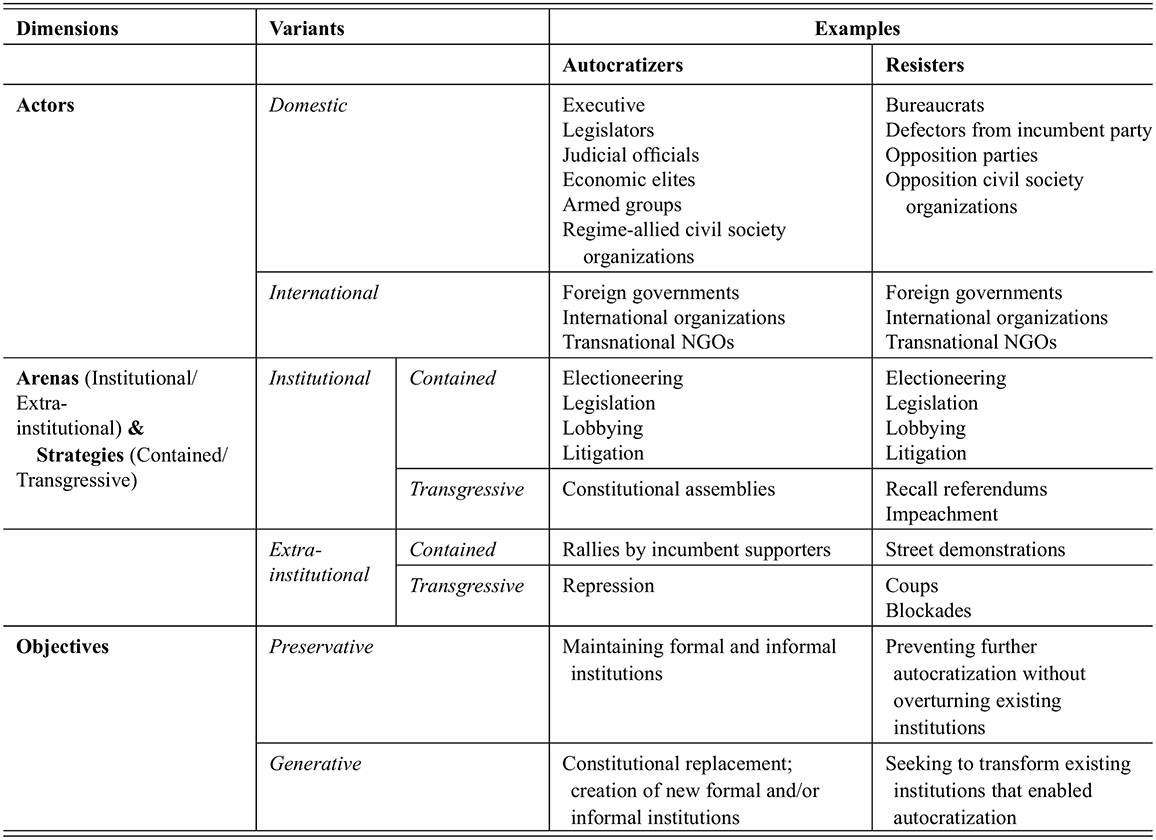
Table 1 Long description
The table describes the possible actors, arenas, strategies, and objectives that characterize episodes of democratic erosion both for autocratizers and resisters. There are two types of actors: 1) domestic actors, and 2) international actors. Domestic actors include autocratizers and resisters: Autocratizers include the executive, legislators, judicial officials, economic elites, armed groups, and regime-allied civil society organizations. Resisters include bureaucrats, defectors from the incumbent party, opposition parties, and opposition civil society organizations. International autocratizers and international resisters include foreign governments, international organizations, and transnational N G O's. Arenas can be institutional or extra-institutional, and strategies can be contained or transgressive. Contained institutional strategies include electioneering, legislation, lobbying, or litigation. Transgressive institutional strategies include constituent assemblies for autocratizers, and recall referendums and impeachment for resisters. Contained extra-institutional strategies would be rallies by incumbent supporters for autocratizers, and street demonstrations for resisters. Transgressive extra-institutional strategies would be repression for autocratizers, and coups and blockades for resisters. Finally, there are two types of objectives: Preservative and generative. Preservative objectives can be maintaining formal or informal institutions for autocratizers, and preventing further autocratization without overturning existing institutions for resisters. Generative objectives can be constitutional replacement; creation of new formal and or informal institutions for autocratizers, and seeking to transform existing institutions that enabled autocratization for resisters.
The relevant arenas of contention can consist of specific institutional domains such as congress, courts,Footnote 2 or elections, or they may be extra-institutional, instead involving societal spaces outside of the governmental sphere.Footnote 3 This distinction recognizes that actors within both autocratizing and opposition camps have state-sanctioned channels of deliberation, dispute resolution, and participation at their disposal, as well as venues that fall outside of formal institutional domains.
The strategies within institutional and extra-institutional arenas can also vary from contained actions – tactics that employ well-established means of claims-making such as electioneering or pre-planned, authorized street demonstrations – to transgressive actions – tactics that do not use well-established means of claims-making such as impeachments or coups to oust the incumbent (McAdam, Tarrow, and Tilly Reference Doug, Tarrow and Tilly2001, 7). The difference between contained and transgressive actions goes beyond their constitutionality or whether they occur through formal institutional channels. It hinges on whether the strategies used “implicitly convey an acceptance of the established, or ‘proper’ channels of conflict resolution” or they represent a radical break with routine democratic politics (Gamboa 2022b, 36–37; McAdam Reference McAdam1999, 57). Though procedures for recall referenda and impeachments often have constitutional bases, they upend routine democratic politics by seeking to oust a leader and often name a new one in ways that depart from regular mechanisms of vertical accountability (i.e. popular elections). Likewise, even though street protests occur outside of normal institutional channels, to the extent that they are peaceful and/or planned, they often reflect a habitual means of claims-making covered by democratic protections for free expression and assembly. As such, they may be considered contained rather than transgressive.
Finally, objectives can be preservative or generative. Following Somer et al. (Reference Murat, McCoy and Luke2021, 936), we categorize goals as preservative if they seek to protect or return to a pre-existing set of political arrangements and rules; we categorize goals as generative if they aim to expose entrenched interests or fundamentally change the polity, the economy, or social structures. Under the classic executive aggrandizement playbook, populist leaders often win elections promising vast transformations to the status quo and frame the “disassembling of institutions that might challenge the executive” as the means of achieving this change (Bermeo Reference Bermeo2016, 11). Yet this is not always the goal of autocratizers, who may – depending on the key players and their allies – instead seek to protect longstanding corruption networks or constrain executive power and aggrandize other institutions, as our analysis of the Peruvian and Guatemalan cases will illustrate. Likewise, opposition actions may pursue minimalist efforts to re-establish the political contract as it was before the aspiring autocrat came to power – a preservative objective. Yet, recognizing the structural deficiencies that allowed autocratic forces to gain momentum in the first place, oppositions may seek reforms to upend existing structures and forge a new social contract entirely. Such aims would instead reflect transformative opposition goals.
While our approach responds to previously theorized pathways that we see as too rigid (Riedl et al. Reference Riedl, Friesen, McCoy, Roberts and Somer2023, Reference Riedl, Friesen, McCoy and Roberts2024, Reference Riedl, McCoy, Roberts and Somer2025), an important critique is that our framework is too disaggregated, leading to case study analyses that are overly particularized and not conducive to deriving generalizable concepts and theories. We would contest this argument in two ways. First, attempting to shoehorn cases of democratic erosion into a limited number of discrete types ultimately obscures nuanced dynamics that require scholarly attention if our goal is to contribute to democratic resilience. In other words, getting the cases right, in all their complexity, matters for countering democratic erosion on the ground where civic and political spaces are closing and fundamental rights are increasingly under threat.
Second, we posit that our analytical framework, which centers on actors, arenas, strategies, and objectives, as well as their interaction over time, provides a productive middle ground between the overly particularistic and the overly general. Leveraging existing theories of contentious politics, we are attentive to both the political opportunities and constraints that shape opposition and regime responses (McAdam Reference McAdam1999), and the strategic approaches that relax some of the structural assumptions of models focused solely on resources or opportunities (see McAdam, Tarrow, and Tilly Reference Doug, Tarrow and Tilly2001, 24–32; Jasper Reference Jasper2006 critique).
While our approach is largely inductive, it is neither atheoretical nor averse to generalizable insights. By starting from the ground, we endeavor to shed light on the constituent components of new forms of democratic erosion to derive preliminary insights and stimulate future research on how different constellations of actors, arenas of contention, strategies, and objectives shape this important global phenomenon.
3 Analyzing the New Wave of Democratic Erosion in Latin America
With this new approach in mind, we now turn to an analysis of democratic erosion in Latin America. The primary task of this section is to apply our framework to select Latin American cases that fall within the more recent wave of democratic erosion. These include El Salvador (2019–present), México (2018–present), Perú (2016–present), Guatemala (2017–2024), and Honduras (2015–2022). Before delving into our case analyses, however, we first take stock of patterns of democratic erosion in the region during the past three decades.
3.1 Waves of Democratic Erosion in Latin America
Nowhere is the diversifying landscape of democratic erosion more evident than in Latin America. Since the third wave of democratization in the 1980s and 1990s, levels of democracy in the region have dipped. After peaking in 2002, V-Dem’s Electoral and Liberal Democracy scores in the region declined by 0.07 and 0.06 (roughly a fourth of a standard deviation) from 0.65 and 0.48 to 0.58 and 0.42, respectively. This decrease, however, has not been constant (Nord et al. Reference Nord, Lundstedt, Altman and Angiolillo2024, 54). These downward trends reflect two different moments. The first began in the early 2000s with cases of democratic erosion (or attempted erosion) in Venezuela, Bolivia, Ecuador, Nicaragua, Honduras, and Colombia, which leveled off at the end of the decade. The second gained ground in the mid 2010s and remains in effect as of this writing. The cases of democratic erosion within this second wave include Brazil, Guatemala, México, El Salvador, Perú, and Honduras.Footnote 4
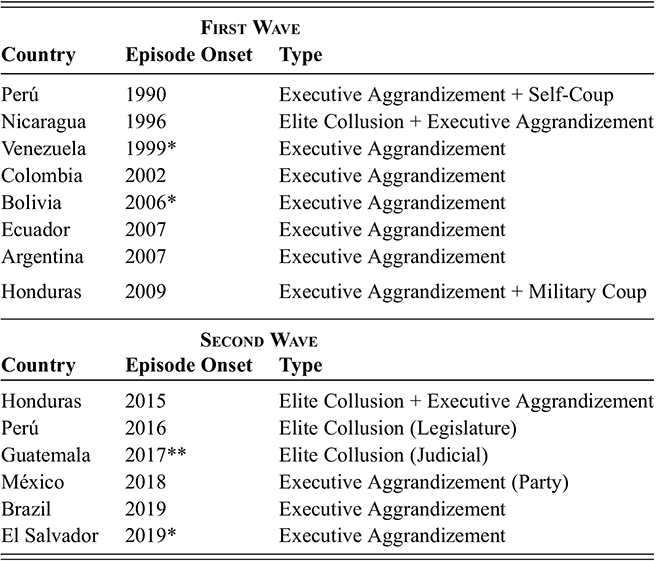
Table 2 lists episodes of democratic erosion that have unfolded in the region since 1990, which clearly correspond to the two waves.Footnote 5 Comparing cases across these two moments underscores the wider variation in modalities of democratic erosion today. Whereas most cases from the first wave, such as Hugo Chávez’s Venezuela (1999–2013), Rafael Correa’s Ecuador (2007–2017), Daniel Ortega’s Nicaragua (2007–present), and Álvaro Uribe’s Colombia (2002–2010), reflect efforts to concentrate power in the executive through “plebiscitary override” or institutional capture,Footnote 6 only a few cases in the subsequent moment beginning in the mid 2010s have followed the executive aggrandizement model (i.e. Jair Bolsonaro’s Brazil [2019–2022] and Nayib Bukele’s El Salvador [2019–present]). Instead, this second wave has been marked by more diverse forms of backsliding.
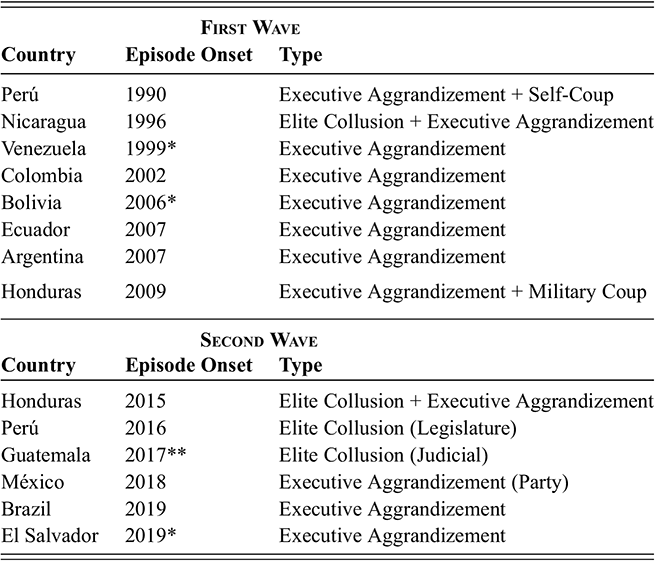
Table 2 Long description
The table describes episodes of democratic erosion in Latin America between 1990 and 2024, including the year of onset and the form that the episode has taken. These forms include executive aggrandizement, seen in cases like Venezuela (1999), Colombia (2002), Bolivia (2006), Ecuador (2007), Argentina (2007), Brazil (2015), and El Salvador (2019). Also within the first wave of democratic erosion are cases like Perú (1990), which experienced executive aggrandizement and a self-coup; Nicaragua (1996), which experienced elite collusion and then executive aggradizement; and Honduras (2009), which faced executive aggrandizement and then a military coup. In the second wave of democratic erosion in Latin America, we see variations of elite collusion: In Honduras (2015), it is combined with executive aggrandizement, in Peru (2016) it is led by legislative actors, and in Guatemala (2017) it is spearheaded by judicial actors. There are also more classic cases of executive aggrandizement in Brazil (2019) and El Salvador (2019). Finally, Mexico (2018) experienced party-led executive aggrandizement.
* According to V-Dem, democratic decline in these countries started in 1994 (Venezuela), 2002 (Bolivia), and 2018 (El Salvador). These starting points are likely capturing declines in the “quality of democracy” rather than state-led forms of democratic backsliding which is the process we are interested in.
** According to V-Dem, democratic decline in Guatemala did not start until 2018; however, we posit that attacks on rule of law institutions began in 2017.
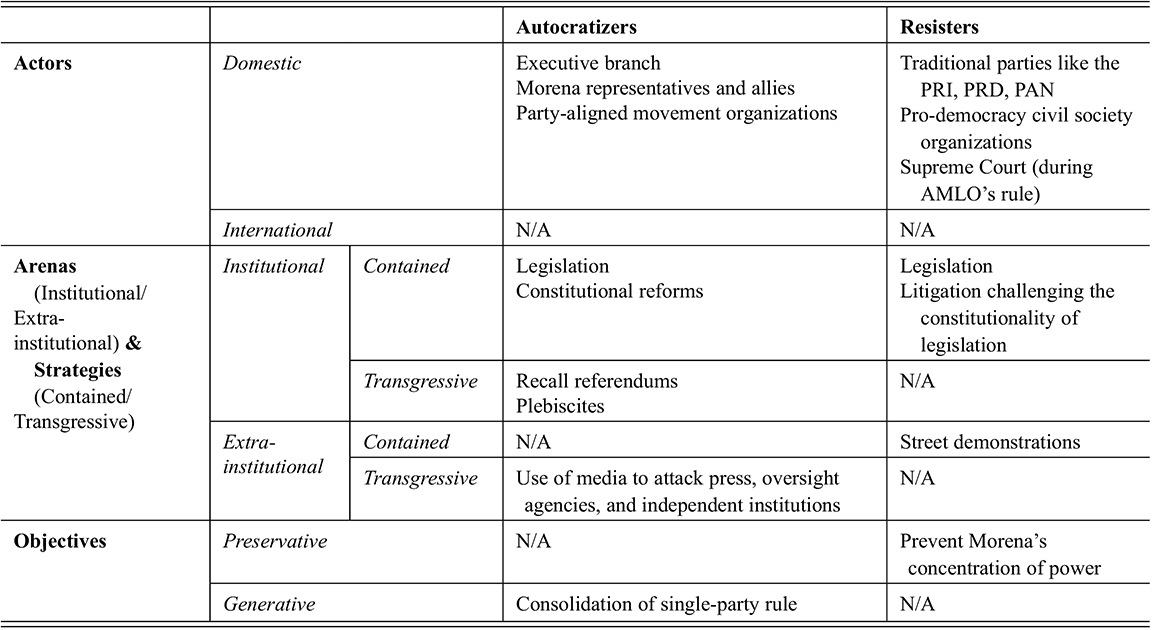
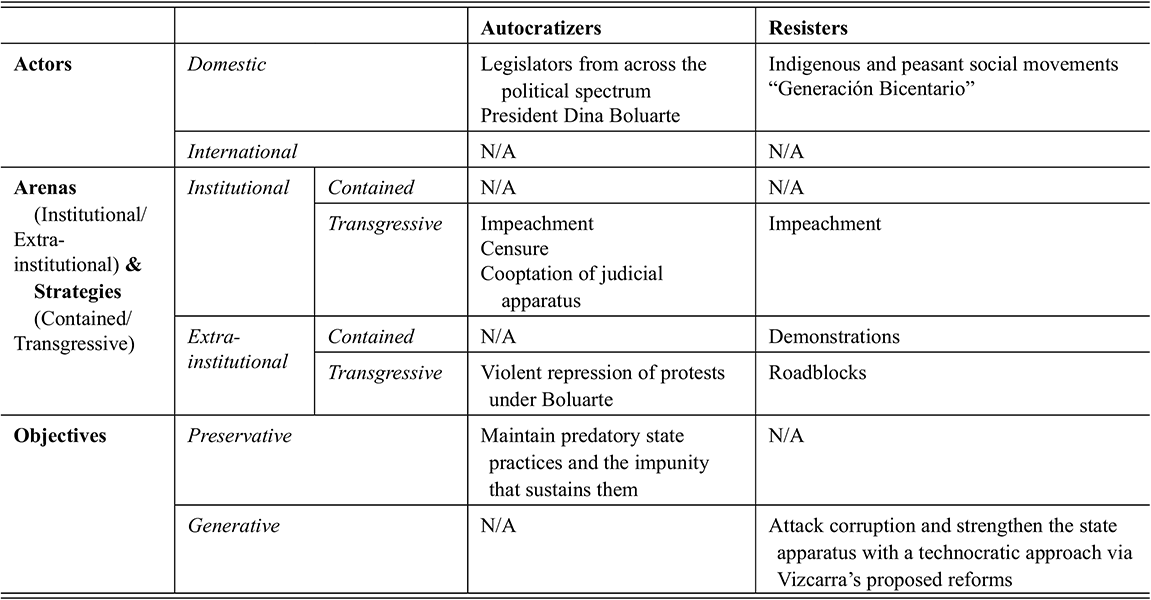
In the case study analyses that follow, we utilize the framework elaborated in the previous section to examine the trajectories and dynamics of democratic erosion and opposition to it in five of the more recent cases in Latin America: El Salvador, México, Perú, Guatemala, and Honduras. These five episodes reflect the diversified modalities of democratic erosion, allowing us to delve into cases that depart from the executive aggrandizement model. While we start with Nayib Bukele’s populist-led erosion in El Salvador (2019–present), the subsequent cases diverge from executive aggrandizement in ways big and small. México under Andrés Manuel López Obrador (AMLO) (2018–present) represents a case of partisan aggrandizement. Andrés Manuel López Obrador’s (AMLO) (2018–2024) populist brand and tactics to subordinate other branches of government resemble patterns of executive aggrandizement; however, unlike most other executive-led erosion cases, securing the advantage of his party, Morena, has taken precedence over his personal survival in office. Perú’s ongoing episode of erosion (2016–present), by contrast, has been characterized by a very weak executive, a legislative effort to undermine state capacity, and an eventual expansion of legislative power. More squarely in the elite collusion model, in Guatemala (2017–2024), judicial and prosecutorial authorities steadily dismantled democratic institutions, yet were backed by a much broader coalition. Meanwhile, Honduras has veered between elite collusion and executive aggrandizement, as longstanding inter-party accords to maintain impunity co-existed alongside the concentration of presidential power under President Juan Orlando Hernández (2014–2022). This range of cases, therefore, allows us to compare the course of erosion episodes when the players, arenas, and objectives vary.
The diverse modalities of democratic backsliding imply different opposition strategies and degrees of democratic resilience, which allows us to probe how different types of erosion shape forms of resistance and vice versa. In El Salvador, opposition resistance became tepid within a year of Bukele’s government, while pushback early in AMLO’s sexenio gave way to major partisan gains by the incumbent in México. By contrast, the Guatemalan opposition managed to arrest autocratization, marshaling a broad coalition to win and defend its electoral victory. Similar opposition strategies proved effective in Honduras even though the country had already plunged into competitive authoritarianism. These distinct responses provide an opportunity to assess the interaction between autocratizers and resisters across different modalities of democratic erosion.
Moreover, this set of erosion episodes brings much-needed attention to countries that have remained relatively understudied within the literature on democratic backsliding and resistance vis-a-vis more attention-grabbing examples such as Chávez (1999–2013) in Venezuela or Bolsonaro (2019–2022) in Brazil. Collectively, these cases also overcome the tendency to study Central and South American countries separately due to differences in size, political history, socioeconomic development, and geopolitical dynamics. Our analyses illustrate that much can be learned by bringing episodes within these subregions into conversation with one another.
3.2 Executive Aggrandizement in El Salvador (2019–2025)
According to V-Dem’s 2024 report, El Salvador experienced one of the world’s most notable “bell-turn” episodes of regime change, whereby “democratization turns into autocratization within maximum five years after the end of democratic advances” (Nord et al. Reference Nord, Lundstedt, Altman and Angiolillo2024, 25). Indeed, the decline in El Salvador’s score on the Liberal Democracy Index between 2018 and 2023 has been greater than any of the other contemporary “bell-turn” episodes worldwide (Nord et al. Reference Nord, Lundstedt, Altman and Angiolillo2024, 26–27). During this period, the country completely erased the democratic gains made since its peace process in 1992.
Following the executive aggrandizement playback that characterized Latin America’s earlier wave of democratic erosion, El Salvador’s authoritarian regressions have centered on a single hegemonic figure: Nayib Bukele, who was elected president by a landslide in 2019 and has remained in office since. Bukele’s rise brought the collapse of El Salvador’s stable two-party system. Building his personal brand through savvy social media appeals, he not only cultivated sky-high approval ratings at home (Galdamez Reference Galdamez2025) but has won adoring fans among heads of state and wealthy businesspeople abroad (Freeman Reference Freeman2023).
The cult of personality that surrounds Bukele has both contributed to and been fueled by his systematic assault on democratic norms and institutions. Opposition forces in El Salvador have been wholly incapable of curtailing Bukele’s accumulation of power, despite early majorities in the legislature and attempts to resist his initial power-grabs. The Salvadoran case thus illustrates the particular challenges of confronting democratic erosion when party system collapse meets charismatic leadership. Such contexts enable autocrats to pursue executive aggrandizement in the service of generative objectives, locking in authoritarian gains and dimming the prospects of future opposition.
3.2.1 Democratic Erosion in El Salvador
Despite its tumultuous political history, which included nearly five decades of military rule (1931–1979) and twelve years of bloody armed conflict (1979–1992), El Salvador developed one of Latin America’s most institutionalized political party systems. From the end of the civil war to the mid 2010s, Salvadoran politics revolved around two main parties: the right-wing Nationalist Republican Alliance (ARENA) created by former military officials and landed elites in 1981 and the Farabundo Martí National Liberation Front (FMLN), the organization encompassing the country’s leftist insurgent groups that transformed into a political party at war’s end. From 1989 to 2019, these two parties controlled both the executive and legislative branches, making the Salvadoran party system one of the least volatile in the region (Mainwaring Reference Mainwaring and Mainwaring2018a, 53).
Despite this stability, however, the thirty years of ARENA and FMLN rule failed to solve El Salvador’s most pressing problems. High levels of violence and criminal activity, largely at the hands of the Mara Salvatrucha (MS-13) and Barrio 18 (18th Street) gangs, instilled fear and hampered human development. By 2015, El Salvador’s intentional homicide rate had skyrocketed to 107 murders per 100,000 people, making it the most violent country in the world that year.Footnote 7 During the same period, a reported 70% of Salvadoran businesses faced gang extortion. Roughly $4 billion a year, or 15% of the country’s GDP, was squandered due to violence, extortion, and the costly measures firms took to operate in such a dangerous environment (Zaidi Reference Zaidi2019).
While ARENA and the FMLN proved incapable of curtailing crime and the Salvadoran economy stagnated, a raft of corruption scandals further delegitimized the two main parties. ARENA president Francisco Flores (1999–2004) was charged with funneling $15 million in humanitarian assistance into personal and party coffers (Roberts Reference Roberts2016). His successor, ARENA’s Tony Saca (2004–2009), pled guilty in 2018 to embezzlement and money laundering involving $300 million in state funds (BBC 2018). The two FMLN presidents, Mauricio Funes (2009–2014) and Salvador Sánchez Céren (2014–2019), fled to Nicaragua after their terms ended to avoid similar corruption charges (Tian Reference Tian2021).
The revelations only fueled widespread anger and disillusionment with political institutions. On the eve of the 2019 election, nearly two-thirds of Salvadorans expressed dissatisfaction with the country’s democratic system and almost eight-in-ten indicated that Salvadoran political parties did not represent them (Meléndez-Sánchez Reference Meléndez-Sánchez2021, 20; Perelló and Navia Reference Perelló and Navia2022, 274). To make matters worse, the parties underwent a process of ideological convergence that led to what Lupu (2015) calls “brand dilution.” Though historically on opposite sides of the ideological spectrum, the two traditional parties pursued similar hardline security policies and neoliberal economic programs, thereby weakening partisanship.Footnote 8
Seizing the opening, candidate Nayib Bukele, though himself a creature of the FMLN’s political machine, maintained an ambiguous ideological position to capture moderate voters while also building his brand as the outsider El Salvador needed to challenge “los mismos de siempre” (“the same [politicians] as always”) (Meléndez-Sánchez Reference Meléndez-Sánchez2021; Perelló and Navia Reference Perelló and Navia2022). After his landslide victory with 53% of the vote under the temporary label of the Grand Alliance for National Unity (GANA), Bukele’s New Ideas party (Nuevas Ideas, NI)Footnote 9 became his personal electoral vehicle and a symbol of his rupture with the corrupt establishment.
During Bukele’s first two years in office, ARENA and FMLN still enjoyed substantial political representation. Together they held 56% of the legislative seats. To overcome the institutional disadvantage, Bukele resorted to transgressive institutional and extra-institutional strategies. In the lead-up to the 2019 election, he encouraged mobs of supporters to swarm the offices of electoral authorities and the attorney general. In February 2020, he staged a dramatic act of legislative intimidation, when, threatening a self-coup, he led security forces into Congress to strong-arm opposition lawmakers into approving an international loan central to his security agenda (Meléndez-Sánchez Reference Meléndez-Sánchez2021, 21–22). The moment demonstrated the lengths Bukele was willing to go to challenge the authority of opposition-controlled institutions.
Bukele’s early authoritarian moves also targeted the media. In September 2020, the president announced a money-laundering probe into the award-winning investigative outlet El Faro – a charge that came just weeks after its journalists had uncovered his alleged negotiations with MS-13 leaders to reduce violence and shore up NI’s electoral support (Nalvarte Reference Nalvarte2020). The claims followed continued harassment of other Salvadoran media organizations and figures, including the use of Pegasus spyware to hack the phones of thirty-five journalists and civil society leaders (Jones Reference Jones2022).
Autocratization in El Salvador reached new levels in 2021 when NI won a supermajority in the Legislative Assembly. Thereafter, Bukele’s assault on civil and political rights was combined with a swift campaign to undermine checks on the executive and extend his time in office. On the first day of the new legislative session in May 2021, NI and allied parties dismissed Attorney General Raúl Melara, who had been investigating incumbent officials for fraud. They also ousted four of the five members of the Supreme Court’s Constitutional Chamber, which had challenged the constitutionality of the administration’s pandemic policies (Freeman and Beltrán Reference Freeman and Beltrán2021). Bukele replaced these top authorities with regime loyalists. Three months later, the Supreme Court overturned the constitutional ban on consecutive presidential re-election, paving the way for Bukele to run for a second term. A subsequent reform to El Salvador’s Judicial Career Law further aggrandized Bukele’s power, forcing the retirement of prosecutors and judges over age sixty or who had served for more than thirty years, amounting to one-third of all judges. The turnover gave the executive near-full control over the judiciary (Labrador Reference Labrador2021).
Without any institutional obstacles standing in his way, Bukele claimed state of emergency powers to crack down on gang violence in late March 2022 after an alleged pact with criminal leaders collapsed and murders spiked. The suspension of civil liberties, wholesale militarization of security, and restrictions on transmitting gang-related content effectively gave the government carte blanche to round up those perceived as delinquents and silence dissent. Despite a record decline in homicides, more than 83,000 people had been arrested by the end of 2024, including thousands later deemed innocent. Human rights groups have reported extensive abuses, including hundreds of people who died in state custody (Alemán Reference Alemán2025).
The mass arrests and human rights violations have done little to dent Bukele’s high approval. Months after declaring his intent to run for re-election, his legislative allies passed a sweeping reform to decrease the number of congressional seats by almost one-third and consolidate El Salvador’s 262 municipalities into forty-four districts. Together, the moves shored up New Ideas’ local control (Renteria Reference Renteria2023). In the 2024 elections, the party won fifty-four of the now-sixty legislative seats, thirty-seven of forty-four local districts, and the presidency with at least 85% of the vote (Meléndez-Sánchez Reference Meléndez-Sánchez2024).Footnote 10
In his second term, Bukele has continued to re-engineer the political rules of the game. In January 2025, the Legislative Assembly voted to lower the bar to pass constitutional reforms. Bukele-allied lawmakers then used the new procedure to eliminate public campaign financing, further harming the future electoral chances of an already fragile opposition. Meanwhile, the state of emergency persists as of this writing.
Domestic factors carry most of the blame for democratic erosion in El Salvador; however, admiration for Bukele’s policies internationally and his outreach to the global far-right have bolstered his image and power. Despite lack of clarity about his security policies,Footnote 11 the undeniable drop in homicides under Bukele’s reign has made him a “role model” for Latin American leaders confronting similar surges in violence. His 2021 decision to make Bitcoin legal tender has won plaudits among cryptocurrency executives and influencers. Bukele has also attached his agenda to the international far-right movement, trafficking in anti-globalist conspiracy theories and headlining conservative conferences like CPAC (Ioanes Reference Ioanes2024).
During US president Trump’s second term, Bukele has become a central US ally. US authorities have fawned over Bukele’s mano dura approach, enlisted his support in detaining deportees from the United States, and helped cover up his negotiations with the gangs prior to the state of exception (Miller et al. Reference Miller, Rotella, Berg and Murphy2025). The international acclaim has only contributed to Bukele’s popularity and perceived invincibility, making foreign governments and international organizations unlikely to challenge him even as El Salvador’s democratic institutions are eviscerated.
3.2.2 Opposition Responses
Opposition to El Salvador’s authoritarian slide has been unsuccessful thus far. Between 2019 and 2021, ARENA and the FMLN used contained institutional strategies in Congress and the judiciary to oppose Bukele’s power-grabs. Leveraging their majorities in the legislature and their access to still independent courts and oversight agencies, they sought to slow down the government’s legislative agenda and limit Bukele’s decree powers (Gamboa Reference Gamboa2025a). Unable to rally the public behind them and win the 2021 elections, the traditional parties’ tactics were short-lived. Since then, ARENA’s and the FMLN’s presidential vote and legislative-shares have plummeted, and new parties capable of contesting power have not emerged. This failure to mobilize meaningful resistance to democratic erosion in El Salvador is best explained by factors related to both Bukele regime governance and opposition dynamics.
Bukele’s adept use of social media has helped him cultivate a “youthful, polished, and distinctly modern personal brand,” which has captivated Salvadorans and international onlookers (Meléndez-Sánchez Reference Meléndez-Sánchez2021, 22). His popularity has been further cemented by the results of his policies. By negotiating with criminal leaders first and then greenlighting mass rights violations, Bukele has overseen the dismantling of gang structures and reduction of homicides on an unprecedented scale (Martínez, Lemus, and Martínez Reference Martínez, Lemus and Martínez2023). Despite exorbitant human and institutional costs, his vow to break with the failed policies of the last three decades has come to fruition, and the increasing returns of sequential power-grabs have limited the resources and opportunities for the opposition to constrain his government and fight back.
Bukele’s charisma, popularity, and authoritarian maneuvers, however, are not the only factors contributing to the anemic opposition response. Internal party conflicts have stymied the kind of party rejuvenation needed for ARENA and the FMLN to mount a viable challenge and counteract NI narratives. Despite their resounding defeats in 2019 and 2021, both parties have failed to undertake critical party reforms. Division and infighting have brought few meaningful changes in party leadership (Beatón Reference Beatón2024; EFE 2024). With preservative, rather than generative goals, in mind, the traditional parties have refused to renew their old leaderships and distance themselves from their pasts. Instead, party leaders entrenched themselves in the institutions they still control, abetting the consolidation of bukelismo (Valencia Reference Valencia2021).
Decades of polarization in the aftermath of the Salvadoran Civil War have also impeded coalition-building efforts that would allow the opposition parties to mount a unified challenge to the incumbent regime. Ahead of the 2024 election, there were whispers of an ARENA-FMLN alliance in coordination with opposition civil society groups to challenge Bukele, but the negotiations broke down when the FMLN reportedly walked away (Meléndez-Sánchez Reference Meléndez-Sánchez2024). Though it is unlikely that a joint presidential ticket would have substantially affected the result, it is hard to imagine any viable resistance to New Ideas’ power absent a unified opposition. Paradoxically, El Salvador’s once-stable and well-entrenched two-party system has made this kind of coalition-building much more difficult.
The vacillating, and ultimately acquiescent, response of the United States, the dominant international influence in El Salvador, has also harmed democratic resistance. Following a close relationship between Bukele and US emissaries during Trump’s first term, Democratic president Joe Biden’s appointed Ambassador Jean Manes denounced Bukele’s efforts to undermine democratic institutions (Miller et al. Reference Miller, Rotella, Berg and Murphy2025). Yet, after Manes’ late 2021 departure – a product of the dismal state of US–Salvadoran relations – US resistance to Bukele’s power-grabs cooled (Gamboa Reference Gamboa2023a). As the Biden administration faced increasing pressures to crackdown on undocumented migration, it turned away from publicly challenging autocratization in El Salvador (Goodman and Aleman Reference Goodman and Aleman2024). Without the United States’s endorsement it was hard for domestic forces to put up the kind of resistance we see in other cases in this volume.
3.2.3 Analysis of the Salvadoran Case
Democratic erosion in El Salvador has been defined by charismatic leadership, executive aggrandizement, and generative objectives to remake the country’s politics and society. Amid party system collapse, Bukele has amassed extraordinary popularity through populist appeals and his modern strongman image. With a legislative supermajority since 2021, the executive has been able to co-opt the judicial system, remove constitutional barriers to re-election, and re-engineer the legislature and local politics to consolidate Bukele’s advantage.
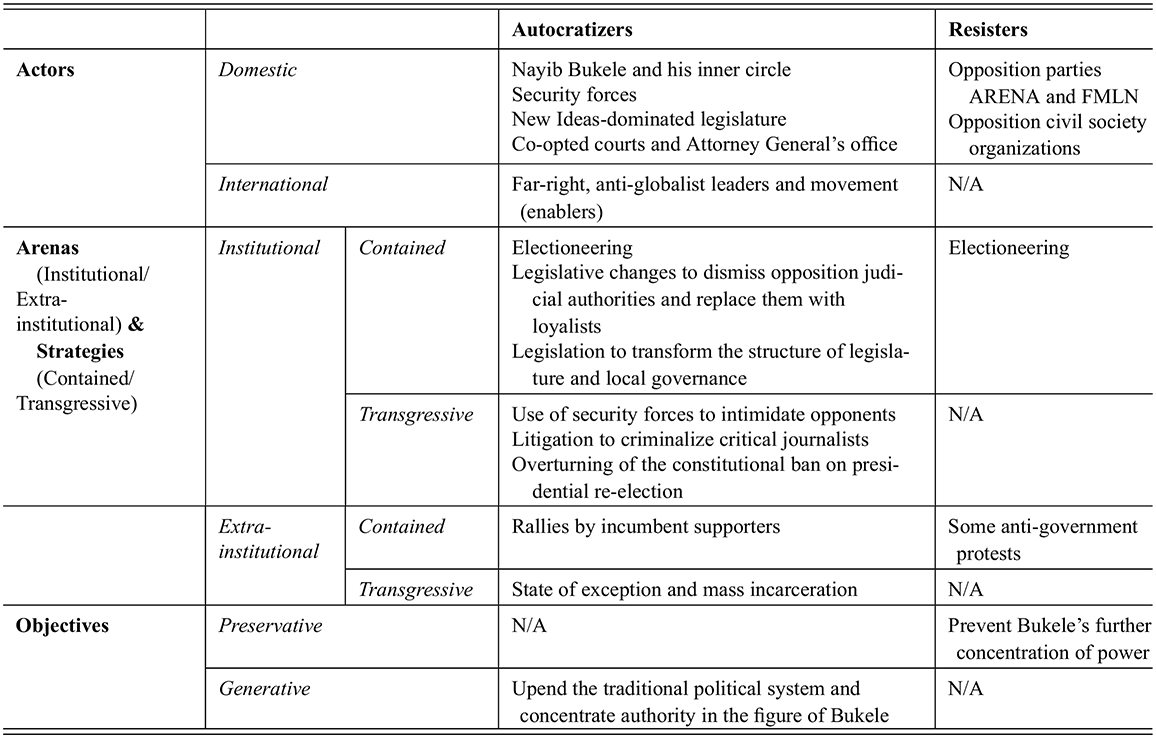
Amid this dramatic concentration of power, the opposition, historically organized into two well-institutionalized political parties, has been unable to coordinate meaningful resistance – in part, a product of their own dysfunction and lack of credibility. Even if these challenges were surmounted, the prospects for the opposition grow increasingly dim as Bukele locks in the gains of his authoritarian actions. The Salvadoran case thus illustrates the difficulties of challenging executive aggrandizement in the service of popular, generative goals following party system collapse (See Table 3).
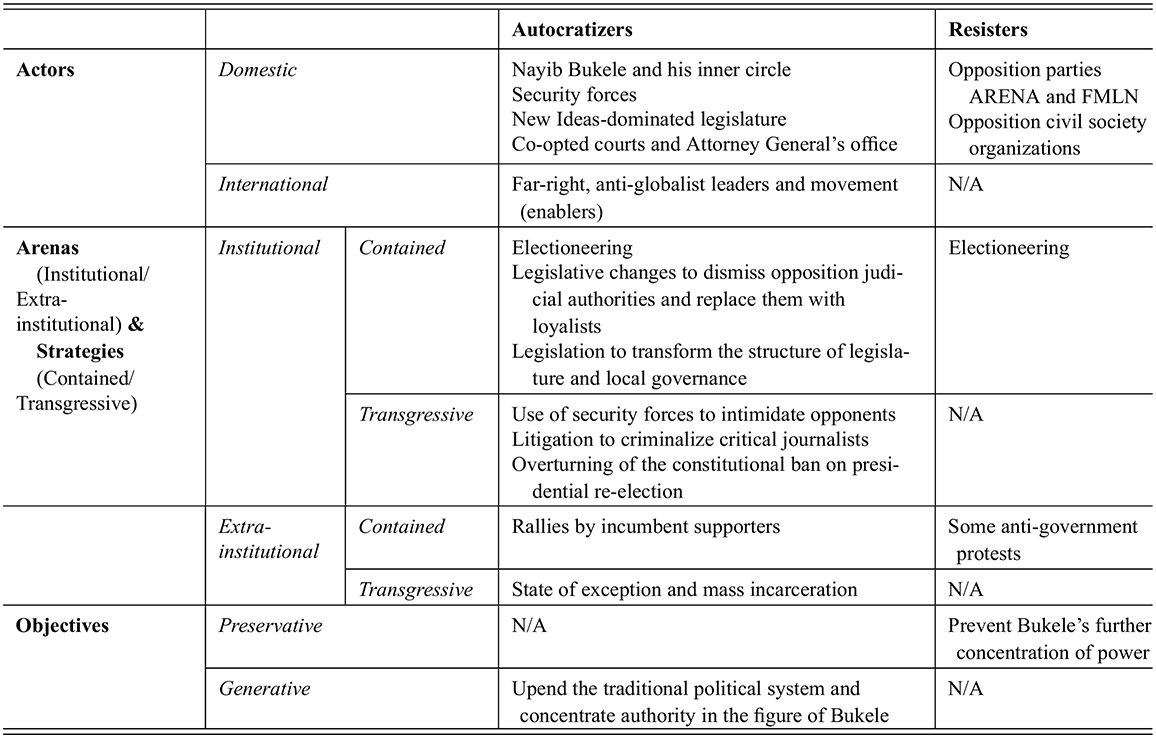
Table 3 Long description
The table illustrates the actors, arenas, strategies, and objectives that characterize El Salvador’s episode of democratic erosion between 2019 and 2025. Among the domestic autocratizing actors are President Nayib Bukele and his inner circle, security forces, the New Ideas dominated legislature, coopted courts, and the Attorney General's office. The domestic resistance actors include opposition parties like ARENA and the F M L N, and opposition civil society organizations. International autocratizing actors include far-right, anti-globalist leaders and movement (enablers). International resisters: N/A. Autocratizers in El Salvador have utilized contained and transgressive institutional strategies, as well as contained and transgressive extra-institutional strategies. The opposition has utilized contained institutional and extra-institutional strategies to resist erosion. Contained institutional strategies used by autocratizers: Electioneering, legislative changes to dismiss opposition judicial authorities and replace them with loyalists; legislation to transform the structure of legislature and local governance. Contained institutional strategies used by resisters: N/A. Transgressive institutional strategies used by autocratizers: use of security forces to intimidate opponents; litigation to criminalize critical journalists; overturning of the constitutional ban on presidential re-election. Transgressive institutional strategies used by resisters: N/A. Contained extra-institutional strategies used by autocratizers: rallies by incumbent supporters. Contained extra-institutional strategies used by resisters: some anti-government protests. Transgressive extra-institutional strategies used by autocratizers: state of exception and mass incarceration. Transgressive extra-institutional strategies used by resisters: N/A. The autocratizers have pursued generative objectives, while resisters have pursued preservative objectives. Preservative objectives of autocratizers: N/A. Preservative objectives of resisters: preventing Bukele’s further concentration of power. Generative objectives of autocratizers: to upend the traditional political system and concentrate authority in the figure of Bukele. Generative objectives of resisters: N/A.
3.3 Partisan Aggrandizement in México (2018–2025)
In some ways, México’s erosion trajectory mirrors that of El Salvador, starting with the rise of populist firebrand Andrés Manuel López Obrador (AMLO) via elections in 2018. Notwithstanding poor economic performance, inequality, weak governance, and deficient representation, México in 2018 was democratic. Its V-Dem Electoral Democracy Index score was 0.68, elections were minimally free and fair, there was some degree of protection for civil and political rights, and there were at least minimal levels of both horizontal and vertical accountability. By 2024, México’s score on this measure had declined to 0.51. In six years, López Obrador and his party Morena (Movimiento de Regeneración Nacional) managed to co-opt and/or undermine courts and oversight agencies, weaken political and civil liberties, and debilitate free and fair elections. If México is not competitive authoritarian already, it is certainly very close to the threshold.
In many ways, México’s erosion of democracy follows the classic executive aggrandizement playbook. Once in office, AMLO used and abused institutions and institutional reforms to undermine checks on the executive. During his time as president, he defunded and co-opted courts and oversight agencies, increased the role of the armed forces in government, and introduced reforms to undermine the nation’s electoral management body (Aguiar Aguilar, Cornejo, and Monsiváis-Carrillo Reference Aguilar, Azul and Monsiváis-Carrillo2025). He did so while constantly and effectively attacking the legitimacy of democratic institutions, the press, civil society organizations, and opposition parties (Aguiar-Aguilar Reference Aguiar-Aguilar, Monsiváis-Carrillo and Guillén2024; Ulfgard Reference Ulfgard2023).
Unlike other executive aggrandizement cases, however, México’s process of democratic backsliding has been more partisan in nature. Different from Nayib BukeleFootnote 12 – who ran for president with a borrowed label (Meléndez-Sánchez Reference Meléndez-Sánchez2021) – AMLO came to power with a relatively well-structured political party. By the time he ran for president, Morena – a splinter of the leftist Partido de la Revolución Democrática (PRD) – had a strong movement component with thousands of municipal and sectoral committees and millions of affiliates (Combes Reference Combes, Rosenblatt, Vommaro, Luna and Rodríguez2021). In contrast to Bukele’s electoral vehicles, which did not win a significant number of congressional seats until after he had been in power for two years, Morena not only won the presidency in 2018 but, together with the Labor Party (PT) and the Social Encounter Party (PES), it also delivered López Obrador qualified majorities in Congress from the get-go.Footnote 13
This pattern of party-centered aggrandizement, while somewhat unique in the Latin American context, has a long-track record in México. In the twentieth century, the country experienced over six decades (1929–2000) of single-party rule under the Institutional Revolutionary Party (PRI) – an authoritarian regime once described by Nobel Laureate Mario Vargas Llosa as the “the perfect dictatorship.” The consolidation of Morena, in some ways, mirrors that of the PRI. Rigid, vertical party structures and anti-democratic internal procedures allowed AMLO – who started his political career inside the PRI – to dominate Morena decision-making, much like PRI leaders did in the 1930s and 1940s (González Ormerod Reference González Ormerod2024). Riding the “revolutionary nationalism” espoused by populist leader Lázaro Cárdenas (1934–1940), the PRI promoted programs to benefit the lower and working classes, while forging corporatist ties with key organized sectors to centralize authority and preempt dissent (Flores-Macías Reference Flores-Macías, Loxton and Mainwaring2018; Grayson Reference Grayson2007). Buttressed by these culturally inscribed, well-recognized forms of authoritarianism,Footnote 14 Morena’s ascent is similarly characterized by populist rhetoric and a poverty-focused platform. And while AMLO decried the corporatist policies of the past, in practice, his rule strengthened ties with some organized interests like the military (Aguiar Aguilar, Cornejo, and Monsiváis-Carrillo Reference Aguilar, Azul and Monsiváis-Carrillo2025).
AMLO is not the first twenty-first-century Latin American leader with authoritarian tendencies to become president with an institutionalized party. In 2006, Evo Morales came to power in Bolivia with Movimiento al Socialismo (MAS), a well-structured indigenous political organization (Anria Reference Anria, Rosenblatt, Vommaro, Luna and Rodríguez2021). Yet, unlike MAS – where strong grassroots movements constrained Morales (Anria Reference Anria2016, Reference Anria2018) – Morena relies more heavily on AMLO’s charisma and leadership to articulate partisan and base organizations, giving him a strong hold on key party functions (Navarrete Vela Reference Vela, Pablo, Palma and Tmaayo2020; Ponce Reference Ponce, Poguntke and Hofmeister2024).Footnote 15
These differences have been consequential. With a firmer grip on the party, AMLO, unlike Morales, was in a better position to guarantee an important degree of continuity and thus pass the baton. Indeed, Morales insisted on staying in and returning to office (even against other party hopefuls), while AMLO did not seek to extend his time in office by reforming or bypassing México’s re-election ban. Instead, he successfully groomed and campaigned for Claudia Sheinbaum (2024–present) to be the next president.
Sheinbaum is a political force in her own right. She is no doubt aligned with and indebted to her predecessor – and would have never won without AMLO’s support. But she is not family like Nicaraguan dictator Daniel Ortega’s wife and co-president, Rosario Murillo, nor the kind of puppet president we have seen in other countries (i.e. Dimitry Medvedev [2008–2012] in Russia or Claudia Juana Rodríguez de Guevara [2023–2024] in El Salvador). So far, she does not seem to be a mere placeholder for López Obrador’s return.
Despite this independence, Sheinbaum has followed in AMLO’s footsteps. In contrast to Ecuador and Colombia, where handpicked successors quickly deviated from their predecessors (Andrews-Lee and Gamboa Reference Andrews-Lee and Gamboa2022), the new president is dependent on Morena for political survival and has remained loyal to obradorismo. Notwithstanding some hopes that she would distance herself from López Obrador’s authoritarian impulses (Ríos Reference Ríos2024), Sheinbaum has endorsed and pushed forward serious power-grabs, most notably the judicial reform that replaced México’s judges and justices with individuals picked by Morena and elected via popular vote (Guillén Reference Guillén2025).
As in El Salvador, the opposition in México has faced important structural obstacles. After eighteen years controlling the political arena, the Partido de Acción Nacional (PAN), the PRI, and the PRD lost legitimacy. Their inability to reduce violence, impunity, and corruption, or rejuvenate party leadership cost them affiliates and support (Greene and Sánchez-Talanquer Reference Greene and Sánchez-Talanquer2018; Sánchez-Talanquer and Greene Reference Mariano and Greene2021). Despite early success using contained institutional strategies in Congress and the courts (at times in coordination with contained extra-institutional strategies), they were unable to rally Mexicans to the polls and lost the few seats that enabled them to veto constitutional reforms between 2021 and 2024. Since the government gained qualified majorities in Congress, it has been harder for the opposition to protect democracy.
3.3.1 Democratic Erosion in México
Even though México has steadily autocratized since López Obrador came to power, the arenas, strategies, and opposition actors have shifted based on Morena’s control of the legislature. We can thus think of México’s erosion process in three stages: (1) from 2019 to 2021, when Morena enjoyed large majorities in the legislature that allowed it to push its agenda through Congress, but courts and oversight agencies had not yet been weakened by protracted backsliding; (2) from 2021 to 2024, after Morena lost some, though not all, of its legislative muscle limiting the institutional tools available to the president while expanding those available to the opposition; and (3) from 2024 to the present, after Morena gained qualified majorities in Congress, enabling it to approve far-reaching constitutional amendments and bypass legislative obstruction.
Like other populist leaders, AMLO came to power during a state crisis. Between 2000 and 2018, homicides in México increased from 10.9 to 29.4 per 100,000 people (UNODC 2025). Between 2014 and 2018, the country’s score on the Corruption Perceptions Index declined from 35 to 28, placing it in the top quartile of most corrupt countries worldwide (Transparency International 2024).Footnote 16 The country also maintained high levels of impunity with a Global Impunity Index score of 69.21 out of 100 in 2017, the worst in Latin America that year (LeClercq Ortega and Rodríguez Sánchez Lara Reference Ortega, Antonio and Rodríguez Sánchez Lara2015, Reference Ortega, Antonio and Rodríguez Sánchez Lara2017).Footnote 17
Unable to address these issues, México’s traditional parties – the PRI, PAN, and PRD – lost most of their support (Greene and Sánchez-Talanquer Reference Greene and Sánchez-Talanquer2018). For decades, México had a fairly institutionalized party system with strong party identities and levels of partisanship above the regional average (Castro Cornejo Reference Castro Cornejo2019). According to the Latin American Public Opinion Project (LAPOP), in 2006, 43% of voters identified with one of the three traditional parties. In 2012, the PRI, PAN, and PRD joined a “Pact of México” to pursue structural reforms to increase revenue and investment in order to improve social security, healthcare, and education (Flores-Macías Reference Flores-Macías2016). The reforms, however, not only failed to address México’s most severe problems but erased any distinction between the three parties (Flores-Macías Reference Flores-Macías2016). By 2017, only 11% of Mexicans identified with one of the traditional parties, and data from the National Electoral Study in 2018 show that most voters believed the three organizations represented the same alternative (Castro Cornejo Reference Castro Cornejo2023).
The traditional parties’ “brand dilution” offered Morena a window of opportunity to appeal to disaffected voters (Castro Cornejo Reference Castro Cornejo2023). Using polarizing rhetoric and anti-systemic discourse that painted the PRI and PAN (or “PRIAN,” as AMLO calls them) as a “corrupt elite” and the PRD as a traitor to its voters, López Obrador was able to mobilize millions of Mexicans against the political establishment. In 2018, he and his party won in a landslide. Not only did he receive the largest vote share in México’s democratic history (53%) and carried all but one of the country’s thirty-two states but his coalition won 63% and 55% of seats in the House and Senate respectively (Greene and Sánchez-Talanquer Reference Greene and Sánchez-Talanquer2018).
Emboldened by his triumph, AMLO began to centralize power in the executive, starve independent agencies of resources, and undermine checks and balances early in his presidency. Under the guise of efficiency and anti-corruption, the president tried to pack the courtsFootnote 18 and passed legislation to enhance his budgetary powers with “super-delegates” that oversaw the delivery of federal assistance programs, forcing governors to cater to the administration (Sánchez-Talanquer Reference Sánchez-Talanquer2020). He also augmented the power of the military by putting it in charge of important infrastructure projects, the fight against domestic oil theft, and responses to health emergencies (Solís Minor and Molozenik Gruer Reference Solís Minor, Gruer, Monsiváis-Carrillo and Guillén2024). AMLO simultaneously de-funded the civilian bureaucracy, courts, and important oversight agencies to minimize their ability to check the executive (Peschard Reference Peschard, Monsiváis-Carrillo and Guillén2024a; Sánchez-Talanquer Reference Sánchez-Talanquer2020).
To do this, López Obrador used contained institutional strategies alongside transgressive institutional and extra-institutional strategies. Taking advantage of his legislative majorities, the president pushed his agenda through Congress. Between 2019 and 2021, the government coalition introduced 2,698 pieces of legislation (46% of all initiatives), including 406 constitutional reforms and 355 bills related to the judiciary. Of those, 25% were either approved or moved forward to the next legislative session. None of the twenty-eight bills introduced directly by the president failed.Footnote 19
Morena carried out these changes with little public pushback, due in part to López Obrador’s ability to undermine the legitimacy of judicial and electoral institutions using transgressive institutional and extra-institutional strategies. AMLO’s attacks against the National Electoral Institute (Instituto Nacional Electoral – INE) after a failed referendum are a classic example of this kind “deceitful autocratization” (Monsiváis-Carrillo Reference Monsiváis-Carrillo2024). Having modified the Constitution in 2019 to allow for and regulate recall referendums and ballot measures, AMLO organized a popular consultation that asked citizens if the state should prosecute México’s former presidents for (allegedly criminal) decisions made during their terms. The referendum invoked principles of majoritarianism while running counter to the pillars of liberal democracy, such as the right to due process. After the Supreme Court (Suprema Corte de Justicia de la Nación – SCJN) modified the question to mitigate biases that could affect voters’ decisions, INE organized the election by the book. The referendum drew only 7.11% of eligible voters, well below the 40% needed to make it binding. Instead of accepting the results, the president transformed his loss into a win, using the outcome to launch delegitimizing attacks against the electoral body (Aguiar Aguilar, Cornejo, and Monsiváis-Carrillo Reference Aguilar, Azul and Monsiváis-Carrillo2025; Hernández-Huerta Reference Hernández-HuertaForthcoming).
During the 2018–2021 period, AMLO also used transgressive extra-institutional strategies to undermine courts and oversight agencies. He publicly attacked the separation of powers, criticized the role of the judiciary, and promoted false and misleading accusations against courts and oversight agencies in his daily morning television show Mañaneras. Throughout his government, these accusations rose and declined depending on the actors trying to constrain him. During his first year in office, it was independent oversight agencies like the National Institute for Information Access and Transparency (Instituto Nacional de Transparencia y Accesso a la Información – INAI) which drew the president’s ire (Peschard Reference Peschard, Monsiváis-Carrillo and Guillén2024b). Later, after Morena had lost important legislative battles (López Noriega and Martín Reyes Reference López, Saúl, Martín Reyes, Noriega and Reyes2025), he directed his attacks at INE and the Supreme Court.
The executive’s actions during the LXIV legislature (September 2018–September 2021) were damaging and deadly,Footnote 20 but they left the core system of checks and balances in place (López Noriega and Martín Reyes Reference López, Saúl, Martín Reyes, Noriega and Reyes2025, 22). Though weakened, courts and oversight agencies remained unchanged, and, notwithstanding some irregularities and violence, the 2021 elections were minimally free and fair (OAS 2021). Moreover, the mid-term elections handed the government a small defeat. The ruling coalition lost forty seats in the House, significantly narrowing its congressional majority to 54%.
The loss had two contradictory consequences. On the one hand, as predicted by Greene and Sánchez-Talanquer (2021), electoral and legislative losses fueled more aggressive power-grabs. The second stage of democratic backsliding (the LXV Legislature from September 2021 to September 2024) was marked by increasingly aggressive attempts to reform INE and eventually the courts. Despite lacking the qualified majorities required to pass constitutional amendments, the government coalition consisting of MorenaFootnote 21 and the Labor Party increased the number of constitutional reforms it introduced from 406 in the LXIV Legislature to 411.Footnote 22
On the other hand, the administration was more constrained in its ability to pass these measures. With more seats in Congress, the opposition was better able to obstruct and delay incumbent legislation. As we discuss in Section 3.3.2, not only was the opposition able to reduce the approval rate of executive-backed legislation from 31% to 25%,Footnote 23 but it delayed the advancement of key constitutional reforms such the amendment seeking to restructure INE and the bill proposing to transfer control of the National Guard (México’s federal police) to the military (López Noriega and Martín Reyes Reference López, Saúl, Martín Reyes, Noriega and Reyes2025).
Unable to approve constitutional amendments, AMLO tried to bypass the need for qualified majorities and achieve similar outcomes using regular legislation instead. Indeed, when a constitutional reform that sought to undermine INE,Footnote 24 cut public funding for political parties, reduce the size of Congress, and replace the mixed system to elect federal legislators with an entirely proportional one failed in 2022, the government put forward “Plan B” – a package of 450 articles that sought to amend general laws related to the electoral system. Among other provisions, “Plan B” allowed the executive to oversee and update voter rolls and forced INE to move to an electronic voting system controlled by the executive branch. It also knee-capped the electoral authority by curtailing its budgetary autonomy, diminishing its auditing powers, and eliminating the District Executive Boards in charge of organizing elections on the ground, which accounted for 84.6% of INE’s civil servants (Hernández-Huerta Reference Hernández-HuertaForthcoming).
Requiring only simple majorities, “Plan B” made its way through Congress and was approved by the governing coalition in February 2023. Following the Colombian playbook, where the opposition undermined Álvaro Uribe’s authoritarian reforms by contesting procedural irregularities (Gamboa, García-Holgado, and González-Ocantos Reference Gamboa, García-Holgado and González-Ocantos2024), the Mexican opposition sued the administration based on violations of legislative rules. Indeed, in trying to rush the legislation through Congress, the government had skipped a required House committee debate, failed to make the text public and accessible to the opposition, and voted on the bill in the Senate without the appropriate quorum (Hernández-Huerta Reference Hernández-HuertaForthcoming). Based on these irregularities, the Supreme Court ruled against the legislation in May 2023 (Martín Reyes Reference Martín Reyes2024).
The Supreme Court’s ruling, alongside other decisions adverse to the executive, gave way to “Plan C.” In 2024, the government repackaged several of its failed reforms into a new set of constitutional amendments. Among other measures, AMLO sought to reduce the size of Congress, change electoral rules to favor the majority party, place the National Guard under the authority of the military, and eliminate all independent oversight agencies like INAI (López Ayllón et al. Reference Ayllón, Sergio, Orozco, Pedro, Diego, López Ayllón, Orozco Henríquez, Salazar and Valadés2024).Footnote 25 He also hoped to re-structure the judiciary to replace independent judges and justices with loyalists, subordinate the judicial branch to representative bodies controlled by Morena, and undermine the courts’ judicial review powers (López Noriega and Martín Reyes Reference López, Saúl, Martín Reyes, Noriega and Reyes2025).
The results of the 2024 elections paved the way for “Plan C.” In June 2024, Morena not only won the presidency with Claudia Sheinbaum but its coalition obtained a qualified majority in Congress with 364 seats in the House and 87 seats in the Senate. These majorities have allowed the new government to approve all but the electoral reform.
Particularly concerning is the judicial reform. Under the guise of democratizing the judiciary, the reform approved by the LXVI Legislature sought to purge the judiciary and replace judges and justices with individuals loyal to the government. In June 2025, Mexicans went to the polls to elect 881 lower and higher court judges and magistrates from candidates selected by executive, legislative, and judicial committees. With Morena in control of the first two branches, not surprisingly, most candidates were close to the ruling party. Compared to the sitting judges and magistrates, the candidates were less likely to have a postgraduate degree or employment experience in the judicial branch (Ponce et al. Reference Ponce, Ríos-Figueroa, Seira and Werner2025). The election had one of the lowest turnouts in recent history. Only around 13% of voters went to the polls (INE 2025b). Of those, 10.8% cast null votes and 12.05% left their ballots blank. All in all, the new members of the Supreme Court were selected with somewhere between 2.8% and 5% of support from the vote-eligible population (INE 2025a).
With a friendly SCJN – at least seven of the justices were approved by or have visible connections with Morena (Maldonado Reference Maldonado2025) – there are even fewer guardrails against governing party power-grabs. Leveraging a current dispute over the eligibility of some individuals elected for judicial positions, Sheinbaum has announced a new electoral reform to slash INE’s operating budget and public party financing, as well as reduce the number of legislative seats – proposals that build on reforms AMLO tried to push forward in 2022 and 2023 (Raziel Reference Raziel2025). If enacted, the amendment would likely undermine the fairness of elections and, thus, the possibility of turnover.
3.3.2 Opposition Responses
The opposition to AMLO and Morena has been mostly, though not exclusively, led by the traditional parties – the PAN, PRI, and PRD – which have relied on contained institutional strategies, and at times, contained extra-institutional strategies to oppose the incumbent power-grabs. Their capacity to leverage legislative, judicial, and electoral arenas, however, has varied over time. With comfortable majorities during the LXIV Legislature, the government was able to build coalitions and pass important anti-democratic reforms. With tighter majorities during the LXV legislature, the opposition had more tools to obstruct, delay, and eventually stop incumbent legislation. Indeed, during the LXIV Legislature, the government failed to pass or had to withdraw 68.6% of the bills it introduced. During the LXV legislature, it failed to pass or had to withdraw 74.7%.Footnote 26
More importantly, however, without a qualified majority in Congress between 2021 and 2024, the government could not easily approve constitutional amendments. Not only were constitutional reforms more likely to fail but they also took significantly longer to go through the legislature. The failure rate of constitutional amendments during the first three years of Morena’s government was 34%; the failure rate during the second half of AMLO’s term was 47.7%. Likewise, during the LXIV Legislature, it took the government coalition 232 days on average to push constitutional amendments through Congress, 114 days less than it took during the LXV Legislature.Footnote 27
These delays not only obstructed the government’s agenda but forced AMLO to use other legislative strategies. Critically, the incumbent party’s inability to easily approve constitutional amendments made it turn to general legislation instead. Though easier to get through Congress, this normal legislative pathway served as an easier target for constitutionality lawsuits. Based on extant jurisprudence, the SCJN could challenge the constitutionality of bills subject to the Constitution more readily than that of bills meant to change the magna carta (Vega Cardona Reference López, Saúl, Martín Reyes, Noriega and Reyes2024).
This is exactly what happened. On April 28, 2022, AMLO introduced a constitutional amendment to reform the Electoral Council (INE). As outlined in Section 3.3.1, the reform included multiple provisions that threatened the independence and capabilities of electoral authorities, raising deep concerns among opposition politicians and civil society groups which mobilized against it. Dismissed by the president, the demonstrations nonetheless helped opposition politicians defeat the bill in the legislature (Gamboa 2023b).
Undeterred, however, AMLO introduced his “Plan B” to amend 450 articles of five general laws related to the electoral system and did not require qualified majorities for congressional approval. Violating multiple procedural laws, the government coalition sanctioned the bill on February 22, 2023. Fifteen constitutionality lawsuits followed shortly thereafter, arguing both procedural and substantive irregularities (Martín Reyes Reference Martín Reyes2024). Leveraging the anomalies in the legislative process (Gamboa, García-Holgado, and González-Ocantos Reference Gamboa, García-Holgado and González-Ocantos2024) and the support of hundreds of thousands of people mobilized to the streets by civil society organizations (Hernández-Huerta Reference Hernández-HuertaForthcoming), the SCJN ruled against the bill in June 2023. As in Colombia (Gamboa 2022b) and Argentina (García Holgado Reference García-Holgado2025), the opposition in México had been able to delay the erosion of democracy using contained institutional strategies in conjunction with contained extra-institutional strategies.
Unfortunately, the gains made in 2023 were lost a year later when Morena won the presidency and, perhaps more devastatingly, a qualified majority in Congress. Although there are good reasons to believe that AMLO’s appointed electoral board members had a hand in this outcome (Raziel Reference Raziel2024), the fact remains that the opposition’s poor performance was due in large part to its inability renew its ranks and escape the anti-systemic trap laid by the government. In 2018 and 2021, the PRD, PAN and PRI received around 39% of the votes in the House and Senate combined; in 2024, they received 30%.
3.3.3 Analysis of the Mexican Case
In many ways, the erosion of democracy in México has followed the traditional executive aggrandizement playbook. Andrés Manuel López Obrador, a populist leader with authoritarian tendencies, used the levers of democracy to undermine horizontal accountability. His attacks painting democratic institutions as constraints on the popular will represented in his approval ratings garnered support not only for his party but also for his power-grabs (Aguiar Aguilar, Cornejo, and Monsiváis-Carrillo Reference Coronel2025; Castro Cornejo, Monsiváis-Carrillo, and Aguiar-Aguilar Reference Cornejo, Rodrigo and Aguiar-Aguilar2025). The distinct economic growth trajectory in México, which did not face the same downturn as other Latin American countries following the 2000s commodity boom, also bolstered AMLO’s support.
Yet, despite these advantages, AMLO did not try to reform or bypass the Constitution to stay in power, as other aspiring autocrats in the region did. Instead, he used his government – and his personal appeal – to strengthen his party and his position within it. In this sense, the erosion of democracy in México is more in line with the partisan aggrandizement common in Mexican history than the executive aggrandizement observed in El Salvador and first wave Latin American cases.
Because of the mixed nature of democratic backsliding in México, the strategies adopted by government and opposition actors have been mostly, though not exclusively, contained institutional ones. AMLO has leveraged his majorities in Congress to bend and, more recently, transform democratic institutions. Although he used some transgressive institutional strategies, like recall referendums and plebiscites, early in his tenure, these have been less successful than routine legislative tactics.
The opposition has fought Morena’s power-grabs using mostly contained institutional strategies as well. Their ability to contest electoral, legislative, and judicial arenas, however, has changed over time. During the first years of AMLO’s rule when institutions were still strong, opposition leaders were able to use courts and oversight agencies to tame some of the president’s power-grabs. During the last three years of AMLO’s government their capacity to rely on state institutions weakened; however, having clawed back some congressional seats, they were able to leverage both legislative and judicial bodies to stop the incumbent’s authoritarian agenda. The opposition’s possibilities of leveraging these arenas have been greatly diminished since 2024 when Morena won qualified majorities in Congress, allowing it to co-opt the judicial branch (See Table 4).
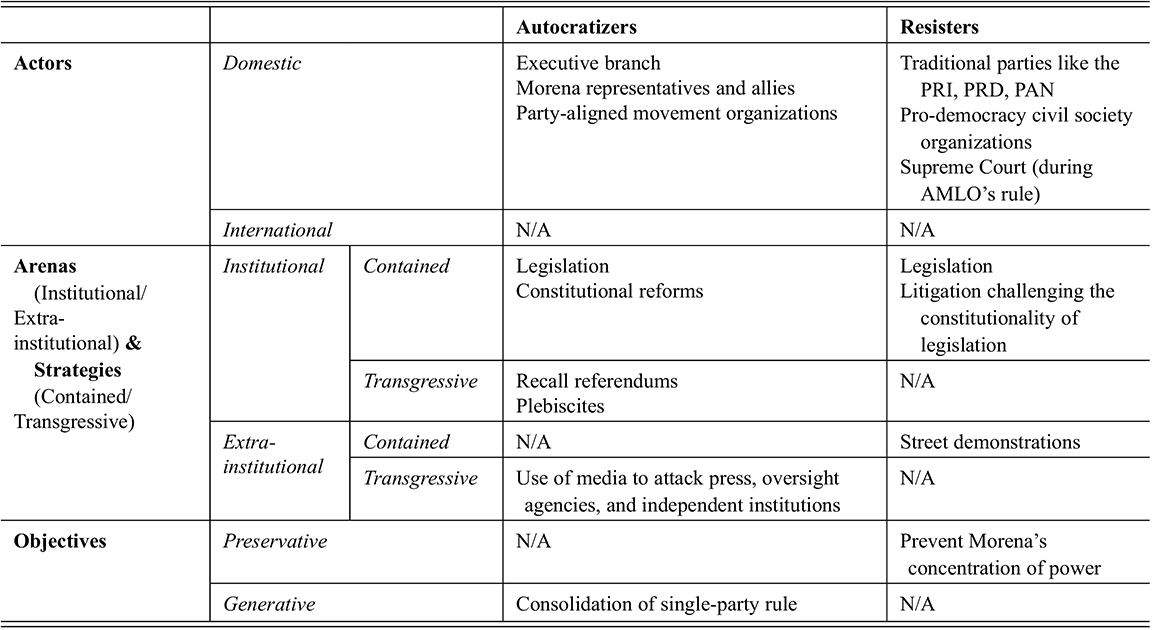
Table 4 Long description
The table illustrates the actors, arenas, strategies, and objectives that characterize Mexico’s episode of democratic erosion between 2019 and 2025. Among the domestic autocratizing actors are the executive branch, Morena party, and its legislative representatives and allies, and party-aligned movement organizations. The domestic resistance actors include traditional parties in the opposition like the P R I, P R D, P A N, pro-democracy civil society organizations, and the Supreme Court during AMLO’s initial years of rule. International autocratizers and resisters: N/A. Autocratizers in Mexico have utilized contained and transgressive institutional strategies, as well as transgressive extra-institutional strategies. The opposition has utilized contained institutional and extra-institutional strategies to resist erosion. Contained institutional strategies used by autocratizers: legislation, constitutional reforms. Contained institutional strategies used by resisters: legislation; litigation challenging constitutionality of legislation. Transgressive institutional strategies used by autocratizers: recall referendums; plebiscites. Transgressive institutional strategies used by resisters: N/A Contained extra-institutional strategies used by autocratizers: N/A. Contained extra-institutional strategies used by resisters: street demonstrations. Transgressive extra-institutional strategies used by autocratizers: use of media to attack press, oversight agencies, and independent institutions. Transgressive extra-institutional strategies used by resisters: N/A. The autocratizers have pursued generative objectives, while resisters have pursued preservative objectives. Preservative objectives of autocratizers: N/A. Preservative objectives of resisters: prevent Morena’s concentration of power. Generative objectives of autocratizers: consolidation of single-party rule. Generative objectives of resisters: N/A.
3.4 Legislature-Led Autocratization in Perú (2016–2025)
Since the third wave of democracy, Perú has endured two periods of autocratization: a first starting with Alberto Fujimori’s (1990–2000) self-coup in 1992 and a more recent episode of democratic backsliding engineered from the legislature beginning in 2016 (Sosa-Villagarcia, Incio, and Arce Reference Sosa-Villagarcia, Incio and Arce2025). Perú’s post-Fujimori transition to democracy in 2000 did not translate into democratic consolidation. Despite economic growth, the country’s democracy stagnated between 2000 and 2016 (Mainwaring and Pérez-Liñán Reference Mainwaring and Pérez-Liñán2023a). It neither eroded – like in Venezuela, Bolivia, Ecuador, or Nicaragua – nor did it transform into a higher-quality democracy like Uruguay (Mainwaring and Pérez-Liñán Reference Mainwaring and Pérez-Liñán2023b). Though democratic, the regime remained saddled with weak institutions and poor representation (Vergara and Watanabe Reference Vergara and Watanabe2019).
By the mid 2010s, Peruvian democracy began to show signs of deterioration again. Between mid 2016 and early 2026, there have been eight presidents, only two of which came to power via popular elections. Four of the eight presidents were impeachedFootnote 28 – one following a self-coup attempt – while another three were removed or forced to resign under threat of impeachment or popular protests. Since 2020, Perú’s scores on V-Dem’s Liberal and Electoral Democracy indices have declined by 20 and 19 percentage points respectively. Although V-Dem and similar indices still consider Perú to be a democracy, Freedom House has downgraded Perú’s regime from “Free” to “Partly Free,” and Peruvian scholars have increasingly warned that the country is approaching competitive authoritarianism (Coronel Reference Coronel2024).
As noted at the beginning of this section, Perú is no stranger to authoritarian power-grabs. In 1992, Fujimori dissolved Congress and the Supreme Court with the help of the country’s armed forces. Framed as emergency measures necessary to battle the Shining Path insurgency, Fujimori ruled by decree for nearly a decade, despite having a tailormade constitution. Yet, unlike in México, where partisan aggrandizement under AMLO somewhat mirrored the earlier path of autocratization under the PRI, Perú’s more recent episode of democratic backsliding diverges significantly from the executive aggrandizement seen two decades earlier. Not only have presidents in Perú since 2016 been weak but the country’s political dysfunction has been described in terms of “hollowing” rather than concentration (Barrenechea and Vergara Reference Barrenechea and Vergara2023, Reference Barrenechea, Alberto, Barrenechea and Vergara2024). Instead of having a popular executive enhancing her grip on political institutions, Perú has seen the legislative branch both undermine state capacity and expand its hold over other branches of government. Consequently, in contrast to El Salvador, where the political survival of other officeholders depends on Nayib Bukele, in Perú, the executive’s ability to stay in power is entirely contingent on the favor of the legislature.Footnote 29
Overall, Perú’s trajectory of autocratization has been a coalitional endeavor indifferent to any ideological project. Unlike earlier Latin American autocratizers, lawmakers are not driven by a left- or right-wing political agenda or charismatic linkages with the people. With preservative goals instead, members of Congress have aligned to protect the status quo. They have passed legislation that weakens the role of the state in regulating certain industries and the ability of oversight bodies to exert horizontal accountability. In contrast to the Mexican and Salvadoran cases, where populist figures have championed transformative objectives, the aim of Perú’s legislative aggrandizement is to defend the short-term interests, corrupt rents, and impunity of its amateur political class and their economic and criminal allies.
Different from other coalition-driven episodes analyzed below (Guatemala and Honduras) and despite the deep political fragmentation and potential openings for pro-democratic resistance, Perú’s opposition has been mostly unsuccessful in stopping democratic backsliding. Defying the literature that assumes weak autocrats fail (Weyland Reference Weyland2024), in Perú the opposition has been unable to defeat an unpopular, weak, and fractured autocratic elite.
3.4.1 Democratic Erosion in Perú
Since its transition to democracy in 2000, Peruvian politics has been shaped by weak parties, volatile coalitions, and political fragmentation. Fujimori’s rise to power shattered Perú’s party system. Out of the four parties that controlled the political arena in the 1980s – Partido Aprista Peruano (APRA), Acción Popular (AP), Partido Popular Cristiano (PPC), and Izquierda Unida (IU) – one dissolved and the other three all but disappeared without being replaced by new organizations. For the past twenty-five years, parties in the country have been nothing more than personalistic vehicles – candidate-centered movements without any roots in society able to survive past their leaders’ personal appeal (Levitsky Reference Levitsky and Mainwaring2018).
Despite unparalleled levels of party fragmentation and fluidity, politics in Perú were somewhat institutionalized up until 2016. Elsewhere we have seen inchoate party systems threaten governability and lead to institutional crisis (Mainwaring Reference Mainwaring and Mainwaring2018b; Mainwaring, Bejarano, and Pizarro Leongómez Reference Mainwaring, María Bejarano, Leongómez, Mainwaring, Bejarano and Leongómez2006). Yet, in Perú, the opposite was true. Appealing to legislators’ immediate interests and leveraging an unprecedented mineral bonanza, Peruvian presidents were able to build minimally functional governing coalitions, avoid executive-legislative crises, and empower technocrats that maintained free-market economic policies favored by important economic elites, all while delivering growth, reducing poverty, and funding social welfare (Dargent and Rousseau Reference Dargent and Rousseau2022; Guibert Reference Guibert, Barrenechea and Vergara2024; Ilizarbe Pizarro Reference Ilizarbe Pizarro, Cameron and Jaramillo2022; Vergara and Watanabe Reference Vergara and Watanabe2019).
This equilibrium broke down in 2016 when Fuerza Popular (FP) – the Fujimorista party – won a simple majority of legislative seats. Originally united around the neoliberal economic model (Guibert Reference Guibert, Barrenechea and Vergara2024; Ilizarbe Pizarro Reference Ilizarbe Pizarro, Cameron and Jaramillo2022; Vergara and Watanabe Reference Vergara and Watanabe2019), that year the right-wing coalition split in two, creating a liberal-technocratic faction led by Pedro Pablo Kuczynski and his party (Peruanos por el Kambio – PPK) and a populist-conservative faction led by Keiko Fujimori (Alberto Fujimori’s daughter) and FP (Meléndez Reference Meléndez2019). In the presidential elections, Fujimori almost doubled Kuczynski’s vote count in the first round, only to lose in the runoff by 41,057 votes – a difference of 0.24% – after her opponent activated the Fujimorista/anti-Fujimorista cleavage. Unwilling to truly concede, FP wielded its legislative bloc to become an obstructionist party.
Starting in 2016, Perú saw a significant increase in the use of transgressive institutional strategies such as constitutional hardball in executive–legislative disputes (Dargent and Rousseau Reference Dargent and Rousseau2022). In the first year of Kuczynski’s term, FP censured or threatened to censure five cabinet members.Footnote 30 When taunted to approve the government’s motion of no confidence, in a play that would have opened the door for the executive to impeach Congress,Footnote 31 legislators refused to back down. Having failed to rein in or appease the legislature (Vergara Reference Vergara2018) and implicated in the Lavo Jato scandal – a corruption investigation involving the Brazilian construction firm Odebrecht (Gonzalez-Ocantos et al. Reference 77Gonzalez-Ocantos, Muñoz Chirinos, Pavão and Hidalgo2023) – Kuczynski was forced to resign in March 2018 before a second, likely successful, impeachment attempt.
Vice President Martín Vizcarra’s (2018–2020) rise to power fueled the inter-branch crisis even further. The Lava Jato investigation had implicated high-level politicians including Keiko Fujimori and former presidents Ollanta Humala, Alejandro Toledo, and Alan García, exacerbating citizens’ anti-systemic sentiment (Gonzalez-Ocantos et al. Reference 77Gonzalez-Ocantos, Muñoz Chirinos, Pavão and Hidalgo2023). Tapping into the public’s distaste for politics, the new president relied on anti-corruption appeals to confront Congress and build support (Muñoz Reference Muñoz2021). His generative goals – empowering prosecutors and cleaning up government – threatened legislators, who faced investigations themselves and went out of their way to obstruct the president.
Besides contained institutional strategies, such as their refusal to approve Vizcarra’s reforms to enhance transparency, governance, representation, and participation (CANRP 2018), the legislature used numerous transgressive institutional strategies to thwart the executive. Not only did Congress impede the investigations against the former attorney general who had tried to hamper the Lava Jato investigation (Paredes and Encinas Reference Paredes and Encinas2020) but it also slow-walked the president’s judicial reform in a gamble to elect Constitutional Tribunal justices and pack the court.
Turning to transgressive institutional strategies of his own, Vizcarra tried to sidestep the congressional obstruction by impeaching and reelecting the legislative body, but the move backfired. The subsequent Congress elected in January 2020 did not ameliorate the interbranch crisis. FP lost its simple majority but Vizcarra – whose party did not present candidates – did not pick up any of the contested seats. The new legislature was not only more fragmentedFootnote 32 but significantly more amateurish than the one before.Footnote 33 Its members coalesced to defend their own individual interests and survival against the president’s generative anti-corruption agenda.
To make matters worse, the inauguration of the new Congress coincided with the beginning of the COVID-19 pandemic, which hit Perú the hardest in all Latin America. Perú was among the countries least prepared to face the public health emergency and experienced the highest COVID-induced fatality rate worldwide. It also suffered severe economic contraction. In 2020, Perú’s GDP declined 12.9%, and its poverty rate reached levels not seen since 2010 (Dargent and Rousseau Reference Dargent and Rousseau2021).
Facing growing popular discontent and unable to impeach Congress again,Footnote 34 Vizcarra had to govern from a position of weakness against a belligerent legislature. Lawmakers refused to advance the president’s agenda or reconsider approved legislation after the executive submitted amendments. Eventually, Congress took advantage of the president’s decreasing popularity and tried to dismiss him. After a first failed attempt to get enough votes in September 2020, the legislature successfully removed Vizcarra a month later.
Congress’ move – particularly its decision to appoint lawmaker Manuel Merino, who had led the impeachment efforts, as interim president – led to massive demonstrations that eventually forced Merino to resign as well. Francisco Sagasti, who had not voted for Vizcarra’s dismissal, stepped in to finish the presidential term initially started by Kuczynski in 2016. Yet, the inter-branch crisis had done irreparable damage. It had fueled citizen’s anti-establishment feelings and overall disregard for politics, broken the economic coalition that had provided some stability until 2016, and strengthened the hand of Congress, which bolstered its authority vis-a-vis the executive (Muñoz Reference Muñoz2021).
These were less-than-ideal conditions for the 2021 general election, which ended with two populists – Keiko Fujimori (13.41% vote share) and Pedro Castillo (18.92% vote share) – in the runoff. Castillo, who eventually won the runoff by 44,000 votes, a 0.26% difference, was a left-wing outsider with authoritarian tendencies. Following Chávez’s, Morales’, and Correa’s scripts, he promised to challenge the neoliberal model, organize a constitutional assembly, and deactivate the Constitutional Tribunal and Ombudsman’s Office (Muñoz Reference Muñoz2021).
Like his predecessors, Castillo had very little support in Congress. His party, Perú Libre (PL), became the largest legislative bloc with thirty-seven of 130 seats, followed by Fuerza Popular with twenty-four (El Comercio 2021). Unlike his predecessors, however, Castillo attained power in an increasingly polarized context where ideological, economic, racial, and geographical cleavages aligned. Supported by technocratic and populist right-wing allies, Keiko Fujimori refused to acknowledge the 2021 electoral results. Using lawsuits, social media harassment, and street mobilization, she sought to nullify the vote and repeat the election (Barrenechea and Encinas Reference Barrenechea and Encinas2022; Cabral Reference Cabral2021).
Though electoral authorities eventually upheld the results, Castillo’s year and a half in government was marked by virulent clashes with the legislature. Full of amateur politicians with no possibility of re-election (Hidalgo Bustamante Reference Hidalgo Bustamante2021), Congress led seven processes to censure cabinet members and two to dismiss the president between July 2021 and October 2022. Jumping ahead of a third vote to “vacate” the presidency in December 2022, Castillo attempted a self-coup. The putsch was clumsy. Without the support of the armed forces or economic and political elites, the president was unable to prevail. After his arrest that same day, he was impeached by Congress and quickly replaced by his vice president Dina Boluarte.
Like Castillo, Boluarte was an outsider. Before becoming vice president, she had never held elected office and had only run for two subnational positions. Her relationship with Castillo’s party was conjunctural and transactional (Barrenechea and Encinas Reference Barrenechea, Encinas, Barrenechea and Vergara2024). Understanding her precariousness, Boluarte aligned herself with the anti-Castillo opposition in Congress once she became president. Pivoting to an “iron fist” discourse that demonized rivals, she ignored the public’s overwhelming desire to hold early electionsFootnote 35 and vowed to stay in office until 2026.
This disregard for the popular will led to mass mobilizations, especially in indigenous and rural communities in southern Perú. Using brutal repression, the new president was eventually able to quash them, while Congress – which had been eager to impeach previous executives – did nothing. Boluarte’s rise to power accelerated the process of autocratization. With an acquiescent president, Congress was able to co-opt the Constitutional Tribunal. It then set its sights on taking over the agency that elects judges and attorneys general (Junta Nacional de Justicia – JNJ) and the directorates of Perú’s electoral agencies (ONPE and Reniec).
As the unrest subsided, it appeared as though Boluarte might survive and finish out Castillo’s term, despite her single-digit approval ratings.
Amid multiple corruption scandals and skyrocketing crime, the legislative forces holding the reins of political power, however, suddenly turned on her in October 2025, vacating the presidency yet again (Freeman Reference Freeman2025). The same fate befell her successor José Jerí in February 2026. With general elections set for April 2026, propping up such an unpopular incumbent became increasingly risky from a short-term, electoral perspective. In the near future, Peruvian executives are likely to remain at the whims of legislative forces.
3.4.2 Opposition Responses
Resistance to the erosion of democracy in Perú has centered on two actors. In stark contrast to our cases of executive and party-led democratic backsliding (El Salvador and México), a first key resister in the Peruvian case was in fact the head of government. President Martín Vizcarra had somewhat generative objectives meant to expose entrenched interests and clean up government, which he tried to achieve initially via contained institutional strategies. He first attempted to curb corruption and promote reforms that would have enhanced transparency and accountability. When these efforts were met with legislative resistance, he then turned to transgressive institutional strategies. In July 2019, Vizcarra introduced a constitutional reform to call for early general elections. Months later, he sought new legislative elections by invoking Article 134 of the Constitution, which empowers the president to dismiss Congress if it issues two votes of no confidence. Even though Congress responded by vacating the presidency and electing Vizcarra’s replacement, the military supported the president, and the Constitutional Tribunal deemed his use of Article 134 legitimate (Quintana Reference Quintana2020).
Unfortunately, as outlined above, the new Congress was not an improvement over its predecessor. When it eventually impeached Vizcarra, opposition in Perú moved to the streets, and protest movements emerged as the second key resistance actor. An estimated 88% of Peruvians were against vacating the presidency, and 94% rejected Merino’s appointment as interim president (Coronel Reference Coronel2020a). Not surprisingly, Vizcarra’s impeachment and Merino’s selection to succeed him sparked the largest cycle of protests in Peruvian history. Tens of thousands of Peruvians mobilized to denounce what they called a “parliamentary coup” (Gurmendi Dunkelberg Reference Gurmendi Dunkelberg2020). They were joined by even more people after the government’s brutal repression. All in all, estimates suggest that 2.7 to 4.2 million Peruvians participated in the demonstrations between October and November 2020 (Coronel Reference Coronel2020b). These contained extra-institutional strategies bore fruit. Using new and creative repertories that leveraged the experience gained by young people in soccer matches and social media (Coronel Reference Coronel2020b), Merino was forced to step down six days after he had been sworn into office.
A year later, after Castillo’s self-coup, the resistance to democratic backsliding manifested itself in the streets again. This time, however, it failed to dislodge Boluarte. The protests were different in composition and strategy. Unlike the 2020 demonstrations, which started in urban settings and spread to the countryside, the 2022–2023 protests started in rural areas and spread to the country’s capital. Likewise, while the 2020 demonstrations stuck to nonviolent repertories, in 2022 and 2023, repression eventually led to fringe violence resembling more transgressive extra-institutional strategies (Coronel Reference Coronel2025). Its rural origins, lack of urban support, and marginal violence further decreased the costs of government repression. Despite 56 civilians dead and 1,000 injured, Boluarte was able to hold on to power with the support of Congress until late 2025 (Coronel Reference Coronel2023).
3.4.3 Analysis of the Peruvian Case
Though a less familiar form of democratic erosion, autocratization in Perú has largely occurred as a combination of elite collusion and legislative aggrandizement, as highly fragmented and volatile political blocs coalesced to first undermine the state and then augment congressional power to pursue short-term political and economic goals. While traditional modes of democratic backsliding typically entail executive co-optation of the legislative branch, in cases like Perú, the executive has more often been a pawn of Congress. The strategies in this form of democratic backsliding have been almost entirely transgressive institutional ones (except for the extra-institutional repression of street protests in 2020 and 2022–2023). Congressional lawmakers are the chief actors opposing any attempt to judicialize corruption or reform the state. The objectives of this coalition – much like the objectives of autocratic elites in Guatemala and Honduras, which we discuss below – have been the preservation of impunity and corruption. Though originally led by the Fujimorista faction, legislative aggrandizement today is spearheaded by amateur politicians who, without any prospect of re-election or robust political parties to discipline them, use Congress for personal enrichment.
The opposition to democratic erosion has had mixed results (Coronel Reference Coronel2023, Reference Coronel2025). Under Vizcarra, the executive pursued transgressive institutional strategies like congressional impeachment; with turnover in the executive and the emergence of new civic movements and associations, however, opposition then shifted to contained (i.e. peaceful demonstrations) and transgressive extra-institutional strategies (i.e. roadblocks). The opposition in the streets has been, for the most part, reactive. While protests have been fueled by overall discontent and moral outrage, their immediate goals have been preservative, ultimately seeking to defend the institutional order by removing the self-appointed Merino in 2020 and calling for new elections in 2023 to dislodge the authoritarian-allied Boluarte (See Table 5).
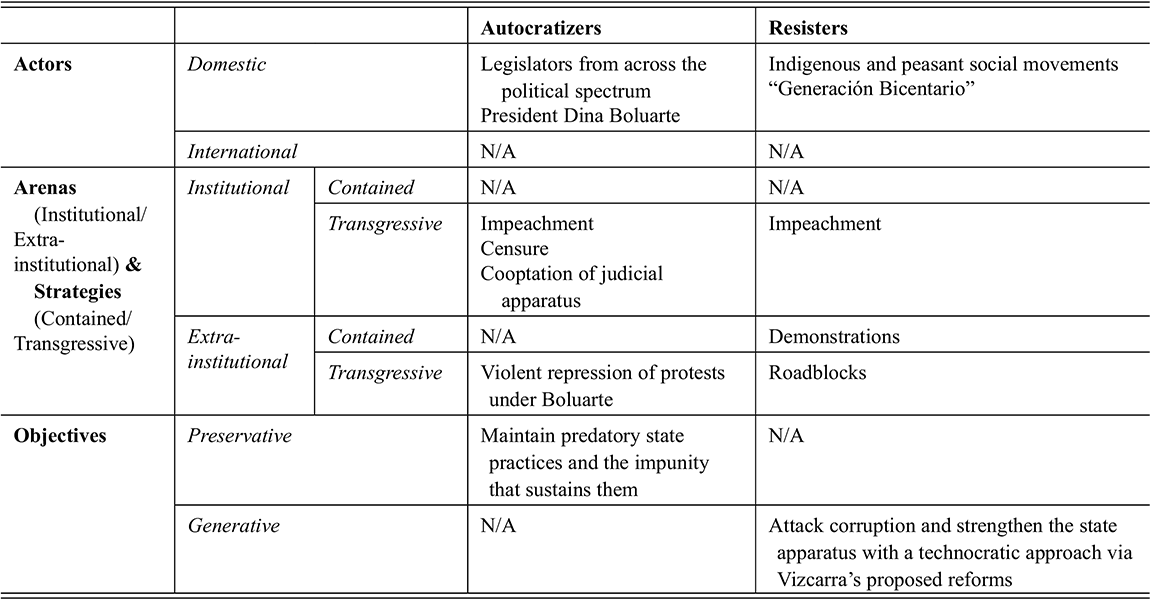
Table 5 Long description
The table illustrates the actors, arenas, strategies, and objectives that characterize Peru’s episode of democratic erosion between 2016 and 2025. Among the domestic autocratizing actors are legislators from across the political spectrum and the executive under former president Dina Boluarte. The domestic resistance actors include indigenous, peasant, and youth movements. International autocratizers and resisters: N/A. Autocratizers in Peru have utilized transgressive institutional strategies. The opposition has utilized transgressive institutional and extra-institutional strategies, as well as contained extra-institutional strategies. Contained institutional strategies used by autocratizers: N/A. Contained institutional strategies used by resisters: N/A. Transgressive institutional strategies used by autocratizers: impeachment, censure, co-optation of judicial apparatus. Transgressive institutional strategies used by resisters: impeachment. Contained extra-institutional strategies used by autocratizers: N/A. Contained extra-institutional strategies used by resisters: demonstrations. Transgressive extra-institutional strategies used by autocratizers: Violent repression of protests under Boluarte. Transgressive extra-institutional strategies used by resisters: roadblocks. The autocratizers have pursued preservative objectives, while resisters sought generative objectives during the presidency of Martín Vizcarra. Preservative objectives of autocratizers: maintaining predatory state practices and impunity that sustains them. Preservative objectives of resisters: N/A. Generative objectives of autocratizers: N/A. Generative objectives of resisters: attack corruption and strengthen the state apparatus with a technocratic approach via Vizcarra’s proposed reforms.
3.5 Elite Collusion via the Judiciary in Guatemala (2017–2024)
Following its transition to democracy in 1986, Guatemala was characterized by much more regime stagnation than change. This pattern, however, was disrupted in the late 2010s, when unprecedented anti-corruption efforts threatened to upend the predatory, rent-seeking practices that defined the Guatemalan political system. In response, a loose coalition of executive and legislative officials, economic elites, and judicial actors brought the country’s independent institutions to heel. By co-opting the state apparatus, this Pacto de Corruptos (“Pact of the Corrupt”), as it has been called in Guatemala, used legal tools to criminalize political opponents, prevent anti-establishment actors from competing for office, and shelve corruption probes involving their allies. As a result, Guatemalan democracy declined steeply from 2017 to 2023.
Yet Guatemala also stands out as a case of remarkable, if partial, democratic resilience in response to backsliding. Against the odds, the opposition party Movimiento Semilla (“Seed Movement”) managed to break the grip of the Pacto de Corruptos in the 2023 general elections, winning the presidency and the third-largest representation in Congress. By broadening its base, enlisting international support, and deploying contained institutional and extra-institutional strategies, this opposition also overcame the judicial attacks that sought to keep Semilla from assuming office.
Like the Peruvian case, Guatemala’s erosion episode reflects a mode of democratic backsliding that diverges significantly from the classic executive aggrandizement model. Rather than centralizing political power or pursuing transformative goals, the objective of dismantling democratic institutions in Guatemala was to safeguard longstanding impunity and achieve short-term political and economic benefits, as in Perú (Augusto Meléndez and Quiñón Reference Aguilar, Azul and Monsiváis-Carrillo2025). But despite similar aims, the protagonists of democratic erosion in Guatemala have been distinct. Rather than elite collusion via Congress (or outright legislative aggrandizement), in Guatemala top prosecutors and judges have spearheaded the assault on democratic norms and institutions. Further, autocratizers within the judiciary are merely the tip of the spear and, in fact, represent a broader alignment of politicians, business elites, ex-military actors, and organized criminal interests.Footnote 36 In other words, rather than concentrating power in the judiciary, in Guatemala autocratizing elites abused judicial authority to persecute opponents and undermine the state’s ability to punish crime and corruption.
The Guatemalan case illustrates that autocratization via elite collusion can provide distinct opportunities for democratic resilience – an important contrast to the Peruvian case, where resistance effort mostly failed to dent autocratization despite deep political fragmentation. In Guatemala, however, the opposition effectively exploited political fissures and fractured the patchwork authoritarian coalition, even though the latter possessed more varied tools and sources of support.
3.5.1 Democratic Erosion in Guatemala
Following nearly thirty years of uninterrupted military rule, Guatemala’s contemporary democratic era began in 1985 with the passage of a new constitution and the transition to elected civilian government in early 1986. The new democratic architecture was expanded in 1996 with the signing of comprehensive peace accords to end the thirty-six-year civil war. The settlement covered a range of issues, including reforms to security forces and the electoral regime, recognition of indigenous identity, and the promotion of human rights. Although the accords were never enshrined into law, the peace process still gave way to the sustainable end of hostilities and decades of free and fair elections.
The endurance of electoral democracy, however, belied other pernicious aspects of governance (Schwartz and Isaacs Reference Schwartz and Isaacs2023). For years, Guatemalan democracy coexisted with a state apparatus deeply penetrated by corrupt interests. Clandestine security structures created during the armed conflict continued to attack human rights defenders with impunity. Political elites sustained themselves and their parties through illicit campaign finance, paid back in state contracts to their benefactors. Judges and prosecutors overlooked criminal offenses and manipulated investigations in exchange for personal rewards. Bureaucratic personnel, whether under duress or on their own initiative, abetted the collusive arrangements that distorted state functioning. In short, Guatemala’s “poor-quality,” yet enduring democracy sat alongside a “semi-patrimonial” state order, with the two features reinforcing one another (Munck Reference Munck2024).
Guatemala’s period of democratic erosion beginning in 2017 was spurred by the upending of this once-stable equilibrium. In the mid 2010s, Guatemala experienced an unprecedented anti-corruption crusade that ensnared hundreds of high-level government officials and business elites. The campaign was waged by elite anti-corruption prosecutors alongside the United Nations International Commission against Impunity in Guatemala (CICIG), a body created in 2007 to dismantle criminal structures embedded in the state. The CICIG unleashed a historic wave of corruption cases starting in 2015 that reached into the highest levels of the Guatemalan government, spurring popular mobilization and opposition organizing on an extraordinary scale. University students, urban middle- and upper-class residents, and civil society groups staged routine weekend protests in the capital. Historically marginalized indigenous communities demonstrated in municipal squares across the country or trekked to Guatemala City to join the larger mobilizations. The cross-class, cross-ethnic movement, alongside international pressures, led to the ouster and imprisonment of the president and vice president alongside dozens of other high-ranking officials.
The momentum of the CICIG-backed campaign carried into the administration of outsider president Jimmy Morales (2016–2020). Initially, Morales expressed support for the CICIG and its domestic allies within the Public Ministry (MP); however, in 2017, anti-corruption prosecutors began stretching beyond executive circles to dismantle the fluid “illicit politico-economic networks” that distorted state functioning and undermined development (Naveda and Arrazola Reference Naveda and Arrazola2017). Establishment politicians and traditional parties (including the president’s) came under investigation for accepting illicit campaign finance (Rafael Reference Rafael2017), while leading figures within Guatemala’s private sector were indicted for supplying the undisclosed funds (Daniel Reference Daniel2021). The investigations unified otherwise disparate political and economic sectors who closed ranks to reverse anti-corruption advances. The subsequent counteroffensive sought to erode the independence of Guatemala’s weak but enduring democratic institutions to revive impunity.
The locus of democratic erosion in Guatemala and the preservative objectives of its authoritarian coalition, which sought to defend entrenched corruption, depart from the actors and aims implicit in the executive aggrandizement model. While Morales and his successor – Alejandro Giammattei (2020–2024) – were important agents of backlash, the engines of democratic erosion in the Guatemalan case are found within the judiciary where loyalists in the MP and the high courts used contained and transgressive institutional strategies to eviscerate judicial independence, curtail political competition, and criminalize opponents.
In 2018, Morales’ animus toward anti-corruption campaign was channeled into the Attorney General selection process to choose the successor of MP leader and CICIG ally Thelma Aldana (2014–2018). From the slate of nominees furnished by Congress, Morales selected Consuelo Porras, a candidate with little prosecutorial experience and extensive ties within ex-military circles (García and García Reference García and García2024). During her first year, Porras stood by amid Morales’ confrontations with the CICIG, which culminated in the dissolution of the commission in late 2019. Porras’ efforts to dismantle previous gains subsequently went into overdrive as she assumed a direct role in vetting corruption investigations and restructured the elite anti-corruption task force that worked with the CICIG, the Special Prosecutor against Impunity (FECI) (García Reference García2022). According to Juan Francisco Sandoval, the lead FECI prosecutor until he was forced into exile in 2021, Porras used her position to defend members of the pro-impunity coalition by transferring corruption cases to subservient prosecutors and leaking sensitive information to defense lawyers.
Beyond the MP, the second key arena in elite efforts to reconsolidate impunity was the Guatemalan court system. In mid 2019, the pro-impunity coalition penetrated the nominating commissions (comisiones de postulación) for Supreme Court magistrates and appellate court judges, orchestrating an illicit scheme to fix the selection process to favor establishment interests (Schwartz Reference Schwartz2022, 312–313). The plot implicated five Supreme Court and seventeen appellate court nominees, prompting the Constitutional Court to suspend the nominations (Beltrán Reference Beltrán2020). The order only hastened attempts to purge the Constitutional Court and install regime loyalists. These efforts came to fruition within the 2021 Constitutional Court selection process, when former criminal court judge Mynor Moto, who had been indicted for manipulating the 2019 judicial selection process, was nominated.Footnote 37 Meanwhile, Congressional deputies refused to swear in magistrate-elect Gloria Porras, a known anti-corruption ally, who eventually fled Guatemala after facing spurious criminal charges (AP 2020; Porras Reference Porras2021). Just two years after the CICIG’s ouster, the Pacto de Corruptos had cemented its grip over Guatemala’s high courts.
Establishment interests then conspired to weaponize legal instruments against anti-corruption crusaders, civil society leaders, and critical journalists and to curtail political competition by barring electoral candidates with anti-systemic agendas. According to the Central American human rights organization Cristosal, as a result of these transgressive institutional strategies, a total of seventy-seven former prosecutors, judges, human rights defenders, and journalists were forced to flee Guatemala between 2021 and 2024 (Cristosal Reference Cristosal2024). The list included Attorney General Aldana, who was barred from running for president in 2019 and was later granted asylum in the United States (AP 2020); former FECI head Sandoval, who fled Guatemala in mid 2021 after he was fired by Porras for investigating corruption within the Giammattei government (Aljazeera Reference Aljazeera2023); high-impact court judge Erika Aifán, who oversaw several sensitive corruption probes against the incumbent government (Menchú Reference Menchú2018); and dozens of other prosecutors.
Other anti-corruption figures that did not flee the country were swept up in politicized criminal investigations and put behind bars. Former CICIG prosecutor Virginia Laparra was convicted of abuse of authority in late 2022 and held in solitary confinement until 2024 (García Reference García2023a). Investigative journalist José Rubén Zamora, who spearheaded investigations into Giammattei government corruption, was convicted of money laundering in June 2023 (AFP 2025). Journalists merely covering his case were investigated for obstructing justice (García Reference García2023b).
The contained and transgressive institutional strategies used to criminalize critics of the ruling coalition were also deployed within the 2023 electoral process, as establishment interests sought to cull the slate of competitors to ensure an impunity-friendly administration. In early 2023, the Supreme Electoral Tribunal (TSE) disqualified leftist indigenous candidate Thelma Cabrera and her running mate Jordán Rodas, the former human rights ombudsman. Electoral authorities subsequently barred two right-wing populist presidential candidates, Roberto Arzú and Carlos Pineda, both of whom grabbed attention with their anti-elite campaign rhetoric. In the case of Pineda, the TSE only scrapped his candidacy after polls revealed him to be the unexpected frontrunner, leaving little doubt about the political motives behind the legal actions (Schwartz Reference Schwartz2024). What began as a campaign to co-opt the judicial apparatus and shore up corruption snowballed into efforts to tilt the electoral playing field and consolidate authoritarianism.
3.5.2 Opposition Responses in Guatemala
Guatemala’s 2023 general elections represented a prime opportunity for the patchwork authoritarian coalition – spearheaded by judicial actors – to secure its upper hand by anointing executive and legislative allies. The longstanding fragmentation of Guatemala’s pro-democratic opposition appeared to only contribute to the corrupt establishment’s advantage. Historic divisions along racial, ethnic, class, and ideological lines, as well clientelist practices, had thwarted the emergence of an institutionalized opposition unified around the fight for democracy and against impunity. Eliminating the main opposition frontrunners from the electoral competition seemed to be enough to prevent any meaningful challenge to the pro-impunity coalition.
Yet, Guatemala’s steep democratic decline in the years preceding the 2023 vote transformed the political landscape. As the pool of anti-establishment alternatives dwindled, opposition party Movimiento Semilla became the lone electoral vehicle representing a challenge to the status quo. In a twist of fate, its candidate, Bernardo Arévalo, squeaked out a second-place finish in the first round amid a field of more than twenty candidates, nearly all associated with the Pacto de Corruptos. He then trounced his establishment rival, Sandra Torres, in the runoff. Meanwhile, Semilla’s legislative gains transformed it into third largest bloc in Congress.
Prosecutorial and judicial actors responded by supercharging their efforts to block Arévalo and Semilla from taking office, resorting to ever more transgressive institutional strategies. Between the first and second round contests, the Constitutional Court ordered an audit following unfounded accusations of fraud. A criminal court judge, in cooperation with Porras’ MP, ordered the temporary suspension of Semilla’s legal status due to spurious accusations of money laundering and improper procedures during the party’s founding six years prior.
After Arévalo handily won the August 2023 runoff, these legal maneuvers accelerated. MP officials raided ballot storage facilities hoping to find evidence of fraud; the Supreme Court and Congress targeted the electoral officials that certified Arévalo’s victory; and prosecutors attempted to strip Arévalo, Vice President-elect Karin Herrera, and other allies of their prosecutorial immunity for social media posts backing student protests.Footnote 38 After a last-ditch effort by the outgoing Congress to delay inauguration proceedings, Arévalo, Herrera, and Semilla’s lawmakers were sworn in at the beginning of 2024.
How did regime opponents manage to halt Guatemala’s authoritarian slide and overcome efforts to undermine the 2023 vote? On the one hand, the Guatemalan case illustrates the importance of broad pro-democracy coalitions and joint contained institutional and extra-institutional strategies against autocratic regressions. On the other hand, it also demonstrates the unique pressure points of coalitional authoritarian regimes, which may be more susceptible to fragmentation in the face of robust opposition mobilization and international demands.
The successful resistance in 2023 seemed improbable considering the demobilization and fear that gripped Guatemalan civil society during the country’s authoritarian slide in the years prior. The 2015 anti-corruption movement brought important opposition gains, including modest political party and electoral reforms, the birth of Movimiento Semilla, and a new consciousness regarding the possibilities of popular mobilization. But with the ouster of the CICIG, the renewed co-optation of the MP and court system, and the escalating criminalization of critical voices, the political momentum shifted decidedly away from the opposition. Disillusionment and resignation prevailed in the run-up to the 2023 elections, as most Guatemalan and international observers believed the contest would inevitably give power to one of the many establishment candidates linked to the ruling coalition.
Rather than a feat of opposition organizing, Arévalo’s first-round success and Semilla’s legislative gains are best attributed to the unique structural features of Guatemala’s party system, as well as strategic missteps by the dominant coalition. Since the 1986 transition, Guatemalan politics has been defined by what Omar Sánchez refers to as a “party non-system,” reflected in a large number of parties, which most often appear and disappear within a few electoral cycles (Sanchez Reference Sanchez2009). Within this volatile landscape, the ruling regime’s actions to bar the most well-known anti-establishment candidates unwittingly funneled the anti-incumbent vote to the only opposition candidate remaining: Semilla’s Arévalo. As a result, he significantly outperformed polls and advanced to the runoff.Footnote 39
Similar miscalculations, however, cannot necessarily explain why Arévalo overcame the vicious “slow motion coup” to prevent him from participating in the second round and assuming the presidency thereafter (Schwartz Reference Schwartz2024, 324). Here, the opposition’s contained institutional and extra-institutional strategies proved critical (Gutiérrez Aiza Reference Gutiérrez Aiza2025), allowing it to cultivate a broad base of support, marshal international backing, and exploit fissures within the authoritarian coalition. Amid unfounded charges of fraud, Guatemalans deployed many of the organizational and rhetorical scripts honed during the 2015 anti-corruption protests. Rather than framing their mobilization as supportive of Arévalo’s candidacy, they instead pitched it as a last stand on behalf of Guatemalan democracy. Following the court-ordered vote audit, citizen poll workers posted photos of precinct-level vote tallies on social media, providing incontrovertible evidence that the contest was clean. Opposition lawyers also countered each of the MP’s obstructionist efforts through litigation, winning important victories to certify the vote and preserve Semilla’s status, at least through the conclusion of the electoral process.Footnote 40
Beyond these institutional strategies, the opposition also cultivated ties with diverse social blocs, enabling mass mobilization against the authoritarian assault. Despite its relative inexperience and lack of national reach, Semilla made notable efforts to bring its anti-corruption, pro-democracy message to Guatemala’s rural areas following the first-round vote, expanding support beyond its urban, educated base in the capital. Not only did this allow Arévalo to win the runoff handily but it also leveraged the political clout of the country’s long marginalized indigenous communities, who became the protagonists of nationwide peaceful protests. Amid the MP’s campaign to block the transfer of power, Mayan ancestral authorities called for a national strike demanding Porras’ resignation and respect for the popular will. At its peak, the strike included 140 roadblocks at strategic sites across the country (Abbott Reference Abbott2023). Though the Constitutional Court authorized the use of violence to disband the barricades, the Minister of the Interior and police leaders refused to resort to repression (Reuters 2024).
The contained institutional and extra-institutional strategies pursued by the opposition movement also facilitated the robust international backing it received. In addition to overseeing the election itself, the Organization of American States (OAS) forcefully condemned the judicial attempts to derail Arévalo’s assumption of power. The US government also vocally opposed each attempt to overturn the election results, ramping up its use of targeted sanctions against anti-democratic actors and warning that deeper economic punishments remained on the table. These international pressures emboldened Guatemala’s domestic opposition, signaling that it was not alone in resisting autocratization.
In short, Guatemala’s opposition coalition was notable both for its breadth and its discipline in recurring to contained institutional and extra-institutional strategies. But the effectiveness of its resistance is also, in part, due to the unique coalitional form of authoritarianism it confronted (Meléndez-Sánchez and Perelló Reference Meléndez-Sánchez and Perelló2025). The autocratic project that emerged in Guatemala was not centered on a hegemonic figure but rather on a loose patchwork of political, economic, and criminal elites who coalesced when their preservative objectives – the rent-seeking opportunities and impunity they enjoyed – were under threat. Its tenuous ties made the authoritarian coalition particularly susceptible to fragmentation when confronted with concerted domestic and international pressures.
We saw this quite clearly in the case of two key sets of actors: electoral authorities and private sector organizations. Though the magistrates of the TSE were instrumental in barring anti-establishment candidates in the lead-up to the 2023 elections, they stood firmly behind the integrity of the vote when it came under attack, breaking with their previous judicial and political allies. Likewise, Guatemala’s organized private actor, which had previously lauded the work of Attorney General Porras, buckled under international pressures, calling on the incumbent regime to allow the peaceful transfer of power. The broad-based opposition movement thus benefitted from the patchwork nature of the authoritarian coalition and the fragile ties that held it together.
3.5.3 Analysis of the Guatemalan Case
Placing the Guatemalan case within the analytical framework introduced in Section 2 underscores several notable features. First, the country’s autocratic forces were comprised of multiple powerful elite blocs that managed to co-opt the state apparatus and weaponize judicial institutions. As a result, they resorted almost entirely to institutional strategies to dismantle democracy – both contained and transgressive. These strategies also fit with the overarching preservative objectives of their authoritarian project: maintain the informal institutions that allowed corruption and impunity to flourish.
The coalitional nature of Guatemala’s authoritarian brand and the co-optation of the judicial apparatus may have seemed like insurmountable challenges for the resistance movement. Indeed, these features have allowed Guatemala’s Pacto de Corruptos to stymie further democratic recovery and continue to harass its opponents, despite Arévalo’s rule (Schwartz Reference Schwartz2024, 339–431). Yet, notwithstanding these persistent obstacles, the Guatemalan case also illustrates the possibilities of democratic resilience when oppositions forge new ties with diverse social sectors and recur initially and primarily to contained institutional and extra-institutional strategies that can capture the narrative of events and marshal robust domestic and international support. Though later repertories became more transgressive (i.e. roadblocks), these tactics responded to the transgressive actions of the autrocratizers. Because they were viewed in this light and they remained peaceful, even the more transgressive elements of opposition strategies gained legitimacy and contributed to effective resistance (See Table 6).
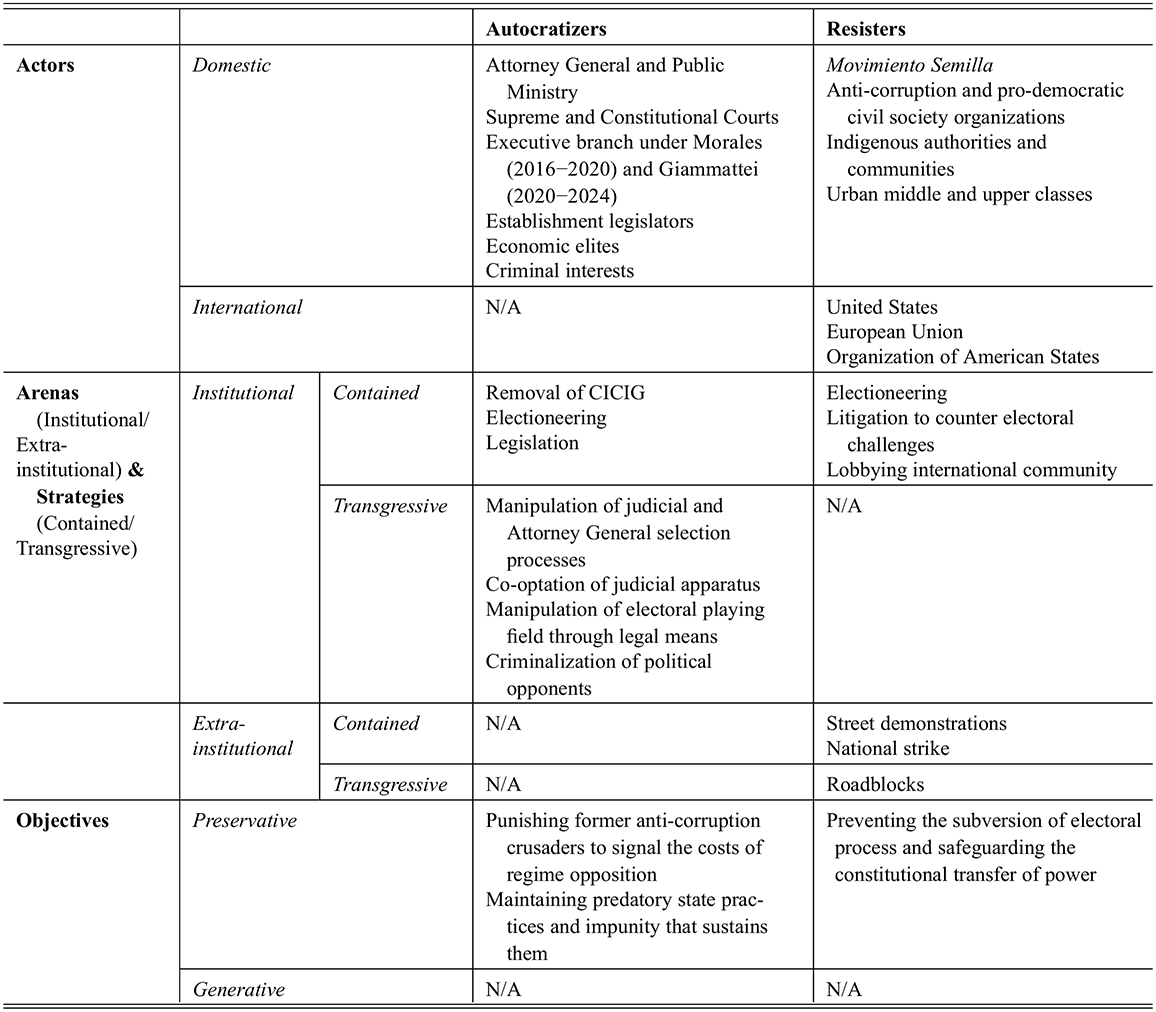
Table 6 Long description
The table illustrates the actors, arenas, strategies, and objectives that characterize Guatemala’s episode of democratic erosion between 2017 and 2024. Among the domestic autocratizing actors are the Attorney General and Public Ministry, Supreme and Constitutional Courts, executive branch under Presidents Jimmy Morales and Alejandro Giammattei, establishment legislators, criminal interests, and economic elites. The domestic resistance actors include the Movimiento Semilla party, anti-corruption and pro-democratic civil society organizations, indigenous authorities and communities, and urban middle and upper classes. International autocratizing actors: N/A. International resistance actors: United States, European Union, Organization of American States. Autocratizers in Guatemala have utilized contained and transgressive institutional strategies. The opposition has utilized contained institutional and extra-institutional strategies, as well as transgressive extra-institutional strategies. Contained institutional strategies used by autocratizers: removal of C I C I G, electioneering, and legislation. Contained institutional strategies used by resisters: electioneering, litigation to counter electoral challenges, and lobbying international community. Transgressive institutional strategies used by autocratizers: manipulation of judicial and Attorney General selection process, co-optation of judicial apparatus, manipulation of electoral playing field through legal means, criminalization of political opponents. Transgressive institutional strategies used by resisters: N/A. Contained extra-institutional strategies used by autocratizers: N/A. Contained extra-institutional strategies used by resisters: street demonstrations, national strike. Transgressive extra-institutional strategies used by autocratizers: N/A. Transgressive extra-institutional strategies used by resisters: roadblocks. The autocratizers and resisters have both pursued preservative objectives. Preservative objectives of autocratizers: punishing former anti-corruption crusaders to signal the costs of regime opposition; maintaining predatory state and practices and impunity that sustains them. Preservative objectives of resisters: preventing undermining of electoral process and safeguarding constitutional transfer of power. Generative objectives of autocratizers: N/A. Generative objectives of resisters: N/A.
3.6 From Elite Collusion to Executive Aggrandizement in Honduras (2009–2022)
Honduras represents one of the few cases of abrupt breakdown following the third wave of democratization in Latin America. In 2009, the Honduran military overthrew democratically elected president Manuel Zelaya, plunging the country into a crisis that left at least twenty people dead, according to the 2011 truth commission report (Comisión de la Verdad y la Reconciliación (CVR) 2011, 288). Zelaya was elected in 2006 as a member of the center-right Liberal Party (Partido Liberal – PL). Once in office, however, he alienated Honduras’ traditional oligarchy, conservative military officials, and the US government, using transgressive institutional strategies to implement an increasingly left-wing agenda. In June 2009, internal forces turned against the president after he defied Supreme Court orders to halt a nonbinding vote meant to gauge popular support for a constitutional referendum. With a warrant for the president’s arrest, Honduran soldiers stormed the presidential residence, captured Zelaya, placed him on a plane to Costa Rica, and swore in head of Congress Roberto Micheletti as interim president. Although the country held elections months later, the ensuing twelve years of conservative National Party (Partido Nacional – PN) rule brought continued democratic erosion.
The 2009 coup marked a dramatic break from Honduras’ seventeen-year streak of electoral democracy. Much like in Guatemala, post-2009 backsliding in Honduras took a hybrid form, involving longstanding patterns of elite collusion between the dominant political parties and, at times, executive aggrandizement. Honduras’ stable bipartisan system, which dates to the early twentieth century, created a context in which the PN and PL competed via elections but ultimately colluded to divvy up the spoils of state control (Sieder Reference Sieder1996). This same bipartisan consensus not only facilitated Zelaya’s ouster but remained crucial in its aftermath, as political elites, in concert with economic and criminal interests, steadily co-opted rule of law institutions.
Yet under PN president Juan Orlando Hernández (2014–2022), this elite collusion combined with elements of executive aggrandizement and pushed Honduras into the competitive authoritarian camp. The incumbent stacked the Supreme Court, scrapped the constitutional ban on re-election, and violently repressed protestors challenging the questionable outcome of the 2017 elections. The ruling regime thus used both contained and transgressive institutional strategies as well as transgressive extra-institutional strategies to dismantle democratic institutions. And as in Guatemala, regime objectives were largely preservative: intended to maintain endemic corruption and allow the government’s organized criminal allies to thrive.
Despite the PN’s immense institutional advantages, Zelaya and his allies leveraged the leftist movement that continued to mobilize in the wake of the 2009 coup to build and strengthen a political party (LIBRE, Liberty and Refoundation) out of a PL splinter. LIBRE pursued contained institutional and, at times, extra-institutional strategies to oppose Hernández’s concentration of power. With an incumbent tarnished by high profile scandals, in 2021, these tactics paid off catapulting Xiomara Castro, Zelaya’s wife, into the presidency. Despite signs of renewed democratic deterioration under Castro, the success of Honduras’ political opposition underscores how disciplined resistance leveraging institutional channels can score important democratic advances even amid competitive authoritarian rule.
3.6.1 Democratic Erosion in Honduras
After the 2009 coup, Honduras quickly moved away from the international spotlight when de facto president Roberto Micheletti was replaced in that year’s regularly scheduled election by former PN lawmaker Porfirio Lobo. Lobo took office at the beginning of 2010, offering the Honduran political system a veneer of legitimacy; however, his rise to power would trigger continued democratic decline, this time primarily through institutional means.
Despite winning the 2009 elections by a striking 18 percentage points over his PL opponent, Lobo forged a cabinet of “national integration,” incorporating members of rival parties (Otero Felipe and Rodríguez Zepeda Reference Felipe and Antonio Rodríguez Zepeda2016). This unity-based approach, however, did not stop Lobo’s government from facing tremendous strains. During his tenure, Honduras saw an increase in organized criminal influence and violence, a trend that many observers attribute to the lawlessness unleashed by the coup itself. According the UN Office on Drugs and Crime, Honduras’ intentional homicide rate spiked from 61 to 92 murders per 100,000 people between 2008 and 2011 (UNODC 2012, 12). Lobo’s militarization of security to address the surge did little to curb violence; to the contrary, allegations of state-perpetrated human rights violations escalated (Sosa Iglesias Reference Iglesias and Eugenio2014, 204–217), signaling the deepening of Honduras’ government-criminal alliance. Lobo’s son Fabio was arrested by the US Drug Enforcement Agency in 2015 and sentenced to twenty-four years in prison for drug trafficking during his father’s presidency. Criminal investigations also found that a powerful Honduran criminal group, the Cachiros, had poured money into Lobo’s presidential campaign and had a direct hand in naming the Secretary of Public Works, Transportation, and Housing, who then granted a Cachiros boss twenty-one state contracts for infrastructure projects never executed (CESPAD n.d.).
The first PN government also cemented corruption as “the operating system” of Honduran politics (Chayes Reference Chayes2017). Beginning in 2016, Honduran and international prosecutors uncovered numerous high-profile corruption schemes, including one against Lobo’s wife for money laundering and embezzlement and another against Lobo’s brother and financial management secretary for fraud (Asmann Reference Asmann2019b; OAS and MACCIH 2018). Other investigations found that members of Congress routinely used networks of NGOs created exclusively to siphon off state funds for political campaigns (CESPAD n.d.).
As in Guatemala, Honduran politicians’ need to secure their illicit rents prompted efforts to co-opt the justice system. Amid the deep polarization of Honduran politics, Lobo and allied legislators sought to pack the high courts with loyalists. In 2010, four lower-court judges were dismissed from their posts for condemning the 2009 military coup as illegal (Human Rights Watch 2010). In 2012, the PN voted to remove four of the five justices within the Supreme Court’s Constitutional Chamber after they voted against a controversial police reform that would have purged police forces in violation of due process (ABC News 2012)
This campaign to eviscerate the independence of state institutions escalated under Lobo’s successor Juan Orlando Hernández (2014–2022). Hernández’s assault on democratic institutions aimed to further concentrate power in the executive to defend and deepen the ill-gotten financial gains of the PN and its allies by ensuring impunity for state-criminal collusion. Building on Lobo’s court-packing, Hernández brought other core institutions under his influence. Months after the 2013 election, the PN and allied legislative blocs divvied up the selection of new magistrates to the Supreme Electoral Tribunal (TSE), sidelining the primary opposition parties (Dada Reference Dada2017).
In contrast to Guatemala, where prosecutorial agencies were central to autocratization, Honduras’ Public Ministry (MP) retained some autonomy. In 2015, it launched a corruption probe that traced the PN’s 2013 campaign funds to state coffers. The wave of protests that ensued forced Hernández to acquiesce to international anti-corruption support and authorize the OAS-backed Support Mission to Fight Corruption and Impunity in Honduras (MACCIH).
Despite this pushback, the administration’s early control of the TSE, high courts, and military proved sufficient to undermine the electoral rules and silence subsequent dissent, allowing Hernández to extend his reign. In April 2015, the Constitutional Chamber of the Supreme Court, which had been almost wholly replaced with regime loyalists in 2012, voided a constitutional provision banning presidential re-election (AP 2015). Just as regime opponents feared, the decision not only helped further entrench the PN but it also empowered organized criminal groups allied with public officials. Indeed, just a month before the 2017 presidential election, US authorities named Hernández’s brother, former PN congressman Tony Hernández, a “person of interest” in a major drug trafficking investigation (Asmann Reference Asmann2019c).
In the 2017 contest, Hernández’s top challenger was sports commentator Salvador Nasralla, who represented the Opposition Alliance against Dictatorship, a front comprised of Castro’s LIBRE and the Innovation and Unity Party (Partido Innovación y Unidad – PINU). In the pre-election phase, the PN leveraged its state control to buy votes and dominate the airwaves. When that failed, on election day, it resorted to outright fraud. With 57% of votes counted and Nasralla enjoying a five-point lead, the electronic vote tally system went down. When it came back online, Hernández appeared as the frontrunner with little explanation (Dada Reference Dada2017). Under pressure from the international community and Nasralla’s coalition, the TSE, led by handpicked PN magistrate David Matamoros, launched a partial recount, but without opposition oversight. Hernández was declared the winner by 1.7 percentage points (BBC 2017).
Between the failure of the electronic vote platform and the official TSE declaration, Honduras exploded in street protests and violence. Opposition demonstrators decrying fraud and demanding new elections were brutally repressed by security forces. According to estimates, at least 16 people were killed and more than 1,600 were injured through mid December 2017 (BBC 2017). The turmoil and international scrutiny ultimately failed to reverse the official outcome, and in January 2018, Hernández became the first Honduran president to be sworn in for a second term since the 1982 return to elected civilian government. Once re-elected, he doubled down on efforts to co-opt the MP, dissolve corruption probes, and defang anti-corruption tribunals (Ernst and Malkin Reference Ernst and Malkin2018; Puerta Reference Puerta2018)
Though transgressive institutional and extra-institutional strategies were crucial to advancing the PN’s authoritarian project, international actors like the United States also played an important, if indirect, role in enabling democratic erosion in Honduras. First, under Barack Obama (2009–2017), the US government responded to the 2009 rupture of the constitutional order by pushing for and recognizing new elections rather than calling for the restoration of Zelaya as president (Lakhani Reference Lakhani2016). Later, Hernández’s election and the subsequent increase in anti-crime cooperation made him one of Latin America’s most reliable US allies in the eyes of bipartisan lawmakers (Asmann Reference Asmann2019a) – despite revelations that US military and police assistance had contributed to state-perpetrated human rights violations (Bargent Reference Bargent2013). Given its fixation on counternarcotics and US-bound migration, the onset of Donald Trump’s first administration (2017–2021) only cemented Hernández’s status, even as US agencies increasingly doubted his commitment to fighting corruption (Asmann Reference Asmann2019c). Consequently, the United States paid little mind to the 2017 allegations of election fraud, despite other international calls to repeat the vote.
3.6.2 Opposition Responses
During most of the PN’s twelve-year rule, Honduras’ political opposition revolved around the LIBRE party, which was established in 2011 by the National Popular Resistance Front (FNRP) that mobilized against the 2009 coup. Since LIBRE’s founding, Mel Zelaya served as the party’s coordinator. LIBRE’s establishment realigned Honduras’ stable two-party system and reoriented politics, previously rooted in clientelism, around ideological cleavages (Perelló and Navia Reference Perelló and Navia2023).
Despite the PN’s co-optation of electoral and judicial institutions, LIBRE remained committed to contained institutional strategies, mostly party-building and electioneering. Zelaya’s long political history and savvy bargaining skills allowed LIBRE to forge strategic alliances with smaller parties and demonstrate its electoral clout. In 2013, LIBRE’s first presidential candidate, Zelaya’s wife, Xiomara Castro, lost to Hernández by eight points. In 2017, LIBRE’s coalition candidate, moderate Salvador Nasralla, reportedly won 41.2% of the vote – 50,000 votes shy of Hernández’s alleged total. Many believe he would have prevailed were it not for the PN-orchestrated fraud described in Section 3.6.1.
Heading into 2021, LIBRE reinvigorated its alliance with Nasralla and his new party, the Savior Party of Honduras (Partido Salvador de Honduras, PSH). Castro ran as the coalition’s presidential candidate and Nasralla as its vice-presidential nominee. Considering the PN’s twelve-year campaign to co-opt institutions, the odds were stacked against the Castro-Nasralla ticket. Even though Hernández would not be on the ballot, few doubted the incumbent party’s willingness to use state agencies and resources to benefit the PN candidate, Nasry “Tito” Asfura.
Yet, there were also reasons for cautious optimism. High-profile corruption and organized crime investigations, both in Honduras and in the United States, increasingly discredited the PN and PL. The scandals that prompted Hernández to adopt the corruption-fighting body MACCIH snowballed during his second term. The 2019 conviction and 2021 sentencing of Hernández’s brother in a US court also implicated the president in drug trafficking operations, underscoring the PN’s image as a defender of the “narco-state.” Meanwhile, the Liberal Party’s candidate Yani Rosenthal began campaigning just months after returning from a three-year prison stint in the United States, where he was convicted for money laundering in connection with the Cachiros criminal group (Palencia Reference Palencia2020).
In addition, the irregularities that marred the 2017 election – made visible by massive street protests – provided an opportunity for the political opposition to loosen the PN’s control over electoral institutions. Following domestic and international criticism, the PN was pressured into passing an electoral reform that created a new National Electoral Council (CNE) and provided LIBRE officials oversight capabilities, even if its representatives were in the minority. Local-level vote counting bodies were also overhauled to provide the three major political parties – the PN, PL, and LIBRE – auditing roles (Freeman and Perelló Reference Freeman and Perelló2022, 124–125). The Honduran case thus illustrates how contained extra-institutional strategies (followed by transgressive extra-institutional state responses) in one moment can contribute to gains that make contained institutional strategies possible subsequently.
The weakening of the other major parties and the reform of electoral oversight mechanisms were important factors facilitating Castro’s victory; however, most experts agree that these conditions were not sufficient to reverse PN-led democratic backsliding. Instead, LIBRE’s own party-building efforts and contained opposition strategies proved decisive. As Eugenio Sosa, Cecilia Menjívar, and Paula Almeida (Reference Sosa, Menjívar and Almeida2022, 51–55) note, LIBRE effectively channeled the social movements mounted in the wake of the 2009 coup – themselves a product of Honduras’ long history of organizing against neoliberalism, environmental degradation, and labor abuses – into successful party-building. The FNRP provided a solid organizational base, but Zelaya also succeeded in peeling off PL cadres opposed to the coup. This provided LIBRE a pool of experienced organizers and access to countrywide political networks, despite the party’s nascent status (Freeman and Perelló Reference Freeman and Perelló2022). LIBRE did not necessarily lead key episodes of social mobilization, like the 2012 student protests and the 2015 anti-corruption demonstrations; however, by pitching itself as the organized opposition to the PN’s “narco-dictatorship,” it advanced a broad anti-regime message that garnered wide support from these and other groups.
In line with its party-building approach, LIBRE also remained committed to occupying and leveraging institutional arenas despite low odds of success. As Freeman and Perelló (Reference Freeman and Perelló2022, 123) argue, the Honduran opposition, unlike other movements contesting authoritarian incumbents in Latin America, “refus[ed] to leave the electoral arena, even as contests became increasingly unfair.” Though electoral participation risked legitimizing contests that the PN manipulated in its favor, LIBRE leaders remained confident in the strength of their message and their base. They also believed that growing anger toward the incumbent government’s corruption, criminality, and autocratic tendencies could eventually tilt the political playing field back in their favor.
Finally, as noted above, pragmatism dominated LIBRE’s electoral strategy, as experienced party leadership recognized the need for alliances with smaller parties and popular political figures. Despite Honduran electoral rules, which allow presidential candidates to win with a plurality of the votes, LIBRE chose to run in alliance with well-known figure Nasralla in 2017 and 2021. The strategy proved successful in the latter contest, as the Castro-Nasralla ticket trounced PN candidate Asfura by fourteen points, easing the results certification by international monitors and decreasing the likelihood of a PN challenge.
Though it did not actively back the Honduran opposition, the United States government welcomed the alternation of power after distancing itself from Hernández, who faced mounting evidence of organized criminal connections. Less than one month after Castro was sworn in as Honduras’ first woman president, authorities arrested and extradited Hernández to face drug and arms trafficking charges in the United States, where he was convicted and sentenced to 45 years in prison (US Department of Justice 2024).Footnote 41
3.6.3 Analysis of the Honduran Case
The National Party served as the primary engine of democratic erosion in Honduras with its legislative and private sector allies backing the executive power-grabs that succeeded in co-opting the country’s high courts and electoral authorities. As such, Honduras’ erosion trajectory illustrates elements of elite collusion and executive aggrandizement. Central America’s leading geopolitical player, the United States, did not actively contribute to autocratization, but did see Hernández as a crucial regional ally, providing a permissive environment for his government’s continued assault on democratic institutions. Though the Honduran regime advanced its political project through some contained institutional strategies, it also proved willing to deploy transgressive institutional and extra-institutional strategies, particularly in the electoral arena where election-day manipulation and postelection violence were used to maintain the PN’s political power. These tactics also underscore the preservative objectives of Honduras’ autocratizers. Though Hernández sought to remake the rules of executive authority, this was largely in the service of allowing the PN and its allies to maintain the criminal connections and rent-seeking schemes that bolstered their political and economic power.
Despite the competitive authoritarian environment, the Honduran opposition leveraged some distinct organizational advantages to facilitate its 2021 electoral victory. Regime opponents built on the coalition mobilized following the 2009 military coup. They dedicated resistance efforts to party-building and leveraged the vast experience and national networks of the pro-Zelaya faction of the PL, which formed the core of LIBRE. In remaining committed to breaking the PN’s power by electoral means, LIBRE prioritized strategic alliances and broad pro-democratic messaging. This approach paid dividends in 2021 when Castro’s substantial margin of victory pre-empted any potential PN challenges.
In the aftermath of Castro’s 2022 inauguration, political polarization in Honduras has remained high. Once in power, LIBRE demonstrated a weak commitment to democracy and anti-corruption reforms (Schwartz 2025), leading to election chaos and the return of the PN to power in the 2025 electoral contest.Footnote 42 Yet, the Honduran experience illustrates how contained resistance strategies can unseat autocratic incumbents, even when they prove willing to manipulate elections and unleash violent repression (See Table 7).
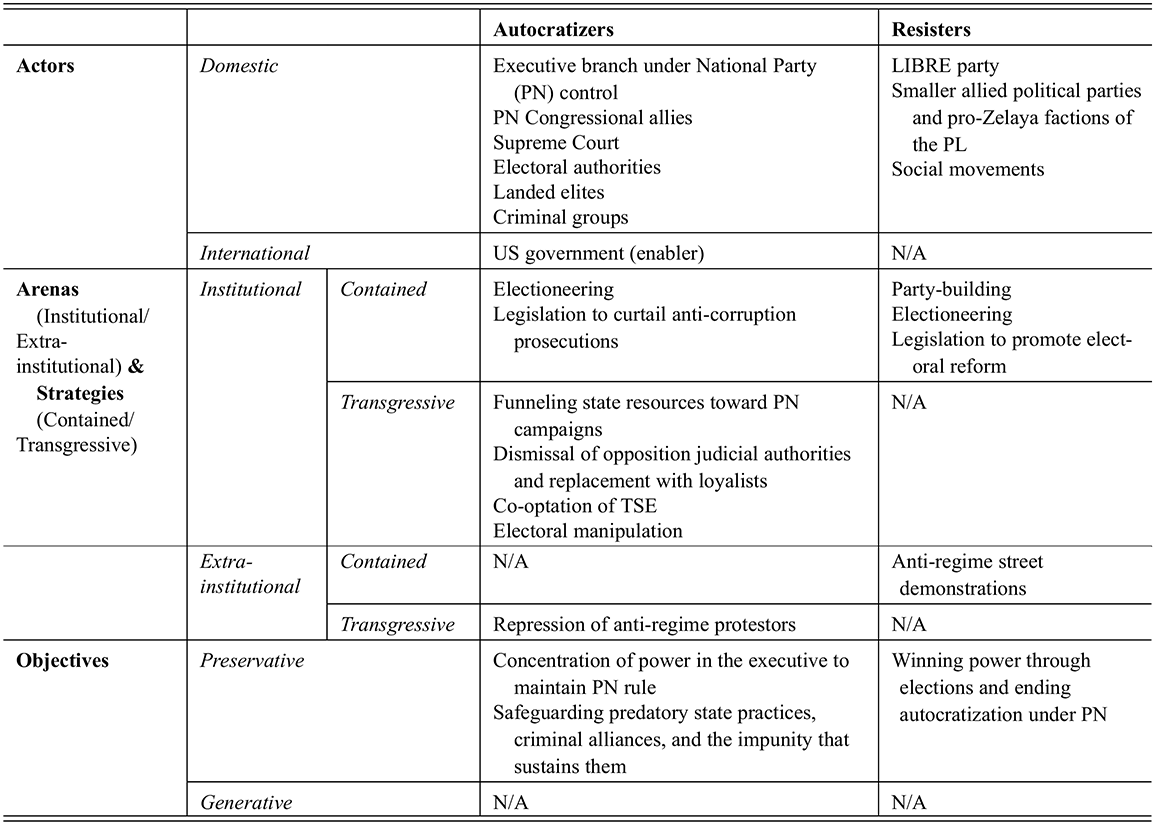
Table 7 Long description
The table illustrates the actors, arenas, strategies, and objectives that characterize Honduras’ episode of democratic erosion between 2009 and 2022. Among the domestic autocratizing actors are the executive branch under the National Party, National Party congressional allies, the Supreme Court, electoral authorities, criminal interests, and landed elites. The domestic resistance actors include the LIBRE party, smaller allied political parties and pro-Zelaya factions of the P L, and social movements. International autocratizing actors: U S government as enabler. International resistance actors: N/A. Autocratizers in Honduras have utilized contained and transgressive institutional strategies, as well as transgressive extra-institutional strategies. The opposition has utilized contained institutional and extra-institutional strategies. Contained institutional strategies used by autocratizers: electioneering, legislation to curtail anti-corruption prosecutions. Contained institutional strategies used by resisters: party-building, electioneering, legislation to promote electoral reform. Transgressive institutional strategies used by autocratizers: funneling state resources toward P N campaigns; dismissal of opposition judicial authorities, and replacement with loyalists; co-optation of T S E; electoral manipulation. Transgressive institutional strategies used by resisters: N/A. Contained extra-institutional strategies used by autocratizers: N/A. Contained extra-institutional strategies used by resisters: anti-regime street demonstrations. Transgressive extra-institutional strategies used by autocratizers: repression of anti-regime protestors. Transgressive extra-institutional strategies used by resisters: N/A. The autocratizers and resisters have both pursued preservative objectives. Preservative objectives of autocratizers: concentration of power in the executive to maintain P N rule; safeguarding predatory state practices, criminal alliances, and impunity that sustains them. Preservative objectives of resisters: winning power through elections and ending autocratization under P N. Generative objectives of autocratizers and resisters: N/A.
4 Theoretical Insights and Future Avenues of Research
Democratic erosion is no longer captured by the lone image of a strongman ruler who eviscerates institutions by personalizing governance. While this more familiar form of backsliding remains common, it is far from the only one. Examining the recent wave of democratic erosion in Latin America, we have shown that autocratization processes are highly diverse. To better understand newer forms of democratic backsliding, we have proposed an analytical framework that disassembles this phenomenon into four dimensions: (1) the actors that lead or oppose autocratization, (2) the strategies they use, (3) the arenas of contention in which the struggle over democracy takes place, and (4) the goals these actors pursue in their attempts to undermine or protect democracy.
We also illustrated how this framework applies in practice by analyzing five different cases of democratic backsliding across North, Central, and South America. In so doing, our goal was not to derive generalizable claims about the actors, strategies, or objectives that render democratic erosion more severe or irreversible, nor the optimal configuration of these factors that facilitates opposition success. Indeed, as discussed in Section 1.2, one of our key contentions is that existing approaches have been too rigid and reductive; as a result, they miss not only the diversity of actors, strategies, arenas of contention, and goals but how autocratizer–opposition interactions shape the course of backsliding itself. In response to these limitations, our framework enables scholars to systematically capture, disaggregate, and track episodes of democratic erosion and resistance to it over time according to common analytical categories.
While it is not the task of this volume to put forward broad theoretical propositions, our five case analyses point to comparative insights that we wish to highlight in the remainder of this concluding section. Our hope is that these observations will provide a foundation for further theoretical and empirical work on these questions and illustrate the utility of our framework in deepening the study of democratic erosion and opposition to it. In particular, we emphasize five key insights:
1. The complexities of the democratic erosion-(anti)corruption nexus – a first notable observation gleaned from placing our five cases side-by-side is the role (albeit varied) of corruption and anti-corruption in struggles over democratic backsliding. Despite the myriad differences in the cases within this Element, (anti)corruption fits into the picture in some form across them. In Guatemala, Honduras, and Perú, where autocratization has been a coalitional affair, maintaining corrupt rents was at the heart of the preservative objectives pursued by erosion agents. As a result, corruption has been a key mobilizing issue for the opposition. In fact, successful pro-democratic resistance in Honduras’ 2021 election and Guatemala’s 2023 election built on anti-corruption organizing following major scandals during the mid 2010s. Meanwhile, in El Salvador and México, the cases that most resemble the executive aggrandizement model, fighting entrenched corruption became the banner around which populist figures rallied supporters and defeated previously well-institutionalized political parties. The five cases thus illustrate that (anti)corruption is not only closely tied to democratic erosion today but that it can be a double-edged sword. In some contexts, it may rally opposition to backsliding and, in others, it may enable aspiring autocrats. Future research would do well to further unpack how (anti)corruption plays into the strategies and goals of autocratizers and opposition to them.
2. Executive aggrandizement, party deterioration, and generative objectives – a second pattern we observe from our case analyses is the connection between executive-led erosion in the pursuit of generative goals and political party deterioration. In broad strokes, this captures what has occurred in El Salvador and, to some extent, México since 2019. In both contexts, well-institutionalized parties and party systems began to buckle under the weight of growing popular disillusionment as issues of crime, violence, and corruption festered. In fact, it is possible that parties like El Salvador’s ARENA and FMLN and México’s PRI, PAN, and PRD suffered from over-institutionalization (akin to what Coppedge (Reference Coppedge1994) calls “partyarchy”), which eroded their party brands, prevented them from rejuvenating themselves, and created a crisis of legitimacy that charismatic figures like Bukele and AMLO seized. Partyarchies tend to have robust horizontal coordination both inside and outside of elections, but very weak mechanisms of vertical interest aggregation. In other words, they are effective campaign and governance vehicles, but ineffectual channels for voters to make demands for security, transparency, or economic prosperity (Luna et al. Reference Luna, Rodríguez, Rosenblatt, Vommaro, Luna, Rodríguez, Rosenblatt and Vommaro2021). In addition to unpacking the links between party deterioration, executive or partisan aggrandizement, and generative objectives, these insights also push us to rethink some of the conventional wisdom regarding the determinants of democratic health. While the literature argues that party and party system institutionalization (usually measured by electoral volatility) are mostly positive for democracy (Mainwaring Reference Mainwaring and Mainwaring2018b), cases like El Salvador and México signal that stiff parties that cannot aggregate and channel voters preferences can also backfire, opening the door to aspiring autocrats who can more effectively sell voters on their transformative goals and obstruct efforts to form broad opposition coalitions (Gamboa Reference Gamboa2020).
3. Party system instability, coalitional authoritarianism, and preservative objectives – if our cases, in part, reveal a “party deterioration-executive aggrandizement-generative goals” nexus, the other side of the coin is the pattern we observe linking party system instability, authoritarian coalitions not centered on the executive, and the pursuit of preservative goals. Guatemala and Perú are emblematic of this type of case. With chronically volatile party systems and deeply fragmented political landscapes, these countries have not seen erosion at the hands of AMLO- or Bukele-like figures. Instead, autocratic coalitions – centered in the legislature in Perú and in the judiciary in Guatemala – spearheaded democratic decline to achieve the fundamental goal that unites them: preserving rent-seeking and impunity. This type of “coalitional authoritarianism” (Sánchez-Sibony Reference Sánchez-Sibony2023) may appear to put the opposition at a disadvantage because erosion agents enjoy broad, multi-sectoral backing. Yet, the Guatemalan case challenges this intuition. Unlike in Perú, where party collapse in 1990 initiated a wave of anti-politics that has hindered party-building and partisan politics, in Guatemala, the opposition was able to transform a civil society movement into an electoral vehicle ready to take advantage of cracks within the authoritarian coalition. With little more than maintaining the status quo holding them together, coalitional authoritarian regimes may be more susceptible to defections that favor the opposition, as occurred in Guatemala when the organized private sector and electoral authorities backed Arévalo’s assumption of power under domestic and international pressure. To be sure, evidence from the Guatemalan case alone cannot support the more general claim that party volatility and fragmentation ultimately benefit pro-democratic forces. Yet, this observation does call for further analyzing how party and party system variation shapes the configurations of actors, strategies, and objectives within episodes of democratic erosion.
4. The backfiring of transgressive autocratization strategies and the role of sequencing – a fourth insight from our cases relates to the (unintended) effects of transgressive strategies among autocratizers. Overall, we observe that transgressive strategies – both institutional and extra-institutional – tend to backfire on incumbents and legitimize the opposition, unless prior contained strategies have sufficiently undermined and/or co-opted institutions. We see this dynamic in the Guatemalan, Honduran, and Mexican cases. In Guatemala, the criminalization of anti-corruption figures and the exclusion of anti-establishment electoral candidates pushed voters to rally around the opposition candidate in the 2023 election. When MP officials sought to overturn the results and prevent the constitutional transfer of power, mass mobilization, which was legitimized by powerful international actors, broke the pro-regime coalition and sank its bid to retain power. In Honduras, state repression against demonstrators following the (likely manipulated) 2017 elections led to important electoral reforms that made it more difficult for the incumbent National Party to contest its huge 2021 loss. Finally, in México, AMLO’s transgressive institutional and extra-institutional strategies during his first two years in office resulted in Morena legislative losses in 2021. It was not until regaining a majority in 2024 that his most significant anti-democratic reforms were again put on the table. Even Bukele’s most transgressive autocratizing acts primarily came after he secured a supermajority in the Legislative Assembly and could co-opt the judiciary through institutional means.Footnote 43 We hope that future research will continue to explore how the sequencing of autocratizing strategies shapes the trajectory of regime change and opposition responses.
5. The advantages of contained opposition strategies – finally, our case analyses largely affirm what scholarship on opposition strategies have already found regarding effective resistance: that contained strategies work best (Gamboa Reference Gamboa2022a, 2023b). Honduras and Guatemala, where electioneering and party-building were critical to overcoming autocratic challenges, are case in point. Yet, the oppositions’ contained institutional strategies were, importantly, complemented by broad, disciplined, and peaceful protests in key moments – illustrating how contained extra-institutional strategies can bolster effective resistance. Building on this observation and our framework, we hope that future studies will continue to analyze the relationship between institutional and extra-institutional opposition strategies, heeding calls for more nuanced analyses (Knospe and Mounk Reference Knospe and Mounk2025; Riedl et al. Reference Riedl, Friesen, McCoy and Roberts2024, Reference Riedl, McCoy, Roberts and Somer2025; Weyland Reference Weyland2025). In so doing, scholars can move beyond “what works” to also analyze “when does it work.”
Acknowledgments
We thank Benjamín García-Holgado, Paula Muñoz Chirinos, Stephan Haggard, one anonymous reviewer, and the series editors for very useful feedback.
The Pontifical Catholic University of Chile
Juan Pablo Luna is Professor of Political Science at The Pontifical Catholic University of Chile. He received his BA in Applied Social Sciences from the UCUDAL (Uruguay) and his PhD in Political Science from the University of North Carolina at Chapel Hill. He is the author of Segmented Representation. Political Party Strategies in Unequal Democracies (Oxford University Press, 2014), and has co-authored Latin American Party Systems (Cambridge University Press, 2010). In 2014, along with Cristobal Rovira, he co-edited The Resilience of the Latin American Right (Johns Hopkins University). His work on political representation, state capacity, and organized crime has appeared in the following journals: Comparative Political Studies, Revista de Ciencia Política, the Journal of Latin American Studies, Latin American Politics and Society, Studies in Comparative International Development, Política y Gobierno, Democratization, Perfiles Latinoamericanos, and the Journal of Democracy.
Columbia University
Maria Victoria Murillo is Professor of Political Science and International Affairs at Columbia University. She is the author of Political Competition, Partisanship, and Policymaking in the Reform of Latin American Public Utilities (Cambridge, 2009). She is also editor of Carreras Magisteriales, Desempeño Educativo y Sindicatos de Maestros en América Latina (2003), and co-editor of Argentine Democracy: the Politics of Institutional Weakness (2005). She has published in edited volumes as well as in the American Journal of Political Science, World Politics, and Comparative Political Studies, among others.
Brown University
Andrew Schrank is the Olive C. Watson Professor of Sociology and International & Public Affairs at Brown University. His articles on business, labor, and the state in Latin America have appeared in the American Journal of Sociology, Comparative Politics, Comparative Political Studies, Latin American Politics & Society, Social Forces, and World Development, among other journals, and his co-authored book, Root-Cause Regulation: Labor Inspection in Europe and the Americas.
Advisory Board
Javier Auyero, University of Texas at Austin
Daniela Campello, Fundação Getúlio Vargas
Eduardo Dargent, Universidad Catolica, Peru
Alberto Diaz-Cayeros, Stanford University
Kathy Hoschtetler, London School of Economics
Evelyne Huber, University of North Carolina, Chapel Hill
Robert Kaufman, Rutgers University
Steven Levitsky, Harvard University
Antonio Lucero, University of Washington, Seattle
Juliana Martinez, Universidad de Costa Rica
Alfred P. Montero, Carlton College
Alison Post, University of California, Berkeley
Gabriel Vommaro, Universidad Nacional de General Sarmiento
Deborah Yashar, Princeton University
Gisela Zaremberg, Flacso México
Veronica Zubilaga, Universidad Simon Boliviar
About the series
Latin American politics and society are at a crossroads, simultaneously confronting serious challenges and remarkable opportunities that are likely to be shaped by formal institutions and informal practices alike. The Elements series on Politics and Society in Latin America offers multidisciplinary and methodologically pluralist contributions on the most important topics and problems confronted by the region.