Introduction
Changing epidemiological and demographic patterns have prompted concern across the United Kingdom about the growing numbers of individuals who live with long-term conditions (LTCs; Department of Health (DH), Social Services and Public Safety DHSSPS, 2005; Welsh Assembly Government, 2008; DH, 2008; Scottish Government, 2009). Patients with LTCs, many of whom are elderly, ‘consume’ a significant amount of National Health Service (NHS) resources in both community and hospital settings. The use of emergency bed days in patients over 65 years is high and has the potential to be reduced if services are better integrated (Imison et al., Reference Imison, Thompson and Poteliakhoff2012). Finding effective ways of managing individuals with LTCs has been a key focus of policy in the early part of the 21st century in England (DH 2004; 2005a; 2005b; 2008; 2010). The World Health Organization (WHO, 2002) has reported similar trends around the world, noting the challenges that demographic changes pose to health systems internationally.
In response, the UK Government introduced the role of CM in 2004. CMs were intended to be highly skilled and experienced clinical nurses using the approach of case management as a means of encouraging self-management and effective disease management. They would be responsible for coordinating care for patients with highly complex needs associated with LTCs (DH, 2004). The ability to find suitable individuals to be case managed often resulted in the use of a risk stratification tool such as Patients At Risk of Readmission (PARR). This case finding algorithm seeks to link different variables to predict outcomes (Kings Fund, 2004).
Following the establishment of a CM service in an inner city primary care trust (PCT) in the United Kingdom, the Trust wished to evaluate the service. Two of three objectives to the evaluation are reported here as they relate to the qualitative part of the study: (i) to what extent had CMs succeeded in implementing the model of case management for which their role had been introduced? (ii) to what extent had their introduction impacted upon the quality of care provided to patients with LTCs and on the quality of life of their carers? Quality of life here is related to general well-being and did not utilise formal quality of life tools.
Background
Although the role of CM is relatively new, the role of case management is not. It was applied in the United States originally for psychiatric patients in the 1950s (Lee et al., Reference Lee, Mackenzie, Dudley-Brown and Chin1998). It was taken up in the United Kingdom in the 1990s as a consequence of the NHS and Community Care Act 1990, although it was initially termed ‘care management’. Case management is defined as a process that combines planning, coordinating, management and review of an individual's care (DH, 2000).
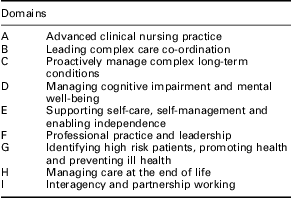
Following the introduction of the role of CM, the NHS Modernisation Agency together with Skills for Health established a competency framework for case management. This was based on nine domains of activity (see Table 1). The role of CM therefore involved combining the established coordination functions of case management with an advanced nursing function.
Domains – case management competences framework (NHS Modernisation Agency and Skills for Health, 2005)
A review of international evidence on case management (1996–2004), which pre-dated the introduction of CMs in the United Kingdom, concluded that evidence on the effectiveness of case management was limited and contradictory (Hutt et al., Reference Hutt, Rosen and McCauley2004). A reason for this may be the use of different methodologies, terminologies and diverse outcome measures.
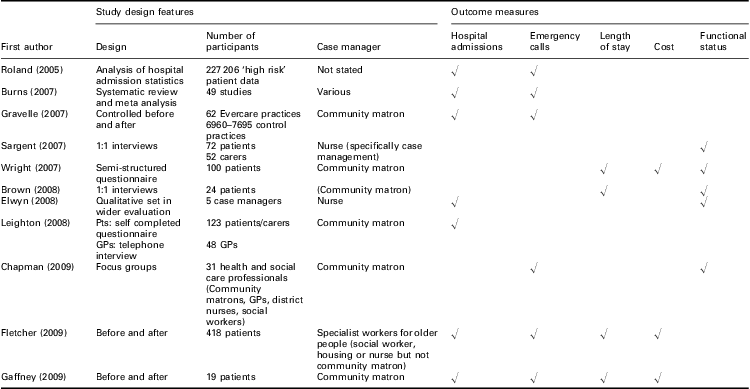
A further literature review undertaken as part of this study looked at post 2004 evaluations. It found that in articles reporting on the United Kingdom there was limited differentiation between case management and the role of the CM. Eleven studies were explored. Four of the studies reported qualitative findings, and seven reported quantitative findings. One of the latter reported quantitative findings from a mixed methods study (Gravelle et al., Reference Gravelle, Dusheiko, Sheaff, Sargent, Boaden, Pickard, Parker and Roland2007). A summary of these studies is presented in Table 2. Findings were varyingly reported on five outcomes: hospital admissions, emergency calls, length of hospital stay, costs and functional status.
Overview of UK studies reviewed

Source: Adapted from Randall et al. (Reference Randall, Barker, Thunhurst, Daly and Mills2011).
In those eight studies that explored hospital admission as an outcome there was conflicting evidence about the impact of case management on hospital admission. A system of case management instigated for individuals with comorbid LTCs by US insurers Evercare reported dramatic reductions in unplanned hospital admissions (Kane et al., Reference Kane, Keckhafer, Flood, Bershadsky and Siadaty2003). Gravelle et al. (Reference Gravelle, Dusheiko, Sheaff, Sargent, Boaden, Pickard, Parker and Roland2007), evaluating UK pilot sites of the Evercare system, were unable to report similar impact in the United Kingdom. Differences in the healthcare systems of the United States and the United Kingdom may account for the marked variation in findings. Hospital episode statistics were analysed by Roland et al. (Reference Roland, Dusheiko, Gravelle and Parker2005) who found that routine hospital admissions fell. However, this evaluation was undertaken at the very beginning of the implementation period for the new role and arguably may not have been the result of their introduction. Roland et al. noted that the single metric of examining hospital admissions may not be suitable for complex and vulnerable patients where many other factors contribute to the need for hospitalisation. Sargent et al. (Reference Sargent, Pickard and Sheaf2007) echoed these concerns. Gaffney (Reference Gaffney2009) provided evidence of a reduction in hospital admissions as the result of the introduction of a CM service. Leighton et al. (Reference Leighton, Clegg and Bee2008) stated that patients and their carers have a clear perception that hospital admissions have been reduced. Following a robust evaluation, Lyndon (Reference Lyndon2007) described a reduction of 59% in high-intensity users of hospital services. Fletcher and Mant (Reference Fletcher and Mant2009) found a non-statistically significant reduction in hospital admissions in the United Kingdom.
Five of these studies explored the impact on the use of emergency facilities. These encompassed regular GP contacts, as well as out of hours contacts, emergency admissions and ambulance contacts. Chapman et al. (Reference Chapman, Smith, Williams and Oliver2009) reported a reduction in GP appointments as a result of case management by CMs, saying that patients reported contacting their CM ahead of any other service. This is consistent with a previous study (Chapman et al., Reference Chapman, Smith, Williams and Oliver2009) reporting analysis of questionnaire data, which suggested that before having a CM 86% of patients phoned a GP, whereas 12% phoned for emergency help.
Gaffney's (Reference Gaffney2009) small-scale study reported a reduction in the length of inpatient stay, with an associated cost saving. For other authors such as Fletcher and Mant (Reference Fletcher and Mant2009), the intention to capture similar data was severely hampered by missing information such as discharge dates. This made it difficult to establish an accurate picture. Both these studies highlighted cost savings in several areas as a result of case management, although it should be noted that Fletcher and Mant's study examined the use of a case management approach by specialist workers for older people.
Patients’ functional ability is another broad area of impact that has been studied. Case managers reported stability in 53% of patients who were case managed (Elwyn et al., Reference Elwyn, Williams, Roberts, Newcombe and Vincent2008). Picking up early warning signs of exacerbation and better medicines management was considered to have a potential impact on functional ability (Sargent et al., Reference Sargent, Pickard and Sheaf2007). Social workers noted an improvement in mental well-being as a result of case management by CMs (Chapman et al., Reference Chapman, Smith, Williams and Oliver2009). It is argued (Taylor et al., Reference Taylor, Kemeny, Reed, Bower and Grunewald2000) that positive mental health can have a beneficial impact on physical health, and as such it could be anticipated that this may reduce admissions to hospital.
However, Offredy et al. (Reference Offredy, Bunn and Morgan2009) argued that evaluating CM services is complicated by the implementation of different service models, confusion over definitions, varying care delivery settings and the use of different outcome measures to assess case management effectiveness.
The role of the CM has been seen as being dynamic and multi-dimensional (Armour, Reference Armour2007; Banning, Reference Banning2009). Evidence suggests that patient and carer satisfaction with this service is high (Schaeffer and Davis, Reference Schaefer and Davis2004; Schein et al., Reference Schein, Gagnon, Chan, Morin and Grondines2005; Armour, Reference Armour2007; Gravelle et al., Reference Gravelle, Dusheiko, Sheaff, Sargent, Boaden, Pickard, Parker and Roland2007; Lyndon, Reference Lyndon2007; Sargent et al., Reference Sargent, Pickard and Sheaf2007; Clegg and Bee Reference Clegg and Bee2008; Leighton et al., Reference Leighton, Clegg and Bee2008; Banning, Reference Banning2009). There are similar positive reports of confidence and satisfaction with CM services from co-workers including GPs (Armour, Reference Armour2007; Leighton et al., Reference Leighton, Clegg and Bee2008; Chapman et al., Reference Chapman, Smith, Williams and Oliver2009). Another requirement for a CM service to be effective is the operation of a robust model for case finding (Girot and Rickaby, Reference Girot and Rickaby2008).
Thus, the literature identifies specific areas in which CMs may be effective. Authors have linked this to the domains of case management, enabling patients to manage their conditions more effectively. They have observed the positive effects on mental well-being, with psychosocial care being seen as equally important to patients as physical care (Scaheffer and Davis, Reference Schaefer and Davis2004; Leighton et al., Reference Leighton, Clegg and Bee2008; Banning, Reference Banning2009). Broader aspects of improved quality of life, better support, reducing hospital admissions and facilitating speedy discharge have been reported as areas where CM services can be effective (Armour, Reference Armour2007; Lyndon, Reference Lyndon2007; Masterson, Reference Masterson2007; Clegg and Bee, Reference Clegg and Bee2008).
The study
Aim
The qualitative aim of this study was to assess and evaluate the extent to which a CM service had implemented case management and the impact that this had had on the quality of care provided to patients, on the everyday experiences of their carers, and on the number of hospital encounters for patients with comorbid LTCs. The findings in respect of the last of these objectives are reported elsewhere (Randall et al., Reference Randall, Barker, Thunhurst, Daly and Mills2011).
Design
The design of the elements of the study reported here was primarily qualitative. The overall methodological approach was one of mixed methods. The study adopted a pragmatic and purposeful approach, which is in keeping with the applied nature of the research. Similarly, the research approach was theoretically conscious, rather than theoretically driven (Thunhurst and Randall, Reference Thunhurst and Randall2010: 402). The following methods were employed for the qualitative elements: focus groups, semi-structured interviews and audio diaries.
Ethical considerations
Ethical approval was granted by a research ethics committee (REC ref: 09/H1210/66) and local site approval was granted by four trusts through their research and development departments. Particular issues considered included the vulnerability of patients. The ethical concerns of CMs related to the project being funded by their employers and the perception that they were ‘expected’ to participate.
Sample/participants
For the qualitative investigations, sampling was purposive. Respondents included CMs and staff who worked at the acute hospitals. This was to ensure a population that was knowledgeable on the topic being explored (Polit and Beck, Reference Polit and Beck2004). All of the PCT's CMs participated (n = 15). Seven staff from the three acute hospitals that interfaced with CMs at the centre of the study participated.
In keeping with the ethical approach agreed for the study, patients and their family carers were approached in the first instance by their CMs to ask whether they would be willing to participate. Those patients and their carers who initially agreed to participate in the study gave permission for their contact details to be passed to the research team who contacted them to explain the study and to seek informed consent. All patients (n = 13) and family carers (n = 8) who agreed to participate were included, except where contact could not be made or work/holiday arrangements precluded setting a mutually appropriate time to meet (n = 2).
Data collection
Qualitative data were collected over an eight-month period from October 2009 to May 2010.
Focus groups
At the outset of the study, focus groups with CMs were conducted to explore their understanding of case management, their perception of their role and of how both case management and the introduction of their role had impacted on hospital admissions. For operational reasons, three focus groups were held, with the number of participants ranging from three to four in each. There is debate surrounding suitable numbers for focus groups. Fern (Reference Fern1982) suggests that four participants are adequate, although concedes that fewer ideas may be generated. Merton et al. (Reference Merton, Fiske and Kendall1990) suggest 15–20 as a suitable number. Either way, a focus group of three participants was arguably too small, but as clinical need had prevented the attendance of two additional CMs the focus group went ahead (in appreciation of the time given by the other participants). The groups were homogeneous in nature and participants came from pre-existing teams. McLafferty (Reference McLafferty2004) notes the alteration of group dynamic when strangers participate. Each focus group lasted between 60 and 90 min and was conducted by the researcher, assisted by a research assistant who took field notes and recorded the discussions.
Interviews
Semi-structured interviews were conducted with CMs, patients and their family carers and secondary care staff. Questions for all groups were focused on the domains of case management, and worded appropriately for each group (in lay language for patients and family carers: see appendix 1). The use of a semi-structured interview allowed the experience of the CM service to be explored from different perspectives and allowed answers to be probed more deeply when appropriate (Parahoo, Reference Parahoo2006). In addition, questions were asked of all three groups about admissions and discharges from hospital in relation to the CM service.
Audio diaries
Although there is little literature available on the use of diaries as a data collection tool (Clayton and Thorne (Reference Clayton and Thorne2000), audio diaries were used to allow the CMs to give clear examples of their work, which can be difficult to record. The research team hoped that recording would be less onerous to the CMs than keeping a written diary. An A4 sheet of instructions for the dictaphone and suggestions of content were provided. A demonstration of start, record, stop was also given. In study findings (relating to patients), Jacelon and Imperio (Reference Jacelon and Imperio2005) suggest a maximum period of two weeks for diaries to be used. This was the time span used in this study. They also report audio diaries as a rich data source, and when used in an unstructured manner Palen and Salzman (Reference Palen and Salzman2002) concur. All CMs took part (n = 15), and all recorded some aspects of their work, indicating this to be an acceptable method of data collection.
Data analysis
When analysing the qualitative data, the domains of case management were used as a guide.
An inductive approach to data analysis was taken (Miles and Huberman, Reference Miles and Huberman1994). Their model integrates four stages: data collection, data reduction, data display and drawing conclusions and verification. Following Miles and Huberman's model, the processes of data reduction and conclusion drawing/verification were managed using a data analysis framework built on Colaizzi's (Reference Colaizzi1978) work. The steps taken drew on a summary of Colaizzi's approach by Beck (Reference Beck1994):
• Data transcribed verbatim.
• Review of all participants’ descriptions using text (interviews and audio diaries).
• Returning to the data to consider significant statements in the context in which they had been given.
• Formulation of meanings with descriptions (coding of data).
• Organisation of codes into themes in a ‘tree’ formation.
• Consideration of significant statements that do not fit into codes and themes and reorganise.
• Formulation of statements that captured participants’ description of the phenomena.
• Offer to returning statements to participants (no one took up this offer).
Findings
The participants who took part in the qualitative elements of the research are listed in Table 3. Overarching themes that emerged across the groups of participants were noted as: visibility, interpersonal relationships, leadership and system/professional boundaries. These findings are summarised below, and combine data from interviews and audio diaries:
Qualitative study informants

*Due to clinical commitments/off duty.
Visibility
For patients and family carers, knowing that they had a CM and knowing how and when to contact them was important. Two patients’ comments exemplified this when they noted:
[You] Can speak to the Community Matron, but you can't get hold of your doctor (B3)
She's on the other end of the phone. It's as simple as that (B4)
In contrast, secondary care staff reported a reduction in the visibility of CMs since the introduction of the CM service, but felt that this was more to do with an increase in the workload of CMs. Despite this, hospital staff believed that the input of the CMs was valuable, for example in knowing the home circumstances of patients and thus facilitating speedy discharge. The CMs themselves reported that case management continued even when a patient was hospitalised:
co-ordination without interfering (CMZ1)
However, it was noted by the matrons that their presence was not always welcomed in an acute hospital:
I can stand there for 20 minutes without anyone speaking to me. I tend to, it sounds awful, but bypass the nurses and speak to a doctor (CMX4)
The CMs felt that their role was misunderstood despite various and continuing efforts to explain it to a body of acute hospital staff that was often fast changing:
I will write in the notes …I'll leave leaflets
They reported that acute staff often confused their role with that of district nurses.
Inter-personal relationships
The most significant finding arising from the acute hospital staff interviews was their inability to comment on the CM service. This was in part because they worked with three distinct CM services from three different PCTs. These were all set up differently. Consequently, their knowledge of CM services was based on their personal relationship with an individual matron rather than on a composite service.
Both patients and their family carers stated that relationships with their CMs were an element of care that was important. Being seen as an individual and in relation to all needs was welcomed by patients:
In my view as a user you get help with everything from medical, social… (A3)
Coordination of care between different sections of health care was deemed important to carers:
Researcher:so, from what you have said, in a sense you've got one person that you can ring with any problem and she's almost [the] …
Patient:door opener, yes…she's the right person
Carer:invaluable (A3, CA3)
For patients, trust and knowing that someone was there improved their mental well-being and, in addition, CMs also gave them an extra layer of support instead of patients having to contact their GP and then dial for emergency help:
I've stopped ringing the GP, who would say, ring an ambulance (A1)
A CM also noted the trust and rapport element and commented:
That consistency makes a massive difference…even though in actual fact, generally speaking, you're not actually doing that much different to everybody else. It's just the same person doing it (CMZ1)
The relationship between patient and CM is central to implementing the domain of self-management. Patients showed that they really seemed to understand the importance of this aspect of care. Throughout the interviews with the 13 patients, it was apparent that most did not want to go into hospital. One carer's comment on independence and the importance of self-management was
I didn't phone the Community Matron, because I could manage this by myself, but it is reassuring to know that she is behind me (CB4)
CMs were very clear that their role encompassed developing their patients’ independence rather than dependence. One matron reported a success story:
I taught one patient about rescue packs, and his admissions have reduced. He no longer hits the 80-100 band on the PARR data and now I have reduced the number of visits to him (CMX1)
Although interpersonal relationships are important, our work shows that the relationship remains professional and, when case management works effectively, interventions may be reduced.
Leadership
The CMs often found it difficult to differentiate leadership from management. Despite this, an association was noted between leadership and coordination by several CMs. One such example is that of a CM organising a case conference that allowed key workers along with patients and family carers to be present and to explore and plan care needs in a timely and effective manner:
The first thing I tend to do is do a case conference. And I always ask the medical consultants to attend where I'm actually looking at how I can actually coordinate the care and be part [of] keeping the package quite tight together so there's no loose ends. And I would say for her it was … a really, really good example of how you can do … pull things together quite quickly if you've got the right people [around] the table talking … at the same time…
In relation to co-ordination, many community matrons were clearer about their leadership role. Directing the wider team through leading by example and by being assertive, CMs were able to inform other professionals of the CM's role as coordinator:
Leadership is key in this role. If you are not able to lead I think it would be an extremely difficult role to fulfil in every sense of the word and not only just leading in terms of coordinating but you've got to be actually be prepared to put you're your foot out sometimes in areas where people might think well I don't think we've done this before so I don't think we can try it…and you'll have to say well I'll do it first so let's see how we go
Leadership may develop in relation to role confidence. CMs employed at the role's inception were effectively supported with training. This became more difficult as those employed later were expected to provide a service, as well as meeting educational needs. As such, the service struggled to embed:
who gets this and who gets the time off the release for it (study) and there's been lots of issues…study leave and hours
Being tenacious was a quality referred to by many CMs as they strived to assert leadership in their quest to case manage this medically fragile group of patients. This tenacious quality also helped them to navigate system and professional boundaries.
System/professional boundaries
Difficulties in understanding the role of the CM were relayed. This confusion was compounded by the different CM service models implemented by the respective PCTs, as there was more than one in the city.
A systemic issue mentioned by many key informants was that of the operation of out of hours cover. Patients reported a poor service overnight and often being actively encouraged to dial for emergency help:
if I'm having an attack…and I ring him he just says ring an ambulance…and that is it…so that's why I stopped ringing him you know…it's a waste of time…
CMs supported this view. One highlights the reduced support available to patients and carers at the weekend as one factor that might make admission more likely:
Both out of hours calls were made on the Saturday night. Our service doesn't work in the evenings or at the weekends. It's not particularly a pattern I've noticed of patients I'm working with being admitted over the weekends but I do wonder in this situation whether the carers have just had too much erm…and weren't able to feel that they could carry on at home…and so this may have led to that phone call to the out of hours and the admission
Other systems issues related to different goals for paramedics. A CM reflects on a case where communication and procedures in relation to an individual at the end of life were ineffectively managed:
I mean it's not the ambulance fault I suppose. As much as you educate the family in things…they get frightened when it's the middle of the night and their loved one can't breathe properly and things and I had one incident last year sometime and again heart failure and the family rang the paramedics and the paramedics resuscitated, but again you know that's their job. I just think if we have a more robust system in place where they could stick not for resuscitation on the door and please leave at home then just go and say look you know do their job and leave…so that was a real shame
Discharges from hospital did not always run smoothly. The following quote taken from an audio diary acknowledges that continuity of care can be fragmented by the simplest of issues. Here, a patient discharged without a blister pack of medicines resulted in readmission:
He keeps falling over. They (hospital) changed the medication but he lives alone, in a tower block, social services carers will only administer the pills if they're in a blister pack …they changed his medications gave it at home in a box, so a carer refused to administer it. He ends up 999, back in
This is one example of a number in relation to social care, which highlights the fragility of services working together. Informants noted variation in relation to problems encountered with one matron summarising:
you can break down that barrier and open up lines of communication…but it does depend on the person and the agency…
These examples represent a small sample of the numerous difficulties that CMs and patients and carers encountered on a regular basis in relation to system and professional boundaries.
Discussion
Study limitations
This study reports on a single CM service and its findings need to be considered within this context. In addition, as patients and carers were recruited by CMs, there is the possibility that those who participated had been approached because of their positive views of the service, although we have no evidence of this. In addition, the size of focus groups may have impacted the quality of data obtained from them.
Interpretation
To what extent were CMs successful in implementing their intended role?
It appeared from our findings that the elements of case management that related to the CMs’ direct relationship with their patients and families were well established. This is noticeable in the findings associated with visibility and interpersonal relationships. However, in order that the CMs fulfil their roles of leadership and leading case management, there needs to be a clear understanding of their role by fellow health- and social-care workers. We have noted that this understanding is not yet apparent in the acute hospital staff services. Manley et al. (Reference Manley, Webster, Hale, Hayes and Minardi2008) contend that managing across boundaries to ensure a seamless service for patients can be seen as a leadership strategy. This is apparent in relation to the role of CM as coordinator. In addition, our findings relating to systems boundaries showed a health service that was prone to fragmentation. The CM service is a subset within a whole, which can place limitations on the achievement of one of the aims of the service, which is to reduce avoidable hospital admissions. Qualitative findings, as noted above, included examples of out of hours GPs instructing patients to phone for emergency help. Similarly, ambulance personnel when confronted with a very sick individual, but one who may only be marginally sicker than is their normal condition, would frequently take the individual to hospital. Systems of sharing information were not clear. Dr Hamish Meldrum (chair of the British Medical Association GP Committee) raised concerns that this lack of integration of CM services can lead to services working at cross-purposes and argued that that CM services should be fully integrated into primary care (Nursing Standard, 2005). Although not talking directly about CMs, the report by Imison et al. (Reference Imison, Thompson and Poteliakhoff2012) states that integration of services is an important factor in reducing hospital admissions in the elderly.
Our findings would suggest fragmentation and an absence of the ‘sub systems’ working together to prevent unnecessary hospital admissions. Secondary care informants offered solutions such as extending the hours worked by CMs. However, to extend the working hours of CMs alone would still not have the desired impact without extending the working hours of other services to which referrals could be made.
What was the impact of CMs on the quality of care provided to patients and on the quality of life of their carers?
Notwithstanding this, our findings related to interpersonal relationships, demonstrated a subtle yet important distinction in the way case management by a CM was perceived by patients and by their carers. For patients, the greatest impact was a result of the CM relating to them as a whole, rather than just tackling a single disease, something that they had experienced during hospital appointments. This may be considered to replicate the findings of Williams et al. (Reference Williams, Smith, Chapman and Oliver2011), who highlighted the proactive role of CMs, as distinct from the reactive and problem led approach of district nursing services. It is unrealistic to expect that every healthcare professional who comes into contact with patients will hold every fact about them, but this assembly of knowledge is key to the CM role and to the effective coordination of care. It was the coordination role that carers reported as being most valuable in supporting them and in supporting their relative who was experiencing the LTC and is echoed by Ross et al. (Reference Ross, Curry and Goodwin2011).
Conclusion
We would conclude that key elements of case management have been implemented through the introduction of the CM service within the PCT studied. We have recorded consistent approval of the CM service from patients and their carers and a clear perception that this has been to the marked benefit of their respective quality of care and every day experiences of life.
However, CM services are increasingly expected to reduce levels of hospital admission. We would conclude that this is a major challenge. Many CM services did not fully recruit until 2008 and as such have had limited time to embed. The complexity of patient need, service issues, the quality of infrastructure, the extent of fragmentation and the limited vision of working in partnership held by other professions all need to be addressed as CMs are not the sole influence on hospital admission rates. As such, a renewed effort is required to break down barriers in health care to ensure that new roles, including that of the CM, are allowed to embed and meet the challenges of supporting the increasing needs of patients with LTCs.
Acknowledgements
The reference group at Heart of Birmingham teaching Primary Care Trust: Angela Knight Jackson, Wayne Harrison, Debbie Williams, Andrew Woods and all staff and patients who gave so generously of their time. Funding Statement: Funding for this work came from Heart of Birmingham Teaching Primary Care Trust.
Appendix 1
Face-to-face patient questions
1. How do you feel about the care and support that you get from you community matron?
2. How do you feel about the information given to you by your community matron about your condition and treatments you receive?
3. What do you understand about your medical condition?
4. How well do you understand the medication that you take and how they might affect you?
5. How confident are you at gaining help if you feel unwell?
6. How has your care with other services been coordinated by the community matron?
Face-to-face family carer questions
1. How do you feel about the care and support that you and your relative get from you community matron?
2. How do you feel about the information given to you by your community matron about the condition your relative has and treatments your relative receives?
3. What do you and your relative understand about your medical condition?
4. How well do you understand the medication that they take and how they might affect your relative?
5. How confident are you at gaining help if your relative starts to feel unwell?
6. How has your relative's care with other services been coordinated by the community matron?