

I am fortunate enough to have made many trips to the opera. I have been ‘at the opera’ in concert halls, opera houses, amphitheatres and cinemas. I have witnessed opera through radio, CD, television and the internet. And I have even been to the opera in video games. In these visits, the action onstage and my own agency sometimes seem to blur together and conflate: I have assassinated in Tosca, committed crimes in The Beggar’s Opera, and undergone transfiguration in a music drama by Wagner. These operas occur in a different mode of reality from my day-to-day life, but nevertheless serve as experiences that are part of my holistic musical and cultural existence.
In recent decades, rich traditions of filmic practice, opera staging and scholarly discourse have made us increasingly aware of the dialogues that exist between opera and film.Footnote 1 Academic investigation has explored the multifaceted complexities of opera on screen, a domain that encompasses filmed recordings of staged opera, ‘live’ broadcasts, and representations of – and allusions to – opera in mainstream Hollywood film. What, then, of other sister moving-image media? Might equally revealing intersections exist in media such as video games?
Video games have a long history of using musical excerpts from opera.Footnote 2 Such music, however, is not often presented in terms of staged opera. Opera in games is more commonly sounded either as part of general playlists of ‘classical’ art music,Footnote 3 or as intertextual references to quotations of opera in other media.Footnote 4 Even the video games based on Der Ring des Nibelungen do not depict a staged operatic work in any traditional way.Footnote 5 These instances might be best considered as part of the broader practice of the citation of art music in games.Footnote 6 This present investigation, however, is instead concerned specifically with moments of staged opera in games.
The aim is to explore situations where opera is directly depicted as occurring in the fictional narrative world of the games; what Marcia J. Citron would describe as ‘opera visits’.Footnote 7 The tradition of the ‘opera visit’ has become an established conceit for films and other popular narrative media. In games, such examples include the staging of pre-existing operas, as well as scenes that present new compositions.
I offer two justifications for this scholarly inquiry. First, these moments where games and opera intersect have the potential to provide insight into the constitutional media. To borrow Michal Grover-Friedlander’s comments (originally made regarding film and opera), the interactions of video games with opera might ‘teach us something about the exchange between the two media, and … the transformation of one medium into the other may reveal unanticipated or previously unarticulated characteristics of each’.Footnote 8
Second, beyond this opportunity for informative intermedial dialogue, there is a distinctly pragmatic necessity for this investigation. While it would be erroneous to characterise video games as the exclusive domain of the young,Footnote 9 video games retain a distinct youth appeal and capture a substantial proportion of young people in modern Western society (one oft-cited statistic estimates that 91% of American children play games).Footnote 10 When games have such great cultural permeation and present opera to those still forming notions of adult culture, opera in games potentially serves an educational function. It is therefore important to consider how opera is being presented in this context and which images and conceptions of the medium are being created, reinforced or disavowed.
Methodologically, this article follows in the footsteps of the hermeneutic tradition of scholarship established both within game music and studies of opera on screen. The writings of William Cheng and William Gibbons on musical experiences in games represent significant precedents for the approach adopted here.Footnote 11 It is important to respect the differences between films and games (a topic to which I shall return), but with this awareness in mind, research on opera scenes in film provides a useful starting foundation for this investigation. I draw here on studies by Citron, Jeongwon Joe and Marc A. Weiner, amongst others.Footnote 12
In line with Joe, ‘my analyses are not drawn from the [creators’] intentionality but [from] my reading of the interplay of sonic and visual signifiers’.Footnote 13 Part of the position I adopt is based on my own experience as a player, in the model of Cheng’s ‘hands-on experiences with gameworlds’ and ‘critical interpretations’.Footnote 14 After Nicholas Cook and the game theorist James Paul Gee, I consider gamers as actively investigative media consumers, ‘reading’ the game and creating musical meanings as they encounter the multimedia text.Footnote 15 A hermeneutic approach is especially apt for video games. Players are encouraged to undertake such interpretation even more than in film, because of the interactive dimension of the medium which demands players respond to the game. As Karen Collins writes, ‘the stakes for players’ involvement, interpretation and therefore attention are much higher in games [than film], so they listen more actively’.Footnote 16 An attitude of interpretation is prompted by the media parameters and embedded in the players’ engagement with the medium.
It is my intention here to interrogate the aesthetic discourse of these opera scenes. I attempt to understand how the operatic materials and the cultural meanings of opera are drawn upon and reconfigured through their sounding in games. As part of this exploration, antecedent critical histories of opera are placed in dialogue with the manifestations of opera in games. This way, we might appreciate how games represent and deploy operatic experiences for the players. In short, these opera scenes are ‘read’ in their game context for their meanings and aesthetic effects, in order to uncover what these games ‘say’ about opera, and what opera ‘does’ in games.
This article explores five games chosen for both their treatment of opera and their dissemination. All the games feature staged opera as part of a sequence that clearly aims to form a significant part of the aesthetic experience of the game. The games are high-profile mainstream titles that collectively have sold near twenty million copies.Footnote 17 While the group has a diversity of musical material, game type, historical range and computer technology, they nevertheless usefully inform one another in a critical manner.
Hitmen
Following the precedent of films such as The Godfather Part III (1990), Quantum of Solace (2011) and Mission: Impossible – Rogue Nation (2015), some games depict scenes of assassination and violence simultaneously with staged opera.Footnote 18 As Jeongwon Joe writes:
[the] use of operatic music in conjunction with cinematic death, especially ritualized, stylized, and climactic murder scenes, has been notable across diverse genres of popular titles … [serving] as a sonic enhancement of [filmic] death scenes.Footnote 19
Citron discusses how Tosca acts as a backdrop for a violent confrontation in the James Bond film Quantum of Solace. She observes that this filmic presentation of opera departs from the typical opera visit, where ‘opera appears in an idealized light. It stands for high art, possesses transformative powers, and serves as an uplifting experience that embodies the best of Western culture.’Footnote 20 In Quantum of Solace, however, Citron argues that the opera is presented without idealisation, as an ‘isolating phenomenon’, with a ‘detached operatic subjectivity’.Footnote 21
Two games, Hitman: Blood Money (2006) and Assassin’s Creed III (2012), both ask the player to enact an assassination during the performance of a staged opera. Predating the Quantum of Solace film by some five years, Hitman: Blood Money used the same opera, Tosca, as the setting for opera house violence. The Hitman games belong to the ‘stealth’ game genre, where the player must achieve game objectives by directing an avatar through a virtual environment while avoiding detection by the enemies. Typical challenges include infiltration, theft or, as in the case of Hitman, assassination.
In the Tosca level, the gamer, playing the role of hitman Agent 47, must arrange the assassination of two targets during rehearsals at the Palais Garnier in Paris: a tenor playing the role of Cavaradossi (Alvaro d’Alvade) and a diplomat watching the rehearsals. As Cheng writes:
[A]s d’Alvade and his fellow NPCs [non-playable characters] run the final scene again and again, the player receives multiple chances to observe their actions and to hatch an ideal plan. … That d’Alvade and his castmates are rehearsing only the final scene of Tosca also means that … the perfect window of opportunity – Cavaradossi’s execution – comes up.Footnote 22
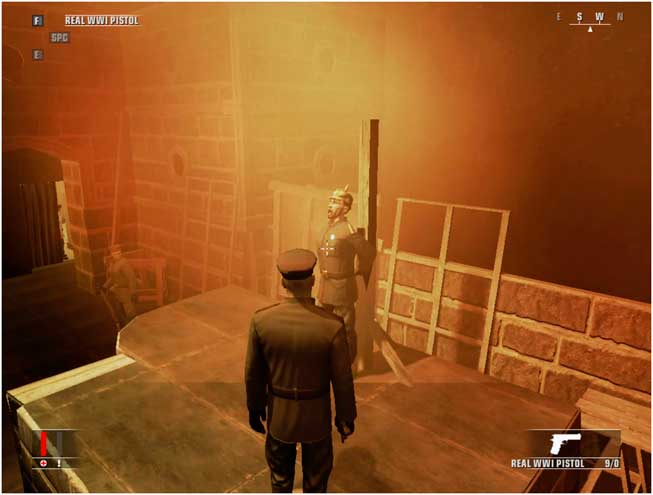
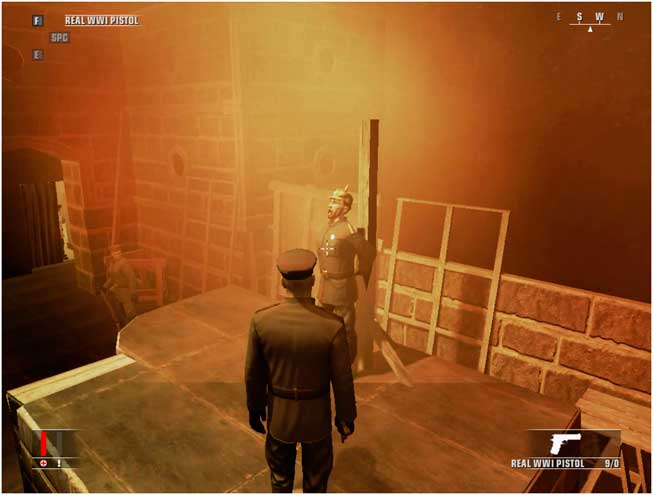
There are several ways that the player can choose to eliminate the tenor. One might replace a prop gun with a real one, use the staged shot to cover the sound of Agent 47’s own lethal bullet, or have Agent 47 play the role of the soldier who executes Cavaradossi, assassinating d’Alvade on stage (see Fig. 1 and Ex. 1). Concerning the other target – the diplomat – the favoured mode of murder is crushing him with a chandelier, in a moment reminiscent of The Phantom of the Opera, set in this same theatre.Footnote 23
In Hitman: Blood Money, tenor Alvaro d’Alvade sings as Cavaradossi while Agent 47, disguised as a soldier, waits for the appropriate moment to assassinate him. Screen capture by Tim Summers, 10 September 2017.
Cavaradossi is killed in the third act of Tosca. The moment in the score marked with * is also when the assassination of tenor d’Alvade occurs in Hitman: Blood Money.
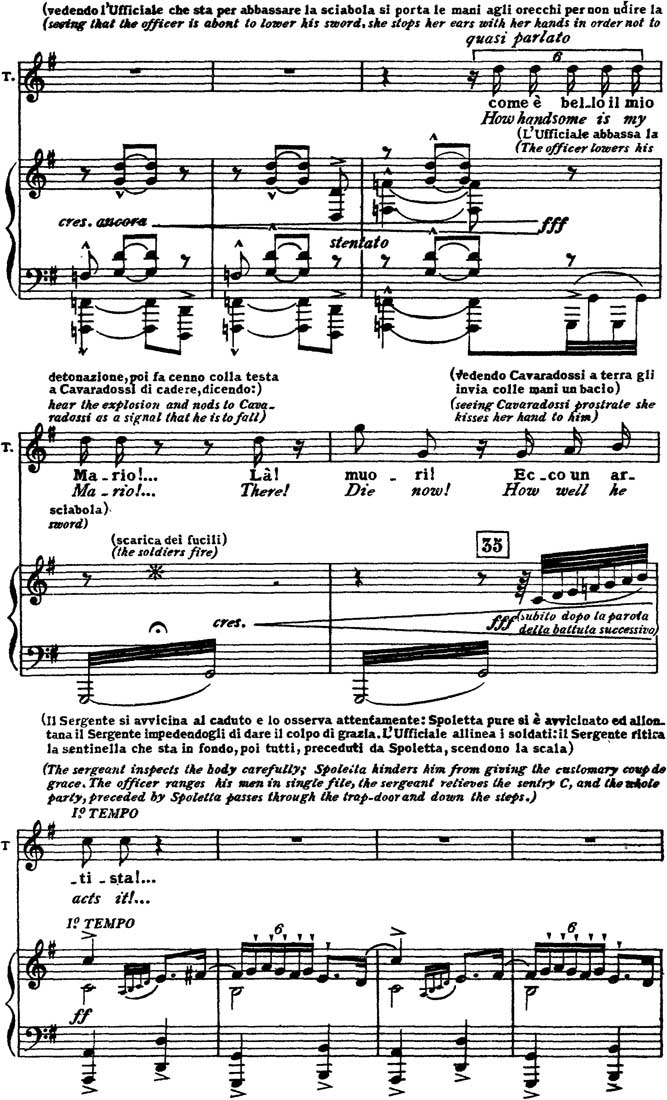
In his evocative discussion of the level, Cheng notes how this sequence toys with its nested fictions, especially the confusion between real death and acted death that happens on both the level of the story of Tosca (where Tosca initially believes Cavaradossi is only playing dead) and the diegetic action of Hitman (where the other actors initially believe d’Alvade is only playing dead).Footnote 24 Since his concerns lie elsewhere, Cheng does not consider the sequence’s significance as a specifically operatic moment. Tosca is, nonetheless, integral to the aesthetic experience of the level and the discourse about the opera that the game articulates.
It is useful to interrogate this Hitman level alongside another game featuring murder at the opera. Assassin’s Creed III is a game with a play mechanic that is often similar to Hitman, involving covert action and homicide. The Assassin’s Creed games take place primarily in historical settings. At the start of the third game, the player adopts the role of Haytham Kenway, a nobleman attending a performance at the Theatre Royal, Covent Garden in 1754. The performance is one of John Gay’s The Beggar’s Opera and is described by the game’s characters as a revival. The Beggar’s Opera was performed five times in Covent Garden during 1754,Footnote 25 but given the regularity of the performances of the work in the preceding years (at both Covent Garden and elsewhere), the notion of a ‘revival’ is rather historically misleading.
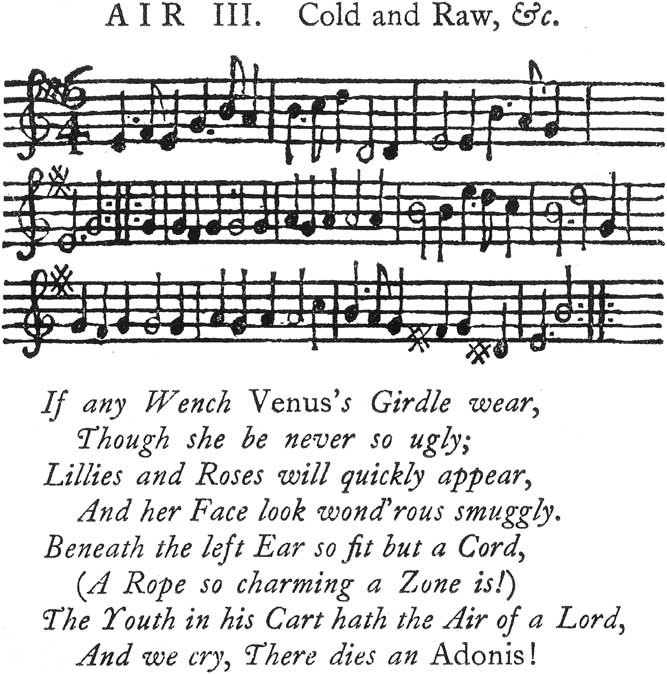
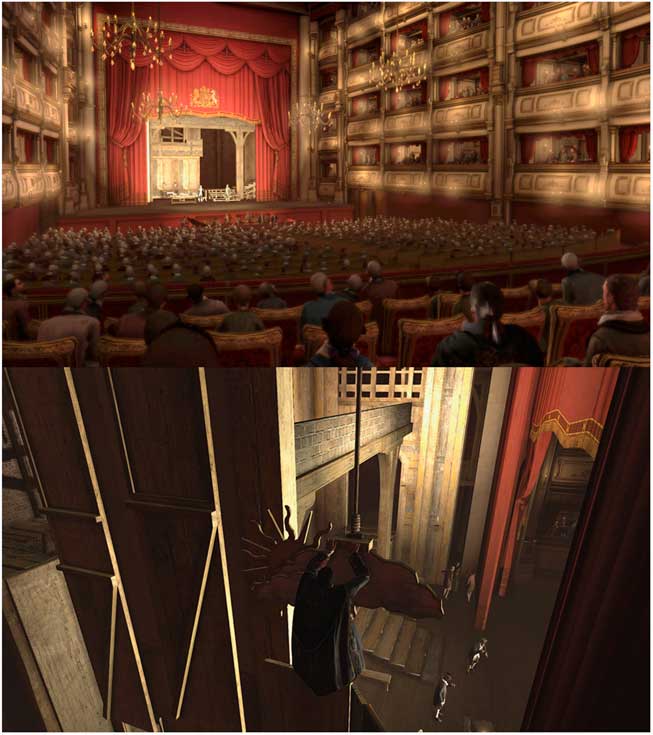
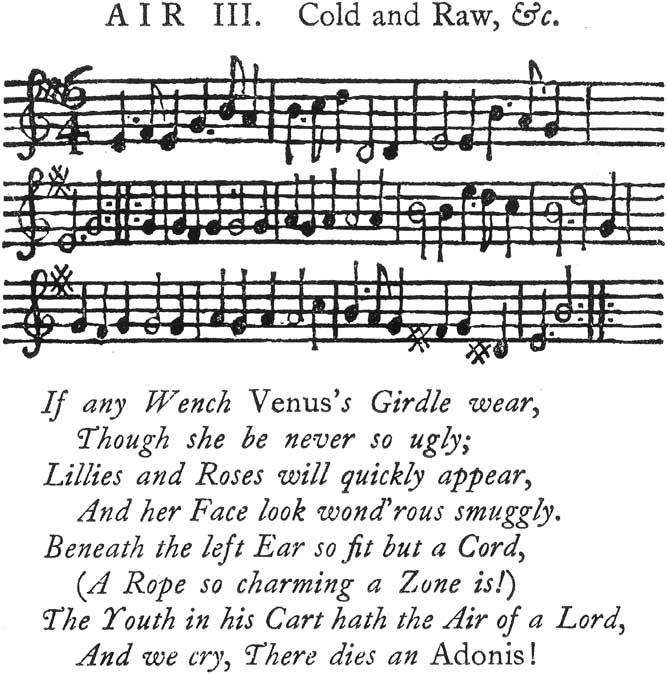
While Kenway enters the auditorium, the opera house’s period-instrument orchestra is heard playing Johann Christoph Pepusch’s ‘Ouverture’.Footnote 26 When the player directs Kenway to sit down, the music skips to the final chords of the overture, before the first ballad, ‘Through All the Employments of Life’, starts to be performed by the actor playing Peachum (Fig. 2).Footnote 27 Kenway’s target is a member of the audience, sitting in one of the boxes. Kenway must make his way from his stalls seat on stage right, to the box, stage left, by sneaking across the top of the stage, using the gangways and clinging to the suspended scenery, while the opera is being performed below him. The songs and dialogue of The Beggar’s Opera continue to play out during this part of the game. When Kenway reaches the box, the operatic action cuts to Mrs Peachum’s air, ‘If Any Wench Venus’s Girdle Wear’ (see Ex. 2). This aria accompanies the sequence in which the target realises he is about to be killed, converses with Kenway, and is ultimately executed when the player presses a button to have Kenway do the deed. Kenway steals jewellery from his victim and leaves the box to make his escape. While Mrs Peachum continues to sing on stage, it is not long before the opera halts, upon the discovery of the death.
Haytham Kenway attends Covent Garden in Assassin’s Creed III. He reaches his victim by crossing the stage while the opera is performed. Screen capture by Tim Summers, 20 February 2018.
Mrs Peachum’s Air, ‘If Any Wench Venus’s Girdle Wear’ from The Beggar’s Opera.
Though The Beggar’s Opera is of a distinctly different genre to the kinds of opera usually used in opera visits in film (Italian opera tends to dominate), this piece is nevertheless apt for Assassin’s Creed. The geographic/historic setting of the game provides certain boundaries for the operatic repertoire that could be included, and, in doing so, the presentation of this opera serves to help define those same contextual factors for the player. More than simple couleur locale/couleur historique, however, the piece is thematically felicitous for Assassin’s Creed, much as Tosca is for Hitman.
Both Tosca and The Beggar’s Opera have long provoked controversy among audiences and critics. Tosca’s spectacle, violence, excesses of emotional expression and dramatic contrivances has led to a history of its reception as a sensationalist work of ‘shameless theatricality’ written to appeal to a wide audience.Footnote 28 As Peter Franklin describes:
[Tosca’s] sure-fire success with audiences has also, since its first night, been matched by the disapproval of idealistic critics. Validating its classification by finding its violence ‘repellent’, they have always located it firmly, and damningly, within the arena of popular culture.Footnote 29
In the year of Tosca’s premiere, Michele Virgillio wrote that ‘Tosca and Scarpia are people created by a sick imagination in a moment of aesthetic aberration’.Footnote 30 Such criticism of Puccini with reference to illness continued. Fausto Torrefranca’s well-known attack on Puccini in terms of sickness and decadence was published in 1912,Footnote 31 and in 1920, Adolf Weissmann wrote:
Puccini is the master of the art of persuasion. In the hotels and cafés, he whispers in the Kapellmeister’s ear: With my notes you will conquer. In New York, London, Berlin, Paris – the same spectacle of seduction by Puccini’s cantilenas … ‘Puccinismus’ has become a sickness.Footnote 32
Tosca’s violence caused contemporary commentators, in Alexandra Wilson’s summary, ‘concern for the nation’s moral well-being’.Footnote 33 Similarly, The Beggar’s Opera was attacked for its ‘alleged unethical influence’, with critics claiming that ‘such an Entertainment must highly tend to corrupt and debauch the Morals of the Nation’.Footnote 34 The work was also blamed for inspiring real-world violent criminal activity. In 1776, music historian John Hawkins painted an extensive picture of criminality prompted by the work, writing that:
The effects of The Beggar’s Opera on the minds of the people, have fulfilled the prognostications of many that it would prove injurious to society. Rapine and violence have been gradually increasing ever since its first representation.Footnote 35
Such discussion of fictional artworks in terms of moral influence anticipates the similar, much later, criticism of video games as dangerous and corrupting popular entertainment. In the words of Christopher J. Ferguson and John Kilburn, ‘Over the last two decades, society has expressed concern that violent video games … may play some role in youth violence.’Footnote 36 In particular, a moral panic about games developed in the aftermath of school shootings in the United States during the 1990s.Footnote 37 The discussion in popular media was almost entirely divorced from any scholarly research into the connections between games and violence. Instead, as sociologist Karen Sternheimer notes, documenting the history of this alarmist thought:
Video games, those who play them, and those who create them have become contemporary folk devils [individuals or groups defined as evil and immoral] because they seem to pose a threat to children.Footnote 38
The US Senate hearings on children and violence that took place at the turn of the millennium are emblematic of the hysteria that blamed video games for tragic acts of violence. In these sessions, video games were repeatedly characterised as ‘force-fed to vulnerable and impressionable children … placing their hearts, their minds, and yes, their souls at risk’,Footnote 39 and as a ‘toxic substance … pouring into our children’s lives’,Footnote 40 responsible for the murderous acts of children alongside violent films and rock music.Footnote 41 Graphic video games, The Beggar’s Opera and Tosca, due to their alluring treatment of violence and criminality, have all been deigned ‘shabby little shocker[s]’, to use a famous description of Puccini’s opera.Footnote 42
In their combination of death and staged opera, meanwhile, it may be tempting to read Hitman and Assassin’s Creed simply as a continuation of the filmic tradition identified by Joe and Citron; part of a video game aesthetic that looks to its more prestigious silver-screen sibling and seeks to emulate its style. While the drive for cinematic audio aesthetics in games has been well documented,Footnote 43 it is important to recognise that the nature of the video game medium adds complicating factors to these opera visits.
Joe sees the film trope of death and opera as a manifestation of opera’s preoccupation with death that extends across national practices, chronological eras and operatic genres.Footnote 44 Video games, in turn, are no less death-obsessed than opera.Footnote 45 It is largely because of this fixation that video games became a target for media hysteria. Death has as an important and paradoxical role in many video games. From platforming games (such as Super Mario Bros. (1985)), to shooting and stealth games, an avatar’s death is one of the ways that a game will end. Yet, while an avatar’s death may signal a ludic loss and the end of a play round, this demise is temporary – with a push of a button, the hero is resurrected.Footnote 46 At the same time, inflicting death is often a ludic goal for winning (as in the games discussed above). Death is meaningful in terms of both winning/losing and in the plots of games. Macheath may escape certain death in The Beggar’s Opera, but Kenway’s victim, who protests that his demise is not a necessity, does indeed die, fulfilling a ludic accomplishment for players, and propelling forward the story of the game.
In Hitman, players may become directly involved in the operatic nexus of death. In several of the strategies for completing the level, players must listen and watch for the appropriate moment in the aria to pull the trigger on d’Alvade. Puccini’s music scores the action of Hitman, just as in Tosca, and players have to ensure their actions fit with the musical-dramatic context of the opera. If, as Cheng suggests, levels of fiction collapse into each other in this scene, then the game action gains at least some dimension of an operatic mode (especially when standing on the stage ‘in-role’ as the soldier). D’Alvade dies to the same melodramatically expressive music as Cavaradossi, which here also sounds simultaneously with the player’s moment of ludic triumph. In enjoying the symphonic outpouring that accompanies both death and victory, the paradoxical nexus of the pleasure we gain from the bloodthirsty action of Tosca is clear: we simultaneously want the dramatic death to occur and yet to revel in its tragedy. Game theorist Jesper Juul has compared the aesthetic experience of tragedy to the video game, since both involve concurrently held contradictory desires. In the case of tragedy, the desire is both for the ‘protagonist to succeed’ and yet for them to ‘suffer as part of an aesthetic experience’, and in games, we wish ‘to avoid failure’ but actively seek out an ‘experience that includes partial failure’.Footnote 47 With its integration of operatic action and assassination gameplay, Hitman perhaps implies that Agent 47’s story is a violent melodrama in a mould not so dissimilar to the opera.
While death is a familiar focal point in both games and operas, it is typically less meditated upon in the former. This might be why the operatic accompaniments to game violence are so striking – through the register of operatic discourse, they apply a dimension of romanticism and accentuate melodramatic aesthetics (of which more below). In The Beggar’s Opera in Assassin’s Creed, this is particularly evident: the killing is programmed to occur simultaneously with Mrs Peachum’s air, which is specifically concerned with the romanticism of death, describing, in Steve Newman’s description of the song, ‘the beautiful pathos of the scaffold’.Footnote 48
Historical scholarship has long recognised that the varied medium of opera has had far more of a socially diverse audience than modern pop-culture representations of opera would typically admit.Footnote 49 The two operas in these games are particularly notable for their challenge to simplistic images of opera’s cultural address. Puccini’s music has continually problematised cultural value systems, ever since its initial reception by his contemporaries as ‘harlot music’.Footnote 50 Franklin uses Tosca to explore how ‘popular veristic opera … threatened the polarized constructions’ of high and low culture.Footnote 51 Mosco Carner claims that, for Puccini, opera was a site ‘in which larger, heterogeneous audiences [were] brought together to be entertained and amused. Italian opera … addressed itself to the majority and aimed at broad appeal.’Footnote 52 The liminal nature of Puccini’s output is encapsulated in Stephen Banfield’s provocative characterisation of Puccini as a composer of ‘musical drama for an audience without a connoisseur’s ability to savour and concentrate’.Footnote 53 While Tosca’s resistance to an exclusively lofty image of opera is clearest in its reception, class differences are specifically thematised in The Beggar’s Opera. Gay’s work is explicitly concerned with the clash between social strata and modes of expression. Witty and satirical, it is an unashamedly populist piece, with, in Thomas Bauman’s words:
[a] pungent political dimension … [that] draws parallels between its cast of thieves, fences, whores, and venal offices from the lower reaches of London life and representatives of the city’s high-end institutions – the government, the professions, and Italian opera seria.Footnote 54
Both The Beggar’s Opera and Assassin’s Creed work to juxtapose received cultural hierarchies: the knife-wielding, thieving, murdering action is undertaken by a criminal nobleman in the setting of Covent Garden. In the opera’s own words, it articulates
[the] similitude of Manners in high and low Life, that it is difficult to determine whether (in the fashionable Vices) the fine Gentlemen imitate the Gentlemen of the Road, or the Gentlemen of the Road the fine Gentlemen.Footnote 55
These games challenge the assumed highbrow status of opera and assumed lowbrow status of games, suggesting a more complex and compatible negotiated relationship through their fusion in the gameworlds. Viewed one way, these dramatic moments of violence could be seen as subversive sacrilege against the high-minded and refined world of opera. But to do so is to mischaracterise and homogenise both historical operatic culture and modern operatic experience, instead putting in its place a far more recent (and disingenuous) conception of opera – one perpetuated in part by popular representations that reinforce the prestigious aura of Western art music, such as the typical film opera visit that Citron described in the quotation reproduced earlier.
These games neither conform to the trope of exultantly rarefying opera, nor do they articulate a viewer-distancing aesthetic of ‘detachment’, such as Citron argues is evident in Quantum of Solace. Instead, we are asked to consider the similarity between the stage action and the game as a whole. This is directly addressed in Assassin’s Creed III. Throughout the game, players are prompted to consult an in-game database of historical information, so they may better understand the world in which they play. Entries in this irreverent encyclopaedia include the Theatre Royal and The Beggar’s Opera. The commentary on the latter concludes:
The Beggar’s Opera was accused of being a ‘base form of entertainment’ and – because its main characters were criminals – accused of causing increase in crime. It’s nice to see that criticism isn’t just for movies and video games. Bloody opera – corrupting our kids…
The games described here embrace, and argue for, the visceral appeal and entertaining nature of (at least some) opera. Representing opera in games, especially in the style found in Assassin’s Creed and Hitman, is technically tricky and not undertaken lightly – and thus likely implies a sincere belief by the gamemakers in its significant value for the game experience. In applying an operatic frame to these moments in games, the similar thrills, spectacles and high-stakes emotion of both media are mutually recognised and reinforced, even if the received wisdom that perpetuates ‘the great divide … between high art and mass culture’ would have us believe otherwise.Footnote 56 To use Yvonne Noble’s phrase, when she describes the parallels of high and low life drawn in The Beggar’s Opera, these instances of opera in games are ‘bringing out the more submerged likenesses’ between the two media.Footnote 57
Melodramatic divas
Final Fantasy VI (1994) includes what is probably the most well-known example of staged opera in video games. In the game, the player controls a band of rebels who seek to overthrow a dictatorship. As part of a plan to gain access to an airship, one of the group, a hardened military general named Celes, must impersonate an opera singer scheduled to perform an opera called Maria and Draco. She takes on the starring role of Maria (Fig. 3). Prior to the opera performance, players must read a copy of the libretto for Maria’s showstopping aria and memorise the text. To progress through the aria in performance, the gamer chooses the correct lyrics from the multiple choices presented to them. During the ‘interlude’ between verses, the player also directs Celes to engage in a dance with another actor, and follow some basic stage directions (throwing a prop bouquet off the castle set’s ramparts). After the aria, the focus splits between the continuing opera, in which Maria/Celes plays only a minor role, and the off-stage heroes who learn that a villain plans to ambush them imminently. Ultimately, they battle the enemy on the stage, interrupting the opera, before departing on the airship.
Celes in Maria and Draco in Final Fantasy VI. At certain points in the aria, the player must choose the correct next line of the libretto from the two options presented (top) for Celes to continue to sing (bottom). Screen capture by Tim Summers, 13 August 2016.
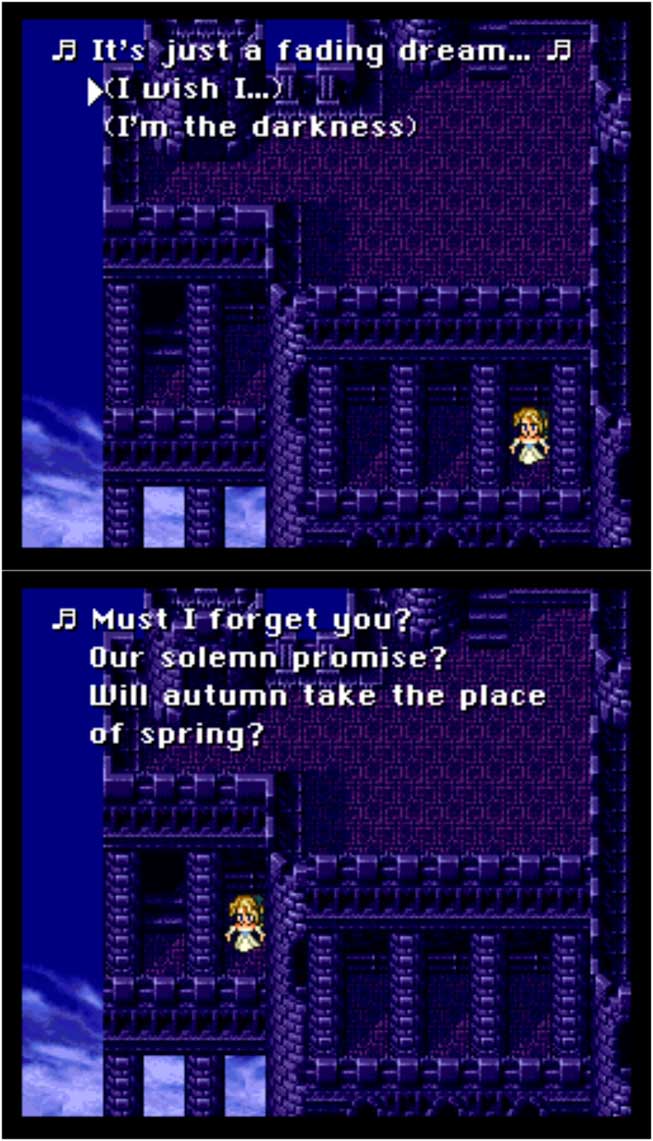
Because of the technological limitations of the Super Nintendo Entertainment System console for which Final Fantasy VI was created, Celes does not gain an acoustically recorded voice in her aria, but rather a synthesised open vowel sound that acts as a vocalise. The contour of the melody approximately follows the libretto phrases that are presented as on-screen text to the viewer.
Maria’s aria was written by the game’s composer, Nobuo Uematsu. Both William Cheng and Ryan Thompson argue for the similarity of this aria to Italian opera.Footnote 58 As Cheng describes:
The aria’s form resembles a modified strophic song with instrumental introduction, interlude, and coda … above rippling arpeggios[, t]his melody’s gentle arching contours, internal phrasal symmetries, steady harmonic rhythms (typically one chord change per measure), and consonant tonal language evoke the Italianate cantilena writing of Vincenzo Bellini, Gaetano Donizetti, and other early Romantics.Footnote 59
The sequence has become a significant touchstone in video game culture. It is particularly notable for the effusive reports of emotional responses that typically accompany its discussion in casual and journalistic discourse.Footnote 60 Even though the sequence after the aria is more obviously comic, players nevertheless highlight the main aria as a profoundly affecting experience, the memory and emotional potency of which lasts long after the gameplay has finished. Cheng ascribes this sequence’s popularity to the technological limitations of Celes’s sung ‘voice’, but characterises the relationship between opera in games in rather dissonant terms:
When opera crops up in games, it is hence liable to come across as a foreign presence, a rarefied display that agitates a game’s aesthetic and narrative frames. Opera’s curious presence in gameworlds offers a means of thinking through additional tensions – between … high and low cultures.Footnote 61
Cheng writes of tensions and juxtapositions. Accordingly, he describes the Final Fantasy VI opera as a ‘performance [that] stands for high musical culture’.Footnote 62 As suggested in the discussion of Hitman and Assassin’s Creed, however, it may be useful to understand the synthesis of games and opera as revealing rather more compatible aesthetic priorities. Perhaps it is the aptness of opera as an expressive mode that helps to make such moments so striking. Rather than an ‘agitating’ ‘foreign presence’, it may be mutual congruity that contributes to these scenes becoming aesthetically successful and, as in Final Fantasy VI, well loved by players.Footnote 63 Part of this symbiosis between opera and games might be found in a kind of expression that can be characterised as melodramatic.
Rather than using the term ‘melodrama’ to refer specifically to a narrow set of specific historical works, such as the Victorian stage melodrama or the German melodrama, instead – in the tradition of Peter Brooks, Linda Williams, Sarah Hibberd and others – I mean to refer to an aesthetic mode that extends from the corpus of melodramas into a multitude of art forms.Footnote 64 James L. Smith, for example, characterises melodrama in terms clearly compatible with a video game:
[T]he undivided protagonist of melodrama has only external pressures to fight against … It is this total dependence upon external adversaries which finally separates melodrama from all other serious dramatic forms … Characteristically, melodrama presses its own extreme conflicts to extreme conclusions. Only three are possible, for when an undivided protagonist opposes a hostile world … the result must be stalemate, victory or defeat. … Triumph, despair and protest are the basic emotions of melodrama, and the art of working each to its highest pitch occasions the catharsis of the form.Footnote 65
Or, put in terms of a game, the player’s avatar works single-mindedly against external forces or opponents in extreme conflicts, with the outcome of winning, losing or achieving a tied finish. More recently, Ben Singer has outlined five ‘basic features or constitutive factors’ of melodrama:
1. Non-classical [illogical] narrative structure.
2. Moral polarisation.
3. Sensationalism.
4. Pathos.
5. Overwrought emotion.Footnote 66
Narrative video games could be usefully mapped onto such a list:
1. The often arbitrary rule-based structures of games.Footnote 67
2. The clear protagonist-antagonist structure of ludic game action.
3. The goal of designers to maximise experiential sensation for players.
4. The player’s identification with avatar characters and interaction with non-playable characters.
5. The extremes of emotion that come with winning and losing.
Hibberd, meanwhile, also argues for Singer’s qualities as ‘characteristic of operas’,Footnote 68 while Jeremy Tambling discusses the typical inclusion of opera in post-1970 film as part of a melodramatic aesthetic. When he claims that ‘the medium of film stands to gain from the operatic’, he argues it is partly because ‘opera, melodrama and cinema [can be brought] into a constellation where they work analogously in terms of pleasure, and in the return of an ideal excess’.Footnote 69 A similar situation appears to be the case in the games described here, manifested through the presentation of staged opera as a moment of sincere expression.
In Final Fantasy VI, when Celes/Maria sings of her profound emotional despair in a sequence that clearly trades on visual and sonic spectacle, we are encouraged to marvel at this moment of ostentatious expressive display. The player is therefore brought into engagement with the opera, through the necessity of paying close attention to the operatic materials. While Celes is shown to be playing a part in the opera, and the sequence following the aria is distinctly light-hearted, there is a musical process that makes the case for opera, despite its overt artifice, as somehow speaking to an emotional truth.
The main playable characters in Final Fantasy VI are introduced to the gamer when they each make their debut in the plot. When a new protagonist is encountered, the action in the world is paused, and against a black screen, the character is shown with a brief biographical description. When Celes is introduced, for example, the text reads: ‘A Magitek knight forged by the Empire and tempered in battle. None have ever truly known the woman beneath the general’s guise.’ Protagonists are at the same time given a non-diegetic musical theme. Because of the small pixelated characters and aphoristic textual description, the music plays a large part in defining the characters for the player. This theme recurs at moments throughout the game that are particularly pertinent to that character’s story. Celes, however, is an exception to this pattern. When she is introduced, she does not have a personalised musical accompaniment. Instead, later in the game, after the opera sequence, she adopts the melody of Maria’s aria as her musical theme.Footnote 70 Celes’s introductory biography refers to the enigmatic quality of the character – we hear no music to tell us more about her, until her operatic manifestation reveals ‘the woman beneath the general’s guise’. In supplying Celes with her musical identity for the game, the opera is presented as a moment of honest expression for the character.
Final Fantasy VI is by no means the only game to use staged opera as a melodramatic moment that represents personal revelation through musical performance. Parasite Eve, for instance, opens with an opera visit. The beginning of any game is crucial for establishing its tone, fictional environment and premise; Parasite Eve uses staged opera to set out its aesthetic stall. We join police officer Aya Brea on her romantic date at Carnegie Hall, where an unnamed opera is being performed. On a castle set, a prince pleads with his father to allow him to marry a woman named Eva, also present on the stage, dressed in a long crimson gown. The king is unwilling, because he believes Eva to be ‘evil’ and that she causes the death of those who ‘succumb to her beauty’. After the king orders Eva’s execution through burning at the stake, Eva starts to sing an aria. Much like the number from Final Fantasy VI, it is a slow, lyrical piece with repetitive vocal figures in an Italianate mould. In simple triple time, a vocalise part sounds a simple minor-mode melody accompanied by an arpeggiating harp and strings (sustaining chords with the harmonic rhythm of one chord per bar).Footnote 71
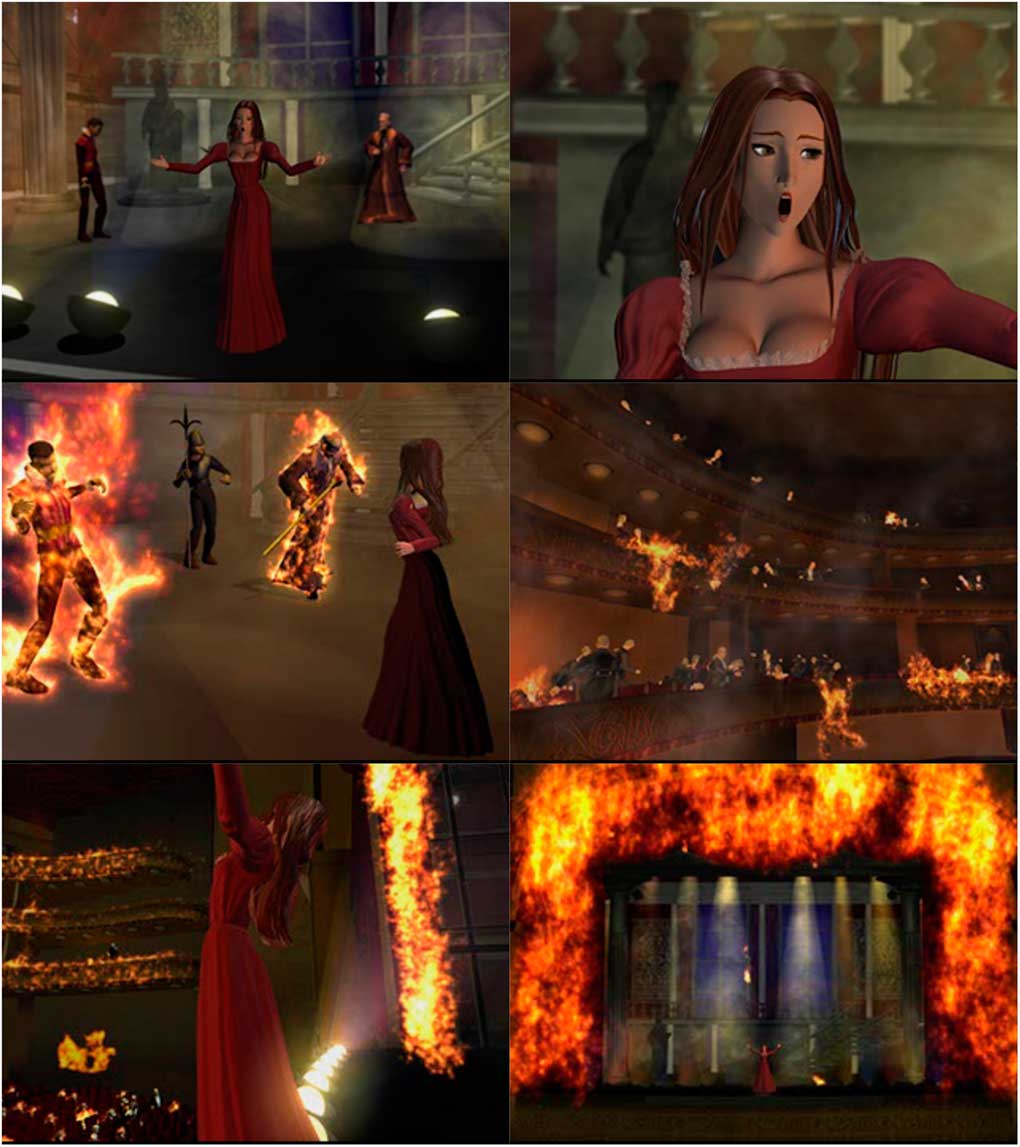
Parasite Eve was made for the Sony PlayStation, which had a limited capacity to show high-quality video clips. At the end of the first ten-bar section of the aria, and on a sustained imperfect cadence, the game suddenly changes from a low-quality and blurry visual style into a glossy and detailed video for the rest of Eva’s aria. Now, we see our diva rendered clearly and in close-up, with expressive bodily and facial gestures during the ecstatic moment of operatic performance. The camera moves around her and zooms in on her face. In an unexpected close-up on the singer’s eyes, we understand that she sees Aya in the audience. As they meet each other’s gaze, Eva’s eyes narrow and change colour. Then, as the soloist looks at the other actors on the stage, they begin to spontaneously combust. Apparently unperturbed, she returns to facing out into the auditorium, where members of the audience also ignite. Soon panic sets in, with bodies falling from the balcony and a stampede for the exit. The flames spread to engulf the building and people within. Yet she continues to sing. At the end of the sequence, Eva stands triumphant alone onstage, still singing, framed by a proscenium arch of flame (Fig. 4).
Eva’s aria in the opening scenes of Parasite Eve. Screen capture by Tim Summers, 13 August 2016.
The rest of the game follows Aya’s struggle to defeat the villainous creature known as ‘Eve’, a megalomaniac sentient parasite that has taken over the singer’s body. After the singer had contracted the parasite, it remained dormant for a decade before this moment of operatic performance caused ‘Eve’ to overtake her host and begin her reign of terror.
Parasite Eve’s arresting opening can clearly be understood as melodramatic in its comic-horrific excess, the spectacle of high-quality images, an unusual narrative logic, the topic of grisly death and the grandiose announcement of the chief villain of the game. As in Final Fantasy VI, it is a moment at which operatic expression gives voice to reveal an inner nature; a claim ultimately made twice. At the end of the game, with Eve defeated, Aya returns to the hall to watch the same opera (albeit with a different singer as Eva). The scene plays out as before, though without any spontaneous combustion. A lieto fine, we hope. Midway through this same aria, however, another biological mutation begins, this time in the bodies of the audience, causing their eyes to turn red. The final image is from the perspective of the singer, watching the softly glowing red eyes in the darkened auditorium. As the singer concludes the number in the relative major key, the game finishes with this shocking ending. Once again, it is this operatic performance that has the power to prompt the biological change.
Both Parasite Eve and Final Fantasy VI’s opera scenes are exaggerated visual-sonic spectacles, which are especially striking given the technological limitations at hand. These sequences stretch any sense of logical causality, but nevertheless serve as important moments of expression for their characters, thereby uniting (as Hibberd puts it) ‘meaning and sensation’, extravagant theatricality and emotionalism.Footnote 72
Beyond the melodramatic qualities of the arias, we should recognise the gendered aspects of the presentation.Footnote 73 Parasite Eve’s plot is dominated by women: the narrative concerns Eve, Aya and Aya’s female relations. Men are regulated to secondary characters. Unlike Parasite Eve, in Final Fantasy the player engages both male and female avatars, though at the moment of the opera, gamers must play as Celes. Even though these games reinscribe the ‘Western tradition of gendering vocal music as a feminine prerogative’,Footnote 74 the context of the game medium may be significant for the discussion of gender.
It has been well recognised that video games are problematic in terms of gender equality, both in the games and in the surrounding culture.Footnote 75 Research has repeatedly documented that male characters dramatically outnumber female characters, that these women are more likely to be presented as having little or no agency, and that they are ‘significantly more likely to be shown partially nude, featured with an unrealistic body image, and depicted wearing sexually revealing clothing’.Footnote 76
The two games discussed here both present opera performances as moments of female agency and expression (of one kind or another), and encourage interpretation from a female subject position. Final Fantasy VI makes an effort to show compatible diverse modes of femininity with Celes, who protests at one moment, ‘I’m a general, not some opera floozy!’ Neither are Celes or Eve simple caricatured divas; they are central characters that the player spends many hours coming to know and understand. When these characters sing, they do so as part of episodes that aim to influence player emotion.Footnote 77
These opera moments, however, remain problematic. Celes, for instance, we might read as reinscribing the trope of the emotional woman, escaping masculine stoicism through feminising music. Both Celes/Maria and Eva/Eve wear low-cut costumes, even if the dresses are prudish in comparison with the typical attire of women in games. While Eve does not serve as a femme fatale in the game, Eva’s role in the opera is certainly characterised as such.Footnote 78 Nevertheless, we might propose that these scenes have the potential to complicate the simplistic representations found elsewhere, as the pixelated divas demonstrate their skill and agency in ways that are clearly meant to be affecting for the gamer.Footnote 79
Final Fantasy VI and Parasite Eve, then, use staged opera arias as part of a melodramatic aesthetic of excess. Rather than demonstrating an oppositional tension between opera and games, this complementary synthesis highlights once again the potential connections between the two genres. Opera is in these examples presented not as caricature, but as an expressive, emotionally affecting and melodramatic medium.
Wagner’s werewolves
So far I have argued that staged opera in games serves to present a vision of opera that emphasises its thrilling, sensationalist and gripping qualities. In the process, such instances avoid portraying opera in terms of high-minded abstraction, but instead elucidate the similarities of the two media at hand. To develop these themes further, I turn to a final example, Gabriel Knight 2: The Beast Within (1995). This game represents what is likely the most extensive meditation upon opera in video games to date.
The Beast Within is a supernatural thriller: a point-and-click adventure game, in which player-controlled characters are directed by clicking on locations and items in the diegesis. Much of the storytelling occurs through exploration and engaging in extensive conversation with other characters.
In modern-day Germany, American crime novelist Gabriel Knight has retreated to Bavaria to work on his new book. While there, he is called upon to investigate a spate of recent murders. The player alternates between Knight’s investigation in Munich and the parallel efforts of his assistant, Grace Nakimura, in locations across Bavaria. As the plot develops, it becomes increasingly intertwined with the life of Ludwig II and the work of Richard Wagner.Footnote 80
Grace comes to suspect that the attacks are the work of a werewolf. Researching historical precedent for the phenomenon, she finds evidence to suggest that Ludwig II had a close connection with such a supernatural being. To discover more about the king, she visits the museum at Herrenchiemsee.Footnote 81 In the museum, the game makers present historically accurate information and artefacts to the player, but begin to thread a fictional seam into the sources through additions and alterations.Footnote 82 A mysterious fictional letter from Ludwig is shown that commands preparations begin for a new Wagner opera to be staged in Munich in 1882.Footnote 83 Intrigued, Grace travels to Bayreuth, to Wahnfried, to find out more.
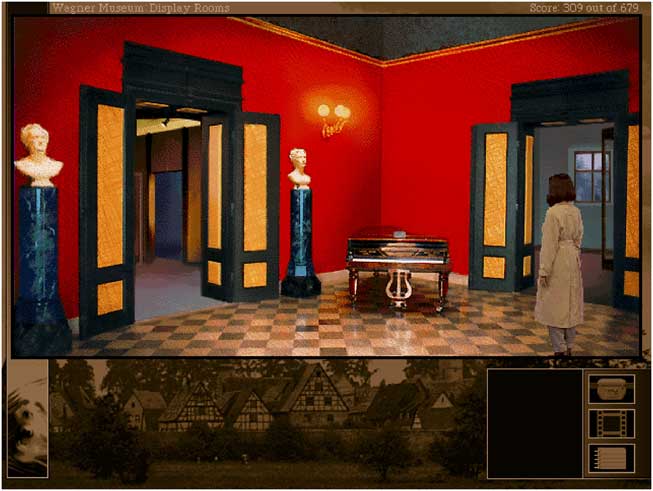
Since The Beast Within uses high-quality images, Wahnfried can be depicted to players with a reasonable degree of visual fidelity. Figure 5, for example, shows Grace standing in Wahnfried, complete with Wagner’s Breitkopf & Härtel piano, a sometime resident of this room. To progress, players must view close-ups of artefacts from Wagner’s life and, in the process, become familiar with his biography.
Grace at Wahnfried in The Beast Within. Objects in the room, such as the piano and busts, may be clicked on for close-up inspection and additional information. Screen capture by Tim Summers, 18 July 2016.
Throughout, fiction and historical accuracy are carefully intertwined. On the Lohengrin-Schreibtisch, Grace finds correspondence by Wagner from September 1881 about acoustics in the Wittelsbach theatre in Munich. She also finds letters between Ludwig and Wagner about this new performance. Confused as to why, with Bayreuth built, Wagner would be concerned with another theatre, she continues to Neuschwanstein.
Grace moves through virtual replicas of several locations at Neuschwanstein, examining the Wagnerian murals and swan motifs. She also finds that the famous Parsifal scenes around the grand Singers’ Hall had been replaced in 1882 with images that depict a new story featuring wolf imagery. As Grace’s tour guide audio tape describes, ‘While all of the other rooms in the castle show scenes from Wagner operas, the scenes in this room are not from any opera that anyone can identify.’ It becomes clear to the player that the new plot is that of a ‘lost’ Wagner opera. Returning to Bayreuth, Grace is shown Cosima’s diary which, in fictional entries, refers to a new, completed, project for the king.
Ludwig and Wagner are presented in extraordinary detail to the player. No flippant contrivance of the plot, this is a concerted effort to ground a fantastical story in historical reality. Since gamers must examine every object and noticeboard within the virtual museums to progress through the game, they cannot avoid being given an education about Wagner and Ludwig. The game creators, meanwhile, are conscious of the potential problem of mixing fiction with historically accurate information. The game’s credits, which are shown at the conclusion of the game, or accessed from the main menu without completing the game, begin with a notice:
The Beast Within is a fictional story. However, many of the settings and historical figures are based on real life. You can learn more about King Ludwig II of Bavaria and Richard Wagner at your local library. Historical dates and facts presented in this fictionalization are not necessarily accurate.
Grace comes to understand that Ludwig II’s mentally unstable later years were the result of a werewolf attack. Since Wagner’s music provoked a physical response in Ludwig, the monarch asked Wagner to create an opera that would help to cure Ludwig’s condition and/or destroy his werewolf betrayer. Grace eventually uncovers the manuscript of the opera, hidden at various locations in Neuschwanstein. Gabriel identifies the modern-day werewolf in Munich and is himself bitten (something of an unhealing Amfortas wound, draining his energy, but not killing him). To save Gabriel and capture the werewolf, Grace mounts a production of the opera, whose title is revealed as Der Fluch des Engelhart, at the Wittelsbach theatre.Footnote 84 She invites the suave werewolf villain (von Glower) to the opera.
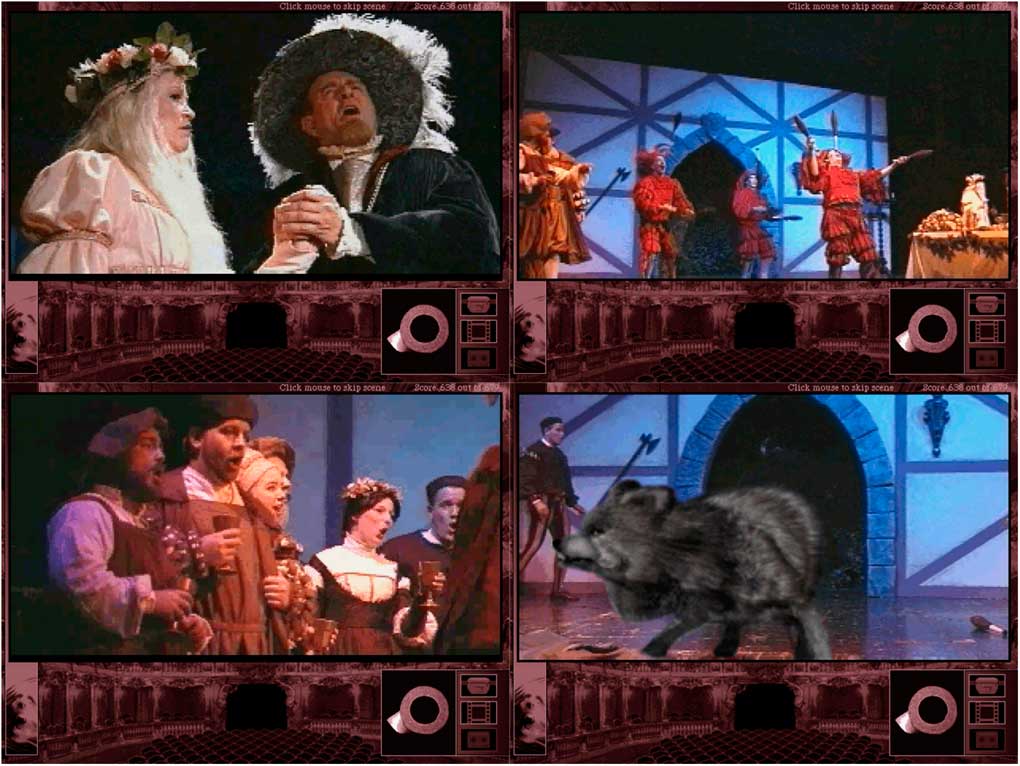
During the third act of the opera, the cumulative, irresistible effect of the music and staging is meant to force the murderous von Glower to change into a werewolf and reveal his nature to the public. The player reads a synopsis of the entire opera before it is staged, though only the third act is directly depicted. The crucial part of the opera is shown to the gamer in full video, similar to a filmed operatic production, and lasts approximately ten minutes (see Fig. 6). Making full use of the space for video/sound provided by the then-new standard of CD-ROM, the singers are acoustically recorded and, though accompanied by a synthesised orchestra, sing a full German text.
Scenes from Der Fluch des Engelhart in The Beast Within, showing Hildegunde and the Baron, the minstrel troupe, the chorus, and Gabriel Knight’s transformation. Screen capture by Tim Summers, 15 August 2016.
This opera sequence, with a set, costumes, chorus and two main soloists, was a complicated and costly affair. The game’s producers would not have expended the resources on staging the opera if it was not thought worth the considerable investment required, nor if they believed that it had the potential to alienate players. The sequence was not undertaken lightly; the scale and production values indicate the producers’ confidence in the value of this operatic moment.
Like Maria and Draco and the unnamed opera in Parasite Eve, Der Fluch des Engelhart qualifies as what Francis Rizzo calls a ‘shadow opera’: newly written operatic scenes for inclusion in a film.Footnote 85 Here, the opera was written by Robert Holmes, composer for the Gabriel Knight series, to a libretto by Jane Jensen, the game’s designer and writer.Footnote 86 The staged scene depicts the first part of the third act of the opera.
The entire scene involves an aria, a duet and a longer ensemble passage that includes the chorus and a few minor solo singing roles.Footnote 87 The opera’s plot is convoluted, but essentially centres on heroine Hildegunde’s love for Engelhart, who has been cursed with werewolfery by an evil Baron who wants Hildegunde for himself. While showing a variety of vocal forces, the scene also demonstrates a diversity of tone, including dramatic action, comedy and heartfelt soliloquising. The musical material for the scene begins as a respectable pastiche of Wagnerian music, especially in the initial aria and duet, which ape the long melodic lines and sustained accompaniment textures typical of his writing. The transformation sequence is less convincingly Wagnerian, not least because of the integration of long descending string glissandi. Nevertheless, taken as a whole, the scene is broadly similar to Wagner’s musical style – the source of the pastiche is distinctly clear and the musical resemblance obvious. (Some artistic licence is perhaps to be fairly granted here; after all, this was supposedly Wagner’s late style.) For the opera neophyte, this is a reasonable broad-strokes representation of the soundworld one might expect to encounter in a Wagnerian opera. Wagner’s music does indeed prove to be as powerful as promised. During the scene, both von Glower and Knight undergo transformations into werewolves, at the prompting of the music.
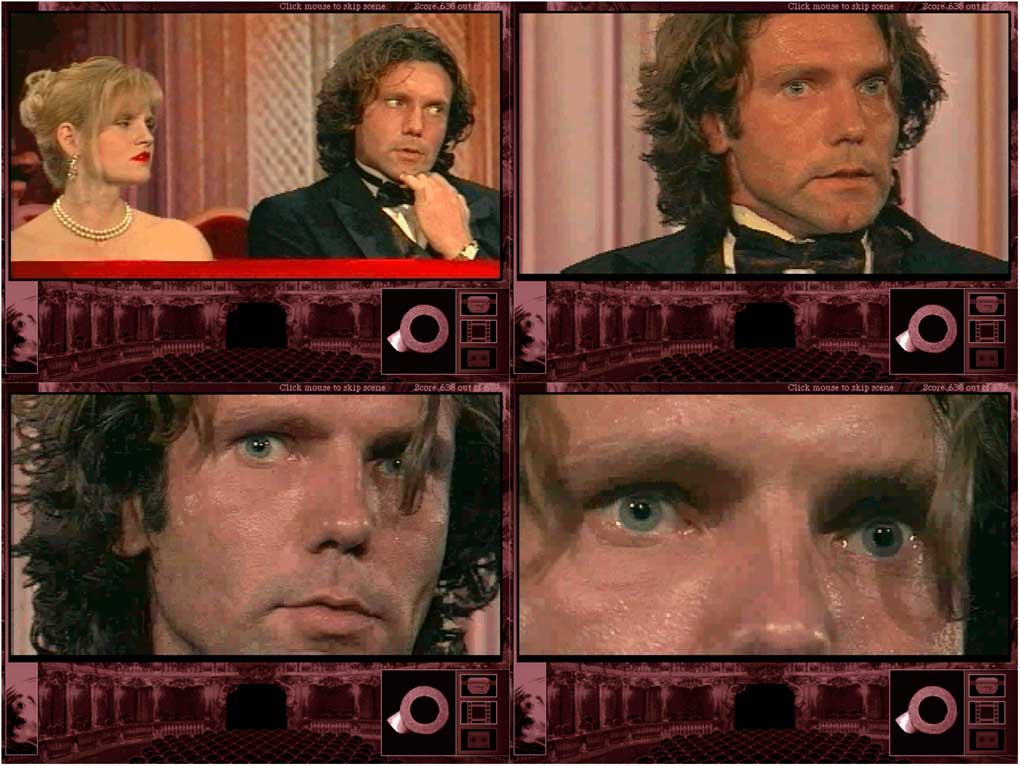
This depiction of the physiological power of Wagner’s music has much in common with Nietzsche’s famous later criticism of the composer’s work. When he writes of Wagner’s music as producing the ‘overexcitement of the nervous mechanism’ with ‘physiological degeneration’, ‘hypnotism by means of music’, and describes youths who become ‘rigid, pale, breathless’ with Wagner ‘master over them’ because his ‘persuasive power … topples every taste, every resistance’,Footnote 88 he could be describing the transformations that occur to von Glower and Knight during Der Fluch des Engelhart (Fig. 7).
Von Glower feels the effects of Wagner’s music, prompting his transformation against his will in The Beast Within. Screen capture by Tim Summers, 15 August 2016.
Nietzsche’s description of the physiological effect of Wagner’s music is part of a strain of nineteenth- and twentieth-century criticism that alludes to, in Thomas Grey’s words, ‘Wagner’s supposedly unhealthy impact on the nervous system’.Footnote 89 More generally, Nietzsche’s critical investigation into Wagner is centred on the term ‘decadence/décadence’, which has several spheres of significance.Footnote 90 It maintains its commonplace meaning of decline and decay, but it is also used to criticise a supposedly modern mode of being, bound up with sickness (degeneracy), cultural degradation and, as Katherine Fry puts it, ‘a modern creative aesthetic that stood opposed to classical values of beauty’.Footnote 91
Far beyond Nietzsche, Wagner’s music has long been charged as somehow pathological ‘as symptoms of an increasingly unhealthy modern cultural condition’, most often through the term ‘degenerate’.Footnote 92 Nancy Stepan notes, ‘Degeneracy in this sense was a pervasive, subtle decay of the individual or group, a deviation from a standard of normality, which was caused by some transgression of social, moral, or physical rules and which became established within the hereditary constitution of the individual’.Footnote 93 As James Kennaway succinctly describes, the late nineteenth and early twentieth centuries
saw a steady stream of books and articles that argued that Wagner was sick, that his music was the expression of his own degeneration and indeed that the music could have pathological consequences for the audience. Indeed Wagner was by far the most important figure in the development of the idea of degenerate music.Footnote 94
The nexus of personal/societal sickness and abnormal morality echoes our earlier discussion of Tosca/Hitman and The Beggar’s Opera/Assassin’s Creed; both games stage the operas alongside thrillingly transgressive behaviour. The Beast Within, in turn, depicts Wagner’s music as physically, directly powerful and bound up with the occult. Like Parasite Eve, The Beast Within literally connects the operatic experience and sickness (in the former, the biological parasite, in the latter, werewolfery). For Nietzsche, Wagner’s pathological degeneracy was no mere metaphor. Since the philosopher understood his own poor health as a ‘nervous’ condition, Wagner’s psychological impact was directly related to his physical illness.Footnote 95 The Beast Within dramatises such a relationship in terms of the werewolves. The regressive aspects of degeneracy were often described in terms of atavism and primitivism: as Thomas Grey describes, ‘Wagner’s critics would soon be diagnosing as a characteristically Wagnerian form of “degeneration” … the activation of regressive, atavistic impulses … without regard for the potentially destructive consequences.’Footnote 96 One such critic, Max Nordau, described degeneracy in terms particularly resonant with the image of the werewolf: as ‘morbid deviation from an original type’.Footnote 97
Charges of degeneracy and decadence were typically founded upon accusations of musical hysteria, unabashed and uncritical emotionalism, extravagance, spectacle and music that ‘appeals … to the sensory organs at a more direct, unmediated level’.Footnote 98 Hysteria figured significantly in the discourse of degeneracy,Footnote 99 revealing its association of femininity with superficiality, irrationality and, as Peter Franklin has suggested, popular culture.Footnote 100 When Nordau’s ‘degeneracy’ refers to aspects of creative work ‘that might be deemed immoral, excessive, fantastic, illogical, or otherwise offensive to the canons of cultivated bourgeois taste and sensibilities’,Footnote 101 it is clearly reminiscent of the sensationalism characteristic of melodrama, as well as the supposed depravity of Tosca and The Beggar’s Opera.
The Beast Within’s depiction of Wagner’s music demonstrates an affinity with the criticism of Wagner’s music as powerfully, psychologically and physically decadent. Like the thrilling spectacle of the supposedly ‘immoral’ operas and action in Hitman and Assassin’s Creed, the game celebrates the ‘degenerate’ and ‘decadent’ qualities of opera. By mirroring werewolves in the fictional opera with the werewolves in the game’s plot, the game argues that Wagner’s opera holds similar topics and expressive values to the game as a whole. The questionable resemblance of Engelhart to Wagner’s actual output aside, Wagner’s opera is here depicted as harbouring physical power, spectacular and sensationalist effects, and using direct expression: it is presented melodramatically, adopting those very same aesthetic values I have argued resonate with those of video games.
The game makes the opposite argument to Nietzsche – that the music is powerful in the same terms, but here is deployed in the service of cure, rather than perpetuating sickness. While transfiguration (Verklärung) in Wagner’s music dramas is properly understood in far more metaphysical and transcendent terms that that represented here, the process of transformation nevertheless thematically resonates with this scene where two people undergo a form of transfiguration at Wagner’s command – one on his way to redemption, the other to condemnation.Footnote 102
Katherine Fry has argued that Nietzsche’s accusation of decadence and degeneracy is grounded in Wagner’s treatment of rhythm: Nietzsche ‘regards the effect of rhythmic ambiguity as a symptom of decay that threatens the health of modern music’, since the ‘rhythmic content is dynamic, multifarious, and irrational’.Footnote 103 Fry illustrates the significance of Wagner’s rhythm to Nietzsche’s experience of the music. Two aspects are particularly telling: first, the degree to which rhythm is related to the construction of the fictional world in Wagner’s opera, and second, that Nietzsche’s experience of Wagnerian musical fabric is somehow ‘overwhelming’ and perception-altering.Footnote 104 The connection between operatic expression and the construction of a virtual world will form the final part of this exploration.
Nietzsche, of course, was far from the only critic to characterise Wagner as a seductive manipulator. Many commentators have grappled with the same kind of intoxicating, perception-altering sensory experience of Wagnerian music drama that he describes.Footnote 105 Chief among Nietzsche’s heirs in this respect was Theodor Adorno, who describes the overwhelming aesthetic effects of Wagner in terms of ‘phantasmagoria’. Drawing on Marx by way of Walter Benjamin,Footnote 106 he describes phantasmagoria as ‘the perfection of the illusion that the work of art is a reality sui generis … [a] magic delusion’.Footnote 107 He borrows Paul Bekker’s words to call it ‘The “illusion of the absolute reality of the unreal.”’Footnote 108 Adorno has in mind a kind of aesthetic excess that overcomes critical distance and creates a distinct compelling reality which seduces listeners into engaging with the artificial worlds. Adorno ultimately regards the phantasmagoria as an ‘insidious deception’ (in Alistair Williams’s characterisation).Footnote 109 As Marc A. Weiner describes, it is
a numbing, sensual bombardment of the listening viewer, resulting purportedly in a drug-like seduction … lull[ing] the audience into perceiving the artificial construct as a natural phenomenon, into emotionally and imaginatively participating in or identifying with the aesthetically induced fantasy.Footnote 110
Adorno is particularly concerned with technologies that ‘conceal the labour that has gone into making’ the phantasmagoria.Footnote 111 As Sherry Lee has pointed out:
The phantasmagorical concept can also be seen in Wagner’s efforts to create the illusion of a magical onstage world through technology—the elaborate behind-the-scenes machinery, and especially the orchestral effects, engineered so that the physical means of producing individual instrumental sounds are obscured.Footnote 112
Adorno famously identifies the Gesamtkunstwerk as a tool for phantasmagoric creation. In Max Paddison’s explication:
[T]he ‘blending’ of essentially different modes of art into a new synthesis … has as its intention the concealing of the joins, and of the artifice of the process of artistic production itself. The contradiction here is that the concealment of artifice through the illusion of ‘nature’ results in the art work as separate, distinct and alienated from nature.Footnote 113
There are clear resonances between the ‘illusion of the absolute reality of the unreal’ and the way that games aim to create compelling, fantastic but believable fictional realities in the form of their virtual worlds.Footnote 114 Wagnerian phantasmagoria has been seen to prefigure cinema.Footnote 115 We might admit video games, as ostentatiously modern and technologically ambitious, into this media lineage. If ‘the Bayreuth experience … aimed to engross the spectator entirely’,Footnote 116 games aim to do the same – not for nothing has the term ‘immersion’ become a focal point of much game criticism.Footnote 117
As an interactive medium, the player’s active engagement with the worlds and characters is at the heart of the success or failure of the game. If I do not care about the plot or ludic challenge, if I do not find motivation to control my avatar, if I do not receive emotional reward from the game or become engaged with the virtual world, I will simply stop playing. In addition, games continually have to contend with foregrounded artificiality: the mechanics of control (such as the ever-visible control panel in Figs. 5–7), the not-quite-realistic images, and the clunky logic of gameplay. Games are concerned with the ostentatious deployment of technology to create seductively engaging fictional worlds. In comparison with film, phantasmagoria is at once even more desirable, and even more demanding, for games.Footnote 118
Kennaway argues that phantasmagoria sits within a nexus of associated properties that include features of mass culture, feminine hysterical irrationality and sensationalism: ‘stimulat[ing] the tired nerves of modern audiences and seduc[ing] the senses rather than engaging the rational self’.Footnote 119 The charge of sensationalist irrationality echoes the qualities of melodramatic aesthetics discussed earlier. In addition, the medicinal dimension of descriptions that talk of hypnosis and drugs recalls the supposedly poisoning effects of the operas of Puccini and Gay, as well as violent games. Kennaway himself alludes to this connection:
In psychiatric and journalistic literature the technological and musical effects of Bayreuth were understood as expressions of ultramodern, hypnotic, hysterical, degenerate Rausch. The Gesamtkunstwerk was a foretaste of modern mass media technology, and its reception as degenerate prefigured much of the ambiguity which that technology has been provoked since.Footnote 120
Scenes of staged opera in games serve the phantasmagoric aspirations of games in a similar way. In these ostentatious moments of operatic audio-visual spectacle, the discrete components that constitute the technology of the game (the programming architecture, audio files, visual materials, user interface, and so on) unite to produce a performed whole. It is a moment at which the Gesamtkunstwerk of the game coalesces. By engaging sonic and visual aspects of the medium in a unified way, in a moment of coherent operatic expression, we do not see the atomised construction, but the illusion of a holistic reality in which we witness the performance. In operas in games, we witness virtual singers, conjured from and dissolved into nothing. They are apparently present to our senses, but distinctly projected in another space, often with odd-sounding and out-of-sync voices. Nevertheless, through the operatic activity, they performatively assert their expressive potential, irrespective of their intangibility.
Games seek to overcome the same critical distance that Adorno was worried that Wagnerian aesthetics dissolve, to create compelling virtual worlds with the aim of engrossing the player. It is not so surprising that operatic scenes which use a melodramatic aesthetic of excess should be apt for such a project. The opera scenes in The Beast Within occur after (at least) nine hours of playing the game, just before the final challenge, representing the perfect cumulative point at which to make the final bid for aesthetic substantiality of the game experience.
For all that Wagner’s work is so often a target for ridicule in popular culture, it is not parodied in The Beast Within. We see no Nazi icons, nor horned helmets. It argues for Wagner’s operatic output as historicised but with direct appeal. Simultaneously, however, this music is at the core of the pulp-fiction werewolf plot and the horror mystery. No high-minded abstraction, Wagner’s opera is depicted as bound up with easily comprehended comedy, visceral sensation and corporeality.
Opera is here used to create a musical moment for gamers, at once de-rarefying opera in terms of its socially elite status, yet retaining claims for its transformative power and importance through direct experience. We are encouraged to marvel at the musical power of Wagner. When the game portrays his opera as potent enough to change the physicality of characters, it thematises the role of staged opera in games, where the musical-visual expressive spectacle, as integrated performance, serves to bolster the phantasmagoria of the game’s reality.Footnote 121
Opera and compelling worlds of play
My investigation here has attempted to illuminate some of the meanings and aesthetic effects generated by scenes of staged opera in games. It has also been concerned with the discourse about opera that these games enact through their representations, and the parallels with studies of opera in film. The video game is, however, a distinctly different medium to film. In video games, player and game are bound together in active interactivity, and player engagement is of paramount importance.Footnote 122 Video games, unlike film, cannot afford to deploy ‘operatics of detachment’, as Citron described in Quantum of Solace. Anything that might risk player disengagement is to be avoided – it is for this reason that the opera scenes are so sincerely and earnestly deployed; no moment of rupture or tension, they encourage engagement in a way that accentuates the common ground of the two media.
By engaging with long-standing tropes of associating opera with disease, alterity, and personal and social degradation (especially in the biological sickness in Parasite Eve and The Beast Within, the criminality of Assassin’s Creed and the violence in Hitman), these games invite us not to stand at a distance and condemn the degenerate decadence, but rather become complicit as we identify with the characters, control the avatars engaging in violence, and revel in the ostentatiousess in the opera scenes. We enjoy and share in the opera; any agenda founded upon critical detachment would be anathema to the game medium’s priority of player involvement. Operatic expression – particularly in Parasite Eve, Final Fantasy VI and The Beast Within – is shown as honest, direct, accessible and emotionally affecting. As such, games and opera illustrate the potential for the simultaneity of both melodramatic sensationalism and sincere aesthetic significance. This is hardly a revelation to most opera-goers, but it is an aspect of opera generally neglected in popular depictions that support either an agenda of elite cultural prestige for the medium, or critically position it as the music of degenerate decadence.
The video game has often been characterised as a lowbrow medium. While widespread recognition of its artistic merit is increasing, the change is slow. When games stage opera in their virtual worlds, and present not an idealised, sanitised and abstracted vision of opera, but one with spectacular sensationalism, and extremes of emotion and action, they lay claim to an aesthetic similarity between games and opera. For games, there is much to be gained in terms of cultural prestige through adopting the operatic register. When opera and games fuse, the similarities between seemingly disparate art forms are accentuated, and the shared pleasures, values and experiences made obvious. These operatic moments make the case for an artistic reception of games, as well as a popular reception of opera. Opera formulates important game moments that are compelling and rewarding for gamers. For players unfamiliar with opera, these games advance an image of the medium different to many pop-culture depictions of opera.
Games rely on the creation of virtual universes as spaces for play to a greater extent than films. As media theorist Torben Grodal notes, gamers must normally ‘make mental maps of the gamespace’.Footnote 123 Players’ understanding of the consistent virtual world, and how it reacts to their actions, underpins the interactive connection of game and player.Footnote 124 When the game realities are important, and technical factors that foreground their constructedness ever-present, the creation of the phantasmagoric world is both more important, and more challenging than in film.
Players therefore experience opera scenes staged in games as aesthetically stimulating, technologically impressive and absorbing moments. Just as in Wagnerian opera before them, these often thrilling sequences use affecting audio-visual spectacle to compel gamers to engage with the virtual conceit. At these points, which unite, on the one hand, disparate technological elements of the game construct, and on the other, enacted musical expression, the virtual reality is projected as an integrated whole. By staging an opera in the game world, those game universes (and the characters who live in them) are strikingly formed.
The operatic worlds in games may not have the best voices, the widest repertoire, or the most innovative staging. They may be pixelated and abbreviated. Nevertheless, for the huge audiences the games reach, they provide novel and interesting modes of operatic engagement and interaction. They speak to – and promote the enjoyment and significance of – opera to a demographic that may not otherwise engage with the medium. Further, they do so in a player-empowered, inclusionary fashion. Staged opera in games has created aesthetically rewarding, captivating and emotionally substantial moments; moments that can provide new operatic experiences with which to play.
Tim Summers is Lecturer in Music at University College Dublin. He researches music in popular culture, often focusing on video games. He is the author of Understanding Video Game Music (Cambridge University Press, 2016) and, on the same topic, he has edited an issue of The Soundtrack and a collection of essays, Ludomusicology: Approaches to Video Game Music (Equinox, 2016). He has written for journals including The Journal of the Royal Musical Association, The Journal of Film Music and Music, Sound, and the Moving Image. He is currently writing a second monograph and editing the Cambridge Companion to Video Game Music.